American
Petroleum Institute
682 Standard
2nd Edition
Introduction
Pumps-Shaft Sealing Systems for
Centrifugal and Rotary Pumps
EAA cust
API 2nd Edition – Description
ƒ Written by select committee of:
ƒ End users
ƒ Pump manufacturers
ƒ Seal manufacturers
ƒ John Crane API 682 Committee Members
ƒ Gordon Buck
ƒ Chris Fone
ƒ API 682 strives to promote:
ƒ Best practices in selection and operation of mechanical seals
ƒ Extend seal life to (3) years service minimum
ƒ Built upon growing acceptance of API 682 1st Edition
ƒ Technically equivalent to ISO Draft International Standard 21049
API 682 Publication Dates
ƒ 1st Edition issued 1994
ƒ 2nd Edition July 2002
ƒ ISO 21049 target date is now late 2003
API 682 Mission Statement
“This standard is designed to
default to the equipment types
most commonly supplied that have
a high probability of meeting the
objective of at least three years of
uninterrupted service while
complying with emissions
regulations.”
.
.
API 682 Standard - Aims
ƒ Maximum reliability and availability of
equipment
ƒ Meet emissions legislation
ƒ Lower costs - standardisation & reliability
ƒ Improved safety - tested & proven sealing
systems
ƒ Consistent seal application based on
accumulation of best practices
ƒ Seal interchangeability
Continued...
Continued...
API 682 Summary
ƒ Only three arrangements
ƒ single
ƒ dual unpressurised
ƒ dual pressurised
ƒ Testing on five fluid groups,
ƒ Propane, water, caustic, cold oil, hot oil
ƒ Specifies materials of construction
ƒ Secondary containment on all single seals
ƒ Forced circulation on dual seals
ƒ Full interchangeability
.
.
API 682 Summary
ƒ Guidelines for seal and hardware design based upon
user experience
ƒ Tested designs
ƒ Qualification type testing
ƒ Individual component & seal integrity testing
ƒ Defined guidelines for auxiliary equipment, pipework
& instrumentation
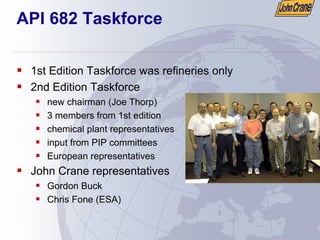
API 682 Taskforce
ƒ 1st Edition Taskforce was refineries only
ƒ 2nd Edition Taskforce
ƒ new chairman (Joe Thorp)
ƒ 3 members from 1st edition
ƒ chemical plant representatives
ƒ input from PIP committees
ƒ European representatives
ƒ John Crane representatives
ƒ Gordon Buck
ƒ Chris Fone (ESA)
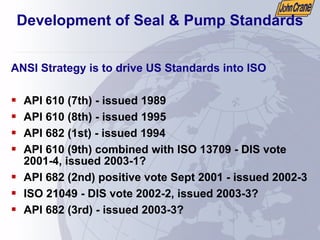
API 676
Positive Displacement
Pumps
API 610
7th Edition
Pumps and Seals
API 610
8th Edition
Mainly Pumps
API 682
1st Edition
Seals Only
Development of Seal & Pump
Standards
API 610
9th Edition/ISO 13709
Only Pumps
API 682
2nd Edition
Seals Only
ISO 21049
Seals Only
Development of Seal & Pump Standards
ANSI Strategy is to drive US Standards into ISO
ƒ API 610 (7th) - issued 1989
ƒ API 610 (8th) - issued 1995
ƒ API 682 (1st) - issued 1994
ƒ API 610 (9th) combined with ISO 13709 - DIS vote
2001-4, issued 2003-1?
ƒ API 682 (2nd) positive vote Sept 2001 - issued 2002-3
ƒ ISO 21049 - DIS vote 2002-2, issued 2003-3?
ƒ API 682 (3rd) - issued 2003-3?
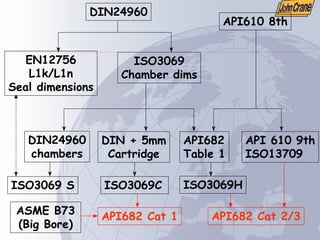
DIN24960
EN12756
L1k/L1n
Seal dimensions
ISO3069
Chamber dims
API 610 9th
ISO13709
API610 8th
API682
Table 1
DIN + 5mm
Cartridge
API682 Cat 2/3
ISO3069H
DIN24960
chambers
ISO3069 S ISO3069C
API682 Cat 1
ASME B73
(Big Bore)
ƒ Replaces the long-standing mechanical seals specification
found in API 610 Pump Standard
ƒ Replaces and expands the scope of API 682 1st Edition:
ƒ Adds new seal types
ƒ Adds new piping plans
ƒ Establishes (3) seal categories
ƒ Adds seals for chemical plants (ANSI & ISO chemical
duty pumps)
ƒ Adds qualification tests for new seal types
ƒ Adds pass/fail criteria for qualification tests
ƒ To be ISO Standard 21049
What’s New in 2nd Edition
API 2nd Edition – Description
ƒ Specification now includes:
ƒ Dry-running secondary containment seals
ƒ Non-contacting wet seals
ƒ Gas lubricated seals
ƒ New piping arrangements for secondary containment
and non-contacting seals
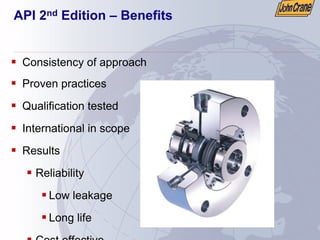
API 2nd Edition – Benefits
ƒ Consistency of approach
ƒ Proven practices
ƒ Qualification tested
ƒ International in scope
ƒ Results
ƒ Reliability
ƒ Low leakage
ƒ Long life
ƒ Cost effective
API-682 1st Ed. Significance?
ƒ 1st Edition released in 1994.
ƒ Few US customers have specified seals as pure 682
1st Ed. compliant.
ƒ API-682 1st Ed. sales growing slowly primarily through
international projects.
ƒ Still generally limited understanding and use of the
specification.
ƒ Market unwilling to accept cost impact associated
with technical requirements of the specification.
Why Expect 2nd Ed. Significance?
ƒ 2nd Ed. is broad based in scope versus 1st Ed. which
was a very narrow high end specification.
ƒ As a stand alone seal standard, 682 2nd Ed. is being
coordinated with the elimination of seal specification
criteria within API–610.
ƒ Much less restrictive, allowing consistency with
current practices and ultimately less costly
arrangement alternatives.
API 682 Specification
Strongly encourage your customers to buy an official copy of the
specification or where appropriate offer a complimentary copy.
Pumps – Shaft Sealing Systems for
Centrifugal and Rotary Pumps
American Petroleum Institute
1220 L Street, NW
Washington, D.C. 20005 USA
Global Engineering Documents at (800) 854-7179
Product No. C682202
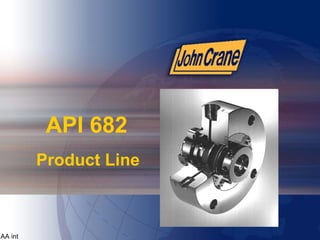
API 682
Product Line
EAA int
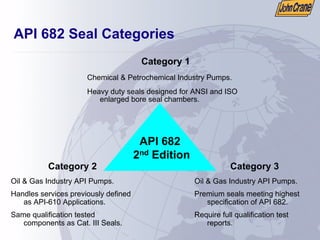
API 682 Seal Categories
Category 1
Chemical & Petrochemical Industry Pumps.
Heavy duty seals designed for ANSI and ISO
enlarged bore seal chambers.
Category 2
Oil & Gas Industry API Pumps.
Handles services previously defined
as API-610 Applications.
Same qualification tested
components as Cat. III Seals.
Category 3
Oil & Gas Industry API Pumps.
Premium seals meeting highest
specification of API 682.
Require full qualification test
reports.
API 682
2nd Edition
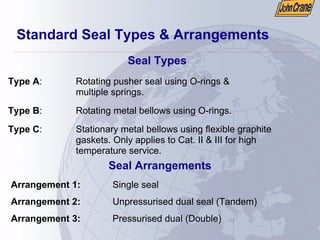
Standard Seal Types & Arrangements
Seal Types
Type A: Rotating pusher seal using O-rings &
multiple springs.
Type B: Rotating metal bellows using O-rings.
Type C: Stationary metal bellows using flexible graphite
gaskets. Only applies to Cat. II & III for high
temperature service.
Seal Arrangements
Arrangement 1: Single seal
Arrangement 2: Unpressurised dual seal (Tandem)
Arrangement 3: Pressurised dual (Double)
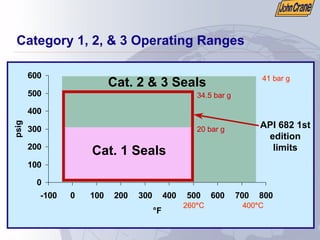
0
100
200
300
400
500
600
-100 0 100 200 300 400 500 600 700 800
°F
psig
Category 1, 2, & 3 Operating Ranges
Cat. 1 Seals
Cat. 2 & 3 Seals
API 682 1st
edition
limits
260°C 400°C
20 bar g
41 bar g
34.5 bar g
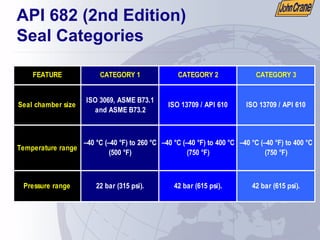
API 682 (2nd Edition)
Seal Categories
FEATURE CATEGORY 1 CATEGORY 2 CATEGORY 3
Seal chamber size
ISO 3069, ASME B73.1
and ASME B73.2
ISO 13709 / API 610 ISO 13709 / API 610
Temperature range
–40 °C (–40 °F) to 260 °C
(500 °F)
–40 °C (–40 °F) to 400 °C
(750 °F)
–40 °C (–40 °F) to 400 °C
(750 °F)
Pressure range 22 bar (315 psi). 42 bar (615 psi). 42 bar (615 psi).
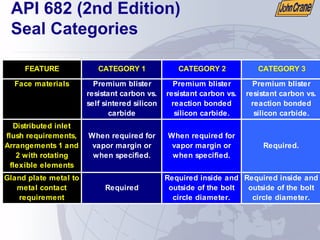
API 682 (2nd Edition)
Seal Categories
FEATURE CATEGORY 1 CATEGORY 2 CATEGORY 3
Face materials Premium blister
resistant carbon vs.
self sintered silicon
carbide
Premium blister
resistant carbon vs.
reaction bonded
silicon carbide.
Premium blister
resistant carbon vs.
reaction bonded
silicon carbide.
Distributed inlet
flush requirements,
Arrangements 1 and
2 with rotating
flexible elements
When required for
vapor margin or
when specified.
When required for
vapor margin or
when specified.
Required.
Gland plate metal to
metal contact
requirement
Required
Required inside and
outside of the bolt
circle diameter.
Required inside and
outside of the bolt
circle diameter.
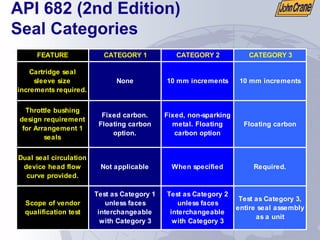
API 682 (2nd Edition)
Seal Categories
FEATURE CATEGORY 1 CATEGORY 2 CATEGORY 3
Cartridge seal
sleeve size
increments required.
None 10 mm increments 10 mm increments
Throttle bushing
design requirement
for Arrangement 1
seals
Fixed carbon.
Floating carbon
option.
Fixed, non-sparking
metal. Floating
carbon option
Floating carbon
Dual seal circulation
device head flow
curve provided.
Not applicable When specified Required.
Scope of vendor
qualification test
Test as Category 1
unless faces
interchangeable
with Category 3
Test as Category 2
unless faces
interchangeable
with Category 3
Test as Category 3,
entire seal assembly
as a unit
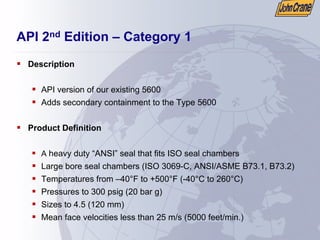
API 2nd Edition – Category 1
ƒ Description
ƒ API version of our existing 5600
ƒ Adds secondary containment to the Type 5600
ƒ Product Definition
ƒ A heavy duty “ANSI” seal that fits ISO seal chambers
ƒ Large bore seal chambers (ISO 3069-C, ANSI/ASME B73.1, B73.2)
ƒ Temperatures from –40°F to +500°F (-40°C to 260°C)
ƒ Pressures to 300 psig (20 bar g)
ƒ Sizes to 4.5 (120 mm)
ƒ Mean face velocities less than 25 m/s (5000 feet/min.)
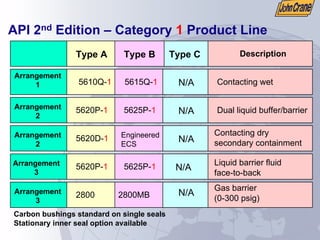
API 2nd Edition – Category 1 Product Line
Arrangement
1 5610Q-1 5615Q-1 Contacting wet
Type A Description
Arrangement
2
5620P-1 5625P-1 Dual liquid buffer/barrier
Arrangement
2
5620D-1 Engineered
ECS
Contacting dry
secondary containment
Arrangement
3
5620P-1 5625P-1 Liquid barrier fluid
face-to-back
Arrangement
3
2800 2800MB
Gas barrier
(0-300 psig)
Type C
N/A
N/A
N/A
N/A
N/A
Type B
Carbon bushings standard on single seals
Stationary inner seal option available
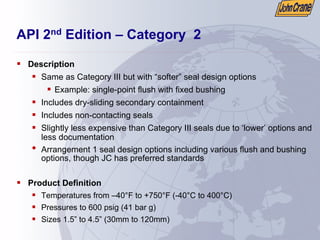
API 2nd Edition – Category 2
ƒ Description
ƒ Same as Category III but with “softer” seal design options
ƒ Example: single-point flush with fixed bushing
ƒ Includes dry-sliding secondary containment
ƒ Includes non-contacting seals
ƒ Slightly less expensive than Category III seals due to ‘lower’ options and
less documentation
• Arrangement 1 seal design options including various flush and bushing
options, though JC has preferred standards
ƒ Product Definition
ƒ Temperatures from –40°F to +750°F (-40°C to 400°C)
ƒ Pressures to 600 psig (41 bar g)
ƒ Sizes 1.5” to 4.5” (30mm to 120mm)
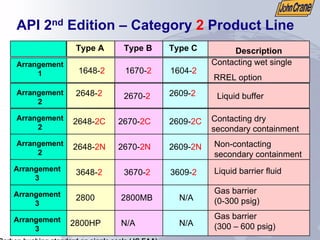
API 2nd Edition – Category 2 Product Line
Arrangement
1 1648-2 1670-2
Contacting wet single
RREL option
Type A Description
2648-2 2670-2 Liquid buffer
2648-2C 2670-2C Contacting dry
secondary containment
3648-2 3670-2 Liquid barrier fluid
2800 2800MB
Gas barrier
(0-300 psig)
Type C
1604-2
2609-2
2609-2C
3609-2
N/A
2648-2N 2670-2N Non-contacting
secondary containment
2609-2N
2800HP N/A
Gas barrier
(300 – 600 psig)
N/A
Type B
Arrangement
2
Arrangement
2
Arrangement
2
Arrangement
3
Arrangement
3
Arrangement
3
Carbon bushing standard on single seals (JC EAA).
API 2nd Edition – Category 3
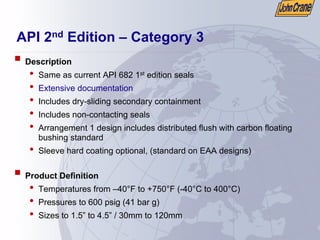
ƒ Description
• Same as current API 682 1st edition seals
• Extensive documentation
• Includes dry-sliding secondary containment
• Includes non-contacting seals
• Arrangement 1 design includes distributed flush with carbon floating
bushing standard
• Sleeve hard coating optional, (standard on EAA designs)
ƒ Product Definition
• Temperatures from –40°F to +750°F (-40°C to 400°C)
• Pressures to 600 psig (41 bar g)
• Sizes to 1.5” to 4.5” / 30mm to 120mm
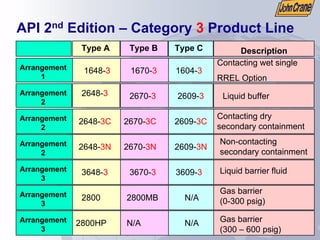
API 2nd Edition – Category 3 Product Line
Arrangement
1
1648-3 1670-3
Contacting wet single
RREL Option
Type A Description
2648-3 2670-3 Liquid buffer
2648-3C 2670-3C
Contacting dry
secondary containment
3648-3 3670-3 Liquid barrier fluid
2800 2800MB
Gas barrier
(0-300 psig)
Type C
1604-3
2609-3
2609-3C
3609-3
N/A
2648-3N 2670-3N
Non-contacting
secondary containment
2609-3N
2800HP N/A Gas barrier
(300 – 600 psig)
N/A
Type B
Arrangement
2
Arrangement
1
Arrangement
2
Arrangement
2
Arrangement
3
Arrangement
3
Arrangement
3
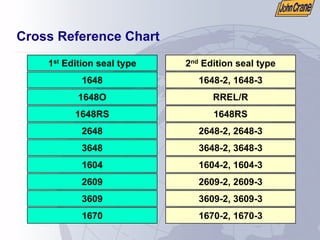
Cross Reference Chart
1st Edition seal type 2nd Edition seal type
1648
1648RS
2648
3648
1604
2609
3609
1670
1648-2, 1648-3
1648RS
2648-2, 2648-3
3648-2, 3648-3
1604-2, 1604-3
2609-2, 2609-3
3609-2, 3609-3
1670-2, 1670-3
1648O RREL/R
API 682 Category 1
ƒ Specific to ANSI/ASME B73.1 & B73.2 and ISO 3069 Type C
ƒ Enlarged bore chemical process pumps
ƒ Qualification tested
ƒ Based from 5600 Universal Cartridge Series
ƒ Special features include:
ƒ Cartridge design, with register fit gland
ƒ Arrangements 1,2, and 3
ƒ Type A & B designs
ƒ Common adaptive hardware between Type A & B versions
ƒ Dry secondary containment option
ƒ Available with both rotating or stationary inner seal
Category 1 Seal Types
5610Q-1
Type A
Arrangement 1
Registered fit with confined O-ring & metal-
to-metal contact with pump seal chamber.
Fixed carbon
bushing
Stationary inner seal option
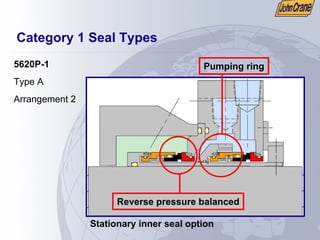
Category 1 Seal Types
5620P-1
Type A
Arrangement 2
Pumping ring
Reverse pressure balanced
Stationary inner seal option
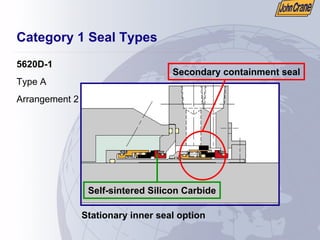
Category 1 Seal Types
5620D-1
Type A
Arrangement 2
Secondary containment seal
Stationary inner seal option
Self-sintered Silicon Carbide
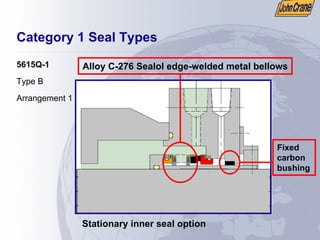
Category 1 Seal Types
5615Q-1
Type B
Arrangement 1
Alloy C-276 Sealol edge-welded metal bellows
Stationary inner seal option
Fixed
carbon
bushing
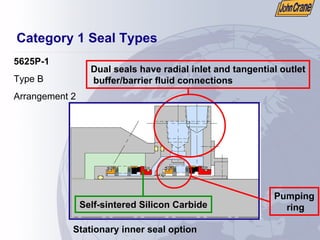
Category 1 Seal Types
5625P-1
Type B
Arrangement 2
Dual seals have radial inlet and tangential outlet
buffer/barrier fluid connections
Pumping
ring
Stationary inner seal option
Self-sintered Silicon Carbide
API 2nd Edition – Category 2
ƒ Description
ƒ Specific to API boxes
ƒ Same as Category III but with “softer” seal design options
ƒ Example: single-point flush and lower bushing requirements
ƒ Includes dry-sliding secondary containment & non-contacting seals
ƒ Includes seal types A, B & C, arrangements 1, 2 & 3
ƒ Slightly less expensive than Category III seals due to ‘lower’ options and
less documentation
• Arrangement 1 seal design options including various flush and bushing
options, though JC has preferred standards
ƒ Product Definition
ƒ Temperatures from –40°F to +750°F (-40°C to 400°C)
ƒ Pressures to 600 psig (41 bar g)
ƒ Sizes 1.5” to 4.5” (30mm to 120mm)
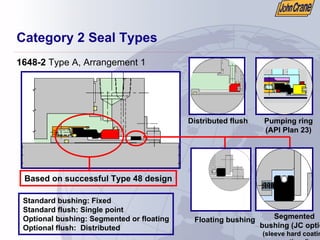
Category 2 Seal Types
1648-2 Type A, Arrangement 1
Based on successful Type 48 design
Standard bushing: Fixed
Standard flush: Single point
Optional bushing: Segmented or floating
Optional flush: Distributed
Distributed flush Pumping ring
(API Plan 23)
Floating bushing Segmented
bushing (JC option)
(sleeve hard coating
optional)
316 SS Metal Parts
Hastelloy™ C
Springs
Fluoroelastomer Secondary Seals
Primary Face
Carbon - standard
Tungsten Carbide - optional
Reaction- bonded Silicon Carbide
Hydraulically Retained Mating Ring
Category 2 Seal Types
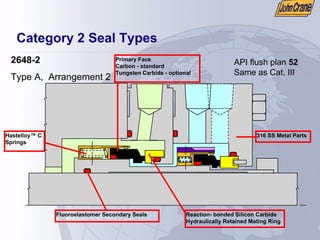
2648-2
Type A, Arrangement 2
API flush plan 52
Same as Cat. III
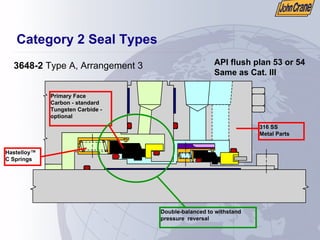
316 SS
Metal Parts
Hastelloy™
C Springs
Primary Face
Carbon - standard
Tungsten Carbide -
optional
Double-balanced to withstand
pressure reversal
Category 2 Seal Types
3648-2 Type A, Arrangement 3 API flush plan 53 or 54
Same as Cat. III
Category 2 Seal Types
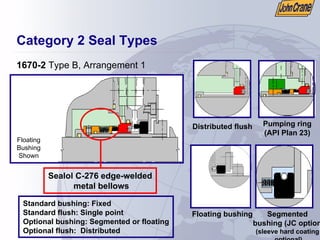
1670-2 Type B, Arrangement 1
Pumping ring
(API Plan 23)
Floating bushing Segmented
bushing (JC option)
(sleeve hard coating
optional)
Distributed flush
Sealol C-276 edge-welded
metal bellows
Standard bushing: Fixed
Standard flush: Single point
Optional bushing: Segmented or floating
Optional flush: Distributed
Floating
Bushing
Shown
Category 2 Seal Types
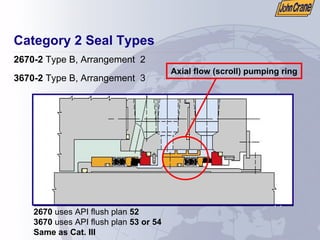
2670-2 Type B, Arrangement 2
3670-2 Type B, Arrangement 3
Axial flow (scroll) pumping ring
2670 uses API flush plan 52
3670 uses API flush plan 53 or 54
Same as Cat. III
Category 2 Seal Types
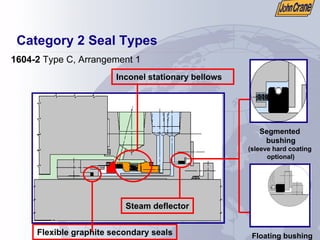
1604-2 Type C, Arrangement 1
Flexible graphite secondary seals
Steam deflector
Inconel stationary bellows
Floating bushing
Segmented
bushing
(sleeve hard coating
optional)
Category 2 Seal Types
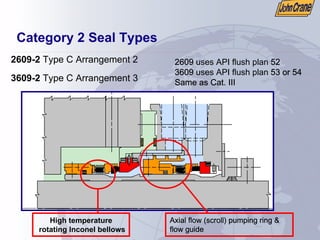
2609-2 Type C Arrangement 2
3609-2 Type C Arrangement 3
Axial flow (scroll) pumping ring &
flow guide
High temperature
rotating Inconel bellows
2609 uses API flush plan 52
3609 uses API flush plan 53 or 54
Same as Cat. III
Category 2 & 3 Secondary
Containment Seals
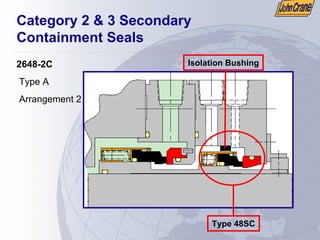
2648-2C
Type A
Arrangement 2
Type 48SC
Isolation Bushing
Category 2 & 3 Secondary Containment Seals
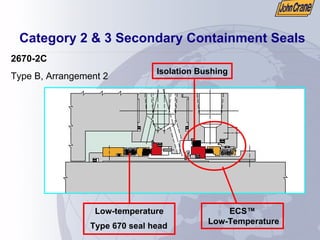
2670-2C
Type B, Arrangement 2
ECS™
Low-Temperature
Isolation Bushing
Low-temperature
Type 670 seal head
Category 2 & 3 Secondary Containment Seals
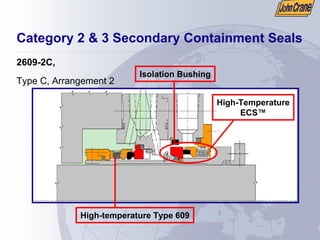
2609-2C,
Type C, Arrangement 2
High-Temperature
ECS™
Isolation Bushing
High-temperature Type 609
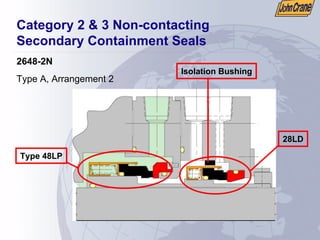
Category 2 & 3 Non-contacting
Secondary Containment Seals
2648-2N
Type A, Arrangement 2
28LD
Isolation Bushing
Type 48LP
API 2nd Edition – Category 3
ƒ Description
ƒ Specific to API boxes
ƒ Same as 1st edition but with additional seal design options
ƒ Includes dry-sliding secondary containment
ƒ Includes non-contacting seals
ƒ Includes seal types A, B & C, arrangements 1, 2 & 3
ƒ Uses premium design options, distributed flush, floating bushes
• Extensive documentation must be supplied
ƒ Product Definition
ƒ Temperatures from –40°F to +750°F (-40°C to 400°C)
ƒ Pressures to 600 psig (41 bar g)
ƒ Sizes 1.5” to 4.5” (30mm to 120mm)
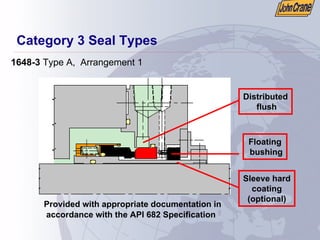
Category 3 Seal Types
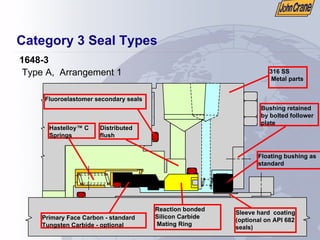
1648-3 Type A, Arrangement 1
Provided with appropriate documentation in
accordance with the API 682 Specification
Floating
bushing
Distributed
flush
Sleeve hard
coating
(optional)
316 SS
Metal parts
Hastelloy™ C
Springs
Fluoroelastomer secondary seals
Reaction bonded
Silicon Carbide
Mating Ring
Floating bushing as
standard
Sleeve hard coating
(optional on API 682
seals)
Bushing retained
by bolted follower
plate
Distributed
flush
Primary Face Carbon - standard
Tungsten Carbide - optional
Category 3 Seal Types
1648-3
Type A, Arrangement 1
Category 3 Seal Types
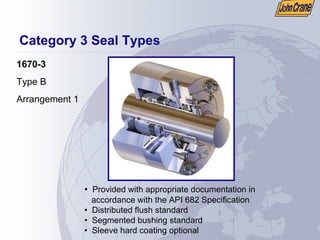
1670-3
Type B
Arrangement 1
• Provided with appropriate documentation in
accordance with the API 682 Specification
• Distributed flush standard
• Segmented bushing standard
• Sleeve hard coating optional
Category 1, 2, & 3 Non-contacting
Gas-lubricated Seals
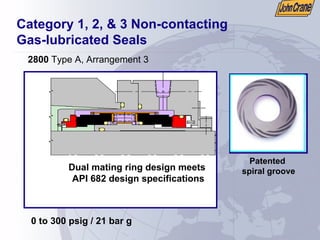
2800 Type A, Arrangement 3
Patented
spiral groove
Dual mating ring design meets
API 682 design specifications
0 to 300 psig / 21 bar g
Category 1, 2, & 3 Non-contacting
Gas-lubricated Seals
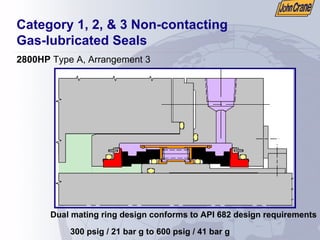
2800HP Type A, Arrangement 3
Dual mating ring design conforms to API 682 design requirements
300 psig / 21 bar g to 600 psig / 41 bar g
Category 1, 2, & 3 Non-contacting
Gas-lubricated Seals
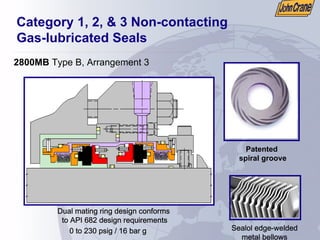
2800MB Type B, Arrangement 3
Dual mating ring design conforms
to API 682 design requirements
Patented
spiral groove
Sealol edge-welded
metal bellows
0 to 230 psig / 16 bar g
API 682, 2nd Edition
Design Requirements
API 682 Overview
ƒ A summary of API 682 was presented previously
ƒ Type A, B, C
ƒ Arrangements 1, 2, 3
ƒ Categories 1, 2, 3
ƒ JC Products for API 682 were presented previously
ƒ Type 48 variations
ƒ Type 670, 604, 609 variations
ƒ Type 5600 variations
ƒ Type 2800’s
ƒ This presentation is about design details
Design Requirements
for
All Categories
All Types
All Arrangements
General and Default Requirements
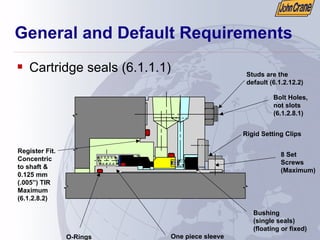
ƒ Cartridge seals (6.1.1.1) Studs are the
default (6.1.2.12.2)
Bolt Holes,
not slots
(6.1.2.8.1)
O-Rings
Rigid Setting Clips
One piece sleeve
8 Set
Screws
(Maximum)
Register Fit.
Concentric
to shaft &
0.125 mm
(.005”) TIR
Maximum
(6.1.2.8.2)
Bushing
(single seals)
(floating or fixed)
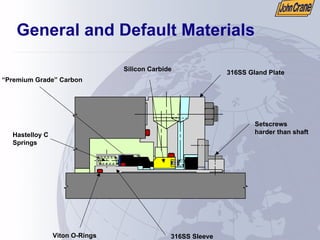
General and Default Materials
Viton O-Rings 316SS Sleeve
316SS Gland Plate
“Premium Grade” Carbon
Hastelloy C
Springs
Silicon Carbide
Setscrews
harder than shaft
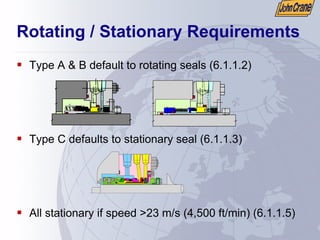
Rotating / Stationary Requirements
ƒ Type A & B default to rotating seals (6.1.1.2)
ƒ Type C defaults to stationary seal (6.1.1.3)
ƒ All stationary if speed >23 m/s (4,500 ft/min) (6.1.1.5)
Maximum Allowable Working
Pressure (MAWP)
ƒ Applies to “pressure casing” (6.1.1.6)
ƒ Pressure casing includes
ƒ Gland
ƒ Piping
ƒ Reservoirs
ƒ Heat exchangers
ƒ Does not apply to seal components
ƒ Equal to pump MAWP (6.1.2.8)
ƒ Glands shall have a corrosion allowance of 3 mm (1/8”)
Axial Movement
ƒ Capable of handling axial movement (6.1.1.8)
ƒ Normal
ƒ Transient
ƒ Thermal growth
ƒ Thrust positioning (vertical pumps)
ƒ Where to get info?
ƒ Not on datasheet
ƒ Pump OEM
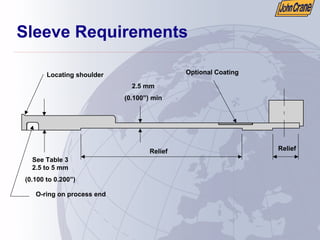
Sleeve Requirements
2.5 mm
(0.100”) min
See Table 3
2.5 to 5 mm
(0.100 to 0.200”)
Locating shoulder Optional Coating
Relief Relief
O-ring on process end
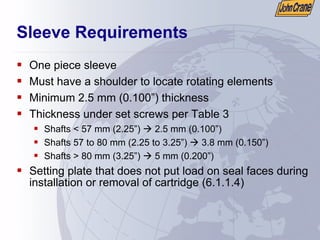
Sleeve Requirements
ƒ One piece sleeve
ƒ Must have a shoulder to locate rotating elements
ƒ Minimum 2.5 mm (0.100”) thickness
ƒ Thickness under set screws per Table 3
ƒ Shafts < 57 mm (2.25”) Æ 2.5 mm (0.100”)
ƒ Shafts 57 to 80 mm (2.25 to 3.25”) Æ 3.8 mm (0.150”)
ƒ Shafts > 80 mm (3.25”) Æ 5 mm (0.200”)
ƒ Setting plate that does not put load on seal faces during
installation or removal of cartridge (6.1.1.4)
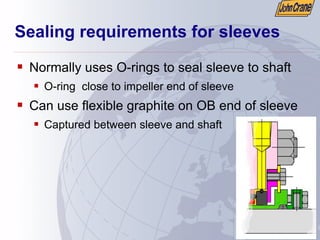
Sealing requirements for sleeves
ƒ Normally uses O-rings to seal sleeve to shaft
ƒ O-ring close to impeller end of sleeve
ƒ Can use flexible graphite on OB end of sleeve
ƒ Captured between sleeve and shaft
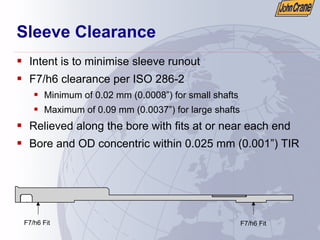
Sleeve Clearance
ƒ Intent is to minimise sleeve runout
ƒ F7/h6 clearance per ISO 286-2
ƒ Minimum of 0.02 mm (0.0008”) for small shafts
ƒ Maximum of 0.09 mm (0.0037”) for large shafts
ƒ Relieved along the bore with fits at or near each end
ƒ Bore and OD concentric within 0.025 mm (0.001”) TIR
F7/h6 Fit F7/h6 Fit
Set Screws for Drive Collar
ƒ Maximum of eight (6.1.3.12)
ƒ Harder than shaft (6.1.3.11)
ƒ Spot drilling the shaft is acceptable but not
recommended
ƒ Can use split ring instead of drive collar for
thrust (6.1.3.13)
ƒ Set screws shall not pass through sleeve unless
sleeve bore is relieved [to avoid damage during
removal] (6.1.3.10)
Gland Plate Requirements
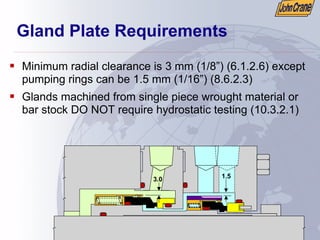
ƒ Minimum radial clearance is 3 mm (1/8”) (6.1.2.6) except
pumping rings can be 1.5 mm (1/16”) (8.6.2.3)
ƒ Glands machined from single piece wrought material or
bar stock DO NOT require hydrostatic testing (10.3.2.1)
3.0 1.5
Gland Plate Requirements:
Clearances
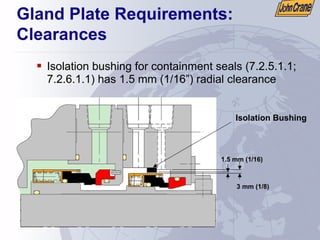
ƒ Isolation bushing for containment seals (7.2.5.1.1;
7.2.6.1.1) has 1.5 mm (1/16”) radial clearance
Isolation Bushing
1.5 mm (1/16)
3 mm (1/8)
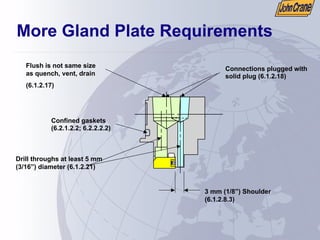
More Gland Plate Requirements
3 mm (1/8”) Shoulder
(6.1.2.8.3)
Drill throughs at least 5 mm
(3/16”) diameter (6.1.2.21)
Confined gaskets
(6.2.1.2.2; 6.2.2.2.2)
Connections plugged with
solid plug (6.1.2.18)
Flush is not same size
as quench, vent, drain
(6.1.2.17)
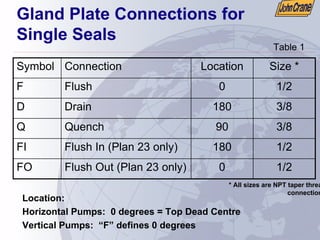
Gland Plate Connections
ƒ Mark with symbols from Table 1 (6.1.2.17)
ƒ Locate per Table 1
ƒ Sizes per Table 1
ƒ Some flexibility within Table 1
ƒ Small pumps
ƒ Limited space
Gland Plate Connections for
Single Seals
1/2
0
Flush Out (Plan 23 only)
FO
1/2
180
Flush In (Plan 23 only)
FI
3/8
90
Quench
Q
3/8
180
Drain
D
1/2
0
Flush
F
Size *
Location
Connection
Symbol
Location:
Horizontal Pumps: 0 degrees = Top Dead Centre
Vertical Pumps: “F” defines 0 degrees
* All sizes are NPT taper thread
connections
Table 1
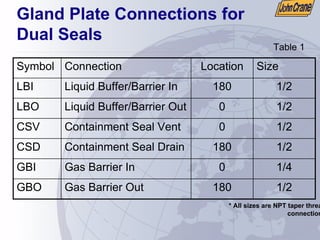
Gland Plate Connections for
Dual Seals
1/4
0
Gas Barrier In
GBI
1/2
180
Gas Barrier Out
GBO
1/2
180
Containment Seal Drain
CSD
1/2
0
Containment Seal Vent
CSV
1/2
0
Liquid Buffer/Barrier Out
LBO
1/2
180
Liquid Buffer/Barrier In
LBI
Size
Location
Connection
Symbol
* All sizes are NPT taper thread
connections
Table 1
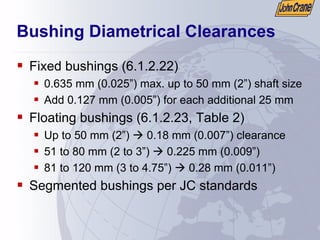
Bushing Diametrical Clearances
ƒ Fixed bushings (6.1.2.22)
ƒ 0.635 mm (0.025”) max. up to 50 mm (2”) shaft size
ƒ Add 0.127 mm (0.005”) for each additional 25 mm
ƒ Floating bushings (6.1.2.23, Table 2)
ƒ Up to 50 mm (2”) Æ 0.18 mm (0.007”) clearance
ƒ 51 to 80 mm (2 to 3”) Æ 0.225 mm (0.009”)
ƒ 81 to 120 mm (3 to 4.75”) Æ 0.28 mm (0.011”)
ƒ Segmented bushings per JC standards
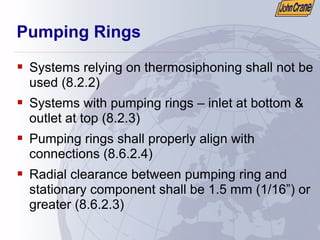
Pumping Rings
ƒ Systems relying on thermosiphoning shall not be
used (8.2.2)
ƒ Systems with pumping rings – inlet at bottom &
outlet at top (8.2.3)
ƒ Pumping rings shall properly align with
connections (8.6.2.4)
ƒ Radial clearance between pumping ring and
stationary component shall be 1.5 mm (1/16”) or
greater (8.6.2.3)
O-Ring Requirements
ƒ Grooves sized for perfluoroelastomer (6.1.1.10)
(use JC Standards for Kalrez, Isolast, etc.)
ƒ Surface finish (6.1.1.9)
ƒ 1.6 µm (63 µin) Ra for static o-rings
ƒ 0.8 µm (32 µin) Ra for dynamic o-rings
Runout and Tolerances
ƒ Wording is different but intent the same
ƒ “seals must be designed for ….”
ƒ Seal chamber face runout of 0.5 µm/mm
(0.0005 in/inch) of bore (6.1.2.13)
Primary Rings
ƒ Normally rotating
ƒ Can be pusher or non-pusher
ƒ Default is multiple spring (6.1.5.1)
ƒ Can be single spring
ƒ Can be bellows
ƒ No lapped joints (6.1.5.2)
Mating Rings
ƒ Normally stationary
ƒ Not clamped-in (6.1.4.1)
ƒ Anti-rotation pin is required (6.1.4.1)
ƒ Mounting to enhance heat transfer (6.1.4.2)
ƒ One mating ring for each primary ring
(7.3.1.3) (no common mating rings without
purchaser approval)
Material for Sleeve and Gland Plate
ƒ Equal or better than pump case material
ƒ 316SS minimum (6.1.6.3; 6.1.6.7)
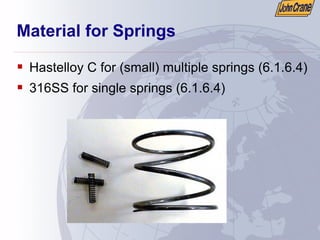
Material for Springs
ƒ Hastelloy C for (small) multiple springs (6.1.6.4)
ƒ 316SS for single springs (6.1.6.4)
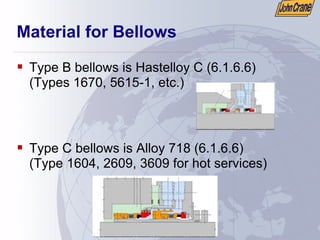
Material for Bellows
ƒ Type B bellows is Hastelloy C (6.1.6.6)
(Types 1670, 5615-1, etc.)
ƒ Type C bellows is Alloy 718 (6.1.6.6)
(Type 1604, 2609, 3609 for hot services)
Material for Primary Rings
ƒ Default is carbon
ƒ “premium grade, blister-resistant”
ƒ Must be tested in qualification tests
ƒ We use
ƒ Antimony filled for Type 48 family (8270)
ƒ Resin filled for Type 670 family
ƒ Resin filled for Type 609 family
ƒ Resin filled for Type 5600 family
ƒ Optional Materials
ƒ Resin filled for Type 48 family (if acids or caustic)
ƒ Antimony filled for 5610/5620 is optional and tested
ƒ Default for hard faces is SiC vs SiC (WC optional)
Material for Mating Rings
ƒ Defaults to SiC
ƒ Category 1 uses sintered SiC
ƒ Is usually for chemical duty seals
ƒ Category 2 and 3 use reaction bonded SiC
ƒ Is usually for refinery seals
Material for O-Rings
ƒ Default is Viton (6.1.6.5.1)
ƒ Perfluoroelastomer is optional (6.1.6.5.2)
ƒ Flexible graphite is used for Type C bellows seal
ƒ Temperature limits are (Annex C.3)
ƒ Viton (hydrocarbon) -7 to 175 C (20 to 350 F)
ƒ Viton (water) -7 to 120 C (20 to 250 F)
ƒ Perfluoroelastomer -7 to 290 C (20 to 550 F)
ƒ Nitrile -40 to 120 C (-40 to 250 F)
ƒ Flexible graphite -240 to 480 C (-400 to 900 F)
Design Requirements
for
Category 1 Seals
Materials for Primary Rings
(Category 1)
ƒ Carbon is the default material (6.1.6.2.2)
ƒ We use resin filled carbon for Type 5600
family
ƒ Alternative for 5610 & 5620 on flashing
hydrocarbon services is Antimony filled
carbon
Material for Mating Rings
(Category 1)
ƒ Default is self-sintered silicon carbide (6.1.6.2.3)
ƒ Because of chemical resistance
ƒ Customer can specify the use of reaction
bonded silicon carbide
Gland Plate
(Category 1)
ƒ Default is single point injection
ƒ Distributed flush is optional (6.2.1.2.1; 6.1.2.14)
ƒ 6.1.2.14 states “Seal chamber pressure shall not
be less than a 30% margin to maximum VP or a
20 C (36 F) product temperature margin at
maximum process temperature”
ƒ Remember
ƒ Register fit
ƒ Bolt holes, not slots
ƒ Confined gasket with metal-to-metal contact [gland to
pump] (6.2.1.2.2)
Design Requirements
for
Category 2 Seals
Materials for Primary Rings
(Category 2)
ƒ Carbon is the default material (6.1.6.2.2)
ƒ We use
ƒ Antimony filled carbon for Type x648 family
ƒ Resin filled carbon for Type 48’s when sealing
acids & caustics
ƒ Resin filled carbon for Type x670 family
ƒ Resin filled carbon for Type x609 family
Material for Mating Rings
(Category 2)
ƒ Default is reaction bonded silicon carbide
(6.1.6.2.3)
ƒ Preferred by many refineries
ƒ Better toughness than self sintered SiC
Gland Plate
(Category 2)
ƒ Default is single point injection
ƒ Distributed flush is optional (6.2.2.2.1; 6.1.2.14)
Design Requirements
for
Category 3 Seals
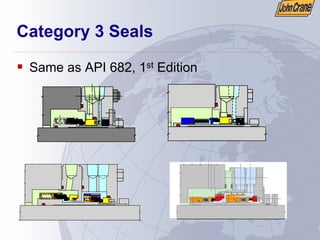
Category 3 Seals
ƒ Same as API 682, 1st Edition
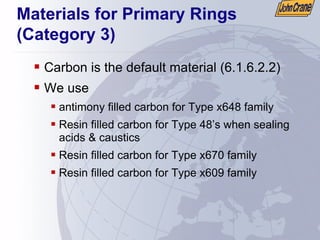
Materials for Primary Rings
(Category 3)
ƒ Carbon is the default material (6.1.6.2.2)
ƒ We use
ƒ antimony filled carbon for Type x648 family
ƒ Resin filled carbon for Type 48’s when sealing
acids & caustics
ƒ Resin filled carbon for Type x670 family
ƒ Resin filled carbon for Type x609 family
Material for Mating Rings
(Category 3)
ƒ Default is reaction bonded silicon carbide
(6.1.6.2.3)
ƒ Preferred by many refineries
ƒ Better toughness than self sintered SiC
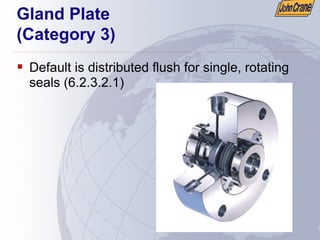
Gland Plate
(Category 3)
ƒ Default is distributed flush for single, rotating
seals (6.2.3.2.1)
Design Requirements
for
Arrangement 1 Seals
Throttle Bushings
(Arrangement 1)
ƒ Throttle bushing required (7.1.2.1)
ƒ Category 1 uses fixed, carbon bushing
ƒ Category 2 uses fixed, non-sparking metal
bushing
ƒ Category 3 uses floating, carbon bushing
ƒ Category 1 & 2 can be specified [by customer] to
be a floating bushing (7.1.2.2)
Design Requirements
for
Arrangement 2 Seals
General Requirements
for Arrangement 2 Seals
ƒ Inner (process) seal rated for 2.75 bar (40 psi)
reverse (ID to OD) pressure (7.2.1.1)
ƒ Outer seal can be a contacting liquid seal or a
contacting or non-contacting containment seal
ƒ The inboard seal can incorporate an auxiliary
sleeve under the seal utilising a locating step
and dog point set screws and not violate the one
piece sleeve requirement (7.2.2.1)
Throttle Bushings
(Arrangement 2)
ƒ Throttle bushing not required
ƒ Fixed throttle bushing optional (7.2.3.1)
ƒ Default for optional bushing is carbon (7.2.3.1)
Design Requirements
for
Arrangement 3 Seals
General Requirements
for Arrangement 3 Seals
ƒ Inner seal must have full reverse pressure rating
(7.3.1.2)
ƒ Cartridge shall utilise two primary rings and two mating
rings (7.3.1.3)
ƒ Contacting Wet Seals
ƒ Standard configuration is Face-to-Back
ƒ Optional configurations are Face-to-Face or Back-to-Back
ƒ Gas Barrier Seals
ƒ Standard configuration is Back-to-Back
ƒ Optional configurations are Face-to-Face or Face-to-Back
Throttle Bushings
(Arrangement 3)
ƒ Throttle bushing not required
ƒ Fixed throttle bushing optional (7.3.3.1)
ƒ Default for optional bushing is carbon (7.3.3.1)
Design Requirements
for
Containment Seals
Containment Seal Specifics
ƒ Containment seals are Arrangement 2
ƒ Can be contacting or non-contacting
ƒ Buffer gas (purge) is optional
ƒ Uses Plan 7x series flush plans
ƒ Isolation bushing between containment seal and
vent/drain port (7.2.5.1.1; 7.2.6.1.1))
API 682, 2nd Edition
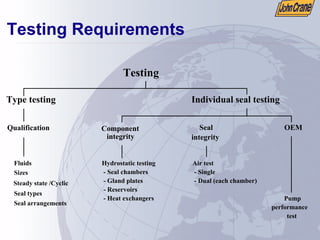
Testing Requirements
Fluids
Sizes
Steady state /Cyclic
Seal types
Seal arrangements
Testing
Type testing
Qualification
Individual seal testing
Component
integrity
Seal
integrity
Hydrostatic testing
- Seal chambers
- Gland plates
- Reservoirs
- Heat exchangers
Air test
- Single
- Dual (each chamber)
Pump
performance
test
OEM
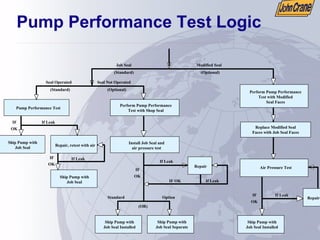
Pump Performance Test Logic
If Leak
Job Seal
(Standard)
Modified Seal
(Optional)
Seal Operated
(Standard)
Seal Not Operated
(Optional)
Perform Pump Performance
Test with Shop Seal
Pump Performance Test
Perform Pump Performance
Test with Modified
Seal Faces
Replace Modified Seal
Faces with Job Seal Faces
Air Pressure Test
Repair, retest with air
Ship Pump with
Job Seal
Install Job Seal and
air pressure test
Repair
Repair
If Leak
If Leak
IF OK
If Leak
IF
OK
Option
Standard
(OR)
IF
OK
IF
OK
IF
OK
If Leak
Ship Pump with
Job Seal
Ship Pump with
Job Seal Installed
Ship Pump with
Job Seal Separate
Ship Pump with
Job Seal Installed
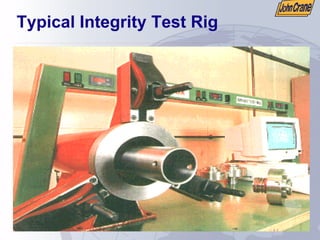
Typical Integrity Test Rig
Technology Testing Center
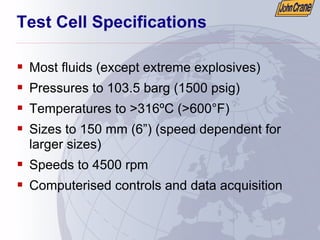
Test Cell Specifications
ƒ Most fluids (except extreme explosives)
ƒ Pressures to 103.5 barg (1500 psig)
ƒ Temperatures to >316ºC (>600°F)
ƒ Sizes to 150 mm (6”) (speed dependent for
larger sizes)
ƒ Speeds to 4500 rpm
ƒ Computerised controls and data acquisition
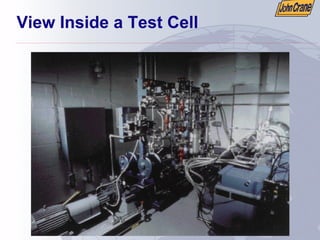
View Inside a Test Cell
TTC Operations Area
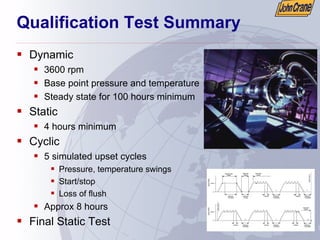
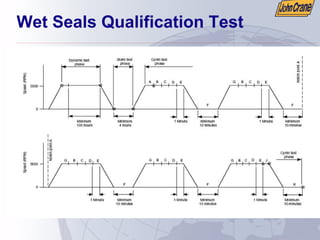
Qualification Test Summary
ƒ Dynamic
ƒ 3600 rpm
ƒ Base point pressure and temperature
ƒ Steady state for 100 hours minimum
ƒ Static
ƒ 4 hours minimum
ƒ Cyclic
ƒ 5 simulated upset cycles
ƒ Pressure, temperature swings
ƒ Start/stop
ƒ Loss of flush
ƒ Approx 8 hours
ƒ Final Static Test
Wet Seals Qualification Test
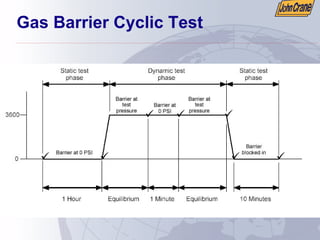
Gas Barrier Cyclic Test
" 9
9 9 9
9 9
9
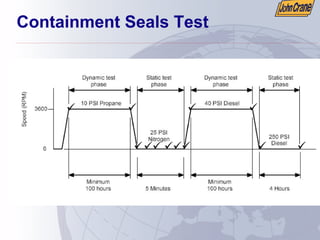
Containment Seals Test
9 9
999 999
9 9
9 9
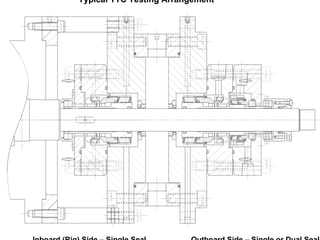
Typical TTC Testing Arrangement
Inboard (Rig) Side – Single Seal Outboard Side – Single or Dual Seal
Results of Qualification
Tests
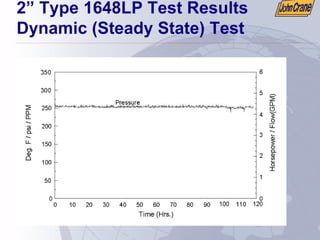
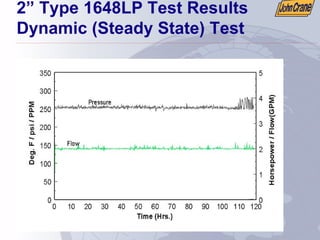
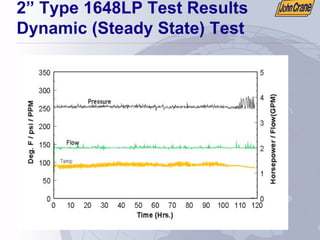
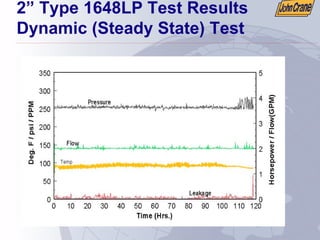
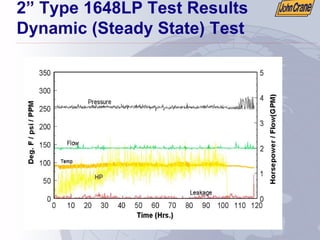
2” Type 1648LP Test Results
Dynamic (Steady State) Test
2” Type 1648LP Test Results
Dynamic (Steady State) Test
2” Type 1648LP Test Results
Dynamic (Steady State) Test
2” Type 1648LP Test Results
Dynamic (Steady State) Test
2” Type 1648LP Test Results
Dynamic (Steady State) Test
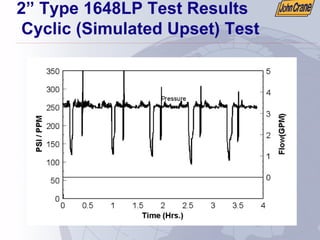
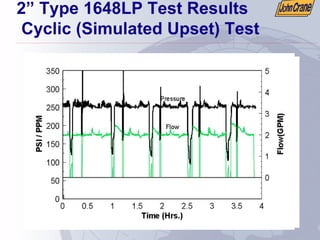
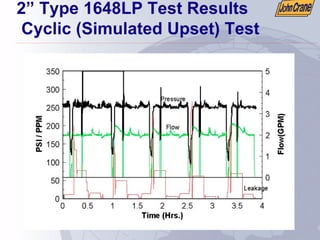
2” Type 1648LP Test Results
Cyclic (Simulated Upset) Test
2” Type 1648LP Test Results
Cyclic (Simulated Upset) Test
2” Type 1648LP Test Results
Cyclic (Simulated Upset) Test
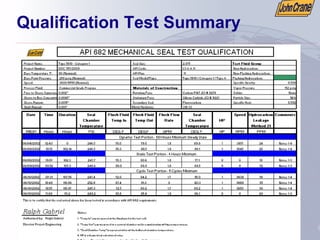
Qualification Test Summary
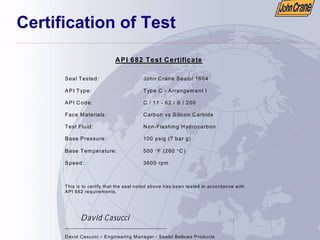
Certification of Test
API 682 Test Certificate
Seal Tested: John Crane Sealol 1604
API Type: Type C - Arrangem ent I
API Code: C / 11 - 62 / S / 200
Face Materials: Carbon vs Silicon Carbide
Test Fluid: Non-Flashing Hydrocarbon
Base Pressure: 100 psig (7 bar g)
Base Tem perature: 500 °F (260 °C)
Speed: 3600 rpm
This is to certify that the seal noted above has been tested in accordance with
API 682 requirements.
David Casucci
___________________________________
David Casucci – Engineering Manager - Sealol Bellows Products
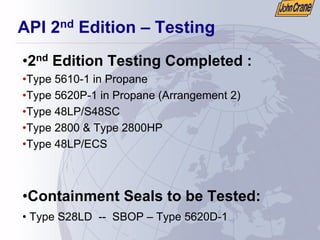
API 2nd Edition – Testing
•2nd Edition Testing Completed :
•Type 5610-1 in Propane
•Type 5620P-1 in Propane (Arrangement 2)
•Type 48LP/S48SC
•Type 2800 & Type 2800HP
•Type 48LP/ECS
•Containment Seals to be Tested:
• Type S28LD -- SBOP – Type 5620D-1
API 682, 2nd Edition
Seal Codes
EAA cust
Annex J: Codes
ƒ Informative
ƒ Four segment code
ƒ Different from 1st Edition
ƒ Different from API 610
ƒ Different from “Seal Configurations”
ƒ Example 2CW-CS (Arrangement 2 with Contacting
Wet Inboard Seal with a Containment Seal)
API 682 (2nd Edition)
Annex J (Seal Codes)
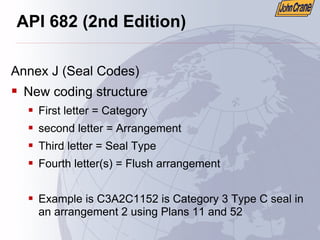
ƒ New coding structure
ƒ First letter = Category
ƒ second letter = Arrangement
ƒ Third letter = Seal Type
ƒ Fourth letter(s) = Flush arrangement
ƒ Example is C3A2C1152 is Category 3 Type C seal in
an arrangement 2 using Plans 11 and 52
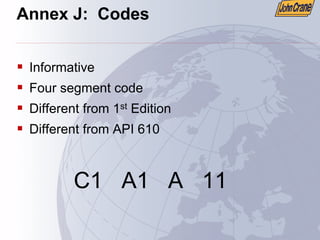
Annex J: Codes
ƒ Informative
ƒ Four segment code
ƒ Different from 1st Edition
ƒ Different from API 610
C1 A1 A 11
Annex J: Codes
ƒ Informative
ƒ Four segment code
ƒ Different from 1st Edition
ƒ Different from API 610
C1 A1 A 11
category
arrangement flush
type
API 682 (2nd Edition)
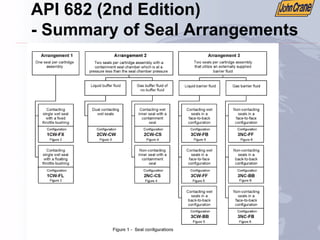
Arrangement 1, Single Seals
One seal per cartridge assembly
1CW-FX Contacting single wet seal with a
fixed throttle bushing
1CW-FL Contacting single wet seal with a
floating throttle bushing
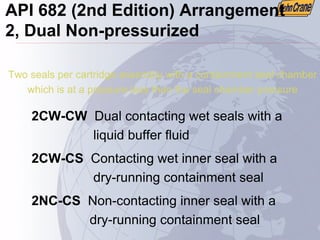
API 682 (2nd Edition) Arrangement
2, Dual Non-pressurized
Two seals per cartridge assembly with a containment seal chamber
which is at a pressure less than the seal chamber pressure
2CW-CW Dual contacting wet seals with a
liquid buffer fluid
2CW-CS Contacting wet inner seal with a
dry-running containment seal
2NC-CS Non-contacting inner seal with a
dry-running containment seal
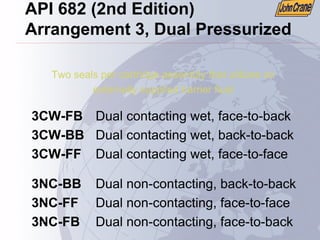
API 682 (2nd Edition)
Arrangement 3, Dual Pressurized
Two seals per cartridge assembly that utilizes an
externally supplied barrier fluid
3CW-FB Dual contacting wet, face-to-back
3CW-BB Dual contacting wet, back-to-back
3CW-FF Dual contacting wet, face-to-face
3NC-BB Dual non-contacting, back-to-back
3NC-FF Dual non-contacting, face-to-face
3NC-FB Dual non-contacting, face-to-back
API 682 (2nd Edition)
- Summary of Seal Arrangements
API 682 Second Edition
Piping Plans
29
3
API 682 Second Edition
Changes to Existing Plans
4
Heat exchangers (8.5.3)
ƒ0.50” x 0.065” wall tubing for shaft sizes 60 mm
(2.5”) and smaller (8.5.3.1.5)
ƒ 0.75” x 0.095” wall tubing for shaft sizes larger
than 60 mm (2.5”) (8.5.3.1.5)
5
Barrier/ buffer fluid reservoirs (8.5.4)
ƒ 12 litre (3 gal) capacity for shaft sizes 60 mm
(2.5”) and smaller (8.5.4.3.1)
ƒ 20 litre (5 gal) capacity for shaft sizes larger
than 60 mm (2.5”) (8.5.4.3.1)
6
12 litre reservoir design
ƒ DN 150 (NPS 6) sch. 40 pipe (8.5.4.4.3 a)
ƒ 316L construction (8.5.4.4.6)
ƒ 12 mm (0.50” NPT) seal connections (8.5.4.4.8 a)
ƒ Seamless tubing is the default
ƒ Sch. 80 pipe is optional
ƒ 12 mm x 1.6 (0.50” x 0.065) wall, 316SS cooling
coil (8.5.4.5.3)
7
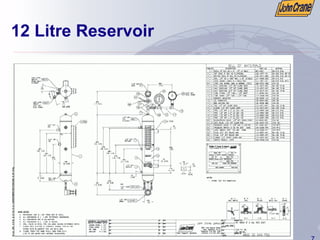
12 Litre Reservoir
8
20 litre reservoir design
ƒ DN 200 (NPS 8) sch. 40 pipe (8.5.4.4.3 b)
ƒ 316L construction (8.5.4.4.6)
ƒ 18 mm (0.75”) seal connections (8.5.4.4.8 b)
ƒ Seamless tubing is the default
ƒ Sch. 80 pipe is optional
ƒ 12 mm x 1.6 (0.50” x 0.065) wall, 316SS
cooling coil (8.5.4.5.3)
9
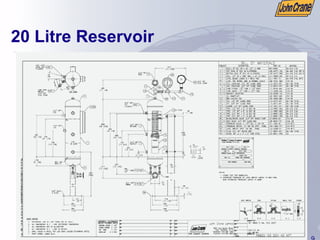
20 Litre Reservoir
10
Barrier/ buffer fluid reservoirs (8.5.4)
ƒ Pressure gauge and switch required (8.5.4.2.7)
ƒ Low level switch required (8.5.4.2.8)
ƒ High level switch optional (8.5.4.2.8)
ƒ Hermetically sealed switches not required (9.1)
11
API 682 Second Edition
New Piping Plans
12
New Piping Plans
ƒ Plan 53’s - Arrangement 3, Contacting Wet (CW) Seals
ƒ 53a – traditional configuration
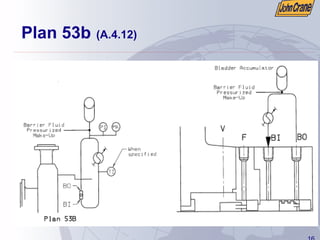
ƒ 53b – bladder accumulator
ƒ 53c – piston pot/ accumulator
ƒ Plan 72 – Arrangement 2 w/ Containment Seal (CS)
ƒ Plan 74 – Arrangement 3, Non-Contacting (NC) Seals
ƒ Plan 75 – Arrangement 2 w/ Containment Seal (CS)
ƒ Plan 76 – Arrangement 2 w/ Containment Seal (CS)
13
Plan 53a (A.4.12)
ƒ Arrangement 3, Contacting Wet (CW) Seals
ƒ Dual Pressurised (Double) Seals
ƒ Utilises direct nitrogen blanket for pressure
ƒ Limits the maximum pressure due to nitrogen
entrainment in the barrier liquid
14
Plan 53b (A.4.12)
ƒ Arrangement 3, Contacting Wet (CW) Seals
ƒ Dual Pressurised (Double) Seals
ƒ Utilizes bladder accumulator for pressure
15
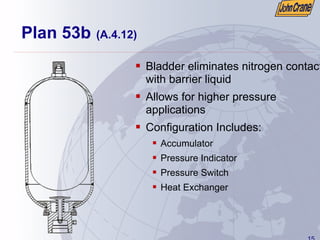
Plan 53b (A.4.12)
ƒ Bladder eliminates nitrogen contact
with barrier liquid
ƒ Allows for higher pressure
applications
ƒ Configuration Includes:
ƒ Accumulator
ƒ Pressure Indicator
ƒ Pressure Switch
ƒ Heat Exchanger
16
Plan 53b (A.4.12)
17
Plan 53c (A.4.12)
ƒ Arrangement 3, Contacting Wet (CW) Seals
ƒ Dual Pressurised (Double) Seals
ƒ Utilises piston pot for pressure
18
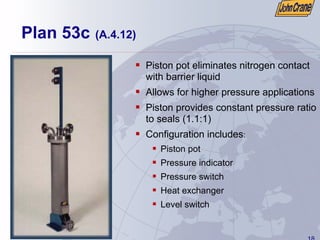
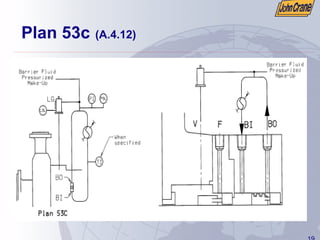
Plan 53c (A.4.12)
ƒ Piston pot eliminates nitrogen contact
with barrier liquid
ƒ Allows for higher pressure applications
ƒ Piston provides constant pressure ratio
to seals (1.1:1)
ƒ Configuration includes:
ƒ Piston pot
ƒ Pressure indicator
ƒ Pressure switch
ƒ Heat exchanger
ƒ Level switch
19
Plan 53c (A.4.12)
20
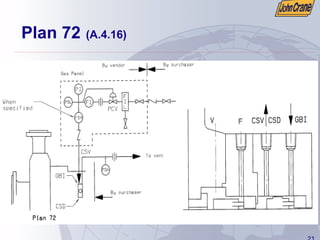
Plan 72 (A.4.16)
ƒ Arrangement 2, w/ Containment Seal (CS)
ƒ Dual Un-Pressurised (Tandem) Seals
ƒ Dry-running secondary
ƒ Low pressure nitrogen sweep
ƒ Sweeps primary leakage to collection system
ƒ Dilutes primary leakage to lower emission levels
ƒ Used in conjunction with Plan 75 or 76
21
Plan 72 (A.4.16)
22
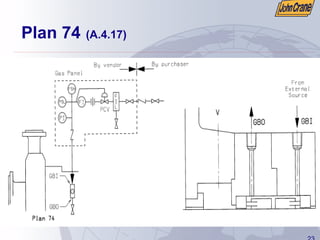
Plan 74 (A.4.17)
ƒ Arrangement 3, Non-contacting Seals (NC)
ƒ Dual Pressurised (Double) Seals
ƒ Nitrogen barrier
ƒ 1.75 - 2 bar (25-30 psi) above seal chamber
pressure
ƒ Zero emissions
ƒ Essentially a T2800 panel
23
Plan 74 (A.4.17)
24
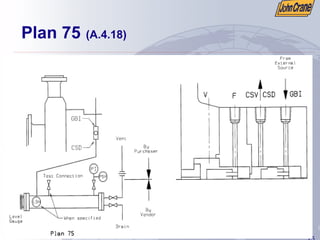
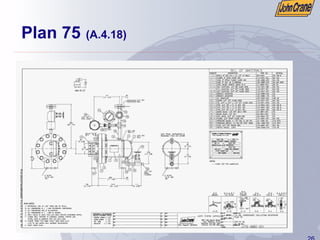
Plan 75 (A.4.18)
ƒ Arrangement 2, w/ Containment Seal (CS)
ƒ Dual Un-Pressurised (Tandem) Seals
ƒ Dry-running secondary
ƒ Condensate collection reservoir (8.6.5.2)
ƒ Used when primary seal leakage may condense
ƒ May be used in conjunction with Plan 72
25
Plan 75 (A.4.18)
26
Plan 75 (A.4.18)
27
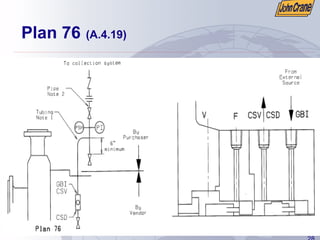
Plan 76 (A.4.19)
ƒ Arrangement 2, w/ Containment Seal (CS)
ƒ Dual Un-Pressurised (Tandem) Seals
ƒ Dry-running secondary
ƒ Primary leakage routed to flare or vent
ƒ Used when primary seal leakage will not condense
ƒ Essentially a 48SC panel
ƒ May be used in conjunction with Plan 72
28
Plan 76 (A.4.19)
API 682 2nd Edition
Questions and Answers
EAA cust
What is API 682?
ƒ Seal standard issued by: American Petroleum
Institute
ƒ Scope includes: Seals for centrifugal and
rotary pumps
ƒ API 610
ƒ API 670
ƒ 1st edition 1994
ƒ 2nd edition May, 2002
How do 2nd Edition & 1st Edition differ?
ƒ Categories
ƒ Category1 is for chemical duty
ƒ Category 2 is for refinery duty
ƒ Old “682 Light”
ƒ Traditional “API 610” seals
ƒ Category 3 is same as 1st edition API 682
ƒ Gas barrier seals
ƒ Containment seals
Who wrote API 682?
ƒ An industry Task Force comprising of:
ƒ End Users
ƒ Chemical plants
ƒ Refineries
ƒ Pump OEM
ƒ Seal OEM
ƒ API Committees
Who must use API 682?
ƒ No one is required to use API 682 but many
industries adopt the standard in full or as part of
their operating specification in an editit format
(Shell PI for instance)
ƒ Refineries will be the biggest users
ƒ Chemical plants are now covered in the
standard
When does API 682 Take Effect?
ƒ After publication (July, 2002)
ƒ Or when invoked by the customer or contractor
What are the advantages of using API 682?
ƒ Consistency of approach to seal selection and
application
ƒ Qualification testing
ƒ Air integrity test prior to shipment
ƒ Provides high degree of probability in providing
(3) years of uninterrupted service while
complying with emission regulations
What are the disadvantages of using API 682?
ƒ “Heavy Duty”
ƒ Cost: Some features specified may result in a higher
expense to the purchaser than seals and systems
previously used.
ƒ Require more radial and axial space
ƒ Paper work
Is API 682 a metric standard?
ƒ Yes though imperial is the default units
ƒ Imperial units are typical in USA
Can the purchaser modify or make additions to
API 682?
ƒ Yes
ƒ Strong set of defaults in API 682
ƒ Allows for user choices
ƒ Users will write their own exceptions and
clarifications to API 682
How are Materials Specified?
ƒ Specified through detailed coding
ƒ Default materials are completely specified
ƒ Limited optional materials available that comply
ƒ Materials have not changed from 1st edition, but
codes used will not match old API 610 material
codes
Are there substitutes for face materials?
ƒ No, must be a tested material
ƒ Rules for “tested material” relaxed somewhat
ƒ John Crane will have additional tested materials,
ie, materials that have been tested and meet the
test requirements of API, even though they may
not be defined options in the standard
What Testing is Required?
ƒ Qualification
ƒ Specific liquids
ƒ Nominal 2” and 4” seals
ƒ Publication of results, with pass or fail criteria
ƒ Hydrotest
ƒ Glands not required to be hydrotested unless cast (previously all
glands needed testing)
ƒ Integrity (air test) on assembly
ƒ 25 psig
Must a seal be tested on all fluids?
ƒ Seals should be tested on the fluids they are expected to
work on
ƒ 5 test fluids
ƒ Water
ƒ Propane
ƒ Caustic
ƒ Hot Oil
ƒ Cold oil
ƒ Qualification testing on representative fluid
How do we retrofit seals into older pumps?
ƒ It is expected that there will sometimes
dimensional problems, due to ‘minimum’
specification:
ƒ 1/8” (3.175mm) minimum sleeve thickness
ƒ 1/8” (3.175mm) general radial clearances
ƒ 1/16” (1.587mm) radial clearance for pumping rings
ƒ Old pumps, or equipment with minimum space
may have to take design exceptions
What is the equivalent code for BSTFL?
ƒ There is no exact equivalent in 682
ƒ New set of codes for API 682 2nd edition
ƒ 2nd edition codes not same as 1st edition
ƒ 682 codes not same as 610 codes
ƒ If customer references an old 610 code
ƒ Probably wants a Category II seal as this is the
closest definition of a historical 610 seal
ƒ There is no direct cross reference possible
How are ANSI / ISO (DIN) Pumps catered for?
ƒ Category I seals are designed for ANSI / ISO
(DIN) large bore
ƒ Special features include
ƒ Register fit
ƒ Throttle bushing
ƒ Drilled bolt holes in gland
Does API 682 include Rotary Pumps?
ƒ Yes but:
ƒ Seal chamber specified for rotary pumps / PD
pumps do not match those in API682 (API676)
Can a customer purchase dry gas seals per
API 682?
ƒ Yes, where it is a dry gas seal for pumps not
compressors, it falls into the following
categories:
ƒ Gas barrier seals
ƒ Containment seals
ƒ New piping plans cover these arrangements
ƒ 71, 72, 75, 76 for containment seals
ƒ 74 for gas barrier seals
What arrangement are dry running
containment seals and dry gas seals?
ƒ Gas barrier seals are Arrangement 3
ƒ Containment seals are Arrangement 2
Must barrier pressure for dual pressurized seals be
constantly controlled versus seal chamber pressure?
ƒ Barrier pressure does not have to track process
pressure
ƒ Plan 53C is an option that tracks process
pressure
What reference is there in API 610 for Seals?
ƒ Whilst API 610, 8th Ed. edition did include limited
seal information, 9th Ed. will not have seal specs;
instead refers to API 682
ƒ If API 610 is referenced, you must now assume
9th Ed. unless otherwise another edition is
specified
Must Data Sheets be Completed?
ƒ Too comply with the requirements of 2nd Ed Yes
seal data sheets must be filled out
ƒ 2nd Edition uses a two page datasheet
ƒ 1st Edition was five pages
ƒ But smaller print in 2nd
Edition
ƒ Data sheet is initiated by purchaser, not JC, and
is different between category 1 & 2, and
category 3
Who Completes the Data Sheet?
ƒ Data sheet is initiated by purchaser O
ƒ Seal vendor info added to info by purchaser
ƒ Some items by either vendor or purchaser
ƒ Defaults marked with shading
ƒ The seal vendor cannot begin with a blank
data sheet!
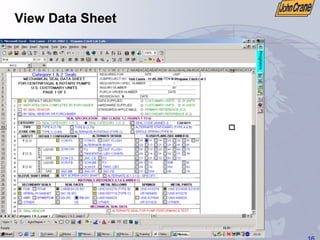
ƒ John Crane CSelect682 will complete the application
part of the data sheet automatically, and will allow you to
complete the rest electronically.
What is an Engineered Seal?
ƒ Seal Types are really just A, B, C
ƒ Part of “Totally Engineered Sealing System”
ƒ Outside the scope of API 682
ƒ Temperature, pressure, speed, fluids, etc.
ƒ Optional testing per Clause 10.3.1.1.2
ƒ Design features
ƒ Conceivably anything
ƒ Probably based on API 682
API 682 2nd Edition
CSelect 682
Seal selection software for API
682 Applications
17
2
Annex A: Selection
ƒ Informative
ƒ Summaries of
ƒ Categories 1, 2, 3
ƒ Arrangements 1, 2, 3
ƒ Seal types A, B, C
ƒ Seal selection
ƒ Tutorial
ƒ Tables
ƒ Logic diagrams
ƒ Piping Plans
ƒ Tutorial
ƒ Logic diagrams
3
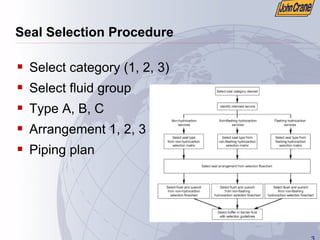
Seal Selection Procedure
ƒ Select category (1, 2, 3)
ƒ Select fluid group
ƒ Type A, B, C
ƒ Arrangement 1, 2, 3
ƒ Piping plan
4
No
No
No
Yes
Yes
Yes
Yes
Yes
Yes
Yes
Yes
No
No
No
No
No
Is product hazardous
by regulation
or other local criteria?
Start
Does product have high
H2S content by
national/local criteria?
Is product under
regulated emission rate
for hydrocarbons?
Arrangement 1
Go to Sheets
7, 8, or 9
Do project/national/local standards
permit a restricted vapor leakage
under all operating conditions?
Will a single seal with special
features mitigate the hazard,
emission, or other difficulties?
Is pumping
temperature
<260°C (500°F)?
Is pumping
temperature
<150°C (300°F)?
Is pumped
fluid dirty?
Arrangement 3
Go to Sheets
7, 8, or 9
Arrangement 2
Go to Sheets
7, 8, or 9
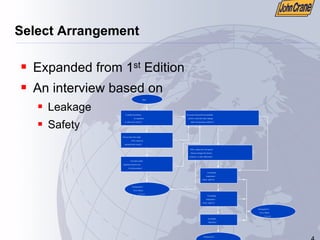
Select Arrangement
ƒ Expanded from 1st Edition
ƒ An interview based on
ƒ Leakage
ƒ Safety
5
CSelect682
ƒ John Crane computer program
ƒ Can be given to customers
ƒ Should be used internally for defining
preferences
ƒ Available April, 2003
6
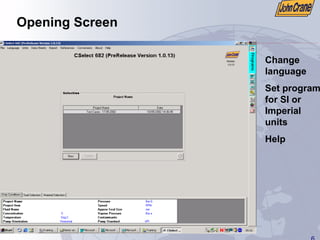
Opening Screen
Change
language
Set program
for SI or
Imperial
units
Help
7
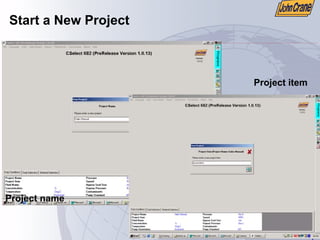
Start a New Project
Project name
Project item
8
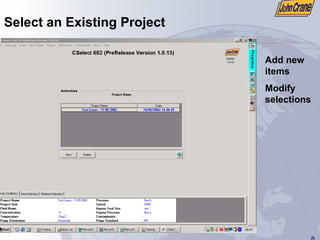
Select an Existing Project
Add new
items
Modify
selections
9
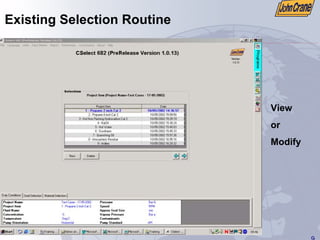
Existing Selection Routine
View
or
Modify
10
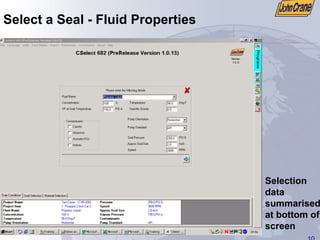
Select a Seal - Fluid Properties
Selection
data
summarised
at bottom of
screen
11
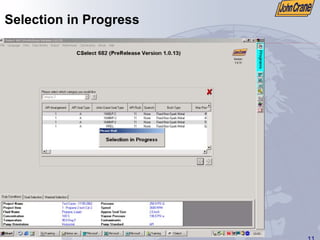
Selection in Progress
12
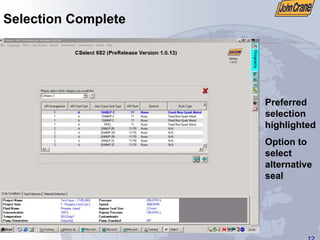
Selection Complete
Preferred
selection
highlighted
Option to
select
alternative
seal
13
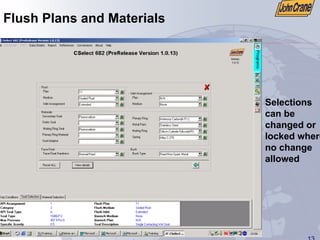
Flush Plans and Materials
Selections
can be
changed or
locked where
no change
allowed
14
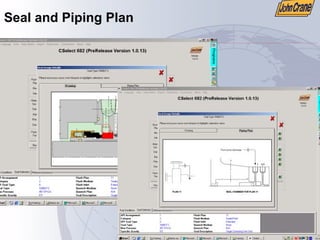
Seal and Piping Plan
15
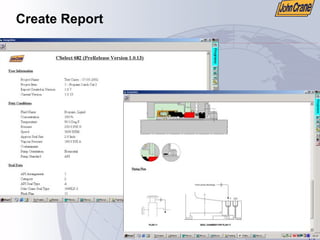
Create Report
16
View Data Sheet
17
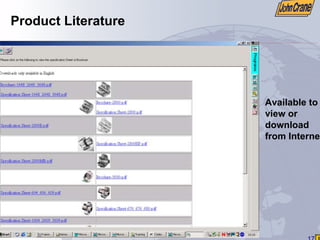
Product Literature
Available to
view or
download
from Internet

dokumen.tips_api-682-presentation.pdf

  • 1.
    American Petroleum Institute 682 Standard 2ndEdition Introduction Pumps-Shaft Sealing Systems for Centrifugal and Rotary Pumps EAA cust
  • 2.
    API 2nd Edition– Description ƒ Written by select committee of: ƒ End users ƒ Pump manufacturers ƒ Seal manufacturers ƒ John Crane API 682 Committee Members ƒ Gordon Buck ƒ Chris Fone ƒ API 682 strives to promote: ƒ Best practices in selection and operation of mechanical seals ƒ Extend seal life to (3) years service minimum ƒ Built upon growing acceptance of API 682 1st Edition ƒ Technically equivalent to ISO Draft International Standard 21049
  • 3.
    API 682 PublicationDates ƒ 1st Edition issued 1994 ƒ 2nd Edition July 2002 ƒ ISO 21049 target date is now late 2003
  • 4.
    API 682 MissionStatement “This standard is designed to default to the equipment types most commonly supplied that have a high probability of meeting the objective of at least three years of uninterrupted service while complying with emissions regulations.”
  • 5.
    . . API 682 Standard- Aims ƒ Maximum reliability and availability of equipment ƒ Meet emissions legislation ƒ Lower costs - standardisation & reliability ƒ Improved safety - tested & proven sealing systems ƒ Consistent seal application based on accumulation of best practices ƒ Seal interchangeability
  • 6.
    Continued... Continued... API 682 Summary ƒOnly three arrangements ƒ single ƒ dual unpressurised ƒ dual pressurised ƒ Testing on five fluid groups, ƒ Propane, water, caustic, cold oil, hot oil ƒ Specifies materials of construction ƒ Secondary containment on all single seals ƒ Forced circulation on dual seals ƒ Full interchangeability
  • 7.
    . . API 682 Summary ƒGuidelines for seal and hardware design based upon user experience ƒ Tested designs ƒ Qualification type testing ƒ Individual component & seal integrity testing ƒ Defined guidelines for auxiliary equipment, pipework & instrumentation
  • 8.
    API 682 Taskforce ƒ1st Edition Taskforce was refineries only ƒ 2nd Edition Taskforce ƒ new chairman (Joe Thorp) ƒ 3 members from 1st edition ƒ chemical plant representatives ƒ input from PIP committees ƒ European representatives ƒ John Crane representatives ƒ Gordon Buck ƒ Chris Fone (ESA)
  • 9.
    API 676 Positive Displacement Pumps API610 7th Edition Pumps and Seals API 610 8th Edition Mainly Pumps API 682 1st Edition Seals Only Development of Seal & Pump Standards API 610 9th Edition/ISO 13709 Only Pumps API 682 2nd Edition Seals Only ISO 21049 Seals Only
  • 10.
    Development of Seal& Pump Standards ANSI Strategy is to drive US Standards into ISO ƒ API 610 (7th) - issued 1989 ƒ API 610 (8th) - issued 1995 ƒ API 682 (1st) - issued 1994 ƒ API 610 (9th) combined with ISO 13709 - DIS vote 2001-4, issued 2003-1? ƒ API 682 (2nd) positive vote Sept 2001 - issued 2002-3 ƒ ISO 21049 - DIS vote 2002-2, issued 2003-3? ƒ API 682 (3rd) - issued 2003-3?
  • 11.
    DIN24960 EN12756 L1k/L1n Seal dimensions ISO3069 Chamber dims API610 9th ISO13709 API610 8th API682 Table 1 DIN + 5mm Cartridge API682 Cat 2/3 ISO3069H DIN24960 chambers ISO3069 S ISO3069C API682 Cat 1 ASME B73 (Big Bore)
  • 12.
    ƒ Replaces thelong-standing mechanical seals specification found in API 610 Pump Standard ƒ Replaces and expands the scope of API 682 1st Edition: ƒ Adds new seal types ƒ Adds new piping plans ƒ Establishes (3) seal categories ƒ Adds seals for chemical plants (ANSI & ISO chemical duty pumps) ƒ Adds qualification tests for new seal types ƒ Adds pass/fail criteria for qualification tests ƒ To be ISO Standard 21049 What’s New in 2nd Edition
  • 13.
    API 2nd Edition– Description ƒ Specification now includes: ƒ Dry-running secondary containment seals ƒ Non-contacting wet seals ƒ Gas lubricated seals ƒ New piping arrangements for secondary containment and non-contacting seals
  • 14.
    API 2nd Edition– Benefits ƒ Consistency of approach ƒ Proven practices ƒ Qualification tested ƒ International in scope ƒ Results ƒ Reliability ƒ Low leakage ƒ Long life ƒ Cost effective
  • 15.
    API-682 1st Ed.Significance? ƒ 1st Edition released in 1994. ƒ Few US customers have specified seals as pure 682 1st Ed. compliant. ƒ API-682 1st Ed. sales growing slowly primarily through international projects. ƒ Still generally limited understanding and use of the specification. ƒ Market unwilling to accept cost impact associated with technical requirements of the specification.
  • 16.
    Why Expect 2ndEd. Significance? ƒ 2nd Ed. is broad based in scope versus 1st Ed. which was a very narrow high end specification. ƒ As a stand alone seal standard, 682 2nd Ed. is being coordinated with the elimination of seal specification criteria within API–610. ƒ Much less restrictive, allowing consistency with current practices and ultimately less costly arrangement alternatives.
  • 17.
    API 682 Specification Stronglyencourage your customers to buy an official copy of the specification or where appropriate offer a complimentary copy. Pumps – Shaft Sealing Systems for Centrifugal and Rotary Pumps American Petroleum Institute 1220 L Street, NW Washington, D.C. 20005 USA Global Engineering Documents at (800) 854-7179 Product No. C682202
  • 18.
  • 19.
    API 682 SealCategories Category 1 Chemical & Petrochemical Industry Pumps. Heavy duty seals designed for ANSI and ISO enlarged bore seal chambers. Category 2 Oil & Gas Industry API Pumps. Handles services previously defined as API-610 Applications. Same qualification tested components as Cat. III Seals. Category 3 Oil & Gas Industry API Pumps. Premium seals meeting highest specification of API 682. Require full qualification test reports. API 682 2nd Edition
  • 20.
    Standard Seal Types& Arrangements Seal Types Type A: Rotating pusher seal using O-rings & multiple springs. Type B: Rotating metal bellows using O-rings. Type C: Stationary metal bellows using flexible graphite gaskets. Only applies to Cat. II & III for high temperature service. Seal Arrangements Arrangement 1: Single seal Arrangement 2: Unpressurised dual seal (Tandem) Arrangement 3: Pressurised dual (Double)
  • 21.
    0 100 200 300 400 500 600 -100 0 100200 300 400 500 600 700 800 °F psig Category 1, 2, & 3 Operating Ranges Cat. 1 Seals Cat. 2 & 3 Seals API 682 1st edition limits 260°C 400°C 20 bar g 41 bar g 34.5 bar g
  • 22.
    API 682 (2ndEdition) Seal Categories FEATURE CATEGORY 1 CATEGORY 2 CATEGORY 3 Seal chamber size ISO 3069, ASME B73.1 and ASME B73.2 ISO 13709 / API 610 ISO 13709 / API 610 Temperature range –40 °C (–40 °F) to 260 °C (500 °F) –40 °C (–40 °F) to 400 °C (750 °F) –40 °C (–40 °F) to 400 °C (750 °F) Pressure range 22 bar (315 psi). 42 bar (615 psi). 42 bar (615 psi).
  • 23.
    API 682 (2ndEdition) Seal Categories FEATURE CATEGORY 1 CATEGORY 2 CATEGORY 3 Face materials Premium blister resistant carbon vs. self sintered silicon carbide Premium blister resistant carbon vs. reaction bonded silicon carbide. Premium blister resistant carbon vs. reaction bonded silicon carbide. Distributed inlet flush requirements, Arrangements 1 and 2 with rotating flexible elements When required for vapor margin or when specified. When required for vapor margin or when specified. Required. Gland plate metal to metal contact requirement Required Required inside and outside of the bolt circle diameter. Required inside and outside of the bolt circle diameter.
  • 24.
    API 682 (2ndEdition) Seal Categories FEATURE CATEGORY 1 CATEGORY 2 CATEGORY 3 Cartridge seal sleeve size increments required. None 10 mm increments 10 mm increments Throttle bushing design requirement for Arrangement 1 seals Fixed carbon. Floating carbon option. Fixed, non-sparking metal. Floating carbon option Floating carbon Dual seal circulation device head flow curve provided. Not applicable When specified Required. Scope of vendor qualification test Test as Category 1 unless faces interchangeable with Category 3 Test as Category 2 unless faces interchangeable with Category 3 Test as Category 3, entire seal assembly as a unit
  • 25.
    API 2nd Edition– Category 1 ƒ Description ƒ API version of our existing 5600 ƒ Adds secondary containment to the Type 5600 ƒ Product Definition ƒ A heavy duty “ANSI” seal that fits ISO seal chambers ƒ Large bore seal chambers (ISO 3069-C, ANSI/ASME B73.1, B73.2) ƒ Temperatures from –40°F to +500°F (-40°C to 260°C) ƒ Pressures to 300 psig (20 bar g) ƒ Sizes to 4.5 (120 mm) ƒ Mean face velocities less than 25 m/s (5000 feet/min.)
  • 26.
    API 2nd Edition– Category 1 Product Line Arrangement 1 5610Q-1 5615Q-1 Contacting wet Type A Description Arrangement 2 5620P-1 5625P-1 Dual liquid buffer/barrier Arrangement 2 5620D-1 Engineered ECS Contacting dry secondary containment Arrangement 3 5620P-1 5625P-1 Liquid barrier fluid face-to-back Arrangement 3 2800 2800MB Gas barrier (0-300 psig) Type C N/A N/A N/A N/A N/A Type B Carbon bushings standard on single seals Stationary inner seal option available
  • 27.
    API 2nd Edition– Category 2 ƒ Description ƒ Same as Category III but with “softer” seal design options ƒ Example: single-point flush with fixed bushing ƒ Includes dry-sliding secondary containment ƒ Includes non-contacting seals ƒ Slightly less expensive than Category III seals due to ‘lower’ options and less documentation • Arrangement 1 seal design options including various flush and bushing options, though JC has preferred standards ƒ Product Definition ƒ Temperatures from –40°F to +750°F (-40°C to 400°C) ƒ Pressures to 600 psig (41 bar g) ƒ Sizes 1.5” to 4.5” (30mm to 120mm)
  • 28.
    API 2nd Edition– Category 2 Product Line Arrangement 1 1648-2 1670-2 Contacting wet single RREL option Type A Description 2648-2 2670-2 Liquid buffer 2648-2C 2670-2C Contacting dry secondary containment 3648-2 3670-2 Liquid barrier fluid 2800 2800MB Gas barrier (0-300 psig) Type C 1604-2 2609-2 2609-2C 3609-2 N/A 2648-2N 2670-2N Non-contacting secondary containment 2609-2N 2800HP N/A Gas barrier (300 – 600 psig) N/A Type B Arrangement 2 Arrangement 2 Arrangement 2 Arrangement 3 Arrangement 3 Arrangement 3 Carbon bushing standard on single seals (JC EAA).
  • 29.
    API 2nd Edition– Category 3 ƒ Description • Same as current API 682 1st edition seals • Extensive documentation • Includes dry-sliding secondary containment • Includes non-contacting seals • Arrangement 1 design includes distributed flush with carbon floating bushing standard • Sleeve hard coating optional, (standard on EAA designs) ƒ Product Definition • Temperatures from –40°F to +750°F (-40°C to 400°C) • Pressures to 600 psig (41 bar g) • Sizes to 1.5” to 4.5” / 30mm to 120mm
  • 30.
    API 2nd Edition– Category 3 Product Line Arrangement 1 1648-3 1670-3 Contacting wet single RREL Option Type A Description 2648-3 2670-3 Liquid buffer 2648-3C 2670-3C Contacting dry secondary containment 3648-3 3670-3 Liquid barrier fluid 2800 2800MB Gas barrier (0-300 psig) Type C 1604-3 2609-3 2609-3C 3609-3 N/A 2648-3N 2670-3N Non-contacting secondary containment 2609-3N 2800HP N/A Gas barrier (300 – 600 psig) N/A Type B Arrangement 2 Arrangement 1 Arrangement 2 Arrangement 2 Arrangement 3 Arrangement 3 Arrangement 3
  • 31.
    Cross Reference Chart 1stEdition seal type 2nd Edition seal type 1648 1648RS 2648 3648 1604 2609 3609 1670 1648-2, 1648-3 1648RS 2648-2, 2648-3 3648-2, 3648-3 1604-2, 1604-3 2609-2, 2609-3 3609-2, 3609-3 1670-2, 1670-3 1648O RREL/R
  • 32.
    API 682 Category1 ƒ Specific to ANSI/ASME B73.1 & B73.2 and ISO 3069 Type C ƒ Enlarged bore chemical process pumps ƒ Qualification tested ƒ Based from 5600 Universal Cartridge Series ƒ Special features include: ƒ Cartridge design, with register fit gland ƒ Arrangements 1,2, and 3 ƒ Type A & B designs ƒ Common adaptive hardware between Type A & B versions ƒ Dry secondary containment option ƒ Available with both rotating or stationary inner seal
  • 33.
    Category 1 SealTypes 5610Q-1 Type A Arrangement 1 Registered fit with confined O-ring & metal- to-metal contact with pump seal chamber. Fixed carbon bushing Stationary inner seal option
  • 34.
    Category 1 SealTypes 5620P-1 Type A Arrangement 2 Pumping ring Reverse pressure balanced Stationary inner seal option
  • 35.
    Category 1 SealTypes 5620D-1 Type A Arrangement 2 Secondary containment seal Stationary inner seal option Self-sintered Silicon Carbide
  • 36.
    Category 1 SealTypes 5615Q-1 Type B Arrangement 1 Alloy C-276 Sealol edge-welded metal bellows Stationary inner seal option Fixed carbon bushing
  • 37.
    Category 1 SealTypes 5625P-1 Type B Arrangement 2 Dual seals have radial inlet and tangential outlet buffer/barrier fluid connections Pumping ring Stationary inner seal option Self-sintered Silicon Carbide
  • 38.
    API 2nd Edition– Category 2 ƒ Description ƒ Specific to API boxes ƒ Same as Category III but with “softer” seal design options ƒ Example: single-point flush and lower bushing requirements ƒ Includes dry-sliding secondary containment & non-contacting seals ƒ Includes seal types A, B & C, arrangements 1, 2 & 3 ƒ Slightly less expensive than Category III seals due to ‘lower’ options and less documentation • Arrangement 1 seal design options including various flush and bushing options, though JC has preferred standards ƒ Product Definition ƒ Temperatures from –40°F to +750°F (-40°C to 400°C) ƒ Pressures to 600 psig (41 bar g) ƒ Sizes 1.5” to 4.5” (30mm to 120mm)
  • 39.
    Category 2 SealTypes 1648-2 Type A, Arrangement 1 Based on successful Type 48 design Standard bushing: Fixed Standard flush: Single point Optional bushing: Segmented or floating Optional flush: Distributed Distributed flush Pumping ring (API Plan 23) Floating bushing Segmented bushing (JC option) (sleeve hard coating optional)
  • 40.
    316 SS MetalParts Hastelloy™ C Springs Fluoroelastomer Secondary Seals Primary Face Carbon - standard Tungsten Carbide - optional Reaction- bonded Silicon Carbide Hydraulically Retained Mating Ring Category 2 Seal Types 2648-2 Type A, Arrangement 2 API flush plan 52 Same as Cat. III
  • 41.
    316 SS Metal Parts Hastelloy™ CSprings Primary Face Carbon - standard Tungsten Carbide - optional Double-balanced to withstand pressure reversal Category 2 Seal Types 3648-2 Type A, Arrangement 3 API flush plan 53 or 54 Same as Cat. III
  • 42.
    Category 2 SealTypes 1670-2 Type B, Arrangement 1 Pumping ring (API Plan 23) Floating bushing Segmented bushing (JC option) (sleeve hard coating optional) Distributed flush Sealol C-276 edge-welded metal bellows Standard bushing: Fixed Standard flush: Single point Optional bushing: Segmented or floating Optional flush: Distributed Floating Bushing Shown
  • 43.
    Category 2 SealTypes 2670-2 Type B, Arrangement 2 3670-2 Type B, Arrangement 3 Axial flow (scroll) pumping ring 2670 uses API flush plan 52 3670 uses API flush plan 53 or 54 Same as Cat. III
  • 44.
    Category 2 SealTypes 1604-2 Type C, Arrangement 1 Flexible graphite secondary seals Steam deflector Inconel stationary bellows Floating bushing Segmented bushing (sleeve hard coating optional)
  • 45.
    Category 2 SealTypes 2609-2 Type C Arrangement 2 3609-2 Type C Arrangement 3 Axial flow (scroll) pumping ring & flow guide High temperature rotating Inconel bellows 2609 uses API flush plan 52 3609 uses API flush plan 53 or 54 Same as Cat. III
  • 46.
    Category 2 &3 Secondary Containment Seals 2648-2C Type A Arrangement 2 Type 48SC Isolation Bushing
  • 47.
    Category 2 &3 Secondary Containment Seals 2670-2C Type B, Arrangement 2 ECS™ Low-Temperature Isolation Bushing Low-temperature Type 670 seal head
  • 48.
    Category 2 &3 Secondary Containment Seals 2609-2C, Type C, Arrangement 2 High-Temperature ECS™ Isolation Bushing High-temperature Type 609
  • 49.
    Category 2 &3 Non-contacting Secondary Containment Seals 2648-2N Type A, Arrangement 2 28LD Isolation Bushing Type 48LP
  • 50.
    API 2nd Edition– Category 3 ƒ Description ƒ Specific to API boxes ƒ Same as 1st edition but with additional seal design options ƒ Includes dry-sliding secondary containment ƒ Includes non-contacting seals ƒ Includes seal types A, B & C, arrangements 1, 2 & 3 ƒ Uses premium design options, distributed flush, floating bushes • Extensive documentation must be supplied ƒ Product Definition ƒ Temperatures from –40°F to +750°F (-40°C to 400°C) ƒ Pressures to 600 psig (41 bar g) ƒ Sizes 1.5” to 4.5” (30mm to 120mm)
  • 51.
    Category 3 SealTypes 1648-3 Type A, Arrangement 1 Provided with appropriate documentation in accordance with the API 682 Specification Floating bushing Distributed flush Sleeve hard coating (optional)
  • 52.
    316 SS Metal parts Hastelloy™C Springs Fluoroelastomer secondary seals Reaction bonded Silicon Carbide Mating Ring Floating bushing as standard Sleeve hard coating (optional on API 682 seals) Bushing retained by bolted follower plate Distributed flush Primary Face Carbon - standard Tungsten Carbide - optional Category 3 Seal Types 1648-3 Type A, Arrangement 1
  • 53.
    Category 3 SealTypes 1670-3 Type B Arrangement 1 • Provided with appropriate documentation in accordance with the API 682 Specification • Distributed flush standard • Segmented bushing standard • Sleeve hard coating optional
  • 54.
    Category 1, 2,& 3 Non-contacting Gas-lubricated Seals 2800 Type A, Arrangement 3 Patented spiral groove Dual mating ring design meets API 682 design specifications 0 to 300 psig / 21 bar g
  • 55.
    Category 1, 2,& 3 Non-contacting Gas-lubricated Seals 2800HP Type A, Arrangement 3 Dual mating ring design conforms to API 682 design requirements 300 psig / 21 bar g to 600 psig / 41 bar g
  • 56.
    Category 1, 2,& 3 Non-contacting Gas-lubricated Seals 2800MB Type B, Arrangement 3 Dual mating ring design conforms to API 682 design requirements Patented spiral groove Sealol edge-welded metal bellows 0 to 230 psig / 16 bar g
  • 57.
    API 682, 2ndEdition Design Requirements
  • 58.
    API 682 Overview ƒA summary of API 682 was presented previously ƒ Type A, B, C ƒ Arrangements 1, 2, 3 ƒ Categories 1, 2, 3 ƒ JC Products for API 682 were presented previously ƒ Type 48 variations ƒ Type 670, 604, 609 variations ƒ Type 5600 variations ƒ Type 2800’s ƒ This presentation is about design details
  • 59.
  • 60.
    General and DefaultRequirements ƒ Cartridge seals (6.1.1.1) Studs are the default (6.1.2.12.2) Bolt Holes, not slots (6.1.2.8.1) O-Rings Rigid Setting Clips One piece sleeve 8 Set Screws (Maximum) Register Fit. Concentric to shaft & 0.125 mm (.005”) TIR Maximum (6.1.2.8.2) Bushing (single seals) (floating or fixed)
  • 61.
    General and DefaultMaterials Viton O-Rings 316SS Sleeve 316SS Gland Plate “Premium Grade” Carbon Hastelloy C Springs Silicon Carbide Setscrews harder than shaft
  • 62.
    Rotating / StationaryRequirements ƒ Type A & B default to rotating seals (6.1.1.2) ƒ Type C defaults to stationary seal (6.1.1.3) ƒ All stationary if speed >23 m/s (4,500 ft/min) (6.1.1.5)
  • 63.
    Maximum Allowable Working Pressure(MAWP) ƒ Applies to “pressure casing” (6.1.1.6) ƒ Pressure casing includes ƒ Gland ƒ Piping ƒ Reservoirs ƒ Heat exchangers ƒ Does not apply to seal components ƒ Equal to pump MAWP (6.1.2.8) ƒ Glands shall have a corrosion allowance of 3 mm (1/8”)
  • 64.
    Axial Movement ƒ Capableof handling axial movement (6.1.1.8) ƒ Normal ƒ Transient ƒ Thermal growth ƒ Thrust positioning (vertical pumps) ƒ Where to get info? ƒ Not on datasheet ƒ Pump OEM
  • 65.
    Sleeve Requirements 2.5 mm (0.100”)min See Table 3 2.5 to 5 mm (0.100 to 0.200”) Locating shoulder Optional Coating Relief Relief O-ring on process end
  • 66.
    Sleeve Requirements ƒ Onepiece sleeve ƒ Must have a shoulder to locate rotating elements ƒ Minimum 2.5 mm (0.100”) thickness ƒ Thickness under set screws per Table 3 ƒ Shafts < 57 mm (2.25”) Æ 2.5 mm (0.100”) ƒ Shafts 57 to 80 mm (2.25 to 3.25”) Æ 3.8 mm (0.150”) ƒ Shafts > 80 mm (3.25”) Æ 5 mm (0.200”) ƒ Setting plate that does not put load on seal faces during installation or removal of cartridge (6.1.1.4)
  • 67.
    Sealing requirements forsleeves ƒ Normally uses O-rings to seal sleeve to shaft ƒ O-ring close to impeller end of sleeve ƒ Can use flexible graphite on OB end of sleeve ƒ Captured between sleeve and shaft
  • 68.
    Sleeve Clearance ƒ Intentis to minimise sleeve runout ƒ F7/h6 clearance per ISO 286-2 ƒ Minimum of 0.02 mm (0.0008”) for small shafts ƒ Maximum of 0.09 mm (0.0037”) for large shafts ƒ Relieved along the bore with fits at or near each end ƒ Bore and OD concentric within 0.025 mm (0.001”) TIR F7/h6 Fit F7/h6 Fit
  • 69.
    Set Screws forDrive Collar ƒ Maximum of eight (6.1.3.12) ƒ Harder than shaft (6.1.3.11) ƒ Spot drilling the shaft is acceptable but not recommended ƒ Can use split ring instead of drive collar for thrust (6.1.3.13) ƒ Set screws shall not pass through sleeve unless sleeve bore is relieved [to avoid damage during removal] (6.1.3.10)
  • 70.
    Gland Plate Requirements ƒMinimum radial clearance is 3 mm (1/8”) (6.1.2.6) except pumping rings can be 1.5 mm (1/16”) (8.6.2.3) ƒ Glands machined from single piece wrought material or bar stock DO NOT require hydrostatic testing (10.3.2.1) 3.0 1.5
  • 71.
    Gland Plate Requirements: Clearances ƒIsolation bushing for containment seals (7.2.5.1.1; 7.2.6.1.1) has 1.5 mm (1/16”) radial clearance Isolation Bushing 1.5 mm (1/16) 3 mm (1/8)
  • 72.
    More Gland PlateRequirements 3 mm (1/8”) Shoulder (6.1.2.8.3) Drill throughs at least 5 mm (3/16”) diameter (6.1.2.21) Confined gaskets (6.2.1.2.2; 6.2.2.2.2) Connections plugged with solid plug (6.1.2.18) Flush is not same size as quench, vent, drain (6.1.2.17)
  • 73.
    Gland Plate Connections ƒMark with symbols from Table 1 (6.1.2.17) ƒ Locate per Table 1 ƒ Sizes per Table 1 ƒ Some flexibility within Table 1 ƒ Small pumps ƒ Limited space
  • 74.
    Gland Plate Connectionsfor Single Seals 1/2 0 Flush Out (Plan 23 only) FO 1/2 180 Flush In (Plan 23 only) FI 3/8 90 Quench Q 3/8 180 Drain D 1/2 0 Flush F Size * Location Connection Symbol Location: Horizontal Pumps: 0 degrees = Top Dead Centre Vertical Pumps: “F” defines 0 degrees * All sizes are NPT taper thread connections Table 1
  • 75.
    Gland Plate Connectionsfor Dual Seals 1/4 0 Gas Barrier In GBI 1/2 180 Gas Barrier Out GBO 1/2 180 Containment Seal Drain CSD 1/2 0 Containment Seal Vent CSV 1/2 0 Liquid Buffer/Barrier Out LBO 1/2 180 Liquid Buffer/Barrier In LBI Size Location Connection Symbol * All sizes are NPT taper thread connections Table 1
  • 76.
    Bushing Diametrical Clearances ƒFixed bushings (6.1.2.22) ƒ 0.635 mm (0.025”) max. up to 50 mm (2”) shaft size ƒ Add 0.127 mm (0.005”) for each additional 25 mm ƒ Floating bushings (6.1.2.23, Table 2) ƒ Up to 50 mm (2”) Æ 0.18 mm (0.007”) clearance ƒ 51 to 80 mm (2 to 3”) Æ 0.225 mm (0.009”) ƒ 81 to 120 mm (3 to 4.75”) Æ 0.28 mm (0.011”) ƒ Segmented bushings per JC standards
  • 77.
    Pumping Rings ƒ Systemsrelying on thermosiphoning shall not be used (8.2.2) ƒ Systems with pumping rings – inlet at bottom & outlet at top (8.2.3) ƒ Pumping rings shall properly align with connections (8.6.2.4) ƒ Radial clearance between pumping ring and stationary component shall be 1.5 mm (1/16”) or greater (8.6.2.3)
  • 78.
    O-Ring Requirements ƒ Groovessized for perfluoroelastomer (6.1.1.10) (use JC Standards for Kalrez, Isolast, etc.) ƒ Surface finish (6.1.1.9) ƒ 1.6 µm (63 µin) Ra for static o-rings ƒ 0.8 µm (32 µin) Ra for dynamic o-rings
  • 79.
    Runout and Tolerances ƒWording is different but intent the same ƒ “seals must be designed for ….” ƒ Seal chamber face runout of 0.5 µm/mm (0.0005 in/inch) of bore (6.1.2.13)
  • 80.
    Primary Rings ƒ Normallyrotating ƒ Can be pusher or non-pusher ƒ Default is multiple spring (6.1.5.1) ƒ Can be single spring ƒ Can be bellows ƒ No lapped joints (6.1.5.2)
  • 81.
    Mating Rings ƒ Normallystationary ƒ Not clamped-in (6.1.4.1) ƒ Anti-rotation pin is required (6.1.4.1) ƒ Mounting to enhance heat transfer (6.1.4.2) ƒ One mating ring for each primary ring (7.3.1.3) (no common mating rings without purchaser approval)
  • 82.
    Material for Sleeveand Gland Plate ƒ Equal or better than pump case material ƒ 316SS minimum (6.1.6.3; 6.1.6.7)
  • 83.
    Material for Springs ƒHastelloy C for (small) multiple springs (6.1.6.4) ƒ 316SS for single springs (6.1.6.4)
  • 84.
    Material for Bellows ƒType B bellows is Hastelloy C (6.1.6.6) (Types 1670, 5615-1, etc.) ƒ Type C bellows is Alloy 718 (6.1.6.6) (Type 1604, 2609, 3609 for hot services)
  • 85.
    Material for PrimaryRings ƒ Default is carbon ƒ “premium grade, blister-resistant” ƒ Must be tested in qualification tests ƒ We use ƒ Antimony filled for Type 48 family (8270) ƒ Resin filled for Type 670 family ƒ Resin filled for Type 609 family ƒ Resin filled for Type 5600 family ƒ Optional Materials ƒ Resin filled for Type 48 family (if acids or caustic) ƒ Antimony filled for 5610/5620 is optional and tested ƒ Default for hard faces is SiC vs SiC (WC optional)
  • 86.
    Material for MatingRings ƒ Defaults to SiC ƒ Category 1 uses sintered SiC ƒ Is usually for chemical duty seals ƒ Category 2 and 3 use reaction bonded SiC ƒ Is usually for refinery seals
  • 87.
    Material for O-Rings ƒDefault is Viton (6.1.6.5.1) ƒ Perfluoroelastomer is optional (6.1.6.5.2) ƒ Flexible graphite is used for Type C bellows seal ƒ Temperature limits are (Annex C.3) ƒ Viton (hydrocarbon) -7 to 175 C (20 to 350 F) ƒ Viton (water) -7 to 120 C (20 to 250 F) ƒ Perfluoroelastomer -7 to 290 C (20 to 550 F) ƒ Nitrile -40 to 120 C (-40 to 250 F) ƒ Flexible graphite -240 to 480 C (-400 to 900 F)
  • 88.
  • 89.
    Materials for PrimaryRings (Category 1) ƒ Carbon is the default material (6.1.6.2.2) ƒ We use resin filled carbon for Type 5600 family ƒ Alternative for 5610 & 5620 on flashing hydrocarbon services is Antimony filled carbon
  • 90.
    Material for MatingRings (Category 1) ƒ Default is self-sintered silicon carbide (6.1.6.2.3) ƒ Because of chemical resistance ƒ Customer can specify the use of reaction bonded silicon carbide
  • 91.
    Gland Plate (Category 1) ƒDefault is single point injection ƒ Distributed flush is optional (6.2.1.2.1; 6.1.2.14) ƒ 6.1.2.14 states “Seal chamber pressure shall not be less than a 30% margin to maximum VP or a 20 C (36 F) product temperature margin at maximum process temperature” ƒ Remember ƒ Register fit ƒ Bolt holes, not slots ƒ Confined gasket with metal-to-metal contact [gland to pump] (6.2.1.2.2)
  • 92.
  • 93.
    Materials for PrimaryRings (Category 2) ƒ Carbon is the default material (6.1.6.2.2) ƒ We use ƒ Antimony filled carbon for Type x648 family ƒ Resin filled carbon for Type 48’s when sealing acids & caustics ƒ Resin filled carbon for Type x670 family ƒ Resin filled carbon for Type x609 family
  • 94.
    Material for MatingRings (Category 2) ƒ Default is reaction bonded silicon carbide (6.1.6.2.3) ƒ Preferred by many refineries ƒ Better toughness than self sintered SiC
  • 95.
    Gland Plate (Category 2) ƒDefault is single point injection ƒ Distributed flush is optional (6.2.2.2.1; 6.1.2.14)
  • 96.
  • 97.
    Category 3 Seals ƒSame as API 682, 1st Edition
  • 98.
    Materials for PrimaryRings (Category 3) ƒ Carbon is the default material (6.1.6.2.2) ƒ We use ƒ antimony filled carbon for Type x648 family ƒ Resin filled carbon for Type 48’s when sealing acids & caustics ƒ Resin filled carbon for Type x670 family ƒ Resin filled carbon for Type x609 family
  • 99.
    Material for MatingRings (Category 3) ƒ Default is reaction bonded silicon carbide (6.1.6.2.3) ƒ Preferred by many refineries ƒ Better toughness than self sintered SiC
  • 100.
    Gland Plate (Category 3) ƒDefault is distributed flush for single, rotating seals (6.2.3.2.1)
  • 101.
  • 102.
    Throttle Bushings (Arrangement 1) ƒThrottle bushing required (7.1.2.1) ƒ Category 1 uses fixed, carbon bushing ƒ Category 2 uses fixed, non-sparking metal bushing ƒ Category 3 uses floating, carbon bushing ƒ Category 1 & 2 can be specified [by customer] to be a floating bushing (7.1.2.2)
  • 103.
  • 104.
    General Requirements for Arrangement2 Seals ƒ Inner (process) seal rated for 2.75 bar (40 psi) reverse (ID to OD) pressure (7.2.1.1) ƒ Outer seal can be a contacting liquid seal or a contacting or non-contacting containment seal ƒ The inboard seal can incorporate an auxiliary sleeve under the seal utilising a locating step and dog point set screws and not violate the one piece sleeve requirement (7.2.2.1)
  • 105.
    Throttle Bushings (Arrangement 2) ƒThrottle bushing not required ƒ Fixed throttle bushing optional (7.2.3.1) ƒ Default for optional bushing is carbon (7.2.3.1)
  • 106.
  • 107.
    General Requirements for Arrangement3 Seals ƒ Inner seal must have full reverse pressure rating (7.3.1.2) ƒ Cartridge shall utilise two primary rings and two mating rings (7.3.1.3) ƒ Contacting Wet Seals ƒ Standard configuration is Face-to-Back ƒ Optional configurations are Face-to-Face or Back-to-Back ƒ Gas Barrier Seals ƒ Standard configuration is Back-to-Back ƒ Optional configurations are Face-to-Face or Face-to-Back
  • 108.
    Throttle Bushings (Arrangement 3) ƒThrottle bushing not required ƒ Fixed throttle bushing optional (7.3.3.1) ƒ Default for optional bushing is carbon (7.3.3.1)
  • 109.
  • 110.
    Containment Seal Specifics ƒContainment seals are Arrangement 2 ƒ Can be contacting or non-contacting ƒ Buffer gas (purge) is optional ƒ Uses Plan 7x series flush plans ƒ Isolation bushing between containment seal and vent/drain port (7.2.5.1.1; 7.2.6.1.1))
  • 111.
    API 682, 2ndEdition Testing Requirements
  • 112.
    Testing Requirements Fluids Sizes Steady state/Cyclic Seal types Seal arrangements Testing Type testing Qualification Individual seal testing Component integrity Seal integrity Hydrostatic testing - Seal chambers - Gland plates - Reservoirs - Heat exchangers Air test - Single - Dual (each chamber) Pump performance test OEM
  • 113.
    Pump Performance TestLogic If Leak Job Seal (Standard) Modified Seal (Optional) Seal Operated (Standard) Seal Not Operated (Optional) Perform Pump Performance Test with Shop Seal Pump Performance Test Perform Pump Performance Test with Modified Seal Faces Replace Modified Seal Faces with Job Seal Faces Air Pressure Test Repair, retest with air Ship Pump with Job Seal Install Job Seal and air pressure test Repair Repair If Leak If Leak IF OK If Leak IF OK Option Standard (OR) IF OK IF OK IF OK If Leak Ship Pump with Job Seal Ship Pump with Job Seal Installed Ship Pump with Job Seal Separate Ship Pump with Job Seal Installed
  • 114.
  • 115.
  • 116.
    Test Cell Specifications ƒMost fluids (except extreme explosives) ƒ Pressures to 103.5 barg (1500 psig) ƒ Temperatures to >316ºC (>600°F) ƒ Sizes to 150 mm (6”) (speed dependent for larger sizes) ƒ Speeds to 4500 rpm ƒ Computerised controls and data acquisition
  • 117.
    View Inside aTest Cell
  • 118.
  • 119.
    Qualification Test Summary ƒDynamic ƒ 3600 rpm ƒ Base point pressure and temperature ƒ Steady state for 100 hours minimum ƒ Static ƒ 4 hours minimum ƒ Cyclic ƒ 5 simulated upset cycles ƒ Pressure, temperature swings ƒ Start/stop ƒ Loss of flush ƒ Approx 8 hours ƒ Final Static Test
  • 120.
  • 121.
    Gas Barrier CyclicTest " 9 9 9 9 9 9 9
  • 122.
    Containment Seals Test 99 999 999 9 9 9 9
  • 123.
    Typical TTC TestingArrangement Inboard (Rig) Side – Single Seal Outboard Side – Single or Dual Seal
  • 124.
  • 125.
    2” Type 1648LPTest Results Dynamic (Steady State) Test
  • 126.
    2” Type 1648LPTest Results Dynamic (Steady State) Test
  • 127.
    2” Type 1648LPTest Results Dynamic (Steady State) Test
  • 128.
    2” Type 1648LPTest Results Dynamic (Steady State) Test
  • 129.
    2” Type 1648LPTest Results Dynamic (Steady State) Test
  • 130.
    2” Type 1648LPTest Results Cyclic (Simulated Upset) Test
  • 131.
    2” Type 1648LPTest Results Cyclic (Simulated Upset) Test
  • 132.
    2” Type 1648LPTest Results Cyclic (Simulated Upset) Test
  • 133.
  • 134.
    Certification of Test API682 Test Certificate Seal Tested: John Crane Sealol 1604 API Type: Type C - Arrangem ent I API Code: C / 11 - 62 / S / 200 Face Materials: Carbon vs Silicon Carbide Test Fluid: Non-Flashing Hydrocarbon Base Pressure: 100 psig (7 bar g) Base Tem perature: 500 °F (260 °C) Speed: 3600 rpm This is to certify that the seal noted above has been tested in accordance with API 682 requirements. David Casucci ___________________________________ David Casucci – Engineering Manager - Sealol Bellows Products
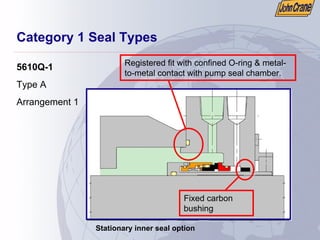
  • 135.
    API 2nd Edition– Testing •2nd Edition Testing Completed : •Type 5610-1 in Propane •Type 5620P-1 in Propane (Arrangement 2) •Type 48LP/S48SC •Type 2800 & Type 2800HP •Type 48LP/ECS •Containment Seals to be Tested: • Type S28LD -- SBOP – Type 5620D-1
  • 136.
    API 682, 2ndEdition Seal Codes EAA cust
  • 137.
    Annex J: Codes ƒInformative ƒ Four segment code ƒ Different from 1st Edition ƒ Different from API 610 ƒ Different from “Seal Configurations” ƒ Example 2CW-CS (Arrangement 2 with Contacting Wet Inboard Seal with a Containment Seal)
  • 138.
    API 682 (2ndEdition) Annex J (Seal Codes) ƒ New coding structure ƒ First letter = Category ƒ second letter = Arrangement ƒ Third letter = Seal Type ƒ Fourth letter(s) = Flush arrangement ƒ Example is C3A2C1152 is Category 3 Type C seal in an arrangement 2 using Plans 11 and 52
  • 139.
    Annex J: Codes ƒInformative ƒ Four segment code ƒ Different from 1st Edition ƒ Different from API 610 C1 A1 A 11
  • 140.
    Annex J: Codes ƒInformative ƒ Four segment code ƒ Different from 1st Edition ƒ Different from API 610 C1 A1 A 11 category arrangement flush type
  • 141.
    API 682 (2ndEdition) Arrangement 1, Single Seals One seal per cartridge assembly 1CW-FX Contacting single wet seal with a fixed throttle bushing 1CW-FL Contacting single wet seal with a floating throttle bushing
  • 142.
    API 682 (2ndEdition) Arrangement 2, Dual Non-pressurized Two seals per cartridge assembly with a containment seal chamber which is at a pressure less than the seal chamber pressure 2CW-CW Dual contacting wet seals with a liquid buffer fluid 2CW-CS Contacting wet inner seal with a dry-running containment seal 2NC-CS Non-contacting inner seal with a dry-running containment seal
  • 143.
    API 682 (2ndEdition) Arrangement 3, Dual Pressurized Two seals per cartridge assembly that utilizes an externally supplied barrier fluid 3CW-FB Dual contacting wet, face-to-back 3CW-BB Dual contacting wet, back-to-back 3CW-FF Dual contacting wet, face-to-face 3NC-BB Dual non-contacting, back-to-back 3NC-FF Dual non-contacting, face-to-face 3NC-FB Dual non-contacting, face-to-back
  • 144.
    API 682 (2ndEdition) - Summary of Seal Arrangements
  • 145.
    API 682 SecondEdition Piping Plans 29
  • 146.
    3 API 682 SecondEdition Changes to Existing Plans
  • 147.
    4 Heat exchangers (8.5.3) ƒ0.50”x 0.065” wall tubing for shaft sizes 60 mm (2.5”) and smaller (8.5.3.1.5) ƒ 0.75” x 0.095” wall tubing for shaft sizes larger than 60 mm (2.5”) (8.5.3.1.5)
  • 148.
    5 Barrier/ buffer fluidreservoirs (8.5.4) ƒ 12 litre (3 gal) capacity for shaft sizes 60 mm (2.5”) and smaller (8.5.4.3.1) ƒ 20 litre (5 gal) capacity for shaft sizes larger than 60 mm (2.5”) (8.5.4.3.1)
  • 149.
    6 12 litre reservoirdesign ƒ DN 150 (NPS 6) sch. 40 pipe (8.5.4.4.3 a) ƒ 316L construction (8.5.4.4.6) ƒ 12 mm (0.50” NPT) seal connections (8.5.4.4.8 a) ƒ Seamless tubing is the default ƒ Sch. 80 pipe is optional ƒ 12 mm x 1.6 (0.50” x 0.065) wall, 316SS cooling coil (8.5.4.5.3)
  • 150.
  • 151.
    8 20 litre reservoirdesign ƒ DN 200 (NPS 8) sch. 40 pipe (8.5.4.4.3 b) ƒ 316L construction (8.5.4.4.6) ƒ 18 mm (0.75”) seal connections (8.5.4.4.8 b) ƒ Seamless tubing is the default ƒ Sch. 80 pipe is optional ƒ 12 mm x 1.6 (0.50” x 0.065) wall, 316SS cooling coil (8.5.4.5.3)
  • 152.
  • 153.
    10 Barrier/ buffer fluidreservoirs (8.5.4) ƒ Pressure gauge and switch required (8.5.4.2.7) ƒ Low level switch required (8.5.4.2.8) ƒ High level switch optional (8.5.4.2.8) ƒ Hermetically sealed switches not required (9.1)
  • 154.
    11 API 682 SecondEdition New Piping Plans
  • 155.
    12 New Piping Plans ƒPlan 53’s - Arrangement 3, Contacting Wet (CW) Seals ƒ 53a – traditional configuration ƒ 53b – bladder accumulator ƒ 53c – piston pot/ accumulator ƒ Plan 72 – Arrangement 2 w/ Containment Seal (CS) ƒ Plan 74 – Arrangement 3, Non-Contacting (NC) Seals ƒ Plan 75 – Arrangement 2 w/ Containment Seal (CS) ƒ Plan 76 – Arrangement 2 w/ Containment Seal (CS)
  • 156.
    13 Plan 53a (A.4.12) ƒArrangement 3, Contacting Wet (CW) Seals ƒ Dual Pressurised (Double) Seals ƒ Utilises direct nitrogen blanket for pressure ƒ Limits the maximum pressure due to nitrogen entrainment in the barrier liquid
  • 157.
    14 Plan 53b (A.4.12) ƒArrangement 3, Contacting Wet (CW) Seals ƒ Dual Pressurised (Double) Seals ƒ Utilizes bladder accumulator for pressure
  • 158.
    15 Plan 53b (A.4.12) ƒBladder eliminates nitrogen contact with barrier liquid ƒ Allows for higher pressure applications ƒ Configuration Includes: ƒ Accumulator ƒ Pressure Indicator ƒ Pressure Switch ƒ Heat Exchanger
  • 159.
  • 160.
    17 Plan 53c (A.4.12) ƒArrangement 3, Contacting Wet (CW) Seals ƒ Dual Pressurised (Double) Seals ƒ Utilises piston pot for pressure
  • 161.
    18 Plan 53c (A.4.12) ƒPiston pot eliminates nitrogen contact with barrier liquid ƒ Allows for higher pressure applications ƒ Piston provides constant pressure ratio to seals (1.1:1) ƒ Configuration includes: ƒ Piston pot ƒ Pressure indicator ƒ Pressure switch ƒ Heat exchanger ƒ Level switch
  • 162.
  • 163.
    20 Plan 72 (A.4.16) ƒArrangement 2, w/ Containment Seal (CS) ƒ Dual Un-Pressurised (Tandem) Seals ƒ Dry-running secondary ƒ Low pressure nitrogen sweep ƒ Sweeps primary leakage to collection system ƒ Dilutes primary leakage to lower emission levels ƒ Used in conjunction with Plan 75 or 76
  • 164.
  • 165.
    22 Plan 74 (A.4.17) ƒArrangement 3, Non-contacting Seals (NC) ƒ Dual Pressurised (Double) Seals ƒ Nitrogen barrier ƒ 1.75 - 2 bar (25-30 psi) above seal chamber pressure ƒ Zero emissions ƒ Essentially a T2800 panel
  • 166.
  • 167.
    24 Plan 75 (A.4.18) ƒArrangement 2, w/ Containment Seal (CS) ƒ Dual Un-Pressurised (Tandem) Seals ƒ Dry-running secondary ƒ Condensate collection reservoir (8.6.5.2) ƒ Used when primary seal leakage may condense ƒ May be used in conjunction with Plan 72
  • 168.
  • 169.
  • 170.
    27 Plan 76 (A.4.19) ƒArrangement 2, w/ Containment Seal (CS) ƒ Dual Un-Pressurised (Tandem) Seals ƒ Dry-running secondary ƒ Primary leakage routed to flare or vent ƒ Used when primary seal leakage will not condense ƒ Essentially a 48SC panel ƒ May be used in conjunction with Plan 72
  • 171.
  • 172.
    API 682 2ndEdition Questions and Answers EAA cust
  • 173.
    What is API682? ƒ Seal standard issued by: American Petroleum Institute ƒ Scope includes: Seals for centrifugal and rotary pumps ƒ API 610 ƒ API 670 ƒ 1st edition 1994 ƒ 2nd edition May, 2002
  • 174.
    How do 2ndEdition & 1st Edition differ? ƒ Categories ƒ Category1 is for chemical duty ƒ Category 2 is for refinery duty ƒ Old “682 Light” ƒ Traditional “API 610” seals ƒ Category 3 is same as 1st edition API 682 ƒ Gas barrier seals ƒ Containment seals
  • 175.
    Who wrote API682? ƒ An industry Task Force comprising of: ƒ End Users ƒ Chemical plants ƒ Refineries ƒ Pump OEM ƒ Seal OEM ƒ API Committees
  • 176.
    Who must useAPI 682? ƒ No one is required to use API 682 but many industries adopt the standard in full or as part of their operating specification in an editit format (Shell PI for instance) ƒ Refineries will be the biggest users ƒ Chemical plants are now covered in the standard
  • 177.
    When does API682 Take Effect? ƒ After publication (July, 2002) ƒ Or when invoked by the customer or contractor
  • 178.
    What are theadvantages of using API 682? ƒ Consistency of approach to seal selection and application ƒ Qualification testing ƒ Air integrity test prior to shipment ƒ Provides high degree of probability in providing (3) years of uninterrupted service while complying with emission regulations
  • 179.
    What are thedisadvantages of using API 682? ƒ “Heavy Duty” ƒ Cost: Some features specified may result in a higher expense to the purchaser than seals and systems previously used. ƒ Require more radial and axial space ƒ Paper work
  • 180.
    Is API 682a metric standard? ƒ Yes though imperial is the default units ƒ Imperial units are typical in USA
  • 181.
    Can the purchasermodify or make additions to API 682? ƒ Yes ƒ Strong set of defaults in API 682 ƒ Allows for user choices ƒ Users will write their own exceptions and clarifications to API 682
  • 182.
    How are MaterialsSpecified? ƒ Specified through detailed coding ƒ Default materials are completely specified ƒ Limited optional materials available that comply ƒ Materials have not changed from 1st edition, but codes used will not match old API 610 material codes
  • 183.
    Are there substitutesfor face materials? ƒ No, must be a tested material ƒ Rules for “tested material” relaxed somewhat ƒ John Crane will have additional tested materials, ie, materials that have been tested and meet the test requirements of API, even though they may not be defined options in the standard
  • 184.
    What Testing isRequired? ƒ Qualification ƒ Specific liquids ƒ Nominal 2” and 4” seals ƒ Publication of results, with pass or fail criteria ƒ Hydrotest ƒ Glands not required to be hydrotested unless cast (previously all glands needed testing) ƒ Integrity (air test) on assembly ƒ 25 psig
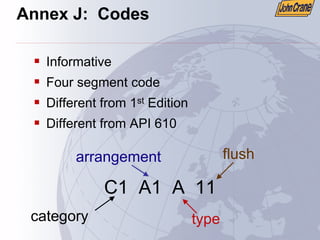
  • 185.
    Must a sealbe tested on all fluids? ƒ Seals should be tested on the fluids they are expected to work on ƒ 5 test fluids ƒ Water ƒ Propane ƒ Caustic ƒ Hot Oil ƒ Cold oil ƒ Qualification testing on representative fluid
  • 186.
    How do weretrofit seals into older pumps? ƒ It is expected that there will sometimes dimensional problems, due to ‘minimum’ specification: ƒ 1/8” (3.175mm) minimum sleeve thickness ƒ 1/8” (3.175mm) general radial clearances ƒ 1/16” (1.587mm) radial clearance for pumping rings ƒ Old pumps, or equipment with minimum space may have to take design exceptions
  • 187.
    What is theequivalent code for BSTFL? ƒ There is no exact equivalent in 682 ƒ New set of codes for API 682 2nd edition ƒ 2nd edition codes not same as 1st edition ƒ 682 codes not same as 610 codes ƒ If customer references an old 610 code ƒ Probably wants a Category II seal as this is the closest definition of a historical 610 seal ƒ There is no direct cross reference possible
  • 188.
    How are ANSI/ ISO (DIN) Pumps catered for? ƒ Category I seals are designed for ANSI / ISO (DIN) large bore ƒ Special features include ƒ Register fit ƒ Throttle bushing ƒ Drilled bolt holes in gland
  • 189.
    Does API 682include Rotary Pumps? ƒ Yes but: ƒ Seal chamber specified for rotary pumps / PD pumps do not match those in API682 (API676)
  • 190.
    Can a customerpurchase dry gas seals per API 682? ƒ Yes, where it is a dry gas seal for pumps not compressors, it falls into the following categories: ƒ Gas barrier seals ƒ Containment seals ƒ New piping plans cover these arrangements ƒ 71, 72, 75, 76 for containment seals ƒ 74 for gas barrier seals
  • 191.
    What arrangement aredry running containment seals and dry gas seals? ƒ Gas barrier seals are Arrangement 3 ƒ Containment seals are Arrangement 2
  • 192.
    Must barrier pressurefor dual pressurized seals be constantly controlled versus seal chamber pressure? ƒ Barrier pressure does not have to track process pressure ƒ Plan 53C is an option that tracks process pressure
  • 193.
    What reference isthere in API 610 for Seals? ƒ Whilst API 610, 8th Ed. edition did include limited seal information, 9th Ed. will not have seal specs; instead refers to API 682 ƒ If API 610 is referenced, you must now assume 9th Ed. unless otherwise another edition is specified
  • 194.
    Must Data Sheetsbe Completed? ƒ Too comply with the requirements of 2nd Ed Yes seal data sheets must be filled out ƒ 2nd Edition uses a two page datasheet ƒ 1st Edition was five pages ƒ But smaller print in 2nd Edition ƒ Data sheet is initiated by purchaser, not JC, and is different between category 1 & 2, and category 3
  • 195.
    Who Completes theData Sheet? ƒ Data sheet is initiated by purchaser O ƒ Seal vendor info added to info by purchaser ƒ Some items by either vendor or purchaser ƒ Defaults marked with shading ƒ The seal vendor cannot begin with a blank data sheet! ƒ John Crane CSelect682 will complete the application part of the data sheet automatically, and will allow you to complete the rest electronically.
  • 196.
    What is anEngineered Seal? ƒ Seal Types are really just A, B, C ƒ Part of “Totally Engineered Sealing System” ƒ Outside the scope of API 682 ƒ Temperature, pressure, speed, fluids, etc. ƒ Optional testing per Clause 10.3.1.1.2 ƒ Design features ƒ Conceivably anything ƒ Probably based on API 682
  • 197.
    API 682 2ndEdition CSelect 682 Seal selection software for API 682 Applications 17
  • 198.
    2 Annex A: Selection ƒInformative ƒ Summaries of ƒ Categories 1, 2, 3 ƒ Arrangements 1, 2, 3 ƒ Seal types A, B, C ƒ Seal selection ƒ Tutorial ƒ Tables ƒ Logic diagrams ƒ Piping Plans ƒ Tutorial ƒ Logic diagrams
  • 199.
    3 Seal Selection Procedure ƒSelect category (1, 2, 3) ƒ Select fluid group ƒ Type A, B, C ƒ Arrangement 1, 2, 3 ƒ Piping plan
  • 200.
    4 No No No Yes Yes Yes Yes Yes Yes Yes Yes No No No No No Is product hazardous byregulation or other local criteria? Start Does product have high H2S content by national/local criteria? Is product under regulated emission rate for hydrocarbons? Arrangement 1 Go to Sheets 7, 8, or 9 Do project/national/local standards permit a restricted vapor leakage under all operating conditions? Will a single seal with special features mitigate the hazard, emission, or other difficulties? Is pumping temperature <260°C (500°F)? Is pumping temperature <150°C (300°F)? Is pumped fluid dirty? Arrangement 3 Go to Sheets 7, 8, or 9 Arrangement 2 Go to Sheets 7, 8, or 9 Select Arrangement ƒ Expanded from 1st Edition ƒ An interview based on ƒ Leakage ƒ Safety
  • 201.
    5 CSelect682 ƒ John Cranecomputer program ƒ Can be given to customers ƒ Should be used internally for defining preferences ƒ Available April, 2003
  • 202.
  • 203.
    7 Start a NewProject Project name Project item
  • 204.
    8 Select an ExistingProject Add new items Modify selections
  • 205.
  • 206.
    10 Select a Seal- Fluid Properties Selection data summarised at bottom of screen
  • 207.
  • 208.
  • 209.
    13 Flush Plans andMaterials Selections can be changed or locked where no change allowed
  • 210.
  • 211.
  • 212.
  • 213.
    17 Product Literature Available to viewor download from Internet