Metal Seals
Design Guide
3
Table of Contents
Introduction	 ....................................................................... 4
Section A – General Information
Advantages of Metal Seals.................................................. A-8
How to Use the Design Guide............................................. A-9
Market Applications......................................................... A-10
Section B – Metal Seal Type Selection
Selecting the Metal Seal Type for Your Application............... B-11
Seal Selection at a Glance................................................ B-14
Section C – Size Selection
Face Seals
MCI	 Metal C-Ring, Internal Pressure Face Seal.......... C-16
MCE	 Metal C-Ring, External Pressure Face Seal......... C-18
MSI	 Spring Energized Metal C-Ring,
		 Internal Pressure Face Seal.............................. C-20
MSE	 Spring Energized Metal C-Ring,
		 External Pressure Face Seal............................. C-22
MEI	 Metal E-Ring, Internal Pressure Face Seal.......... C-24
MEE	 Metal E-Ring, External Pressure Face Seal......... C-26
MOI	 Metal O-Ring, I.D. Vented, Internal Pressure
		 Face Seal....................................................... C-28
MON	 Metal O-Ring, Plain, Internal Pressure Face Seal. C-28
MOP	 Metal O-Ring, Pressure Filled,
		 Internal Pressure Face Seal.............................. C-28
MOE	 Metal O-Ring, O.D. Vented,
		 External Pressure Face Seal............................. C-30
MOM	 Metal O-Ring, Plain, External Pressure Face Seal.C-30
MOR	 Metal O-Ring, Pressure Filled,
		 External Pressure Face Seal............................. C-30
MUI	 Metal U-Ring, Internal Pressure Face Seal.......... C-32
MUE	 Metal U-Ring, External Pressure Face Seal......... C-34
MWI	 Metal Wire Ring, Internal Pressure Face Seal...... C-36
MWE	 Metal Wire Ring, External Pressure Face Seal..... C-38
Axial Seals
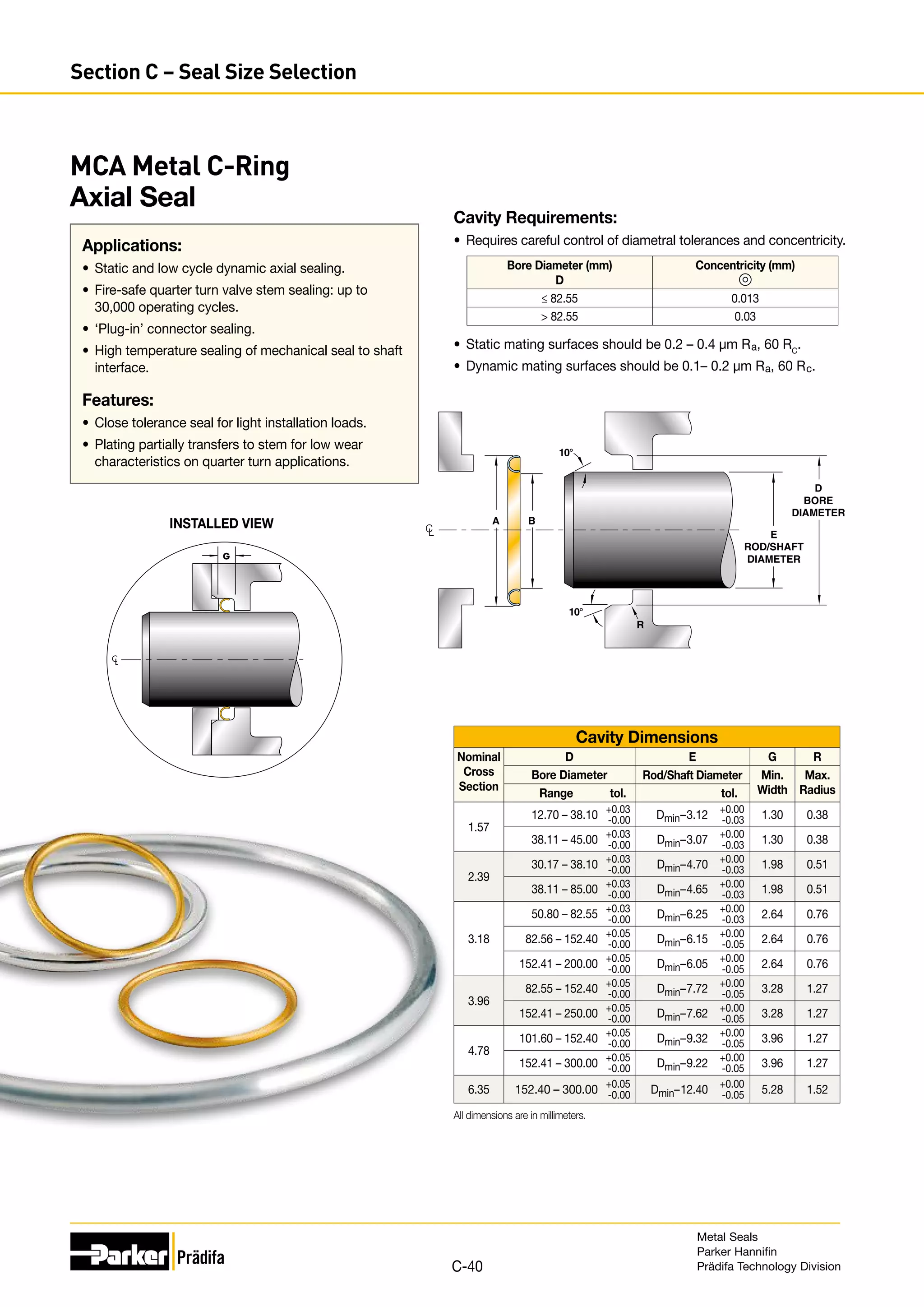
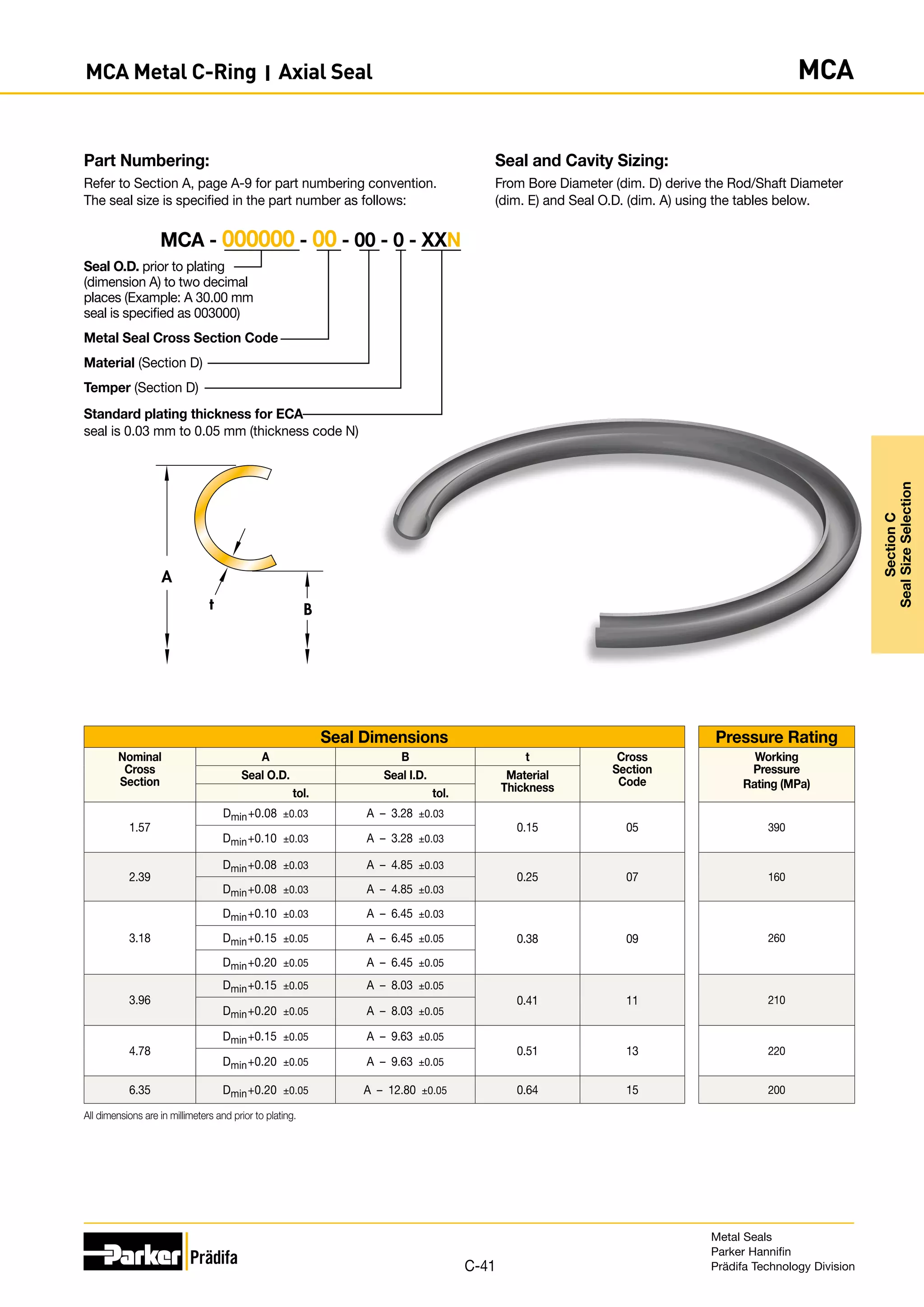
MCA	 Metal C-Ring, Axial Seal................................... C-40
Seals for Standard Applications
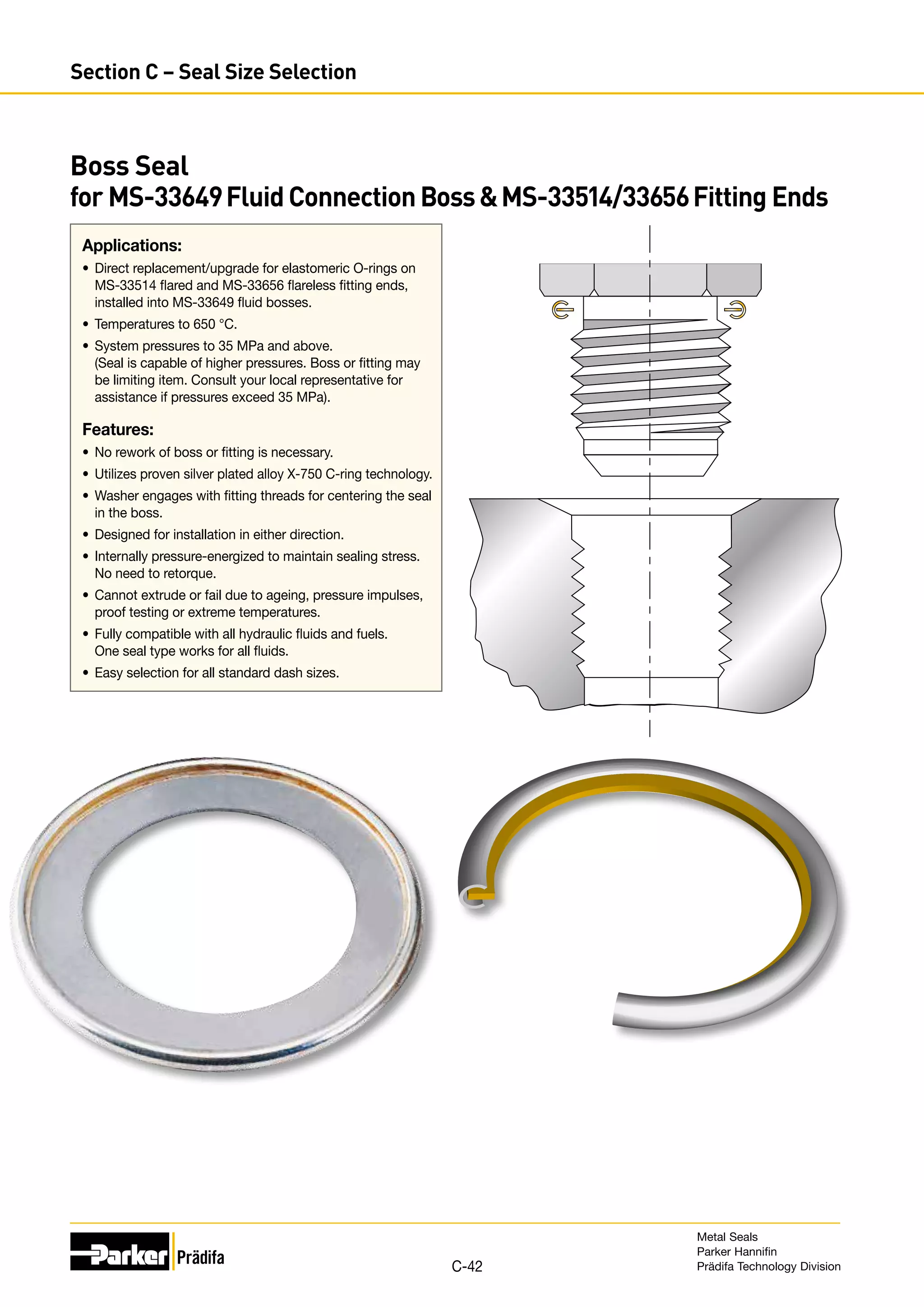
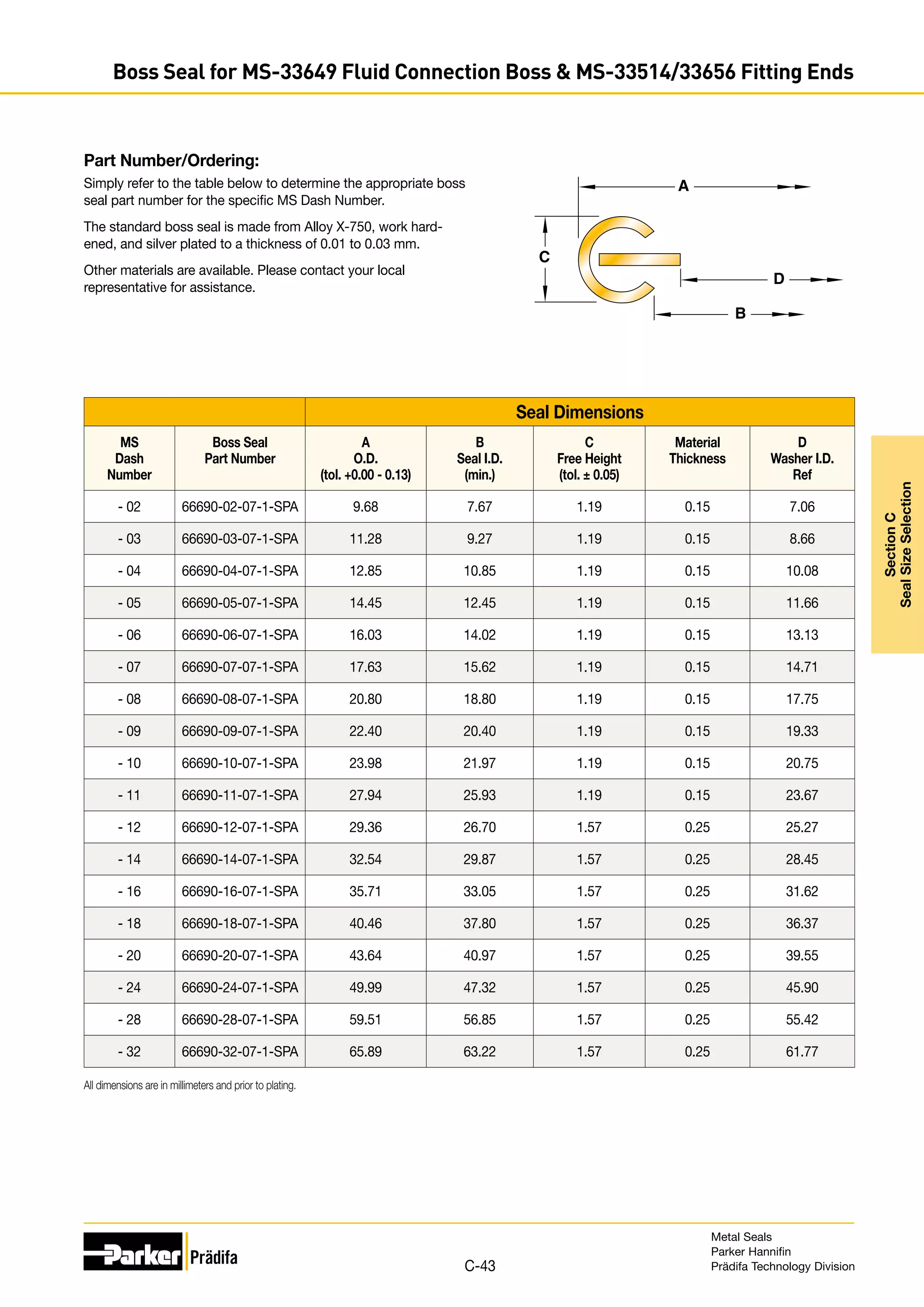
Boss Seal	 for MS-33649 Fluid Connection Boss
			 and MS-33514/33656 Fitting Ends.................. C-42
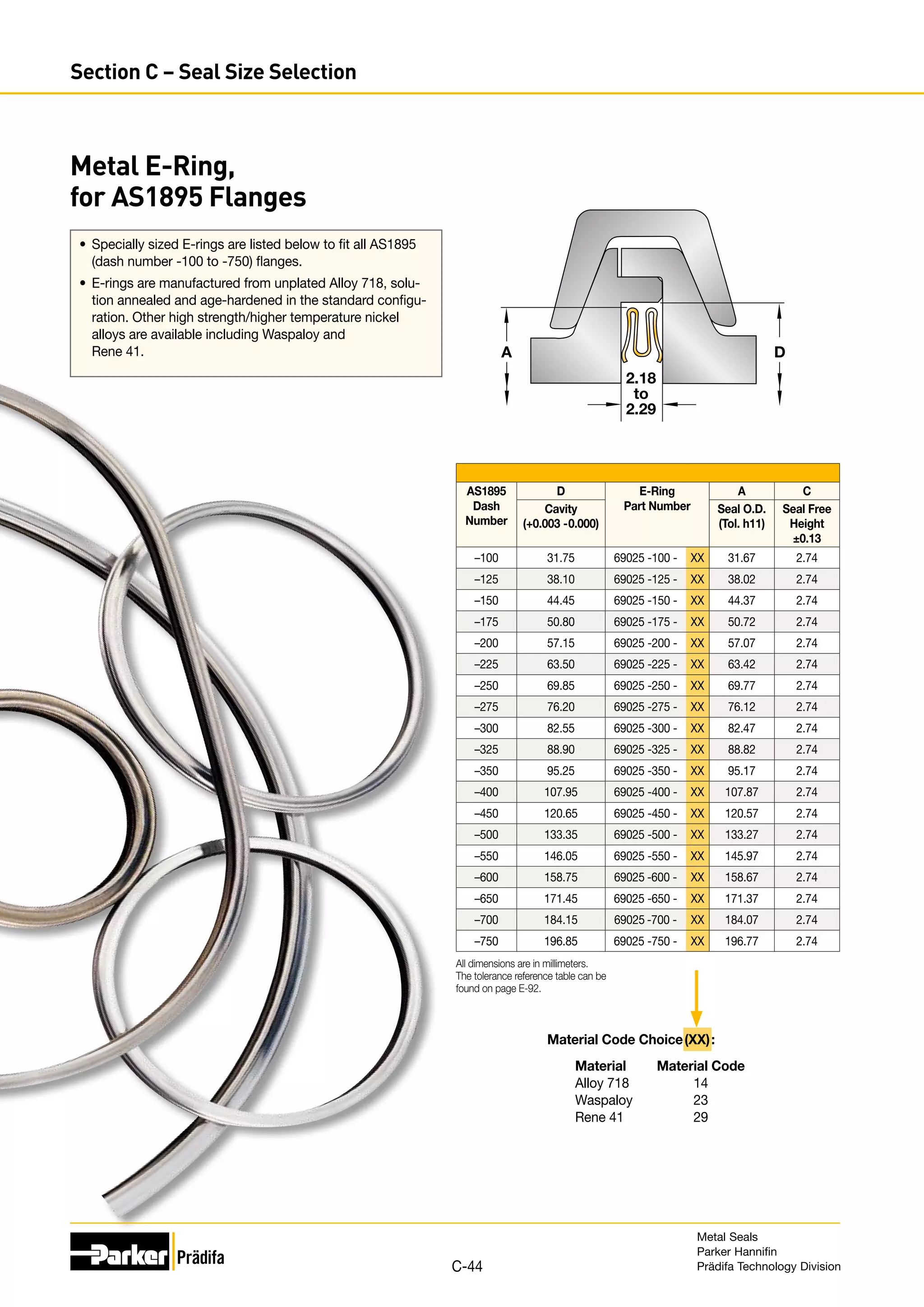
Metal E-Ring for AS1895 Flanges................................... C-44
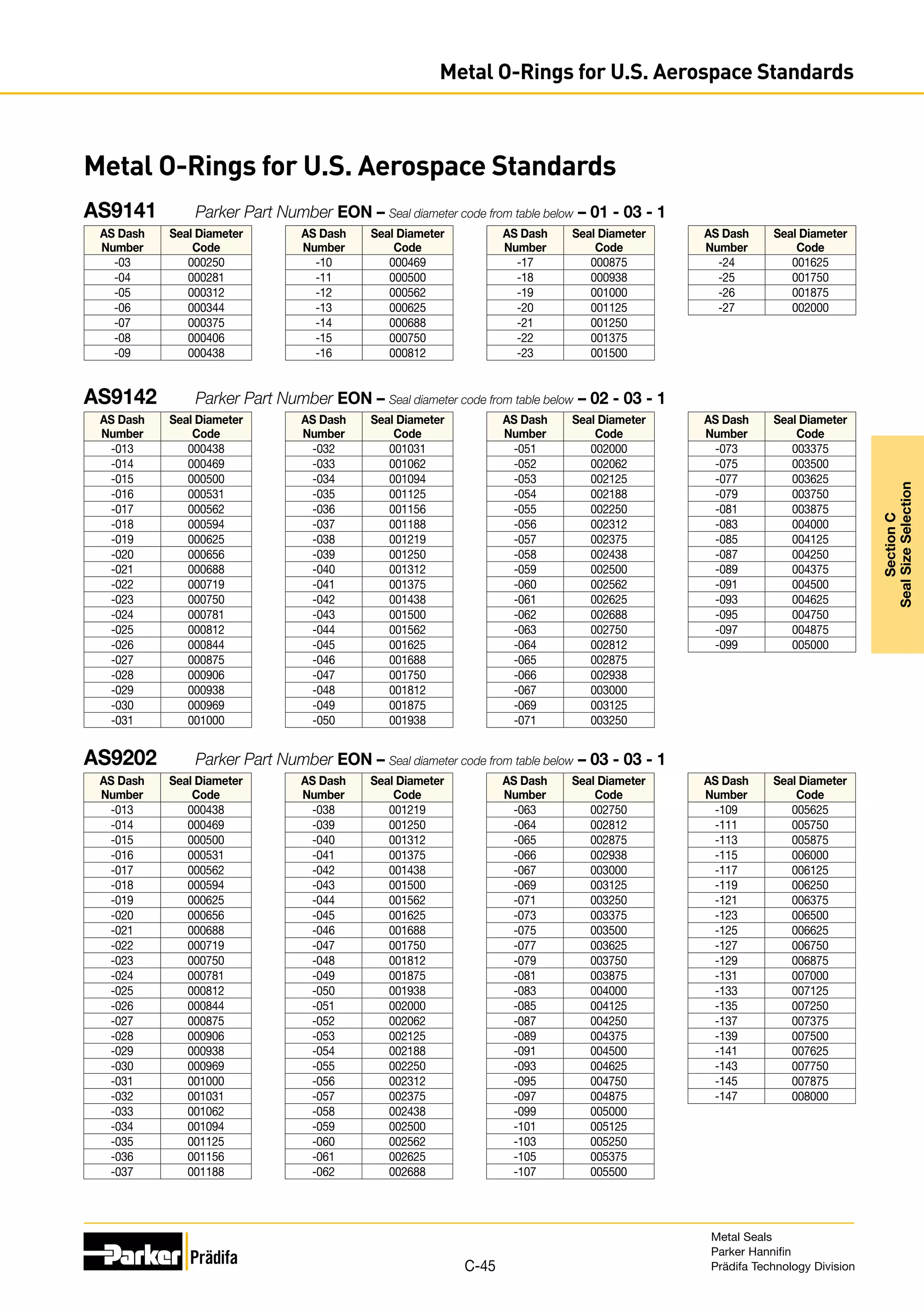
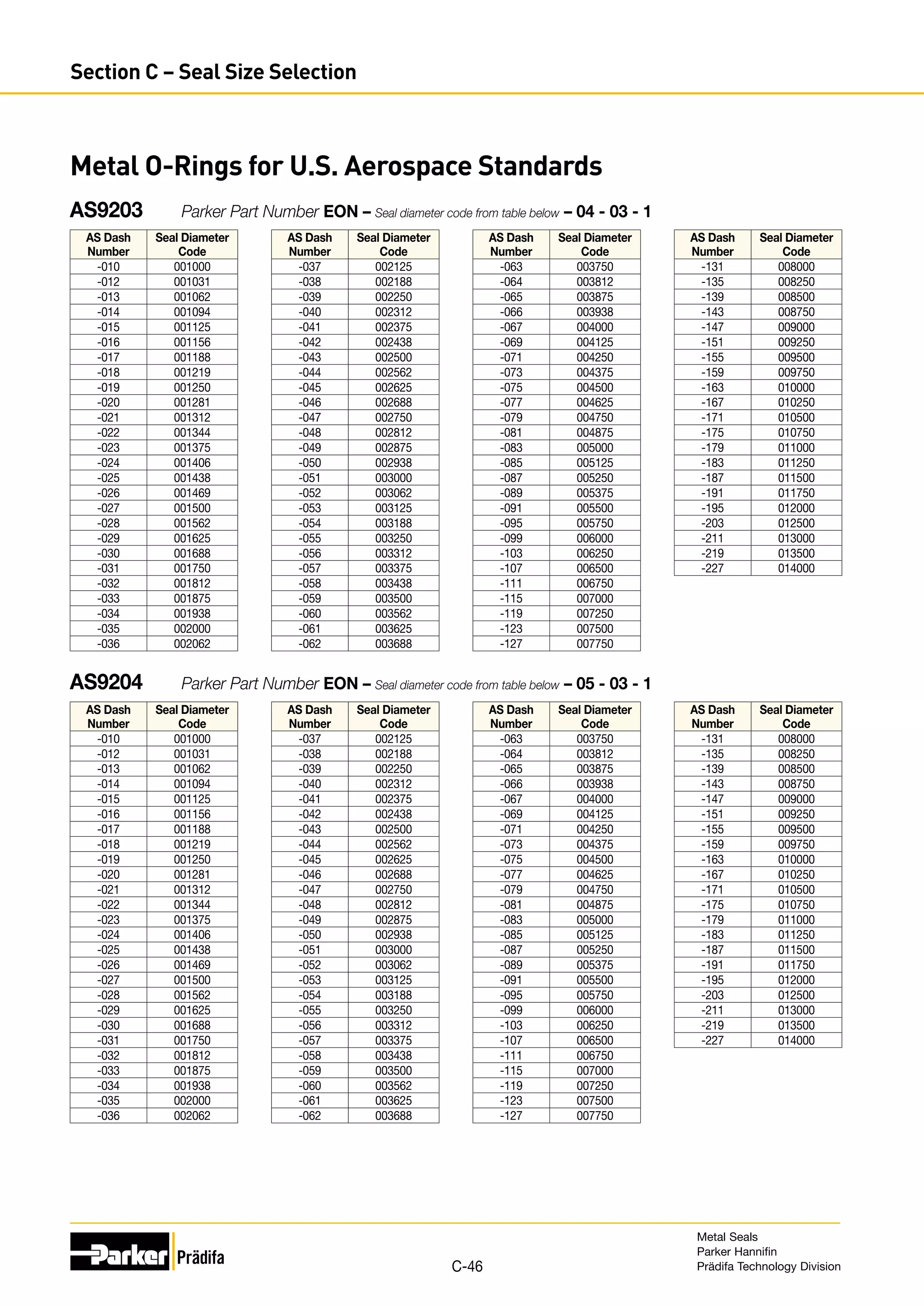
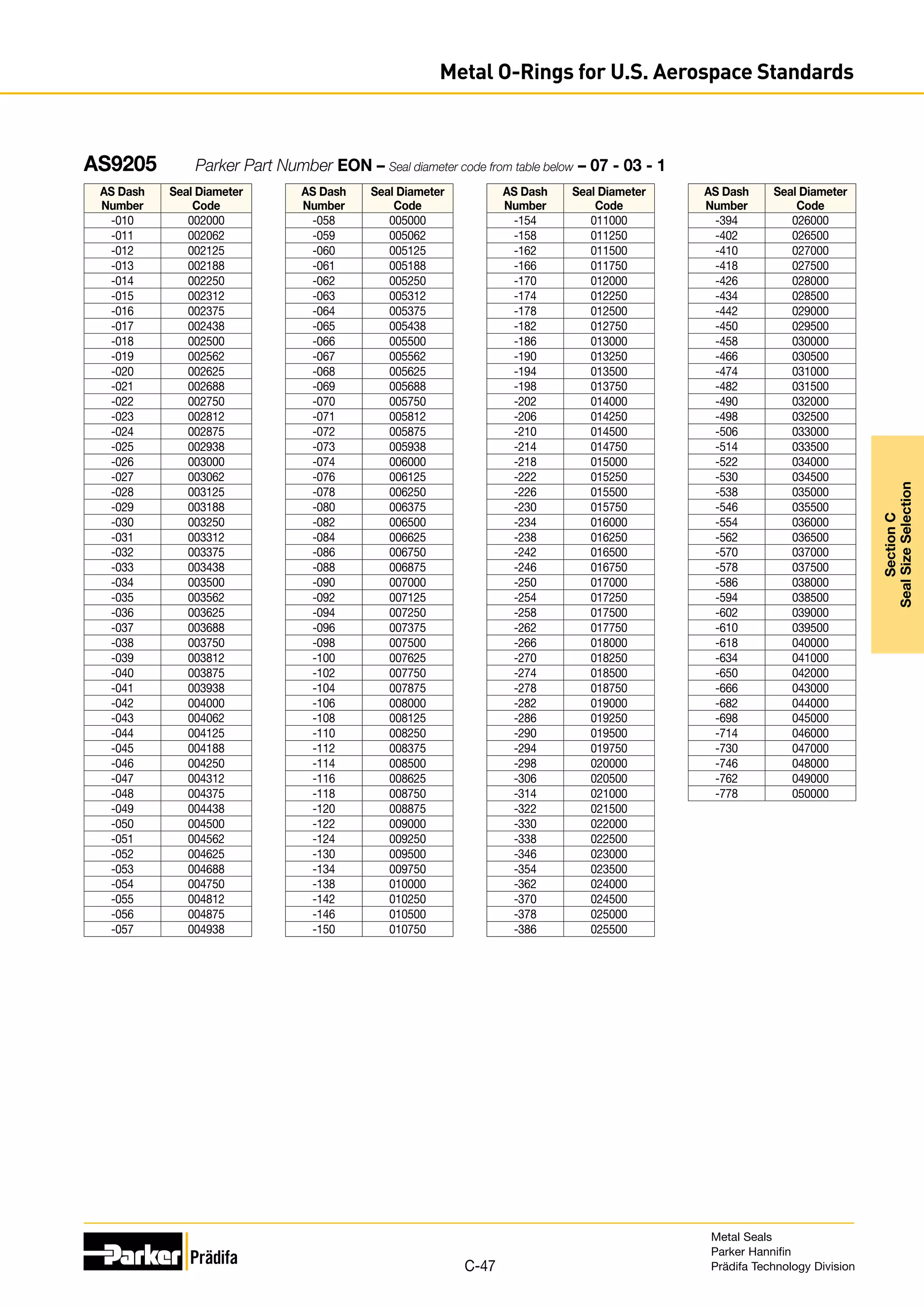
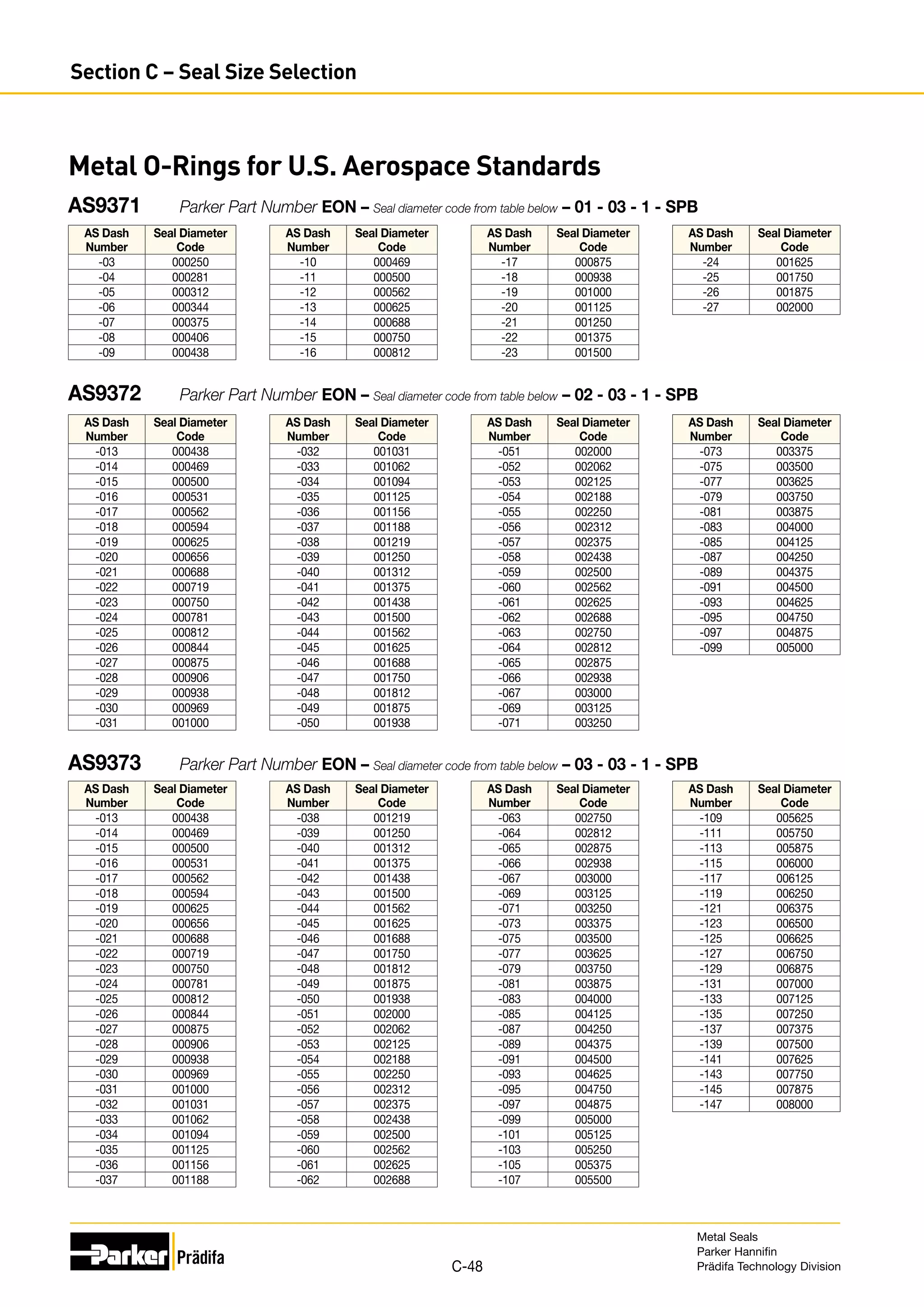
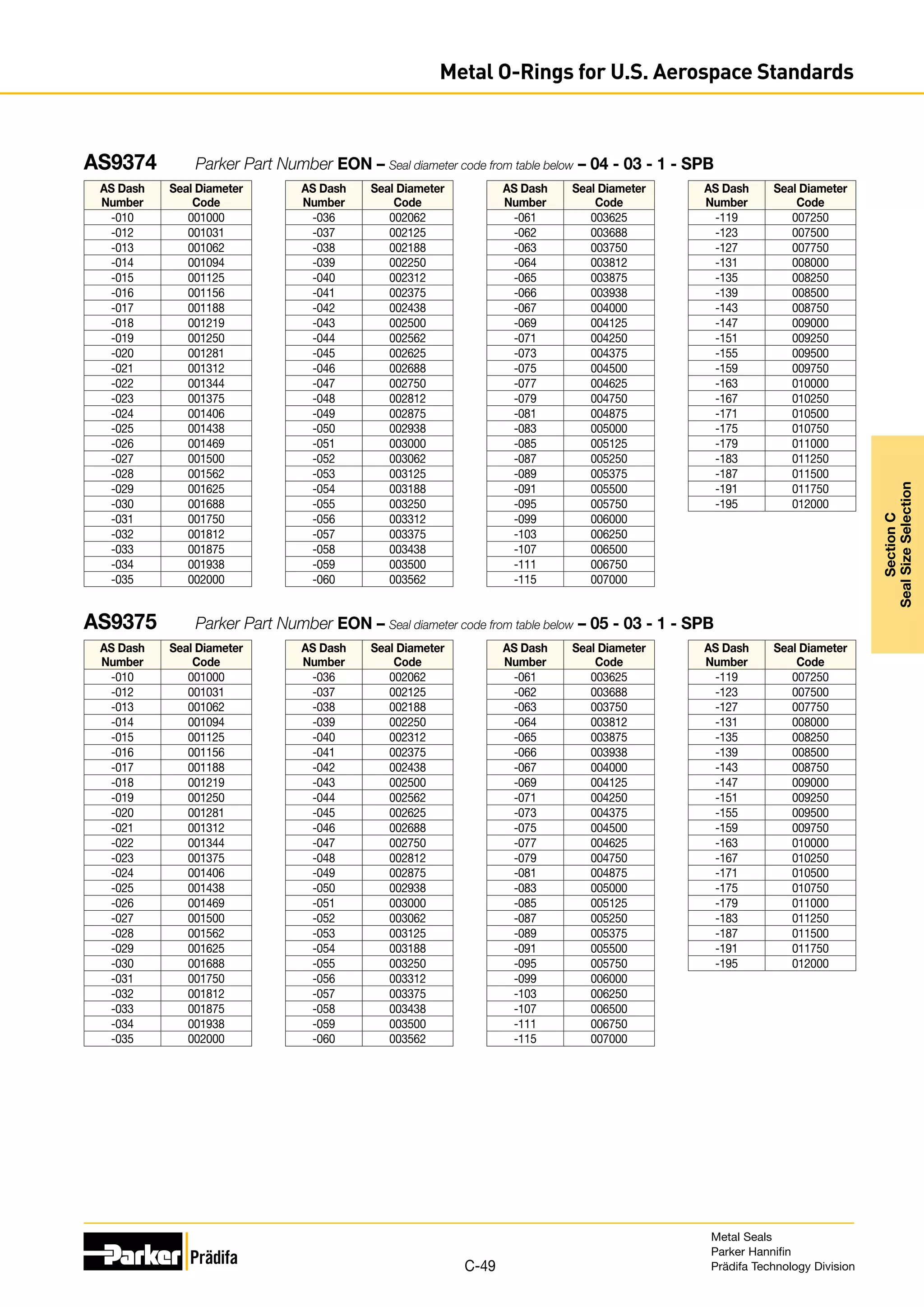
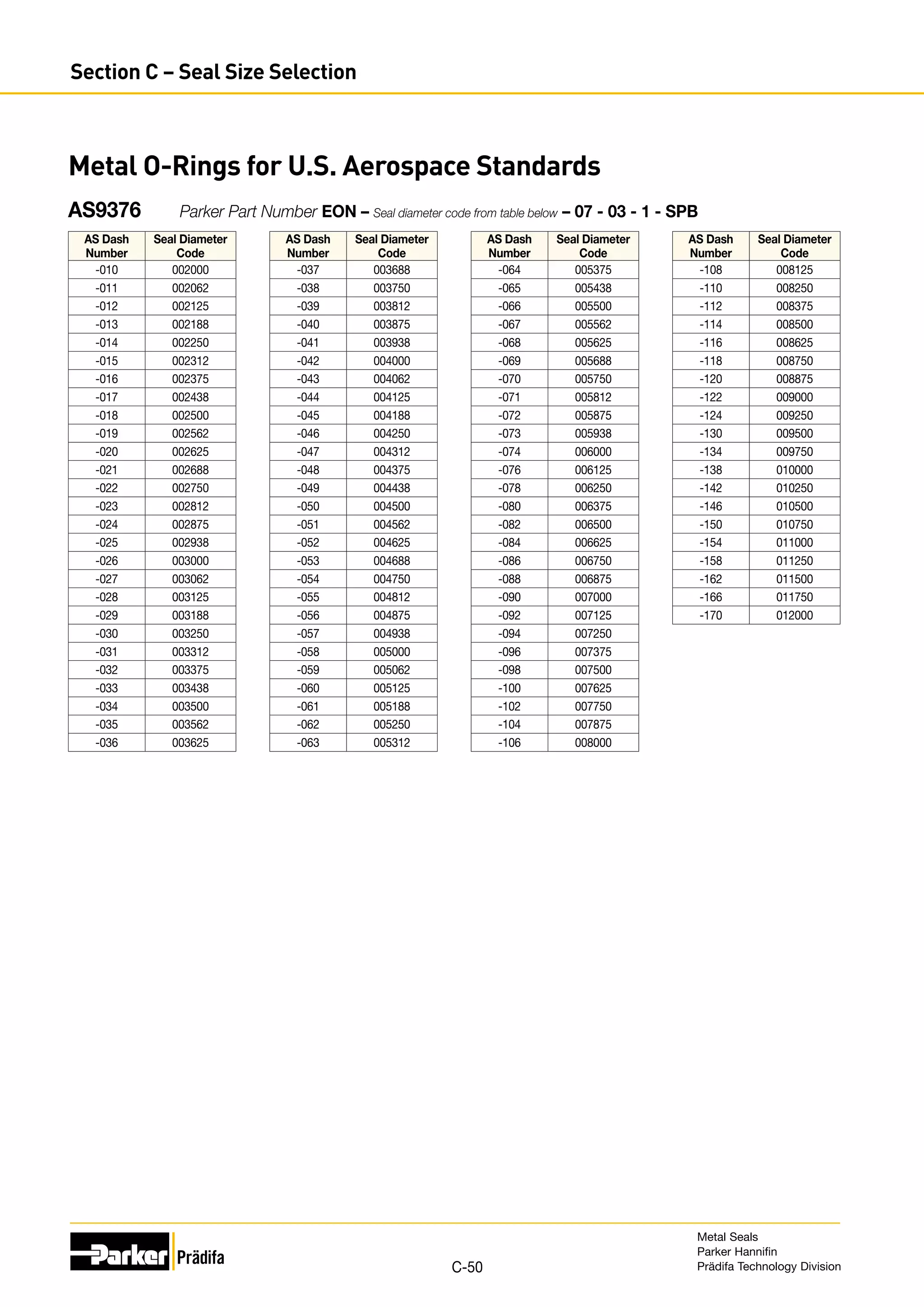
Metal O-Ring for Aerospace Standards........................... C-45
Section D – Material Selection Process
Selecting the Material
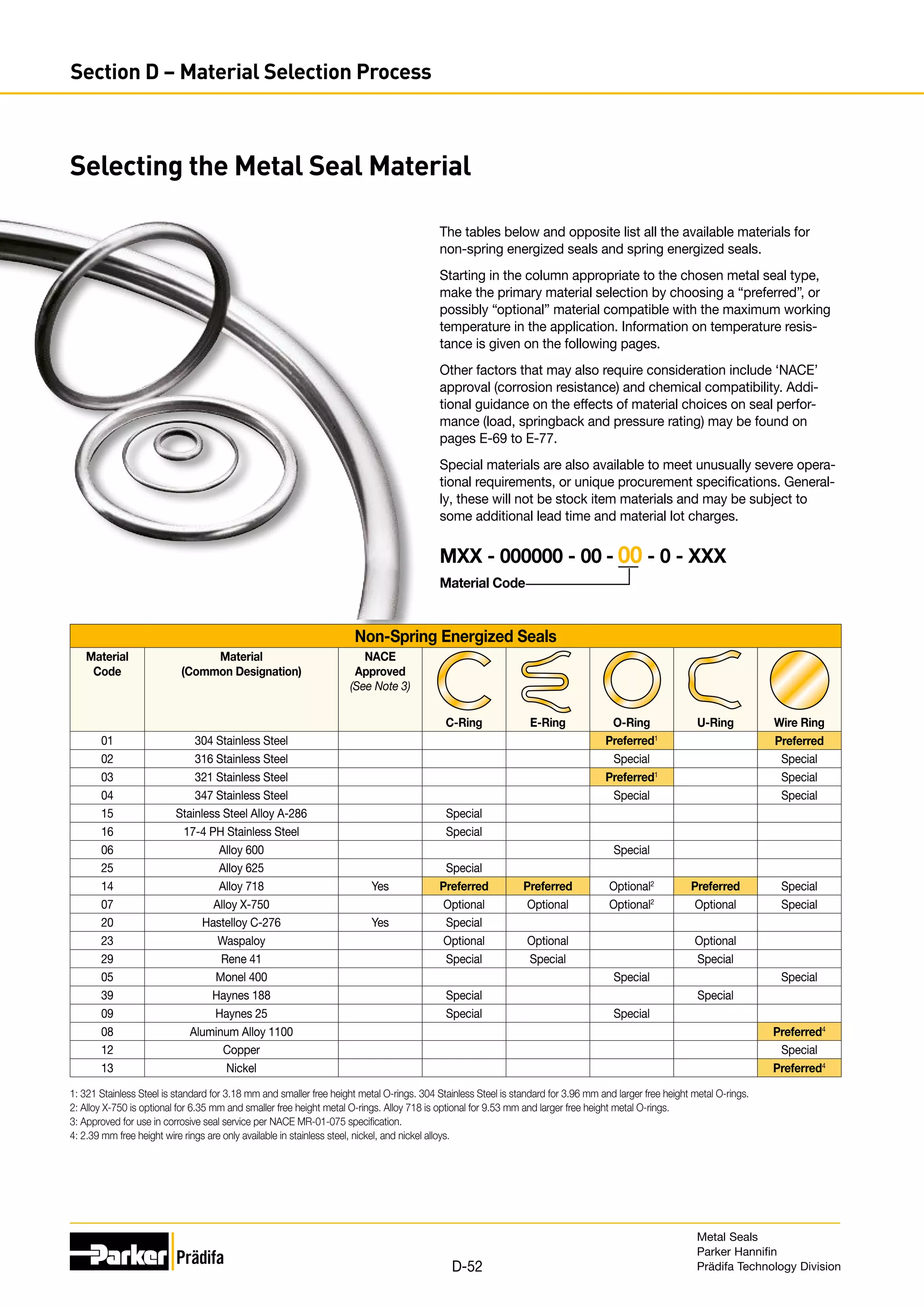
Material Codes for Non-Spring Energized Seals................... D-52
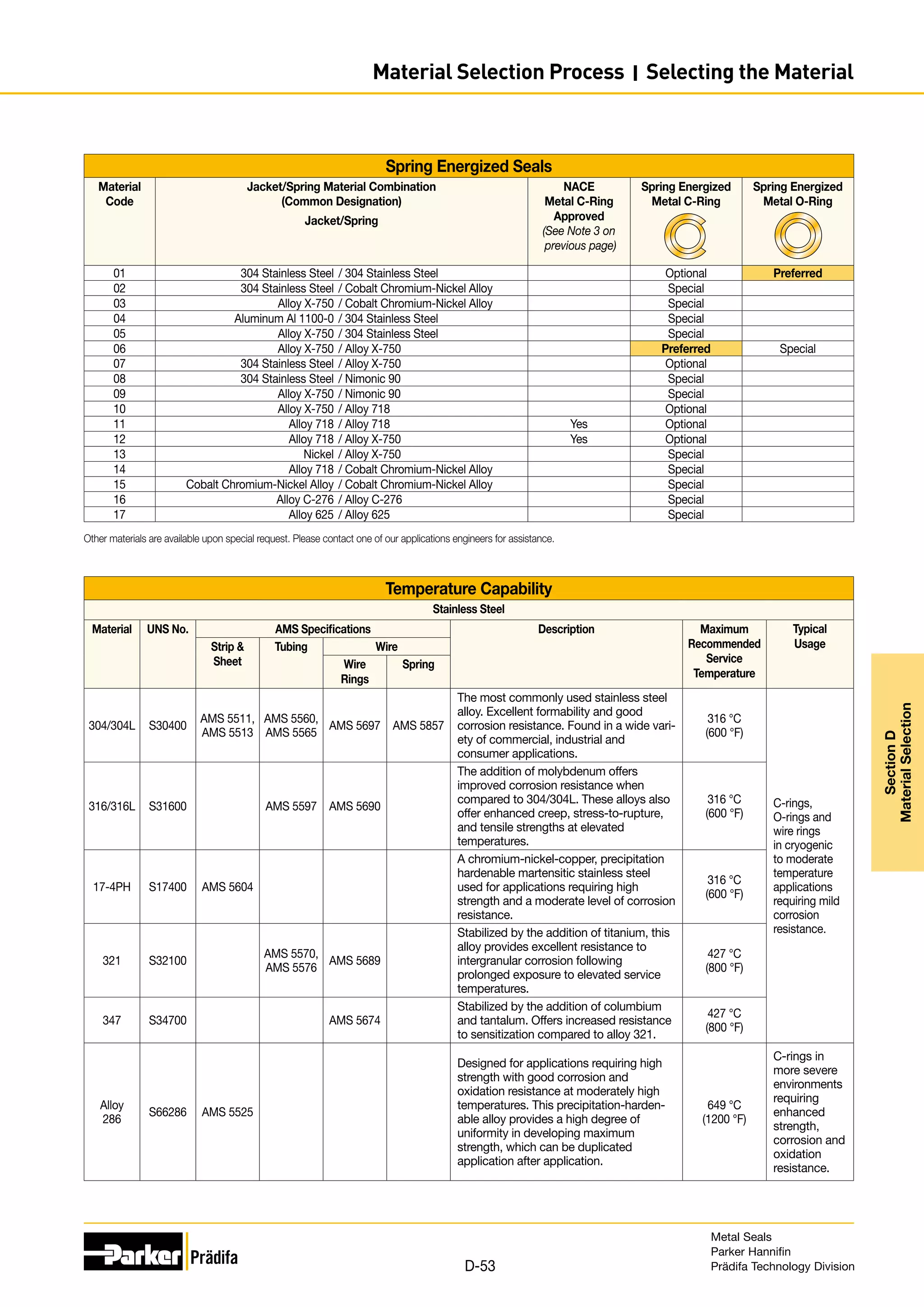
Material Codes for Spring Energized Seals.......................... D-53
Temperature Capabilities – Stainless Steel.......................... D-53
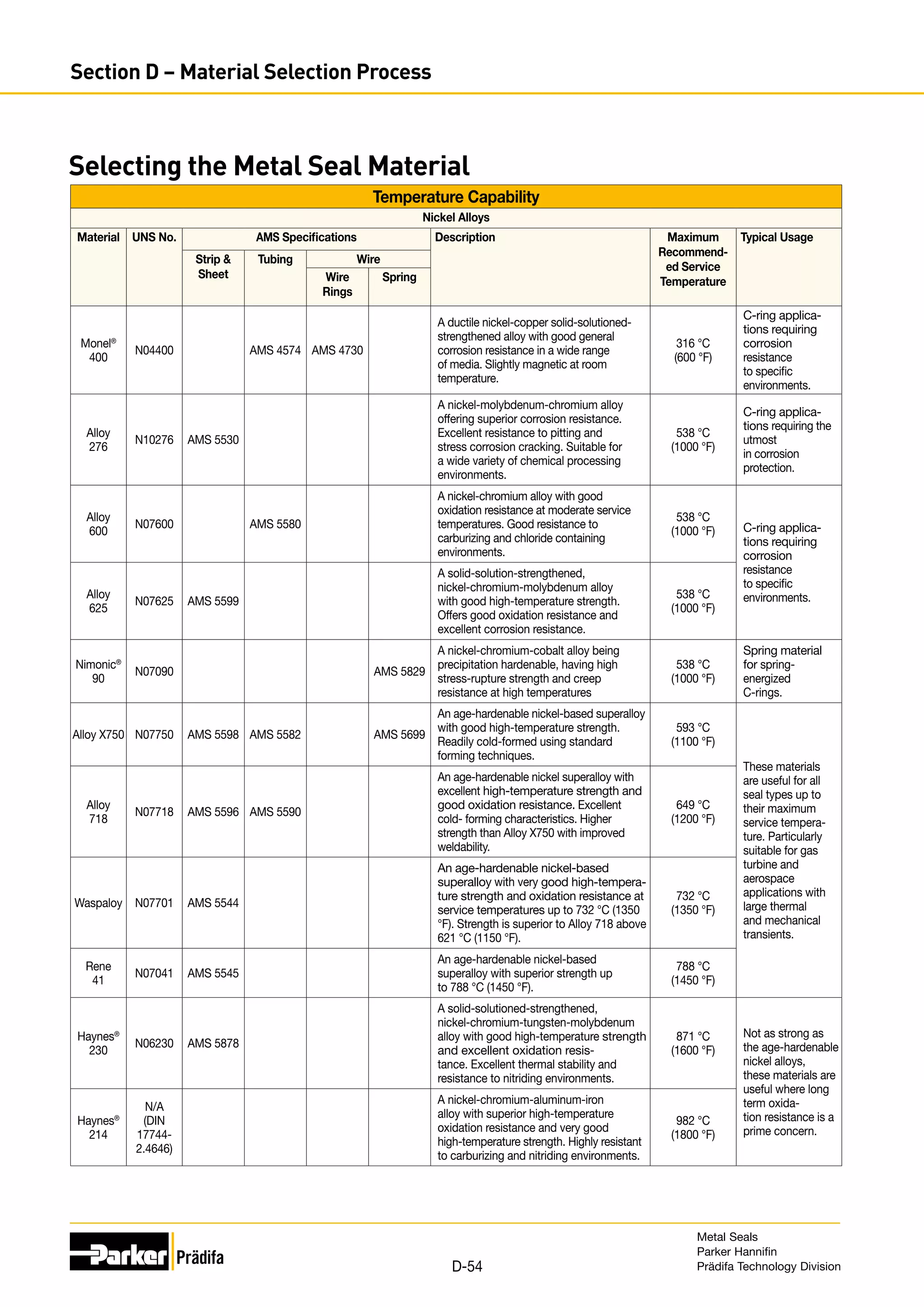
Temperature Capabilities – Nickel Alloys............................. D-54
Temperature Capabilities – Cobalt Alloys............................ D-55
Temperature Capabilities – Other Materials......................... D-55
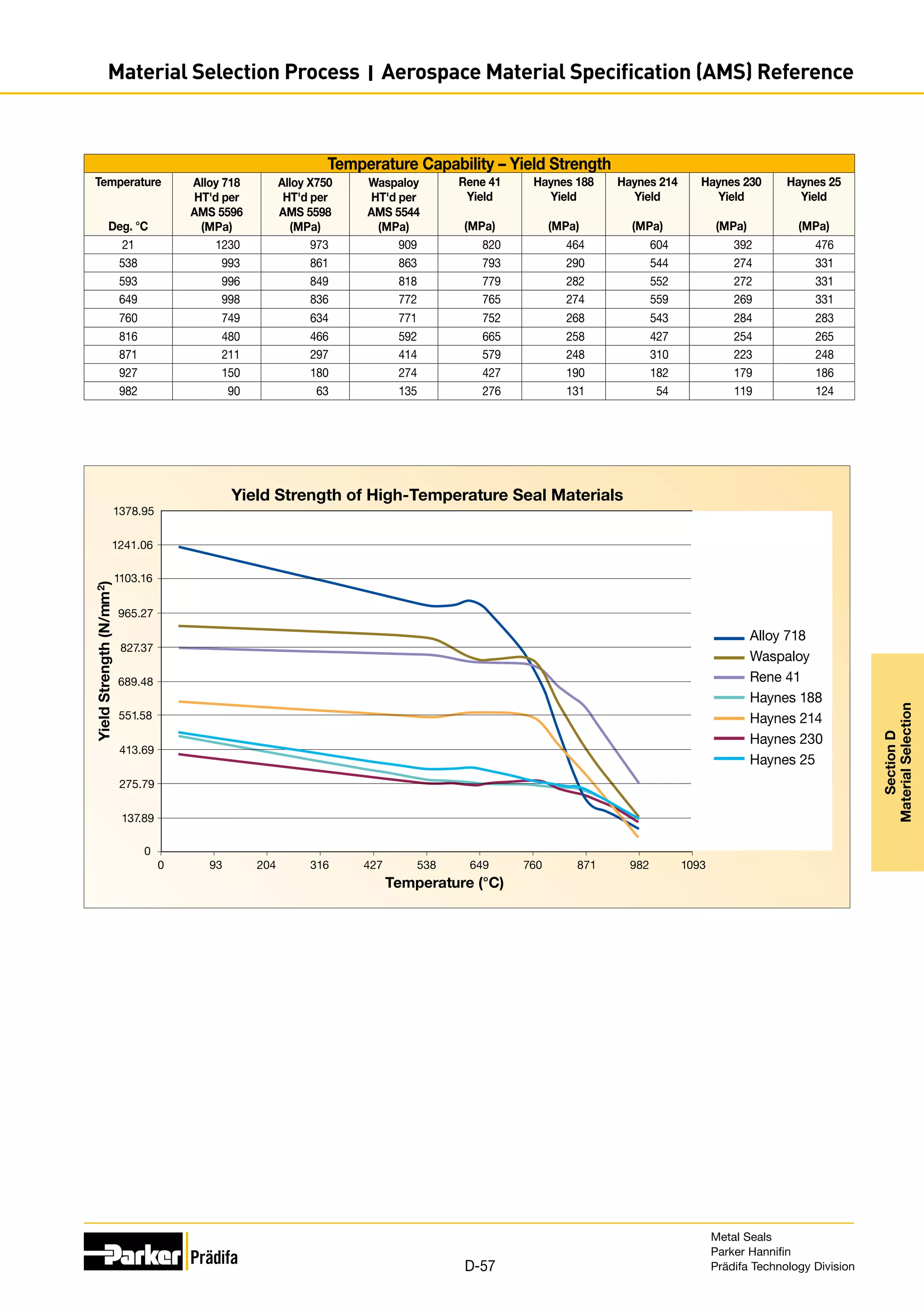
Aerospace Material Specification (AMS) Reference.............. D-56
Yield Strength, Relaxation & Springback............................. D-56
Platings, Coatings and Finishes
Temper Codes................................................................. D-58
Finish Codes	.................................................................. D-59
Finish Thickness Selecting Guidelines................................ D-60
Silver-Indium Plating........................................................ D-61
TriCom®
Plating............................................................... D-62
TriCom-HT™
Plating.......................................................... D-64
Section E – Technical Information Performance Data
Load, Deflection and Springback / Terminology................... E-68
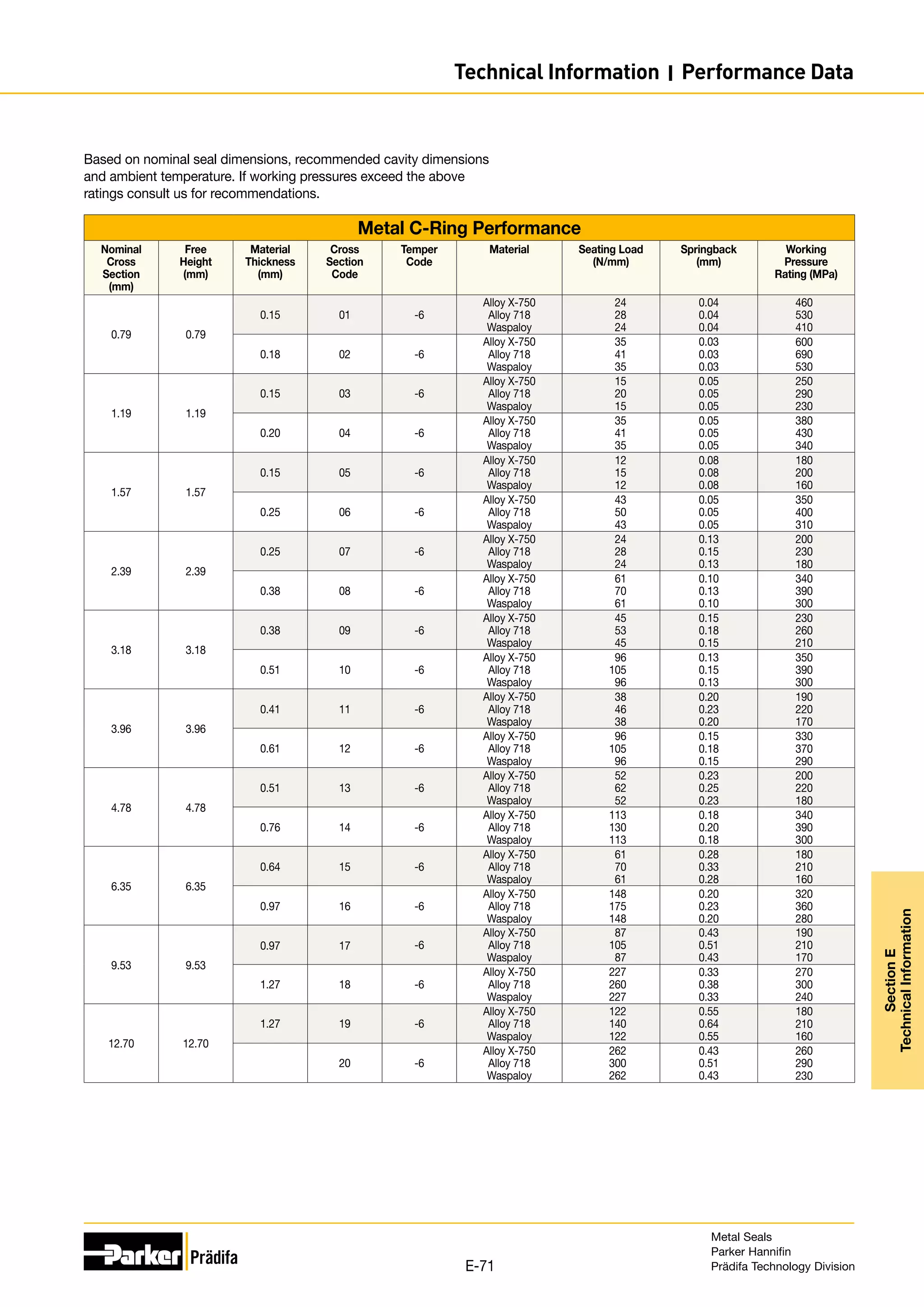
Metal C-Ring Performance................................................ E-70
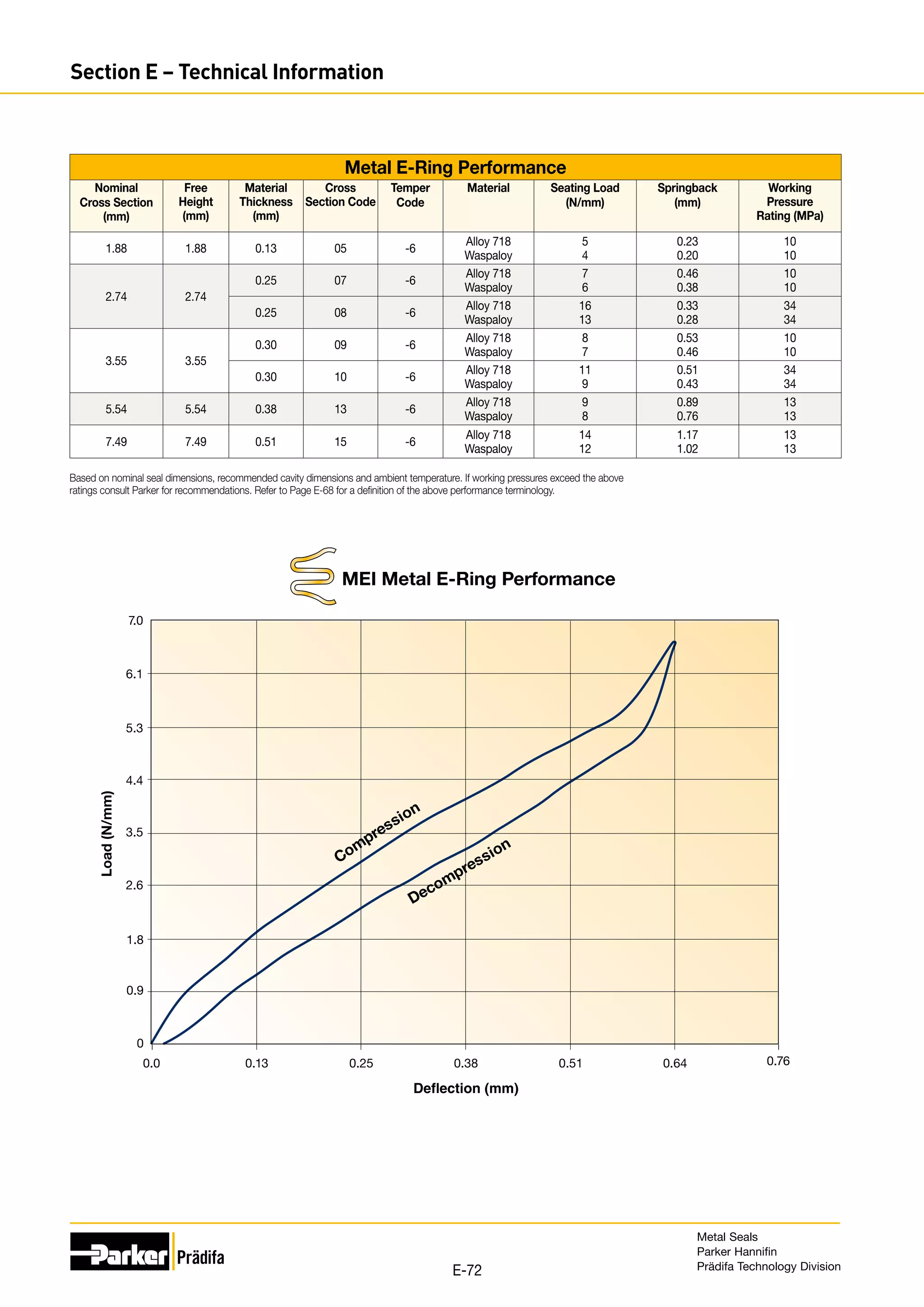
Metal E-Ring Performance................................................ E-72
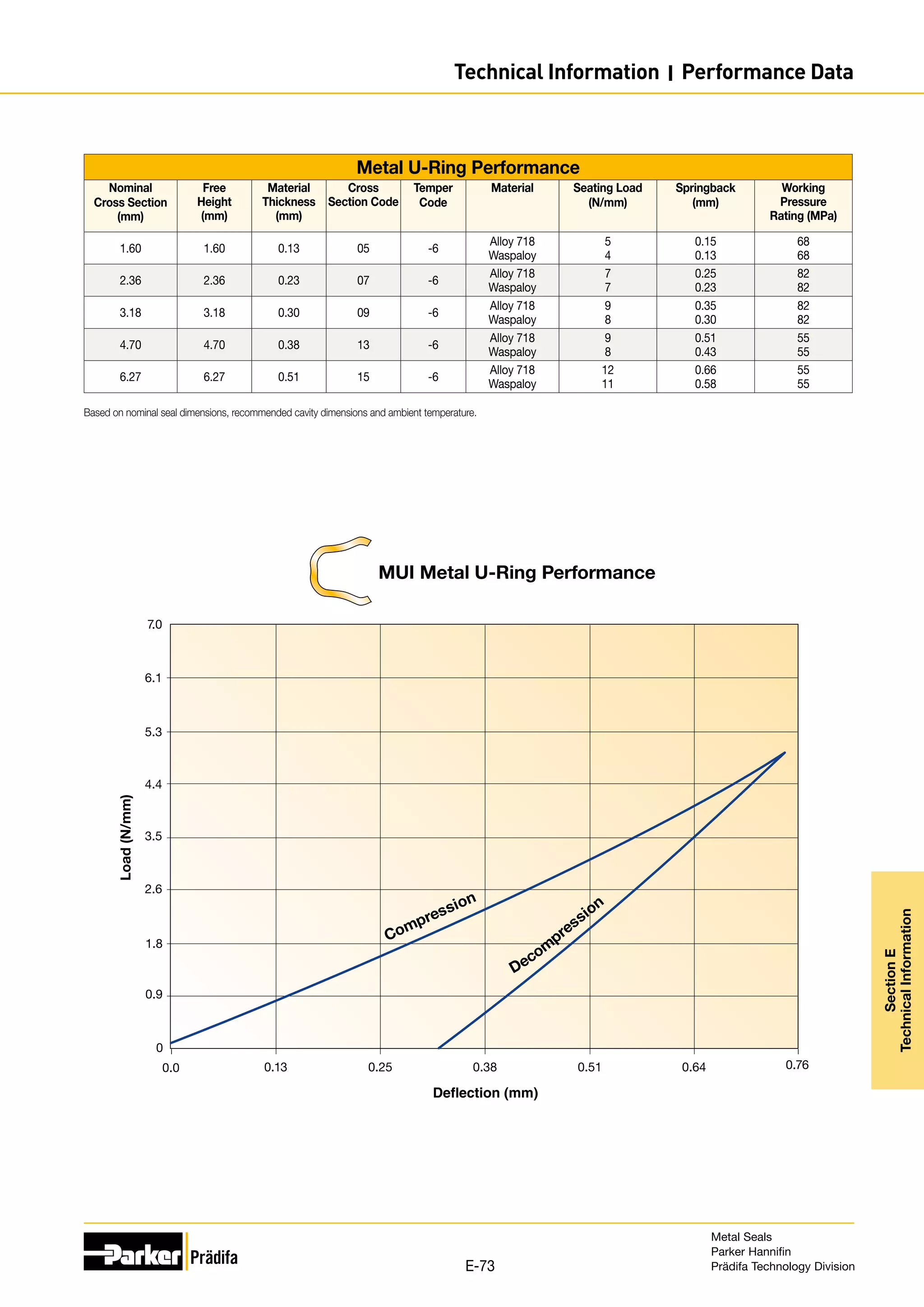
Metal U-Ring Performance................................................ E-73
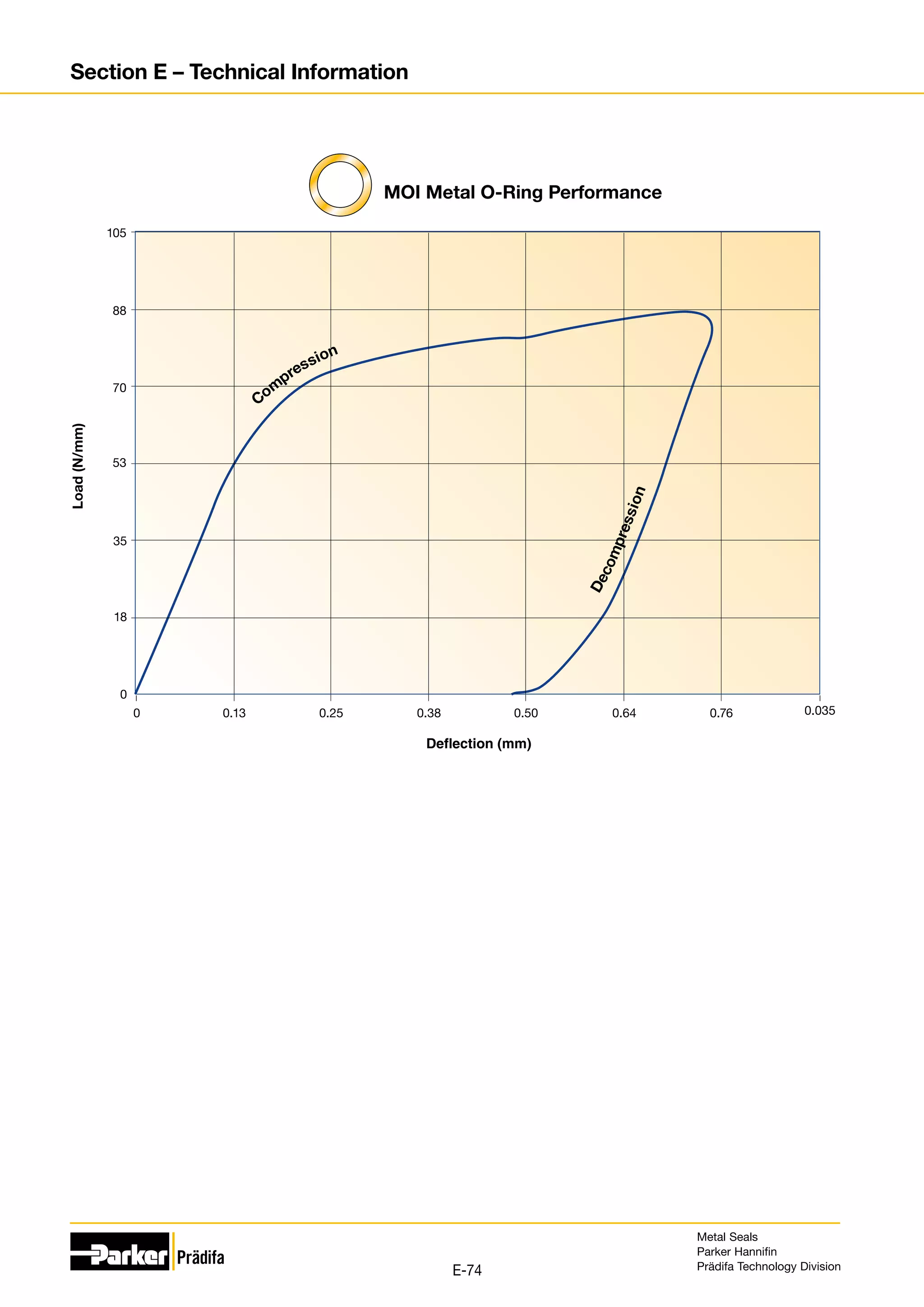
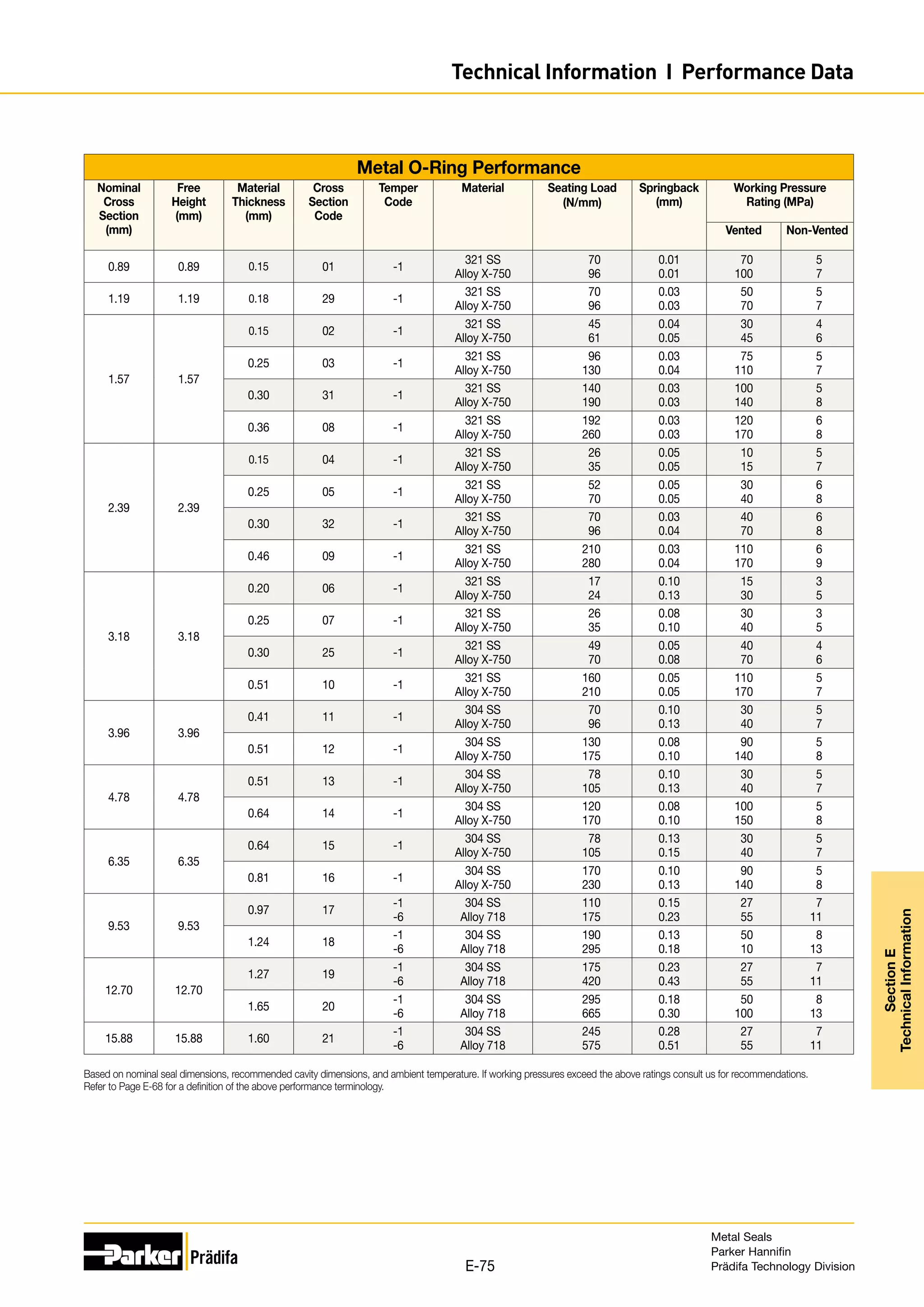
Metal O-Ring Performance................................................ E-74
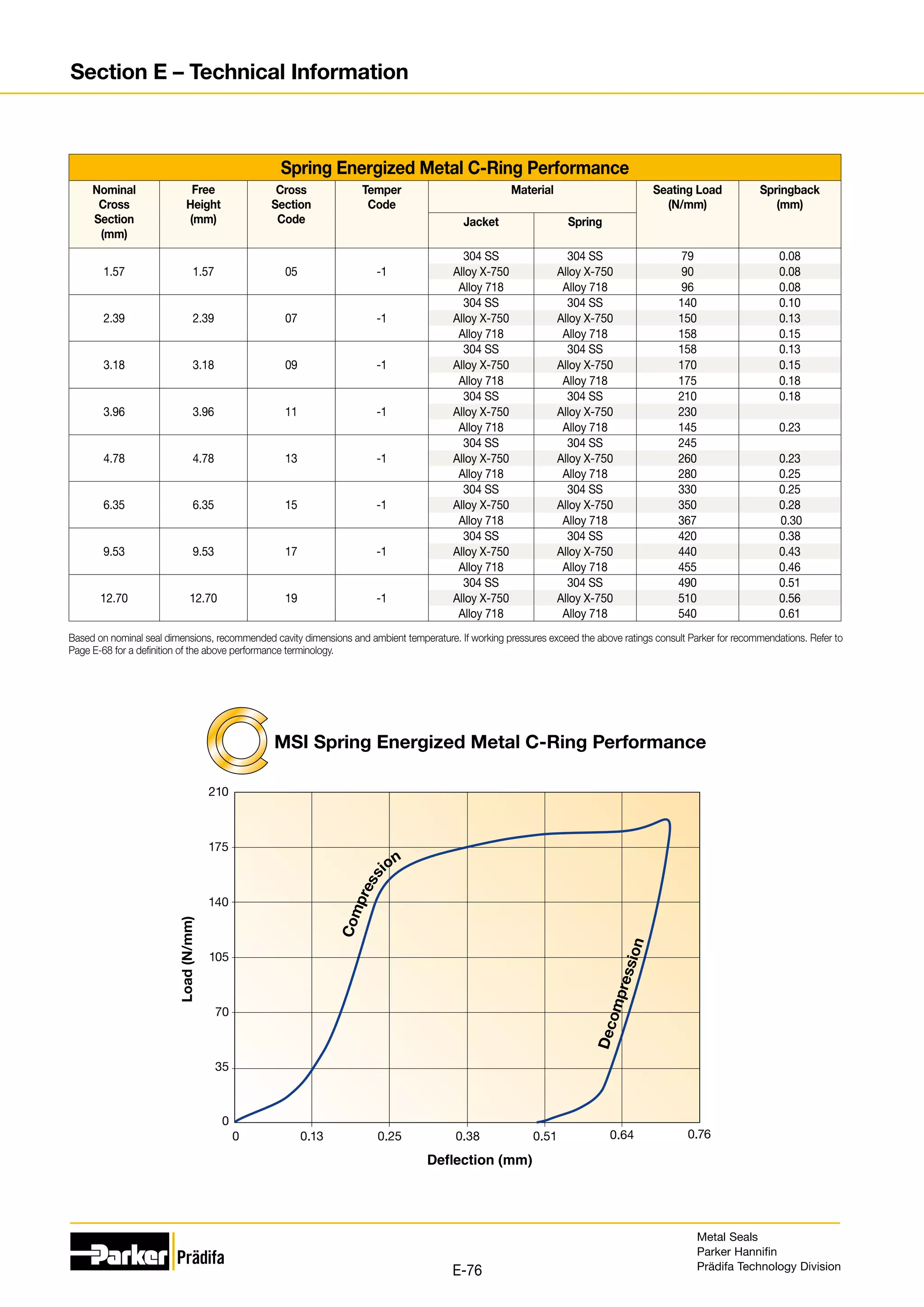
Metal Energized C-Ring Performance................................. E-76
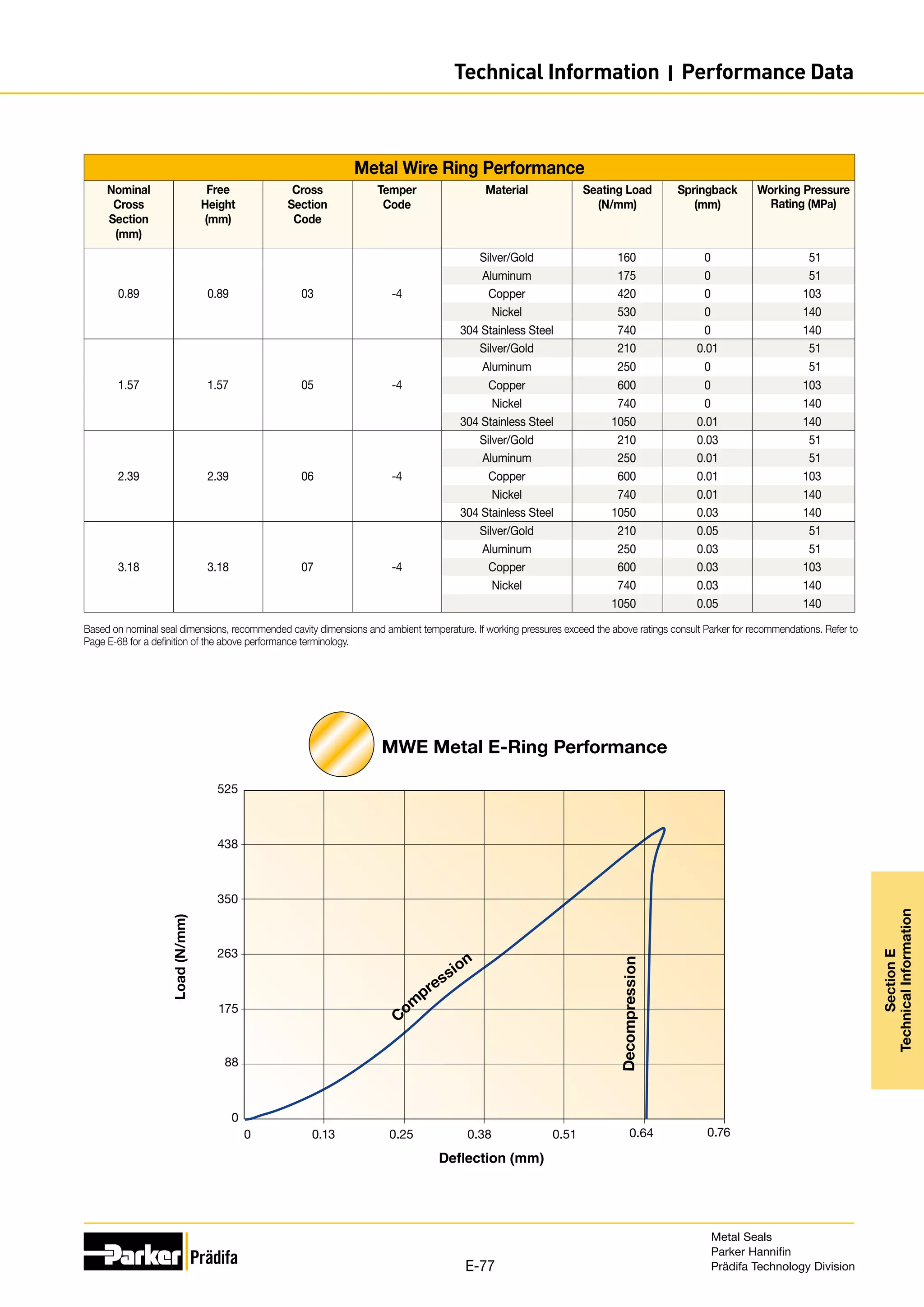
Metal Wire Ring Performance............................................ E-77
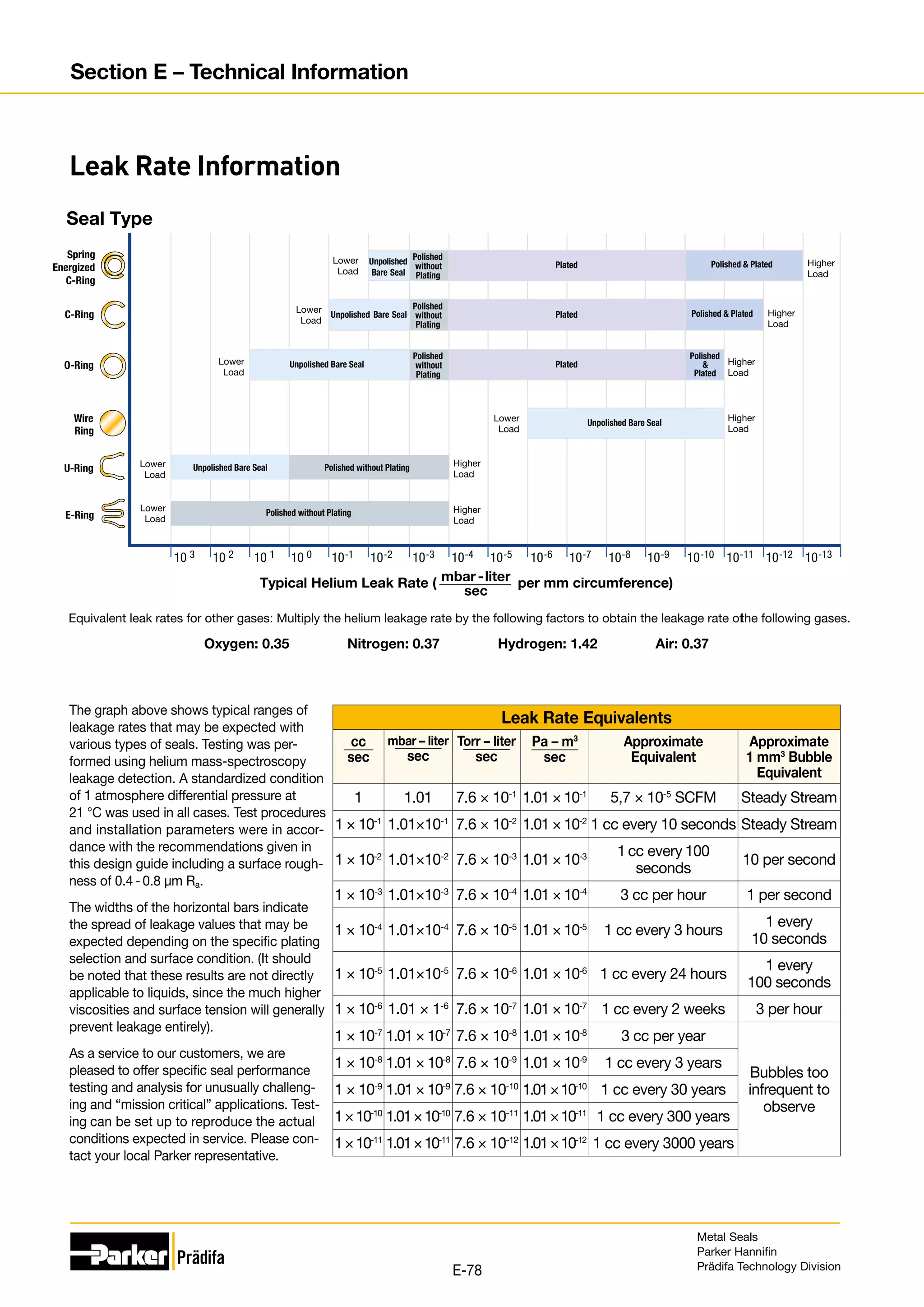
Leak Rate Information......................................................... E-78
Fatigue and Stress Relaxation............................................. E-79
Installation Guidelines
Surface Roughness.......................................................... E-80
Surface Flatness.............................................................. E-80
Surface Hardness............................................................ E-81
Compression Limiters...................................................... E-81
Bolt Load and Tightening Torque Guidelines........................ E-82
Seal Shaping Requirements for Non-Circular Seals.............. E-84
Manufacturing Specifications
Roundness and Flatness.................................................. E-85
Surface Finish................................................................. E-85
Metal O-Ring Weld Finish................................................. E-85
Preferred C-Ring and Spring Energized C-Ring Sizes........... E-86
Tolerance Reference Table.................................................. E-92
Conversion Tables............................................................... E-93
Section F – Additional Styles
Formed Seals		 ................................................................... F-96
Precision Machined Seals..................................................... F-96
Beaded Gaskets................................................................... F-97
Additional E-Ring Styles....................................................... F-98
Frequently Asked Questions................................................. F-99
Application Data Sheets
Face Seal��������������������������������������������������������������������� F-103
Axial Seal���������������������������������������������������������������������� F-104
Parker´s safety programme����������������������������������������������� F-105
Metal Seals
Parker Hannifin
Prädifa Technology Division
4
The Global Leader in Sealing Technology
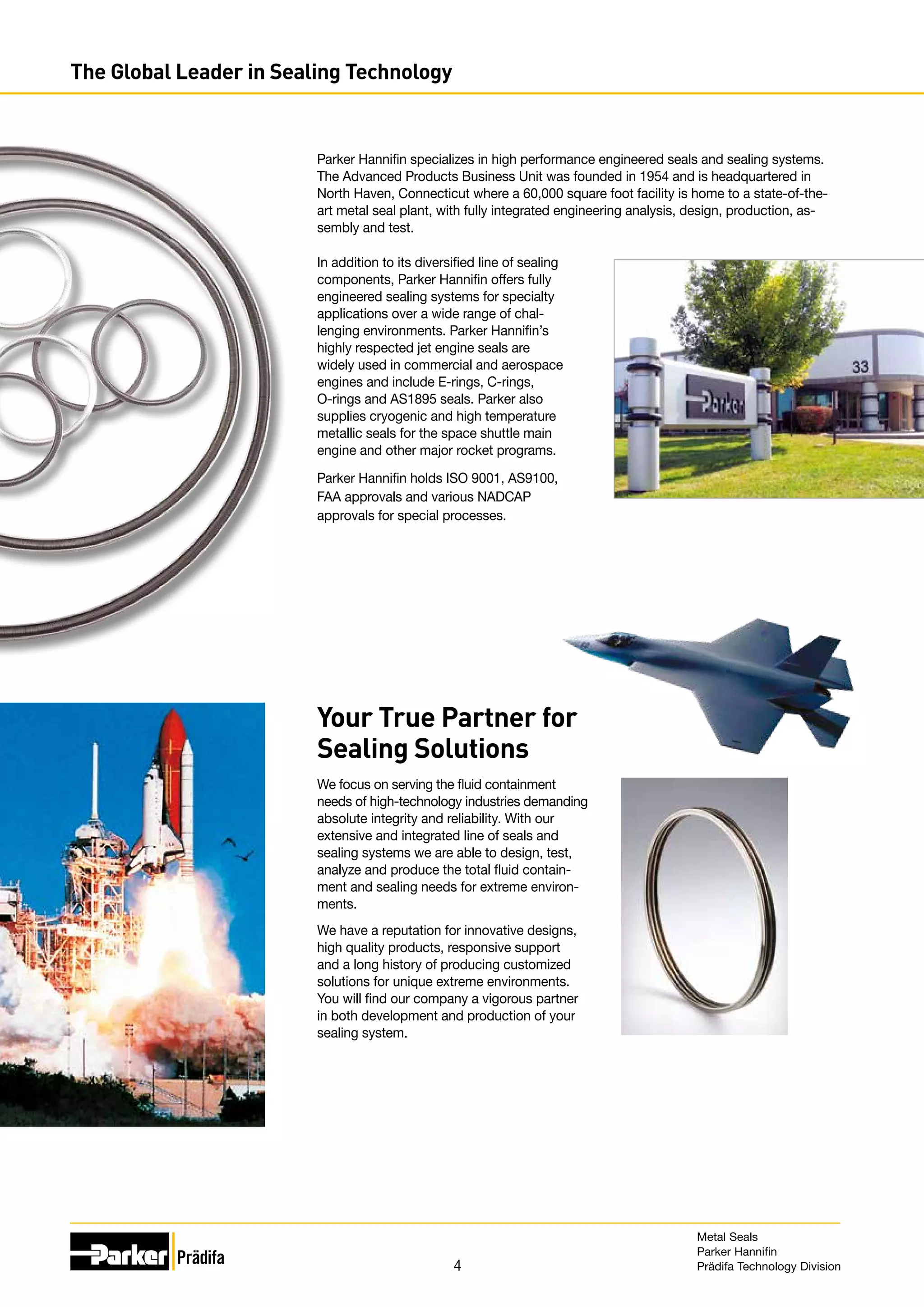
In addition to its diversified line of sealing
components, Parker Hannifin offers fully
engineered sealing systems for specialty
applications over a wide range of chal-
lenging environments. Parker Hannifin’s
highly respected jet engine seals are
widely used in commercial and aerospace
engines and include E-rings, C-rings,
O-rings and AS1895 seals. Parker also
supplies cryogenic and high temperature
metallic seals for the space shuttle main
engine and other major rocket programs.
Parker Hannifin holds ISO 9001, AS9100,
FAA approvals and various NADCAP
approvals for special processes.
Your True Partner for
Sealing Solutions
We focus on serving the fluid containment
needs of high-technology industries demanding
absolute integrity and reliability. With our
extensive and integrated line of seals and
sealing systems we are able to design, test,
analyze and produce the total fluid contain-
ment and sealing needs for extreme environ-
ments.
We have a reputation for innovative designs,
high quality products, responsive support
and a long history of producing customized
solutions for unique extreme environments.
You will find our company a vigorous partner
in both development and production of your
sealing system.
Parker Hannifin specializes in high performance engineered seals and sealing systems.
The Advanced Products Business Unit was founded in 1954 and is headquartered in
North Haven, Connecticut where a 60,000 square foot facility is home to a state-of-the-
art metal seal plant, with fully integrated engineering analysis, design, production, as-
sembly and test.
Metal Seals
Parker Hannifin
Prädifa Technology Division
5
The Global Leader in Sealing Technology
Contract RD
We offer our services in the research and
development of materials and sealing technol-
ogy. Our team of experienced engineers and
scientists are able to develop and test new
products and materials, perform extensive
research and create new technology.
Serving the Needs
of High-Technology
Industries
Dependable Sealing
Systems for Safety-Critical
and Extreme Environments
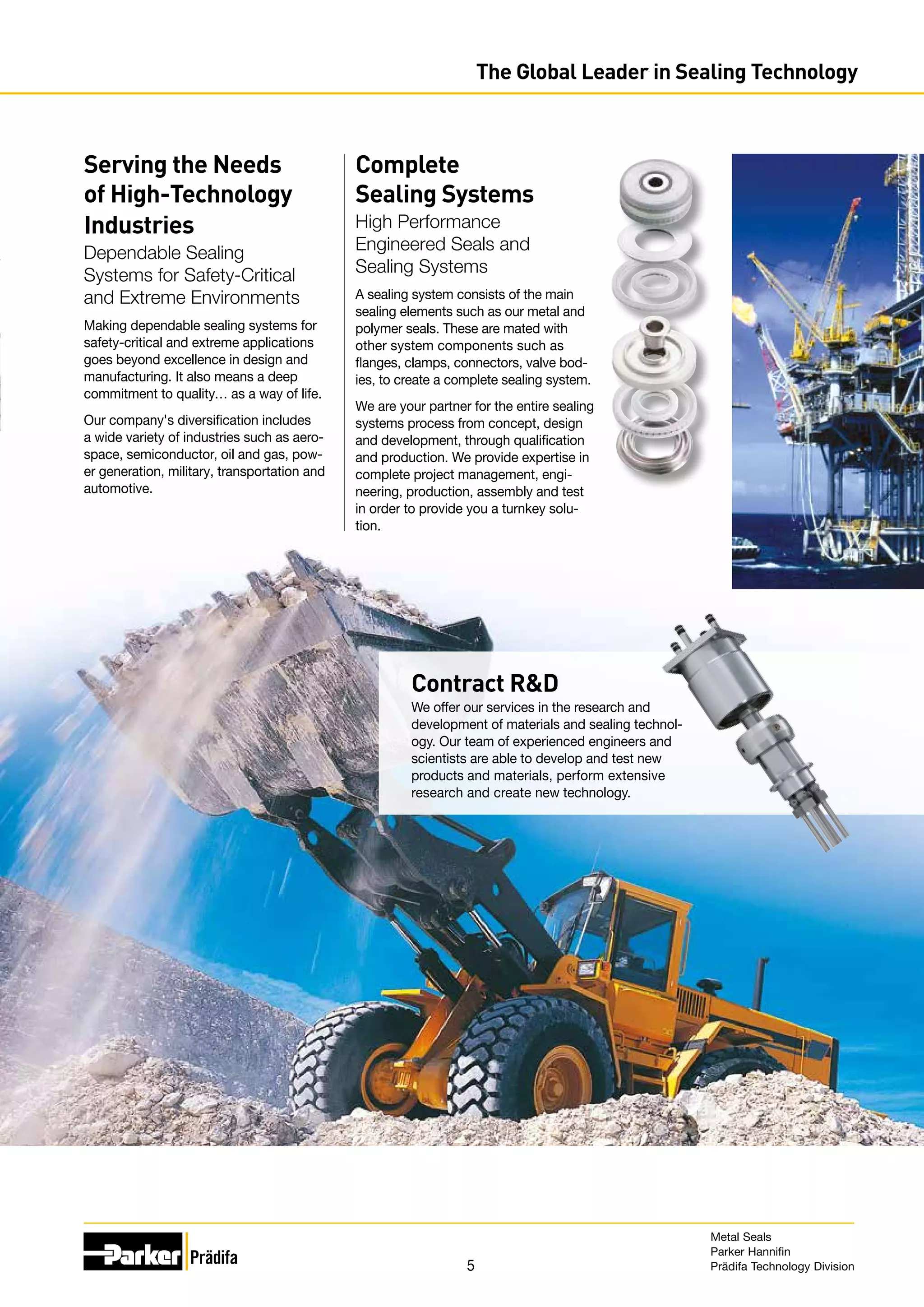
Making dependable sealing systems for
safety-critical and extreme applications
goes beyond excellence in design and
manufacturing. It also means a deep
commitment to quality… as a way of life.
Our company's diversification includes
a wide variety of industries such as aero-
space, semiconductor, oil and gas, pow-
er generation, military, transportation and
automotive.
Complete
Sealing Systems
High Performance
Engineered Seals and
Sealing Systems
A sealing system consists of the main
sealing elements such as our metal and
polymer seals. These are mated with
other system components such as
flanges, clamps, connectors, valve bod-
ies, to create a complete sealing system.
We are your partner for the entire sealing
systems process from concept, design
and development, through qualification
and production. We provide expertise in
complete project management, engi-
neering, production, assembly and test
in order to provide you a turnkey solu-
tion.
Metal Seals
Parker Hannifin
Prädifa Technology Division
6
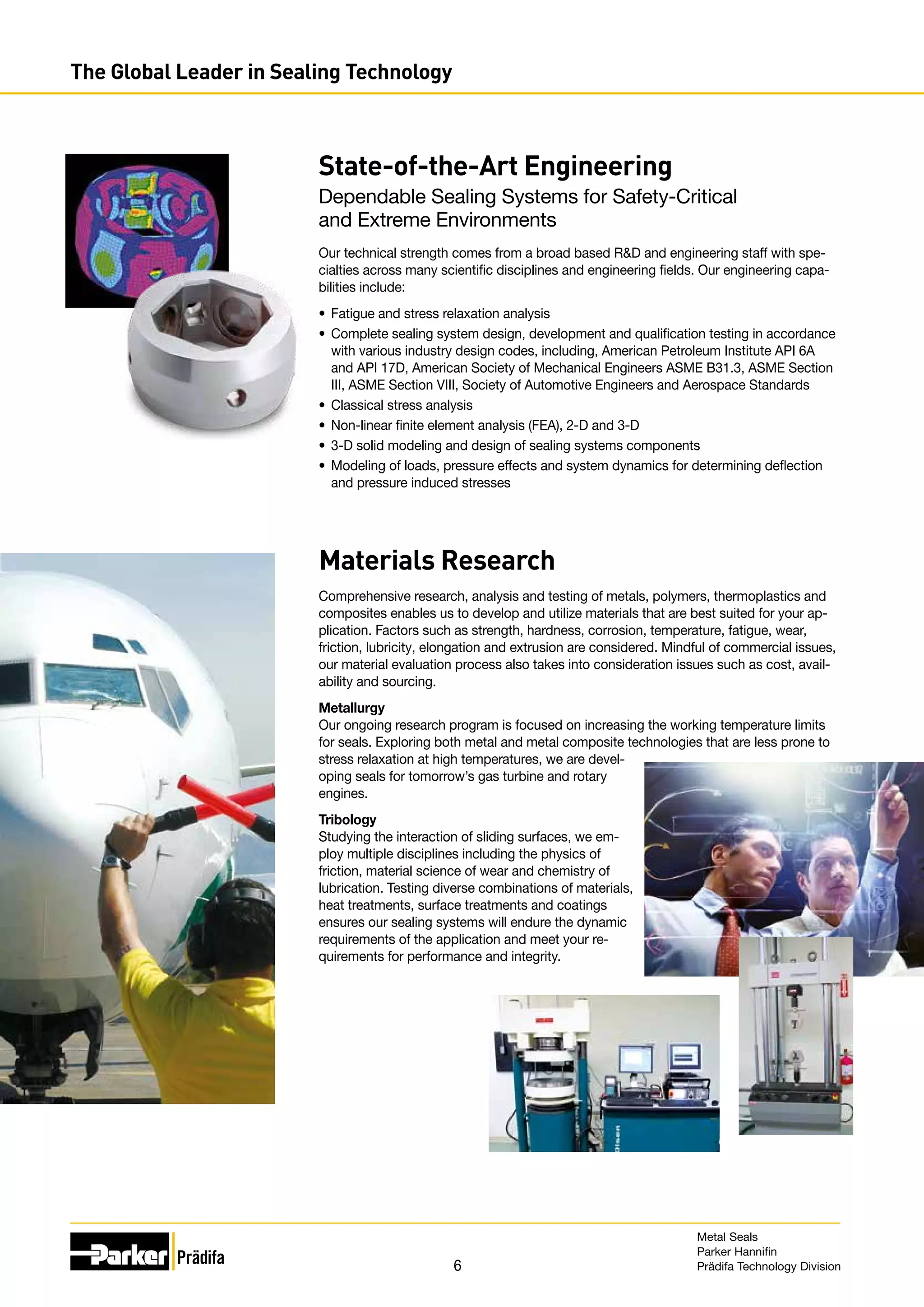
State-of-the-Art Engineering
Dependable Sealing Systems for Safety-Critical
and Extreme Environments
Our technical strength comes from a broad based RD and engineering staff with spe-
cialties across many scientific disciplines and engineering fields. Our engineering capa-
bilities include:
•	 Fatigue and stress relaxation analysis
•	 Complete sealing system design, development and qualification testing in accordance
with various industry design codes, including, American Petroleum Institute API 6A
and API 17D, American Society of Mechanical Engineers ASME B31.3, ASME Section
III, ASME Section VIII, Society of Automotive Engineers and Aerospace Standards
•	 Classical stress analysis
•	 Non-linear finite element analysis (FEA), 2-D and 3-D
•	 3-D solid modeling and design of sealing systems components
•	 Modeling of loads, pressure effects and system dynamics for determining deflection
and pressure induced stresses
Materials Research
Comprehensive research, analysis and testing of metals, polymers, thermoplastics and
composites enables us to develop and utilize materials that are best suited for your ap-
plication. Factors such as strength, hardness, corrosion, temperature, fatigue, wear,
friction, lubricity, elongation and extrusion are considered. Mindful of commercial issues,
our material evaluation process also takes into consideration issues such as cost, avail-
ability and sourcing.
Metallurgy
Our ongoing research program is focused on increasing the working temperature limits
for seals. Exploring both metal and metal composite technologies that are less prone to
stress relaxation at high temperatures, we are devel-
oping seals for tomorrow’s gas turbine and rotary
engines.
Tribology
Studying the interaction of sliding surfaces, we em-
ploy multiple disciplines including the physics of
friction, material science of wear and chemistry of
lubrication. Testing diverse combinations of materials,
heat treatments, surface treatments and coatings
ensures our sealing systems will endure the dynamic
requirements of the application and meet your re-
quirements for performance and integrity.
The Global Leader in Sealing Technology
Metal Seals
Parker Hannifin
Prädifa Technology Division
7
Manufacturing Technologies
Our core manufacturing technologies include metal roll and die forming, various fusion
weld methods, CNC machining of metals, polymers and thermoplastics, vacuum heat
treatment and electroplating. Production engineering skills include CAE development of
roll and die forming tools, as well as the design and development of specialized forming
machines and proprietary welding processes.
Test Capabilities
An important part of the development process
of a sealing system is the rigorous testing of
the new design. We perform comprehensive
qualification testing of the sealing systems as
well as 100 % functional testing of production
units prior to delivery if desired.
Our extensive testing capabilities include:
•	 Pressure testing: 10-5
torr to 140 MPa (20,000 psi)
•	 Helium mass spectroscopy leakage testing: 10-11
mbar × liter/sec
•	 Temperature range: Cryogenic to 982 °C (1800 °F)
•	 High cycle fatigue testing
•	 Dynamic wear, friction and torque testing
•	 Extrusion testing
•	 Load versus deflection seal testing and measurement
We are also able to design elaborate test fixtures and equipment to meet the testing and
functional requirements of your unique sealing system. When necessary, we collaborate
with outside test facilities, universities, and our customer’s own engineering depart-
ments and laboratories for specialized performance and qualification testing.
Total Project Management –
Budgeting, Scheduling  Planning
The Key to Successful Projects
Every Parker sealing system is treated with a complete project management approach
to ensure all aspects of the program run smoothly, efficiently and in strict adherence to
your schedule requirements. The project manager is your single point contact; however,
you also have access to our engineering staff throughout the program.
Our project manager develops a comprehensive program schedule identifying all project
milestones and the “critical path”. The project manager then coordinates the responsibil-
ities of all functional teams including engineering, manufacturing, purchasing and quality
control ensuring all tasks are performed on time. We believe the philosophy of a
dedicated project manager is key to the success of the program.
The Global Leader in Sealing Technology
Metal Seals
Parker Hannifin
Prädifa Technology Division
8
The Global Leader in Sealing Technology
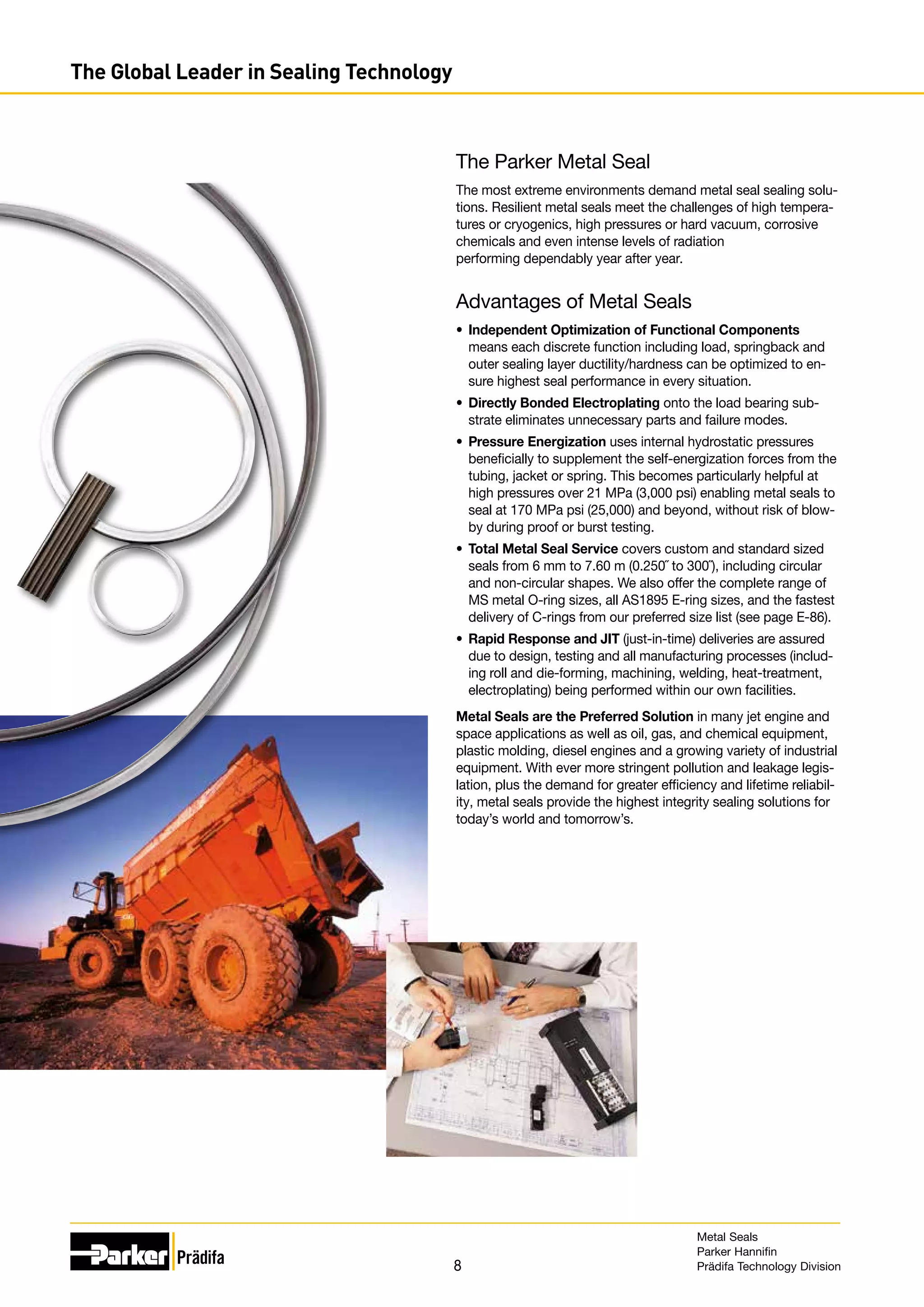
The Parker Metal Seal
The most extreme environments demand metal seal sealing solu-
tions. Resilient metal seals meet the challenges of high tempera-
tures or cryogenics, high pressures or hard vacuum, corrosive
chemicals and even intense levels of radiation
performing dependably year after year.
Advantages of Metal Seals
•	 Independent Optimization of Functional Components
means each discrete function including load, springback and
outer sealing layer ductility/hardness can be optimized to en-
sure highest seal performance in every situation.
•	 Directly Bonded Electroplating onto the load bearing sub-
strate eliminates unnecessary parts and failure modes.
•	 Pressure Energization uses internal hydrostatic pressures
beneficially to supplement the self-energization forces from the
tubing, jacket or spring. This becomes particularly helpful at
high pressures over 21 MPa (3,000 psi) enabling metal seals to
seal at 170 MPa psi (25,000) and beyond, without risk of blow-
by during proof or burst testing.
•	 Total Metal Seal Service covers custom and standard sized
seals from 6 mm to 7.60 m (0.250˝ to 300˝), including circular
and non-circular shapes. We also offer the complete range of
MS metal O-ring sizes, all AS1895 E-ring sizes, and the fastest
delivery of C-rings from our preferred size list (see page E-86).
•	 Rapid Response and JIT (just-in-time) deliveries are assured
due to design, testing and all manufacturing processes (includ-
ing roll and die-forming, machining, welding, heat-treatment,
electroplating) being performed within our own facilities.
Metal Seals are the Preferred Solution in many jet engine and
space applications as well as oil, gas, and chemical equipment,
plastic molding, diesel engines and a growing variety of industrial
equipment. With ever more stringent pollution and leakage legis-
lation, plus the demand for greater efficiency and lifetime reliabil-
ity, metal seals provide the highest integrity sealing solutions for
today’s world and tomorrow’s.
Metal Seals
Parker Hannifin
Prädifa Technology Division
9
Section A – General Information
This design guide provides a rapid, unambiguous, self-selection process with all the features, appli-
cations and limitations of each product clearly stated. The guide is organized into sections which
easily allows you to determine the part number of the metal seal that is right for your application.
Section B helps you to determine which metal seal type is most appropriate for
your application.
Section C is organized by metal seal type. Having selected the best metal seal type
from Section B, simply turn to the page in Section C for the seal selected
and you will find all the groove and metal seal dimensions you need.
Section D lists the many available metal seal materials and assists you in
determining which combination of materials is most appropriate for
your sealing environment.
Section E provides supporting technical information and recommendations.
Section F shows a number of other metal seal designs which are available
for unique applications when only a special seal will do. In these
cases, please contact one of our applications engineers at any of our
worldwide offices and we will be happy to assist you. Please send us your
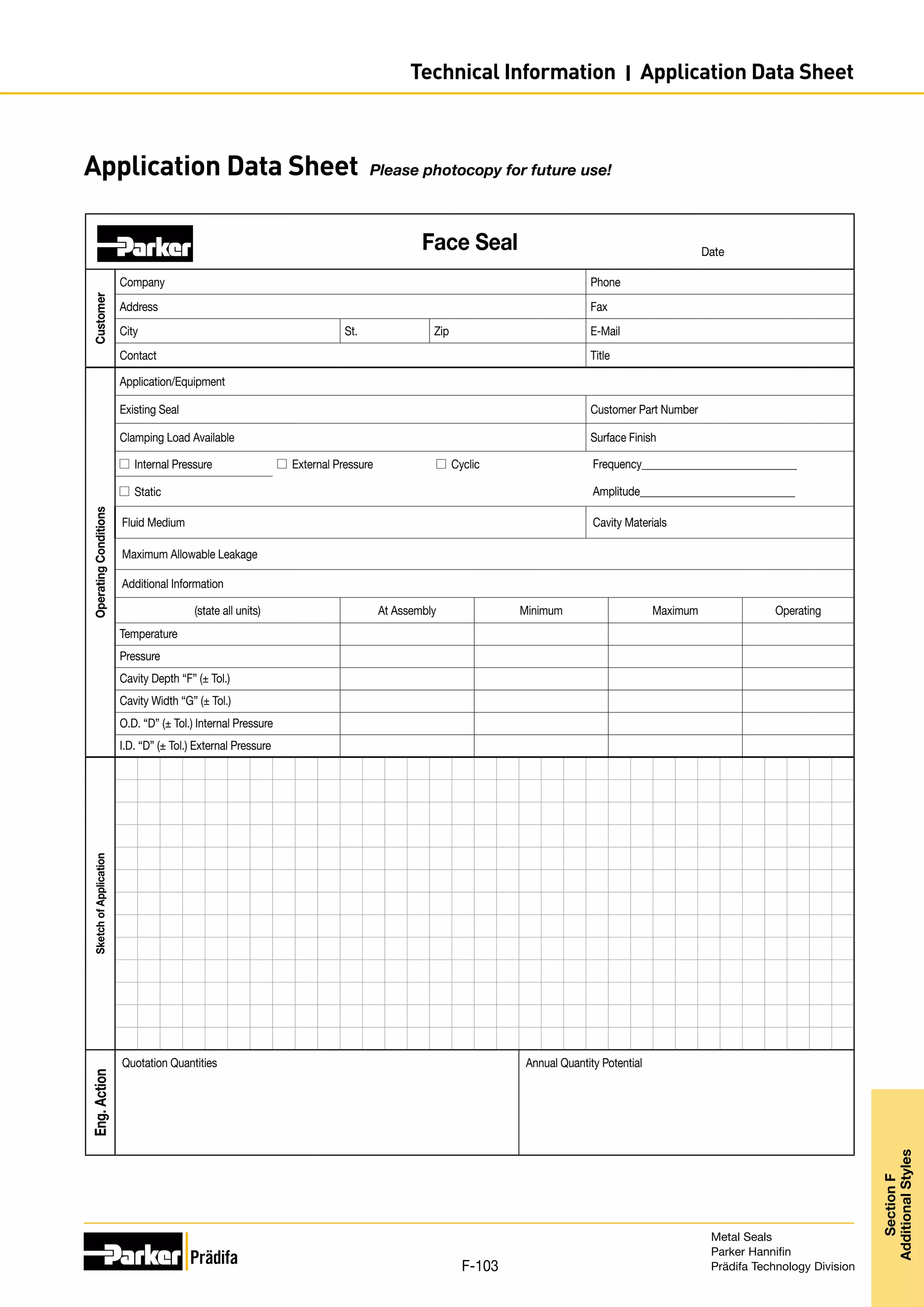
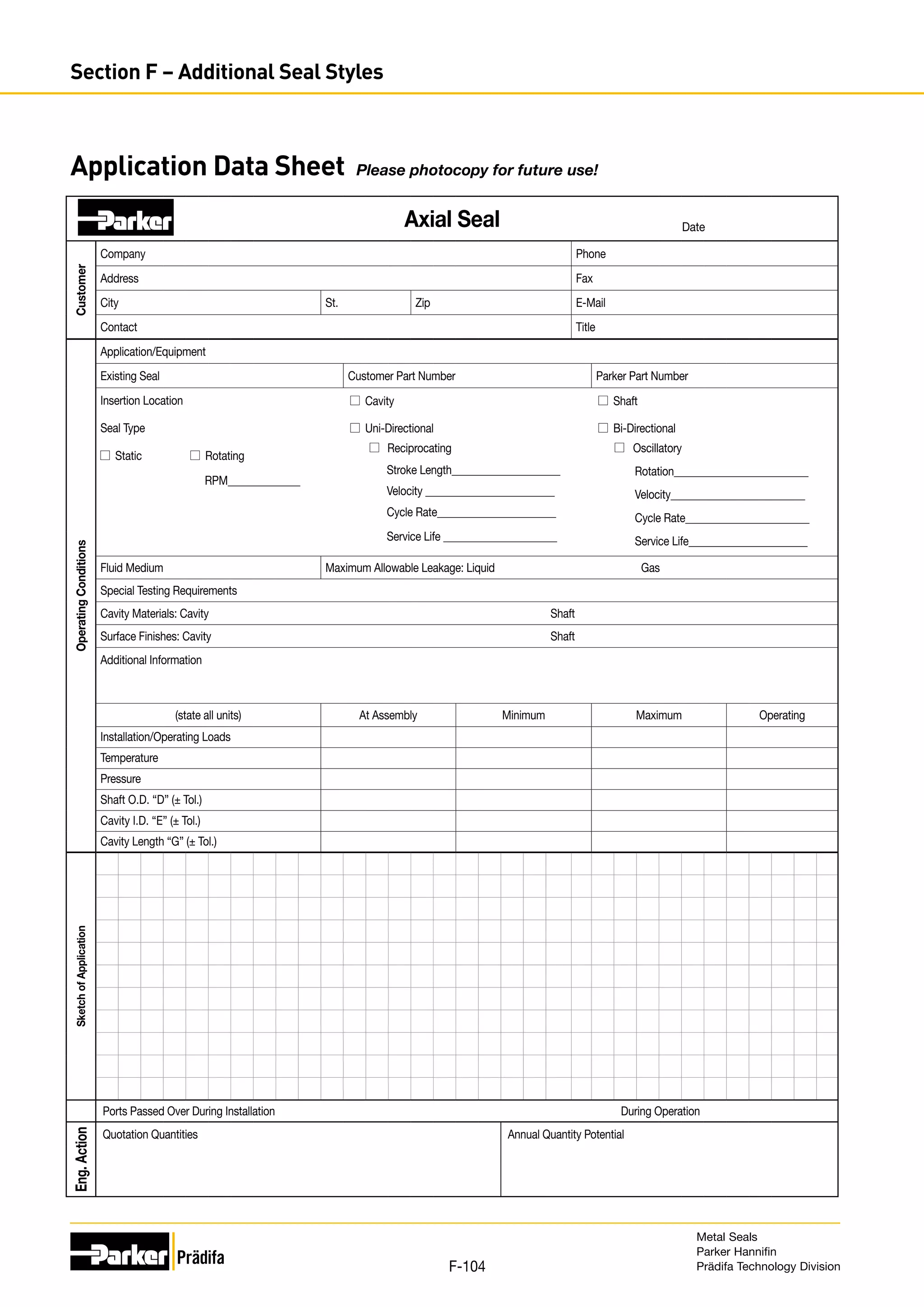
application data sheet (Page F-103  F-104) for a fast, complete re-
sponse.
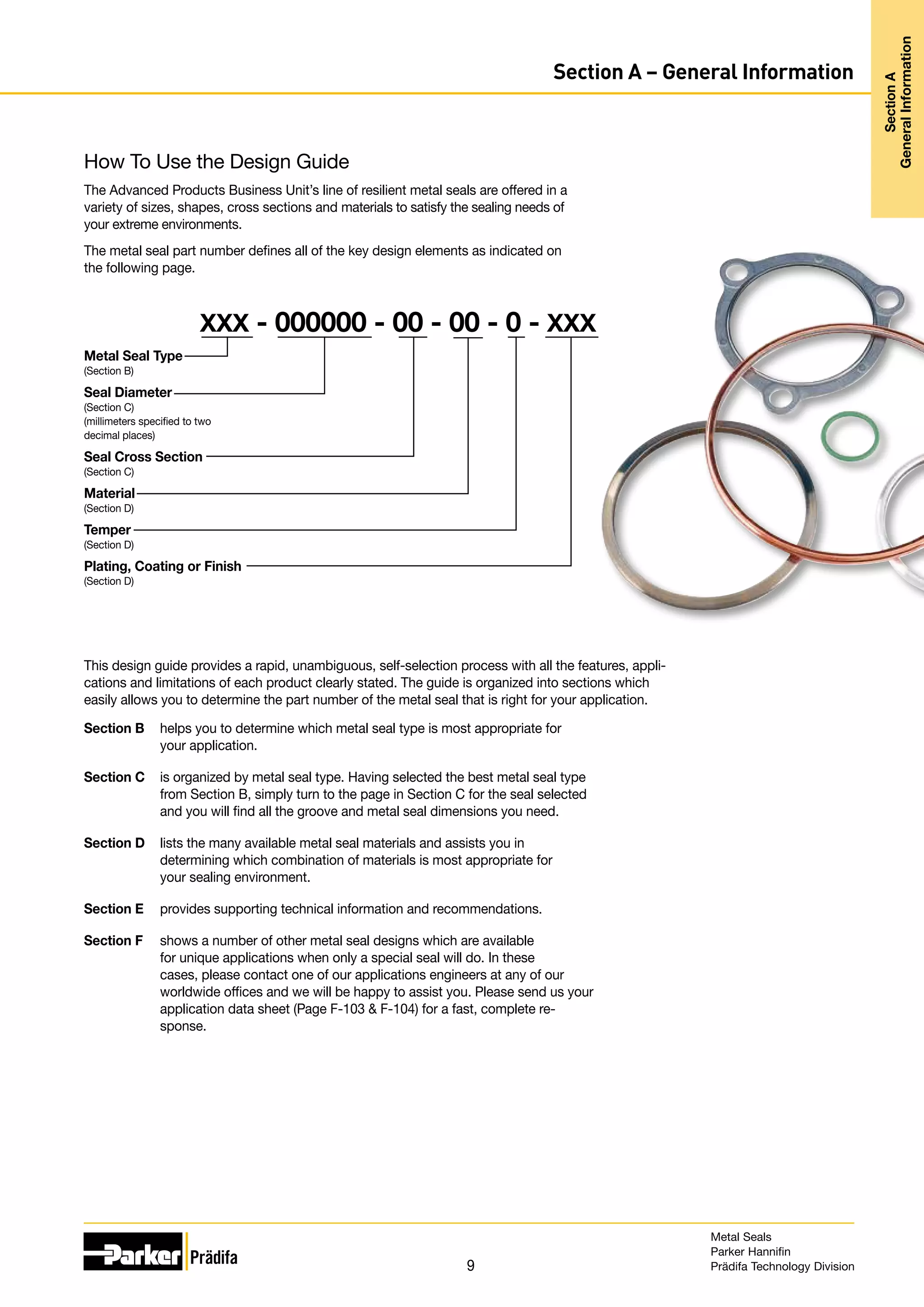
Metal Seal Type
(Section B)
Seal Diameter
(Section C)
(millimeters specified to two
decimal places)
Seal Cross Section
(Section C)
Material
(Section D)
Temper
(Section D)
Plating, Coating or Finish
(Section D)
XXX - 000000 - 00 - 00 - 0 - XXX
How To Use the Design Guide
The Advanced Products Business Unit’s line of resilient metal seals are offered in a
variety of sizes, shapes, cross sections and materials to satisfy the sealing needs of
your extreme environments.
The metal seal part number defines all of the key design elements as indicated on
the following page.
Metal Seals
Parker Hannifin
Prädifa Technology Division
Section
A
General
Information
Section
A
General
Information
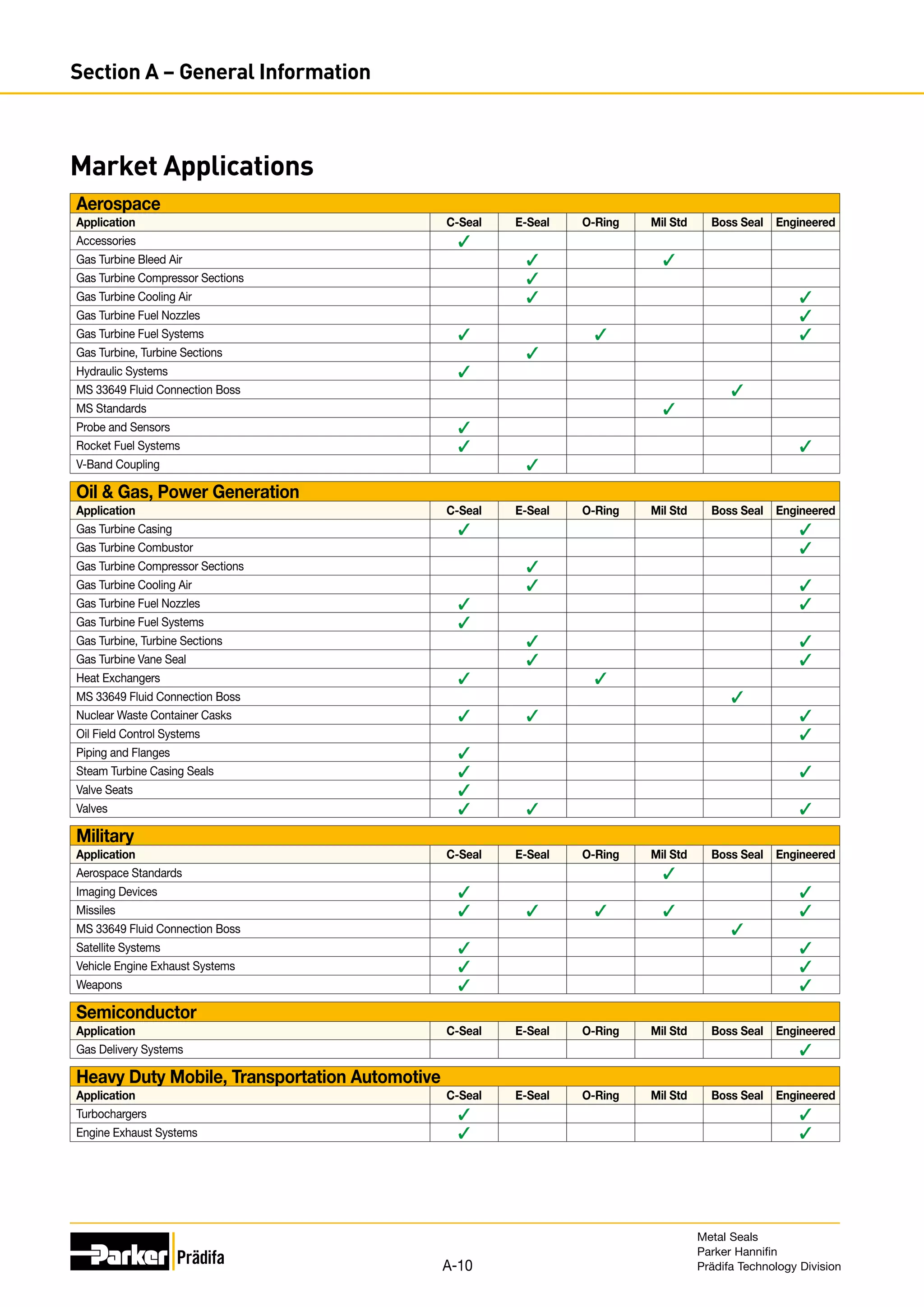
Market Applications
Aerospace
Application C-Seal E-Seal O-Ring Mil Std Boss Seal Engineered
Accessories
Gas Turbine Bleed Air
Gas Turbine Compressor Sections
Gas Turbine Cooling Air
Gas Turbine Fuel Nozzles
Gas Turbine Fuel Systems
Gas Turbine, Turbine Sections
Hydraulic Systems
MS 33649 Fluid Connection Boss
MS Standards
Probe and Sensors
Rocket Fuel Systems
V-Band Coupling
Oil  Gas, Power Generation
Application C-Seal E-Seal O-Ring Mil Std Boss Seal Engineered
Gas Turbine Casing
Gas Turbine Combustor
Gas Turbine Compressor Sections
Gas Turbine Cooling Air
Gas Turbine Fuel Nozzles
Gas Turbine Fuel Systems
Gas Turbine, Turbine Sections
Gas Turbine Vane Seal
Heat Exchangers
MS 33649 Fluid Connection Boss
Nuclear Waste Container Casks
Oil Field Control Systems
Piping and Flanges
Steam Turbine Casing Seals
Valve Seats
Valves
Military
Application C-Seal E-Seal O-Ring Mil Std Boss Seal Engineered
Aerospace Standards
Imaging Devices
Missiles
MS 33649 Fluid Connection Boss
Satellite Systems
Vehicle Engine Exhaust Systems
Weapons
Semiconductor
Application C-Seal E-Seal O-Ring Mil Std Boss Seal Engineered
Gas Delivery Systems
Heavy Duty Mobile, Transportation Automotive
Application C-Seal E-Seal O-Ring Mil Std Boss Seal Engineered
Turbochargers
Engine Exhaust Systems
Metal Seals
Parker Hannifin
Prädifa Technology Division
A-10
Section A – General Information
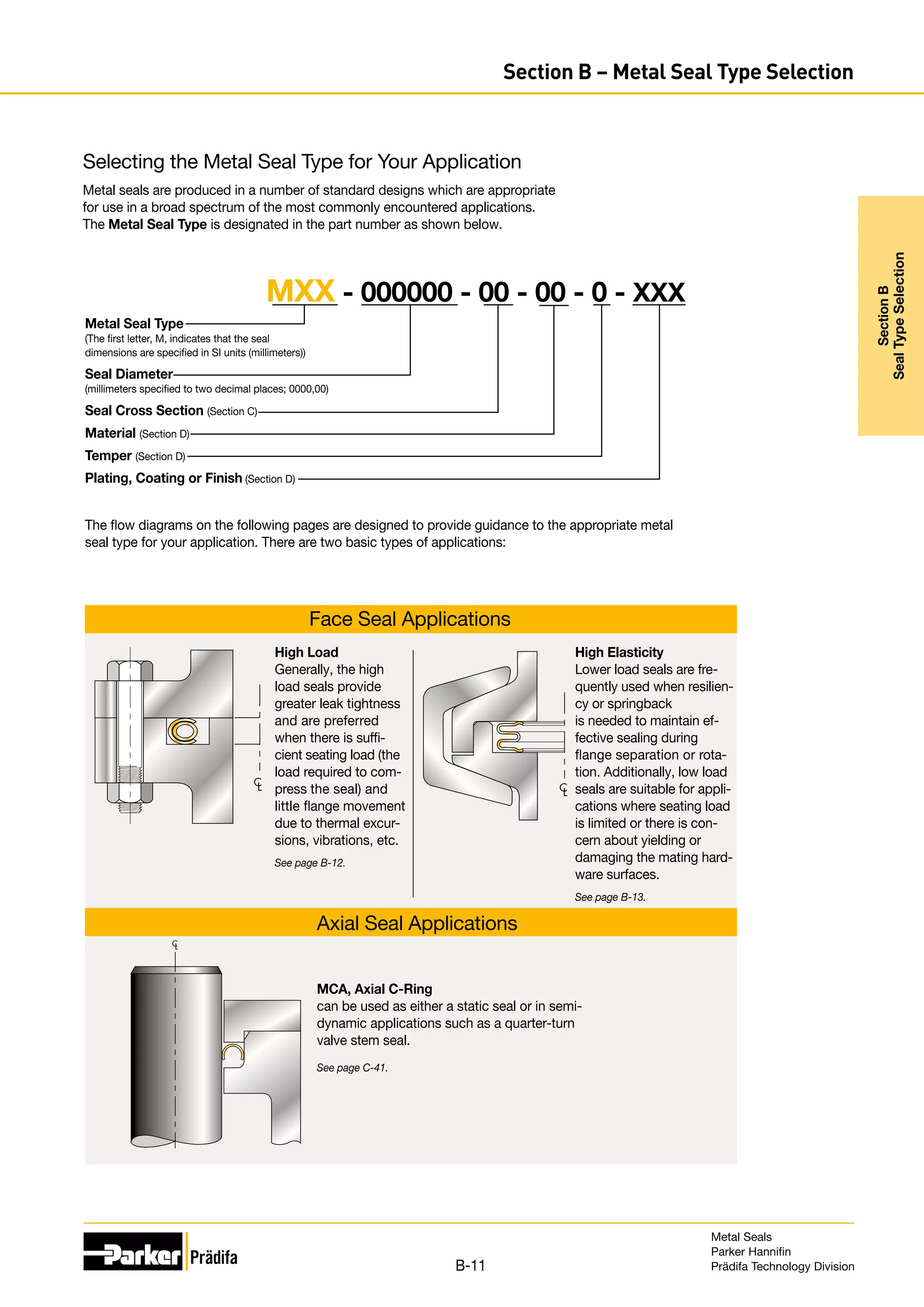
Selecting the Metal Seal Type for Your Application
Metal seals are produced in a number of standard designs which are appropriate
for use in a broad spectrum of the most commonly encountered applications.
The Metal Seal Type is designated in the part number as shown below.
High Load
Generally, the high
load seals provide
greater leak tightness
and are preferred
when there is suffi-
cient seating load (the
load required to com-
press the seal) and
little flange movement
due to thermal excur-
sions, vibrations, etc.
See page B-12.
The flow diagrams on the following pages are designed to provide guidance to the appropriate metal
seal type for your application. There are two basic types of applications:
Metal Seal Type
(The first letter, M, indicates that the seal
dimensions are specified in SI units (millimeters))
Seal Diameter
(millimeters specified to two decimal places; 0000,00)
Seal Cross Section (Section C)
Material (Section D)
Temper (Section D)
Plating, Coating or Finish (Section D)
MXX - 000000 - 00 - 00 - 0 - XXX
Face Seal Applications
High Elasticity
Lower load seals are fre-
quently used when resilien-
cy or springback
is needed to maintain ef-
fective sealing during
flange separation or rota-
tion. Additionally, low load
seals are suitable for appli-
cations where seating load
is limited or there is con-
cern about yielding or
damaging the mating hard-
ware surfaces.
See page B-13.
C
L
C
L
Axial Seal Applications
MCA, Axial C-Ring
can be used as either a static seal or in semi-
dynamic applications such as a quarter-turn
valve stem seal.
See page C-41.
C
L
Metal Seals
Parker Hannifin
Prädifa Technology Division
B-11
Section B – Metal Seal Type Selection
Section
B
Seal
Type
Selection
Surface
Roughness
Internal
Pressure
Direction
External
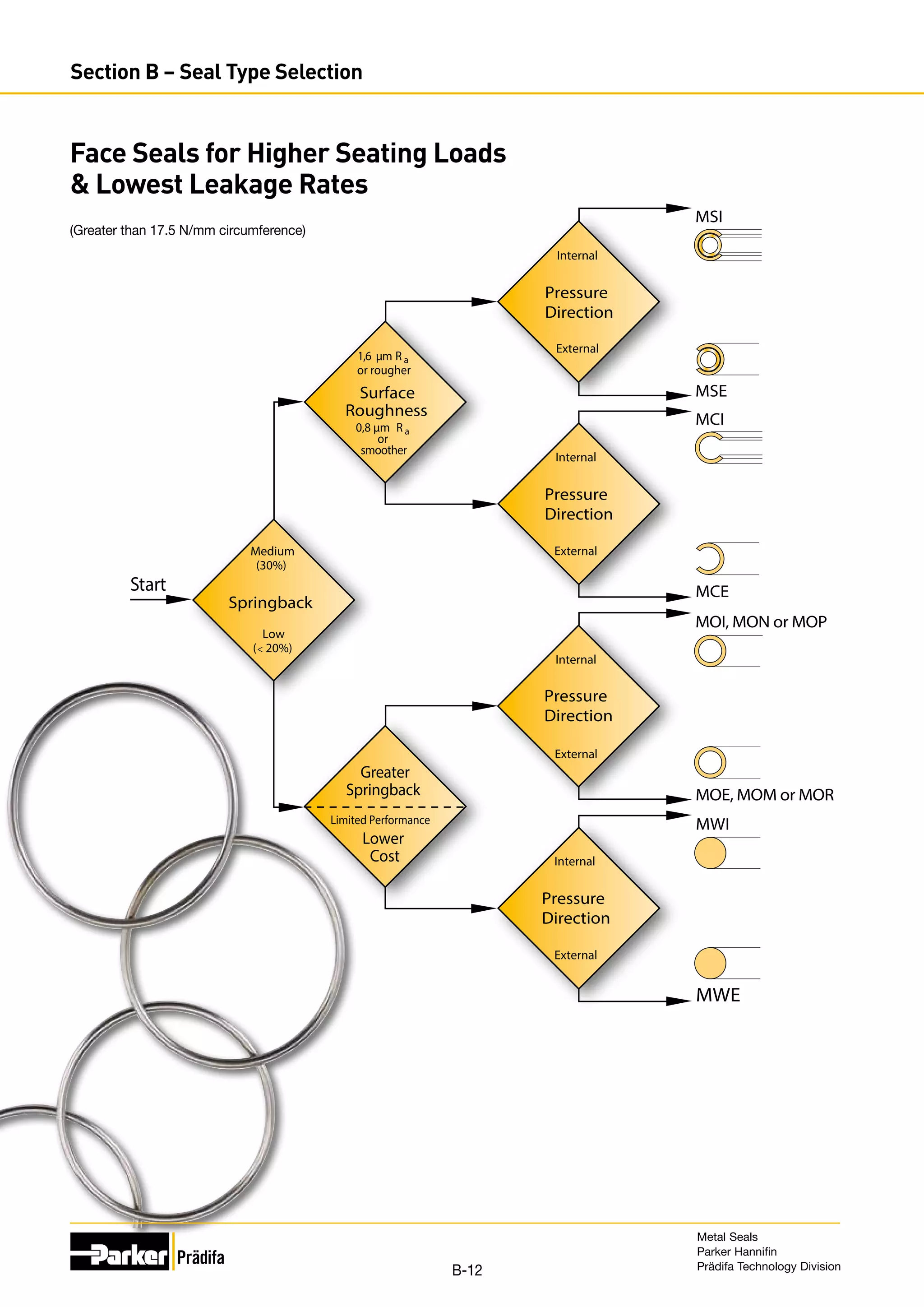
MSI
MCI
MCE
MSE
MOI, MON or MOP
MWI
MWE
MOE, MOM or MOR
Springback
Greater
Springback
Lower
Cost
1,6 µm R a
or rougher
0,8 µm R a
or
smoother
Medium
(30%)
Low
( 20%)
Start
Internal
Pressure
Direction
External
Internal
Pressure
Direction
External
Internal
Pressure
Direction
External
Limited Performance
Face Seals for Higher Seating Loads
 Lowest Leakage Rates
(Greater than 17.5 N/mm circumference)
B-12
Metal Seals
Parker Hannifin
Prädifa Technology Division
Section B – Seal Type Selection
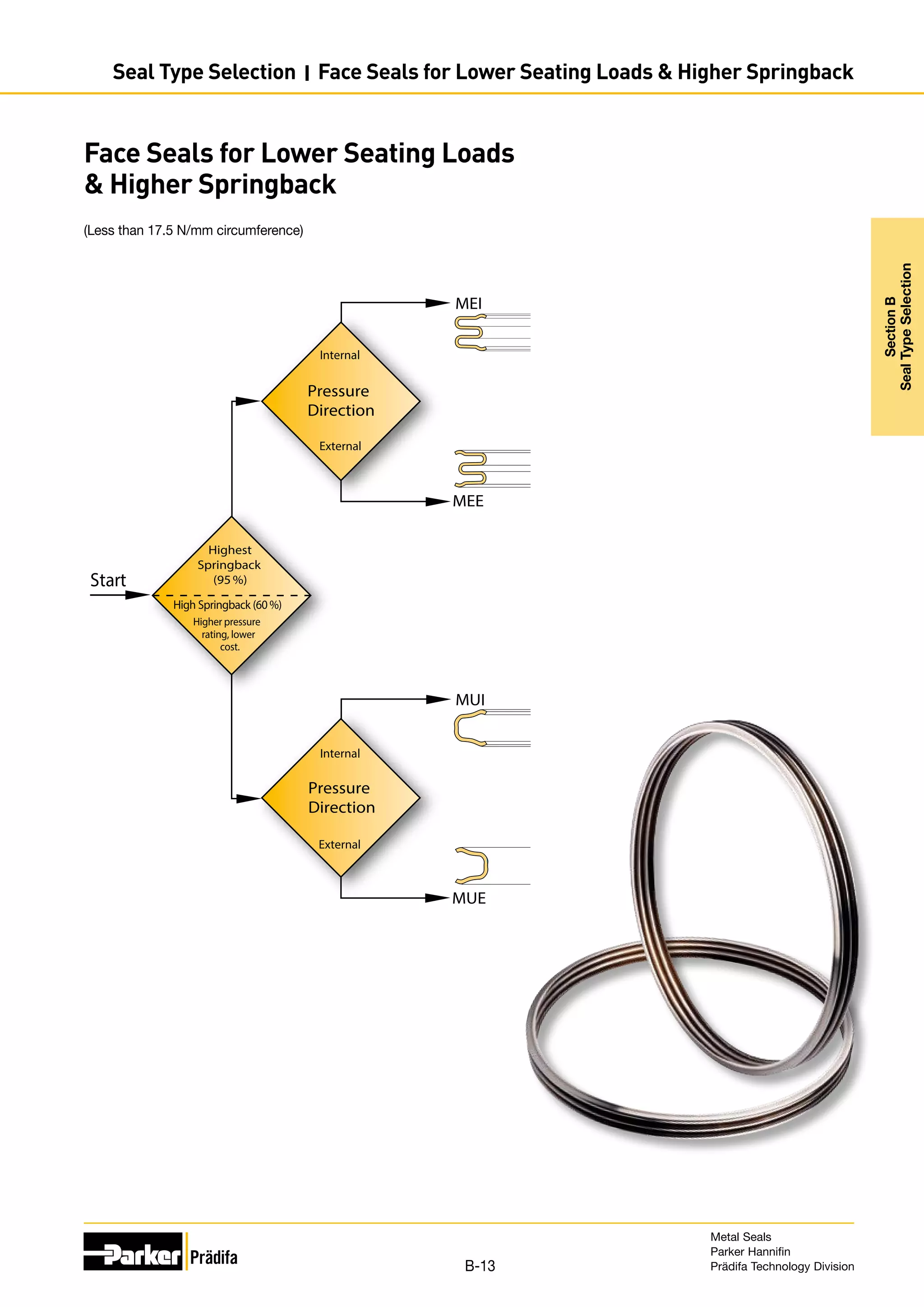
MEI
MUI
MEE
MUE
Highest
Springback
(95 %)
High Springback (60%)
Higher pressure
rating, lower
cost.
Internal
Pressure
Direction
External
Internal
Pressure
Direction
External
Start
Face Seals for Lower Seating Loads
 Higher Springback
(Less than 17.5 N/mm circumference)
B-13
Metal Seals
Parker Hannifin
Prädifa Technology Division
Section
B
Seal
Type
Selection
Seal Type Selection I Face Seals for Lower Seating Loads  Higher Springback
Section
B
Seal
Type
Selection
Seal Type Sealing Requirements
High Springback Low Load High Load Low Leak Rate Pressure
Capability
Low Cost
Metal C-Ring
Metal E-Ring
Metal O-Ring
Metal U-Ring
Metal Wire Ring
Spring Energized C-Ring
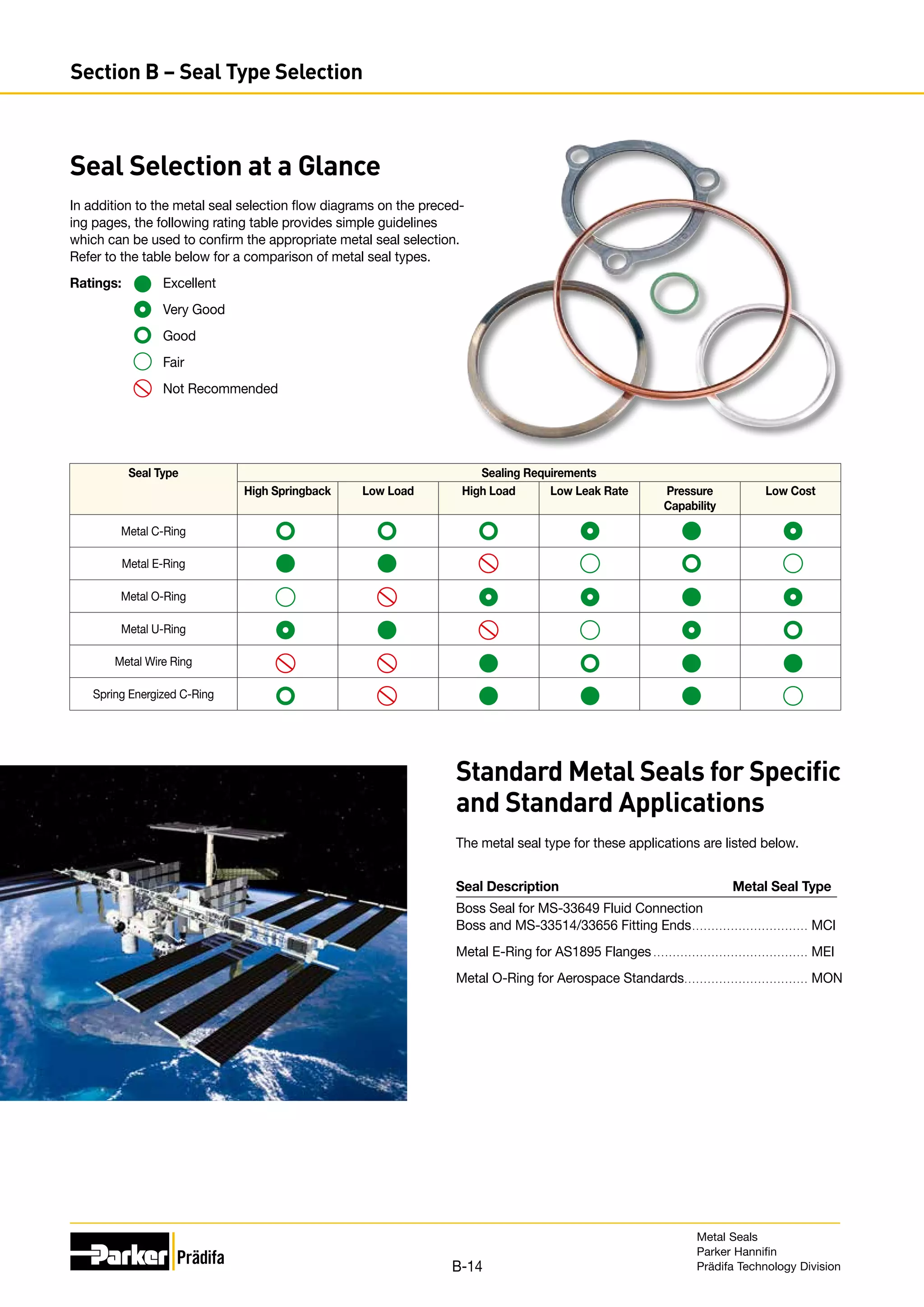
In addition to the metal seal selection flow diagrams on the preced-
ing pages, the following rating table provides simple guidelines
which can be used to confirm the appropriate metal seal selection.
Refer to the table below for a comparison of metal seal types.
Ratings:	Excellent
	 Very Good
	Good
	Fair
	 Not Recommended
Standard Metal Seals for Specific
and Standard Applications
The metal seal type for these applications are listed below.
	
Seal Description	 Metal Seal Type
Boss Seal for MS-33649 Fluid Connection
Boss and MS-33514/33656 Fitting Ends.. . . . . . . . . . . . . . . . . . . . . . . . . . . . . . MCI
Metal E-Ring for AS1895 Flanges. . . . . . . . . . . . . . . . . . . . . . . . . . . . . . . . . . . . . . . . . MEI
Metal O-Ring for Aerospace Standards.. . . . . . . . . . . . . . . . . . . . . . . . . . . . . . . . MON
Seal Selection at a Glance
Metal Seals
Parker Hannifin
Prädifa Technology Division
B-14
Section B – Seal Type Selection
Refer to the page of the metal seal type selected for your application to determine the appropriate
seal diameter, cross section and cavity dimensions. Cavity, seal dimensions and seal performance
data for the standard metal seals can be found on the following pages:
Seal Type	 Seal Description	 Page
Face Seals
MCI	 Metal C-Ring, External Pressure Face Seal.. . . . . . . . . . . . . . . . . . . . . . . . . . . . . . . . . . . . . . . . . . . . . . . . . C-16
MCE	 Metal C-Ring, External Pressure Face Seal.. . . . . . . . . . . . . . . . . . . . . . . . . . . . . . . . . . . . . . . . . . . . . . . . . C-18
MSI	 Spring Energized Metal C-Ring, Internal Pressure Face Seal. . . . . . . . . . . . . . . . . . . . . . . . C-20
MSE	 Spring Energized Metal C-Ring, External Pressure Face Seal. . . . . . . . . . . . . . . . . . . . . . . C-22
MEI	 Metal E-Ring, Internal Pressure Face Seal. . . . . . . . . . . . . . . . . . . . . . . . . . . . . . . . . . . . . . . . . . . . . . . . . . . C-24
MEE	 Metal E-Ring, External Pressure Face Seal. . . . . . . . . . . . . . . . . . . . . . . . . . . . . . . . . . . . . . . . . . . . . . . . . . C-26
MOI	 Metal O-Ring, I.D. Vented, Internal Pressure Face Seal. . . . . . . . . . . . . . . . . . . . . . . . . . . . . . . . C-28
MON	 Metal O-Ring, Plain, Internal Pressure Face Seal. . . . . . . . . . . . . . . . . . . . . . . . . . . . . . . . . . . . . . . . . C-28
MOP	 Metal O-Ring, Pressure Filled, Internal Pressure Face Seal.. . . . . . . . . . . . . . . . . . . . . . . . . . C-28
MOE	 Metal O-Ring, O.D. Vented, External Pressure Face Seal. . . . . . . . . . . . . . . . . . . . . . . . . . . . . C-30
MOM	 Metal O-Ring, Plain, External Pressure Face Seal. . . . . . . . . . . . . . . . . . . . . . . . . . . . . . . . . . . . . . . . C-30
MOR	 Metal O-Ring, Pressure Filled, External Pressure Face Seal.. . . . . . . . . . . . . . . . . . . . . . . . . C-30
MUI	 Metal U-Ring, Internal Pressure Face Seal.. . . . . . . . . . . . . . . . . . . . . . . . . . . . . . . . . . . . . . . . . . . . . . . . . . C-32
MUE	 Metal U-Ring, External Pressure Face Seal.. . . . . . . . . . . . . . . . . . . . . . . . . . . . . . . . . . . . . . . . . . . . . . . . . C-34
MWI	 Metal Wire Ring, Internal Pressure Face Seal. . . . . . . . . . . . . . . . . . . . . . . . . . . . . . . . . . . . . . . . . . . . . . . C-36
MWE	 Metal Wire Ring, External Pressure Face Seal.. . . . . . . . . . . . . . . . . . . . . . . . . . . . . . . . . . . . . . . . . . . . . C-38
Axial Seals
MCA	 Metal C-Ring, Axial Seal. . . . . . . . . . . . . . . . . . . . . . . . . . . . . . . . . . . . . . . . . . . . . . . . . . . . . . . . . . . . . . . . . . . . . . . . . . . . . C-40
Seals for Standard Applications
Boss Seal	 for MS-33649 Fluid Connection Boss and MS-33514/33656 Fitting Ends.C-42
Metal E-Ring 	 for AS1895 Flanges. . . . . . . . . . . . . . . . . . . . . . . . . . . . . . . . . . . . . . . . . . . . . . . . . . . . . . . . . . . . . . . . . . . . . . . . . . . . . . . . . . . . C-44
Metal O-Ring 	 for Aerospace Standards. . . . . . . . . . . . . . . . . . . . . . . . . . . . . . . . . . . . . . . . . . . . . . . . . . . . . . . . . . . . . . . . . . . . . . . . . . . . C-45
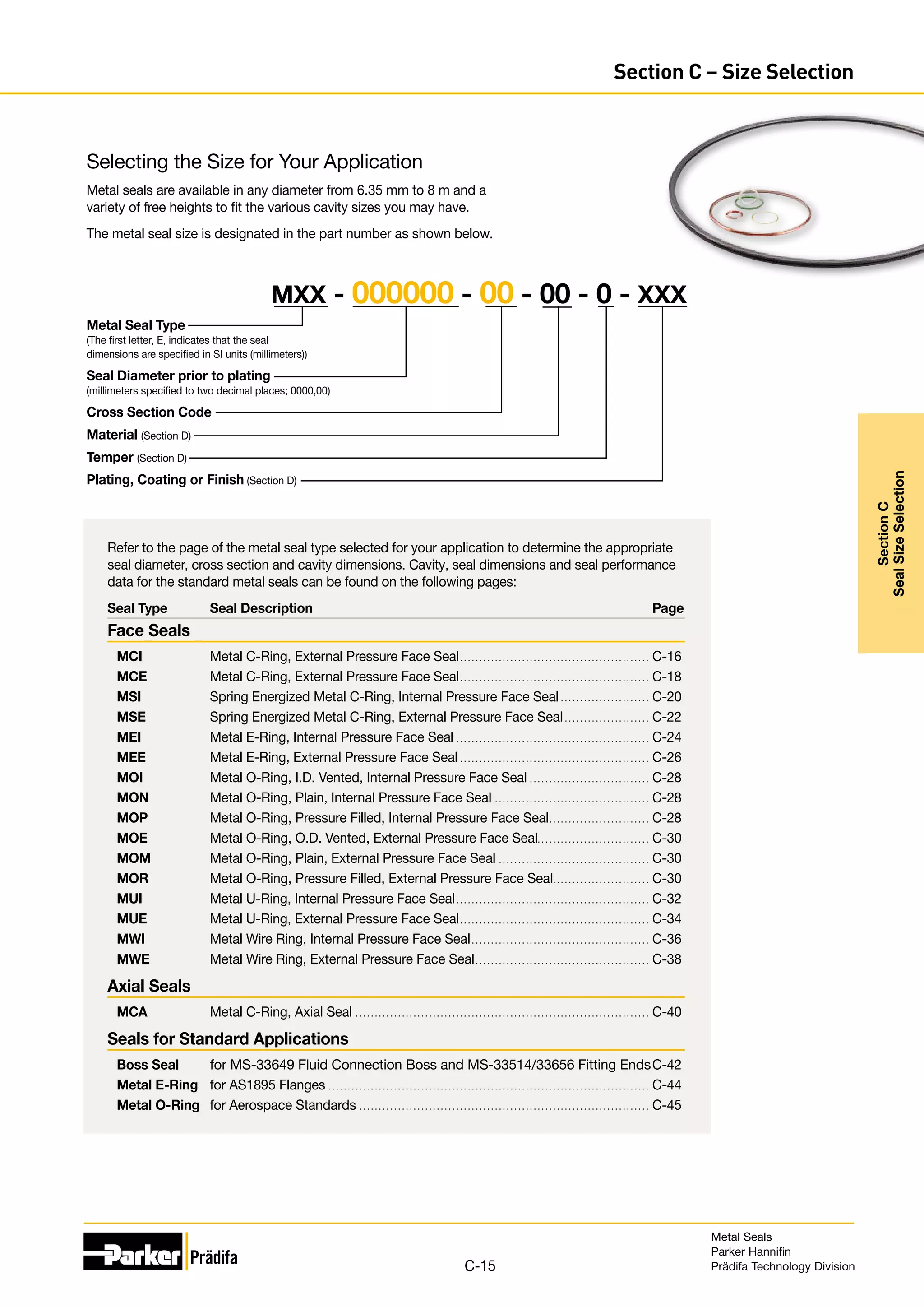
Selecting the Size for Your Application
Metal seals are available in any diameter from 6.35 mm to 8 m and a
variety of free heights to fit the various cavity sizes you may have.
The metal seal size is designated in the part number as shown below.
Metal Seal Type
(The first letter, E, indicates that the seal
dimensions are specified in SI units (millimeters))
Seal Diameter prior to plating
(millimeters specified to two decimal places; 0000,00)
Cross Section Code
Material (Section D)
Temper (Section D)
Plating, Coating or Finish (Section D)
MXX - 000000 - 00 - 00 - 0 - XXX
Metal Seals
Parker Hannifin
Prädifa Technology Division
C-15
Section
C
Seal
Size
Selection
Section C – Size Selection
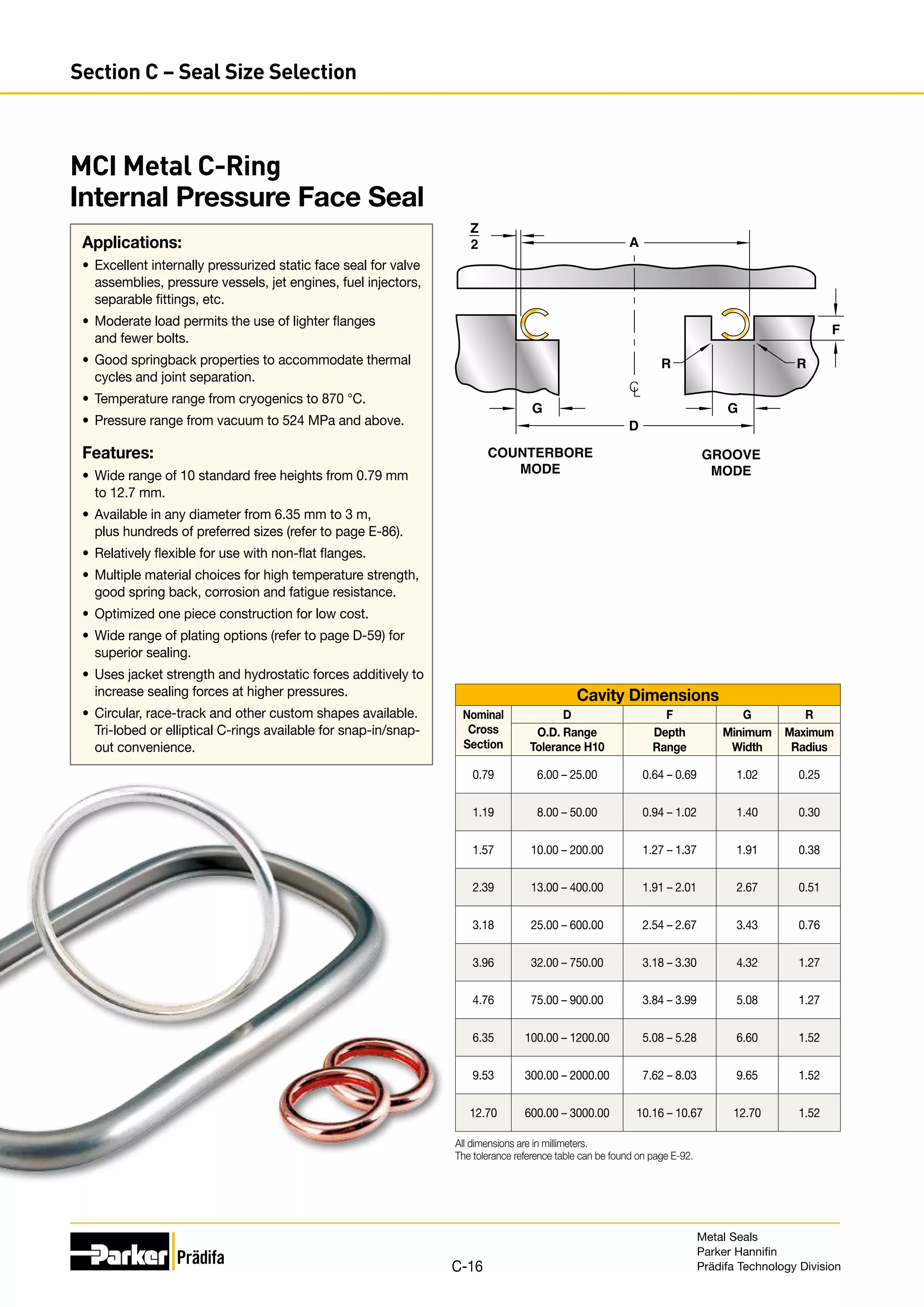
MCI Metal C-Ring
Internal Pressure Face Seal
Applications:
•	 Excellent internally pressurized static face seal for valve
assemblies, pressure vessels, jet engines, fuel injectors,
separable fittings, etc.
•	 Moderate load permits the use of lighter flanges
and fewer bolts.
•	 Good springback properties to accommodate thermal
cycles and joint separation.
•	 Temperature range from cryogenics to 870 °C.
•	 Pressure range from vacuum to 524 MPa and above.
Features:
•	 Wide range of 10 standard free heights from 0.79 mm
to 12.7 mm.
•	 Available in any diameter from 6.35 mm to 3 m,
plus hundreds of preferred sizes (refer to page E-86).
•	 Relatively flexible for use with non-flat flanges.
•	 Multiple material choices for high temperature strength,
good spring back, corrosion and fatigue resistance.
•	 Optimized one piece construction for low cost.
•	 Wide range of plating options (refer to page D-59) for
superior sealing.
•	 Uses jacket strength and hydrostatic forces additively to
increase sealing forces at higher pressures.
•	 Circular, race-track and other custom shapes available.
Tri-lobed or elliptical C-rings available for snap-in/snap-
out convenience.
Cavity Dimensions
Nominal
Cross
Section
D F G R
O.D. Range
Tolerance H10
Depth
Range
Minimum
Width
Maximum
Radius
0.79 6.00 – 25.00 0.64 – 0.69 1.02 0.25
1.19 8.00 – 50.00 0.94 – 1.02 1.40 0.30
1.57 10.00 – 200.00 1.27 – 1.37 1.91 0.38
2.39 13.00 – 400.00 1.91 – 2.01 2.67 0.51
3.18 25.00 – 600.00 2.54 – 2.67 3.43 0.76
3.96 32.00 – 750.00 3.18 – 3.30 4.32 1.27
4.76 75.00 – 900.00 3.84 – 3.99 5.08 1.27
6.35 100.00 – 1200.00 5.08 – 5.28 6.60 1.52
9.53 300.00 – 2000.00 7.62 – 8.03 9.65 1.52
12.70 600.00 – 3000.00 10.16 – 10.67 12.70 1.52
All dimensions are in millimeters.
The tolerance reference table can be found on page E-92.
D
A
R R
G
G
Z
2
COUNTERBORE
MODE
GROOVE
MODE
C
L
F
Metal Seals
Parker Hannifin
Prädifa Technology Division
C-16
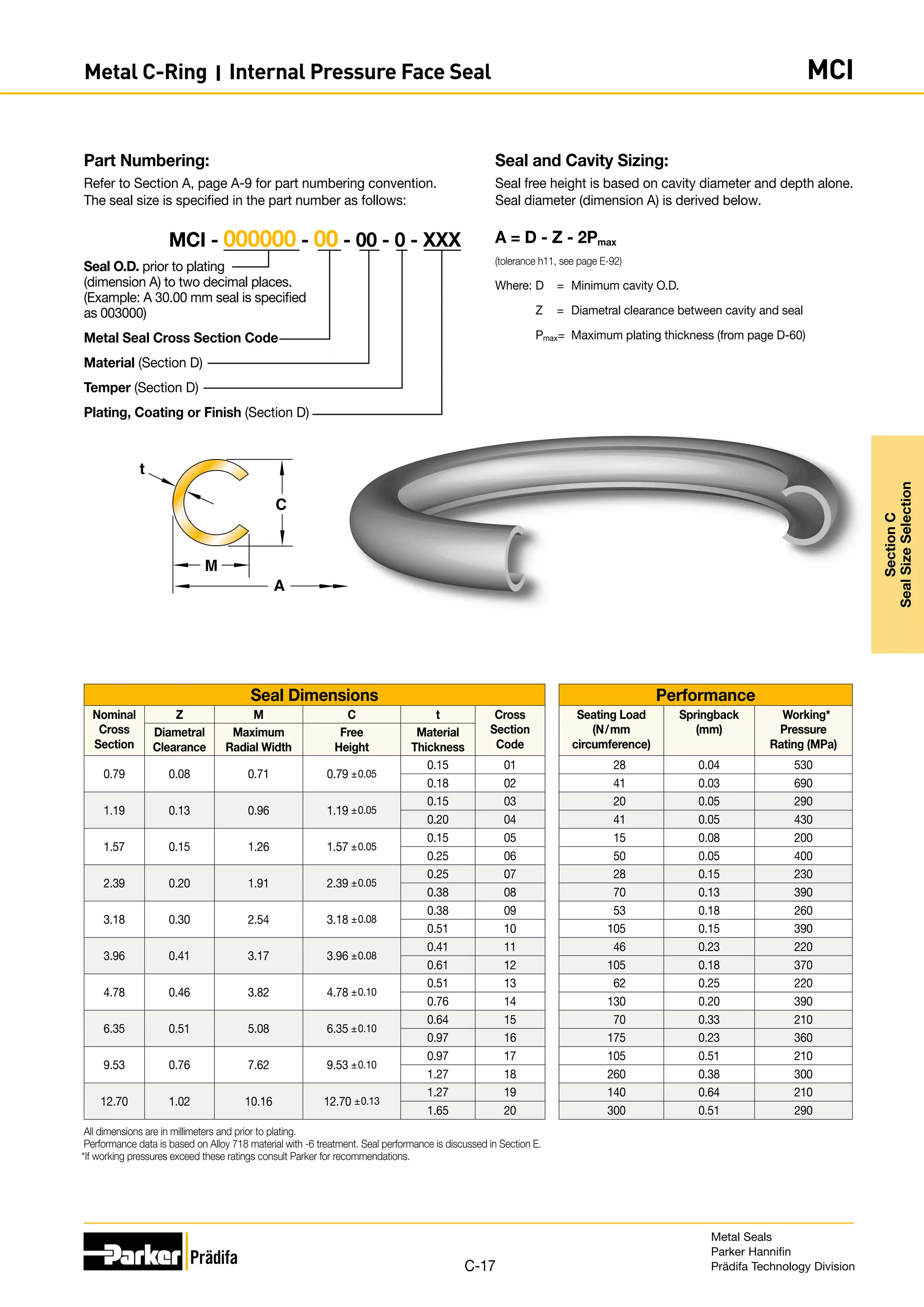
Section C – Seal Size Selection
Seal Dimensions Performance
Nominal
Cross
Section
Z M C t Cross
Section
Code
Seating Load
(N/mm
circumference)
Springback
(mm)
Working*
Pressure
Rating (MPa)
Diametral
Clearance
Maximum
Radial Width
Free
Height
Material
Thickness
0.79 0.08 0.71 0.79 ±0.05
0.15 01 28 0.04 530
0.18 02 41 0.03 690
1.19 0.13 0.96 1.19 ±0.05
0.15 03 20 0.05 290
0.20 04 41 0.05 430
1.57 0.15 1.26 1.57 ±0.05
0.15 05 15 0.08 200
0.25 06 50 0.05 400
2.39 0.20 1.91 2.39 ±0.05
0.25 07 28 0.15 230
0.38 08 70 0.13 390
3.18 0.30 2.54 3.18 ±0.08
0.38 09 53 0.18 260
0.51 10 105 0.15 390
3.96 0.41 3.17 3.96 ±0.08
0.41 11 46 0.23 220
0.61 12 105 0.18 370
4.78 ­0.46 3.82 4.78 ±0.10
0.51 13 62 0.25 220
0.76 14 130 0.20 390
6.35 0.51 5.08 6.35 ±0.10
0.64 15 70 0.33 210
0.97 16 175 0.23 360
9.53 0.76 7.62 9.53 ±0.10
0.97 17 105 0.51 210
1.27 18 260 0.38 300
12.70 1.02 10.16 12.70 ±0.13
1.27 19 140 0.64 210
1.65 20 300 0.51 290
All dimensions are in millimeters and prior to plating.
Performance data is based on Alloy 718 material with -6 treatment. Seal performance is discussed in Section E.
*If working pressures exceed these ratings consult Parker for recommendations.
t
A
M
C
Seal and Cavity Sizing:
Seal free height is based on cavity diameter and depth alone.
Seal diameter (dimension A) is derived below.
A = D - Z - 2Pmax
(tolerance h11, see page E-92)
Where:	D	 =	 Minimum cavity O.D.
	 Z	 =	 Diametral clearance between cavity and seal
	Pmax	
=	 Maximum plating thickness (from page D-60)
Part Numbering:
Refer to Section A, page A-9 for part numbering convention.
The seal size is specified in the part number as follows:
Seal O.D. prior to plating
(dimension A) to two decimal places.
(Example: A 30.00 mm seal is specified
as 003000)
Metal Seal Cross Section Code
Material (Section D)
Temper (Section D)
Plating, Coating or Finish (Section D)
MCI - 000000 - 00 - 00 - 0 - XXX
Metal Seals
Parker Hannifin
Prädifa Technology Division
C-17
Section
C
Seal
Size
Selection
Metal C-Ring I Internal Pressure Face Seal MCI
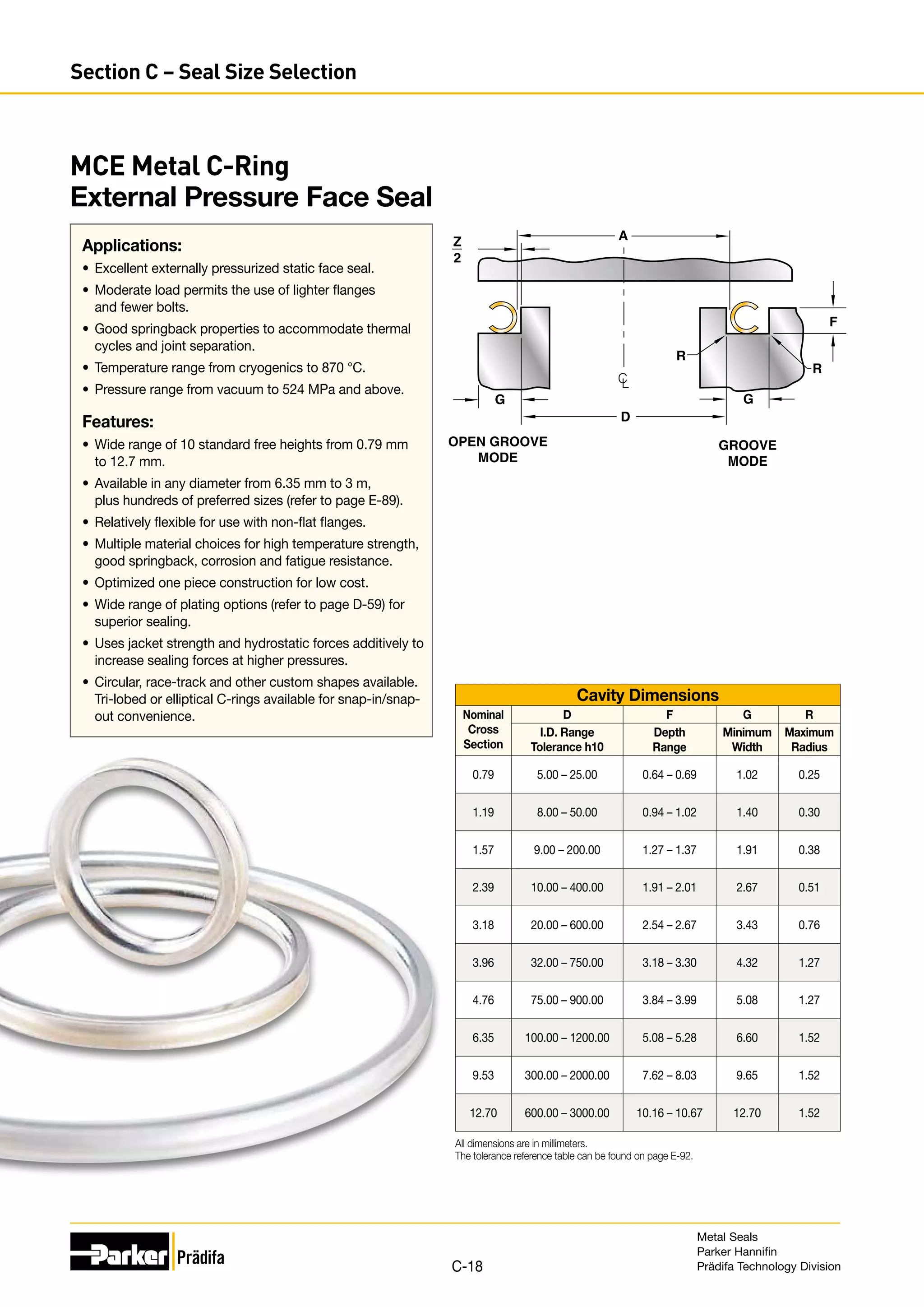
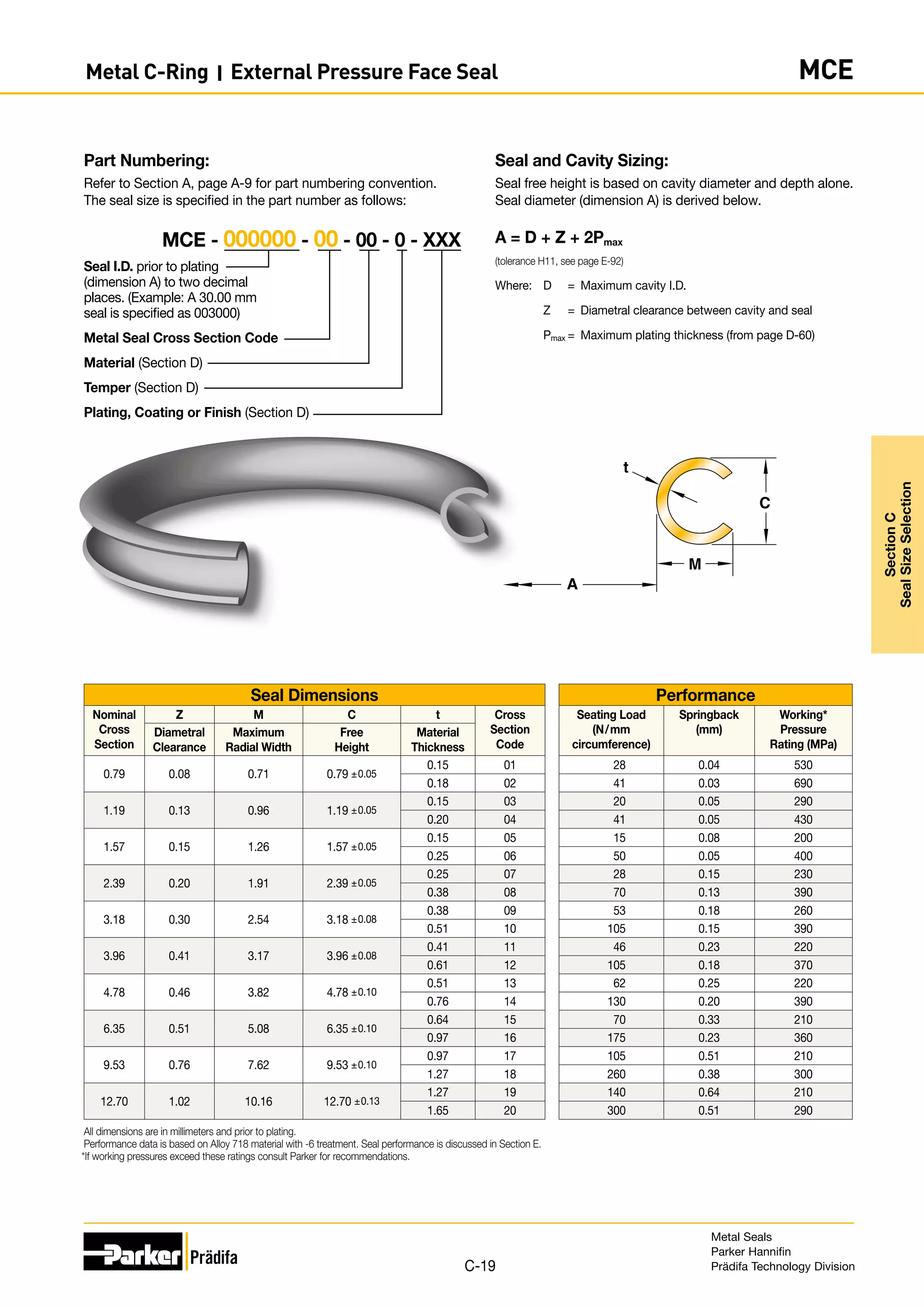
MCE Metal C-Ring
External Pressure Face Seal
Applications:
•	 Excellent externally pressurized static face seal.
•	 Moderate load permits the use of lighter flanges
and fewer bolts.
•	 Good springback properties to accommodate thermal
cycles and joint separation.
•	 Temperature range from cryogenics to 870 °C.
•	 Pressure range from vacuum to 524 MPa and above.
Features:
•	 Wide range of 10 standard free heights from 0.79 mm
to 12.7 mm.
•	 Available in any diameter from 6.35 mm to 3 m,
plus hundreds of preferred sizes (refer to page E-89).
•	 Relatively flexible for use with non-flat flanges.
•	 Multiple material choices for high temperature strength,
good springback, corrosion and fatigue resistance.
•	 Optimized one piece construction for low cost.
•	 Wide range of plating options (refer to page D-59) for
superior sealing.
•	 Uses jacket strength and hydrostatic forces additively to
increase sealing forces at higher pressures.
•	 Circular, race-track and other custom shapes available.
Tri-lobed or elliptical C-rings available for snap-in/snap-
	out convenience.
Z
2
D
A
R
R
G
OPEN GROOVE
MODE
GROOVE
MODE
C
L
F
G
Cavity Dimensions
Nominal
Cross
Section
D F G R
I.D. Range
Tolerance h10
Depth
Range
Minimum
Width
Maximum
Radius
0.79 5.00 – 25.00 0.64 – 0.69 1.02 0.25
1.19 8.00 – 50.00 0.94 – 1.02 1.40 0.30
1.57 9.00 – 200.00 1.27 – 1.37 1.91 0.38
2.39 10.00 – 400.00 1.91 – 2.01 2.67 0.51
3.18 20.00 – 600.00 2.54 – 2.67 3.43 0.76
3.96 32.00 – 750.00 3.18 – 3.30 4.32 1.27
4.76 75.00 – 900.00 3.84 – 3.99 5.08 1.27
6.35 100.00 – 1200.00 5.08 – 5.28 6.60 1.52
9.53 300.00 – 2000.00 7.62 – 8.03 9.65 1.52
12.70 600.00 – 3000.00 10.16 – 10.67 12.70 1.52
All dimensions are in millimeters.
The tolerance reference table can be found on page E-92.
Metal Seals
Parker Hannifin
Prädifa Technology Division
C-18
Section C – Seal Size Selection
Seal and Cavity Sizing:
Seal free height is based on cavity diameter and depth alone.
Seal diameter (dimension A) is derived below.
A = D + Z + 2Pmax
(tolerance H11, see page E-92)
Where:	 D	 =	 Maximum cavity I.D.
	 Z	 =	 Diametral clearance between cavity and seal
	Pmax	=	 Maximum plating thickness (from page D-60)
Part Numbering:
Refer to Section A, page A-9 for part numbering convention.
The seal size is specified in the part number as follows:
Seal I.D. prior to plating
(dimension A) to two decimal
places. (Example: A 30.00 mm
seal is specified as 003000)
Metal Seal Cross Section Code
Material (Section D)
Temper (Section D)
Plating, Coating or Finish (Section D)
MCE - 000000 - 00 - 00 - 0 - XXX
t
A
M
C
Seal Dimensions Performance
Nominal
Cross
Section
Z M C t Cross
Section
Code
Seating Load
(N/mm
circumference)
Springback
(mm)
Working*
Pressure
Rating (MPa)
Diametral
Clearance
Maximum
Radial Width
Free
Height
Material
Thickness
0.79 0.08 0.71 0.79 ±0.05
0.15 01 28 0.04 530
0.18 02 41 0.03 690
1.19 0.13 0.96 1.19 ±0.05
0.15 03 20 0.05 290
0.20 04 41 0.05 430
1.57 0.15 1.26 1.57 ±0.05
0.15 05 15 0.08 200
0.25 06 50 0.05 400
2.39 0.20 1.91 2.39 ±0.05
0.25 07 28 0.15 230
0.38 08 70 0.13 390
3.18 0.30 2.54 3.18 ±0.08
0.38 09 53 0.18 260
0.51 10 105 0.15 390
3.96 0.41 3.17 3.96 ±0.08
0.41 11 46 0.23 220
0.61 12 105 0.18 370
4.78 ­0.46 3.82 4.78 ±0.10
0.51 13 62 0.25 220
0.76 14 130 0.20 390
6.35 0.51 5.08 6.35 ±0.10
0.64 15 70 0.33 210
0.97 16 175 0.23 360
9.53 0.76 7.62 9.53 ±0.10
0.97 17 105 0.51 210
1.27 18 260 0.38 300
12.70 1.02 10.16 12.70 ±0.13
1.27 19 140 0.64 210
1.65 20 300 0.51 290
All dimensions are in millimeters and prior to plating.
Performance data is based on Alloy 718 material with -6 treatment. Seal performance is discussed in Section E.
*If working pressures exceed these ratings consult Parker for recommendations.
Metal Seals
Parker Hannifin
Prädifa Technology Division
C-19
Section
C
Seal
Size
Selection
Metal C-Ring I External Pressure Face Seal MCE
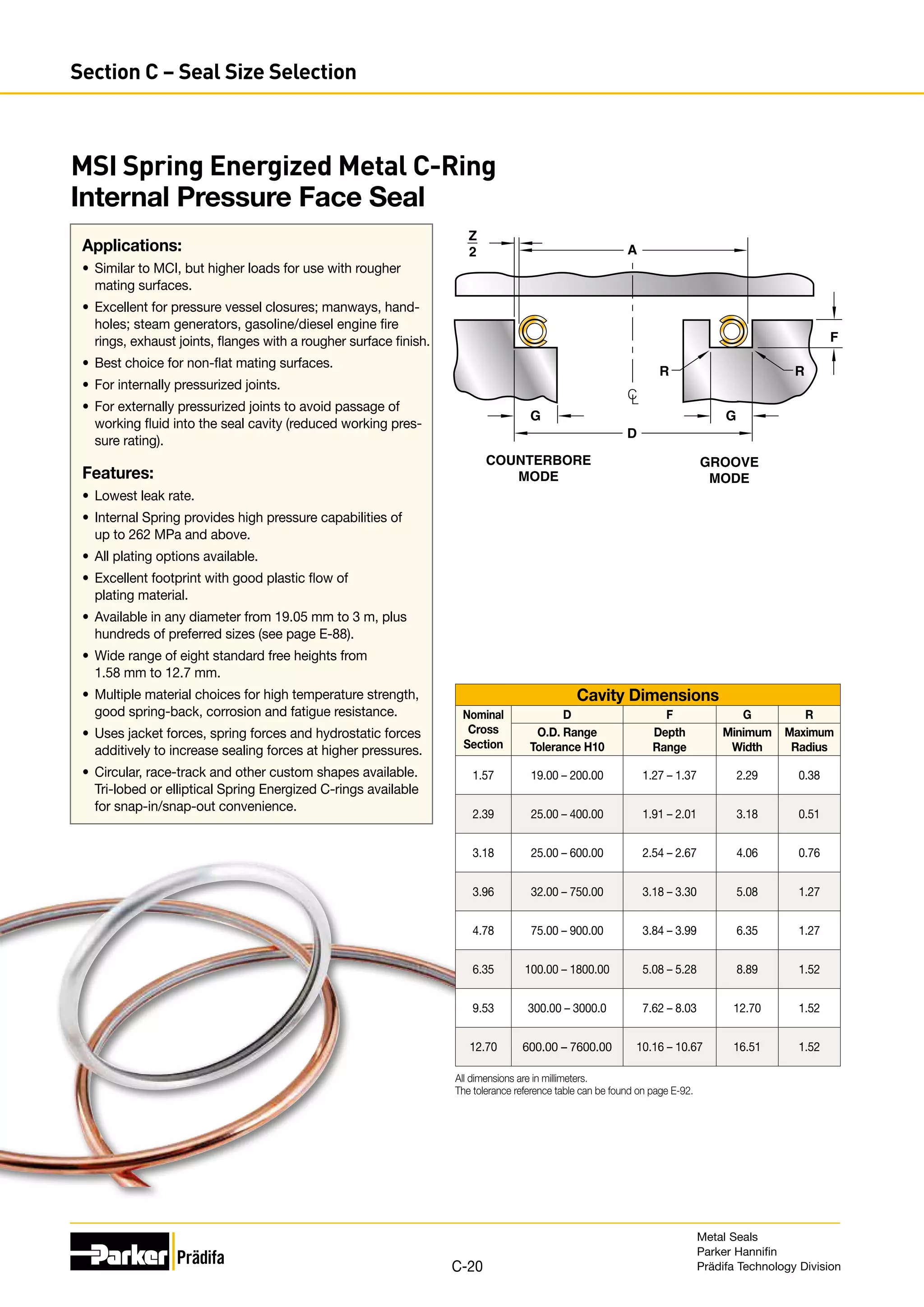
MSI Spring Energized Metal C-Ring
Internal Pressure Face Seal
Applications:
•	 Similar to MCI, but higher loads for use with rougher
mating surfaces.
•	 Excellent for pressure vessel closures; manways, hand-
holes; steam generators, gasoline/diesel engine fire
rings, exhaust joints, flanges with a rougher surface finish.
•	 Best choice for non-flat mating surfaces.
•	 For internally pressurized joints.
•	 For externally pressurized joints to avoid passage of
working fluid into the seal cavity (reduced working pres-
sure rating).
Features:
•	 Lowest leak rate.
•	 Internal Spring provides high pressure capabilities of
up to 262 MPa and above.
•	 All plating options available.
•	 Excellent footprint with good plastic flow of
plating material.
•	 Available in any diameter from 19.05 mm to 3 m, plus
hundreds of preferred sizes (see page E-88).
•	 Wide range of eight standard free heights from
1.58 mm to 12.7 mm.
•	 Multiple material choices for high temperature strength,
good spring-back, corrosion and fatigue resistance.
•	 Uses jacket forces, spring forces and hydrostatic forces
additively to increase sealing forces at higher pressures.
•	 Circular, race-track and other custom shapes available.
Tri-lobed or elliptical Spring Energized C-rings available
for snap-in/snap-out convenience.
D
A
R R
G
G
Z
2
COUNTERBORE
MODE
GROOVE
MODE
C
L
F
Cavity Dimensions
Nominal
Cross
Section
D F G R
O.D. Range
Tolerance H10
Depth
Range
Minimum
Width
Maximum
Radius
1.57 19.00 – 200.00 1.27 – 1.37 2.29 0.38
2.39 25.00 – 400.00 1.91 – 2.01 3.18 0.51
3.18 25.00 – 600.00 2.54 – 2.67 4.06 0.76
3.96 32.00 – 750.00 3.18 – 3.30 5.08 1.27
4.78 75.00 – 900.00 3.84 – 3.99 6.35 1.27
6.35 100.00 – 1800.00 5.08 – 5.28 8.89 1.52
9.53 300.00 – 3000.0 7.62 – 8.03 12.70 1.52
12.70 600.00 – 7600.00 10.16 – 10.67 16.51 1.52
All dimensions are in millimeters.
The tolerance reference table can be found on page E-92.
Metal Seals
Parker Hannifin
Prädifa Technology Division
C-20
Section C – Seal Size Selection
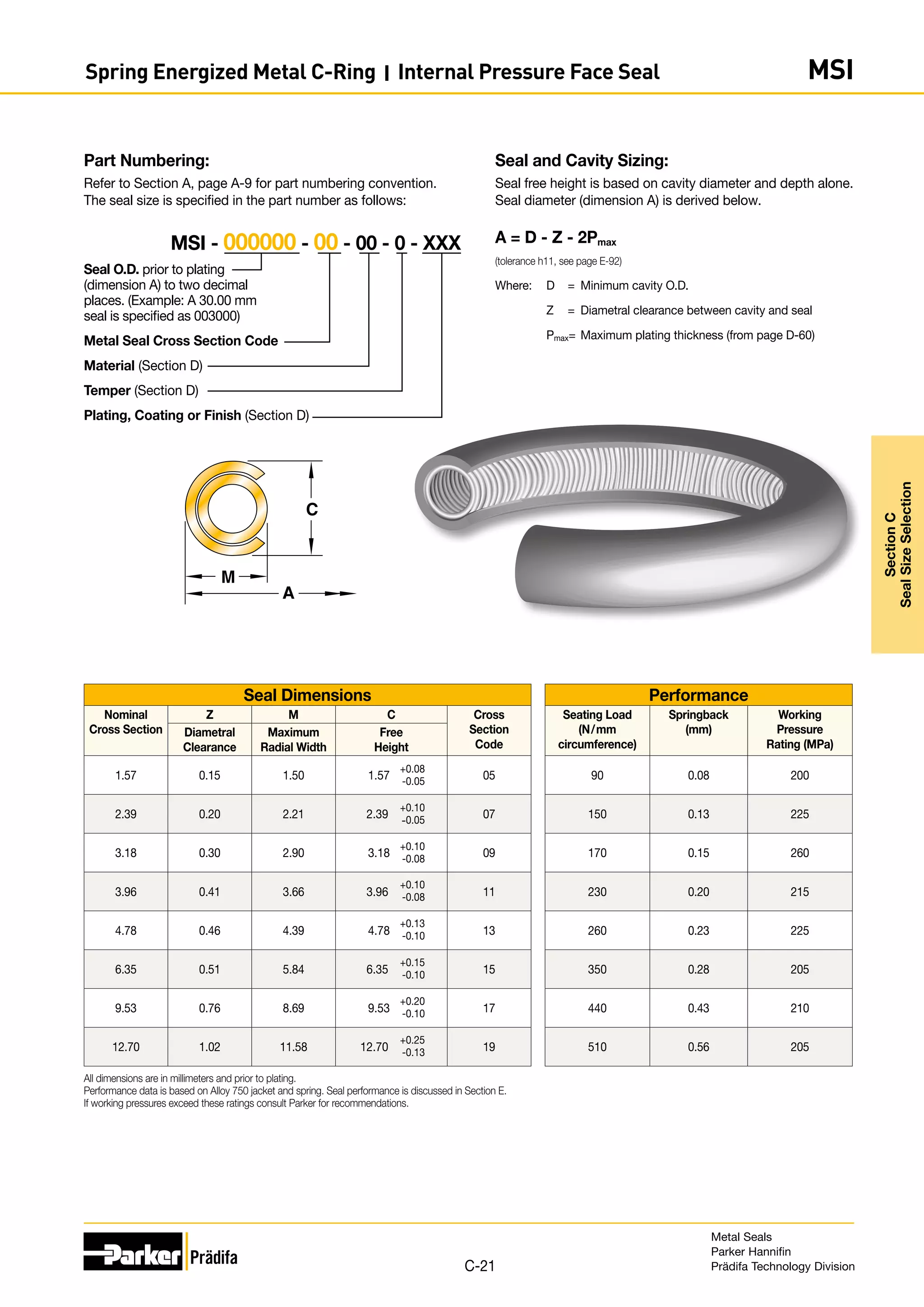
Seal Dimensions Performance
Nominal
Cross Section
Z M C Cross
Section
Code
Seating Load
(N/mm
circumference)
Springback
(mm)
Working
Pressure
Rating (MPa)
Diametral
Clearance
Maximum
Radial Width
Free
Height
1.57 0.15 1.50 1.57
+0.08
-0.05
05 90 0.08 200
2.39 0.20 2.21 2.39
+0.10
-0.05
07 150 0.13 225
3.18 0.30 2.90 3.18
+0.10
-0.08
09 170 0.15 260
3.96 0.41 3.66 3.96
+0.10
-0.08 11 230 0.20 215
4.78 0.46 4.39 4.78
+0.13
-0.10 13 260 0.23 225
6.35 0.51 5.84 6.35
+0.15
-0.10 15 350 0.28 205
9.53 0.76 8.69 9.53
+0.20
-0.10 17 440 0.43 210
12.70 1.02 11.58 12.70
+0.25
-0.13 19 510 0.56 205
All dimensions are in millimeters and prior to plating.
Performance data is based on Alloy 750 jacket and spring. Seal performance is discussed in Section E.
If working pressures exceed these ratings consult Parker for recommendations.
A
M
C
Seal and Cavity Sizing:
Seal free height is based on cavity diameter and depth alone.
Seal diameter (dimension A) is derived below.
A = D - Z - 2Pmax
(tolerance h11, see page E-92)
Where:	 D	 =	 Minimum cavity O.D.
	 Z	 =	 Diametral clearance between cavity and seal
	Pmax	
=	Maximum plating thickness (from page D-60)
Part Numbering:
Refer to Section A, page A-9 for part numbering convention.
The seal size is specified in the part number as follows:
Seal O.D. prior to plating
(dimension A) to two decimal
places. (Example: A 30.00 mm
seal is specified as 003000)
Metal Seal Cross Section Code
Material (Section D)
Temper (Section D)
Plating, Coating or Finish (Section D)
MSI - 000000 - 00 - 00 - 0 - XXX
Metal Seals
Parker Hannifin
Prädifa Technology Division
C-21
Section
C
Seal
Size
Selection
Spring Energized Metal C-Ring I Internal Pressure Face Seal MSI
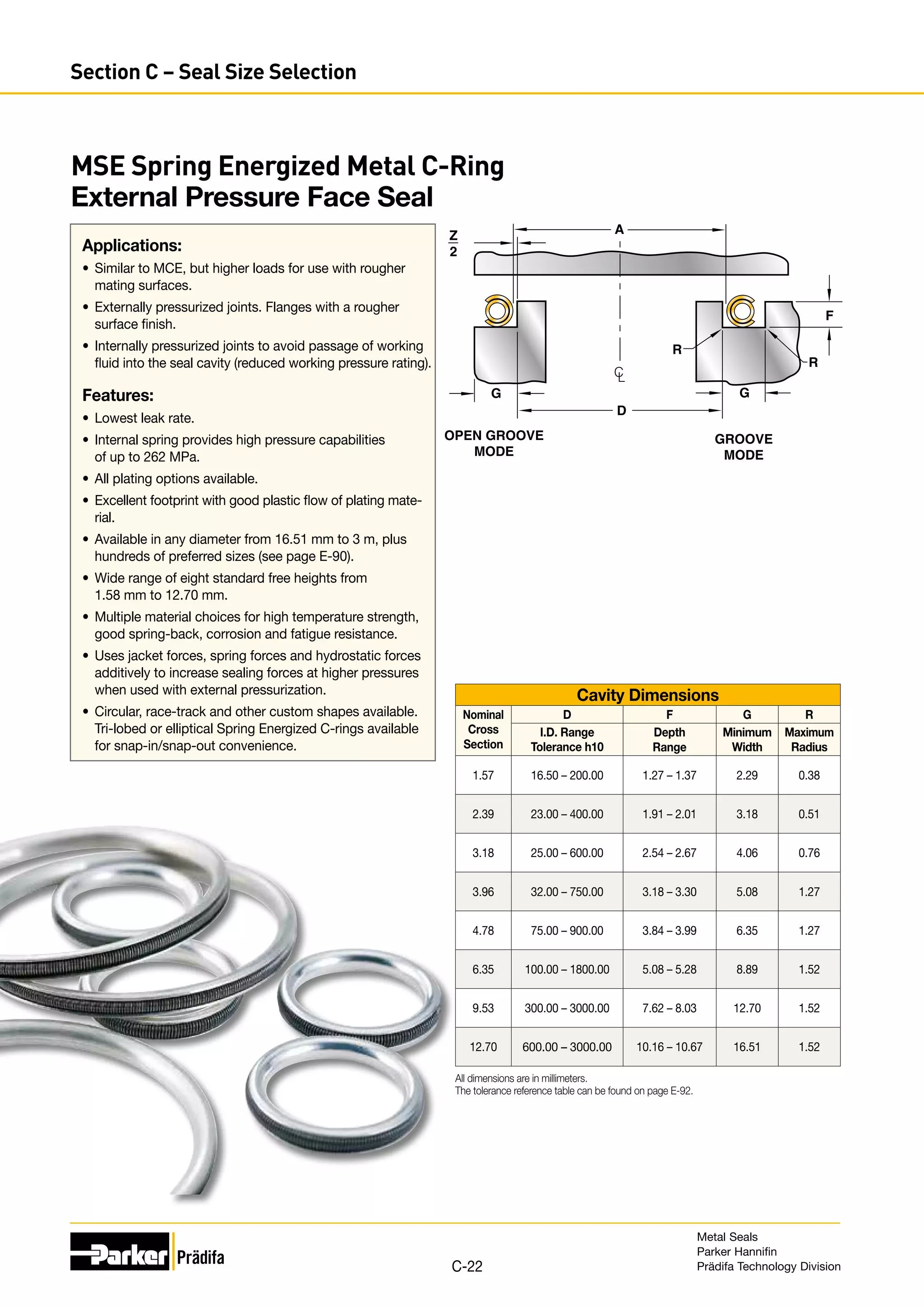
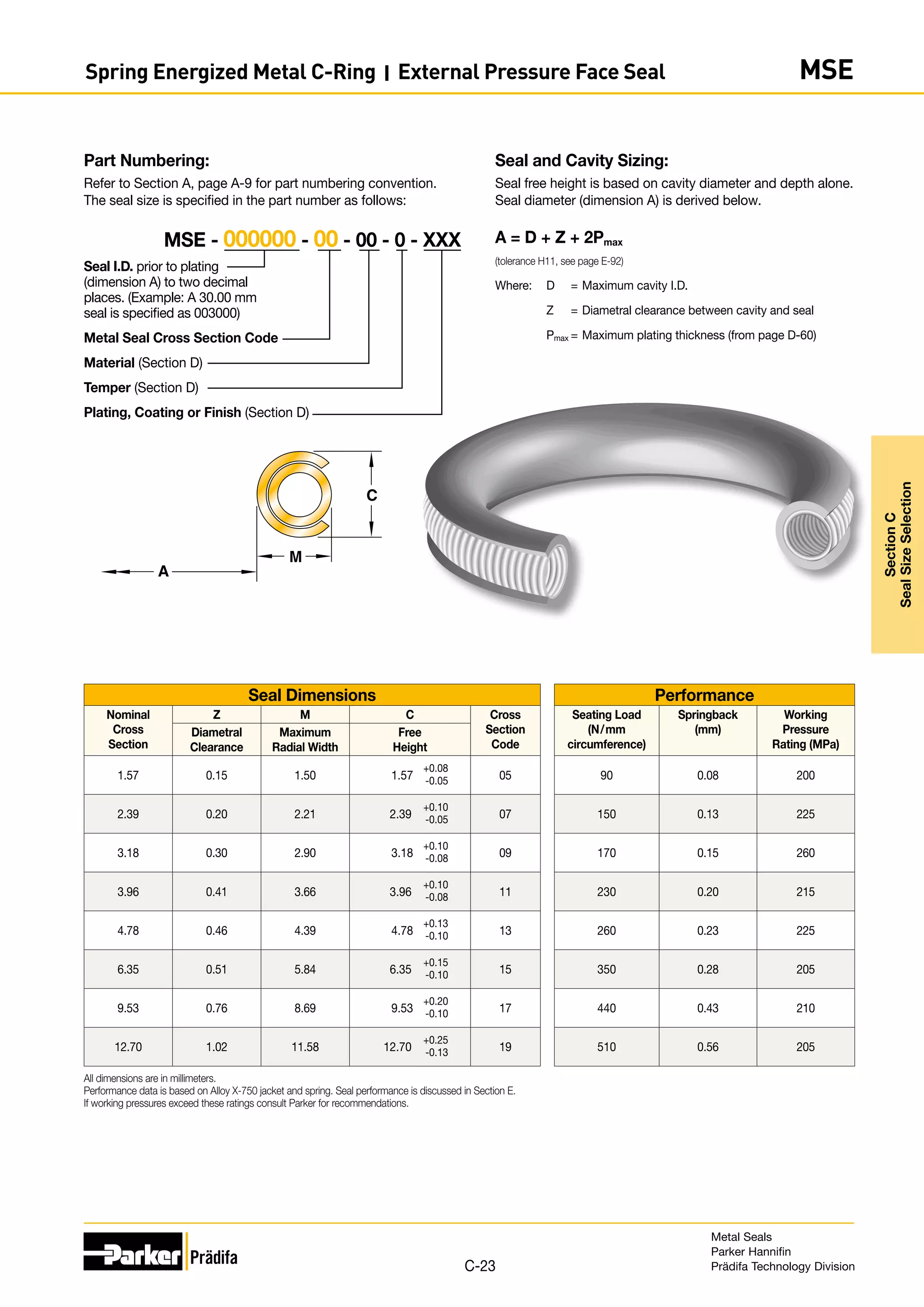
MSE Spring Energized Metal C-Ring
External Pressure Face Seal
Applications:
•	 Similar to MCE, but higher loads for use with rougher
mating surfaces.
•	 Externally pressurized joints. Flanges with a rougher
surface finish.
•	 Internally pressurized joints to avoid passage of working
fluid into the seal cavity (reduced working pressure rating).
Features:
•	 Lowest leak rate.
•	 Internal spring provides high pressure capabilities
of up to 262 MPa.
•	 All plating options available.
•	 Excellent footprint with good plastic flow of plating mate-
rial.
•	 Available in any diameter from 16.51 mm to 3 m, plus
hundreds of preferred sizes (see page E-90).
•	 Wide range of eight standard free heights from
1.58 mm to 12.70 mm.
•	 Multiple material choices for high temperature strength,
good spring-back, corrosion and fatigue resistance.
•	 Uses jacket forces, spring forces and hydrostatic forces
additively to increase sealing forces at higher pressures
when used with external pressurization.
•	 Circular, race-track and other custom shapes available.
Tri-lobed or elliptical Spring Energized C-rings available
for snap-in/snap-out convenience.
Z
2
D
A
R
R
G
OPEN GROOVE
MODE
GROOVE
MODE
C
L
F
G
Cavity Dimensions
Nominal
Cross
Section
D F G R
I.D. Range
Tolerance h10
Depth
Range
Minimum
Width
Maximum
Radius
1.57 16.50 – 200.00 1.27 – 1.37 2.29 0.38
2.39 23.00 – 400.00 1.91 – 2.01 3.18 0.51
3.18 25.00 – 600.00 2.54 – 2.67 4.06 0.76
3.96 32.00 – 750.00 3.18 – 3.30 5.08 1.27
4.78 75.00 – 900.00 3.84 – 3.99 6.35 1.27
6.35 100.00 – 1800.00 5.08 – 5.28 8.89 1.52
9.53 300.00 – 3000.00 7.62 – 8.03 12.70 1.52
12.70 600.00 – 3000.00 10.16 – 10.67 16.51 1.52
All dimensions are in millimeters.
The tolerance reference table can be found on page E-92.
Metal Seals
Parker Hannifin
Prädifa Technology Division
C-22
Section C – Seal Size Selection
Seal Dimensions Performance
Nominal
Cross
Section
Z M C Cross
Section
Code
Seating Load
(N/mm
circumference)
Springback
(mm)
Working
Pressure
Rating (MPa)
Diametral
Clearance
Maximum
Radial Width
Free
Height
1.57 0.15 1.50 1.57
+0.08
-0.05 05 90 0.08 200
2.39 0.20 2.21 2.39
+0.10
-0.05 07 150 0.13 225
3.18 0.30 2.90 3.18
+0.10
-0.08 09 170 0.15 260
3.96 0.41 3.66 3.96
+0.10
-0.08 11 230 0.20 215
4.78 0.46 4.39 4.78
+0.13
-0.10 13 260 0.23 225
6.35 0.51 5.84 6.35
+0.15
-0.10 15 350 0.28 205
9.53 0.76 8.69 9.53
+0.20
-0.10 17 440 0.43 210
12.70 1.02 11.58 12.70
+0.25
-0.13 19 510 0.56 205
All dimensions are in millimeters.
Performance data is based on Alloy X-750 jacket and spring. Seal performance is discussed in Section E.
If working pressures exceed these ratings consult Parker for recommendations.
Seal and Cavity Sizing:
Seal free height is based on cavity diameter and depth alone.
Seal diameter (dimension A) is derived below.
A = D + Z + 2Pmax
(tolerance H11, see page E-92)
Where:	 D	 =	Maximum cavity I.D.
	 Z	 =	Diametral clearance between cavity and seal
	Pmax	=	Maximum plating thickness (from page D-60)
Part Numbering:
Refer to Section A, page A-9 for part numbering convention.
The seal size is specified in the part number as follows:
Seal I.D. prior to plating
(dimension A) to two decimal
places. (Example: A 30.00 mm
seal is specified as 003000)
Metal Seal Cross Section Code
Material (Section D)
Temper (Section D)
Plating, Coating or Finish (Section D)
MSE - 000000 - 00 - 00 - 0 - XXX
A
M
C
Metal Seals
Parker Hannifin
Prädifa Technology Division
C-23
Section
C
Seal
Size
Selection
Spring Energized Metal C-Ring I External Pressure Face Seal MSE
A
R R
G
G
D
Z
2
C
L
F
COUNTERBORE
MODE
GROOVE
MODE
Cavity Dimensions
Nominal
Cross
Section
D F G R
O.D.
Range Tolerance
H10
Depth
Range
Minimum
Width
Maximum
Radius
1.88 45.00 – 200.00 1.55 – 1.60 2.29 0.38
2.74
50.00 – 300.00 2.16 – 2.21 2.92 0.51
57.00 – 300.00 2.16 – 2.26 4.32 0.51
50.00 – 300.00 2.16 – 2.26 2.92 0.51
3.55
50.00 – 600.00 2.95 – 3.05 4.19 0.76
50.00 – 600.00 2.95 – 3.05 4.19 0.76
5.54 85.00 – 900.00 4.55 – 4.65 5.84 1.02
7.49 150.00 – 1200.00 6.20 – 6.35 8.00 1.52
All dimensions are in millimeters.
The tolerance reference table can be found on page E-92.
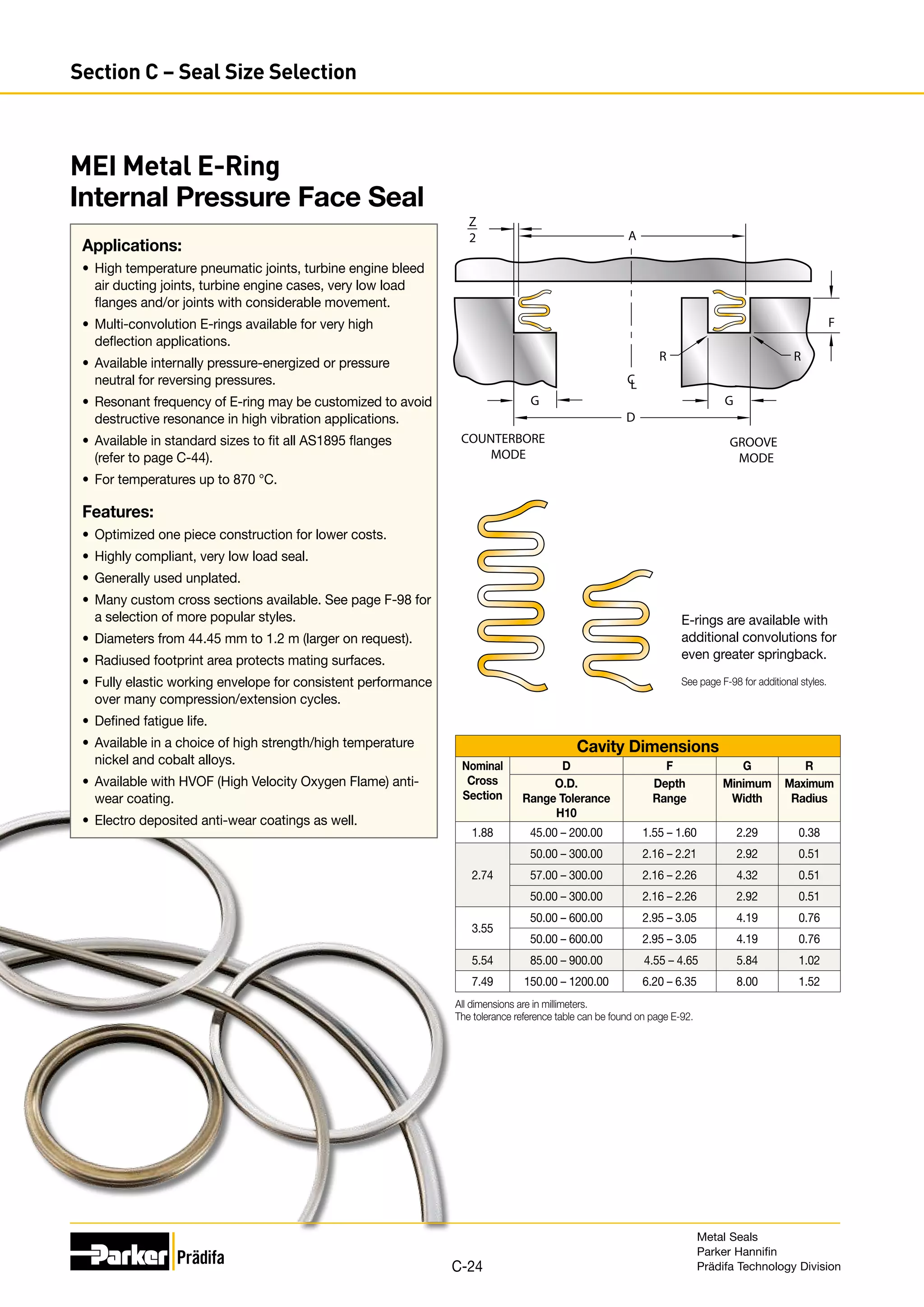
MEI Metal E-Ring
Internal Pressure Face Seal
Applications:
•	 High temperature pneumatic joints, turbine engine bleed
air ducting joints, turbine engine cases, very low load
flanges and/or joints with considerable movement.
•	 Multi-convolution E-rings available for very high
deflection applications.
•	 Available internally pressure-energized or pressure
neutral for reversing pressures.
•	 Resonant frequency of E-ring may be customized to avoid
destructive resonance in high vibration applications.
•	 Available in standard sizes to fit all AS1895 flanges
(refer to page C-44).
•	 For temperatures up to 870 °C.
Features:
•	 Optimized one piece construction for lower costs.
•	 Highly compliant, very low load seal.
•	 Generally used unplated.
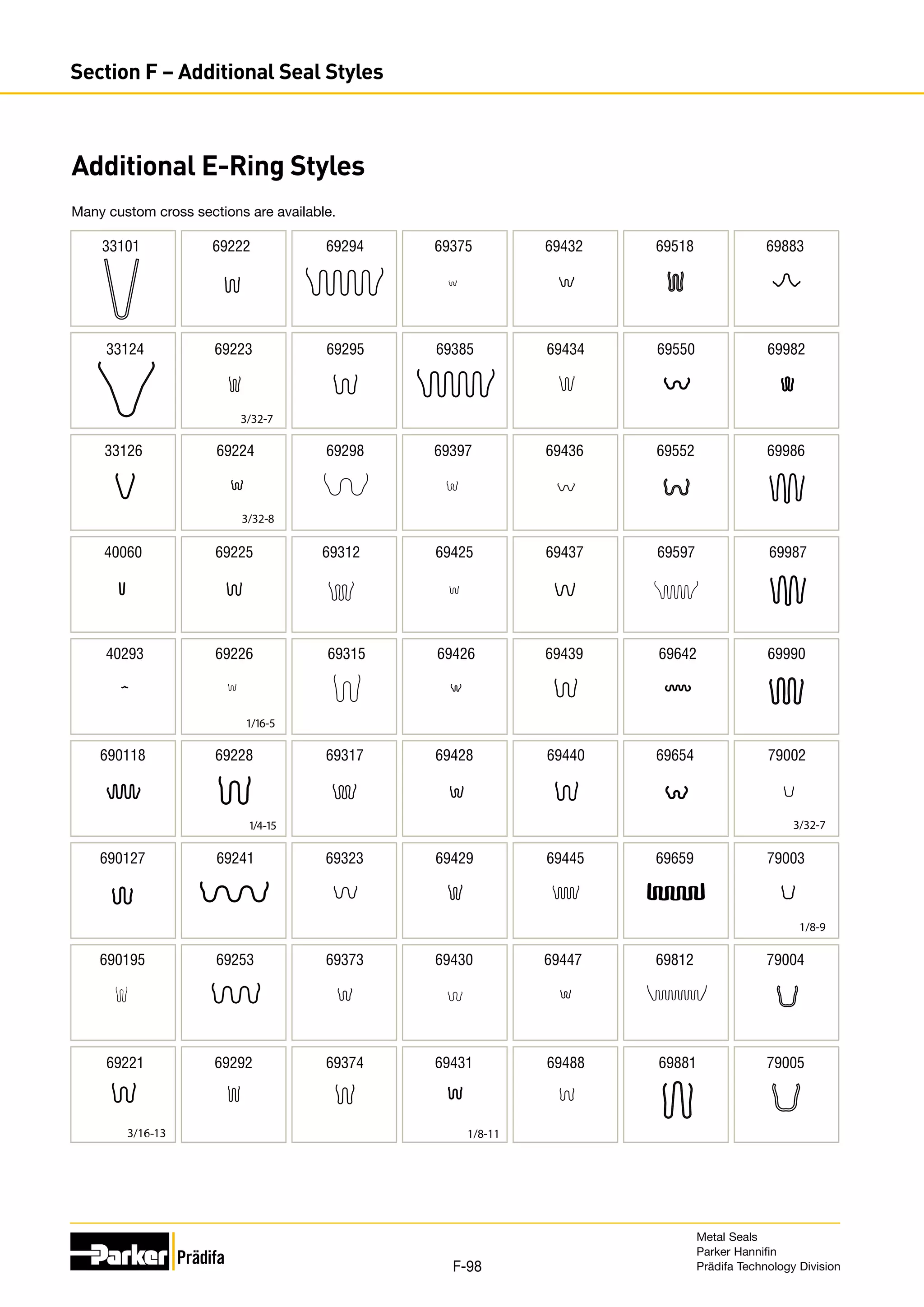
•	 Many custom cross sections available. See page F-98 for
a selection of more popular styles.
•	 Diameters from 44.45 mm to 1.2 m (larger on request).
•	 Radiused footprint area protects mating surfaces.
•	 Fully elastic working envelope for consistent performance
over many compression/extension cycles.
•	 Defined fatigue life.
•	 Available in a choice of high strength/high temperature
nickel and cobalt alloys.
•	 Available with HVOF (High Velocity Oxygen Flame) anti-
wear coating.
•	 Electro deposited anti-wear coatings as well.
E-rings are available with
additional convolutions for
even greater springback.
See page F-98 for additional styles.
Metal Seals
Parker Hannifin
Prädifa Technology Division
C-24
Section C – Seal Size Selection
Seal and Cavity Sizing:
Seal free height is based on cavity diameter and depth alone.
Seal diameter (dimension A) is derived below.
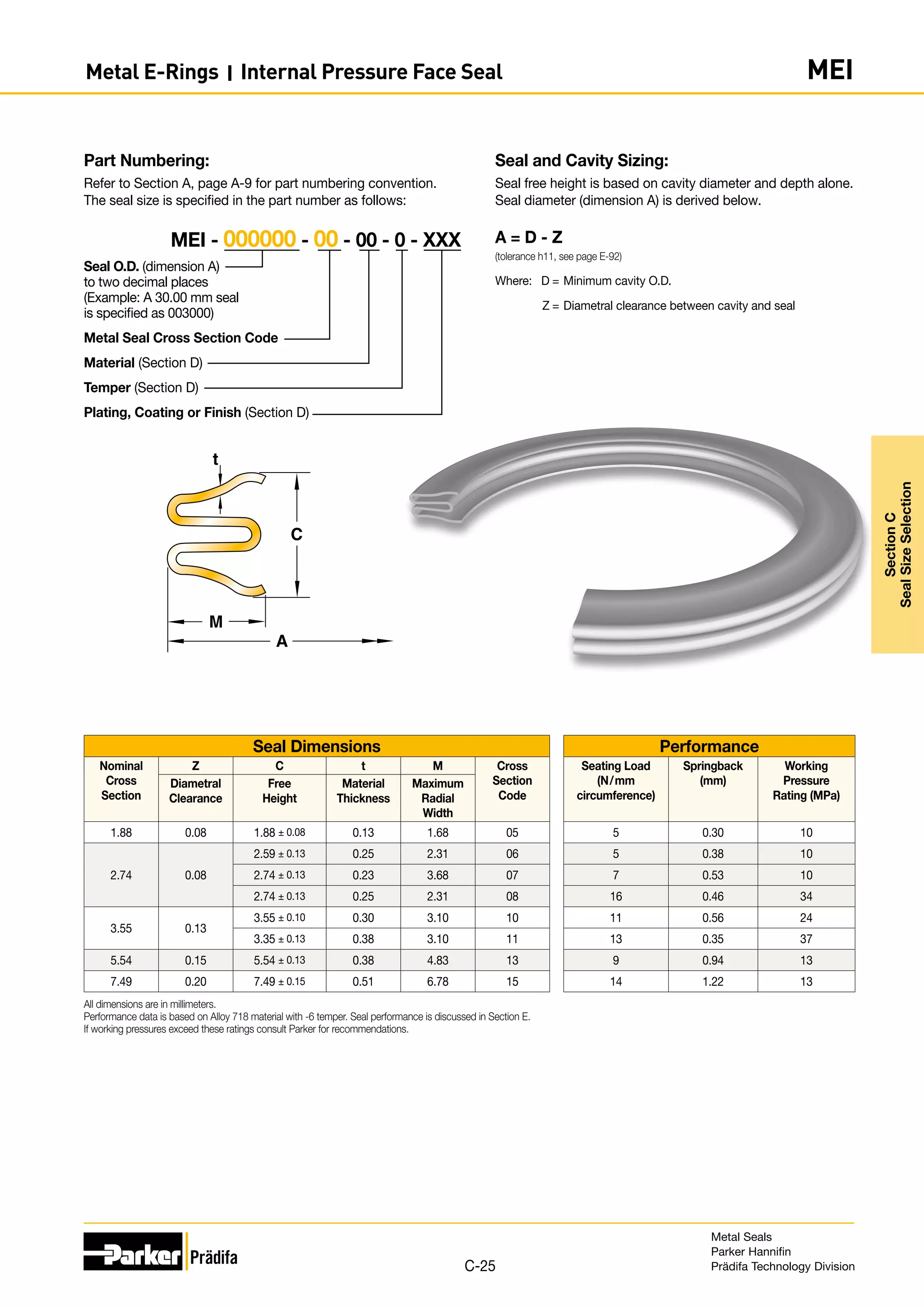
A = D - Z
(tolerance h11, see page E-92)
Where:	 D	=	Minimum cavity O.D.
	 Z	=	Diametral clearance between cavity and seal
Part Numbering:
Refer to Section A, page A-9 for part numbering convention.
The seal size is specified in the part number as follows:
Seal O.D. (dimension A)
to two decimal places
(Example: A 30.00 mm seal
is specified as 003000)
Metal Seal Cross Section Code
Material (Section D)
Temper (Section D)
Plating, Coating or Finish (Section D)
MEI - 000000 - 00 - 00 - 0 - XXX
C
A
M
t
Seal Dimensions Performance
Nominal
Cross
Section
Z C t M Cross
Section
Code
Seating Load
(N/mm
circumference)
Springback
(mm)
Working
Pressure
Rating (MPa)
Diametral
Clearance
Free
Height
Material
Thickness
Maximum
Radial
Width
1.88 0.08 1.88 ± 0.08 0.13 1.68 05 5 0.30 10
2.74 0.08
2.59 ± 0.13 0.25 2.31 06 5 0.38 10
2.74 ± 0.13 0.23 3.68 07 7 0.53 10
2.74 ± 0.13 0.25 2.31 08 16 0.46 34
3.55 0.13
3.55 ± 0.10 0.30 3.10 10 11 0.56 24
3.35 ± 0.13 0.38 3.10 11 13 0.35 37
5.54 0.15 5.54 ± 0.13 0.38 4.83 13 9 0.94 13
7.49 0.20 7.49 ± 0.15 0.51 6.78 15 14 1.22 13
All dimensions are in millimeters.
Performance data is based on Alloy 718 material with -6 temper. Seal performance is discussed in Section E.
If working pressures exceed these ratings consult Parker for recommendations.
Metal Seals
Parker Hannifin
Prädifa Technology Division
C-25
Section
C
Seal
Size
Selection
Metal E-Rings I Internal Pressure Face Seal MEI
Z
2
D
A
R
R
G
OPEN GROOVE
MODE
GROOVE
MODE
C
L
F
G
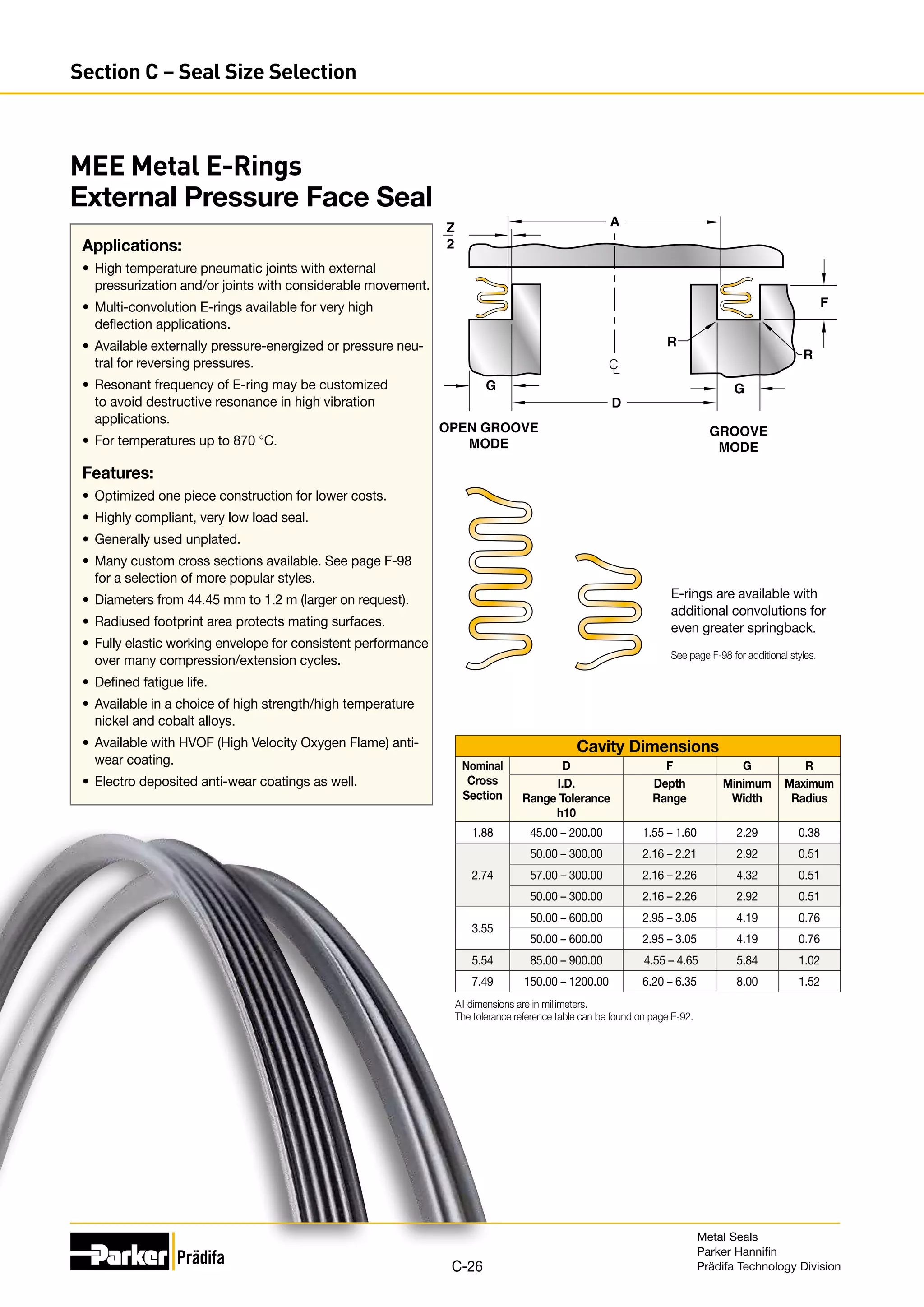
Cavity Dimensions
Nominal
Cross
Section
D F G R
I.D.
Range Tolerance
h10
Depth
Range
Minimum
Width
Maximum
Radius
1.88 45.00 – 200.00 1.55 – 1.60 2.29 0.38
2.74
50.00 – 300.00 2.16 – 2.21 2.92 0.51
57.00 – 300.00 2.16 – 2.26 4.32 0.51
50.00 – 300.00 2.16 – 2.26 2.92 0.51
3.55
50.00 – 600.00 2.95 – 3.05 4.19 0.76
50.00 – 600.00 2.95 – 3.05 4.19 0.76
5.54 85.00 – 900.00 4.55 – 4.65 5.84 1.02
7.49 150.00 – 1200.00 6.20 – 6.35 8.00 1.52
All dimensions are in millimeters.
The tolerance reference table can be found on page E-92.
E-rings are available with
additional convolutions for
even greater springback.
See page F-98 for additional styles.
MEE Metal E-Rings
External Pressure Face Seal
Applications:
•	 High temperature pneumatic joints with external
pressurization and/or joints with considerable movement.
•	 Multi-convolution E-rings available for very high
deflection applications.
•	 Available externally pressure-energized or pressure neu-
tral for reversing pressures.
•	 Resonant frequency of E-ring may be customized
to avoid destructive resonance in high vibration
applications.
•	 For temperatures up to 870 °C.
Features:
•	 Optimized one piece construction for lower costs.
•	 Highly compliant, very low load seal.
•	 Generally used unplated.
•	 Many custom cross sections available. See page F-98
for a selection of more popular styles.
•	 Diameters from 44.45 mm to 1.2 m (larger on request).
•	 Radiused footprint area protects mating surfaces.
•	 Fully elastic working envelope for consistent performance
over many compression/extension cycles.
•	 Defined fatigue life.
•	 Available in a choice of high strength/high temperature
nickel and cobalt alloys.
•	 Available with HVOF (High Velocity Oxygen Flame) anti-
wear coating.
•	 Electro deposited anti-wear coatings as well.
Metal Seals
Parker Hannifin
Prädifa Technology Division
C-26
Section C – Seal Size Selection
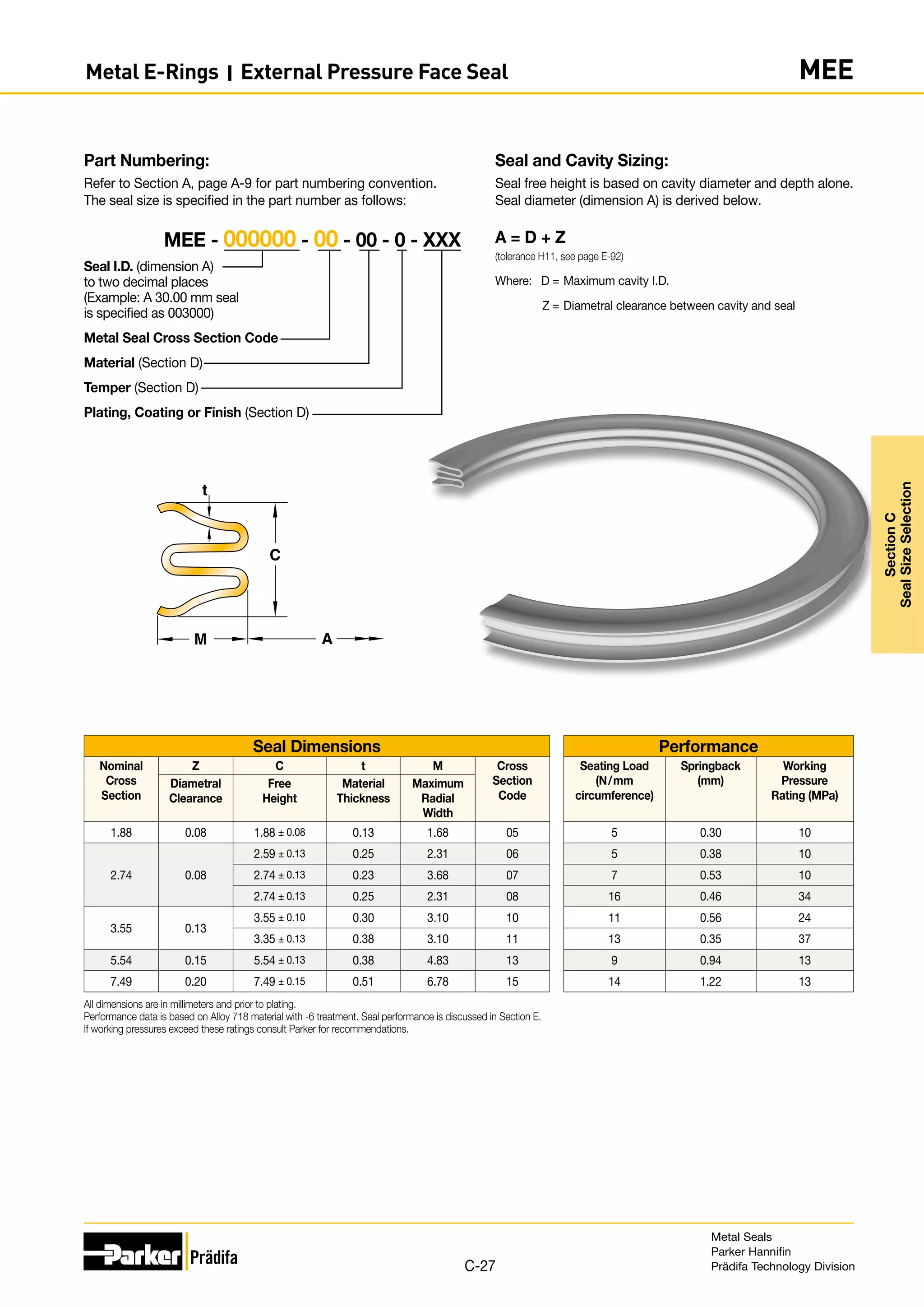
Seal Dimensions Performance
Nominal
Cross
Section
Z C t M Cross
Section
Code
Seating Load
(N/mm
circumference)
Springback
(mm)
Working
Pressure
Rating (MPa)
Diametral
Clearance
Free
Height
Material
Thickness
Maximum
Radial
Width
1.88 0.08 1.88 ± 0.08 0.13 1.68 05 5 0.30 10
2.74 0.08
2.59 ± 0.13 0.25 2.31 06 5 0.38 10
2.74 ± 0.13 0.23 3.68 07 7 0.53 10
2.74 ± 0.13 0.25 2.31 08 16 0.46 34
3.55 0.13
3.55 ± 0.10 0.30 3.10 10 11 0.56 24
3.35 ± 0.13 0.38 3.10 11 13 0.35 37
5.54 0.15 5.54 ± 0.13 0.38 4.83 13 9 0.94 13
7.49 0.20 7.49 ± 0.15 0.51 6.78 15 14 1.22 13
All dimensions are in millimeters and prior to plating.
Performance data is based on Alloy 718 material with -6 treatment. Seal performance is discussed in Section E.
If working pressures exceed these ratings consult Parker for recommendations.
Seal and Cavity Sizing:
Seal free height is based on cavity diameter and depth alone.
Seal diameter (dimension A) is derived below.
A = D + Z
(tolerance H11, see page E-92)
Where:	 D	=	Maximum cavity I.D.
	 Z	=	Diametral clearance between cavity and seal
Part Numbering:
Refer to Section A, page A-9 for part numbering convention.
The seal size is specified in the part number as follows:
Seal I.D. (dimension A)
to two decimal places
(Example: A 30.00 mm seal
is specified as 003000)
Metal Seal Cross Section Code
Material (Section D)
Temper (Section D)
Plating, Coating or Finish (Section D)
MEE - 000000 - 00 - 00 - 0 - XXX
A
C
M
t
Metal Seals
Parker Hannifin
Prädifa Technology Division
C-27
Section
C
Seal
Size
Selection
Metal E-Rings I External Pressure Face Seal MEE
D
A
R R
G
G
Z
2
COUNTERBORE MODE GROOVE MODE
C
L
F
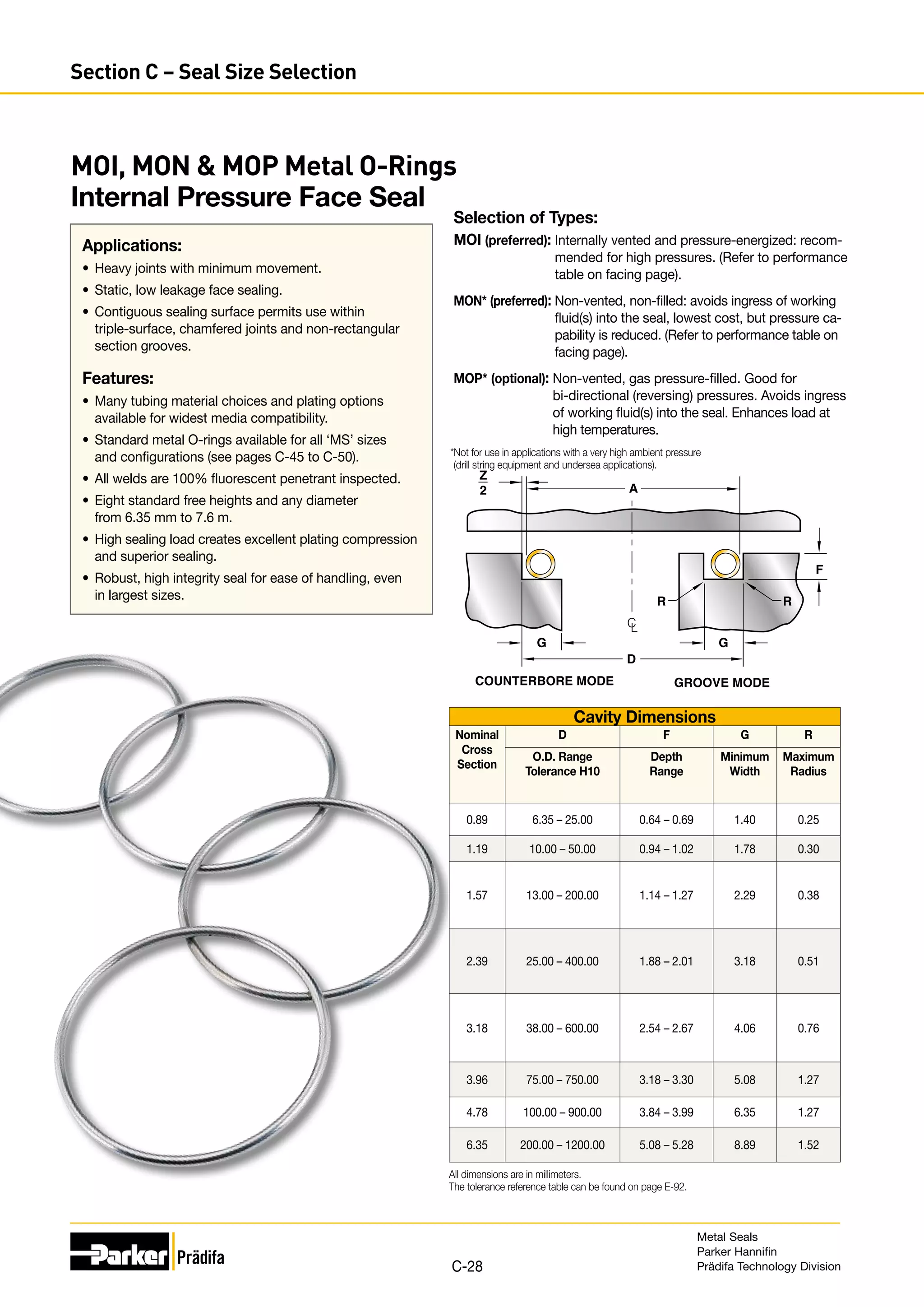
Selection of Types:
MOI (preferred): 
Internally vented and pressure-energized: recom-
mended for high pressures. (Refer to performance
table on facing page).
MON* (preferred): 
Non-vented, non-filled: avoids ingress of working
fluid(s) into the seal, lowest cost, but pressure ca-
pability is reduced. (Refer to performance table on
facing page).
MOP* (optional): 
Non-vented, gas pressure-filled. Good for
­
bi-directional (reversing) pressures. Avoids ingress
of working fluid(s) into the seal. Enhances load at
high temperatures.
*Not for use in applications with a very high ambient pressure
(drill string equipment and undersea applications).
Cavity Dimensions
Nominal
Cross
Section
D F G R
O.D. Range
Tolerance H10
Depth
Range
Minimum
Width
Maximum
Radius
0.89 6.35 – 25.00 0.64 – 0.69 1.40 0.25
1.19 10.00 – 50.00 0.94 – 1.02 1.78 0.30
1.57 13.00 – 200.00 1.14 – 1.27 2.29 0.38
2.39 25.00 – 400.00 1.88 – 2.01 3.18 0.51
3.18 38.00 – 600.00 2.54 – 2.67 4.06 0.76
3.96 75.00 – 750.00 3.18 – 3.30 5.08 1.27
4.78 100.00 – 900.00 3.84 – 3.99 6.35 1.27
6.35 200.00 – 1200.00 5.08 – 5.28 8.89 1.52
All dimensions are in millimeters.
The tolerance reference table can be found on page E-92.
MOI, MON  MOP Metal O-Rings
Internal Pressure Face Seal
Applications:
•	 Heavy joints with minimum movement.
•	 Static, low leakage face sealing.
•	 Contiguous sealing surface permits use within
triple-surface, chamfered joints and non-rectangular
section grooves.
Features:
•	 Many tubing material choices and plating options
available for widest media compatibility.
•	 Standard metal O-rings available for all ‘MS’ sizes
and configurations (see pages C-45 to C-50).
•	 All welds are 100% fluorescent penetrant inspected.
•	 Eight standard free heights and any diameter
from 6.35 mm to 7.6 m.
•	 High sealing load creates excellent plating compression
and superior sealing.
•	 Robust, high integrity seal for ease of handling, even
in largest sizes.
Metal Seals
Parker Hannifin
Prädifa Technology Division
C-28
Section C – Seal Size Selection
Seal Dimensions Performance
Nominal
Cross
Section
Z C t Cross
Section
Code
Seating Load
(N/mm circ.)
Springback
(mm)
Working Pressure Rating (MPa)
Diametral
Clearance
Free
Height
Material
Thickness
Vented Non-Vented
304SS/
321SS
Alloy
X-750/
Alloy 718
304SS/
321SS
Alloy
X-750/
Alloy 718
304SS/
321SS
Alloy
X-750/
Alloy 718
304SS/
321SS
Alloy
X-750/
Alloy 718
0.89 0.18 0.89
+0.08
-0.03
0.15 01 70 96 0.01 0.01 70 100 5 7
1.19 0.20 1.19
+0.08
-0.03
0.18 29 70 96 0.03 0.03 50 70 5 7
1.57 0.20 1.57 +0.08
-0.03
0.15 02 45 61 0.04 0.05 30 45 4 6
0.25 03 96 130 0.03 0.04 75 110 5 7
0.30 31 140 190 0.03 0.03 100 140 5 8
0.35 08 190 260 0.03 0.03 120 170 6 8
2.39 0.23 2.39 +0.08
-0.03
0.15 04 26 35 0.05 0.05 10 15 5 7
0.25 05 52 70 0.05 0.05 30 40 6 8
0.30 32 70 96 0.03 0.04 40 70 6 8
0.46 09 210 280 0.03 0.04 110 170 6 9
3.18 0.28 3.18 +0.08
-0.03
0.20 06 17 24 0.10 0.13 15 30 3 5
0.25 07 26 35 0.08 0.10 30 40 3 5
0.30 25 49 70 0.05 0.08 40 70 4 6
0.51 10 160 210 0.05 0.05 110 170 5 7
3.96 0.33 3.96 +0.10
-0.00
0.41 11 70 96 0.10 0.13 30 40 5 7
0.51 12 130 175 0.08 0.10 90 140 5 8
4.78 0.35 4.78 +0.13
-0.00
0.51 13 78 105 0.10 0.13 30 40 5 7
0.63 14 120 170 0.08 0.10 100 150 5 8
6.35 0.46 6.35 +0.13
-0.00
0.63 15 78 105 0.13 0.15 30 40 5 7
0.81 16 170 230 0.10 0.13 90 140 5 8
All dimensions are in millimeters and prior to plating.
Performance data is based on Alloy 718 material with -6 treatment. Seal performance is discussed in Section E.
If working pressures exceed these ratings consult Parker for recommendations.
Seal and Cavity Sizing:
Seal free height is based on cavity diameter and depth alone.
Seal diameter (dimension A) is derived below.
Seal Tolerance
Free Height Seal Diameter Tolerance (-0.000)
0.89 - 4.77 +0.13
6.35 +0.20
9.52 - 15.87 +0.25
A = D - Z - 2Pmax
Where:	 D	 =	Minimum cavity O.D.
	 Z	 =	Diametral clearance between cavity and seal
	Pmax	=	Maximum plating thickness (from page D-60)
Part Numbering:
Refer to Section A, page A-9 for part numbering convention.
The seal size is specified in the part number as follows:
Seal O.D. prior to plating
(dimension A) to two decimal
places. (Example: A 30.00 mm
seal is specified as 003000)
Metal Seal Cross Section Code
Material (Section D)
Temper (Section D)
Plating, Coating or Finish (Section D)
MO [I, N, P] - 000000 - 00 - 00 - 0 - XXX
t
A
C
Metal Seals
Parker Hannifin
Prädifa Technology Division
C-29
Section
C
Seal
Size
Selection
Metal O-Rings I Internal Pressure Face Seal MOI, MON  MOP
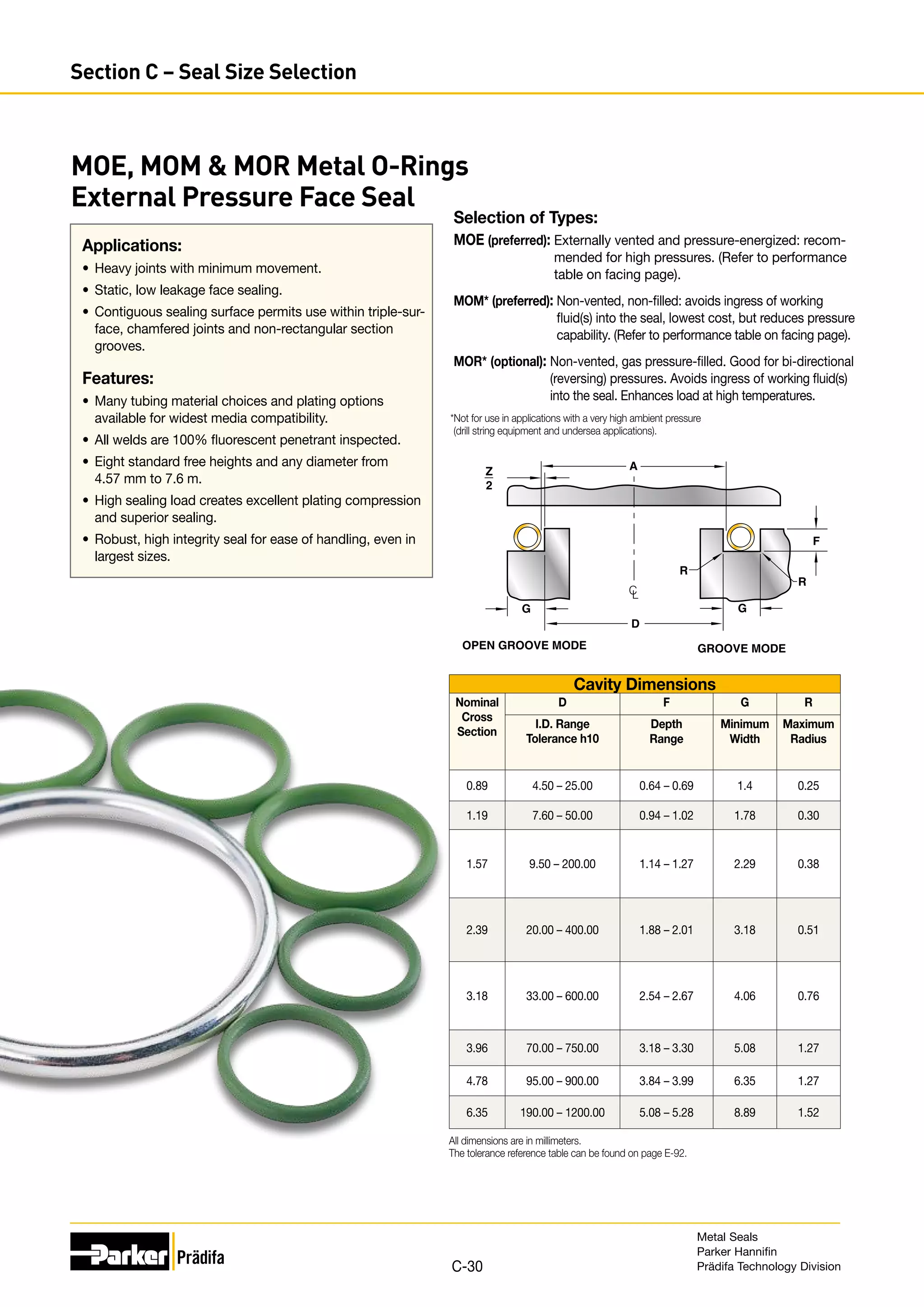
Selection of Types:
MOE (preferred): 
Externally vented and pressure-energized: recom-
mended for high pressures. (Refer to performance
table on facing page).
MOM* (preferred): 
Non-vented, non-filled: avoids ingress of working
fluid(s) into the seal, lowest cost, but reduces pressure
capability. (Refer to performance table on facing page).
MOR* (optional): 
Non-vented, gas pressure-filled. Good for bi-directional
(reversing) pressures. Avoids ingress of working fluid(s)
into the seal. Enhances load at high temperatures.
*Not for use in applications with a very high ambient pressure
(drill string equipment and undersea applications).
Cavity Dimensions
Nominal
Cross
Section
D F G R
I.D. Range
Tolerance h10
Depth
Range
Minimum
Width
Maximum
Radius
0.89 4.50 – 25.00 0.64 – 0.69 1.4 0.25
1.19 7.60 – 50.00 0.94 – 1.02 1.78 0.30
1.57 9.50 – 200.00 1.14 – 1.27 2.29 0.38
2.39 20.00 – 400.00 1.88 – 2.01 3.18 0.51
3.18 33.00 – 600.00 2.54 – 2.67 4.06 0.76
3.96 70.00 – 750.00 3.18 – 3.30 5.08 1.27
4.78 95.00 – 900.00 3.84 – 3.99 6.35 1.27
6.35 190.00 – 1200.00 5.08 – 5.28 8.89 1.52
All dimensions are in millimeters.
The tolerance reference table can be found on page E-92.
MOE, MOM  MOR Metal O-Rings
External Pressure Face Seal
Applications:
•	 Heavy joints with minimum movement.
•	 Static, low leakage face sealing.
•	 Contiguous sealing surface permits use within triple-sur-
face, chamfered joints and non-rectangular section
grooves.
Features:
•	 Many tubing material choices and plating options
available for widest media compatibility.
•	 All welds are 100% fluorescent penetrant inspected.
•	 Eight standard free heights and any diameter from
4.57 mm to 7.6 m.
•	 High sealing load creates excellent plating compression
and superior sealing.
•	 Robust, high integrity seal for ease of handling, even in
largest sizes.
Z
2
D
A
R
R
G
OPEN GROOVE MODE GROOVE MODE
C
L
F
G
Metal Seals
Parker Hannifin
Prädifa Technology Division
C-30
Section C – Seal Size Selection
Seal Dimensions Performance
Nominal
Cross
Section
Z C t Cross
Section
Code
Seating Load
(N/mm circ.)
Springback
(mm)
Working Pressure Rating (MPa)
Diametral
Clearance
Free
Height
Material
Thickness
Vented Non-Vented
304SS/
321SS
Alloy
X-750/
Alloy 718
304SS/
321SS
Alloy
X-750/
Alloy 718
304SS/
321SS
Alloy
X-750/
Alloy 718
304SS/
321SS
Alloy
X-750/
Alloy 718
0.89 0.18 0.89
+0.08
-0.03
0.15 01 70 96 0.01 0.01 70 100 5 7
1.19 0.20 1.19
+0.08
-0.03
0.18 29 70 96 0.03 0.03 50 70 5 7
1.57 0.20 1.57 +0.08
-0.03
0.15 02 45 61 0.04 0.05 30 45 4 6
0.25 03 96 130 0.03 0.04 75 110 5 7
0.30 31 140 190 0.03 0.03 100 140 5 8
0.35 08 190 260 0.03 0.03 120 170 6 8
2.39 0.23 2.39 +0.08
-0.03
0.15 04 26 35 0.05 0.05 10 15 5 7
0.25 05 52 70 0.05 0.05 30 40 6 8
0.30 32 70 96 0.03 0.04 40 70 6 8
0.46 09 210 280 0.03 0.04 110 170 6 9
3.18 0.28 3.18 +0.08
-0.03
0.20 06 17 24 0.10 0.13 15 30 3 5
0.25 07 26 35 0.08 0.10 30 40 3 5
0.30 25 49 70 0.05 0.08 40 70 4 6
0.51 10 160 210 0.05 0.05 110 170 5 7
3.96 0.33 3.96 +0.10
-0.00
0.41 11 70 96 0.10 0.13 30 40 5 7
0.51 12 130 175 0.08 0.10 90 140 5 8
4.78 0.35 4.78 +0.13
-0.00
0.51 13 78 105 0.10 0.13 30 40 5 7
0.63 14 120 170 0.08 0.10 100 150 5 8
6.35 0.46 6.35 +0.13
-0.00
0.63 15 78 105 0.13 0.15 30 40 5 7
0.81 16 170 230 0.10 0.13 90 140 5 8
All dimensions are in millimeters and prior to plating.
Performance data is based on Alloy 718 material with -6 treatment. Seal performance is discussed in Section E.
If working pressures exceed these ratings consult Parker for recommendations.
Seal and Cavity Sizing:
Seal free height is based on cavity diameter and depth alone.
Seal diameter (dimension A) is derived below.
Seal Tolerance
Free Height Seal Diameter Tolerance (-0.000)
0.89 - 4.77 +0.13
6.35 +0.20
9.52 - 15.87 +0.25
A = D + Z + 2Pmax
Where:	 D	 =	 Maximum cavity I.D.
	 Z	 =	 Diametral clearance between cavity and seal
	Pmax	=	 Maximum plating thickness (from page D-60)
Part Numbering:
Refer to Section A, page A-9 for part numbering convention.
The seal size is specified in the part number as follows:
Seal I.D. prior to plating
(dimension A) to two decimal
places. (Example: A 30.00 mm
seal is specified as 003000)
Metal Seal Cross Section Code
Material (Section D)
Temper (Section D)
Plating, Coating or Finish (Section D)
MO [E, M, R] - 000000 - 00 - 00 - 0 - XXX
t
A
C
Metal Seals
Parker Hannifin
Prädifa Technology Division
C-31
Section
C
Seal
Size
Selection
Metal O-Rings I External Pressure Face Seal MOE, MOM  MOR
Cavity Dimensions
Nominal
Cross
Section
D F G R
O.D. Range
Tolerance H10
Depth
Range
Minimum
Width
Maximum
Radius
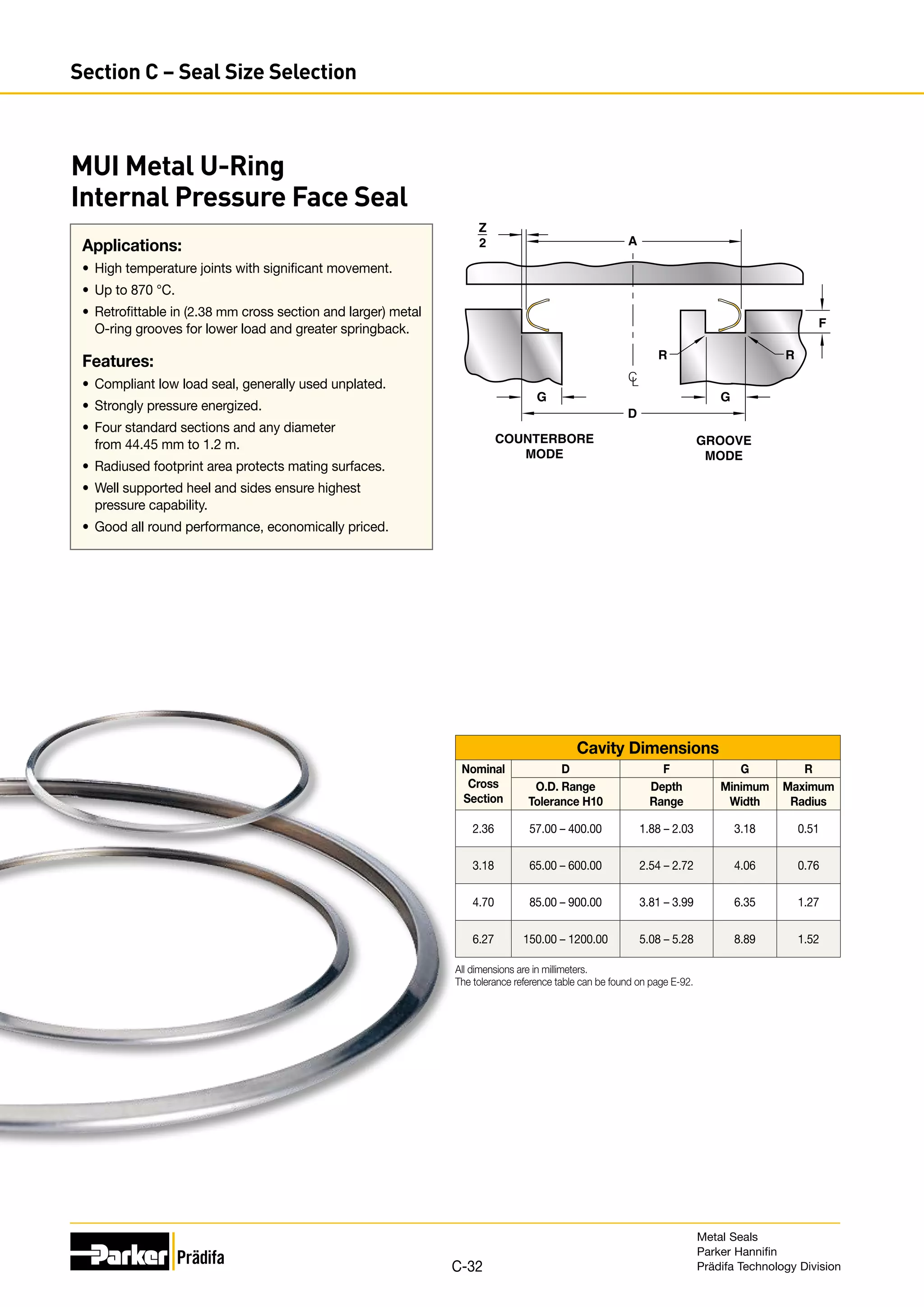
2.36 57.00 – 400.00 1.88 – 2.03 3.18 0.51
3.18 65.00 – 600.00 2.54 – 2.72 4.06 0.76
4.70 85.00 – 900.00 3.81 – 3.99 6.35 1.27
6.27 150.00 – 1200.00 5.08 – 5.28 8.89 1.52
All dimensions are in millimeters.
The tolerance reference table can be found on page E-92.
Applications:
•	 High temperature joints with significant movement.
•	 Up to 870 °C.
•	 Retrofittable in (2.38 mm cross section and larger) metal
O-ring grooves for lower load and greater springback.
Features:
•	 Compliant low load seal, generally used unplated.
•	 Strongly pressure energized.
•	 Four standard sections and any diameter
from 44.45 mm to 1.2 m.
•	 Radiused footprint area protects mating surfaces.
•	 Well supported heel and sides ensure highest
pressure capability.
•	 Good all round performance, economically priced.
D
A
R R
G
G
Z
2
COUNTERBORE
MODE
GROOVE
MODE
C
L
F
MUI Metal U-Ring
Internal Pressure Face Seal
Metal Seals
Parker Hannifin
Prädifa Technology Division
C-32
Section C – Seal Size Selection
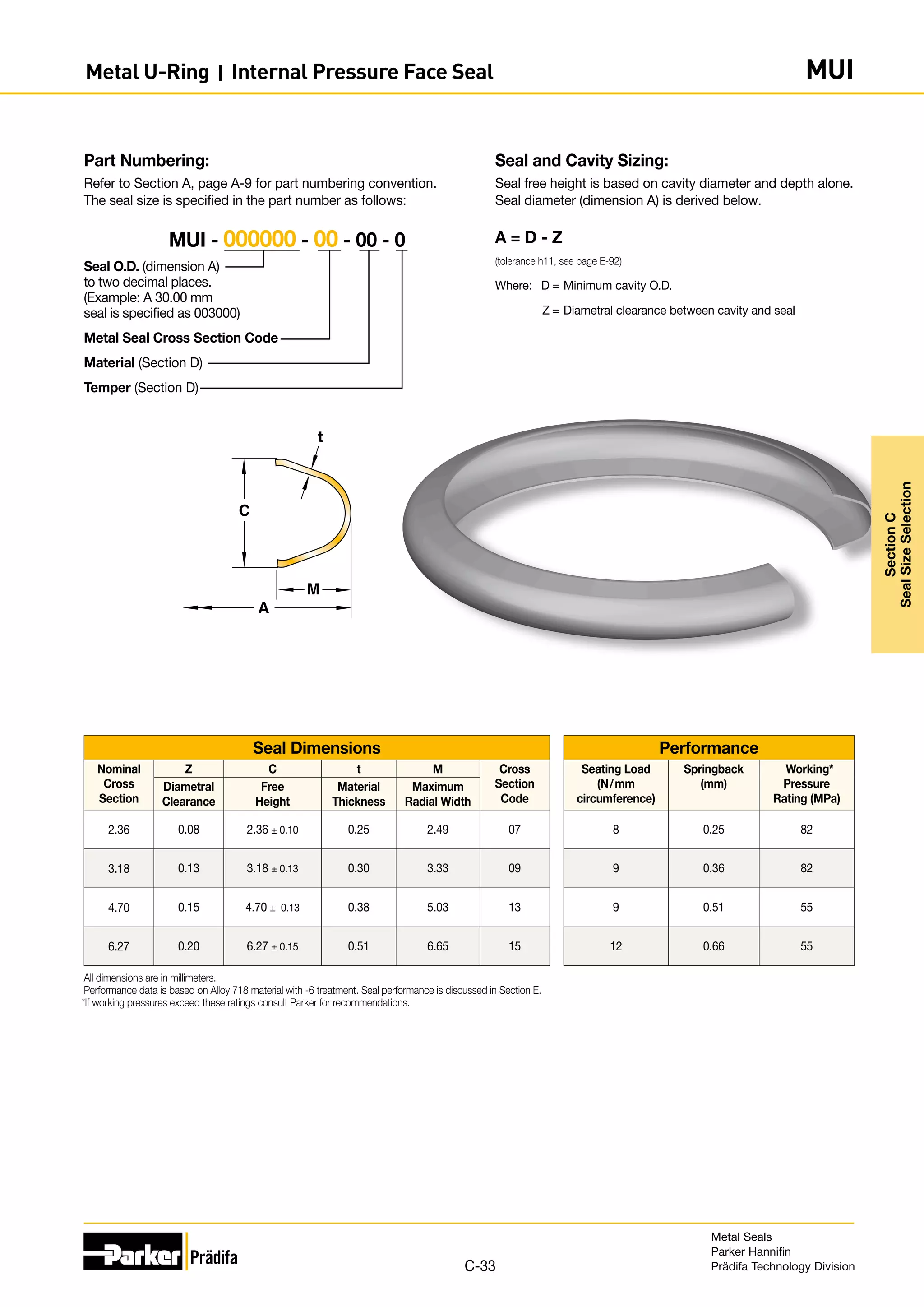
Seal and Cavity Sizing:
Seal free height is based on cavity diameter and depth alone.
Seal diameter (dimension A) is derived below.
A = D - Z
(tolerance h11, see page E-92)
Where:	 D	=	Minimum cavity O.D.
	 Z	=	Diametral clearance between cavity and seal
Part Numbering:
Refer to Section A, page A-9 for part numbering convention.
The seal size is specified in the part number as follows:
Seal O.D. (dimension A)
to two decimal places.
(Example: A 30.00 mm
seal is specified as 003000)
Metal Seal Cross Section Code
Material (Section D)
Temper (Section D)
MUI - 000000 - 00 - 00 - 0
A
C
M
t
Seal Dimensions Performance
Nominal
Cross
Section
Z C t M Cross
Section
Code
Seating Load
(N/mm
circumference)
Springback
(mm)
Working*
Pressure
Rating (MPa)
Diametral
Clearance
Free
Height
Material
Thickness
Maximum
Radial Width
2.36 0.08 2.36 ± 0.10 0.25 2.49 07 8 0.25 82
3.18 0.13 3.18 ± 0.13 0.30 3.33 09 9 0.36 82
4.70 0.15 4.70 ± 0.13 0.38 5.03 13 9 0.51 55
6.27 0.20 6.27 ± 0.15 0.51 6.65 15 12 0.66 55
All dimensions are in millimeters.
Performance data is based on Alloy 718 material with -6 treatment. Seal performance is discussed in Section E.
*If working pressures exceed these ratings consult Parker for recommendations.
Metal Seals
Parker Hannifin
Prädifa Technology Division
C-33
Section
C
Seal
Size
Selection
Metal U-Ring I Internal Pressure Face Seal MUI
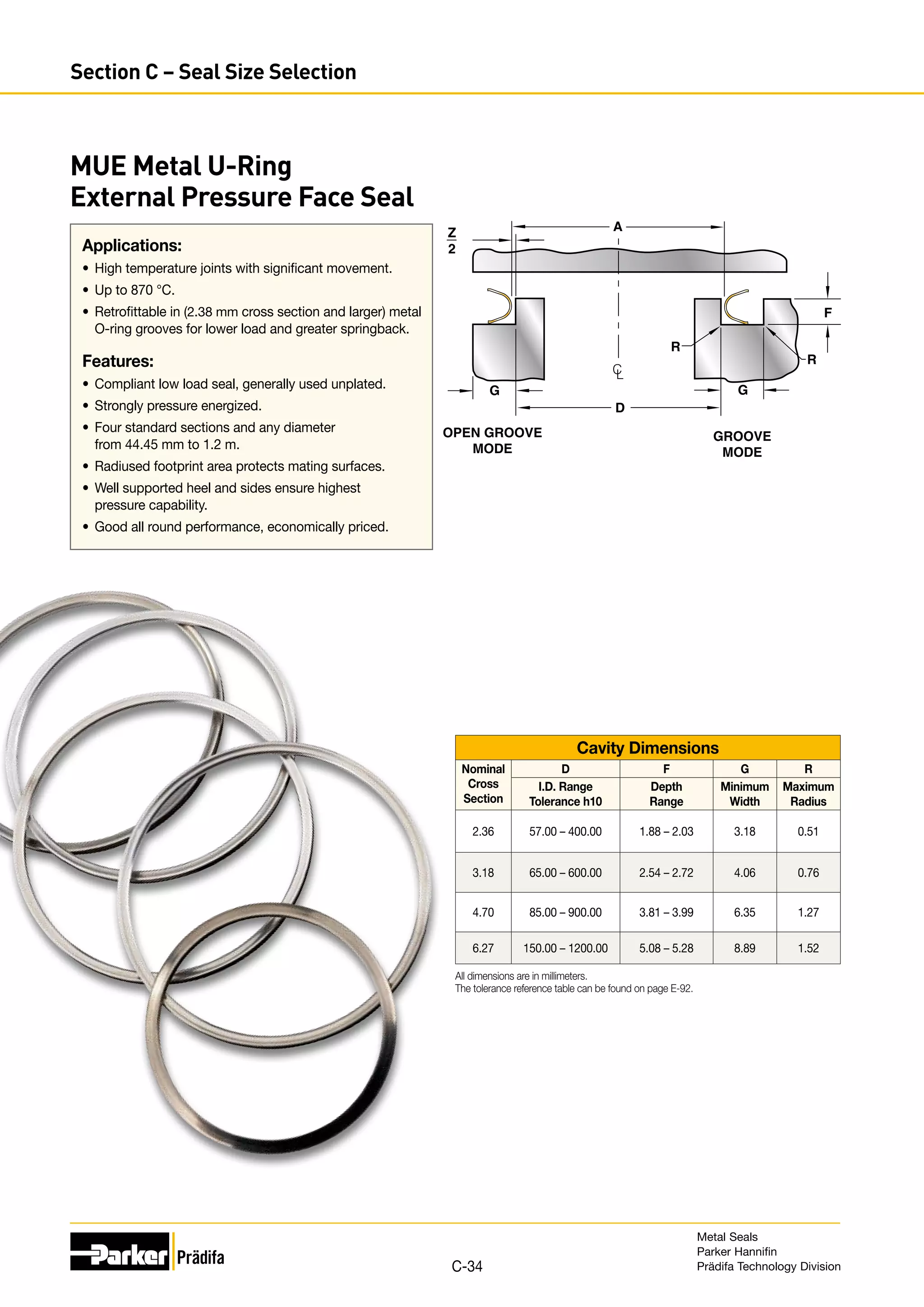
Applications:
•	 High temperature joints with significant movement.
•	 Up to 870 °C.
•	 Retrofittable in (2.38 mm cross section and larger) metal
O-ring grooves for lower load and greater springback.
Features:
•	 Compliant low load seal, generally used unplated.
•	 Strongly pressure energized.
•	 Four standard sections and any diameter
from 44.45 mm to 1.2 m.
•	 Radiused footprint area protects mating surfaces.
•	 Well supported heel and sides ensure highest
pressure capability.
•	 Good all round performance, economically priced.
MUE Metal U-Ring
External Pressure Face Seal
Z
2
D
A
R
R
G
OPEN GROOVE
MODE
GROOVE
MODE
C
L
F
G
Cavity Dimensions
Nominal
Cross
Section
D F G R
I.D. Range
Tolerance h10
Depth
Range
Minimum
Width
Maximum
Radius
2.36 57.00 – 400.00 1.88 – 2.03 3.18 0.51
3.18 65.00 – 600.00 2.54 – 2.72 4.06 0.76
4.70 85.00 – 900.00 3.81 – 3.99 6.35 1.27
6.27 150.00 – 1200.00 5.08 – 5.28 8.89 1.52
All dimensions are in millimeters.
The tolerance reference table can be found on page E-92.
Metal Seals
Parker Hannifin
Prädifa Technology Division
C-34
Section C – Seal Size Selection
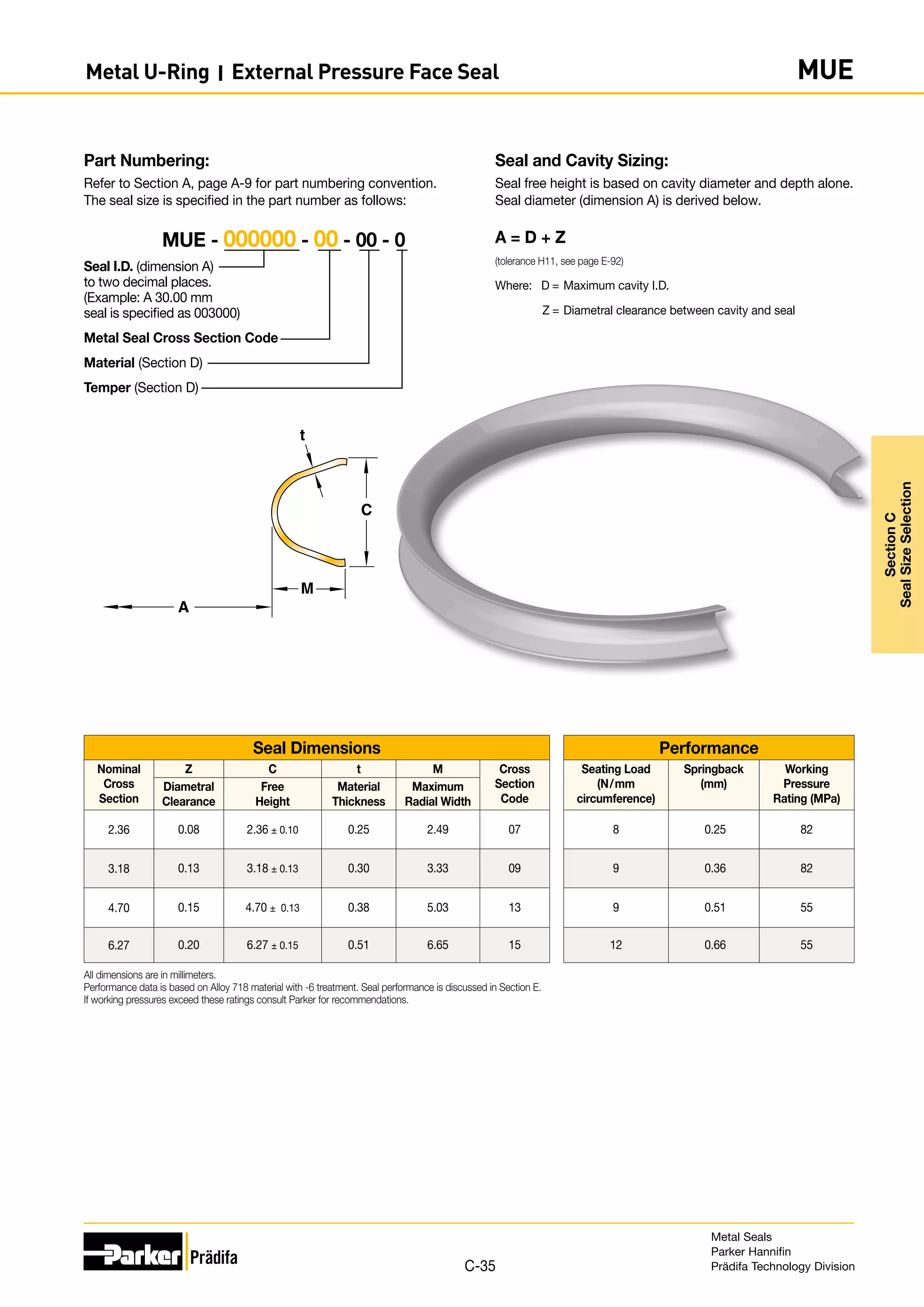
Seal and Cavity Sizing:
Seal free height is based on cavity diameter and depth alone.
Seal diameter (dimension A) is derived below.
A = D + Z
(tolerance H11, see page E-92)
Where:	 D	=	Maximum cavity I.D.
	 Z	=	Diametral clearance between cavity and seal
Part Numbering:
Refer to Section A, page A-9 for part numbering convention.
The seal size is specified in the part number as follows:
Seal I.D. (dimension A)
to two decimal places.
(Example: A 30.00 mm
seal is specified as 003000)
Metal Seal Cross Section Code
Material (Section D)
Temper (Section D)
MUE - 000000 - 00 - 00 - 0
Seal Dimensions Performance
Nominal
Cross
Section
Z C t M Cross
Section
Code
Seating Load
(N/mm
circumference)
Springback
(mm)
Working
Pressure
Rating (MPa)
Diametral
Clearance
Free
Height
Material
Thickness
Maximum
Radial Width
2.36 0.08 2.36 ± 0.10 0.25 2.49 07 8 0.25 82
3.18 0.13 3.18 ± 0.13 0.30 3.33 09 9 0.36 82
4.70 0.15 4.70 ± 0.13 0.38 5.03 13 9 0.51 55
6.27 0.20 6.27 ± 0.15 0.51 6.65 15 12 0.66 55
All dimensions are in millimeters.
Performance data is based on Alloy 718 material with -6 treatment. Seal performance is discussed in Section E.
If working pressures exceed these ratings consult Parker for recommendations.
A
C
M
t
Metal Seals
Parker Hannifin
Prädifa Technology Division
C-35
Section
C
Seal
Size
Selection
Metal U-Ring I External Pressure Face Seal MUE
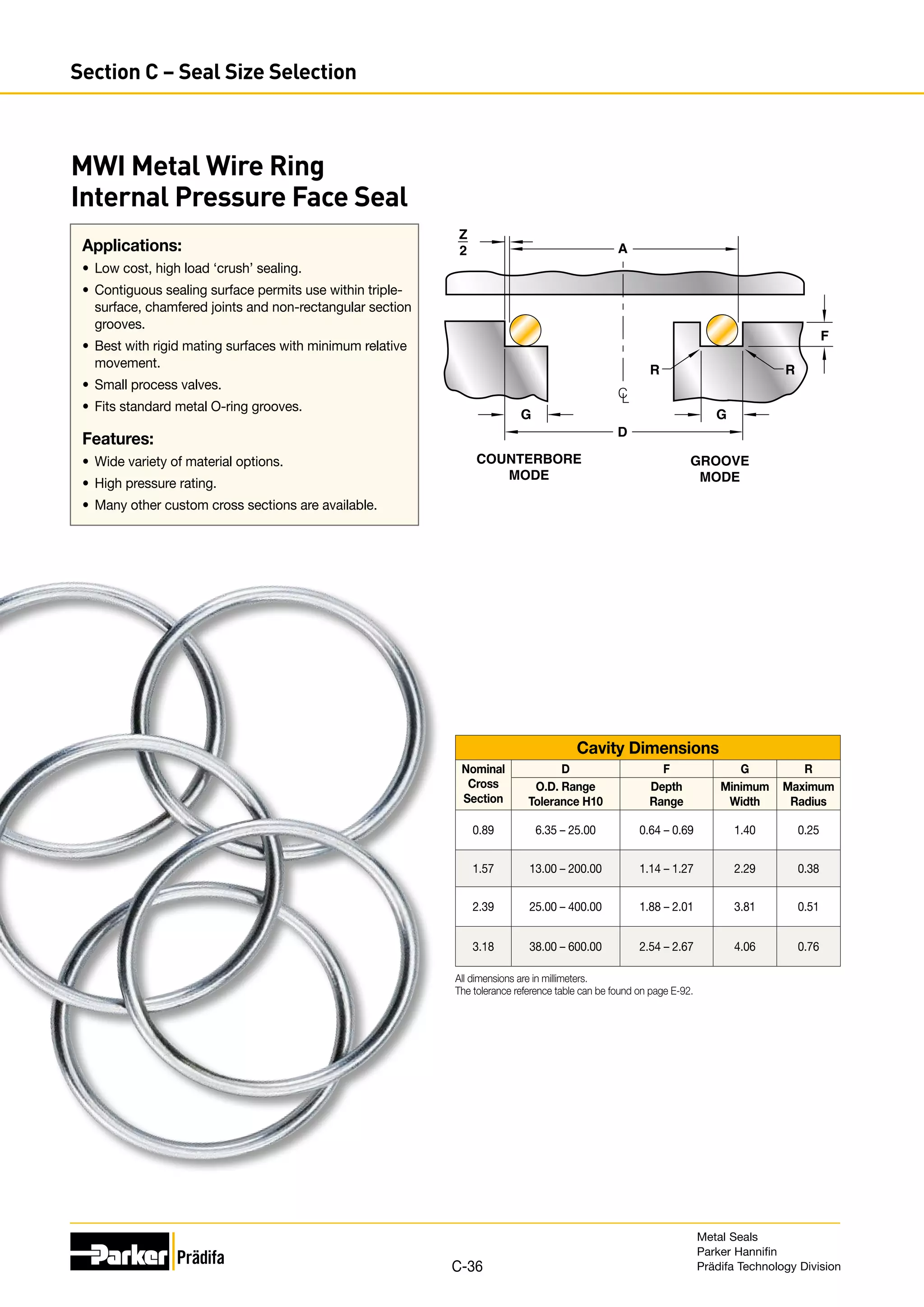
Applications:
•	 Low cost, high load ‘crush’ sealing.
•	 Contiguous sealing surface permits use within triple-
surface, chamfered joints and non-rectangular section
grooves.
•	 Best with rigid mating surfaces with minimum relative
movement.
•	 Small process valves.
•	 Fits standard metal O-ring grooves.
Features:
•	 Wide variety of material options.
•	 High pressure rating.
•	 Many other custom cross sections are available.
MWI Metal Wire Ring
Internal Pressure Face Seal
D
A
R R
G
G
Z
2
COUNTERBORE
MODE
GROOVE
MODE
C
L
F
Cavity Dimensions
Nominal
Cross
Section
D F G R
O.D. Range
Tolerance H10
Depth
Range
Minimum
Width
Maximum
Radius
0.89 6.35 – 25.00 0.64 – 0.69 1.40 0.25
1.57 13.00 – 200.00 1.14 – 1.27 2.29 0.38
2.39 25.00 – 400.00 1.88 – 2.01 3.81 0.51
3.18 38.00 – 600.00 2.54 – 2.67 4.06 0.76
All dimensions are in millimeters.
The tolerance reference table can be found on page E-92.
Metal Seals
Parker Hannifin
Prädifa Technology Division
C-36
Section C – Seal Size Selection
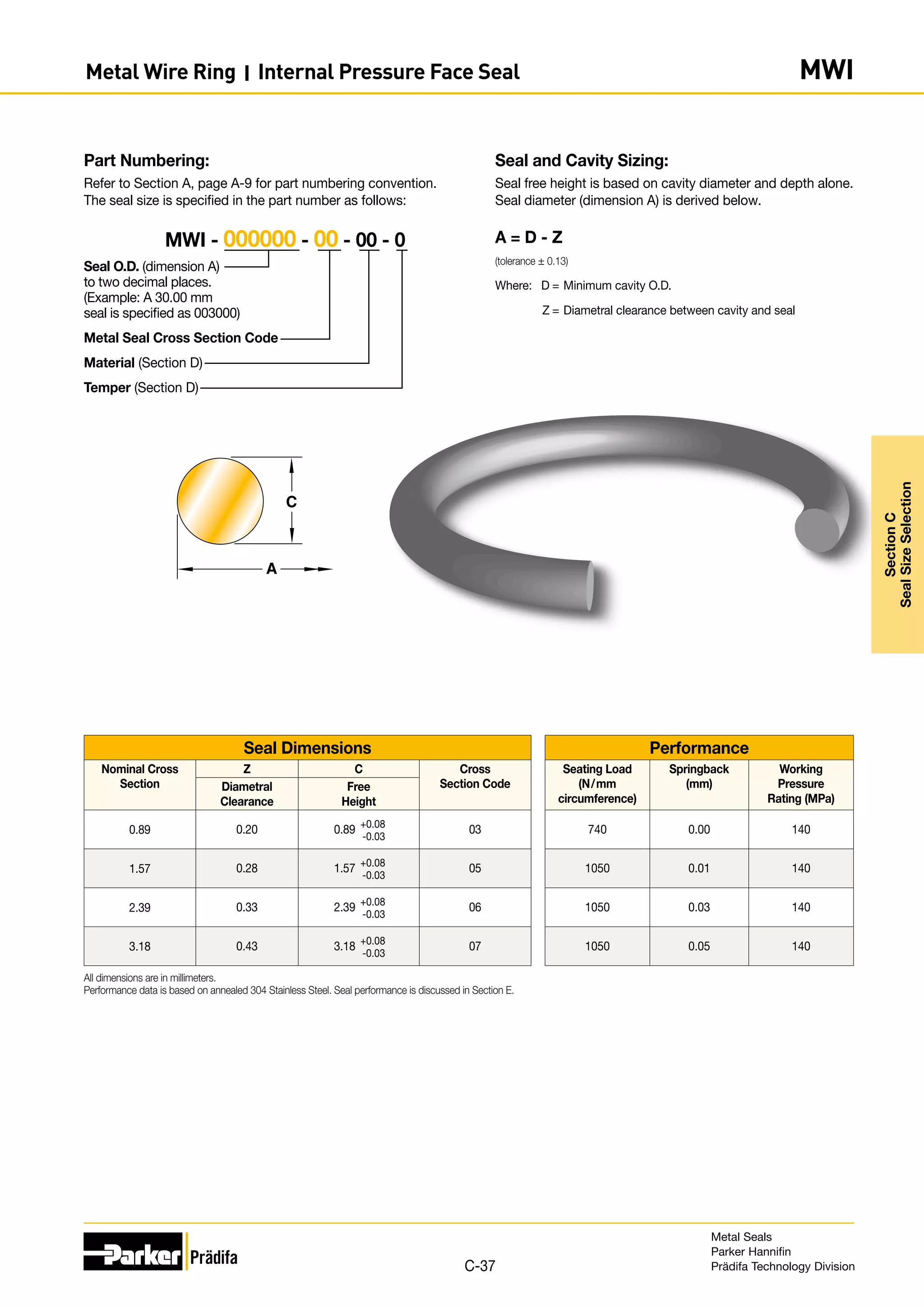
Seal and Cavity Sizing:
Seal free height is based on cavity diameter and depth alone.
Seal diameter (dimension A) is derived below.
A = D - Z
(tolerance ± 0.13)
Where:	 D	=	Minimum cavity O.D.
	 Z	=	Diametral clearance between cavity and seal
Part Numbering:
Refer to Section A, page A-9 for part numbering convention.
The seal size is specified in the part number as follows:
Seal O.D. (dimension A)
to two decimal places.
(Example: A 30.00 mm
seal is specified as 003000)
Metal Seal Cross Section Code
Material (Section D)
Temper (Section D)
MWI - 000000 - 00 - 00 - 0
Seal Dimensions Performance
Nominal Cross
Section
Z C Cross
Section Code
Seating Load
(N/mm
circumference)
Springback
(mm)
Working
Pressure
Rating (MPa)
Diametral
Clearance
Free
Height
0.89 0.20 0.89 +0.08
-0.03
03 740 0.00 140
1.57 0.28 1.57 +0.08
-0.03
05 1050 0.01 140
2.39 0.33 2.39 +0.08
-0.03
06 1050 0.03 140
3.18 0.43 3.18 +0.08
-0.03
07 1050 0.05 140
All dimensions are in millimeters.
Performance data is based on annealed 304 Stainless Steel. Seal performance is discussed in Section E.
A
C
Metal Seals
Parker Hannifin
Prädifa Technology Division
C-37
Section
C
Seal
Size
Selection
Metal Wire Ring I Internal Pressure Face Seal MWI
Applications:
•	 Low cost, high load ‘crush’ sealing.
•	 Contiguous sealing surface permits use within
triple-surface, chamfered joints and non-rectangular
section grooves.
•	 Best with rigid mating surfaces with minimum
relative movement.
•	 Small process valves.
•	 Fits standard metal O-ring grooves.
Features:
•	 High pressure rating.
•	 Many other custom cross sections are available.
Contact your local representative.
MWE Metal Wire Ring
External Pressure Face Seal
Z
2
D
A
R
R
G
OPEN GROOVE
MODE
GROOVE
MODE
C
L
F
G
Cavity Dimensions
Nominal
Cross
Section
D F G R
I.D. Range
Tolerance h10
Depth
Range
Minimum
Width
Maximum
Radius
0.89 4.50 – 25.00 0.64 – 0.69 1.40 0.25
1.57 10.00 – 200.00 1.14 – 1.27 2.29 0.38
2.39 20.00 – 400.00 1.88 – 2.01 3.81 0.51
3.18 32.00 – 600.00 2.54 – 2.67 4.06 0.76
All dimensions are in millimeters.
The tolerance reference table can be found on page E-92.
Metal Seals
Parker Hannifin
Prädifa Technology Division
C-38
Section C – Seal Size Selection
Seal and Cavity Sizing:
Seal free height is based on cavity diameter and depth alone.
Seal diameter (dimension A) is derived below.
A = D + Z
(tolerance ± 0,13 mm)
Where:	 D	=	Maximum cavity I.D.
	 Z	=	Diametral clearance between cavity and seal
Part Numbering:
Refer to Section A, page A-9 for part numbering convention.
The seal size is specified in the part number as follows:
Seal I.D. (dimension A)
to two decimal places.
(Example: A 30.00 mm
seal is specified as 003000)
Metal Seal Cross Section Code
Material (Section D)
Temper (Section D)
MWE - 000000 - 00 - 00 - 0
Seal Dimensions Performance
Nominal Cross
Section
Z C Cross
Section Code
Seating Load
(N/mm
circumference)
Springback
(mm)
Working
Pressure
Rating (MPa)
Diametral
Clearance
Free
Height
0.89 0.20 0.89 +0.08
-0.03
03 740 0.00 140
1.57 0.28 1.57
+0.08
-0.03
05 1050 0.01 140
2.39 0.33 2.39
+0.08
-0.03
06 1050 0.03 140
3.18 0.43 3.18
+0.08
-0.03
07 1050 0.05 140
All dimensions are in millimeters.
Performance data is based on annealed 304 Stainless Steel. Seal performance is discussed in Section E.
A
C
Metal Seals
Parker Hannifin
Prädifa Technology Division
C-39
Section
C
Seal
Size
Selection
Metal Wire Ring I External Pressure Face Seal MWE
Cavity Dimensions
Nominal
Cross
Section
D E G R
Bore Diameter Rod/Shaft Diameter Min.
Width
Max.
Radius
Range tol. tol.
1.57
12.70 – 38.10 +0.03
-0.00 Dmin–3.12 +0.00
-0.03 1.30 0.38
38.11 – 45.00 +0.03
-0.00 Dmin–3.07 +0.00
-0.03 1.30 0.38
2.39
30.17 – 38.10 +0.03
-0.00 Dmin–4.70 +0.00
-0.03 1.98 0.51
38.11 – 85.00 +0.03
-0.00 Dmin–4.65 +0.00
-0.03 1.98 0.51
3.18
50.80 – 82.55 +0.03
-0.00 Dmin–6.25 +0.00
-0.03 2.64 0.76
82.56 – 152.40 +0.05
-0.00 Dmin–6.15 +0.00
-0.05 2.64 0.76
152.41 – 200.00 +0.05
-0.00 Dmin–6.05 +0.00
-0.05 2.64 0.76
3.96
82.55 – 152.40 +0.05
-0.00 Dmin–7.72 +0.00
-0.05 3.28 1.27
152.41 – 250.00 +0.05
-0.00 Dmin–7.62 +0.00
-0.05 3.28 1.27
4.78
101.60 – 152.40 +0.05
-0.00 Dmin–9.32 +0.00
-0.05 3.96 1.27
152.41 – 300.00 +0.05
-0.00 Dmin–9.22 +0.00
-0.05 3.96 1.27
6.35 152.40 – 300.00 +0.05
-0.00 Dmin–12.40 +0.00
-0.05 5.28 1.52
All dimensions are in millimeters.
MCA Metal C-Ring
Axial Seal
Applications:
•	 Static and low cycle dynamic axial sealing.
•	 Fire-safe quarter turn valve stem sealing: up to
30,000 operating cycles.
•	 ‘Plug-in’ connector sealing.
•	 High temperature sealing of mechanical seal to shaft
interface.
Features:
•	 Close tolerance seal for light installation loads.
•	 Plating partially transfers to stem for low wear
characteristics on quarter turn applications.
G
C
L
INSTALLED VIEW
E
ROD/SHAFT
DIAMETER
C
L
D
BORE
DIAMETER
R
A B
10°
10°
Cavity Requirements:
•	 Requires careful control of diametral tolerances and concentricity.
Bore Diameter (mm)
D
Concentricity (mm)
≤ 82.55 0.013
 82.55 0.03
•	 Static mating surfaces should be 0.2 – 0.4 µm Ra, 60 RC
.
•	 Dynamic mating surfaces should be 0.1– 0.2 µm Ra, 60 Rc.
Metal Seals
Parker Hannifin
Prädifa Technology Division
C-40
Section C – Seal Size Selection
Seal and Cavity Sizing:
From Bore Diameter (dim. D) derive the Rod/Shaft Diameter
(dim. E) and Seal O.D. (dim. A) using the tables below.
Part Numbering:
Refer to Section A, page A-9 for part numbering convention.
The seal size is specified in the part number as follows:
Seal O.D. prior to plating
(dimension A) to two decimal
places (Example: A 30.00 mm
seal is specified as 003000)
Metal Seal Cross Section Code
Material (Section D)
Temper (Section D)
Standard plating thickness for ECA
seal is 0.03 mm to 0.05 mm (thickness code N)
MCA - 000000 - 00 - 00 - 0 - XXN
B
A
t
Seal Dimensions Pressure Rating
Nominal
Cross
Section
A B t Cross
Section
Code
Working
Pressure
Rating (MPa)
Seal O.D. Seal I.D. Material
Thickness
tol. tol.
1.57
Dmin+0.08 ±0.03 A – 3.28 ±0.03
0.15 05 390
Dmin+0.10 ±0.03 A – 3.28 ±0.03
2.39
Dmin+0.08 ±0.03 A – 4.85 ±0.03
0.25 07 160
Dmin+0.08 ±0.03 A – 4.85 ±0.03
3.18
Dmin+0.10 ±0.03 A – 6.45 ±0.03
0.38 09 260
Dmin+0.15 ±0.05 A – 6.45 ±0.05
Dmin+0.20 ±0.05 A – 6.45 ±0.05
3.96
Dmin+0.15 ±0.05 A – 8.03 ±0.05
0.41 11 210
Dmin+0.20 ±0.05 A – 8.03 ±0.05
4.78
Dmin+0.15 ±0.05 A – 9.63 ±0.05
0.51 13 220
Dmin+0.20 ±0.05 A – 9.63 ±0.05
6.35 Dmin+0.20 ±0.05 A – 12.80 ±0.05 0.64 15 200
All dimensions are in millimeters and prior to plating.
Metal Seals
Parker Hannifin
Prädifa Technology Division
C-41
Section
C
Seal
Size
Selection
MCA Metal C-Ring I Axial Seal MCA
Applications:
•	 Direct replacement/upgrade for elastomeric O-rings on
MS-33514 flared and MS-33656 flareless fitting ends,
installed into MS-33649 fluid bosses.
•	 Temperatures to 650 °C.
•	 System pressures to 35 MPa and above.
(Seal is capable of higher pressures. Boss or fitting may
be limiting item. Consult your local representative for
assistance if pressures exceed 35 MPa).
Features:
•	 No rework of boss or fitting is necessary.
•	 Utilizes proven silver plated alloy X-750 C-ring technology.
•	 Washer engages with fitting threads for centering the seal
in the boss.
•	 Designed for installation in either direction.
•	 Internally pressure-energized to maintain sealing stress.
No need to retorque.
•	 Cannot extrude or fail due to ageing, pressure impulses,
proof testing or extreme temperatures.
•	 Fully compatible with all hydraulic fluids and fuels.
One seal type works for all fluids.
•	 Easy selection for all standard dash sizes.
Boss Seal
for MS-33649FluidConnectionBossMS-33514/33656Fitting Ends
Metal Seals
Parker Hannifin
Prädifa Technology Division
C-42
Section C – Seal Size Selection
Part Number/Ordering:
Simply refer to the table below to determine the appropriate boss
seal part number for the specific MS Dash Number.
The standard boss seal is made from Alloy X-750, work hard-
ened, and silver plated to a thickness of 0.01 to 0.03 mm.
Other materials are available. Please contact your local
representative for assistance.
B
D
A
C
Seal Dimensions
MS
Dash
Number
Boss Seal
Part Number
A
O.D.
(tol. +0.00 - 0.13)
B
Seal I.D.
(min.)
C
Free Height
(tol. ± 0.05)
Material
Thickness
D
Washer I.D.
Ref
- 02 66690-02-07-1-SPA 9.68 7.67 1.19 0.15 7.06
- 03 66690-03-07-1-SPA 11.28 9.27 1.19 0.15 8.66
- 04 66690-04-07-1-SPA 12.85 10.85 1.19 0.15 10.08
- 05 66690-05-07-1-SPA 14.45 12.45 1.19 0.15 11.66
- 06 66690-06-07-1-SPA 16.03 14.02 1.19 0.15 13.13
- 07 66690-07-07-1-SPA 17.63 15.62 1.19 0.15 14.71
- 08 66690-08-07-1-SPA 20.80 18.80 1.19 0.15 17.75
- 09 66690-09-07-1-SPA 22.40 20.40 1.19 0.15 19.33
- 10 66690-10-07-1-SPA 23.98 21.97 1.19 0.15 20.75
- 11 66690-11-07-1-SPA 27.94 25.93 1.19 0.15 23.67
- 12 66690-12-07-1-SPA 29.36 26.70 1.57 0.25 25.27
- 14 66690-14-07-1-SPA 32.54 29.87 1.57 0.25 28.45
- 16 66690-16-07-1-SPA 35.71 33.05 1.57 0.25 31.62
- 18 66690-18-07-1-SPA 40.46 37.80 1.57 0.25 36.37
- 20 66690-20-07-1-SPA 43.64 40.97 1.57 0.25 39.55
- 24 66690-24-07-1-SPA 49.99 47.32 1.57 0.25 45.90
- 28 66690-28-07-1-SPA 59.51 56.85 1.57 0.25 55.42
- 32 66690-32-07-1-SPA 65.89 63.22 1.57 0.25 61.77
All dimensions are in millimeters and prior to plating.
Metal Seals
Parker Hannifin
Prädifa Technology Division
C-43
Section
C
Seal
Size
Selection
Boss Seal for MS-33649 Fluid Connection Boss  MS-33514/33656 Fitting Ends
A D
2.18
to
2.29
AS1895
Dash
Number
D E-Ring
Part Number
A C
Cavity
(+0.003 -0.000)
Seal O.D.
(Tol. h11)
Seal Free
Height
±0.13
–100 31.75 69025 -100 - XX 31.67 2.74
–125 38.10 69025 -125 - XX 38.02 2.74
–150 44.45 69025 -150 - XX 44.37 2.74
–175 50.80 69025 -175 - XX 50.72 2.74
–200 57.15 69025 -200 - XX 57.07 2.74
–225 63.50 69025 -225 - XX 63.42 2.74
–250 69.85 69025 -250 - XX 69.77 2.74
–275 76.20 69025 -275 - XX 76.12 2.74
–300 82.55 69025 -300 - XX 82.47 2.74
–325 88.90 69025 -325 - XX 88.82 2.74
–350 95.25 69025 -350 - XX 95.17 2.74
–400 107.95 69025 -400 - XX 107.87 2.74
–450 120.65 69025 -450 - XX 120.57 2.74
–500 133.35 69025 -500 - XX 133.27 2.74
–550 146.05 69025 -550 - XX 145.97 2.74
–600 158.75 69025 -600 - XX 158.67 2.74
–650 171.45 69025 -650 - XX 171.37 2.74
–700 184.15 69025 -700 - XX 184.07 2.74
–750 196.85 69025 -750 - XX 196.77 2.74
All dimensions are in millimeters.
The tolerance reference table can be
found on page E-92.
Material Code Choice (XX):
	 Material	 Material Code
	 Alloy 718	 14
	Waspaloy	 23
	 Rene 41	 29
•	 Specially sized E-rings are listed below to fit all AS1895
(dash number -100 to -750) flanges.
•	 E-rings are manufactured from unplated Alloy 718, solu-
tion annealed and age-hardened in the standard configu-
ration. Other high strength/higher temperature nickel
alloys are available including Waspaloy and
Rene 41.
Metal E-Ring,
for AS1895 Flanges
Metal Seals
Parker Hannifin
Prädifa Technology Division
C-44
Section C – Seal Size Selection
Metal O-Rings for U.S. Aerospace Standards
AS Dash
Number
Seal Diameter
Code
-03 000250
-04 000281
-05 000312
-06 000344
-07 000375
-08 000406
-09 000438
AS Dash
Number
Seal Diameter
Code
-10 000469
-11 000500
-12 000562
-13 000625
-14 000688
-15 000750
-16 000812
AS Dash
Number
Seal Diameter
Code
-17 000875
-18 000938
-19 001000
-20 001125
-21 001250
-22 001375
-23 001500
AS Dash
Number
Seal Diameter
Code
-24 001625
-25 001750
-26 001875
-27 002000
AS Dash
Number
Seal Diameter
Code
-013 000438
-014 000469
-015 000500
-016 000531
-017 000562
-018 000594
-019 000625
-020 000656
-021 000688
-022 000719
-023 000750
-024 000781
-025 000812
-026 000844
-027 000875
-028 000906
-029 000938
-030 000969
-031 001000
AS Dash
Number
Seal Diameter
Code
-032 001031
-033 001062
-034 001094
-035 001125
-036 001156
-037 001188
-038 001219
-039 001250
-040 001312
-041 001375
-042 001438
-043 001500
-044 001562
-045 001625
-046 001688
-047 001750
-048 001812
-049 001875
-050 001938
AS Dash
Number
Seal Diameter
Code
-051 002000
-052 002062
-053 002125
-054 002188
-055 002250
-056 002312
-057 002375
-058 002438
-059 002500
-060 002562
-061 002625
-062 002688
-063 002750
-064 002812
-065 002875
-066 002938
-067 003000
-069 003125
-071 003250
AS Dash
Number
Seal Diameter
Code
-073 003375
-075 003500
-077 003625
-079 003750
-081 003875
-083 004000
-085 004125
-087 004250
-089 004375
-091 004500
-093 004625
-095 004750
-097 004875
-099 005000
AS Dash
Number
Seal Diameter
Code
-013 000438
-014 000469
-015 000500
-016 000531
-017 000562
-018 000594
-019 000625
-020 000656
-021 000688
-022 000719
-023 000750
-024 000781
-025 000812
-026 000844
-027 000875
-028 000906
-029 000938
-030 000969
-031 001000
-032 001031
-033 001062
-034 001094
-035 001125
-036 001156
-037 001188
AS Dash
Number
Seal Diameter
Code
-038 001219
-039 001250
-040 001312
-041 001375
-042 001438
-043 001500
-044 001562
-045 001625
-046 001688
-047 001750
-048 001812
-049 001875
-050 001938
-051 002000
-052 002062
-053 002125
-054 002188
-055 002250
-056 002312
-057 002375
-058 002438
-059 002500
-060 002562
-061 002625
-062 002688
AS Dash
Number
Seal Diameter
Code
-063 002750
-064 002812
-065 002875
-066 002938
-067 003000
-069 003125
-071 003250
-073 003375
-075 003500
-077 003625
-079 003750
-081 003875
-083 004000
-085 004125
-087 004250
-089 004375
-091 004500
-093 004625
-095 004750
-097 004875
-099 005000
-101 005125
-103 005250
-105 005375
-107 005500
AS Dash
Number
Seal Diameter
Code
-109 005625
-111 005750
-113 005875
-115 006000
-117 006125
-119 006250
-121 006375
-123 006500
-125 006625
-127 006750
-129 006875
-131 007000
-133 007125
-135 007250
-137 007375
-139 007500
-141 007625
-143 007750
-145 007875
-147 008000
AS9141	 Parker Part Number EON – Seal diameter code from table below – 01 - 03 - 1
AS9142	 Parker Part Number EON – Seal diameter code from table below – 02 - 03 - 1
AS9202	 Parker Part Number EON – Seal diameter code from table below – 03 - 03 - 1
Metal Seals
Parker Hannifin
Prädifa Technology Division
C-45
Section
C
Seal
Size
Selection
Metal O-Rings for U.S. Aerospace Standards
AS Dash
Number
Seal Diameter
Code
-010 001000
-012 001031
-013 001062
-014 001094
-015 001125
-016 001156
-017 001188
-018 001219
-019 001250
-020 001281
-021 001312
-022 001344
-023 001375
-024 001406
-025 001438
-026 001469
-027 001500
-028 001562
-029 001625
-030 001688
-031 001750
-032 001812
-033 001875
-034 001938
-035 002000
-036 002062
AS Dash
Number
Seal Diameter
Code
-037 002125
-038 002188
-039 002250
-040 002312
-041 002375
-042 002438
-043 002500
-044 002562
-045 002625
-046 002688
-047 002750
-048 002812
-049 002875
-050 002938
-051 003000
-052 003062
-053 003125
-054 003188
-055 003250
-056 003312
-057 003375
-058 003438
-059 003500
-060 003562
-061 003625
-062 003688
AS Dash
Number
Seal Diameter
Code
-063 003750
-064 003812
-065 003875
-066 003938
-067 004000
-069 004125
-071 004250
-073 004375
-075 004500
-077 004625
-079 004750
-081 004875
-083 005000
-085 005125
-087 005250
-089 005375
-091 005500
-095 005750
-099 006000
-103 006250
-107 006500
-111 006750
-115 007000
-119 007250
-123 007500
-127 007750
AS Dash
Number
Seal Diameter
Code
-131 008000
-135 008250
-139 008500
-143 008750
-147 009000
-151 009250
-155 009500
-159 009750
-163 010000
-167 010250
-171 010500
-175 010750
-179 011000
-183 011250
-187 011500
-191 011750
-195 012000
-203 012500
-211 013000
-219 013500
-227 014000
AS Dash
Number
Seal Diameter
Code
-010 001000
-012 001031
-013 001062
-014 001094
-015 001125
-016 001156
-017 001188
-018 001219
-019 001250
-020 001281
-021 001312
-022 001344
-023 001375
-024 001406
-025 001438
-026 001469
-027 001500
-028 001562
-029 001625
-030 001688
-031 001750
-032 001812
-033 001875
-034 001938
-035 002000
-036 002062
AS Dash
Number
Seal Diameter
Code
-037 002125
-038 002188
-039 002250
-040 002312
-041 002375
-042 002438
-043 002500
-044 002562
-045 002625
-046 002688
-047 002750
-048 002812
-049 002875
-050 002938
-051 003000
-052 003062
-053 003125
-054 003188
-055 003250
-056 003312
-057 003375
-058 003438
-059 003500
-060 003562
-061 003625
-062 003688
AS Dash
Number
Seal Diameter
Code
-063 003750
-064 003812
-065 003875
-066 003938
-067 004000
-069 004125
-071 004250
-073 004375
-075 004500
-077 004625
-079 004750
-081 004875
-083 005000
-085 005125
-087 005250
-089 005375
-091 005500
-095 005750
-099 006000
-103 006250
-107 006500
-111 006750
-115 007000
-119 007250
-123 007500
-127 007750
AS Dash
Number
Seal Diameter
Code
-131 008000
-135 008250
-139 008500
-143 008750
-147 009000
-151 009250
-155 009500
-159 009750
-163 010000
-167 010250
-171 010500
-175 010750
-179 011000
-183 011250
-187 011500
-191 011750
-195 012000
-203 012500
-211 013000
-219 013500
-227 014000
AS9203	 Parker Part Number EON – Seal diameter code from table below – 04 - 03 - 1
AS9204	 Parker Part Number EON – Seal diameter code from table below – 05 - 03 - 1
Metal Seals
Parker Hannifin
Prädifa Technology Division
C-46
Section C – Seal Size Selection
AS Dash
Number
Seal Diameter
Code
-010 002000
-011 002062
-012 002125
-013 002188
-014 002250
-015 002312
-016 002375
-017 002438
-018 002500
-019 002562
-020 002625
-021 002688
-022 002750
-023 002812
-024 002875
-025 002938
-026 003000
-027 003062
-028 003125
-029 003188
-030 003250
-031 003312
-032 003375
-033 003438
-034 003500
-035 003562
-036 003625
-037 003688
-038 003750
-039 003812
-040 003875
-041 003938
-042 004000
-043 004062
-044 004125
-045 004188
-046 004250
-047 004312
-048 004375
-049 004438
-050 004500
-051 004562
-052 004625
-053 004688
-054 004750
-055 004812
-056 004875
-057 004938
AS Dash
Number
Seal Diameter
Code
-058 005000
-059 005062
-060 005125
-061 005188
-062 005250
-063 005312
-064 005375
-065 005438
-066 005500
-067 005562
-068 005625
-069 005688
-070 005750
-071 005812
-072 005875
-073 005938
-074 006000
-076 006125
-078 006250
-080 006375
-082 006500
-084 006625
-086 006750
-088 006875
-090 007000
-092 007125
-094 007250
-096 007375
-098 007500
-100 007625
-102 007750
-104 007875
-106 008000
-108 008125
-110 008250
-112 008375
-114 008500
-116 008625
-118 008750
-120 008875
-122 009000
-124 009250
-130 009500
-134 009750
-138 010000
-142 010250
-146 010500
-150 010750
AS Dash
Number
Seal Diameter
Code
-154 011000
-158 011250
-162 011500
-166 011750
-170 012000
-174 012250
-178 012500
-182 012750
-186 013000
-190 013250
-194 013500
-198 013750
-202 014000
-206 014250
-210 014500
-214 014750
-218 015000
-222 015250
-226 015500
-230 015750
-234 016000
-238 016250
-242 016500
-246 016750
-250 017000
-254 017250
-258 017500
-262 017750
-266 018000
-270 018250
-274 018500
-278 018750
-282 019000
-286 019250
-290 019500
-294 019750
-298 020000
-306 020500
-314 021000
-322 021500
-330 022000
-338 022500
-346 023000
-354 023500
-362 024000
-370 024500
-378 025000
-386 025500
AS Dash
Number
Seal Diameter
Code
-394 026000
-402 026500
-410 027000
-418 027500
-426 028000
-434 028500
-442 029000
-450 029500
-458 030000
-466 030500
-474 031000
-482 031500
-490 032000
-498 032500
-506 033000
-514 033500
-522 034000
-530 034500
-538 035000
-546 035500
-554 036000
-562 036500
-570 037000
-578 037500
-586 038000
-594 038500
-602 039000
-610 039500
-618 040000
-634 041000
-650 042000
-666 043000
-682 044000
-698 045000
-714 046000
-730 047000
-746 048000
-762 049000
-778 050000
AS9205	 Parker Part Number EON – Seal diameter code from table below – 07 - 03 - 1
Metal Seals
Parker Hannifin
Prädifa Technology Division
C-47
Section
C
Seal
Size
Selection
Metal O-Rings for U.S. Aerospace Standards
AS Dash
Number
Seal Diameter
Code
-03 000250
-04 000281
-05 000312
-06 000344
-07 000375
-08 000406
-09 000438
AS Dash
Number
Seal Diameter
Code
-10 000469
-11 000500
-12 000562
-13 000625
-14 000688
-15 000750
-16 000812
AS Dash
Number
Seal Diameter
Code
-17 000875
-18 000938
-19 001000
-20 001125
-21 001250
-22 001375
-23 001500
AS Dash
Number
Seal Diameter
Code
-24 001625
-25 001750
-26 001875
-27 002000
AS Dash
Number
Seal Diameter
Code
-013 000438
-014 000469
-015 000500
-016 000531
-017 000562
-018 000594
-019 000625
-020 000656
-021 000688
-022 000719
-023 000750
-024 000781
-025 000812
-026 000844
-027 000875
-028 000906
-029 000938
-030 000969
-031 001000
AS Dash
Number
Seal Diameter
Code
-032 001031
-033 001062
-034 001094
-035 001125
-036 001156
-037 001188
-038 001219
-039 001250
-040 001312
-041 001375
-042 001438
-043 001500
-044 001562
-045 001625
-046 001688
-047 001750
-048 001812
-049 001875
-050 001938
AS Dash
Number
Seal Diameter
Code
-051 002000
-052 002062
-053 002125
-054 002188
-055 002250
-056 002312
-057 002375
-058 002438
-059 002500
-060 002562
-061 002625
-062 002688
-063 002750
-064 002812
-065 002875
-066 002938
-067 003000
-069 003125
-071 003250
AS Dash
Number
Seal Diameter
Code
-073 003375
-075 003500
-077 003625
-079 003750
-081 003875
-083 004000
-085 004125
-087 004250
-089 004375
-091 004500
-093 004625
-095 004750
-097 004875
-099 005000
AS Dash
Number
Seal Diameter
Code
-013 000438
-014 000469
-015 000500
-016 000531
-017 000562
-018 000594
-019 000625
-020 000656
-021 000688
-022 000719
-023 000750
-024 000781
-025 000812
-026 000844
-027 000875
-028 000906
-029 000938
-030 000969
-031 001000
-032 001031
-033 001062
-034 001094
-035 001125
-036 001156
-037 001188
AS Dash
Number
Seal Diameter
Code
-038 001219
-039 001250
-040 001312
-041 001375
-042 001438
-043 001500
-044 001562
-045 001625
-046 001688
-047 001750
-048 001812
-049 001875
-050 001938
-051 002000
-052 002062
-053 002125
-054 002188
-055 002250
-056 002312
-057 002375
-058 002438
-059 002500
-060 002562
-061 002625
-062 002688
AS Dash
Number
Seal Diameter
Code
-063 002750
-064 002812
-065 002875
-066 002938
-067 003000
-069 003125
-071 003250
-073 003375
-075 003500
-077 003625
-079 003750
-081 003875
-083 004000
-085 004125
-087 004250
-089 004375
-091 004500
-093 004625
-095 004750
-097 004875
-099 005000
-101 005125
-103 005250
-105 005375
-107 005500
AS Dash
Number
Seal Diameter
Code
-109 005625
-111 005750
-113 005875
-115 006000
-117 006125
-119 006250
-121 006375
-123 006500
-125 006625
-127 006750
-129 006875
-131 007000
-133 007125
-135 007250
-137 007375
-139 007500
-141 007625
-143 007750
-145 007875
-147 008000
AS9371	 Parker Part Number EON – Seal diameter code from table below – 01 - 03 - 1 - SPB
AS9372	 Parker Part Number EON – Seal diameter code from table below – 02 - 03 - 1 - SPB
AS9373	 Parker Part Number EON – Seal diameter code from table below – 03 - 03 - 1 - SPB
Metal Seals
Parker Hannifin
Prädifa Technology Division
C-48
Section C – Seal Size Selection
AS Dash
Number
Seal Diameter
Code
-010 001000
-012 001031
-013 001062
-014 001094
-015 001125
-016 001156
-017 001188
-018 001219
-019 001250
-020 001281
-021 001312
-022 001344
-023 001375
-024 001406
-025 001438
-026 001469
-027 001500
-028 001562
-029 001625
-030 001688
-031 001750
-032 001812
-033 001875
-034 001938
-035 002000
AS Dash
Number
Seal Diameter
Code
-036 002062
-037 002125
-038 002188
-039 002250
-040 002312
-041 002375
-042 002438
-043 002500
-044 002562
-045 002625
-046 002688
-047 002750
-048 002812
-049 002875
-050 002938
-051 003000
-052 003062
-053 003125
-054 003188
-055 003250
-056 003312
-057 003375
-058 003438
-059 003500
-060 003562
AS Dash
Number
Seal Diameter
Code
-061 003625
-062 003688
-063 003750
-064 003812
-065 003875
-066 003938
-067 004000
-069 004125
-071 004250
-073 004375
-075 004500
-077 004625
-079 004750
-081 004875
-083 005000
-085 005125
-087 005250
-089 005375
-091 005500
-095 005750
-099 006000
-103 006250
-107 006500
-111 006750
-115 007000
AS Dash
Number
Seal Diameter
Code
-119 007250
-123 007500
-127 007750
-131 008000
-135 008250
-139 008500
-143 008750
-147 009000
-151 009250
-155 009500
-159 009750
-163 010000
-167 010250
-171 010500
-175 010750
-179 011000
-183 011250
-187 011500
-191 011750
-195 012000
AS Dash
Number
Seal Diameter
Code
-010 001000
-012 001031
-013 001062
-014 001094
-015 001125
-016 001156
-017 001188
-018 001219
-019 001250
-020 001281
-021 001312
-022 001344
-023 001375
-024 001406
-025 001438
-026 001469
-027 001500
-028 001562
-029 001625
-030 001688
-031 001750
-032 001812
-033 001875
-034 001938
-035 002000
AS Dash
Number
Seal Diameter
Code
-036 002062
-037 002125
-038 002188
-039 002250
-040 002312
-041 002375
-042 002438
-043 002500
-044 002562
-045 002625
-046 002688
-047 002750
-048 002812
-049 002875
-050 002938
-051 003000
-052 003062
-053 003125
-054 003188
-055 003250
-056 003312
-057 003375
-058 003438
-059 003500
-060 003562
AS Dash
Number
Seal Diameter
Code
-061 003625
-062 003688
-063 003750
-064 003812
-065 003875
-066 003938
-067 004000
-069 004125
-071 004250
-073 004375
-075 004500
-077 004625
-079 004750
-081 004875
-083 005000
-085 005125
-087 005250
-089 005375
-091 005500
-095 005750
-099 006000
-103 006250
-107 006500
-111 006750
-115 007000
AS Dash
Number
Seal Diameter
Code
-119 007250
-123 007500
-127 007750
-131 008000
-135 008250
-139 008500
-143 008750
-147 009000
-151 009250
-155 009500
-159 009750
-163 010000
-167 010250
-171 010500
-175 010750
-179 011000
-183 011250
-187 011500
-191 011750
-195 012000
AS9374	 Parker Part Number EON – Seal diameter code from table below – 04 - 03 - 1 - SPB
AS9375	 Parker Part Number EON – Seal diameter code from table below – 05 - 03 - 1 - SPB
Metal Seals
Parker Hannifin
Prädifa Technology Division
C-49
Section
C
Seal
Size
Selection
Metal O-Rings for U.S. Aerospace Standards
AS Dash
Number
Seal Diameter
Code
-010 002000
-011 002062
-012 002125
-013 002188
-014 002250
-015 002312
-016 002375
-017 002438
-018 002500
-019 002562
-020 002625
-021 002688
-022 002750
-023 002812
-024 002875
-025 002938
-026 003000
-027 003062
-028 003125
-029 003188
-030 003250
-031 003312
-032 003375
-033 003438
-034 003500
-035 003562
-036 003625
AS Dash
Number
Seal Diameter
Code
-037 003688
-038 003750
-039 003812
-040 003875
-041 003938
-042 004000
-043 004062
-044 004125
-045 004188
-046 004250
-047 004312
-048 004375
-049 004438
-050 004500
-051 004562
-052 004625
-053 004688
-054 004750
-055 004812
-056 004875
-057 004938
-058 005000
-059 005062
-060 005125
-061 005188
-062 005250
-063 005312
AS Dash
Number
Seal Diameter
Code
-064 005375
-065 005438
-066 005500
-067 005562
-068 005625
-069 005688
-070 005750
-071 005812
-072 005875
-073 005938
-074 006000
-076 006125
-078 006250
-080 006375
-082 006500
-084 006625
-086 006750
-088 006875
-090 007000
-092 007125
-094 007250
-096 007375
-098 007500
-100 007625
-102 007750
-104 007875
-106 008000
AS Dash
Number
Seal Diameter
Code
-108 008125
-110 008250
-112 008375
-114 008500
-116 008625
-118 008750
-120 008875
-122 009000
-124 009250
-130 009500
-134 009750
-138 010000
-142 010250
-146 010500
-150 010750
-154 011000
-158 011250
-162 011500
-166 011750
-170 012000
AS9376	 Parker Part Number EON – Seal diameter code from table below – 07 - 03 - 1 - SPB
Metal Seals
Parker Hannifin
Prädifa Technology Division
C-50
Section C – Seal Size Selection
This section includes:	 Page
Selecting the Metal Seal Material
Material Codes for Non-Spring Energized Seals.. . . . . . . . . . . . . . . . . . . . . . . . . . . . . . . . . . . . . . . . . . . . . . . . . . . . . . . . . . . . . . . . . . D-52
Material Codes for Spring Energized Seals. . . . . . . . . . . . . . . . . . . . . . . . . . . . . . . . . . . . . . . . . . . . . . . . . . . . . . . . . . . . . . . . . . . . . . . . . . D-53
Temperature Capabilities – Stainless Steel.. . . . . . . . . . . . . . . . . . . . . . . . . . . . . . . . . . . . . . . . . . . . . . . . . . . . . . . . . . . . . . . . . . . . . . . . . . D-53
Temperature Capabilities – Nickel Alloys.. . . . . . . . . . . . . . . . . . . . . . . . . . . . . . . . . . . . . . . . . . . . . . . . . . . . . . . . . . . . . . . . . . . . . . . . . . . . . D-54
Temperature Capabilities – Cobalt Alloys. . . . . . . . . . . . . . . . . . . . . . . . . . . . . . . . . . . . . . . . . . . . . . . . . . . . . . . . . . . . . . . . . . . . . . . . . . . . . D-55
Temperature Capabilities – Other Materials.. . . . . . . . . . . . . . . . . . . . . . . . . . . . . . . . . . . . . . . . . . . . . . . . . . . . . . . . . . . . . . . . . . . . . . . . . D-55
Aerospace Material Specification (AMS) Reference. . . . . . . . . . . . . . . . . . . . . . . . . . . . . . . . . . . . . . . . . . . . . . . . . . . . . . . . . . . . . . D-56
Yield Strength, Relaxation  Springback.. . . . . . . . . . . . . . . . . . . . . . . . . . . . . . . . . . . . . . . . . . . . . . . . . . . . . . . . . . . . . . . . . . . . . . . . . . . . . D-56
Metal Seal, Platings, Coatings and Finishes
Temper Codes. . . . . . . . . . . . . . . . . . . . . . . . . . . . . . . . . . . . . . . . . . . . . . . . . . . . . . . . . . . . . . . . . . . . . . . . . . . . . . . . . . . . . . . . . . . . . . . . . . . . . . . . . . . . . . . . . . . . D-58
Finish Codes. . . . . . . . . . . . . . . . . . . . . . . . . . . . . . . . . . . . . . . . . . . . . . . . . . . . . . . . . . . . . . . . . . . . . . . . . . . . . . . . . . . . . . . . . . . . . . . . . . . . . . . . . . . . . . . . . . . . . . D-59
Finish Thickness Selecting Guidelines. . . . . . . . . . . . . . . . . . . . . . . . . . . . . . . . . . . . . . . . . . . . . . . . . . . . . . . . . . . . . . . . . . . . . . . . . . . . . . . . . D-60
Silver-Indium Plating. . . . . . . . . . . . . . . . . . . . . . . . . . . . . . . . . . . . . . . . . . . . . . . . . . . . . . . . . . . . . . . . . . . . . . . . . . . . . . . . . . . . . . . . . . . . . . . . . . . . . . . . . . . D-61
TriCom®
Plating.. . . . . . . . . . . . . . . . . . . . . . . . . . . . . . . . . . . . . . . . . . . . . . . . . . . . . . . . . . . . . . . . . . . . . . . . . . . . . . . . . . . . . . . . . . . . . . . . . . . . . . . . . . . . . . . . . . D-62
TriCom-HT™
Plating.. . . . . . . . . . . . . . . . . . . . . . . . . . . . . . . . . . . . . . . . . . . . . . . . . . . . . . . . . . . . . . . . . . . . . . . . . . . . . . . . . . . . . . . . . . . . . . . . . . . . . . . . . . . . D-64
Introduction to the Material Selection Process
With the seal type, diameter and cross-section already determined, the
following pages (D-52 to D-65) provide specific guidance in selecting the
appropriate material(s), temper and finish.
Comprehensive data is given to ensure an optimum match between the
many material choices and the application. However, we are always
pleased to offer additional technical consulting and advice if required. To
obtain the fastest response please send us your completed application
data sheet (see page F-103, F-104), for immediate review by our product
specialists and engineering staff.
Metal seal material, temper and finish are designated in the part number
as shown below.
Metal Seal Type (Section B)
Seal Diameter (millimeters specified to
two decimal places – Section C)
Seal Cross Section (Section C)
Material Code
Temper Code
Finish Code (material  thickness)
MXX - 000000 - 00 - 00 - 0 - XXX
Metal Seals
Parker Hannifin
Prädifa Technology Division
D-51
Section
D
Material
Selection
Section D – Material Selection Process
Selecting the
Metal Seal Material
Non-Spring Energized Seals
Material
Code
Material
(Common Designation)
NACE
Approved
(See Note 3)
C-Ring E-Ring O-Ring U-Ring Wire Ring
01 304 Stainless Steel Preferred1
Preferred
02 316 Stainless Steel Special Special
03 321 Stainless Steel Preferred1
Special
04 347 Stainless Steel Special Special
15 Stainless Steel Alloy A-286 Special
16 17-4 PH Stainless Steel Special
06 Alloy 600 Special
25 Alloy 625 Special
14 Alloy 718 Yes Preferred Preferred Optional2
Preferred Special
07 Alloy X-750 Optional Optional Optional2
Optional Special
20 Hastelloy C-276 Yes Special
23 Waspaloy Optional Optional Optional
29 Rene 41 Special Special Special
05 Monel 400 Special Special
39 Haynes 188 Special Special
09 Haynes 25 Special Special
08 Aluminum Alloy 1100 Preferred4
12 Copper Special
13 Nickel Preferred4
1: 321 Stainless Steel is standard for 3.18 mm and smaller free height metal O-rings. 304 Stainless Steel is standard for 3.96 mm and larger free height metal O-rings.
2: Alloy X-750 is optional for 6.35 mm and smaller free height metal O-rings. Alloy 718 is optional for 9.53 mm and larger free height metal O-rings.
3: Approved for use in corrosive seal service per NACE MR-01-075 specification.
4: 2.39 mm free height wire rings are only available in stainless steel, nickel, and nickel alloys.
Selecting the Metal Seal Material
MXX - 000000 - 00 - 00 - 0 - XXX
Material Code
The tables below and opposite list all the available materials for
non-spring energized seals and spring energized seals.
Starting in the column appropriate to the chosen metal seal type,
make the primary material selection by choosing a “preferred”, or
possibly “optional” material compatible with the maximum working
temperature in the application. Information on temperature resis-
tance is given on the following pages.
Other factors that may also require consideration include ‘NACE’
approval (corrosion resistance) and chemical compatibility. Addi-
tional guidance on the effects of material choices on seal perfor-
mance (load, springback and pressure rating) may be found on
pages E-69 to E-77.
Special materials are also available to meet unusually severe opera-
tional requirements, or unique procurement specifications. General-
ly, these will not be stock item materials and may be subject to
some additional lead time and material lot charges.
Metal Seals
Parker Hannifin
Prädifa Technology Division
D-52
Section D – Material Selection Process
Spring Energized Seals
Material
Code
Jacket/Spring Material Combination
(Common Designation)
Jacket/Spring
NACE
Metal C-Ring
Approved
(See Note 3 on
previous page)
Spring Energized
Metal C-Ring
Spring Energized
Metal O-Ring
01 	 304 Stainless Steel	/ 304 Stainless Steel Optional Preferred
02 	 304 Stainless Steel	/ Cobalt Chromium-Nickel Alloy Special
03 	 Alloy X-750	/ Cobalt Chromium-Nickel Alloy Special
04 	 Aluminum Al 1100-0	/ 304 Stainless Steel Special
05 	 Alloy X-750	/ 304 Stainless Steel Special
06 	 Alloy X-750	/ Alloy X-750 Preferred Special
07 	 304 Stainless Steel	/ Alloy X-750 Optional
08 	 304 Stainless Steel	/ Nimonic 90 Special
09 	 Alloy X-750	/ Nimonic 90 Special
10 	 Alloy X-750	/ Alloy 718 Optional
11 	 Alloy 718	/ Alloy 718 Yes Optional
12 	 Alloy 718	/ Alloy X-750 Yes Optional
13 	 Nickel	/ Alloy X-750 Special
14 	 Alloy 718	/ Cobalt Chromium-Nickel Alloy Special
15 	 Cobalt Chromium-Nickel Alloy	/ Cobalt Chromium-Nickel Alloy Special
16 	 Alloy C-276	/ Alloy C-276 Special
17 	 Alloy 625	/ Alloy 625 Special
Other materials are available upon special request. Please contact one of our applications engineers for assistance.
Temperature Capability
Stainless Steel
Material UNS No. AMS Specifications Description Maximum
Recommended
Service
Temperature
Typical
Usage
Strip 
Sheet
Tubing Wire
Wire
Rings
Spring
304/304L S30400
AMS 5511,
AMS 5513
AMS 5560,
AMS 5565
AMS 5697 AMS 5857
The most commonly used stainless steel
alloy. Excellent formability and good
corrosion resistance. Found in a wide vari-
ety of commercial, industrial and
consumer applications.
316 °C
(600 °F)
C-rings,
O-rings and
wire rings
in cryogenic
to moderate
temperature
applications
requiring mild
corrosion
resistance.
316/316L S31600 AMS 5597 AMS 5690
The addition of molybdenum offers
improved corrosion resistance when
compared to 304/304L. These alloys also
offer enhanced creep, stress-to-rupture,
and tensile strengths at elevated
temperatures.
316 °C
(600 °F)
17-4PH S17400 AMS 5604
A chromium-nickel-copper, precipitation
hardenable martensitic stainless steel
used for applications requiring high
strength and a moderate level of corrosion
resistance.
316 °C
(600 °F)
321 S32100
AMS 5570,
AMS 5576
AMS 5689
Stabilized by the addition of titanium, this
alloy provides excellent resistance to
intergranular corrosion following
prolonged exposure to elevated service
temperatures.
427 °C
(800 °F)
347 S34700 AMS 5674
Stabilized by the addition of columbium
and tantalum. Offers increased resistance
to sensitization compared to alloy 321.
427 °C
(800 °F)
Alloy
286
S66286 AMS 5525
Designed for applications requiring high
strength with good corrosion and
oxidation resistance at moderately high
temperatures. This precipitation-harden-
able alloy provides a high degree of
uniformity in developing maximum
strength, which can be duplicated
application after application.
649 °C
(1200 °F)
C-rings in
more severe
environments
requiring
enhanced
strength,
corrosion and
oxidation
resistance.
Metal Seals
Parker Hannifin
Prädifa Technology Division
D-53
Section
D
Material
Selection
Material Selection Process I Selecting the Material
Selecting the Metal Seal Material
Temperature Capability
Nickel Alloys
Material UNS No. AMS Specifications Description Maximum
Recommend-
ed Service
Temperature
Typical Usage
Strip 
Sheet
Tubing Wire
Wire
Rings
Spring
Monel®
400
N04400 AMS 4574 AMS 4730
A ductile nickel-copper solid-solutioned-
strengthened alloy with good general
corrosion resistance in a wide range
of media. Slightly magnetic at room
temperature.
316 °C
(600 °F)
C-ring applica-
tions requiring
corrosion
resistance
to specific
environments.
Alloy
276
N10276 AMS 5530
A nickel-molybdenum-chromium alloy
offering superior corrosion resistance.
Excellent resistance to pitting and
stress corrosion cracking. Suitable for
a wide variety of chemical processing
environments.
538 °C
(1000 °F)
C-ring applica-
tions requiring the
utmost
in corrosion
protection.
Alloy
600
N07600 AMS 5580
A nickel-chromium alloy with good
oxidation resistance at moderate service
temperatures. Good resistance to
carburizing and chloride containing
environments.
538 °C
(1000 °F) C-ring applica-
tions requiring
corrosion
resistance
to specific
environments.
Alloy
625
N07625 AMS 5599
A solid-solution-strengthened,
nickel-chromium-molybdenum alloy
with good high-temperature strength.
Offers good oxidation resistance and
excellent corrosion resistance.
538 °C
(1000 °F)
Nimonic®
90
N07090 AMS 5829
A nickel-chromium-cobalt alloy being
precipitation hardenable, having high
stress-rupture strength and creep
resistance at high temperatures
538 °C
(1000 °F)
Spring material
for spring-
energized
C-rings.
Alloy X750 N07750 AMS 5598 AMS 5582 AMS 5699
An age-hardenable nickel-based superalloy
with good high-temperature strength.
Readily cold-formed using standard
forming techniques.
593 °C
(1100 °F)
These materials
are useful for all
seal types up to
their maximum
service tempera-
ture. Particularly
suitable for gas
turbine and
aerospace
applications with
large thermal
and mechanical
transients.
Alloy
718
N07718 AMS 5596 AMS 5590
An age-hardenable nickel superalloy with
excellent high-temperature strength and
good oxidation resistance. Excellent
cold- forming characteristics. Higher
strength than Alloy X750 with improved
weldability.
649 °C
(1200 °F)
Waspaloy N07701 AMS 5544
An age-hardenable nickel-based
superalloy with very good high-tempera-
ture strength and oxidation resistance at
service temperatures up to 732 °C (1350
°F). Strength is superior to Alloy 718 above
621 °C (1150 °F).
732 °C
(1350 °F)
Rene
41
N07041 AMS 5545
An age-hardenable nickel-based
superalloy with superior strength up
to 788 °C (1450 °F).
788 °C
(1450 °F)
Haynes®
230
N06230 AMS 5878
A solid-solutioned-strengthened,
nickel-chromium-tungsten-molybdenum
alloy with good high-temperature strength
and excellent oxidation resis-
tance. Excellent thermal stability and
resistance to nitriding environments.
871 °C
(1600 °F)
Not as strong as
the age-hardenable
nickel alloys,
these materials are
useful where long
term oxida-
tion resistance is a
prime concern.
Haynes®
214
N/A
(DIN
17744-
2.4646)
A nickel-chromium-aluminum-iron
alloy with superior high-temperature
oxidation resistance and very good
high-temperature strength. Highly resistant
to carburizing and nitriding environments.
982 °C
(1800 °F)
Metal Seals
Parker Hannifin
Prädifa Technology Division
D-54
Section D – Material Selection Process
Temperature Capability [cont.]
Cobalt Alloys
Material UNS
No.
AMS Specifications Description Maximum
Recommend-
ed Service
Temperature
Typical Usage
Strip 
Sheet
Tub-
ing
Wire
Wire
Rings
Spring
Elgiloy®
Cobalt-
Chromium-
Nickel Alloy
R30003 AMS 5876 AMS 5833
This cobalt-chromium-nickel alloy gives a
combination of high strength, ductility and good
mechanical properties and is age hardenable.
Excellent fatigue life and corrosion resistance in
numerous environments.
371 °C
(700 °F)
Approved high
strength spring
material for sour
gas application.
Haynes®
25
R30605 AMS 5537
A solid-solution-strengthened, cobalt-nickel-
chromium-tungsten alloy with very good resistance to
high-temperature oxidizing environments. Largely
replaced by Haynes 188 and Haynes 230.
871 °C
(1600 °F)
High temperature
C-ring applications.
High wear C-ring
applications.
Haynes®
188
R30188 AMS 5608
A cobalt-nickel-chromium-tungsten alloy with very
good resistance to high-temperature oxidizing
environments. Better thermal stability than Haynes 25
with similar high-temperature strength.
871 °C
(1600 °F)
High temperature
C-ring applications.
Temperature Capabilities
Other Materials
Material UNS
No.
AMS Specifications Description Maximum
Recommended
Service
Temperature
Typical Usage
Strip

Sheet
Tub-
ing
Wire
Wire
Rings
Spring
Indium N/A
Commercially pure ( 99.9%)
Indium
66 °C
(150 °F)
Electroplated in various combinations to
provide aductile outer layer that enhances
seal-ability and/or corrosion. Occasionally
used for wire rings.
Lead N/A Commercially pure ( 99.9%) Lead
204 °C
(400 °F)
PTFE N/A
Chemically inert polymer.
Highly resistant to chemical attack.
260 °C
(500 °F)
Near net-shape electroplated anti-wear coatings.
Used to prolong seal life in applications with high
thermal, mechanical or vibrational movement.
Copper C11000
Commercially pure ( 99.0%
copper). Fair corrosion resistance.
316 °C
(600 °F)
Electroplated in various combinations to provide
aductile outer layer that enhances seal-ability and/
or corrosion. Occasionally used for wire rings.
Nickel 200 N02200
Commercially pure ( 99.9%)
Nickel
316 °C
(600 °F)
Low-temperature wire rings.
Aluminum
Alloy 1100
A91100
Commercially pure ( 99.0%)
aluminum. Good corrosion
resistance and high formability.
538 °C
(1000 °F)
Machined seals.
Silver N/A
Commercially pure ( 99.9%)
Silver
260 °C (500 °F)
Oxidizing;
650 °C (1200 °F)
non-oxydizing
Electroplated in various combinations to provide
aductile outer layer that enhances seal-ability and/
or corrosion. Occasionally used for wire rings.
TriCom®
N/A
A cobalt-chrome-carbide anti-wear
coating with a low coefficient of
friction and good oxidation
resistance.
649 °C
(1200 °F)
Near net-shape electroplated anti-wear coatings.
Used to prolong seal life in applications with high
thermal, mechanical or vibrational movement.
Nickel 201 N02201
Low-carbon version of Nickel 200.
Preferable for application
temperatures above 316 °C (600 °F).
760 °C
(1400 °F)
High-temperature wire rings.
Gold N/A Commercially pure ( 99.9%) Gold
927 °C
(1700 °F)
Electroplated in various combinations to provide
aductile outer layer that enhances seal-ability and/
or corrosion. Occasionally used for wire rings.
Tribaloy®
T-400
N/A Cobalt-chromium-molybdenum
alloys offering excellent wear
resistance at extreme tempera-
tures.
982 °C
(1800 °F) HVOF plasma-sprayed anti-wear coatings for
extreme environments. May require post-coating
machining to meet design tolerances.
Tribaloy®
T-800
N/A
982 °C
(1800 °F)
Nickel N/A
Commercially pure ( 99.9%)
Nickel
1204 °C
(2200 °F)
Electroplated in various combinations to provide
aductile outer layer that enhances seal-ability and/
or corrosion. Occasionally used for wire rings.
Metal Seals
Parker Hannifin
Prädifa Technology Division
D-55
Section
D
Material
Selection
Material Selection Process I Selecting the Material
Aerospace Material
Specification (AMS) Reference
Yield Strength, Relaxation  Springback
Material
(Common Designation)
Strip  Sheet Tubing Wire
C-Rings, E-Rings, U-Rings O-Rings Wire Rings Springs
304 Stainless Steel AMS 5511 AMS 5560, 5565 AMS 5697 AMS 5857
316 Stainless Steel AMS 5584 AMS 5690
17-4 PH Stainless Steel
Monel 400 AMS 4574 AMS 4730
Cobalt Chromium-Nickel Alloy AMS 6876 AMS 5833
321 Stainless Steel AMS 5570, 5576 AMS 5689
347 Stainless Steel AMS 5575 AMS 5674
Alloy 600 AMS 5580
Alloy 625 AMS 5599
Aluminum Al 1100-0 AMS 4001
Hastelloy C-276 AMS 5530
Alloy X-750 AMS 5598 AMS 5582 AMS 5699
Alloy 718 AMS 5596 AMS 5590
Stainless Steel Alloy A-286 AMS 5525
Waspaloy AMS 5544
Rene 41 AMS 5545
Haynes 188 AMS 5608
Our material procurement specifications ensure that we receive
only the highest quality materials in a condition best suited for
seal manufacture. This ensures that you receive the highest
quality seals with consistent performance. Our procurement
specifications comply with (but are frequently more stringent
than) the following AMS specifications.
Yield strength and stress relaxation are particularly important
in the design and application of resilient metal seals for elevated
temperatures. For any given seal design, springback is a
function of yield strength and stress relaxation (as well as modu-
lus of elasticity).
A useful estimation of springback for short term exposure to
elevated temperatures may be obtained by derating the pub-
lished springback by the ratio of the yield strength at the elevated
temperature to the yield strength at ambient temperature.
	YST
SBA =
YSRT
SBo
Where:	SBA	=	Springback adjusted
	YST	 =	 Yield Strength at elevated temperature
	YSRT	 =	 Yield Strength at room temperature
	SBo	=	Original Springback	
Stress relaxation occurs when material is exposed to long
term elevated temperatures. This results in reduced load
and springback.
Metal Seals
Parker Hannifin
Prädifa Technology Division
D-56
Section D – Material Selection Process
Temperature Capability – Yield Strength
Temperature
Deg. °C
Alloy 718
HT'd per
AMS 5596
(MPa)
Alloy X750
HT'd per
AMS 5598
(MPa)
Waspaloy
HT'd per
AMS 5544
(MPa)
Rene 41
Yield
(MPa)
Haynes 188
Yield
(MPa)
Haynes 214
Yield
(MPa)
Haynes 230
Yield
(MPa)
Haynes 25
Yield
(MPa)
21 1230 973 909 820 464 604 392 476
538 993 861 863 793 290 544 274 331
593 996 849 818 779 282 552 272 331
649 998 836 772 765 274 559 269 331
760 749 634 771 752 268 543 284 283
816 480 466 592 665 258 427 254 265
871 211 297 414 579 248 310 223 248
927 150 180 274 427 190 182 179 186
982 90 63 135 276 131 54 119 124
Yield Strength of High-Temperature Seal Materials
Yield
Strength
(N/mm
2
)
Alloy 718
Waspaloy
Rene 41
Haynes 188
Haynes 214
Haynes 230
Haynes 25
965.27
413.69
551.58
275.79
137.89
0
689.48
827.37
1103.16
1241.06
1378.95
1093
982
871
760
649
538
427
316
204
93
0
Temperature (°C)
Metal Seals
Parker Hannifin
Prädifa Technology Division
D-57
Section
D
Material
Selection
Material Selection Process I Aerospace Material Specification (AMS) Reference
Temper Codes for Non-Spring Energized Seals
Material
Code
Material
(Common Designation)
C-Ring
(Face Seal)
Axial
C-Ring E-Ring O-Ring U-Ring Wire Ring
01 304 Stainless Steel 1 4
02 316 Stainless Steel 1 4
03 321 Stainless Steel 1 4
04 347 Stainless Steel 1 4
05 Monel 400 1 4
06 Alloy 600 1
07 Alloy X-750 6 1 1†
08 Aluminum Alloy 1100 4
09 Haynes 25 1
10 Gold 4
11 Silver 4
12 Copper 4
13 Nickel 4
14 Alloy 718 6* 1 or 6* 6* 1†
6*
15 Stainless Steel Alloy A-286 6 1
16 17-4 PH Stainless Steel 6 1
20 Hastelloy C-276 1 1
23 Waspaloy 6 6 6 6
25 Alloy 625 6 1
29 Rene 41 6 6 6 6
39 Haynes 188 1 1 1
*NACE APPROVAL – For approval in corrosive service per NACE MR-01-075 Specification, specify temper code 8.
†
Alloy X-750 and 718 O-Rings are available in -6 and -2 tempers for increased fatigue and stress relaxation resistance and seating load.
Metal Seal Material Temper
We provide clear recommendations on the best choice of mate-
rial condition for the type of seal selected and material type. For
high performance resilient metal seals manufactured from nickel
alloys such as X-750, 718 and Waspaloy, we recommend a
solution annealed and age hardened heat treatment to our stan-
dard (-6) condition after forming. This increases springback and
load by increasing yield strength, as well as improving fatigue
resistance and creep resistance. Metal O-Rings and Spring
Energized C-Rings are frequently manufactured from austenitic
stainless steels which are not precipitation hardenable. These
seals are supplied in the work hardened condition.
Temper Code
MXX - 000000 - 00 - 00 - 0 - XXX
Temper
Code Temper Description
1 Work Hardened
2 Age Hardened
4 Annealed
6
Solution Heat Treat, (Stabilization Heat Treat if
applicable), and Precipitation Heat Treat
8 Temper For Service Per NACE MR0175 Specification
Material
Code Jacket/Spring Materials
06 Alloy X-750/Alloy X-750
11 Alloy 718/Alloy 718
Temper Codes for Spring Energized Seals
The-1WorkHardenedtempercodeisstandardforallSpringEnergized
Seals. All springs are supplied in an appropriate spring temper prior
to installation in the seal jacket. The -6 Solution Annealed and Age
Hardened temper code is available for increased fatigue resistance of
the jacket/spring combinations (at right) in cyclic operating conditions
such as piston engines.
Metal Seals
Parker Hannifin
Prädifa Technology Division
D-58
Section D – Material Selection Process
Finish Code
Finish Thickness
MXX - 000000 - 00 - 00 - 0 - XXX
Specialized platings and coatings allow us to modify the surface
properties of a metal seal to create a ductile, low hardness outer
surface layer. This acts as an integral “gasket” and ensures
optimum sealing despite mating surface imperfections. However,
unlike a large surface area traditional flat gasket, the narrow
footprint of a metal seal produces a high localized contact stress
without excessive bolt-up loads.
SEAL BASE
MATERIAL
SURFACE FINISH PLATING
OR COATING
Finish
Code
Finish
Material
Properties, Uses And Limitations Maximum
Temp °C
Maximum Seal
Load N/mm
Unplated
Typically air applications where total leak tightness is not required. Lowest cost. Contact
your local representative for anti-gall coating options.
depends
on base
not limited
SFX
(unplated)
SSX
(Silver)
SGX
(Gold) etc.
Super-
Finishing
Spin-polished substrate sealing surfaces with a circular lay. Improves leakage control on
unplated or low load seals, or for high vacuum.
depends
on base
 plating
depends
on plating
IP
Indium
(In)
Extremely soft metal, excellent for cryogenics, low strength flanges, optical components
and vacuum. Not for use with high load seals or at high pressures, due to creep and
extrusion.
66 61
LP
Lead
(Pb)
Similar properties to Indium, although slightly harder and higher
temperature capability. Not for use with high load seals.
204 70
PC
Tin
(Sn)
Very soft metal, excellent for cryogenics, low strength flanges, optical
components and vacuum. Not for use with high load seals or at high pressures, due to
creep and extrusion.
204 70
TC PTFE
Chemically inert soft polymer. Not for use with high load seals. Permits some permeation
of gases.
232 79
SP
Silver
(Ag)
Closest to an ideal plating material and therefore most frequently selected
for a wide variety of applications. Soft in its pure and annealed form. Good corrosion and
temperature resistance. Used in nuclear seals/borated water. Excellent anti-galling
properties. Inexpensive.
260
(oxidizing)
649
(non-oxidizing)
not limited
AP
Gold
under Silver
Oxidizing environments above 260 °C (500 °F). As high temperature oxygen permeates
the outer silver layer the thin gold layer ensures proper adhesion of the silver.
649 not limited
GP
Gold
(Au)
Soft metal with excellent chemical and oxidation resistance and very high
temperature capability. Expensive for larger sizes.
927 not limited
CP
Copper
(Cu)
Relatively soft and inexpensive plating. Good high temperature resistance.
Not for use with Waspaloy.
927 not limited
NP
Nickel
(Ni)
Very high temperature capability, but harder than either Silver or Copper even when
annealed. Used instead of silver in hot, oxidizing environments.
1204 not limited
Platings and coatings can also improve seal performance by
reducing the coefficient of friction of the seal and preventing
galling. This assists the seal to slide and “seat down” properly
during initial compression or permit, for example, limited dy-
namic use as a valve stem seal.
In addition to the primary physical properties of ductility and
softness, seal coatings are also chosen to withstand high
temperatures and often corrosive or oxidizing environments.
With a wide choice of surface coatings available, we recom-
mend the selection be made by the following process of elimi-
nation.
1.	Eliminate all platings and coatings with inadequate high
temperature capability (see table below).
2.	Eliminate all coatings chemically incompatible with the fluid
medium.
3.	Choose the softest remaining coating able to withstand the
seating stresses. (Ultra soft materials such as Indium and
Lead are very easily damaged and subject to creep if over-
stressed. They should only be selected for specially critical
applications with well controlled handling and installation
instructions.)
4.	NOTE: Silver remains, for many applications, the preferred
choice.
Metal Seals
Parker Hannifin
Prädifa Technology Division
D-59
Section
D
Material
Selection
Material Selection Process I Plating, Coating and Finishes
Available Finish Thicknesses
Finish
Thickness Code
P
Finish Thickness (mm)
A 0.01 – 0.03
B 0.03 – 0.04
C 0.04 – 0.06
D 0.05 – 0.08
E 0.06 – 0.09
F 0.08 – 0.10
G 0.10 – 0.15
H 0.15 – 0.23
J 0.09 – 0.13
K 0.13 – 0.18
M 0.10 – 0.13
N 0.03 – 0.05
Finish Thickness Selection Guidelines
Finish of the mating surfaces is an important factor in selecting
the most appropriate plating or coating thickness. Generally,
rougher surfaces require thicker finishes to ensure proper
sealing. Refer to the appropriate seal cross section in the bar
chart below. Locate the flange surface finish in the bar above
the seal free height to determine the appropriate finish thick-
ness on the left.
0.04 – 0.06 C 0.8 0.8 0.8 0.8 0.8 0.8 0.8 0.4 0.4
0.05 – 0.08 D 1.6 1.6 1.6 1.6 1.6 0.8 0.8 0.4 0.4
0.08 – 0.10 F 3.2 3.2
3.2 3.2 3.2 1.6 1.6 0.8 0.8
0.10 – 0.15 G 6.4 6.4 6.4 3.2 3.2 1.6 1.6
0.13 – 0.18 K 6.4 6.4 3.2 3.2
0.15 – 0.23 H 6.4 6.4
0.03 – 0.04 B 0.4 0.4 0.4 0.4 0.4 0.4 0.4
Finish
Thickness
(mm)
Finish
Thickness
Code
Seal Free Height (mm)
The numbers in the bars reflect
surface finish in µm Ra
0.79/
0.89
1.19 1.57 2.39 3.18 3.96 4.78 6.35 9.53 12.70 15.88
Metal Seals
Parker Hannifin
Prädifa Technology Division
D-60
Section D – Material Selection Process
Plating Information Silver-Indium
Overview:
Parker Hannifin’s Silver-Indium diffused plating is a patent-
pending electro-deposited plating process developed for
metal seals exposed to hot, oxidizing environments. This new
coating is specifically engineered to minimize the blistering
and subsequent delamination often seen with plain silver or
silver-gold composite coatings.
1
2
3
Silver-Indium
Silver-Gold
Silver
1.27
1.14
1.02
0.89
0.76
0.64
0.51
0.38
0.25
0.13
Silver-Indium
Silver-Gold
Silver
Blister
Size
(mm)
Figure 3: Blister size of Silver, Silver-Gold,
and Silver-Indium samples after 500 hours in
air at 621 °C (1150 °F).
Figure 1: Blisters seen on a standard silver
plated seal after 1,000 hours in air at 260 °C
(500 °F)
Figure 2: Parker Hannifin’s Silver-Indium
diffused plating
Current Plating Technology:
Silver plating is typically used to improve the performance of
static metal seals by providing a ductile, low-hardness outer layer
capable of conforming to irregularities in the mating surfaces.
However, silver is easily permeated by oxygen at elevated tem-
peratures, leading to oxidation of the underlying substrate.
This oxidation causes the silver plating to lose adhesion and
blister. As a result, silver and silver gold composite coatings are
generally limited to application temperatures less than 260 °C
(500 °F).
One method used to combat silver blistering is to add a thin
layer of gold between the substrate and the silver plate. The
dense gold layer retards the diffusion of oxygen, thereby
reducing the incidence of blisters. Although this method is
highly effective, it is prohibitively expensive for general or
high volume use.
The Parker Solution:
Parker’s solution incorporates a unique heat treatment pro-
cess to diffuse a thin layer of indium into the silver plating,
producing a soft but robust surface that is more resistant to
high temperature blistering than either silver or silver-gold
composite coatings. The diffused indium prevents oxygen
diffusion through the plating layer in two ways. First, the
indium binds to oxygen at both the surface and within the
plating matrix, forming stable oxides. Second, the indium
fills inter-spatial voids within the silver plating, effectively
blocking atomic diffusion of oxygen atoms, thereby prevent-
ing them from reaching the underlying substrate.
Performance:
Long-term testing confirms that Parker’s new Silver-Indium
diffused plating is significantly better at reducing blister
formation and subsequent delamination when compared to
plain silver or silver gold composite coatings. And, because
Silver-Indium retains its ductility during and after high-tem-
perature exposure, sealing performance is fully maintained.
Applications:
Silver-Indium plating is suitable for use in applications cur-
rently using plain silver or silver-gold composite coatings for
enhanced sealing performance, including aerospace, auto-
motive, and heavy diesel applications. In addition, the add-
ed oxidation resistance provided by Silver-Indium allows it
to be used in high temperature applications (up to 621 °C
(1150 °F)) well beyond the capability of standard silver and
silver gold composite coatings.
Metal Seals
Parker Hannifin
Prädifa Technology Division
D-61
Section
D
Material
Selection
Material Selection Process I Platings, Coatings and Finishes
Metal Seal Platings, Coatings and Finishes
TriCom®
TriCom is a proprietary electrodeposited composite tribological
coating developed to provide excellent wear and oxidation
protection for metallic sealing systems. TriCom comprises a
unique matrix of cobalt co-deposited with chromium carbide
(Cr3
C2
) particles to create a wear and oxidation resistant system
for prolonged use at 621 °C (1150 °F) and limited use at 677 °C
(1250 °F).
TriCom is designed to significantly reduce the wear of metallic
sealing elements and the respective mating surfaces caused by
thermal expansion and vibrational movement.
The unique wear characteristics, excellent bond strength, and
ease of application of TriCom make it an excellent candidate for
application on thin flexible sealing members. These characteris-
tics provide TriCom a competitive advantage when compared
with other coating alternatives. Bond strength testing has been
performed to show that TriCom will continue to adhere to a seal
under bending loads that would cause a comparable thermal
sprayed coating to spall.
Figure 2: Pin on Flat Wear Test Results for Alloy 718 Coated with TriCom and
Tribaloy T-800.
Table 1 – TriCom Characteristics
Hardness (as-coated)
300 – 350 HVN
29 – 35 HRC
As-Coated Surface Finish 0.8 µm Ra or better
Coating Thickness As specified 0.001 to 0.005 in. typical)
Service Temperature 621 °C (1250 °F) Max.
Coating Structure:
TriCom is a composite coating containing finely dispersed chro-
mium carbide particles (Figure 1). Cobalt in the coating matrix
provides high temperature lubricity. Chromium carbide reduces
the wear rate by acting as a solid lubricant when partially oxi-
dized. When TriCom is heated in air, cobalt oxide and chromium
oxide is formed on the surface of the coating creating a lubricious
oxide glaze that protects the coating and counter face from wear.
The oxide glaze physically separates the parts and allows them to
glide over each other, minimizing wear on both surfaces while
preserving sealing integrity.
Coating Performance:
Extensive testing has been performed at ambient and elevated
temperatures to characterize the capabilities and service limits
of TriCom.
The results of independent ambient temperature wear tests of
uncoated, TriCom coated, and Tribaloy T-800 coated samples are
presented in (Figure 2). Samples were weighed before and after
a linear reciprocating wear test to determine mass lost to wear.
TriCom reduced wear of coated and uncoated counter faces to
levels lower than T-800 or systems without coatings.
Figure 1: TriCom is a composite coating consisting of a cobalt matrix with
chromium-carbide reinforcing phase.
Metal Seals
Parker Hannifin
Prädifa Technology Division
D-62
Section D – Material Selection Process
TriCom®
(cont.)
TriCom has also performed well in elevated temperature tests.
A coated 10 mm diameter ball was tested in linear reciprocating
contact at 732 °C (1350 °F). The sample was worn against an
uncoated Alloy 718 at a contact stress of 317 MPa (46 ksi) for a
total distance of 7,9 km (4.9 miles) without wearing through the
coating (Figure 3).
Table 2 – Test Parameters for Oscillating Wear Tests
Test Laboratory IMR Labs, Ithaca, NY
Motion Oscillatory – 2.54 mm (0.1 in) stroke
Frequency 15 cycles/min.
Test Duration 1,000 cycles
Temperature 20 °C (68 °F)
Contact Chamfered pin against flat
Contact Stress 100 MPa (14.5 ksi)
In high frequency wear tests at 732 °C (1350 °F) (modified ASTM
D5707 method), TriCom caused less wear on the counter face
than other nickel-cobalt based anti-wear coatings.
Benefits Over Thermal Spray Coatings
Thermal sprayed coatings often need grinding or polishing to
meet tight tolerances and ensure a good surface finish. TriCom
coated parts are typically coated to net shape with no necessary
secondary operations. The coating may be polished or ground to
meet a customer’s specific requirements if necessary.
The TriCom coating process will not deform thin parts. The ther-
mal spray process will cause dimensional distortion in thin sec-
tions as the spray jet impinges upon the part.
Table 3 – Test Parameters for High Temperature Wear Tests
Test Laboratory
Parker Hannifin Advanced Products,
North Haven, CT
Motion Linear Reciprocating (6.35 mm stroke)
Frequency 145 cycles/min.
Test Duration 622,500 cycles (72 hours)
Temperature 621 °C (1150 °F)
Contact 10 mm ball on flat
Contact Stress 317 MPa (46.0 ksi)
Figure 3: TriCom exhibited excellent wear resistance at
621 °C (1150 °F), surviving 7.9 km (4.9 miles) of sliding wear
on a 10mm ball. Wear scar diameter is 0.56 mm.
Applications:
TriCom is typically applied to temperature resistant metals
including stainless steel, nickel and cobalt super alloys. Tri-
Com is suitable for use in mildly oxidizing environments, such
as air, and carburizing atmospheres including exhaust gas-
ses. Common applications include resilient metal sealing
components in land based and aviation gas turbines.
TriCom wears well against most metals, including stainless
steel, nickel and cobalt alloys, and cast iron. TriCom should
be used in high contact stress systems that experience wear
due to differential thermal expansion and vibration. TriCom is
best suited for predominately static applications but has
been utilized successfully in low speed dynamic systems.
Metal Seals
Parker Hannifin
Prädifa Technology Division
D-63
Section
D
Material
Selection
Material Selection Process I Platings, Coatings and Finishes
Metal Seal Platings, Coatings and Finishes
TriCom-HT™
TriCom-HT is a proprietary electro-deposited coating developed
to provide excellent wear and oxidation resistance for high
temperature metal seals and sealing components. TriCom-HT
comprises a unique cobalt-nickel alloy matrix co-deposited with
chromium carbide (Cr3
C2
) and MCrAlY particles to provide a
wear and oxidation resistant system for prolonged use at 760 °C
(1400 °F) and limited exposure up to 843 °C (1550 °F).
TriCom-HT is designed to significantly reduce the wear of me-
tallic sealing elements caused by thermal expansion and vibra-
tional movement between mating surfaces.
Coating Structure:
TriCom-HT is a composite tribological coating containing finely
dispersed reinforcing phases of chromium carbide and MCrAIY
particles (Figure 1). Cobalt in the coating matrix provides high
temperature lubricity while nickel provides ductility, oxidation
resistance and increased hardness to prevent abrasive wear.
Chromium carbide reduces the wear rate by acting as a solid
lubricant when partially oxidized. MCrAIY is used as a vehicle to
introduce strong oxide forming metals into the coating to increase
oxidation resistance and coating adhesion to the substrate. Upon
heating in air, chromium oxide, alumina and yttria form within the
coating matrix, slowing further oxidation of the coating. Cobalt
oxide and chromium oxide also form on the coating surface,
providing a lubricious oxide glaze that decreases both the coating
and counter face wear rates (­
Figure 2).
Figure 1: TriCom-HT is a composite coating consisting of
a cobalt-nickel matrix with chromium carbide and MCrAlY
reinforcing phases.
Figure 2: TriCom-HT forms a multi-layer oxide scale at
service temperatures to simultaneously slow oxidation
and wear.
Coating Performance:
TriCom-HT is designed to balance wear resistance with oxidation
resistance to provide a long lasting solution to high temperature
wear. TriCom-HT was tested using a high temperature linear
reciprocating wear tester to fully evaluate the coating at each
stage of development.
The unique composition of TriCom-HT significantly improves
oxidation and wear behavior compared to typical cobalt chromi-
um carbide coatings (Figure 3), extending the service temperature
and life of the coating. In high temperature, high frequency fric-
tion and wear tests (modified ASTM D 5707 method) TriCom-
HT coated samples exhibited less wear than samples coated
with a cobalt chromium carbide coating. The wear rate of
­
TriCom-HT coated samples remained stable throughout the test
temperature range of 732 °C to 816 °C (1350 °F to 1500 °F).
Metal Seals
Parker Hannifin
Prädifa Technology Division
D-64
Section D – Material Selection Process
TriCom-HT™
(cont.)
Table 3 compares the oxidation behavior of TriCom-HT to com-
petitive wear resistant coatings at 732 °C (1350 °F). The oxidation
rate of TriCom-HT approximates that of nickel-based coatings,
and is an order of magnitude better than typical cobalt chromium
carbide coatings.
Table 1: TriCom-HT Characteristics
Hardness 450 – 500 HVN 45 – 49 HRC
As-Coated Surface Finish 1.6 μm (64 µin) Ra or Better
Coating Thickness As Specified 0.025 to 0.127 mm (0.001 to 0.005 in.) Typical
Service Temperature
760 °C (1400 °F) Continuous
843 °C (1550 °F) Maximum
Table 2: Test Parameters for High Temperature Wear Tests
Test Laboratory Parker Hannifin Advanced Products – North Haven, CT
Motion Linear Reciprocating (6.35 mm stroke)
Frequency 145 cycles/min
Test Duration 622.500 cycles (72 hours)
Temperature 732 °C (1350 °F)
Contact 10 mm ball-on-flat
Contact Stress 317 MPa (46.0 ksi)
Table 3: Oxidation Testing at 732 °C for 72 Hours in Air
Coating Scale Thickness
TriCom-HT 147.32 × 10⁻⁴
mm
Cobalt Chromium Carbide Coating 48.26 × 10⁻³
mm
Nickel Chromium Carbide Coating 88.90 × 10⁻⁴
mm
Figure 3: Wear scar on coated spheres from high temperature ball-on-flat wear tests.
TriCom-HT (at left) exhibits significantly less wear after 72-hours at 732 °C (1350 °F) than
a typical cobalt chromium carbide coating (right). Contact stress was 317 MPa (46 ksi)
and total wear distance was 7.9 km (4.9 miles).
Figure 4: TriCom-HT prevents wear in high load metal to metal sealing
applications such as these automotive exhaust manifold couplers.
Applications:
TriCom-HT is typically applied to temperature resistant
metals including stainless steels, nickel and cobalt superal-
loys. TriCom-HT works well in both oxidizing environments,
such as air, and carburizing atmospheres including exhaust
gases.
TriCom-HT is suitable for any high temperature static sealing
application where differential thermal expansion or vibration-
al wear may occur. Typical applications include resilient
metal seals, sealing components for land based and aviation
gas turbines, and diesel exhaust components.
Metal Seals
Parker Hannifin
Prädifa Technology Division
D-65
Section
D
Material
Selection
Material Selection Process I Platings, Coatings and Finishes
Metal Seals
Parker Hannifin
Prädifa Technology Division
D-66
Section D – Material Selection Process
This section includes:	 Page
Performance Data
Load, Deflection and Springback / Terminology. . . . . . . . . . . . . . . . . . . . . . . . . . . . . . . . . . . . . . . . . . . . . . . . . . . . . . . . . . . . . . . . . . . E-68
Metal C-Ring Performance.. . . . . . . . . . . . . . . . . . . . . . . . . . . . . . . . . . . . . . . . . . . . . . . . . . . . . . . . . . . . . . . . . . . . . . . . . . . . . . . . . . . . . . . . . . . . . . . . . E-70
Metal E-Ring Performance. . . . . . . . . . . . . . . . . . . . . . . . . . . . . . . . . . . . . . . . . . . . . . . . . . . . . . . . . . . . . . . . . . . . . . . . . . . . . . . . . . . . . . . . . . . . . . . . . . E-72
Metal U-Ring Performance.. . . . . . . . . . . . . . . . . . . . . . . . . . . . . . . . . . . . . . . . . . . . . . . . . . . . . . . . . . . . . . . . . . . . . . . . . . . . . . . . . . . . . . . . . . . . . . . . . E-73
Metal O-Ring Performance.. . . . . . . . . . . . . . . . . . . . . . . . . . . . . . . . . . . . . . . . . . . . . . . . . . . . . . . . . . . . . . . . . . . . . . . . . . . . . . . . . . . . . . . . . . . . . . . . . E-74
Metal Energized C-Ring Performance.. . . . . . . . . . . . . . . . . . . . . . . . . . . . . . . . . . . . . . . . . . . . . . . . . . . . . . . . . . . . . . . . . . . . . . . . . . . . . . . . . E-76
Metal Wire Ring Performance.. . . . . . . . . . . . . . . . . . . . . . . . . . . . . . . . . . . . . . . . . . . . . . . . . . . . . . . . . . . . . . . . . . . . . . . . . . . . . . . . . . . . . . . . . . . . . E-77
Leak Rate Information.. . . . . . . . . . . . . . . . . . . . . . . . . . . . . . . . . . . . . . . . . . . . . . . . . . . . . . . . . . . . . . . . . . . . . . . . . . . . . . . . . . . . . . . . . . . . . . . . E-78
Fatigue and Stress Relaxation.. . . . . . . . . . . . . . . . . . . . . . . . . . . . . . . . . . . . . . . . . . . . . . . . . . . . . . . . . . . . . . . . . . . . . . . . . . . . . . . . . E-79
Installation Guidelines
Surface Roughness. . . . . . . . . . . . . . . . . . . . . . . . . . . . . . . . . . . . . . . . . . . . . . . . . . . . . . . . . . . . . . . . . . . . . . . . . . . . . . . . . . . . . . . . . . . . . . . . . . . . . . . . . . . . E-80
Surface Flatness.. . . . . . . . . . . . . . . . . . . . . . . . . . . . . . . . . . . . . . . . . . . . . . . . . . . . . . . . . . . . . . . . . . . . . . . . . . . . . . . . . . . . . . . . . . . . . . . . . . . . . . . . . . . . . . . . E-80
Surface Hardness. . . . . . . . . . . . . . . . . . . . . . . . . . . . . . . . . . . . . . . . . . . . . . . . . . . . . . . . . . . . . . . . . . . . . . . . . . . . . . . . . . . . . . . . . . . . . . . . . . . . . . . . . . . . . . . E-81
Compression Limiters. . . . . . . . . . . . . . . . . . . . . . . . . . . . . . . . . . . . . . . . . . . . . . . . . . . . . . . . . . . . . . . . . . . . . . . . . . . . . . . . . . . . . . . . . . . . . . . . . . . . . . . . . E-81
Bolt Load and Tightening Torque Guidelines.. . . . . . . . . . . . . . . . . . . . . . . . . . . . . . . . . . . . . . . . . . . . . . . . . . . . . . . . . . . . . . . . . . . . . . . E-82
Seal Shaping Requirements for Non-Circular Seals. . . . . . . . . . . . . . . . . . . . . . . . . . . . . . . . . . . . . . . . . E-84
Manufacturing Specifications
Roundness and Flatness.. . . . . . . . . . . . . . . . . . . . . . . . . . . . . . . . . . . . . . . . . . . . . . . . . . . . . . . . . . . . . . . . . . . . . . . . . . . . . . . . . . . . . . . . . . . . . . . . . . . . E-85
Surface Finish.. . . . . . . . . . . . . . . . . . . . . . . . . . . . . . . . . . . . . . . . . . . . . . . . . . . . . . . . . . . . . . . . . . . . . . . . . . . . . . . . . . . . . . . . . . . . . . . . . . . . . . . . . . . . . . . . . . . . E-85
Metal O-Ring Weld Finish.. . . . . . . . . . . . . . . . . . . . . . . . . . . . . . . . . . . . . . . . . . . . . . . . . . . . . . . . . . . . . . . . . . . . . . . . . . . . . . . . . . . . . . . . . . . . . . . . . . . E-85
Preferred C-Ring and Spring Energized C-Ring Sizes. . . . . . . . . . . . . . . . . . . . . . . . . . . . . . . . . . . . . E-86
Tolerance Reference Table. . . . . . . . . . . . . . . . . . . . . . . . . . . . . . . . . . . . . . . . . . . . . . . . . . . . . . . . . . . . . . . . . . . . . . . . . . . . . . . . . . . . . . . . E-92
Conversion Tables. . . . . . . . . . . . . . . . . . . . . . . . . . . . . . . . . . . . . . . . . . . . . . . . . . . . . . . . . . . . . . . . . . . . . . . . . . . . . . . . . . . . . . . . . . . . . . . . . . . . . . . . E-93
This section provides additional information about Metal Seal design, use
and performance. It allows the design engineer to fine tune the cavity
requirements to ensure optimum seal performance.
Metal Seals
Parker Hannifin
Prädifa Technology Division
E-67
Section
E
Technical
Information
Section E – Technical Information
Load, Deflection and Springback
All metal seals, except for metal wire rings, are designed to
undergo both plastic and elastic deformation when installed.
(Wire rings are essentially limited to plastic deformation only.)
Plastic deformation of the jacket, or O-ring tubing, enlarges
the contact area, or “footprint”, to bridge across surface imper-
fections or tool marks in the mating surfaces. It also creates a
reduced gradient in the load/deflection curve to permit a wide
tolerance in the working height, resulting in a robust sealing
process. High integrity sealing is ensured by the ductile outer
layer or coating which, being inelastic and of low compressive
yield strength, flows into and fills the mating surface crevices.
Elastic deformation provides elastic recovery or “springback”
to maintain good sealing, despite separation of the mating sur-
faces due to the effects of thermal cycling, flange rotation, ap-
plied mechanical or hydrostatic loads or creep.
Terminology
Free Height: The cross-sectional height of an uncompressed
seal. This is conventionally stated before platings or coatings.
Working Height: The cross-sectional height of an installed seal,
which is equivalent to the groove depth. Many metal seals allow
wide tolerance in the permissible working height to accommo-
date tolerance stack ups.
Seating Load: The load required to compress a seal to the
working height. For convenience, all loads are conventionally
stated per unit circumferential length. Generally, a higher seating
load will ensure greater leak tightness.
Springback: The difference between the working height and the
(reduced) free height after all applied loads have been released:
this represents the total elastic recovery of the seal.
Useful Springback: That portion of the spring-back curve where
the load exceeds 20–25% of the load at working height. Below
this, the load may be insufficient to maintain good seal perfor-
mance.
Working, Proof and Burst Pressures: The working pressures
given in this design guide are the maximum for both steady-state
and cyclical pressures (subject to fatigue considerations) with the
groove to seal diametrical clearances recommended in Sec-
tion C.
Where high pressure transients are expected, or installed seals
are subject to a proof test (as part of a 100% acceptance test,
not a type test), designers should select a metal seal with a work-
ing pressure sufficient to accommodate such high pressure ex-
posures.
Burst testing may be performed at pressures higher than the
rated working pressure. Experience has shown that pressure
energized metal seals will seal effectively at pressures signifi-
cantly beyond their working pressure, although some permissi-
ble permanent deformation of the seal may occur.
Leakage failure may occur at extremely high pressures, however,
this is typically the result of flange or joint separation or distor-
tion, due to the high hydrostatic loads under such conditions.
The onset of leakage will be detected when such flange separa-
tion exceeds the useful springback of the seal.
Metal Seals
Parker Hannifin
Prädifa Technology Division
E-68
Section E – Technical Information
Load, Deflection and Springback
0.89
0.64 0.76
0.51
0.38
Load
(N/mm)
0.25
0.13
0
0
88
175
263
350
438
525
MSI: spring energized metal C-ring
MOI: metal O-ring
MWI: metal wire ring
MCI: metal C-Ring
MEI: metal E-ring
Metal Seals
Parker Hannifin
Prädifa Technology Division
E-69
Section
E
Technical
Information
Technical Information I Performance Data
0.64
0.51
0.38
MCI Metal C-Ring Performance
Load
(N/mm)
0.25
0.13
0
0
4
7
11
14
18
21
25
28
32
35
Com
pression
D
e
c
o
m
p
r
e
s
s
i
o
n
Metal Seals
Parker Hannifin
Prädifa Technology Division
E-70
Section E – Technical Information
Based on nominal seal dimensions, recommended cavity dimensions
and ambient temperature. If working pressures exceed the above
ratings consult us for recommendations.
Metal C-Ring Performance
Nominal
Cross
Section
(mm)
Free
Height
(mm)
Material
Thickness
(mm)
Cross
Section
Code
Temper
Code
Material Seating Load
(N/mm)
Springback
(mm)
Working
Pressure
Rating (MPa)
0.79 0.79
0.15 01 -6
Alloy X-750
Alloy 718
Waspaloy
24
28
24
0.04
0.04
0.04
460
530
410
0.18 02 -6
Alloy X-750
Alloy 718
Waspaloy
35
41
35
0.03
0.03
0.03
600
690
530
1.19 1.19
0.15 03 -6
Alloy X-750
Alloy 718
Waspaloy
15
20
15
0.05
0.05
0.05
250
290
230
0.20 04 -6
Alloy X-750
Alloy 718
Waspaloy
35
41
35
0.05
0.05
0.05
380
430
340
1.57 1.57
0.15 05 -6
Alloy X-750
Alloy 718
Waspaloy
12
15
12
0.08
0.08
0.08
180
200
160
0.25 06 -6
Alloy X-750
Alloy 718
Waspaloy
43
50
43
0.05
0.05
0.05
350
400
310
2.39 2.39
0.25 07 -6
Alloy X-750
Alloy 718
Waspaloy
24
28
24
0.13
0.15
0.13
200
230
180
0.38 08 -6
Alloy X-750
Alloy 718
Waspaloy
61
70
61
0.10
0.13
0.10
340
390
300
3.18 3.18
0.38 09 -6
Alloy X-750
Alloy 718
Waspaloy
45
53
45
0.15
0.18
0.15
230
260
210
0.51 10 -6
Alloy X-750
Alloy 718
Waspaloy
96
105
96
0.13
0.15
0.13
350
390
300
3.96 3.96
0.41 11 -6
Alloy X-750
Alloy 718
Waspaloy
38
46
38
0.20
0.23
0.20
190
220
170
0.61 12 -6
Alloy X-750
Alloy 718
Waspaloy
96
105
96
0.15
0.18
0.15
330
370
290
4.78 4.78
0.51 13 -6
Alloy X-750
Alloy 718
Waspaloy
52
62
52
0.23
0.25
0.23
200
220
180
0.76 14 -6
Alloy X-750
Alloy 718
Waspaloy
113
130
113
0.18
0.20
0.18
340
390
300
6.35 6.35
0.64 15 -6
Alloy X-750
Alloy 718
Waspaloy
61
70
61
0.28
0.33
0.28
180
210
160
0.97 16 -6
Alloy X-750
Alloy 718
Waspaloy
148
175
148
0.20
0.23
0.20
320
360
280
9.53 9.53
0.97 17 -6
Alloy X-750
Alloy 718
Waspaloy
87
105
87
0.43
0.51
0.43
190
210
170
1.27 18 -6
Alloy X-750
Alloy 718
Waspaloy
227
260
227
0.33
0.38
0.33
270
300
240
12.70 12.70
1.27 19 -6
Alloy X-750
Alloy 718
Waspaloy
122
140
122
0.55
0.64
0.55
180
210
160
20 -6
Alloy X-750
Alloy 718
Waspaloy
262
300
262
0.43
0.51
0.43
260
290
230
Metal Seals
Parker Hannifin
Prädifa Technology Division
E-71
Section
E
Technical
Information
Technical Information I Performance Data
0.76
0.64
0.51
0.38
MEI Metal E-Ring Performance
Load
(N/mm)
0.25
0.13
0.0
0
0.9
1.8
2.6
3.5
4.4
5.3
6.1
7.0
Compression
Decompression
Metal E-Ring Performance
Nominal
Cross Section
(mm)
Free
Height
(mm)
Material
Thickness
(mm)
Cross
Section Code
Temper
Code
Material Seating Load
(N/mm)
Springback
(mm)
Working
Pressure
Rating (MPa)
1.88 1.88 0.13 05 -6
Alloy 718
Waspaloy
5
4
0.23
0.20
10
10
2.74 2.74
0.25 07 -6
Alloy 718
Waspaloy
7
6
0.46
0.38
10
10
0.25 08 -6
Alloy 718
Waspaloy
16
13
0.33
0.28
34
34
3.55 3.55
0.30 09 -6
Alloy 718
Waspaloy
8
7
0.53
0.46
10
10
0.30 10 -6
Alloy 718
Waspaloy
11
9
0.51
0.43
34
34
5.54 5.54 0.38 13 -6
Alloy 718
Waspaloy
9
8
0.89
0.76
13
13
7.49 7.49 0.51 15 -6
Alloy 718
Waspaloy
14
12
1.17
1.02
13
13
Based on nominal seal dimensions, recommended cavity dimensions and ambient temperature. If working pressures exceed the above
ratings consult Parker for recommendations. Refer to Page E-68 for a definition of the above performance terminology.
Metal Seals
Parker Hannifin
Prädifa Technology Division
E-72
Section E – Technical Information
MUI Metal U-Ring Performance
0.0
0
Compression
Decom
pression
0.76
0.64
0.51
0.38
Load
(N/mm)
0.25
0.13
0.9
1.8
2.6
3.5
4.4
5.3
6.1
7.0
Metal U-Ring Performance
Nominal
Cross Section
(mm)
Free
Height
(mm)
Material
Thickness
(mm)
Cross
Section Code
Temper
Code
Material Seating Load
(N/mm)
Springback
(mm)
Working
Pressure
Rating (MPa)
1.60 1.60 0.13 05 -6
Alloy 718
Waspaloy
5
4
0.15
0.13
68
68
2.36 2.36 0.23 07 -6
Alloy 718
Waspaloy
7
7
0.25
0.23
82
82
3.18 3.18 0.30 09 -6
Alloy 718
Waspaloy
9
8
0.35
0.30
82
82
4.70 4.70 0.38 13 -6
Alloy 718
Waspaloy
9
8
0.51
0.43
55
55
6.27 6.27 0.51 15 -6
Alloy 718
Waspaloy
12
11
0.66
0.58
55
55
Based on nominal seal dimensions, recommended cavity dimensions and ambient temperature.
Metal Seals
Parker Hannifin
Prädifa Technology Division
E-73
Section
E
Technical
Information
Technical Information I Performance Data
0.035
0.76
0.64
0.50
0.38
MOI Metal O-Ring Performance
0.25
0.13
0
0
18
35
53
70
88
105
Com
pression
D
e
c
o
m
p
r
e
s
s
i
o
n
Load
(N/mm)
Metal Seals
Parker Hannifin
Prädifa Technology Division
E-74
Section E – Technical Information
Metal O-Ring Performance
Nominal
Cross
Section
(mm)
Free
Height
(mm)
Material
Thickness
(mm)
Cross
Section
Code
Temper
Code
Material Seating Load
(N/mm)
Springback
(mm)
Working Pressure
Rating (MPa)
Vented Non-Vented
0.89 0.89 0.15 01 -1
321 SS
Alloy X-750
70
96
0.01
0.01
70
100
5
7
1.19 1.19 0.18 29 -1
321 SS
Alloy X-750
70
96
0.03
0.03
50
70
5
7
1.57 1.57
0.15 02 -1
321 SS
Alloy X-750
45
61
0.04
0.05
30
45
4
6
0.25 03 -1
321 SS
Alloy X-750
96
130
0.03
0.04
75
110
5
7
0.30 31 -1
321 SS
Alloy X-750
140
190
0.03
0.03
100
140
5
8
0.36 08 -1
321 SS
Alloy X-750
192
260
0.03
0.03
120
170
6
8
2.39 2.39
0.15 04 -1
321 SS
Alloy X-750
26
35
0.05
0.05
10
15
5
7
0.25 05 -1
321 SS
Alloy X-750
52
70
0.05
0.05
30
40
6
8
0.30 32 -1
321 SS
Alloy X-750
70
96
0.03
0.04
40
70
6
8
0.46 09 -1
321 SS
Alloy X-750
210
280
0.03
0.04
110
170
6
9
3.18 3.18
0.20 06 -1
321 SS
Alloy X-750
17
24
0.10
0.13
15
30
3
5
0.25 07 -1
321 SS
Alloy X-750
26
35
0.08
0.10
30
40
3
5
0.30 25 -1
321 SS
Alloy X-750
49
70
0.05
0.08
40
70
4
6
0.51 10 -1
321 SS
Alloy X-750
160
210
0.05
0.05
110
170
5
7
3.96 3.96
0.41 11 -1
304 SS
Alloy X-750
70
96
0.10
0.13
30
40
5
7
0.51 12 -1
304 SS
Alloy X-750
130
175
0.08
0.10
90
140
5
8
4.78 4.78
0.51 13 -1
304 SS
Alloy X-750
78
105
0.10
0.13
30
40
5
7
0.64 14 -1
304 SS
Alloy X-750
120
170
0.08
0.10
100
150
5
8
6.35 6.35
0.64 15 -1
304 SS
Alloy X-750
78
105
0.13
0.15
30
40
5
7
0.81 16 -1
304 SS
Alloy X-750
170
230
0.10
0.13
90
140
5
8
9.53 9.53
0.97 17
-1
-6
304 SS
Alloy 718
110
175
0.15
0.23
27
55
7
11
1.24 18
-1
-6
304 SS
Alloy 718
190
295
0.13
0.18
50
10
8
13
12.70 12.70
1.27 19
-1
-6
304 SS
Alloy 718
175
420
0.23
0.43
27
55
7
11
1.65 20
-1
-6
304 SS
Alloy 718
295
665
0.18
0.30
50
100
8
13
15.88 15.88 1.60 21
-1
-6
304 SS
Alloy 718
245
575
0.28
0.51
27
55
7
11
Based on nominal seal dimensions, recommended cavity dimensions, and ambient temperature. If working pressures exceed the above ratings consult us for recommendations.
Refer to Page E-68 for a definition of the above performance terminology.
Metal Seals
Parker Hannifin
Prädifa Technology Division
E-75
Section
E
Technical
Information
Technical Information I Performance Data
0.64 0.76
0.51
0.38
MSI Spring Energized Metal C-Ring Performance
0.25
0.13
0
0
35
70
105
140
175
210
D
e
c
o
m
p
r
e
s
s
i
o
n
C
o
m
p
r
e
s
s
ion
Load
(N/mm)
Spring Energized Metal C-Ring Performance
Nominal
Cross
Section
(mm)
Free
Height
(mm)
Cross
Section
Code
Temper
Code
Material Seating Load
(N/mm)
Springback
(mm)
Jacket Spring
1.57 1.57 05 -1
304 SS 304 SS 79 0.08
Alloy X-750 Alloy X-750 90 0.08
Alloy 718 Alloy 718 96 0.08
2.39 2.39 07 -1
304 SS 304 SS 140 0.10
Alloy X-750 Alloy X-750 150 0.13
Alloy 718 Alloy 718 158 0.15
3.18 3.18 09 -1
304 SS 304 SS 158 0.13
Alloy X-750 Alloy X-750 170 0.15
Alloy 718 Alloy 718 175 0.18
3.96 3.96 11 -1
304 SS 304 SS 210 0.18
Alloy X-750 Alloy X-750 230
Alloy 718 Alloy 718 145 0.23
4.78 4.78 13 -1
304 SS 304 SS 245
Alloy X-750 Alloy X-750 260 0.23
Alloy 718 Alloy 718 280 0.25
6.35 6.35 15 -1
304 SS 304 SS 330 0.25
Alloy X-750 Alloy X-750 350 0.28
Alloy 718 Alloy 718 367 0.30
9.53 9.53 17 -1
304 SS 304 SS 420 0.38
Alloy X-750 Alloy X-750 440 0.43
Alloy 718 Alloy 718 455 0.46
12.70 12.70 19 -1
304 SS 304 SS 490 0.51
Alloy X-750 Alloy X-750 510 0.56
Alloy 718 Alloy 718 540 0.61
Based on nominal seal dimensions, recommended cavity dimensions and ambient temperature. If working pressures exceed the above ratings consult Parker for recommendations. Refer to
Page E-68 for a definition of the above performance terminology.
Metal Seals
Parker Hannifin
Prädifa Technology Division
E-76
Section E – Technical Information
Metal Wire Ring Performance
Nominal
Cross
Section
(mm)
Free
Height
(mm)
Cross
Section
Code
Temper
Code
Material Seating Load
(N/mm)
Springback
(mm)
Working Pressure
Rating (MPa)
0.89 0.89 03 -4
Silver/Gold 160 0 51
Aluminum 175 0 51
Copper 420 0 103
Nickel 530 0 140
304 Stainless Steel 740 0 140
1.57 1.57 05 -4
Silver/Gold 210 0.01 51
Aluminum 250 0 51
Copper 600 0 103
Nickel 740 0 140
304 Stainless Steel 1050 0.01 140
2.39 2.39 06 -4
Silver/Gold 210 0.03 51
Aluminum 250 0.01 51
Copper 600 0.01 103
Nickel 740 0.01 140
304 Stainless Steel 1050 0.03 140
3.18 3.18 07 -4
Silver/Gold 210 0.05 51
Aluminum 250 0.03 51
Copper 600 0.03 103
Nickel 740 0.03 140
1050 0.05 140
Based on nominal seal dimensions, recommended cavity dimensions and ambient temperature. If working pressures exceed the above ratings consult Parker for recommendations. Refer to
Page E-68 for a definition of the above performance terminology.
MWE Metal E-Ring Performance
0
88
175
263
350
438
525
C
om
pression
D
e
c
o
m
p
r
e
s
s
i
o
n
0.64 0.76
0.51
0.38
0.25
0.13
0
Load
(N/mm)
Metal Seals
Parker Hannifin
Prädifa Technology Division
E-77
Section
E
Technical
Information
Technical Information I Performance Data
The graph above shows typical ranges of
leakage rates that may be expected with
various types of seals. Testing was per-
formed using helium mass-spectroscopy
leakage detection. A standardized condition
of 1 atmosphere differential pressure at
21 °C was used in all cases. Test procedures
and installation parameters were in accor-
dance with the recommendations given in
this design guide including a surface rough-
ness of 0.4 - 0.8 µm Ra.
The widths of the horizontal bars indicate
the spread of leakage values that may be
expected depending on the specific plating
selection and surface condition. (It should
be noted that these results are not directly
applicable to liquids, since the much higher
viscosities and surface tension will generally
prevent leakage entirely).
As a service to our customers, we are
pleased to offer specific seal performance
testing and analysis for unusually challeng-
ing and “mission critical” applications. Test-
ing can be set up to reproduce the actual
conditions expected in service. Please con-
tact your local Parker representative.
Typical Helium Leak Rate ( per mm circumference)
Equivalent leak rates for other gases: Multiply the helium leakage rate by the following factors to obtain the leakage rate of
the following gases.
Oxygen: 0.35 Nitrogen: 0.37 Hydrogen: 1.42 Air: 0.37
Seal Type
E-Ring
U-Ring
Wire
Ring
O-Ring
C-Ring
Spring
Energized
C-Ring
Lower
Load
Lower
Load
Higher
Load
Higher
Load
Lower
Load
Lower
Load
Lower
Load
Lower
Load
Higher
Load
Higher
Load
Higher
Load
Higher
Load
10 2 10 1
10 3 10 0 10-1 10-2 10-3 10-4 10-5 10-6 10-7 10-8 10-9 10-10 10-11 10-12 10-13
Unpolished Bare Seal
Unpolished
Bare Seal
Polished without Plating
Polished
without
Plating
Polished
without
Plating
Polished
without
Plating
Plated
Plated
Plated
Polished

Plated
Polished  Plated
Polished  Plated
Polished without Plating
mbar-liter
sec
Leak Rate Equivalents
cc
sec
mbar – liter
sec
Torr – liter
sec
Pa – m3
sec
Approximate
Equivalent
Approximate
1 mm3
Bubble
Equivalent
1 1.01 7.6 × 10⁻¹
1.01 × 10⁻¹
5,7 × 10⁻⁵
SCFM Steady Stream
1 × 10⁻¹
1.01×10⁻¹
7.6 × 10⁻²
1.01 × 10⁻²
1 cc every 10 seconds Steady Stream
1 × 10⁻²
1.01×10⁻²
7.6 × 10⁻³
1.01 × 10⁻³ 1 cc every 100
seconds
10 per second
1 × 10⁻³
1.01×10⁻³
7.6 × 10⁻⁴
1.01 × 10⁻⁴
3 cc per hour 1 per second
1 × 10⁻⁴
1.01×10⁻⁴
7.6 × 10⁻⁵
1.01 × 10⁻⁵
1 cc every 3 hours
1 every
10 seconds
1 × 10⁻⁵
1.01×10⁻⁵
7.6 × 10⁻⁶
1.01 × 10⁻⁶
1 cc every 24 hours
1 every
100 seconds
1 × 10⁻⁶
1.01 × 1-6
7.6 × 10⁻⁷
1.01 × 10⁻⁷
1 cc every 2 weeks 3 per hour
1 × 10⁻⁷
1.01 × 10⁻⁷
7.6 × 10⁻⁸
1.01 × 10⁻⁸
3 cc per year
Bubbles too
infrequent to
observe
1 × 10⁻⁸
1.01 × 10⁻⁸
7.6 × 10⁻⁹
1.01 × 10⁻⁹
1 cc every 3 years
1 × 10⁻⁹
1.01 × 10⁻⁹
7.6 × 10⁻¹⁰
1.01×10⁻¹⁰
1 cc every 30 years
1×10⁻¹⁰
1.01×10⁻¹⁰
7.6 × 10⁻¹¹
1.01×10⁻¹¹
1 cc every 300 years
1×10-11
1.01×10⁻¹¹
7.6 × 10⁻¹²
1.01×10⁻¹²
1 cc every 3000 years
Leak Rate Information
Metal Seals
Parker Hannifin
Prädifa Technology Division
E-78
Section E – Technical Information
Fatigue and Stress Relaxation
Fatigue
Fatigue is the main failure mechanism in a material that is sub-
jected to fluctuating loads. Under cyclic loading, localized slip
bands can form in regions of high localized stresses. As fluctuat-
ing loading continues, these bands increase in number and small
microscopic cracks form. Given enough time and stress ampli-
tude, the cracks will grow and propagate through the wall of the
seal resulting in a fatigue failure and leakage.
Spring
Energized
C-Ring U-Ring
C-Ring
O-Ring E-Ring
Stress Relaxation Resistance Excellent
Fair
+
0
–
0
Time
Stress
1 CYCLE
Se
(a) Completely reversed alternating
stress used for classical S/N fatigue.
(d) Cyclic stress due to pressure fluctuation
(c) Cyclic stress due to
increase in cavity depth
(resulting in decreased
seal load).
(b) Stress in compressed state
2 CYCLES
There are several types of loading that can result in fatigue
failure, the most common type being alternating tension and
compression or reversed loading. Loading of this type is illus-
trated in line (a) in the figure above, and is the type used
in fatigue testing to develop the endurance or fatigue limits
(Se) of materials. The endurance limit is the stress below
which fatigue failure will not occur, regardless of the number
of applied cycles (generally considered 107
cycles).
Another type of loading results in stresses modulating from
one magnitude to another, in the same direction (low to
high tensile stress). This is the type of loading most com-
monly seen in resilient metal seals. Referring to the figure,
the seal is deflected or compressed at installation to a stress
level corresponding to line (b). If the seal is then exposed to
fluctuating flange separation or cavity growth, the stresses in
the seal decrease, then increase as illustrated in line (c). If
the seal is subjected to pressure cycling, the stresses in the
seal can increase beyond the assembly stresses as illustrat-
ed in line (d).
Seals designed for greater springback are more resistant to
fatigue due to a combination of cross sectional geometry
and material properties including temper.
Stress Relaxation
Any highly stressed component, held at high temperatures, is
subject to a form of permanent deformation known as stress
relaxation. Unlike creep, stress relaxation occurs in a relatively
short period of time, typically in as little as 100 hours of expo-
sure time. This is an important design consideration in any
critical sealing application at elevated temperature. Stress relax-
ation compromises both the sealing load and springback prop-
erties of the seal, impacting its ability to maintain sealing integ-
rity under both static and dynamic conditions.
Parker Hannifin has extensive experience designing and testing
seals to combat the negative effects of stress relaxation. Our
seals are designed to optimize resistance to stress relaxation
through careful consideration of geometry, materials and appro-
priate heat treatment.
Metal Seals
Parker Hannifin
Prädifa Technology Division
E-79
Section
E
Technical
Information
Technical Information I Fatigue and Stress Relaxation
Maximum Waviness of Cavity Mating Surfaces
Seal Free Height
C-Ring E-Ring O-Ring U-Ring Wire Ring
Spring
Energized C-Ring
Maximum Gradient
Less than 2.74 mm 0.002 0.004 0.001 0.002 0.001 0.003
Greater than or equal to 2.74 mm 0.004 0.007 0.002 0.004 0.002 0.005
Surface Roughness Recommendations
The roughness of the mating surfaces directly affects the leak
rate when using unplated seals. Selecting high load seals with
appropriate plating can substantially offset the affects of rough
finishes; however, the guidelines in the table, left should be fol-
lowed whenever possible. We also recommend a turned finish
with a circular lay. This is always preferable to a random or radial
lay. Discontinuities, radial scratches or pits may be blended,
subject to the flatness recommendations given below.
Surfaces with a smoother finish than recommended may actually
impair sealing. With the optimum surface roughness and circular
lay, the finish embeds within the seal surface. Each ridge of the
surface roughness acts as a stress riser and as an independent,
redundant sealing line.
To select the appropriate plating or coating material and thick-
ness refer to Page D-60 in the metal seal material selection sec-
tion.
Surface Flatness Recommendations
Metal seals can accommodate some degree of waviness, or lack
of flatness of the mating surfaces. Spring energized seals offer
the greatest amount of compliance since each coil of the spring
acts as an independent force to assist the jacket in conforming to
the mating surface.
Specific surface flatness recommendations:
•	 Maximum waviness of the cavity mating surfaces must be with
in the limits given in the table below.
•	 The sum of the flatness tolerances of the opposing mating
surfaces shall not exceed 4% of the seal free height.
•	 The cavity depth limits provided in Section C shall not be ex-
ceeded.
In addition to the required cavity dimensions provided in Sec-
tion C, there are other important cavity design issues which
affect seal performance.
Application/Medium
Being Sealed
Surface Roughness. Ra
µ m µ inch
Dynamic Axial Seal
Vacuum Applications
0.1 – 0.2 4 – 8
0.2 – 0.4 8 – 16
Helium Gas
Hydrogen Gas
Freon
0.2 – 0.4 8 – 16
Air
Nitrogen Gas
Argon
Natural Gas
Fuel (aircraft and automotive)
0.4 – 0.8 16 – 32
Water
Hydraulic Oil
Crude Oil
Sealants
0.4 – 1.6 16 – 63
Installation Guidelines
Metal Seals
Parker Hannifin
Prädifa Technology Division
E-80
Section E – Technical Information
Surface Hardness Recommendations
Many metal seals are designed to produce high seating loads
against the mating surfaces to meet ultra low leakage require-
ments. To withstand these high compressive stresses, without
damage to the sealing surfaces, requires these surfaces to have a
hardness of at least 35 Rc. This is particularly important when the
seal seating load exceeds 35 N/mm (200 lb/inch) of circumfer-
ence. Dynamic axial seals require a hardness of at least 60 Rc.
Compression Limiters
Section C provides the required cavity depths for each type of
metal seal. Using the specified groove depths results in optimal
seal compression with the proper seating load and excellent
resiliency. Excessive compression can actually reduce sealing
stress by creating an excessively broad, or even double footprint.
Additionally, the seal may be crushed so that normal springback
cannot occur. Equally, under-compression must also be avoided,
since it results in low sealing stresses and potential leakage.
When it is not possible or practical to machine the required
hardware cavity or cavity depth, a compression limiter may be
used. Two types of limiters are available:
External Limiter:
The external limiter is a metal plate manufactured to a thick-
ness corresponding to the required working height of the
seal. This is the preferred type of compression limiter. It is
designed with a large surface area which does not com-
press even under the highest of compressive loads thus
always ensuring proper seal compression. This type of limiter
also supports the seal against hoop stresses from internal
pressures as well as providing convenient centering within a
bolt circle. External limiters are available with a relieved in-
side diameter which allows the seal to snap into the limiter
resulting in a convenient one piece assembly.
Internal Limiter:
A solid wire installed within the seal serves as an internal
limiter and prevents over-compression of the seal. This
method is available with all C-Rings, O-Rings, and Spring
Energized C-Rings. Because the wire will also compress
under high loads, seal compression with this method may
not be as consistent as with the external limiter. Seating
loads over 175 N/mm (1000 lb/inch) of circumference may
result in excessive compression of the seal and reduced seal
performance. The internal limiter also offers no support to
the seal against pressure induced hoop stresses and will
require a groove for high pressure applications.
Availability of Limiters
External and Internal limiters can be custom designed for all
applications. Contact Parker for more information.
Metal Seals
Parker Hannifin
Prädifa Technology Division
E-81
Section
E
Technical
Information
Technical Information I Installation Guidelines
The equation below provides the tightening torque required to pro-
duce a bolt load for various bolt geometries.
Where:	 T	 =	 torque applied to the bolt, (Nm)
	 L	 =	 bolt load, (N)
	 p	=	bolt thread pitch, (mm)
	 µ	=	coefficient of friction
			(assumes thread coefficient = bearing circle coefficient)
	 d	 =	 bolt pitch diameter, (mm)
	 D	 =	 mean bearing circle diameter, (mm)
The metal seal seating load, or load required to compress the
seal, is typically achieved by tightening a number of bolts
spaced around the flange. The number, size, and grade of these
bolts must be sufficient to compress the seal during installation
and withstand the system operating pressure which acts upon
the surface of the flange.
Bolt Load
Pressure
(hydrostatic load)
Bolt Load Required ≥ Hydrostatic Load + Seal Seating Load + Safety Margin
Seal
Seating
Load
Installation Guidelines
Bolt Load  Tightening Torque Guidelines Note: 
These bolt load and tightening torque guidelines are not
intended to be used as design criteria and are only of-
fered as a general guide. Many other factors such as
flange thickness, flange rotation, thermal cycling, bolt
stress relaxation, externally applied loads, temperature
derating, impulse and fatigue, etc., must be considered
by the design engineer to ensure proper bolt and torque
selection.
L
1000
T = (0.16p + µ (0.58d + ))
D
2
Metal Seals
Parker Hannifin
Prädifa Technology Division
E-82
Section E – Technical Information
The table below was generated from the equation on the previ-
ous page for Unified and American National threads. This table
can be used as a guideline for estimating the bolt load
and tightening torque requirements.
Seal Seating Load:
Step 1:	 Obtain the seal seating load (N/mm circumference)
from the tables on pages C-16 through C-39.
Step 2:	 Multiply the seating load by the seal circumference,
(mm) to obtain the total seal seating load (N).
Hydrostatic Load:
Step 3:	 Calculate the differential area: (in mm2
):
	( π/4) × (Seal O.D.)2
Step 4:	 Multiply the pressure (MPa) by the differential area to
obtain the hydrostatic load (N).
Number of Bolts required:
Step 5:	 Total clamping load = seal seating load + hydrostatic
load.
Step 6:	 Divide total clamping load by the maximum clamping
load for the chosen bolt size from the table to obtain
the number of bolts required.
Apply suitable safety and design margin:
Step 7:	 The design engineer must consider other influences
such as elevated temperatures and pressure impulses.
A sufficient safety margin should be applied when
determining the required number of bolts in order to
meet Code or other design requirements.
DIN 13 Grade
6.9 Bolts
Maximum
Bolt
Clamping
Load (N)
Torque
Dry
(N×m)
Torque
Lubri-
cated
(N×m)
3400 2.4 2.3
5550 5.0 4.7
7800 8.5 8.0
14300 21 19
22800 41 39
33400 72 67
45600 115 105
63000 180 165
76500 245 225
98500 345 325
123000 465 435
142000 600 560
187000 890 830
227000 1200 1100
DIN 13 Grade
8.8 Bolts
Maximum
Bolt
Clamping
Load (N)
Torque
Dry
(N×m)
Torque
Lubri-
cated
(N×m)
4000 2.9 2.7
6550 6.0 5.5
9250 10 9.5
17000 25 23
27100 49 46
39500 86 80
54000 135 125
75000 210 195
90500 290 270
117000 410 385
145000 550 510
169000 710 660
221000 1050 980
269000 1450 1350
DIN 13 Grade
10.9 Bolts
Maximum
Bolt
Clamping
Load (N)
Torque
Dry
(N×m)
Torque
Lubri-
cated
(N×m)
5650 4.1 3.8
9200 8.5 8.0
13000 14 13
23900 35 32
38000 69 64
55500 120 110
76000 190 180
105000 295 275
127000 405 390
164000 580 540
205000 780 720
237000 1000 930
311000 1500 1400
379000 2000 1850
DIN 13 Grade
12.9 Bolts
Maximum
Bolt
Clamping
Load (N)
Torque
Dry
(N×m)
Torque
Lubri-
cated
(N×m)
6750 4.9 4.6
11100 10 9.5
15600 17 16
28700 41 39
45700 83 77
66700 145 135
91300 230 215
126000 355 330
153000 485 455
197000 690 650
245000 930 870
284000 1200 1100
374000 1800 1650
454000 2400 2250
Size Bolt
Stress
Area
(sq.mm)
M4	 ×	0.7 8.78
M5	 ×	0.8 14.2
M6	 ×	1.0 20.1
M8	 ×	1.25 36.6
M10	×	1.5 58.0
M12	×	1.75 84.3
M14	×	2.0 115
M16	×	2.0 157
M18	×	2.5 192
M20	×	2.5 245
M22	×	2.5 303
M24	×	3.0 353
M27	×	3.0 459
M30	×	3.5 561
Dry torque assumes µ = 0.14
Lubricated torque assumes µ = 0.125
Metal Seals
Parker Hannifin
Prädifa Technology Division
E-83
Section
E
Technical
Information
Technical Information I Installation Guidelines
All standard metal seals can be formed into various shapes.
The illustration below shows some of the many shapes in
which metal seals can be made.
For applications as varied as fuel nozzle mounting flanges on
aircraft gas turbine engines, or dies for extrusion of plastic
film, the availability of specially shaped metal seals offers the
greatest design flexibility.
Minimum Inside Bend Radius of Seal (mm)
Cross Section Code C-Ring E-Ring O-Ring U-Ring Spring Energized
C-Ring
Wire Ring
01 5.0 10.0
02 5.0 15.0
03 5.0 15.0 10.0
04 5.0 23.0
05 7.5 18.0 23.0 18.0 10.0 15.0
06 7.5 23.0 33.0
07 12.5 38.0 33.0 25.5 15.0 23.0
08 12.5 23.0 10.0
09 15.0 48.0 15.0 33.0 20.5 33.0
10 15.0 30.0 20.5
11 20.5 30.0 40.0 23.0
12 20.5 23.0
13 23.0 48.0 48.0 50.0 28.0
14 23.0 28.0
15 30.0 68.0 63.0 66.0 38.0
16 30.0 38.0
17 45.0 96.0 58.0
18 45.0 58.0
19 60.0 127.0 76.0
20 60.0 76.0
21 160.0
25 33.0
29 12.5
31 15.0
32 23.0
The table (below) provides the minimum outer corner radius
for the various cross sections of metal C-rings, O-rings, spring
energized C-rings, wire rings, E-rings and U-rings. All shaped
seals are ​
custom designed by our engineers. Please send us your
completed “application data sheet” provided on pages F-103 and
F-104 of this design guide including a sketch of the non-circular
cavity and we will assist you in determining the best seal type
and shape for your application.
Seal Shaping Requirements
for Non-Circular Seals
Metal Seals
Parker Hannifin
Prädifa Technology Division
E-84
Section E – Technical Information
Metal Seal Manufacturing Specifications
The table below provides the allowable roundness and flatness
for standard metal seals: C-rings, E-rings, O-rings, U-rings, wire
rings, spring energized C-rings, and spring energized O-rings in
an unrestrained state. When restrained, the seal diameter shall be
within the limits specified in Section C.
Definition of Roundness
Difference between the largest measured reading and the lowest
measured reading.
Metal Seal Roundness  Flatness
Seal Diameter Range
(millimeters)
Roundness  Flatness
(millimeters)
4.57 - 25.40 0.51
25.41 - 63.50 0.76
63.51 - 127.00 1.52
127.01 - 254.00 2.29
254.01 - 304.80 3.18
304.81 - 355.60 3.81
355.61 - 406.40 4.45
406.41 - 457.20 5.08
457.21 - 558.80 6.35
558.81 - 914.40 12.70
Metal Seal Surface Finish
All unplated and plated metal seals are produced with a 0.4 µm
Ra surface finish.
Metal O-Ring Weld Finishing
The Metal O-Ring weld process results in a weld fillet which is
finished and smoothed to the adjacent surfaces. The surface
at the blend area shall not be more than 0.05 mm below the
adjacent surfaces.
Metal Seals
Parker Hannifin
Prädifa Technology Division
E-85
Section
E
Technical
Information
Technical Information I Metal Seal Manufacturing Specifications
Parker C-rings and spring energized C-rings are available in a
virtually unlimited number of sizes. Each uniquely sized seal is
produced with tooling specifically made for that size. Choosing
one of the diameters listed below typically will result in a cost
saving and reduced delivery times. The following is a list of the
preferred C-ring and spring energized C-ring sizes.
Preferred C-Ring Sizes Internal Pressure Face Seal
Seal
Type
Free
Height
(mm)
Cross
Section
Code
Preferred Seal Diameters
(all dimensions are in millimeters)
MCI 0.79 01  02
3.81
4.70
5.49
5.61
5.99
6.10
6.48
6.53
6.58
6.60
6.63
6.83
7.29
7.70
7.72
7.92
7.98
8.10
8.18
8.26
8.31
8.61
9.70
10.31
10.47
10.57
10.97
11.30
11.38
11.63
11.81
12.55
12.85
12.90
13.44
13.59
13.79
14.67
14.73
15.47
16.10
16.79
17.65
18.39
19.00
19.36
19.56
19.63
19.94
20.22
20.75
21.57
23.01
23.09
24.41
25.30
26.26
MCI 1.19 03  04
7.87
8.46
8.74
8.94
9.60
9.68
10.49
11.00
11.10
11.28
11.46
12.22
14.55
14.96
16.03
16.74
17.02
17.63
18.31
19.99
20.52
20.62
20.80
21.41
22.50
23.11
23.17
23.52
23.62
24.03
24.13
24.77
25.50
25.52
28.90
29.00
30.60
31.04
32.56
34.77
35.00
38.58
39.37
41.00
41.58
41.71
42.90
48.54
49.76
58.42
58.65
71.17
87.05
98.81
113.46
121.92
MCI 1.57 05  06
6.88
7.85
8.59
8.79
9.04
9.65
10.01
10.08
11.18
11.76
12.27
12.50
12.52
12.65
12.83
12.88
12.93
13.01
13.21
13.34
13.48
13.51
13.54
13.89
14.50
14.68
14.99
15.06
15.27
15.39
15.55
15.93
16.21
16.51
16.99
17.53
17.58
17.60
17.63
17.86
18.01
18.11
18.62
18.87
19.05
19.20
19.43
19.79
19.96
19.99
20.24
20.32
20.80
21.01
21.31
21.59
21.74
21.79
21.97
22.00
22.25
22.30
22.38
22.43
22.48
22.94
23.27
23.42
23.50
23.90
24.11
24.38
24.69
24.74
24.99
25.15
25.22
25.35
25.50
26.01
26.67
26.75
26.98
27.00
27.07
27.86
27.99
28.50
28.65
29.24
29.36
29.62
29.77
30.00
30.15
31.06
31.09
31.45
31.88
32.44
32.54
32.77
33.33
33.53
33.55
33.66
33.73
33.99
34.11
34.19
34.21
34.70
35.48
35.71
35.87
35.99
36.07
36.27
36.63
37.85
38.02
39.34
39.50
39.55
39.78
40.00
40.46
40.49
41.15
41.76
41.86
42.09
42.93
43.64
43.76
44.63
45.92
46.05
46.08
46.13
46.99
47.50
47.70
47.85
48.69
48.92
49.10
49.73
49.99
50.72
50.95
52.30
52.63
52.86
53.72
53.77
53.85
54.61
55.80
56.06
56.52
57.00
57.66
59.11
59.36
59.51
60.45
60.50
60.63
61.60
63.42
64.75
65.02
65.89
66.68
67.23
67.74
68.58
69.01
70.33
71.15
71.83
73.53
75.00
75.11
75.74
77.24
78.00
80.44
83.44
86.00
93.14
96.75
97.56
98.43
99.97
101.24
101.35
102.79
106.30
109.45
111.25
112.88
114.78
115.24
117.12
119.81
121.74
130.66
133.73
137.85
138.02
140.16
147.22
147.29
148.11
158.75
163.63
168.71
180.34
187.12
201.68
203.71
228.47
255.75
362.92
MCI 2.39 07  08
9.50
10.03
11.61
11.74
12.24
12.37
12.42
14.78
15.60
15.72
15.80
16.38
16.56
17.17
17.22
17.35
17.68
17.96
18.16
18.77
19.81
20.12
20.35
20.70
21.01
21.95
22.12
22.15
22.73
23.37
23.55
23.62
23.72
23.88
24.21
24.33
24.69
25.15
25.93
26.39
26.72
26.98
27.03
27.46
27.51
27.61
28.45
28.78
28.96
29.11
29.67
29.72
29.92
30.51
30.73
31.12
31.17
31.29
31.34
31.50
31.70
32.00
32.13
32.31
32.36
32.99
33.07
33.20
34.01
34.44
34.67
35.31
35.38
35.54
36.50
36.63
37.19
37.44
37.77
37.90
38.08
38.53
39.42
39.88
40.01
40.46
40.64
41.02
41.10
41.22
42.11
42.19
42.32
42.70
43.00
44.12
44.20
44.37
45.14
45.21
45.29
45.77
45.87
46.18
46.36
46.58
47.19
47.37
47.83
48.46
49.76
49.91
50.34
50.55
50.57
50.67
51.00
51.74
51.89
52.12
53.52
53.59
53.65
53.90
53.98
54.15
54.79
55.55
55.73
55.78
56.74
56.77
57.00
57.30
57.40
57.99
58.32
58.90
58.95
59.00
59.64
59.79
60.00
60.05
60.07
60.12
60.22
60.48
61.01
62.08
62.99
63.32
63.65
63.86
64.39
65.25
65.84
66.83
67.01
68.12
68.20
68.25
68.43
68.71
69.39
69.44
69.67
69.95
70.23
70.61
70.64
71.17
71.60
73.18
73.99
74.19
74.78
78.99
79.53
80.49
Preferred C-Ring Sizes
Internal Pressure Face Seal
Metal Seals
Parker Hannifin
Prädifa Technology Division
E-86
Section E – Technical Information
Preferred C-Ring Sizes Internal Pressure Face Seal
Seal
Type
Free
Height
(mm)
Cross
Section
Code
Preferred Seal Diameters
(all dimensions are in millimeters)
MCI
[cont.]
2.39 07  08
80.67
80.98
82.70
85.85
85.88
87.00
87.38
88.19
88.65
89.05
90.65
91.01
91.11
93.83
94.01
94.21
97.00
100.25
101.35
101.42
102.44
102.54
105.92
107.77
108.41
109.91
111.15
113.00
113.08
114.73
114.81
115.49
117.47
119.20
119.30
119.33
119.99
120.47
121.01
121.13
121.74
122.81
123.60
123.70
123.80
124.99
126.67
129.31
130.30
130.33
131.17
133.17
134.87
135.71
136.35
139.24
140.21
145.44
147.22
147.85
149.94
152.22
153.67
158.70
160.27
176.00
184.30
203.20
209.55
273.58
MCI 3.18 09  10
22.00
24.71
26.31
27.10
28.60
28.68
29.54
29.69
30.05
31.01
32.66
32.72
33.27
35.13
35.56
35.84
36.14
36.60
36.93
37.41
37.64
37.80
39.01
39.90
40.59
41.71
41.81
41.91
43.71
43.82
44.60
45.36
45.72
46.33
46.94
47.12
47.55
48.26
48.62
50.01
50.17
50.22
50.39
51.99
53.21
53.23
54.89
54.94
55.32
55.60
55.83
56.72
56.77
56.90
57.99
59.69
59.79
60.07
61.11
61.34
61.49
61.72
61.80
62.03
62.10
62.94
63.07
63.20
63.25
63.37
64.14
64.26
64.82
65.61
65.99
66.29
66.42
66.50
67.16
68.00
68.22
68.33
68.81
69.06
69.60
69.90
70.23
71.04
71.30
71.32
71.91
72.01
72.78
73.03
73.89
73.99
74.35
74.91
75.41
75.77
75.84
76.00
76.58
77.01
77.52
77.60
79.12
80.49
80.70
82.37
82.63
82.80
84.46
84.51
84.63
85.42
85.52
85.62
87.94
89.54
89.81
91.24
91.82
92.00
92.84
93.22
93.40
94.74
94.89
95.00
95.38
96.57
98.17
98.45
99.06
99.24
99.47
99.75
99.82
100.61
101.22
102.41
102.77
102.92
103.10
104.52
104.77
105.31
106.10
106.58
108.33
109.91
111.25
112.32
113.16
114.20
114.22
116.10
116.54
117.60
117.78
117.86
119.79
119.81
119.89
120.52
120.65
120.83
122.99
125.40
125.60
125.73
125.78
126.31
127.38
128.57
128.90
129.24
129.26
129.41
130.56
130.99
131.95
132.87
136.65
136.80
137.01
137.16
138.10
139.52
142.75
143.41
145.62
146.05
146.51
148.01
149.48
150.34
150.88
151.21
151.76
152.60
153.54
153.85
155.57
155.85
156.03
156.82
157.00
158.55
162.31
165.10
167.39
167.59
169.49
170.99
171.45
173.20
174.68
179.22
179.40
184.00
184.61
190.55
191.82
193.19
194.82
197.87
202.95
209.55
228.83
252.88
MCI 3.96 11  12
32.46
37.47
40.26
44.12
45.03
46.41
52.38
52.45
53.47
56.01
59.49
59.94
64.52
65.41
68.43
69.57
69.65
69.72
70.99
72.47
73.41
75.64
75.87
77.19
77.22
77.78
79.50
82.45
83.57
86.11
86.41
87.17
89.99
91.44
94.41
94.77
98.86
101.14
102.46
102.62
104.27
106.48
106.83
108.43
109.60
110.59
111.99
113.77
114.10
115.87
117.22
119.76
121.87
127.46
128.98
129.44
130.00
130.33
132.00
135.10
138.71
139.50
139.75
139.83
147.50
147.70
147.80
151.16
151.66
161.49
161.72
175.01
179.02
183.31
185.75
196.60
212.72
MCI 4.78 13  14
43.74
50.42
52.45
66.50
69.42
74.17
82.27
91.90
96.14
97.33
97.54
101.83
101.98
103.45
103.68
103.89
104.44
105.46
108.58
108.76
109.80
110.87
112.75
114.05
116.81
117.96
119.91
120.01
123.57
126.42
126.54
127.94
128.19
129.97
131.27
131.90
133.60
135.99
137.01
139.80
144.20
146.94
146.96
147.65
149.94
150.06
150.14
152.88
154.99
158.93
159.49
160.40
160.53
161.82
167.08
167.23
169.67
173.33
174.37
177.55
180.72
182.40
182.58
183.26
190.14
202.74
225.22
234.98
263.52
MCI 6.35 15  16
99.44
119.38
119.71
123.62
124.36
129.69
132.69
137.21
138.56
144.07
145.67
153.09
167.13
213.61
MCI 9.53 17  18 151.61
Continued on next page.
Metal Seals
Parker Hannifin
Prädifa Technology Division
E-87
Section
E
Technical
Information
Technical Information I Preferred C-Ring Sizes Internal Pressure Face Seal
Preferred Spring Energized C-Ring Sizes Internal Pressure Face Seal
Seal
Type
Free
Height
(mm)
Cross
Section
Code
Preferred Seal Diameters
(all dimensions are in millimeters)
MSI 1.57 05
14.58
16.36
17.32
19.76
19.99
24.69
27.71
44.25
45.39
91.95
93.80
MSI 2.39 07
18.72
20.65
22.56
23.87
25.65
26.16
27.81
29.64
31.65
33.20
33.81
35.56
35.71
35.84
37.82
37.95
39.68
41.25
41.33
42.32
43.69
44.83
45.47
45.80
46.00
48.01
49.33
49.63
51.69
51.82
52.43
52.58
54.15
54.81
57.68
57.71
58.32
60.40
60.71
61.60
62.00
64.54
65.99
68.71
68.86
72.01
75.06
75.69
80.34
84.81
85.37
99.85
102.69
104.55
105.99
108.08
116.79
116.89
133.05
137.59
153.59
185.67
MSI 3.18 09
25.81
26.01
27.61
28.93
29.39
29.90
30.12
33.12
33.60
34.87
39.62
43.82
44.81
46.36
47.50
47.90
48.00
53.24
56.41
56.82
59.72
60.71
61.70
62.00
62.38
62.94
63.58
65.81
66.47
68.99
69.24
70.36
73.36
77.37
79.10
79.40
79.91
84.00
84.33
85.90
88.01
91.87
92.00
97.43
97.99
100.91
104.57
108.99
111.51
114.00
120.62
120.85
120.88
121.79
127.10
129.59
135.56
136.27
138.00
138.84
141.00
147.45
151.99
152.43
155.30
157.94
164.31
164.90
171.58
171.70
MSI 3.96 11
47.60
47.70
49.43
54.76
56.74
59.67
70.51
72.01
75.74
76.99
82.58
84.23
84.99
85.28
85.62
116.38
122.00
123.24
124.00
130.00
138.00
138.51
138.71
142.93
145.21
159.74
178.61
189.74
200.00
214.78
MSI 4.78 13
63.45
69.75
72.85
74.47
75.08
82.12
85.65
109.04
111.12
113.41
119.99
120.27
122.12
140..92
141.12
147.52
152.12
154.99
190.68
216.71
MSI 6.35 15
109.22
126.49
129.69
137.21
139.29
144.70
Preferred C-Ring Sizes
Internal Pressure Face Seal
Metal Seals
Parker Hannifin
Prädifa Technology Division
E-88
Section E – Technical Information
Preferred C-Ring Sizes External Pressure Face Seal
Seal
Type
Free
Height
(mm)
Cross
Section
Code
Preferred Seal Diameters
(all dimensions are in millimeters)
MCE 0.79 01  02
4.95
5.08
6.40
7.19
7.24
7.32
7.65
7.82
8.00
9.78
9.93
10.36
11.25
11.86
11.96
12.70
14.35
14.86
15.09
15.98
19.30
20.37
21.92
22.35
24.77
29.87
33.10
MCE 1.19 03  04
5.59
8.13
8.28
8.66
9.98
12.75
12.95
14.20
14.43
15.01
16.71
17.20
17.27
20.22
20.27
22.96
22.99
24.00
24.89
26.06
27.15
27.43
28.17
29.21
29.49
30.02
30.23
30.51
31.57
32.84
34.65
37.21
39.22
41.61
46.51
MCE 1.57 05  06
4.52
4.75
5.31
6.02
6.55
6.73
7.90
9.25
9.53
9.58
10.11
10.59
11.07
11.23
11.43
12.14
12.60
13.41
13.69
13.77
14.45
15.62
15.70
15.75
16.25
17.47
17.78
18.06
18.08
18.21
18.77
19.25
19.40
19.94
20.50
20.55
20.65
20.83
21.13
21.36
21.51
22.23
22.27
24.92
25.02
25.25
25.55
25.65
26.42
26.72
27.33
27.76
28.25
28.32
28.42
29.79
30.07
30.71
31.75
31.80
31.85
33.00
33.38
33.63
34.93
36.83
38.10
38.15
38.56
39.55
40.13
40.18
40.28
40.49
42.16
44.17
44.22
44.45
44.70
47.63
51.28
55.40
57.15
57.28
58.80
59.18
59.59
60.33
61.93
61.98
63.40
63.50
66.75
70.00
71.73
72.97
74.47
75.95
76.20
78.00
84.15
85.73
87.40
88.65
88.90
89.51
92.23
101.60
103.17
106.38
109.65
119.63
126.70
126.77
133.35
145.75
151.49
187.38
213.36
MCE 2.39 07  08
3.51
10.16
11.51
11.99
12.19
13.11
15.14
16.00
17.40
18.36
18.44
18.92
18.95
19.00
19.05
19.89
20.04
20.70
22.20
22.28
23.06
23.80
24.66
25.45
26.29
26.82
27.81
27.89
28.19
28.58
28.73
29.19
29.79
29.90
30.15
30.25
30.43
31.17
31.24
31.60
31.70
31.80
32.26
33.81
35.18
35.81
36.25
37.85
37.95
38.10
38.51
38.63
39.75
40.31
40.64
41.33
42.01
43.05
43.84
43.99
44.02
44.07
44.20
45.77
45.82
46.46
46.76
47.57
47.68
47.80
47.88
49.15
49.25
50.88
52.40
53.26
54.05
55.80
57.10
59.69
60.38
62.48
62.74
63.45
63.65
65.00
68.22
68.33
69.85
69.93
70.87
71.10
73.03
73.10
76.00
76.28
76.38
76.81
77.55
80.52
81.28
81.41
84.00
87.50
89.48
91.52
91.69
92.08
92.15
95.00
95.25
95.71
95.76
104.90
105.00
107.95
111.86
112.73
116.00
117.35
117.47
124.94
127.00
131.95
139.83
142.87
149.22
166.75
196.85
215.90
MCE 3.18 09  10
22.50
23.50
24.94
26.49
26.95
27.79
28.12
31.29
31.98
32.18
32.51
32.69
33.45
34.98
36.22
38.79
40.06
42.19
43.71
44.86
45.52
48.44
49.94
50.62
52.22
53.98
54.99
56.24
57.35
58.17
58.19
58.78
60.40
62.13
63.58
63.63
63.81
64.97
65.08
66.19
67.31
70.00
71.43
71.81
73.08
74.85
76.33
76.35
79.38
80.82
81.08
81.20
82.30
83.29
85.73
88.98
91.92
93.68
95.12
97.23
97.49
97.99
99.47
100.28
100.96
103.99
104.14
105.33
109.37
111.12
113.00
114.38
114.45
116.99
117.55
120.78
121.82
123.34
124.00
125.32
125.45
125.50
125.63
126.19
126.49
126.95
127.81
128.52
129.01
133.22
133.73
134.29
135.00
135.20
135.28
136.68
137.39
139.70
140.00
141.35
143.13
143.89
145.29
146.05
146.43
150.16
152.40
152.48
154.30
155.57
156.01
157.91
158.72
158.85
159.03
161.98
164.29
168.27
173.71
173.86
174.04
177.80
181.79
182.12
188.90
190.75
208.97
209.88
222.33
235.03
355.55
MCE 3.96 11  12
29.97
30.12
37.34
45.03
48.67
53.01
53.80
59.56
60.45
61.39
70.21
70.74
73.10
75.44
86.82
99.80
100.15
104.04
104.85
105.05
108.20
108.89
111.20
115.24
117.50
117.58
122.22
123.24
130.17
130.25
130.40
132.84
140.56
150.01
155.24
156.01
181.38
243.23
269.24
MCE 4.78 13  14
44.83
52.50
65.58
82.75
82.86
86.46
91.67
94.95
98.50
100.00
104.70
104.85
105.51
106.86
111.00
123.90
125.22
132.59
140.06
142.80
151.51
153.80
168.35
168.50
176.91
181.13
181.38
190.50
191.54
197.13
206.45
MCE 6.35 15  16
132.92
140.97
141.05
141.10
150.01
162.71
185.45
186.00
199.59
Metal Seals
Parker Hannifin
Prädifa Technology Division
E-89
Section
E
Technical
Information
Technical Information I Preferred C-Ring Sizes Internal Pressure Face Seal
Preferred Spring Energized C-Ring Sizes External Pressure Face Seal
Seal
Type
Free
Height
(mm)
Cross
Section
Code
Preferred Seal Diameters
(all dimensions are in millimeters)
MSE 1.57 05
8.43
24.21
27.94
31.90
34.19
34.29
40.69
50.19
71.76
78.26
97.79
MSE 2.39 07
5.97
16.15
20.04
23.65
24.89
25.43
25.58
27.20
27.56
30.33
30.91
32.00
34.19
37.21
40.06
42.19
43.74
44.70
48.77
54.31
54.79
59.31
60.10
62.89
65.51
66.07
67.31
72.21
73.48
80.19
88.93
89.00
90.07
91.69
92.08
101.85
102.06
105.21
106.35
110.26
118.26
124.21
135.08
141.02
141.58
196.29
201.70
MSE 3.18 09
19.36
19.91
22.33
23.52
24.82
28.12
28.40
32.21
33.58
34.21
34.47
41.20
45.21
46.10
49.81
50.19
52.50
54.05
55.19
60.25
66.70
69.85
74.65
80.01
83.29
94.01
97.69
100.10
100.30
103.76
110.92
118.01
120.29
130.23
130.99
132.71
134.70
140.41
145.39
145.77
162.00
162.10
167.00
171.53
180.01
MSE 3.96 11
36.65
41.50
58.17
58.42
70.21
71.50
83.01
89.99
91.26
100.53
108.89
110.01
111.51
112.27
117.96
135.00
143.28
159.64
162.99
184.99
196.01
MSE 4.78 13
47.75
68.17
94.89
98.45
104.14
123.22
131.24
142.80
145.01
MSE 6.35 15
56.59
114.60
121.59
138.61
153.31
161.01
188.26
Preferred C-Ring and Spring
Energized C-Ring Sizes
Preferred C-Ring Sizes
External Pressure Face Seal
Metal Seals
Parker Hannifin
Prädifa Technology Division
E-90
Section E – Technical Information
Preferred Axial C-Ring Sizes
Seal
Type
Free
Height
(mm)
Cross
Section
Code
Preferred Seal Diameters
(all dimensions are in millimeters)
MCA 0.79 01
5.56
6.35
7.95
8.38
13.61
17.47
18.24
27.23
MCA 1.19 03
7.14
8.89
10.80
15.11
15.88
15.90
16.66
18.29
19.08
20.65
23.83
24.56
24.84
28.60
31.32
37.31
MCA 1.57 05
8.08
9.40
9.55
10.82
10.85
10.90
11.13
11.91
12.73
12.78
14.00
14.28
14.33
15.95
16.08
16.69
17.07
17.42
19.10
20.09
20.19
21.21
22.25
22.33
22.40
22.86
22.91
23.04
24.11
25.38
25.40
25.43
25.81
26.01
27.00
27.58
28.63
28.70
30.18
31.83
31.93
32.08
34.06
34.95
35.08
38.18
38.20
40.87
41.38
44.91
54.03
58.04
71.53
MCA 2.39 07
14.94
21.72
23.83
23.85
24.59
25.04
26.77
27.58
28.83
29.72
30.28
31.50
32.23
33.35
33.40
34.24
34.93
35.00
35.99
36.53
36.55
39.62
39.70
39.75
40.08
41.28
41.35
41.50
42.60
42.77
42.88
43.84
44.50
44.53
45.24
47.35
49.23
49.28
49.33
50.27
50.44
51.08
51.28
53.19
54.31
54.76
55.52
55.58
58.75
59.87
65.00
66.12
70.79
72.95
74.63
76.40
78.03
80.01
81.36
91.29
MCA 3.18 09
22.30
31.78
37.49
38.05
44.48
50.80
52.48
54.00
54.08
54.99
57.20
59.44
63.48
63.53
65.08
65.91
66.68
66.70
69.95
69.98
71.22
71.27
71.91
72.29
73.15
73.51
74.30
74.98
75.01
75.59
76.23
76.30
76.99
77.72
77.90
79.45
79.50
80.80
82.50
82.55
82.70
85.60
85.70
87.33
87.76
88.88
89.41
90.30
91.62
92.05
92.10
94.97
95.23
95.40
96.11
98.40
100.20
101.07
101.52
101.57
102.23
114.27
114.30
117.45
120.65
120.80
121.41
122.28
123.19
124.61
126.01
126.97
131.11
133.32
135.38
139.67
145.64
146.02
151.28
154.18
154.41
158.95
181.33
194.26
200.00
278.82
283.90
MCA 3.96 11
60.40
104.01
115.09
119.51
122.07
123.47
129.57
133.78
142.62
143.61
144.42
147.62
156.46
161.92
165.28
160.32
168.00
179.25
184.15
187.53
198.27
220.19
222.25
229.59
239.12
324.21
MCA 4.78 13
75.03
133.50
136.45
145.59
159.11
165.35
170.38
172.06
174.60
176.20
177.90
180.47
183.77
184.18
187.30
195.35
200.63
219.05
231.75
236.02
250.01
269.42
284.20
304.80
308.31
MCA 6.35 15
41.40
124.66
228.60
234.52
263.73
280.16
309.50
330.20
387.76
416.18
Preferred Spring Energized Axial C-Ring
Seal
Type
Free
Height
(mm)
Cross
Section
Code
Preferred Seal Diameters
(all dimensions are in millimeters)
- 1.19 03 10.41
MSA 1.57 05 14.07 23.22 34.98 41.30 79.43
MSA 2.39 07 94.29
MSA 3.18 09 41.68 68.07 121.01 139.78 150.93 157.12
MSA 4.78 13 75.08 283.72
Metal Seals
Parker Hannifin
Prädifa Technology Division
E-91
Section
E
Technical
Information
Technical Information I Preferred C-Ring Sizes Internal Pressure Face Seal
ANSI B4.1
Nominal
Diameter (inches)
Over To
Tolerance Grade
h10 Cavity ID H10 Cavity OD h11 Seal OD H11 Seal ID
(Dimensions are in 0.001 inches)
0 – 0.12 + 0.0 / – 1.6 – 0.0 / + 1.6 + 0.0 / – 2.5 – 0.0 / + 2.5
0.12 – 0.24 + 0.0 / – 1.8 – 0.0 / + 1.8 + 0.0 / – 3.0 – 0.0 / + 3.0
0.24 – 0.40 + 0.0 / – 2.2 – 0.0 / + 2.2 + 0.0 / – 3.5 – 0.0 / + 3.5
0.40 – 0.71 + 0.0 / – 2.8 – 0.0 / + 2.8 + 0.0 / – 4.0 – 0.0 / + 4.0
0.71 – 1.19 + 0.0 / – 3.5 – 0.0 / + 3.5 + 0.0 / – 5.0 – 0.0 / + 5.0
1.19 – 1.97 + 0.0 / – 4.0 – 0.0 / + 4.0 + 0.0 / – 6.0 – 0.0 / + 6.0
1.97 – 3.15 + 0.0 / – 4.5 – 0.0 / + 4.5 + 0.0 / – 7.0 – 0.0 / + 7.0
3.15 – 4.73 + 0.0 / – 5.0 – 0.0 / + 5.0 + 0.0 / – 9.0 – 0.0 / + 9.0
4.73 – 7.09 + 0.0 / – 6.0 – 0.0 / + 6.0 + 0.0 / – 10.0 – 0.0 / + 10.0
7.09 – 9.85 + 0.0 / – 7.0 – 0.0 / + 7.0 + 0.0 / – 12.0 – 0.0 / + 12.0
9.85 – 12.41 + 0.0 / – 8.0 – 0.0 / + 8.0 + 0.0 / – 12.0 – 0.0 / + 12.0
12.41 – 15.75 + 0.0 / – 9.0 – 0.0 / + 9.0 + 0.0 / – 14.0 – 0.0 / + 14.0
15.75 – 19.69 + 0.0 / – 10.0 – 0.0 / + 10.0 + 0.0 / – 16.0 – 0.0 / + 16.0
19.69 – 30.09 + 0.0 / – 12.0 – 0.0 / + 12.0 + 0.0 / – 20.0 – 0.0 / + 20.0
30.09 – 41.49 + 0.0 / – 16.0 – 0.0 / + 16.0 + 0.0 / – 25.0 – 0.0 / + 25.0
41.49 – 56.19 + 0.0 / – 20.0 – 0.0 / + 20.0 + 0.0 / – 30.0 – 0.0 / + 30.0
56.19 – 76.39 + 0.0 / – 25.0 – 0.0 / + 25.0 + 0.0 / – 40.0 – 0.0 / + 40.0
BS 4500
Nominal
Diameter (mm)
Over To
Tolerance Grade
h10 Cavity ID H10 Cavity OD h11 Seal OD H11 Seal ID
(Dimensions are in 0.001 millimeters)
0 – 3 + 0.0 / – 40 – 0.0 / + 40 + 0.0 / – 60 – 0.0 / + 60
3 – 6 + 0.0 / – 48 – 0.0 / + 48 + 0.0 / – 75 – 0.0 / + 75
6 – 10 + 0.0 / – 58 – 0.0 / + 58 + 0.0 / – 90 – 0.0 / + 90
10 – 18 + 0.0 / – 70 – 0.0 / + 70 + 0.0 / – 110 – 0.0 / + 110
18 – 30 + 0.0 / – 84 – 0.0 / + 84 + 0.0 / – 130 – 0.0 / + 130
30 – 50 + 0.0 / – 100 – 0.0 / + 100 + 0.0 / – 160 – 0.0 / + 160
50 – 80 + 0.0 / – 120 – 0.0 / + 120 + 0.0 / – 190 – 0.0 / + 190
80 – 120 + 0.0 / – 140 – 0.0 / + 140 + 0.0 / – 220 – 0.0 / + 220
120 – 180 + 0.0 / – 160 – 0.0 / + 160 + 0.0 / – 250 – 0.0 / + 250
180 – 250 + 0.0 / – 185 – 0.0 / + 185 + 0.0 / – 290 – 0.0 / + 290
250 – 315 + 0.0 / – 210 – 0.0 / + 210 + 0.0 / – 320 – 0.0 / + 320
315 – 400 + 0.0 / – 230 – 0.0 / + 230 + 0.0 / – 360 – 0.0 / + 360
400 – 500 + 0.0 / – 250 – 0.0 / + 250 + 0.0 / – 400 – 0.0 / + 400
500 – 760 + 0.0 / – 300 – 0.0 / + 300 + 0.0 / – 500 – 0.0 / + 500
760 – 1050 + 0.0 / – 400 – 0.0 / + 400 + 0.0 / – 630 – 0.0 / + 630
1050 – 1425 + 0.0 / – 500 – 0.0 / + 500 + 0.0 / – 760 – 0.0 / + 760
1425 – 1940 + 0.0 / – 630 – 0.0 / + 630 + 0.0 / – 1000 – 0.0 / + 1000
All tolerances above heavy line are in accordance with American-British-Canadian (ABC) Agreements.
The tolerance tables below are consistent with the American
National Standard Tolerances (ANSI B4.1) and the British Stan-
dard for Metric ISO Limits and Fits (BS 4500).
Tolerance Reference Tables
Metal Seals
Parker Hannifin
Prädifa Technology Division
E-92
Section E – Technical Information
Pressure
to obtain
multiply
atmosphere bar inches of
mercury
inches of
water
millimeters
of mercury
(Torr)
millimeters
of
water
kPa MPa Newtons/
m2
(Pascal)
pounds/
square
inch
atmosphere by 1 1.0133 29.9210 4.0678×10²
7.6000×10²
1.0332×10⁴
1.0133×10⁻¹
1.0133×10⁻¹
1.0133×10⁵
14.6960
bar by 9.8692×10-1
1 29.5300 4.0146×10²
7.5006×10²
1.0197×10⁴
1.000×10⁻²
1.0000×10⁻¹
1.0000×10⁵
14.5038
inches of
mercury
by 3.3421×10⁻²
3.3864×10⁻²
1 13.5950 25.4000 3.4532×10²
3.3864 3.3864×10⁻³
3.3864×10³
4.9116×10⁻¹
inches of
water
by 2.4584×10⁻³
2.4840×10⁻³
7.3556×10⁻²
1 1.8685 25.4000 2.4910×10⁻¹
2.4910×10⁻²
2.4910×10²
3.6128×10⁻²
mmof
mercury(Torr)
by 1.3158×10⁻³
1.3332×10⁻³
3.9370×10⁻²
5.3520×10⁻¹
1 13.5950 1.3332×10⁻¹
9.8068 1.3332×10²
1.9337×10⁻²
millimeters
of water
by 9.6787×10⁻⁵
9.8068×10⁻⁵
2.8959×10⁻³
3.9370×10⁻²
7.3556×10⁻²
1 9.8068×10⁻³
1.0000×10⁻³
9.8068 1.4223×10-3
kPa by 9.8692×10-3
1.0000×10⁻²
2.9530×10⁻¹
4.0146 7.5006 1.0197×10⁻²
1 1.0000×10⁻⁶
1.0000×10³
1.4504×10-1
MPa by 9.8692 10.0000 2.9530×10²
4.0146×10³
7.5006×10³
1.0197×10⁵
1.0000×10⁻⁶
1 1.0000×10⁶
1.4504×10²
Newtons/
m2
(Pascal)
by 9.8692×10⁻⁶
1.0000×10⁻⁵
2.9530×10⁻⁴
4.0146×10⁻³
7.5006×10⁻³
1.0197×10⁻¹
6.8948×10⁻³
6.8948×10⁻³
1 1.4504×10⁻⁴
pounds/
square inch
by 6.8046×10⁻²
6.8947×10⁻²
2.0360 27.6810 51.7144 7.0310×10²
6.8948 6.8948×10⁻³
6.8948×10³
1
Torque [Moment]
to obtain
multiply
N-m kg-m kg-cm ft-lb Inch-lb
N-m by 1 0.1020 10.1970 0.7376 8.8509
kg-m by 9.8068 1 100.0000 7.2330 86.7942
kg-cm by 0.0981 0.0100 1 0.0723 0.8679
ft-lb by 1.3558 0.1383 13.8255 1 12.0000
inch-lb by 0.1130 0.0115 1.1522 0.0833 1
Force
to obtain
multiply
newton kilogram pound
newton by 1 0.1020 0.2248
kilogram by 9.8068 1 2.2046
pound by 4.4482 0.4536 1
Distributed Force [Force per unit length]
to obtain
multiply
N/mm kg/cm lb/in
N/mm by 1 1.0197 5.7102
kg/cm by 0.9807 1 5.5997
lb/in by 0.1751 0.1786 1
For leakage rate conversion refer to page E-80.
1200
1000
800
600
400
200
0
-200
-400
KELVIN (K)
CELSIUS (°C )
FAHRENHEIT
(°F
)
RANKINE
(R)
1860
1460
873
673
473
273
73 1073
600
400
200
0
-200 800
1260
1060
860
660
460
260
60
°F = °C ( ) + 32
°C = (°F - 32)
°R = °F + 460
K = °C + 273
K = °R ( )
9
5
5
9
5
9
Temperature
Conversion Tables
Metal Seals
Parker Hannifin
Prädifa Technology Division
E-93
Section
E
Technical
Information
Technical Information I Conversion Tables
Metal Seals
Parker Hannifin
Prädifa Technology Division
E-94
Section E – Technical Information
This section includes:	 Page
Formed Seals. . . . . . . . . . . . . . . . . . . . . . . . . . . . . . . . . . . . . . . . . . . . . . . . . . . . . . . . . . . . . . . . . . . . . . . . . . . . . . . . . . . . . . . . . . . . . . . . . . . . . . . . . . . . . . . . . F-96
Precision Machined Seals.. . . . . . . . . . . . . . . . . . . . . . . . . . . . . . . . . . . . . . . . . . . . . . . . . . . . . . . . . . . . . . . . . . . . . . . . . . . . . . . . . . . . . . . . . F-96
Beaded Gaskets. . . . . . . . . . . . . . . . . . . . . . . . . . . . . . . . . . . . . . . . . . . . . . . . . . . . . . . . . . . . . . . . . . . . . . . . . . . . . . . . . . . . . . . . . . . . . . . . . . . . . . . . . . . . F-97
Additional E-Ring Styles. . . . . . . . . . . . . . . . . . . . . . . . . . . . . . . . . . . . . . . . . . . . . . . . . . . . . . . . . . . . . . . . . . . . . . . . . . . . . . . . . . . . . . . . . . . . . F-98
Frequently Asked Questions. . . . . . . . . . . . . . . . . . . . . . . . . . . . . . . . . . . . . . . . . . . . . . . . . . . . . . . . . . . . . . . . . . . . . . . . . . . . . . . . . . . . . F-99
Application Data Sheets
Face Seal. . . . . . . . . . . . . . . . . . . . . . . . . . . . . . . . . . . . . . . . . . . . . . . . . . . . . . . . . . . . . . . . . . . . . . . . . . . . . . . . . . . . . . . . . . . . . . . . . . . . . . . . . . . . . . . . . . . . . . . . . .F-103
Axial Seal. . . . . . . . . . . . . . . . . . . . . . . . . . . . . . . . . . . . . . . . . . . . . . . . . . . . . . . . . . . . . . . . . . . . . . . . . . . . . . . . . . . . . . . . . . . . . . . . . . . . . . . . . . . . . . . . . . . . . . . . . .F-104
The seals shown and described in Section C of this design guide have been designed,
tested and carefully selected as our standard line of metal seals. Using the standard metal
seals will satisfy the vast majority of applications and sealing requirements.
There are however, applications which have
unique demands and we are pleased to offer our
sealing expertise in developing sealing solutions
for your specialized applications. Our extensive
manufacturing capabilities allow us to quickly
produce prototype seals which can be tested in
our laboratories to verify leak rate, compressive
load and springback.
For over 50 years we have been designing and
manufacturing customized seals along with our
standard product line. Please advise us of your
requirements by filling out a copy of the “Applica-
tion Data Sheet” included as pages F-103 and
F-104 of this design manual. Please send the
completed “Application Data Sheet” to Parker. We
will respond quickly with detailed recommenda-
tions.
The following pages provide a brief overview of
the wide range of unique seals we can offer, in-
cluding:
•	 Various Formed Seals
•	 Precision Machined Seals
•	 Beaded Gaskets
Metal Seals
Parker Hannifin
Prädifa Technology Division
F-95
Section
F
Additional
Styles
Section F – Additional Metal Seal Styles
The formed V-ring is a low
load, versatile seal which
can be manufactured for a
wide range of cavity sizes
and depths. It has excellent
springback.
The customized E-ring can
be designed with a large
number and variety of con-
volutions. These seals pro-
vide exceptional springback
when flange separation is of
primary concern.
Formed seals are produced from metal strip which is formed
into various cross sectional sizes and shapes to suit the needs
of the application.
The spring energized axial
C-ring is very similar to the
standard, non-spring ener-
gized axial C-Ring. However,
due to the additional sealing
stress created by the spring,
it is capable of sealing high-
er reversing pressures.
The seal below is an example of the type of seal that is produced
in our machine shop. It is machined to very tight tolerances and
is available in sizes that are smaller than formed seals.
The machined V-ring is a
popular seal intended for
use in precision flanges with
surfaces finishes of 0.1–0.4 µm
(4–16 µ inch) Ra. The “heel”
end is designed to serve as a
compression limiter allowing
the seal to be used without
a groove.
Formed Seals Precision Machined Seals
Metal Seals
Parker Hannifin
Prädifa Technology Division
F-96
Section F – Additional Seal Styles
Beaded Gaskets
Cross sectional view
showing raised bead.
Beaded gaskets are inexpensively laser cut or stamped from a
metal sheet. They are then embossed with a ridge, or “bead”
which acts as the sealing surface of the gasket. The seals can be
cut to virtually any shape and include bolt holes to facilitate in-
stallation. As the mating flanges are bolted together the raised
bead of the gasket produces a higher sealing stress than a plain
flat gasket.
Two typical beaded gaskets are shown below. Simply send a
copy of your flange drawing to Parker and we will design a bead-
ed gasket for you.
Metal Seals
Parker Hannifin
Prädifa Technology Division
F-97
Section
F
Additional
Styles
Technical Information I Beaded Gaskets
Many custom cross sections are available.
Additional E-Ring Styles
Metal Seals
Parker Hannifin
Prädifa Technology Division
F-98
Section F – Additional Seal Styles
Frequently Asked Questions
How do I choose the right metal seal?
Selecting the most appropriate seal for your application can save
a lot of money by eliminating the tremendous costs associated
with machine downtime, unscheduled service, and spill remedia-
tion.
We offer a wide variety of metal seals designed to meet the chal-
lenges of high temperatures or cryogenics, high pressures, vacu-
um, corrosive chemicals and even intense levels of radiation.
Unlike rubber, composite, asbestos, and other organic gaskets,
metal seals do not deteriorate over time due to compacting,
outgassing or blowouts.
In addition, because the seating loads for metal seals can be
significantly less than those required for crush-type gaskets, the
strength and mass of the flanges can be reduced. This is particular-
ly important to designers concerned with reducing size and
weight.
Different Needs
C-ring – provides a good combination of leak tightness and
springback. It is one of the most popular designs.
E-ring – offers the greatest amount of springback of all metal
seals.
Metal O-ring – used for over 50 years and remains an economi-
cal choice for high-load, high pressure sealing.
Spring energized C-ring – is similar to the standard C-ring, but it
has an internal spring that produces much greater load for seal-
ing against rough surfaces or when extreme leak tightness is
required.
Wire ring – is a low cost, high load, crush type seal used with
smooth mating surfaces and minimum relative movement.
Face seal / axial seal – keep in mind that metal face seals,
which are ideal for static applications, are compressed by ap-
proximately 10% to 20% of their original free height to produce
preferred sealing loads for optimized performance. Axial seals can
be used in either static or semi-dynamic applications to seal
against shafts and bores.
Due to the relative rigidity of metal seals in comparison to elas-
tomeric and polymeric seals, the axial seals must be produced to
tighter tolerances than face seal grooves. Face seals are gener-
ally preferred instead of axial seals due to their relative ease of
gland manufacture, installation and seal performance.
High Load vs High Elasticity – high load metal seals are de-
signed for extreme leak tightness. High elasticity seals provide
resiliency or springback needed to maintain effective sealing
during mating surface separation, such as with thermal cycling.
Metal Seals
Parker Hannifin
Prädifa Technology Division
F-99
Section
F
Additional
Styles
Technical Information I Frequently Asked Questions
A Variety of Metals
Metal seals are produced with a wide variety of materials in-
cluding high performance nickel alloys such as Alloy 718, Alloy
X-750 and Waspaloy. Heat treated to increase seating load and
springback, these high-strength metals improve fatigue and
creep resistance. Metal O-rings and spring energized C-rings
are also often manufactured from austenitic stainless steels.
Material selection is based on operating conditions such as
temperature and pressure as well as performance issues such
as seating load and springback. Other factors that should be
considered in the selection process are corrosion resistance
and chemical compatibility. Special materials are available to
meet unusually severe operational requirements.
Are metal seals reusable?
This is one of the most common questions asked by our
customers. Generally, metal seals are not considered to be
reusable and are replaced after each use. However, after
considering a few important issues, the customer must ulti-
mately be the one who answers the question for themselves.
Issues to consider:
1)	 What type of seal is it?
An E-ring provides nearly full elastic recovery after the
compressive force is removed. E-rings usually are left
unplated meaning there is no ductile outer surface which
can be deformed into the hardened mating surface by com-
pression. As a result, unplated E-rings and other low load
seals are more suited for reuse than other metal seals. O-
rings and C-rings undergo mostly plastic deformation and
therefore are usually discarded after one use.
2)	 What is the surface roughness of the mating hardware?
A rough surface will mean an equally rough impression into
the soft plated surface of the seal. Reinstalling the seal will
result in a mismatch of the plated surfaces and mating
hardware surfaces. The surface roughness impression made
in the plating upon initial installation may act as leak paths
upon subsequent installations. Smooth surfaces will mini-
mize this effect and improve the chances for seal reuse.
3)	 How flat are the surfaces of the mating hardware?
When a seal is compressed it conforms to the waviness of
the mating surfaces. When the seal is reinstalled it is likely
that the waviness of the flange will not match with the wavi-
ness of the seal. This waviness mismatch may result in leak
paths and non-uniform sealing forces on the circumference
of the seal. Flat surfaces will increase the possibility for seal
reuse.
4)	 What if the seal leaks upon reuse?
In some applications the time, effort and cost of assembling
the equipment or machinery is very high. The money saved
by reusing the seal is minimal compared to the cost for
Frequently Asked Questions
disassembly and reassembly if the seal needs to be re-
placed. Most customers are not willing to risk the cost of the
labor replacing the seal to save on the price of a seal. How-
ever, if the consequences of a leaking seal are small then the
customer will likely be willing to reuse the seal.
After considering these issues the customer can decide
whether or not to reuse the seal. Most customers will con-
clude that the seal should be replaced after each use.
Why use a -8 heat treatment?
Sulfide stress cracking (SSC) is a special corrosion type, a form
of stress corrosion cracking commonly found in oil field applica-
tions where hydrogen sulfide (H2S) may be present. Susceptible
alloys, especially steels, react with hydrogen sulfide, forming
metal sulfides and elementary atomic hydrogen. The atomic
hydrogen diffuses into the metal matrix.
Stress corrosion cracking requires three simultaneous factors –
surface tensile stress, alloy and environment. The alteration or
elimination of any one of them can prevent this attack. Where
possible, the alteration of the environment or the choice of a
different alloy is the best solution. Elimination of stress is usually
attempted through heat treatment.
Choosing materials with a high nickel content can greatly im-
prove the resistance to sulfide stress cracking. Heat treating a
high nickel content material such as Alloy 718 to reduce the
tensile stress to meet the requirements of NACE MR0175 can
greatly reduce sulfide stress cracking corrosion.
NACE standard MR0175 does not give a recipe for heat treat-
ment. But it does state that a material such as Alloy 718 should
not have a hardness greater then 40HRC. Our -8 heat treatment
removes the tensile stress enough to meet the requirement, but
still give some strength. The -8 heat treatment will have a re-
duced seating load of about 30% over our standard -6 solution
anneal and age hardened heat treatment.
What is leakage?
Leakage describes the unwanted loss, or leak of matter as it
escapes its proper location. The matter may be liquid, gas or
even solid in the form of powder for example.
It is a fact that every single seal on the planet has a measurable
leakage rate. The leakage rate may be zero for some materials,
such as liquid water or petroleum hydrocarbons with a relatively
large molecular size, but will be more than zero for very small
molecules such helium or hydrogen gas. It is possible to manu-
facture a seal that has a leakage rate of 1×10-11
cc/sec/mm of
helium. This is equivalent to the loss of a cubic centimeter of
helium every 3000 years. It’s an extremely low number but it is
not the same as zero. Leakage is more properly thought of as a
continuous spectrum of rates.
Metal Seals
Parker Hannifin
Prädifa Technology Division
F-100
Section F – Additional Seal Styles
Questions About Tooling
Parker is already tooled for a vast majority of standard sizes and
cross sections. Sometimes it may be necessary to manufacture
new tooling when the customer has special needs. The following
guideline can help the customer understand when tooling may
be necessary.
There are two primary types of seal tooling. Roll form tooling
and die form tooling.
Roll form tooling uses a series of rolls to make a particular cross
section in any diameter needed. For example a 3.18 mm cross
section C-ring roll form tooling can make a part that is 241.30
mm in diameter or 1029.30 mm in diameter.
There is virtually no limitation on how large of a diameter can
be roll formed. There are practical guidelines in the catalog
pages however from a handling point of view, too small of a
cross section with too large of a diameter may be difficult to
handle without bending.
The diameter of the roll form also limits the lower end of the di-
ameter. It is not possible to roll form a part with a smaller diame-
ter than the diameter of the roll form. This catalog lists those
guidelines as well.
Die form tooling makes one size diameter and one cross section.
C-ring tooling that makes Internal pressure C-rings with a cross
section of 3.18 mm and a diameter of 38.10 mm cannot be used
to make any other diameter.
C-seal (face seals - MCI, MCE, MSI and MSE)
C-rings under 200 mm are primarily die formed. This design
guide lists the die sizes currently available. If an application
requires a diameter not found on the list, then tooling may have
to be made.
C-rings larger than 200 mm are primarily roll formed. All the stan-
dard cross section sizes have roll form tooling already made.
C-seal (axial seals – MCA and MSA)
Axial C-rings require very tight tolerances. All axial C-rings are
made using die form tooling. Available tooling sizes are listed on
page E-91. If the required seal size is not listed then tooling will
have be manufactured.
E-seal (face seals - MEI and MEE )
E-seals are manufactured using a series of roll forms. The num-
ber of roll stages depends on the number of the convolutions and
the complexity of the cross section. This number can range from
four to as many as 25 roll stages.
Parker has designed over 60 different cross sections as of the
date of this catalog. This design guide lists only six cross sec-
tions as standard cross sections on pages C-24 to C-27. Some
of the additional designs may be found on page F-98. E-seal
applications tend to be unique and challenging, requiring careful
selection to fit the appropriate cross section.
U-seals (face seals – MUI and MUE)
U-seals are manufactured using a series of roll forms. They
are simpler in nature than E-seals.
O-rings (face seals MOI, MON, MOP, MOE, MOM and
MOR)
O-rings are manufactured by winding tubing around an arbor.
Parker has all of the tooling necessary to make any size.
Wire rings (face seals – MWI and MWE)
Wire rings are manufactured by winding wire around an ar-
bor.
Parker has all of the tooling necessary to make any size.
How to troubleshoot a seal
It must be understood that a seal is only one component of
the hardware necessary to contain the medium leaking. Seals
are placed against flanges or shafts /bores and that hardware
is just as important to prevent the loss of medium as the seal.
The seal must be properly matched with appropriate hard-
ware. Together they function as a team, and an issue with
either part may cause the customer to experience more leak-
age than desired.
If a customer is experiencing an issue with leakage then there
are several questions that must be addressed.
1)	 What is the expectation for leakage?
As written above this might be zero for some applications,
but it also may be a specific number for others. A custom-
er may not want to see a pool of oil under machinery and
the expectation may be zero leakage of oil. If, however,
the customer is trying to contain air from leaking from
one part of a jet engine to another part, there may be a
measured amount that is allowed.
2)	 Has the seal type been properly selected for the applica-
tion?
Different types of seals have different abilities. Some
applications require a seal with a low load and high
amounts of springback. Some seals have very high
seating load and it may not be possible to bolt the hard-
ware down. Some types of seals do not have enough
springback for certain applications.
3)	 Has the seal been properly sized for the application?
Metal seals are less forgiving of sizing error than polymer
seals. The seal needs to be correctly sized by taking into
account:
a.	 Cavity depth
b.	 Cavity dimension tolerances
c.	 The amount of flange separation that the application
may experience
Metal Seals
Parker Hannifin
Prädifa Technology Division
F-101
Section
F
Additional
Styles
Technical Information I Frequently Asked Questions
4)	 Has the correct seal material been chosen for
the application?
Proper material selection is critical. Materials must be selected
for stress relaxation at temperature. Some materials are more
appropriate than others for corrosion resistance, fatigue
strength and chemical compatibility.
5)	 Has the customer hardware been examined?
a.	 Is the surface finish appropriate for the level of leakage
desired? For example, is the customer using a circular lay
face seal groove?
b.	 Is the hardware tolerance understood and accounted for?
c.	 Is there enough seating load for the seal? For example, are
there enough bolts to compress the seal and are they the
right size and grade?
d.	 Do the customer flanges have the correct hardness?
For example, seals with a seating load of 35025.36 N/m
requires mating surface hardness of at least 35 Rc.
e.	 Are there radial scratches or digs in the flange sealing
surface?
6) Has the seal been examined?
a.	 Does the seal show signs of abuse or mishandling?
b. 	Are radial scratches visible on the sealing surface?
c.	 Has the seal been compressed to the proper cavity depth?
Seals such as C-rings operate in the plastic region of the
material and will take a set. When measured the seal
should show that it has been compressed and the amount
of springback should be taken into account.
d. 	Is there a visible footprint where the seal made contact
with the flange hardware? Is this footprint continuous?
Does the footprint look the same on all parts of the seal
that come into contact with the hardware?
e. 	Was the seal properly sized? Has the seal diameter been
measured?
Frequently Asked Questions
Metal Seals
Parker Hannifin
Prädifa Technology Division
F-102
Section F – Additional Seal Styles
Face Seal
Customer
Company Phone
Address Fax
City St. Zip E-Mail
Contact Title
Operating
Conditions
Application/Equipment
Existing Seal Customer Part Number
Clamping Load Available Surface Finish
Internal Pressure External Pressure Cyclic Frequency______________________________
Static Amplitude______________________________
Fluid Medium Cavity Materials
Maximum Allowable Leakage
Additional Information
(state all units) At Assembly Minimum Maximum Operating
Temperature
Pressure
Cavity Depth “F” (± Tol.)
Cavity Width “G” (± Tol.)
O.D. “D” (± Tol.) Internal Pressure
I.D. “D” (± Tol.) External Pressure
Sketch
of
Application
Eng.
Action
Quotation Quantities Annual Quantity Potential
Date
Application Data Sheet Please photocopy for future use!
Metal Seals
Parker Hannifin
Prädifa Technology Division
F-103
Section
F
Additional
Styles
Technical Information I Application Data Sheet
Application Data Sheet Please photocopy for future use!
Date
Axial Seal
Customer
Company Phone
Address Fax
City St. Zip E-Mail
Contact Title
Operating
Conditions
Application/Equipment
Existing Seal Customer Part Number Parker Part Number
Insertion Location Cavity Shaft
Seal Type Uni-Directional Bi-Directional
Static Rotating
RPM______________
Reciprocating
Stroke Length_____________________
Velocity _________________________
Cycle Rate_______________________
Oscillatory
Rotation__________________________
Velocity__________________________
Cycle Rate________________________
Service Life_______________________
Service Life ______________________
Fluid Medium Maximum Allowable Leakage: Liquid Gas
Special Testing Requirements
Cavity Materials: Cavity Shaft
Surface Finishes: Cavity Shaft
Additional Information
(state all units) At Assembly Minimum Maximum Operating
Installation/Operating Loads
Temperature
Pressure
Shaft O.D. “D” (± Tol.)
Cavity I.D. “E” (± Tol.)
Cavity Length “G” (± Tol.)
Sketch
of
Application
Ports Passed Over During Installation During Operation
Eng.
Action
Quotation Quantities Annual Quantity Potential
Metal Seals
Parker Hannifin
Prädifa Technology Division
F-104
Section F – Additional Seal Styles
F-105
Parker´s safety programme
Warning - user responsibility
This document and other information from Parker Hannifin Cor-
poration, its subsidiaries and authorized distributors provide
product or system options for further investigation by users hav-
ing technical expertise.
The user, through its own analysis and testing, is solely responsi-
ble for making the final selection of the system and components
and assuring that all performance, endurance, maintenance,
safety and warning requirements of the application are met. The
user must analyze all aspects of the application, follow applica-
ble industry standards, and follow the information concerning
the product in the current product catalogue and in any materials
provided by Parker or its subsidiaries or authorized distributors.
To the extent that Parker or its subsidiaries or authorized distrib-
utors provide component or system options based upon data or
specifications provided by the user, the user is responsible for
determining that such data and specifications are suitable and
sufficient for all applications and responsibly foreseeable uses of
the components or systems.
Range of application
Our seals may only be used within the application parameters
stated in our documents as regards compatibility with contact
media, pressures, temperatures and time of storage. Application
or use outside of the specified application parameters as well as
the selection of different compounds by mistake may result in
damage to life, the environment and/or equipment and facilities.
The information contained in our publications is based on know-
how developed over decades of experience in the manufactur-
ing and application of seals. Despite this experience, unknown
factors arising out of the practical application of seals may con-
siderably affect the overall applicability of this information in
such a way that the recommendations provided herein are not to
be considered generally binding.
The data for operating pressure, operating temperature, and sur-
face speed stated in the columns represent maximum values
and are interrelated. Under extreme working conditions it is rec-
ommended not to use all maximum values simultaneously.
For special requirements (pressure, temperature, speed, etc.)
please contact our consultancy service, so that suitable materi-
als and/or designs can be recommended.
Compatibility of seals and operating
media / cleaning agents
Due to the great diversity of operational parameters affecting flu-
idic devices and their impact on seals, it is absolutely imperative
that manufacturers of these devices approve seals for functional
and operational suitability under field conditions.
Furthermore, in view of the consistent increase of newly avail-
able media used as hydraulic oils, lubricants, and cleaning
agents, special attention is invited to the aspect of compatibility
with sealing elastomers currently in use.
Additives contained in base media in order to enhance certain
functional characteristics may affect compatibility characteris-
tics of sealing materials.
For this reason, it is imperative that any product equipped with
our seals be tested for compatibility with operational media or
cleaning agents approved or specified by you either at your plant
or by means of field tests prior to any field use.
We kindly ask you to comply with this notice since, as a manu-
facturer of seals, we are not in a position, as a matter of princi-
ple, to perform simulations of any and all conditions present in
the final application nor of knowing the composition of the op-
erational media and cleaning agents used.
Design modifications
We reserve the right to make design modifications without prior
notification.
Prototypes and samples
Prototypes and samples are produced from experimental
moulds. The subsequent series production may differ in terms
of production techniques from the prototype production unless
specific agreement to the contrary was reached beforehand.
Delivery and services
The delivery guarantee (availability of moulds) for individual di-
mensions of our range of products is limited to a period of 7
years.
Damaged moulds, including standard items, can only be re-
placed in case of sufficient demand. Most of the dimensions
stated in this catalogue are normally (but not as a matter of
course) available ex stock.
For the production of smaller quantities, special compounds,
and in case of special production procedures, we reserve the
right of charging a prorated share of set-up costs.
All deliveries and services are subject to our terms.
Quality systems
Our manufacturing sites are certified according to ISO 9001
and/or ­
ISO/TS 16949.
Copyright
All rights reserved by Parker Hannifin Corporation. Extracts may
only be taken with permission. Modification rights reserved.
Validity
This edition supersedes all prior documents.
Metal Seals
Parker Hannifin
Prädifa Technology Division
F-106
Metal Seals
Parker Hannifin
Prädifa Technology Division
Parker-Prädifa worldwide
Parker Hannifin GmbH
Engineered Materials Group Europe
P.O. Box 1641
74306 Bietigheim-Bissingen ∙ Germany
Tel. +49 (0) 7142 351-0 ∙ Fax +49 (0) 7142 351-293
www.parker.com/praedifa
e-mail: praedifa@parker.com
PTD 3359 EN · Pdf· 03/2018
© 2016 Parker Hannifin Corporation · Subject to change.
Europe, Middle East, Africa
AE – United Arab Emirates,
Dubai
Tel: +971 4 8127100
parker.me@parker.com
AT – Austria, Wiener Neustadt
Tel: +43 (0)2622 23501-0
parker.austria@parker.com
AT – Eastern Europe, Wiener
Neustadt
Tel: +43 (0)2622 23501 900
parker.easteurope@parker.com
AZ – Azerbaijan, Baku
Tel: +994 50 2233 458
parker.azerbaijan@parker.com
BE/LU – Belgium, Nivelles
Tel: +32 (0)67 280 900
parker.belgium@parker.com
BG – Bulgaria, Sofia
Tel: +359 2 980 1344
parker.bulgaria@parker.com
BY – Belarus, Minsk
Tel: +375 17 209 9399
parker.belarus@parker.com
CH – Switzerland, Etoy
Tel: +41 (0)21 821 87 00
parker.switzerland@parker.com
CZ – Czech Republic, Klecany
Tel: +420 284 083 111
parker.czechrepublic@parker.com
DE – Germany, Kaarst
Tel: +49 (0)2131 4016 0
parker.germany@parker.com
DK – Denmark, Ballerup
Tel: +45 43 56 04 00
parker.denmark@parker.com
ES – Spain, Madrid
Tel: +34 902 330 001
parker.spain@parker.com
FI – Finland, Vantaa
Tel: +358 (0)20 753 2500
parker.finland@parker.com
FR – France, Contamine s/Arve
Tel: +33 (0)4 50 25 80 25
parker.france@parker.com
GR – Greece, Athens
Tel: +30 210 933 6450
parker.greece@parker.com
HU – Hungary, Budaörs
Tel: +36 23 885 470
parker.hungary@parker.com
IE – Ireland, Dublin
Tel: +353 (0)1 466 6370
parker.ireland@parker.com
IT – Italy, Corsico (MI)
Tel: +39 02 45 19 21
parker.italy@parker.com
KZ – Kazakhstan, Almaty
Tel: +7 7273 561 000
parker.easteurope@parker.com
NL – The Netherlands, Oldenzaal
Tel: +31 (0)541 585 000
parker.nl@parker.com
NO – Norway, Asker
Tel: +47 66 75 34 00
parker.norway@parker.com
PL – Poland, Warsaw
Tel: +48 (0)22 573 24 00
parker.poland@parker.com
RO – Romania, Bucharest
Tel: +40 21 252 1382
parker.romania@parker.com
RU – Russia, Moscow
Tel: +7 495 645-2156
parker.russia@parker.com
SE – Sweden, Spånga
Tel: +46 (0)8 59 79 50 00
parker.sweden@parker.com
SK – Slovakia, Banská Bystrica
Tel: +421 484 162 252
parker.slovakia@parker.com
SL – Slovenia, Novo Mesto
Tel: +386 7 337 6650
parker.slovenia@parker.com
TR – Turkey, Istanbul
Tel: +90 216 4997081
parker.turkey@parker.com
UA – Ukraine, Kiev
Tel +380 44 494 2731
parker.ukraine@parker.com
UK – United Kingdom, Warwick
Tel: +44 (0)1926 317 878
parker.uk@parker.com
ZA – South Africa, Kempton Park
Tel: +27 (0)11 961 0700
parker.southafrica@parker.com
North America
CA – Canada, Milton, Ontario
Tel: +1 905 693 3000
US – USA, Cleveland
Tel: +1 216 896 3000
Asia Pacific
AU – Australia, Castle Hill
Tel: +61 (0)2-9634 7777
CN – China, Shanghai
Tel: +86 21 2899 5000
HK – Hong Kong
Tel: +852 2428 8008
IN – India, Mumbai
Tel: +91 22 6513 7081-85
JP – Japan, Tokyo
Tel: +81 (0)3 6408 3901
KR – South Korea, Seoul
Tel: +82 2 559 0400
MY – Malaysia, Shah Alam
Tel: +60 3 7849 0800
NZ – New Zealand, Mt Wellington
Tel: +64 9 574 1744
SG – Singapore
Tel: +65 6887 6300
TH – Thailand, Bangkok
Tel: +662 186 7000-99
TW – Taiwan, Taipei
Tel: +886 2 2298 8987
South America
AR – Argentina, Buenos Aires
Tel: +54 3327 44 4129
BR – Brazil,
Sao Jose dos Campos
Tel: +55 800 727 5374
CL – Chile, Santiago
Tel: +56 2 623 1216
MX – Mexico, Toluca
Tel: +52 72 2275 4200

Metal seal design guide metric ; Parker

  • 1.
  • 3.
    3 Table of Contents Introduction ....................................................................... 4 Section A – General Information Advantages of Metal Seals.................................................. A-8 How to Use the Design Guide............................................. A-9 Market Applications......................................................... A-10 Section B – Metal Seal Type Selection Selecting the Metal Seal Type for Your Application............... B-11 Seal Selection at a Glance................................................ B-14 Section C – Size Selection Face Seals MCI Metal C-Ring, Internal Pressure Face Seal.......... C-16 MCE Metal C-Ring, External Pressure Face Seal......... C-18 MSI Spring Energized Metal C-Ring, Internal Pressure Face Seal.............................. C-20 MSE Spring Energized Metal C-Ring, External Pressure Face Seal............................. C-22 MEI Metal E-Ring, Internal Pressure Face Seal.......... C-24 MEE Metal E-Ring, External Pressure Face Seal......... C-26 MOI Metal O-Ring, I.D. Vented, Internal Pressure Face Seal....................................................... C-28 MON Metal O-Ring, Plain, Internal Pressure Face Seal. C-28 MOP Metal O-Ring, Pressure Filled, Internal Pressure Face Seal.............................. C-28 MOE Metal O-Ring, O.D. Vented, External Pressure Face Seal............................. C-30 MOM Metal O-Ring, Plain, External Pressure Face Seal.C-30 MOR Metal O-Ring, Pressure Filled, External Pressure Face Seal............................. C-30 MUI Metal U-Ring, Internal Pressure Face Seal.......... C-32 MUE Metal U-Ring, External Pressure Face Seal......... C-34 MWI Metal Wire Ring, Internal Pressure Face Seal...... C-36 MWE Metal Wire Ring, External Pressure Face Seal..... C-38 Axial Seals MCA Metal C-Ring, Axial Seal................................... C-40 Seals for Standard Applications Boss Seal for MS-33649 Fluid Connection Boss and MS-33514/33656 Fitting Ends.................. C-42 Metal E-Ring for AS1895 Flanges................................... C-44 Metal O-Ring for Aerospace Standards........................... C-45 Section D – Material Selection Process Selecting the Material Material Codes for Non-Spring Energized Seals................... D-52 Material Codes for Spring Energized Seals.......................... D-53 Temperature Capabilities – Stainless Steel.......................... D-53 Temperature Capabilities – Nickel Alloys............................. D-54 Temperature Capabilities – Cobalt Alloys............................ D-55 Temperature Capabilities – Other Materials......................... D-55 Aerospace Material Specification (AMS) Reference.............. D-56 Yield Strength, Relaxation & Springback............................. D-56 Platings, Coatings and Finishes Temper Codes................................................................. D-58 Finish Codes .................................................................. D-59 Finish Thickness Selecting Guidelines................................ D-60 Silver-Indium Plating........................................................ D-61 TriCom® Plating............................................................... D-62 TriCom-HT™ Plating.......................................................... D-64 Section E – Technical Information Performance Data Load, Deflection and Springback / Terminology................... E-68 Metal C-Ring Performance................................................ E-70 Metal E-Ring Performance................................................ E-72 Metal U-Ring Performance................................................ E-73 Metal O-Ring Performance................................................ E-74 Metal Energized C-Ring Performance................................. E-76 Metal Wire Ring Performance............................................ E-77 Leak Rate Information......................................................... E-78 Fatigue and Stress Relaxation............................................. E-79 Installation Guidelines Surface Roughness.......................................................... E-80 Surface Flatness.............................................................. E-80 Surface Hardness............................................................ E-81 Compression Limiters...................................................... E-81 Bolt Load and Tightening Torque Guidelines........................ E-82 Seal Shaping Requirements for Non-Circular Seals.............. E-84 Manufacturing Specifications Roundness and Flatness.................................................. E-85 Surface Finish................................................................. E-85 Metal O-Ring Weld Finish................................................. E-85 Preferred C-Ring and Spring Energized C-Ring Sizes........... E-86 Tolerance Reference Table.................................................. E-92 Conversion Tables............................................................... E-93 Section F – Additional Styles Formed Seals ................................................................... F-96 Precision Machined Seals..................................................... F-96 Beaded Gaskets................................................................... F-97 Additional E-Ring Styles....................................................... F-98 Frequently Asked Questions................................................. F-99 Application Data Sheets Face Seal��������������������������������������������������������������������� F-103 Axial Seal���������������������������������������������������������������������� F-104 Parker´s safety programme����������������������������������������������� F-105 Metal Seals Parker Hannifin Prädifa Technology Division
  • 4.
    4 The Global Leaderin Sealing Technology In addition to its diversified line of sealing components, Parker Hannifin offers fully engineered sealing systems for specialty applications over a wide range of chal- lenging environments. Parker Hannifin’s highly respected jet engine seals are widely used in commercial and aerospace engines and include E-rings, C-rings, O-rings and AS1895 seals. Parker also supplies cryogenic and high temperature metallic seals for the space shuttle main engine and other major rocket programs. Parker Hannifin holds ISO 9001, AS9100, FAA approvals and various NADCAP approvals for special processes. Your True Partner for Sealing Solutions We focus on serving the fluid containment needs of high-technology industries demanding absolute integrity and reliability. With our extensive and integrated line of seals and sealing systems we are able to design, test, analyze and produce the total fluid contain- ment and sealing needs for extreme environ- ments. We have a reputation for innovative designs, high quality products, responsive support and a long history of producing customized solutions for unique extreme environments. You will find our company a vigorous partner in both development and production of your sealing system. Parker Hannifin specializes in high performance engineered seals and sealing systems. The Advanced Products Business Unit was founded in 1954 and is headquartered in North Haven, Connecticut where a 60,000 square foot facility is home to a state-of-the- art metal seal plant, with fully integrated engineering analysis, design, production, as- sembly and test. Metal Seals Parker Hannifin Prädifa Technology Division
  • 5.
    5 The Global Leaderin Sealing Technology Contract RD We offer our services in the research and development of materials and sealing technol- ogy. Our team of experienced engineers and scientists are able to develop and test new products and materials, perform extensive research and create new technology. Serving the Needs of High-Technology Industries Dependable Sealing Systems for Safety-Critical and Extreme Environments Making dependable sealing systems for safety-critical and extreme applications goes beyond excellence in design and manufacturing. It also means a deep commitment to quality… as a way of life. Our company's diversification includes a wide variety of industries such as aero- space, semiconductor, oil and gas, pow- er generation, military, transportation and automotive. Complete Sealing Systems High Performance Engineered Seals and Sealing Systems A sealing system consists of the main sealing elements such as our metal and polymer seals. These are mated with other system components such as flanges, clamps, connectors, valve bod- ies, to create a complete sealing system. We are your partner for the entire sealing systems process from concept, design and development, through qualification and production. We provide expertise in complete project management, engi- neering, production, assembly and test in order to provide you a turnkey solu- tion. Metal Seals Parker Hannifin Prädifa Technology Division
  • 6.
    6 State-of-the-Art Engineering Dependable SealingSystems for Safety-Critical and Extreme Environments Our technical strength comes from a broad based RD and engineering staff with spe- cialties across many scientific disciplines and engineering fields. Our engineering capa- bilities include: • Fatigue and stress relaxation analysis • Complete sealing system design, development and qualification testing in accordance with various industry design codes, including, American Petroleum Institute API 6A and API 17D, American Society of Mechanical Engineers ASME B31.3, ASME Section III, ASME Section VIII, Society of Automotive Engineers and Aerospace Standards • Classical stress analysis • Non-linear finite element analysis (FEA), 2-D and 3-D • 3-D solid modeling and design of sealing systems components • Modeling of loads, pressure effects and system dynamics for determining deflection and pressure induced stresses Materials Research Comprehensive research, analysis and testing of metals, polymers, thermoplastics and composites enables us to develop and utilize materials that are best suited for your ap- plication. Factors such as strength, hardness, corrosion, temperature, fatigue, wear, friction, lubricity, elongation and extrusion are considered. Mindful of commercial issues, our material evaluation process also takes into consideration issues such as cost, avail- ability and sourcing. Metallurgy Our ongoing research program is focused on increasing the working temperature limits for seals. Exploring both metal and metal composite technologies that are less prone to stress relaxation at high temperatures, we are devel- oping seals for tomorrow’s gas turbine and rotary engines. Tribology Studying the interaction of sliding surfaces, we em- ploy multiple disciplines including the physics of friction, material science of wear and chemistry of lubrication. Testing diverse combinations of materials, heat treatments, surface treatments and coatings ensures our sealing systems will endure the dynamic requirements of the application and meet your re- quirements for performance and integrity. The Global Leader in Sealing Technology Metal Seals Parker Hannifin Prädifa Technology Division
  • 7.
    7 Manufacturing Technologies Our coremanufacturing technologies include metal roll and die forming, various fusion weld methods, CNC machining of metals, polymers and thermoplastics, vacuum heat treatment and electroplating. Production engineering skills include CAE development of roll and die forming tools, as well as the design and development of specialized forming machines and proprietary welding processes. Test Capabilities An important part of the development process of a sealing system is the rigorous testing of the new design. We perform comprehensive qualification testing of the sealing systems as well as 100 % functional testing of production units prior to delivery if desired. Our extensive testing capabilities include: • Pressure testing: 10-5 torr to 140 MPa (20,000 psi) • Helium mass spectroscopy leakage testing: 10-11 mbar × liter/sec • Temperature range: Cryogenic to 982 °C (1800 °F) • High cycle fatigue testing • Dynamic wear, friction and torque testing • Extrusion testing • Load versus deflection seal testing and measurement We are also able to design elaborate test fixtures and equipment to meet the testing and functional requirements of your unique sealing system. When necessary, we collaborate with outside test facilities, universities, and our customer’s own engineering depart- ments and laboratories for specialized performance and qualification testing. Total Project Management – Budgeting, Scheduling Planning The Key to Successful Projects Every Parker sealing system is treated with a complete project management approach to ensure all aspects of the program run smoothly, efficiently and in strict adherence to your schedule requirements. The project manager is your single point contact; however, you also have access to our engineering staff throughout the program. Our project manager develops a comprehensive program schedule identifying all project milestones and the “critical path”. The project manager then coordinates the responsibil- ities of all functional teams including engineering, manufacturing, purchasing and quality control ensuring all tasks are performed on time. We believe the philosophy of a dedicated project manager is key to the success of the program. The Global Leader in Sealing Technology Metal Seals Parker Hannifin Prädifa Technology Division
  • 8.
    8 The Global Leaderin Sealing Technology The Parker Metal Seal The most extreme environments demand metal seal sealing solu- tions. Resilient metal seals meet the challenges of high tempera- tures or cryogenics, high pressures or hard vacuum, corrosive chemicals and even intense levels of radiation performing dependably year after year. Advantages of Metal Seals • Independent Optimization of Functional Components means each discrete function including load, springback and outer sealing layer ductility/hardness can be optimized to en- sure highest seal performance in every situation. • Directly Bonded Electroplating onto the load bearing sub- strate eliminates unnecessary parts and failure modes. • Pressure Energization uses internal hydrostatic pressures beneficially to supplement the self-energization forces from the tubing, jacket or spring. This becomes particularly helpful at high pressures over 21 MPa (3,000 psi) enabling metal seals to seal at 170 MPa psi (25,000) and beyond, without risk of blow- by during proof or burst testing. • Total Metal Seal Service covers custom and standard sized seals from 6 mm to 7.60 m (0.250˝ to 300˝), including circular and non-circular shapes. We also offer the complete range of MS metal O-ring sizes, all AS1895 E-ring sizes, and the fastest delivery of C-rings from our preferred size list (see page E-86). • Rapid Response and JIT (just-in-time) deliveries are assured due to design, testing and all manufacturing processes (includ- ing roll and die-forming, machining, welding, heat-treatment, electroplating) being performed within our own facilities. Metal Seals are the Preferred Solution in many jet engine and space applications as well as oil, gas, and chemical equipment, plastic molding, diesel engines and a growing variety of industrial equipment. With ever more stringent pollution and leakage legis- lation, plus the demand for greater efficiency and lifetime reliabil- ity, metal seals provide the highest integrity sealing solutions for today’s world and tomorrow’s. Metal Seals Parker Hannifin Prädifa Technology Division
  • 9.
    9 Section A –General Information This design guide provides a rapid, unambiguous, self-selection process with all the features, appli- cations and limitations of each product clearly stated. The guide is organized into sections which easily allows you to determine the part number of the metal seal that is right for your application. Section B helps you to determine which metal seal type is most appropriate for your application. Section C is organized by metal seal type. Having selected the best metal seal type from Section B, simply turn to the page in Section C for the seal selected and you will find all the groove and metal seal dimensions you need. Section D lists the many available metal seal materials and assists you in determining which combination of materials is most appropriate for your sealing environment. Section E provides supporting technical information and recommendations. Section F shows a number of other metal seal designs which are available for unique applications when only a special seal will do. In these cases, please contact one of our applications engineers at any of our worldwide offices and we will be happy to assist you. Please send us your application data sheet (Page F-103 F-104) for a fast, complete re- sponse. Metal Seal Type (Section B) Seal Diameter (Section C) (millimeters specified to two decimal places) Seal Cross Section (Section C) Material (Section D) Temper (Section D) Plating, Coating or Finish (Section D) XXX - 000000 - 00 - 00 - 0 - XXX How To Use the Design Guide The Advanced Products Business Unit’s line of resilient metal seals are offered in a variety of sizes, shapes, cross sections and materials to satisfy the sealing needs of your extreme environments. The metal seal part number defines all of the key design elements as indicated on the following page. Metal Seals Parker Hannifin Prädifa Technology Division Section A General Information Section A General Information
  • 10.
    Market Applications Aerospace Application C-SealE-Seal O-Ring Mil Std Boss Seal Engineered Accessories Gas Turbine Bleed Air Gas Turbine Compressor Sections Gas Turbine Cooling Air Gas Turbine Fuel Nozzles Gas Turbine Fuel Systems Gas Turbine, Turbine Sections Hydraulic Systems MS 33649 Fluid Connection Boss MS Standards Probe and Sensors Rocket Fuel Systems V-Band Coupling Oil Gas, Power Generation Application C-Seal E-Seal O-Ring Mil Std Boss Seal Engineered Gas Turbine Casing Gas Turbine Combustor Gas Turbine Compressor Sections Gas Turbine Cooling Air Gas Turbine Fuel Nozzles Gas Turbine Fuel Systems Gas Turbine, Turbine Sections Gas Turbine Vane Seal Heat Exchangers MS 33649 Fluid Connection Boss Nuclear Waste Container Casks Oil Field Control Systems Piping and Flanges Steam Turbine Casing Seals Valve Seats Valves Military Application C-Seal E-Seal O-Ring Mil Std Boss Seal Engineered Aerospace Standards Imaging Devices Missiles MS 33649 Fluid Connection Boss Satellite Systems Vehicle Engine Exhaust Systems Weapons Semiconductor Application C-Seal E-Seal O-Ring Mil Std Boss Seal Engineered Gas Delivery Systems Heavy Duty Mobile, Transportation Automotive Application C-Seal E-Seal O-Ring Mil Std Boss Seal Engineered Turbochargers Engine Exhaust Systems Metal Seals Parker Hannifin Prädifa Technology Division A-10 Section A – General Information
  • 11.
    Selecting the MetalSeal Type for Your Application Metal seals are produced in a number of standard designs which are appropriate for use in a broad spectrum of the most commonly encountered applications. The Metal Seal Type is designated in the part number as shown below. High Load Generally, the high load seals provide greater leak tightness and are preferred when there is suffi- cient seating load (the load required to com- press the seal) and little flange movement due to thermal excur- sions, vibrations, etc. See page B-12. The flow diagrams on the following pages are designed to provide guidance to the appropriate metal seal type for your application. There are two basic types of applications: Metal Seal Type (The first letter, M, indicates that the seal dimensions are specified in SI units (millimeters)) Seal Diameter (millimeters specified to two decimal places; 0000,00) Seal Cross Section (Section C) Material (Section D) Temper (Section D) Plating, Coating or Finish (Section D) MXX - 000000 - 00 - 00 - 0 - XXX Face Seal Applications High Elasticity Lower load seals are fre- quently used when resilien- cy or springback is needed to maintain ef- fective sealing during flange separation or rota- tion. Additionally, low load seals are suitable for appli- cations where seating load is limited or there is con- cern about yielding or damaging the mating hard- ware surfaces. See page B-13. C L C L Axial Seal Applications MCA, Axial C-Ring can be used as either a static seal or in semi- dynamic applications such as a quarter-turn valve stem seal. See page C-41. C L Metal Seals Parker Hannifin Prädifa Technology Division B-11 Section B – Metal Seal Type Selection Section B Seal Type Selection
  • 12.
    Surface Roughness Internal Pressure Direction External MSI MCI MCE MSE MOI, MON orMOP MWI MWE MOE, MOM or MOR Springback Greater Springback Lower Cost 1,6 µm R a or rougher 0,8 µm R a or smoother Medium (30%) Low ( 20%) Start Internal Pressure Direction External Internal Pressure Direction External Internal Pressure Direction External Limited Performance Face Seals for Higher Seating Loads Lowest Leakage Rates (Greater than 17.5 N/mm circumference) B-12 Metal Seals Parker Hannifin Prädifa Technology Division Section B – Seal Type Selection
  • 13.
    MEI MUI MEE MUE Highest Springback (95 %) High Springback(60%) Higher pressure rating, lower cost. Internal Pressure Direction External Internal Pressure Direction External Start Face Seals for Lower Seating Loads Higher Springback (Less than 17.5 N/mm circumference) B-13 Metal Seals Parker Hannifin Prädifa Technology Division Section B Seal Type Selection Seal Type Selection I Face Seals for Lower Seating Loads Higher Springback Section B Seal Type Selection
  • 14.
    Seal Type SealingRequirements High Springback Low Load High Load Low Leak Rate Pressure Capability Low Cost Metal C-Ring Metal E-Ring Metal O-Ring Metal U-Ring Metal Wire Ring Spring Energized C-Ring In addition to the metal seal selection flow diagrams on the preced- ing pages, the following rating table provides simple guidelines which can be used to confirm the appropriate metal seal selection. Refer to the table below for a comparison of metal seal types. Ratings: Excellent Very Good Good Fair Not Recommended Standard Metal Seals for Specific and Standard Applications The metal seal type for these applications are listed below. Seal Description Metal Seal Type Boss Seal for MS-33649 Fluid Connection Boss and MS-33514/33656 Fitting Ends.. . . . . . . . . . . . . . . . . . . . . . . . . . . . . . MCI Metal E-Ring for AS1895 Flanges. . . . . . . . . . . . . . . . . . . . . . . . . . . . . . . . . . . . . . . . . MEI Metal O-Ring for Aerospace Standards.. . . . . . . . . . . . . . . . . . . . . . . . . . . . . . . . MON Seal Selection at a Glance Metal Seals Parker Hannifin Prädifa Technology Division B-14 Section B – Seal Type Selection
  • 15.
    Refer to thepage of the metal seal type selected for your application to determine the appropriate seal diameter, cross section and cavity dimensions. Cavity, seal dimensions and seal performance data for the standard metal seals can be found on the following pages: Seal Type Seal Description Page Face Seals MCI Metal C-Ring, External Pressure Face Seal.. . . . . . . . . . . . . . . . . . . . . . . . . . . . . . . . . . . . . . . . . . . . . . . . . C-16 MCE Metal C-Ring, External Pressure Face Seal.. . . . . . . . . . . . . . . . . . . . . . . . . . . . . . . . . . . . . . . . . . . . . . . . . C-18 MSI Spring Energized Metal C-Ring, Internal Pressure Face Seal. . . . . . . . . . . . . . . . . . . . . . . . C-20 MSE Spring Energized Metal C-Ring, External Pressure Face Seal. . . . . . . . . . . . . . . . . . . . . . . C-22 MEI Metal E-Ring, Internal Pressure Face Seal. . . . . . . . . . . . . . . . . . . . . . . . . . . . . . . . . . . . . . . . . . . . . . . . . . . C-24 MEE Metal E-Ring, External Pressure Face Seal. . . . . . . . . . . . . . . . . . . . . . . . . . . . . . . . . . . . . . . . . . . . . . . . . . C-26 MOI Metal O-Ring, I.D. Vented, Internal Pressure Face Seal. . . . . . . . . . . . . . . . . . . . . . . . . . . . . . . . C-28 MON Metal O-Ring, Plain, Internal Pressure Face Seal. . . . . . . . . . . . . . . . . . . . . . . . . . . . . . . . . . . . . . . . . C-28 MOP Metal O-Ring, Pressure Filled, Internal Pressure Face Seal.. . . . . . . . . . . . . . . . . . . . . . . . . . C-28 MOE Metal O-Ring, O.D. Vented, External Pressure Face Seal. . . . . . . . . . . . . . . . . . . . . . . . . . . . . C-30 MOM Metal O-Ring, Plain, External Pressure Face Seal. . . . . . . . . . . . . . . . . . . . . . . . . . . . . . . . . . . . . . . . C-30 MOR Metal O-Ring, Pressure Filled, External Pressure Face Seal.. . . . . . . . . . . . . . . . . . . . . . . . . C-30 MUI Metal U-Ring, Internal Pressure Face Seal.. . . . . . . . . . . . . . . . . . . . . . . . . . . . . . . . . . . . . . . . . . . . . . . . . . C-32 MUE Metal U-Ring, External Pressure Face Seal.. . . . . . . . . . . . . . . . . . . . . . . . . . . . . . . . . . . . . . . . . . . . . . . . . C-34 MWI Metal Wire Ring, Internal Pressure Face Seal. . . . . . . . . . . . . . . . . . . . . . . . . . . . . . . . . . . . . . . . . . . . . . . C-36 MWE Metal Wire Ring, External Pressure Face Seal.. . . . . . . . . . . . . . . . . . . . . . . . . . . . . . . . . . . . . . . . . . . . . C-38 Axial Seals MCA Metal C-Ring, Axial Seal. . . . . . . . . . . . . . . . . . . . . . . . . . . . . . . . . . . . . . . . . . . . . . . . . . . . . . . . . . . . . . . . . . . . . . . . . . . . . C-40 Seals for Standard Applications Boss Seal for MS-33649 Fluid Connection Boss and MS-33514/33656 Fitting Ends.C-42 Metal E-Ring for AS1895 Flanges. . . . . . . . . . . . . . . . . . . . . . . . . . . . . . . . . . . . . . . . . . . . . . . . . . . . . . . . . . . . . . . . . . . . . . . . . . . . . . . . . . . . C-44 Metal O-Ring for Aerospace Standards. . . . . . . . . . . . . . . . . . . . . . . . . . . . . . . . . . . . . . . . . . . . . . . . . . . . . . . . . . . . . . . . . . . . . . . . . . . . C-45 Selecting the Size for Your Application Metal seals are available in any diameter from 6.35 mm to 8 m and a variety of free heights to fit the various cavity sizes you may have. The metal seal size is designated in the part number as shown below. Metal Seal Type (The first letter, E, indicates that the seal dimensions are specified in SI units (millimeters)) Seal Diameter prior to plating (millimeters specified to two decimal places; 0000,00) Cross Section Code Material (Section D) Temper (Section D) Plating, Coating or Finish (Section D) MXX - 000000 - 00 - 00 - 0 - XXX Metal Seals Parker Hannifin Prädifa Technology Division C-15 Section C Seal Size Selection Section C – Size Selection
  • 16.
    MCI Metal C-Ring InternalPressure Face Seal Applications: • Excellent internally pressurized static face seal for valve assemblies, pressure vessels, jet engines, fuel injectors, separable fittings, etc. • Moderate load permits the use of lighter flanges and fewer bolts. • Good springback properties to accommodate thermal cycles and joint separation. • Temperature range from cryogenics to 870 °C. • Pressure range from vacuum to 524 MPa and above. Features: • Wide range of 10 standard free heights from 0.79 mm to 12.7 mm. • Available in any diameter from 6.35 mm to 3 m, plus hundreds of preferred sizes (refer to page E-86). • Relatively flexible for use with non-flat flanges. • Multiple material choices for high temperature strength, good spring back, corrosion and fatigue resistance. • Optimized one piece construction for low cost. • Wide range of plating options (refer to page D-59) for superior sealing. • Uses jacket strength and hydrostatic forces additively to increase sealing forces at higher pressures. • Circular, race-track and other custom shapes available. Tri-lobed or elliptical C-rings available for snap-in/snap- out convenience. Cavity Dimensions Nominal Cross Section D F G R O.D. Range Tolerance H10 Depth Range Minimum Width Maximum Radius 0.79 6.00 – 25.00 0.64 – 0.69 1.02 0.25 1.19 8.00 – 50.00 0.94 – 1.02 1.40 0.30 1.57 10.00 – 200.00 1.27 – 1.37 1.91 0.38 2.39 13.00 – 400.00 1.91 – 2.01 2.67 0.51 3.18 25.00 – 600.00 2.54 – 2.67 3.43 0.76 3.96 32.00 – 750.00 3.18 – 3.30 4.32 1.27 4.76 75.00 – 900.00 3.84 – 3.99 5.08 1.27 6.35 100.00 – 1200.00 5.08 – 5.28 6.60 1.52 9.53 300.00 – 2000.00 7.62 – 8.03 9.65 1.52 12.70 600.00 – 3000.00 10.16 – 10.67 12.70 1.52 All dimensions are in millimeters. The tolerance reference table can be found on page E-92. D A R R G G Z 2 COUNTERBORE MODE GROOVE MODE C L F Metal Seals Parker Hannifin Prädifa Technology Division C-16 Section C – Seal Size Selection
  • 17.
    Seal Dimensions Performance Nominal Cross Section ZM C t Cross Section Code Seating Load (N/mm circumference) Springback (mm) Working* Pressure Rating (MPa) Diametral Clearance Maximum Radial Width Free Height Material Thickness 0.79 0.08 0.71 0.79 ±0.05 0.15 01 28 0.04 530 0.18 02 41 0.03 690 1.19 0.13 0.96 1.19 ±0.05 0.15 03 20 0.05 290 0.20 04 41 0.05 430 1.57 0.15 1.26 1.57 ±0.05 0.15 05 15 0.08 200 0.25 06 50 0.05 400 2.39 0.20 1.91 2.39 ±0.05 0.25 07 28 0.15 230 0.38 08 70 0.13 390 3.18 0.30 2.54 3.18 ±0.08 0.38 09 53 0.18 260 0.51 10 105 0.15 390 3.96 0.41 3.17 3.96 ±0.08 0.41 11 46 0.23 220 0.61 12 105 0.18 370 4.78 ­0.46 3.82 4.78 ±0.10 0.51 13 62 0.25 220 0.76 14 130 0.20 390 6.35 0.51 5.08 6.35 ±0.10 0.64 15 70 0.33 210 0.97 16 175 0.23 360 9.53 0.76 7.62 9.53 ±0.10 0.97 17 105 0.51 210 1.27 18 260 0.38 300 12.70 1.02 10.16 12.70 ±0.13 1.27 19 140 0.64 210 1.65 20 300 0.51 290 All dimensions are in millimeters and prior to plating. Performance data is based on Alloy 718 material with -6 treatment. Seal performance is discussed in Section E. *If working pressures exceed these ratings consult Parker for recommendations. t A M C Seal and Cavity Sizing: Seal free height is based on cavity diameter and depth alone. Seal diameter (dimension A) is derived below. A = D - Z - 2Pmax (tolerance h11, see page E-92) Where: D = Minimum cavity O.D. Z = Diametral clearance between cavity and seal Pmax = Maximum plating thickness (from page D-60) Part Numbering: Refer to Section A, page A-9 for part numbering convention. The seal size is specified in the part number as follows: Seal O.D. prior to plating (dimension A) to two decimal places. (Example: A 30.00 mm seal is specified as 003000) Metal Seal Cross Section Code Material (Section D) Temper (Section D) Plating, Coating or Finish (Section D) MCI - 000000 - 00 - 00 - 0 - XXX Metal Seals Parker Hannifin Prädifa Technology Division C-17 Section C Seal Size Selection Metal C-Ring I Internal Pressure Face Seal MCI
  • 18.
    MCE Metal C-Ring ExternalPressure Face Seal Applications: • Excellent externally pressurized static face seal. • Moderate load permits the use of lighter flanges and fewer bolts. • Good springback properties to accommodate thermal cycles and joint separation. • Temperature range from cryogenics to 870 °C. • Pressure range from vacuum to 524 MPa and above. Features: • Wide range of 10 standard free heights from 0.79 mm to 12.7 mm. • Available in any diameter from 6.35 mm to 3 m, plus hundreds of preferred sizes (refer to page E-89). • Relatively flexible for use with non-flat flanges. • Multiple material choices for high temperature strength, good springback, corrosion and fatigue resistance. • Optimized one piece construction for low cost. • Wide range of plating options (refer to page D-59) for superior sealing. • Uses jacket strength and hydrostatic forces additively to increase sealing forces at higher pressures. • Circular, race-track and other custom shapes available. Tri-lobed or elliptical C-rings available for snap-in/snap- out convenience. Z 2 D A R R G OPEN GROOVE MODE GROOVE MODE C L F G Cavity Dimensions Nominal Cross Section D F G R I.D. Range Tolerance h10 Depth Range Minimum Width Maximum Radius 0.79 5.00 – 25.00 0.64 – 0.69 1.02 0.25 1.19 8.00 – 50.00 0.94 – 1.02 1.40 0.30 1.57 9.00 – 200.00 1.27 – 1.37 1.91 0.38 2.39 10.00 – 400.00 1.91 – 2.01 2.67 0.51 3.18 20.00 – 600.00 2.54 – 2.67 3.43 0.76 3.96 32.00 – 750.00 3.18 – 3.30 4.32 1.27 4.76 75.00 – 900.00 3.84 – 3.99 5.08 1.27 6.35 100.00 – 1200.00 5.08 – 5.28 6.60 1.52 9.53 300.00 – 2000.00 7.62 – 8.03 9.65 1.52 12.70 600.00 – 3000.00 10.16 – 10.67 12.70 1.52 All dimensions are in millimeters. The tolerance reference table can be found on page E-92. Metal Seals Parker Hannifin Prädifa Technology Division C-18 Section C – Seal Size Selection
  • 19.
    Seal and CavitySizing: Seal free height is based on cavity diameter and depth alone. Seal diameter (dimension A) is derived below. A = D + Z + 2Pmax (tolerance H11, see page E-92) Where: D = Maximum cavity I.D. Z = Diametral clearance between cavity and seal Pmax = Maximum plating thickness (from page D-60) Part Numbering: Refer to Section A, page A-9 for part numbering convention. The seal size is specified in the part number as follows: Seal I.D. prior to plating (dimension A) to two decimal places. (Example: A 30.00 mm seal is specified as 003000) Metal Seal Cross Section Code Material (Section D) Temper (Section D) Plating, Coating or Finish (Section D) MCE - 000000 - 00 - 00 - 0 - XXX t A M C Seal Dimensions Performance Nominal Cross Section Z M C t Cross Section Code Seating Load (N/mm circumference) Springback (mm) Working* Pressure Rating (MPa) Diametral Clearance Maximum Radial Width Free Height Material Thickness 0.79 0.08 0.71 0.79 ±0.05 0.15 01 28 0.04 530 0.18 02 41 0.03 690 1.19 0.13 0.96 1.19 ±0.05 0.15 03 20 0.05 290 0.20 04 41 0.05 430 1.57 0.15 1.26 1.57 ±0.05 0.15 05 15 0.08 200 0.25 06 50 0.05 400 2.39 0.20 1.91 2.39 ±0.05 0.25 07 28 0.15 230 0.38 08 70 0.13 390 3.18 0.30 2.54 3.18 ±0.08 0.38 09 53 0.18 260 0.51 10 105 0.15 390 3.96 0.41 3.17 3.96 ±0.08 0.41 11 46 0.23 220 0.61 12 105 0.18 370 4.78 ­0.46 3.82 4.78 ±0.10 0.51 13 62 0.25 220 0.76 14 130 0.20 390 6.35 0.51 5.08 6.35 ±0.10 0.64 15 70 0.33 210 0.97 16 175 0.23 360 9.53 0.76 7.62 9.53 ±0.10 0.97 17 105 0.51 210 1.27 18 260 0.38 300 12.70 1.02 10.16 12.70 ±0.13 1.27 19 140 0.64 210 1.65 20 300 0.51 290 All dimensions are in millimeters and prior to plating. Performance data is based on Alloy 718 material with -6 treatment. Seal performance is discussed in Section E. *If working pressures exceed these ratings consult Parker for recommendations. Metal Seals Parker Hannifin Prädifa Technology Division C-19 Section C Seal Size Selection Metal C-Ring I External Pressure Face Seal MCE
  • 20.
    MSI Spring EnergizedMetal C-Ring Internal Pressure Face Seal Applications: • Similar to MCI, but higher loads for use with rougher mating surfaces. • Excellent for pressure vessel closures; manways, hand- holes; steam generators, gasoline/diesel engine fire rings, exhaust joints, flanges with a rougher surface finish. • Best choice for non-flat mating surfaces. • For internally pressurized joints. • For externally pressurized joints to avoid passage of working fluid into the seal cavity (reduced working pres- sure rating). Features: • Lowest leak rate. • Internal Spring provides high pressure capabilities of up to 262 MPa and above. • All plating options available. • Excellent footprint with good plastic flow of plating material. • Available in any diameter from 19.05 mm to 3 m, plus hundreds of preferred sizes (see page E-88). • Wide range of eight standard free heights from 1.58 mm to 12.7 mm. • Multiple material choices for high temperature strength, good spring-back, corrosion and fatigue resistance. • Uses jacket forces, spring forces and hydrostatic forces additively to increase sealing forces at higher pressures. • Circular, race-track and other custom shapes available. Tri-lobed or elliptical Spring Energized C-rings available for snap-in/snap-out convenience. D A R R G G Z 2 COUNTERBORE MODE GROOVE MODE C L F Cavity Dimensions Nominal Cross Section D F G R O.D. Range Tolerance H10 Depth Range Minimum Width Maximum Radius 1.57 19.00 – 200.00 1.27 – 1.37 2.29 0.38 2.39 25.00 – 400.00 1.91 – 2.01 3.18 0.51 3.18 25.00 – 600.00 2.54 – 2.67 4.06 0.76 3.96 32.00 – 750.00 3.18 – 3.30 5.08 1.27 4.78 75.00 – 900.00 3.84 – 3.99 6.35 1.27 6.35 100.00 – 1800.00 5.08 – 5.28 8.89 1.52 9.53 300.00 – 3000.0 7.62 – 8.03 12.70 1.52 12.70 600.00 – 7600.00 10.16 – 10.67 16.51 1.52 All dimensions are in millimeters. The tolerance reference table can be found on page E-92. Metal Seals Parker Hannifin Prädifa Technology Division C-20 Section C – Seal Size Selection
  • 21.
    Seal Dimensions Performance Nominal CrossSection Z M C Cross Section Code Seating Load (N/mm circumference) Springback (mm) Working Pressure Rating (MPa) Diametral Clearance Maximum Radial Width Free Height 1.57 0.15 1.50 1.57 +0.08 -0.05 05 90 0.08 200 2.39 0.20 2.21 2.39 +0.10 -0.05 07 150 0.13 225 3.18 0.30 2.90 3.18 +0.10 -0.08 09 170 0.15 260 3.96 0.41 3.66 3.96 +0.10 -0.08 11 230 0.20 215 4.78 0.46 4.39 4.78 +0.13 -0.10 13 260 0.23 225 6.35 0.51 5.84 6.35 +0.15 -0.10 15 350 0.28 205 9.53 0.76 8.69 9.53 +0.20 -0.10 17 440 0.43 210 12.70 1.02 11.58 12.70 +0.25 -0.13 19 510 0.56 205 All dimensions are in millimeters and prior to plating. Performance data is based on Alloy 750 jacket and spring. Seal performance is discussed in Section E. If working pressures exceed these ratings consult Parker for recommendations. A M C Seal and Cavity Sizing: Seal free height is based on cavity diameter and depth alone. Seal diameter (dimension A) is derived below. A = D - Z - 2Pmax (tolerance h11, see page E-92) Where: D = Minimum cavity O.D. Z = Diametral clearance between cavity and seal Pmax = Maximum plating thickness (from page D-60) Part Numbering: Refer to Section A, page A-9 for part numbering convention. The seal size is specified in the part number as follows: Seal O.D. prior to plating (dimension A) to two decimal places. (Example: A 30.00 mm seal is specified as 003000) Metal Seal Cross Section Code Material (Section D) Temper (Section D) Plating, Coating or Finish (Section D) MSI - 000000 - 00 - 00 - 0 - XXX Metal Seals Parker Hannifin Prädifa Technology Division C-21 Section C Seal Size Selection Spring Energized Metal C-Ring I Internal Pressure Face Seal MSI
  • 22.
    MSE Spring EnergizedMetal C-Ring External Pressure Face Seal Applications: • Similar to MCE, but higher loads for use with rougher mating surfaces. • Externally pressurized joints. Flanges with a rougher surface finish. • Internally pressurized joints to avoid passage of working fluid into the seal cavity (reduced working pressure rating). Features: • Lowest leak rate. • Internal spring provides high pressure capabilities of up to 262 MPa. • All plating options available. • Excellent footprint with good plastic flow of plating mate- rial. • Available in any diameter from 16.51 mm to 3 m, plus hundreds of preferred sizes (see page E-90). • Wide range of eight standard free heights from 1.58 mm to 12.70 mm. • Multiple material choices for high temperature strength, good spring-back, corrosion and fatigue resistance. • Uses jacket forces, spring forces and hydrostatic forces additively to increase sealing forces at higher pressures when used with external pressurization. • Circular, race-track and other custom shapes available. Tri-lobed or elliptical Spring Energized C-rings available for snap-in/snap-out convenience. Z 2 D A R R G OPEN GROOVE MODE GROOVE MODE C L F G Cavity Dimensions Nominal Cross Section D F G R I.D. Range Tolerance h10 Depth Range Minimum Width Maximum Radius 1.57 16.50 – 200.00 1.27 – 1.37 2.29 0.38 2.39 23.00 – 400.00 1.91 – 2.01 3.18 0.51 3.18 25.00 – 600.00 2.54 – 2.67 4.06 0.76 3.96 32.00 – 750.00 3.18 – 3.30 5.08 1.27 4.78 75.00 – 900.00 3.84 – 3.99 6.35 1.27 6.35 100.00 – 1800.00 5.08 – 5.28 8.89 1.52 9.53 300.00 – 3000.00 7.62 – 8.03 12.70 1.52 12.70 600.00 – 3000.00 10.16 – 10.67 16.51 1.52 All dimensions are in millimeters. The tolerance reference table can be found on page E-92. Metal Seals Parker Hannifin Prädifa Technology Division C-22 Section C – Seal Size Selection
  • 23.
    Seal Dimensions Performance Nominal Cross Section ZM C Cross Section Code Seating Load (N/mm circumference) Springback (mm) Working Pressure Rating (MPa) Diametral Clearance Maximum Radial Width Free Height 1.57 0.15 1.50 1.57 +0.08 -0.05 05 90 0.08 200 2.39 0.20 2.21 2.39 +0.10 -0.05 07 150 0.13 225 3.18 0.30 2.90 3.18 +0.10 -0.08 09 170 0.15 260 3.96 0.41 3.66 3.96 +0.10 -0.08 11 230 0.20 215 4.78 0.46 4.39 4.78 +0.13 -0.10 13 260 0.23 225 6.35 0.51 5.84 6.35 +0.15 -0.10 15 350 0.28 205 9.53 0.76 8.69 9.53 +0.20 -0.10 17 440 0.43 210 12.70 1.02 11.58 12.70 +0.25 -0.13 19 510 0.56 205 All dimensions are in millimeters. Performance data is based on Alloy X-750 jacket and spring. Seal performance is discussed in Section E. If working pressures exceed these ratings consult Parker for recommendations. Seal and Cavity Sizing: Seal free height is based on cavity diameter and depth alone. Seal diameter (dimension A) is derived below. A = D + Z + 2Pmax (tolerance H11, see page E-92) Where: D = Maximum cavity I.D. Z = Diametral clearance between cavity and seal Pmax = Maximum plating thickness (from page D-60) Part Numbering: Refer to Section A, page A-9 for part numbering convention. The seal size is specified in the part number as follows: Seal I.D. prior to plating (dimension A) to two decimal places. (Example: A 30.00 mm seal is specified as 003000) Metal Seal Cross Section Code Material (Section D) Temper (Section D) Plating, Coating or Finish (Section D) MSE - 000000 - 00 - 00 - 0 - XXX A M C Metal Seals Parker Hannifin Prädifa Technology Division C-23 Section C Seal Size Selection Spring Energized Metal C-Ring I External Pressure Face Seal MSE
  • 24.
    A R R G G D Z 2 C L F COUNTERBORE MODE GROOVE MODE Cavity Dimensions Nominal Cross Section DF G R O.D. Range Tolerance H10 Depth Range Minimum Width Maximum Radius 1.88 45.00 – 200.00 1.55 – 1.60 2.29 0.38 2.74 50.00 – 300.00 2.16 – 2.21 2.92 0.51 57.00 – 300.00 2.16 – 2.26 4.32 0.51 50.00 – 300.00 2.16 – 2.26 2.92 0.51 3.55 50.00 – 600.00 2.95 – 3.05 4.19 0.76 50.00 – 600.00 2.95 – 3.05 4.19 0.76 5.54 85.00 – 900.00 4.55 – 4.65 5.84 1.02 7.49 150.00 – 1200.00 6.20 – 6.35 8.00 1.52 All dimensions are in millimeters. The tolerance reference table can be found on page E-92. MEI Metal E-Ring Internal Pressure Face Seal Applications: • High temperature pneumatic joints, turbine engine bleed air ducting joints, turbine engine cases, very low load flanges and/or joints with considerable movement. • Multi-convolution E-rings available for very high deflection applications. • Available internally pressure-energized or pressure neutral for reversing pressures. • Resonant frequency of E-ring may be customized to avoid destructive resonance in high vibration applications. • Available in standard sizes to fit all AS1895 flanges (refer to page C-44). • For temperatures up to 870 °C. Features: • Optimized one piece construction for lower costs. • Highly compliant, very low load seal. • Generally used unplated. • Many custom cross sections available. See page F-98 for a selection of more popular styles. • Diameters from 44.45 mm to 1.2 m (larger on request). • Radiused footprint area protects mating surfaces. • Fully elastic working envelope for consistent performance over many compression/extension cycles. • Defined fatigue life. • Available in a choice of high strength/high temperature nickel and cobalt alloys. • Available with HVOF (High Velocity Oxygen Flame) anti- wear coating. • Electro deposited anti-wear coatings as well. E-rings are available with additional convolutions for even greater springback. See page F-98 for additional styles. Metal Seals Parker Hannifin Prädifa Technology Division C-24 Section C – Seal Size Selection
  • 25.
    Seal and CavitySizing: Seal free height is based on cavity diameter and depth alone. Seal diameter (dimension A) is derived below. A = D - Z (tolerance h11, see page E-92) Where: D = Minimum cavity O.D. Z = Diametral clearance between cavity and seal Part Numbering: Refer to Section A, page A-9 for part numbering convention. The seal size is specified in the part number as follows: Seal O.D. (dimension A) to two decimal places (Example: A 30.00 mm seal is specified as 003000) Metal Seal Cross Section Code Material (Section D) Temper (Section D) Plating, Coating or Finish (Section D) MEI - 000000 - 00 - 00 - 0 - XXX C A M t Seal Dimensions Performance Nominal Cross Section Z C t M Cross Section Code Seating Load (N/mm circumference) Springback (mm) Working Pressure Rating (MPa) Diametral Clearance Free Height Material Thickness Maximum Radial Width 1.88 0.08 1.88 ± 0.08 0.13 1.68 05 5 0.30 10 2.74 0.08 2.59 ± 0.13 0.25 2.31 06 5 0.38 10 2.74 ± 0.13 0.23 3.68 07 7 0.53 10 2.74 ± 0.13 0.25 2.31 08 16 0.46 34 3.55 0.13 3.55 ± 0.10 0.30 3.10 10 11 0.56 24 3.35 ± 0.13 0.38 3.10 11 13 0.35 37 5.54 0.15 5.54 ± 0.13 0.38 4.83 13 9 0.94 13 7.49 0.20 7.49 ± 0.15 0.51 6.78 15 14 1.22 13 All dimensions are in millimeters. Performance data is based on Alloy 718 material with -6 temper. Seal performance is discussed in Section E. If working pressures exceed these ratings consult Parker for recommendations. Metal Seals Parker Hannifin Prädifa Technology Division C-25 Section C Seal Size Selection Metal E-Rings I Internal Pressure Face Seal MEI
  • 26.
    Z 2 D A R R G OPEN GROOVE MODE GROOVE MODE C L F G Cavity Dimensions Nominal Cross Section DF G R I.D. Range Tolerance h10 Depth Range Minimum Width Maximum Radius 1.88 45.00 – 200.00 1.55 – 1.60 2.29 0.38 2.74 50.00 – 300.00 2.16 – 2.21 2.92 0.51 57.00 – 300.00 2.16 – 2.26 4.32 0.51 50.00 – 300.00 2.16 – 2.26 2.92 0.51 3.55 50.00 – 600.00 2.95 – 3.05 4.19 0.76 50.00 – 600.00 2.95 – 3.05 4.19 0.76 5.54 85.00 – 900.00 4.55 – 4.65 5.84 1.02 7.49 150.00 – 1200.00 6.20 – 6.35 8.00 1.52 All dimensions are in millimeters. The tolerance reference table can be found on page E-92. E-rings are available with additional convolutions for even greater springback. See page F-98 for additional styles. MEE Metal E-Rings External Pressure Face Seal Applications: • High temperature pneumatic joints with external pressurization and/or joints with considerable movement. • Multi-convolution E-rings available for very high deflection applications. • Available externally pressure-energized or pressure neu- tral for reversing pressures. • Resonant frequency of E-ring may be customized to avoid destructive resonance in high vibration applications. • For temperatures up to 870 °C. Features: • Optimized one piece construction for lower costs. • Highly compliant, very low load seal. • Generally used unplated. • Many custom cross sections available. See page F-98 for a selection of more popular styles. • Diameters from 44.45 mm to 1.2 m (larger on request). • Radiused footprint area protects mating surfaces. • Fully elastic working envelope for consistent performance over many compression/extension cycles. • Defined fatigue life. • Available in a choice of high strength/high temperature nickel and cobalt alloys. • Available with HVOF (High Velocity Oxygen Flame) anti- wear coating. • Electro deposited anti-wear coatings as well. Metal Seals Parker Hannifin Prädifa Technology Division C-26 Section C – Seal Size Selection
  • 27.
    Seal Dimensions Performance Nominal Cross Section ZC t M Cross Section Code Seating Load (N/mm circumference) Springback (mm) Working Pressure Rating (MPa) Diametral Clearance Free Height Material Thickness Maximum Radial Width 1.88 0.08 1.88 ± 0.08 0.13 1.68 05 5 0.30 10 2.74 0.08 2.59 ± 0.13 0.25 2.31 06 5 0.38 10 2.74 ± 0.13 0.23 3.68 07 7 0.53 10 2.74 ± 0.13 0.25 2.31 08 16 0.46 34 3.55 0.13 3.55 ± 0.10 0.30 3.10 10 11 0.56 24 3.35 ± 0.13 0.38 3.10 11 13 0.35 37 5.54 0.15 5.54 ± 0.13 0.38 4.83 13 9 0.94 13 7.49 0.20 7.49 ± 0.15 0.51 6.78 15 14 1.22 13 All dimensions are in millimeters and prior to plating. Performance data is based on Alloy 718 material with -6 treatment. Seal performance is discussed in Section E. If working pressures exceed these ratings consult Parker for recommendations. Seal and Cavity Sizing: Seal free height is based on cavity diameter and depth alone. Seal diameter (dimension A) is derived below. A = D + Z (tolerance H11, see page E-92) Where: D = Maximum cavity I.D. Z = Diametral clearance between cavity and seal Part Numbering: Refer to Section A, page A-9 for part numbering convention. The seal size is specified in the part number as follows: Seal I.D. (dimension A) to two decimal places (Example: A 30.00 mm seal is specified as 003000) Metal Seal Cross Section Code Material (Section D) Temper (Section D) Plating, Coating or Finish (Section D) MEE - 000000 - 00 - 00 - 0 - XXX A C M t Metal Seals Parker Hannifin Prädifa Technology Division C-27 Section C Seal Size Selection Metal E-Rings I External Pressure Face Seal MEE
  • 28.
    D A R R G G Z 2 COUNTERBORE MODEGROOVE MODE C L F Selection of Types: MOI (preferred): Internally vented and pressure-energized: recom- mended for high pressures. (Refer to performance table on facing page). MON* (preferred): Non-vented, non-filled: avoids ingress of working fluid(s) into the seal, lowest cost, but pressure ca- pability is reduced. (Refer to performance table on facing page). MOP* (optional): Non-vented, gas pressure-filled. Good for ­ bi-directional (reversing) pressures. Avoids ingress of working fluid(s) into the seal. Enhances load at high temperatures. *Not for use in applications with a very high ambient pressure (drill string equipment and undersea applications). Cavity Dimensions Nominal Cross Section D F G R O.D. Range Tolerance H10 Depth Range Minimum Width Maximum Radius 0.89 6.35 – 25.00 0.64 – 0.69 1.40 0.25 1.19 10.00 – 50.00 0.94 – 1.02 1.78 0.30 1.57 13.00 – 200.00 1.14 – 1.27 2.29 0.38 2.39 25.00 – 400.00 1.88 – 2.01 3.18 0.51 3.18 38.00 – 600.00 2.54 – 2.67 4.06 0.76 3.96 75.00 – 750.00 3.18 – 3.30 5.08 1.27 4.78 100.00 – 900.00 3.84 – 3.99 6.35 1.27 6.35 200.00 – 1200.00 5.08 – 5.28 8.89 1.52 All dimensions are in millimeters. The tolerance reference table can be found on page E-92. MOI, MON MOP Metal O-Rings Internal Pressure Face Seal Applications: • Heavy joints with minimum movement. • Static, low leakage face sealing. • Contiguous sealing surface permits use within triple-surface, chamfered joints and non-rectangular section grooves. Features: • Many tubing material choices and plating options available for widest media compatibility. • Standard metal O-rings available for all ‘MS’ sizes and configurations (see pages C-45 to C-50). • All welds are 100% fluorescent penetrant inspected. • Eight standard free heights and any diameter from 6.35 mm to 7.6 m. • High sealing load creates excellent plating compression and superior sealing. • Robust, high integrity seal for ease of handling, even in largest sizes. Metal Seals Parker Hannifin Prädifa Technology Division C-28 Section C – Seal Size Selection
  • 29.
    Seal Dimensions Performance Nominal Cross Section ZC t Cross Section Code Seating Load (N/mm circ.) Springback (mm) Working Pressure Rating (MPa) Diametral Clearance Free Height Material Thickness Vented Non-Vented 304SS/ 321SS Alloy X-750/ Alloy 718 304SS/ 321SS Alloy X-750/ Alloy 718 304SS/ 321SS Alloy X-750/ Alloy 718 304SS/ 321SS Alloy X-750/ Alloy 718 0.89 0.18 0.89 +0.08 -0.03 0.15 01 70 96 0.01 0.01 70 100 5 7 1.19 0.20 1.19 +0.08 -0.03 0.18 29 70 96 0.03 0.03 50 70 5 7 1.57 0.20 1.57 +0.08 -0.03 0.15 02 45 61 0.04 0.05 30 45 4 6 0.25 03 96 130 0.03 0.04 75 110 5 7 0.30 31 140 190 0.03 0.03 100 140 5 8 0.35 08 190 260 0.03 0.03 120 170 6 8 2.39 0.23 2.39 +0.08 -0.03 0.15 04 26 35 0.05 0.05 10 15 5 7 0.25 05 52 70 0.05 0.05 30 40 6 8 0.30 32 70 96 0.03 0.04 40 70 6 8 0.46 09 210 280 0.03 0.04 110 170 6 9 3.18 0.28 3.18 +0.08 -0.03 0.20 06 17 24 0.10 0.13 15 30 3 5 0.25 07 26 35 0.08 0.10 30 40 3 5 0.30 25 49 70 0.05 0.08 40 70 4 6 0.51 10 160 210 0.05 0.05 110 170 5 7 3.96 0.33 3.96 +0.10 -0.00 0.41 11 70 96 0.10 0.13 30 40 5 7 0.51 12 130 175 0.08 0.10 90 140 5 8 4.78 0.35 4.78 +0.13 -0.00 0.51 13 78 105 0.10 0.13 30 40 5 7 0.63 14 120 170 0.08 0.10 100 150 5 8 6.35 0.46 6.35 +0.13 -0.00 0.63 15 78 105 0.13 0.15 30 40 5 7 0.81 16 170 230 0.10 0.13 90 140 5 8 All dimensions are in millimeters and prior to plating. Performance data is based on Alloy 718 material with -6 treatment. Seal performance is discussed in Section E. If working pressures exceed these ratings consult Parker for recommendations. Seal and Cavity Sizing: Seal free height is based on cavity diameter and depth alone. Seal diameter (dimension A) is derived below. Seal Tolerance Free Height Seal Diameter Tolerance (-0.000) 0.89 - 4.77 +0.13 6.35 +0.20 9.52 - 15.87 +0.25 A = D - Z - 2Pmax Where: D = Minimum cavity O.D. Z = Diametral clearance between cavity and seal Pmax = Maximum plating thickness (from page D-60) Part Numbering: Refer to Section A, page A-9 for part numbering convention. The seal size is specified in the part number as follows: Seal O.D. prior to plating (dimension A) to two decimal places. (Example: A 30.00 mm seal is specified as 003000) Metal Seal Cross Section Code Material (Section D) Temper (Section D) Plating, Coating or Finish (Section D) MO [I, N, P] - 000000 - 00 - 00 - 0 - XXX t A C Metal Seals Parker Hannifin Prädifa Technology Division C-29 Section C Seal Size Selection Metal O-Rings I Internal Pressure Face Seal MOI, MON MOP
  • 30.
    Selection of Types: MOE(preferred): Externally vented and pressure-energized: recom- mended for high pressures. (Refer to performance table on facing page). MOM* (preferred): Non-vented, non-filled: avoids ingress of working fluid(s) into the seal, lowest cost, but reduces pressure capability. (Refer to performance table on facing page). MOR* (optional): Non-vented, gas pressure-filled. Good for bi-directional (reversing) pressures. Avoids ingress of working fluid(s) into the seal. Enhances load at high temperatures. *Not for use in applications with a very high ambient pressure (drill string equipment and undersea applications). Cavity Dimensions Nominal Cross Section D F G R I.D. Range Tolerance h10 Depth Range Minimum Width Maximum Radius 0.89 4.50 – 25.00 0.64 – 0.69 1.4 0.25 1.19 7.60 – 50.00 0.94 – 1.02 1.78 0.30 1.57 9.50 – 200.00 1.14 – 1.27 2.29 0.38 2.39 20.00 – 400.00 1.88 – 2.01 3.18 0.51 3.18 33.00 – 600.00 2.54 – 2.67 4.06 0.76 3.96 70.00 – 750.00 3.18 – 3.30 5.08 1.27 4.78 95.00 – 900.00 3.84 – 3.99 6.35 1.27 6.35 190.00 – 1200.00 5.08 – 5.28 8.89 1.52 All dimensions are in millimeters. The tolerance reference table can be found on page E-92. MOE, MOM MOR Metal O-Rings External Pressure Face Seal Applications: • Heavy joints with minimum movement. • Static, low leakage face sealing. • Contiguous sealing surface permits use within triple-sur- face, chamfered joints and non-rectangular section grooves. Features: • Many tubing material choices and plating options available for widest media compatibility. • All welds are 100% fluorescent penetrant inspected. • Eight standard free heights and any diameter from 4.57 mm to 7.6 m. • High sealing load creates excellent plating compression and superior sealing. • Robust, high integrity seal for ease of handling, even in largest sizes. Z 2 D A R R G OPEN GROOVE MODE GROOVE MODE C L F G Metal Seals Parker Hannifin Prädifa Technology Division C-30 Section C – Seal Size Selection
  • 31.
    Seal Dimensions Performance Nominal Cross Section ZC t Cross Section Code Seating Load (N/mm circ.) Springback (mm) Working Pressure Rating (MPa) Diametral Clearance Free Height Material Thickness Vented Non-Vented 304SS/ 321SS Alloy X-750/ Alloy 718 304SS/ 321SS Alloy X-750/ Alloy 718 304SS/ 321SS Alloy X-750/ Alloy 718 304SS/ 321SS Alloy X-750/ Alloy 718 0.89 0.18 0.89 +0.08 -0.03 0.15 01 70 96 0.01 0.01 70 100 5 7 1.19 0.20 1.19 +0.08 -0.03 0.18 29 70 96 0.03 0.03 50 70 5 7 1.57 0.20 1.57 +0.08 -0.03 0.15 02 45 61 0.04 0.05 30 45 4 6 0.25 03 96 130 0.03 0.04 75 110 5 7 0.30 31 140 190 0.03 0.03 100 140 5 8 0.35 08 190 260 0.03 0.03 120 170 6 8 2.39 0.23 2.39 +0.08 -0.03 0.15 04 26 35 0.05 0.05 10 15 5 7 0.25 05 52 70 0.05 0.05 30 40 6 8 0.30 32 70 96 0.03 0.04 40 70 6 8 0.46 09 210 280 0.03 0.04 110 170 6 9 3.18 0.28 3.18 +0.08 -0.03 0.20 06 17 24 0.10 0.13 15 30 3 5 0.25 07 26 35 0.08 0.10 30 40 3 5 0.30 25 49 70 0.05 0.08 40 70 4 6 0.51 10 160 210 0.05 0.05 110 170 5 7 3.96 0.33 3.96 +0.10 -0.00 0.41 11 70 96 0.10 0.13 30 40 5 7 0.51 12 130 175 0.08 0.10 90 140 5 8 4.78 0.35 4.78 +0.13 -0.00 0.51 13 78 105 0.10 0.13 30 40 5 7 0.63 14 120 170 0.08 0.10 100 150 5 8 6.35 0.46 6.35 +0.13 -0.00 0.63 15 78 105 0.13 0.15 30 40 5 7 0.81 16 170 230 0.10 0.13 90 140 5 8 All dimensions are in millimeters and prior to plating. Performance data is based on Alloy 718 material with -6 treatment. Seal performance is discussed in Section E. If working pressures exceed these ratings consult Parker for recommendations. Seal and Cavity Sizing: Seal free height is based on cavity diameter and depth alone. Seal diameter (dimension A) is derived below. Seal Tolerance Free Height Seal Diameter Tolerance (-0.000) 0.89 - 4.77 +0.13 6.35 +0.20 9.52 - 15.87 +0.25 A = D + Z + 2Pmax Where: D = Maximum cavity I.D. Z = Diametral clearance between cavity and seal Pmax = Maximum plating thickness (from page D-60) Part Numbering: Refer to Section A, page A-9 for part numbering convention. The seal size is specified in the part number as follows: Seal I.D. prior to plating (dimension A) to two decimal places. (Example: A 30.00 mm seal is specified as 003000) Metal Seal Cross Section Code Material (Section D) Temper (Section D) Plating, Coating or Finish (Section D) MO [E, M, R] - 000000 - 00 - 00 - 0 - XXX t A C Metal Seals Parker Hannifin Prädifa Technology Division C-31 Section C Seal Size Selection Metal O-Rings I External Pressure Face Seal MOE, MOM MOR
  • 32.
    Cavity Dimensions Nominal Cross Section D FG R O.D. Range Tolerance H10 Depth Range Minimum Width Maximum Radius 2.36 57.00 – 400.00 1.88 – 2.03 3.18 0.51 3.18 65.00 – 600.00 2.54 – 2.72 4.06 0.76 4.70 85.00 – 900.00 3.81 – 3.99 6.35 1.27 6.27 150.00 – 1200.00 5.08 – 5.28 8.89 1.52 All dimensions are in millimeters. The tolerance reference table can be found on page E-92. Applications: • High temperature joints with significant movement. • Up to 870 °C. • Retrofittable in (2.38 mm cross section and larger) metal O-ring grooves for lower load and greater springback. Features: • Compliant low load seal, generally used unplated. • Strongly pressure energized. • Four standard sections and any diameter from 44.45 mm to 1.2 m. • Radiused footprint area protects mating surfaces. • Well supported heel and sides ensure highest pressure capability. • Good all round performance, economically priced. D A R R G G Z 2 COUNTERBORE MODE GROOVE MODE C L F MUI Metal U-Ring Internal Pressure Face Seal Metal Seals Parker Hannifin Prädifa Technology Division C-32 Section C – Seal Size Selection
  • 33.
    Seal and CavitySizing: Seal free height is based on cavity diameter and depth alone. Seal diameter (dimension A) is derived below. A = D - Z (tolerance h11, see page E-92) Where: D = Minimum cavity O.D. Z = Diametral clearance between cavity and seal Part Numbering: Refer to Section A, page A-9 for part numbering convention. The seal size is specified in the part number as follows: Seal O.D. (dimension A) to two decimal places. (Example: A 30.00 mm seal is specified as 003000) Metal Seal Cross Section Code Material (Section D) Temper (Section D) MUI - 000000 - 00 - 00 - 0 A C M t Seal Dimensions Performance Nominal Cross Section Z C t M Cross Section Code Seating Load (N/mm circumference) Springback (mm) Working* Pressure Rating (MPa) Diametral Clearance Free Height Material Thickness Maximum Radial Width 2.36 0.08 2.36 ± 0.10 0.25 2.49 07 8 0.25 82 3.18 0.13 3.18 ± 0.13 0.30 3.33 09 9 0.36 82 4.70 0.15 4.70 ± 0.13 0.38 5.03 13 9 0.51 55 6.27 0.20 6.27 ± 0.15 0.51 6.65 15 12 0.66 55 All dimensions are in millimeters. Performance data is based on Alloy 718 material with -6 treatment. Seal performance is discussed in Section E. *If working pressures exceed these ratings consult Parker for recommendations. Metal Seals Parker Hannifin Prädifa Technology Division C-33 Section C Seal Size Selection Metal U-Ring I Internal Pressure Face Seal MUI
  • 34.
    Applications: • High temperaturejoints with significant movement. • Up to 870 °C. • Retrofittable in (2.38 mm cross section and larger) metal O-ring grooves for lower load and greater springback. Features: • Compliant low load seal, generally used unplated. • Strongly pressure energized. • Four standard sections and any diameter from 44.45 mm to 1.2 m. • Radiused footprint area protects mating surfaces. • Well supported heel and sides ensure highest pressure capability. • Good all round performance, economically priced. MUE Metal U-Ring External Pressure Face Seal Z 2 D A R R G OPEN GROOVE MODE GROOVE MODE C L F G Cavity Dimensions Nominal Cross Section D F G R I.D. Range Tolerance h10 Depth Range Minimum Width Maximum Radius 2.36 57.00 – 400.00 1.88 – 2.03 3.18 0.51 3.18 65.00 – 600.00 2.54 – 2.72 4.06 0.76 4.70 85.00 – 900.00 3.81 – 3.99 6.35 1.27 6.27 150.00 – 1200.00 5.08 – 5.28 8.89 1.52 All dimensions are in millimeters. The tolerance reference table can be found on page E-92. Metal Seals Parker Hannifin Prädifa Technology Division C-34 Section C – Seal Size Selection
  • 35.
    Seal and CavitySizing: Seal free height is based on cavity diameter and depth alone. Seal diameter (dimension A) is derived below. A = D + Z (tolerance H11, see page E-92) Where: D = Maximum cavity I.D. Z = Diametral clearance between cavity and seal Part Numbering: Refer to Section A, page A-9 for part numbering convention. The seal size is specified in the part number as follows: Seal I.D. (dimension A) to two decimal places. (Example: A 30.00 mm seal is specified as 003000) Metal Seal Cross Section Code Material (Section D) Temper (Section D) MUE - 000000 - 00 - 00 - 0 Seal Dimensions Performance Nominal Cross Section Z C t M Cross Section Code Seating Load (N/mm circumference) Springback (mm) Working Pressure Rating (MPa) Diametral Clearance Free Height Material Thickness Maximum Radial Width 2.36 0.08 2.36 ± 0.10 0.25 2.49 07 8 0.25 82 3.18 0.13 3.18 ± 0.13 0.30 3.33 09 9 0.36 82 4.70 0.15 4.70 ± 0.13 0.38 5.03 13 9 0.51 55 6.27 0.20 6.27 ± 0.15 0.51 6.65 15 12 0.66 55 All dimensions are in millimeters. Performance data is based on Alloy 718 material with -6 treatment. Seal performance is discussed in Section E. If working pressures exceed these ratings consult Parker for recommendations. A C M t Metal Seals Parker Hannifin Prädifa Technology Division C-35 Section C Seal Size Selection Metal U-Ring I External Pressure Face Seal MUE
  • 36.
    Applications: • Low cost,high load ‘crush’ sealing. • Contiguous sealing surface permits use within triple- surface, chamfered joints and non-rectangular section grooves. • Best with rigid mating surfaces with minimum relative movement. • Small process valves. • Fits standard metal O-ring grooves. Features: • Wide variety of material options. • High pressure rating. • Many other custom cross sections are available. MWI Metal Wire Ring Internal Pressure Face Seal D A R R G G Z 2 COUNTERBORE MODE GROOVE MODE C L F Cavity Dimensions Nominal Cross Section D F G R O.D. Range Tolerance H10 Depth Range Minimum Width Maximum Radius 0.89 6.35 – 25.00 0.64 – 0.69 1.40 0.25 1.57 13.00 – 200.00 1.14 – 1.27 2.29 0.38 2.39 25.00 – 400.00 1.88 – 2.01 3.81 0.51 3.18 38.00 – 600.00 2.54 – 2.67 4.06 0.76 All dimensions are in millimeters. The tolerance reference table can be found on page E-92. Metal Seals Parker Hannifin Prädifa Technology Division C-36 Section C – Seal Size Selection
  • 37.
    Seal and CavitySizing: Seal free height is based on cavity diameter and depth alone. Seal diameter (dimension A) is derived below. A = D - Z (tolerance ± 0.13) Where: D = Minimum cavity O.D. Z = Diametral clearance between cavity and seal Part Numbering: Refer to Section A, page A-9 for part numbering convention. The seal size is specified in the part number as follows: Seal O.D. (dimension A) to two decimal places. (Example: A 30.00 mm seal is specified as 003000) Metal Seal Cross Section Code Material (Section D) Temper (Section D) MWI - 000000 - 00 - 00 - 0 Seal Dimensions Performance Nominal Cross Section Z C Cross Section Code Seating Load (N/mm circumference) Springback (mm) Working Pressure Rating (MPa) Diametral Clearance Free Height 0.89 0.20 0.89 +0.08 -0.03 03 740 0.00 140 1.57 0.28 1.57 +0.08 -0.03 05 1050 0.01 140 2.39 0.33 2.39 +0.08 -0.03 06 1050 0.03 140 3.18 0.43 3.18 +0.08 -0.03 07 1050 0.05 140 All dimensions are in millimeters. Performance data is based on annealed 304 Stainless Steel. Seal performance is discussed in Section E. A C Metal Seals Parker Hannifin Prädifa Technology Division C-37 Section C Seal Size Selection Metal Wire Ring I Internal Pressure Face Seal MWI
  • 38.
    Applications: • Low cost,high load ‘crush’ sealing. • Contiguous sealing surface permits use within triple-surface, chamfered joints and non-rectangular section grooves. • Best with rigid mating surfaces with minimum relative movement. • Small process valves. • Fits standard metal O-ring grooves. Features: • High pressure rating. • Many other custom cross sections are available. Contact your local representative. MWE Metal Wire Ring External Pressure Face Seal Z 2 D A R R G OPEN GROOVE MODE GROOVE MODE C L F G Cavity Dimensions Nominal Cross Section D F G R I.D. Range Tolerance h10 Depth Range Minimum Width Maximum Radius 0.89 4.50 – 25.00 0.64 – 0.69 1.40 0.25 1.57 10.00 – 200.00 1.14 – 1.27 2.29 0.38 2.39 20.00 – 400.00 1.88 – 2.01 3.81 0.51 3.18 32.00 – 600.00 2.54 – 2.67 4.06 0.76 All dimensions are in millimeters. The tolerance reference table can be found on page E-92. Metal Seals Parker Hannifin Prädifa Technology Division C-38 Section C – Seal Size Selection
  • 39.
    Seal and CavitySizing: Seal free height is based on cavity diameter and depth alone. Seal diameter (dimension A) is derived below. A = D + Z (tolerance ± 0,13 mm) Where: D = Maximum cavity I.D. Z = Diametral clearance between cavity and seal Part Numbering: Refer to Section A, page A-9 for part numbering convention. The seal size is specified in the part number as follows: Seal I.D. (dimension A) to two decimal places. (Example: A 30.00 mm seal is specified as 003000) Metal Seal Cross Section Code Material (Section D) Temper (Section D) MWE - 000000 - 00 - 00 - 0 Seal Dimensions Performance Nominal Cross Section Z C Cross Section Code Seating Load (N/mm circumference) Springback (mm) Working Pressure Rating (MPa) Diametral Clearance Free Height 0.89 0.20 0.89 +0.08 -0.03 03 740 0.00 140 1.57 0.28 1.57 +0.08 -0.03 05 1050 0.01 140 2.39 0.33 2.39 +0.08 -0.03 06 1050 0.03 140 3.18 0.43 3.18 +0.08 -0.03 07 1050 0.05 140 All dimensions are in millimeters. Performance data is based on annealed 304 Stainless Steel. Seal performance is discussed in Section E. A C Metal Seals Parker Hannifin Prädifa Technology Division C-39 Section C Seal Size Selection Metal Wire Ring I External Pressure Face Seal MWE
  • 40.
    Cavity Dimensions Nominal Cross Section D EG R Bore Diameter Rod/Shaft Diameter Min. Width Max. Radius Range tol. tol. 1.57 12.70 – 38.10 +0.03 -0.00 Dmin–3.12 +0.00 -0.03 1.30 0.38 38.11 – 45.00 +0.03 -0.00 Dmin–3.07 +0.00 -0.03 1.30 0.38 2.39 30.17 – 38.10 +0.03 -0.00 Dmin–4.70 +0.00 -0.03 1.98 0.51 38.11 – 85.00 +0.03 -0.00 Dmin–4.65 +0.00 -0.03 1.98 0.51 3.18 50.80 – 82.55 +0.03 -0.00 Dmin–6.25 +0.00 -0.03 2.64 0.76 82.56 – 152.40 +0.05 -0.00 Dmin–6.15 +0.00 -0.05 2.64 0.76 152.41 – 200.00 +0.05 -0.00 Dmin–6.05 +0.00 -0.05 2.64 0.76 3.96 82.55 – 152.40 +0.05 -0.00 Dmin–7.72 +0.00 -0.05 3.28 1.27 152.41 – 250.00 +0.05 -0.00 Dmin–7.62 +0.00 -0.05 3.28 1.27 4.78 101.60 – 152.40 +0.05 -0.00 Dmin–9.32 +0.00 -0.05 3.96 1.27 152.41 – 300.00 +0.05 -0.00 Dmin–9.22 +0.00 -0.05 3.96 1.27 6.35 152.40 – 300.00 +0.05 -0.00 Dmin–12.40 +0.00 -0.05 5.28 1.52 All dimensions are in millimeters. MCA Metal C-Ring Axial Seal Applications: • Static and low cycle dynamic axial sealing. • Fire-safe quarter turn valve stem sealing: up to 30,000 operating cycles. • ‘Plug-in’ connector sealing. • High temperature sealing of mechanical seal to shaft interface. Features: • Close tolerance seal for light installation loads. • Plating partially transfers to stem for low wear characteristics on quarter turn applications. G C L INSTALLED VIEW E ROD/SHAFT DIAMETER C L D BORE DIAMETER R A B 10° 10° Cavity Requirements: • Requires careful control of diametral tolerances and concentricity. Bore Diameter (mm) D Concentricity (mm) ≤ 82.55 0.013 82.55 0.03 • Static mating surfaces should be 0.2 – 0.4 µm Ra, 60 RC . • Dynamic mating surfaces should be 0.1– 0.2 µm Ra, 60 Rc. Metal Seals Parker Hannifin Prädifa Technology Division C-40 Section C – Seal Size Selection
  • 41.
    Seal and CavitySizing: From Bore Diameter (dim. D) derive the Rod/Shaft Diameter (dim. E) and Seal O.D. (dim. A) using the tables below. Part Numbering: Refer to Section A, page A-9 for part numbering convention. The seal size is specified in the part number as follows: Seal O.D. prior to plating (dimension A) to two decimal places (Example: A 30.00 mm seal is specified as 003000) Metal Seal Cross Section Code Material (Section D) Temper (Section D) Standard plating thickness for ECA seal is 0.03 mm to 0.05 mm (thickness code N) MCA - 000000 - 00 - 00 - 0 - XXN B A t Seal Dimensions Pressure Rating Nominal Cross Section A B t Cross Section Code Working Pressure Rating (MPa) Seal O.D. Seal I.D. Material Thickness tol. tol. 1.57 Dmin+0.08 ±0.03 A – 3.28 ±0.03 0.15 05 390 Dmin+0.10 ±0.03 A – 3.28 ±0.03 2.39 Dmin+0.08 ±0.03 A – 4.85 ±0.03 0.25 07 160 Dmin+0.08 ±0.03 A – 4.85 ±0.03 3.18 Dmin+0.10 ±0.03 A – 6.45 ±0.03 0.38 09 260 Dmin+0.15 ±0.05 A – 6.45 ±0.05 Dmin+0.20 ±0.05 A – 6.45 ±0.05 3.96 Dmin+0.15 ±0.05 A – 8.03 ±0.05 0.41 11 210 Dmin+0.20 ±0.05 A – 8.03 ±0.05 4.78 Dmin+0.15 ±0.05 A – 9.63 ±0.05 0.51 13 220 Dmin+0.20 ±0.05 A – 9.63 ±0.05 6.35 Dmin+0.20 ±0.05 A – 12.80 ±0.05 0.64 15 200 All dimensions are in millimeters and prior to plating. Metal Seals Parker Hannifin Prädifa Technology Division C-41 Section C Seal Size Selection MCA Metal C-Ring I Axial Seal MCA
  • 42.
    Applications: • Direct replacement/upgradefor elastomeric O-rings on MS-33514 flared and MS-33656 flareless fitting ends, installed into MS-33649 fluid bosses. • Temperatures to 650 °C. • System pressures to 35 MPa and above. (Seal is capable of higher pressures. Boss or fitting may be limiting item. Consult your local representative for assistance if pressures exceed 35 MPa). Features: • No rework of boss or fitting is necessary. • Utilizes proven silver plated alloy X-750 C-ring technology. • Washer engages with fitting threads for centering the seal in the boss. • Designed for installation in either direction. • Internally pressure-energized to maintain sealing stress. No need to retorque. • Cannot extrude or fail due to ageing, pressure impulses, proof testing or extreme temperatures. • Fully compatible with all hydraulic fluids and fuels. One seal type works for all fluids. • Easy selection for all standard dash sizes. Boss Seal for MS-33649FluidConnectionBossMS-33514/33656Fitting Ends Metal Seals Parker Hannifin Prädifa Technology Division C-42 Section C – Seal Size Selection
  • 43.
    Part Number/Ordering: Simply referto the table below to determine the appropriate boss seal part number for the specific MS Dash Number. The standard boss seal is made from Alloy X-750, work hard- ened, and silver plated to a thickness of 0.01 to 0.03 mm. Other materials are available. Please contact your local representative for assistance. B D A C Seal Dimensions MS Dash Number Boss Seal Part Number A O.D. (tol. +0.00 - 0.13) B Seal I.D. (min.) C Free Height (tol. ± 0.05) Material Thickness D Washer I.D. Ref - 02 66690-02-07-1-SPA 9.68 7.67 1.19 0.15 7.06 - 03 66690-03-07-1-SPA 11.28 9.27 1.19 0.15 8.66 - 04 66690-04-07-1-SPA 12.85 10.85 1.19 0.15 10.08 - 05 66690-05-07-1-SPA 14.45 12.45 1.19 0.15 11.66 - 06 66690-06-07-1-SPA 16.03 14.02 1.19 0.15 13.13 - 07 66690-07-07-1-SPA 17.63 15.62 1.19 0.15 14.71 - 08 66690-08-07-1-SPA 20.80 18.80 1.19 0.15 17.75 - 09 66690-09-07-1-SPA 22.40 20.40 1.19 0.15 19.33 - 10 66690-10-07-1-SPA 23.98 21.97 1.19 0.15 20.75 - 11 66690-11-07-1-SPA 27.94 25.93 1.19 0.15 23.67 - 12 66690-12-07-1-SPA 29.36 26.70 1.57 0.25 25.27 - 14 66690-14-07-1-SPA 32.54 29.87 1.57 0.25 28.45 - 16 66690-16-07-1-SPA 35.71 33.05 1.57 0.25 31.62 - 18 66690-18-07-1-SPA 40.46 37.80 1.57 0.25 36.37 - 20 66690-20-07-1-SPA 43.64 40.97 1.57 0.25 39.55 - 24 66690-24-07-1-SPA 49.99 47.32 1.57 0.25 45.90 - 28 66690-28-07-1-SPA 59.51 56.85 1.57 0.25 55.42 - 32 66690-32-07-1-SPA 65.89 63.22 1.57 0.25 61.77 All dimensions are in millimeters and prior to plating. Metal Seals Parker Hannifin Prädifa Technology Division C-43 Section C Seal Size Selection Boss Seal for MS-33649 Fluid Connection Boss MS-33514/33656 Fitting Ends
  • 44.
    A D 2.18 to 2.29 AS1895 Dash Number D E-Ring PartNumber A C Cavity (+0.003 -0.000) Seal O.D. (Tol. h11) Seal Free Height ±0.13 –100 31.75 69025 -100 - XX 31.67 2.74 –125 38.10 69025 -125 - XX 38.02 2.74 –150 44.45 69025 -150 - XX 44.37 2.74 –175 50.80 69025 -175 - XX 50.72 2.74 –200 57.15 69025 -200 - XX 57.07 2.74 –225 63.50 69025 -225 - XX 63.42 2.74 –250 69.85 69025 -250 - XX 69.77 2.74 –275 76.20 69025 -275 - XX 76.12 2.74 –300 82.55 69025 -300 - XX 82.47 2.74 –325 88.90 69025 -325 - XX 88.82 2.74 –350 95.25 69025 -350 - XX 95.17 2.74 –400 107.95 69025 -400 - XX 107.87 2.74 –450 120.65 69025 -450 - XX 120.57 2.74 –500 133.35 69025 -500 - XX 133.27 2.74 –550 146.05 69025 -550 - XX 145.97 2.74 –600 158.75 69025 -600 - XX 158.67 2.74 –650 171.45 69025 -650 - XX 171.37 2.74 –700 184.15 69025 -700 - XX 184.07 2.74 –750 196.85 69025 -750 - XX 196.77 2.74 All dimensions are in millimeters. The tolerance reference table can be found on page E-92. Material Code Choice (XX): Material Material Code Alloy 718 14 Waspaloy 23 Rene 41 29 • Specially sized E-rings are listed below to fit all AS1895 (dash number -100 to -750) flanges. • E-rings are manufactured from unplated Alloy 718, solu- tion annealed and age-hardened in the standard configu- ration. Other high strength/higher temperature nickel alloys are available including Waspaloy and Rene 41. Metal E-Ring, for AS1895 Flanges Metal Seals Parker Hannifin Prädifa Technology Division C-44 Section C – Seal Size Selection
  • 45.
    Metal O-Rings forU.S. Aerospace Standards AS Dash Number Seal Diameter Code -03 000250 -04 000281 -05 000312 -06 000344 -07 000375 -08 000406 -09 000438 AS Dash Number Seal Diameter Code -10 000469 -11 000500 -12 000562 -13 000625 -14 000688 -15 000750 -16 000812 AS Dash Number Seal Diameter Code -17 000875 -18 000938 -19 001000 -20 001125 -21 001250 -22 001375 -23 001500 AS Dash Number Seal Diameter Code -24 001625 -25 001750 -26 001875 -27 002000 AS Dash Number Seal Diameter Code -013 000438 -014 000469 -015 000500 -016 000531 -017 000562 -018 000594 -019 000625 -020 000656 -021 000688 -022 000719 -023 000750 -024 000781 -025 000812 -026 000844 -027 000875 -028 000906 -029 000938 -030 000969 -031 001000 AS Dash Number Seal Diameter Code -032 001031 -033 001062 -034 001094 -035 001125 -036 001156 -037 001188 -038 001219 -039 001250 -040 001312 -041 001375 -042 001438 -043 001500 -044 001562 -045 001625 -046 001688 -047 001750 -048 001812 -049 001875 -050 001938 AS Dash Number Seal Diameter Code -051 002000 -052 002062 -053 002125 -054 002188 -055 002250 -056 002312 -057 002375 -058 002438 -059 002500 -060 002562 -061 002625 -062 002688 -063 002750 -064 002812 -065 002875 -066 002938 -067 003000 -069 003125 -071 003250 AS Dash Number Seal Diameter Code -073 003375 -075 003500 -077 003625 -079 003750 -081 003875 -083 004000 -085 004125 -087 004250 -089 004375 -091 004500 -093 004625 -095 004750 -097 004875 -099 005000 AS Dash Number Seal Diameter Code -013 000438 -014 000469 -015 000500 -016 000531 -017 000562 -018 000594 -019 000625 -020 000656 -021 000688 -022 000719 -023 000750 -024 000781 -025 000812 -026 000844 -027 000875 -028 000906 -029 000938 -030 000969 -031 001000 -032 001031 -033 001062 -034 001094 -035 001125 -036 001156 -037 001188 AS Dash Number Seal Diameter Code -038 001219 -039 001250 -040 001312 -041 001375 -042 001438 -043 001500 -044 001562 -045 001625 -046 001688 -047 001750 -048 001812 -049 001875 -050 001938 -051 002000 -052 002062 -053 002125 -054 002188 -055 002250 -056 002312 -057 002375 -058 002438 -059 002500 -060 002562 -061 002625 -062 002688 AS Dash Number Seal Diameter Code -063 002750 -064 002812 -065 002875 -066 002938 -067 003000 -069 003125 -071 003250 -073 003375 -075 003500 -077 003625 -079 003750 -081 003875 -083 004000 -085 004125 -087 004250 -089 004375 -091 004500 -093 004625 -095 004750 -097 004875 -099 005000 -101 005125 -103 005250 -105 005375 -107 005500 AS Dash Number Seal Diameter Code -109 005625 -111 005750 -113 005875 -115 006000 -117 006125 -119 006250 -121 006375 -123 006500 -125 006625 -127 006750 -129 006875 -131 007000 -133 007125 -135 007250 -137 007375 -139 007500 -141 007625 -143 007750 -145 007875 -147 008000 AS9141 Parker Part Number EON – Seal diameter code from table below – 01 - 03 - 1 AS9142 Parker Part Number EON – Seal diameter code from table below – 02 - 03 - 1 AS9202 Parker Part Number EON – Seal diameter code from table below – 03 - 03 - 1 Metal Seals Parker Hannifin Prädifa Technology Division C-45 Section C Seal Size Selection Metal O-Rings for U.S. Aerospace Standards
  • 46.
    Metal O-Rings forU.S. Aerospace Standards AS Dash Number Seal Diameter Code -010 001000 -012 001031 -013 001062 -014 001094 -015 001125 -016 001156 -017 001188 -018 001219 -019 001250 -020 001281 -021 001312 -022 001344 -023 001375 -024 001406 -025 001438 -026 001469 -027 001500 -028 001562 -029 001625 -030 001688 -031 001750 -032 001812 -033 001875 -034 001938 -035 002000 -036 002062 AS Dash Number Seal Diameter Code -037 002125 -038 002188 -039 002250 -040 002312 -041 002375 -042 002438 -043 002500 -044 002562 -045 002625 -046 002688 -047 002750 -048 002812 -049 002875 -050 002938 -051 003000 -052 003062 -053 003125 -054 003188 -055 003250 -056 003312 -057 003375 -058 003438 -059 003500 -060 003562 -061 003625 -062 003688 AS Dash Number Seal Diameter Code -063 003750 -064 003812 -065 003875 -066 003938 -067 004000 -069 004125 -071 004250 -073 004375 -075 004500 -077 004625 -079 004750 -081 004875 -083 005000 -085 005125 -087 005250 -089 005375 -091 005500 -095 005750 -099 006000 -103 006250 -107 006500 -111 006750 -115 007000 -119 007250 -123 007500 -127 007750 AS Dash Number Seal Diameter Code -131 008000 -135 008250 -139 008500 -143 008750 -147 009000 -151 009250 -155 009500 -159 009750 -163 010000 -167 010250 -171 010500 -175 010750 -179 011000 -183 011250 -187 011500 -191 011750 -195 012000 -203 012500 -211 013000 -219 013500 -227 014000 AS Dash Number Seal Diameter Code -010 001000 -012 001031 -013 001062 -014 001094 -015 001125 -016 001156 -017 001188 -018 001219 -019 001250 -020 001281 -021 001312 -022 001344 -023 001375 -024 001406 -025 001438 -026 001469 -027 001500 -028 001562 -029 001625 -030 001688 -031 001750 -032 001812 -033 001875 -034 001938 -035 002000 -036 002062 AS Dash Number Seal Diameter Code -037 002125 -038 002188 -039 002250 -040 002312 -041 002375 -042 002438 -043 002500 -044 002562 -045 002625 -046 002688 -047 002750 -048 002812 -049 002875 -050 002938 -051 003000 -052 003062 -053 003125 -054 003188 -055 003250 -056 003312 -057 003375 -058 003438 -059 003500 -060 003562 -061 003625 -062 003688 AS Dash Number Seal Diameter Code -063 003750 -064 003812 -065 003875 -066 003938 -067 004000 -069 004125 -071 004250 -073 004375 -075 004500 -077 004625 -079 004750 -081 004875 -083 005000 -085 005125 -087 005250 -089 005375 -091 005500 -095 005750 -099 006000 -103 006250 -107 006500 -111 006750 -115 007000 -119 007250 -123 007500 -127 007750 AS Dash Number Seal Diameter Code -131 008000 -135 008250 -139 008500 -143 008750 -147 009000 -151 009250 -155 009500 -159 009750 -163 010000 -167 010250 -171 010500 -175 010750 -179 011000 -183 011250 -187 011500 -191 011750 -195 012000 -203 012500 -211 013000 -219 013500 -227 014000 AS9203 Parker Part Number EON – Seal diameter code from table below – 04 - 03 - 1 AS9204 Parker Part Number EON – Seal diameter code from table below – 05 - 03 - 1 Metal Seals Parker Hannifin Prädifa Technology Division C-46 Section C – Seal Size Selection
  • 47.
    AS Dash Number Seal Diameter Code -010002000 -011 002062 -012 002125 -013 002188 -014 002250 -015 002312 -016 002375 -017 002438 -018 002500 -019 002562 -020 002625 -021 002688 -022 002750 -023 002812 -024 002875 -025 002938 -026 003000 -027 003062 -028 003125 -029 003188 -030 003250 -031 003312 -032 003375 -033 003438 -034 003500 -035 003562 -036 003625 -037 003688 -038 003750 -039 003812 -040 003875 -041 003938 -042 004000 -043 004062 -044 004125 -045 004188 -046 004250 -047 004312 -048 004375 -049 004438 -050 004500 -051 004562 -052 004625 -053 004688 -054 004750 -055 004812 -056 004875 -057 004938 AS Dash Number Seal Diameter Code -058 005000 -059 005062 -060 005125 -061 005188 -062 005250 -063 005312 -064 005375 -065 005438 -066 005500 -067 005562 -068 005625 -069 005688 -070 005750 -071 005812 -072 005875 -073 005938 -074 006000 -076 006125 -078 006250 -080 006375 -082 006500 -084 006625 -086 006750 -088 006875 -090 007000 -092 007125 -094 007250 -096 007375 -098 007500 -100 007625 -102 007750 -104 007875 -106 008000 -108 008125 -110 008250 -112 008375 -114 008500 -116 008625 -118 008750 -120 008875 -122 009000 -124 009250 -130 009500 -134 009750 -138 010000 -142 010250 -146 010500 -150 010750 AS Dash Number Seal Diameter Code -154 011000 -158 011250 -162 011500 -166 011750 -170 012000 -174 012250 -178 012500 -182 012750 -186 013000 -190 013250 -194 013500 -198 013750 -202 014000 -206 014250 -210 014500 -214 014750 -218 015000 -222 015250 -226 015500 -230 015750 -234 016000 -238 016250 -242 016500 -246 016750 -250 017000 -254 017250 -258 017500 -262 017750 -266 018000 -270 018250 -274 018500 -278 018750 -282 019000 -286 019250 -290 019500 -294 019750 -298 020000 -306 020500 -314 021000 -322 021500 -330 022000 -338 022500 -346 023000 -354 023500 -362 024000 -370 024500 -378 025000 -386 025500 AS Dash Number Seal Diameter Code -394 026000 -402 026500 -410 027000 -418 027500 -426 028000 -434 028500 -442 029000 -450 029500 -458 030000 -466 030500 -474 031000 -482 031500 -490 032000 -498 032500 -506 033000 -514 033500 -522 034000 -530 034500 -538 035000 -546 035500 -554 036000 -562 036500 -570 037000 -578 037500 -586 038000 -594 038500 -602 039000 -610 039500 -618 040000 -634 041000 -650 042000 -666 043000 -682 044000 -698 045000 -714 046000 -730 047000 -746 048000 -762 049000 -778 050000 AS9205 Parker Part Number EON – Seal diameter code from table below – 07 - 03 - 1 Metal Seals Parker Hannifin Prädifa Technology Division C-47 Section C Seal Size Selection Metal O-Rings for U.S. Aerospace Standards
  • 48.
    Metal O-Rings forU.S. Aerospace Standards AS Dash Number Seal Diameter Code -03 000250 -04 000281 -05 000312 -06 000344 -07 000375 -08 000406 -09 000438 AS Dash Number Seal Diameter Code -10 000469 -11 000500 -12 000562 -13 000625 -14 000688 -15 000750 -16 000812 AS Dash Number Seal Diameter Code -17 000875 -18 000938 -19 001000 -20 001125 -21 001250 -22 001375 -23 001500 AS Dash Number Seal Diameter Code -24 001625 -25 001750 -26 001875 -27 002000 AS Dash Number Seal Diameter Code -013 000438 -014 000469 -015 000500 -016 000531 -017 000562 -018 000594 -019 000625 -020 000656 -021 000688 -022 000719 -023 000750 -024 000781 -025 000812 -026 000844 -027 000875 -028 000906 -029 000938 -030 000969 -031 001000 AS Dash Number Seal Diameter Code -032 001031 -033 001062 -034 001094 -035 001125 -036 001156 -037 001188 -038 001219 -039 001250 -040 001312 -041 001375 -042 001438 -043 001500 -044 001562 -045 001625 -046 001688 -047 001750 -048 001812 -049 001875 -050 001938 AS Dash Number Seal Diameter Code -051 002000 -052 002062 -053 002125 -054 002188 -055 002250 -056 002312 -057 002375 -058 002438 -059 002500 -060 002562 -061 002625 -062 002688 -063 002750 -064 002812 -065 002875 -066 002938 -067 003000 -069 003125 -071 003250 AS Dash Number Seal Diameter Code -073 003375 -075 003500 -077 003625 -079 003750 -081 003875 -083 004000 -085 004125 -087 004250 -089 004375 -091 004500 -093 004625 -095 004750 -097 004875 -099 005000 AS Dash Number Seal Diameter Code -013 000438 -014 000469 -015 000500 -016 000531 -017 000562 -018 000594 -019 000625 -020 000656 -021 000688 -022 000719 -023 000750 -024 000781 -025 000812 -026 000844 -027 000875 -028 000906 -029 000938 -030 000969 -031 001000 -032 001031 -033 001062 -034 001094 -035 001125 -036 001156 -037 001188 AS Dash Number Seal Diameter Code -038 001219 -039 001250 -040 001312 -041 001375 -042 001438 -043 001500 -044 001562 -045 001625 -046 001688 -047 001750 -048 001812 -049 001875 -050 001938 -051 002000 -052 002062 -053 002125 -054 002188 -055 002250 -056 002312 -057 002375 -058 002438 -059 002500 -060 002562 -061 002625 -062 002688 AS Dash Number Seal Diameter Code -063 002750 -064 002812 -065 002875 -066 002938 -067 003000 -069 003125 -071 003250 -073 003375 -075 003500 -077 003625 -079 003750 -081 003875 -083 004000 -085 004125 -087 004250 -089 004375 -091 004500 -093 004625 -095 004750 -097 004875 -099 005000 -101 005125 -103 005250 -105 005375 -107 005500 AS Dash Number Seal Diameter Code -109 005625 -111 005750 -113 005875 -115 006000 -117 006125 -119 006250 -121 006375 -123 006500 -125 006625 -127 006750 -129 006875 -131 007000 -133 007125 -135 007250 -137 007375 -139 007500 -141 007625 -143 007750 -145 007875 -147 008000 AS9371 Parker Part Number EON – Seal diameter code from table below – 01 - 03 - 1 - SPB AS9372 Parker Part Number EON – Seal diameter code from table below – 02 - 03 - 1 - SPB AS9373 Parker Part Number EON – Seal diameter code from table below – 03 - 03 - 1 - SPB Metal Seals Parker Hannifin Prädifa Technology Division C-48 Section C – Seal Size Selection
  • 49.
    AS Dash Number Seal Diameter Code -010001000 -012 001031 -013 001062 -014 001094 -015 001125 -016 001156 -017 001188 -018 001219 -019 001250 -020 001281 -021 001312 -022 001344 -023 001375 -024 001406 -025 001438 -026 001469 -027 001500 -028 001562 -029 001625 -030 001688 -031 001750 -032 001812 -033 001875 -034 001938 -035 002000 AS Dash Number Seal Diameter Code -036 002062 -037 002125 -038 002188 -039 002250 -040 002312 -041 002375 -042 002438 -043 002500 -044 002562 -045 002625 -046 002688 -047 002750 -048 002812 -049 002875 -050 002938 -051 003000 -052 003062 -053 003125 -054 003188 -055 003250 -056 003312 -057 003375 -058 003438 -059 003500 -060 003562 AS Dash Number Seal Diameter Code -061 003625 -062 003688 -063 003750 -064 003812 -065 003875 -066 003938 -067 004000 -069 004125 -071 004250 -073 004375 -075 004500 -077 004625 -079 004750 -081 004875 -083 005000 -085 005125 -087 005250 -089 005375 -091 005500 -095 005750 -099 006000 -103 006250 -107 006500 -111 006750 -115 007000 AS Dash Number Seal Diameter Code -119 007250 -123 007500 -127 007750 -131 008000 -135 008250 -139 008500 -143 008750 -147 009000 -151 009250 -155 009500 -159 009750 -163 010000 -167 010250 -171 010500 -175 010750 -179 011000 -183 011250 -187 011500 -191 011750 -195 012000 AS Dash Number Seal Diameter Code -010 001000 -012 001031 -013 001062 -014 001094 -015 001125 -016 001156 -017 001188 -018 001219 -019 001250 -020 001281 -021 001312 -022 001344 -023 001375 -024 001406 -025 001438 -026 001469 -027 001500 -028 001562 -029 001625 -030 001688 -031 001750 -032 001812 -033 001875 -034 001938 -035 002000 AS Dash Number Seal Diameter Code -036 002062 -037 002125 -038 002188 -039 002250 -040 002312 -041 002375 -042 002438 -043 002500 -044 002562 -045 002625 -046 002688 -047 002750 -048 002812 -049 002875 -050 002938 -051 003000 -052 003062 -053 003125 -054 003188 -055 003250 -056 003312 -057 003375 -058 003438 -059 003500 -060 003562 AS Dash Number Seal Diameter Code -061 003625 -062 003688 -063 003750 -064 003812 -065 003875 -066 003938 -067 004000 -069 004125 -071 004250 -073 004375 -075 004500 -077 004625 -079 004750 -081 004875 -083 005000 -085 005125 -087 005250 -089 005375 -091 005500 -095 005750 -099 006000 -103 006250 -107 006500 -111 006750 -115 007000 AS Dash Number Seal Diameter Code -119 007250 -123 007500 -127 007750 -131 008000 -135 008250 -139 008500 -143 008750 -147 009000 -151 009250 -155 009500 -159 009750 -163 010000 -167 010250 -171 010500 -175 010750 -179 011000 -183 011250 -187 011500 -191 011750 -195 012000 AS9374 Parker Part Number EON – Seal diameter code from table below – 04 - 03 - 1 - SPB AS9375 Parker Part Number EON – Seal diameter code from table below – 05 - 03 - 1 - SPB Metal Seals Parker Hannifin Prädifa Technology Division C-49 Section C Seal Size Selection Metal O-Rings for U.S. Aerospace Standards
  • 50.
    Metal O-Rings forU.S. Aerospace Standards AS Dash Number Seal Diameter Code -010 002000 -011 002062 -012 002125 -013 002188 -014 002250 -015 002312 -016 002375 -017 002438 -018 002500 -019 002562 -020 002625 -021 002688 -022 002750 -023 002812 -024 002875 -025 002938 -026 003000 -027 003062 -028 003125 -029 003188 -030 003250 -031 003312 -032 003375 -033 003438 -034 003500 -035 003562 -036 003625 AS Dash Number Seal Diameter Code -037 003688 -038 003750 -039 003812 -040 003875 -041 003938 -042 004000 -043 004062 -044 004125 -045 004188 -046 004250 -047 004312 -048 004375 -049 004438 -050 004500 -051 004562 -052 004625 -053 004688 -054 004750 -055 004812 -056 004875 -057 004938 -058 005000 -059 005062 -060 005125 -061 005188 -062 005250 -063 005312 AS Dash Number Seal Diameter Code -064 005375 -065 005438 -066 005500 -067 005562 -068 005625 -069 005688 -070 005750 -071 005812 -072 005875 -073 005938 -074 006000 -076 006125 -078 006250 -080 006375 -082 006500 -084 006625 -086 006750 -088 006875 -090 007000 -092 007125 -094 007250 -096 007375 -098 007500 -100 007625 -102 007750 -104 007875 -106 008000 AS Dash Number Seal Diameter Code -108 008125 -110 008250 -112 008375 -114 008500 -116 008625 -118 008750 -120 008875 -122 009000 -124 009250 -130 009500 -134 009750 -138 010000 -142 010250 -146 010500 -150 010750 -154 011000 -158 011250 -162 011500 -166 011750 -170 012000 AS9376 Parker Part Number EON – Seal diameter code from table below – 07 - 03 - 1 - SPB Metal Seals Parker Hannifin Prädifa Technology Division C-50 Section C – Seal Size Selection
  • 51.
    This section includes: Page Selecting the Metal Seal Material Material Codes for Non-Spring Energized Seals.. . . . . . . . . . . . . . . . . . . . . . . . . . . . . . . . . . . . . . . . . . . . . . . . . . . . . . . . . . . . . . . . . . D-52 Material Codes for Spring Energized Seals. . . . . . . . . . . . . . . . . . . . . . . . . . . . . . . . . . . . . . . . . . . . . . . . . . . . . . . . . . . . . . . . . . . . . . . . . . D-53 Temperature Capabilities – Stainless Steel.. . . . . . . . . . . . . . . . . . . . . . . . . . . . . . . . . . . . . . . . . . . . . . . . . . . . . . . . . . . . . . . . . . . . . . . . . . D-53 Temperature Capabilities – Nickel Alloys.. . . . . . . . . . . . . . . . . . . . . . . . . . . . . . . . . . . . . . . . . . . . . . . . . . . . . . . . . . . . . . . . . . . . . . . . . . . . . D-54 Temperature Capabilities – Cobalt Alloys. . . . . . . . . . . . . . . . . . . . . . . . . . . . . . . . . . . . . . . . . . . . . . . . . . . . . . . . . . . . . . . . . . . . . . . . . . . . . D-55 Temperature Capabilities – Other Materials.. . . . . . . . . . . . . . . . . . . . . . . . . . . . . . . . . . . . . . . . . . . . . . . . . . . . . . . . . . . . . . . . . . . . . . . . . D-55 Aerospace Material Specification (AMS) Reference. . . . . . . . . . . . . . . . . . . . . . . . . . . . . . . . . . . . . . . . . . . . . . . . . . . . . . . . . . . . . . D-56 Yield Strength, Relaxation Springback.. . . . . . . . . . . . . . . . . . . . . . . . . . . . . . . . . . . . . . . . . . . . . . . . . . . . . . . . . . . . . . . . . . . . . . . . . . . . . D-56 Metal Seal, Platings, Coatings and Finishes Temper Codes. . . . . . . . . . . . . . . . . . . . . . . . . . . . . . . . . . . . . . . . . . . . . . . . . . . . . . . . . . . . . . . . . . . . . . . . . . . . . . . . . . . . . . . . . . . . . . . . . . . . . . . . . . . . . . . . . . . . D-58 Finish Codes. . . . . . . . . . . . . . . . . . . . . . . . . . . . . . . . . . . . . . . . . . . . . . . . . . . . . . . . . . . . . . . . . . . . . . . . . . . . . . . . . . . . . . . . . . . . . . . . . . . . . . . . . . . . . . . . . . . . . . D-59 Finish Thickness Selecting Guidelines. . . . . . . . . . . . . . . . . . . . . . . . . . . . . . . . . . . . . . . . . . . . . . . . . . . . . . . . . . . . . . . . . . . . . . . . . . . . . . . . . D-60 Silver-Indium Plating. . . . . . . . . . . . . . . . . . . . . . . . . . . . . . . . . . . . . . . . . . . . . . . . . . . . . . . . . . . . . . . . . . . . . . . . . . . . . . . . . . . . . . . . . . . . . . . . . . . . . . . . . . . D-61 TriCom® Plating.. . . . . . . . . . . . . . . . . . . . . . . . . . . . . . . . . . . . . . . . . . . . . . . . . . . . . . . . . . . . . . . . . . . . . . . . . . . . . . . . . . . . . . . . . . . . . . . . . . . . . . . . . . . . . . . . . . D-62 TriCom-HT™ Plating.. . . . . . . . . . . . . . . . . . . . . . . . . . . . . . . . . . . . . . . . . . . . . . . . . . . . . . . . . . . . . . . . . . . . . . . . . . . . . . . . . . . . . . . . . . . . . . . . . . . . . . . . . . . . D-64 Introduction to the Material Selection Process With the seal type, diameter and cross-section already determined, the following pages (D-52 to D-65) provide specific guidance in selecting the appropriate material(s), temper and finish. Comprehensive data is given to ensure an optimum match between the many material choices and the application. However, we are always pleased to offer additional technical consulting and advice if required. To obtain the fastest response please send us your completed application data sheet (see page F-103, F-104), for immediate review by our product specialists and engineering staff. Metal seal material, temper and finish are designated in the part number as shown below. Metal Seal Type (Section B) Seal Diameter (millimeters specified to two decimal places – Section C) Seal Cross Section (Section C) Material Code Temper Code Finish Code (material thickness) MXX - 000000 - 00 - 00 - 0 - XXX Metal Seals Parker Hannifin Prädifa Technology Division D-51 Section D Material Selection Section D – Material Selection Process
  • 52.
    Selecting the Metal SealMaterial Non-Spring Energized Seals Material Code Material (Common Designation) NACE Approved (See Note 3) C-Ring E-Ring O-Ring U-Ring Wire Ring 01 304 Stainless Steel Preferred1 Preferred 02 316 Stainless Steel Special Special 03 321 Stainless Steel Preferred1 Special 04 347 Stainless Steel Special Special 15 Stainless Steel Alloy A-286 Special 16 17-4 PH Stainless Steel Special 06 Alloy 600 Special 25 Alloy 625 Special 14 Alloy 718 Yes Preferred Preferred Optional2 Preferred Special 07 Alloy X-750 Optional Optional Optional2 Optional Special 20 Hastelloy C-276 Yes Special 23 Waspaloy Optional Optional Optional 29 Rene 41 Special Special Special 05 Monel 400 Special Special 39 Haynes 188 Special Special 09 Haynes 25 Special Special 08 Aluminum Alloy 1100 Preferred4 12 Copper Special 13 Nickel Preferred4 1: 321 Stainless Steel is standard for 3.18 mm and smaller free height metal O-rings. 304 Stainless Steel is standard for 3.96 mm and larger free height metal O-rings. 2: Alloy X-750 is optional for 6.35 mm and smaller free height metal O-rings. Alloy 718 is optional for 9.53 mm and larger free height metal O-rings. 3: Approved for use in corrosive seal service per NACE MR-01-075 specification. 4: 2.39 mm free height wire rings are only available in stainless steel, nickel, and nickel alloys. Selecting the Metal Seal Material MXX - 000000 - 00 - 00 - 0 - XXX Material Code The tables below and opposite list all the available materials for non-spring energized seals and spring energized seals. Starting in the column appropriate to the chosen metal seal type, make the primary material selection by choosing a “preferred”, or possibly “optional” material compatible with the maximum working temperature in the application. Information on temperature resis- tance is given on the following pages. Other factors that may also require consideration include ‘NACE’ approval (corrosion resistance) and chemical compatibility. Addi- tional guidance on the effects of material choices on seal perfor- mance (load, springback and pressure rating) may be found on pages E-69 to E-77. Special materials are also available to meet unusually severe opera- tional requirements, or unique procurement specifications. General- ly, these will not be stock item materials and may be subject to some additional lead time and material lot charges. Metal Seals Parker Hannifin Prädifa Technology Division D-52 Section D – Material Selection Process
  • 53.
    Spring Energized Seals Material Code Jacket/SpringMaterial Combination (Common Designation) Jacket/Spring NACE Metal C-Ring Approved (See Note 3 on previous page) Spring Energized Metal C-Ring Spring Energized Metal O-Ring 01 304 Stainless Steel / 304 Stainless Steel Optional Preferred 02 304 Stainless Steel / Cobalt Chromium-Nickel Alloy Special 03 Alloy X-750 / Cobalt Chromium-Nickel Alloy Special 04 Aluminum Al 1100-0 / 304 Stainless Steel Special 05 Alloy X-750 / 304 Stainless Steel Special 06 Alloy X-750 / Alloy X-750 Preferred Special 07 304 Stainless Steel / Alloy X-750 Optional 08 304 Stainless Steel / Nimonic 90 Special 09 Alloy X-750 / Nimonic 90 Special 10 Alloy X-750 / Alloy 718 Optional 11 Alloy 718 / Alloy 718 Yes Optional 12 Alloy 718 / Alloy X-750 Yes Optional 13 Nickel / Alloy X-750 Special 14 Alloy 718 / Cobalt Chromium-Nickel Alloy Special 15 Cobalt Chromium-Nickel Alloy / Cobalt Chromium-Nickel Alloy Special 16 Alloy C-276 / Alloy C-276 Special 17 Alloy 625 / Alloy 625 Special Other materials are available upon special request. Please contact one of our applications engineers for assistance. Temperature Capability Stainless Steel Material UNS No. AMS Specifications Description Maximum Recommended Service Temperature Typical Usage Strip Sheet Tubing Wire Wire Rings Spring 304/304L S30400 AMS 5511, AMS 5513 AMS 5560, AMS 5565 AMS 5697 AMS 5857 The most commonly used stainless steel alloy. Excellent formability and good corrosion resistance. Found in a wide vari- ety of commercial, industrial and consumer applications. 316 °C (600 °F) C-rings, O-rings and wire rings in cryogenic to moderate temperature applications requiring mild corrosion resistance. 316/316L S31600 AMS 5597 AMS 5690 The addition of molybdenum offers improved corrosion resistance when compared to 304/304L. These alloys also offer enhanced creep, stress-to-rupture, and tensile strengths at elevated temperatures. 316 °C (600 °F) 17-4PH S17400 AMS 5604 A chromium-nickel-copper, precipitation hardenable martensitic stainless steel used for applications requiring high strength and a moderate level of corrosion resistance. 316 °C (600 °F) 321 S32100 AMS 5570, AMS 5576 AMS 5689 Stabilized by the addition of titanium, this alloy provides excellent resistance to intergranular corrosion following prolonged exposure to elevated service temperatures. 427 °C (800 °F) 347 S34700 AMS 5674 Stabilized by the addition of columbium and tantalum. Offers increased resistance to sensitization compared to alloy 321. 427 °C (800 °F) Alloy 286 S66286 AMS 5525 Designed for applications requiring high strength with good corrosion and oxidation resistance at moderately high temperatures. This precipitation-harden- able alloy provides a high degree of uniformity in developing maximum strength, which can be duplicated application after application. 649 °C (1200 °F) C-rings in more severe environments requiring enhanced strength, corrosion and oxidation resistance. Metal Seals Parker Hannifin Prädifa Technology Division D-53 Section D Material Selection Material Selection Process I Selecting the Material
  • 54.
    Selecting the MetalSeal Material Temperature Capability Nickel Alloys Material UNS No. AMS Specifications Description Maximum Recommend- ed Service Temperature Typical Usage Strip Sheet Tubing Wire Wire Rings Spring Monel® 400 N04400 AMS 4574 AMS 4730 A ductile nickel-copper solid-solutioned- strengthened alloy with good general corrosion resistance in a wide range of media. Slightly magnetic at room temperature. 316 °C (600 °F) C-ring applica- tions requiring corrosion resistance to specific environments. Alloy 276 N10276 AMS 5530 A nickel-molybdenum-chromium alloy offering superior corrosion resistance. Excellent resistance to pitting and stress corrosion cracking. Suitable for a wide variety of chemical processing environments. 538 °C (1000 °F) C-ring applica- tions requiring the utmost in corrosion protection. Alloy 600 N07600 AMS 5580 A nickel-chromium alloy with good oxidation resistance at moderate service temperatures. Good resistance to carburizing and chloride containing environments. 538 °C (1000 °F) C-ring applica- tions requiring corrosion resistance to specific environments. Alloy 625 N07625 AMS 5599 A solid-solution-strengthened, nickel-chromium-molybdenum alloy with good high-temperature strength. Offers good oxidation resistance and excellent corrosion resistance. 538 °C (1000 °F) Nimonic® 90 N07090 AMS 5829 A nickel-chromium-cobalt alloy being precipitation hardenable, having high stress-rupture strength and creep resistance at high temperatures 538 °C (1000 °F) Spring material for spring- energized C-rings. Alloy X750 N07750 AMS 5598 AMS 5582 AMS 5699 An age-hardenable nickel-based superalloy with good high-temperature strength. Readily cold-formed using standard forming techniques. 593 °C (1100 °F) These materials are useful for all seal types up to their maximum service tempera- ture. Particularly suitable for gas turbine and aerospace applications with large thermal and mechanical transients. Alloy 718 N07718 AMS 5596 AMS 5590 An age-hardenable nickel superalloy with excellent high-temperature strength and good oxidation resistance. Excellent cold- forming characteristics. Higher strength than Alloy X750 with improved weldability. 649 °C (1200 °F) Waspaloy N07701 AMS 5544 An age-hardenable nickel-based superalloy with very good high-tempera- ture strength and oxidation resistance at service temperatures up to 732 °C (1350 °F). Strength is superior to Alloy 718 above 621 °C (1150 °F). 732 °C (1350 °F) Rene 41 N07041 AMS 5545 An age-hardenable nickel-based superalloy with superior strength up to 788 °C (1450 °F). 788 °C (1450 °F) Haynes® 230 N06230 AMS 5878 A solid-solutioned-strengthened, nickel-chromium-tungsten-molybdenum alloy with good high-temperature strength and excellent oxidation resis- tance. Excellent thermal stability and resistance to nitriding environments. 871 °C (1600 °F) Not as strong as the age-hardenable nickel alloys, these materials are useful where long term oxida- tion resistance is a prime concern. Haynes® 214 N/A (DIN 17744- 2.4646) A nickel-chromium-aluminum-iron alloy with superior high-temperature oxidation resistance and very good high-temperature strength. Highly resistant to carburizing and nitriding environments. 982 °C (1800 °F) Metal Seals Parker Hannifin Prädifa Technology Division D-54 Section D – Material Selection Process
  • 55.
    Temperature Capability [cont.] CobaltAlloys Material UNS No. AMS Specifications Description Maximum Recommend- ed Service Temperature Typical Usage Strip Sheet Tub- ing Wire Wire Rings Spring Elgiloy® Cobalt- Chromium- Nickel Alloy R30003 AMS 5876 AMS 5833 This cobalt-chromium-nickel alloy gives a combination of high strength, ductility and good mechanical properties and is age hardenable. Excellent fatigue life and corrosion resistance in numerous environments. 371 °C (700 °F) Approved high strength spring material for sour gas application. Haynes® 25 R30605 AMS 5537 A solid-solution-strengthened, cobalt-nickel- chromium-tungsten alloy with very good resistance to high-temperature oxidizing environments. Largely replaced by Haynes 188 and Haynes 230. 871 °C (1600 °F) High temperature C-ring applications. High wear C-ring applications. Haynes® 188 R30188 AMS 5608 A cobalt-nickel-chromium-tungsten alloy with very good resistance to high-temperature oxidizing environments. Better thermal stability than Haynes 25 with similar high-temperature strength. 871 °C (1600 °F) High temperature C-ring applications. Temperature Capabilities Other Materials Material UNS No. AMS Specifications Description Maximum Recommended Service Temperature Typical Usage Strip Sheet Tub- ing Wire Wire Rings Spring Indium N/A Commercially pure ( 99.9%) Indium 66 °C (150 °F) Electroplated in various combinations to provide aductile outer layer that enhances seal-ability and/or corrosion. Occasionally used for wire rings. Lead N/A Commercially pure ( 99.9%) Lead 204 °C (400 °F) PTFE N/A Chemically inert polymer. Highly resistant to chemical attack. 260 °C (500 °F) Near net-shape electroplated anti-wear coatings. Used to prolong seal life in applications with high thermal, mechanical or vibrational movement. Copper C11000 Commercially pure ( 99.0% copper). Fair corrosion resistance. 316 °C (600 °F) Electroplated in various combinations to provide aductile outer layer that enhances seal-ability and/ or corrosion. Occasionally used for wire rings. Nickel 200 N02200 Commercially pure ( 99.9%) Nickel 316 °C (600 °F) Low-temperature wire rings. Aluminum Alloy 1100 A91100 Commercially pure ( 99.0%) aluminum. Good corrosion resistance and high formability. 538 °C (1000 °F) Machined seals. Silver N/A Commercially pure ( 99.9%) Silver 260 °C (500 °F) Oxidizing; 650 °C (1200 °F) non-oxydizing Electroplated in various combinations to provide aductile outer layer that enhances seal-ability and/ or corrosion. Occasionally used for wire rings. TriCom® N/A A cobalt-chrome-carbide anti-wear coating with a low coefficient of friction and good oxidation resistance. 649 °C (1200 °F) Near net-shape electroplated anti-wear coatings. Used to prolong seal life in applications with high thermal, mechanical or vibrational movement. Nickel 201 N02201 Low-carbon version of Nickel 200. Preferable for application temperatures above 316 °C (600 °F). 760 °C (1400 °F) High-temperature wire rings. Gold N/A Commercially pure ( 99.9%) Gold 927 °C (1700 °F) Electroplated in various combinations to provide aductile outer layer that enhances seal-ability and/ or corrosion. Occasionally used for wire rings. Tribaloy® T-400 N/A Cobalt-chromium-molybdenum alloys offering excellent wear resistance at extreme tempera- tures. 982 °C (1800 °F) HVOF plasma-sprayed anti-wear coatings for extreme environments. May require post-coating machining to meet design tolerances. Tribaloy® T-800 N/A 982 °C (1800 °F) Nickel N/A Commercially pure ( 99.9%) Nickel 1204 °C (2200 °F) Electroplated in various combinations to provide aductile outer layer that enhances seal-ability and/ or corrosion. Occasionally used for wire rings. Metal Seals Parker Hannifin Prädifa Technology Division D-55 Section D Material Selection Material Selection Process I Selecting the Material
  • 56.
    Aerospace Material Specification (AMS)Reference Yield Strength, Relaxation Springback Material (Common Designation) Strip Sheet Tubing Wire C-Rings, E-Rings, U-Rings O-Rings Wire Rings Springs 304 Stainless Steel AMS 5511 AMS 5560, 5565 AMS 5697 AMS 5857 316 Stainless Steel AMS 5584 AMS 5690 17-4 PH Stainless Steel Monel 400 AMS 4574 AMS 4730 Cobalt Chromium-Nickel Alloy AMS 6876 AMS 5833 321 Stainless Steel AMS 5570, 5576 AMS 5689 347 Stainless Steel AMS 5575 AMS 5674 Alloy 600 AMS 5580 Alloy 625 AMS 5599 Aluminum Al 1100-0 AMS 4001 Hastelloy C-276 AMS 5530 Alloy X-750 AMS 5598 AMS 5582 AMS 5699 Alloy 718 AMS 5596 AMS 5590 Stainless Steel Alloy A-286 AMS 5525 Waspaloy AMS 5544 Rene 41 AMS 5545 Haynes 188 AMS 5608 Our material procurement specifications ensure that we receive only the highest quality materials in a condition best suited for seal manufacture. This ensures that you receive the highest quality seals with consistent performance. Our procurement specifications comply with (but are frequently more stringent than) the following AMS specifications. Yield strength and stress relaxation are particularly important in the design and application of resilient metal seals for elevated temperatures. For any given seal design, springback is a function of yield strength and stress relaxation (as well as modu- lus of elasticity). A useful estimation of springback for short term exposure to elevated temperatures may be obtained by derating the pub- lished springback by the ratio of the yield strength at the elevated temperature to the yield strength at ambient temperature. YST SBA = YSRT SBo Where: SBA = Springback adjusted YST = Yield Strength at elevated temperature YSRT = Yield Strength at room temperature SBo = Original Springback Stress relaxation occurs when material is exposed to long term elevated temperatures. This results in reduced load and springback. Metal Seals Parker Hannifin Prädifa Technology Division D-56 Section D – Material Selection Process
  • 57.
    Temperature Capability –Yield Strength Temperature Deg. °C Alloy 718 HT'd per AMS 5596 (MPa) Alloy X750 HT'd per AMS 5598 (MPa) Waspaloy HT'd per AMS 5544 (MPa) Rene 41 Yield (MPa) Haynes 188 Yield (MPa) Haynes 214 Yield (MPa) Haynes 230 Yield (MPa) Haynes 25 Yield (MPa) 21 1230 973 909 820 464 604 392 476 538 993 861 863 793 290 544 274 331 593 996 849 818 779 282 552 272 331 649 998 836 772 765 274 559 269 331 760 749 634 771 752 268 543 284 283 816 480 466 592 665 258 427 254 265 871 211 297 414 579 248 310 223 248 927 150 180 274 427 190 182 179 186 982 90 63 135 276 131 54 119 124 Yield Strength of High-Temperature Seal Materials Yield Strength (N/mm 2 ) Alloy 718 Waspaloy Rene 41 Haynes 188 Haynes 214 Haynes 230 Haynes 25 965.27 413.69 551.58 275.79 137.89 0 689.48 827.37 1103.16 1241.06 1378.95 1093 982 871 760 649 538 427 316 204 93 0 Temperature (°C) Metal Seals Parker Hannifin Prädifa Technology Division D-57 Section D Material Selection Material Selection Process I Aerospace Material Specification (AMS) Reference
  • 58.
    Temper Codes forNon-Spring Energized Seals Material Code Material (Common Designation) C-Ring (Face Seal) Axial C-Ring E-Ring O-Ring U-Ring Wire Ring 01 304 Stainless Steel 1 4 02 316 Stainless Steel 1 4 03 321 Stainless Steel 1 4 04 347 Stainless Steel 1 4 05 Monel 400 1 4 06 Alloy 600 1 07 Alloy X-750 6 1 1† 08 Aluminum Alloy 1100 4 09 Haynes 25 1 10 Gold 4 11 Silver 4 12 Copper 4 13 Nickel 4 14 Alloy 718 6* 1 or 6* 6* 1† 6* 15 Stainless Steel Alloy A-286 6 1 16 17-4 PH Stainless Steel 6 1 20 Hastelloy C-276 1 1 23 Waspaloy 6 6 6 6 25 Alloy 625 6 1 29 Rene 41 6 6 6 6 39 Haynes 188 1 1 1 *NACE APPROVAL – For approval in corrosive service per NACE MR-01-075 Specification, specify temper code 8. † Alloy X-750 and 718 O-Rings are available in -6 and -2 tempers for increased fatigue and stress relaxation resistance and seating load. Metal Seal Material Temper We provide clear recommendations on the best choice of mate- rial condition for the type of seal selected and material type. For high performance resilient metal seals manufactured from nickel alloys such as X-750, 718 and Waspaloy, we recommend a solution annealed and age hardened heat treatment to our stan- dard (-6) condition after forming. This increases springback and load by increasing yield strength, as well as improving fatigue resistance and creep resistance. Metal O-Rings and Spring Energized C-Rings are frequently manufactured from austenitic stainless steels which are not precipitation hardenable. These seals are supplied in the work hardened condition. Temper Code MXX - 000000 - 00 - 00 - 0 - XXX Temper Code Temper Description 1 Work Hardened 2 Age Hardened 4 Annealed 6 Solution Heat Treat, (Stabilization Heat Treat if applicable), and Precipitation Heat Treat 8 Temper For Service Per NACE MR0175 Specification Material Code Jacket/Spring Materials 06 Alloy X-750/Alloy X-750 11 Alloy 718/Alloy 718 Temper Codes for Spring Energized Seals The-1WorkHardenedtempercodeisstandardforallSpringEnergized Seals. All springs are supplied in an appropriate spring temper prior to installation in the seal jacket. The -6 Solution Annealed and Age Hardened temper code is available for increased fatigue resistance of the jacket/spring combinations (at right) in cyclic operating conditions such as piston engines. Metal Seals Parker Hannifin Prädifa Technology Division D-58 Section D – Material Selection Process
  • 59.
    Finish Code Finish Thickness MXX- 000000 - 00 - 00 - 0 - XXX Specialized platings and coatings allow us to modify the surface properties of a metal seal to create a ductile, low hardness outer surface layer. This acts as an integral “gasket” and ensures optimum sealing despite mating surface imperfections. However, unlike a large surface area traditional flat gasket, the narrow footprint of a metal seal produces a high localized contact stress without excessive bolt-up loads. SEAL BASE MATERIAL SURFACE FINISH PLATING OR COATING Finish Code Finish Material Properties, Uses And Limitations Maximum Temp °C Maximum Seal Load N/mm Unplated Typically air applications where total leak tightness is not required. Lowest cost. Contact your local representative for anti-gall coating options. depends on base not limited SFX (unplated) SSX (Silver) SGX (Gold) etc. Super- Finishing Spin-polished substrate sealing surfaces with a circular lay. Improves leakage control on unplated or low load seals, or for high vacuum. depends on base plating depends on plating IP Indium (In) Extremely soft metal, excellent for cryogenics, low strength flanges, optical components and vacuum. Not for use with high load seals or at high pressures, due to creep and extrusion. 66 61 LP Lead (Pb) Similar properties to Indium, although slightly harder and higher temperature capability. Not for use with high load seals. 204 70 PC Tin (Sn) Very soft metal, excellent for cryogenics, low strength flanges, optical components and vacuum. Not for use with high load seals or at high pressures, due to creep and extrusion. 204 70 TC PTFE Chemically inert soft polymer. Not for use with high load seals. Permits some permeation of gases. 232 79 SP Silver (Ag) Closest to an ideal plating material and therefore most frequently selected for a wide variety of applications. Soft in its pure and annealed form. Good corrosion and temperature resistance. Used in nuclear seals/borated water. Excellent anti-galling properties. Inexpensive. 260 (oxidizing) 649 (non-oxidizing) not limited AP Gold under Silver Oxidizing environments above 260 °C (500 °F). As high temperature oxygen permeates the outer silver layer the thin gold layer ensures proper adhesion of the silver. 649 not limited GP Gold (Au) Soft metal with excellent chemical and oxidation resistance and very high temperature capability. Expensive for larger sizes. 927 not limited CP Copper (Cu) Relatively soft and inexpensive plating. Good high temperature resistance. Not for use with Waspaloy. 927 not limited NP Nickel (Ni) Very high temperature capability, but harder than either Silver or Copper even when annealed. Used instead of silver in hot, oxidizing environments. 1204 not limited Platings and coatings can also improve seal performance by reducing the coefficient of friction of the seal and preventing galling. This assists the seal to slide and “seat down” properly during initial compression or permit, for example, limited dy- namic use as a valve stem seal. In addition to the primary physical properties of ductility and softness, seal coatings are also chosen to withstand high temperatures and often corrosive or oxidizing environments. With a wide choice of surface coatings available, we recom- mend the selection be made by the following process of elimi- nation. 1. Eliminate all platings and coatings with inadequate high temperature capability (see table below). 2. Eliminate all coatings chemically incompatible with the fluid medium. 3. Choose the softest remaining coating able to withstand the seating stresses. (Ultra soft materials such as Indium and Lead are very easily damaged and subject to creep if over- stressed. They should only be selected for specially critical applications with well controlled handling and installation instructions.) 4. NOTE: Silver remains, for many applications, the preferred choice. Metal Seals Parker Hannifin Prädifa Technology Division D-59 Section D Material Selection Material Selection Process I Plating, Coating and Finishes
  • 60.
    Available Finish Thicknesses Finish ThicknessCode P Finish Thickness (mm) A 0.01 – 0.03 B 0.03 – 0.04 C 0.04 – 0.06 D 0.05 – 0.08 E 0.06 – 0.09 F 0.08 – 0.10 G 0.10 – 0.15 H 0.15 – 0.23 J 0.09 – 0.13 K 0.13 – 0.18 M 0.10 – 0.13 N 0.03 – 0.05 Finish Thickness Selection Guidelines Finish of the mating surfaces is an important factor in selecting the most appropriate plating or coating thickness. Generally, rougher surfaces require thicker finishes to ensure proper sealing. Refer to the appropriate seal cross section in the bar chart below. Locate the flange surface finish in the bar above the seal free height to determine the appropriate finish thick- ness on the left. 0.04 – 0.06 C 0.8 0.8 0.8 0.8 0.8 0.8 0.8 0.4 0.4 0.05 – 0.08 D 1.6 1.6 1.6 1.6 1.6 0.8 0.8 0.4 0.4 0.08 – 0.10 F 3.2 3.2 3.2 3.2 3.2 1.6 1.6 0.8 0.8 0.10 – 0.15 G 6.4 6.4 6.4 3.2 3.2 1.6 1.6 0.13 – 0.18 K 6.4 6.4 3.2 3.2 0.15 – 0.23 H 6.4 6.4 0.03 – 0.04 B 0.4 0.4 0.4 0.4 0.4 0.4 0.4 Finish Thickness (mm) Finish Thickness Code Seal Free Height (mm) The numbers in the bars reflect surface finish in µm Ra 0.79/ 0.89 1.19 1.57 2.39 3.18 3.96 4.78 6.35 9.53 12.70 15.88 Metal Seals Parker Hannifin Prädifa Technology Division D-60 Section D – Material Selection Process
  • 61.
    Plating Information Silver-Indium Overview: ParkerHannifin’s Silver-Indium diffused plating is a patent- pending electro-deposited plating process developed for metal seals exposed to hot, oxidizing environments. This new coating is specifically engineered to minimize the blistering and subsequent delamination often seen with plain silver or silver-gold composite coatings. 1 2 3 Silver-Indium Silver-Gold Silver 1.27 1.14 1.02 0.89 0.76 0.64 0.51 0.38 0.25 0.13 Silver-Indium Silver-Gold Silver Blister Size (mm) Figure 3: Blister size of Silver, Silver-Gold, and Silver-Indium samples after 500 hours in air at 621 °C (1150 °F). Figure 1: Blisters seen on a standard silver plated seal after 1,000 hours in air at 260 °C (500 °F) Figure 2: Parker Hannifin’s Silver-Indium diffused plating Current Plating Technology: Silver plating is typically used to improve the performance of static metal seals by providing a ductile, low-hardness outer layer capable of conforming to irregularities in the mating surfaces. However, silver is easily permeated by oxygen at elevated tem- peratures, leading to oxidation of the underlying substrate. This oxidation causes the silver plating to lose adhesion and blister. As a result, silver and silver gold composite coatings are generally limited to application temperatures less than 260 °C (500 °F). One method used to combat silver blistering is to add a thin layer of gold between the substrate and the silver plate. The dense gold layer retards the diffusion of oxygen, thereby reducing the incidence of blisters. Although this method is highly effective, it is prohibitively expensive for general or high volume use. The Parker Solution: Parker’s solution incorporates a unique heat treatment pro- cess to diffuse a thin layer of indium into the silver plating, producing a soft but robust surface that is more resistant to high temperature blistering than either silver or silver-gold composite coatings. The diffused indium prevents oxygen diffusion through the plating layer in two ways. First, the indium binds to oxygen at both the surface and within the plating matrix, forming stable oxides. Second, the indium fills inter-spatial voids within the silver plating, effectively blocking atomic diffusion of oxygen atoms, thereby prevent- ing them from reaching the underlying substrate. Performance: Long-term testing confirms that Parker’s new Silver-Indium diffused plating is significantly better at reducing blister formation and subsequent delamination when compared to plain silver or silver gold composite coatings. And, because Silver-Indium retains its ductility during and after high-tem- perature exposure, sealing performance is fully maintained. Applications: Silver-Indium plating is suitable for use in applications cur- rently using plain silver or silver-gold composite coatings for enhanced sealing performance, including aerospace, auto- motive, and heavy diesel applications. In addition, the add- ed oxidation resistance provided by Silver-Indium allows it to be used in high temperature applications (up to 621 °C (1150 °F)) well beyond the capability of standard silver and silver gold composite coatings. Metal Seals Parker Hannifin Prädifa Technology Division D-61 Section D Material Selection Material Selection Process I Platings, Coatings and Finishes
  • 62.
    Metal Seal Platings,Coatings and Finishes TriCom® TriCom is a proprietary electrodeposited composite tribological coating developed to provide excellent wear and oxidation protection for metallic sealing systems. TriCom comprises a unique matrix of cobalt co-deposited with chromium carbide (Cr3 C2 ) particles to create a wear and oxidation resistant system for prolonged use at 621 °C (1150 °F) and limited use at 677 °C (1250 °F). TriCom is designed to significantly reduce the wear of metallic sealing elements and the respective mating surfaces caused by thermal expansion and vibrational movement. The unique wear characteristics, excellent bond strength, and ease of application of TriCom make it an excellent candidate for application on thin flexible sealing members. These characteris- tics provide TriCom a competitive advantage when compared with other coating alternatives. Bond strength testing has been performed to show that TriCom will continue to adhere to a seal under bending loads that would cause a comparable thermal sprayed coating to spall. Figure 2: Pin on Flat Wear Test Results for Alloy 718 Coated with TriCom and Tribaloy T-800. Table 1 – TriCom Characteristics Hardness (as-coated) 300 – 350 HVN 29 – 35 HRC As-Coated Surface Finish 0.8 µm Ra or better Coating Thickness As specified 0.001 to 0.005 in. typical) Service Temperature 621 °C (1250 °F) Max. Coating Structure: TriCom is a composite coating containing finely dispersed chro- mium carbide particles (Figure 1). Cobalt in the coating matrix provides high temperature lubricity. Chromium carbide reduces the wear rate by acting as a solid lubricant when partially oxi- dized. When TriCom is heated in air, cobalt oxide and chromium oxide is formed on the surface of the coating creating a lubricious oxide glaze that protects the coating and counter face from wear. The oxide glaze physically separates the parts and allows them to glide over each other, minimizing wear on both surfaces while preserving sealing integrity. Coating Performance: Extensive testing has been performed at ambient and elevated temperatures to characterize the capabilities and service limits of TriCom. The results of independent ambient temperature wear tests of uncoated, TriCom coated, and Tribaloy T-800 coated samples are presented in (Figure 2). Samples were weighed before and after a linear reciprocating wear test to determine mass lost to wear. TriCom reduced wear of coated and uncoated counter faces to levels lower than T-800 or systems without coatings. Figure 1: TriCom is a composite coating consisting of a cobalt matrix with chromium-carbide reinforcing phase. Metal Seals Parker Hannifin Prädifa Technology Division D-62 Section D – Material Selection Process
  • 63.
    TriCom® (cont.) TriCom has alsoperformed well in elevated temperature tests. A coated 10 mm diameter ball was tested in linear reciprocating contact at 732 °C (1350 °F). The sample was worn against an uncoated Alloy 718 at a contact stress of 317 MPa (46 ksi) for a total distance of 7,9 km (4.9 miles) without wearing through the coating (Figure 3). Table 2 – Test Parameters for Oscillating Wear Tests Test Laboratory IMR Labs, Ithaca, NY Motion Oscillatory – 2.54 mm (0.1 in) stroke Frequency 15 cycles/min. Test Duration 1,000 cycles Temperature 20 °C (68 °F) Contact Chamfered pin against flat Contact Stress 100 MPa (14.5 ksi) In high frequency wear tests at 732 °C (1350 °F) (modified ASTM D5707 method), TriCom caused less wear on the counter face than other nickel-cobalt based anti-wear coatings. Benefits Over Thermal Spray Coatings Thermal sprayed coatings often need grinding or polishing to meet tight tolerances and ensure a good surface finish. TriCom coated parts are typically coated to net shape with no necessary secondary operations. The coating may be polished or ground to meet a customer’s specific requirements if necessary. The TriCom coating process will not deform thin parts. The ther- mal spray process will cause dimensional distortion in thin sec- tions as the spray jet impinges upon the part. Table 3 – Test Parameters for High Temperature Wear Tests Test Laboratory Parker Hannifin Advanced Products, North Haven, CT Motion Linear Reciprocating (6.35 mm stroke) Frequency 145 cycles/min. Test Duration 622,500 cycles (72 hours) Temperature 621 °C (1150 °F) Contact 10 mm ball on flat Contact Stress 317 MPa (46.0 ksi) Figure 3: TriCom exhibited excellent wear resistance at 621 °C (1150 °F), surviving 7.9 km (4.9 miles) of sliding wear on a 10mm ball. Wear scar diameter is 0.56 mm. Applications: TriCom is typically applied to temperature resistant metals including stainless steel, nickel and cobalt super alloys. Tri- Com is suitable for use in mildly oxidizing environments, such as air, and carburizing atmospheres including exhaust gas- ses. Common applications include resilient metal sealing components in land based and aviation gas turbines. TriCom wears well against most metals, including stainless steel, nickel and cobalt alloys, and cast iron. TriCom should be used in high contact stress systems that experience wear due to differential thermal expansion and vibration. TriCom is best suited for predominately static applications but has been utilized successfully in low speed dynamic systems. Metal Seals Parker Hannifin Prädifa Technology Division D-63 Section D Material Selection Material Selection Process I Platings, Coatings and Finishes
  • 64.
    Metal Seal Platings,Coatings and Finishes TriCom-HT™ TriCom-HT is a proprietary electro-deposited coating developed to provide excellent wear and oxidation resistance for high temperature metal seals and sealing components. TriCom-HT comprises a unique cobalt-nickel alloy matrix co-deposited with chromium carbide (Cr3 C2 ) and MCrAlY particles to provide a wear and oxidation resistant system for prolonged use at 760 °C (1400 °F) and limited exposure up to 843 °C (1550 °F). TriCom-HT is designed to significantly reduce the wear of me- tallic sealing elements caused by thermal expansion and vibra- tional movement between mating surfaces. Coating Structure: TriCom-HT is a composite tribological coating containing finely dispersed reinforcing phases of chromium carbide and MCrAIY particles (Figure 1). Cobalt in the coating matrix provides high temperature lubricity while nickel provides ductility, oxidation resistance and increased hardness to prevent abrasive wear. Chromium carbide reduces the wear rate by acting as a solid lubricant when partially oxidized. MCrAIY is used as a vehicle to introduce strong oxide forming metals into the coating to increase oxidation resistance and coating adhesion to the substrate. Upon heating in air, chromium oxide, alumina and yttria form within the coating matrix, slowing further oxidation of the coating. Cobalt oxide and chromium oxide also form on the coating surface, providing a lubricious oxide glaze that decreases both the coating and counter face wear rates (­ Figure 2). Figure 1: TriCom-HT is a composite coating consisting of a cobalt-nickel matrix with chromium carbide and MCrAlY reinforcing phases. Figure 2: TriCom-HT forms a multi-layer oxide scale at service temperatures to simultaneously slow oxidation and wear. Coating Performance: TriCom-HT is designed to balance wear resistance with oxidation resistance to provide a long lasting solution to high temperature wear. TriCom-HT was tested using a high temperature linear reciprocating wear tester to fully evaluate the coating at each stage of development. The unique composition of TriCom-HT significantly improves oxidation and wear behavior compared to typical cobalt chromi- um carbide coatings (Figure 3), extending the service temperature and life of the coating. In high temperature, high frequency fric- tion and wear tests (modified ASTM D 5707 method) TriCom- HT coated samples exhibited less wear than samples coated with a cobalt chromium carbide coating. The wear rate of ­ TriCom-HT coated samples remained stable throughout the test temperature range of 732 °C to 816 °C (1350 °F to 1500 °F). Metal Seals Parker Hannifin Prädifa Technology Division D-64 Section D – Material Selection Process
  • 65.
    TriCom-HT™ (cont.) Table 3 comparesthe oxidation behavior of TriCom-HT to com- petitive wear resistant coatings at 732 °C (1350 °F). The oxidation rate of TriCom-HT approximates that of nickel-based coatings, and is an order of magnitude better than typical cobalt chromium carbide coatings. Table 1: TriCom-HT Characteristics Hardness 450 – 500 HVN 45 – 49 HRC As-Coated Surface Finish 1.6 μm (64 µin) Ra or Better Coating Thickness As Specified 0.025 to 0.127 mm (0.001 to 0.005 in.) Typical Service Temperature 760 °C (1400 °F) Continuous 843 °C (1550 °F) Maximum Table 2: Test Parameters for High Temperature Wear Tests Test Laboratory Parker Hannifin Advanced Products – North Haven, CT Motion Linear Reciprocating (6.35 mm stroke) Frequency 145 cycles/min Test Duration 622.500 cycles (72 hours) Temperature 732 °C (1350 °F) Contact 10 mm ball-on-flat Contact Stress 317 MPa (46.0 ksi) Table 3: Oxidation Testing at 732 °C for 72 Hours in Air Coating Scale Thickness TriCom-HT 147.32 × 10⁻⁴ mm Cobalt Chromium Carbide Coating 48.26 × 10⁻³ mm Nickel Chromium Carbide Coating 88.90 × 10⁻⁴ mm Figure 3: Wear scar on coated spheres from high temperature ball-on-flat wear tests. TriCom-HT (at left) exhibits significantly less wear after 72-hours at 732 °C (1350 °F) than a typical cobalt chromium carbide coating (right). Contact stress was 317 MPa (46 ksi) and total wear distance was 7.9 km (4.9 miles). Figure 4: TriCom-HT prevents wear in high load metal to metal sealing applications such as these automotive exhaust manifold couplers. Applications: TriCom-HT is typically applied to temperature resistant metals including stainless steels, nickel and cobalt superal- loys. TriCom-HT works well in both oxidizing environments, such as air, and carburizing atmospheres including exhaust gases. TriCom-HT is suitable for any high temperature static sealing application where differential thermal expansion or vibration- al wear may occur. Typical applications include resilient metal seals, sealing components for land based and aviation gas turbines, and diesel exhaust components. Metal Seals Parker Hannifin Prädifa Technology Division D-65 Section D Material Selection Material Selection Process I Platings, Coatings and Finishes
  • 66.
    Metal Seals Parker Hannifin PrädifaTechnology Division D-66 Section D – Material Selection Process
  • 67.
    This section includes: Page Performance Data Load, Deflection and Springback / Terminology. . . . . . . . . . . . . . . . . . . . . . . . . . . . . . . . . . . . . . . . . . . . . . . . . . . . . . . . . . . . . . . . . . . E-68 Metal C-Ring Performance.. . . . . . . . . . . . . . . . . . . . . . . . . . . . . . . . . . . . . . . . . . . . . . . . . . . . . . . . . . . . . . . . . . . . . . . . . . . . . . . . . . . . . . . . . . . . . . . . . E-70 Metal E-Ring Performance. . . . . . . . . . . . . . . . . . . . . . . . . . . . . . . . . . . . . . . . . . . . . . . . . . . . . . . . . . . . . . . . . . . . . . . . . . . . . . . . . . . . . . . . . . . . . . . . . . E-72 Metal U-Ring Performance.. . . . . . . . . . . . . . . . . . . . . . . . . . . . . . . . . . . . . . . . . . . . . . . . . . . . . . . . . . . . . . . . . . . . . . . . . . . . . . . . . . . . . . . . . . . . . . . . . E-73 Metal O-Ring Performance.. . . . . . . . . . . . . . . . . . . . . . . . . . . . . . . . . . . . . . . . . . . . . . . . . . . . . . . . . . . . . . . . . . . . . . . . . . . . . . . . . . . . . . . . . . . . . . . . . E-74 Metal Energized C-Ring Performance.. . . . . . . . . . . . . . . . . . . . . . . . . . . . . . . . . . . . . . . . . . . . . . . . . . . . . . . . . . . . . . . . . . . . . . . . . . . . . . . . . E-76 Metal Wire Ring Performance.. . . . . . . . . . . . . . . . . . . . . . . . . . . . . . . . . . . . . . . . . . . . . . . . . . . . . . . . . . . . . . . . . . . . . . . . . . . . . . . . . . . . . . . . . . . . . E-77 Leak Rate Information.. . . . . . . . . . . . . . . . . . . . . . . . . . . . . . . . . . . . . . . . . . . . . . . . . . . . . . . . . . . . . . . . . . . . . . . . . . . . . . . . . . . . . . . . . . . . . . . . E-78 Fatigue and Stress Relaxation.. . . . . . . . . . . . . . . . . . . . . . . . . . . . . . . . . . . . . . . . . . . . . . . . . . . . . . . . . . . . . . . . . . . . . . . . . . . . . . . . . E-79 Installation Guidelines Surface Roughness. . . . . . . . . . . . . . . . . . . . . . . . . . . . . . . . . . . . . . . . . . . . . . . . . . . . . . . . . . . . . . . . . . . . . . . . . . . . . . . . . . . . . . . . . . . . . . . . . . . . . . . . . . . . E-80 Surface Flatness.. . . . . . . . . . . . . . . . . . . . . . . . . . . . . . . . . . . . . . . . . . . . . . . . . . . . . . . . . . . . . . . . . . . . . . . . . . . . . . . . . . . . . . . . . . . . . . . . . . . . . . . . . . . . . . . . E-80 Surface Hardness. . . . . . . . . . . . . . . . . . . . . . . . . . . . . . . . . . . . . . . . . . . . . . . . . . . . . . . . . . . . . . . . . . . . . . . . . . . . . . . . . . . . . . . . . . . . . . . . . . . . . . . . . . . . . . . E-81 Compression Limiters. . . . . . . . . . . . . . . . . . . . . . . . . . . . . . . . . . . . . . . . . . . . . . . . . . . . . . . . . . . . . . . . . . . . . . . . . . . . . . . . . . . . . . . . . . . . . . . . . . . . . . . . . E-81 Bolt Load and Tightening Torque Guidelines.. . . . . . . . . . . . . . . . . . . . . . . . . . . . . . . . . . . . . . . . . . . . . . . . . . . . . . . . . . . . . . . . . . . . . . . E-82 Seal Shaping Requirements for Non-Circular Seals. . . . . . . . . . . . . . . . . . . . . . . . . . . . . . . . . . . . . . . . . E-84 Manufacturing Specifications Roundness and Flatness.. . . . . . . . . . . . . . . . . . . . . . . . . . . . . . . . . . . . . . . . . . . . . . . . . . . . . . . . . . . . . . . . . . . . . . . . . . . . . . . . . . . . . . . . . . . . . . . . . . . . E-85 Surface Finish.. . . . . . . . . . . . . . . . . . . . . . . . . . . . . . . . . . . . . . . . . . . . . . . . . . . . . . . . . . . . . . . . . . . . . . . . . . . . . . . . . . . . . . . . . . . . . . . . . . . . . . . . . . . . . . . . . . . . E-85 Metal O-Ring Weld Finish.. . . . . . . . . . . . . . . . . . . . . . . . . . . . . . . . . . . . . . . . . . . . . . . . . . . . . . . . . . . . . . . . . . . . . . . . . . . . . . . . . . . . . . . . . . . . . . . . . . . E-85 Preferred C-Ring and Spring Energized C-Ring Sizes. . . . . . . . . . . . . . . . . . . . . . . . . . . . . . . . . . . . . E-86 Tolerance Reference Table. . . . . . . . . . . . . . . . . . . . . . . . . . . . . . . . . . . . . . . . . . . . . . . . . . . . . . . . . . . . . . . . . . . . . . . . . . . . . . . . . . . . . . . . E-92 Conversion Tables. . . . . . . . . . . . . . . . . . . . . . . . . . . . . . . . . . . . . . . . . . . . . . . . . . . . . . . . . . . . . . . . . . . . . . . . . . . . . . . . . . . . . . . . . . . . . . . . . . . . . . . . E-93 This section provides additional information about Metal Seal design, use and performance. It allows the design engineer to fine tune the cavity requirements to ensure optimum seal performance. Metal Seals Parker Hannifin Prädifa Technology Division E-67 Section E Technical Information Section E – Technical Information
  • 68.
    Load, Deflection andSpringback All metal seals, except for metal wire rings, are designed to undergo both plastic and elastic deformation when installed. (Wire rings are essentially limited to plastic deformation only.) Plastic deformation of the jacket, or O-ring tubing, enlarges the contact area, or “footprint”, to bridge across surface imper- fections or tool marks in the mating surfaces. It also creates a reduced gradient in the load/deflection curve to permit a wide tolerance in the working height, resulting in a robust sealing process. High integrity sealing is ensured by the ductile outer layer or coating which, being inelastic and of low compressive yield strength, flows into and fills the mating surface crevices. Elastic deformation provides elastic recovery or “springback” to maintain good sealing, despite separation of the mating sur- faces due to the effects of thermal cycling, flange rotation, ap- plied mechanical or hydrostatic loads or creep. Terminology Free Height: The cross-sectional height of an uncompressed seal. This is conventionally stated before platings or coatings. Working Height: The cross-sectional height of an installed seal, which is equivalent to the groove depth. Many metal seals allow wide tolerance in the permissible working height to accommo- date tolerance stack ups. Seating Load: The load required to compress a seal to the working height. For convenience, all loads are conventionally stated per unit circumferential length. Generally, a higher seating load will ensure greater leak tightness. Springback: The difference between the working height and the (reduced) free height after all applied loads have been released: this represents the total elastic recovery of the seal. Useful Springback: That portion of the spring-back curve where the load exceeds 20–25% of the load at working height. Below this, the load may be insufficient to maintain good seal perfor- mance. Working, Proof and Burst Pressures: The working pressures given in this design guide are the maximum for both steady-state and cyclical pressures (subject to fatigue considerations) with the groove to seal diametrical clearances recommended in Sec- tion C. Where high pressure transients are expected, or installed seals are subject to a proof test (as part of a 100% acceptance test, not a type test), designers should select a metal seal with a work- ing pressure sufficient to accommodate such high pressure ex- posures. Burst testing may be performed at pressures higher than the rated working pressure. Experience has shown that pressure energized metal seals will seal effectively at pressures signifi- cantly beyond their working pressure, although some permissi- ble permanent deformation of the seal may occur. Leakage failure may occur at extremely high pressures, however, this is typically the result of flange or joint separation or distor- tion, due to the high hydrostatic loads under such conditions. The onset of leakage will be detected when such flange separa- tion exceeds the useful springback of the seal. Metal Seals Parker Hannifin Prädifa Technology Division E-68 Section E – Technical Information
  • 69.
    Load, Deflection andSpringback 0.89 0.64 0.76 0.51 0.38 Load (N/mm) 0.25 0.13 0 0 88 175 263 350 438 525 MSI: spring energized metal C-ring MOI: metal O-ring MWI: metal wire ring MCI: metal C-Ring MEI: metal E-ring Metal Seals Parker Hannifin Prädifa Technology Division E-69 Section E Technical Information Technical Information I Performance Data
  • 70.
    0.64 0.51 0.38 MCI Metal C-RingPerformance Load (N/mm) 0.25 0.13 0 0 4 7 11 14 18 21 25 28 32 35 Com pression D e c o m p r e s s i o n Metal Seals Parker Hannifin Prädifa Technology Division E-70 Section E – Technical Information
  • 71.
    Based on nominalseal dimensions, recommended cavity dimensions and ambient temperature. If working pressures exceed the above ratings consult us for recommendations. Metal C-Ring Performance Nominal Cross Section (mm) Free Height (mm) Material Thickness (mm) Cross Section Code Temper Code Material Seating Load (N/mm) Springback (mm) Working Pressure Rating (MPa) 0.79 0.79 0.15 01 -6 Alloy X-750 Alloy 718 Waspaloy 24 28 24 0.04 0.04 0.04 460 530 410 0.18 02 -6 Alloy X-750 Alloy 718 Waspaloy 35 41 35 0.03 0.03 0.03 600 690 530 1.19 1.19 0.15 03 -6 Alloy X-750 Alloy 718 Waspaloy 15 20 15 0.05 0.05 0.05 250 290 230 0.20 04 -6 Alloy X-750 Alloy 718 Waspaloy 35 41 35 0.05 0.05 0.05 380 430 340 1.57 1.57 0.15 05 -6 Alloy X-750 Alloy 718 Waspaloy 12 15 12 0.08 0.08 0.08 180 200 160 0.25 06 -6 Alloy X-750 Alloy 718 Waspaloy 43 50 43 0.05 0.05 0.05 350 400 310 2.39 2.39 0.25 07 -6 Alloy X-750 Alloy 718 Waspaloy 24 28 24 0.13 0.15 0.13 200 230 180 0.38 08 -6 Alloy X-750 Alloy 718 Waspaloy 61 70 61 0.10 0.13 0.10 340 390 300 3.18 3.18 0.38 09 -6 Alloy X-750 Alloy 718 Waspaloy 45 53 45 0.15 0.18 0.15 230 260 210 0.51 10 -6 Alloy X-750 Alloy 718 Waspaloy 96 105 96 0.13 0.15 0.13 350 390 300 3.96 3.96 0.41 11 -6 Alloy X-750 Alloy 718 Waspaloy 38 46 38 0.20 0.23 0.20 190 220 170 0.61 12 -6 Alloy X-750 Alloy 718 Waspaloy 96 105 96 0.15 0.18 0.15 330 370 290 4.78 4.78 0.51 13 -6 Alloy X-750 Alloy 718 Waspaloy 52 62 52 0.23 0.25 0.23 200 220 180 0.76 14 -6 Alloy X-750 Alloy 718 Waspaloy 113 130 113 0.18 0.20 0.18 340 390 300 6.35 6.35 0.64 15 -6 Alloy X-750 Alloy 718 Waspaloy 61 70 61 0.28 0.33 0.28 180 210 160 0.97 16 -6 Alloy X-750 Alloy 718 Waspaloy 148 175 148 0.20 0.23 0.20 320 360 280 9.53 9.53 0.97 17 -6 Alloy X-750 Alloy 718 Waspaloy 87 105 87 0.43 0.51 0.43 190 210 170 1.27 18 -6 Alloy X-750 Alloy 718 Waspaloy 227 260 227 0.33 0.38 0.33 270 300 240 12.70 12.70 1.27 19 -6 Alloy X-750 Alloy 718 Waspaloy 122 140 122 0.55 0.64 0.55 180 210 160 20 -6 Alloy X-750 Alloy 718 Waspaloy 262 300 262 0.43 0.51 0.43 260 290 230 Metal Seals Parker Hannifin Prädifa Technology Division E-71 Section E Technical Information Technical Information I Performance Data
  • 72.
    0.76 0.64 0.51 0.38 MEI Metal E-RingPerformance Load (N/mm) 0.25 0.13 0.0 0 0.9 1.8 2.6 3.5 4.4 5.3 6.1 7.0 Compression Decompression Metal E-Ring Performance Nominal Cross Section (mm) Free Height (mm) Material Thickness (mm) Cross Section Code Temper Code Material Seating Load (N/mm) Springback (mm) Working Pressure Rating (MPa) 1.88 1.88 0.13 05 -6 Alloy 718 Waspaloy 5 4 0.23 0.20 10 10 2.74 2.74 0.25 07 -6 Alloy 718 Waspaloy 7 6 0.46 0.38 10 10 0.25 08 -6 Alloy 718 Waspaloy 16 13 0.33 0.28 34 34 3.55 3.55 0.30 09 -6 Alloy 718 Waspaloy 8 7 0.53 0.46 10 10 0.30 10 -6 Alloy 718 Waspaloy 11 9 0.51 0.43 34 34 5.54 5.54 0.38 13 -6 Alloy 718 Waspaloy 9 8 0.89 0.76 13 13 7.49 7.49 0.51 15 -6 Alloy 718 Waspaloy 14 12 1.17 1.02 13 13 Based on nominal seal dimensions, recommended cavity dimensions and ambient temperature. If working pressures exceed the above ratings consult Parker for recommendations. Refer to Page E-68 for a definition of the above performance terminology. Metal Seals Parker Hannifin Prädifa Technology Division E-72 Section E – Technical Information
  • 73.
    MUI Metal U-RingPerformance 0.0 0 Compression Decom pression 0.76 0.64 0.51 0.38 Load (N/mm) 0.25 0.13 0.9 1.8 2.6 3.5 4.4 5.3 6.1 7.0 Metal U-Ring Performance Nominal Cross Section (mm) Free Height (mm) Material Thickness (mm) Cross Section Code Temper Code Material Seating Load (N/mm) Springback (mm) Working Pressure Rating (MPa) 1.60 1.60 0.13 05 -6 Alloy 718 Waspaloy 5 4 0.15 0.13 68 68 2.36 2.36 0.23 07 -6 Alloy 718 Waspaloy 7 7 0.25 0.23 82 82 3.18 3.18 0.30 09 -6 Alloy 718 Waspaloy 9 8 0.35 0.30 82 82 4.70 4.70 0.38 13 -6 Alloy 718 Waspaloy 9 8 0.51 0.43 55 55 6.27 6.27 0.51 15 -6 Alloy 718 Waspaloy 12 11 0.66 0.58 55 55 Based on nominal seal dimensions, recommended cavity dimensions and ambient temperature. Metal Seals Parker Hannifin Prädifa Technology Division E-73 Section E Technical Information Technical Information I Performance Data
  • 74.
    0.035 0.76 0.64 0.50 0.38 MOI Metal O-RingPerformance 0.25 0.13 0 0 18 35 53 70 88 105 Com pression D e c o m p r e s s i o n Load (N/mm) Metal Seals Parker Hannifin Prädifa Technology Division E-74 Section E – Technical Information
  • 75.
    Metal O-Ring Performance Nominal Cross Section (mm) Free Height (mm) Material Thickness (mm) Cross Section Code Temper Code MaterialSeating Load (N/mm) Springback (mm) Working Pressure Rating (MPa) Vented Non-Vented 0.89 0.89 0.15 01 -1 321 SS Alloy X-750 70 96 0.01 0.01 70 100 5 7 1.19 1.19 0.18 29 -1 321 SS Alloy X-750 70 96 0.03 0.03 50 70 5 7 1.57 1.57 0.15 02 -1 321 SS Alloy X-750 45 61 0.04 0.05 30 45 4 6 0.25 03 -1 321 SS Alloy X-750 96 130 0.03 0.04 75 110 5 7 0.30 31 -1 321 SS Alloy X-750 140 190 0.03 0.03 100 140 5 8 0.36 08 -1 321 SS Alloy X-750 192 260 0.03 0.03 120 170 6 8 2.39 2.39 0.15 04 -1 321 SS Alloy X-750 26 35 0.05 0.05 10 15 5 7 0.25 05 -1 321 SS Alloy X-750 52 70 0.05 0.05 30 40 6 8 0.30 32 -1 321 SS Alloy X-750 70 96 0.03 0.04 40 70 6 8 0.46 09 -1 321 SS Alloy X-750 210 280 0.03 0.04 110 170 6 9 3.18 3.18 0.20 06 -1 321 SS Alloy X-750 17 24 0.10 0.13 15 30 3 5 0.25 07 -1 321 SS Alloy X-750 26 35 0.08 0.10 30 40 3 5 0.30 25 -1 321 SS Alloy X-750 49 70 0.05 0.08 40 70 4 6 0.51 10 -1 321 SS Alloy X-750 160 210 0.05 0.05 110 170 5 7 3.96 3.96 0.41 11 -1 304 SS Alloy X-750 70 96 0.10 0.13 30 40 5 7 0.51 12 -1 304 SS Alloy X-750 130 175 0.08 0.10 90 140 5 8 4.78 4.78 0.51 13 -1 304 SS Alloy X-750 78 105 0.10 0.13 30 40 5 7 0.64 14 -1 304 SS Alloy X-750 120 170 0.08 0.10 100 150 5 8 6.35 6.35 0.64 15 -1 304 SS Alloy X-750 78 105 0.13 0.15 30 40 5 7 0.81 16 -1 304 SS Alloy X-750 170 230 0.10 0.13 90 140 5 8 9.53 9.53 0.97 17 -1 -6 304 SS Alloy 718 110 175 0.15 0.23 27 55 7 11 1.24 18 -1 -6 304 SS Alloy 718 190 295 0.13 0.18 50 10 8 13 12.70 12.70 1.27 19 -1 -6 304 SS Alloy 718 175 420 0.23 0.43 27 55 7 11 1.65 20 -1 -6 304 SS Alloy 718 295 665 0.18 0.30 50 100 8 13 15.88 15.88 1.60 21 -1 -6 304 SS Alloy 718 245 575 0.28 0.51 27 55 7 11 Based on nominal seal dimensions, recommended cavity dimensions, and ambient temperature. If working pressures exceed the above ratings consult us for recommendations. Refer to Page E-68 for a definition of the above performance terminology. Metal Seals Parker Hannifin Prädifa Technology Division E-75 Section E Technical Information Technical Information I Performance Data
  • 76.
    0.64 0.76 0.51 0.38 MSI SpringEnergized Metal C-Ring Performance 0.25 0.13 0 0 35 70 105 140 175 210 D e c o m p r e s s i o n C o m p r e s s ion Load (N/mm) Spring Energized Metal C-Ring Performance Nominal Cross Section (mm) Free Height (mm) Cross Section Code Temper Code Material Seating Load (N/mm) Springback (mm) Jacket Spring 1.57 1.57 05 -1 304 SS 304 SS 79 0.08 Alloy X-750 Alloy X-750 90 0.08 Alloy 718 Alloy 718 96 0.08 2.39 2.39 07 -1 304 SS 304 SS 140 0.10 Alloy X-750 Alloy X-750 150 0.13 Alloy 718 Alloy 718 158 0.15 3.18 3.18 09 -1 304 SS 304 SS 158 0.13 Alloy X-750 Alloy X-750 170 0.15 Alloy 718 Alloy 718 175 0.18 3.96 3.96 11 -1 304 SS 304 SS 210 0.18 Alloy X-750 Alloy X-750 230 Alloy 718 Alloy 718 145 0.23 4.78 4.78 13 -1 304 SS 304 SS 245 Alloy X-750 Alloy X-750 260 0.23 Alloy 718 Alloy 718 280 0.25 6.35 6.35 15 -1 304 SS 304 SS 330 0.25 Alloy X-750 Alloy X-750 350 0.28 Alloy 718 Alloy 718 367 0.30 9.53 9.53 17 -1 304 SS 304 SS 420 0.38 Alloy X-750 Alloy X-750 440 0.43 Alloy 718 Alloy 718 455 0.46 12.70 12.70 19 -1 304 SS 304 SS 490 0.51 Alloy X-750 Alloy X-750 510 0.56 Alloy 718 Alloy 718 540 0.61 Based on nominal seal dimensions, recommended cavity dimensions and ambient temperature. If working pressures exceed the above ratings consult Parker for recommendations. Refer to Page E-68 for a definition of the above performance terminology. Metal Seals Parker Hannifin Prädifa Technology Division E-76 Section E – Technical Information
  • 77.
    Metal Wire RingPerformance Nominal Cross Section (mm) Free Height (mm) Cross Section Code Temper Code Material Seating Load (N/mm) Springback (mm) Working Pressure Rating (MPa) 0.89 0.89 03 -4 Silver/Gold 160 0 51 Aluminum 175 0 51 Copper 420 0 103 Nickel 530 0 140 304 Stainless Steel 740 0 140 1.57 1.57 05 -4 Silver/Gold 210 0.01 51 Aluminum 250 0 51 Copper 600 0 103 Nickel 740 0 140 304 Stainless Steel 1050 0.01 140 2.39 2.39 06 -4 Silver/Gold 210 0.03 51 Aluminum 250 0.01 51 Copper 600 0.01 103 Nickel 740 0.01 140 304 Stainless Steel 1050 0.03 140 3.18 3.18 07 -4 Silver/Gold 210 0.05 51 Aluminum 250 0.03 51 Copper 600 0.03 103 Nickel 740 0.03 140 1050 0.05 140 Based on nominal seal dimensions, recommended cavity dimensions and ambient temperature. If working pressures exceed the above ratings consult Parker for recommendations. Refer to Page E-68 for a definition of the above performance terminology. MWE Metal E-Ring Performance 0 88 175 263 350 438 525 C om pression D e c o m p r e s s i o n 0.64 0.76 0.51 0.38 0.25 0.13 0 Load (N/mm) Metal Seals Parker Hannifin Prädifa Technology Division E-77 Section E Technical Information Technical Information I Performance Data
  • 78.
    The graph aboveshows typical ranges of leakage rates that may be expected with various types of seals. Testing was per- formed using helium mass-spectroscopy leakage detection. A standardized condition of 1 atmosphere differential pressure at 21 °C was used in all cases. Test procedures and installation parameters were in accor- dance with the recommendations given in this design guide including a surface rough- ness of 0.4 - 0.8 µm Ra. The widths of the horizontal bars indicate the spread of leakage values that may be expected depending on the specific plating selection and surface condition. (It should be noted that these results are not directly applicable to liquids, since the much higher viscosities and surface tension will generally prevent leakage entirely). As a service to our customers, we are pleased to offer specific seal performance testing and analysis for unusually challeng- ing and “mission critical” applications. Test- ing can be set up to reproduce the actual conditions expected in service. Please con- tact your local Parker representative. Typical Helium Leak Rate ( per mm circumference) Equivalent leak rates for other gases: Multiply the helium leakage rate by the following factors to obtain the leakage rate of the following gases. Oxygen: 0.35 Nitrogen: 0.37 Hydrogen: 1.42 Air: 0.37 Seal Type E-Ring U-Ring Wire Ring O-Ring C-Ring Spring Energized C-Ring Lower Load Lower Load Higher Load Higher Load Lower Load Lower Load Lower Load Lower Load Higher Load Higher Load Higher Load Higher Load 10 2 10 1 10 3 10 0 10-1 10-2 10-3 10-4 10-5 10-6 10-7 10-8 10-9 10-10 10-11 10-12 10-13 Unpolished Bare Seal Unpolished Bare Seal Unpolished Bare Seal Unpolished Bare Seal Unpolished Bare Seal Polished without Plating Polished without Plating Polished without Plating Polished without Plating Plated Plated Plated Polished Plated Polished Plated Polished Plated Polished without Plating mbar-liter sec Leak Rate Equivalents cc sec mbar – liter sec Torr – liter sec Pa – m3 sec Approximate Equivalent Approximate 1 mm3 Bubble Equivalent 1 1.01 7.6 × 10⁻¹ 1.01 × 10⁻¹ 5,7 × 10⁻⁵ SCFM Steady Stream 1 × 10⁻¹ 1.01×10⁻¹ 7.6 × 10⁻² 1.01 × 10⁻² 1 cc every 10 seconds Steady Stream 1 × 10⁻² 1.01×10⁻² 7.6 × 10⁻³ 1.01 × 10⁻³ 1 cc every 100 seconds 10 per second 1 × 10⁻³ 1.01×10⁻³ 7.6 × 10⁻⁴ 1.01 × 10⁻⁴ 3 cc per hour 1 per second 1 × 10⁻⁴ 1.01×10⁻⁴ 7.6 × 10⁻⁵ 1.01 × 10⁻⁵ 1 cc every 3 hours 1 every 10 seconds 1 × 10⁻⁵ 1.01×10⁻⁵ 7.6 × 10⁻⁶ 1.01 × 10⁻⁶ 1 cc every 24 hours 1 every 100 seconds 1 × 10⁻⁶ 1.01 × 1-6 7.6 × 10⁻⁷ 1.01 × 10⁻⁷ 1 cc every 2 weeks 3 per hour 1 × 10⁻⁷ 1.01 × 10⁻⁷ 7.6 × 10⁻⁸ 1.01 × 10⁻⁸ 3 cc per year Bubbles too infrequent to observe 1 × 10⁻⁸ 1.01 × 10⁻⁸ 7.6 × 10⁻⁹ 1.01 × 10⁻⁹ 1 cc every 3 years 1 × 10⁻⁹ 1.01 × 10⁻⁹ 7.6 × 10⁻¹⁰ 1.01×10⁻¹⁰ 1 cc every 30 years 1×10⁻¹⁰ 1.01×10⁻¹⁰ 7.6 × 10⁻¹¹ 1.01×10⁻¹¹ 1 cc every 300 years 1×10-11 1.01×10⁻¹¹ 7.6 × 10⁻¹² 1.01×10⁻¹² 1 cc every 3000 years Leak Rate Information Metal Seals Parker Hannifin Prädifa Technology Division E-78 Section E – Technical Information
  • 79.
    Fatigue and StressRelaxation Fatigue Fatigue is the main failure mechanism in a material that is sub- jected to fluctuating loads. Under cyclic loading, localized slip bands can form in regions of high localized stresses. As fluctuat- ing loading continues, these bands increase in number and small microscopic cracks form. Given enough time and stress ampli- tude, the cracks will grow and propagate through the wall of the seal resulting in a fatigue failure and leakage. Spring Energized C-Ring U-Ring C-Ring O-Ring E-Ring Stress Relaxation Resistance Excellent Fair + 0 – 0 Time Stress 1 CYCLE Se (a) Completely reversed alternating stress used for classical S/N fatigue. (d) Cyclic stress due to pressure fluctuation (c) Cyclic stress due to increase in cavity depth (resulting in decreased seal load). (b) Stress in compressed state 2 CYCLES There are several types of loading that can result in fatigue failure, the most common type being alternating tension and compression or reversed loading. Loading of this type is illus- trated in line (a) in the figure above, and is the type used in fatigue testing to develop the endurance or fatigue limits (Se) of materials. The endurance limit is the stress below which fatigue failure will not occur, regardless of the number of applied cycles (generally considered 107 cycles). Another type of loading results in stresses modulating from one magnitude to another, in the same direction (low to high tensile stress). This is the type of loading most com- monly seen in resilient metal seals. Referring to the figure, the seal is deflected or compressed at installation to a stress level corresponding to line (b). If the seal is then exposed to fluctuating flange separation or cavity growth, the stresses in the seal decrease, then increase as illustrated in line (c). If the seal is subjected to pressure cycling, the stresses in the seal can increase beyond the assembly stresses as illustrat- ed in line (d). Seals designed for greater springback are more resistant to fatigue due to a combination of cross sectional geometry and material properties including temper. Stress Relaxation Any highly stressed component, held at high temperatures, is subject to a form of permanent deformation known as stress relaxation. Unlike creep, stress relaxation occurs in a relatively short period of time, typically in as little as 100 hours of expo- sure time. This is an important design consideration in any critical sealing application at elevated temperature. Stress relax- ation compromises both the sealing load and springback prop- erties of the seal, impacting its ability to maintain sealing integ- rity under both static and dynamic conditions. Parker Hannifin has extensive experience designing and testing seals to combat the negative effects of stress relaxation. Our seals are designed to optimize resistance to stress relaxation through careful consideration of geometry, materials and appro- priate heat treatment. Metal Seals Parker Hannifin Prädifa Technology Division E-79 Section E Technical Information Technical Information I Fatigue and Stress Relaxation
  • 80.
    Maximum Waviness ofCavity Mating Surfaces Seal Free Height C-Ring E-Ring O-Ring U-Ring Wire Ring Spring Energized C-Ring Maximum Gradient Less than 2.74 mm 0.002 0.004 0.001 0.002 0.001 0.003 Greater than or equal to 2.74 mm 0.004 0.007 0.002 0.004 0.002 0.005 Surface Roughness Recommendations The roughness of the mating surfaces directly affects the leak rate when using unplated seals. Selecting high load seals with appropriate plating can substantially offset the affects of rough finishes; however, the guidelines in the table, left should be fol- lowed whenever possible. We also recommend a turned finish with a circular lay. This is always preferable to a random or radial lay. Discontinuities, radial scratches or pits may be blended, subject to the flatness recommendations given below. Surfaces with a smoother finish than recommended may actually impair sealing. With the optimum surface roughness and circular lay, the finish embeds within the seal surface. Each ridge of the surface roughness acts as a stress riser and as an independent, redundant sealing line. To select the appropriate plating or coating material and thick- ness refer to Page D-60 in the metal seal material selection sec- tion. Surface Flatness Recommendations Metal seals can accommodate some degree of waviness, or lack of flatness of the mating surfaces. Spring energized seals offer the greatest amount of compliance since each coil of the spring acts as an independent force to assist the jacket in conforming to the mating surface. Specific surface flatness recommendations: • Maximum waviness of the cavity mating surfaces must be with in the limits given in the table below. • The sum of the flatness tolerances of the opposing mating surfaces shall not exceed 4% of the seal free height. • The cavity depth limits provided in Section C shall not be ex- ceeded. In addition to the required cavity dimensions provided in Sec- tion C, there are other important cavity design issues which affect seal performance. Application/Medium Being Sealed Surface Roughness. Ra µ m µ inch Dynamic Axial Seal Vacuum Applications 0.1 – 0.2 4 – 8 0.2 – 0.4 8 – 16 Helium Gas Hydrogen Gas Freon 0.2 – 0.4 8 – 16 Air Nitrogen Gas Argon Natural Gas Fuel (aircraft and automotive) 0.4 – 0.8 16 – 32 Water Hydraulic Oil Crude Oil Sealants 0.4 – 1.6 16 – 63 Installation Guidelines Metal Seals Parker Hannifin Prädifa Technology Division E-80 Section E – Technical Information
  • 81.
    Surface Hardness Recommendations Manymetal seals are designed to produce high seating loads against the mating surfaces to meet ultra low leakage require- ments. To withstand these high compressive stresses, without damage to the sealing surfaces, requires these surfaces to have a hardness of at least 35 Rc. This is particularly important when the seal seating load exceeds 35 N/mm (200 lb/inch) of circumfer- ence. Dynamic axial seals require a hardness of at least 60 Rc. Compression Limiters Section C provides the required cavity depths for each type of metal seal. Using the specified groove depths results in optimal seal compression with the proper seating load and excellent resiliency. Excessive compression can actually reduce sealing stress by creating an excessively broad, or even double footprint. Additionally, the seal may be crushed so that normal springback cannot occur. Equally, under-compression must also be avoided, since it results in low sealing stresses and potential leakage. When it is not possible or practical to machine the required hardware cavity or cavity depth, a compression limiter may be used. Two types of limiters are available: External Limiter: The external limiter is a metal plate manufactured to a thick- ness corresponding to the required working height of the seal. This is the preferred type of compression limiter. It is designed with a large surface area which does not com- press even under the highest of compressive loads thus always ensuring proper seal compression. This type of limiter also supports the seal against hoop stresses from internal pressures as well as providing convenient centering within a bolt circle. External limiters are available with a relieved in- side diameter which allows the seal to snap into the limiter resulting in a convenient one piece assembly. Internal Limiter: A solid wire installed within the seal serves as an internal limiter and prevents over-compression of the seal. This method is available with all C-Rings, O-Rings, and Spring Energized C-Rings. Because the wire will also compress under high loads, seal compression with this method may not be as consistent as with the external limiter. Seating loads over 175 N/mm (1000 lb/inch) of circumference may result in excessive compression of the seal and reduced seal performance. The internal limiter also offers no support to the seal against pressure induced hoop stresses and will require a groove for high pressure applications. Availability of Limiters External and Internal limiters can be custom designed for all applications. Contact Parker for more information. Metal Seals Parker Hannifin Prädifa Technology Division E-81 Section E Technical Information Technical Information I Installation Guidelines
  • 82.
    The equation belowprovides the tightening torque required to pro- duce a bolt load for various bolt geometries. Where: T = torque applied to the bolt, (Nm) L = bolt load, (N) p = bolt thread pitch, (mm) µ = coefficient of friction (assumes thread coefficient = bearing circle coefficient) d = bolt pitch diameter, (mm) D = mean bearing circle diameter, (mm) The metal seal seating load, or load required to compress the seal, is typically achieved by tightening a number of bolts spaced around the flange. The number, size, and grade of these bolts must be sufficient to compress the seal during installation and withstand the system operating pressure which acts upon the surface of the flange. Bolt Load Pressure (hydrostatic load) Bolt Load Required ≥ Hydrostatic Load + Seal Seating Load + Safety Margin Seal Seating Load Installation Guidelines Bolt Load Tightening Torque Guidelines Note: These bolt load and tightening torque guidelines are not intended to be used as design criteria and are only of- fered as a general guide. Many other factors such as flange thickness, flange rotation, thermal cycling, bolt stress relaxation, externally applied loads, temperature derating, impulse and fatigue, etc., must be considered by the design engineer to ensure proper bolt and torque selection. L 1000 T = (0.16p + µ (0.58d + )) D 2 Metal Seals Parker Hannifin Prädifa Technology Division E-82 Section E – Technical Information
  • 83.
    The table belowwas generated from the equation on the previ- ous page for Unified and American National threads. This table can be used as a guideline for estimating the bolt load and tightening torque requirements. Seal Seating Load: Step 1: Obtain the seal seating load (N/mm circumference) from the tables on pages C-16 through C-39. Step 2: Multiply the seating load by the seal circumference, (mm) to obtain the total seal seating load (N). Hydrostatic Load: Step 3: Calculate the differential area: (in mm2 ): ( π/4) × (Seal O.D.)2 Step 4: Multiply the pressure (MPa) by the differential area to obtain the hydrostatic load (N). Number of Bolts required: Step 5: Total clamping load = seal seating load + hydrostatic load. Step 6: Divide total clamping load by the maximum clamping load for the chosen bolt size from the table to obtain the number of bolts required. Apply suitable safety and design margin: Step 7: The design engineer must consider other influences such as elevated temperatures and pressure impulses. A sufficient safety margin should be applied when determining the required number of bolts in order to meet Code or other design requirements. DIN 13 Grade 6.9 Bolts Maximum Bolt Clamping Load (N) Torque Dry (N×m) Torque Lubri- cated (N×m) 3400 2.4 2.3 5550 5.0 4.7 7800 8.5 8.0 14300 21 19 22800 41 39 33400 72 67 45600 115 105 63000 180 165 76500 245 225 98500 345 325 123000 465 435 142000 600 560 187000 890 830 227000 1200 1100 DIN 13 Grade 8.8 Bolts Maximum Bolt Clamping Load (N) Torque Dry (N×m) Torque Lubri- cated (N×m) 4000 2.9 2.7 6550 6.0 5.5 9250 10 9.5 17000 25 23 27100 49 46 39500 86 80 54000 135 125 75000 210 195 90500 290 270 117000 410 385 145000 550 510 169000 710 660 221000 1050 980 269000 1450 1350 DIN 13 Grade 10.9 Bolts Maximum Bolt Clamping Load (N) Torque Dry (N×m) Torque Lubri- cated (N×m) 5650 4.1 3.8 9200 8.5 8.0 13000 14 13 23900 35 32 38000 69 64 55500 120 110 76000 190 180 105000 295 275 127000 405 390 164000 580 540 205000 780 720 237000 1000 930 311000 1500 1400 379000 2000 1850 DIN 13 Grade 12.9 Bolts Maximum Bolt Clamping Load (N) Torque Dry (N×m) Torque Lubri- cated (N×m) 6750 4.9 4.6 11100 10 9.5 15600 17 16 28700 41 39 45700 83 77 66700 145 135 91300 230 215 126000 355 330 153000 485 455 197000 690 650 245000 930 870 284000 1200 1100 374000 1800 1650 454000 2400 2250 Size Bolt Stress Area (sq.mm) M4 × 0.7 8.78 M5 × 0.8 14.2 M6 × 1.0 20.1 M8 × 1.25 36.6 M10 × 1.5 58.0 M12 × 1.75 84.3 M14 × 2.0 115 M16 × 2.0 157 M18 × 2.5 192 M20 × 2.5 245 M22 × 2.5 303 M24 × 3.0 353 M27 × 3.0 459 M30 × 3.5 561 Dry torque assumes µ = 0.14 Lubricated torque assumes µ = 0.125 Metal Seals Parker Hannifin Prädifa Technology Division E-83 Section E Technical Information Technical Information I Installation Guidelines
  • 84.
    All standard metalseals can be formed into various shapes. The illustration below shows some of the many shapes in which metal seals can be made. For applications as varied as fuel nozzle mounting flanges on aircraft gas turbine engines, or dies for extrusion of plastic film, the availability of specially shaped metal seals offers the greatest design flexibility. Minimum Inside Bend Radius of Seal (mm) Cross Section Code C-Ring E-Ring O-Ring U-Ring Spring Energized C-Ring Wire Ring 01 5.0 10.0 02 5.0 15.0 03 5.0 15.0 10.0 04 5.0 23.0 05 7.5 18.0 23.0 18.0 10.0 15.0 06 7.5 23.0 33.0 07 12.5 38.0 33.0 25.5 15.0 23.0 08 12.5 23.0 10.0 09 15.0 48.0 15.0 33.0 20.5 33.0 10 15.0 30.0 20.5 11 20.5 30.0 40.0 23.0 12 20.5 23.0 13 23.0 48.0 48.0 50.0 28.0 14 23.0 28.0 15 30.0 68.0 63.0 66.0 38.0 16 30.0 38.0 17 45.0 96.0 58.0 18 45.0 58.0 19 60.0 127.0 76.0 20 60.0 76.0 21 160.0 25 33.0 29 12.5 31 15.0 32 23.0 The table (below) provides the minimum outer corner radius for the various cross sections of metal C-rings, O-rings, spring energized C-rings, wire rings, E-rings and U-rings. All shaped seals are ​ custom designed by our engineers. Please send us your completed “application data sheet” provided on pages F-103 and F-104 of this design guide including a sketch of the non-circular cavity and we will assist you in determining the best seal type and shape for your application. Seal Shaping Requirements for Non-Circular Seals Metal Seals Parker Hannifin Prädifa Technology Division E-84 Section E – Technical Information
  • 85.
    Metal Seal ManufacturingSpecifications The table below provides the allowable roundness and flatness for standard metal seals: C-rings, E-rings, O-rings, U-rings, wire rings, spring energized C-rings, and spring energized O-rings in an unrestrained state. When restrained, the seal diameter shall be within the limits specified in Section C. Definition of Roundness Difference between the largest measured reading and the lowest measured reading. Metal Seal Roundness Flatness Seal Diameter Range (millimeters) Roundness Flatness (millimeters) 4.57 - 25.40 0.51 25.41 - 63.50 0.76 63.51 - 127.00 1.52 127.01 - 254.00 2.29 254.01 - 304.80 3.18 304.81 - 355.60 3.81 355.61 - 406.40 4.45 406.41 - 457.20 5.08 457.21 - 558.80 6.35 558.81 - 914.40 12.70 Metal Seal Surface Finish All unplated and plated metal seals are produced with a 0.4 µm Ra surface finish. Metal O-Ring Weld Finishing The Metal O-Ring weld process results in a weld fillet which is finished and smoothed to the adjacent surfaces. The surface at the blend area shall not be more than 0.05 mm below the adjacent surfaces. Metal Seals Parker Hannifin Prädifa Technology Division E-85 Section E Technical Information Technical Information I Metal Seal Manufacturing Specifications
  • 86.
    Parker C-rings andspring energized C-rings are available in a virtually unlimited number of sizes. Each uniquely sized seal is produced with tooling specifically made for that size. Choosing one of the diameters listed below typically will result in a cost saving and reduced delivery times. The following is a list of the preferred C-ring and spring energized C-ring sizes. Preferred C-Ring Sizes Internal Pressure Face Seal Seal Type Free Height (mm) Cross Section Code Preferred Seal Diameters (all dimensions are in millimeters) MCI 0.79 01 02 3.81 4.70 5.49 5.61 5.99 6.10 6.48 6.53 6.58 6.60 6.63 6.83 7.29 7.70 7.72 7.92 7.98 8.10 8.18 8.26 8.31 8.61 9.70 10.31 10.47 10.57 10.97 11.30 11.38 11.63 11.81 12.55 12.85 12.90 13.44 13.59 13.79 14.67 14.73 15.47 16.10 16.79 17.65 18.39 19.00 19.36 19.56 19.63 19.94 20.22 20.75 21.57 23.01 23.09 24.41 25.30 26.26 MCI 1.19 03 04 7.87 8.46 8.74 8.94 9.60 9.68 10.49 11.00 11.10 11.28 11.46 12.22 14.55 14.96 16.03 16.74 17.02 17.63 18.31 19.99 20.52 20.62 20.80 21.41 22.50 23.11 23.17 23.52 23.62 24.03 24.13 24.77 25.50 25.52 28.90 29.00 30.60 31.04 32.56 34.77 35.00 38.58 39.37 41.00 41.58 41.71 42.90 48.54 49.76 58.42 58.65 71.17 87.05 98.81 113.46 121.92 MCI 1.57 05 06 6.88 7.85 8.59 8.79 9.04 9.65 10.01 10.08 11.18 11.76 12.27 12.50 12.52 12.65 12.83 12.88 12.93 13.01 13.21 13.34 13.48 13.51 13.54 13.89 14.50 14.68 14.99 15.06 15.27 15.39 15.55 15.93 16.21 16.51 16.99 17.53 17.58 17.60 17.63 17.86 18.01 18.11 18.62 18.87 19.05 19.20 19.43 19.79 19.96 19.99 20.24 20.32 20.80 21.01 21.31 21.59 21.74 21.79 21.97 22.00 22.25 22.30 22.38 22.43 22.48 22.94 23.27 23.42 23.50 23.90 24.11 24.38 24.69 24.74 24.99 25.15 25.22 25.35 25.50 26.01 26.67 26.75 26.98 27.00 27.07 27.86 27.99 28.50 28.65 29.24 29.36 29.62 29.77 30.00 30.15 31.06 31.09 31.45 31.88 32.44 32.54 32.77 33.33 33.53 33.55 33.66 33.73 33.99 34.11 34.19 34.21 34.70 35.48 35.71 35.87 35.99 36.07 36.27 36.63 37.85 38.02 39.34 39.50 39.55 39.78 40.00 40.46 40.49 41.15 41.76 41.86 42.09 42.93 43.64 43.76 44.63 45.92 46.05 46.08 46.13 46.99 47.50 47.70 47.85 48.69 48.92 49.10 49.73 49.99 50.72 50.95 52.30 52.63 52.86 53.72 53.77 53.85 54.61 55.80 56.06 56.52 57.00 57.66 59.11 59.36 59.51 60.45 60.50 60.63 61.60 63.42 64.75 65.02 65.89 66.68 67.23 67.74 68.58 69.01 70.33 71.15 71.83 73.53 75.00 75.11 75.74 77.24 78.00 80.44 83.44 86.00 93.14 96.75 97.56 98.43 99.97 101.24 101.35 102.79 106.30 109.45 111.25 112.88 114.78 115.24 117.12 119.81 121.74 130.66 133.73 137.85 138.02 140.16 147.22 147.29 148.11 158.75 163.63 168.71 180.34 187.12 201.68 203.71 228.47 255.75 362.92 MCI 2.39 07 08 9.50 10.03 11.61 11.74 12.24 12.37 12.42 14.78 15.60 15.72 15.80 16.38 16.56 17.17 17.22 17.35 17.68 17.96 18.16 18.77 19.81 20.12 20.35 20.70 21.01 21.95 22.12 22.15 22.73 23.37 23.55 23.62 23.72 23.88 24.21 24.33 24.69 25.15 25.93 26.39 26.72 26.98 27.03 27.46 27.51 27.61 28.45 28.78 28.96 29.11 29.67 29.72 29.92 30.51 30.73 31.12 31.17 31.29 31.34 31.50 31.70 32.00 32.13 32.31 32.36 32.99 33.07 33.20 34.01 34.44 34.67 35.31 35.38 35.54 36.50 36.63 37.19 37.44 37.77 37.90 38.08 38.53 39.42 39.88 40.01 40.46 40.64 41.02 41.10 41.22 42.11 42.19 42.32 42.70 43.00 44.12 44.20 44.37 45.14 45.21 45.29 45.77 45.87 46.18 46.36 46.58 47.19 47.37 47.83 48.46 49.76 49.91 50.34 50.55 50.57 50.67 51.00 51.74 51.89 52.12 53.52 53.59 53.65 53.90 53.98 54.15 54.79 55.55 55.73 55.78 56.74 56.77 57.00 57.30 57.40 57.99 58.32 58.90 58.95 59.00 59.64 59.79 60.00 60.05 60.07 60.12 60.22 60.48 61.01 62.08 62.99 63.32 63.65 63.86 64.39 65.25 65.84 66.83 67.01 68.12 68.20 68.25 68.43 68.71 69.39 69.44 69.67 69.95 70.23 70.61 70.64 71.17 71.60 73.18 73.99 74.19 74.78 78.99 79.53 80.49 Preferred C-Ring Sizes Internal Pressure Face Seal Metal Seals Parker Hannifin Prädifa Technology Division E-86 Section E – Technical Information
  • 87.
    Preferred C-Ring SizesInternal Pressure Face Seal Seal Type Free Height (mm) Cross Section Code Preferred Seal Diameters (all dimensions are in millimeters) MCI [cont.] 2.39 07 08 80.67 80.98 82.70 85.85 85.88 87.00 87.38 88.19 88.65 89.05 90.65 91.01 91.11 93.83 94.01 94.21 97.00 100.25 101.35 101.42 102.44 102.54 105.92 107.77 108.41 109.91 111.15 113.00 113.08 114.73 114.81 115.49 117.47 119.20 119.30 119.33 119.99 120.47 121.01 121.13 121.74 122.81 123.60 123.70 123.80 124.99 126.67 129.31 130.30 130.33 131.17 133.17 134.87 135.71 136.35 139.24 140.21 145.44 147.22 147.85 149.94 152.22 153.67 158.70 160.27 176.00 184.30 203.20 209.55 273.58 MCI 3.18 09 10 22.00 24.71 26.31 27.10 28.60 28.68 29.54 29.69 30.05 31.01 32.66 32.72 33.27 35.13 35.56 35.84 36.14 36.60 36.93 37.41 37.64 37.80 39.01 39.90 40.59 41.71 41.81 41.91 43.71 43.82 44.60 45.36 45.72 46.33 46.94 47.12 47.55 48.26 48.62 50.01 50.17 50.22 50.39 51.99 53.21 53.23 54.89 54.94 55.32 55.60 55.83 56.72 56.77 56.90 57.99 59.69 59.79 60.07 61.11 61.34 61.49 61.72 61.80 62.03 62.10 62.94 63.07 63.20 63.25 63.37 64.14 64.26 64.82 65.61 65.99 66.29 66.42 66.50 67.16 68.00 68.22 68.33 68.81 69.06 69.60 69.90 70.23 71.04 71.30 71.32 71.91 72.01 72.78 73.03 73.89 73.99 74.35 74.91 75.41 75.77 75.84 76.00 76.58 77.01 77.52 77.60 79.12 80.49 80.70 82.37 82.63 82.80 84.46 84.51 84.63 85.42 85.52 85.62 87.94 89.54 89.81 91.24 91.82 92.00 92.84 93.22 93.40 94.74 94.89 95.00 95.38 96.57 98.17 98.45 99.06 99.24 99.47 99.75 99.82 100.61 101.22 102.41 102.77 102.92 103.10 104.52 104.77 105.31 106.10 106.58 108.33 109.91 111.25 112.32 113.16 114.20 114.22 116.10 116.54 117.60 117.78 117.86 119.79 119.81 119.89 120.52 120.65 120.83 122.99 125.40 125.60 125.73 125.78 126.31 127.38 128.57 128.90 129.24 129.26 129.41 130.56 130.99 131.95 132.87 136.65 136.80 137.01 137.16 138.10 139.52 142.75 143.41 145.62 146.05 146.51 148.01 149.48 150.34 150.88 151.21 151.76 152.60 153.54 153.85 155.57 155.85 156.03 156.82 157.00 158.55 162.31 165.10 167.39 167.59 169.49 170.99 171.45 173.20 174.68 179.22 179.40 184.00 184.61 190.55 191.82 193.19 194.82 197.87 202.95 209.55 228.83 252.88 MCI 3.96 11 12 32.46 37.47 40.26 44.12 45.03 46.41 52.38 52.45 53.47 56.01 59.49 59.94 64.52 65.41 68.43 69.57 69.65 69.72 70.99 72.47 73.41 75.64 75.87 77.19 77.22 77.78 79.50 82.45 83.57 86.11 86.41 87.17 89.99 91.44 94.41 94.77 98.86 101.14 102.46 102.62 104.27 106.48 106.83 108.43 109.60 110.59 111.99 113.77 114.10 115.87 117.22 119.76 121.87 127.46 128.98 129.44 130.00 130.33 132.00 135.10 138.71 139.50 139.75 139.83 147.50 147.70 147.80 151.16 151.66 161.49 161.72 175.01 179.02 183.31 185.75 196.60 212.72 MCI 4.78 13 14 43.74 50.42 52.45 66.50 69.42 74.17 82.27 91.90 96.14 97.33 97.54 101.83 101.98 103.45 103.68 103.89 104.44 105.46 108.58 108.76 109.80 110.87 112.75 114.05 116.81 117.96 119.91 120.01 123.57 126.42 126.54 127.94 128.19 129.97 131.27 131.90 133.60 135.99 137.01 139.80 144.20 146.94 146.96 147.65 149.94 150.06 150.14 152.88 154.99 158.93 159.49 160.40 160.53 161.82 167.08 167.23 169.67 173.33 174.37 177.55 180.72 182.40 182.58 183.26 190.14 202.74 225.22 234.98 263.52 MCI 6.35 15 16 99.44 119.38 119.71 123.62 124.36 129.69 132.69 137.21 138.56 144.07 145.67 153.09 167.13 213.61 MCI 9.53 17 18 151.61 Continued on next page. Metal Seals Parker Hannifin Prädifa Technology Division E-87 Section E Technical Information Technical Information I Preferred C-Ring Sizes Internal Pressure Face Seal
  • 88.
    Preferred Spring EnergizedC-Ring Sizes Internal Pressure Face Seal Seal Type Free Height (mm) Cross Section Code Preferred Seal Diameters (all dimensions are in millimeters) MSI 1.57 05 14.58 16.36 17.32 19.76 19.99 24.69 27.71 44.25 45.39 91.95 93.80 MSI 2.39 07 18.72 20.65 22.56 23.87 25.65 26.16 27.81 29.64 31.65 33.20 33.81 35.56 35.71 35.84 37.82 37.95 39.68 41.25 41.33 42.32 43.69 44.83 45.47 45.80 46.00 48.01 49.33 49.63 51.69 51.82 52.43 52.58 54.15 54.81 57.68 57.71 58.32 60.40 60.71 61.60 62.00 64.54 65.99 68.71 68.86 72.01 75.06 75.69 80.34 84.81 85.37 99.85 102.69 104.55 105.99 108.08 116.79 116.89 133.05 137.59 153.59 185.67 MSI 3.18 09 25.81 26.01 27.61 28.93 29.39 29.90 30.12 33.12 33.60 34.87 39.62 43.82 44.81 46.36 47.50 47.90 48.00 53.24 56.41 56.82 59.72 60.71 61.70 62.00 62.38 62.94 63.58 65.81 66.47 68.99 69.24 70.36 73.36 77.37 79.10 79.40 79.91 84.00 84.33 85.90 88.01 91.87 92.00 97.43 97.99 100.91 104.57 108.99 111.51 114.00 120.62 120.85 120.88 121.79 127.10 129.59 135.56 136.27 138.00 138.84 141.00 147.45 151.99 152.43 155.30 157.94 164.31 164.90 171.58 171.70 MSI 3.96 11 47.60 47.70 49.43 54.76 56.74 59.67 70.51 72.01 75.74 76.99 82.58 84.23 84.99 85.28 85.62 116.38 122.00 123.24 124.00 130.00 138.00 138.51 138.71 142.93 145.21 159.74 178.61 189.74 200.00 214.78 MSI 4.78 13 63.45 69.75 72.85 74.47 75.08 82.12 85.65 109.04 111.12 113.41 119.99 120.27 122.12 140..92 141.12 147.52 152.12 154.99 190.68 216.71 MSI 6.35 15 109.22 126.49 129.69 137.21 139.29 144.70 Preferred C-Ring Sizes Internal Pressure Face Seal Metal Seals Parker Hannifin Prädifa Technology Division E-88 Section E – Technical Information
  • 89.
    Preferred C-Ring SizesExternal Pressure Face Seal Seal Type Free Height (mm) Cross Section Code Preferred Seal Diameters (all dimensions are in millimeters) MCE 0.79 01 02 4.95 5.08 6.40 7.19 7.24 7.32 7.65 7.82 8.00 9.78 9.93 10.36 11.25 11.86 11.96 12.70 14.35 14.86 15.09 15.98 19.30 20.37 21.92 22.35 24.77 29.87 33.10 MCE 1.19 03 04 5.59 8.13 8.28 8.66 9.98 12.75 12.95 14.20 14.43 15.01 16.71 17.20 17.27 20.22 20.27 22.96 22.99 24.00 24.89 26.06 27.15 27.43 28.17 29.21 29.49 30.02 30.23 30.51 31.57 32.84 34.65 37.21 39.22 41.61 46.51 MCE 1.57 05 06 4.52 4.75 5.31 6.02 6.55 6.73 7.90 9.25 9.53 9.58 10.11 10.59 11.07 11.23 11.43 12.14 12.60 13.41 13.69 13.77 14.45 15.62 15.70 15.75 16.25 17.47 17.78 18.06 18.08 18.21 18.77 19.25 19.40 19.94 20.50 20.55 20.65 20.83 21.13 21.36 21.51 22.23 22.27 24.92 25.02 25.25 25.55 25.65 26.42 26.72 27.33 27.76 28.25 28.32 28.42 29.79 30.07 30.71 31.75 31.80 31.85 33.00 33.38 33.63 34.93 36.83 38.10 38.15 38.56 39.55 40.13 40.18 40.28 40.49 42.16 44.17 44.22 44.45 44.70 47.63 51.28 55.40 57.15 57.28 58.80 59.18 59.59 60.33 61.93 61.98 63.40 63.50 66.75 70.00 71.73 72.97 74.47 75.95 76.20 78.00 84.15 85.73 87.40 88.65 88.90 89.51 92.23 101.60 103.17 106.38 109.65 119.63 126.70 126.77 133.35 145.75 151.49 187.38 213.36 MCE 2.39 07 08 3.51 10.16 11.51 11.99 12.19 13.11 15.14 16.00 17.40 18.36 18.44 18.92 18.95 19.00 19.05 19.89 20.04 20.70 22.20 22.28 23.06 23.80 24.66 25.45 26.29 26.82 27.81 27.89 28.19 28.58 28.73 29.19 29.79 29.90 30.15 30.25 30.43 31.17 31.24 31.60 31.70 31.80 32.26 33.81 35.18 35.81 36.25 37.85 37.95 38.10 38.51 38.63 39.75 40.31 40.64 41.33 42.01 43.05 43.84 43.99 44.02 44.07 44.20 45.77 45.82 46.46 46.76 47.57 47.68 47.80 47.88 49.15 49.25 50.88 52.40 53.26 54.05 55.80 57.10 59.69 60.38 62.48 62.74 63.45 63.65 65.00 68.22 68.33 69.85 69.93 70.87 71.10 73.03 73.10 76.00 76.28 76.38 76.81 77.55 80.52 81.28 81.41 84.00 87.50 89.48 91.52 91.69 92.08 92.15 95.00 95.25 95.71 95.76 104.90 105.00 107.95 111.86 112.73 116.00 117.35 117.47 124.94 127.00 131.95 139.83 142.87 149.22 166.75 196.85 215.90 MCE 3.18 09 10 22.50 23.50 24.94 26.49 26.95 27.79 28.12 31.29 31.98 32.18 32.51 32.69 33.45 34.98 36.22 38.79 40.06 42.19 43.71 44.86 45.52 48.44 49.94 50.62 52.22 53.98 54.99 56.24 57.35 58.17 58.19 58.78 60.40 62.13 63.58 63.63 63.81 64.97 65.08 66.19 67.31 70.00 71.43 71.81 73.08 74.85 76.33 76.35 79.38 80.82 81.08 81.20 82.30 83.29 85.73 88.98 91.92 93.68 95.12 97.23 97.49 97.99 99.47 100.28 100.96 103.99 104.14 105.33 109.37 111.12 113.00 114.38 114.45 116.99 117.55 120.78 121.82 123.34 124.00 125.32 125.45 125.50 125.63 126.19 126.49 126.95 127.81 128.52 129.01 133.22 133.73 134.29 135.00 135.20 135.28 136.68 137.39 139.70 140.00 141.35 143.13 143.89 145.29 146.05 146.43 150.16 152.40 152.48 154.30 155.57 156.01 157.91 158.72 158.85 159.03 161.98 164.29 168.27 173.71 173.86 174.04 177.80 181.79 182.12 188.90 190.75 208.97 209.88 222.33 235.03 355.55 MCE 3.96 11 12 29.97 30.12 37.34 45.03 48.67 53.01 53.80 59.56 60.45 61.39 70.21 70.74 73.10 75.44 86.82 99.80 100.15 104.04 104.85 105.05 108.20 108.89 111.20 115.24 117.50 117.58 122.22 123.24 130.17 130.25 130.40 132.84 140.56 150.01 155.24 156.01 181.38 243.23 269.24 MCE 4.78 13 14 44.83 52.50 65.58 82.75 82.86 86.46 91.67 94.95 98.50 100.00 104.70 104.85 105.51 106.86 111.00 123.90 125.22 132.59 140.06 142.80 151.51 153.80 168.35 168.50 176.91 181.13 181.38 190.50 191.54 197.13 206.45 MCE 6.35 15 16 132.92 140.97 141.05 141.10 150.01 162.71 185.45 186.00 199.59 Metal Seals Parker Hannifin Prädifa Technology Division E-89 Section E Technical Information Technical Information I Preferred C-Ring Sizes Internal Pressure Face Seal
  • 90.
    Preferred Spring EnergizedC-Ring Sizes External Pressure Face Seal Seal Type Free Height (mm) Cross Section Code Preferred Seal Diameters (all dimensions are in millimeters) MSE 1.57 05 8.43 24.21 27.94 31.90 34.19 34.29 40.69 50.19 71.76 78.26 97.79 MSE 2.39 07 5.97 16.15 20.04 23.65 24.89 25.43 25.58 27.20 27.56 30.33 30.91 32.00 34.19 37.21 40.06 42.19 43.74 44.70 48.77 54.31 54.79 59.31 60.10 62.89 65.51 66.07 67.31 72.21 73.48 80.19 88.93 89.00 90.07 91.69 92.08 101.85 102.06 105.21 106.35 110.26 118.26 124.21 135.08 141.02 141.58 196.29 201.70 MSE 3.18 09 19.36 19.91 22.33 23.52 24.82 28.12 28.40 32.21 33.58 34.21 34.47 41.20 45.21 46.10 49.81 50.19 52.50 54.05 55.19 60.25 66.70 69.85 74.65 80.01 83.29 94.01 97.69 100.10 100.30 103.76 110.92 118.01 120.29 130.23 130.99 132.71 134.70 140.41 145.39 145.77 162.00 162.10 167.00 171.53 180.01 MSE 3.96 11 36.65 41.50 58.17 58.42 70.21 71.50 83.01 89.99 91.26 100.53 108.89 110.01 111.51 112.27 117.96 135.00 143.28 159.64 162.99 184.99 196.01 MSE 4.78 13 47.75 68.17 94.89 98.45 104.14 123.22 131.24 142.80 145.01 MSE 6.35 15 56.59 114.60 121.59 138.61 153.31 161.01 188.26 Preferred C-Ring and Spring Energized C-Ring Sizes Preferred C-Ring Sizes External Pressure Face Seal Metal Seals Parker Hannifin Prädifa Technology Division E-90 Section E – Technical Information
  • 91.
    Preferred Axial C-RingSizes Seal Type Free Height (mm) Cross Section Code Preferred Seal Diameters (all dimensions are in millimeters) MCA 0.79 01 5.56 6.35 7.95 8.38 13.61 17.47 18.24 27.23 MCA 1.19 03 7.14 8.89 10.80 15.11 15.88 15.90 16.66 18.29 19.08 20.65 23.83 24.56 24.84 28.60 31.32 37.31 MCA 1.57 05 8.08 9.40 9.55 10.82 10.85 10.90 11.13 11.91 12.73 12.78 14.00 14.28 14.33 15.95 16.08 16.69 17.07 17.42 19.10 20.09 20.19 21.21 22.25 22.33 22.40 22.86 22.91 23.04 24.11 25.38 25.40 25.43 25.81 26.01 27.00 27.58 28.63 28.70 30.18 31.83 31.93 32.08 34.06 34.95 35.08 38.18 38.20 40.87 41.38 44.91 54.03 58.04 71.53 MCA 2.39 07 14.94 21.72 23.83 23.85 24.59 25.04 26.77 27.58 28.83 29.72 30.28 31.50 32.23 33.35 33.40 34.24 34.93 35.00 35.99 36.53 36.55 39.62 39.70 39.75 40.08 41.28 41.35 41.50 42.60 42.77 42.88 43.84 44.50 44.53 45.24 47.35 49.23 49.28 49.33 50.27 50.44 51.08 51.28 53.19 54.31 54.76 55.52 55.58 58.75 59.87 65.00 66.12 70.79 72.95 74.63 76.40 78.03 80.01 81.36 91.29 MCA 3.18 09 22.30 31.78 37.49 38.05 44.48 50.80 52.48 54.00 54.08 54.99 57.20 59.44 63.48 63.53 65.08 65.91 66.68 66.70 69.95 69.98 71.22 71.27 71.91 72.29 73.15 73.51 74.30 74.98 75.01 75.59 76.23 76.30 76.99 77.72 77.90 79.45 79.50 80.80 82.50 82.55 82.70 85.60 85.70 87.33 87.76 88.88 89.41 90.30 91.62 92.05 92.10 94.97 95.23 95.40 96.11 98.40 100.20 101.07 101.52 101.57 102.23 114.27 114.30 117.45 120.65 120.80 121.41 122.28 123.19 124.61 126.01 126.97 131.11 133.32 135.38 139.67 145.64 146.02 151.28 154.18 154.41 158.95 181.33 194.26 200.00 278.82 283.90 MCA 3.96 11 60.40 104.01 115.09 119.51 122.07 123.47 129.57 133.78 142.62 143.61 144.42 147.62 156.46 161.92 165.28 160.32 168.00 179.25 184.15 187.53 198.27 220.19 222.25 229.59 239.12 324.21 MCA 4.78 13 75.03 133.50 136.45 145.59 159.11 165.35 170.38 172.06 174.60 176.20 177.90 180.47 183.77 184.18 187.30 195.35 200.63 219.05 231.75 236.02 250.01 269.42 284.20 304.80 308.31 MCA 6.35 15 41.40 124.66 228.60 234.52 263.73 280.16 309.50 330.20 387.76 416.18 Preferred Spring Energized Axial C-Ring Seal Type Free Height (mm) Cross Section Code Preferred Seal Diameters (all dimensions are in millimeters) - 1.19 03 10.41 MSA 1.57 05 14.07 23.22 34.98 41.30 79.43 MSA 2.39 07 94.29 MSA 3.18 09 41.68 68.07 121.01 139.78 150.93 157.12 MSA 4.78 13 75.08 283.72 Metal Seals Parker Hannifin Prädifa Technology Division E-91 Section E Technical Information Technical Information I Preferred C-Ring Sizes Internal Pressure Face Seal
  • 92.
    ANSI B4.1 Nominal Diameter (inches) OverTo Tolerance Grade h10 Cavity ID H10 Cavity OD h11 Seal OD H11 Seal ID (Dimensions are in 0.001 inches) 0 – 0.12 + 0.0 / – 1.6 – 0.0 / + 1.6 + 0.0 / – 2.5 – 0.0 / + 2.5 0.12 – 0.24 + 0.0 / – 1.8 – 0.0 / + 1.8 + 0.0 / – 3.0 – 0.0 / + 3.0 0.24 – 0.40 + 0.0 / – 2.2 – 0.0 / + 2.2 + 0.0 / – 3.5 – 0.0 / + 3.5 0.40 – 0.71 + 0.0 / – 2.8 – 0.0 / + 2.8 + 0.0 / – 4.0 – 0.0 / + 4.0 0.71 – 1.19 + 0.0 / – 3.5 – 0.0 / + 3.5 + 0.0 / – 5.0 – 0.0 / + 5.0 1.19 – 1.97 + 0.0 / – 4.0 – 0.0 / + 4.0 + 0.0 / – 6.0 – 0.0 / + 6.0 1.97 – 3.15 + 0.0 / – 4.5 – 0.0 / + 4.5 + 0.0 / – 7.0 – 0.0 / + 7.0 3.15 – 4.73 + 0.0 / – 5.0 – 0.0 / + 5.0 + 0.0 / – 9.0 – 0.0 / + 9.0 4.73 – 7.09 + 0.0 / – 6.0 – 0.0 / + 6.0 + 0.0 / – 10.0 – 0.0 / + 10.0 7.09 – 9.85 + 0.0 / – 7.0 – 0.0 / + 7.0 + 0.0 / – 12.0 – 0.0 / + 12.0 9.85 – 12.41 + 0.0 / – 8.0 – 0.0 / + 8.0 + 0.0 / – 12.0 – 0.0 / + 12.0 12.41 – 15.75 + 0.0 / – 9.0 – 0.0 / + 9.0 + 0.0 / – 14.0 – 0.0 / + 14.0 15.75 – 19.69 + 0.0 / – 10.0 – 0.0 / + 10.0 + 0.0 / – 16.0 – 0.0 / + 16.0 19.69 – 30.09 + 0.0 / – 12.0 – 0.0 / + 12.0 + 0.0 / – 20.0 – 0.0 / + 20.0 30.09 – 41.49 + 0.0 / – 16.0 – 0.0 / + 16.0 + 0.0 / – 25.0 – 0.0 / + 25.0 41.49 – 56.19 + 0.0 / – 20.0 – 0.0 / + 20.0 + 0.0 / – 30.0 – 0.0 / + 30.0 56.19 – 76.39 + 0.0 / – 25.0 – 0.0 / + 25.0 + 0.0 / – 40.0 – 0.0 / + 40.0 BS 4500 Nominal Diameter (mm) Over To Tolerance Grade h10 Cavity ID H10 Cavity OD h11 Seal OD H11 Seal ID (Dimensions are in 0.001 millimeters) 0 – 3 + 0.0 / – 40 – 0.0 / + 40 + 0.0 / – 60 – 0.0 / + 60 3 – 6 + 0.0 / – 48 – 0.0 / + 48 + 0.0 / – 75 – 0.0 / + 75 6 – 10 + 0.0 / – 58 – 0.0 / + 58 + 0.0 / – 90 – 0.0 / + 90 10 – 18 + 0.0 / – 70 – 0.0 / + 70 + 0.0 / – 110 – 0.0 / + 110 18 – 30 + 0.0 / – 84 – 0.0 / + 84 + 0.0 / – 130 – 0.0 / + 130 30 – 50 + 0.0 / – 100 – 0.0 / + 100 + 0.0 / – 160 – 0.0 / + 160 50 – 80 + 0.0 / – 120 – 0.0 / + 120 + 0.0 / – 190 – 0.0 / + 190 80 – 120 + 0.0 / – 140 – 0.0 / + 140 + 0.0 / – 220 – 0.0 / + 220 120 – 180 + 0.0 / – 160 – 0.0 / + 160 + 0.0 / – 250 – 0.0 / + 250 180 – 250 + 0.0 / – 185 – 0.0 / + 185 + 0.0 / – 290 – 0.0 / + 290 250 – 315 + 0.0 / – 210 – 0.0 / + 210 + 0.0 / – 320 – 0.0 / + 320 315 – 400 + 0.0 / – 230 – 0.0 / + 230 + 0.0 / – 360 – 0.0 / + 360 400 – 500 + 0.0 / – 250 – 0.0 / + 250 + 0.0 / – 400 – 0.0 / + 400 500 – 760 + 0.0 / – 300 – 0.0 / + 300 + 0.0 / – 500 – 0.0 / + 500 760 – 1050 + 0.0 / – 400 – 0.0 / + 400 + 0.0 / – 630 – 0.0 / + 630 1050 – 1425 + 0.0 / – 500 – 0.0 / + 500 + 0.0 / – 760 – 0.0 / + 760 1425 – 1940 + 0.0 / – 630 – 0.0 / + 630 + 0.0 / – 1000 – 0.0 / + 1000 All tolerances above heavy line are in accordance with American-British-Canadian (ABC) Agreements. The tolerance tables below are consistent with the American National Standard Tolerances (ANSI B4.1) and the British Stan- dard for Metric ISO Limits and Fits (BS 4500). Tolerance Reference Tables Metal Seals Parker Hannifin Prädifa Technology Division E-92 Section E – Technical Information
  • 93.
    Pressure to obtain multiply atmosphere barinches of mercury inches of water millimeters of mercury (Torr) millimeters of water kPa MPa Newtons/ m2 (Pascal) pounds/ square inch atmosphere by 1 1.0133 29.9210 4.0678×10² 7.6000×10² 1.0332×10⁴ 1.0133×10⁻¹ 1.0133×10⁻¹ 1.0133×10⁵ 14.6960 bar by 9.8692×10-1 1 29.5300 4.0146×10² 7.5006×10² 1.0197×10⁴ 1.000×10⁻² 1.0000×10⁻¹ 1.0000×10⁵ 14.5038 inches of mercury by 3.3421×10⁻² 3.3864×10⁻² 1 13.5950 25.4000 3.4532×10² 3.3864 3.3864×10⁻³ 3.3864×10³ 4.9116×10⁻¹ inches of water by 2.4584×10⁻³ 2.4840×10⁻³ 7.3556×10⁻² 1 1.8685 25.4000 2.4910×10⁻¹ 2.4910×10⁻² 2.4910×10² 3.6128×10⁻² mmof mercury(Torr) by 1.3158×10⁻³ 1.3332×10⁻³ 3.9370×10⁻² 5.3520×10⁻¹ 1 13.5950 1.3332×10⁻¹ 9.8068 1.3332×10² 1.9337×10⁻² millimeters of water by 9.6787×10⁻⁵ 9.8068×10⁻⁵ 2.8959×10⁻³ 3.9370×10⁻² 7.3556×10⁻² 1 9.8068×10⁻³ 1.0000×10⁻³ 9.8068 1.4223×10-3 kPa by 9.8692×10-3 1.0000×10⁻² 2.9530×10⁻¹ 4.0146 7.5006 1.0197×10⁻² 1 1.0000×10⁻⁶ 1.0000×10³ 1.4504×10-1 MPa by 9.8692 10.0000 2.9530×10² 4.0146×10³ 7.5006×10³ 1.0197×10⁵ 1.0000×10⁻⁶ 1 1.0000×10⁶ 1.4504×10² Newtons/ m2 (Pascal) by 9.8692×10⁻⁶ 1.0000×10⁻⁵ 2.9530×10⁻⁴ 4.0146×10⁻³ 7.5006×10⁻³ 1.0197×10⁻¹ 6.8948×10⁻³ 6.8948×10⁻³ 1 1.4504×10⁻⁴ pounds/ square inch by 6.8046×10⁻² 6.8947×10⁻² 2.0360 27.6810 51.7144 7.0310×10² 6.8948 6.8948×10⁻³ 6.8948×10³ 1 Torque [Moment] to obtain multiply N-m kg-m kg-cm ft-lb Inch-lb N-m by 1 0.1020 10.1970 0.7376 8.8509 kg-m by 9.8068 1 100.0000 7.2330 86.7942 kg-cm by 0.0981 0.0100 1 0.0723 0.8679 ft-lb by 1.3558 0.1383 13.8255 1 12.0000 inch-lb by 0.1130 0.0115 1.1522 0.0833 1 Force to obtain multiply newton kilogram pound newton by 1 0.1020 0.2248 kilogram by 9.8068 1 2.2046 pound by 4.4482 0.4536 1 Distributed Force [Force per unit length] to obtain multiply N/mm kg/cm lb/in N/mm by 1 1.0197 5.7102 kg/cm by 0.9807 1 5.5997 lb/in by 0.1751 0.1786 1 For leakage rate conversion refer to page E-80. 1200 1000 800 600 400 200 0 -200 -400 KELVIN (K) CELSIUS (°C ) FAHRENHEIT (°F ) RANKINE (R) 1860 1460 873 673 473 273 73 1073 600 400 200 0 -200 800 1260 1060 860 660 460 260 60 °F = °C ( ) + 32 °C = (°F - 32) °R = °F + 460 K = °C + 273 K = °R ( ) 9 5 5 9 5 9 Temperature Conversion Tables Metal Seals Parker Hannifin Prädifa Technology Division E-93 Section E Technical Information Technical Information I Conversion Tables
  • 94.
    Metal Seals Parker Hannifin PrädifaTechnology Division E-94 Section E – Technical Information
  • 95.
    This section includes: Page Formed Seals. . . . . . . . . . . . . . . . . . . . . . . . . . . . . . . . . . . . . . . . . . . . . . . . . . . . . . . . . . . . . . . . . . . . . . . . . . . . . . . . . . . . . . . . . . . . . . . . . . . . . . . . . . . . . . . . . F-96 Precision Machined Seals.. . . . . . . . . . . . . . . . . . . . . . . . . . . . . . . . . . . . . . . . . . . . . . . . . . . . . . . . . . . . . . . . . . . . . . . . . . . . . . . . . . . . . . . . . F-96 Beaded Gaskets. . . . . . . . . . . . . . . . . . . . . . . . . . . . . . . . . . . . . . . . . . . . . . . . . . . . . . . . . . . . . . . . . . . . . . . . . . . . . . . . . . . . . . . . . . . . . . . . . . . . . . . . . . . . F-97 Additional E-Ring Styles. . . . . . . . . . . . . . . . . . . . . . . . . . . . . . . . . . . . . . . . . . . . . . . . . . . . . . . . . . . . . . . . . . . . . . . . . . . . . . . . . . . . . . . . . . . . . F-98 Frequently Asked Questions. . . . . . . . . . . . . . . . . . . . . . . . . . . . . . . . . . . . . . . . . . . . . . . . . . . . . . . . . . . . . . . . . . . . . . . . . . . . . . . . . . . . . F-99 Application Data Sheets Face Seal. . . . . . . . . . . . . . . . . . . . . . . . . . . . . . . . . . . . . . . . . . . . . . . . . . . . . . . . . . . . . . . . . . . . . . . . . . . . . . . . . . . . . . . . . . . . . . . . . . . . . . . . . . . . . . . . . . . . . . . . . .F-103 Axial Seal. . . . . . . . . . . . . . . . . . . . . . . . . . . . . . . . . . . . . . . . . . . . . . . . . . . . . . . . . . . . . . . . . . . . . . . . . . . . . . . . . . . . . . . . . . . . . . . . . . . . . . . . . . . . . . . . . . . . . . . . . .F-104 The seals shown and described in Section C of this design guide have been designed, tested and carefully selected as our standard line of metal seals. Using the standard metal seals will satisfy the vast majority of applications and sealing requirements. There are however, applications which have unique demands and we are pleased to offer our sealing expertise in developing sealing solutions for your specialized applications. Our extensive manufacturing capabilities allow us to quickly produce prototype seals which can be tested in our laboratories to verify leak rate, compressive load and springback. For over 50 years we have been designing and manufacturing customized seals along with our standard product line. Please advise us of your requirements by filling out a copy of the “Applica- tion Data Sheet” included as pages F-103 and F-104 of this design manual. Please send the completed “Application Data Sheet” to Parker. We will respond quickly with detailed recommenda- tions. The following pages provide a brief overview of the wide range of unique seals we can offer, in- cluding: • Various Formed Seals • Precision Machined Seals • Beaded Gaskets Metal Seals Parker Hannifin Prädifa Technology Division F-95 Section F Additional Styles Section F – Additional Metal Seal Styles
  • 96.
    The formed V-ringis a low load, versatile seal which can be manufactured for a wide range of cavity sizes and depths. It has excellent springback. The customized E-ring can be designed with a large number and variety of con- volutions. These seals pro- vide exceptional springback when flange separation is of primary concern. Formed seals are produced from metal strip which is formed into various cross sectional sizes and shapes to suit the needs of the application. The spring energized axial C-ring is very similar to the standard, non-spring ener- gized axial C-Ring. However, due to the additional sealing stress created by the spring, it is capable of sealing high- er reversing pressures. The seal below is an example of the type of seal that is produced in our machine shop. It is machined to very tight tolerances and is available in sizes that are smaller than formed seals. The machined V-ring is a popular seal intended for use in precision flanges with surfaces finishes of 0.1–0.4 µm (4–16 µ inch) Ra. The “heel” end is designed to serve as a compression limiter allowing the seal to be used without a groove. Formed Seals Precision Machined Seals Metal Seals Parker Hannifin Prädifa Technology Division F-96 Section F – Additional Seal Styles
  • 97.
    Beaded Gaskets Cross sectionalview showing raised bead. Beaded gaskets are inexpensively laser cut or stamped from a metal sheet. They are then embossed with a ridge, or “bead” which acts as the sealing surface of the gasket. The seals can be cut to virtually any shape and include bolt holes to facilitate in- stallation. As the mating flanges are bolted together the raised bead of the gasket produces a higher sealing stress than a plain flat gasket. Two typical beaded gaskets are shown below. Simply send a copy of your flange drawing to Parker and we will design a bead- ed gasket for you. Metal Seals Parker Hannifin Prädifa Technology Division F-97 Section F Additional Styles Technical Information I Beaded Gaskets
  • 98.
    Many custom crosssections are available. Additional E-Ring Styles Metal Seals Parker Hannifin Prädifa Technology Division F-98 Section F – Additional Seal Styles
  • 99.
    Frequently Asked Questions Howdo I choose the right metal seal? Selecting the most appropriate seal for your application can save a lot of money by eliminating the tremendous costs associated with machine downtime, unscheduled service, and spill remedia- tion. We offer a wide variety of metal seals designed to meet the chal- lenges of high temperatures or cryogenics, high pressures, vacu- um, corrosive chemicals and even intense levels of radiation. Unlike rubber, composite, asbestos, and other organic gaskets, metal seals do not deteriorate over time due to compacting, outgassing or blowouts. In addition, because the seating loads for metal seals can be significantly less than those required for crush-type gaskets, the strength and mass of the flanges can be reduced. This is particular- ly important to designers concerned with reducing size and weight. Different Needs C-ring – provides a good combination of leak tightness and springback. It is one of the most popular designs. E-ring – offers the greatest amount of springback of all metal seals. Metal O-ring – used for over 50 years and remains an economi- cal choice for high-load, high pressure sealing. Spring energized C-ring – is similar to the standard C-ring, but it has an internal spring that produces much greater load for seal- ing against rough surfaces or when extreme leak tightness is required. Wire ring – is a low cost, high load, crush type seal used with smooth mating surfaces and minimum relative movement. Face seal / axial seal – keep in mind that metal face seals, which are ideal for static applications, are compressed by ap- proximately 10% to 20% of their original free height to produce preferred sealing loads for optimized performance. Axial seals can be used in either static or semi-dynamic applications to seal against shafts and bores. Due to the relative rigidity of metal seals in comparison to elas- tomeric and polymeric seals, the axial seals must be produced to tighter tolerances than face seal grooves. Face seals are gener- ally preferred instead of axial seals due to their relative ease of gland manufacture, installation and seal performance. High Load vs High Elasticity – high load metal seals are de- signed for extreme leak tightness. High elasticity seals provide resiliency or springback needed to maintain effective sealing during mating surface separation, such as with thermal cycling. Metal Seals Parker Hannifin Prädifa Technology Division F-99 Section F Additional Styles Technical Information I Frequently Asked Questions
  • 100.
    A Variety ofMetals Metal seals are produced with a wide variety of materials in- cluding high performance nickel alloys such as Alloy 718, Alloy X-750 and Waspaloy. Heat treated to increase seating load and springback, these high-strength metals improve fatigue and creep resistance. Metal O-rings and spring energized C-rings are also often manufactured from austenitic stainless steels. Material selection is based on operating conditions such as temperature and pressure as well as performance issues such as seating load and springback. Other factors that should be considered in the selection process are corrosion resistance and chemical compatibility. Special materials are available to meet unusually severe operational requirements. Are metal seals reusable? This is one of the most common questions asked by our customers. Generally, metal seals are not considered to be reusable and are replaced after each use. However, after considering a few important issues, the customer must ulti- mately be the one who answers the question for themselves. Issues to consider: 1) What type of seal is it? An E-ring provides nearly full elastic recovery after the compressive force is removed. E-rings usually are left unplated meaning there is no ductile outer surface which can be deformed into the hardened mating surface by com- pression. As a result, unplated E-rings and other low load seals are more suited for reuse than other metal seals. O- rings and C-rings undergo mostly plastic deformation and therefore are usually discarded after one use. 2) What is the surface roughness of the mating hardware? A rough surface will mean an equally rough impression into the soft plated surface of the seal. Reinstalling the seal will result in a mismatch of the plated surfaces and mating hardware surfaces. The surface roughness impression made in the plating upon initial installation may act as leak paths upon subsequent installations. Smooth surfaces will mini- mize this effect and improve the chances for seal reuse. 3) How flat are the surfaces of the mating hardware? When a seal is compressed it conforms to the waviness of the mating surfaces. When the seal is reinstalled it is likely that the waviness of the flange will not match with the wavi- ness of the seal. This waviness mismatch may result in leak paths and non-uniform sealing forces on the circumference of the seal. Flat surfaces will increase the possibility for seal reuse. 4) What if the seal leaks upon reuse? In some applications the time, effort and cost of assembling the equipment or machinery is very high. The money saved by reusing the seal is minimal compared to the cost for Frequently Asked Questions disassembly and reassembly if the seal needs to be re- placed. Most customers are not willing to risk the cost of the labor replacing the seal to save on the price of a seal. How- ever, if the consequences of a leaking seal are small then the customer will likely be willing to reuse the seal. After considering these issues the customer can decide whether or not to reuse the seal. Most customers will con- clude that the seal should be replaced after each use. Why use a -8 heat treatment? Sulfide stress cracking (SSC) is a special corrosion type, a form of stress corrosion cracking commonly found in oil field applica- tions where hydrogen sulfide (H2S) may be present. Susceptible alloys, especially steels, react with hydrogen sulfide, forming metal sulfides and elementary atomic hydrogen. The atomic hydrogen diffuses into the metal matrix. Stress corrosion cracking requires three simultaneous factors – surface tensile stress, alloy and environment. The alteration or elimination of any one of them can prevent this attack. Where possible, the alteration of the environment or the choice of a different alloy is the best solution. Elimination of stress is usually attempted through heat treatment. Choosing materials with a high nickel content can greatly im- prove the resistance to sulfide stress cracking. Heat treating a high nickel content material such as Alloy 718 to reduce the tensile stress to meet the requirements of NACE MR0175 can greatly reduce sulfide stress cracking corrosion. NACE standard MR0175 does not give a recipe for heat treat- ment. But it does state that a material such as Alloy 718 should not have a hardness greater then 40HRC. Our -8 heat treatment removes the tensile stress enough to meet the requirement, but still give some strength. The -8 heat treatment will have a re- duced seating load of about 30% over our standard -6 solution anneal and age hardened heat treatment. What is leakage? Leakage describes the unwanted loss, or leak of matter as it escapes its proper location. The matter may be liquid, gas or even solid in the form of powder for example. It is a fact that every single seal on the planet has a measurable leakage rate. The leakage rate may be zero for some materials, such as liquid water or petroleum hydrocarbons with a relatively large molecular size, but will be more than zero for very small molecules such helium or hydrogen gas. It is possible to manu- facture a seal that has a leakage rate of 1×10-11 cc/sec/mm of helium. This is equivalent to the loss of a cubic centimeter of helium every 3000 years. It’s an extremely low number but it is not the same as zero. Leakage is more properly thought of as a continuous spectrum of rates. Metal Seals Parker Hannifin Prädifa Technology Division F-100 Section F – Additional Seal Styles
  • 101.
    Questions About Tooling Parkeris already tooled for a vast majority of standard sizes and cross sections. Sometimes it may be necessary to manufacture new tooling when the customer has special needs. The following guideline can help the customer understand when tooling may be necessary. There are two primary types of seal tooling. Roll form tooling and die form tooling. Roll form tooling uses a series of rolls to make a particular cross section in any diameter needed. For example a 3.18 mm cross section C-ring roll form tooling can make a part that is 241.30 mm in diameter or 1029.30 mm in diameter. There is virtually no limitation on how large of a diameter can be roll formed. There are practical guidelines in the catalog pages however from a handling point of view, too small of a cross section with too large of a diameter may be difficult to handle without bending. The diameter of the roll form also limits the lower end of the di- ameter. It is not possible to roll form a part with a smaller diame- ter than the diameter of the roll form. This catalog lists those guidelines as well. Die form tooling makes one size diameter and one cross section. C-ring tooling that makes Internal pressure C-rings with a cross section of 3.18 mm and a diameter of 38.10 mm cannot be used to make any other diameter. C-seal (face seals - MCI, MCE, MSI and MSE) C-rings under 200 mm are primarily die formed. This design guide lists the die sizes currently available. If an application requires a diameter not found on the list, then tooling may have to be made. C-rings larger than 200 mm are primarily roll formed. All the stan- dard cross section sizes have roll form tooling already made. C-seal (axial seals – MCA and MSA) Axial C-rings require very tight tolerances. All axial C-rings are made using die form tooling. Available tooling sizes are listed on page E-91. If the required seal size is not listed then tooling will have be manufactured. E-seal (face seals - MEI and MEE ) E-seals are manufactured using a series of roll forms. The num- ber of roll stages depends on the number of the convolutions and the complexity of the cross section. This number can range from four to as many as 25 roll stages. Parker has designed over 60 different cross sections as of the date of this catalog. This design guide lists only six cross sec- tions as standard cross sections on pages C-24 to C-27. Some of the additional designs may be found on page F-98. E-seal applications tend to be unique and challenging, requiring careful selection to fit the appropriate cross section. U-seals (face seals – MUI and MUE) U-seals are manufactured using a series of roll forms. They are simpler in nature than E-seals. O-rings (face seals MOI, MON, MOP, MOE, MOM and MOR) O-rings are manufactured by winding tubing around an arbor. Parker has all of the tooling necessary to make any size. Wire rings (face seals – MWI and MWE) Wire rings are manufactured by winding wire around an ar- bor. Parker has all of the tooling necessary to make any size. How to troubleshoot a seal It must be understood that a seal is only one component of the hardware necessary to contain the medium leaking. Seals are placed against flanges or shafts /bores and that hardware is just as important to prevent the loss of medium as the seal. The seal must be properly matched with appropriate hard- ware. Together they function as a team, and an issue with either part may cause the customer to experience more leak- age than desired. If a customer is experiencing an issue with leakage then there are several questions that must be addressed. 1) What is the expectation for leakage? As written above this might be zero for some applications, but it also may be a specific number for others. A custom- er may not want to see a pool of oil under machinery and the expectation may be zero leakage of oil. If, however, the customer is trying to contain air from leaking from one part of a jet engine to another part, there may be a measured amount that is allowed. 2) Has the seal type been properly selected for the applica- tion? Different types of seals have different abilities. Some applications require a seal with a low load and high amounts of springback. Some seals have very high seating load and it may not be possible to bolt the hard- ware down. Some types of seals do not have enough springback for certain applications. 3) Has the seal been properly sized for the application? Metal seals are less forgiving of sizing error than polymer seals. The seal needs to be correctly sized by taking into account: a. Cavity depth b. Cavity dimension tolerances c. The amount of flange separation that the application may experience Metal Seals Parker Hannifin Prädifa Technology Division F-101 Section F Additional Styles Technical Information I Frequently Asked Questions
  • 102.
    4) Has thecorrect seal material been chosen for the application? Proper material selection is critical. Materials must be selected for stress relaxation at temperature. Some materials are more appropriate than others for corrosion resistance, fatigue strength and chemical compatibility. 5) Has the customer hardware been examined? a. Is the surface finish appropriate for the level of leakage desired? For example, is the customer using a circular lay face seal groove? b. Is the hardware tolerance understood and accounted for? c. Is there enough seating load for the seal? For example, are there enough bolts to compress the seal and are they the right size and grade? d. Do the customer flanges have the correct hardness? For example, seals with a seating load of 35025.36 N/m requires mating surface hardness of at least 35 Rc. e. Are there radial scratches or digs in the flange sealing surface? 6) Has the seal been examined? a. Does the seal show signs of abuse or mishandling? b. Are radial scratches visible on the sealing surface? c. Has the seal been compressed to the proper cavity depth? Seals such as C-rings operate in the plastic region of the material and will take a set. When measured the seal should show that it has been compressed and the amount of springback should be taken into account. d. Is there a visible footprint where the seal made contact with the flange hardware? Is this footprint continuous? Does the footprint look the same on all parts of the seal that come into contact with the hardware? e. Was the seal properly sized? Has the seal diameter been measured? Frequently Asked Questions Metal Seals Parker Hannifin Prädifa Technology Division F-102 Section F – Additional Seal Styles
  • 103.
    Face Seal Customer Company Phone AddressFax City St. Zip E-Mail Contact Title Operating Conditions Application/Equipment Existing Seal Customer Part Number Clamping Load Available Surface Finish Internal Pressure External Pressure Cyclic Frequency______________________________ Static Amplitude______________________________ Fluid Medium Cavity Materials Maximum Allowable Leakage Additional Information (state all units) At Assembly Minimum Maximum Operating Temperature Pressure Cavity Depth “F” (± Tol.) Cavity Width “G” (± Tol.) O.D. “D” (± Tol.) Internal Pressure I.D. “D” (± Tol.) External Pressure Sketch of Application Eng. Action Quotation Quantities Annual Quantity Potential Date Application Data Sheet Please photocopy for future use! Metal Seals Parker Hannifin Prädifa Technology Division F-103 Section F Additional Styles Technical Information I Application Data Sheet
  • 104.
    Application Data SheetPlease photocopy for future use! Date Axial Seal Customer Company Phone Address Fax City St. Zip E-Mail Contact Title Operating Conditions Application/Equipment Existing Seal Customer Part Number Parker Part Number Insertion Location Cavity Shaft Seal Type Uni-Directional Bi-Directional Static Rotating RPM______________ Reciprocating Stroke Length_____________________ Velocity _________________________ Cycle Rate_______________________ Oscillatory Rotation__________________________ Velocity__________________________ Cycle Rate________________________ Service Life_______________________ Service Life ______________________ Fluid Medium Maximum Allowable Leakage: Liquid Gas Special Testing Requirements Cavity Materials: Cavity Shaft Surface Finishes: Cavity Shaft Additional Information (state all units) At Assembly Minimum Maximum Operating Installation/Operating Loads Temperature Pressure Shaft O.D. “D” (± Tol.) Cavity I.D. “E” (± Tol.) Cavity Length “G” (± Tol.) Sketch of Application Ports Passed Over During Installation During Operation Eng. Action Quotation Quantities Annual Quantity Potential Metal Seals Parker Hannifin Prädifa Technology Division F-104 Section F – Additional Seal Styles
  • 105.
    F-105 Parker´s safety programme Warning- user responsibility This document and other information from Parker Hannifin Cor- poration, its subsidiaries and authorized distributors provide product or system options for further investigation by users hav- ing technical expertise. The user, through its own analysis and testing, is solely responsi- ble for making the final selection of the system and components and assuring that all performance, endurance, maintenance, safety and warning requirements of the application are met. The user must analyze all aspects of the application, follow applica- ble industry standards, and follow the information concerning the product in the current product catalogue and in any materials provided by Parker or its subsidiaries or authorized distributors. To the extent that Parker or its subsidiaries or authorized distrib- utors provide component or system options based upon data or specifications provided by the user, the user is responsible for determining that such data and specifications are suitable and sufficient for all applications and responsibly foreseeable uses of the components or systems. Range of application Our seals may only be used within the application parameters stated in our documents as regards compatibility with contact media, pressures, temperatures and time of storage. Application or use outside of the specified application parameters as well as the selection of different compounds by mistake may result in damage to life, the environment and/or equipment and facilities. The information contained in our publications is based on know- how developed over decades of experience in the manufactur- ing and application of seals. Despite this experience, unknown factors arising out of the practical application of seals may con- siderably affect the overall applicability of this information in such a way that the recommendations provided herein are not to be considered generally binding. The data for operating pressure, operating temperature, and sur- face speed stated in the columns represent maximum values and are interrelated. Under extreme working conditions it is rec- ommended not to use all maximum values simultaneously. For special requirements (pressure, temperature, speed, etc.) please contact our consultancy service, so that suitable materi- als and/or designs can be recommended. Compatibility of seals and operating media / cleaning agents Due to the great diversity of operational parameters affecting flu- idic devices and their impact on seals, it is absolutely imperative that manufacturers of these devices approve seals for functional and operational suitability under field conditions. Furthermore, in view of the consistent increase of newly avail- able media used as hydraulic oils, lubricants, and cleaning agents, special attention is invited to the aspect of compatibility with sealing elastomers currently in use. Additives contained in base media in order to enhance certain functional characteristics may affect compatibility characteris- tics of sealing materials. For this reason, it is imperative that any product equipped with our seals be tested for compatibility with operational media or cleaning agents approved or specified by you either at your plant or by means of field tests prior to any field use. We kindly ask you to comply with this notice since, as a manu- facturer of seals, we are not in a position, as a matter of princi- ple, to perform simulations of any and all conditions present in the final application nor of knowing the composition of the op- erational media and cleaning agents used. Design modifications We reserve the right to make design modifications without prior notification. Prototypes and samples Prototypes and samples are produced from experimental moulds. The subsequent series production may differ in terms of production techniques from the prototype production unless specific agreement to the contrary was reached beforehand. Delivery and services The delivery guarantee (availability of moulds) for individual di- mensions of our range of products is limited to a period of 7 years. Damaged moulds, including standard items, can only be re- placed in case of sufficient demand. Most of the dimensions stated in this catalogue are normally (but not as a matter of course) available ex stock. For the production of smaller quantities, special compounds, and in case of special production procedures, we reserve the right of charging a prorated share of set-up costs. All deliveries and services are subject to our terms. Quality systems Our manufacturing sites are certified according to ISO 9001 and/or ­ ISO/TS 16949. Copyright All rights reserved by Parker Hannifin Corporation. Extracts may only be taken with permission. Modification rights reserved. Validity This edition supersedes all prior documents. Metal Seals Parker Hannifin Prädifa Technology Division
  • 106.
  • 108.
    Parker-Prädifa worldwide Parker HannifinGmbH Engineered Materials Group Europe P.O. Box 1641 74306 Bietigheim-Bissingen ∙ Germany Tel. +49 (0) 7142 351-0 ∙ Fax +49 (0) 7142 351-293 www.parker.com/praedifa e-mail: praedifa@parker.com PTD 3359 EN · Pdf· 03/2018 © 2016 Parker Hannifin Corporation · Subject to change. Europe, Middle East, Africa AE – United Arab Emirates, Dubai Tel: +971 4 8127100 parker.me@parker.com AT – Austria, Wiener Neustadt Tel: +43 (0)2622 23501-0 parker.austria@parker.com AT – Eastern Europe, Wiener Neustadt Tel: +43 (0)2622 23501 900 parker.easteurope@parker.com AZ – Azerbaijan, Baku Tel: +994 50 2233 458 parker.azerbaijan@parker.com BE/LU – Belgium, Nivelles Tel: +32 (0)67 280 900 parker.belgium@parker.com BG – Bulgaria, Sofia Tel: +359 2 980 1344 parker.bulgaria@parker.com BY – Belarus, Minsk Tel: +375 17 209 9399 parker.belarus@parker.com CH – Switzerland, Etoy Tel: +41 (0)21 821 87 00 parker.switzerland@parker.com CZ – Czech Republic, Klecany Tel: +420 284 083 111 parker.czechrepublic@parker.com DE – Germany, Kaarst Tel: +49 (0)2131 4016 0 parker.germany@parker.com DK – Denmark, Ballerup Tel: +45 43 56 04 00 parker.denmark@parker.com ES – Spain, Madrid Tel: +34 902 330 001 parker.spain@parker.com FI – Finland, Vantaa Tel: +358 (0)20 753 2500 parker.finland@parker.com FR – France, Contamine s/Arve Tel: +33 (0)4 50 25 80 25 parker.france@parker.com GR – Greece, Athens Tel: +30 210 933 6450 parker.greece@parker.com HU – Hungary, Budaörs Tel: +36 23 885 470 parker.hungary@parker.com IE – Ireland, Dublin Tel: +353 (0)1 466 6370 parker.ireland@parker.com IT – Italy, Corsico (MI) Tel: +39 02 45 19 21 parker.italy@parker.com KZ – Kazakhstan, Almaty Tel: +7 7273 561 000 parker.easteurope@parker.com NL – The Netherlands, Oldenzaal Tel: +31 (0)541 585 000 parker.nl@parker.com NO – Norway, Asker Tel: +47 66 75 34 00 parker.norway@parker.com PL – Poland, Warsaw Tel: +48 (0)22 573 24 00 parker.poland@parker.com RO – Romania, Bucharest Tel: +40 21 252 1382 parker.romania@parker.com RU – Russia, Moscow Tel: +7 495 645-2156 parker.russia@parker.com SE – Sweden, Spånga Tel: +46 (0)8 59 79 50 00 parker.sweden@parker.com SK – Slovakia, Banská Bystrica Tel: +421 484 162 252 parker.slovakia@parker.com SL – Slovenia, Novo Mesto Tel: +386 7 337 6650 parker.slovenia@parker.com TR – Turkey, Istanbul Tel: +90 216 4997081 parker.turkey@parker.com UA – Ukraine, Kiev Tel +380 44 494 2731 parker.ukraine@parker.com UK – United Kingdom, Warwick Tel: +44 (0)1926 317 878 parker.uk@parker.com ZA – South Africa, Kempton Park Tel: +27 (0)11 961 0700 parker.southafrica@parker.com North America CA – Canada, Milton, Ontario Tel: +1 905 693 3000 US – USA, Cleveland Tel: +1 216 896 3000 Asia Pacific AU – Australia, Castle Hill Tel: +61 (0)2-9634 7777 CN – China, Shanghai Tel: +86 21 2899 5000 HK – Hong Kong Tel: +852 2428 8008 IN – India, Mumbai Tel: +91 22 6513 7081-85 JP – Japan, Tokyo Tel: +81 (0)3 6408 3901 KR – South Korea, Seoul Tel: +82 2 559 0400 MY – Malaysia, Shah Alam Tel: +60 3 7849 0800 NZ – New Zealand, Mt Wellington Tel: +64 9 574 1744 SG – Singapore Tel: +65 6887 6300 TH – Thailand, Bangkok Tel: +662 186 7000-99 TW – Taiwan, Taipei Tel: +886 2 2298 8987 South America AR – Argentina, Buenos Aires Tel: +54 3327 44 4129 BR – Brazil, Sao Jose dos Campos Tel: +55 800 727 5374 CL – Chile, Santiago Tel: +56 2 623 1216 MX – Mexico, Toluca Tel: +52 72 2275 4200