DOGS 
WORKING DOGS 
2.CARERS 
A Working Dog 
An Animal 
Carer
« 
A working dog is a working animal, i.e., 
a type of dog that is not merely a pet but learns 
and performs tasks to assist and/or entertain its 
human companions, or a breed of such origin.
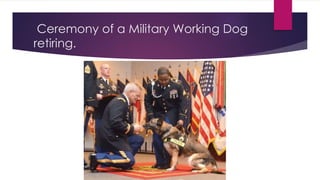
Ceremony of a Military Working Dog 
retiring.
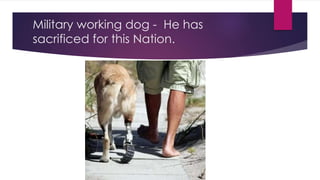
Military working dog - He has 
sacrificed for this Nation.
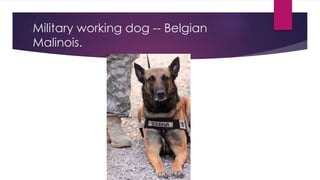
Military working dog -- Belgian 
Malinois.
The Story of a Military Dog,Layka 
 3-Legged Military Dog Skydives to Test Canine Combat Vest 
 Layka, a Belgian Malinois, was on the cover of National Geographic 
magazine. 
 
National Geographic 
 PUBLISHED JUNE 12, 2014 
 Layka, a military service dog wounded in Afghanistan andfeatured on the 
June cover of National Geographicmagazine, has a new career: free-fall 
equipment tester. The Belgian Malinois was recently selected to test a 
specially designed canine combat vest, and her skydive was captured in 
the above video.
 The role of dogs in the U.S. military has been evolving since World War I. They have been used 
extensively in Afghanistan and Iraq to protect troops by leading patrols and sniffing out explosives. 
Different vests have been used over the years to help protect the dogs during combat, but handlers 
found that some of the heavier vests caused the dogs to overheat. 
 In recent years, the company Hardpoint Technologies, working with the special operations community, 
has been working on a vest designed to improve a military dog's performance and safety. Hardpoint 
developed a lightweight, multipurpose canine work vest that can be used across a range of military 
missions, from patrol to detection. 
 Layka tested the vest in a parachute jump last month. The vest is equipped with convenient straps and 
handles so that troops can easily carry a dog or even "wear" it as a backpack. It also has multiple 
access points to attach leashes, and pockets that can carry ice packs to help cool the dogs in hot 
climates. The vest also serves as a harness for tandem parachute jumps with a handler.
 While in Afghanistan, Layka was shot by enemy forces during a search 
operation. But she managed to attack the shooter and protect her 
handler, Staff Sgt. Julian McDonald, who later adopted her. The dog had 
to have a limb amputated and is now retired from military service. 
 The All Veteran Group, a team of combat veterans who apply their military 
skills to the civilian world, organized Layka's jump. Group president and 
founder Mike Elliott, who has also accompanied former President George 
H. W. Bush on tandem jumps, accompanied Layka and Sergeant 
McDonald on their jump. (On Thursday morning, Elliott made another 
tandem jump with President Bush in honor of his 90th birthday.)
 "I was truly impressed with Layka," Elliott says. "She was very calm, very 
disciplined." When the airplane doors opened, Layka got a little fidgety, he 
said, which is typical of both people and dogs. But once in the air 
skydiving, she was calm. 
 To learn more about war dogs and their role in military operations, read 
National Geographic magazine's June cover story "The Dogs of War"and 
our online coverage, including "War Dog Helps Family Cope" and aseries 
of historical war dog stories.
Siberian Husky the "Snow Dog" 
Huskies are very active and 
energetic.That’s why,they were 
used to pull heavy loads long 
distances through difficult 
conditions in the past.Also, In 
Alaska and Canada,people used 
them as sled dogs but nowadays 
they have the status of family pets 
and show dogs.
Dog sledding in the untouched snowy landscapes is 
an adventure uniting lovers of dogs and nature. 
 Here is a video of excited sled dogs. 
http://youtu.be/Qv4I_MDX7ws
Heroic Military Dogs 
 Here is a video about military dogs 
 http://youtu.be/gSa5KZtb5To
Therapy Dogs 
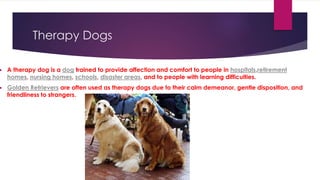
 A therapy dog is a dog trained to provide affection and comfort to people in hospitals,retirement 
homes, nursing homes, schools, disaster areas, and to people with learning difficulties. 
 Golden Retrievers are often used as therapy dogs due to their calm demeanor, gentle disposition, and 
friendliness to strangers.
The First Therapy Dog,SMOKY 
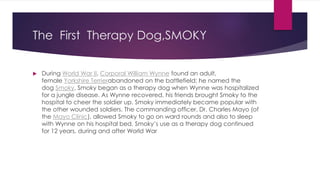
 During World War II, Corporal William Wynne found an adult, 
female Yorkshire Terrierabandoned on the battlefield; he named the 
dog Smoky. Smoky began as a therapy dog when Wynne was hospitalized 
for a jungle disease. As Wynne recovered, his friends brought Smoky to the 
hospital to cheer the soldier up. Smoky immediately became popular with 
the other wounded soldiers. The commanding officer, Dr. Charles Mayo (of 
the Mayo Clinic), allowed Smoky to go on ward rounds and also to sleep 
with Wynne on his hospital bed. Smoky’s use as a therapy dog continued 
for 12 years, during and after World War
 The systematic use of therapy dogs is attributed to Elaine Smith[citation needed], 
who worked as a registered nurse. Smith noticed how well patients 
responded to visits by a chaplain and his Golden Retriever. In 1976, Smith 
started a program for training dogs to visit institutions. Other health care 
professionals noticed the therapeutic effect of animal companionship, 
such as relieving stress, lowering blood pressure, and raising mood, and the 
demand for therapy dogs continued to grow. In recent years, therapy 
dogs have been enlisted to help children overcome speech and 
emotional disorders.
 In 1982, Nancy Stanley founded Tender Loving Zoo (TLZ), a non-profit organization that 
introduced animal therapy to severely disabled children and convalescent hospitals for 
the elderly. She got the idea while working at the Los Angeles Zoo, where she noticed 
how disabled visitors responded eagerly to animals. She researched the beneficial effects 
that animals can have on patients and then began taking her pet miniature poodle, 
Freeway, to the Revere Developmental Center for the severely disabled.[citation needed] 
 Inspired by the response of the patients and the encouragement of the staff, she bought 
a van, recruited helpers and persuaded a pet store to lend baby animals. Soon requests 
for TLZ visits were coming from schools, hospitals and convalescent homes throughout the 
county. Partly as a result of Stanley's work, the concept of dog-therapy has broadened to 
"animal-assisted therapy" or "pet therapy", including many other species, such as therapy 
cats, therapy rabbits and therapy birds.[1] 
 Benefits[edit]
 Research indicates that interaction with therapy dogs can temporarily 
affect the release of various neurotransmitters in the brain; levels 
of oxytocin (linked with bonding) and dopamine(involved in the reward-motivation 
system) are increased, while cortisol levels (an 
immunosuppressant associated with stress) are decreased.[2] 
 One example of the use of therapy dogs is the building of self-confidence. 
Many children have difficulties reading. As a result, they can develop low 
self-esteem when reading in public. By reading to a dog, children relax 
and focus on the dog and 'the reading', therefore building self-confidence.[ 
citation needed]
If you need information about TDI(Therapy Dogs International),you 
can copy and paste the following website. 
http://www.tdi-dog.org/OurPrograms.aspx?Page=Hospitals+(Children%27s) 
 Some hospitals such as Phoenix Children's Hospital's provides an Animal-Assisted Therapy Program 
to patients and their families for therapeutic purposes 
 . http://youtu.be/VgXYFnwguj8 (6.41 mins)
Speaking Activity 
 Questions 
 1.Do you like dogs?Why?/Why not? 
 2.Are dogs really man’s best friend? 
 3.What kind of dogs do you like and dislike? 
 4.Do you think dogs are the best kind of pet? 
 5.Do you think dogs have a ood life? 
 6.Are you afraid of dogs?If so,why?/If not,do you know anyone who 
is afraid of dogs?Why do you think he/she is afraid of dogs?
Questions 
 What do you think of dogs that bark non-stop? 
 Do you think people spend too much money on dogs? 
 In what ways are dogs helpful to humans? 
 Are there many abandoned dogs in your town? 
 What do you think of the abandoned dogs? 
 Do you believe in the excuses of people who abandon their pet 
dogs? 
 What do you think about the concept of dog-therapy?
 Do you know any other kind of pets that can 
assist therapy?If you do, 
 Please tell as how they are used as therapy 
pets?

Dogs ppt (1)

  • 1.
    DOGS WORKING DOGS 2.CARERS A Working Dog An Animal Carer
  • 2.
    « A workingdog is a working animal, i.e., a type of dog that is not merely a pet but learns and performs tasks to assist and/or entertain its human companions, or a breed of such origin.
  • 3.
    Ceremony of aMilitary Working Dog retiring.
  • 4.
    Military working dog- He has sacrificed for this Nation.
  • 5.
    Military working dog-- Belgian Malinois.
  • 6.
    The Story ofa Military Dog,Layka  3-Legged Military Dog Skydives to Test Canine Combat Vest  Layka, a Belgian Malinois, was on the cover of National Geographic magazine.  National Geographic  PUBLISHED JUNE 12, 2014  Layka, a military service dog wounded in Afghanistan andfeatured on the June cover of National Geographicmagazine, has a new career: free-fall equipment tester. The Belgian Malinois was recently selected to test a specially designed canine combat vest, and her skydive was captured in the above video.
  • 7.
     The roleof dogs in the U.S. military has been evolving since World War I. They have been used extensively in Afghanistan and Iraq to protect troops by leading patrols and sniffing out explosives. Different vests have been used over the years to help protect the dogs during combat, but handlers found that some of the heavier vests caused the dogs to overheat.  In recent years, the company Hardpoint Technologies, working with the special operations community, has been working on a vest designed to improve a military dog's performance and safety. Hardpoint developed a lightweight, multipurpose canine work vest that can be used across a range of military missions, from patrol to detection.  Layka tested the vest in a parachute jump last month. The vest is equipped with convenient straps and handles so that troops can easily carry a dog or even "wear" it as a backpack. It also has multiple access points to attach leashes, and pockets that can carry ice packs to help cool the dogs in hot climates. The vest also serves as a harness for tandem parachute jumps with a handler.
  • 8.
     While inAfghanistan, Layka was shot by enemy forces during a search operation. But she managed to attack the shooter and protect her handler, Staff Sgt. Julian McDonald, who later adopted her. The dog had to have a limb amputated and is now retired from military service.  The All Veteran Group, a team of combat veterans who apply their military skills to the civilian world, organized Layka's jump. Group president and founder Mike Elliott, who has also accompanied former President George H. W. Bush on tandem jumps, accompanied Layka and Sergeant McDonald on their jump. (On Thursday morning, Elliott made another tandem jump with President Bush in honor of his 90th birthday.)
  • 9.
     "I wastruly impressed with Layka," Elliott says. "She was very calm, very disciplined." When the airplane doors opened, Layka got a little fidgety, he said, which is typical of both people and dogs. But once in the air skydiving, she was calm.  To learn more about war dogs and their role in military operations, read National Geographic magazine's June cover story "The Dogs of War"and our online coverage, including "War Dog Helps Family Cope" and aseries of historical war dog stories.
  • 10.
    Siberian Husky the"Snow Dog" Huskies are very active and energetic.That’s why,they were used to pull heavy loads long distances through difficult conditions in the past.Also, In Alaska and Canada,people used them as sled dogs but nowadays they have the status of family pets and show dogs.
  • 11.
    Dog sledding inthe untouched snowy landscapes is an adventure uniting lovers of dogs and nature.  Here is a video of excited sled dogs. http://youtu.be/Qv4I_MDX7ws
  • 12.
    Heroic Military Dogs  Here is a video about military dogs  http://youtu.be/gSa5KZtb5To
  • 13.
    Therapy Dogs A therapy dog is a dog trained to provide affection and comfort to people in hospitals,retirement homes, nursing homes, schools, disaster areas, and to people with learning difficulties.  Golden Retrievers are often used as therapy dogs due to their calm demeanor, gentle disposition, and friendliness to strangers.
  • 14.
    The First TherapyDog,SMOKY  During World War II, Corporal William Wynne found an adult, female Yorkshire Terrierabandoned on the battlefield; he named the dog Smoky. Smoky began as a therapy dog when Wynne was hospitalized for a jungle disease. As Wynne recovered, his friends brought Smoky to the hospital to cheer the soldier up. Smoky immediately became popular with the other wounded soldiers. The commanding officer, Dr. Charles Mayo (of the Mayo Clinic), allowed Smoky to go on ward rounds and also to sleep with Wynne on his hospital bed. Smoky’s use as a therapy dog continued for 12 years, during and after World War
  • 15.
     The systematicuse of therapy dogs is attributed to Elaine Smith[citation needed], who worked as a registered nurse. Smith noticed how well patients responded to visits by a chaplain and his Golden Retriever. In 1976, Smith started a program for training dogs to visit institutions. Other health care professionals noticed the therapeutic effect of animal companionship, such as relieving stress, lowering blood pressure, and raising mood, and the demand for therapy dogs continued to grow. In recent years, therapy dogs have been enlisted to help children overcome speech and emotional disorders.
  • 16.
     In 1982,Nancy Stanley founded Tender Loving Zoo (TLZ), a non-profit organization that introduced animal therapy to severely disabled children and convalescent hospitals for the elderly. She got the idea while working at the Los Angeles Zoo, where she noticed how disabled visitors responded eagerly to animals. She researched the beneficial effects that animals can have on patients and then began taking her pet miniature poodle, Freeway, to the Revere Developmental Center for the severely disabled.[citation needed]  Inspired by the response of the patients and the encouragement of the staff, she bought a van, recruited helpers and persuaded a pet store to lend baby animals. Soon requests for TLZ visits were coming from schools, hospitals and convalescent homes throughout the county. Partly as a result of Stanley's work, the concept of dog-therapy has broadened to "animal-assisted therapy" or "pet therapy", including many other species, such as therapy cats, therapy rabbits and therapy birds.[1]  Benefits[edit]
  • 17.
     Research indicatesthat interaction with therapy dogs can temporarily affect the release of various neurotransmitters in the brain; levels of oxytocin (linked with bonding) and dopamine(involved in the reward-motivation system) are increased, while cortisol levels (an immunosuppressant associated with stress) are decreased.[2]  One example of the use of therapy dogs is the building of self-confidence. Many children have difficulties reading. As a result, they can develop low self-esteem when reading in public. By reading to a dog, children relax and focus on the dog and 'the reading', therefore building self-confidence.[ citation needed]
  • 18.
    If you needinformation about TDI(Therapy Dogs International),you can copy and paste the following website. http://www.tdi-dog.org/OurPrograms.aspx?Page=Hospitals+(Children%27s)  Some hospitals such as Phoenix Children's Hospital's provides an Animal-Assisted Therapy Program to patients and their families for therapeutic purposes  . http://youtu.be/VgXYFnwguj8 (6.41 mins)
  • 19.
    Speaking Activity Questions  1.Do you like dogs?Why?/Why not?  2.Are dogs really man’s best friend?  3.What kind of dogs do you like and dislike?  4.Do you think dogs are the best kind of pet?  5.Do you think dogs have a ood life?  6.Are you afraid of dogs?If so,why?/If not,do you know anyone who is afraid of dogs?Why do you think he/she is afraid of dogs?
  • 20.
    Questions  Whatdo you think of dogs that bark non-stop?  Do you think people spend too much money on dogs?  In what ways are dogs helpful to humans?  Are there many abandoned dogs in your town?  What do you think of the abandoned dogs?  Do you believe in the excuses of people who abandon their pet dogs?  What do you think about the concept of dog-therapy?
  • 21.
     Do youknow any other kind of pets that can assist therapy?If you do,  Please tell as how they are used as therapy pets?