 Assignment
 Submitted to: Dr. Tanveer
 Submitted By: Zohaib Saleem
 Registration no. 2012-ag-2642
 Roll no. 727
 Section C
Behaviour of
dogs
WHAT IS BEHAVIOUR
 Behavior is the internally coordinated
responses (actions or inactions) of the
domestic dog (individuals or groups) to
internal and/or external stimuli.
How dogs differ in behaviour
than other animals
 Intelligence
 Senses
Different types of behaviours
 Communication behavior
 Social behavior
 Reproduction behavior
 Feeding behaviour
CommunicationCommunication
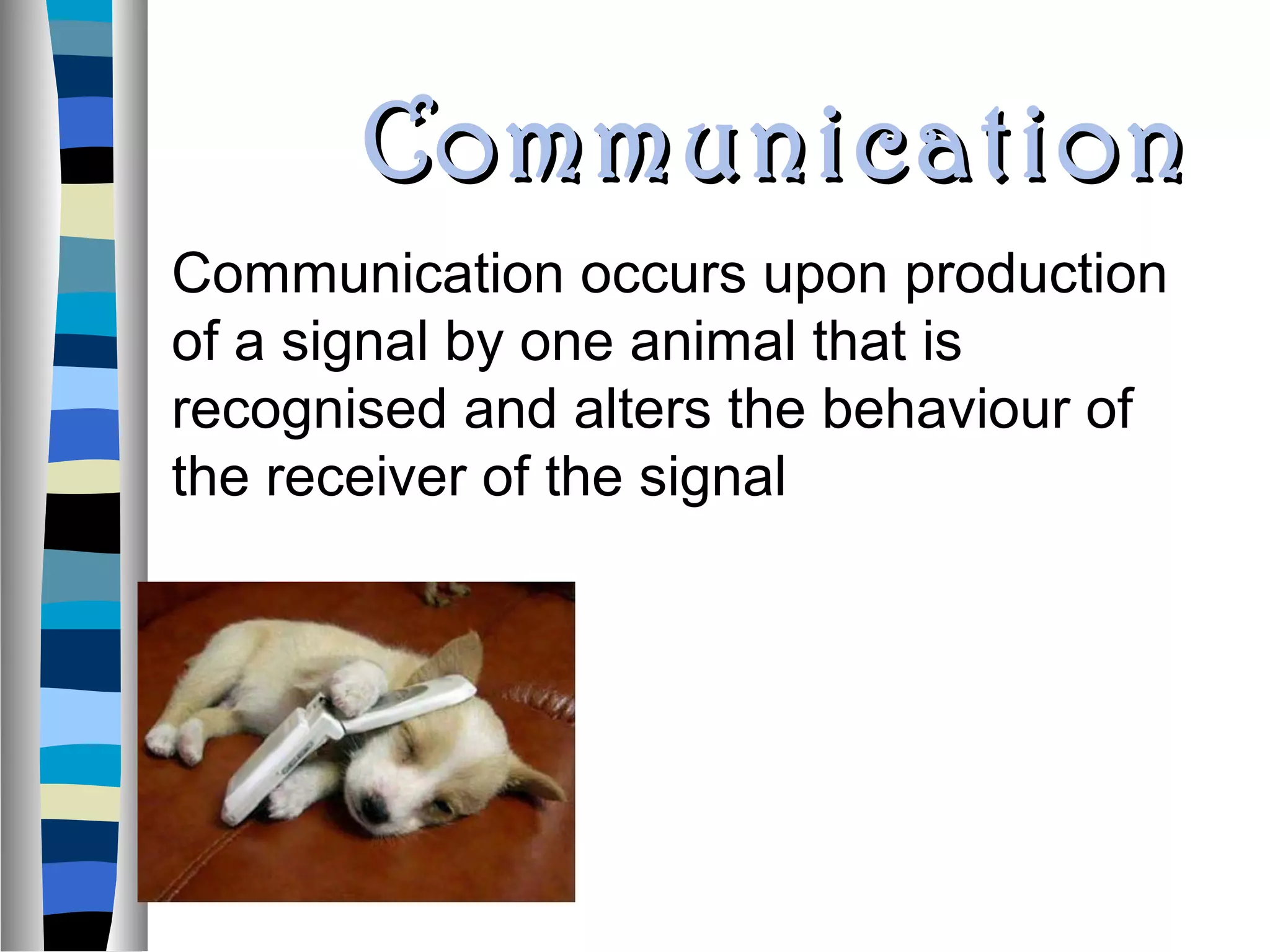
Communication occurs upon production
of a signal by one animal that is
recognised and alters the behaviour of
the receiver of the signal
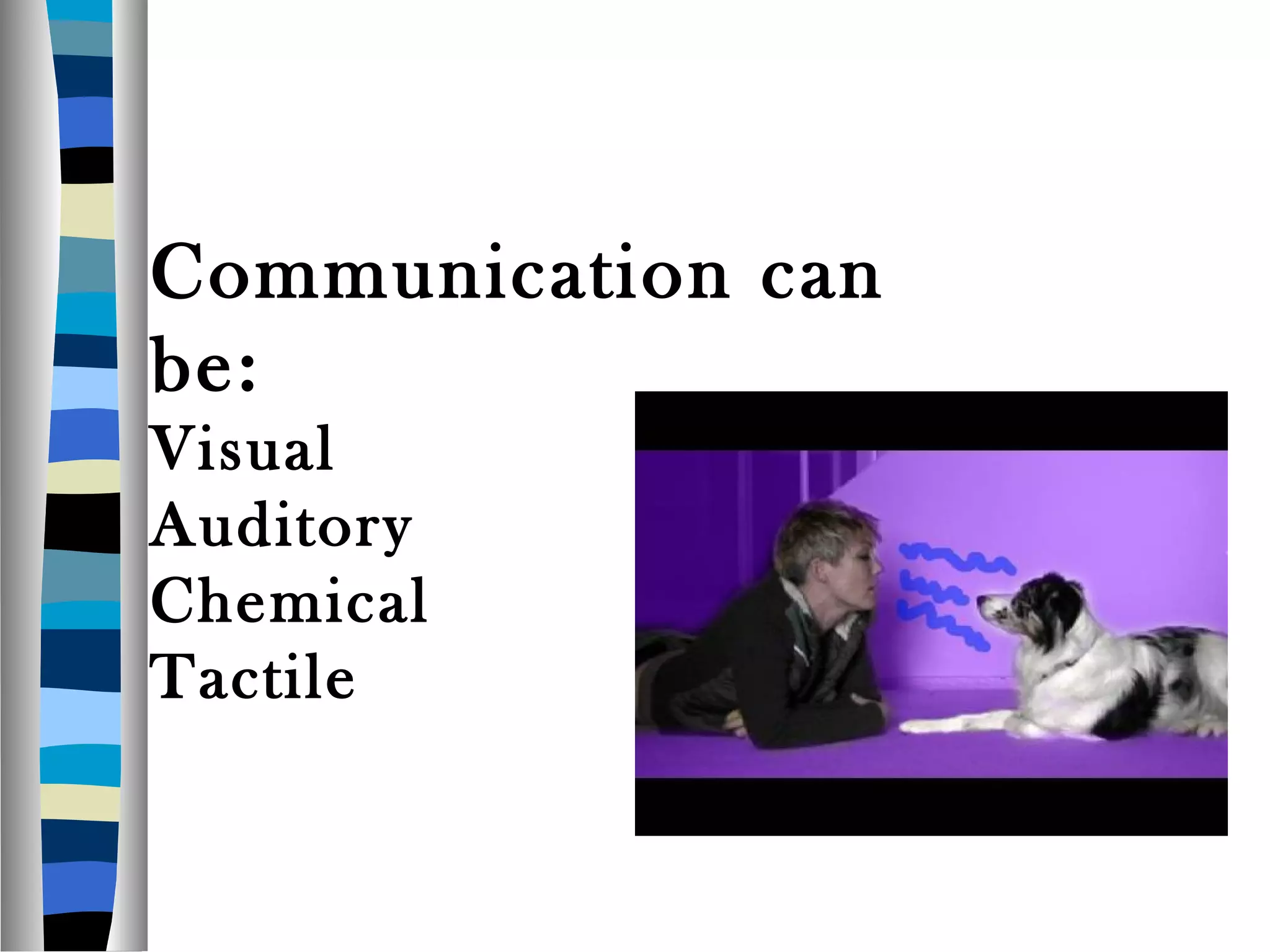
Communication can
be:
Visual
Auditory
Chemical
Tactile
Inter and Intra-
specie
Communication
Communication Behaviour
 Dog to dog communication
 Dog to Human communication
DOG-DOG communication
 These communication behaviors
include:
 Eye gaze
 Facial expression
 Vocalization
 Body posture (including movements of
bodies and limbs)
DOG-DOG communication
 gustatory communication (scents,
pheromones and taste) including in it
Dog-Human Communication
 Humans communicate with dogs by
using
 Vocalization
 Hand signals
 Body posture
VisualVisual
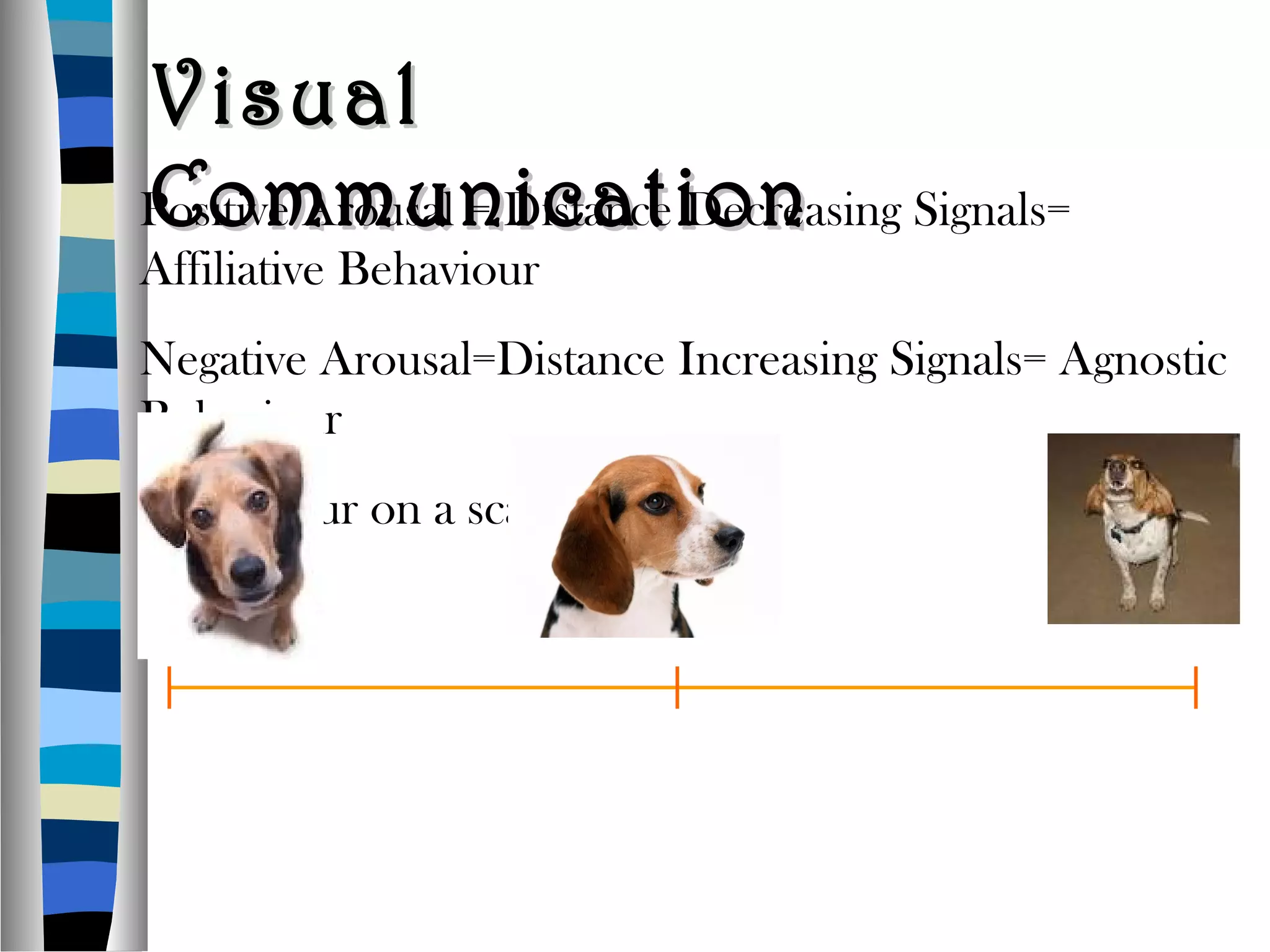
CommunicationCommunicationPositive Arousal = Distance Decreasing Signals=
Affiliative Behaviour
Negative Arousal=Distance Increasing Signals= Agnostic
Behaviour
Both occur on a scale
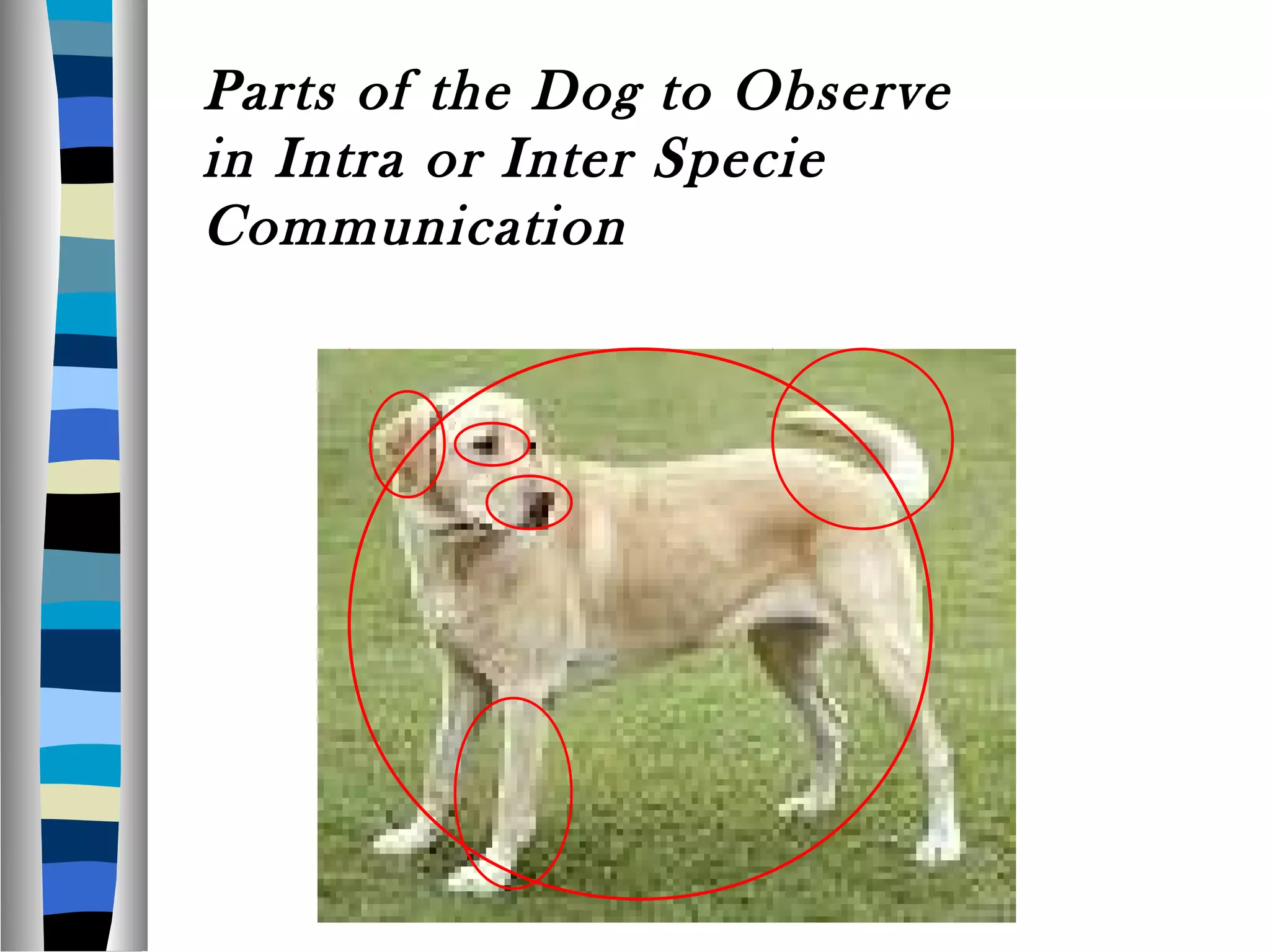
Parts of the Dog to Observe
in Intra or Inter Specie
Communication
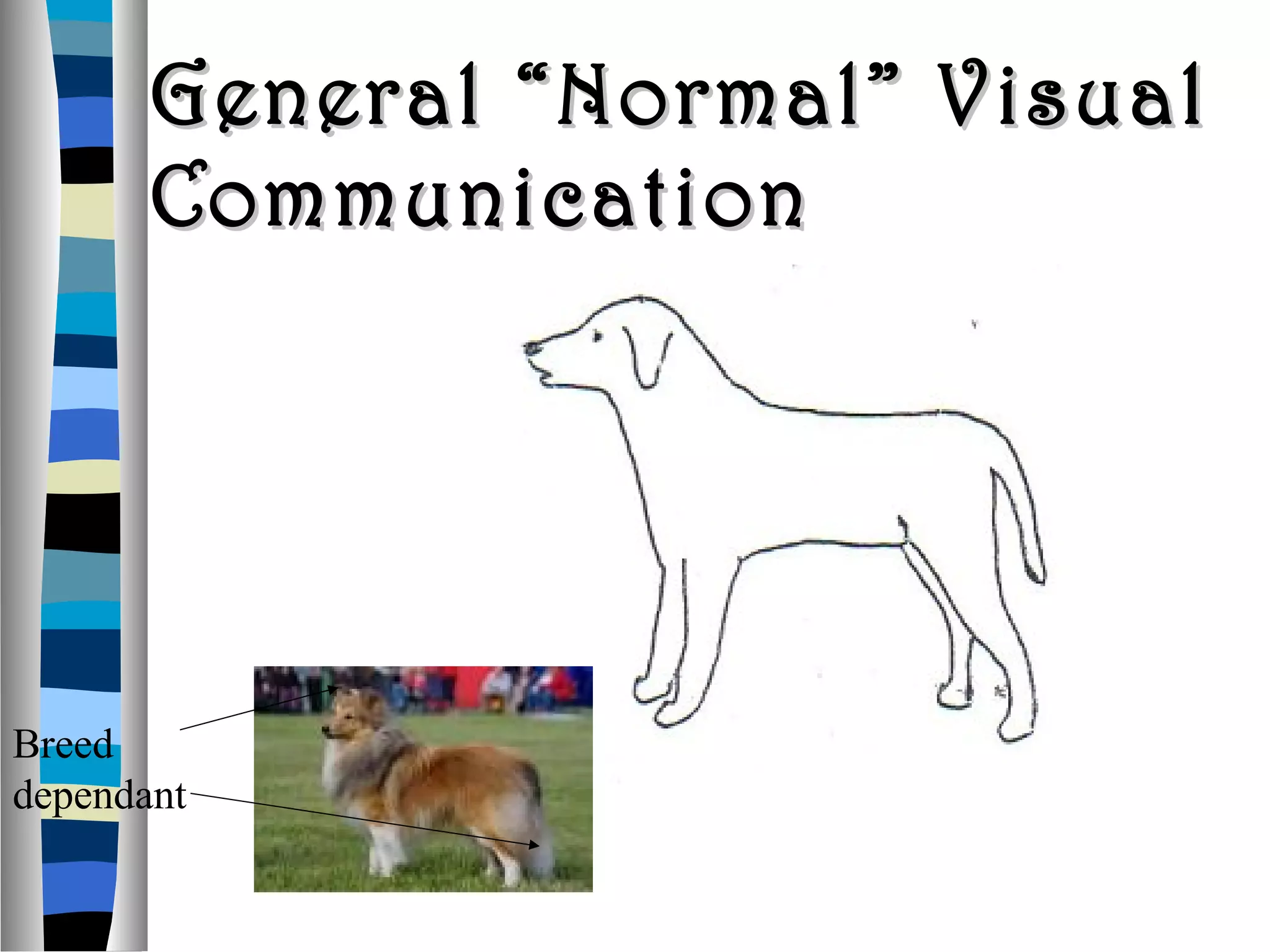
General “Normal” VisualGeneral “Normal” Visual
CommunicationCommunication
Breed
dependant
Familiar/ObviousFamiliar/Obvious
“Positive Arousal”“Positive Arousal”
Visual CommunicationVisual Communication
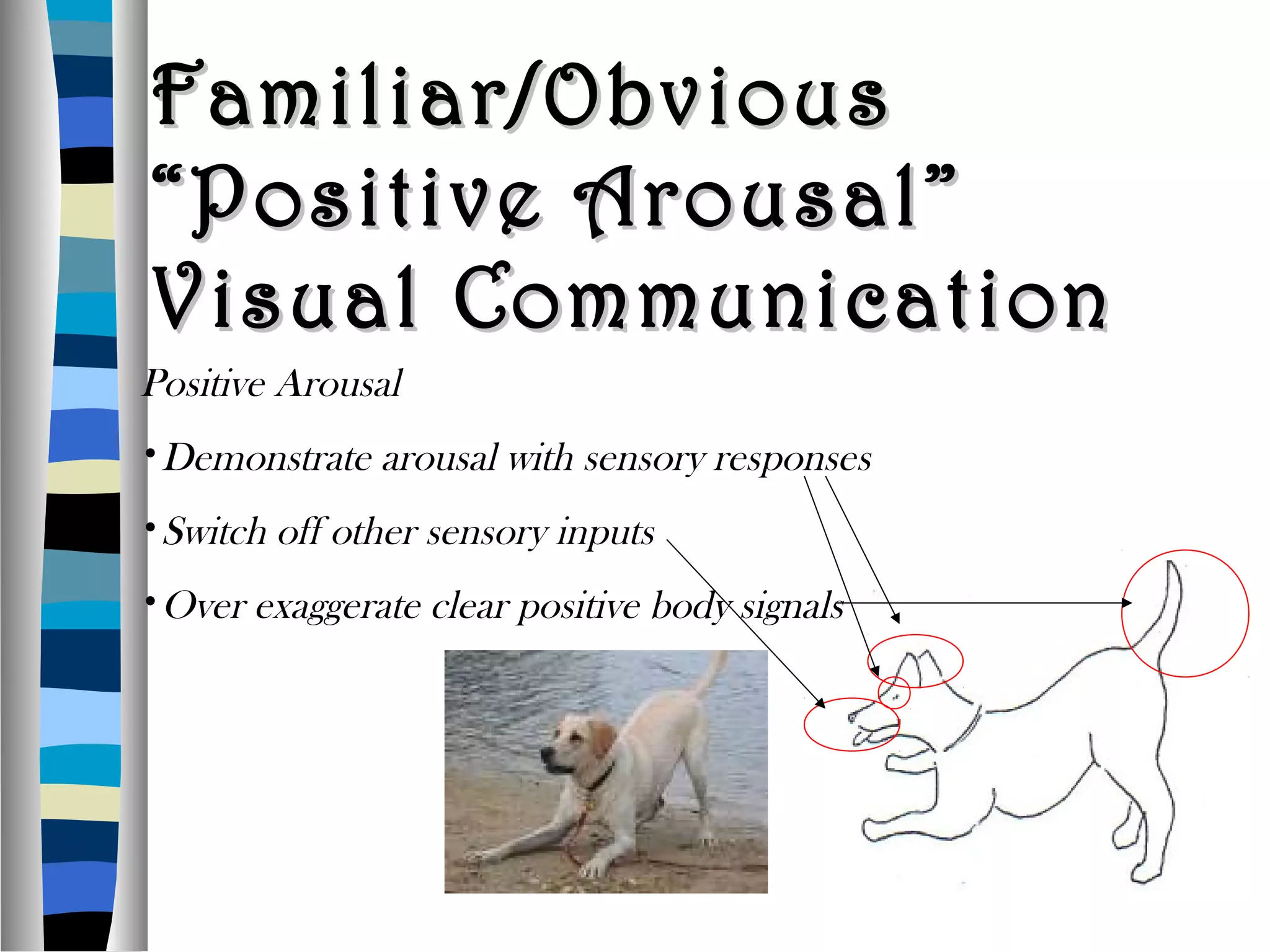
Positive Arousal
•Demonstrate arousal with sensory responses
•Switch off other sensory inputs
•Over exaggerate clear positive body signals
Familiar/Obvious“NegatiFamiliar/Obvious“Negati
ve Arousal” Visualve Arousal” Visual
CommunicationCommunication
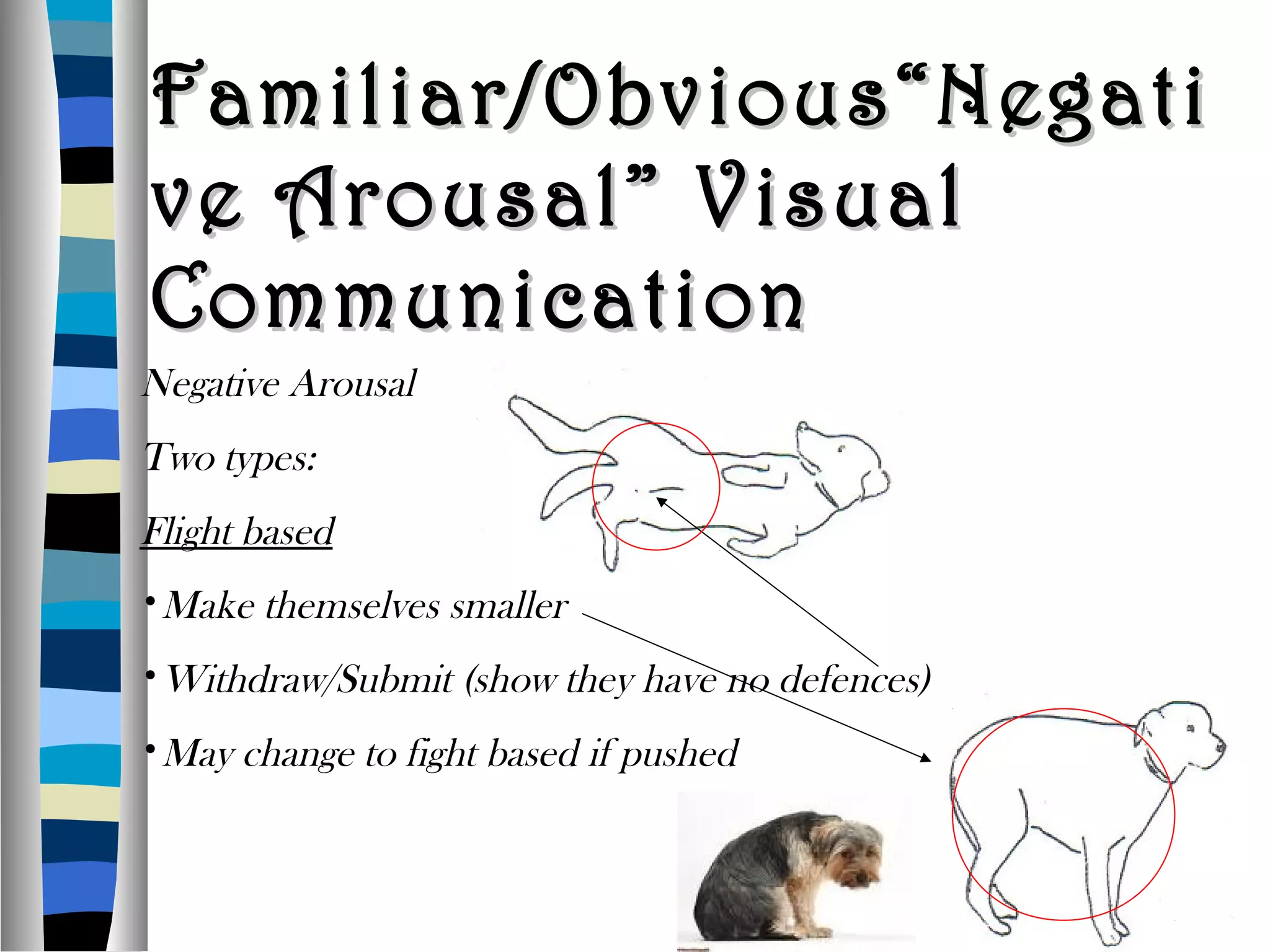
Negative Arousal
Two types:
Flight based
•Make themselves smaller
•Withdraw/Submit (show they have no defences)
•May change to fight based if pushed
““Negative Arousal”Negative Arousal”
Visual CommunicationVisual Communication
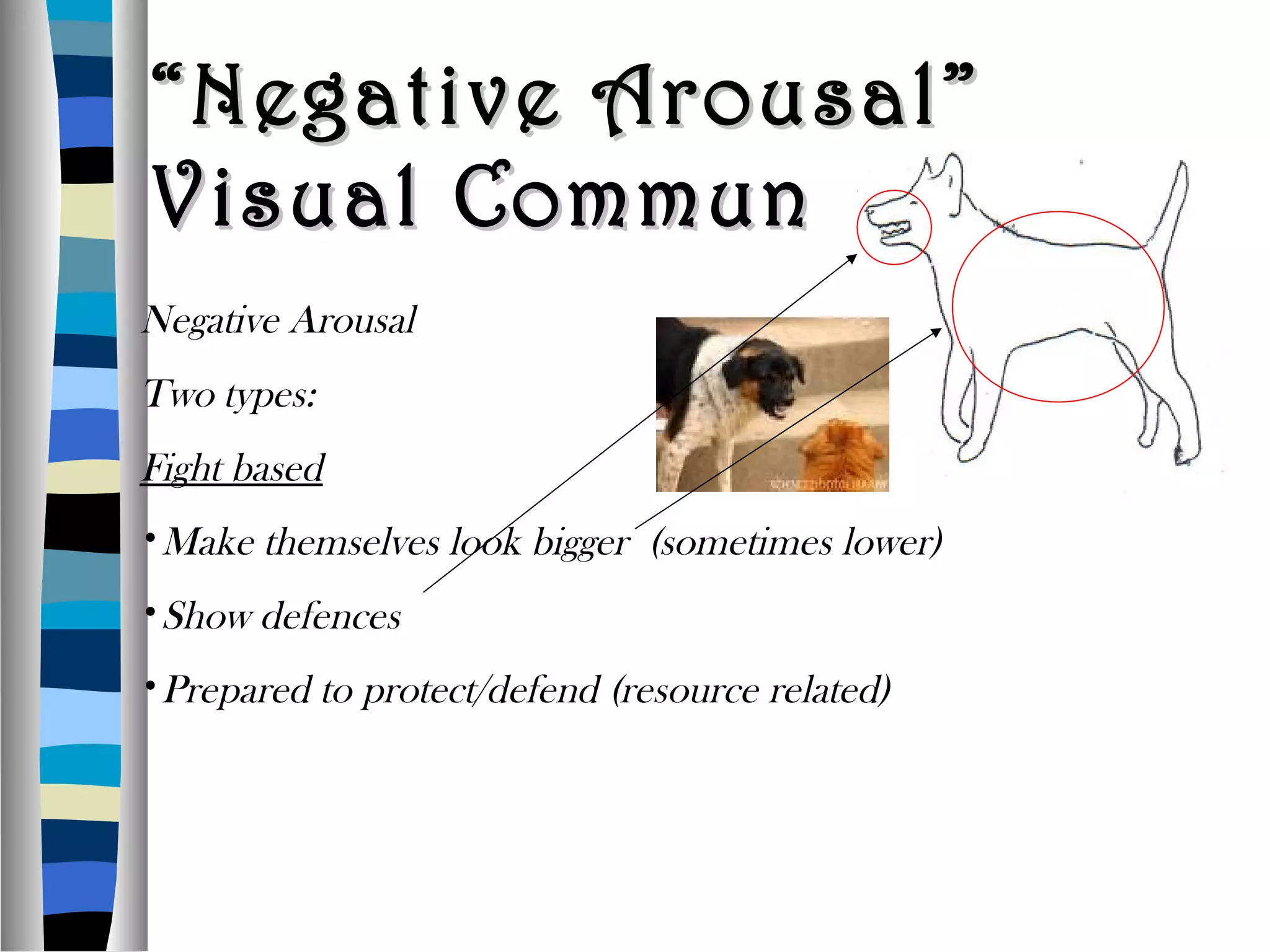
Negative Arousal
Two types:
Fight based
•Make themselves look bigger (sometimes lower)
•Show defences
•Prepared to protect/defend (resource related)
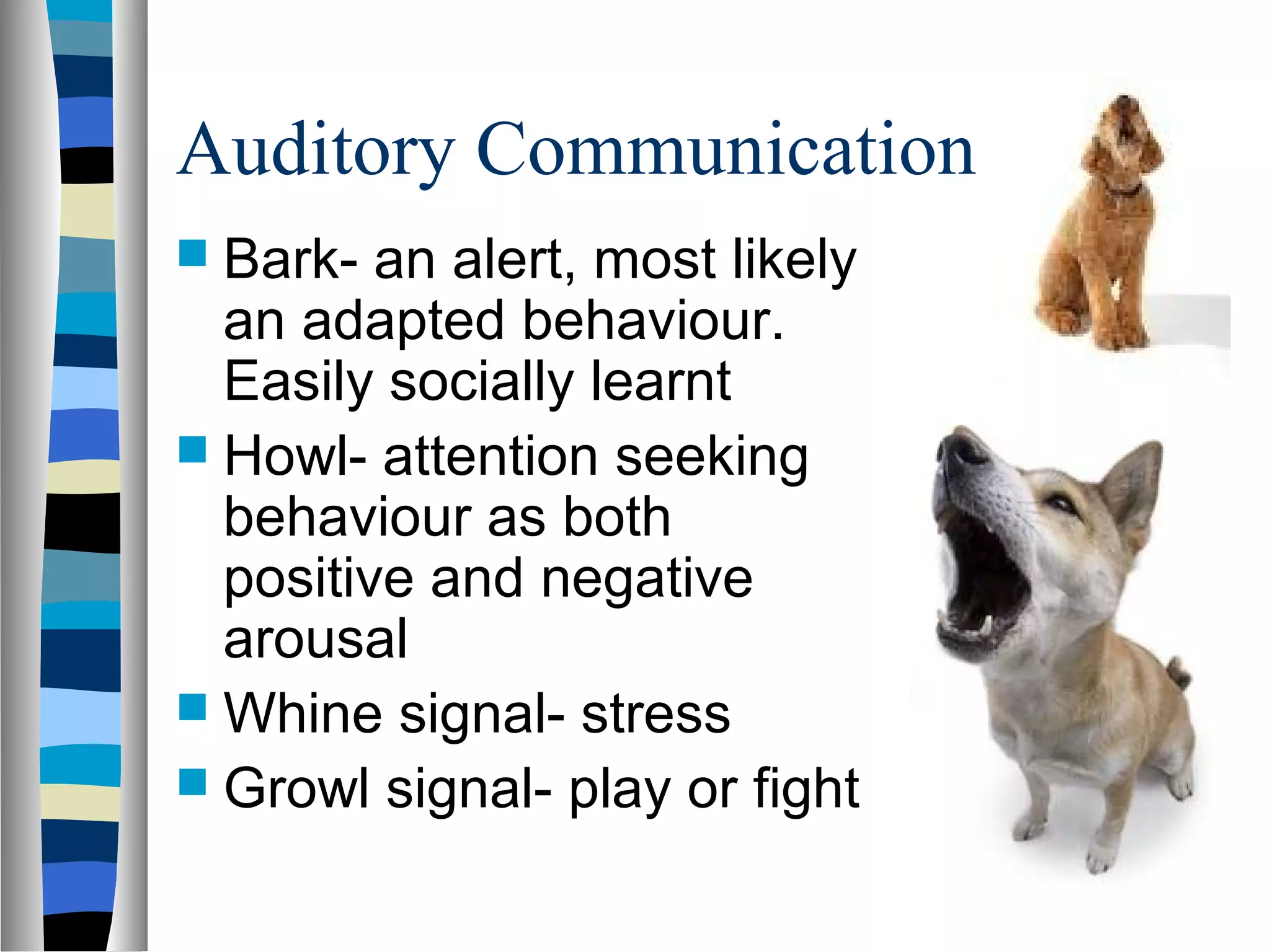
Auditory Communication
 Bark- an alert, most likely
an adapted behaviour.
Easily socially learnt
 Howl- attention seeking
behaviour as both
positive and negative
arousal
 Whine signal- stress
 Growl signal- play or fight
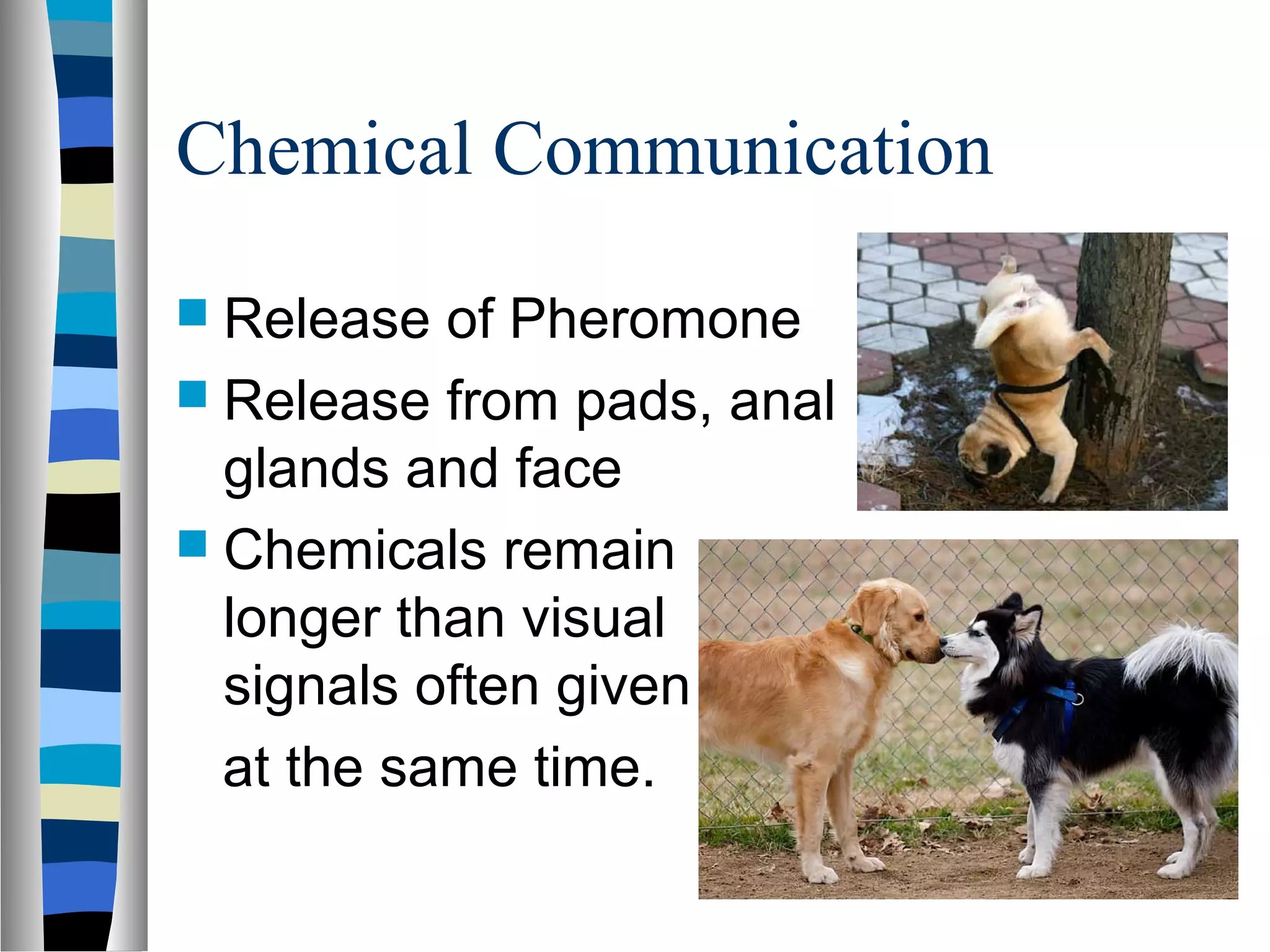
Chemical Communication
 Release of Pheromone
 Release from pads, anal
glands and face
 Chemicals remain
longer than visual
signals often given
at the same time.
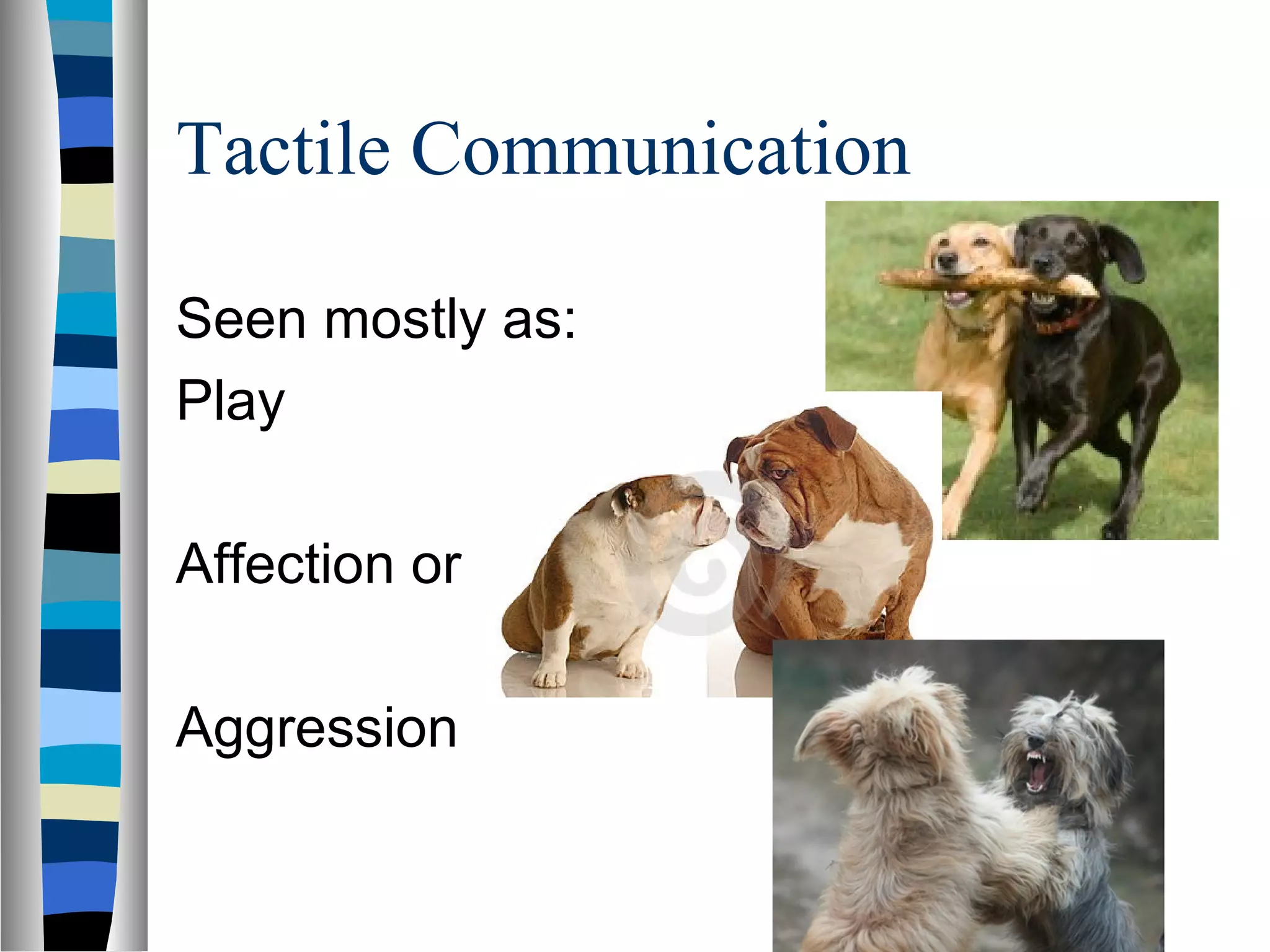
Tactile Communication
Seen mostly as:
Play
Affection or
Aggression
Social behavior
 Play (Dog-dog , Dog-human)
 Empathy
 Personalities
 Leadership, dominance
 Scent
 Feral dogs
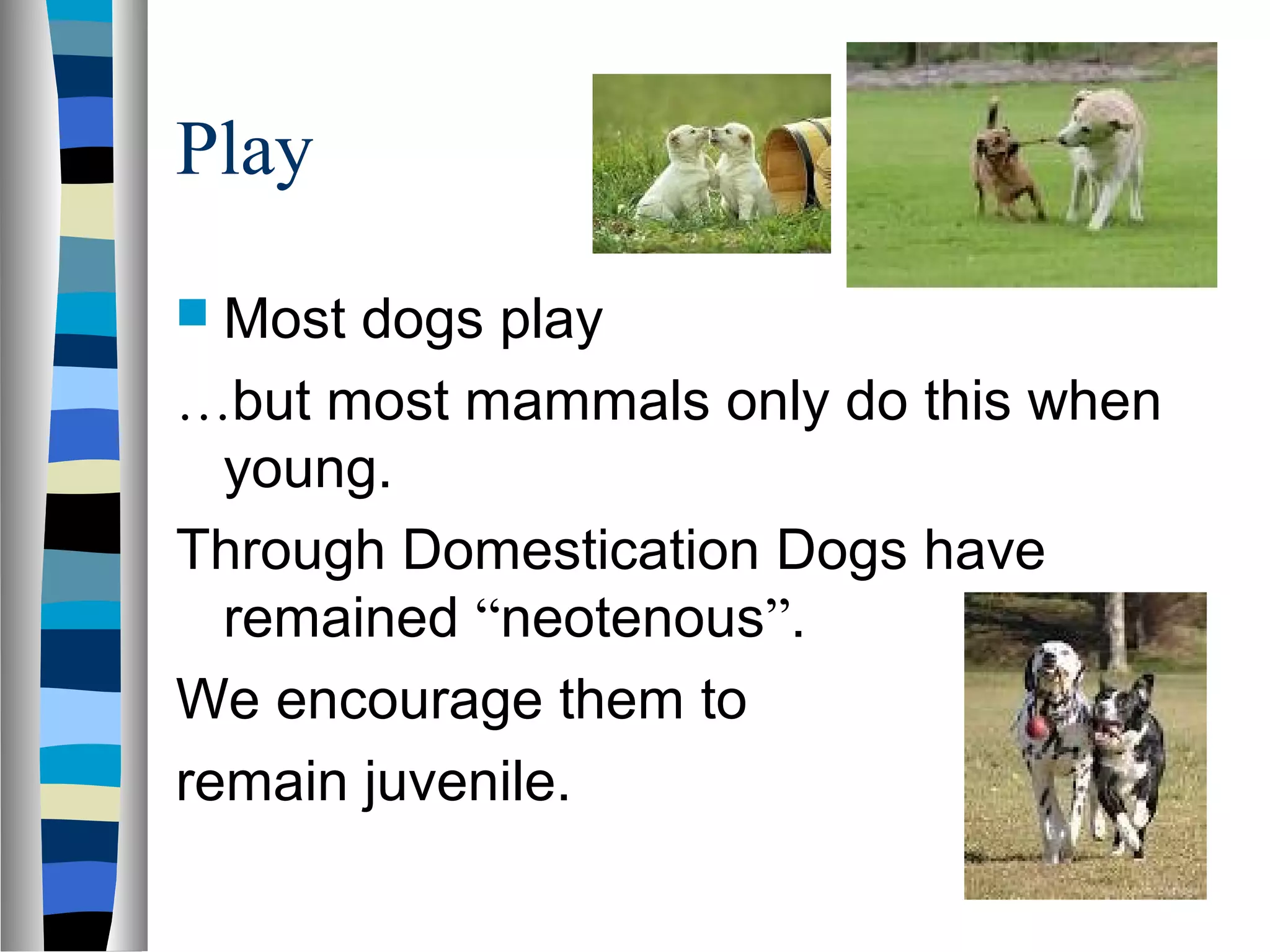
Play
 Most dogs play
…but most mammals only do this when
young.
Through Domestication Dogs have
remained “neotenous”.
We encourage them to
remain juvenile.
Theories as to why dogs play
 Helps with development of bone and muscle
 Teaches useful communication skills
 Teaches hunting skills (although not required
in domestication)
 Teaches co-operation between group
members
 Teaches about surrounding environment
 Allows for trial and error learning
 Puppy enjoys doing it!…functional behaviour.
Reproduction behavior
 Dogs reach sexual maturity and can
reproduce during their first year, in
contrast to wolves at two years-of-age.
Bitches have their first estrus ("heat") at
6 to 12 months-of-age; smaller dogs
tend to come into heat earlier whereas
larger dogs take longer to mature.
Reproduction behavior
 Dog bitches have an estrous cycle that
is nonseasonal and monestrus, i.e.
there is only one estrus per estrous
cycle
 The average duration of estrus is 9
days with spontaneous ovulation
usually about 3 days after the onset of
estrus.
Reproduction behavior
 The male dog mounts the female and is
able to achieve intromission, this is
sometimes known as the “tie” or
“copulatory lock”
 Dogs are polygamous
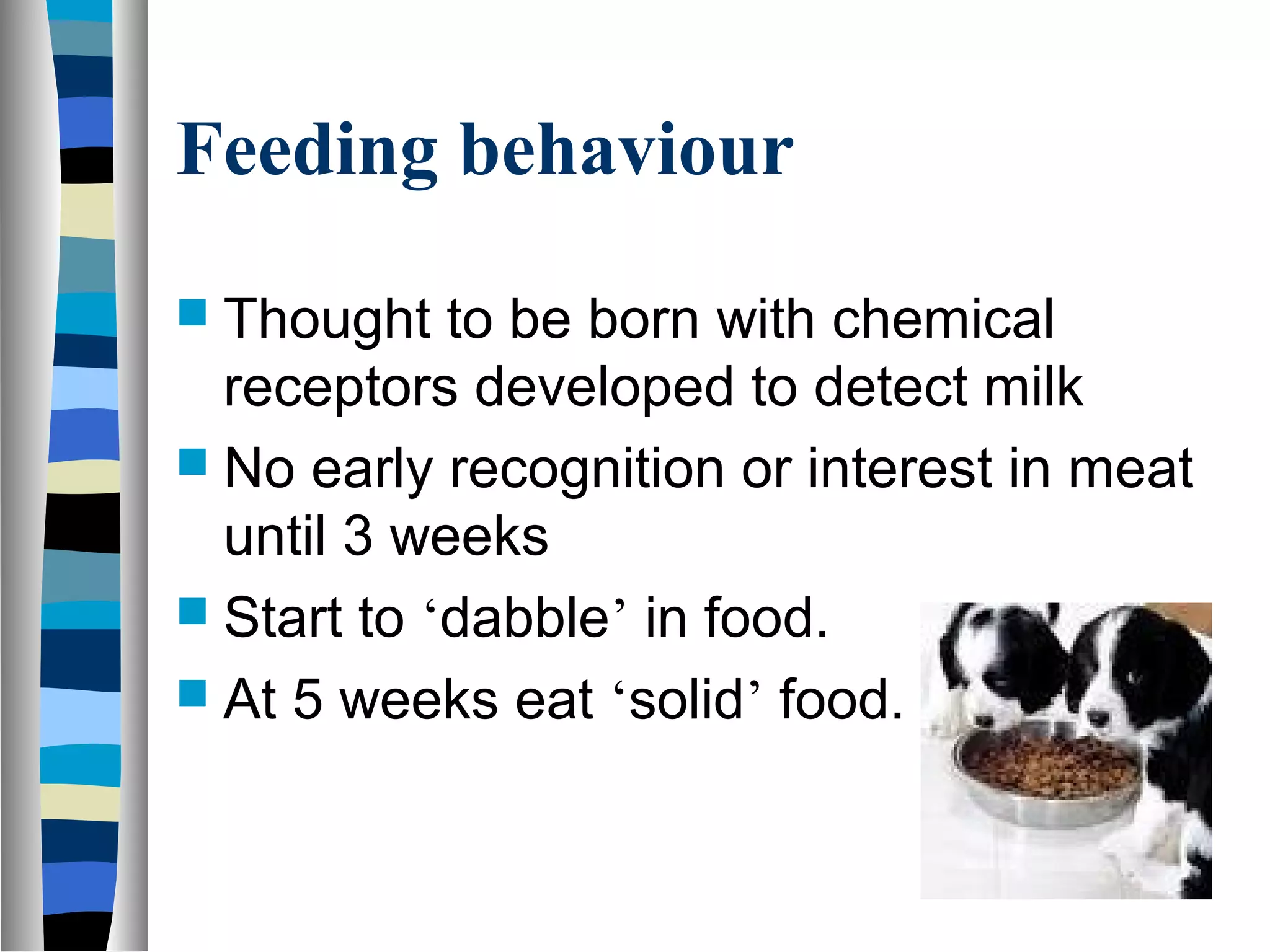
Feeding behaviour
 Thought to be born with chemical
receptors developed to detect milk
 No early recognition or interest in meat
until 3 weeks
 Start to ‘dabble’ in food.
 At 5 weeks eat ‘solid’ food.
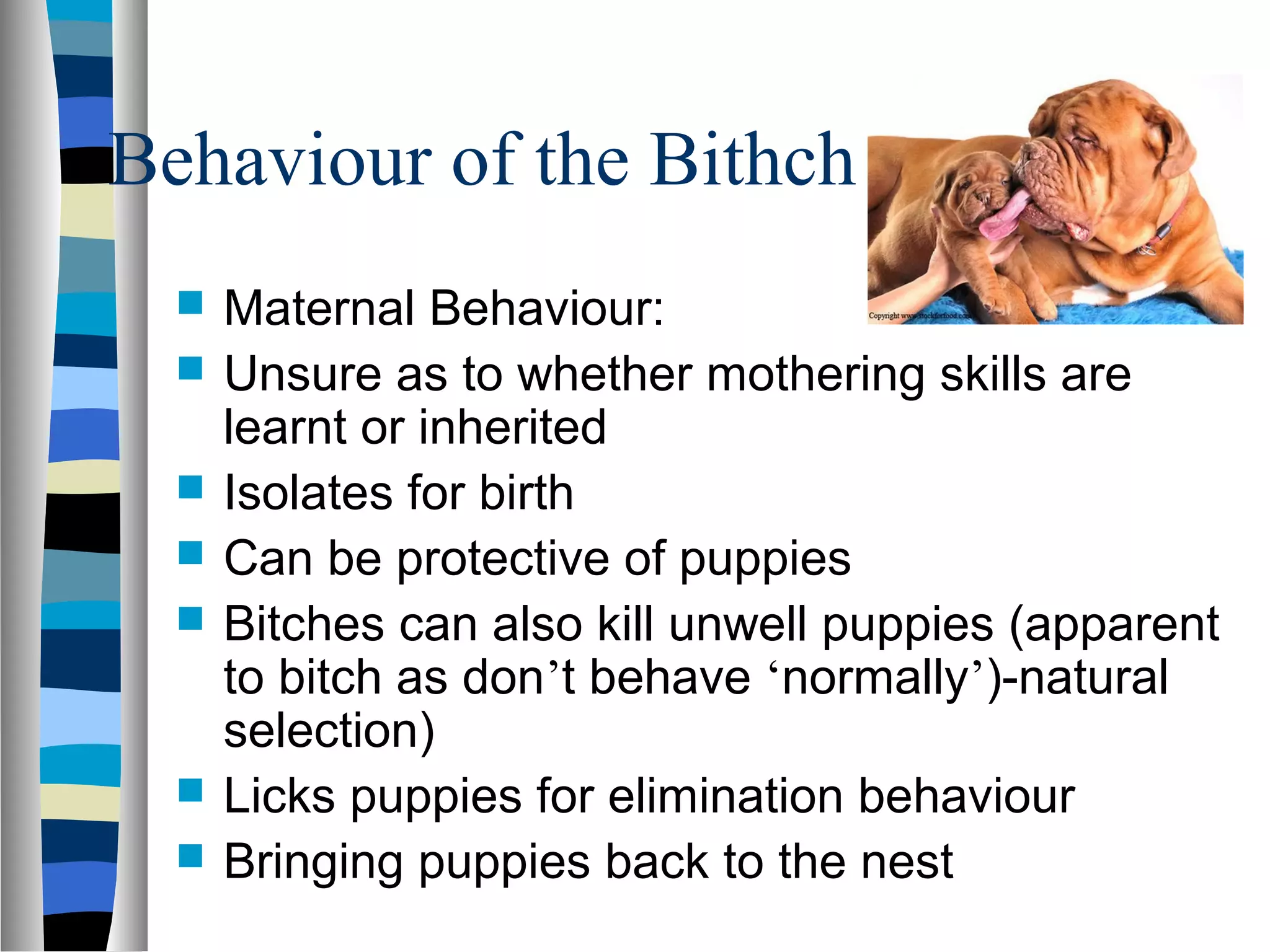
Behaviour of the Bithch
 Maternal Behaviour:
 Unsure as to whether mothering skills are
learnt or inherited
 Isolates for birth
 Can be protective of puppies
 Bitches can also kill unwell puppies (apparent
to bitch as don’t behave ‘normally’)-natural
selection)
 Licks puppies for elimination behaviour
 Bringing puppies back to the nest
Behaviour of the Dog
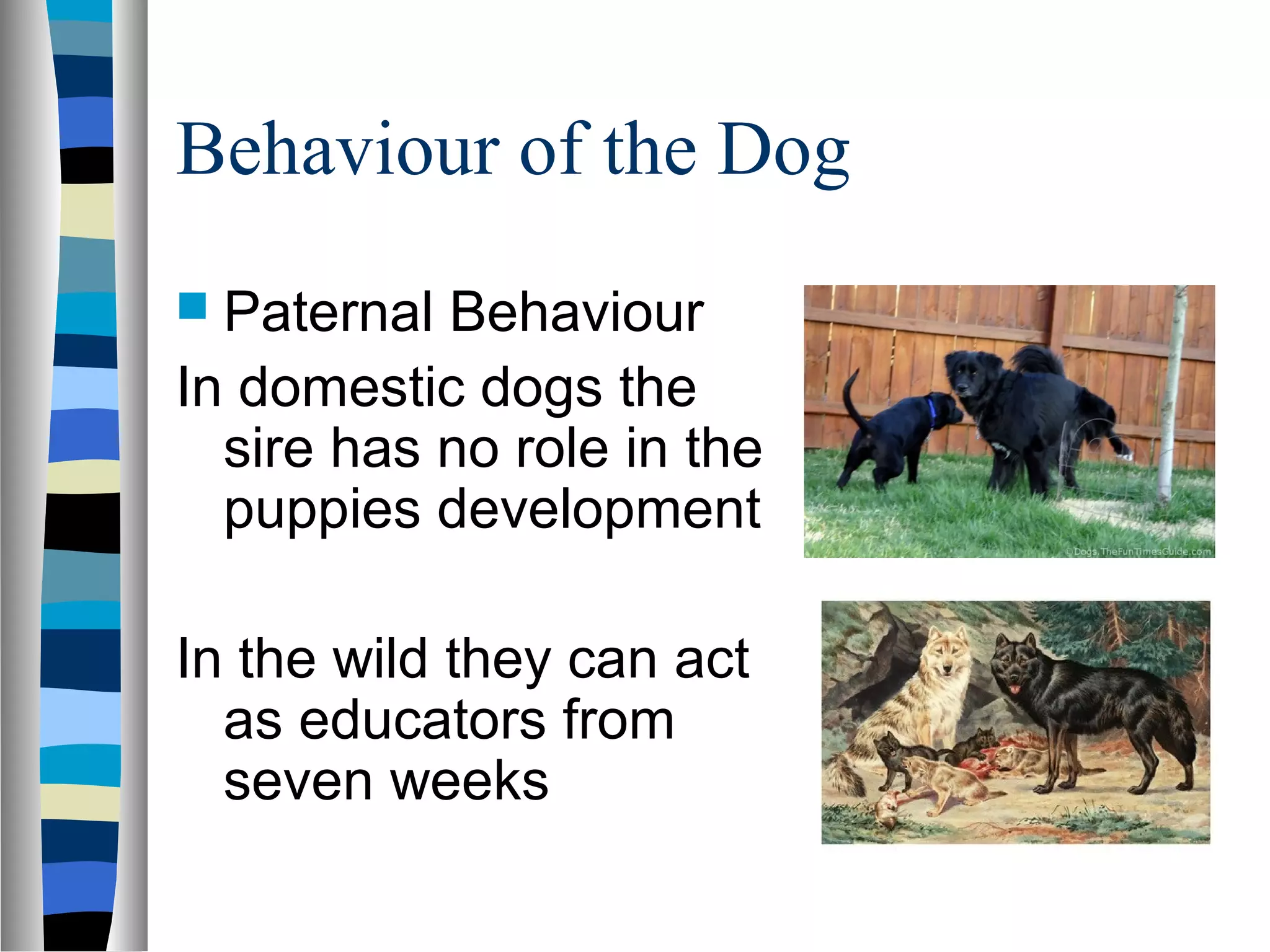
 Paternal Behaviour
In domestic dogs the
sire has no role in the
puppies development
In the wild they can act
as educators from
seven weeks
Affects of Puberty- Male
(General)
 Increased hair growth
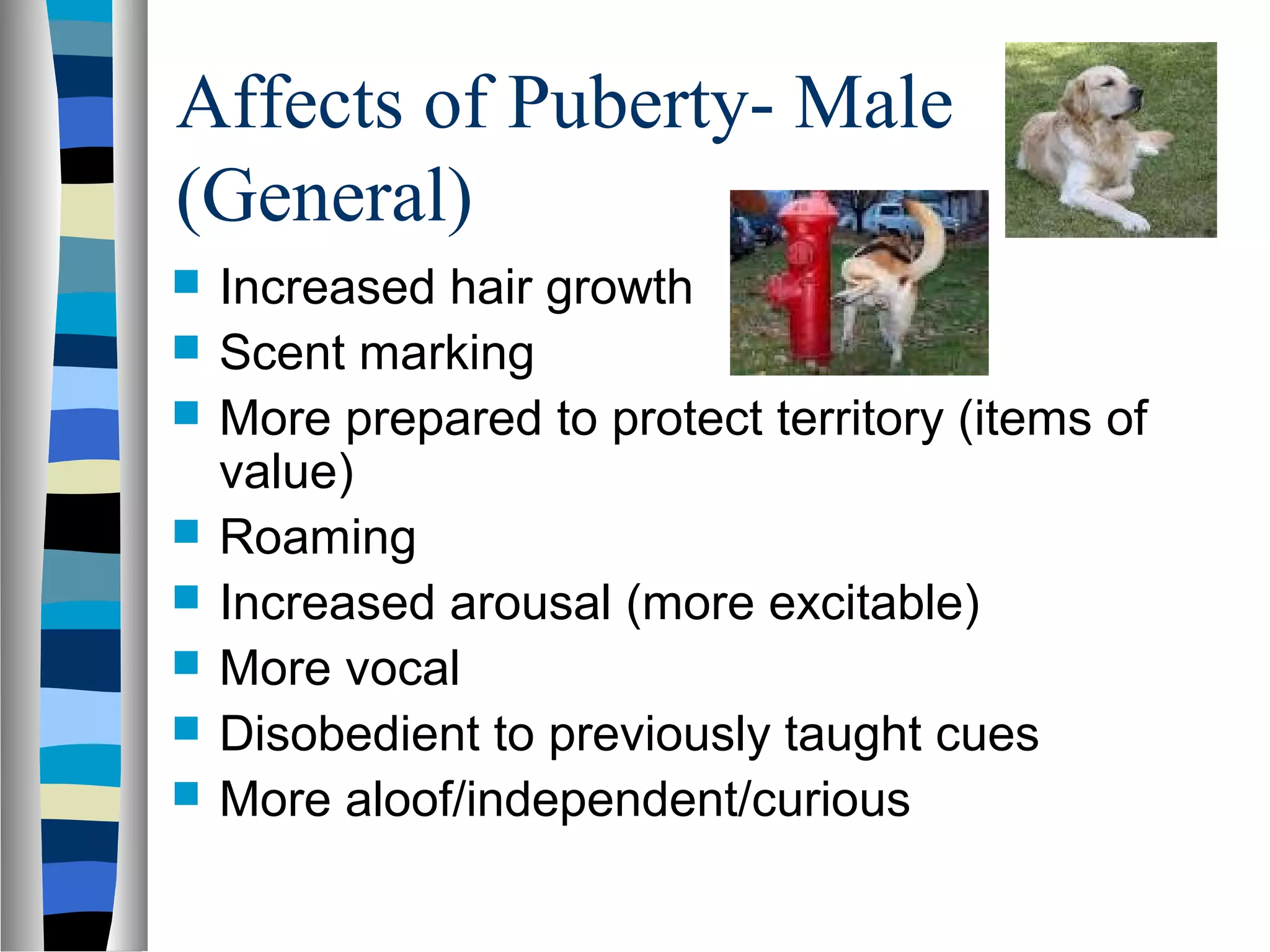
 Scent marking
 More prepared to protect territory (items of
value)
 Roaming
 Increased arousal (more excitable)
 More vocal
 Disobedient to previously taught cues
 More aloof/independent/curious
Affect of Puberty- Females
(General)
 Signs of oestrous
 More protective
 More sensitive
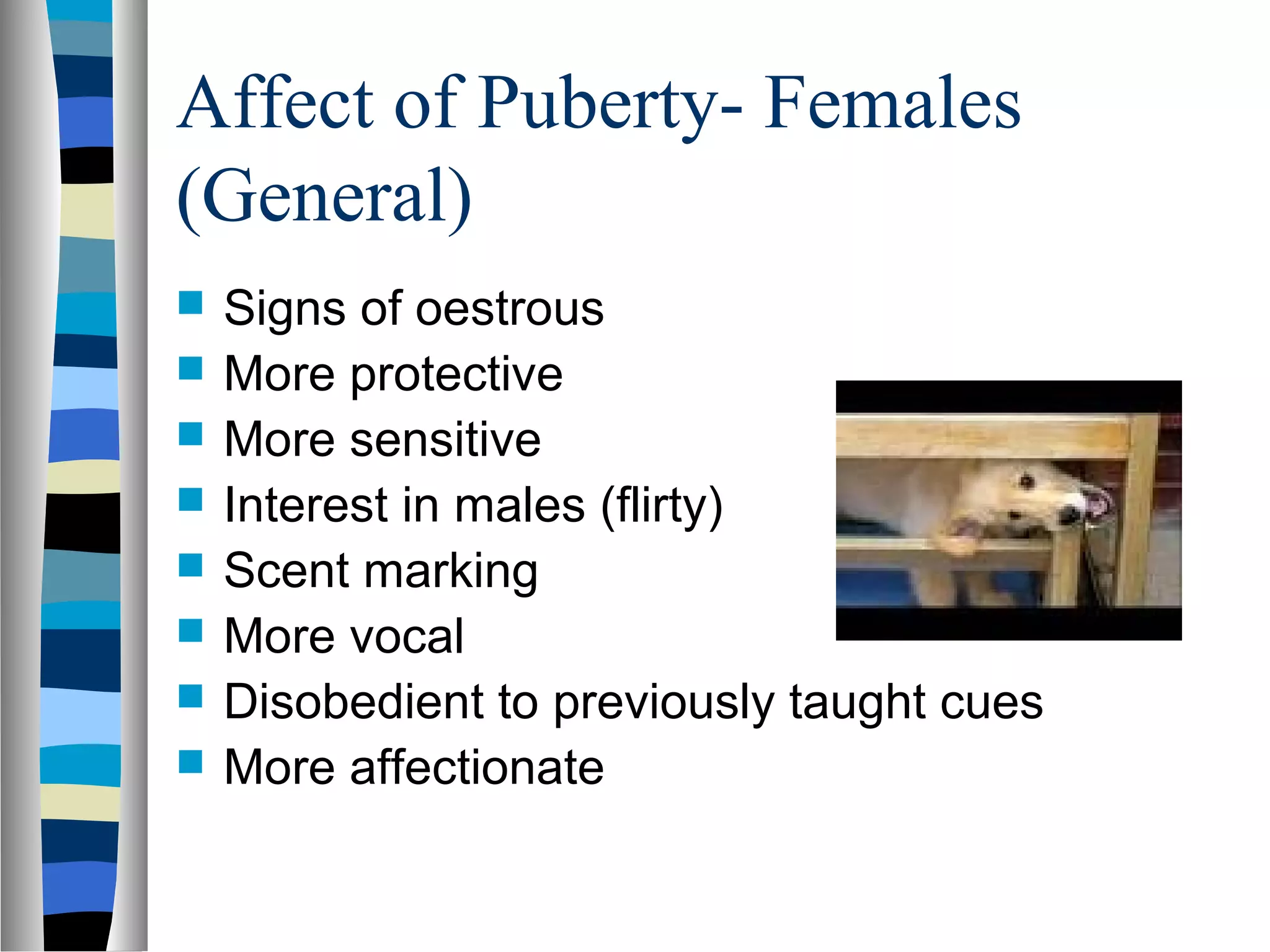
 Interest in males (flirty)
 Scent marking
 More vocal
 Disobedient to previously taught cues
 More affectionate
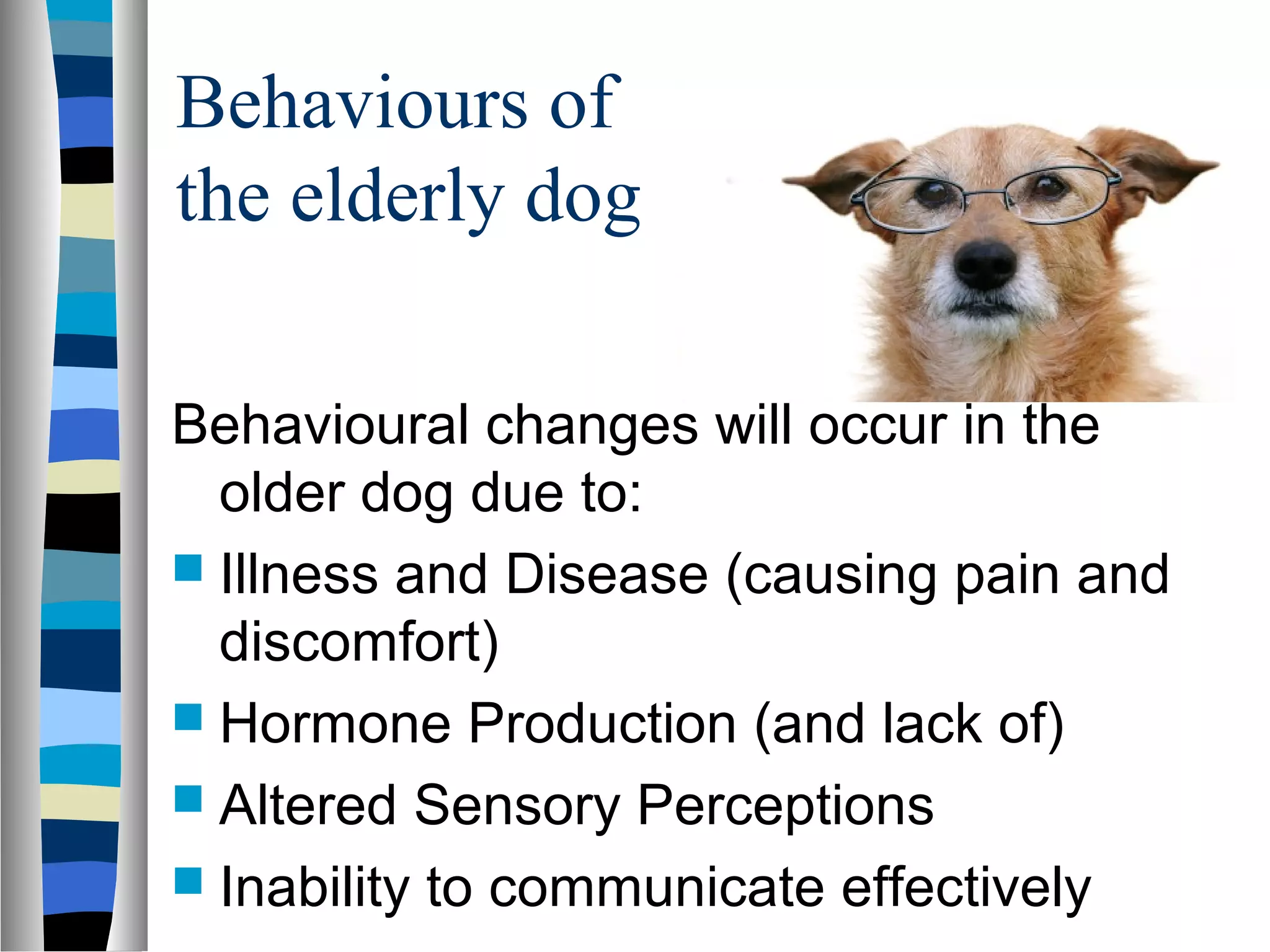
Behaviours of
the elderly dog
Behavioural changes will occur in the
older dog due to:
 Illness and Disease (causing pain and
discomfort)
 Hormone Production (and lack of)
 Altered Sensory Perceptions
 Inability to communicate effectively
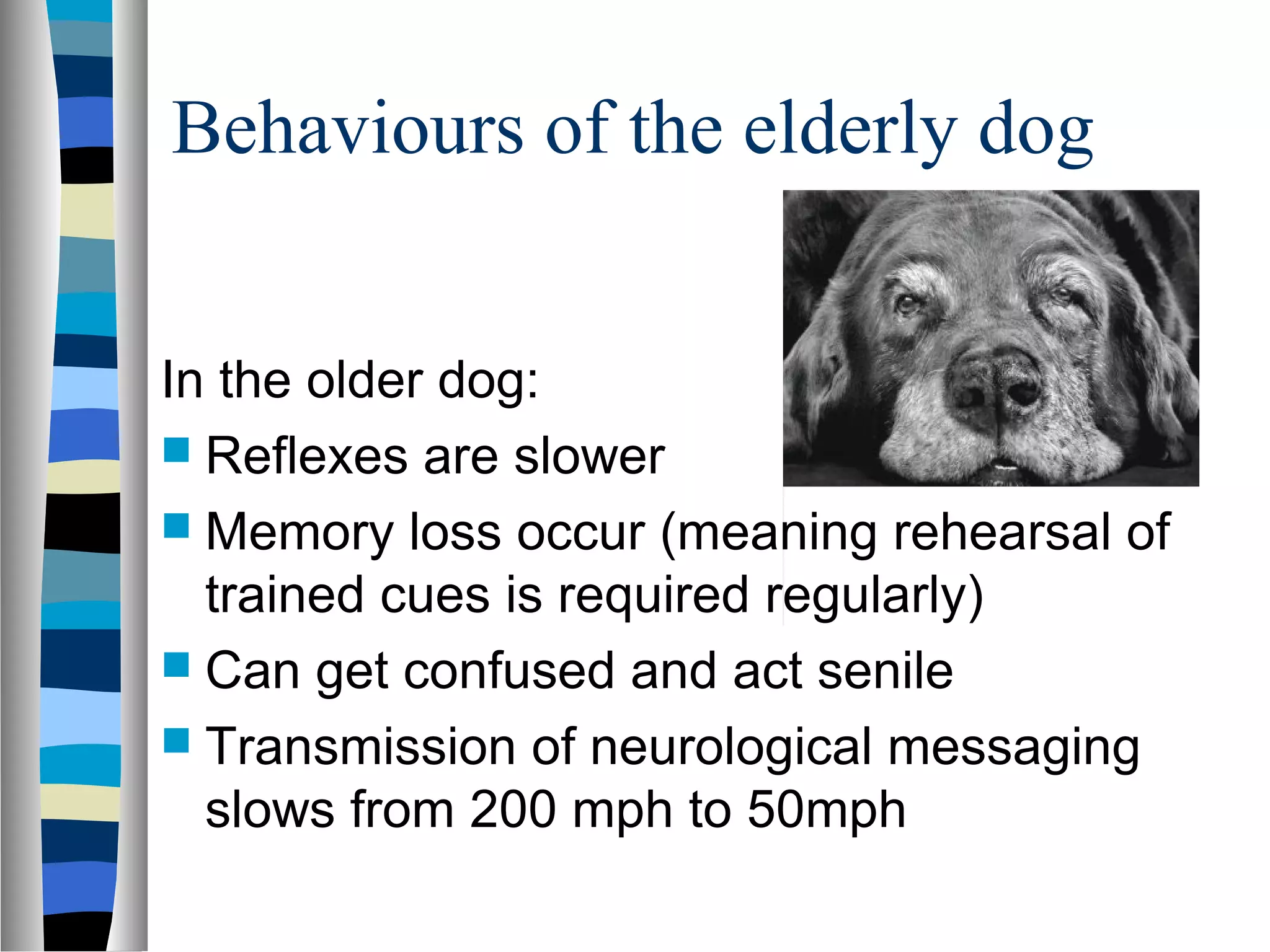
Behaviours of the elderly dog
In the older dog:
 Reflexes are slower
 Memory loss occur (meaning rehearsal of
trained cues is required regularly)
 Can get confused and act senile
 Transmission of neurological messaging
slows from 200 mph to 50mph
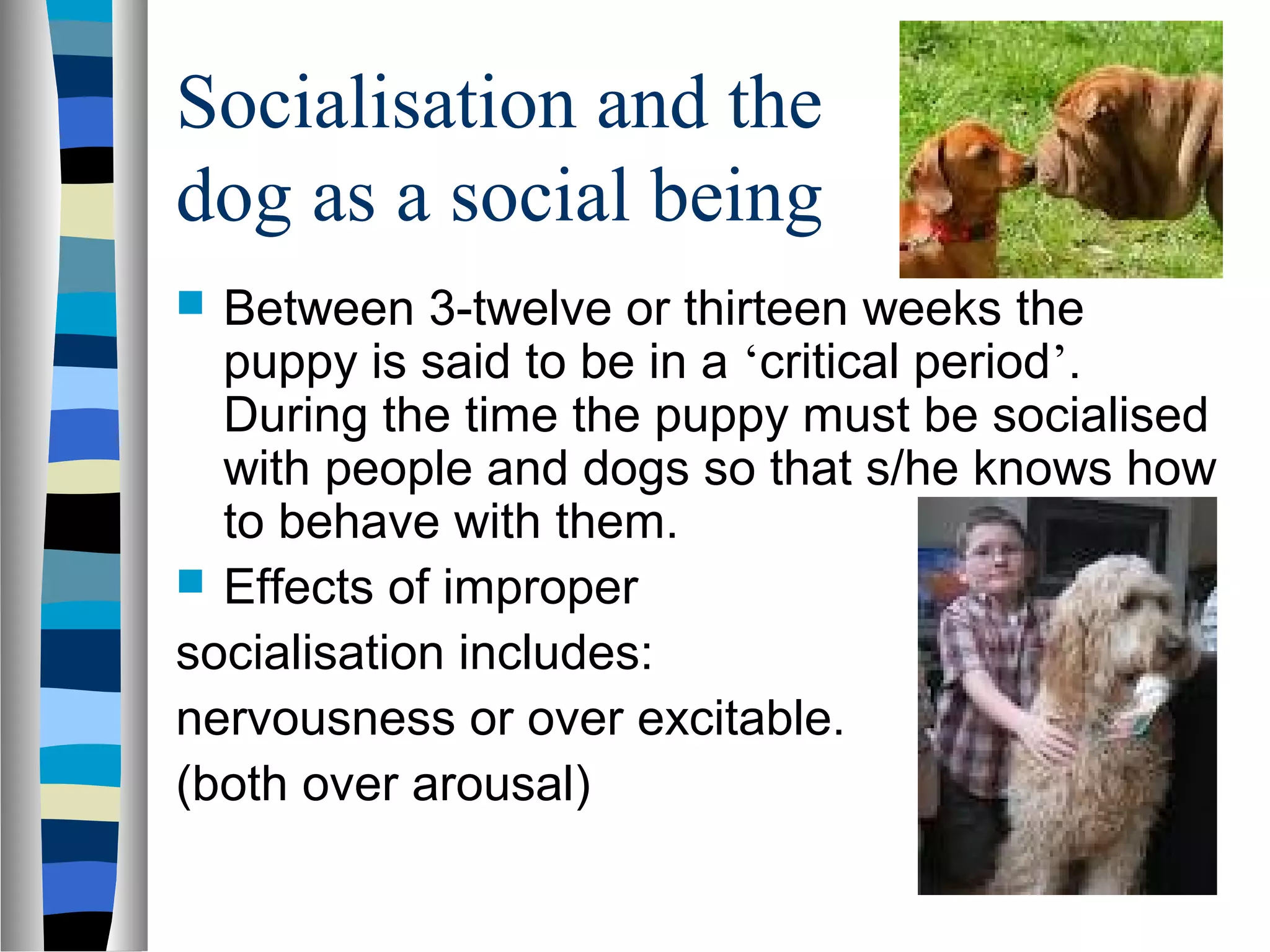
Socialisation and the
dog as a social being
 Between 3-twelve or thirteen weeks the
puppy is said to be in a ‘critical period’.
During the time the puppy must be socialised
with people and dogs so that s/he knows how
to behave with them.
 Effects of improper
socialisation includes:
nervousness or over excitable.
(both over arousal)
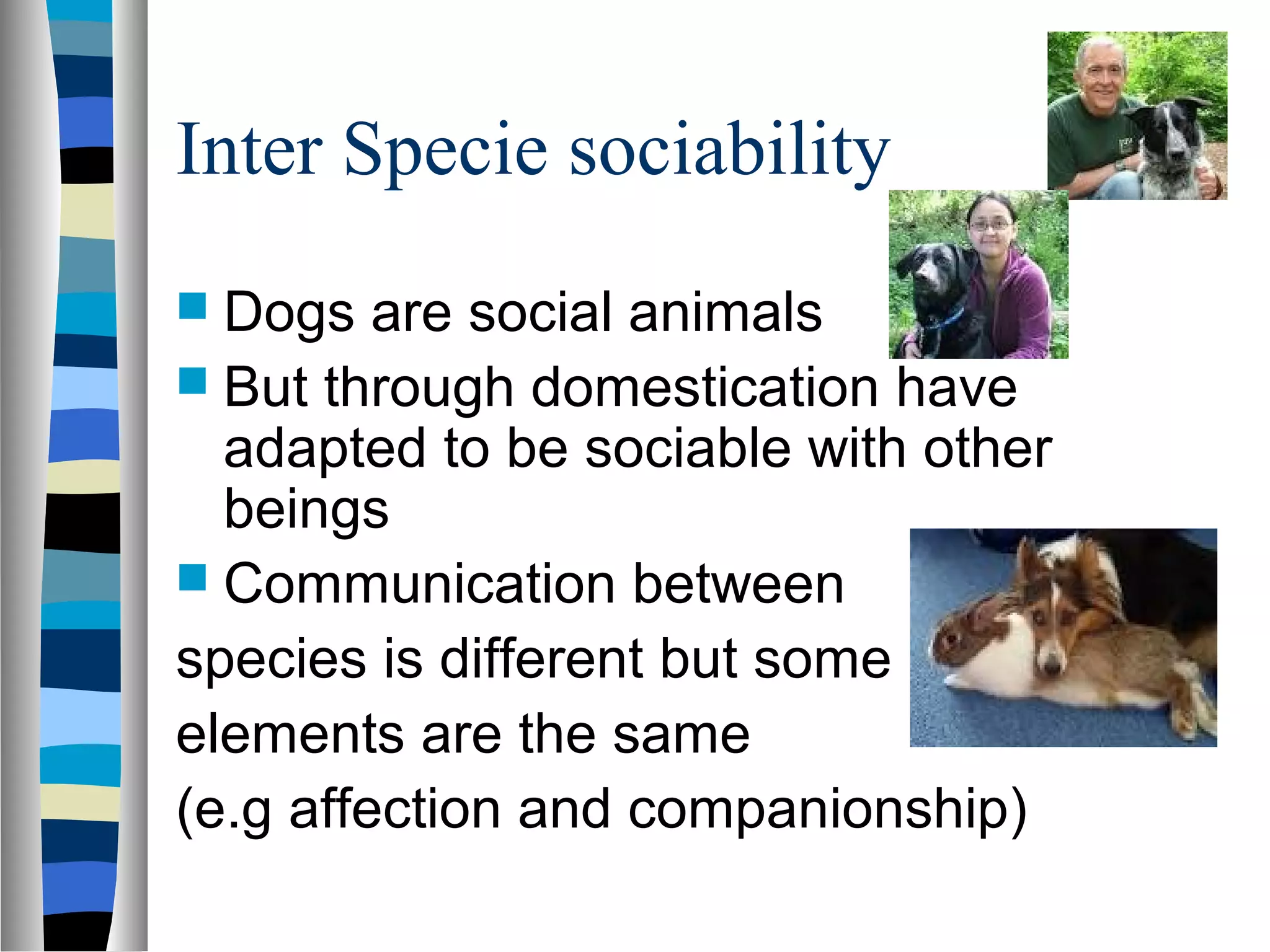
Inter Specie sociability
 Dogs are social animals
 But through domestication have
adapted to be sociable with other
beings
 Communication between
species is different but some
elements are the same
(e.g affection and companionship)
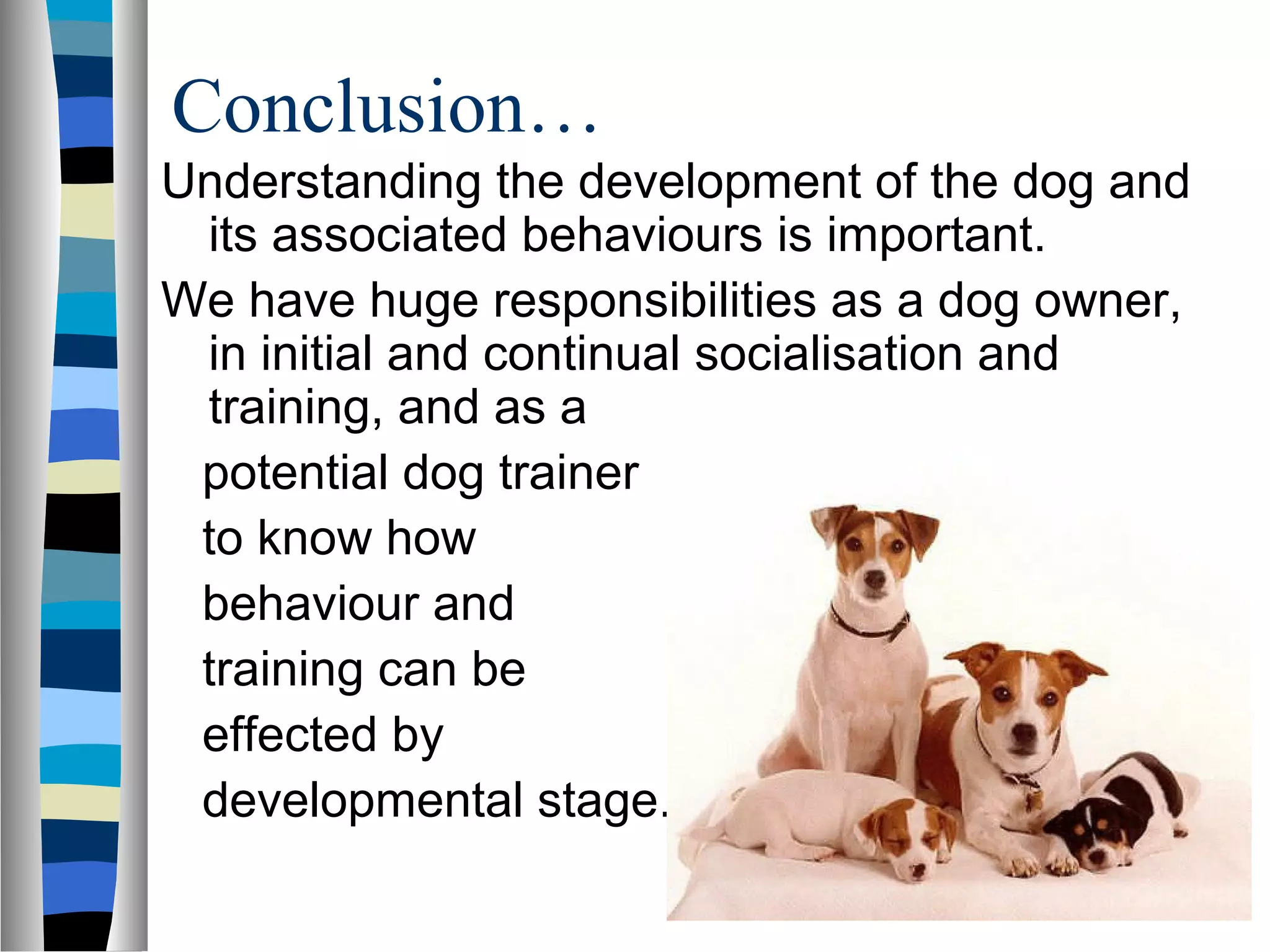
Conclusion…
Understanding the development of the dog and
its associated behaviours is important.
We have huge responsibilities as a dog owner,
in initial and continual socialisation and
training, and as a
potential dog trainer
to know how
behaviour and
training can be
effected by
developmental stage.

Understanding behavior of cat and dog

  • 2.
     Assignment  Submittedto: Dr. Tanveer  Submitted By: Zohaib Saleem  Registration no. 2012-ag-2642  Roll no. 727  Section C
  • 3.
  • 4.
    WHAT IS BEHAVIOUR Behavior is the internally coordinated responses (actions or inactions) of the domestic dog (individuals or groups) to internal and/or external stimuli.
  • 5.
    How dogs differin behaviour than other animals  Intelligence  Senses
  • 6.
    Different types ofbehaviours  Communication behavior  Social behavior  Reproduction behavior  Feeding behaviour
  • 7.
    CommunicationCommunication Communication occurs uponproduction of a signal by one animal that is recognised and alters the behaviour of the receiver of the signal
  • 8.
  • 9.
  • 10.
    Communication Behaviour  Dogto dog communication  Dog to Human communication
  • 11.
    DOG-DOG communication  Thesecommunication behaviors include:  Eye gaze  Facial expression  Vocalization  Body posture (including movements of bodies and limbs)
  • 12.
    DOG-DOG communication  gustatorycommunication (scents, pheromones and taste) including in it
  • 13.
    Dog-Human Communication  Humanscommunicate with dogs by using  Vocalization  Hand signals  Body posture
  • 14.
    VisualVisual CommunicationCommunicationPositive Arousal =Distance Decreasing Signals= Affiliative Behaviour Negative Arousal=Distance Increasing Signals= Agnostic Behaviour Both occur on a scale
  • 15.
    Parts of theDog to Observe in Intra or Inter Specie Communication
  • 16.
    General “Normal” VisualGeneral“Normal” Visual CommunicationCommunication Breed dependant
  • 17.
    Familiar/ObviousFamiliar/Obvious “Positive Arousal”“Positive Arousal” VisualCommunicationVisual Communication Positive Arousal •Demonstrate arousal with sensory responses •Switch off other sensory inputs •Over exaggerate clear positive body signals
  • 18.
    Familiar/Obvious“NegatiFamiliar/Obvious“Negati ve Arousal” VisualveArousal” Visual CommunicationCommunication Negative Arousal Two types: Flight based •Make themselves smaller •Withdraw/Submit (show they have no defences) •May change to fight based if pushed
  • 19.
    ““Negative Arousal”Negative Arousal” VisualCommunicationVisual Communication Negative Arousal Two types: Fight based •Make themselves look bigger (sometimes lower) •Show defences •Prepared to protect/defend (resource related)
  • 20.
    Auditory Communication  Bark-an alert, most likely an adapted behaviour. Easily socially learnt  Howl- attention seeking behaviour as both positive and negative arousal  Whine signal- stress  Growl signal- play or fight
  • 21.
    Chemical Communication  Releaseof Pheromone  Release from pads, anal glands and face  Chemicals remain longer than visual signals often given at the same time.
  • 22.
    Tactile Communication Seen mostlyas: Play Affection or Aggression
  • 23.
    Social behavior  Play(Dog-dog , Dog-human)  Empathy  Personalities  Leadership, dominance  Scent  Feral dogs
  • 24.
    Play  Most dogsplay …but most mammals only do this when young. Through Domestication Dogs have remained “neotenous”. We encourage them to remain juvenile.
  • 25.
    Theories as towhy dogs play  Helps with development of bone and muscle  Teaches useful communication skills  Teaches hunting skills (although not required in domestication)  Teaches co-operation between group members  Teaches about surrounding environment  Allows for trial and error learning  Puppy enjoys doing it!…functional behaviour.
  • 26.
    Reproduction behavior  Dogsreach sexual maturity and can reproduce during their first year, in contrast to wolves at two years-of-age. Bitches have their first estrus ("heat") at 6 to 12 months-of-age; smaller dogs tend to come into heat earlier whereas larger dogs take longer to mature.
  • 27.
    Reproduction behavior  Dogbitches have an estrous cycle that is nonseasonal and monestrus, i.e. there is only one estrus per estrous cycle  The average duration of estrus is 9 days with spontaneous ovulation usually about 3 days after the onset of estrus.
  • 28.
    Reproduction behavior  Themale dog mounts the female and is able to achieve intromission, this is sometimes known as the “tie” or “copulatory lock”  Dogs are polygamous
  • 29.
    Feeding behaviour  Thoughtto be born with chemical receptors developed to detect milk  No early recognition or interest in meat until 3 weeks  Start to ‘dabble’ in food.  At 5 weeks eat ‘solid’ food.
  • 30.
    Behaviour of theBithch  Maternal Behaviour:  Unsure as to whether mothering skills are learnt or inherited  Isolates for birth  Can be protective of puppies  Bitches can also kill unwell puppies (apparent to bitch as don’t behave ‘normally’)-natural selection)  Licks puppies for elimination behaviour  Bringing puppies back to the nest
  • 31.
    Behaviour of theDog  Paternal Behaviour In domestic dogs the sire has no role in the puppies development In the wild they can act as educators from seven weeks
  • 32.
    Affects of Puberty-Male (General)  Increased hair growth  Scent marking  More prepared to protect territory (items of value)  Roaming  Increased arousal (more excitable)  More vocal  Disobedient to previously taught cues  More aloof/independent/curious
  • 33.
    Affect of Puberty-Females (General)  Signs of oestrous  More protective  More sensitive  Interest in males (flirty)  Scent marking  More vocal  Disobedient to previously taught cues  More affectionate
  • 34.
    Behaviours of the elderlydog Behavioural changes will occur in the older dog due to:  Illness and Disease (causing pain and discomfort)  Hormone Production (and lack of)  Altered Sensory Perceptions  Inability to communicate effectively
  • 35.
    Behaviours of theelderly dog In the older dog:  Reflexes are slower  Memory loss occur (meaning rehearsal of trained cues is required regularly)  Can get confused and act senile  Transmission of neurological messaging slows from 200 mph to 50mph
  • 36.
    Socialisation and the dogas a social being  Between 3-twelve or thirteen weeks the puppy is said to be in a ‘critical period’. During the time the puppy must be socialised with people and dogs so that s/he knows how to behave with them.  Effects of improper socialisation includes: nervousness or over excitable. (both over arousal)
  • 37.
    Inter Specie sociability Dogs are social animals  But through domestication have adapted to be sociable with other beings  Communication between species is different but some elements are the same (e.g affection and companionship)
  • 38.
    Conclusion… Understanding the developmentof the dog and its associated behaviours is important. We have huge responsibilities as a dog owner, in initial and continual socialisation and training, and as a potential dog trainer to know how behaviour and training can be effected by developmental stage.