Establishing Effective
   Communication with External
Stakeholders: The Impact of Training

         KELLY C. LOCKHART DODSON
    TREVECCA NAZARENE UNIVERSITY, COHORT 11
           SYMPOSIUM MARCH 26, 2011
Introduction


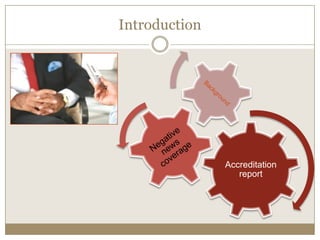
               Accreditation
                  report
Research Questions

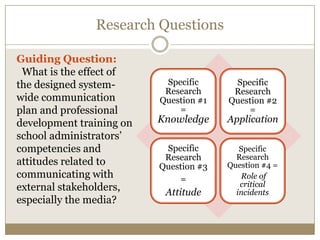
Guiding Question:
 What is the effect of
the designed system-       Specific      Specific
                           Research      Research
wide communication        Question #1   Question #2
plan and professional         =             =
development training on   Knowledge     Application
school administrators’
competencies and           Specific        Specific
                           Research       Research
attitudes related to      Question #3   Question #4 =
communicating with            =             Role of
external stakeholders,                     critical
                           Attitude       incidents
especially the media?
Review of Literature

School Public •ISSLC, 2008
Relations
              •Phi Delta
              Kappa/Gallup, 2009

              •Bagin & Gallagher,
              2001

              •Coombs, 1999a, et.al
Review of Literature

              •Greenwald &
              Leavitt, 1984
Attitude and •Cameron, 1993
Involvement
              •Slater in Dillard &
              Pfau, 2002
              •Zaichkowsky, 1986
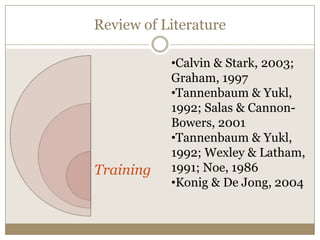
Review of Literature

           •Calvin & Stark, 2003;
           Graham, 1997
           •Tannenbaum & Yukl,
           1992; Salas & Cannon-
           Bowers, 2001
           •Tannenbaum & Yukl,
           1992; Wexley & Latham,
Training   1991; Noe, 1986
           •Konig & De Jong, 2004
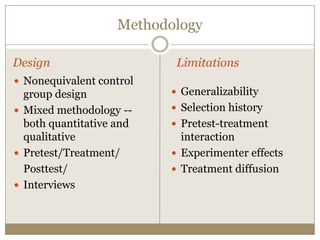
Methodology

Design                     Limitations
 Nonequivalent control
  group design             Generalizability
 Mixed methodology --     Selection history
  both quantitative and    Pretest-treatment
  qualitative               interaction
 Pretest/Treatment/       Experimenter effects
  Posttest/                Treatment diffusion
 Interviews
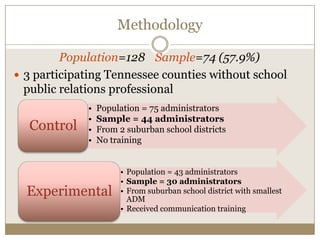
Methodology

         Population=128 Sample=74 (57.9%)
 3 participating Tennessee counties without school
  public relations professional
             •   Population = 75 administrators
             •   Sample = 44 administrators
  Control    •   From 2 suburban school districts
             •   No training


                      • Population = 43 administrators
                      • Sample = 30 administrators
  Experimental        • From suburban school district with smallest
                        ADM
                      • Received communication training
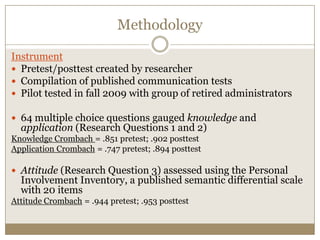
Methodology

Instrument
 Pretest/posttest created by researcher
 Compilation of published communication tests
 Pilot tested in fall 2009 with group of retired administrators

 64 multiple choice questions gauged knowledge and
  application (Research Questions 1 and 2)
Knowledge Crombach = .851 pretest; .902 posttest
Application Crombach = .747 pretest; .894 posttest

 Attitude (Research Question 3) assessed using the Personal
  Involvement Inventory, a published semantic differential scale
  with 20 items
Attitude Crombach = .944 pretest; .953 posttest
Methodology

 5 participants interviewed using Critical Incident
  Technique (Research Question 4)
 Training tool designed for use with leaders
 Reflect on critical incidents
 May be positive or negative


 Sessions digitally recorded, kept confidential
 Responses categorized, enumerated to explain
 quantitative results
Findings: Research Question #1 – Knowledge


• Multiple regression

• Overall model significant, p < .001

• Both individual predictors showed a significant
 relationship to the dependent variable
            School System: p < .001
            Pre Communication Knowledge: p < .001.

• Regression coefficient = Experimental group scored 8.02
 points better than the control group on the posttest while
 accounting for the pretest.
Findings: Research Question #2 – Application


• Multiple regression

• Overall model significant, p < .001

• Both individual predictors showed a significant
 relationship to the dependent variable
            School System: p < .001
            Pre Communication Application: p < .001.

• Regression coefficient = Experimental group scored 4.07
 points better than the control group on the posttest while
 accounting for the pretest.
Findings Research Question #3 – Attitude

• Multiple regression

• Overall model significant, p < .001

• Both individual predictors showed a significant
 relationship to the dependent variable
            School System: p < .01
            Pre Personal Involvement: p < .001.

• Regression coefficient = Experimental group scored
 7.106 points better than the control group on the posttest
 while accounting for the pretest.
Findings           Independent samples t test
Research           Compared attitudes toward
Question #4         school public relations
                    initiatives with question #92
Critical            responses
Incidents
                   Result was significant, p < .05
Question #92:      Administrators with
“Have you ever      unpleasant incident with
had an
unpleasant
                    media scored significantly
incident with       “less involved” or had a poorer
the media as a      attitude toward school public
school              relations initiatives
administrator?”
 5 administrators interviewed
Findings
               2 of 5 critical incidents = negative
Research
               20 of 31 negative words or
Question
#4              phrases came from 2 critical
                incidents deemed negative
Critical       25 of 36 positive words or
Incidents       phrases came from 3 critical
                incidents deemed positive
Qualitative    Positive words included:
                “relationship,” “proactive,”
                “positive,” “trust,” and “very
                pleased”
Other Findings

 Question #91 on the    30 experimental and
 pretest/posttest:        44 control group
                          participants
“Did you receive          responded
 college instruction
                         71.6% of study
 about                    participants had not
 communicating with       received college
 the media as part of     instruction about
 your schooling for       communicating with
 your current job         the media
 title?”
Other Findings

 Independent              Participants with college
  samples t test            instruction =
                            significantly more
 Compared responses        involvement or better
  to Question #91 and       attitudes toward school
  participants’ pretest     public relations
  scores (knowledge,        initiatives on pretest
  application, and         p < .05
  attitude)                College instruction did
                            not significantly impact
                            knowledge or
                            application pretest
                            scores
Other Findings

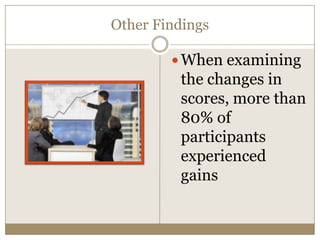
         When examining
         the changes in
         scores, more than
         80% of
         participants
         experienced
         gains
Conclusions

 Significant posttest data supported positive
  impact of training materials and
  professional development training on
  knowledge, application, and attitude
 Pretest attitudes toward school public
  relations initiatives significantly impacted by
1. Previous college-level instruction
2. “Unpleasant” critical incidents with media
Recommendations

The researcher recommends the following:
1.   More communication training for administrators

2. Further utilization of Critical Incident Technique

3. Further use of the Personal Involvement Inventory
     in educational settings

4. Further study of school public relations, especially
     within the area of relationship building
Acknowledgements

 God
 Cohort 11
 Dr. Linda Collins, Dissertation Adviser
 Dr. Esther Swink, Dissertation Reader
 Dr. James Agee, Statistician
Questions?

Dodson kelly symposium

  • 1.
    Establishing Effective Communication with External Stakeholders: The Impact of Training KELLY C. LOCKHART DODSON TREVECCA NAZARENE UNIVERSITY, COHORT 11 SYMPOSIUM MARCH 26, 2011
  • 2.
    Introduction Accreditation report
  • 3.
    Research Questions Guiding Question: What is the effect of the designed system- Specific Specific Research Research wide communication Question #1 Question #2 plan and professional = = development training on Knowledge Application school administrators’ competencies and Specific Specific Research Research attitudes related to Question #3 Question #4 = communicating with = Role of external stakeholders, critical Attitude incidents especially the media?
  • 4.
    Review of Literature SchoolPublic •ISSLC, 2008 Relations •Phi Delta Kappa/Gallup, 2009 •Bagin & Gallagher, 2001 •Coombs, 1999a, et.al
  • 5.
    Review of Literature •Greenwald & Leavitt, 1984 Attitude and •Cameron, 1993 Involvement •Slater in Dillard & Pfau, 2002 •Zaichkowsky, 1986
  • 6.
    Review of Literature •Calvin & Stark, 2003; Graham, 1997 •Tannenbaum & Yukl, 1992; Salas & Cannon- Bowers, 2001 •Tannenbaum & Yukl, 1992; Wexley & Latham, Training 1991; Noe, 1986 •Konig & De Jong, 2004
  • 7.
    Methodology Design Limitations  Nonequivalent control group design  Generalizability  Mixed methodology --  Selection history both quantitative and  Pretest-treatment qualitative interaction  Pretest/Treatment/  Experimenter effects Posttest/  Treatment diffusion  Interviews
  • 8.
    Methodology Population=128 Sample=74 (57.9%)  3 participating Tennessee counties without school public relations professional • Population = 75 administrators • Sample = 44 administrators Control • From 2 suburban school districts • No training • Population = 43 administrators • Sample = 30 administrators Experimental • From suburban school district with smallest ADM • Received communication training
  • 9.
    Methodology Instrument  Pretest/posttest createdby researcher  Compilation of published communication tests  Pilot tested in fall 2009 with group of retired administrators  64 multiple choice questions gauged knowledge and application (Research Questions 1 and 2) Knowledge Crombach = .851 pretest; .902 posttest Application Crombach = .747 pretest; .894 posttest  Attitude (Research Question 3) assessed using the Personal Involvement Inventory, a published semantic differential scale with 20 items Attitude Crombach = .944 pretest; .953 posttest
  • 10.
    Methodology  5 participantsinterviewed using Critical Incident Technique (Research Question 4)  Training tool designed for use with leaders  Reflect on critical incidents  May be positive or negative  Sessions digitally recorded, kept confidential  Responses categorized, enumerated to explain quantitative results
  • 11.
    Findings: Research Question#1 – Knowledge • Multiple regression • Overall model significant, p < .001 • Both individual predictors showed a significant relationship to the dependent variable School System: p < .001 Pre Communication Knowledge: p < .001. • Regression coefficient = Experimental group scored 8.02 points better than the control group on the posttest while accounting for the pretest.
  • 12.
    Findings: Research Question#2 – Application • Multiple regression • Overall model significant, p < .001 • Both individual predictors showed a significant relationship to the dependent variable School System: p < .001 Pre Communication Application: p < .001. • Regression coefficient = Experimental group scored 4.07 points better than the control group on the posttest while accounting for the pretest.
  • 13.
    Findings Research Question#3 – Attitude • Multiple regression • Overall model significant, p < .001 • Both individual predictors showed a significant relationship to the dependent variable School System: p < .01 Pre Personal Involvement: p < .001. • Regression coefficient = Experimental group scored 7.106 points better than the control group on the posttest while accounting for the pretest.
  • 14.
    Findings  Independent samples t test Research  Compared attitudes toward Question #4 school public relations initiatives with question #92 Critical responses Incidents  Result was significant, p < .05 Question #92:  Administrators with “Have you ever unpleasant incident with had an unpleasant media scored significantly incident with “less involved” or had a poorer the media as a attitude toward school public school relations initiatives administrator?”
  • 15.
     5 administratorsinterviewed Findings  2 of 5 critical incidents = negative Research  20 of 31 negative words or Question #4 phrases came from 2 critical incidents deemed negative Critical  25 of 36 positive words or Incidents phrases came from 3 critical incidents deemed positive Qualitative  Positive words included: “relationship,” “proactive,” “positive,” “trust,” and “very pleased”
  • 16.
    Other Findings  Question#91 on the  30 experimental and pretest/posttest: 44 control group participants “Did you receive responded college instruction  71.6% of study about participants had not communicating with received college the media as part of instruction about your schooling for communicating with your current job the media title?”
  • 17.
    Other Findings  Independent  Participants with college samples t test instruction = significantly more  Compared responses involvement or better to Question #91 and attitudes toward school participants’ pretest public relations scores (knowledge, initiatives on pretest application, and  p < .05 attitude)  College instruction did not significantly impact knowledge or application pretest scores
  • 18.
    Other Findings  When examining the changes in scores, more than 80% of participants experienced gains
  • 19.
    Conclusions  Significant posttestdata supported positive impact of training materials and professional development training on knowledge, application, and attitude  Pretest attitudes toward school public relations initiatives significantly impacted by 1. Previous college-level instruction 2. “Unpleasant” critical incidents with media
  • 20.
    Recommendations The researcher recommendsthe following: 1. More communication training for administrators 2. Further utilization of Critical Incident Technique 3. Further use of the Personal Involvement Inventory in educational settings 4. Further study of school public relations, especially within the area of relationship building
  • 21.
    Acknowledgements  God  Cohort11  Dr. Linda Collins, Dissertation Adviser  Dr. Esther Swink, Dissertation Reader  Dr. James Agee, Statistician
  • 22.

Editor's Notes

  • #2 Fast. Just say your name and the title of the research project.
  • #3 Imagine if you will your large marquee school sign being flashed up onto the news at 5 o’clock. Then, there’s the video of a teacher in handcuffs being placed in the back of a police car.I chose a topic that combines my backgrounds in mass communications and education.Three years ago as I was trying to decide on a research topic, my county school system was splattered on television and print media outlets for several crisis events. At the same time, the accreditation team recommended that my county school system create and adopt a communication plan.
  • #4 With that in mind, the Guiding Question for my research study becameSpecific Research Question #1: How does the designed system-wide communication plan and professional development impact administrators’ knowledge of communication models and theories, planning and implementation of a complementary school-level communication plan, crisis communication management skills, and media relations skills.Specific Research Question #2=How does the designed system-wide communication plan and professional development impact administrators’ application of communication models and theories, planning and implementation of a complementary school-level communication plan, crisis communication management skills, and media relations skills.Specific Research Question #3: How does the designed system-wide communication plan and professional development training impact administrators’ attitude toward school public relations initiatives?Specific Research Question #4: What impact do critical incidents with media have on administrators’ attitude toward school public relations initiatives?
  • #5 The review of literature centered around three major topics: school public relations, attitude and involvement, and training. Communicating with external stakeholders, especially the media, is a standard for school administrators. (ISSLC, 2008)Public perception of public schools is diminishing, as accountability and market competiveness increases. (Phi Delta Kappa/Gallup, 2009)Public perception and public support of public schools may increase through building relationships with external stakeholders, especially the media. (Bagin &amp; Gallagher, 2001) Crisis management research shows the need to cultivate pre-crisis relationships with stakeholders. (Birch, 1994; Coombs, 1999a; Couretas, 1985; Fearn-Banks, 1996; Seitel, 1983).
  • #6 Attitude is related to involvement. If one is “involved,” one is ready or motivated to receive and to respond to messages, issues, and objects. Attitude is defined also as increased attentional capacity or as increased cognitive activation.(Greenwald &amp; Leavitt, 1984; Cameron, 1993)Attitude signifies arousal, interest, and motivation. Additionally, attitude acts as a filter. (Slater in Dillard &amp; Pfau, 2002) Relevance is an antecedent to involvement. (Zaichkowsky, 1986)
  • #7 The two studies found regarding school public relations training did not discuss the impact of the training but the need for training. (Calvin &amp; Stark, 2003; Graham, 1997)Training is a demonstrated way to increase knowledge, skills, and abilities, and also the application of new knowledge, skills, and abilities. (Tannenbaum &amp; Yukl, 1992; Salas &amp; Cannon-Bowers, 2001)Attributes of trainees, including motivation, attitude, and expectations, can influence training effectiveness. (Tannenbaum &amp; Yukl, 1992; Wexley &amp; Latham, 1991; Noe, 1986)Critical Incident Technique is used by different training bodies as a reflective tool in leadership training. In communication training, the type of communication critical incidents and a leaders’ response to the communication critical incident have been studied in order to train leaders how to better respond in future incidents. (Konig &amp; De Jong, 2004)
  • #8 Used intact groups as the treatment and control groups. Dependent variable = performance on testIndependent variable = intervention/training or no trainingNot generalizable to school systems which have dissimilar characteristics, namely a school public relations directorSelection history refers to anything that may happen to participants between the pre-test and posttest – in particular to the this study would be positive or negative interactions with the media.The prettest could impact posttest results.Because some of the participants know the researcher, those administrators may have felt experimenter effectsIt is possible that participants from one group may have talked to other participants in the same or different group leading to treatment diffusion.
  • #9 Groups were non equivalent and were not randomly selected.Control and experimental group members serve three suburban school districts without a full-time school public relations professional.Participated in one of two identical one-half day, three-hour professional development training sessions with researcher Radomization was not required because the population for both groups is below 100.The study design is considered mixed because it is quantitative and qualitative.
  • #10 Crombach’s alpha measures the amount of internal consistency a test possesses.
  • #11 Administrators described recent incident with media, their actions, their feelings, and what changes (if any) they would make when dealing with the media in the future
  • #12 A multiple regression was run to investigate the relationship and predictive ability of two variables (School System and Pre Communication Knowledge) on administrators’ communication knowledge posttest scores. The overall model was significant, F (2, 50) = 72.66, p &lt; .001, showing that the two variables can significantly predict posttest knowledge scores. The R2 = .74, which indicated that 74% of the variability in the posttest scores could be attributed to these two variables. Additionally, both of the individual predictors showed a significant relationship to the dependent variable (School System: b = 8.019, t = 6.5, p &lt; .001; and Pre Communication Knowledge: b = .809, t = 10.1, p &lt; .001.) The regression coefficient indicates that the experimental group scored 8.02 points better than the control group on the posttest while accounting for the pretest.
  • #13 Research Question #2: In order to discover the relationship and predictive ability of two variables (School System and Pre Communication Application) on administrators’ communication application posttest scores, a multiple regression was run. The R was .820 and was significant, F (2, 50) = 51.43, p &lt; .001, illustrating that posttest application scores are significantly predicted by the two variables. The R2 = .67 which indicates that 67% of the variability in the posttest scores could be accounted for by these two variables. Also, both of the individual predictors showed a significant relationship to the dependent variable (School System: b = 4.072, t = 7.37, p &lt; .001; and Pre Communication Application: b = .705, t = 7.71, p &lt; .001.) While accounting for the pretest, the regression coefficient denotes that the experimental group scored 4.07 points better than the control group on the posttest.
  • #14 Research Question #3: Multiple regression was used to explore the relationship and predictive ability of two variables (School System and Pre Personal Involvement) on administrators’ personal involvement posttest scores. The R was .771 and was significant, F (2, 49) = 35.85, p &lt; .001, showing that this combination of variables can significantly predict personal involvement posttest scores. Additionally, R2 = .59, showing that 59% of the variability in the posttest scores for involvement can be accounted for by these two variables. Both of the individual predictors showed a significant relationship to the dependent variable (School System: b = 7.106, t = 3.35, p &lt; .01; and Pre Personal Involvement: b = .583, t = 8.04, p &lt; .001). What the regression coefficient shows is that the experimental group scored 7.106 points better than the control group on the posttest while accounting for the pretest.
  • #15 Research Question #4: Administrators’ attitudes toward school public relations initiatives, as measured by the Personal Involvement Inventory, were compared with their responses to question #92 regarding an unpleasant incident with the media as a school administrator. The result was significant. Administrators who said they experienced an unpleasant incident with the media as an administrator scored significantly “less involved” or had a poorer attitude toward school public relations initiatives than administrators who had not experienced an unpleasant incident, t (71) = 2.009, p &lt; .05. Administrators’ scores on the knowledge and application portions of the pre/posttest were not significantly related to an unpleasant incident with the media as a school administrator, however, when statistically analyzed using an independent samples t test.
  • #16 Example of negative response: “I became less trusting of them and more critical of the industry.”Example of positive response: “I am very pleased with the relationship that we have with this station. They provide fair coverage to our system.”
  • #18 An independent samples t test was run between the respondents’ answer to Question #91 and the pretest scores on all three sections of the pretest (knowledge, application, and attitude). Study participants who received college instruction on communicating with the media indicated significantly more involvement or better attitudes toward school public relations initiatives on the pretest, t (71) =-2.102, p &lt; .05. College instruction did not significantly impact knowledge or application scores.
  • #21 TrainingCollege-level communication coursesProfessional development training within school systemFindings are in keeping with previous research on training which show that learning and transfer will occur only when trainees have both the ability and volition to acquire and apply new skills. (Tannenbaum &amp; Yukl, 1992; Wexley &amp; Latham, 1991; Noe, 1986)