Follow us: @ehp_uk
Developing a graduated
approach to Speech
Language and
Communication Needs
(SLCN) within a school
setting
Follow us: @ehp_uk
Identifying children and young
people with SLCN within a
School setting
Natasha Carley
Paediatric Speech and Language Therapist
11/10/2017
Follow us: @ehp_uk
Aims:
• Increase knowledge and awareness of SLCN in education and the
impact they can have on children's’ lives.
• Increased awareness of the Universal, Targeted, Specialist approach.
• Strategies to increase identification of SLCN in education settings.
• Universal and Targeted interventions
• Increased awareness of charities and organisations who can provide
support and resources for Schools.
Follow us: @ehp_uk
Language is THE key
Good language and communication skills are the foundations of
learning, emotional development and socialising.
Language and communication skills are important for children to
achieve at school and are a strong predictor of later academic success.
Without the right help, at the right time, they will be left out and left
behind.
Follow us: @ehp_uk
A child with SLCN – their journey
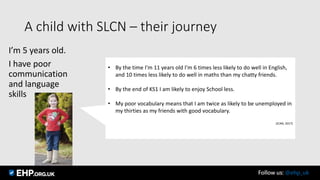
I’m 5 years old.
I have poor
communication
and language
skills
• By the time I’m 11 years old I’m 6 times less likely to do well in English,
and 10 times less likely to do well in maths than my chatty friends.
• By the end of KS1 I am likely to enjoy School less.
• My poor vocabulary means that I am twice as likely to be unemployed in
my thirties as my friends with good vocabulary.
(ICAN, 2017)
Follow us: @ehp_uk
A child with SLCN – their journey
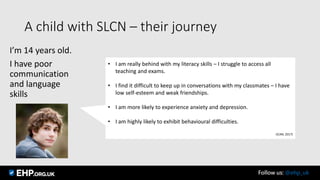
I’m 14 years old.
I have poor
communication
and language
skills
• I am really behind with my literacy skills – I struggle to access all
teaching and exams.
• I find it difficult to keep up in conversations with my classmates – I have
low self-esteem and weak friendships.
• I am more likely to experience anxiety and depression.
• I am highly likely to exhibit behavioural difficulties.
(ICAN, 2017)
Follow us: @ehp_uk
SLCN in our Classrooms:
What are we dealing with?
• 1 in 10 children have a language difficulty. How many in each class?
• Language disorder is 7 times more prevalent than ASD.
• In areas of deprivation what percentage of children start School
without the language they need for learning?
• In Primary Schools more children have SLCN than any other special
need.
• In Secondary Schools the census data reports a fall in SLCN. Is this
true?
*The Communication Trust and ICAN (2017)
Follow us: @ehp_uk
Identification and Intervention for SLCN:
What’s the plan?
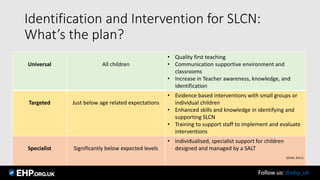
Universal All children
• Quality first teaching
• Communication supportive environment and
classrooms
• Increase in Teacher awareness, knowledge, and
identification
Targeted Just below age related expectations
• Evidence based interventions with small groups or
individual children
• Enhanced skills and knowledge in identifying and
supporting SLCN
• Training to support staff to implement and evaluate
interventions
Specialist Significantly below expected levels
• Individualised, specialist support for children
designed and managed by a SALT
(ICAN, 2011)
Follow us: @ehp_uk
Universal Approach:
Increasing identification of children with SLCN
Staff Training is invaluable. Increase awareness and knowledge of:
• Developmental milestones
• How children with SLCN present in the classroom
• Use of screening tools
Follow us: @ehp_uk
Identifying children with SLCN:
Staff Training Providers
• NHS SALT service
• Commissioned SALT:
• RCSLT Guidance:
https://www.rcslt.org/speech_and_language_therapy/commissioning/qual_standards_schoo
ls
• SLT for Kids: http://www.sltforkids.co.uk/
• EHP: www.ehp.org.uk
• Specialist Teachers
Follow us: @ehp_uk
Identifying children with SLCN:
Staff Training Providers
• ELKLAN: www.elklan.co.uk
• ICAN: http://www.ican.org.uk/What-we-do/Training.aspx
• Language for Learning: http://www.languageforlearning.co.uk/
• HANEN: www.hanen.org
• Afasic: http://www.afasic.org.uk/professionals/courses/
• ASEND: www.asend.co.uk
Follow us: @ehp_uk
Identifying children with SLCN:
Online Resources and Staff Training
• Talking Point
• The Communication Trust
• Inclusion Development Programme
Follow us: @ehp_uk
http://www.talkingpoint.org.uk/
• Ages and stages
• Progress checkers
• Free enquiry service
• Free resources:
• Primary and secondary milestone posters.
• Universally Speaking booklets. Universally Speaking is a series of booklets for
anyone who works with children and young people. The booklets show where
children should be with their communication skills at any given age.
Follow us: @ehp_uk
https://www.thecommunicationtrust.org.uk/resources/resources/resources-
for-practitioners/
• Beyond measure: guidance for education staff on using the reception
baseline assessment as an opportunity to identify and support children
who have SLCN, as early as possible.
• Early years, primary and secondary progression tools. The Progression Tools
aim to support teaching staff to identify children who may be struggling to
develop their speech, language and communication skills. They can also be
used to track progression of these skills over time or
following interventions.
Follow us: @ehp_uk
Inclusion Development Programme
http://www.idponline.org.uk/
The Inclusion Development Programme (IDP): This was developed by
the Government to equip teachers, TAs and early years staff with the
skills they need to successfully include children with SEN. There are two
modules on SLCN, one for school staff and one for those working in
early years. They can be accessed here:
Follow us: @ehp_uk
Identifying children with SLCN:
Screening Tools
• WellComm (6months-6years): A Speech and Language Toolkit for
Screening and Intervention in the Early Years.
• Speechlink: Provides packages to help with the identification and
intervention for KS1, KS2 and KS3.
https://www.speechlink.info/index.php
Follow us: @ehp_uk
Universal Approach to intervention for SLCN
• Communication friendly classrooms:
https://www.thecommunicationtrust.org.uk/resources/resources/resources-for-
practitioners/communication-friendly-checklists/
• Communication supporting classroom observation tool:
https://www.thecommunicationtrust.org.uk/media/93866/tct_bcrp_csc_final.pdf
• SLCF : The SLCF is a free professional development tool, accessible to all, which sets out
the key skills needed to support the speech, language and communication (SLC)
development of all children and young people. https://www.slcframework.org.uk/
• Elklan training: https://www.elklan.co.uk/courses/practitioners
• Word aware: Word Aware is a whole school vocabulary approach to promote vocabulary
development in children. http://thinkingtalking.co.uk/word-aware/
Follow us: @ehp_uk
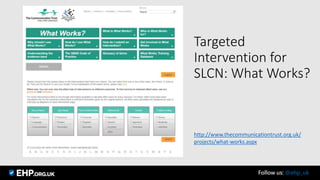
Targeted
Intervention for
SLCN: What Works?
http://www.thecommunicationtrust.org.uk/
projects/what-works.aspx
Follow us: @ehp_uk
Targeted Intervention for SLCN:
• Active Listening for Active Learning
• How to listen
• Comprehension monitoring and self-help skills
• Lego Therapy
• Social development programme
• http://thewackywarehouse.com/lego-therapy/
• Example Targets: positional and descrtiptive language, behaviour, patience,
active listening, peer interaction, problem solving, working independently.
• Makaton
• language programme using signs and symbols to help communication
Follow us: @ehp_uk
Targeted Intervention for SLCN:
• Narrative therapy (Becky Shanks)
• Story structure
• Story grammar
• Concepts who? Where? When? What happens? The end
• Black Sheep Press
• Pre-Teaching Vocabulary:
• Pip St John PTV : https://pipstjohn.files.wordpress.com/2016/10/pre-teaching-
vocabulary-pip-st-john-oct-2016.pdf
• Victoria Joffe
• Word Aware
• Vocabulary Enrichment Intervention Programme (KS3-4)
• Social Stories
• Support for children with ASD and pragmatic language difficulties
• Improve children’s understanding of events
• Help to understand different perspectives
• Respond appropriately when communicating
Follow us: @ehp_uk
Targeted Intervention for SLCN:
• Talk Boost KS1 (ICAN):
• This targeted intervention aims to support children who have language delay
to close the gap/catch up with their peers.
• The programme focuses on: Listening, Vocabulary, Sentence building,
Storytelling, Conversations.
• Training and resource needed
• http://www.ican.org.uk/talkboost
• Early Talk Boost, Talk Boost KS2 and Secondary Talk also available (see
ICAN website for more information)
Follow us: @ehp_uk
When to refer for specialist SALT provision?
• Dysfluency.
• Significant social communication and interaction difficulties.
• Significant/disordered speech and language difficulties.
• Selective mutism.
• Children who do not make expected progress following targeted
intervention.
Follow us: @ehp_uk
The secret to getting ahead is getting started!Mark Twain
• What changes could you make in your setting?
• When?
• Who?
• How?
Please discuss and share your ideas.
Follow us: @ehp_uk
Questions?
Follow us: @ehp_uk
Seamus Mannion September 2017 Follow us: @ehp_uk
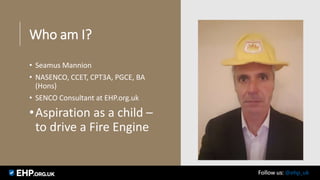
Who am I?
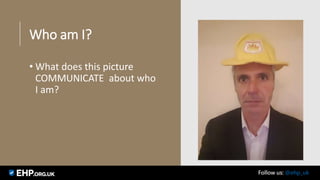
• What does this picture
COMMUNICATE about who
I am?
Seamus Mannion September 2017 Follow us: @ehp_uk
Who am I?
• Seamus Mannion
• NASENCO, CCET, CPT3A, PGCE, BA
(Hons)
• SENCO Consultant at EHP.org.uk
•Aspiration as a child –
to drive a Fire Engine
Seamus Mannion September 2017 Follow us: @ehp_uk
Demonstrating the impact of Speech, Language
and Communication Needs (SLCN) interventions
We aim to enable you to:
• Have greater understanding of how widespread SLCN are in
children
• Be able to use SEND learning walks to gather evidence of impact
• Be able to use impact statements to demonstrate effective
support/ intervention, provided by LSAs, Therapists and even
yourselves (SENCOs/ Inclusion Leads)
Seamus Mannion September 2017 Follow us: @ehp_uk
Why highlight Communication?
Seamus Mannion September 2017 Follow us: @ehp_uk
https://www.youtube.com/watch?v=YUcgJZ6pdcE
The communication commitment
“He/ she
doesn’t have
a SLCN. I can
understand
what he/ she
is saying”
A YouGov poll, undertaken by The
Communication Trust, of 349 teachers
found that only 27% had received
training around speech, language and
communication and 81% felt they would
benefit from more training on this issue.
We often focus on the speech and the
language but not the
COMMUNICATION.
Seamus Mannion September 2017 Follow us: @ehp_uk
Some facts about SLCN in the UK
• In the UK, over 1 million children and young people – that’s 2 – 3 in
every UK classroom – have some form of long term and persistent
speech, language and communication difficulty.
• In areas of poverty, over 50% of children are starting school with
delayed communication skills.
• Only 43% of parents of 0 - 5 years olds are able to correctly identify
the stages of communication.
Source – The Communication Trust
Seamus Mannion September 2017 Follow us: @ehp_uk
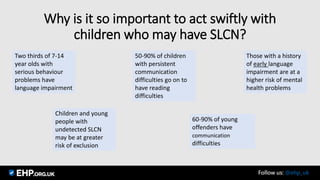
Why is it so important to act swiftly with
children who may have SLCN?
Two thirds of 7-14
year olds with
serious behaviour
problems have
language impairment
60-90% of young
offenders have
communication
difficulties
50-90% of children
with persistent
communication
difficulties go on to
have reading
difficulties
Those with a history
of early language
impairment are at a
higher risk of mental
health problems
Children and young
people with
undetected SLCN
may be at greater
risk of exclusion
Seamus Mannion September 2017 Follow us: @ehp_uk
How can I use
the work of a
SALT to help
me in my job?
Q. If schools are paying for a therapist why should
we be the ones to demonstrate the effectiveness
of their impact?
A. You might need it on a daily basis.
Follow us: @ehp_uk
INSET
Follow us: @ehp_uk
BUDGET
MANAGEMENT
Follow us: @ehp_uk
MEETING
PARENTS/
CARERS
Follow us: @ehp_uk
SUPPORTING
BEHAVIOUR
ISSUES
Follow us: @ehp_uk
The Role of a SENCO
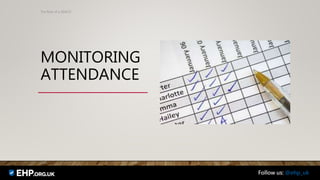
MONITORING
ATTENDANCE
Follow us: @ehp_uk
RECORD
KEEPING/
PAPERWORK
Follow us: @ehp_uk
LESSON
OBSERVATIONS/
LEARNING
WALKS
Follow us: @ehp_uk
TRACKING
PROGRESS
Follow us: @ehp_uk
PLANNING
STRATEGICALLY
Follow us: @ehp_uk
LEADING ON
SEND
Follow us: @ehp_uk
LISTENING TO
CHILDREN,
PARENTS AND
STAFF
Follow us: @ehp_uk
RECRUITMENT
Follow us: @ehp_uk
TEACHING
Follow us: @ehp_uk
MEETING OTHER
PROFESSIONALS
Follow us: @ehp_uk
MANAGING A
TEAM
Follow us: @ehp_uk
TESTING AND
ACCESS
ARRANGEMENTS
Follow us: @ehp_uk
COORDINATING
ALL OF THE
ABOVE!
Follow us: @ehp_uk
Effective use
of a Speech
and Language
Therapist
Please have a quick discussion with a partner
about the different ways you feel you could, or
already do, use a Speech and Language Therapist
in your setting.
Seamus Mannion September 2017 Follow us: @ehp_uk
Effective use of a Speech and Language
Therapist
Individual
assessment
1-1 therapy
Small group work eg
Social
Communication
group
To support an EHCP
referral
To support a
CAMHS/ HYMS
referral
To train staff
Environmental
assessment (eg
sensory)
To observe the
impact of training/
advice through SEND
learning walks
Seamus Mannion September 2017 Follow us: @ehp_uk
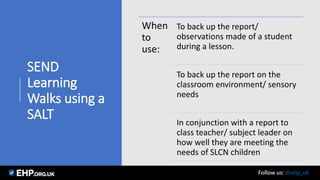
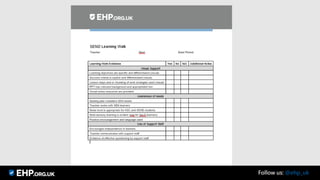
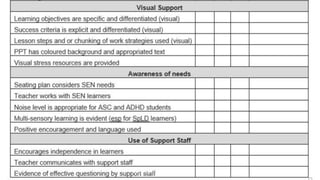
SEND
Learning
Walks using a
SALT
When
to
use:
To back up the report/
observations made of a student
during a lesson.
To back up the report on the
classroom environment/ sensory
needs
In conjunction with a report to
class teacher/ subject leader on
how well they are meeting the
needs of SLCN children
Seamus Mannion September 2017 Follow us: @ehp_uk
Seamus Mannion September 2017
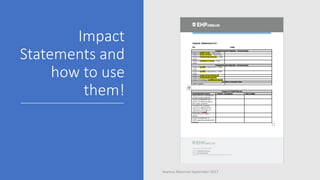
Impact
Statements and
how to use
them!
Seamus Mannion September 2017
Impact of
the people I
line
managed
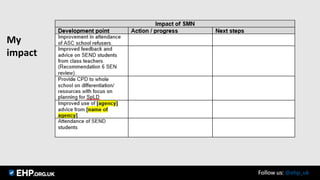
Seamus Mannion September 2017
My
impact
Follow us: @ehp_uk
References
Seamus Mannion September 2017 Follow us: @ehp_uk
Follow us: @ehp_uk
Thanks for listening!
Web: www.ehp.org.uk
Phone: 0330 088 8408
Twitter: @EHP_UK
Facebook: EHPuk
Instagram: @ehp_uk
Connect with us

Developing a graduated response to Speech Language and Communication Needs (SLCN) within a school setting

  • 1.
  • 2.
    Developing a graduated approachto Speech Language and Communication Needs (SLCN) within a school setting Follow us: @ehp_uk
  • 3.
    Identifying children andyoung people with SLCN within a School setting Natasha Carley Paediatric Speech and Language Therapist 11/10/2017 Follow us: @ehp_uk
  • 4.
    Aims: • Increase knowledgeand awareness of SLCN in education and the impact they can have on children's’ lives. • Increased awareness of the Universal, Targeted, Specialist approach. • Strategies to increase identification of SLCN in education settings. • Universal and Targeted interventions • Increased awareness of charities and organisations who can provide support and resources for Schools. Follow us: @ehp_uk
  • 5.
    Language is THEkey Good language and communication skills are the foundations of learning, emotional development and socialising. Language and communication skills are important for children to achieve at school and are a strong predictor of later academic success. Without the right help, at the right time, they will be left out and left behind. Follow us: @ehp_uk
  • 6.
    A child withSLCN – their journey I’m 5 years old. I have poor communication and language skills • By the time I’m 11 years old I’m 6 times less likely to do well in English, and 10 times less likely to do well in maths than my chatty friends. • By the end of KS1 I am likely to enjoy School less. • My poor vocabulary means that I am twice as likely to be unemployed in my thirties as my friends with good vocabulary. (ICAN, 2017) Follow us: @ehp_uk
  • 7.
    A child withSLCN – their journey I’m 14 years old. I have poor communication and language skills • I am really behind with my literacy skills – I struggle to access all teaching and exams. • I find it difficult to keep up in conversations with my classmates – I have low self-esteem and weak friendships. • I am more likely to experience anxiety and depression. • I am highly likely to exhibit behavioural difficulties. (ICAN, 2017) Follow us: @ehp_uk
  • 8.
    SLCN in ourClassrooms: What are we dealing with? • 1 in 10 children have a language difficulty. How many in each class? • Language disorder is 7 times more prevalent than ASD. • In areas of deprivation what percentage of children start School without the language they need for learning? • In Primary Schools more children have SLCN than any other special need. • In Secondary Schools the census data reports a fall in SLCN. Is this true? *The Communication Trust and ICAN (2017) Follow us: @ehp_uk
  • 9.
    Identification and Interventionfor SLCN: What’s the plan? Universal All children • Quality first teaching • Communication supportive environment and classrooms • Increase in Teacher awareness, knowledge, and identification Targeted Just below age related expectations • Evidence based interventions with small groups or individual children • Enhanced skills and knowledge in identifying and supporting SLCN • Training to support staff to implement and evaluate interventions Specialist Significantly below expected levels • Individualised, specialist support for children designed and managed by a SALT (ICAN, 2011) Follow us: @ehp_uk
  • 10.
    Universal Approach: Increasing identificationof children with SLCN Staff Training is invaluable. Increase awareness and knowledge of: • Developmental milestones • How children with SLCN present in the classroom • Use of screening tools Follow us: @ehp_uk
  • 11.
    Identifying children withSLCN: Staff Training Providers • NHS SALT service • Commissioned SALT: • RCSLT Guidance: https://www.rcslt.org/speech_and_language_therapy/commissioning/qual_standards_schoo ls • SLT for Kids: http://www.sltforkids.co.uk/ • EHP: www.ehp.org.uk • Specialist Teachers Follow us: @ehp_uk
  • 12.
    Identifying children withSLCN: Staff Training Providers • ELKLAN: www.elklan.co.uk • ICAN: http://www.ican.org.uk/What-we-do/Training.aspx • Language for Learning: http://www.languageforlearning.co.uk/ • HANEN: www.hanen.org • Afasic: http://www.afasic.org.uk/professionals/courses/ • ASEND: www.asend.co.uk Follow us: @ehp_uk
  • 13.
    Identifying children withSLCN: Online Resources and Staff Training • Talking Point • The Communication Trust • Inclusion Development Programme Follow us: @ehp_uk
  • 14.
    http://www.talkingpoint.org.uk/ • Ages andstages • Progress checkers • Free enquiry service • Free resources: • Primary and secondary milestone posters. • Universally Speaking booklets. Universally Speaking is a series of booklets for anyone who works with children and young people. The booklets show where children should be with their communication skills at any given age. Follow us: @ehp_uk
  • 15.
    https://www.thecommunicationtrust.org.uk/resources/resources/resources- for-practitioners/ • Beyond measure:guidance for education staff on using the reception baseline assessment as an opportunity to identify and support children who have SLCN, as early as possible. • Early years, primary and secondary progression tools. The Progression Tools aim to support teaching staff to identify children who may be struggling to develop their speech, language and communication skills. They can also be used to track progression of these skills over time or following interventions. Follow us: @ehp_uk
  • 16.
    Inclusion Development Programme http://www.idponline.org.uk/ TheInclusion Development Programme (IDP): This was developed by the Government to equip teachers, TAs and early years staff with the skills they need to successfully include children with SEN. There are two modules on SLCN, one for school staff and one for those working in early years. They can be accessed here: Follow us: @ehp_uk
  • 17.
    Identifying children withSLCN: Screening Tools • WellComm (6months-6years): A Speech and Language Toolkit for Screening and Intervention in the Early Years. • Speechlink: Provides packages to help with the identification and intervention for KS1, KS2 and KS3. https://www.speechlink.info/index.php Follow us: @ehp_uk
  • 18.
    Universal Approach tointervention for SLCN • Communication friendly classrooms: https://www.thecommunicationtrust.org.uk/resources/resources/resources-for- practitioners/communication-friendly-checklists/ • Communication supporting classroom observation tool: https://www.thecommunicationtrust.org.uk/media/93866/tct_bcrp_csc_final.pdf • SLCF : The SLCF is a free professional development tool, accessible to all, which sets out the key skills needed to support the speech, language and communication (SLC) development of all children and young people. https://www.slcframework.org.uk/ • Elklan training: https://www.elklan.co.uk/courses/practitioners • Word aware: Word Aware is a whole school vocabulary approach to promote vocabulary development in children. http://thinkingtalking.co.uk/word-aware/ Follow us: @ehp_uk
  • 19.
    Targeted Intervention for SLCN: WhatWorks? http://www.thecommunicationtrust.org.uk/ projects/what-works.aspx Follow us: @ehp_uk
  • 20.
    Targeted Intervention forSLCN: • Active Listening for Active Learning • How to listen • Comprehension monitoring and self-help skills • Lego Therapy • Social development programme • http://thewackywarehouse.com/lego-therapy/ • Example Targets: positional and descrtiptive language, behaviour, patience, active listening, peer interaction, problem solving, working independently. • Makaton • language programme using signs and symbols to help communication Follow us: @ehp_uk
  • 21.
    Targeted Intervention forSLCN: • Narrative therapy (Becky Shanks) • Story structure • Story grammar • Concepts who? Where? When? What happens? The end • Black Sheep Press • Pre-Teaching Vocabulary: • Pip St John PTV : https://pipstjohn.files.wordpress.com/2016/10/pre-teaching- vocabulary-pip-st-john-oct-2016.pdf • Victoria Joffe • Word Aware • Vocabulary Enrichment Intervention Programme (KS3-4) • Social Stories • Support for children with ASD and pragmatic language difficulties • Improve children’s understanding of events • Help to understand different perspectives • Respond appropriately when communicating Follow us: @ehp_uk
  • 22.
    Targeted Intervention forSLCN: • Talk Boost KS1 (ICAN): • This targeted intervention aims to support children who have language delay to close the gap/catch up with their peers. • The programme focuses on: Listening, Vocabulary, Sentence building, Storytelling, Conversations. • Training and resource needed • http://www.ican.org.uk/talkboost • Early Talk Boost, Talk Boost KS2 and Secondary Talk also available (see ICAN website for more information) Follow us: @ehp_uk
  • 23.
    When to referfor specialist SALT provision? • Dysfluency. • Significant social communication and interaction difficulties. • Significant/disordered speech and language difficulties. • Selective mutism. • Children who do not make expected progress following targeted intervention. Follow us: @ehp_uk
  • 24.
    The secret togetting ahead is getting started!Mark Twain • What changes could you make in your setting? • When? • Who? • How? Please discuss and share your ideas. Follow us: @ehp_uk
  • 25.
  • 26.
    Seamus Mannion September2017 Follow us: @ehp_uk
  • 27.
    Who am I? •What does this picture COMMUNICATE about who I am? Seamus Mannion September 2017 Follow us: @ehp_uk
  • 28.
    Who am I? •Seamus Mannion • NASENCO, CCET, CPT3A, PGCE, BA (Hons) • SENCO Consultant at EHP.org.uk •Aspiration as a child – to drive a Fire Engine Seamus Mannion September 2017 Follow us: @ehp_uk
  • 29.
    Demonstrating the impactof Speech, Language and Communication Needs (SLCN) interventions We aim to enable you to: • Have greater understanding of how widespread SLCN are in children • Be able to use SEND learning walks to gather evidence of impact • Be able to use impact statements to demonstrate effective support/ intervention, provided by LSAs, Therapists and even yourselves (SENCOs/ Inclusion Leads) Seamus Mannion September 2017 Follow us: @ehp_uk
  • 30.
    Why highlight Communication? SeamusMannion September 2017 Follow us: @ehp_uk https://www.youtube.com/watch?v=YUcgJZ6pdcE The communication commitment
  • 31.
    “He/ she doesn’t have aSLCN. I can understand what he/ she is saying” A YouGov poll, undertaken by The Communication Trust, of 349 teachers found that only 27% had received training around speech, language and communication and 81% felt they would benefit from more training on this issue. We often focus on the speech and the language but not the COMMUNICATION. Seamus Mannion September 2017 Follow us: @ehp_uk
  • 32.
    Some facts aboutSLCN in the UK • In the UK, over 1 million children and young people – that’s 2 – 3 in every UK classroom – have some form of long term and persistent speech, language and communication difficulty. • In areas of poverty, over 50% of children are starting school with delayed communication skills. • Only 43% of parents of 0 - 5 years olds are able to correctly identify the stages of communication. Source – The Communication Trust Seamus Mannion September 2017 Follow us: @ehp_uk
  • 33.
    Why is itso important to act swiftly with children who may have SLCN? Two thirds of 7-14 year olds with serious behaviour problems have language impairment 60-90% of young offenders have communication difficulties 50-90% of children with persistent communication difficulties go on to have reading difficulties Those with a history of early language impairment are at a higher risk of mental health problems Children and young people with undetected SLCN may be at greater risk of exclusion Seamus Mannion September 2017 Follow us: @ehp_uk
  • 34.
    How can Iuse the work of a SALT to help me in my job? Q. If schools are paying for a therapist why should we be the ones to demonstrate the effectiveness of their impact? A. You might need it on a daily basis. Follow us: @ehp_uk
  • 35.
  • 36.
  • 37.
  • 38.
  • 39.
    The Role ofa SENCO MONITORING ATTENDANCE Follow us: @ehp_uk
  • 40.
  • 41.
  • 42.
  • 43.
  • 44.
  • 45.
  • 46.
  • 47.
  • 48.
  • 49.
  • 50.
  • 51.
  • 52.
    Effective use of aSpeech and Language Therapist Please have a quick discussion with a partner about the different ways you feel you could, or already do, use a Speech and Language Therapist in your setting. Seamus Mannion September 2017 Follow us: @ehp_uk
  • 53.
    Effective use ofa Speech and Language Therapist Individual assessment 1-1 therapy Small group work eg Social Communication group To support an EHCP referral To support a CAMHS/ HYMS referral To train staff Environmental assessment (eg sensory) To observe the impact of training/ advice through SEND learning walks Seamus Mannion September 2017 Follow us: @ehp_uk
  • 54.
    SEND Learning Walks using a SALT When to use: Toback up the report/ observations made of a student during a lesson. To back up the report on the classroom environment/ sensory needs In conjunction with a report to class teacher/ subject leader on how well they are meeting the needs of SLCN children Seamus Mannion September 2017 Follow us: @ehp_uk
  • 55.
    Seamus Mannion September2017 Follow us: @ehp_uk
  • 56.
  • 57.
    Impact Statements and how touse them! Seamus Mannion September 2017
  • 58.
    Seamus Mannion September2017 Impact of the people I line managed
  • 59.
    Seamus Mannion September2017 My impact Follow us: @ehp_uk
  • 60.
    References Seamus Mannion September2017 Follow us: @ehp_uk
  • 61.
    Follow us: @ehp_uk Thanksfor listening! Web: www.ehp.org.uk Phone: 0330 088 8408 Twitter: @EHP_UK Facebook: EHPuk Instagram: @ehp_uk Connect with us

Editor's Notes

  • #9 2/3 in each class 50% in areas of deprivation no – SLCN is harder to identify – hidden population
  • #10 Better Communication Research programme report Understanding SLCN – profiles of need and provision provides evidence for the need for universal, quality first teaching as the ‘first phase’ in a strategic approach to supporting children with SLCN. The report makes it clear that if this is in place there can be a more cost effective allocation of specialist resources at targeted and specialist levels. https://www.gov.uk/government/uploads/system/uploads/attachment_data/file/219622/DFE-RR247-BCRP1.pdf

  • #15 Universally speaking: Provides information about what helps children learn to talk and listen, whether they are on the right track and what to do if you have concerns about any of the children you work with
  • #18 WellComm - Easy to administer and score, the screening tool uses a unique traffic light system to help practitioners understand the child’s current level of speech and language and to provide a pathway for action, ensuring every child gets the support they need. Complete set £349.95
  • #19 SLCF: It is a self-assessment tool which enables individuals to map out their skills, knowledge and confidence in supporting the development of these essential skills in the children and young people they work with. The SLCF provides users with a personalised analysis of their current confidence levels and offers suggestions for next steps in continuing professional development (CPD) including training courses, reading and resources. In addition, at the Universal level, there are opportunities for practitioners to develop their learning through short interactive online activities.
  • #23 How much does Talk Boost KS1 cost? Option One Training delivered by an I CAN Communication Advisor - Each training session costs £700 + VAT plus £350 for a Starter Kit set of training materials per training pair (teacher and teaching assistant). The training minimum is one training pair. Option Two We have a regional team of Licensed Tutors who deliver training. Training material Starter Kits are purchased from I CAN at a cost of £350 per training pair + the cost of the Licensed Tutor delivering your training. Prices vary for training but this option usually works out cheaper than option one. Find your local Licensed Tutor here. Additional resources, including all of the activities made into games and the objects needed to complete Talk Boost KS1, have been made into a Toolkit costing £175. This is an optional resource. Both a Starter Kit and Toolkit can be bought together at the same time as a bundle for a discounted price of £480.