Skill Enhancement Course: SEC
ASEC- 101:Survey and Documentation of Archaeological Remains
BA Ist Sem.
Unit III : Basic Introduction to Documentation
13. Documentation of Antiquities: Definition and Classification
Sachin Kr. Tiwary
Unit III : Basic Introduction to Documentation
10. Definition and Significance of Documentation
11. Types and Methods of Documentation
12. Documentation of archaeological objects at the site
13. Documentation of Antiquities: Definition and Classification
14. Role of Archaeological Drawing,
15. Instruments for Archaeological Drawing
Definition :
Documentation of antiquities refers to the systematic process of recording, cataloging, and preserving information about
objects of historical, archaeological, or cultural significance. This process aims to provide a comprehensive understanding of
the artifacts, their provenance, context, and condition, ensuring that important details are maintained for research,
conservation, and educational purposes.
Antiquities are objects or works of art that are at least 100 years old and reflect a past era's science, art, literature, religion,
customs, morals, or politics. Artifacts are human-made objects that are historically or culturally interesting.
Antiquities: The Antiquities and Art Treasures Act (AATA) of 1972 defines an antiquity as an object or work of art that is at
least 100 years old. It also includes manuscripts, records, or other documents that are at least 75 years old and have
scientific, historical, literary, or aesthetic value.
Artifacts: Artifacts are human-made objects that are historically or culturally interesting. They can include ornaments, tools,
and other objects.
Effective documentation encompasses various aspects:
Identification: Assigning unique identification numbers or codes to each antiquity.
Description: Providing detailed descriptions of the artifacts, including their dimensions, materials, shapes, colors, and any
distinguishing features.
Provenance: Recording the origin and history of the object, including its archaeological context, previous ownership, and any
relevant historical data.Condition Assessment: Documenting the current physical state of the antiquity, noting any damage,
deterioration, or conservation efforts.
Photography and Illustration: Capturing visual representations of the antiquities through photographs and drawings to
support the written documentation.
Classification of Antiquities:
1. Based on Type:
Artistic Antiquities: This category includes sculptures, paintings, and decorative arts that reflect the
artistic styles and cultural values of a particular period or civilization.
Functional Antiquities: Objects that were used for specific purposes, such as tools, pottery,
weapons, and household items.
Architectural Antiquities: Structures or components of buildings, such as columns, capitals, and
foundations, that reflect architectural styles and techniques of a specific culture or time period.
Epigraphic Antiquities: Inscribed objects, such as tablets, inscriptions, and coins, that provide
valuable historical information through written language.
Classification of Antiquities:
2. Based on Material:
Stone Antiquities: Artifacts made from various types
of stone, including flint, marble, granite, and
limestone for various purposes.
Metal Antiquities: Objects crafted from metals such
as bronze, iron, silver, and gold, including tools,
weapons, and decorative items.
T.C. Antiquities: Pottery and other ceramic items,
which can provide insights into the technological
advances and cultural practices of the societies that
produced them.
Organic Antiquities: Items made from organic
materials, such as wood, textiles, and bone, which
often require specific conservation methods due to
their susceptibility to decay.
Stone Antiquities
Metal Antiquities
Organic Antiquities
T.C. Antiquities
Classification of Antiquities:
3. Based on Cultural Context:
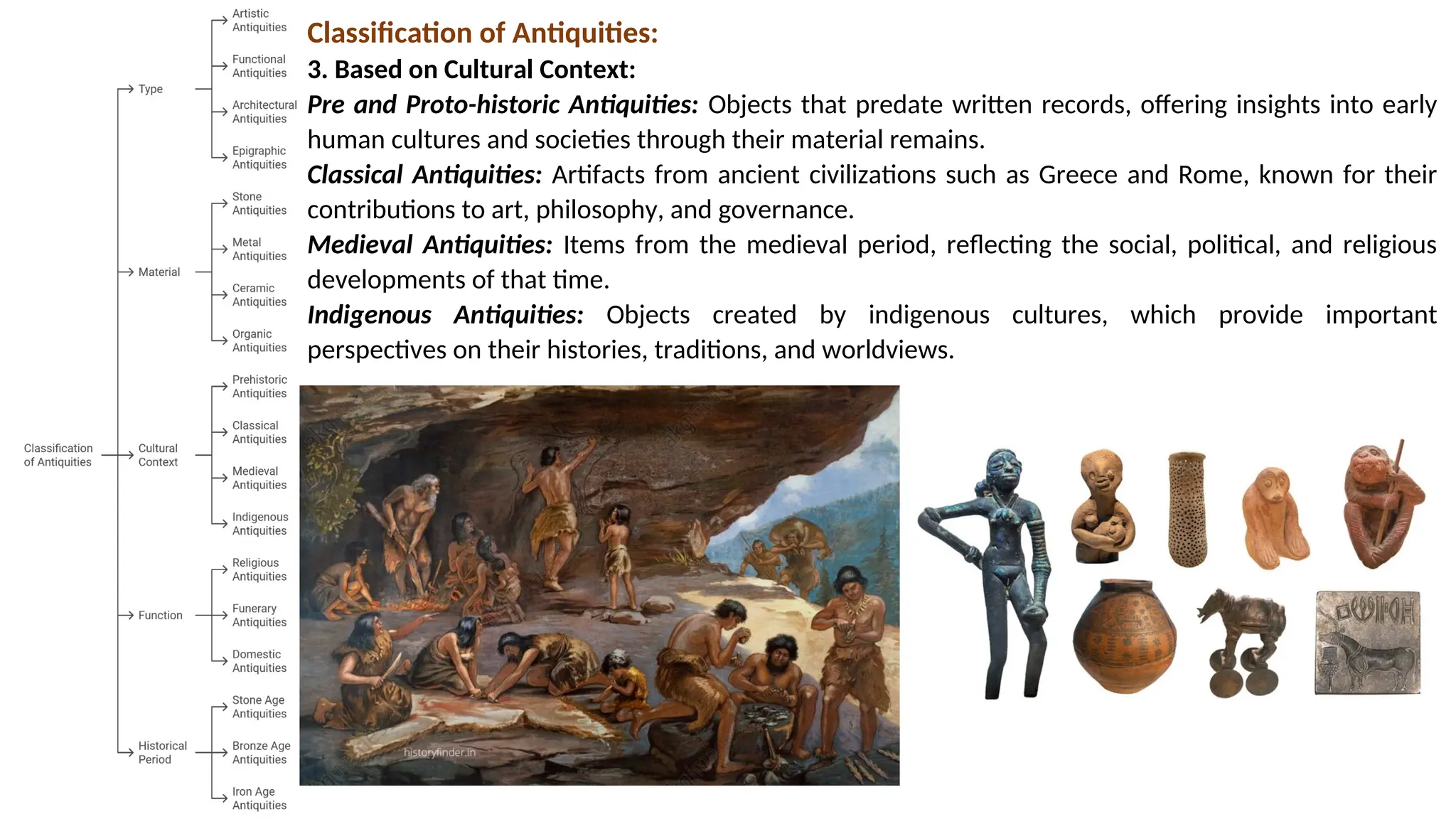
Pre and Proto-historic Antiquities: Objects that predate written records, offering insights into early
human cultures and societies through their material remains.
Classical Antiquities: Artifacts from ancient civilizations such as Greece and Rome, known for their
contributions to art, philosophy, and governance.
Medieval Antiquities: Items from the medieval period, reflecting the social, political, and religious
developments of that time.
Indigenous Antiquities: Objects created by indigenous cultures, which provide important
perspectives on their histories, traditions, and worldviews.
Ancient History
1. Stone Age/Pre-History (From First stone tool (3 lakh 84 thousands) till the
introduction of Indus Valley-Civilization c.6000 BCE)
2. Bronze Age/Proto-History (From Indus Valley Civilization c. 6000 BCE to the
introduction of Iron 2000 BCE)
3. Iron Age- Historical Phase
3.1. Pre-Classical Period (c. 600 BCE–200 CE)- Pradyot Dynasty to Indo-Sythian Dynasty
3.2. Classical Period (c. 300–550 CE)- From Gupta-Vakataka Dynasty to the Maukhari in
the north and Pallva in the south.
3.3. Early Medieval Period (600/750-1200 CE): The early medieval period of India
was a transition between the ancient and medieval periods, and lasted from approximately
600–1200 CE. It was characterized by the formation of regional states, and the decline of the
Gupta Empire led to the emergence of regional powers in both the north and south of the
country.
Classification of Antiquities:
4. Based on Function:
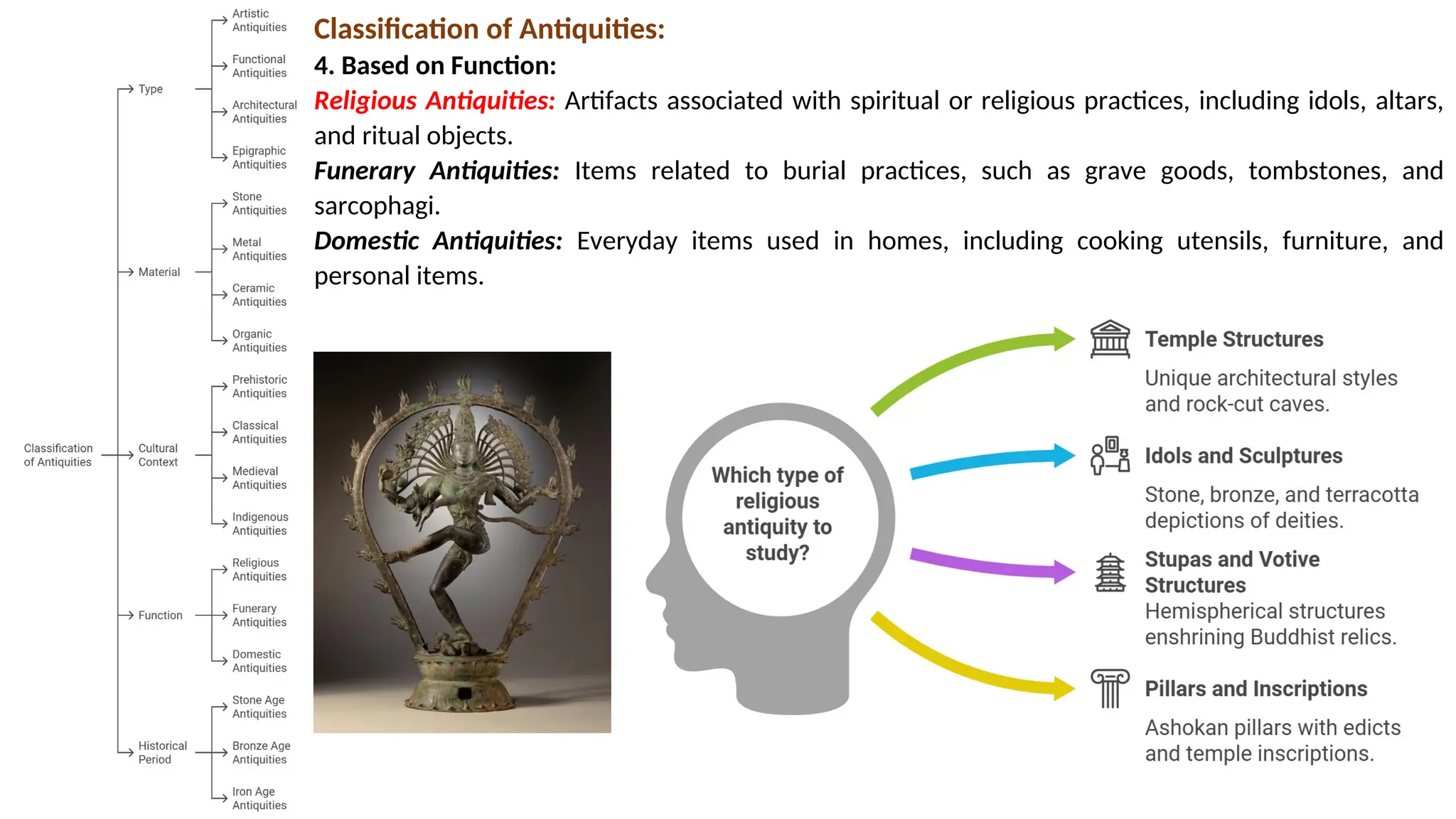
Religious Antiquities: Artifacts associated with spiritual or religious practices, including idols, altars,
and ritual objects.
Funerary Antiquities: Items related to burial practices, such as grave goods, tombstones, and
sarcophagi.
Domestic Antiquities: Everyday items used in homes, including cooking utensils, furniture, and
personal items.
Classification of Antiquities:
4. Based on Function:
Religious Antiquities: Artifacts associated with spiritual or religious practices, including idols, altars,
and ritual objects.
Funerary Antiquities: Items related to burial practices, such as grave goods, tombstones, and
sarcophagi.
Domestic Antiquities: Everyday items used in homes, including cooking utensils, furniture, and
personal items.
Classification of Antiquities:
4. Based on Function:
Religious Antiquities: Artifacts associated with spiritual or religious practices, including idols, altars,
and ritual objects.
Funerary Antiquities: Items related to burial practices, such as grave goods, tombstones, and
sarcophagi.
Domestic Antiquities: Everyday items used in homes, including cooking utensils, furniture, and
personal items.
Classification of Antiquities:
5. Based on Historical Period:
Stone Age Antiquities: Artifacts from the earliest periods of human history, including tools and cave
paintings.
Bronze Age Antiquities: Objects associated with the development of metallurgy and early urban
societies.
Iron Age Antiquities: Artifacts reflecting the rise of complex societies and technological
advancements.
Significance of Documentation of Antiquities:
•Preservation of Cultural Heritage: Documenting antiquities helps preserve valuable information about cultural heritage
and history, enabling future generations to study and understand their significance.
•Research and Analysis: Accurate documentation facilitates scholarly research, allowing historians, archaeologists, and
curators to analyze artifacts and interpret their cultural contexts.
•Conservation and Restoration: Documentation provides a baseline for assessing the condition of antiquities, aiding in
conservation efforts and restoration projects to ensure their longevity.
•Legal and Ethical Compliance: Proper documentation is essential for compliance with legal and ethical standards in the
handling and preservation of cultural property, particularly regarding ownership and repatriation issues.
Unit III : Basic Introduction to Documentation
10. Definition and Significance of Documentation
11. Types and Methods of Documentation
12. Documentation of archaeological objects at the site
13. Documentation of Antiquities: Definition and Classification
14. Role of Archaeological Drawing-NEXT TOPIC
15. Instruments for Archaeological Drawing
Thank You
Any
Question?

Documentation of Antiquities Definition and Classification

  • 1.
    Skill Enhancement Course:SEC ASEC- 101:Survey and Documentation of Archaeological Remains BA Ist Sem. Unit III : Basic Introduction to Documentation 13. Documentation of Antiquities: Definition and Classification 13. Documentation of Antiquities: Definition and Classification Sachin Kr. Tiwary
  • 2.
    Unit III :Basic Introduction to Documentation 10. Definition and Significance of Documentation 11. Types and Methods of Documentation 12. Documentation of archaeological objects at the site 13. Documentation of Antiquities: Definition and Classification 14. Role of Archaeological Drawing, 15. Instruments for Archaeological Drawing
  • 3.
    Definition : Documentation ofantiquities refers to the systematic process of recording, cataloging, and preserving information about objects of historical, archaeological, or cultural significance. This process aims to provide a comprehensive understanding of the artifacts, their provenance, context, and condition, ensuring that important details are maintained for research, conservation, and educational purposes. Antiquities are objects or works of art that are at least 100 years old and reflect a past era's science, art, literature, religion, customs, morals, or politics. Artifacts are human-made objects that are historically or culturally interesting. Antiquities: The Antiquities and Art Treasures Act (AATA) of 1972 defines an antiquity as an object or work of art that is at least 100 years old. It also includes manuscripts, records, or other documents that are at least 75 years old and have scientific, historical, literary, or aesthetic value. Artifacts: Artifacts are human-made objects that are historically or culturally interesting. They can include ornaments, tools, and other objects.
  • 4.
    Effective documentation encompassesvarious aspects: Identification: Assigning unique identification numbers or codes to each antiquity. Description: Providing detailed descriptions of the artifacts, including their dimensions, materials, shapes, colors, and any distinguishing features. Provenance: Recording the origin and history of the object, including its archaeological context, previous ownership, and any relevant historical data.Condition Assessment: Documenting the current physical state of the antiquity, noting any damage, deterioration, or conservation efforts. Photography and Illustration: Capturing visual representations of the antiquities through photographs and drawings to support the written documentation.
  • 5.
    Classification of Antiquities: 1.Based on Type: Artistic Antiquities: This category includes sculptures, paintings, and decorative arts that reflect the artistic styles and cultural values of a particular period or civilization. Functional Antiquities: Objects that were used for specific purposes, such as tools, pottery, weapons, and household items. Architectural Antiquities: Structures or components of buildings, such as columns, capitals, and foundations, that reflect architectural styles and techniques of a specific culture or time period. Epigraphic Antiquities: Inscribed objects, such as tablets, inscriptions, and coins, that provide valuable historical information through written language.
  • 6.
    Classification of Antiquities: 2.Based on Material: Stone Antiquities: Artifacts made from various types of stone, including flint, marble, granite, and limestone for various purposes. Metal Antiquities: Objects crafted from metals such as bronze, iron, silver, and gold, including tools, weapons, and decorative items. T.C. Antiquities: Pottery and other ceramic items, which can provide insights into the technological advances and cultural practices of the societies that produced them. Organic Antiquities: Items made from organic materials, such as wood, textiles, and bone, which often require specific conservation methods due to their susceptibility to decay.
  • 7.
    Stone Antiquities Metal Antiquities OrganicAntiquities T.C. Antiquities
  • 8.
    Classification of Antiquities: 3.Based on Cultural Context: Pre and Proto-historic Antiquities: Objects that predate written records, offering insights into early human cultures and societies through their material remains. Classical Antiquities: Artifacts from ancient civilizations such as Greece and Rome, known for their contributions to art, philosophy, and governance. Medieval Antiquities: Items from the medieval period, reflecting the social, political, and religious developments of that time. Indigenous Antiquities: Objects created by indigenous cultures, which provide important perspectives on their histories, traditions, and worldviews.
  • 9.
    Ancient History 1. StoneAge/Pre-History (From First stone tool (3 lakh 84 thousands) till the introduction of Indus Valley-Civilization c.6000 BCE) 2. Bronze Age/Proto-History (From Indus Valley Civilization c. 6000 BCE to the introduction of Iron 2000 BCE) 3. Iron Age- Historical Phase 3.1. Pre-Classical Period (c. 600 BCE–200 CE)- Pradyot Dynasty to Indo-Sythian Dynasty 3.2. Classical Period (c. 300–550 CE)- From Gupta-Vakataka Dynasty to the Maukhari in the north and Pallva in the south. 3.3. Early Medieval Period (600/750-1200 CE): The early medieval period of India was a transition between the ancient and medieval periods, and lasted from approximately 600–1200 CE. It was characterized by the formation of regional states, and the decline of the Gupta Empire led to the emergence of regional powers in both the north and south of the country.
  • 10.
    Classification of Antiquities: 4.Based on Function: Religious Antiquities: Artifacts associated with spiritual or religious practices, including idols, altars, and ritual objects. Funerary Antiquities: Items related to burial practices, such as grave goods, tombstones, and sarcophagi. Domestic Antiquities: Everyday items used in homes, including cooking utensils, furniture, and personal items.
  • 11.
    Classification of Antiquities: 4.Based on Function: Religious Antiquities: Artifacts associated with spiritual or religious practices, including idols, altars, and ritual objects. Funerary Antiquities: Items related to burial practices, such as grave goods, tombstones, and sarcophagi. Domestic Antiquities: Everyday items used in homes, including cooking utensils, furniture, and personal items.
  • 12.
    Classification of Antiquities: 4.Based on Function: Religious Antiquities: Artifacts associated with spiritual or religious practices, including idols, altars, and ritual objects. Funerary Antiquities: Items related to burial practices, such as grave goods, tombstones, and sarcophagi. Domestic Antiquities: Everyday items used in homes, including cooking utensils, furniture, and personal items.
  • 13.
    Classification of Antiquities: 5.Based on Historical Period: Stone Age Antiquities: Artifacts from the earliest periods of human history, including tools and cave paintings. Bronze Age Antiquities: Objects associated with the development of metallurgy and early urban societies. Iron Age Antiquities: Artifacts reflecting the rise of complex societies and technological advancements.
  • 14.
    Significance of Documentationof Antiquities: •Preservation of Cultural Heritage: Documenting antiquities helps preserve valuable information about cultural heritage and history, enabling future generations to study and understand their significance. •Research and Analysis: Accurate documentation facilitates scholarly research, allowing historians, archaeologists, and curators to analyze artifacts and interpret their cultural contexts. •Conservation and Restoration: Documentation provides a baseline for assessing the condition of antiquities, aiding in conservation efforts and restoration projects to ensure their longevity. •Legal and Ethical Compliance: Proper documentation is essential for compliance with legal and ethical standards in the handling and preservation of cultural property, particularly regarding ownership and repatriation issues.
  • 15.
    Unit III :Basic Introduction to Documentation 10. Definition and Significance of Documentation 11. Types and Methods of Documentation 12. Documentation of archaeological objects at the site 13. Documentation of Antiquities: Definition and Classification 14. Role of Archaeological Drawing-NEXT TOPIC 15. Instruments for Archaeological Drawing Thank You Any Question?