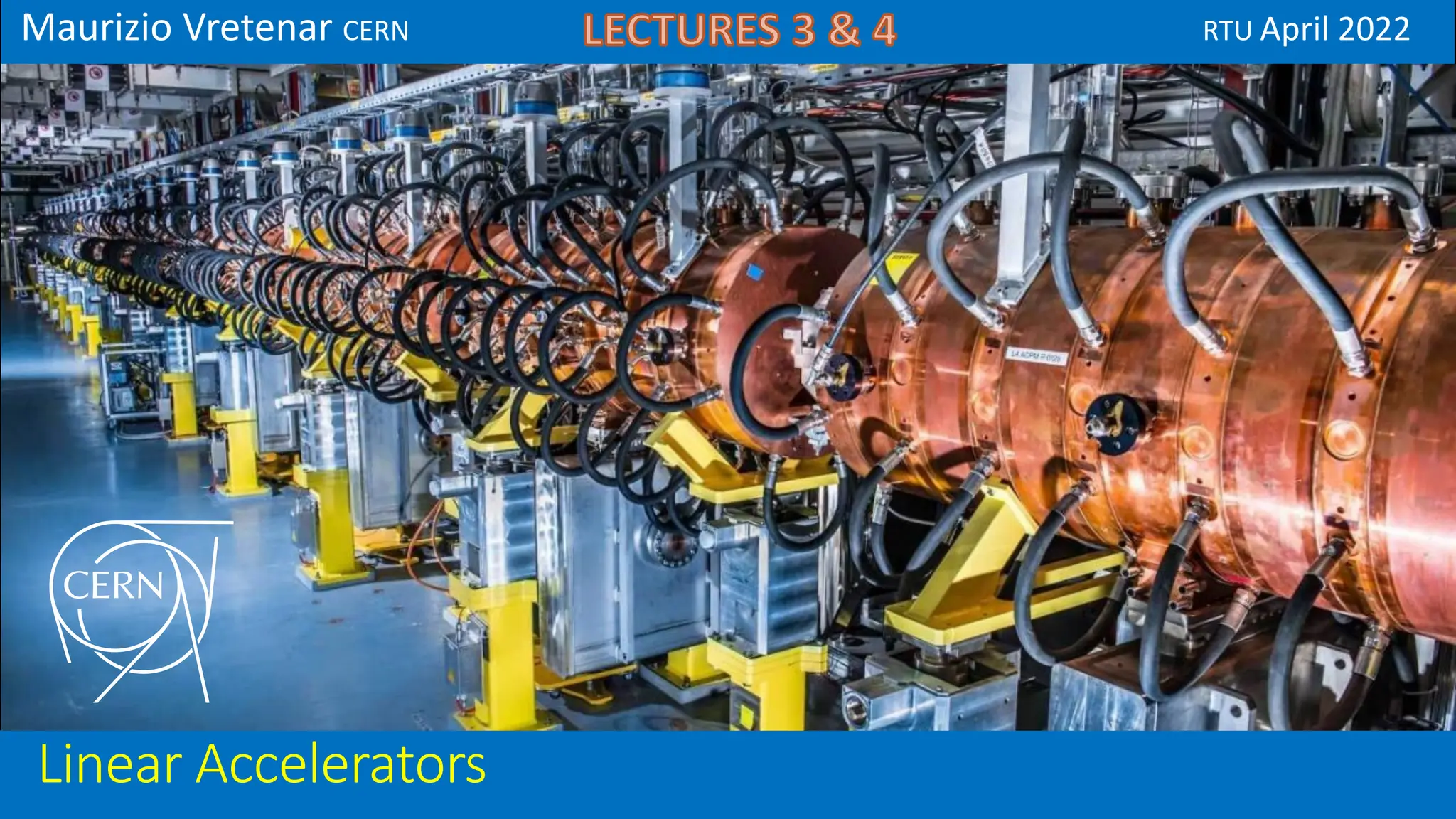
Maurizio Vretenar CERN RTU April 2022
Linear Accelerators
Module 1
Why linear accelerators
Basic linac structure
Acceleration in periodic structures
2
Definitions
3
Linear accelerator: a device where charged particles acquire energy moving on a linear path
RF linear accelerator: acceleration is provided by time-varying electric fields (i.e. excludes
electrostatic accelerators)
A few definitions:
➢CW (Continuous wave) linacs when the beam bunches come continuously out of the linac;
➢Pulsed linac when the beam is produced in pulses: t pulse length, fr repetition frequency, beam
duty cycle t × fr (%)
➢ Main parameters: E kinetic energy of the particles coming out of the linac [MeV]
I average current during the beam pulse [mA] (different from average
current and from bunch current !)
P beam power = electrical power transferred to the beam during acceleration
P [W] = Vtot × I = E [eV] × I [A] × duty cycle
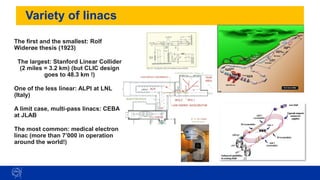
Variety of linacs
The first and the smallest: Rolf
Widerøe thesis (1923)
The largest: Stanford Linear Collider
(2 miles = 3.2 km) (but CLIC design
goes to 48.3 km !)
One of the less linear: ALPI at LNL
(Italy)
A limit case, multi-pass linacs: CEBAF
at JLAB
The most common: medical electron
linac (more than 7’000 in operation
around the world!)
4
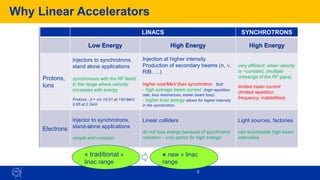
Why Linear Accelerators
5
LINACS SYNCHROTRONS
Low Energy High Energy High Energy
Protons,
Ions
Injectors to synchrotrons,
stand alone applications
synchronous with the RF fields
in the range where velocity
increases with energy.
Protons : b = v/c =0.51 at 150 MeV,
0.95 at 2 GeV.
Injection at higher intensity
Production of secondary beams (n, n,
RIB, …)
higher cost/MeV than synchrotron but:
- high average beam current (high repetition
rate, less resonances, easier beam loss).
- higher linac energy allows for higher intensity
in the synchrotron.
very efficient when velocity
is ~constant, (multiple
crossings of the RF gaps).
limited mean current
(limited repetition
frequency, instabilities)
Electrons
Injector to synchrotrons,
stand-alone applications
simple and compact
Linear colliders
do not lose energy because of synchrotron
radiation – only option for high energy!
Light sources, factories
can accumulate high beam
intensities
« traditional »
linac range
« new » linac
range
6
Classic (Newton) relation:
Relativistic (Einstein) relation:
Proton and Electron Velocity
2
0
2
2
2
0
2
,
2 c
m
T
c
v
v
m
T =
=
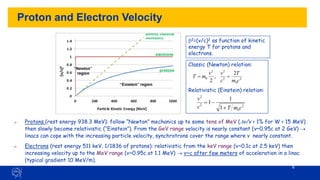
→ Protons (rest energy 938.3 MeV): follow “Newton” mechanics up to some tens of MeV (Dv/v < 1% for W < 15 MeV)
then slowly become relativistic (“Einstein”). From the GeV range velocity is nearly constant (v~0.95c at 2 GeV) →
linacs can cope with the increasing particle velocity, synchrotrons cover the range where v nearly constant.
→ Electrons (rest energy 511 keV, 1/1836 of protons): relativistic from the keV range (v~0.1c at 2.5 keV) then
increasing velocity up to the MeV range (v~0.95c at 1.1 MeV) → v~c after few meters of acceleration in a linac
(typical gradient 10 MeV/m).
b2=(v/c)2 as function of kinetic
energy T for protons and
electrons.
2
0
2
2
1
1
1
c
m
T
c
v
+
−
=
7
Basic linear accelerator structure
b

 2
=
D
d
DC
particle
injector
?
Protons: energy
~100 keV
b= v/c ~ 0.015
Accelerating gap: E = E0 cos (wt + )
en. gain DW = eV0Tcos
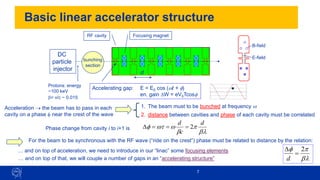
1. The beam must to be bunched at frequency w
2. distance between cavities and phase of each cavity must be correlated
bunching
section
d
Phase change from cavity i to i+1 is
RF cavity Focusing magnet
Acceleration → the beam has to pass in each
cavity on a phase  near the crest of the wave
For the beam to be synchronous with the RF wave (“ride on the crest”) phase must be related to distance by the relation:
B-field
E-field
… and on top of acceleration, we need to introduce in our “linac” some focusing elements
… and on top of that, we will couple a number of gaps in an “accelerating structure”
b

b
w
wt

d
c
d
2
=
=
=
D
Synchronism condition for the Wideröe
8
b

 2
=
D
d
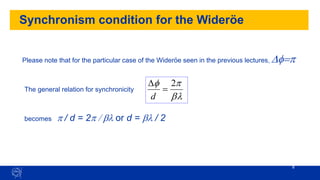
Please note that for the particular case of the Wideröe seen in the previous lectures, D=
The general relation for synchronicity
becomes  / d = 2 / b or d = b / 2
Accelerating structure architecture
d
d = const.
 variable
 = const.
d variable
d  b
b

 2
=
D
d
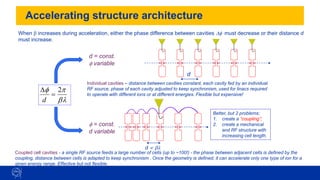
Coupled cell cavities - a single RF source feeds a large number of cells (up to ~100!) - the phase between adjacent cells is defined by the
coupling, distance between cells is adapted to keep synchronism . Once the geometry is defined, it can accelerate only one type of ion for a
given energy range. Effective but not flexible.
Better, but 2 problems:
1. create a “coupling”;
2. create a mechanical
and RF structure with
increasing cell length.
When b increases during acceleration, either the phase difference between cavities D must decrease or their distance d
must increase.
Individual cavities – distance between cavities constant, each cavity fed by an individual
RF source, phase of each cavity adjusted to keep synchronism, used for linacs required
to operate with different ions or at different energies. Flexible but expensive!
10
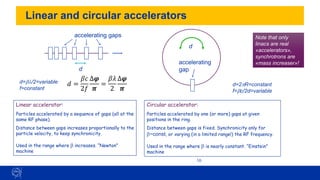
Linear and circular accelerators
Linear accelerator:
Particles accelerated by a sequence of gaps (all at the
same RF phase).
Distance between gaps increases proportionally to the
particle velocity, to keep synchronicity.
Used in the range where b increases. “Newton”
machine
Circular accelerator:
Particles accelerated by one (or more) gaps at given
positions in the ring.
Distance between gaps is fixed. Synchronicity only for
b~const, or varying (in a limited range!) the RF frequency.
Used in the range where b is nearly constant. “Einstein”
machine
d=2R=constant
f=bc/2d=variable
d=b/2=variable
f=constant
d
d
𝑑 =
𝛽𝑐
2𝑓
∆𝝋
𝝅
=
𝛽𝜆
2
∆𝝋
𝝅
accelerating gaps
accelerating
gap
Note that only
linacs are real
«accelerators»,
synchrotrons are
«mass increaser»!
11
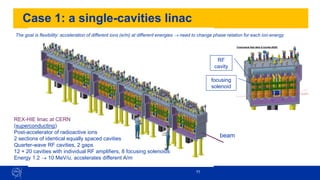
Case 1: a single-cavities linac
REX-HIE linac at CERN
(superconducting)
Post-accelerator of radioactive ions
2 sections of identical equally spaced cavities
Quarter-wave RF cavities, 2 gaps
12 + 20 cavities with individual RF amplifiers, 8 focusing solenoids
Energy 1.2 → 10 MeV/u, accelerates different A/m
beam
RF
cavity
focusing
solenoid
The goal is flexibility: acceleration of different ions (e/m) at different energies → need to change phase relation for each ion-energy
12
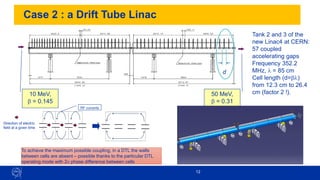
Case 2 : a Drift Tube Linac
Tank 2 and 3 of the
new Linac4 at CERN:
57 coupled
accelerating gaps
Frequency 352.2
MHz,  = 85 cm
Cell length (d=b)
from 12.3 cm to 26.4
cm (factor 2 !).
d
10 MeV,
b = 0.145
50 MeV,
b = 0.31
To achieve the maximum possible coupling, in a DTL the walls
between cells are absent – possible thanks to the particular DTL
operating mode with 2 phase difference between cells
Direction of electric
field at a given time
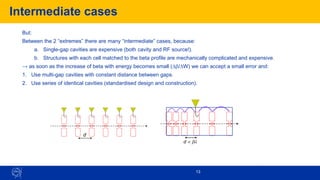
Intermediate cases
13
But:
Between the 2 “extremes” there are many “intermediate” cases, because:
a. Single-gap cavities are expensive (both cavity and RF source!).
b. Structures with each cell matched to the beta profile are mechanically complicated and expensive.
→ as soon as the increase of beta with energy becomes small (Db/DW) we can accept a small error and:
1. Use multi-gap cavities with constant distance between gaps.
2. Use series of identical cavities (standardised design and construction).
13
d
d  b
14
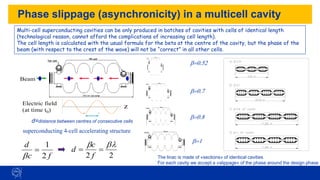
Phase slippage (asynchronicity) in a multicell cavity
superconducting 4-cell accelerating structure
2
2
b
b
=
=
f
c
d
Multi-cell superconducting cavities can be only produced in batches of cavities with cells of identical length
(technological reason, cannot afford the complications of increasing cell length).
The cell length is calculated with the usual formula for the beta at the centre of the cavity, but the phase of the
beam (with respect to the crest of the wave) will not be “correct” in all other cells.
l=b/2
-1.5
-1
-0.5
0
0.5
1
1.5
0 20 40 60 80 100 120 140
z
Electric field
(at time t0)
Beam
d=distance between centres of consecutive cells
f
c
d
2
1
=
b
b=0.52
b=0.7
b=0.8
b=1
The linac is made of «sections» of identical cavities
For each cavity we accept a «slippage» of the phase around the design phase
Effects of phase slippage
15
b
b

w

D
=
D
=
D t
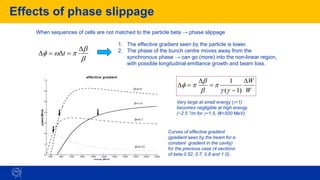
When sequences of cells are not matched to the particle beta → phase slippage
1. The effective gradient seen by the particle is lower.
2. The phase of the bunch centre moves away from the
synchronous phase → can go (more) into the non-linear region,
with possible longitudinal emittance growth and beam loss.
Curves of effective gradient
(gradient seen by the beam for a
constant gradient in the cavity)
for the previous case (4 sections
of beta 0.52, 0.7, 0.8 and 1.0).
W
W
D
−
=
D
=
D
)
1
(
1



b
b


Very large at small energy (~1)
becomes negligible at high energy
(~2.5 °/m for ~1.5, W=500 MeV).
Electron linacs
16
Pictures from K. Wille, The
Physics of Particle
Accelerators
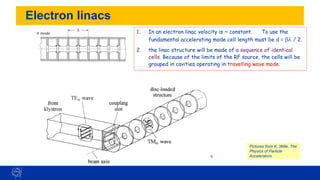
1. In an electron linac velocity is ~ constant. To use the
fundamental accelerating mode cell length must be d = b / 2.
2. the linac structure will be made of a sequence of identical
cells. Because of the limits of the RF source, the cells will be
grouped in cavities operating in travelling wave mode.
17
Acceleration in periodic structures - wave propagation
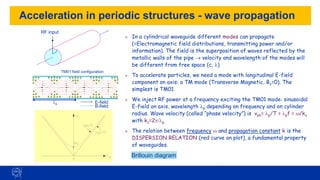
➢ In a cylindrical waveguide different modes can propagate
(=Electromagnetic field distributions, transmitting power and/or
information). The field is the superposition of waves reflected by the
metallic walls of the pipe → velocity and wavelength of the modes will
be different from free space (c, )
➢ To accelerate particles, we need a mode with longitudinal E-field
component on axis: a TM mode (Transverse Magnetic, Bz=0). The
simplest is TM01.
➢ We inject RF power at a frequency exciting the TM01 mode: sinusoidal
E-field on axis, wavelength p depending on frequency and on cylinder
radius. Wave velocity (called “phase velocity”) is vph= p/T = pf = w/kz
with kz=2/p
➢ The relation between frequency w and propagation constant k is the
DISPERSION RELATION (red curve on plot), a fundamental property
of waveguides.
RF input
TM01 field configuration
E-field
B-field
p
Brillouin diagram
18
Wave velocity: the dispersion relation
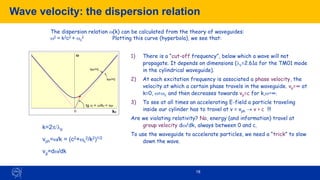
1) There is a “cut-off frequency”, below which a wave will not
propagate. It depends on dimensions (c=2.61a for the TM01 mode
in the cylindrical waveguide).
2) At each excitation frequency is associated a phase velocity, the
velocity at which a certain phase travels in the waveguide. vp=∞ at
k=0, w=wc and then decreases towards vp=c for k,w→∞.
3) To see at all times an accelerating E-field a particle traveling
inside our cylinder has to travel at v = vph → v > c !!!
Are we violating relativity? No, energy (and information) travel at
group velocity dw/dk, always between 0 and c.
To use the waveguide to accelerate particles, we need a “trick” to slow
down the wave.
The dispersion relation w(k) can be calculated from the theory of waveguides:
w2 = k2c2 + wc
2 Plotting this curve (hyperbola), we see that:
vph=w/k = (c2+wc
2/k2)1/2
vg=dw/dk
k=2/p
kz
w
0
tg a = w/kz = vph
vph>c
vph=c
19
Slowing down waves: the disc- loaded waveguide
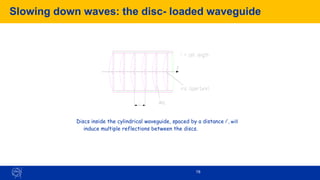
Discs inside the cylindrical waveguide, spaced by a distance l , will
induce multiple reflections between the discs.
20
Dispersion relation for the disc-loaded waveguide
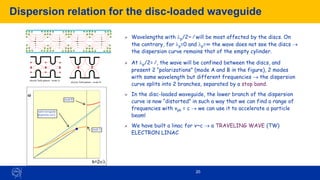
electric field pattern - mode A
electric field pattern - mode B
➢ Wavelengths with p/2~ l will be most affected by the discs. On
the contrary, for p=0 and p=∞ the wave does not see the discs →
the dispersion curve remains that of the empty cylinder.
➢ At p/2= l , the wave will be confined between the discs, and
present 2 “polarizations” (mode A and B in the figure), 2 modes
with same wavelength but different frequencies → the dispersion
curve splits into 2 branches, separated by a stop band.
➢ In the disc-loaded waveguide, the lower branch of the dispersion
curve is now “distorted” in such a way that we can find a range of
frequencies with vph = c → we can use it to accelerate a particle
beam!
➢ We have built a linac for v~c → a TRAVELING WAVE (TW)
ELECTRON LINAC
electric field pattern - mode A
electric field pattern - mode B
0
10
20
30
40
50
60
0 40 k=2/
w
mode B
mode A
open waveguide
dispersion curve
21
Traveling wave linac structures
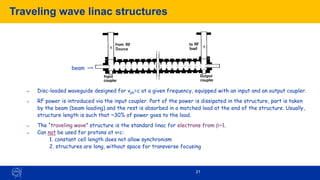
→ Disc-loaded waveguide designed for vph=c at a given frequency, equipped with an input and an output coupler.
→ RF power is introduced via the input coupler. Part of the power is dissipated in the structure, part is taken
by the beam (beam loading) and the rest is absorbed in a matched load at the end of the structure. Usually,
structure length is such that ~30% of power goes to the load.
→ The “traveling wave” structure is the standard linac for electrons from b~1.
→ Can not be used for protons at v<c:
1. constant cell length does not allow synchronism
2. structures are long, without space for transverse focusing
beam
22
Standing wave linac structures
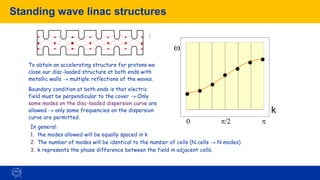
To obtain an accelerating structure for protons we
close our disc-loaded structure at both ends with
metallic walls → multiple reflections of the waves.
Boundary condition at both ends is that electric
field must be perpendicular to the cover → Only
some modes on the disc-loaded dispersion curve are
allowed → only some frequencies on the dispersion
curve are permitted.
w
k

/2
0
0 6.67 13.34 20.01 26.68 33.35
mode 0
mode /2
mode 2/3
-
1.
5
-
1
-
0
.
5
0
0
.
5
1
1.
5
0 50 10
0 150 20
0 250
-
1.
5
-
1
-
0
.
5
0
0
.
5
1
1.
5
0 50 10
0 150 20
0 250
-
1.
5
-
1
-
0
.
5
0
0
.
5
1
1.
5
0 50 10
0 150 20
0 250
0
0
.
2
0
.
4
0
.
6
0
.
8
1
0 50 10
0 150 20
0 250
E
z
In general:
1. the modes allowed will be equally spaced in k
2. The number of modes will be identical to the number of cells (N cells → N modes)
3. k represents the phase difference between the field in adjacent cells.
23
More on standing wave structures
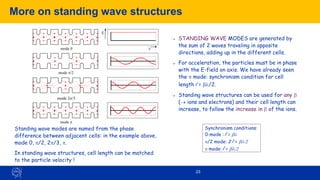
→ STANDING WAVE MODES are generated by
the sum of 2 waves traveling in opposite
directions, adding up in the different cells.
→ For acceleration, the particles must be in phase
with the E-field on axis. We have already seen
the  mode: synchronism condition for cell
length l = b/2.
→ Standing wave structures can be used for any b
(→ ions and electrons) and their cell length can
increase, to follow the increase in b of the ions.
mode 0
mode /2
mode 2/3
mode 
-
1.
5
-
1
-
0
.
5
0
0
.
5
1
1.
5
0 50 10
0 150 20
0 250
-
1.
5
-
1
-
0
.
5
0
0
.
5
1
1.
5
0 50 10
0 150 20
0 250
-
1.
5
-
1
-
0
.
5
0
0
.
5
1
1.
5
0 50 10
0 150 20
0 250
0
0
.
2
0
.
4
0
.
6
0
.
8
1
0 50 10
0 150 20
0 250
E
z
Standing wave modes are named from the phase
difference between adjacent cells: in the example above,
mode 0, /2, 2/3, .
In standing wave structures, cell length can be matched
to the particle velocity !
Synchronism conditions:
0-mode : l = b
/2 mode: 2 l = b/2
 mode: l = b/2
24
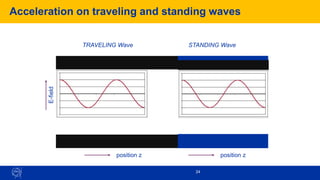
Acceleration on traveling and standing waves
TRAVELING Wave STANDING Wave
E-field
position z position z
25
Practical standing wave structures
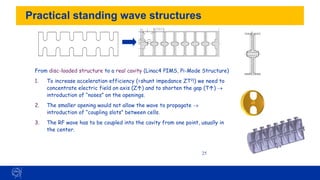
From disc-loaded structure to a real cavity (Linac4 PIMS, Pi-Mode Structure)
1. To increase acceleration efficiency (=shunt impedance ZT2!) we need to
concentrate electric field on axis (Z) and to shorten the gap (T) →
introduction of “noses” on the openings.
2. The smaller opening would not allow the wave to propagate →
introduction of “coupling slots” between cells.
3. The RF wave has to be coupled into the cavity from one point, usually in
the center.
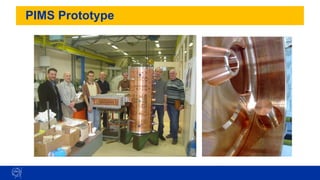
PIMS Prototype
26
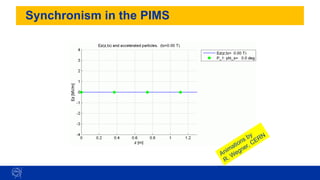
Synchronism in the PIMS
27
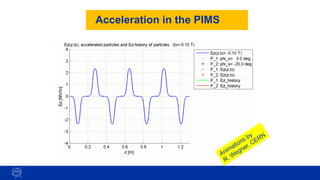
Acceleration in the PIMS
28
29
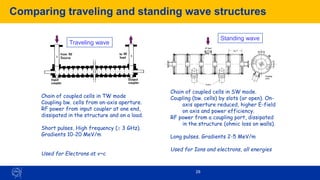
Comparing traveling and standing wave structures
Chain of coupled cells in SW mode.
Coupling (bw. cells) by slots (or open). On-
axis aperture reduced, higher E-field
on axis and power efficiency.
RF power from a coupling port, dissipated
in the structure (ohmic loss on walls).
Long pulses. Gradients 2-5 MeV/m
Used for Ions and electrons, all energies
Standing wave
Traveling wave
Chain of coupled cells in TW mode
Coupling bw. cells from on-axis aperture.
RF power from input coupler at one end,
dissipated in the structure and on a load.
Short pulses, High frequency ( 3 GHz).
Gradients 10-20 MeV/m
Used for Electrons at v~c
Comparable RF efficiencies
30
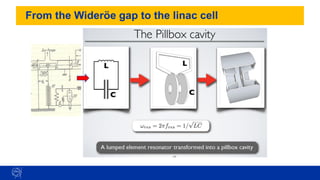
From the Wideröe gap to the linac cell
31
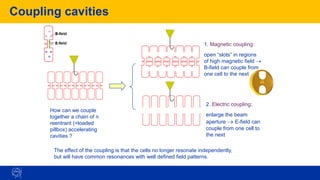
Coupling cavities
How can we couple
together a chain of n
reentrant (=loaded
pillbox) accelerating
cavities ?
1. Magnetic coupling:
open “slots” in regions
of high magnetic field →
B-field can couple from
one cell to the next
2. Electric coupling:
enlarge the beam
aperture → E-field can
couple from one cell to
the next
The effect of the coupling is that the cells no longer resonate independently,
but will have common resonances with well defined field patterns.
33
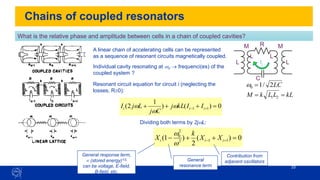
Chains of coupled resonators
0
)
(
)
1
2
( 1
1 =
+
+
+ +
− i
i
i I
I
kL
j
C
j
L
j
I w
w
w
0
)
(
2
)
1
( 1
1
2
2
0
=
+
+
− +
− i
i
i X
X
k
X
w
w
A linear chain of accelerating cells can be represented
as a sequence of resonant circuits magnetically coupled.
Individual cavity resonating at w0 → frequenci(es) of the
coupled system ?
Resonant circuit equation for circuit i (neglecting the
losses, R0):
Dividing both terms by 2jwL:
General response term,
 (stored energy)1/2,
can be voltage, E-field,
B-field, etc.
General
resonance term
Contribution from
adjacent oscillators
What is the relative phase and amplitude between cells in a chain of coupled cavities?
C
L L
L
L
M
M R
Ii
LC
2
/
1
0 =
w
kL
L
L
k
M =
= 2
1
34
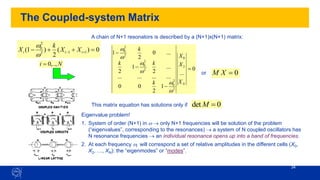
The Coupled-system Matrix
0
...
1
2
0
0
...
...
...
...
...
2
1
2
...
0
2
1
2
0
2
2
0
2
2
0
2
2
0
=
−
−
−
N
X
X
X
k
k
k
k
w
w
w
w
w
w
0
=
X
M
or
This matrix equation has solutions only if
Eigenvalue problem!
1. System of order (N+1) in w → only N+1 frequencies will be solution of the problem
(“eigenvalues”, corresponding to the resonances) → a system of N coupled oscillators has
N resonance frequencies → an individual resonance opens up into a band of frequencies.
2. At each frequency wi will correspond a set of relative amplitudes in the different cells (X0,
X2, …, XN): the “eigenmodes” or “modes”.
0
det =
M
A chain of N+1 resonators is described by a (N+1)x(N+1) matrix:
0
)
(
2
)
1
( 1
1
2
2
0
=
+
+
− +
− i
i
i X
X
k
X
w
w
N
i ,..,
0
=
35
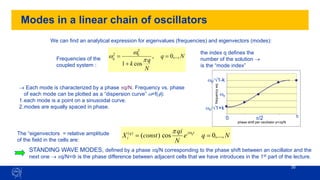
Modes in a linear chain of oscillators
N
q
N
q
k
q ,..,
0
,
cos
1
2
0
2
=
+
=

w
w
N
q
e
N
qi
const
X
t
j
q
i
q
,...,
0
cos
)
(
)
(
=
=
w

We can find an analytical expression for eigenvalues (frequencies) and eigenvectors (modes):
Frequencies of the
coupled system :
the index q defines the
number of the solution →
is the “mode index”
→ Each mode is characterized by a phase q/N. Frequency vs. phase
of each mode can be plotted as a “dispersion curve” w=f():
1.each mode is a point on a sinusoidal curve.
2.modes are equally spaced in phase.
The “eigenvectors = relative amplitude
of the field in the cells are:
STANDING WAVE MODES, defined by a phase q/N corresponding to the phase shift between an oscillator and the
next one → q/N=F is the phase difference between adjacent cells that we have introduces in the 1st part of the lecture.
0.985
0.99
0.995
1
1.005
1.01
1.015
0 50 100 150 200
phase shift per oscillator =q/N
frequency
wq
0 /2 
w0
w0/√1-k
w0/√1+k
36
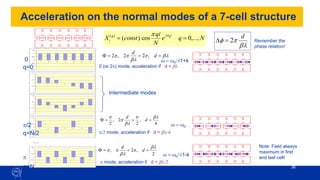
Acceleration on the normal modes of a 7-cell structure
N
q
e
N
qi
const
X
t
j
q
i
q
,...,
0
cos
)
(
)
(
=
=
w

b


d
2
=
D
b

b

 =
=
=
F d
d
,
2
2
,
2
2
,
2
,
b

b

 =
=
=
F d
d
4
,
2
2
,
2
b

b


=
=
=
F d
d
Note: Field always
maximum in first
and last cell!
-1.5
-1
-0.5
0
0.5
1
1.5
1 2 3 4 5 6 7
-1.5
-1
-0.5
0
0.5
1
1.5
1 2 3 4 5 6 7
-1.5
-1
-0.5
0
0.5
1
1.5
1 2 3 4 5 6 7
-1.5
-1
-0.5
0
0.5
1
1.5
1 2 3 4 5 6 7
…
-1.5
-1
-0.5
0
0.5
1
1.5
1 2 3 4 5 6 7
0 (or 2) mode, acceleration if d = b
Intermediate modes
/2 mode, acceleration if d = b/4
 mode, acceleration if d = b/2,
w = w0/√1-k
w = w0
w = w0/√1+k
0
/2

Remember the
phase relation!
q=0
q=N/2
q=N
37
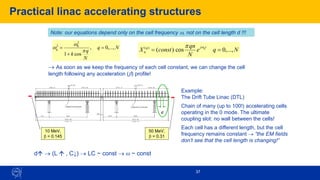
Practical linac accelerating structures
N
q
N
q
k
q ,...,
0
,
cos
1
2
0
2
=
+
=

w
w
Note: our equations depend only on the cell frequency w, not on the cell length d !!!
N
q
e
N
qn
const
X
t
j
q
n
q
,...,
0
cos
)
(
)
(
=
=
w

→ As soon as we keep the frequency of each cell constant, we can change the cell
length following any acceleration (b) profile!
d
10 MeV,
b = 0.145
50 MeV,
b = 0.31
Example:
The Drift Tube Linac (DTL)
Chain of many (up to 100!) accelerating cells
operating in the 0 mode. The ultimate
coupling slot: no wall between the cells!
Each cell has a different length, but the cell
frequency remains constant → “the EM fields
don’t see that the cell length is changing!”
d → (L  , C↓) → LC ~ const → w ~ const
38
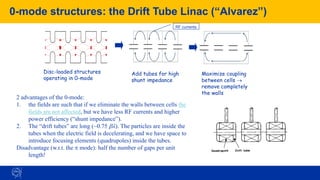
0-mode structures: the Drift Tube Linac (“Alvarez”)
2 advantages of the 0-mode:
1. the fields are such that if we eliminate the walls between cells the
fields are not affected, but we have less RF currents and higher
power efficiency (“shunt impedance”).
2. The “drift tubes” are long (~0.75 b). The particles are inside the
tubes when the electric field is decelerating, and we have space to
introduce focusing elements (quadrupoles) inside the tubes.
Disadvantage (w.r.t. the  mode): half the number of gaps per unit
length!
Disc-loaded structures
operating in 0-mode
Add tubes for high
shunt impedance
Maximize coupling
between cells →
remove completely
the walls
RF currents
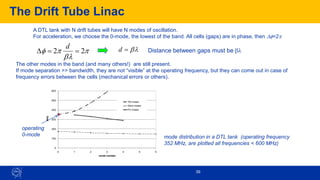
The Drift Tube Linac
39
A DTL tank with N drift tubes will have N modes of oscillation.
For acceleration, we choose the 0-mode, the lowest of the band. All cells (gaps) are in phase, then D=2

b

 2
2 =
=
D
d b
=
d Distance between gaps must be b
0
100
200
300
400
500
600
0 1 2 3 4 5 6
MHz
mode number
TM modes
Stem modes
PC modes
The other modes in the band (and many others!) are still present.
If mode separation >> bandwidth, they are not “visible” at the operating frequency, but they can come out in case of
frequency errors between the cells (mechanical errors or others).
operating
0-mode mode distribution in a DTL tank (operating frequency
352 MHz, are plotted all frequencies < 600 MHz)
40
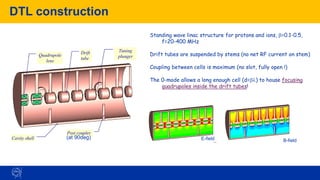
DTL construction
Tuning
plunger
Quadrupole
lens
Drift
tube
Cavity shell
Post coupler
Tuning
plunger
Quadrupole
lens
Drift
tube
Cavity shell
Post coupler
Standing wave linac structure for protons and ions, b=0.1-0.5,
f=20-400 MHz
Drift tubes are suspended by stems (no net RF current on stem)
Coupling between cells is maximum (no slot, fully open !)
The 0-mode allows a long enough cell (d=b) to house focusing
quadrupoles inside the drift tubes!
B-field
E-field
(at 90deg)
41
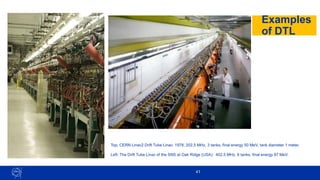
Examples
of DTL
Top; CERN Linac2 Drift Tube Linac: 1978, 202.5 MHz, 3 tanks, final energy 50 MeV, tank diameter 1 meter.
Left: The Drift Tube Linac of the SNS at Oak Ridge (USA): 402.5 MHz, 6 tanks, final energy 87 MeV.
42
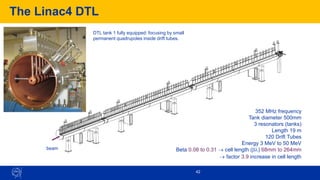
The Linac4 DTL
beam
352 MHz frequency
Tank diameter 500mm
3 resonators (tanks)
Length 19 m
120 Drift Tubes
Energy 3 MeV to 50 MeV
Beta 0.08 to 0.31 → cell length (b) 68mm to 264mm
→ factor 3.9 increase in cell length
DTL tank 1 fully equipped: focusing by small
permanent quadrupoles inside drift tubes.
43
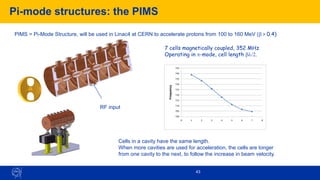
Pi-mode structures: the PIMS
RF input
Cells in a cavity have the same length.
When more cavities are used for acceleration, the cells are longer
from one cavity to the next, to follow the increase in beam velocity.
PIMS = Pi-Mode Structure, will be used in Linac4 at CERN to accelerate protons from 100 to 160 MeV (b > 0.4)
7 cells magnetically coupled, 352 MHz
Operating in -mode, cell length b/2.
700
705
710
715
720
725
730
735
740
745
0 1 2 3 4 5 6 7 8
Frequency
44
Sequence of PIMS cavities
Cells have same length inside a cavity (7 cells) but increase from one cavity to the next.
At high energy (>100 MeV) beta changes slowly and phase error (“phase slippage”) is small.
0
1
0 100 200 300 400
Kinetic Energy[MeV]
(v/c)^2
100 MeV,
128 cm
160 MeV,
155 cm
Focusing quadrupoles
between cavities
PIMS range
45
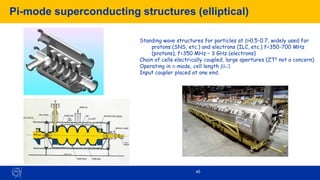
Pi-mode superconducting structures (elliptical)
Standing wave structures for particles at b>0.5-0.7, widely used for
protons (SNS, etc.) and electrons (ILC, etc.) f=350-700 MHz
(protons), f=350 MHz – 3 GHz (electrons)
Chain of cells electrically coupled, large apertures (ZT2 not a concern).
Operating in -mode, cell length b/2
Input coupler placed at one end.
46
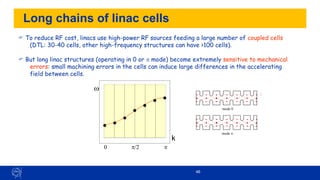
Long chains of linac cells
 To reduce RF cost, linacs use high-power RF sources feeding a large number of coupled cells
(DTL: 30-40 cells, other high-frequency structures can have >100 cells).
 But long linac structures (operating in 0 or  mode) become extremely sensitive to mechanical
errors: small machining errors in the cells can induce large differences in the accelerating
field between cells.
w
k

/2
0
0 6.67 13.34 20.01 26.68 33.35
mode 0
mode /2
mode 2/3
mode 
-
1.
5
-
1
-
0
.
5
0
0
.
5
1
1.
5
0 50 10
0 150 20
0 250
-
1.
5
-
1
-
0
.
5
0
0
.
5
1
1.
5
0 50 10
0 150 20
0 250
-
1.
5
-
1
-
0
.
5
0
0
.
5
1
1.
5
0 50 10
0 150 20
0 250
0
0
.
2
0
.
4
0
.
6
0
.
8
1
0 50 10
0 150 20
0 250
E
z
mode 0
mode /2
mode 2/3
mode 
-
1.
5
-
1
-
0
.
5
0
0
.
5
1
1.
5
0 50 10
0 150 20
0 250
-
1.
5
-
1
-
0
.
5
0
0
.
5
1
1.
5
0 50 10
0 150 20
0 250
-
1.
5
-
1
-
0
.
5
0
0
.
5
1
1.
5
0 50 10
0 150 20
0 250
0
0
.
2
0
.
4
0
.
6
0
.
8
1
0 50 10
0 150 20
0 250
E
z
47
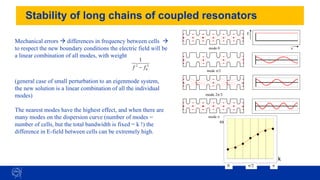
Stability of long chains of coupled resonators
Mechanical errors → differences in frequency between cells →
to respect the new boundary conditions the electric field will be
a linear combination of all modes, with weight
(general case of small perturbation to an eigenmode system,
the new solution is a linear combination of all the individual
modes)
The nearest modes have the highest effect, and when there are
many modes on the dispersion curve (number of modes =
number of cells, but the total bandwidth is fixed = k !) the
difference in E-field between cells can be extremely high.
2
0
2
1
f
f −
mode 0
mode /2
mode 2/3
mode 
-
1.
5
-
1
-
0
.
5
0
0
.
5
1
1.
5
0 50 10
0 150 20
0 250
-
1.
5
-
1
-
0
.
5
0
0
.
5
1
1.
5
0 50 10
0 150 20
0 250
-
1.
5
-
1
-
0
.
5
0
0
.
5
1
1.
5
0 50 10
0 150 20
0 250
0
0
.
2
0
.
4
0
.
6
0
.
8
1
0 50 10
0 150 20
0 250
E
z
w
k

/2
0
0 6.67 13.34 20.01 26.68 33.35
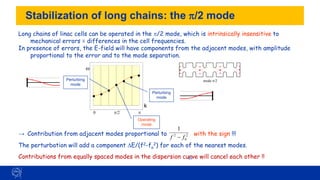
48
Stabilization of long chains: the /2 mode
mode 0
mode /2
mode 2/3
mode 
-
1.
5
-
1
-
0
.
5
0
0
.
5
1
1.
5
0 50 10
0 150 20
0 250
-
1.
5
-
1
-
0
.
5
0
0
.
5
1
1.
5
0 50 10
0 150 20
0 250
-
1.
5
-
1
-
0
.
5
0
0
.
5
1
1.
5
0 50 10
0 150 20
0 250
0
0
.
2
0
.
4
0
.
6
0
.
8
1
0 50 10
0 150 20
0 250
E
z
Long chains of linac cells can be operated in the /2 mode, which is intrinsically insensitive to
mechanical errors = differences in the cell frequencies.
In presence of errors, the E-field will have components from the adjacent modes, with amplitude
proportional to the error and to the mode separation.
w
k

/2
0
0 6.67 13.34 20.01 26.68 33.35
Perturbing
mode
Perturbing
mode
Operating
mode
→ Contribution from adjacent modes proportional to with the sign !!!
The perturbation will add a component DE/(f2-fo
2) for each of the nearest modes.
Contributions from equally spaced modes in the dispersion curve will cancel each other !!
2
0
2
1
f
f −
-
1.
5
-
1
-
0
.
5
0
0
.
5
1
1.
5
0 50 10
0 150 20
0 250
-
1.
5
-
1
-
0
.
5
0
0
.
5
1
1.
5
0 50 10
0 150 20
0 250
-
1.
5
-
1
-
0
.
5
0
0
.
5
1
1.
5
0 50 10
0 150 20
0 250
0
0
.
2
0
.
4
0
.
6
0
.
8
1
0 50 10
0 150 20
0 250
E
z
m
o
d
e
0
m
o
d
e

/
2
m
o
d
e
2

/
3
m
o
d
e

-
1
.
5
-
1
-
0
.
5
0
0
.
5
1
1
.
5
0
5
0
1
0
0
1
5
0
2
0
0
2
5
0
-
1
.
5
-
1
-
0
.
5
0
0
.
5
1
1
.
5
0
5
0
1
0
0
1
5
0
2
0
0
2
5
0
-
1
.
5
-
1
-
0
.
5
0
0
.
5
1
1
.
5
0
5
0
1
0
0
1
5
0
2
0
0
2
5
0
0
0
.
2
0
.
4
0
.
6
0
.
8
1
0
5
0
1
0
0
1
5
0
2
0
0
2
5
0
E
z
49
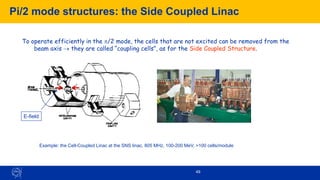
Pi/2 mode structures: the Side Coupled Linac
To operate efficiently in the /2 mode, the cells that are not excited can be removed from the
beam axis → they are called “coupling cells”, as for the Side Coupled Structure.
Example: the Cell-Coupled Linac at the SNS linac, 805 MHz, 100-200 MeV, >100 cells/module
E-field
50
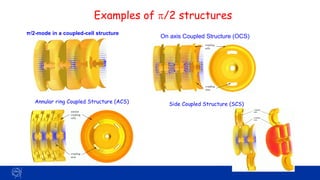
π/2-mode in a coupled-cell structure
Annular ring Coupled Structure (ACS) Side Coupled Structure (SCS)
On axis Coupled Structure (OCS)
Examples of /2 structures
51
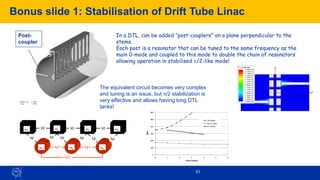
Bonus slide 1: Stabilisation of Drift Tube Linac
51
In a DTL, can be added “post-couplers” on a plane perpendicular to the
stems.
Each post is a resonator that can be tuned to the same frequency as the
main 0-mode and coupled to this mode to double the chain of resonators
allowing operation in stabilised /2-like mode!
Post-
coupler
0
100
200
300
400
500
600
0 1 2 3 4 5 6
MHz
mode number
TM modes
Stem modes
PC modes
The equivalent circuit becomes very complex
and tuning is an issue, but /2 stabilization is
very effective and allows having long DTL
tanks!
52
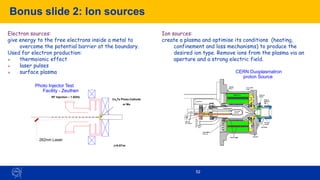
Bonus slide 2: Ion sources
52
Electron sources:
give energy to the free electrons inside a metal to
overcome the potential barrier at the boundary.
Used for electron production:
➢ thermoionic effect
➢ laser pulses
➢ surface plasma
Cs2Te Photo-Cathode
or Mo
RF Injection – 1.5GHz
D=0.67ns
Photo Injector Test
Facility - Zeuthen
262nm Laser
Ion sources:
create a plasma and optimise its conditions (heating,
confinement and loss mechanisms) to produce the
desired ion type. Remove ions from the plasma via an
aperture and a strong electric field.
CERN Duoplasmatron
proton Source
Module 3
A quick overview of beam dynamics in
linear accelerators
53
Introduction
54
A linear accelerator requires an accurate beam optics design, in order to:
❑ Minimize emittance growth (remember Liouville: emittance can only increase!);
❑ Minimize beam loss, to: a) avoid activation of the accelerator (of the linac and
of the following machine!) and b) reduce the requirements on the ion source.
Note that the operating regimes in linacs can be very different, between
− ma peak currents for heavy ion linacs (~ 105 particles / bunch)
- mA peak currents for proton linacs (~ 108 particles / bunch)
- 100’s mA peak currents for high-power proton linacs (~ 1011 particles / bunch)
- A’s peak currents for electron linacs
Beam emittance
55
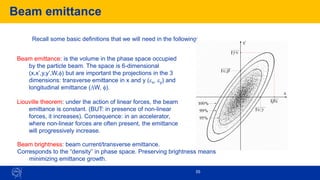
Recall some basic definitions that we will need in the following:
Beam emittance: is the volume in the phase space occupied
by the particle beam. The space is 6-dimensional
(x,x’,y,y’,W,) but are important the projections in the 3
dimensions: transverse emittance in x and y (ex, ey) and
longitudinal emittance (DW, ).
Liouville theorem: under the action of linear forces, the beam
emittance is constant. (BUT: in presence of non-linear
forces, it increases). Consequence: in an accelerator,
where non-linear forces are often present, the emittance
will progressively increase.
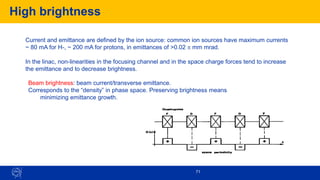
Beam brightness: beam current/transverse emittance.
Corresponds to the “density” in phase space. Preserving brightness means
minimizing emittance growth.
56
Longitudinal dynamics
4
/
3
)
( 
b

=
D const
W
( )
3
2
0
2
0
2
2
sin
b



w
w
mc
T
qE
l
−
=
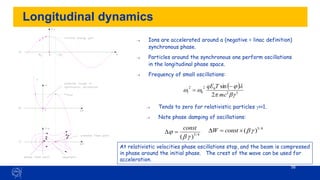
→ Ions are accelerated around a (negative = linac definition)
synchronous phase.
→ Particles around the synchronous one perform oscillations
in the longitudinal phase space.
→ Frequency of small oscillations:
→ Tends to zero for relativistic particles >>1.
→ Note phase damping of oscillations:
4
/
3
)
( 
b

const
=
D
At relativistic velocities phase oscillations stop, and the beam is compressed
in phase around the initial phase. The crest of the wave can be used for
acceleration.
57
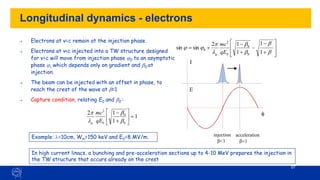
Longitudinal dynamics - electrons
E
I
injection
b<1
acceleration
b=1









+
−
−
+
−
+
=
b
b
b
b




1
1
1
1
2
sin
sin
0
0
0
2
0
qE
mc
g
→ Electrons at v=c remain at the injection phase.
→ Electrons at v<c injected into a TW structure designed
for v=c will move from injection phase 0 to an asymptotic
phase , which depends only on gradient and b0 at
injection.
→ The beam can be injected with an offset in phase, to
reach the crest of the wave at b=1
→ Capture condition, relating E0 and b0 :
1
1
1
2
0
0
0
2
=






+
−
b
b


qE
mc
g
Example: =10cm, Win=150 keV and E0=8 MV/m.
In high current linacs, a bunching and pre-acceleration sections up to 4-10 MeV prepares the injection in
the TW structure that occurs already on the crest
58
Transverse dynamics - Space charge

=
r
r dr
r
r
n
r
e
E
0
)
(
2e 
=
r
dr
r
r
n
r
v
e
B
0
)
(
2
m

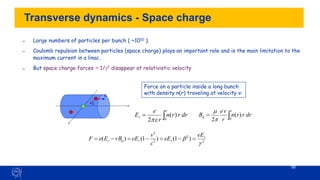
→ Large numbers of particles per bunch ( ~1010 ).
→ Coulomb repulsion between particles (space charge) plays an important role and is the main limitation to the
maximum current in a linac.
→ But space charge forces ~ 1/2 disappear at relativistic velocity
Force on a particle inside a long bunch
with density n(r) traveling at velocity v:
2
2
2
2
)
1
(
)
1
(
)
(

b

r
r
r
r
eE
eE
c
v
eE
vB
E
e
F =
−
=
−
=
−
=
E
B
59
Transverse dynamics - RF defocusing
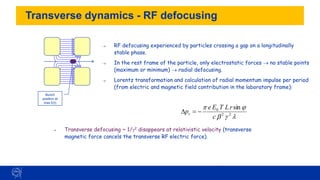
→ RF defocusing experienced by particles crossing a gap on a longitudinally
stable phase.
→ In the rest frame of the particle, only electrostatic forces → no stable points
(maximum or minimum) → radial defocusing.
→ Lorentz transformation and calculation of radial momentum impulse per period
(from electric and magnetic field contribution in the laboratory frame):


b


2
2
0 sin
c
r
L
T
E
e
pr −
=
D
→ Transverse defocusing ~ 1/2 disappears at relativistic velocity (transverse
magnetic force cancels the transverse RF electric force).
Bunch
position at
max E(t)
Focusing
60
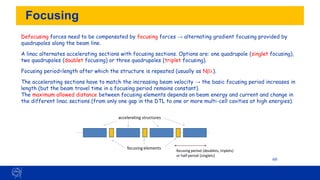
Defocusing forces need to be compensated by focusing forces → alternating gradient focusing provided by
quadrupoles along the beam line.
A linac alternates accelerating sections with focusing sections. Options are: one quadrupole (singlet focusing),
two quadrupoles (doublet focusing) or three quadrupoles (triplet focusing).
Focusing period=length after which the structure is repeated (usually as Nb).
The accelerating sections have to match the increasing beam velocity → the basic focusing period increases in
length (but the beam travel time in a focusing period remains constant).
The maximum allowed distance between focusing elements depends on beam energy and current and change in
the different linac sections (from only one gap in the DTL to one or more multi-cell cavities at high energies).
accelerating structures
focusing elements
focusing period (doublets, triplets)
or half period (singlets)
61
61
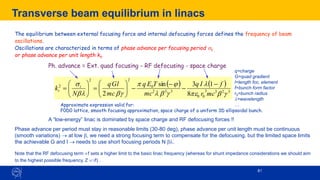
Transverse beam equilibrium in linacs
( ) ( ) ...
8
1
3
sin
2 3
2
3
3
0
0
3
3
2
0
2
2
2
−
−
−
−
−








=








=

b
e


b



b
b

mc
r
f
I
q
mc
T
E
q
mc
Gl
q
N
k t
t
Ph. advance = Ext. quad focusing - RF defocusing - space charge
Approximate expression valid for:
F0D0 lattice, smooth focusing approximation, space charge of a uniform 3D ellipsoidal bunch.
A “low-energy” linac is dominated by space charge and RF defocusing forces !!
Phase advance per period must stay in reasonable limits (30-80 deg), phase advance per unit length must be continuous
(smooth variations) → at low b, we need a strong focusing term to compensate for the defocusing, but the limited space limits
the achievable G and l → needs to use short focusing periods N b.
Note that the RF defocusing term f sets a higher limit to the basic linac frequency (whereas for shunt impedance considerations we should aim
to the highest possible frequency, Z √f) .
The equilibrium between external focusing force and internal defocusing forces defines the frequency of beam
oscillations.
Oscillations are characterized in terms of phase advance per focusing period t
or phase advance per unit length kt.
q=charge
G=quad gradient
l=length foc. element
f=bunch form factor
r0=bunch radius
=wavelength
…
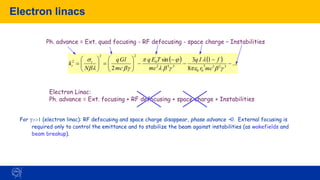
Electron linacs
( ) ( ) ...
8
1
3
sin
2 3
2
3
3
0
0
3
3
2
0
2
2
2
−
−
−
−
−








=








=

b
e


b



b
b

mc
r
f
I
q
mc
T
E
q
mc
Gl
q
N
k t
t
Ph. advance = Ext. quad focusing - RF defocusing - space charge – Instabilities
Electron Linac:
Ph. advance = Ext. focusing + RF defocusing + space charge + Instabilities
For >>1 (electron linac): RF defocusing and space charge disappear, phase advance →0. External focusing is
required only to control the emittance and to stabilize the beam against instabilities (as wakefields and
beam breakup).
63
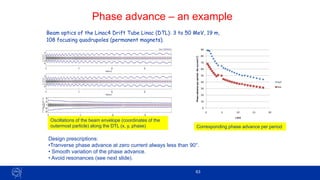
Phase advance – an example
0
10
20
30
40
50
60
70
80
90
0 5 10 15 20
Phase
advance
per
period
-
No
current
(°)
z (m)
koT
koL
Beam optics of the Linac4 Drift Tube Linac (DTL): 3 to 50 MeV, 19 m,
108 focusing quadrupoles (permanent magnets).
Design prescriptions:
•Tranverse phase advance at zero current always less than 90°.
• Smooth variation of the phase advance.
• Avoid resonances (see next slide).
Oscillations of the beam envelope (coordinates of the
outermost particle) along the DTL (x, y, phase) Corresponding phase advance per period
64
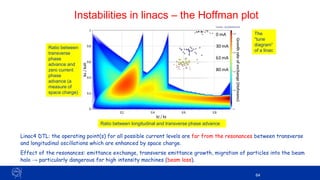
Instabilities in linacs – the Hoffman plot
0 mA
30 mA
63 mA
80 mA
Linac4 DTL: the operating point(s) for all possible current levels are far from the resonances between transverse
and longitudinal oscillations which are enhanced by space charge.
Effect of the resonances: emittance exchange, transverse emittance growth, migration of particles into the beam
halo → particularly dangerous for high intensity machines (beam loss).
The
“tune
diagram”
of a linac
Ratio between
transverse
phase
advance and
zero current
phase
advance (a
measure of
space charge)
Ratio between longitudinal and transverse phase advance
65
Focusing periods
Focusing usually provided by quadrupoles.
Need to keep the phase advance in the good range, with an approximately constant phase
advance per unit length → The length of the focusing periods has to change along the linac,
going gradually from short periods in the initial part (to compensate for high space charge
and RF defocusing) to longer periods at high energy.
For Protons (high beam current and high space charge), distance between two quadrupoles (=1/2
of a FODO focusing period):
- b in the DTL, from ~70mm (3 MeV, 352 MHz) to ~250mm (40 MeV),
- can be increased to 4-10b at higher energy (>40 MeV).
- longer focusing periods require special dynamics (example: the IH linac).
For Electrons (no space charge, no RF defocusing):
focusing periods up to several meters, depending on the required beam conditions. Focusing
is mainly required to control the emittance.
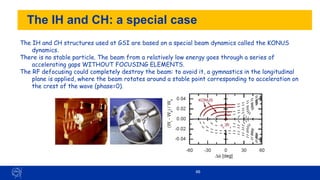
The IH and CH: a special case
66
The IH and CH structures used at GSI are based on a special beam dynamics called the KONUS
dynamics.
There is no stable particle. The beam from a relatively low energy goes through a series of
accelerating gaps WITHOUT FOCUSING ELEMENTS.
The RF defocusing could completely destroy the beam: to avoid it, a gymnastics in the longitudinal
plane is applied, where the beam rotates around a stable point corresponding to acceleration on
the crest of the wave (phase=0).
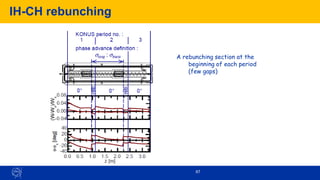
IH-CH rebunching
67
A rebunching section at the
beginning of each period
(few gaps)
68
High-intensity protons – the case of Linac4
Example: beam dynamics design for Linac4@CERN.
High intensity protons (60 mA bunch current, duty cycle could go up to 5%), 3 - 160 MeV
Beam dynamics design minimising emittance growth and halo development in order to:
1. avoid uncontrolled beam loss (activation of machine parts)
2. preserve small emittance (high luminosity in the following accelerators)
Transverse (x) r.m.s. beam envelope along Linac4
0
0.001
0.002
0.003
0.004
0.005
10 20 30 40 50 60 70 80
distance from ion source [m]
x_rms
beam
size
[m]
DTL : FFDD and FODO
CCDTL : FODO PIMS : FODO
69
Beam Optics Design Guidelines
Prescriptions to minimise emittance growth and halo formation:
1. Keep zero current phase advance always below 90º, to avoid resonances
2. Keep longitudinal to transverse phase advance ratio 0.5-0.8, to avoid emittance exchange
3. Keep a smooth variation of transverse and longitudinal phase advance per meter.
4. Keep sufficient safety margin between beam radius and aperture
Transverse r.m.s. emittance and phase advance along Linac4 (RFQ-DTL-CCDTL-PIMS)
0
20
40
60
80
100
120
140
160
180
200
220
0 10 20 30 40 50 60 70
position [m]
phase
advance
per
meter
kx
ky
kz
2.00E-07
2.50E-07
3.00E-07
3.50E-07
4.00E-07
4.50E-07
0 10 20 30 40 50 60 70 80
100% Normalised RMS transverse emittance (PI m rad)
x
y
transition
transition
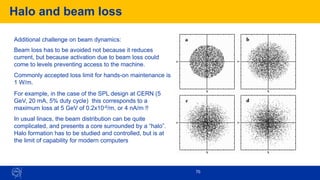
Halo and beam loss
70
Additional challenge on beam dynamics:
Beam loss has to be avoided not because it reduces
current, but because activation due to beam loss could
come to levels preventing access to the machine.
Commonly accepted loss limit for hands-on maintenance is
1 W/m.
For example, in the case of the SPL design at CERN (5
GeV, 20 mA, 5% duty cycle) this corresponds to a
maximum loss at 5 GeV of 0.2x10⁻⁶/m, or 4 nA/m !!
In usual linacs, the beam distribution can be quite
complicated, and presents a core surrounded by a “halo”.
Halo formation has to be studied and controlled, but is at
the limit of capability for modern computers
High brightness
71
Current and emittance are defined by the ion source: common ion sources have maximum currents
~ 80 mA for H-, ~ 200 mA for protons, in emittances of >0.02  mm mrad.
In the linac, non-linearities in the focusing channel and in the space charge forces tend to increase
the emittance and to decrease brightness.
Beam brightness: beam current/transverse emittance.
Corresponds to the “density” in phase space. Preserving brightness means
minimizing emittance growth.
72
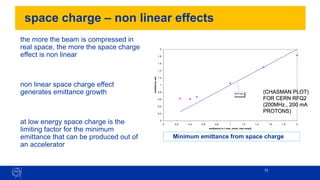
space charge – non linear effects
the more the beam is compressed in
real space, the more the space charge
effect is non linear
non linear space charge effect
generates emittance growth
at low energy space charge is the
limiting factor for the minimum
emittance that can be produced out of
an accelerator
0
0.2
0.4
0.6
0.8
1
1.2
1.4
1.6
1.8
2
0 0.2 0.4 0.6 0.8 1 1.2 1.4 1.6 1.8 2
emittance in ( rms, norm, mm mrad)
emittance
out
ein=eou
t
(CHASMAN PLOT)
FOR CERN RFQ2
(200MHz., 200 mA
PROTONS)
Minimum emittance from space charge
73
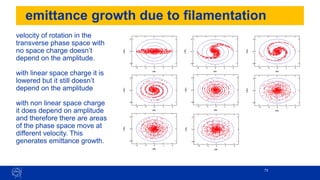
emittance growth due to filamentation
velocity of rotation in the
transverse phase space with
no space charge doesn’t
depend on the amplitude.
with linear space charge it is
lowered but it still doesn’t
depend on the amplitude
with non linear space charge
it does depend on amplitude
and therefore there are areas
of the phase space move at
different velocity. This
generates emittance growth.
74
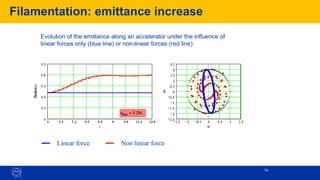
Linear force Non linear force
Evolution of the emittance along an accelerator under the influence of
linear forces only (blue line) or non-linear forces (red line)
Filamentation: emittance increase
Module 4
Linac architecture (and limitations)
75
76
Proton linac architecture – cell length, focusing period
Injector
EXAMPLE: the Linac4 project at CERN. H-, 160 MeV energy, 352 MHz.
A 3 MeV injector + 22 multi-cell standing wave accelerating structures of 3 types
Two basic principles to remember:
1. As beta increases, phase error
between cells of identical length
becomes small → we can have short
sequences of identical cells (lower
construction costs).
2. As beta increases, the distance
between focusing elements can increase
(more details in 2nd lecture!).
DTL: every cell is different, focusing quadrupoles in each drift tube
CCDTL: sequences of 2 identical cells, quadrupoles every 3 cells
PIMS: sequences of 7 identical cells, quadrupoles every 7 cells
Section Output
Energy
[MeV]
Number of
consecutive
identical cells
Distance
between
quadrupoles
RFQ 3 1 -
DTL 50 1 b
CCDTL 100 3 4 b
PIMS 160 7 5 b
77
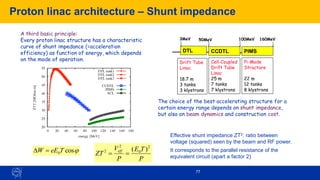
Proton linac architecture – Shunt impedance
A third basic principle:
Every proton linac structure has a characteristic
curve of shunt impedance (=acceleration
efficiency) as function of energy, which depends
on the mode of operation.
The choice of the best accelerating structure for a
certain energy range depends on shunt impedance,
but also on beam dynamics and construction cost.
CCDTL PIMS
3MeV 50MeV 100MeV 160MeV
Drift Tube
Linac
18.7 m
3 tanks
3 klystrons
Pi-Mode
Structure
22 m
12 tanks
8 klystrons
Cell-Coupled
Drift Tube
Linac
25 m
7 tanks
7 klystrons
DTL
P
T
E
P
V
ZT eff
2
0
2
2 )
(
=
=
Effective shunt impedance ZT2: ratio between
voltage (squared) seen by the beam and RF power.
It corresponds to the parallel resistance of the
equivalent circuit (apart a factor 2)

cos
0T
eE
W =
D
High Energy Linacs
78
Superconducting Proton Linac a CERN project for extending Linac4 up to 5 GeV energy
Section Output
Energy
[MeV]
Lattice Number of
RF gaps
between
quadrupoles
Number of
RF gaps
per period
Number of
consecutive
identical
cells
DTL 50 F0D0 1 2 1
CCDTL 102 F0D0 3 6 3
PIMS 160 F0D0 12 24 12
Low b 750 FD 15 15 300
High b / 1 2500 FD 35 35
920
High b / 2 5000 F0D0 35 70
low-beta: 20 cryo-modules with 3 cavities/cryo-module
high-beta -FD: 13 cryo-modules with 8 cavities/module
high-beta -FODO: 10 cryo-modules with 8 cavities/module
79
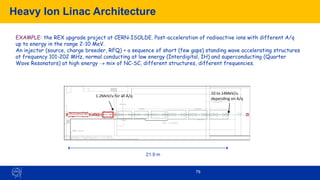
Heavy Ion Linac Architecture
1.2MeV/u for all A/q
10 to 14MeV/u
depending on A/q
EXAMPLE: the REX upgrade project at CERN-ISOLDE. Post-acceleration of radioactive ions with different A/q
up to energy in the range 2-10 MeV.
An injector (source, charge breeder, RFQ) + a sequence of short (few gaps) standing wave accelerating structures
at frequency 101-202 MHz, normal conducting at low energy (Interdigital, IH) and superconducting (Quarter
Wave Resonators) at high energy → mix of NC-SC, different structures, different frequencies.
21.9 m
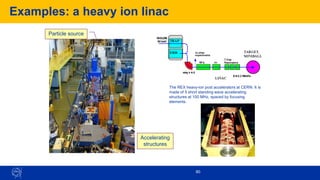
80
Examples: a heavy ion linac
The REX heavy-ion post accelerators at CERN. It is
made of 5 short standing wave accelerating
structures at 100 MHz, spaced by focusing
elements.
Particle source
Accelerating
structures
81
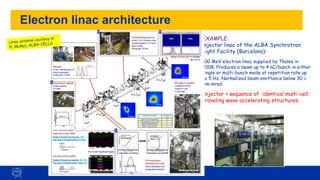
Electron linac architecture
EXAMPLE:
injector linac of the ALBA Synchrotron
Light Facility (Barcelona):
100 MeV electron linac supplied by Thales in
2008. Produces a beam up to 4 nC/bunch in either
single or multi-bunch mode at repetition rate up
to 5 Hz. Normalized beam emittance below 30 
mm mrad.
Injector + sequence of identical multi-cell
traveling wave accelerating structures.
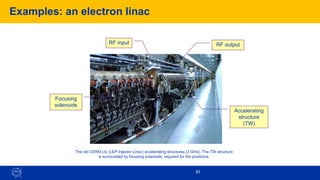
82
Examples: an electron linac
RF input RF output
Accelerating
structure
(TW)
Focusing
solenoids
The old CERN LIL (LEP Injector Linac) accelerating structures (3 GHz). The TW structure
is surrounded by focusing solenoids, required for the positrons.
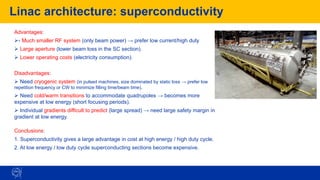
Linac architecture: superconductivity
83
Advantages:
➢- Much smaller RF system (only beam power) → prefer low current/high duty
➢ Large aperture (lower beam loss in the SC section).
➢ Lower operating costs (electricity consumption).
Disadvantages:
➢ Need cryogenic system (in pulsed machines, size dominated by static loss → prefer low
repetition frequency or CW to minimize filling time/beam time).
➢ Need cold/warm transitions to accommodate quadrupoles → becomes more
expensive at low energy (short focusing periods).
➢ Individual gradients difficult to predict (large spread) → need large safety margin in
gradient at low energy.
Conclusions:
1. Superconductivity gives a large advantage in cost at high energy / high duty cycle.
2. At low energy / low duty cycle superconducting sections become expensive.
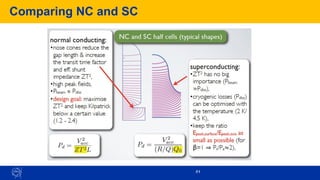
Comparing NC and SC
84
This and the next few slides courtesy of F. Gerigk, CERN
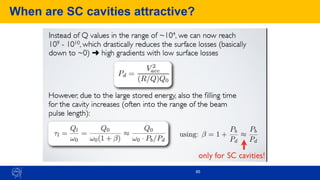
When are SC cavities attractive?
85
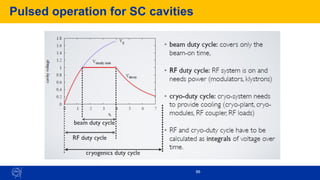
Pulsed operation for SC cavities
86
Transition warm/cold
87
The RFQ must be normal conducting (construction problems / inherent beam loss).
Modern high-energy (>200 MeV) sections should be superconducting.
But where is the optimum transition energy between normal and superconducting?
The answer is in the cost → the economics has to be worked out correctly !
SNS
JPARC
Linac4/SPL
ESS
0
50
100
150
200
250
300
350
400
450
1 10 100
Project Duty Cycle
[%]
Transition
Energy [MeV]
SNS 6 186
JPARC 2.5 400
Linac4/SPL 4 160
ESS 4 50
Project-X 100 10
EUROTRANS 100 5
EURISOL 100 5
IFMIF/EVEDA 100 5
Overview of warm/cold transition
energies for linacs (operating
and in design)
Duty cycle [%]
Energy
[MeV]
90
88
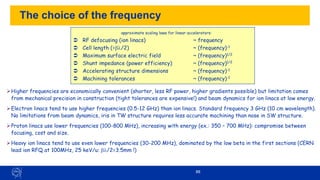
The choice of the frequency
➢Higher frequencies are economically convenient (shorter, less RF power, higher gradients possible) but limitation comes
from mechanical precision in construction (tight tolerances are expensive!) and beam dynamics for ion linacs at low energy.
➢Electron linacs tend to use higher frequencies (0.5-12 GHz) than ion linacs. Standard frequency 3 GHz (10 cm wavelength).
No limitations from beam dynamics, iris in TW structure requires less accurate machining than nose in SW structure.
➢Proton linacs use lower frequencies (100-800 MHz), increasing with energy (ex.: 350 – 700 MHz): compromise between
focusing, cost and size.
➢Heavy ion linacs tend to use even lower frequencies (30-200 MHz), dominated by the low beta in the first sections (CERN
lead ion RFQ at 100MHz, 25 keV/u: b/2=3.5mm !)
approximate scaling laws for linear accelerators:
 RF defocusing (ion linacs) ~ frequency
 Cell length (=b/2) ~ (frequency)-1
 Maximum surface electric field ~ (frequency)1/2
 Shunt impedance (power efficiency) ~ (frequency)1/2
 Accelerating structure dimensions ~ (frequency)-1
 Machining tolerances ~ (frequency)-1
Linac architecture: optimum gradient (NC)
89
The cost of a linear accelerator is made of 2 terms:
• a “structure” cost proportional to linac length
• an “RF” cost proportional to total RF power
P
C
l
C
C RF
s +
=
Cs, CRF unit costs (€/m, €/W)
T
E
C
T
E
C
C RF
s 0
0
1
+

0
20
40
60
80
100
120
5 15 25 35 45 55 65 75 85 95 105
E0 [MV/m]
Cost
Total cost
structure cost
RF cost
Example: for Linac4
Cs … ~200 kCHF/m
CRF…~0.6 CHF/W (recuperating LEP equipment)
E0T … ~ 3 – 4 MV/m
Note that the optimum design gradient (E0T) in a normal-conducting linac is
not necessarily the highest achievable (limited by sparking).
T
E
l 0
/
1

T
E
l
T
E
P 0
2
0 )
( 

Overall cost is the sum of a structure term
decreasing with the gradient and of an RF
term increasing with the gradient → there is
an optimum gradient minimizing cost.
breakdown limit
optimum
gradient
Appendix: breakdowns, conditioning, multipacting
4/13/2022 Presenter | Presentation Title 90
This block of 6 slides can go either in the linac or in the RF lectures – depends on timing
On the breakdown limit…
91
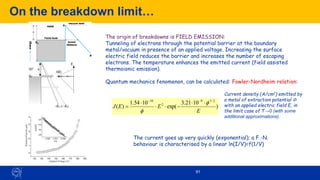
The origin of breakdowns is FIELD EMISSION:
Tunneling of electrons through the potential barrier at the boundary
metal/vacuum in presence of an applied voltage. Increasing the surface
electric field reduces the barrier and increases the number of escaping
electrons. The temperature enhances the emitted current (field assisted
thermoionic emission).
Quantum mechanics fenomenon, can be calculated: Fowler-Nordheim relation:
Current density (A/cm2) emitted by
a metal of extraction potential F
with an applied electric field E, in
the limit case of T→0 (with some
additional approximations).
The current goes up very quickly (exponential); a F.-N.
behaviour is characterised by a linear ln(I/V)=f(1/V)
)
10
21
.
3
exp(
10
54
.
1
)
(
2
/
3
9
2
10
E
E
E
J




−



=
−
−
Breakdown and impurities
92
Looking at the numbers, for copper the F.E. current starts to become important only for fields in
the region of few GV/m, well beyond normal operating fields in the order of 10-40 MV/m.
(E=1 GV/m → J=5e-17 A/m2, E=5 GV/m → J=7e11 A/m2 !!)
But: the theory is valid for smooth and perfect surfaces. A real electrode has marks coming from
machining (finite surface roughness) and contains impurities incrusted on the surface (grains). Both
these elements increase the surface field (edges for the roughness and dielectric constant for the
impurities).
“Mountain and snow”: The real field on the surface is bE, adding an “enhancement” factor b.
)
10
55
.
6
exp(
)
(
10
83
.
4
)
(
10
5
.
2
11
E
E
E
J


−




= −
b
b F.-N. formula for copper, with
the enhancement factor
Field emission current is a pre-breakdown phenomenon. When the current at
a certain spot goes beyond a certain limit a breakdown starts (the real
physics of the phenomenon is still under discussion).
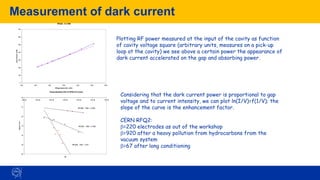
Field emission current is often called « dark current » and can be measured.
3.4 10
7
3.6 10
7
3.8 10
7
4 10
7
4.2 10
7
4.4 10
7
4.6 10
7
0
200
400
600
J( )
E
E
Copper, b=60
Measurement of dark current
93
RFQ2A - 5.4.1990
0
100
200
300
400
500
600
700
400 600 800 1000 1200 1400 1600
Voltage square (arb. units)
Input
Power
(kW)
Plotting RF power measured at the input of the cavity as function
of cavity voltage square (arbitrary units, measures on a pick-up
loop at the cavity) we see above a certain power the appearance of
dark current accelerated on the gap and absorbing power.
Fowler-Nordheim Plot for RFQ2 FE Current
RFQ2A - 1990 - b =220
RFQ2B - 1993 - b =920
RFQ2B - 1997 - b =67
-36
-35
-34
-33
-32
-31
-30
4.5E-06 5.0E-06 5.5E-06 6.0E-06 6.5E-06 7.0E-06 7.5E-06
1/V
LN(I/V**2.5)
Considering that the dark current power is proportional to gap
voltage and to current intensity, we can plot ln(I/V)=f(1/V); the
slope of the curve is the enhancement factor.
CERN RFQ2:
b=220 electrodes as out of the workshop
b=920 after a heavy pollution from hydrocarbons from the
vacuum system
b=67 after long conditioning
Breakdowns and conditioning
94
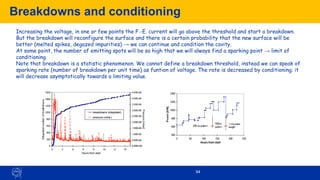
Increasing the voltage, in one or few points the F.-E. current will go above the threshold and start a breakdown.
But the breakdown will reconfigure the surface and there is a certain probability that the new surface will be
better (melted spikes, degazed impurities) → we can continue and condition the cavity.
At some point, the number of emitting spots will be so high that we will always find a sparking point → limit of
conditioning.
Note that breakdown is a statistic phenomenon. We cannot define a breakdown threshold, instead we can speak of
sparking rate (number of breakdown per unit time) as funtion of voltage. The rate is decreased by conditioning; it
will decrease asymptotically towards a limiting value.
The Kilpatrick field
95
W. Kilpatrick in 1956 fitted some experimental data on breakdown “levels” in RF regime with a F.-N. type
formula, assuming that the breakdown is ignited by the impact on the surface of an ion accelerated on the gap,
with energy W:
8
.
1
)
/
17
exp(
2
=
− E
WE
In the late 60’s at Los Alamos they introduced a calculation of the ion velocity based on gap and frequency (the
ion has a transit time factor!) → frequency dependant version of the Kilpatrick criterion:
)
/
5
.
8
exp(
64
.
1 2
E
E
f −
=
This formula is still used as a reference in the design of linear accelerators! For a given frequency, allows to calculate
the “Kilpatrick field”.
Very useful and a good reference, with some caveats:
1. It gives the famous result that maximum field goes as √f ; although demonstrated in several cases, now it is not considered as a
fixed law and in particular does not hold >10 GHz, where other phenomena take place.
2. It is not valid for small gaps and low frequencies, where we approach instead the limits for DC field;
3. It gives the wrong message that there is a breakdown threshold;
4. The experimental data were taken in the 50’s with bad vacuums, nowadays a cavity can operate at a few times the Kilpatrick limit.
Usual maximum fields range from about 1 Kilpatrick (CW systems high reliability) to 2.5 Kilpatrick (RFQ2)
Multipactoring
96
Electron resonance due to secondary emitted electrons from the surfaces.
Occurs at low voltages and can completely stop normal operation of a
cavity.
Some causes of multipactoring:
- Dirty surfaces (impurities emitting electrons)
- Air pockets (providing ions and electrons)
- Parallel plate and coaxial geometries (well-defined electron path)
- High pulsing rates (remaining electrons)
- Presence of silver (secondary emission >1)
- Vicinity of a ceramic insulator (high sec. emission)
- Bad luck…
Some cures:
• Conditioning: long times in the mp. region, possibly at higher repetition
frequency, heating the surfaces to oxidize them and thus reduce the
secondary emission coefficient below 1. Adding a frequency modulation
increases the conditioned surface.
• Some paints (aquadag) were used in the past but are not very good for
the vacuum.
The inner conductor of a coaxial coupler that
was (probably by mistake) silver plated and then
installed in a CERN linac cavity in 1978.
Multipactoring went on for 25 years during
normal operation sputtering silver on the
window, until it eventually short circuited a Friday
night in 2003 stopping all CERN accelerators…
Additional slides on coupling
4/13/2022 Presenter | Presentation Title 97
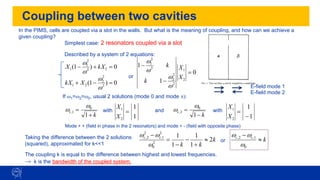
Coupling between two cavities
Simplest case: 2 resonators coupled via a slot
0
)
1
( 2
2
2
1
1 =
+
− kX
X
w
w
0
)
1
( 2
2
2
2
1 =
−
+
w
w
X
kX
0
1
1
2
1
2
2
2
2
2
1
=
−
−
X
X
k
k
w
w
w
w
k
c
+
=
1
0
1
,
w
w
k
c
−
=
1
0
2
,
w
w
In the PIMS, cells are coupled via a slot in the walls. But what is the meaning of coupling, and how can we achieve a
given coupling?
Described by a system of 2 equations:
or
If w1=w2=w0, usual 2 solutions (mode 0 and mode ):
and
with
1
1
2
1
=
X
X
with
1
1
2
1
−
=
X
X
Mode + + (field in phase in the 2 resonators) and mode + - (field with opposite phase)
E-field mode 1
E-field mode 2
k
k
k
c
c
2
1
1
1
1
2
0
2
1
,
2
2
,

+
−
−
=
−
w
w
w
Taking the difference between the 2 solutions
(squared), approximated for k<<1
or k
c
c

−
0
1
,
2
,
w
w
w
The coupling k is equal to the difference between highest and lowest frequencies.
→ k is the bandwidth of the coupled system.
More on coupling
- “Coupling” only when
the 2 resonators are
close in frequency.
- For f1=f2, maximum
spacing between the 2
frequencies (=kf0)
The coupling k is:
•Proportional to the 3rd power of slot length.
•Inv. proportional to the stored energies.
Solving the previous equations allowing a different frequency for each cell, we can plot the frequencies of the coupled
system as a function of the frequency of the first resonator, keeping the frequency of the second constant, for different
values of the coupling k.
170
180
190
200
210
220
230
170 180 190 200 210 220 230
f1c
f2c
f1c
f2c
f1c
f2c
120
140
160
180
200
220
240
260
280
120 140 160 180 200 220 240 260 280
Coupled
freqeuencies
[MHz]
Frequency f1 [MHz]
maximum
separation
when f1=f2
f1 f0
case of 3
different
coupling
factors
(0.1%, 5%,
10%)
For an elliptical coupling slot:

















2
2
1
1
3
U
H
U
H
l
F
k
F = slot form factor
l = slot length (in
the direction of H)
H = magnetic field
at slot position
U = stored energy
100
Elwood
Smith
End of Lectures 3 & 4

doctoral_school_04_22_linacsssssssssssss

  • 1.
    Maurizio Vretenar CERNRTU April 2022 Linear Accelerators
  • 2.
    Module 1 Why linearaccelerators Basic linac structure Acceleration in periodic structures 2
  • 3.
    Definitions 3 Linear accelerator: adevice where charged particles acquire energy moving on a linear path RF linear accelerator: acceleration is provided by time-varying electric fields (i.e. excludes electrostatic accelerators) A few definitions: ➢CW (Continuous wave) linacs when the beam bunches come continuously out of the linac; ➢Pulsed linac when the beam is produced in pulses: t pulse length, fr repetition frequency, beam duty cycle t × fr (%) ➢ Main parameters: E kinetic energy of the particles coming out of the linac [MeV] I average current during the beam pulse [mA] (different from average current and from bunch current !) P beam power = electrical power transferred to the beam during acceleration P [W] = Vtot × I = E [eV] × I [A] × duty cycle
  • 4.
    Variety of linacs Thefirst and the smallest: Rolf Widerøe thesis (1923) The largest: Stanford Linear Collider (2 miles = 3.2 km) (but CLIC design goes to 48.3 km !) One of the less linear: ALPI at LNL (Italy) A limit case, multi-pass linacs: CEBAF at JLAB The most common: medical electron linac (more than 7’000 in operation around the world!) 4
  • 5.
    Why Linear Accelerators 5 LINACSSYNCHROTRONS Low Energy High Energy High Energy Protons, Ions Injectors to synchrotrons, stand alone applications synchronous with the RF fields in the range where velocity increases with energy. Protons : b = v/c =0.51 at 150 MeV, 0.95 at 2 GeV. Injection at higher intensity Production of secondary beams (n, n, RIB, …) higher cost/MeV than synchrotron but: - high average beam current (high repetition rate, less resonances, easier beam loss). - higher linac energy allows for higher intensity in the synchrotron. very efficient when velocity is ~constant, (multiple crossings of the RF gaps). limited mean current (limited repetition frequency, instabilities) Electrons Injector to synchrotrons, stand-alone applications simple and compact Linear colliders do not lose energy because of synchrotron radiation – only option for high energy! Light sources, factories can accumulate high beam intensities « traditional » linac range « new » linac range
  • 6.
    6 Classic (Newton) relation: Relativistic(Einstein) relation: Proton and Electron Velocity 2 0 2 2 2 0 2 , 2 c m T c v v m T = = → Protons (rest energy 938.3 MeV): follow “Newton” mechanics up to some tens of MeV (Dv/v < 1% for W < 15 MeV) then slowly become relativistic (“Einstein”). From the GeV range velocity is nearly constant (v~0.95c at 2 GeV) → linacs can cope with the increasing particle velocity, synchrotrons cover the range where v nearly constant. → Electrons (rest energy 511 keV, 1/1836 of protons): relativistic from the keV range (v~0.1c at 2.5 keV) then increasing velocity up to the MeV range (v~0.95c at 1.1 MeV) → v~c after few meters of acceleration in a linac (typical gradient 10 MeV/m). b2=(v/c)2 as function of kinetic energy T for protons and electrons. 2 0 2 2 1 1 1 c m T c v + − =
  • 7.
    7 Basic linear acceleratorstructure b   2 = D d DC particle injector ? Protons: energy ~100 keV b= v/c ~ 0.015 Accelerating gap: E = E0 cos (wt + ) en. gain DW = eV0Tcos 1. The beam must to be bunched at frequency w 2. distance between cavities and phase of each cavity must be correlated bunching section d Phase change from cavity i to i+1 is RF cavity Focusing magnet Acceleration → the beam has to pass in each cavity on a phase  near the crest of the wave For the beam to be synchronous with the RF wave (“ride on the crest”) phase must be related to distance by the relation: B-field E-field … and on top of acceleration, we need to introduce in our “linac” some focusing elements … and on top of that, we will couple a number of gaps in an “accelerating structure” b  b w wt  d c d 2 = = = D
  • 8.
    Synchronism condition forthe Wideröe 8 b   2 = D d Please note that for the particular case of the Wideröe seen in the previous lectures, D= The general relation for synchronicity becomes  / d = 2 / b or d = b / 2
  • 9.
    Accelerating structure architecture d d= const.  variable  = const. d variable d  b b   2 = D d Coupled cell cavities - a single RF source feeds a large number of cells (up to ~100!) - the phase between adjacent cells is defined by the coupling, distance between cells is adapted to keep synchronism . Once the geometry is defined, it can accelerate only one type of ion for a given energy range. Effective but not flexible. Better, but 2 problems: 1. create a “coupling”; 2. create a mechanical and RF structure with increasing cell length. When b increases during acceleration, either the phase difference between cavities D must decrease or their distance d must increase. Individual cavities – distance between cavities constant, each cavity fed by an individual RF source, phase of each cavity adjusted to keep synchronism, used for linacs required to operate with different ions or at different energies. Flexible but expensive!
  • 10.
    10 Linear and circularaccelerators Linear accelerator: Particles accelerated by a sequence of gaps (all at the same RF phase). Distance between gaps increases proportionally to the particle velocity, to keep synchronicity. Used in the range where b increases. “Newton” machine Circular accelerator: Particles accelerated by one (or more) gaps at given positions in the ring. Distance between gaps is fixed. Synchronicity only for b~const, or varying (in a limited range!) the RF frequency. Used in the range where b is nearly constant. “Einstein” machine d=2R=constant f=bc/2d=variable d=b/2=variable f=constant d d 𝑑 = 𝛽𝑐 2𝑓 ∆𝝋 𝝅 = 𝛽𝜆 2 ∆𝝋 𝝅 accelerating gaps accelerating gap Note that only linacs are real «accelerators», synchrotrons are «mass increaser»!
  • 11.
    11 Case 1: asingle-cavities linac REX-HIE linac at CERN (superconducting) Post-accelerator of radioactive ions 2 sections of identical equally spaced cavities Quarter-wave RF cavities, 2 gaps 12 + 20 cavities with individual RF amplifiers, 8 focusing solenoids Energy 1.2 → 10 MeV/u, accelerates different A/m beam RF cavity focusing solenoid The goal is flexibility: acceleration of different ions (e/m) at different energies → need to change phase relation for each ion-energy
  • 12.
    12 Case 2 :a Drift Tube Linac Tank 2 and 3 of the new Linac4 at CERN: 57 coupled accelerating gaps Frequency 352.2 MHz,  = 85 cm Cell length (d=b) from 12.3 cm to 26.4 cm (factor 2 !). d 10 MeV, b = 0.145 50 MeV, b = 0.31 To achieve the maximum possible coupling, in a DTL the walls between cells are absent – possible thanks to the particular DTL operating mode with 2 phase difference between cells Direction of electric field at a given time
  • 13.
    Intermediate cases 13 But: Between the2 “extremes” there are many “intermediate” cases, because: a. Single-gap cavities are expensive (both cavity and RF source!). b. Structures with each cell matched to the beta profile are mechanically complicated and expensive. → as soon as the increase of beta with energy becomes small (Db/DW) we can accept a small error and: 1. Use multi-gap cavities with constant distance between gaps. 2. Use series of identical cavities (standardised design and construction). 13 d d  b
  • 14.
    14 Phase slippage (asynchronicity)in a multicell cavity superconducting 4-cell accelerating structure 2 2 b b = = f c d Multi-cell superconducting cavities can be only produced in batches of cavities with cells of identical length (technological reason, cannot afford the complications of increasing cell length). The cell length is calculated with the usual formula for the beta at the centre of the cavity, but the phase of the beam (with respect to the crest of the wave) will not be “correct” in all other cells. l=b/2 -1.5 -1 -0.5 0 0.5 1 1.5 0 20 40 60 80 100 120 140 z Electric field (at time t0) Beam d=distance between centres of consecutive cells f c d 2 1 = b b=0.52 b=0.7 b=0.8 b=1 The linac is made of «sections» of identical cavities For each cavity we accept a «slippage» of the phase around the design phase
  • 15.
    Effects of phaseslippage 15 b b  w  D = D = D t When sequences of cells are not matched to the particle beta → phase slippage 1. The effective gradient seen by the particle is lower. 2. The phase of the bunch centre moves away from the synchronous phase → can go (more) into the non-linear region, with possible longitudinal emittance growth and beam loss. Curves of effective gradient (gradient seen by the beam for a constant gradient in the cavity) for the previous case (4 sections of beta 0.52, 0.7, 0.8 and 1.0). W W D − = D = D ) 1 ( 1    b b   Very large at small energy (~1) becomes negligible at high energy (~2.5 °/m for ~1.5, W=500 MeV).
  • 16.
    Electron linacs 16 Pictures fromK. Wille, The Physics of Particle Accelerators 1. In an electron linac velocity is ~ constant. To use the fundamental accelerating mode cell length must be d = b / 2. 2. the linac structure will be made of a sequence of identical cells. Because of the limits of the RF source, the cells will be grouped in cavities operating in travelling wave mode.
  • 17.
    17 Acceleration in periodicstructures - wave propagation ➢ In a cylindrical waveguide different modes can propagate (=Electromagnetic field distributions, transmitting power and/or information). The field is the superposition of waves reflected by the metallic walls of the pipe → velocity and wavelength of the modes will be different from free space (c, ) ➢ To accelerate particles, we need a mode with longitudinal E-field component on axis: a TM mode (Transverse Magnetic, Bz=0). The simplest is TM01. ➢ We inject RF power at a frequency exciting the TM01 mode: sinusoidal E-field on axis, wavelength p depending on frequency and on cylinder radius. Wave velocity (called “phase velocity”) is vph= p/T = pf = w/kz with kz=2/p ➢ The relation between frequency w and propagation constant k is the DISPERSION RELATION (red curve on plot), a fundamental property of waveguides. RF input TM01 field configuration E-field B-field p Brillouin diagram
  • 18.
    18 Wave velocity: thedispersion relation 1) There is a “cut-off frequency”, below which a wave will not propagate. It depends on dimensions (c=2.61a for the TM01 mode in the cylindrical waveguide). 2) At each excitation frequency is associated a phase velocity, the velocity at which a certain phase travels in the waveguide. vp=∞ at k=0, w=wc and then decreases towards vp=c for k,w→∞. 3) To see at all times an accelerating E-field a particle traveling inside our cylinder has to travel at v = vph → v > c !!! Are we violating relativity? No, energy (and information) travel at group velocity dw/dk, always between 0 and c. To use the waveguide to accelerate particles, we need a “trick” to slow down the wave. The dispersion relation w(k) can be calculated from the theory of waveguides: w2 = k2c2 + wc 2 Plotting this curve (hyperbola), we see that: vph=w/k = (c2+wc 2/k2)1/2 vg=dw/dk k=2/p kz w 0 tg a = w/kz = vph vph>c vph=c
  • 19.
    19 Slowing down waves:the disc- loaded waveguide Discs inside the cylindrical waveguide, spaced by a distance l , will induce multiple reflections between the discs.
  • 20.
    20 Dispersion relation forthe disc-loaded waveguide electric field pattern - mode A electric field pattern - mode B ➢ Wavelengths with p/2~ l will be most affected by the discs. On the contrary, for p=0 and p=∞ the wave does not see the discs → the dispersion curve remains that of the empty cylinder. ➢ At p/2= l , the wave will be confined between the discs, and present 2 “polarizations” (mode A and B in the figure), 2 modes with same wavelength but different frequencies → the dispersion curve splits into 2 branches, separated by a stop band. ➢ In the disc-loaded waveguide, the lower branch of the dispersion curve is now “distorted” in such a way that we can find a range of frequencies with vph = c → we can use it to accelerate a particle beam! ➢ We have built a linac for v~c → a TRAVELING WAVE (TW) ELECTRON LINAC electric field pattern - mode A electric field pattern - mode B 0 10 20 30 40 50 60 0 40 k=2/ w mode B mode A open waveguide dispersion curve
  • 21.
    21 Traveling wave linacstructures → Disc-loaded waveguide designed for vph=c at a given frequency, equipped with an input and an output coupler. → RF power is introduced via the input coupler. Part of the power is dissipated in the structure, part is taken by the beam (beam loading) and the rest is absorbed in a matched load at the end of the structure. Usually, structure length is such that ~30% of power goes to the load. → The “traveling wave” structure is the standard linac for electrons from b~1. → Can not be used for protons at v<c: 1. constant cell length does not allow synchronism 2. structures are long, without space for transverse focusing beam
  • 22.
    22 Standing wave linacstructures To obtain an accelerating structure for protons we close our disc-loaded structure at both ends with metallic walls → multiple reflections of the waves. Boundary condition at both ends is that electric field must be perpendicular to the cover → Only some modes on the disc-loaded dispersion curve are allowed → only some frequencies on the dispersion curve are permitted. w k  /2 0 0 6.67 13.34 20.01 26.68 33.35 mode 0 mode /2 mode 2/3 - 1. 5 - 1 - 0 . 5 0 0 . 5 1 1. 5 0 50 10 0 150 20 0 250 - 1. 5 - 1 - 0 . 5 0 0 . 5 1 1. 5 0 50 10 0 150 20 0 250 - 1. 5 - 1 - 0 . 5 0 0 . 5 1 1. 5 0 50 10 0 150 20 0 250 0 0 . 2 0 . 4 0 . 6 0 . 8 1 0 50 10 0 150 20 0 250 E z In general: 1. the modes allowed will be equally spaced in k 2. The number of modes will be identical to the number of cells (N cells → N modes) 3. k represents the phase difference between the field in adjacent cells.
  • 23.
    23 More on standingwave structures → STANDING WAVE MODES are generated by the sum of 2 waves traveling in opposite directions, adding up in the different cells. → For acceleration, the particles must be in phase with the E-field on axis. We have already seen the  mode: synchronism condition for cell length l = b/2. → Standing wave structures can be used for any b (→ ions and electrons) and their cell length can increase, to follow the increase in b of the ions. mode 0 mode /2 mode 2/3 mode  - 1. 5 - 1 - 0 . 5 0 0 . 5 1 1. 5 0 50 10 0 150 20 0 250 - 1. 5 - 1 - 0 . 5 0 0 . 5 1 1. 5 0 50 10 0 150 20 0 250 - 1. 5 - 1 - 0 . 5 0 0 . 5 1 1. 5 0 50 10 0 150 20 0 250 0 0 . 2 0 . 4 0 . 6 0 . 8 1 0 50 10 0 150 20 0 250 E z Standing wave modes are named from the phase difference between adjacent cells: in the example above, mode 0, /2, 2/3, . In standing wave structures, cell length can be matched to the particle velocity ! Synchronism conditions: 0-mode : l = b /2 mode: 2 l = b/2  mode: l = b/2
  • 24.
    24 Acceleration on travelingand standing waves TRAVELING Wave STANDING Wave E-field position z position z
  • 25.
    25 Practical standing wavestructures From disc-loaded structure to a real cavity (Linac4 PIMS, Pi-Mode Structure) 1. To increase acceleration efficiency (=shunt impedance ZT2!) we need to concentrate electric field on axis (Z) and to shorten the gap (T) → introduction of “noses” on the openings. 2. The smaller opening would not allow the wave to propagate → introduction of “coupling slots” between cells. 3. The RF wave has to be coupled into the cavity from one point, usually in the center.
  • 26.
  • 27.
  • 28.
  • 29.
    29 Comparing traveling andstanding wave structures Chain of coupled cells in SW mode. Coupling (bw. cells) by slots (or open). On- axis aperture reduced, higher E-field on axis and power efficiency. RF power from a coupling port, dissipated in the structure (ohmic loss on walls). Long pulses. Gradients 2-5 MeV/m Used for Ions and electrons, all energies Standing wave Traveling wave Chain of coupled cells in TW mode Coupling bw. cells from on-axis aperture. RF power from input coupler at one end, dissipated in the structure and on a load. Short pulses, High frequency ( 3 GHz). Gradients 10-20 MeV/m Used for Electrons at v~c Comparable RF efficiencies
  • 30.
  • 31.
    From the Wideröegap to the linac cell 31
  • 32.
    Coupling cavities How canwe couple together a chain of n reentrant (=loaded pillbox) accelerating cavities ? 1. Magnetic coupling: open “slots” in regions of high magnetic field → B-field can couple from one cell to the next 2. Electric coupling: enlarge the beam aperture → E-field can couple from one cell to the next The effect of the coupling is that the cells no longer resonate independently, but will have common resonances with well defined field patterns.
  • 33.
    33 Chains of coupledresonators 0 ) ( ) 1 2 ( 1 1 = + + + + − i i i I I kL j C j L j I w w w 0 ) ( 2 ) 1 ( 1 1 2 2 0 = + + − + − i i i X X k X w w A linear chain of accelerating cells can be represented as a sequence of resonant circuits magnetically coupled. Individual cavity resonating at w0 → frequenci(es) of the coupled system ? Resonant circuit equation for circuit i (neglecting the losses, R0): Dividing both terms by 2jwL: General response term,  (stored energy)1/2, can be voltage, E-field, B-field, etc. General resonance term Contribution from adjacent oscillators What is the relative phase and amplitude between cells in a chain of coupled cavities? C L L L L M M R Ii LC 2 / 1 0 = w kL L L k M = = 2 1
  • 34.
    34 The Coupled-system Matrix 0 ... 1 2 0 0 ... ... ... ... ... 2 1 2 ... 0 2 1 2 0 2 2 0 2 2 0 2 2 0 = − − − N X X X k k k k w w w w w w 0 = X M or Thismatrix equation has solutions only if Eigenvalue problem! 1. System of order (N+1) in w → only N+1 frequencies will be solution of the problem (“eigenvalues”, corresponding to the resonances) → a system of N coupled oscillators has N resonance frequencies → an individual resonance opens up into a band of frequencies. 2. At each frequency wi will correspond a set of relative amplitudes in the different cells (X0, X2, …, XN): the “eigenmodes” or “modes”. 0 det = M A chain of N+1 resonators is described by a (N+1)x(N+1) matrix: 0 ) ( 2 ) 1 ( 1 1 2 2 0 = + + − + − i i i X X k X w w N i ,.., 0 =
  • 35.
    35 Modes in alinear chain of oscillators N q N q k q ,.., 0 , cos 1 2 0 2 = + =  w w N q e N qi const X t j q i q ,..., 0 cos ) ( ) ( = = w  We can find an analytical expression for eigenvalues (frequencies) and eigenvectors (modes): Frequencies of the coupled system : the index q defines the number of the solution → is the “mode index” → Each mode is characterized by a phase q/N. Frequency vs. phase of each mode can be plotted as a “dispersion curve” w=f(): 1.each mode is a point on a sinusoidal curve. 2.modes are equally spaced in phase. The “eigenvectors = relative amplitude of the field in the cells are: STANDING WAVE MODES, defined by a phase q/N corresponding to the phase shift between an oscillator and the next one → q/N=F is the phase difference between adjacent cells that we have introduces in the 1st part of the lecture. 0.985 0.99 0.995 1 1.005 1.01 1.015 0 50 100 150 200 phase shift per oscillator =q/N frequency wq 0 /2  w0 w0/√1-k w0/√1+k
  • 36.
    36 Acceleration on thenormal modes of a 7-cell structure N q e N qi const X t j q i q ,..., 0 cos ) ( ) ( = = w  b   d 2 = D b  b   = = = F d d , 2 2 , 2 2 , 2 , b  b   = = = F d d 4 , 2 2 , 2 b  b   = = = F d d Note: Field always maximum in first and last cell! -1.5 -1 -0.5 0 0.5 1 1.5 1 2 3 4 5 6 7 -1.5 -1 -0.5 0 0.5 1 1.5 1 2 3 4 5 6 7 -1.5 -1 -0.5 0 0.5 1 1.5 1 2 3 4 5 6 7 -1.5 -1 -0.5 0 0.5 1 1.5 1 2 3 4 5 6 7 … -1.5 -1 -0.5 0 0.5 1 1.5 1 2 3 4 5 6 7 0 (or 2) mode, acceleration if d = b Intermediate modes /2 mode, acceleration if d = b/4  mode, acceleration if d = b/2, w = w0/√1-k w = w0 w = w0/√1+k 0 /2  Remember the phase relation! q=0 q=N/2 q=N
  • 37.
    37 Practical linac acceleratingstructures N q N q k q ,..., 0 , cos 1 2 0 2 = + =  w w Note: our equations depend only on the cell frequency w, not on the cell length d !!! N q e N qn const X t j q n q ,..., 0 cos ) ( ) ( = = w  → As soon as we keep the frequency of each cell constant, we can change the cell length following any acceleration (b) profile! d 10 MeV, b = 0.145 50 MeV, b = 0.31 Example: The Drift Tube Linac (DTL) Chain of many (up to 100!) accelerating cells operating in the 0 mode. The ultimate coupling slot: no wall between the cells! Each cell has a different length, but the cell frequency remains constant → “the EM fields don’t see that the cell length is changing!” d → (L  , C↓) → LC ~ const → w ~ const
  • 38.
    38 0-mode structures: theDrift Tube Linac (“Alvarez”) 2 advantages of the 0-mode: 1. the fields are such that if we eliminate the walls between cells the fields are not affected, but we have less RF currents and higher power efficiency (“shunt impedance”). 2. The “drift tubes” are long (~0.75 b). The particles are inside the tubes when the electric field is decelerating, and we have space to introduce focusing elements (quadrupoles) inside the tubes. Disadvantage (w.r.t. the  mode): half the number of gaps per unit length! Disc-loaded structures operating in 0-mode Add tubes for high shunt impedance Maximize coupling between cells → remove completely the walls RF currents
  • 39.
    The Drift TubeLinac 39 A DTL tank with N drift tubes will have N modes of oscillation. For acceleration, we choose the 0-mode, the lowest of the band. All cells (gaps) are in phase, then D=2  b   2 2 = = D d b = d Distance between gaps must be b 0 100 200 300 400 500 600 0 1 2 3 4 5 6 MHz mode number TM modes Stem modes PC modes The other modes in the band (and many others!) are still present. If mode separation >> bandwidth, they are not “visible” at the operating frequency, but they can come out in case of frequency errors between the cells (mechanical errors or others). operating 0-mode mode distribution in a DTL tank (operating frequency 352 MHz, are plotted all frequencies < 600 MHz)
  • 40.
    40 DTL construction Tuning plunger Quadrupole lens Drift tube Cavity shell Postcoupler Tuning plunger Quadrupole lens Drift tube Cavity shell Post coupler Standing wave linac structure for protons and ions, b=0.1-0.5, f=20-400 MHz Drift tubes are suspended by stems (no net RF current on stem) Coupling between cells is maximum (no slot, fully open !) The 0-mode allows a long enough cell (d=b) to house focusing quadrupoles inside the drift tubes! B-field E-field (at 90deg)
  • 41.
    41 Examples of DTL Top; CERNLinac2 Drift Tube Linac: 1978, 202.5 MHz, 3 tanks, final energy 50 MeV, tank diameter 1 meter. Left: The Drift Tube Linac of the SNS at Oak Ridge (USA): 402.5 MHz, 6 tanks, final energy 87 MeV.
  • 42.
    42 The Linac4 DTL beam 352MHz frequency Tank diameter 500mm 3 resonators (tanks) Length 19 m 120 Drift Tubes Energy 3 MeV to 50 MeV Beta 0.08 to 0.31 → cell length (b) 68mm to 264mm → factor 3.9 increase in cell length DTL tank 1 fully equipped: focusing by small permanent quadrupoles inside drift tubes.
  • 43.
    43 Pi-mode structures: thePIMS RF input Cells in a cavity have the same length. When more cavities are used for acceleration, the cells are longer from one cavity to the next, to follow the increase in beam velocity. PIMS = Pi-Mode Structure, will be used in Linac4 at CERN to accelerate protons from 100 to 160 MeV (b > 0.4) 7 cells magnetically coupled, 352 MHz Operating in -mode, cell length b/2. 700 705 710 715 720 725 730 735 740 745 0 1 2 3 4 5 6 7 8 Frequency
  • 44.
    44 Sequence of PIMScavities Cells have same length inside a cavity (7 cells) but increase from one cavity to the next. At high energy (>100 MeV) beta changes slowly and phase error (“phase slippage”) is small. 0 1 0 100 200 300 400 Kinetic Energy[MeV] (v/c)^2 100 MeV, 128 cm 160 MeV, 155 cm Focusing quadrupoles between cavities PIMS range
  • 45.
    45 Pi-mode superconducting structures(elliptical) Standing wave structures for particles at b>0.5-0.7, widely used for protons (SNS, etc.) and electrons (ILC, etc.) f=350-700 MHz (protons), f=350 MHz – 3 GHz (electrons) Chain of cells electrically coupled, large apertures (ZT2 not a concern). Operating in -mode, cell length b/2 Input coupler placed at one end.
  • 46.
    46 Long chains oflinac cells  To reduce RF cost, linacs use high-power RF sources feeding a large number of coupled cells (DTL: 30-40 cells, other high-frequency structures can have >100 cells).  But long linac structures (operating in 0 or  mode) become extremely sensitive to mechanical errors: small machining errors in the cells can induce large differences in the accelerating field between cells. w k  /2 0 0 6.67 13.34 20.01 26.68 33.35 mode 0 mode /2 mode 2/3 mode  - 1. 5 - 1 - 0 . 5 0 0 . 5 1 1. 5 0 50 10 0 150 20 0 250 - 1. 5 - 1 - 0 . 5 0 0 . 5 1 1. 5 0 50 10 0 150 20 0 250 - 1. 5 - 1 - 0 . 5 0 0 . 5 1 1. 5 0 50 10 0 150 20 0 250 0 0 . 2 0 . 4 0 . 6 0 . 8 1 0 50 10 0 150 20 0 250 E z mode 0 mode /2 mode 2/3 mode  - 1. 5 - 1 - 0 . 5 0 0 . 5 1 1. 5 0 50 10 0 150 20 0 250 - 1. 5 - 1 - 0 . 5 0 0 . 5 1 1. 5 0 50 10 0 150 20 0 250 - 1. 5 - 1 - 0 . 5 0 0 . 5 1 1. 5 0 50 10 0 150 20 0 250 0 0 . 2 0 . 4 0 . 6 0 . 8 1 0 50 10 0 150 20 0 250 E z
  • 47.
    47 Stability of longchains of coupled resonators Mechanical errors → differences in frequency between cells → to respect the new boundary conditions the electric field will be a linear combination of all modes, with weight (general case of small perturbation to an eigenmode system, the new solution is a linear combination of all the individual modes) The nearest modes have the highest effect, and when there are many modes on the dispersion curve (number of modes = number of cells, but the total bandwidth is fixed = k !) the difference in E-field between cells can be extremely high. 2 0 2 1 f f − mode 0 mode /2 mode 2/3 mode  - 1. 5 - 1 - 0 . 5 0 0 . 5 1 1. 5 0 50 10 0 150 20 0 250 - 1. 5 - 1 - 0 . 5 0 0 . 5 1 1. 5 0 50 10 0 150 20 0 250 - 1. 5 - 1 - 0 . 5 0 0 . 5 1 1. 5 0 50 10 0 150 20 0 250 0 0 . 2 0 . 4 0 . 6 0 . 8 1 0 50 10 0 150 20 0 250 E z w k  /2 0 0 6.67 13.34 20.01 26.68 33.35
  • 48.
    48 Stabilization of longchains: the /2 mode mode 0 mode /2 mode 2/3 mode  - 1. 5 - 1 - 0 . 5 0 0 . 5 1 1. 5 0 50 10 0 150 20 0 250 - 1. 5 - 1 - 0 . 5 0 0 . 5 1 1. 5 0 50 10 0 150 20 0 250 - 1. 5 - 1 - 0 . 5 0 0 . 5 1 1. 5 0 50 10 0 150 20 0 250 0 0 . 2 0 . 4 0 . 6 0 . 8 1 0 50 10 0 150 20 0 250 E z Long chains of linac cells can be operated in the /2 mode, which is intrinsically insensitive to mechanical errors = differences in the cell frequencies. In presence of errors, the E-field will have components from the adjacent modes, with amplitude proportional to the error and to the mode separation. w k  /2 0 0 6.67 13.34 20.01 26.68 33.35 Perturbing mode Perturbing mode Operating mode → Contribution from adjacent modes proportional to with the sign !!! The perturbation will add a component DE/(f2-fo 2) for each of the nearest modes. Contributions from equally spaced modes in the dispersion curve will cancel each other !! 2 0 2 1 f f − - 1. 5 - 1 - 0 . 5 0 0 . 5 1 1. 5 0 50 10 0 150 20 0 250 - 1. 5 - 1 - 0 . 5 0 0 . 5 1 1. 5 0 50 10 0 150 20 0 250 - 1. 5 - 1 - 0 . 5 0 0 . 5 1 1. 5 0 50 10 0 150 20 0 250 0 0 . 2 0 . 4 0 . 6 0 . 8 1 0 50 10 0 150 20 0 250 E z m o d e 0 m o d e  / 2 m o d e 2  / 3 m o d e  - 1 . 5 - 1 - 0 . 5 0 0 . 5 1 1 . 5 0 5 0 1 0 0 1 5 0 2 0 0 2 5 0 - 1 . 5 - 1 - 0 . 5 0 0 . 5 1 1 . 5 0 5 0 1 0 0 1 5 0 2 0 0 2 5 0 - 1 . 5 - 1 - 0 . 5 0 0 . 5 1 1 . 5 0 5 0 1 0 0 1 5 0 2 0 0 2 5 0 0 0 . 2 0 . 4 0 . 6 0 . 8 1 0 5 0 1 0 0 1 5 0 2 0 0 2 5 0 E z
  • 49.
    49 Pi/2 mode structures:the Side Coupled Linac To operate efficiently in the /2 mode, the cells that are not excited can be removed from the beam axis → they are called “coupling cells”, as for the Side Coupled Structure. Example: the Cell-Coupled Linac at the SNS linac, 805 MHz, 100-200 MeV, >100 cells/module E-field
  • 50.
    50 π/2-mode in acoupled-cell structure Annular ring Coupled Structure (ACS) Side Coupled Structure (SCS) On axis Coupled Structure (OCS) Examples of /2 structures
  • 51.
    51 Bonus slide 1:Stabilisation of Drift Tube Linac 51 In a DTL, can be added “post-couplers” on a plane perpendicular to the stems. Each post is a resonator that can be tuned to the same frequency as the main 0-mode and coupled to this mode to double the chain of resonators allowing operation in stabilised /2-like mode! Post- coupler 0 100 200 300 400 500 600 0 1 2 3 4 5 6 MHz mode number TM modes Stem modes PC modes The equivalent circuit becomes very complex and tuning is an issue, but /2 stabilization is very effective and allows having long DTL tanks!
  • 52.
    52 Bonus slide 2:Ion sources 52 Electron sources: give energy to the free electrons inside a metal to overcome the potential barrier at the boundary. Used for electron production: ➢ thermoionic effect ➢ laser pulses ➢ surface plasma Cs2Te Photo-Cathode or Mo RF Injection – 1.5GHz D=0.67ns Photo Injector Test Facility - Zeuthen 262nm Laser Ion sources: create a plasma and optimise its conditions (heating, confinement and loss mechanisms) to produce the desired ion type. Remove ions from the plasma via an aperture and a strong electric field. CERN Duoplasmatron proton Source
  • 53.
    Module 3 A quickoverview of beam dynamics in linear accelerators 53
  • 54.
    Introduction 54 A linear acceleratorrequires an accurate beam optics design, in order to: ❑ Minimize emittance growth (remember Liouville: emittance can only increase!); ❑ Minimize beam loss, to: a) avoid activation of the accelerator (of the linac and of the following machine!) and b) reduce the requirements on the ion source. Note that the operating regimes in linacs can be very different, between − ma peak currents for heavy ion linacs (~ 105 particles / bunch) - mA peak currents for proton linacs (~ 108 particles / bunch) - 100’s mA peak currents for high-power proton linacs (~ 1011 particles / bunch) - A’s peak currents for electron linacs
  • 55.
    Beam emittance 55 Recall somebasic definitions that we will need in the following: Beam emittance: is the volume in the phase space occupied by the particle beam. The space is 6-dimensional (x,x’,y,y’,W,) but are important the projections in the 3 dimensions: transverse emittance in x and y (ex, ey) and longitudinal emittance (DW, ). Liouville theorem: under the action of linear forces, the beam emittance is constant. (BUT: in presence of non-linear forces, it increases). Consequence: in an accelerator, where non-linear forces are often present, the emittance will progressively increase. Beam brightness: beam current/transverse emittance. Corresponds to the “density” in phase space. Preserving brightness means minimizing emittance growth.
  • 56.
    56 Longitudinal dynamics 4 / 3 ) (  b  = Dconst W ( ) 3 2 0 2 0 2 2 sin b    w w mc T qE l − = → Ions are accelerated around a (negative = linac definition) synchronous phase. → Particles around the synchronous one perform oscillations in the longitudinal phase space. → Frequency of small oscillations: → Tends to zero for relativistic particles >>1. → Note phase damping of oscillations: 4 / 3 ) (  b  const = D At relativistic velocities phase oscillations stop, and the beam is compressed in phase around the initial phase. The crest of the wave can be used for acceleration.
  • 57.
    57 Longitudinal dynamics -electrons E I injection b<1 acceleration b=1          + − − + − + = b b b b     1 1 1 1 2 sin sin 0 0 0 2 0 qE mc g → Electrons at v=c remain at the injection phase. → Electrons at v<c injected into a TW structure designed for v=c will move from injection phase 0 to an asymptotic phase , which depends only on gradient and b0 at injection. → The beam can be injected with an offset in phase, to reach the crest of the wave at b=1 → Capture condition, relating E0 and b0 : 1 1 1 2 0 0 0 2 =       + − b b   qE mc g Example: =10cm, Win=150 keV and E0=8 MV/m. In high current linacs, a bunching and pre-acceleration sections up to 4-10 MeV prepares the injection in the TW structure that occurs already on the crest
  • 58.
    58 Transverse dynamics -Space charge  = r r dr r r n r e E 0 ) ( 2e  = r dr r r n r v e B 0 ) ( 2 m  → Large numbers of particles per bunch ( ~1010 ). → Coulomb repulsion between particles (space charge) plays an important role and is the main limitation to the maximum current in a linac. → But space charge forces ~ 1/2 disappear at relativistic velocity Force on a particle inside a long bunch with density n(r) traveling at velocity v: 2 2 2 2 ) 1 ( ) 1 ( ) (  b  r r r r eE eE c v eE vB E e F = − = − = − = E B
  • 59.
    59 Transverse dynamics -RF defocusing → RF defocusing experienced by particles crossing a gap on a longitudinally stable phase. → In the rest frame of the particle, only electrostatic forces → no stable points (maximum or minimum) → radial defocusing. → Lorentz transformation and calculation of radial momentum impulse per period (from electric and magnetic field contribution in the laboratory frame):   b   2 2 0 sin c r L T E e pr − = D → Transverse defocusing ~ 1/2 disappears at relativistic velocity (transverse magnetic force cancels the transverse RF electric force). Bunch position at max E(t)
  • 60.
    Focusing 60 Defocusing forces needto be compensated by focusing forces → alternating gradient focusing provided by quadrupoles along the beam line. A linac alternates accelerating sections with focusing sections. Options are: one quadrupole (singlet focusing), two quadrupoles (doublet focusing) or three quadrupoles (triplet focusing). Focusing period=length after which the structure is repeated (usually as Nb). The accelerating sections have to match the increasing beam velocity → the basic focusing period increases in length (but the beam travel time in a focusing period remains constant). The maximum allowed distance between focusing elements depends on beam energy and current and change in the different linac sections (from only one gap in the DTL to one or more multi-cell cavities at high energies). accelerating structures focusing elements focusing period (doublets, triplets) or half period (singlets)
  • 61.
    61 61 Transverse beam equilibriumin linacs ( ) ( ) ... 8 1 3 sin 2 3 2 3 3 0 0 3 3 2 0 2 2 2 − − − − −         =         =  b e   b    b b  mc r f I q mc T E q mc Gl q N k t t Ph. advance = Ext. quad focusing - RF defocusing - space charge Approximate expression valid for: F0D0 lattice, smooth focusing approximation, space charge of a uniform 3D ellipsoidal bunch. A “low-energy” linac is dominated by space charge and RF defocusing forces !! Phase advance per period must stay in reasonable limits (30-80 deg), phase advance per unit length must be continuous (smooth variations) → at low b, we need a strong focusing term to compensate for the defocusing, but the limited space limits the achievable G and l → needs to use short focusing periods N b. Note that the RF defocusing term f sets a higher limit to the basic linac frequency (whereas for shunt impedance considerations we should aim to the highest possible frequency, Z √f) . The equilibrium between external focusing force and internal defocusing forces defines the frequency of beam oscillations. Oscillations are characterized in terms of phase advance per focusing period t or phase advance per unit length kt. q=charge G=quad gradient l=length foc. element f=bunch form factor r0=bunch radius =wavelength …
  • 62.
    Electron linacs ( )( ) ... 8 1 3 sin 2 3 2 3 3 0 0 3 3 2 0 2 2 2 − − − − −         =         =  b e   b    b b  mc r f I q mc T E q mc Gl q N k t t Ph. advance = Ext. quad focusing - RF defocusing - space charge – Instabilities Electron Linac: Ph. advance = Ext. focusing + RF defocusing + space charge + Instabilities For >>1 (electron linac): RF defocusing and space charge disappear, phase advance →0. External focusing is required only to control the emittance and to stabilize the beam against instabilities (as wakefields and beam breakup).
  • 63.
    63 Phase advance –an example 0 10 20 30 40 50 60 70 80 90 0 5 10 15 20 Phase advance per period - No current (°) z (m) koT koL Beam optics of the Linac4 Drift Tube Linac (DTL): 3 to 50 MeV, 19 m, 108 focusing quadrupoles (permanent magnets). Design prescriptions: •Tranverse phase advance at zero current always less than 90°. • Smooth variation of the phase advance. • Avoid resonances (see next slide). Oscillations of the beam envelope (coordinates of the outermost particle) along the DTL (x, y, phase) Corresponding phase advance per period
  • 64.
    64 Instabilities in linacs– the Hoffman plot 0 mA 30 mA 63 mA 80 mA Linac4 DTL: the operating point(s) for all possible current levels are far from the resonances between transverse and longitudinal oscillations which are enhanced by space charge. Effect of the resonances: emittance exchange, transverse emittance growth, migration of particles into the beam halo → particularly dangerous for high intensity machines (beam loss). The “tune diagram” of a linac Ratio between transverse phase advance and zero current phase advance (a measure of space charge) Ratio between longitudinal and transverse phase advance
  • 65.
    65 Focusing periods Focusing usuallyprovided by quadrupoles. Need to keep the phase advance in the good range, with an approximately constant phase advance per unit length → The length of the focusing periods has to change along the linac, going gradually from short periods in the initial part (to compensate for high space charge and RF defocusing) to longer periods at high energy. For Protons (high beam current and high space charge), distance between two quadrupoles (=1/2 of a FODO focusing period): - b in the DTL, from ~70mm (3 MeV, 352 MHz) to ~250mm (40 MeV), - can be increased to 4-10b at higher energy (>40 MeV). - longer focusing periods require special dynamics (example: the IH linac). For Electrons (no space charge, no RF defocusing): focusing periods up to several meters, depending on the required beam conditions. Focusing is mainly required to control the emittance.
  • 66.
    The IH andCH: a special case 66 The IH and CH structures used at GSI are based on a special beam dynamics called the KONUS dynamics. There is no stable particle. The beam from a relatively low energy goes through a series of accelerating gaps WITHOUT FOCUSING ELEMENTS. The RF defocusing could completely destroy the beam: to avoid it, a gymnastics in the longitudinal plane is applied, where the beam rotates around a stable point corresponding to acceleration on the crest of the wave (phase=0).
  • 67.
    IH-CH rebunching 67 A rebunchingsection at the beginning of each period (few gaps)
  • 68.
    68 High-intensity protons –the case of Linac4 Example: beam dynamics design for Linac4@CERN. High intensity protons (60 mA bunch current, duty cycle could go up to 5%), 3 - 160 MeV Beam dynamics design minimising emittance growth and halo development in order to: 1. avoid uncontrolled beam loss (activation of machine parts) 2. preserve small emittance (high luminosity in the following accelerators) Transverse (x) r.m.s. beam envelope along Linac4 0 0.001 0.002 0.003 0.004 0.005 10 20 30 40 50 60 70 80 distance from ion source [m] x_rms beam size [m] DTL : FFDD and FODO CCDTL : FODO PIMS : FODO
  • 69.
    69 Beam Optics DesignGuidelines Prescriptions to minimise emittance growth and halo formation: 1. Keep zero current phase advance always below 90º, to avoid resonances 2. Keep longitudinal to transverse phase advance ratio 0.5-0.8, to avoid emittance exchange 3. Keep a smooth variation of transverse and longitudinal phase advance per meter. 4. Keep sufficient safety margin between beam radius and aperture Transverse r.m.s. emittance and phase advance along Linac4 (RFQ-DTL-CCDTL-PIMS) 0 20 40 60 80 100 120 140 160 180 200 220 0 10 20 30 40 50 60 70 position [m] phase advance per meter kx ky kz 2.00E-07 2.50E-07 3.00E-07 3.50E-07 4.00E-07 4.50E-07 0 10 20 30 40 50 60 70 80 100% Normalised RMS transverse emittance (PI m rad) x y transition transition
  • 70.
    Halo and beamloss 70 Additional challenge on beam dynamics: Beam loss has to be avoided not because it reduces current, but because activation due to beam loss could come to levels preventing access to the machine. Commonly accepted loss limit for hands-on maintenance is 1 W/m. For example, in the case of the SPL design at CERN (5 GeV, 20 mA, 5% duty cycle) this corresponds to a maximum loss at 5 GeV of 0.2x10⁻⁶/m, or 4 nA/m !! In usual linacs, the beam distribution can be quite complicated, and presents a core surrounded by a “halo”. Halo formation has to be studied and controlled, but is at the limit of capability for modern computers
  • 71.
    High brightness 71 Current andemittance are defined by the ion source: common ion sources have maximum currents ~ 80 mA for H-, ~ 200 mA for protons, in emittances of >0.02  mm mrad. In the linac, non-linearities in the focusing channel and in the space charge forces tend to increase the emittance and to decrease brightness. Beam brightness: beam current/transverse emittance. Corresponds to the “density” in phase space. Preserving brightness means minimizing emittance growth.
  • 72.
    72 space charge –non linear effects the more the beam is compressed in real space, the more the space charge effect is non linear non linear space charge effect generates emittance growth at low energy space charge is the limiting factor for the minimum emittance that can be produced out of an accelerator 0 0.2 0.4 0.6 0.8 1 1.2 1.4 1.6 1.8 2 0 0.2 0.4 0.6 0.8 1 1.2 1.4 1.6 1.8 2 emittance in ( rms, norm, mm mrad) emittance out ein=eou t (CHASMAN PLOT) FOR CERN RFQ2 (200MHz., 200 mA PROTONS) Minimum emittance from space charge
  • 73.
    73 emittance growth dueto filamentation velocity of rotation in the transverse phase space with no space charge doesn’t depend on the amplitude. with linear space charge it is lowered but it still doesn’t depend on the amplitude with non linear space charge it does depend on amplitude and therefore there are areas of the phase space move at different velocity. This generates emittance growth.
  • 74.
    74 Linear force Nonlinear force Evolution of the emittance along an accelerator under the influence of linear forces only (blue line) or non-linear forces (red line) Filamentation: emittance increase
  • 75.
    Module 4 Linac architecture(and limitations) 75
  • 76.
    76 Proton linac architecture– cell length, focusing period Injector EXAMPLE: the Linac4 project at CERN. H-, 160 MeV energy, 352 MHz. A 3 MeV injector + 22 multi-cell standing wave accelerating structures of 3 types Two basic principles to remember: 1. As beta increases, phase error between cells of identical length becomes small → we can have short sequences of identical cells (lower construction costs). 2. As beta increases, the distance between focusing elements can increase (more details in 2nd lecture!). DTL: every cell is different, focusing quadrupoles in each drift tube CCDTL: sequences of 2 identical cells, quadrupoles every 3 cells PIMS: sequences of 7 identical cells, quadrupoles every 7 cells Section Output Energy [MeV] Number of consecutive identical cells Distance between quadrupoles RFQ 3 1 - DTL 50 1 b CCDTL 100 3 4 b PIMS 160 7 5 b
  • 77.
    77 Proton linac architecture– Shunt impedance A third basic principle: Every proton linac structure has a characteristic curve of shunt impedance (=acceleration efficiency) as function of energy, which depends on the mode of operation. The choice of the best accelerating structure for a certain energy range depends on shunt impedance, but also on beam dynamics and construction cost. CCDTL PIMS 3MeV 50MeV 100MeV 160MeV Drift Tube Linac 18.7 m 3 tanks 3 klystrons Pi-Mode Structure 22 m 12 tanks 8 klystrons Cell-Coupled Drift Tube Linac 25 m 7 tanks 7 klystrons DTL P T E P V ZT eff 2 0 2 2 ) ( = = Effective shunt impedance ZT2: ratio between voltage (squared) seen by the beam and RF power. It corresponds to the parallel resistance of the equivalent circuit (apart a factor 2)  cos 0T eE W = D
  • 78.
    High Energy Linacs 78 SuperconductingProton Linac a CERN project for extending Linac4 up to 5 GeV energy Section Output Energy [MeV] Lattice Number of RF gaps between quadrupoles Number of RF gaps per period Number of consecutive identical cells DTL 50 F0D0 1 2 1 CCDTL 102 F0D0 3 6 3 PIMS 160 F0D0 12 24 12 Low b 750 FD 15 15 300 High b / 1 2500 FD 35 35 920 High b / 2 5000 F0D0 35 70 low-beta: 20 cryo-modules with 3 cavities/cryo-module high-beta -FD: 13 cryo-modules with 8 cavities/module high-beta -FODO: 10 cryo-modules with 8 cavities/module
  • 79.
    79 Heavy Ion LinacArchitecture 1.2MeV/u for all A/q 10 to 14MeV/u depending on A/q EXAMPLE: the REX upgrade project at CERN-ISOLDE. Post-acceleration of radioactive ions with different A/q up to energy in the range 2-10 MeV. An injector (source, charge breeder, RFQ) + a sequence of short (few gaps) standing wave accelerating structures at frequency 101-202 MHz, normal conducting at low energy (Interdigital, IH) and superconducting (Quarter Wave Resonators) at high energy → mix of NC-SC, different structures, different frequencies. 21.9 m
  • 80.
    80 Examples: a heavyion linac The REX heavy-ion post accelerators at CERN. It is made of 5 short standing wave accelerating structures at 100 MHz, spaced by focusing elements. Particle source Accelerating structures
  • 81.
    81 Electron linac architecture EXAMPLE: injectorlinac of the ALBA Synchrotron Light Facility (Barcelona): 100 MeV electron linac supplied by Thales in 2008. Produces a beam up to 4 nC/bunch in either single or multi-bunch mode at repetition rate up to 5 Hz. Normalized beam emittance below 30  mm mrad. Injector + sequence of identical multi-cell traveling wave accelerating structures.
  • 82.
    82 Examples: an electronlinac RF input RF output Accelerating structure (TW) Focusing solenoids The old CERN LIL (LEP Injector Linac) accelerating structures (3 GHz). The TW structure is surrounded by focusing solenoids, required for the positrons.
  • 83.
    Linac architecture: superconductivity 83 Advantages: ➢-Much smaller RF system (only beam power) → prefer low current/high duty ➢ Large aperture (lower beam loss in the SC section). ➢ Lower operating costs (electricity consumption). Disadvantages: ➢ Need cryogenic system (in pulsed machines, size dominated by static loss → prefer low repetition frequency or CW to minimize filling time/beam time). ➢ Need cold/warm transitions to accommodate quadrupoles → becomes more expensive at low energy (short focusing periods). ➢ Individual gradients difficult to predict (large spread) → need large safety margin in gradient at low energy. Conclusions: 1. Superconductivity gives a large advantage in cost at high energy / high duty cycle. 2. At low energy / low duty cycle superconducting sections become expensive.
  • 84.
    Comparing NC andSC 84 This and the next few slides courtesy of F. Gerigk, CERN
  • 85.
    When are SCcavities attractive? 85
  • 86.
    Pulsed operation forSC cavities 86
  • 87.
    Transition warm/cold 87 The RFQmust be normal conducting (construction problems / inherent beam loss). Modern high-energy (>200 MeV) sections should be superconducting. But where is the optimum transition energy between normal and superconducting? The answer is in the cost → the economics has to be worked out correctly ! SNS JPARC Linac4/SPL ESS 0 50 100 150 200 250 300 350 400 450 1 10 100 Project Duty Cycle [%] Transition Energy [MeV] SNS 6 186 JPARC 2.5 400 Linac4/SPL 4 160 ESS 4 50 Project-X 100 10 EUROTRANS 100 5 EURISOL 100 5 IFMIF/EVEDA 100 5 Overview of warm/cold transition energies for linacs (operating and in design) Duty cycle [%] Energy [MeV] 90
  • 88.
    88 The choice ofthe frequency ➢Higher frequencies are economically convenient (shorter, less RF power, higher gradients possible) but limitation comes from mechanical precision in construction (tight tolerances are expensive!) and beam dynamics for ion linacs at low energy. ➢Electron linacs tend to use higher frequencies (0.5-12 GHz) than ion linacs. Standard frequency 3 GHz (10 cm wavelength). No limitations from beam dynamics, iris in TW structure requires less accurate machining than nose in SW structure. ➢Proton linacs use lower frequencies (100-800 MHz), increasing with energy (ex.: 350 – 700 MHz): compromise between focusing, cost and size. ➢Heavy ion linacs tend to use even lower frequencies (30-200 MHz), dominated by the low beta in the first sections (CERN lead ion RFQ at 100MHz, 25 keV/u: b/2=3.5mm !) approximate scaling laws for linear accelerators:  RF defocusing (ion linacs) ~ frequency  Cell length (=b/2) ~ (frequency)-1  Maximum surface electric field ~ (frequency)1/2  Shunt impedance (power efficiency) ~ (frequency)1/2  Accelerating structure dimensions ~ (frequency)-1  Machining tolerances ~ (frequency)-1
  • 89.
    Linac architecture: optimumgradient (NC) 89 The cost of a linear accelerator is made of 2 terms: • a “structure” cost proportional to linac length • an “RF” cost proportional to total RF power P C l C C RF s + = Cs, CRF unit costs (€/m, €/W) T E C T E C C RF s 0 0 1 +  0 20 40 60 80 100 120 5 15 25 35 45 55 65 75 85 95 105 E0 [MV/m] Cost Total cost structure cost RF cost Example: for Linac4 Cs … ~200 kCHF/m CRF…~0.6 CHF/W (recuperating LEP equipment) E0T … ~ 3 – 4 MV/m Note that the optimum design gradient (E0T) in a normal-conducting linac is not necessarily the highest achievable (limited by sparking). T E l 0 / 1  T E l T E P 0 2 0 ) (   Overall cost is the sum of a structure term decreasing with the gradient and of an RF term increasing with the gradient → there is an optimum gradient minimizing cost. breakdown limit optimum gradient
  • 90.
    Appendix: breakdowns, conditioning,multipacting 4/13/2022 Presenter | Presentation Title 90 This block of 6 slides can go either in the linac or in the RF lectures – depends on timing
  • 91.
    On the breakdownlimit… 91 The origin of breakdowns is FIELD EMISSION: Tunneling of electrons through the potential barrier at the boundary metal/vacuum in presence of an applied voltage. Increasing the surface electric field reduces the barrier and increases the number of escaping electrons. The temperature enhances the emitted current (field assisted thermoionic emission). Quantum mechanics fenomenon, can be calculated: Fowler-Nordheim relation: Current density (A/cm2) emitted by a metal of extraction potential F with an applied electric field E, in the limit case of T→0 (with some additional approximations). The current goes up very quickly (exponential); a F.-N. behaviour is characterised by a linear ln(I/V)=f(1/V) ) 10 21 . 3 exp( 10 54 . 1 ) ( 2 / 3 9 2 10 E E E J     −    = − −
  • 92.
    Breakdown and impurities 92 Lookingat the numbers, for copper the F.E. current starts to become important only for fields in the region of few GV/m, well beyond normal operating fields in the order of 10-40 MV/m. (E=1 GV/m → J=5e-17 A/m2, E=5 GV/m → J=7e11 A/m2 !!) But: the theory is valid for smooth and perfect surfaces. A real electrode has marks coming from machining (finite surface roughness) and contains impurities incrusted on the surface (grains). Both these elements increase the surface field (edges for the roughness and dielectric constant for the impurities). “Mountain and snow”: The real field on the surface is bE, adding an “enhancement” factor b. ) 10 55 . 6 exp( ) ( 10 83 . 4 ) ( 10 5 . 2 11 E E E J   −     = − b b F.-N. formula for copper, with the enhancement factor Field emission current is a pre-breakdown phenomenon. When the current at a certain spot goes beyond a certain limit a breakdown starts (the real physics of the phenomenon is still under discussion). Field emission current is often called « dark current » and can be measured. 3.4 10 7 3.6 10 7 3.8 10 7 4 10 7 4.2 10 7 4.4 10 7 4.6 10 7 0 200 400 600 J( ) E E Copper, b=60
  • 93.
    Measurement of darkcurrent 93 RFQ2A - 5.4.1990 0 100 200 300 400 500 600 700 400 600 800 1000 1200 1400 1600 Voltage square (arb. units) Input Power (kW) Plotting RF power measured at the input of the cavity as function of cavity voltage square (arbitrary units, measures on a pick-up loop at the cavity) we see above a certain power the appearance of dark current accelerated on the gap and absorbing power. Fowler-Nordheim Plot for RFQ2 FE Current RFQ2A - 1990 - b =220 RFQ2B - 1993 - b =920 RFQ2B - 1997 - b =67 -36 -35 -34 -33 -32 -31 -30 4.5E-06 5.0E-06 5.5E-06 6.0E-06 6.5E-06 7.0E-06 7.5E-06 1/V LN(I/V**2.5) Considering that the dark current power is proportional to gap voltage and to current intensity, we can plot ln(I/V)=f(1/V); the slope of the curve is the enhancement factor. CERN RFQ2: b=220 electrodes as out of the workshop b=920 after a heavy pollution from hydrocarbons from the vacuum system b=67 after long conditioning
  • 94.
    Breakdowns and conditioning 94 Increasingthe voltage, in one or few points the F.-E. current will go above the threshold and start a breakdown. But the breakdown will reconfigure the surface and there is a certain probability that the new surface will be better (melted spikes, degazed impurities) → we can continue and condition the cavity. At some point, the number of emitting spots will be so high that we will always find a sparking point → limit of conditioning. Note that breakdown is a statistic phenomenon. We cannot define a breakdown threshold, instead we can speak of sparking rate (number of breakdown per unit time) as funtion of voltage. The rate is decreased by conditioning; it will decrease asymptotically towards a limiting value.
  • 95.
    The Kilpatrick field 95 W.Kilpatrick in 1956 fitted some experimental data on breakdown “levels” in RF regime with a F.-N. type formula, assuming that the breakdown is ignited by the impact on the surface of an ion accelerated on the gap, with energy W: 8 . 1 ) / 17 exp( 2 = − E WE In the late 60’s at Los Alamos they introduced a calculation of the ion velocity based on gap and frequency (the ion has a transit time factor!) → frequency dependant version of the Kilpatrick criterion: ) / 5 . 8 exp( 64 . 1 2 E E f − = This formula is still used as a reference in the design of linear accelerators! For a given frequency, allows to calculate the “Kilpatrick field”. Very useful and a good reference, with some caveats: 1. It gives the famous result that maximum field goes as √f ; although demonstrated in several cases, now it is not considered as a fixed law and in particular does not hold >10 GHz, where other phenomena take place. 2. It is not valid for small gaps and low frequencies, where we approach instead the limits for DC field; 3. It gives the wrong message that there is a breakdown threshold; 4. The experimental data were taken in the 50’s with bad vacuums, nowadays a cavity can operate at a few times the Kilpatrick limit. Usual maximum fields range from about 1 Kilpatrick (CW systems high reliability) to 2.5 Kilpatrick (RFQ2)
  • 96.
    Multipactoring 96 Electron resonance dueto secondary emitted electrons from the surfaces. Occurs at low voltages and can completely stop normal operation of a cavity. Some causes of multipactoring: - Dirty surfaces (impurities emitting electrons) - Air pockets (providing ions and electrons) - Parallel plate and coaxial geometries (well-defined electron path) - High pulsing rates (remaining electrons) - Presence of silver (secondary emission >1) - Vicinity of a ceramic insulator (high sec. emission) - Bad luck… Some cures: • Conditioning: long times in the mp. region, possibly at higher repetition frequency, heating the surfaces to oxidize them and thus reduce the secondary emission coefficient below 1. Adding a frequency modulation increases the conditioned surface. • Some paints (aquadag) were used in the past but are not very good for the vacuum. The inner conductor of a coaxial coupler that was (probably by mistake) silver plated and then installed in a CERN linac cavity in 1978. Multipactoring went on for 25 years during normal operation sputtering silver on the window, until it eventually short circuited a Friday night in 2003 stopping all CERN accelerators…
  • 97.
    Additional slides oncoupling 4/13/2022 Presenter | Presentation Title 97
  • 98.
    Coupling between twocavities Simplest case: 2 resonators coupled via a slot 0 ) 1 ( 2 2 2 1 1 = + − kX X w w 0 ) 1 ( 2 2 2 2 1 = − + w w X kX 0 1 1 2 1 2 2 2 2 2 1 = − − X X k k w w w w k c + = 1 0 1 , w w k c − = 1 0 2 , w w In the PIMS, cells are coupled via a slot in the walls. But what is the meaning of coupling, and how can we achieve a given coupling? Described by a system of 2 equations: or If w1=w2=w0, usual 2 solutions (mode 0 and mode ): and with 1 1 2 1 = X X with 1 1 2 1 − = X X Mode + + (field in phase in the 2 resonators) and mode + - (field with opposite phase) E-field mode 1 E-field mode 2 k k k c c 2 1 1 1 1 2 0 2 1 , 2 2 ,  + − − = − w w w Taking the difference between the 2 solutions (squared), approximated for k<<1 or k c c  − 0 1 , 2 , w w w The coupling k is equal to the difference between highest and lowest frequencies. → k is the bandwidth of the coupled system.
  • 99.
    More on coupling -“Coupling” only when the 2 resonators are close in frequency. - For f1=f2, maximum spacing between the 2 frequencies (=kf0) The coupling k is: •Proportional to the 3rd power of slot length. •Inv. proportional to the stored energies. Solving the previous equations allowing a different frequency for each cell, we can plot the frequencies of the coupled system as a function of the frequency of the first resonator, keeping the frequency of the second constant, for different values of the coupling k. 170 180 190 200 210 220 230 170 180 190 200 210 220 230 f1c f2c f1c f2c f1c f2c 120 140 160 180 200 220 240 260 280 120 140 160 180 200 220 240 260 280 Coupled freqeuencies [MHz] Frequency f1 [MHz] maximum separation when f1=f2 f1 f0 case of 3 different coupling factors (0.1%, 5%, 10%) For an elliptical coupling slot:                  2 2 1 1 3 U H U H l F k F = slot form factor l = slot length (in the direction of H) H = magnetic field at slot position U = stored energy
  • 100.