MANUAL
OF STYLE
PRINCIPLES
OF
BUSINESS
WRITING
01
03
02
04
05 06
PRINCIPLES
OF
BUSINESS
WRITING
07
09
08
10
11 12
PRINCIPLES OF EFFECTIVE
BUSINESS WRITING
Ensure that your writing observes the following principles:
CLARITY. Keep it clear and simple. Avoid using jargon. Use the active
voice as much as possible.
CONCISENESS. Keep it short, brief, and direct to the point.
COMPLETENESS. Provide complete and necessary information.
CONCRETENESS. Avoid vague terms and language. Do not use
idiomatic expressions and figures of speech.
PRINCIPLES OF EFFECTIVE
BUSINESS WRITING
Ensure that your writing observes the following principles:
CONSISTENCY. Ensure that your documents are consistent in spelling,
grammar, punctuation, hyphenation, capitalization, typeface (bold,
italic, underlined, among others), and abbreviation.
COHERENCE. Follow a logical sequence in your discourse.
COURTESY. Always build goodwill in your communications. Be polite
and courteous to your readers.
I. ABBREVIATIONS
I. ABBREVIATIONS
If an abbreviation or acronym appears
more than once in a document, spell
it out at first mention in documents,
issuances, and press releases. Enclose
the abbreviation and acronym in
parentheses after the full form or
spelled-out term, and then use the
abbreviation or acronym in
succeeding paragraphs.
The Department of Education (DepEd) shall
continue to provide School-Based Management
(SBM) grants to public schools. To augment the
school funds, DepEd, through the School
Effectiveness Division, shall manage the
allocation of SBM grants based on the SBM
Guidelines on Availment, Release, Utilization,
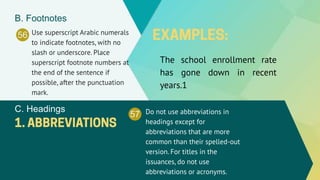
and Liquidation.
DepEd is an abbreviation, a shortened version of
the Department of Education. SBM is an acronym
or initialism. Acronyms are set in all capital
letters with no period in-between letters.
01
02 If a term is mentioned only once, use
the spelled-out form.
B. Articles and Abbreviations
If the acronym is read as a word,
avoid using an article before it.
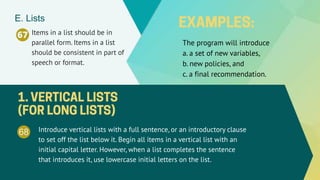
If the abbreviation or acronym is read
as a series of letters, use an article
before it.
DepEd has issued new instructions for
implementation. NEDA is an agency that plays a
big role in disaster risk reduction.
We will hold our convention at SEAMEO
INNOTECH.
05
06 Write acronyms in capital letters.
Write abbreviations in initial upper
case and lowercase, as relevant. In
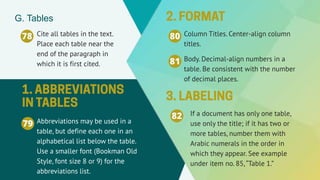
their spelled-out forms, capitalize
only the first letters of proper nouns.
World Health Organization (WHO)
Assistant Secretary (ASec)
Philippine Red Cross (PRC)
Undersecretary (Usec)
Department of Health (DOH)
Office of the Secretary (OSec)
C. Capitalization of Abbreviations
and Acronyms
D. Countries
Spell out country names in texts.
Abbreviate country names in tables
and lists. In certain technical
applications, it may be advisable to
use either the two-letter or three-
letter standard abbreviations based
on the English names of countries.
Check the International Organization
for Standardization (ISO) standard for
two-letter abbreviation and the UN
standard for three-letter abbreviation
for countries at:
https://www.worldatlas.com/
aatlas/ctycodes.htm
Philippines – PHL
Germany – GER
France – FR
Israel – IS
07
PHL and PH. PHL and/or PH is the International
Organization for Standardization initials for the
Philippines. RP is not used anymore to avoid
ambiguity. DFA Department Order No. 16- 10,
dated October 20, 2010, directs all DFA offices,
consulates general, and for permanent missions
to use PHL or PH.
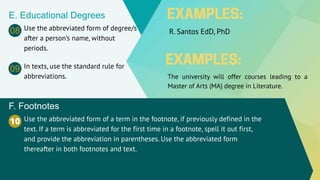
E. Educational Degrees
Use the abbreviated form of degree/s
after a person’s name, without
periods.
R. Santos EdD, PhD
08
10 Use the abbreviated form of a term in the footnote, if previously defined in the
text. If a term is abbreviated for the first time in a footnote, spell it out first,
and provide the abbreviation in parentheses. Use the abbreviated form
thereafter in both footnotes and text.
F. Footnotes
In texts, use the standard rule for
abbreviations.
09
The university will offer courses leading to a
Master of Arts (MA) degree in Literature.
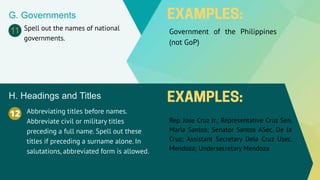
G. Governments
Spell out the names of national
governments.
Government of the Philippines
(not GoP)
11
Abbreviating titles before names.
Abbreviate civil or military titles
preceding a full name. Spell out these
titles if preceding a surname alone. In
salutations, abbreviated form is allowed.
Rep. Jose Cruz Jr.; Representative Cruz Sen.
Maria Santos; Senator Santos ASec. De la
Cruz; Assistant Secretary Dela Cruz Usec.
Mendoza; Undersecretary Mendoza
H. Headings and Titles
12
Social Titles. Abbreviate social
titles whether preceding the full
name or the surname. Spell out
“Doctor” in direct address.
Ms., Mr., Mrs. / Dr. Cruz / See you later,
Doctor.
H. Headings and Titles
13
Omit these titles when an
academic degree or professional
designation follows a name.
14
Juan Santos MD (not Dr. Juan Santos MD)
Reverend and Honorable. Use Rev.
and Hon. before a full name when
“the” does not precede the title.
Spell out the titles when used with
“the.”
15
Rev. Rey Reyes; the Reverend Rey Reyes Hon.
Mary Sison; the Honorable Mary Sison
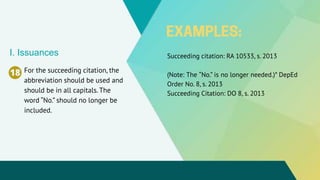
Issuances are spelled out at first
mention and are abbreviated
thereafter. Republic act,
administrative order, executive
order, and other legislations
should be abbreviated as RA, AO,
EO, respectively, and others—
without periods in-between
letters.The year series should be
included.
I. Issuances
16 At first mention, capitalize using
title case, with the abbreviated
word “No.” but the “s”, which stands
for series, should be in lowercase.
17
At first mention: Republic Act No. 10533, s.
2013
For the succeeding citation, the
abbreviation should be used and
should be in all capitals. The
word “No.” should no longer be
included.
I. Issuances
18
Succeeding citation: RA 10533, s. 2013
(Note: The “No.” is no longer needed.)* DepEd
Order No. 8, s. 2013
Succeeding Citation: DO 8, s. 2013
J. Non-English Terms
At first appearance, spell out first the
English translation of abbreviated
non-English terms, followed by the
non-English abbreviation in
parentheses.
Commission on the Filipino
Language (KWF)
19
20 Add lowercase “s” to indicate a plural abbreviation. Do not place an apostrophe
before the “s.”
K. Plurals
School Disaster Risk Reduction and
Management Plans (SDRRMPs)
L. Possessive
Add an apostrophe before the s to
indicate a possessive form. Do not
add ’s to the abbreviation or
acronym.
Department of Education’s
(DepEd) policies
21
22 Omit the period when abbreviating
educational degrees, names of countries
and other geographic locations,
government ministries and agencies,
institutions, or organizations.
M. Punctuation
PhD MA
USA DepEd
NEDA
23
N. Tables
List alphabetically and define any
abbreviation used in tables. Place
the definitions below the table.
Left-align text in first column.
Right-align all numbers. Table A: Enrollment Rate
II.
CAPITALIZATION
II. CAPITALIZATION
Use a capital letter to begin proper
nouns, sentences, headings, some
abbreviations and acronyms, and
the important words in composition
titles.
Pasig River, Pioneer Street, New York City
24
Capitalize the initial letter of
common nouns such as party, river,
and street when they are an integral
part of the full name of a place or
thing.
25 Filipinos, Americans, Indians, Arabs, Africans
Capitalize the initial letter of proper
names of nationalities, peoples,
races, tribes, and so on.
26
Philippine Constitution
A country’s constitution should be honored.
Capitalize the initial letter of specific
constitutions. Use lowercase “c” if the
constitution is used in a generic sense.
27
A. Educational Degrees/Grades
Use lowercase initial letter for
degrees and fellowships in text.
Capitalize all letters and abbreviate,
without a period, when used after a
person’s name.
She has a master’s degree in Philippine Studies.
Juan dela Cruz MD
For grade levels, capitalize initial letter:
She was enrolled in Kindergarten.
The pupil was accelerated from Grade 4 to
Grade 6.
28
29 Capitalize the initial letter of ethnic
and national groups.
Mangyan
Ilocano/Ilokano
Manobo
Bayuganon
B. Ethnic Groups
C. Government
Use initial capital letter for
“government” for formal and full
names of the governments. When
used in a generic sense, use the
lowercase letter for “government.”
Government of the Philippines
The government should provide basic social
services.
30
31 Capitalize initial letters of actual
names of meetings, conferences, and
forums. When used in a generic sense,
use lowercase initial letter.
We invite you to Ugnayan: A National
Conference on Resilience.
Our organization will conduct a national
conference on resilience next month.
D. Meetings, Conferences, and
Forums
E. Ministries, Departments, and
Other Government Bodies
Capitalize initial letters of full
names of national ministries and
departments and other permanent
bodies, but lowercase generic
references. When referring to the
Department of Education as ‘the
Department,’ capitalize “D.”
The Department of Education has drafted its
own annual plan. The Department will finalize
its plan by March.
Each department is responsible for drafting an
annual plan.
32
F. Committees
At first reference, spell out and
capitalize the initial letter of a
committee’s full name. Place
abbreviated form in parentheses
after the spelled-out form.
Lowercase “committee” when it
stands alone.
The Office Screening Committee (OSC) ranked
the applicants. The committee submitted the
ranking of applicants to the Personnel Selection
Board.
33
G. Organizations, Companies,
and Institutions
Capitalize initial letters of full
names of organizations, companies,
and institutions. No comma before
“Inc." or "Ltd.”
National Organization of Professional Teachers Inc.
34
H. Parts of a Document or
Publication
Capitalize initial letters of
references to annexes, appendixes,
boxes, enclosures, figures, maps,
and tables within a text.
Please refer to Table 1 for information on the
changes of budget throughout the years.
35
I. Political Parties, Religions,
and Religious Bodies
Capitalize initial letters of full
names of political parties and
religious bodies and of their
adherents.
Roman Catholic
He is a member of Jehovah’s Witnesses.
36
J. Plans, Policies, Programs,
Subprojects, Strategies, and
Laws
Capitalize initial letters of actual names of plans,
policies, treaties, acts, programs, subprojects, and
similar documents or agreements. Lowercase
initial letters when used in a generic sense, or
when their short form is used except for
Department issuances (e.g., order, memorandum).
Use lowercase initial letters for bills not yet
approved.
37
K to 12 Basic Education Program The Gawad Siklab
Search for Outstanding Student Government is
ongoing. The search is open to all student bodies
nationwide.
K. Titles
Capitalize initial letters for civil,
military, religious, and professional
titles when these immediately
precede a personal name.
Lowercase when following a name
or used in place of a name.
President Juan J. de los Santos; the president
Governor Mariano de la Cruz; the governor
Education Department Secretary Maria Santos; the
secretary
38
Once a title has been given, it need
not be repeated each time a
person’s name is mentioned. Cecilia Reyes, senator of the Philippines --Senator
Reyes
39
K. Titles
In promotional or ceremonial
contexts, such as a displayed list of
donors in a book or a list of
corporate officers in an annual
report, titles are usually capitalized
even when following a personal
name. Exceptions may be allowed
for reasons of courtesy or
diplomacy.
Josefa Ramos, Secretary of Education
40
Lowercase titles when used alone or
when set off descriptively from a name by
commas, often after a name. When
applicable, capitalize only the names of
departments, divisions, and other groups.
Maria Santos, Education Department Secretary
Maria Santos, secretary of the Department of
Education...
41
III.
CURRENCIES
AND EXCHANGE
RATES
III. CURRENCIES
AND EXCHANGE
RATES
Peso. For consistency with news
publications, use P instead of PhP when
referring to amounts and figures of
money. Do not place a space between
the currency and the number.
P500 or P10,000
42
43 Dollar. For instances where dollars refer to other
non-US currencies in a single work, they should
be specifically expressed. For formal usage, the
International Organization for Standardization’s
(ISO) three-letter codes should be used
https://www.iso.org/iso4217-currency-codes.html
Canadian dollar: CAD1,900
Singapore dollar: SGD525
US dollar: USD818
IV.
DATES
IV. DATES
The Chicago Manual of Style
recommends full capitals without
periods, in keeping with the general
guidelines.
AD - anno Domini (in the year of our Lord); AD
2013 BC - before Christ; 300 BC
44
45 Use numerals (with zeroes for even
hours) for exact times. Chicago Manual
of Style recommends lowercase a.m.
and p.m.
11:00 a.m. - ante meridiem (before noon) 12 p.m.
- meridiem (or 12 nn. [rarely used]) 1:00 p.m. -
post meridiem (after noon)
A. Systems of Chronology
B. Time of Day
The abbreviations a.m. and p.m.
should not be used with morning,
afternoon, evening, night, or o’clock.
See examples below for proper
usage.
10:30 a.m. or ten-thirty in the morning 11:00
p.m. or eleven o’clock at night
46
47 Write month, day, comma, and then
year.
December 25, 2018
C. Date Format
48 Except for correspondence and DepEd issuances,
abbreviate Jan., Feb., Mar., Apr., Jul., Aug., Sept., Oct., Nov.,
and Dec., when used with a specific date. Spell out the
names of months when using a month alone or with a
year alone. If space is limited, use the shortened form.
Apr. 27, 2018
(No comma after month)
1900s, 1980s, (formal)
‘80s,‘90s (informal)
49 Do not use an apostrophe
before “s” to signify
decades.
D. Decades
V.
FORMATTING
To emphasize any item in a
document, use boldface. Do not
italicize, underline or put in
quotation marks. To emphasize any
item in issuances, use boldface.
50
51 Enclosure is part of a document;
annex or attachment is an extra
material that is part of the
enclosure.
A. Annexes and Enclosures
52 For acronyms and abbreviations used more than once in the appendix,
spell out the term on first mention, then provide the acronym or
abbreviation in parentheses after the word. Use the acronym or
abbreviated form thereafter.
53 Restart footnote numbering of each appendix to 1. Do not
continue numbering from the main text. Each appendix
footnote numbering should start with 1.
54 Page numbering of enclosures should start from 1.
Annexes should start from A
55 Enclosures/Appendixes must be cited in the main text, and in
the enclosure/appendix list, these should appear in the order
in which they are cited in the main text.
56 Use superscript Arabic numerals
to indicate footnotes, with no
slash or underscore. Place
superscript footnote numbers at
the end of the sentence if
possible, after the punctuation
mark.
B. Footnotes
The school enrollment rate
has gone down in recent
years.1
57 Do not use abbreviations in
headings except for
abbreviations that are more
common than their spelled-out
version. For titles in the
issuances, do not use
abbreviations or acronyms.
C. Headings
58 Use title case for headings, except for the nonessential words
(articles, prepositions).
59 The optimum number of heading levels is three, maximum is
four. Indent appropriately. Sample as follows:
60 Place figures immediately after
the paragraph where they are
cited. Label the figures using
Arabic numerals. Provide a title
for each figure.
D. Figures
61 Avoid using color on figures. You
may use shades of black for bar
charts and graphs.
62 Place figures in a box, along with
its title. Provide a list of
abbreviations at the bottom of
the figure (in alphabetical order).
Provide the source/s of each
figure.
63
64
65
66
Figures need to be able to stand alone,
separate from the text.Thus, they
should contain their own abbreviations
list and other explanatory material,
placed at the bottom.
Use superscript lowercase letters
for footnote indicators.
List abbreviations in alphabetical
order, with their definitions.
Provide a source for every figure. For figures with several sources,
list the sources in alphabetical order (by author). Be precise when
identifying sources to ensure that interested readers or
researchers could find them. See sample above.
67 Items in a list should be in
parallel form. Items in a list
should be consistent in part of
speech or format.
E. Lists
68 Introduce vertical lists with a full sentence, or an introductory clause
to set off the list below it. Begin all items in a vertical list with an
initial capital letter. However, when a list completes the sentence
that introduces it, use lowercase initial letters on the list.
The program will introduce
a. a set of new variables,
b. new policies, and
c. a final recommendation.
69 Use a period if the item
in a vertical list is a full
sentence or can be read
as an imperative.
The reasons for the low rate of enrollment are
listed below. a. Parents do not have sufficient
funds for tuition. b. Overage children are hesitant
to attend school. c. Schools are not accessible.
70 For lists that complete a
whole sentence, separate
items in the list with a
comma unless there is a
comma within the list—in
which case separate items
in the list with a
semicolon.
The success of the school can be attributed to
a. capacity building of the school administrators,
teachers, and principals;
b. improved information and communications
technology;
c. complete set of instructional materials; and
d. rehabilitated school buildings.
71 Use bullets or lowercase
alphabetized letters for
the items on the list.
Lists should be
numbered when a
hierarchy of importance
exists or when the
number of items is
important.
The new project will include the following
equipment:
a. vehicles,
b. printing machines, and
c. photocopy machines.
72 Use a colon when the
introduction to the list is
not a full sentence.
The following materials are included in
a go-bag for emergencies:
a. Important documents,
b. Medicine,
c. Flashlight,
d. Extra clothes, and
e. Money.
73 List countries, provinces,
cities, and organizations in
alphabetical order, unless a
reason for an alternative
arrangement is given.
74 Avoid using “respectively” and “former ...
latter,” because they require the reader to
reread the sentence and match up the
different parts.
75 Avoid using “namely.”
76 Use lowercase Roman
numerals without
parentheses for preliminary
pages. Use Arabic numerals
for all other pages.
F. Page Numbers
77 Place page numbers at the bottom of the
page, right-aligned, for odd-numbered pages.
Place page numbers at the bottom of the
page, left-aligned, for even-numbered pages.
78 Cite all tables in the text.
Place each table near the
end of the paragraph in
which it is first cited.
G. Tables
79 Abbreviations may be used in a
table, but define each one in an
alphabetical list below the table.
Use a smaller font (Bookman Old
Style, font size 8 or 9) for the
abbreviations list.
80 Column Titles. Center-align column
titles.
81 Body. Decimal-align numbers in a
table. Be consistent with the number
of decimal places.
82 If a document has only one table,
use only the title; if it has two or
more tables, number them with
Arabic numerals in the order in
which they appear. See example
under item no. 85,“Table 1.”
83
84
85
Provide a short table title.
Place the title after the table
number, and center the table
number and title across the
columns. Place the table
number and title outside the
table. See example under
number 85.
Indicate the unit of measurement
used in the table. Place this below
the table title.
Use regular font on titles.
86
87
88
Consider placing large tables
(more than one page) as
appendixes.
Tables should be able to stand
alone. Place all explanatory
material immediately below the
table, including abbreviations,
footnotes, and sources.
When numbering in a table, use a period
after every number. Roman numerals
could also be used. Avoid using the
closing parenthesis.
89
90
91
92
Round off numbers to just two
decimal places, unless there is a
special reason specified. Be
consistent with the number of
decimal places used within a
table.
Provide a source for all tables.
Define all symbols below the table along
with abbreviations, if any. Use an en dash to
denote negative numbers.
Use either complete sentences or
sentence fragments consistently
throughout a table. Use bullets for each
entry, and center column title.
VI.
LANGUAGE
USAGE
93 Use gender-neutral language.
Avoid using the masculine
gender when the gender is not
known. See samples of gender-
neutral language in Appendix 2.
A. Gender References
94 Eliminate language that could
potentially affect sensibilities in
terms of religion, race, and the
like. See samples of politically
correct terms in Appendix 2.
B. Politically Correct Terms
95 Write non-English terms in italics
and provide their English
translation in parentheses after
the word, or in a footnote, at first
appearance. Italicize the non-
English term throughout the
document.
C. Non-English Terms
ceteris paribus (all things being equal)
96 Do not italicize local proper
nouns, e.g., names of agencies,
institutions, or organizations.
VII.
NUMBERS
97 Spell out numbers from one to
nine. Spell out a number used as
the first word of a sentence. It is
better to reword when a spelled-
out number will consist of many
words.
A. Numerals or Words
98 Numbers with four or more
digits should also be in
numerical form and separated by
commas.
50,000–1,000,000
Eleven pupils from Taguig Elementary
School made it to the final round. About
50,000 high school students took the
assessment test.
99 First to ninth are spelled out.
Tenth onwards should be
written as 10th, and so on.
A. Numerals or Words
100 Fractions are spelled out and
hyphenated.
One-third of the student population One-half of
the learners
21st century 10th DepEd Anniversary
101 Use figures for the following:
Ages
Grade/Year Levels
Series of numbers in the same category
Statistical Data
Money
Hours/Time
Year
A. Numerals or Words
103
Avoid following the word for a
number with a figure in
parentheses for the same
number unless for legal
purposes.
Regions I–XII
Regional Offices I–XII
102 Use Roman Numerals when
indicating the DepEd regions.
Avoid:
Eight (8)
Ten (10)
B. Negative Numbers
104 Use an en dash to signify
negative numbers in texts.
105 In text, write out all negative
numbers as numerals, preceded
by an en dash. When providing a
plus-or-minus range, place “±”
before the number without a
space. In tables, use an en dash
for negative numbers.
C. Very Large Numbers
25.6 million
76 billion
five trillion
106Very large numbers (in the
millions or more) should be
expressed in the form of numeral
and spelled-out word, especially
when they are fractional. Except
in years, page numbers, and
serial numbers, insert a comma
every three digits.
D. Percent
107 When used in press releases and
speeches, spell out “percent” rather than
in its symbol form (%). If the article uses
“percent” three times or more, use the
symbol “%” instead of the word “percent.”
Use % in infographics. For issuances, use
the spelled-out form.
108
Write decimals with a period, not
a comma. Use a maximum of two
decimal places, unless a reason is
specified.
E. Decimals
F. Fractions
109 In a text, spell out fractions and
hyphenate.
G. Rounding
110 Round up numbers 0.5 and
above; round down numbers
below 0.5.
VIII.
ORGANIZATIONS
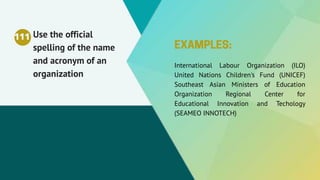
Use the official
spelling of the name
and acronym of an
organization
International Labour Organization (ILO)
United Nations Children's Fund (UNICEF)
Southeast Asian Ministers of Education
Organization Regional Center for
Educational Innovation and Techology
(SEAMEO INNOTECH)
111
IX.
WORD CLASS
Use the definite article “the” to
restrict or particularize a noun
and an indefinite article (“a” or
“an”) when the identity of the
noun, is not specified or fixed.
A. Articles
112 114 Exception. Retain the “s” if a phrase
sounds unnatural or misleading
without it.
human resources budget
results framework
skills training
training needs assessment
schools division memorandum
B. Nouns Used as Adjectives
In general, make nouns
singular when they are used as
adjectives.
113
Verbals are verb forms that
could function either as a
noun (gerund) or an adjective
(participle). There are three
verbals—gerund, participle,
and infinitive. Gerunds end in -
ing and functions as a noun.
Participles function as an
adjective. Infinitives usually
take the form of “..to + verb”
and also function as nouns.
C. Verbals
115
Reading is the student’s favorite hobby.
To win the championship was one of
the student’s dreams.
Crying salty tears, the accuser narrated
her experience.
X.
PUNCTUATION
Use an apostrophe to show
that one or more letters have
been omitted from a word to
form a contraction. Limit the
use of contractions unless in
dialogs or scripts.
A. Apostrophe
116 117 An apostrophe is also used in place of
omitted letters or numbers.
Class of ’80 (1980)
Ma’am (Madam)
he’d (he would) be assigned
it’s (it is) an assessment
it’ll (it will) be announced
An apostrophe with the letter –s
is added to the end of most
nouns to indicate the possessive
form. This includes nouns that
end in –s, whether the –s is
pronounced or not. For common
nouns in plural form ending in –
s, or proper nouns (such as names
of countries or organizations),
which are plural in form and
ending in –s, add an apostrophe
only.
A. Apostrophe
118
Children’s hour
Philippines’ role
Brackets are usually used in
transcriptions for “silent” editing.
These are also used in
transcriptions that have poor
recording. In this case, the editor
resorts to suggesting words that
can complete a statement.
Brackets are used to indicate that
the editor has added a particular
word or rephrased a statement in
a transcription.
B. Brackets
119
BARMM [Bangsamoro Autonomous
Region in Muslim Mindanao]
CALABARZON [Cavite, Laguna, Batangas,
Rizal, Quezon]
CAR [Cordillera Administrative Region]
Caraga [Region XIII]
MIMAROPA [Mindoro, Marinduque,
Romblon, Palawan]
SOCCSKSARGEN (North Cotabato,
Sarangani, South Cotabato, Sultan
Kudarat, Cotabato City, General Santos
City, Kidapawan City, Koronadal City and
Tacurong City)*
A colon is used to introduce a list
of specific items in a sentence.
C. Colon
120
The glove compartment
contained three items:
a. a torchlight,
b. a pack of batteries, and
c. a black trash bag.
It is also used to introduce
subtitles.
121
Effective Oral Communication
Skills and Strategies: How to
Teach Confidently, Eloquently,
and Passionately
Use a colon after the salutation
of a business letter.
C. Colon
122
Your Excellency:
Dear Mr. Rosales:
Use a colon when indicating
references to the main text of a
DepEd Memorandum/ DepEd Order.
When the referenced numbers are
more than one, use a colon before
listing the nos
124
References:
DepEd Memorandum No. 45, s.
2018
DepEd Memorandum: Nos. 63,
68, and 93, s. 2016
Use a colon to formally introduce
a question or a quotation.
123
The national scientist explained to the
Congress: “Why is it important to
protect the environment?”
Exception: If there is only one reference, there is no
need to insert a colon before the “no.”
A comma indicates a division in a
sentence, as in setting off a word,
phrase, or clause; to separate
items in a list; to mark off
thousands in numerals; and to
separate types or levels of
information in bibliographic and
other data.
D. Comma
125 When enumerating a series of three or
more elements, separate the elements
with commas.
126
The learners, teachers, and the
researchers worked overnight to
meet the deadline.
123
If the last element in a series
consists of paired elements
joined by and, place a comma
before that element.
127
The author wrote additional
lessons, the managing editor
proofread the proofs, and the
editorial assistant implemented
the corrections and coordinated
with the layout artists.
Use a comma to separate two clauses
of a compound sentence joined by
conjunctions (but, and, nor, for, so, yet,
or).
128
The President hailed the
Supreme Court decision, and the
senators and congressmen
concurred.
D. Comma
If the compound clauses are
short and related, the comma is
needed.
129
The teachers sang, and the
students danced.
Place a comma to set off phrases and
clauses within a sentence.
130
Republic Act No. 10533,
otherwise known as the
Enhanced Basic Education Act of
2013 (K to 12 Law), was signed
into law on May 15, 2017.
D. Comma
Use a comma to separate an
independent clause in a
sentence.
131
The chosen work schedule of
the employees shall be their
fixed work schedule, which may
be changed only after 6 months.
Commas are not required around Jr. and
Sr., and they are never used to set off II, III,
and the like when these are used as part
of a name. In an inverted name, however
(as in an index), a comma is required
before such an element, which comes last.
132
President Juan de la Cruz II was
the predecessor of President
Carlo Reyes.
D. Comma
Commas are not required around
Inc., Ltd., and such as part of a
company.
133
The Philippine Professional Linkage
from Various Disciplines Inc. will
conduct the International Seminar
on Leadership and Management
from August 12 to 14, 2016 at the
Baguio Teachers Camp, Baguio City.
D. Comma
Use an en dash (–) to
connect ranges of numbers
for dates, times, pages, or
references.
134
The School Year 2018–2019 will
formally open on Monday, June 4,
2018. The relevant paragraphs can
be found on pages 89–90.
E. Dashes
An em dash (—) may replace
commas, parentheses, and colons, in
parenthetical phrases. They may
emphasize a break or an explanatory
expression. Do not add spaces
before and after an em dash.
135
Three Filipino heroes—Jose Rizal,
Apolinario Mabini, and Andres
Bonifacio—are three of the heroes
honored in the country.
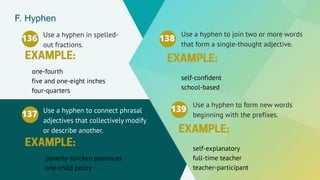
Use a hyphen in spelled-
out fractions.
136
one-fourth
five and one-eight inches
four-quarters
F. Hyphen
Use a hyphen to join two or more words
that form a single-thought adjective.
138
self-confident
school-based
Use a hyphen to connect phrasal
adjectives that collectively modify
or describe another.
137
poverty-stricken provinces
one-child policy
Use a hyphen to form new words
beginning with the prefixes.
139
self-explanatory
full-time teacher
teacher-participant
Use a hyphen to join a
number and a unit of
measure to form an
adjectival phrase.
140
10-kilometer fun run
15-year old student
70-year old retiree
F. Hyphen
Hyphenate adjectival phrases.
141
spelled-out syllabus evidence-based
policy up-to-date technology
Do not hyphenate the word "email",
and words with "ly"
142
He sent out an email to the staff.
newly appointed director
Use square brackets for
parenthetical elements
within the parentheses
143
The situation of the barangay
(referring to the local
government unit [LGU]) was
improving in terms of
infrastructure.
G. Parentheses
Use a period to mark the
end of a declarative or
imperative sentence.
144
The K to 12 Basic Education Program
is a flagship reform program of the
Department of Education (DepEd), in
close collaboration with various
education sectors, particularly the
Commission on Higher Education
(CHED) and the Technical Education
and Skills Development Authority
(TESDA).
H. Period
Place the period before
double or single closing
quotation marks.
145
A lawmaker described the
regime as a “kleptocracy.”
H. Period
When parentheses enclose a complete
and independent sentence, place the
period inside.
146
Observe the changes that happened.
(You may use a magnifying lens to
see the changes more clearly.)
If the parentheses enclose
a phrase or a word, place
the period outside.
147
Birds generate much heat from
their own metabolism (that is
the sum of all the chemical
changes in the body).
H. Period
Do not place periods on acronyms.
149
ECCD [Early Childhood Care and
Development]
SBM [School-Based Management]
Place periods after abbreviations.
148
Mr. and Mrs. Santos
Place periods after initials.
150
His Excellency Mario M. De Leon
Place a question mark at
the end of a direct question.
Do not use a question mark
after an indirect question.
151
How long will it take for
humans to reach Jupiter?
The teacher asked how many
students were absent.
I. Question Mark
Punctuation marks after
quoted text should be
placed within the quotation
marks. Commas that are
followed by attributive
statements should be
placed inside the quotation
marks as well. Only colons
(:) and semicolons (;) are
written outside the
quotation marks. Use
double quotation marks.
152
“The painting was sold at the
auction.”
The data were gathered from
the publications "The
Demographics of Metro
Manila"; "Indicators of
Population"; and "Handbook of
Statistics."
J. Quotation Marks
Set off direct quotations
with quotation marks. Place
only the exact quoted
words within the quotation
marks
153
The report cited the occurrence
as “statistically insignificant.”
J. Quotation Marks
Do not use any punctuation before a
quotation introduced by “that” or
“which,” or a similar conjunction.
154
The teacher said that the student will
“do well” in class.
The trainer was very good, which
made the participants perform
“exceedingly well."
When the items in a series
are complex or involve
internal punctuation,
separate them with a
semicolon.
155
The National Capital Region (NCR)
bagged a total of 95 medals; Region
III, 87; Region IV-A (CALABARZON),
75; Caraga, 69; Region X, 58; and the
Cordillera Administrative Region
(CAR), 52.
K. Semicolon
Use a semicolon to join two
independent clauses that are not
connected by a coordinate
conjunction.
156
The President hailed the Supreme
Court decision; the senators and
representatives also concurred with it.
XI.
REFERENCES
157 Cite all quoted or referenced
materials correctly and
completely in a footnote.
Italicize all publication titles
throughout a document
(except when using the
acronym).
The Chicago Manual of Style (CMOS)
is a reference book of many
publishers. The CMOS is the style
guide of choice for American
English.
158 Cite quoted or referenced
material from an electronic
source correctly and as
completely as possible in a
footnote.
159 Do not add a period after a
URL. Do not underline URLs.
Department of Education.
http://www.deped.gov.ph/
XII.
SPELLING
160
161
162
Use American spelling.
Consult the Merriam-Webster
dictionary (www.m-w.com)
for correct spellings if
unsure.
For Filipino words, use the
UP Diksiyonaryong Filipino,
Binagong Edisyon (2010) or
the Diksiyonaryong Filipino
(Komisyon ng Wikang
Filipino).
American English is to be
used consistently for all
documents, including
issuances. Exceptions are:
advisor and trainor. DepEd
prefers adviser and trainer.
163
164
The spelling of proper nouns
are retained, e.g.,
Organisation for Economic
Co-operation and
Development.
Words that have the same
singular and plural forms
163
164
The spelling of proper nouns
are retained, e.g.,
Organisation for Economic
Co-operation and
Development.
Words that have the same
singular and plural forms
APPENDIXE
S
https://www.deped.gov.ph/wp-content/uploads/2019/10/DO_s2019_030-2.pdf
THE DEPARTMENT OF EDUCATION
MANUAL OF STYLE
Read More
THANK YOU

DO 30 S. 2019.pptx

  • 1.
  • 3.
  • 4.
  • 5.
    PRINCIPLES OF EFFECTIVE BUSINESSWRITING Ensure that your writing observes the following principles: CLARITY. Keep it clear and simple. Avoid using jargon. Use the active voice as much as possible. CONCISENESS. Keep it short, brief, and direct to the point. COMPLETENESS. Provide complete and necessary information. CONCRETENESS. Avoid vague terms and language. Do not use idiomatic expressions and figures of speech.
  • 6.
    PRINCIPLES OF EFFECTIVE BUSINESSWRITING Ensure that your writing observes the following principles: CONSISTENCY. Ensure that your documents are consistent in spelling, grammar, punctuation, hyphenation, capitalization, typeface (bold, italic, underlined, among others), and abbreviation. COHERENCE. Follow a logical sequence in your discourse. COURTESY. Always build goodwill in your communications. Be polite and courteous to your readers.
  • 7.
  • 8.
    I. ABBREVIATIONS If anabbreviation or acronym appears more than once in a document, spell it out at first mention in documents, issuances, and press releases. Enclose the abbreviation and acronym in parentheses after the full form or spelled-out term, and then use the abbreviation or acronym in succeeding paragraphs. The Department of Education (DepEd) shall continue to provide School-Based Management (SBM) grants to public schools. To augment the school funds, DepEd, through the School Effectiveness Division, shall manage the allocation of SBM grants based on the SBM Guidelines on Availment, Release, Utilization, and Liquidation. DepEd is an abbreviation, a shortened version of the Department of Education. SBM is an acronym or initialism. Acronyms are set in all capital letters with no period in-between letters. 01 02 If a term is mentioned only once, use the spelled-out form.
  • 9.
    B. Articles andAbbreviations If the acronym is read as a word, avoid using an article before it. If the abbreviation or acronym is read as a series of letters, use an article before it. DepEd has issued new instructions for implementation. NEDA is an agency that plays a big role in disaster risk reduction. We will hold our convention at SEAMEO INNOTECH. 05 06 Write acronyms in capital letters. Write abbreviations in initial upper case and lowercase, as relevant. In their spelled-out forms, capitalize only the first letters of proper nouns. World Health Organization (WHO) Assistant Secretary (ASec) Philippine Red Cross (PRC) Undersecretary (Usec) Department of Health (DOH) Office of the Secretary (OSec) C. Capitalization of Abbreviations and Acronyms
  • 10.
    D. Countries Spell outcountry names in texts. Abbreviate country names in tables and lists. In certain technical applications, it may be advisable to use either the two-letter or three- letter standard abbreviations based on the English names of countries. Check the International Organization for Standardization (ISO) standard for two-letter abbreviation and the UN standard for three-letter abbreviation for countries at: https://www.worldatlas.com/ aatlas/ctycodes.htm Philippines – PHL Germany – GER France – FR Israel – IS 07 PHL and PH. PHL and/or PH is the International Organization for Standardization initials for the Philippines. RP is not used anymore to avoid ambiguity. DFA Department Order No. 16- 10, dated October 20, 2010, directs all DFA offices, consulates general, and for permanent missions to use PHL or PH.
  • 11.
    E. Educational Degrees Usethe abbreviated form of degree/s after a person’s name, without periods. R. Santos EdD, PhD 08 10 Use the abbreviated form of a term in the footnote, if previously defined in the text. If a term is abbreviated for the first time in a footnote, spell it out first, and provide the abbreviation in parentheses. Use the abbreviated form thereafter in both footnotes and text. F. Footnotes In texts, use the standard rule for abbreviations. 09 The university will offer courses leading to a Master of Arts (MA) degree in Literature.
  • 12.
    G. Governments Spell outthe names of national governments. Government of the Philippines (not GoP) 11 Abbreviating titles before names. Abbreviate civil or military titles preceding a full name. Spell out these titles if preceding a surname alone. In salutations, abbreviated form is allowed. Rep. Jose Cruz Jr.; Representative Cruz Sen. Maria Santos; Senator Santos ASec. De la Cruz; Assistant Secretary Dela Cruz Usec. Mendoza; Undersecretary Mendoza H. Headings and Titles 12
  • 13.
    Social Titles. Abbreviatesocial titles whether preceding the full name or the surname. Spell out “Doctor” in direct address. Ms., Mr., Mrs. / Dr. Cruz / See you later, Doctor. H. Headings and Titles 13 Omit these titles when an academic degree or professional designation follows a name. 14 Juan Santos MD (not Dr. Juan Santos MD) Reverend and Honorable. Use Rev. and Hon. before a full name when “the” does not precede the title. Spell out the titles when used with “the.” 15 Rev. Rey Reyes; the Reverend Rey Reyes Hon. Mary Sison; the Honorable Mary Sison
  • 14.
    Issuances are spelledout at first mention and are abbreviated thereafter. Republic act, administrative order, executive order, and other legislations should be abbreviated as RA, AO, EO, respectively, and others— without periods in-between letters.The year series should be included. I. Issuances 16 At first mention, capitalize using title case, with the abbreviated word “No.” but the “s”, which stands for series, should be in lowercase. 17 At first mention: Republic Act No. 10533, s. 2013
  • 15.
    For the succeedingcitation, the abbreviation should be used and should be in all capitals. The word “No.” should no longer be included. I. Issuances 18 Succeeding citation: RA 10533, s. 2013 (Note: The “No.” is no longer needed.)* DepEd Order No. 8, s. 2013 Succeeding Citation: DO 8, s. 2013
  • 16.
    J. Non-English Terms Atfirst appearance, spell out first the English translation of abbreviated non-English terms, followed by the non-English abbreviation in parentheses. Commission on the Filipino Language (KWF) 19 20 Add lowercase “s” to indicate a plural abbreviation. Do not place an apostrophe before the “s.” K. Plurals School Disaster Risk Reduction and Management Plans (SDRRMPs)
  • 17.
    L. Possessive Add anapostrophe before the s to indicate a possessive form. Do not add ’s to the abbreviation or acronym. Department of Education’s (DepEd) policies 21 22 Omit the period when abbreviating educational degrees, names of countries and other geographic locations, government ministries and agencies, institutions, or organizations. M. Punctuation PhD MA USA DepEd NEDA
  • 18.
    23 N. Tables List alphabeticallyand define any abbreviation used in tables. Place the definitions below the table. Left-align text in first column. Right-align all numbers. Table A: Enrollment Rate
  • 19.
  • 20.
    II. CAPITALIZATION Use acapital letter to begin proper nouns, sentences, headings, some abbreviations and acronyms, and the important words in composition titles. Pasig River, Pioneer Street, New York City 24 Capitalize the initial letter of common nouns such as party, river, and street when they are an integral part of the full name of a place or thing. 25 Filipinos, Americans, Indians, Arabs, Africans Capitalize the initial letter of proper names of nationalities, peoples, races, tribes, and so on. 26 Philippine Constitution A country’s constitution should be honored. Capitalize the initial letter of specific constitutions. Use lowercase “c” if the constitution is used in a generic sense. 27
  • 21.
    A. Educational Degrees/Grades Uselowercase initial letter for degrees and fellowships in text. Capitalize all letters and abbreviate, without a period, when used after a person’s name. She has a master’s degree in Philippine Studies. Juan dela Cruz MD For grade levels, capitalize initial letter: She was enrolled in Kindergarten. The pupil was accelerated from Grade 4 to Grade 6. 28 29 Capitalize the initial letter of ethnic and national groups. Mangyan Ilocano/Ilokano Manobo Bayuganon B. Ethnic Groups
  • 22.
    C. Government Use initialcapital letter for “government” for formal and full names of the governments. When used in a generic sense, use the lowercase letter for “government.” Government of the Philippines The government should provide basic social services. 30 31 Capitalize initial letters of actual names of meetings, conferences, and forums. When used in a generic sense, use lowercase initial letter. We invite you to Ugnayan: A National Conference on Resilience. Our organization will conduct a national conference on resilience next month. D. Meetings, Conferences, and Forums
  • 23.
    E. Ministries, Departments,and Other Government Bodies Capitalize initial letters of full names of national ministries and departments and other permanent bodies, but lowercase generic references. When referring to the Department of Education as ‘the Department,’ capitalize “D.” The Department of Education has drafted its own annual plan. The Department will finalize its plan by March. Each department is responsible for drafting an annual plan. 32
  • 24.
    F. Committees At firstreference, spell out and capitalize the initial letter of a committee’s full name. Place abbreviated form in parentheses after the spelled-out form. Lowercase “committee” when it stands alone. The Office Screening Committee (OSC) ranked the applicants. The committee submitted the ranking of applicants to the Personnel Selection Board. 33
  • 25.
    G. Organizations, Companies, andInstitutions Capitalize initial letters of full names of organizations, companies, and institutions. No comma before “Inc." or "Ltd.” National Organization of Professional Teachers Inc. 34 H. Parts of a Document or Publication Capitalize initial letters of references to annexes, appendixes, boxes, enclosures, figures, maps, and tables within a text. Please refer to Table 1 for information on the changes of budget throughout the years. 35
  • 26.
    I. Political Parties,Religions, and Religious Bodies Capitalize initial letters of full names of political parties and religious bodies and of their adherents. Roman Catholic He is a member of Jehovah’s Witnesses. 36 J. Plans, Policies, Programs, Subprojects, Strategies, and Laws Capitalize initial letters of actual names of plans, policies, treaties, acts, programs, subprojects, and similar documents or agreements. Lowercase initial letters when used in a generic sense, or when their short form is used except for Department issuances (e.g., order, memorandum). Use lowercase initial letters for bills not yet approved. 37 K to 12 Basic Education Program The Gawad Siklab Search for Outstanding Student Government is ongoing. The search is open to all student bodies nationwide.
  • 27.
    K. Titles Capitalize initialletters for civil, military, religious, and professional titles when these immediately precede a personal name. Lowercase when following a name or used in place of a name. President Juan J. de los Santos; the president Governor Mariano de la Cruz; the governor Education Department Secretary Maria Santos; the secretary 38 Once a title has been given, it need not be repeated each time a person’s name is mentioned. Cecilia Reyes, senator of the Philippines --Senator Reyes 39
  • 28.
    K. Titles In promotionalor ceremonial contexts, such as a displayed list of donors in a book or a list of corporate officers in an annual report, titles are usually capitalized even when following a personal name. Exceptions may be allowed for reasons of courtesy or diplomacy. Josefa Ramos, Secretary of Education 40 Lowercase titles when used alone or when set off descriptively from a name by commas, often after a name. When applicable, capitalize only the names of departments, divisions, and other groups. Maria Santos, Education Department Secretary Maria Santos, secretary of the Department of Education... 41
  • 29.
  • 30.
    III. CURRENCIES AND EXCHANGE RATES Peso.For consistency with news publications, use P instead of PhP when referring to amounts and figures of money. Do not place a space between the currency and the number. P500 or P10,000 42 43 Dollar. For instances where dollars refer to other non-US currencies in a single work, they should be specifically expressed. For formal usage, the International Organization for Standardization’s (ISO) three-letter codes should be used https://www.iso.org/iso4217-currency-codes.html Canadian dollar: CAD1,900 Singapore dollar: SGD525 US dollar: USD818
  • 31.
  • 32.
    IV. DATES The ChicagoManual of Style recommends full capitals without periods, in keeping with the general guidelines. AD - anno Domini (in the year of our Lord); AD 2013 BC - before Christ; 300 BC 44 45 Use numerals (with zeroes for even hours) for exact times. Chicago Manual of Style recommends lowercase a.m. and p.m. 11:00 a.m. - ante meridiem (before noon) 12 p.m. - meridiem (or 12 nn. [rarely used]) 1:00 p.m. - post meridiem (after noon) A. Systems of Chronology B. Time of Day
  • 33.
    The abbreviations a.m.and p.m. should not be used with morning, afternoon, evening, night, or o’clock. See examples below for proper usage. 10:30 a.m. or ten-thirty in the morning 11:00 p.m. or eleven o’clock at night 46 47 Write month, day, comma, and then year. December 25, 2018 C. Date Format 48 Except for correspondence and DepEd issuances, abbreviate Jan., Feb., Mar., Apr., Jul., Aug., Sept., Oct., Nov., and Dec., when used with a specific date. Spell out the names of months when using a month alone or with a year alone. If space is limited, use the shortened form. Apr. 27, 2018 (No comma after month)
  • 34.
    1900s, 1980s, (formal) ‘80s,‘90s(informal) 49 Do not use an apostrophe before “s” to signify decades. D. Decades
  • 35.
  • 36.
    To emphasize anyitem in a document, use boldface. Do not italicize, underline or put in quotation marks. To emphasize any item in issuances, use boldface. 50 51 Enclosure is part of a document; annex or attachment is an extra material that is part of the enclosure. A. Annexes and Enclosures 52 For acronyms and abbreviations used more than once in the appendix, spell out the term on first mention, then provide the acronym or abbreviation in parentheses after the word. Use the acronym or abbreviated form thereafter.
  • 37.
    53 Restart footnotenumbering of each appendix to 1. Do not continue numbering from the main text. Each appendix footnote numbering should start with 1.
  • 38.
    54 Page numberingof enclosures should start from 1. Annexes should start from A
  • 39.
    55 Enclosures/Appendixes mustbe cited in the main text, and in the enclosure/appendix list, these should appear in the order in which they are cited in the main text.
  • 40.
    56 Use superscriptArabic numerals to indicate footnotes, with no slash or underscore. Place superscript footnote numbers at the end of the sentence if possible, after the punctuation mark. B. Footnotes The school enrollment rate has gone down in recent years.1 57 Do not use abbreviations in headings except for abbreviations that are more common than their spelled-out version. For titles in the issuances, do not use abbreviations or acronyms. C. Headings
  • 41.
    58 Use titlecase for headings, except for the nonessential words (articles, prepositions). 59 The optimum number of heading levels is three, maximum is four. Indent appropriately. Sample as follows:
  • 43.
    60 Place figuresimmediately after the paragraph where they are cited. Label the figures using Arabic numerals. Provide a title for each figure. D. Figures 61 Avoid using color on figures. You may use shades of black for bar charts and graphs. 62 Place figures in a box, along with its title. Provide a list of abbreviations at the bottom of the figure (in alphabetical order). Provide the source/s of each figure.
  • 44.
    63 64 65 66 Figures need tobe able to stand alone, separate from the text.Thus, they should contain their own abbreviations list and other explanatory material, placed at the bottom. Use superscript lowercase letters for footnote indicators. List abbreviations in alphabetical order, with their definitions. Provide a source for every figure. For figures with several sources, list the sources in alphabetical order (by author). Be precise when identifying sources to ensure that interested readers or researchers could find them. See sample above.
  • 45.
    67 Items ina list should be in parallel form. Items in a list should be consistent in part of speech or format. E. Lists 68 Introduce vertical lists with a full sentence, or an introductory clause to set off the list below it. Begin all items in a vertical list with an initial capital letter. However, when a list completes the sentence that introduces it, use lowercase initial letters on the list. The program will introduce a. a set of new variables, b. new policies, and c. a final recommendation.
  • 46.
    69 Use aperiod if the item in a vertical list is a full sentence or can be read as an imperative. The reasons for the low rate of enrollment are listed below. a. Parents do not have sufficient funds for tuition. b. Overage children are hesitant to attend school. c. Schools are not accessible. 70 For lists that complete a whole sentence, separate items in the list with a comma unless there is a comma within the list—in which case separate items in the list with a semicolon. The success of the school can be attributed to a. capacity building of the school administrators, teachers, and principals; b. improved information and communications technology; c. complete set of instructional materials; and d. rehabilitated school buildings.
  • 47.
    71 Use bulletsor lowercase alphabetized letters for the items on the list. Lists should be numbered when a hierarchy of importance exists or when the number of items is important. The new project will include the following equipment: a. vehicles, b. printing machines, and c. photocopy machines.
  • 48.
    72 Use acolon when the introduction to the list is not a full sentence. The following materials are included in a go-bag for emergencies: a. Important documents, b. Medicine, c. Flashlight, d. Extra clothes, and e. Money.
  • 49.
    73 List countries,provinces, cities, and organizations in alphabetical order, unless a reason for an alternative arrangement is given. 74 Avoid using “respectively” and “former ... latter,” because they require the reader to reread the sentence and match up the different parts. 75 Avoid using “namely.”
  • 50.
    76 Use lowercaseRoman numerals without parentheses for preliminary pages. Use Arabic numerals for all other pages. F. Page Numbers 77 Place page numbers at the bottom of the page, right-aligned, for odd-numbered pages. Place page numbers at the bottom of the page, left-aligned, for even-numbered pages.
  • 51.
    78 Cite alltables in the text. Place each table near the end of the paragraph in which it is first cited. G. Tables 79 Abbreviations may be used in a table, but define each one in an alphabetical list below the table. Use a smaller font (Bookman Old Style, font size 8 or 9) for the abbreviations list. 80 Column Titles. Center-align column titles. 81 Body. Decimal-align numbers in a table. Be consistent with the number of decimal places. 82 If a document has only one table, use only the title; if it has two or more tables, number them with Arabic numerals in the order in which they appear. See example under item no. 85,“Table 1.”
  • 52.
    83 84 85 Provide a shorttable title. Place the title after the table number, and center the table number and title across the columns. Place the table number and title outside the table. See example under number 85. Indicate the unit of measurement used in the table. Place this below the table title. Use regular font on titles.
  • 53.
    86 87 88 Consider placing largetables (more than one page) as appendixes. Tables should be able to stand alone. Place all explanatory material immediately below the table, including abbreviations, footnotes, and sources. When numbering in a table, use a period after every number. Roman numerals could also be used. Avoid using the closing parenthesis.
  • 54.
    89 90 91 92 Round off numbersto just two decimal places, unless there is a special reason specified. Be consistent with the number of decimal places used within a table. Provide a source for all tables. Define all symbols below the table along with abbreviations, if any. Use an en dash to denote negative numbers. Use either complete sentences or sentence fragments consistently throughout a table. Use bullets for each entry, and center column title.
  • 55.
  • 56.
    93 Use gender-neutrallanguage. Avoid using the masculine gender when the gender is not known. See samples of gender- neutral language in Appendix 2. A. Gender References 94 Eliminate language that could potentially affect sensibilities in terms of religion, race, and the like. See samples of politically correct terms in Appendix 2. B. Politically Correct Terms 95 Write non-English terms in italics and provide their English translation in parentheses after the word, or in a footnote, at first appearance. Italicize the non- English term throughout the document. C. Non-English Terms ceteris paribus (all things being equal) 96 Do not italicize local proper nouns, e.g., names of agencies, institutions, or organizations.
  • 57.
  • 58.
    97 Spell outnumbers from one to nine. Spell out a number used as the first word of a sentence. It is better to reword when a spelled- out number will consist of many words. A. Numerals or Words 98 Numbers with four or more digits should also be in numerical form and separated by commas. 50,000–1,000,000 Eleven pupils from Taguig Elementary School made it to the final round. About 50,000 high school students took the assessment test.
  • 59.
    99 First toninth are spelled out. Tenth onwards should be written as 10th, and so on. A. Numerals or Words 100 Fractions are spelled out and hyphenated. One-third of the student population One-half of the learners 21st century 10th DepEd Anniversary 101 Use figures for the following: Ages Grade/Year Levels Series of numbers in the same category Statistical Data Money Hours/Time Year
  • 60.
    A. Numerals orWords 103 Avoid following the word for a number with a figure in parentheses for the same number unless for legal purposes. Regions I–XII Regional Offices I–XII 102 Use Roman Numerals when indicating the DepEd regions. Avoid: Eight (8) Ten (10) B. Negative Numbers 104 Use an en dash to signify negative numbers in texts. 105 In text, write out all negative numbers as numerals, preceded by an en dash. When providing a plus-or-minus range, place “±” before the number without a space. In tables, use an en dash for negative numbers.
  • 61.
    C. Very LargeNumbers 25.6 million 76 billion five trillion 106Very large numbers (in the millions or more) should be expressed in the form of numeral and spelled-out word, especially when they are fractional. Except in years, page numbers, and serial numbers, insert a comma every three digits. D. Percent 107 When used in press releases and speeches, spell out “percent” rather than in its symbol form (%). If the article uses “percent” three times or more, use the symbol “%” instead of the word “percent.” Use % in infographics. For issuances, use the spelled-out form. 108 Write decimals with a period, not a comma. Use a maximum of two decimal places, unless a reason is specified. E. Decimals
  • 62.
    F. Fractions 109 Ina text, spell out fractions and hyphenate. G. Rounding 110 Round up numbers 0.5 and above; round down numbers below 0.5.
  • 63.
  • 64.
    Use the official spellingof the name and acronym of an organization International Labour Organization (ILO) United Nations Children's Fund (UNICEF) Southeast Asian Ministers of Education Organization Regional Center for Educational Innovation and Techology (SEAMEO INNOTECH) 111
  • 65.
  • 66.
    Use the definitearticle “the” to restrict or particularize a noun and an indefinite article (“a” or “an”) when the identity of the noun, is not specified or fixed. A. Articles 112 114 Exception. Retain the “s” if a phrase sounds unnatural or misleading without it. human resources budget results framework skills training training needs assessment schools division memorandum B. Nouns Used as Adjectives In general, make nouns singular when they are used as adjectives. 113
  • 67.
    Verbals are verbforms that could function either as a noun (gerund) or an adjective (participle). There are three verbals—gerund, participle, and infinitive. Gerunds end in - ing and functions as a noun. Participles function as an adjective. Infinitives usually take the form of “..to + verb” and also function as nouns. C. Verbals 115 Reading is the student’s favorite hobby. To win the championship was one of the student’s dreams. Crying salty tears, the accuser narrated her experience.
  • 68.
  • 69.
    Use an apostropheto show that one or more letters have been omitted from a word to form a contraction. Limit the use of contractions unless in dialogs or scripts. A. Apostrophe 116 117 An apostrophe is also used in place of omitted letters or numbers. Class of ’80 (1980) Ma’am (Madam) he’d (he would) be assigned it’s (it is) an assessment it’ll (it will) be announced
  • 70.
    An apostrophe withthe letter –s is added to the end of most nouns to indicate the possessive form. This includes nouns that end in –s, whether the –s is pronounced or not. For common nouns in plural form ending in – s, or proper nouns (such as names of countries or organizations), which are plural in form and ending in –s, add an apostrophe only. A. Apostrophe 118 Children’s hour Philippines’ role
  • 71.
    Brackets are usuallyused in transcriptions for “silent” editing. These are also used in transcriptions that have poor recording. In this case, the editor resorts to suggesting words that can complete a statement. Brackets are used to indicate that the editor has added a particular word or rephrased a statement in a transcription. B. Brackets 119 BARMM [Bangsamoro Autonomous Region in Muslim Mindanao] CALABARZON [Cavite, Laguna, Batangas, Rizal, Quezon] CAR [Cordillera Administrative Region] Caraga [Region XIII] MIMAROPA [Mindoro, Marinduque, Romblon, Palawan] SOCCSKSARGEN (North Cotabato, Sarangani, South Cotabato, Sultan Kudarat, Cotabato City, General Santos City, Kidapawan City, Koronadal City and Tacurong City)*
  • 72.
    A colon isused to introduce a list of specific items in a sentence. C. Colon 120 The glove compartment contained three items: a. a torchlight, b. a pack of batteries, and c. a black trash bag. It is also used to introduce subtitles. 121 Effective Oral Communication Skills and Strategies: How to Teach Confidently, Eloquently, and Passionately
  • 73.
    Use a colonafter the salutation of a business letter. C. Colon 122 Your Excellency: Dear Mr. Rosales: Use a colon when indicating references to the main text of a DepEd Memorandum/ DepEd Order. When the referenced numbers are more than one, use a colon before listing the nos 124 References: DepEd Memorandum No. 45, s. 2018 DepEd Memorandum: Nos. 63, 68, and 93, s. 2016 Use a colon to formally introduce a question or a quotation. 123 The national scientist explained to the Congress: “Why is it important to protect the environment?” Exception: If there is only one reference, there is no need to insert a colon before the “no.”
  • 74.
    A comma indicatesa division in a sentence, as in setting off a word, phrase, or clause; to separate items in a list; to mark off thousands in numerals; and to separate types or levels of information in bibliographic and other data. D. Comma 125 When enumerating a series of three or more elements, separate the elements with commas. 126 The learners, teachers, and the researchers worked overnight to meet the deadline. 123
  • 75.
    If the lastelement in a series consists of paired elements joined by and, place a comma before that element. 127 The author wrote additional lessons, the managing editor proofread the proofs, and the editorial assistant implemented the corrections and coordinated with the layout artists. Use a comma to separate two clauses of a compound sentence joined by conjunctions (but, and, nor, for, so, yet, or). 128 The President hailed the Supreme Court decision, and the senators and congressmen concurred. D. Comma
  • 76.
    If the compoundclauses are short and related, the comma is needed. 129 The teachers sang, and the students danced. Place a comma to set off phrases and clauses within a sentence. 130 Republic Act No. 10533, otherwise known as the Enhanced Basic Education Act of 2013 (K to 12 Law), was signed into law on May 15, 2017. D. Comma
  • 77.
    Use a commato separate an independent clause in a sentence. 131 The chosen work schedule of the employees shall be their fixed work schedule, which may be changed only after 6 months. Commas are not required around Jr. and Sr., and they are never used to set off II, III, and the like when these are used as part of a name. In an inverted name, however (as in an index), a comma is required before such an element, which comes last. 132 President Juan de la Cruz II was the predecessor of President Carlo Reyes. D. Comma
  • 78.
    Commas are notrequired around Inc., Ltd., and such as part of a company. 133 The Philippine Professional Linkage from Various Disciplines Inc. will conduct the International Seminar on Leadership and Management from August 12 to 14, 2016 at the Baguio Teachers Camp, Baguio City. D. Comma
  • 79.
    Use an endash (–) to connect ranges of numbers for dates, times, pages, or references. 134 The School Year 2018–2019 will formally open on Monday, June 4, 2018. The relevant paragraphs can be found on pages 89–90. E. Dashes An em dash (—) may replace commas, parentheses, and colons, in parenthetical phrases. They may emphasize a break or an explanatory expression. Do not add spaces before and after an em dash. 135 Three Filipino heroes—Jose Rizal, Apolinario Mabini, and Andres Bonifacio—are three of the heroes honored in the country.
  • 80.
    Use a hyphenin spelled- out fractions. 136 one-fourth five and one-eight inches four-quarters F. Hyphen Use a hyphen to join two or more words that form a single-thought adjective. 138 self-confident school-based Use a hyphen to connect phrasal adjectives that collectively modify or describe another. 137 poverty-stricken provinces one-child policy Use a hyphen to form new words beginning with the prefixes. 139 self-explanatory full-time teacher teacher-participant
  • 81.
    Use a hyphento join a number and a unit of measure to form an adjectival phrase. 140 10-kilometer fun run 15-year old student 70-year old retiree F. Hyphen Hyphenate adjectival phrases. 141 spelled-out syllabus evidence-based policy up-to-date technology Do not hyphenate the word "email", and words with "ly" 142 He sent out an email to the staff. newly appointed director
  • 82.
    Use square bracketsfor parenthetical elements within the parentheses 143 The situation of the barangay (referring to the local government unit [LGU]) was improving in terms of infrastructure. G. Parentheses Use a period to mark the end of a declarative or imperative sentence. 144 The K to 12 Basic Education Program is a flagship reform program of the Department of Education (DepEd), in close collaboration with various education sectors, particularly the Commission on Higher Education (CHED) and the Technical Education and Skills Development Authority (TESDA). H. Period
  • 83.
    Place the periodbefore double or single closing quotation marks. 145 A lawmaker described the regime as a “kleptocracy.” H. Period When parentheses enclose a complete and independent sentence, place the period inside. 146 Observe the changes that happened. (You may use a magnifying lens to see the changes more clearly.)
  • 84.
    If the parenthesesenclose a phrase or a word, place the period outside. 147 Birds generate much heat from their own metabolism (that is the sum of all the chemical changes in the body). H. Period Do not place periods on acronyms. 149 ECCD [Early Childhood Care and Development] SBM [School-Based Management] Place periods after abbreviations. 148 Mr. and Mrs. Santos Place periods after initials. 150 His Excellency Mario M. De Leon
  • 85.
    Place a questionmark at the end of a direct question. Do not use a question mark after an indirect question. 151 How long will it take for humans to reach Jupiter? The teacher asked how many students were absent. I. Question Mark
  • 86.
    Punctuation marks after quotedtext should be placed within the quotation marks. Commas that are followed by attributive statements should be placed inside the quotation marks as well. Only colons (:) and semicolons (;) are written outside the quotation marks. Use double quotation marks. 152 “The painting was sold at the auction.” The data were gathered from the publications "The Demographics of Metro Manila"; "Indicators of Population"; and "Handbook of Statistics." J. Quotation Marks
  • 87.
    Set off directquotations with quotation marks. Place only the exact quoted words within the quotation marks 153 The report cited the occurrence as “statistically insignificant.” J. Quotation Marks Do not use any punctuation before a quotation introduced by “that” or “which,” or a similar conjunction. 154 The teacher said that the student will “do well” in class. The trainer was very good, which made the participants perform “exceedingly well."
  • 88.
    When the itemsin a series are complex or involve internal punctuation, separate them with a semicolon. 155 The National Capital Region (NCR) bagged a total of 95 medals; Region III, 87; Region IV-A (CALABARZON), 75; Caraga, 69; Region X, 58; and the Cordillera Administrative Region (CAR), 52. K. Semicolon Use a semicolon to join two independent clauses that are not connected by a coordinate conjunction. 156 The President hailed the Supreme Court decision; the senators and representatives also concurred with it.
  • 89.
  • 90.
    157 Cite allquoted or referenced materials correctly and completely in a footnote. Italicize all publication titles throughout a document (except when using the acronym). The Chicago Manual of Style (CMOS) is a reference book of many publishers. The CMOS is the style guide of choice for American English.
  • 91.
    158 Cite quotedor referenced material from an electronic source correctly and as completely as possible in a footnote. 159 Do not add a period after a URL. Do not underline URLs. Department of Education. http://www.deped.gov.ph/
  • 92.
  • 93.
    160 161 162 Use American spelling. Consultthe Merriam-Webster dictionary (www.m-w.com) for correct spellings if unsure. For Filipino words, use the UP Diksiyonaryong Filipino, Binagong Edisyon (2010) or the Diksiyonaryong Filipino (Komisyon ng Wikang Filipino). American English is to be used consistently for all documents, including issuances. Exceptions are: advisor and trainor. DepEd prefers adviser and trainer.
  • 94.
    163 164 The spelling ofproper nouns are retained, e.g., Organisation for Economic Co-operation and Development. Words that have the same singular and plural forms
  • 95.
    163 164 The spelling ofproper nouns are retained, e.g., Organisation for Economic Co-operation and Development. Words that have the same singular and plural forms
  • 96.
  • 99.
  • 100.