DNA REPLICATION
Name: B.Tharumathi
Submitted by: B.Tharumathi
Submitted To: dr. Sanmuga priya
Molecular Biology
II Bsc Biotechnology "B"
3
DNA replication:
• Complementarybase pairingproducessemiconservative
replication
–Double helix unwinds
–Each strand acts as template
–Complementary base pairing ensures that T signals
addition of A on new strand, and G signals addition of C
–Two daughter helices produced after replication
4
5
•Dispersive replication:
•Conservative replication:
Experimental proof of semiconservative replication
– three possible models
•Semiconservative replication –
– Watson and Crick model
–The parental double helixremains intact;
–both strands of the daughter double helix are newly
synthesized
–Atcompletion,bothstrands of both double helices contain
both original and newly synthesized material.
6
Meselson-Stahl experiments confirm
semiconservative replication
Fig. 6.16
7
• Experimentalloweddifferentiationofparentaland
newly formed DNA.
•Bacteria were grown in media containing either
normal isotope of nitrogen (14N) or the heavy
isotope (15N).
•DNA banded after equilibrium density gradient
centrifugation at a position which matched the
density of the DNA:
– heavy DNA was at a higher density than normal DNA.
8
Meselson-Stahl experiments confirm
semiconservative replication
•Whenbacteria grownin 15Nweretransferred
to normal 14N containing medium,
14
•They checked the composition of the resulting
DNA molecules by density gradient
centrifugation,
–foundan intermediateband,
–indicating a hybrid molecule
–containing both 14N and 15N DNA.
–thenewly synthesizedDNA strandhadthe N
while the parental strand had 15N.
9
15N
10
11
The mechanism of DNA replication
•
•
Two basic steps:
Two basic components:
• Tightly controlledprocess,
• Requires:
–aset ofproteinsand enzymes,
–and requiresenergy in the form of ATP.
– Initiation
– Elongation.
– template
– primer.
–occursatspecifictimesduring the cell cycle.
12
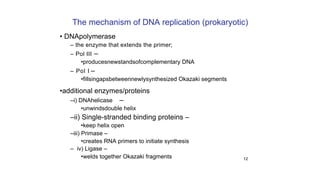
The mechanism of DNA replication (prokaryotic)
• DNApolymerase
–
–
•additional enzymes/proteins
–
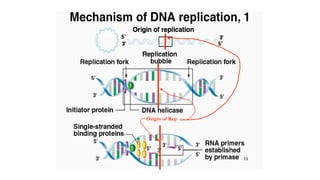
–i) DNAhelicase
•unwindsdouble helix
–ii) Single-stranded binding proteins –
•keep helix open
–iii) Primase –
•creates RNA primers to initiate synthesis
– iv) Ligase –
•welds together Okazaki fragments
– the enzyme that extends the primer;
– Pol III
•producesnewstandsofcomplementary DNA
– Pol I
•fillsingapsbetweennewlysynthesized Okazaki segments
13
Origin of Rep
14
Origins of Replication
•Replication proceeds in both directions
(bidirectionally) from a single origin of
replication on the prokaryotic circular
chromosome
•Replication proceeds in both directions
(bidirectionally) from hundreds or thousands
of origins of replication on each of the linear
eukaryotic chromosomes.
15
Origins of Replication
•Bacteria have 1 origin of
replication per one
chromosome
•They only have one
chromosome = 1 origin!
Molecular Biology of the Cell, 4th Edition.
16
Eukaryotic Origins of Replication
17
Replication Initiation
replication
• DNA origin of
•Initiator proteins bind
•Recruits DNA
helicase
•Opening of DNA
strands
Originof Rep
18
•Replication Initiation:
•Replication is Finished:
•Replication Elongation:
•DNA polIII
•DNA polI removes primer
•Fills gap using 3’ends
•DNA ligase connects frags
•Uses 5’ ends!
•Primase and the RNA Primer
•Musthave3’ to add to
Originof Rep
19
Replication Fork Origin of Rep
Thank you

DNA REPLICATION_20260106_095953_0000.pdf

  • 1.
    DNA REPLICATION Name: B.Tharumathi Submittedby: B.Tharumathi Submitted To: dr. Sanmuga priya Molecular Biology II Bsc Biotechnology "B"
  • 2.
    3 DNA replication: • Complementarybasepairingproducessemiconservative replication –Double helix unwinds –Each strand acts as template –Complementary base pairing ensures that T signals addition of A on new strand, and G signals addition of C –Two daughter helices produced after replication
  • 3.
  • 4.
    5 •Dispersive replication: •Conservative replication: Experimentalproof of semiconservative replication – three possible models •Semiconservative replication – – Watson and Crick model –The parental double helixremains intact; –both strands of the daughter double helix are newly synthesized –Atcompletion,bothstrands of both double helices contain both original and newly synthesized material.
  • 5.
  • 6.
    Meselson-Stahl experiments confirm semiconservativereplication Fig. 6.16 7 • Experimentalloweddifferentiationofparentaland newly formed DNA. •Bacteria were grown in media containing either normal isotope of nitrogen (14N) or the heavy isotope (15N). •DNA banded after equilibrium density gradient centrifugation at a position which matched the density of the DNA: – heavy DNA was at a higher density than normal DNA.
  • 7.
    8 Meselson-Stahl experiments confirm semiconservativereplication •Whenbacteria grownin 15Nweretransferred to normal 14N containing medium, 14 •They checked the composition of the resulting DNA molecules by density gradient centrifugation, –foundan intermediateband, –indicating a hybrid molecule –containing both 14N and 15N DNA. –thenewly synthesizedDNA strandhadthe N while the parental strand had 15N.
  • 8.
  • 9.
  • 10.
    11 The mechanism ofDNA replication • • Two basic steps: Two basic components: • Tightly controlledprocess, • Requires: –aset ofproteinsand enzymes, –and requiresenergy in the form of ATP. – Initiation – Elongation. – template – primer. –occursatspecifictimesduring the cell cycle.
  • 11.
    12 The mechanism ofDNA replication (prokaryotic) • DNApolymerase – – •additional enzymes/proteins – –i) DNAhelicase •unwindsdouble helix –ii) Single-stranded binding proteins – •keep helix open –iii) Primase – •creates RNA primers to initiate synthesis – iv) Ligase – •welds together Okazaki fragments – the enzyme that extends the primer; – Pol III •producesnewstandsofcomplementary DNA – Pol I •fillsingapsbetweennewlysynthesized Okazaki segments
  • 12.
  • 13.
    14 Origins of Replication •Replicationproceeds in both directions (bidirectionally) from a single origin of replication on the prokaryotic circular chromosome •Replication proceeds in both directions (bidirectionally) from hundreds or thousands of origins of replication on each of the linear eukaryotic chromosomes.
  • 14.
    15 Origins of Replication •Bacteriahave 1 origin of replication per one chromosome •They only have one chromosome = 1 origin! Molecular Biology of the Cell, 4th Edition.
  • 15.
  • 16.
    17 Replication Initiation replication • DNAorigin of •Initiator proteins bind •Recruits DNA helicase •Opening of DNA strands Originof Rep
  • 17.
    18 •Replication Initiation: •Replication isFinished: •Replication Elongation: •DNA polIII •DNA polI removes primer •Fills gap using 3’ends •DNA ligase connects frags •Uses 5’ ends! •Primase and the RNA Primer •Musthave3’ to add to Originof Rep
  • 18.
  • 19.