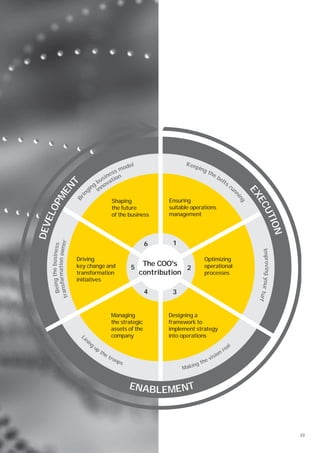
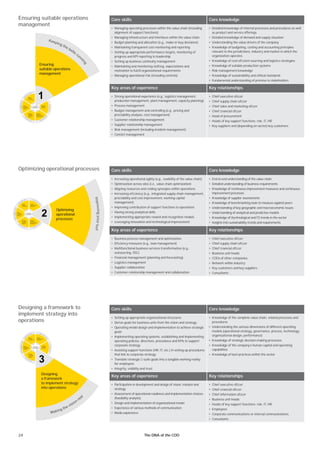
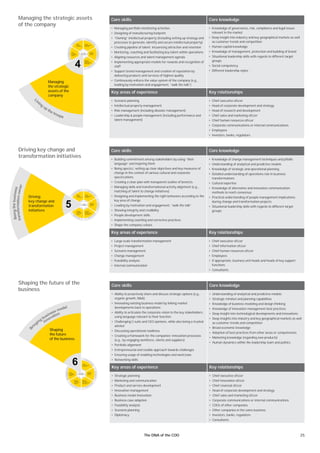
The DNA of the COO
Time to claim the spotlight
Our thanks to the more than 300 COOs and 40 further C-suite members and
    executive experts who participated in the study. In particular, we would like to
    thank all those who shared their insights and personal experience of the role in
    a series of in-depth interviews (listed alphabetically by company name):

    Dr. Daniel Bandle                                      Silvester Macho
    COO, AXA Winterthur                                    CIO, Metro
    Axel Jaeger                                            Gerda Ochse
    CFO, Carl Zeiss SMT                                    CTO, Metropolitan International
    Vivienne Ouyang                                        Franz-Josef Elsing
    COO, CHIC Group                                        CIO, Nordzucker
    Charles Robert Davis                                   Iqbal Khan
    Vice President Director, Darya-Varia Laboratoria       COO, Old Mutual Investment Group
    Dr. Dietmar Schell                                     Ngurah Adnyana
    Operations & Quality Assurance Director, DiaSorin      COO, PLN (Persero)
    Magnus Graf Lambsdorff                                 Frits Eulderink
    Partner, Egon Zehnder International                    COO, Royal Vopak
    Steven Phan                                            Denis Chuiko
    COO for the Asia Pacific region, Ernst & Young          COO, Russian Post
    Pascal Macioce                                         Mark Pavlovich
    COO for Europe, Middle East, India and Africa,         Director for Operations Analysis,
    Ernst & Young                                          SavaSeniorCare Administrative Services
    Dr. Josef Richter                                      Arunotpal Thakur
    CIO, HOERBIGER Group                                   Business Head Leather Products,
                                                           Tata International
    Vidjongtius
    CFO, Kalbe Farma                                       David Bulman
                                                           CIO, Virgin Atlantic Airways
    Arno Dalheimer
    Managing Director Manufacturing and Purchasing,
    Liebherr Machines Bulle
    Frila Berlini Yaman
    COO for Exploration and Production,
    MedcoEnergi Internasional


B                                            Document title Additional text
In sharp contrast to the role of the chief operating
                                          officer (COO), commentary and advice abound about
                                          the roles of the other C-suite members, whether the
                                          CEO, CFO or CIO. Why is so little known about the
                                          role of the COO, despite its long history? In
                                          researching The DNA of the COO, we uncovered a
                                          compelling story of a wide-ranging role that still
                                          needs to fight to justify its existence, despite having
                                          a clear rationale. This report provides much-needed
                                          insight into what it is to be a COO today. It is based
                                          on detailed research into the role, including many
                                          in-depth interviews with COOs and their C-suite
                                          peers. It incorporates analysis of two surveys: a
                                          shorter February 2012 pilot study of 200 COOs; and

In this report                            a comprehensive April 2012 survey of another 306
                                          COOs and senior operations professionals across
                                          Africa, America, Asia, Australia, Europe and the
Executive summary                    3
                                          Middle East. In the second survey, a further 43
                                          respondents from across the C-suite were also polled
Resetting the logic of the job       6
                                          to give their perspective on how the COO is perceived
Proving their worth                  10   by the rest of the management team.

                                          This report explores the expectations and aspirations
Mastering change, shaping strategy   14
                                          of those in the job, along with the skills, capabilities
Making the contacts, managing the         and relationships that they need to master in order
politics                             18   to succeed. It is one of a series of Ernst & Young
                                          thought leadership programs that seek to understand
The COO’s contribution               22   what it takes for C-level executives to take control of
                                          their evolving roles. Already available are The DNA of
Rapid-growth markets: shaping             the CFO and The DNA of the CIO, which deal with the
tomorrow’s leaders                   26   traits and characteristics of today’s senior finance
                                          and information technology professionals.
The next rung on the ladder          30

Time to claim the spotlight          36

Demographics                         38


                                                                                                 1
Dear fellow COOs,

                 Welcome to The DNA of the COO, the first in-depth Ernst & Young research that focuses on
                 the role of the chief operating officer (COO). It aims to provide insights into the person
                 behind the role and examines the skills, experiences, relationships and mindset that COOs
                 need in order to succeed.

                 I believe this is an important and timely perspective, for several reasons. First, COOs suffer
                 from a lack of information on their role. While their boardroom colleagues have conferences,
dedicated forums, and wide-ranging literature to help them in fulfilling their role, there is little around that
focuses on the COO. Second, the role of the COO is needed now more than it has ever been, given the deep
and wide-ranging pressures of recent years. In grappling with market uncertainty and volatility, companies
have required a sustained pursuit of greater efficiency, embarking on major business transformation as a
result. Few people are better placed than the COO to manage such challenges.

Indeed, what is clear from this research is that there is a major opportunity in all this for those COOs who are
willing to pursue it. Too many, for too long, have stood out of the spotlight, focusing on the operational
basics, while ignoring the chance to grab a more strategic role within the organization. Clearly, the exact
nature of this position is hugely diverse, given the wide variations in operational roles from one industry to
another, but the gist of it lies in supporting the chief executive officer and management team in determining
the optimal strategy for the future — and then helping to implement it.

Getting this right requires not just a grasp of the dynamics of one’s particular sector, but also leadership,
people skills, vision, ambition and more. At its core, this research acts as a road map, helping to indicate
what is needed and the direction in which things are headed. In putting this report together, I am proud that
we were able to draw on the views of hundreds of COOs, from every major industry and many diverse regions,
as well as many of their colleagues in the rest of the C-suite.

This will not be the end of our efforts in this area. Ernst & Young plans to build on this initiative by creating
ongoing thought leadership and research of interest to the COO. I know as well as you how much this is
needed, and I trust you will find this report as useful in gaining a high-level view of your role as I have.

Pascal Macioce, COO
Europe, Middle East, India and Africa
Ernst & Young


2                                                  The DNA of the COO
Executive summary
The role of the chief operating officer (COO) often
defies a “one size fits all” description. Essentially, it
is a job whose responsibilities are defined closely in
tandem with the individual needs and goals of the
chief executive officer (CEO). Despite this, there are
common themes and concerns that cut across
everyone in this position. What we find is a breed of
executive who combines deep operational knowledge
with broad strategic insight, and who has what it
takes to become the next CEO. Yet we also find a role
that is fraught with challenges. Successful COOs
have to adapt constantly to a fast-changing
corporate and external environment. They must
possess a mastery of change, to help translate
strategic vision into action. And they must ultimately
help the business to innovate and grow.

One of the C-suite’s toughest roles
The need for a figurehead in the operations role is more pressing
than ever. More than anything else, this is due to increasing
complexity, the single most important shift in the role over the past
five years. This manifests itself in a number of ways. Companies
must be highly flexible and agile, while retaining a sharper-than-
ever focus on cost-containment and efficiency. They have to fight
for market share in developed markets, while also building scale
and capacity in rapid-growth markets. These challenges require
strong leadership to catalyze and implement the strategic agenda.
In many companies, COOs are ideally placed to lead this charge.


                    33%
                                 percentage of COOs who think
                                 their role has become more
                                 complex in recent years


                                                                    3
But doing so is far from easy: one in three COOs strongly agree1                       Leadership skills vital, but confidence here lags
that their role is one of the most difficult in the management team.
                                                                                       COO responsibilities differ, but one theme remains constant. To
Their peers in the C-suite are even more certain: half of them think
                                                                                       perform the role well, 87% of COOs say that highly developed
that few other roles are as tough.
                                                                                       leadership qualities and interpersonal skills are the most crucial
Thriving on the adrenaline of complexity and change                                    attributes. Indeed, many admit that soft skills were an essential
                                                                                       part of their career development, second only to hard work, which
For COOs, the inherent challenges of the job are part and parcel of                    is a baseline assumption of any C-suite role. The reason is simple:
its appeal. Overall, about 6 in 10 say that the complexity and                         COOs have to interact with almost every function in the business
diversity of the role is fundamentally what makes it worthwhile for                    and, in multinational companies, a wide variety of different
them. Indeed, 49% strongly agree that they thrive on the constant                      cultures. Accessibility and the capacity to adapt their management
change and challenge of their role, not least because they are                         style to suit different audiences become critical. Furthermore, a
often on the frontlines of implementing business transformation.                       key part of their job is to manage business change, which requires
And, as might be expected, the talented candidates who are able                        strong leadership. But, in all this, many COOs recognize the need
to cope with such challenges are well regarded internally. This                        for improvement. When asked about the areas in which they most
positive perception — along with the potential to influence                             need to improve their skills, the majority (57%) admit to the need
corporate strategy and clear potential for career development —                        for sharper leadership skills.
are the three core aspects of why COOs find their job a fulfilling
one. Their peers clearly agree: 66% of COOs surveyed for this                          Not yet strategic enough
report are a member of the board or executive leadership team,
                                                                                       The days when COOs could focus all their attention on the nuts and
well ahead of other C-suite roles, such as the CIO.
                                                                                       bolts of operations are fading. Today, mastery of operational issues
A stepping stone to the top job                                                        is a given. Beyond this, COOs have a clear opportunity to help
                                                                                       define the strategy that underpins a CEO’s vision, and to then take
Forty percent of COOs polled aspire to be promoted to CEO within                       the lead in implementing it. Indeed, this is an increasingly
the next five years, ahead of the 30% who see their current role as                     important part of how the COO role can be secured within the
a final career destination. Among respondents from rapid-growth                         business. Their C-suite peers surveyed for this report strongly
markets, the proportion aspiring to become CEO is as high as 54%.                      agree: for example, 70% consider the ability to participate in
This is in clear contrast to other C-suite executives, such as the                     strategic discussions a vital skill for the job, along with other
CFO or CIO, many of whom are typically happier to remain where                         abilities, such as delivering business transformation effectively.
they are, as related Ernst & Young research shows.2 Of course, only                    This is recognized by COOs, relatively few of whom remain
a select few COOs will make this transition to the top job. Those                      concerned with operational issues alone. But greater progess is
that do so will need to look beyond their operational heartland and                    needed. Just 57% of COOs strongly agree that they have
adopt a more strategic mindset. They will also need to build strong                    participated in strategic decision-making, and only 50% have
relationships with a wider range of stakeholders, both internally                      spotted the opportunity to get operations involved in business
and externally. Although the route from COO to CEO is a common                         transformation. This is a risk. As just one illustration of this, only
one, the scale of the ascent should not be underestimated. Nor                         half of C-suite executives are certain that the company would
should the challenges on the way, in particular the delicate                           perform worse if the COO role did not exist at all.
balancing act with incumbent CEOs, not all of whom will look
favorably on the operations leader who is eyeing their job.


                                                                                                                    17%
                           the average degree of


7.8/10
                                                                                                                                  of CIOs have a position believe
                                                                                                                                  proportion of COOs who


                                                                        41%                                         60%
                           satisfaction that COOs have                                 COOs that are strongly
                                                                                                                                  in the executiveboard-level
                                                                                                                                  participating in
                           about the overall perception                                satisfied with their career                 strategy discussions is highly
                                                                                                                                  leadership team
                           of their role                                               development potential                      important to their performance


1   Whenever we refer to terms such as strong/strongly or major, we refer to those
    respondents that chose 9 or 10 on a scale from 1 to 10, where 1 is low and 10 is
    high.
2   Please refer to “The DNA of the CFO — A study of what makes the chief financial
    officer” and “The DNA of the CIO — Opening the door to the C-suite”.


4                                                                           The DNA of the COO
A lack of visibility harming potential                                       Few other C-suite roles are as closely linked to the overall
                                                                             leadership of the business as that of the COO. Many have the
When asked about the biggest barriers to the career development              genuine ability — and aspiration — to do the top job. But to fully
of the COO, respondents point to lack of acceptance or                       prepare for that transition, and to ensure their own relevance
understanding as their number one concern. This reflects the fact             within their current job, stronger efforts will be needed to bolster
that the scope of the COO’s role is often defined by the areas in             specific skills, strengthen core relationships and increase their
which CEOs most need support, which can vary widely from one                 visibility. The DNA of the COO seeks to provide a toolkit that maps
business to another. This highlights a common issue for COOs: a              out what needs to be changed, where the stumbling blocks lie, and
lack of visibility. When operations are running smoothly, they rarely        how best to prepare.
get the credit for “keeping the wheels turning,” but often only
become noticed when things go wrong. A similar challenge applies             The characteristics of today’s typical COO
in external relationships. For the most part, it is the CEO and CFO
who are visible to the media, investors and other constituents,
while the COO stays within the walls of the company. Especially for
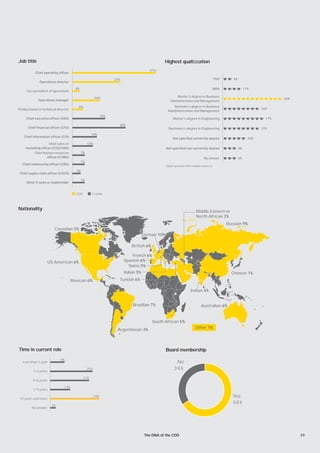
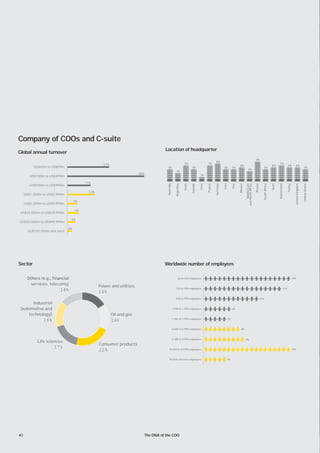
those COOs who aspire to the CEO position, it will be essential to                                      The average COO is a 48-year-old male. He
                                                                                                        has typically been in his current role for six
make their input more visible to both internal and external
                                                                                                        years.
stakeholders.
                                                                                                        Over half (54%) of COOs have a Master’s
Rapid-growth markets: shaping tomorrow’s leaders                                                        degree or higher, although there is no

Whereas many COOs in developed markets are focused on eking
out greater operational efficiencies to defend their companies’
market positions, their peers in rapid-growth markets have a more                                       Among those companies that have a COO
enviable priority list. Topping it is the need to build capacity, scale                                 role, they tend to be senior 66% of the ones
                                                                                                        polled are a member of the executive
up production and ensure that the right resources are in place to
                                                                                                        committee or board.
capture growth opportunities. This agenda demands a highly
entrepreneurial and strategic mindset, along with the ability to
introduce efficiency and process optimization so that growth can                                         role, especially their potential for career
be sustainable. With a dual focus on top-line growth and bottom-
line performance, rapid-growth market COOs require a broader                                            strategy.
palette of skills. This in turn will make them highly attractive
                                                                                                        Many COOs worry that they may not be
candidates for other leadership roles in the future.
                                                                                                        members of the management team, but their
                                                                                                        peers do not share this perception and, in fact,
                                                                                                        hold them in the highest regard.

                                                                                                        Motivation and hard work are seen as the
                                                                                                        attributes that have done most to get
                                                                                                        COOs where they are today.


                                                                                                                             proportion of rapid-growth market COOs


                                                                                                                57%
                                                                     percentage of COOs who think that


                                                           31%
                    the average level of agreement


9.4/10              among COOs that leadership and                   a lack of corporate understanding of                    who see supporting growth as a key part of
                    people management skills are key                 their role is the greatest obstacle to                  the value they add, compared with 44% of
                    to their performance, above all else             their further career development                        developed market peers


                                                                The DNA of the COO                                                                             5
Now is the time
to preparethe logic of the job
Resetting for
the rebound

In contrast to many other C-suite roles, that of the                                 Between 2000 and 2012, the proportion of Fortune 500 and S&P
chief operating officer (COO) has had a turbulent                                     500 companies with a dedicated COO role slipped from 49% to
                                                                                     35%.4 But in Europe, where the title is a relative newcomer in the
recent history. Despite having been around in some
                                                                                     C-suite, it appears to be on the rise. About 37 of the 97 largest
form or another for many decades now, The New York                                   companies within the Eurozone and UK now have a COO, most of
Times reported on the appointment of a COO at a US                                   whom had only had one predecessor in that position, which
bank as early as 19353, while the rail industry has had                              highlights how recent an arrival it is.5 Indeed, about one-quarter of
specialist COO roles for at least a century —                                        companies polled by Ernst & Young in a separate pilot survey in
uncertainty about its future often still lingers.                                    early 2012 acknowledged that they had only created a COO
                                                                                     position at some point in the past eight years.
                                                                                     There are several reasons why the COO role has struggled to fully
                                                                                     cement itself within today’s C-suite. Some companies, for example,
                                                                                     may opt instead to split operations responsibilities between several
                                                                                     executives; in others, the CEO may decide to handle operational
                                                                                     issues directly. But in many companies, across a range of industries
                                                                                     and regions, changing market dynamics now provide a chance to
                                                                                     clarify the inherent logic of the COO’s role, at least for those willing
                                                                                     to take on the challenge.

                                                                                     New pressures redefine an old role
                                                                                     In many respects, the ongoing financial crisis is a key driver of
                                                                                     these dynamics: a daunting regulatory environment; a tougher
                                                                                     emphasis on efficiency and cost management, including a drive to
                                                                                     transform many core aspects of the business; and the need to
                                                                                     expand into new markets in the pursuit of growth. All these factors
                                                                                     underscore the need for an operational leader, especially within an
                                                                                     increasingly complex and global business environment. “The larger
                                                                                     and more complex the organization, the more they need a COO,”
                                                                                     explains Magnus Graf Lambsdorff, Partner at Egon Zehnder
                                                                                     International. This need is further exacerbated by the increasing
                                                                                     speed of change, from ever shorter product development life
                                                                                     cycles to a continuously evolving technology.


3   “Banking bill wins favor as revised,” The New York Times, 25 August 1935.        4   “Crist Kolder volatility report,” cristkolder website, www.cristkolder.com/
                                                                                         VolatilityReport.pdf, accessed September 27th, 2012.
                                                                                     5   “The rise of the COO,” Harvard Business Review, 9 November 2011, Gunjan
                                                                                         Bhardwaj, et al.


6                                                                          The DNA of the COO
“Operations are increasingly
                                                                                    of strategic importance,
                                                                                    addressing both the revenue
                                                                                    and the cost challenges
                                                                                    organizations face.”
                                                                                      Adrian Edwards, Global Supply Chain and
                                                                                      Operations Leader, Ernst & Young


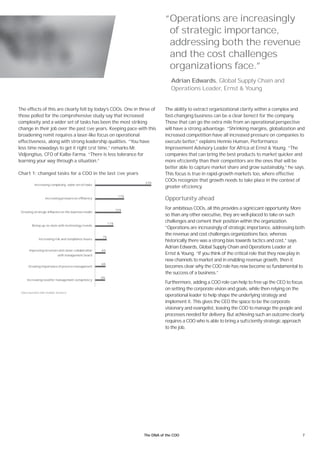
The effects of this are clearly felt by today’s COOs. One in three of              The ability to extract organizational clarity within a complex and
those polled for the comprehensive study say that increased                        fast-changing business can be a clear benefit for the company.
complexity and a wider set of tasks has been the most striking                     Those that can go the extra mile from an operational perspective
change in their job over the past five years. Keeping pace with this                will have a strong advantage. “Shrinking margins, globalization and
broadening remit requires a laser-like focus on operational                        increased competition have all increased pressure on companies to
effectiveness, along with strong leadership qualities. “You have                   execute better,” explains Hennie Human, Performance
less time nowadays to get it right first time,” remarks Mr.                         Improvement Advisory Leader for Africa at Ernst & Young. “The
Vidjongtius, CFO of Kalbe Farma. “There is less tolerance for                      companies that can bring the best products to market quicker and
learning your way through a situation.”                                            more efficiently than their competitors are the ones that will be
                                                                                   better able to capture market share and grow sustainably,” he says.
Chart 1: changed tasks for a COO in the last five years                             This focus is true in rapid-growth markets too, where effective
                                                                         33%
                                                                                   COOs recognize that growth needs to take place in the context of
           Increasing complexity, wider set of tasks
                                                                                   greater efficiency.
                                                                   17%
                    Increasing pressure on ef ciency                               Opportunity ahead
                                                                  15%              For ambitious COOs, all this provides a significant opportunity. More
 Growing strategic in uence on the business model
                                                                                   so than any other executive, they are well-placed to take on such
                                                            11%
                                                                                   challenges and cement their position within the organization.
         Being up-to-date with technology trends
                                                                                   “Operations are increasingly of strategic importance, addressing both
                                                                                   the revenue and cost challenges organizations face, whereas
                                                       7%
               Increasing risk and compliance issues
                                                                                   historically there was a strong bias towards tactics and cost,” says
                                                                                   Adrian Edwards, Global Supply Chain and Operations Leader at
       Improving structure and closer collaboration    6%
                          with management board                                    Ernst & Young. “If you think of the critical role that they now play in
                                                                                   new channels to market and in enabling revenue growth, then it
                                                       6%
      Growing importance of process management                                     becomes clear why the COO role has now become so fundamental to
                                                                                   the success of a business.”
                                                       6%
     Increasing need for management competency
                                                                                   Furthermore, adding a COO role can help to free up the CEO to focus
                                                                                   on setting the corporate vision and goals, while then relying on the
 (Open question with multiple answers)
                                                                                   operational leader to help shape the underlying strategy and
                                                                                   implement it. This gives the CEO the space to be the corporate
                                                                                   visionary and evangelist, leaving the COO to manage the people and
                                                                                   processes needed for delivery. But achieving such an outcome clearly
                                                                                   requires a COO who is able to bring a sufficiently strategic approach
                                                                                   to the job.


                                                                         The DNA of the COO                                                             7
For many companies, this also acts as an effective form of succession             This makes the COO role highly dependent on the relative strengths
planning. By giving a single executive the authority to interact closely          of the CEO. For example, in companies where the CEO needs to spend
with every other part of the business and build the relationships                 time courting investors, customers, analysts and the media, the
necessary for success, they lay the groundwork for an effective                   requirement for a more internally facing second-in-command is much
successor. This approach was most prominently highlighted in recent               greater. In others, there may be a greater focus on being the CEO’s
times with the appointment of ex-COO Timothy Cook as the CEO of                   “fixer,” despatched to fulfill specific business initiatives, such as a
Apple in the summer of 2011, picking up the reins of his predecessor,             business transformation project or a large-scale overseas expansion.
Steve Jobs.6 This is hardly an exception: between 2000 and 2012,                  “If you’ve got a highly strategic CEO, then you tend to find that the
just under half of all internal CEO appointees in the Fortune 500 were            COO is less so, whereas if you’ve got a CEO who is much more
previously in the COO role, according to Crist Kolder Associates.7                operational then you find that the COO gets more involved in
                                                                                  strategic issues,” explains Edwards.
The corporate chameleon
But while the rationale for the job is clearer than ever, the position
itself is more daunting. First of all, there is no one size fits all model
that will guarantee success. Unlike other management roles, such as
the CFO, there are no professional standards, nor are expectations of
the job common across all organizations. Rather than possessing a
single set of skills that can be easily identified in any business, COOs
have to adapt, chameleon-like, to the environment in which they find
themselves.
In particular, given the scope that the role holds in helping to define
and implement the CEO’s vision, the COO’s role is necessarily defined
closely in parallel with that of the chief executive. Ernst & Young’s
Edwards uses the analogy of a river to illustrate this point: “If you
imagine that the other members of the management team, such as
the CEO and CFO, are rocks in a river, then the COO role is like the
water that goes around and fills in the space.”


6   “Steve Jobs resigns as CEO of Apple,” Apple Press Release, 24 August 2011.
7   “Crist Kolder volatility report,” cristkolder website, www.cristkolder.com/
    VolatilityReport.pdf, accessed September 27th, 2012.


8
A guide to the top
Inevitably, this calls for someone not only hugely competent, but also
inherently flexible. It requires an executive who is able to build
bridges with all other parts of the business, while managing
successfully both upwards and downwards. It demands strong
leadership, while accepting that the COO cannot stand under the
same spotlight that shines on the CEO. To make all of this work, it
requires a great deal of clarity — and sensitivity — in mapping out how
best to fit in. For their part, CEOs need to be able to give COOs
complete autonomy in certain areas; in return, they rightly expect full
support for their overall vision.
To help understand how to prepare for such a role, and for the future
career potential this might offer, The DNA of the COO acts as a guide.
It explores how, in order to prove their worth, COOs should take the
lead in business transformation, while also working to deepen their
strategic position within the business. It highlights what relationships
will be needed for success, with specific insights about the
fundamental dynamic between the COO and CEO. It also provides a
detailed overview of the full extent of the potential contribution that
COOs can make, and the core skills and experiences they need in
order to deliver that contribution. Finally, it gives guidance for both
current and aspiring COOs on how best to climb the corporate ladder.


                                                                           9
Now is the time
to prepare forworth
Proving their
the rebound

COOs will greatly increase their chances of being           In general, the COO’s C-suite peers have great respect for the
successful in their role if they can demonstrate clearly    demands of the role, with almost half strongly agreeing that it is
                                                            one of the most difficult in the management team. This is even
to other members of the C-suite the value that they
                                                            more than the proportion of COOs who agree with the same
bring. “In order not to become redundant, we as COOs        statement (32%). Yet, when it comes to the question of whether a
have to prove that it really does make sense to bring       company would perform worse if it had no COO, there are some
these processing and operations functions together,”        signs of a divergence of opinion. Although 51% of C-suite
says Daniel Bandle, COO of AXA Winterthur, a large          respondents strongly agree, that still leaves 49% who are less sure.
Swiss insurance company. “No one doubts that these          In short, COOs have more to do in order to prove their value to the
                                                            rest of the business.
functions are absolutely necessary in any organization,
but the question is whether it makes sense to bundle        Encouragingly, there is much internal support: peers in the C-suite
them together. It is up to us as COOs to prove that         have a high opinion of the value that COOs bring to most of their
                                                            core responsibilities. But there are some areas in which COOs need
we’re bringing added value. We need to do a better job
                                                            to catch up. For example, while 57% agree strongly that they add
of marketing ourselves.”                                    value by executing transformational projects, fewer of their C-suite
                                                            peers (44%) hold the same view. As the individual in the company
                                                            who is best placed to lead and implement change, COOs should
                                                            ensure that they make the most of such opportunities.
                                                            In doing so, they should address themselves to areas in which the
                                                            rest of the C-suite sees most scope for them to contribute: for
                                                            example, they recognize the possibility for COOs to provide a
                                                            strategic input by supporting growth opportunities, whether the
                                                            expansion into a new product or geographic market, or the
                                                            reorganization of the business to bolster growth in existing
                                                            markets.

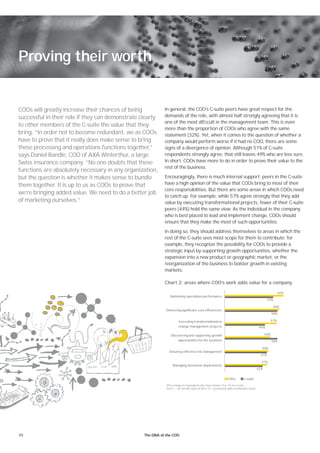
                                                            Chart 2: areas where COO’s work adds value for a company

                                                                                                                                                              65%
                                                               Optimizing operations performance
                                                                                                                                                    53%

                                                                                                                                                         60%
                                                             Delivering signi cant cost ef ciencies
                                                                                                                                                        58%

                                                                       Executing transformational or                                                    57%
                                                                       change management projects                                            44%

                                                                Discovering and supporting growth                                                 50%
                                                                     opportunities for the business                                                     58%

                                                                                                                                              48%
                                                               Ensuring effective risk management
                                                                                                                                              47%

                                                                                                                                              47%
                                                                  Managing functional departments
                                                                                                                                            42%


                                                                                                                COOs          C-suite
                                                             (Percentage of respondents who have chosen 9 or 10 on a scale
                                                             from 1 = do not add value at all to 10 = proactively add considerable value)


10                                                The DNA of the COO
“We as COOs need to do a
                                                                             better job of marketing
                                                                             ourselves.”
                                                                             Daniel Bandle, COO, AXA Winterthur


Rising above the complexity                                                  The growing demands on businesses across all sectors and regions
                                                                             create a fertile environment for COOs to demonstrate that they
The key difficulty for COOs is that finding the space to showcase
                                                                             add value across a broad range of areas. In this, they need to
their skills can be hugely challenging. It requires them to find a
                                                                             challenge an often-held perception that the role is primarily
ladder out of the operational trenches, to gain a wider perspective
                                                                             concerned with keeping the wheels turning and little else. To
of the business. This is hard, not least because they feel that, given
                                                                             overcome this, COOs must demonstrate that they now bring a
the demands of their role, they need to be in several places at
                                                                             strategic contribution to the business, and that their role “moves
once. “You’re expected to be a fixer and are responsible for all the
                                                                             the needle” on business performance, especially when compared
operational problems that happen,” explains Vivienne Ouyang,
                                                                             with those firms without a COO.
COO of CHIC Group, a Chinese conglomerate. “In a global business,
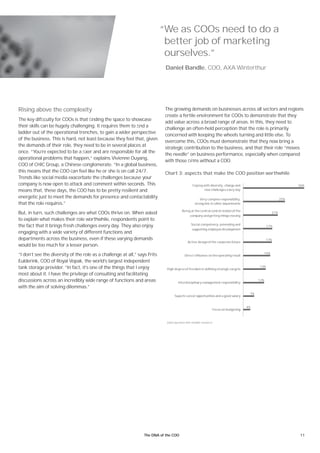
this means that the COO can feel like he or she is on call 24/7.             Chart 3: aspects that make the COO position worthwhile
Trends like social media exacerbate the challenges because your
company is now open to attack and comment within seconds. This                                   Coping with diversity, change and                               36%
means that, these days, the COO has to be pretty resilient and                                           new challenges every day

energetic just to meet the demands for presence and contactability                                     Very complex responsibility,                        25%
that the role requires.”                                                                           strong link to other departments

                                                                                         Being at the central control station of the
But, in turn, such challenges are what COOs thrive on. When asked                                                                                    21%
                                                                                              company and getting things moving
to explain what makes their role worthwhile, respondents point to
                                                                                                Social competency: promoting and
the fact that it brings fresh challenges every day. They also enjoy                                                                                17%
                                                                                                 supporting employee development
engaging with a wide variety of different functions and
departments across the business, even if these varying demands                                                                                     17%
                                                                                             Active design of the corporate future
would be too much for a lesser person.
                                                                                                                                               16%
“I don’t see the diversity of the role as a challenge at all,” says Frits                  Direct in uence on the operating result
Eulderink, COO of Royal Vopak, the world’s largest independent
tank storage provider. “In fact, it’s one of the things that I enjoy         High degree of freedom in de ning strategic targets
                                                                                                                                             13%

most about it. I have the privilege of consulting and facilitating
discussions across an incredibly wide range of functions and areas                    Interdisciplinary management responsibility
                                                                                                                                             12%

with the aim of solving dilemmas.”
                                                                                                                                        7%
                                                                                   Superb career opportunities and a good salary


                                                                                                                                       4%
                                                                                                                 Focus on budgeting


                                                                             (Open question with multiple answers)


                                                                  The DNA of the COO                                                                              11
Making the most of a unique perspective                                  Alongside this, COOs can also strike the right balance between
                                                                         efficiency and flexibility. Although the need to minimize costs and
There is ample opportunity to demonstrate such worth. Indeed,
                                                                         increase efficiency remains important for almost every company, a
COOs should take the chance to capitalize on their unique vantage
                                                                         purely operational “cost minimization” approach risks stripping out
point over every aspect of the business. By getting involved in
                                                                         functions and capabilities that customers value or that are
almost every function, they can spot interdependencies and serve
                                                                         necessary to achieve strategic goals. As the “messenger” of the
as the integrator between different activities across the business.
                                                                         C-suite and the owner of the operational agenda, the COO is
They can help to break down functional and geographical silos, and
                                                                         perhaps the only individual who can ensure that this balance is
identify ways of combining assets to drive efficiencies and transfer
                                                                         struck.
best practice. “By weeding out inefficiencies and deriving
economies of scale across operations, we can add much more               Nevertheless, in achieving all of this, it remains difficult for COOs
value than if our role was scattered across the organization,” says      to gain internal visibility. To a large extent, seamless operations are
AXA Winterthur COO Daniel Bandle.                                        invisible to the rest of the company and only become apparent
                                                                         when things go wrong. Neither do COOs particularly want to sit
Having this visibility across the entire enterprise is particularly
                                                                         back and enjoy the ride when things are going well. “I don’t want to
important for companies that span multiple geographical locations.
                                                                         spend my time getting involved in processes that are running
Many companies recognize the need to get close to local markets in
                                                                         perfectly,” explains Dr. Dietmar Schell, Operations & Quality
order to ensure relevance to customers, but this means that the
                                                                         Assurance Director at DiaSorin, a medical diagnostics firm. “It’s
opportunities for economies of scale can be lost. The COO is able to
                                                                         much more important for me to know when things are going
spot the potential for aggregation at a regional or even global level,
                                                                         wrong at the earliest stage, because that gives us an opportunity
and can take examples of operational excellence in one region and
                                                                         to make improvements and change our processes,” he says.
transfer them to another. Equally, the COO can identify where a
                                                                         Indeed, change is at the heart of what sets apart the role of the
local, customized approach is more appropriate.
                                                                         COO, as the next section explores.
COOs are also well-placed to determine which activities have to be
conducted in-house, as against those that can be handed over to
an external provider. “Things that are core today can quickly
become commodities,” notes Dr. Josef Richter, CIO of HOERBIGER
Group, a global engineering and technology company. “The COO
needs to identify this transition as early as possible, make the
necessary changes and ensure that the organization is constantly
building up the right capabilities or releasing people for new roles.”


12                                                             The DNA of the COO
“I don’t see the diversity of the
                                                                    role as a challenge at all. In
                                                                    fact, it’s one of the things I
                                                                    enjoy most about it.”
                                                                    Frits Eulderink, COO, Royal Vopak


It’s still a man’s world

Over the past decade, there has been a steady — and highly
overdue — increase in the proportion of women in top
management positions. Yet senior operations roles continue to
remain an exception to this rule. Among the COOs surveyed for
this report, an overwhelming 90% were male, although the
proportion is lower in rapid-growth markets than in developed
ones. Metropolitan International’s Gerda Ochse, one of the few
female operations leaders interviewed, points out that the role
can often involve large amounts of travel, which may
discourage women with young families from putting
themselves forward. She notes, however, that the situation is
improving, and that there are more female senior operations
professionals now than at any time in the past. And as the
required skill set of the COO shifts towards the need for strong
communication skills and a more strategic mindset, we may
hopefully see a new generation of female COOs in the near
future. “If I think back, I can definitely see it change. I think
there’s a clear place for both genders. The change might be
slow, but it is happening,” says Ochse.


                                                                                                        13
Mastering change, shaping strategy


What is it that separates a COO from a typical            But this is not all. In the same way that CEOs and business
operations manager? The latter is normally expected       founders require entrepreneurial skills to devise new business
                                                          ideas and create a culture of product and service innovation, the
to take charge of a part of the business that is up and
                                                          COO must also be “intrapreneurial.” This means that they should
running and keep a close hand on the tiller. By           constantly be on the lookout for ways to improve processes,
contrast, the COO must work out what such                 reallocate assets and drive efficiencies in the pursuit of better
processes ought to look like, and how to lead the         performance. As a result, being comfortable with constant change
change process to get it there. A mastery of change       is a given in the COO role. “In operations, the concept of
management is therefore a core part of the role for       continuous improvement means that you are always trying to find
                                                          things to change for the better,” says Frila Berlini Yaman, COO for
many, and often even how the position was secured
                                                          Exploration and Production at MedcoEnergi Internasional, an
in the first place.                                        Indonesian energy company.
                                                          The willingness to embrace change requires COOs to be
                                                          comfortable making decisions, even if that choice turns out to be
                                                          less than perfect and needs to be revised at a later stage.
                                                          “Sometimes you don’t have all the information but it’s still usually
                                                          preferable to make a wrong decision than to make no decision at
                                                          all,” says DiaSorin operations leader Dr. Dietmar Schell. “At least if
                                                          you make a decision, and it turns out to be wrong, you have the
                                                          opportunity to revise it. We can tolerate mistakes as long as they
                                                          are corrected and as long as there is an opportunity to learn from
                                                          them.”
                                                          Of course, while COOs thrive on change, they should not engineer
                                                          change purely for its own sake. “The need for change should come
                                                          from a genuine concern for the company,” argues Royal Vopak
                                                          COO Frits Eulderink. “You do, however, have to be very alert to the
                                                          small details and early signs of what might be significant in the
                                                          future. It is such a transparent and competitive world that, even if
                                                          you come up with something brilliant today, it won’t keep you safe
                                                          for long because your competition will be able to catch up very
                                                          quickly.”


14
“My duty is to create a well-
                                                                                     oiled machine that will
                                                                                     guarantee that targets can be
                                                                                     accomplished within the
                                                                                     framework of the strategy.”
                                                                                       Denis Chuiko, COO, Russian Post


A focus on transformation                                                              other external stakeholders. You then need the ability to co-
                                                                                       ordinate these assets and match them to different strategic
Beyond the diverse day-to-day operational demands placed on the
                                                                                       initiatives.”
COO, many have become the “go-to” person for handling any
larger business transformation initiatives. They are major                             There is also a strong link between this aspect of the role and
undertakings, because the pace of change continues to accelerate                       people development, because without the right teams in place
within the business environment. Responding to this demands                            across the company’s operations there is no execution of strategy.
tenacity and a hunger for continuous improvement. And, given the                       COOs must, therefore, be deeply involved in talent management to
focus and capabilities of the COO, the role is especially well suited                  ensure that there is a strong pipeline of managers who are aligned
to managing such transformation.                                                       with the changing world outside and the company’s own
                                                                                       transformation agenda.
Much is already being done. Half of COOs polled are closely
engaged in discussing the role that operations can play in business                    When this is done well, it can be exceedingly powerful. And it also
transformation, and 57% see this as a key part of creating value for                   highlights the significant potential of the CEO-COO tandem act.
the organization. But what is important to realize is that taking                      At one major US pharmacy benefits manager, for example, the
responsibility for such initiatives is a key part of how the COO can                   CEO and COO have collaborated closely over the past seven years
make the shift from a wholly operational perspective to a more                         to transform the company from a siloed, functional business into
strategic one.                                                                         one that is customer-centric and process-oriented. Importantly,
                                                                                       the two executives worked together on the overall strategy and
Quite simply, dealing with this level of change ties in with the wider
                                                                                       implications, before the COO then led the process. This is a clear
issue of where the job ought to be focused: enabling the CEO’s
                                                                                       example of where the role ought to be positioned, and how leading
vision. At its core, this involves turning an abstract corporate
                                                                                       significant organizational change can be a “door-opener” for the
strategy into a working daily reality, deploying specific frameworks
                                                                                       COO to play a more strategic role in the business.
and processes that can deliver on the strategic objectives set for
each part of the organization. “My duty is to create a well-oiled                      Joining the strategic inner circle
machine that will guarantee that targets can be accomplished
within the framework of the strategy,” as Denis Chuiko, COO of                         Indeed, while all COOs cut their teeth amid the day-to-day
Russian Post, the state postal operator, puts it.                                      operational efforts, this is not necessarily what will help propel
                                                                                       them to the top of the organization. For COOs eager to maintain
The need for business transformation can also be a driver for                          the momentum of their rise, they need not only to master
appointing a COO in the first place. Earlier in 2012, Nokia Siemens                     operational excellence, but to become a driver of strategy as well.
Networks created a new COO role, specifically in order to take                          Those CEOs who are willing to share the load can find an invaluable
responsibility for the “transformation of the company’s mode of                        ally in the COO, someone who can help them grapple with the
operations and business performance management,” as the firm                            company’s strategic decision-making and then being ideally placed
described it.8 For the company’s CEO, Rajeev Suri, the new role                        to execute the resulting strategy. Getting this right will demand
serves to drive the restructuring of the business in line with its new                 both strong leadership and a contact book stuffed with allies
overall strategy, which includes the divestment of a range of                          across the business (see next section for more on the skills and
non-core assets.                                                                       contacts needed for success).
In such a position, the COO controls the allocation and                                Nevertheless, this switch in focus also highlights a dichotomy in
prioritization of corporate resources and assets in order to achieve                   the role of today’s COOs. On the one hand, they must focus their
the strategic goals. Once a decision has been made, he or she must                     attention on the here and now. This demands a deep involvement
ensure that the right resources are in the right places. “The COO                      across the company’s operations to ensure that they are
needs to understand which are the most important strategic                             performing at the optimal level. On the other hand, they must find
initiatives and have a complete view of the people, resources and                      the space to shape longer-term strategy, because they are best
other assets that are available to implement these choices,”                           placed to assess the company’s readiness. “It’s very important for
explains Hennie Human, Performance Improvement Advisory                                the COO to play an active role in defining strategy, because this
Leader for Africa at Ernst & Young. “This should extend beyond the                     makes it much easier to cascade that strategy through the
organization to encompass service providers, contractors and                           organization and ensure alignment with operations,” says CHIC
                                                                                       Group COO Vivienne Ouyang.

8   “Nokia Siemens creates COO position to oversee re-org,” Total Telecom,
    16 March 2012.

                                                                             The DNA of the COO                                                         15
There is much to be gained by getting this right. By obtaining a          of the COO’s role, to avoid any overlap and to provide the
dual perspective — of both high-level strategy and lower-level            necessary environment for such a function to succeed. The
processes and operations — COOs can identify emerging trends and          company should also apply a wider range of metrics, beyond purely
immediately assess their implications. They are also typically            operational ones, in assessing the COO’s performance. However, in
located at the nexus between in-house operations and external             too many companies this is not yet the case.
demands and customers. Indeed, Steven Phan, COO for the Asia
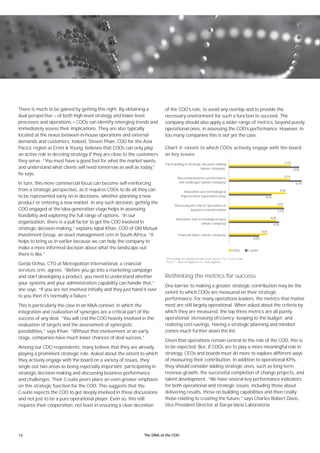
Pacific region at Ernst & Young, believes that COOs can only play          Chart 4: extent to which COOs actively engage with the board
an active role in defining strategy if they are close to the customers     on key issues
they serve. “You must have a good feel for what the market wants                                                                                                       57%
                                                                          Participating in strategic decision-making
and understand what clients will need tomorrow as well as today,”                                   (whole company)                                                          65%
he says.
                                                                                   Discussing business performance                                                     57%

In turn, this more commercial focus can become self-reinforcing                     and challenges (whole company)                                                            67%

from a strategic perspective, as it requires COOs to do all they can                    Innovation and technological                                               53%
to be represented early on in decisions, whether planning a new                       improvement (operations only)                                    40%
product or entering a new market. In any such decision, getting the                                                                                              50%
                                                                                 Discussing the role of operations in
COO engaged at the idea-generation stage helps in assessing                                 business transformation                                              51%
feasibility and exploring the full range of options. “In our                                                                                               44%
                                                                                  Innovation and technological input
organization, there is a pull factor to get the COO involved in                                    (whole company)                                           47%
strategic decision-making,” explains Iqbal Khan, COO of Old Mutual
                                                                                                                                                     36%
Investment Group, an asset management firm in South Africa. “It                      Financial topics (whole company)
                                                                                                                                              28%
helps to bring us in earlier because we can help the company to
make a more informed decision about what the landscape out                                                                    COOs         C-suite
there is like.”
                                                                           (Percentage of respondents who have chosen 9 or 10 on a scale
                                                                           from 1 = does not apply to 10 = fully applies)
Gerda Ochse, CTO at Metropolitan International, a financial
services firm, agrees. “Before you go into a marketing campaign
and start developing a product, you need to understand whether            Rethinking the metrics for success
your systems and your administration capability can handle that,”
                                                                          One barrier to making a greater strategic contribution may be the
she says. “If you are not involved initially and they just hand it over
                                                                          extent to which COOs are measured on their strategic
to you then it’s normally a failure.”
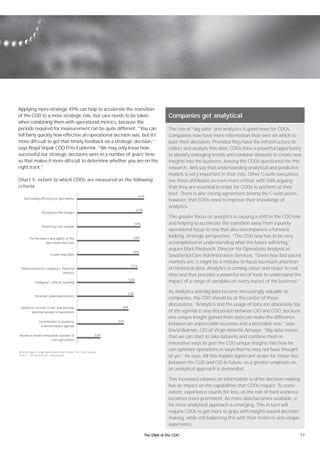
                                                                          performance. For many operations leaders, the metrics that matter
This is particularly the case in an M&A context, in which the             most are still largely operational. When asked about the criteria by
integration and realization of synergies are a critical part of the       which they are measured, the top three metrics are all purely
success of any deal. “You will find the COO heavily involved in the        operational: increasing efficiency; keeping to the budget; and
evaluation of targets and the assessment of synergistic                   realizing cost-savings. Having a strategic planning and mindset
possibilities,” says Khan. “Without that involvement at an early          comes much further down the list.
stage, companies have much lower chances of deal success.”
                                                                          Given that operations remain central to the role of the COO, this is
Among our COO respondents, many believe that they are already             to be expected. But, if COOs are to play a more meaningful role in
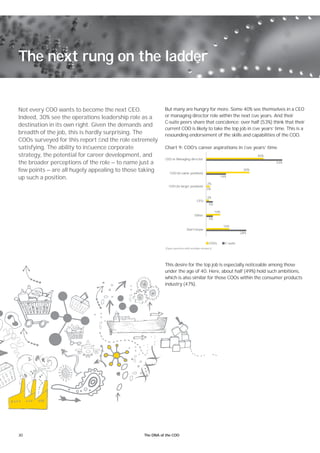
playing a prominent strategic role. Asked about the extent to which       strategy, CEOs and boards must do more to explore different ways
they actively engage with the board on a variety of issues, they          of measuring their contribution. In addition to operational KPIs,
single out two areas as being especially important: participating in      they should consider adding strategic ones, such as long-term
strategic decision-making and discussing business performance             revenue growth, the successful completion of change projects, and
and challenges. Their C-suite peers place an even greater emphasis        talent development. “We have several key performance indicators
on this strategic function for the COO. This suggests that the            for both operational and strategic issues, including those about
C-suite expects the COO to get deeply involved in these discussions       delivering results, those on building capabilities and then finally
and not just to be a pure operational player. Even so, this still         those relating to creating the future,” says Charles Robert Davis,
requires their cooperation, not least in ensuring a clear definition       Vice President Director at Darya-Varia Laboratoria.


16                                                              The DNA of the COO
Applying more strategic KPIs can help to accelerate the transition
of the COO to a more strategic role, but care needs to be taken                                  Companies get analytical
when combining them with operational metrics, because the
periods required for measurement can be quite different. “You can                                The rise of “big data” and analytics is good news for COOs.
tell fairly quickly how effective an operational decision was, but it’s                          Companies now have more information than ever on which to
more difficult to get that timely feedback on a strategic decision,”                              base their decisions. Provided they have the infrastructure to
says Royal Vopak COO Frits Eulderink. “We may only know how                                      collect and analyze this data, COOs have a powerful opportunity
successful our strategic decisions were in a number of years’ time,                              to identify emerging trends and combine datasets to create new
so that makes it more difficult to determine whether you are on the                               insights into the business. Among the COOs questioned for this
right track.”                                                                                    research, 46% say that understanding analytical and predictive
                                                                                                 models is very important in their role. Other C-suite executives
Chart 5: extent to which COOs are measured on the following                                      see these attributes as even more critical, with 56% arguing
criteria                                                                                         that they are essential in order for COOs to perform at their
                                                                                63%
                                                                                                 best. There is also strong agreement among the C-suite peers,
   Increasing ef ciency in operations
                                                                                                 however, that COOs need to improve their knowledge of
                                                                                                 analytics.
                                                                               61%
                 Keeping to the budget
                                                                                                 This greater focus on analytics is causing a shift in the COO role
                                                                             59%                 and helping to accelerate the transition away from a purely
                  Realizing cost savings
                                                                                                 operational focus to one that also encompasses a forward-
        Performance and agility of the                                     58%                   looking, strategic perspective. “The COO now has to be very
                 operations function                                                             accomplished at understanding what the future will bring,”
                                                                                                 argues Mark Pavlovich, Director for Operations Analysis at
                                                                           58%
                        Leadership skills                                                        SavaSeniorCare Administrative Services. “Given how fast-paced
                                                                                                 markets are, it might be a mistake to focus too much attention
                                                                          57%
 Improvement in company’s nancial                                                                on historical data. Analytics is coming closer and closer to real
                          metrics
                                                                                                 time and that provides a powerful set of tools to understand the
                                                                         54%
            Company’s ethical standing                                                           impact of a range of variables on every aspect of the business.”

                                                                       53%
                                                                                                 As analytics and big data become increasingly valuable to
            Strategic planning/mindset
                                                                                                 companies, the COO should be at the center of these
                                                                                                 discussions. “Analytics and the usage of data are absolutely top
 Ability to recruit, retain and develop                            48%
          talented people in operations                                                          of the agenda in any discussion between CIO and COO, because
                                                                                                 one unique insight gained from data can make the difference
               Contribution to business                          44%
                transformation agenda
                                                                                                 between an unprofitable business and a profitable one,” says
                                                                                                 David Bulman, CIO of Virgin Atlantic Airways. “Big data means
Business model innovation outside of                       22%
                                                                                                 that we can start to take datasets and combine them in
                    core operations
                                                                                                 innovative ways to give the COO unique insights into how he
(Percentage of respondents who have chosen 9 or 10 on a scale
                                                                                                 can optimize operations in ways that he may not have thought
from 1 = not at all to 10 = absolutely)                                                          of yet,” he says. All this implies significant scope for closer ties
                                                                                                 between the COO and CIO in future, as a greater emphasis on
                                                                                                 an analytical approach is demanded.

                                                                                                 This increased reliance on information to drive decision-making
                                                                                                 has an impact on the capabilities that COOs require. To some
                                                                                                 extent, experience counts for less, as the role of hard evidence
                                                                                                 becomes more prominent. As more data becomes available, a
                                                                                                 far more analytical approach is emerging. This in turn will
                                                                                                 require COOs to get more to grips with insights-based decision-
                                                                                                 making, while still balancing this with their instincts and unique
                                                                                                 experience.

                                                                                     The DNA of the COO                                                               17
Now is the time
Making the contacts,
to preparethe politics
managing for
the rebound

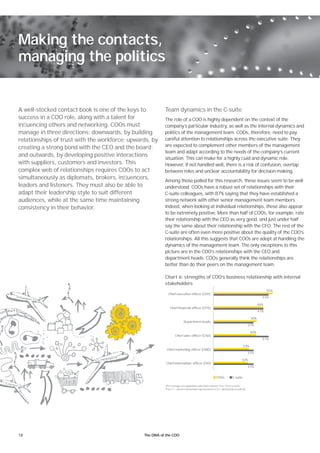
A well-stocked contact book is one of the keys to         Team dynamics in the C-suite
success in a COO role, along with a talent for            The role of a COO is highly dependent on the context of the
influencing others and networking. COOs must               company’s particular industry, as well as the internal dynamics and
manage in three directions: downwards, by building        politics of the management team. COOs, therefore, need to pay
relationships of trust with the workforce; upwards, by    careful attention to relationships across the executive suite. They
creating a strong bond with the CEO and the board;        are expected to complement other members of the management
                                                          team and adapt according to the needs of the company’s current
and outwards, by developing positive interactions
                                                          situation. This can make for a highly fluid and dynamic role.
with suppliers, customers and investors. This             However, if not handled well, there is a risk of confusion, overlap
complex web of relationships requires COOs to act         between roles and unclear accountability for decision-making.
simultaneously as diplomats, brokers, influencers,         Among those polled for this research, these issues seem to be well
leaders and listeners. They must also be able to          understood. COOs have a robust set of relationships with their
adapt their leadership style to suit different            C-suite colleagues, with 87% saying that they have established a
audiences, while at the same time maintaining             strong network with other senior management team members.
consistency in their behavior.                            Indeed, when looking at individual relationships, these also appear
                                                          to be extremely positive. More than half of COOs, for example, rate
                                                          their relationship with the CEO as very good, and just under half
                                                          say the same about their relationship with the CFO. The rest of the
                                                          C-suite are often even more positive about the quality of the COO’s
                                                          relationships. All this suggests that COOs are adept at handling the
                                                          dynamics of the management team. The only exceptions to this
                                                          picture are in the COO’s relationships with the CEO and
                                                          department heads; COOs generally think the relationships are
                                                          better than do their peers on the management team.

                                                          Chart 6: strengths of COO’s business relationship with internal
                                                          stakeholders
                                                                                                                                               55%
                                                             Chief executive of cer (CEO)
                                                                                                                                           51%

                                                                                                                                         46%
                                                              Chief nancial of cer (CFO)
                                                                                                                                         47%

                                                                                                                                   40%
                                                                          Department heads
                                                                                                                                  37%

                                                                                                                                   40%
                                                                   Chief sales of cer (CSO)
                                                                                                                                           51%

                                                                                                                             33%
                                                            Chief marketing of cer (CMO)
                                                                                                                                  37%

                                                                                                                           32%
                                                           Chief information of cer (CIO)
                                                                                                                                  37%


                                                                                                     COOs          C-suite

                                                           (Percentage of respondents who have chosen 9 or 10 on a scale
                                                           from 1 = needs substantial improvement to 10 = absolutely excellent)


18                                              The DNA of the COO
Visionary ideas may sound
                                                                         good in the executive suite, but
                                                                         without the COO’s
                                                                         endorsement that they are
                                                                         operationally feasible, they
                                                                         count for very little.


One relationship the COO needs to handle with particular                 The best relationships between CEO and COO are generally formed
sensitivity is that with the CIO. Overall, COOs view this relationship   when the two parties possess complementary skills. Among our
as one of their least successful among executives: just 32%              respondents, an overwhelming proportion of both COOs and other
consider it to be very strong. Depending on the company’s                members of the management team agree with this principle. A
structure, many CIOs may report into the COO, or at least be             CEO who seeks to hire a COO in his own image will encounter
engaged in projects that COOs have a hand in as well. Given the          problems. Instead, the two should have different competencies and
scope for functional overlap, the COO and CIO may find themselves         abilities that can be combined for the greater good of the business.
increasingly focused on the same goals if their respective remits        Related to this, both executives must therefore pay careful
are not carefully defined. Managed correctly, the relationship can        attention to defining the boundaries of their role and ensuring that
be mutually beneficial. The COO gains a partner who can assist in         other members of the management team understand the scope of
navigating the complexities of rapid ongoing technological change,       their responsibilities.
and the CIO gains an ally with a louder voice within the C-suite.
                                                                         In addition to possessing complementary skills and capabilities, a
“Both CIO and COO have the same objective of providing efficient
                                                                         successful CEO-COO team should also have compatible
operations and I am the enabler of that,” argues Dr. Josef Richter,
                                                                         personalities. “If you’re an introvert CEO, then you’re probably very
the CIO of HOERBIGER Group, who sees himself as a bridge
                                                                         happy to have a COO who will go to stakeholder meetings and
between corporate IT and the wider business.
                                                                         engage the employees,” says Markus Heinen, Performance
                                                                         Improvement Advisory Leader for Germany, Switzerland and
The CEO: If you get just one partnership right, make
                                                                         Austria at Ernst & Young. “But if you’re an extrovert CEO, then the
it this one                                                              last thing you need is a COO mirroring your own character. You
As earlier examples showed, the relationship between the CEO and         need the right combination of behaviors and expertise.”
COO is arguably the most important for the company’s success. It
                                                                         Egon Zehnder International’s Magnus Graf Lambsdorff argues that
is also the most vital for the COO’s overall career. When asked
                                                                         recruiters will typically expect a different set of competencies in a
about the importance of a range of C-suite executives to the
                                                                         COO from those in a CEO: “COOs tend to be results-oriented and
development of the COO’s career, the CEO stands head and
                                                                         collaborative in terms of the ability to implement initiatives or
shoulders above the rest. Nearly 7 in 10 (68%) of COOs consider
                                                                         change. With the development of organizational capability, the
this relationship to be essential to their career. By contrast, the
                                                                         COO will typically concentrate on getting things done, rather than
next highest — the CFO — is only half as important (34%), followed
                                                                         the long-term view, which is often the CEO’s concern. Then in
by department heads and the CSO (33% and 32% respectively).
                                                                         terms of change management, the CEO drives this through
When the CEO-COO partnership is working well, the double act can         communication, while the COO achieves it through deeds and
be extremely powerful, playing to the strengths of each individual       measures.”
and ensuring that both internal and external affairs receive the
same degree of attention. But if tension arises, or if there is
                                                                         The COO as challenger
overlap between roles and responsibilities, then the relationship        With a clear understanding of the company’s assets and
can quickly break down, causing serious damage to the wider              capabilities, the COO can also challenge the CEO’s strategic
organization. “You need to have complete trust, transparency and         thinking, and participate in defining it. Visionary ideas may sound
openness to make the relationship work,” says Ngurah Adnyana,            good in the executive suite, but without the COO’s endorsement
COO of PLN, an electricity distribution company based in Indonesia       that they are operationally feasible, they count for very little. “The
(see the box Working in tandem on page 20, for more on the               management team may reach a decision that meets their strategic
CEO-COO partnership).                                                    objectives, but the COO should be there to bring things back to
                                                                         reality if those plans are too difficult or costly to implement,” says
                                                                         MedcoEnergi Internasional COO Frila Berlini Yaman.


                                                              The DNA of the COO                                                             19
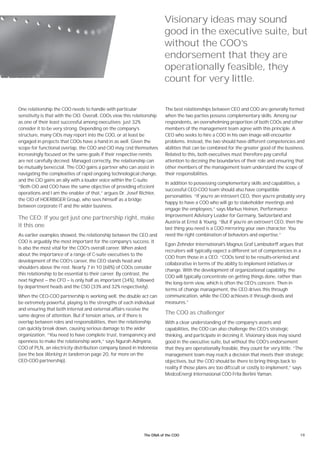
Among the COOs questioned for this report, just under half agree
 Working in tandem                                                      that the COO is the only person who can challenge the CEO firmly
                                                                        but fairly. Interestingly, other members of the management team
 Making a success of the COO role requires a close link with the        agree with this statement more strongly, indicating that, for them,
 CEO. But ensuring an effective and conflict-free relationship           the COO is better placed than the more functional members of the
 requires both parties to adhere to a clear set of principles,          management team to challenge strategic thinking. This is an
 which include the following:                                           opportunity that COOs should welcome and encourage, by
 Trust is the foundation of success                                     adopting a more proactive approach to participating in such
 The CEO and COO need to have complete trust in each other’s            discussions.
 abilities and integrity. If a CEO worries that the COO is
 overstepping the mark and seeking to take on some of the               Chart 7: extent to which the COO is the only person who can
 CEO’s job, or if the COO worries that he or she is being               challenge the CEO firmly but fairly
 undermined by the CEO, then the relationship will not work.
                                                                                              15%            16%                 23%                   30%   17%
                                                                           COOs
 Both visible and invisible
 The CEO-COO partnership is often the closest on the                                    7% 5%                         28%                        37%         23%
                                                                         C-suite
 management team. But, in some respects, operations need to
 be invisible to the CEO. Smooth-running operations mean that
                                                                                       Strongly disagree           Slightly disagree   Neutral
 the CEO should barely notice them and can get on with the
                                                                                       Slightly agree              Strongly agree
 strategic side of running the company.
                                                                         (From 1 = strongly disagree to 10 = strongly agree)
 The right role for the right reasons
 If a COO is appointed merely to reduce the CEO’s workload,
 then the role will be unsuccessful. CEOs need to recognize why         Looking beyond the corporate walls
 they are hiring an individual and what skills the COO can bring
 that the CEO does not possess. Equally, COOs need to be                Internal relationships with the management team and workforce
 confident that they are being hired for the right reasons, and          may be the COO’s number one priority, but external interactions
 that they will get the support they need from the CEO.                 also matter greatly. As value chains become more complex and
                                                                        companies increasingly encompass a web of relationships across
 Keep each other on speed-dial                                          regional and organizational boundaries, the lines between internal
 Even though senior executives are frequently on the road,              and external stakeholder are more and more blurred. Both are now
 regular communication between CEO and COO is essential.                critical to operational excellence, and COOs cannot focus their
 Informal discussion slots are valuable, while close physical           entire attention on activities within the company walls without
 proximity between the two offices can help to foster an “open           putting their credibility and the broader business at risk.
 door” culture.
                                                                        Our survey asked COOs about the strengths of their relationships
 Don’t mix your messages                                                with external stakeholders. What is most striking is that the
 The rest of the business looks to the CEO and COO for                  strongest relationship of all was considered to be between the COO
 direction. The two executives must ensure that they are                and key clients, even though the COO has not traditionally been
 consistent and avoid mixed messages. Even if they do not agree         seen as a client-facing role. Many of those interviewed for this
 on a particular issue, they still need to put across a single point    report (42%) emphasized that strong client relationships not only
 of view. This will ultimately be the CEO’s mandate, so the COO         enabled them to do their job effectively, but were also important
 needs to be comfortable with being occasionally overruled.             for their overall career. This hints at another distinction between
                                                                        the modern COO and the traditional operations manager: the
 Not afraid of a healthy disagreement
                                                                        requirement to foster relationships not only within the
 Despite the need for consistency and complete trust, the CEO
                                                                        organization, but with key external partners too.
 and COO should also be willing to debate issues and put forward
 their views — in private at least. Both parties need to be
 comfortable with being challenged, as it is often through such
 debate that better decisions emerge.


20                                                            The DNA of the COO
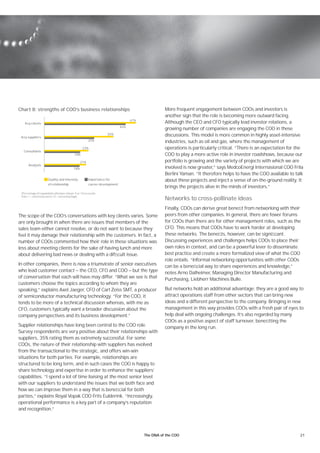
Chart 8: strengths of COO’s business relationships                                                 More frequent engagement between COOs and investors is
                                                                                                   another sign that the role is becoming more outward facing.
                                                                                   47%
   Key clients                                                                                     Although the CEO and CFO typically lead investor relations, a
                                                                             42%
                                                                                                   growing number of companies are engaging the COO in these
 Key suppliers
                                                                   35%                             discussions. This model is more common in highly asset-intensive
                                                        25%                                        industries, such as oil and gas, where the management of
                                                   23%                                             operations is particularly critical. “There is an expectation for the
  Consultants
                                            18%                                                    COO to play a more active role in investor roadshows, because our
                                                 21%                                               portfolio is growing and the variety of projects with which we are
      Analysts
                                           18%                                                     involved is now greater,” says MedcoEnergi Internasional COO Frila
                                                                                                   Berlini Yaman. “It therefore helps to have the COO available to talk
                      Quality and intensity             Importance for                             about these projects and inject a sense of on-the-ground reality. It
                      of relationship                   career development
                                                                                                   brings the projects alive in the minds of investors.”
 (Percentage of respondents who have chosen 9 or 10 on a scale
 from 1 = extremely low to 10 = extremely high)
                                                                                                   Networks to cross-pollinate ideas
                                                                                                   Finally, COOs can derive great benefit from networking with their
The scope of the COO’s conversations with key clients varies. Some                                 peers from other companies. In general, there are fewer forums
are only brought in when there are issues that members of the                                      for COOs than there are for other management roles, such as the
sales team either cannot resolve, or do not want to because they                                   CFO. This means that COOs have to work harder at developing
feel it may damage their relationship with the customers. In fact, a                               these networks. The benefits, however, can be significant.
number of COOs commented how their role in these situations was                                    Discussing experiences and challenges helps COOs to place their
less about meeting clients for the sake of having lunch and more                                   own roles in context, and can be a powerful lever to disseminate
about delivering bad news or dealing with a difficult issue.                                        best practice and create a more formalized view of what the COO
                                                                                                   role entails. “Informal networking opportunities with other COOs
In other companies, there is now a triumvirate of senior executives                                can be a beneficial way to share experiences and knowledge,”
who lead customer contact — the CEO, CFO and COO — but the type                                    notes Arno Dalheimer, Managing Director Manufacturing and
of conversation that each will have may differ. “What we see is that                               Purchasing, Liebherr Machines Bulle.
customers choose the topics according to whom they are
speaking,” explains Axel Jaeger, CFO of Carl Zeiss SMT, a producer                                 But networks hold an additional advantage: they are a good way to
of semiconductor manufacturing technology. “For the COO, it                                        attract operations staff from other sectors that can bring new
tends to be more of a technical discussion whereas, with me as                                     ideas and a different perspective to the company. Bringing in new
CFO, customers typically want a broader discussion about the                                       management in this way provides COOs with a fresh pair of eyes to
company perspectives and its business development.”                                                help deal with ongoing challenges. It’s also regarded by many
                                                                                                   COOs as a positive aspect of staff turnover, benefitting the
Supplier relationships have long been central to the COO role.                                     company in the long run.
Survey respondents are very positive about their relationships with
suppliers, 35% rating them as extremely successful. For some
COOs, the nature of their relationship with suppliers has evolved
from the transactional to the strategic, and offers win-win
situations for both parties. For example, relationships are
structured to be long term, and in such cases the COO is happy to
share technology and expertise in order to enhance the suppliers’
capabilities. “I spend a lot of time liaising at the most senior level
with our suppliers to understand the issues that we both face and
how we can improve them in a way that is beneficial for both
parties,” explains Royal Vopak COO Frits Eulderink. “Increasingly,
operational performance is a key part of a company’s reputation
and recognition.”


                                                                                         The DNA of the COO                                                           21
Now is the time
 to prepare for
 The COO’s contribution
 the rebound
 There are few roles in a company that are as broad as
 the COO’s. Operations leaders see every aspect and
 function of the business, and engage with an
 extremely diverse range of internal and external
 stakeholders. Although the precise responsibilities of
 the COO will differ from company to company, we
 believe that there are six key areas in which
 operations leaders play an active role. Successful
 COOs need to master each area, from the basics of
 ensuring that there is suitable operations
 management in place through to defining the future
 shape of the business.


22
 22                                              The DNA of the COO
l                    Kee
                                                        ode                        pin
                                                     ssm                              gt
                                                                                        he
                                                  ine n                                    be
                                   T          bus atio                                       lts
                                             g ov                                                  ru
                                           in inn
                               N


                                          g                                                          n


                                                                                                              EX
                             ME

                                     in


                                                                                                       ni
                                   Br


                                                                          Ensuring


                                                                                                         ng
                                                      Shaping


                                                                                                                EC
                           OP


                                                      the future          suitable operations


                                                                                                                  UT
                                                      of the business     management
                         EL


                                                                                                                    ION
                      DEV


                                                                      6    1
      formation owner
     ng the business


                                   Driving
                                                                 The COO's
                                                                                        Optimizing              Improving your tur
                                   key change and             5              2          operational
                                   transformation               contribution            processes
                                   initiatives
    s
  Bei
tran


                                                                      4    3
                                                                                                                                  f


                                                      Managing            Designing a
                                                      the strategic       framework to
                                                      assets of the       implement strategy
                                                      company             into operations
                                        ni
                                       Li


                                          ng
                                                                                                   l
                                               up                                                ea
                                                  th
                                                    et                                       ionr
                                                      roo                                 vis
                                                         ps                            he
                                                                                   ng t
                                                                               Maki


                                                              ENABLEMENT


                                                                                                                                      23
Ensuring suitable operations                                                                                                                                                                                                                                         Core skills                                                              Core knowledge
                                      management
                                                                                                                                                                                                                                                                                                           • Managing operating processes within the value chain (including         • Detailed knowledge of internal processes and procedures as well
                                                                                                                                                                                                                                                                                                             alignment of support functions)                                          as product and service offerings
                                                                                                                                                                                                                                                                                                           • Managing infrastructure and interfaces within the value chain          • Detailed knowledge of demand and supply situation
                                                                                                                                                                                                                                     Keep                                                                  • Budget planning and allocation (e.g., make-or-buy decisions)           • Understanding the value drivers of the company
                                                                                                                                                                                                                                         ing
                                                                                                                                                                                                                                             the                                                           • Maintaining transparent cost monitoring and reporting                  • Knowledge of budgeting, costing and accounting principles
                                                                                                                                                                                                                                                 be
                                                                                                                                                                                                                                                   lts                                                     • Setting up appropriate performance targets, monitoring of                relevant to the jurisdictions, industry and market in which the
                                                                                                                                                                                                                                                       ru                                                                                                                             organization operates
                                                                                                                                                                                                                                                         nn                                                  progress and KPI reporting to leadership
                                                                                                                                                                                                                                                                                                           • Setting up business continuity management                              • Knowledge of cost-efficient sourcing and logistics strategies


                                                                                                                                                                                                                                                                               in
                                                                                                                                                                                  Ensuring


                                                                                                                                                                                                                                                                                 g
                                                                                                                                                                                                                                                                                                           • Maintaining and monitoring staffing, expectations and                   • Knowledge of suitable production systems
                                                                                                                                                                                  suitable operations                                                                                                        motivation to fulfill organizational requirements                       • Risk management knowledge
                                                                                                                                                                                  management                                                                                                               • Managing operational risk (including controls)                         • Knowledge of sustainability and ethical standards
                                                                                                                                                                                                                                                                                                                                                                                    • Fundamental understanding of promise to stakeholders

                                                                                                                                                                                                                                                                                                           Key areas of experience                                                  Key relationships

                                                                                                                                                                         1
                                                                                                                                  el                                             Kee
                                                                                                                               mod                                                  pin
                                                                                                                                                                                       gt
                                                                                                                    ess                                                                  he
                                                                                                                 sin                                                                        be
                                                                                                               bu

                                                                                                                                                                                                                                                                                                           • Strong operational experience (e.g., logistics management,             • Chief executive officer
                                                                                                     g                                                                                        lts
                                                                                                   in                                                                                                                  ru
                                                                                                 ng
                                                                                                                                                                                                                           nn
                                                                                             i


                                                                                                                                                                Ensuring
                                                                                          Br


                                                                                                                     Shaping
                                                                                                                                                                                                                             in


                                                                                                                                                                suitable operations
                                                                                                                                                                                                                               g


                                                                                                                     the future


                                                                                                                                                                                                                                                                                                             production management, plant management, capacity planning)
                                                                                                                     of the business                            management


                                                                                                                                                                                                                                                                                                                                                                                    • Chief supply chain officer
                                                                             tion
                                                        he bus owner ansforma


                                                                                                                                              6                  1


                                                                                                                                                                                                                                                                                                           • Process management                                                     • Chief sales and marketing officer
                                                                                                                                                                                                                                     Improving your tur
                                                              iness tr


                                                                                         Driving                                                                                           Optimizing
                                                                                         key change/                                  5
                                                                                                                                              The COO's                                    operational
                                                                                                                                                          2
                                                                                         transformation                                      contribution                                  processes
                                                                                         initiatives

                                                                                                                                              4                  3
                                                                                                                                                                                                                                                                                                           • Budget management and controlling (e.g., pricing and                   • Chief financial officer
                                                    ng t


                                                                                                                                                                                                                                     f
                                                 Bei


                                                                                                                                                                                                                                                                                                             profitability analysis, cost management)
                                                                                                                     Managing                                   Designing a


                                                                                                                                                                                                                                                                                                                                                                                    • Head of procurement
                                                                                                                     the strategic                              framework to
                                                                                                                     assets of the                              implement strategy
                                                                                                                                                                                                                            al


                                                                                                Li                   company                                    into operations
                                                                                                                                                                                                                           re


                                                                                                     ni                                                                                                                    on
                                                                                                          ng                                                                                                          si

                                                                                                                                                                                                                                                                                                           • Customer relationship management
                                                                                                               up                                                                                              vi
                                                                                                                    th                                                                               he
                                                                                                                                                                                                gt

                                                                                                                                                                                                                                                                                                                                                                                    • Heads of key support functions: risk, IT, HR
                                                                                                                         et                                                                in
                                                                                                                              r oo
                                                                                                                                     ps                                               M ak


                                                                                                                                                                                                                                                                                                           • Supplier relationship management                                       • Key suppliers and (depending on sector) key customers
                                                                                                                                                                                                                                                                                                           • Risk management (including incident management)
                                                                                                                                                                                                                                                                                                           • Conflict management


                                      Optimizing operational processes                                                                                                                                                                                                                                     Core skills                                                              Core knowledge
                                                                                                                                                                                                                                                                                                           • Increasing operational agility (e.g., flexibility of the value chain)   • End-to-end understanding of the value chain
                                                                                                                                                                                                                                                                                                           • Optimization across silos (i.e., value chain optimization)             • Detailed understanding of business requirements
                                                                                                                                                                                                                                                                                                           • Aligning resources and finding synergies within operations              • Knowledge of continuous improvement measures and continuous
                                                                                                                                                                                                                                                                                                           • Increasing efficiency (e.g., integrated supply chain management,          improvement processes
                                                                                                                                                                                                                                                                                                             profitability and cost improvement, working capital                     • Knowledge of supplier assessments
                                                                                                                                                                                                                                                                                     Improvi


                                                                                             el                                              Kee
                                                                                          mod                                                   pin
                                                                                                                                                   gt
                                                           ess

                                                                                                                                                                                                                                                                                                             management)
                                                                                                                                                     he
                                                        sin

                                                                                                                                                                                                                                                                                                                                                                                    • Knowledge of benchmarking tools to measure against peers
                                                                                                                                                        be
                                                      bu                                                                                                  lts
                                           g
                                         in                                                                                                                                  ru
                                       ng
                                                                                                                                                                                 nn
                                      i


                                                                                                                                Ensuring
                                   Br


                                                                          Shaping
                                                                                                                                                                                   in


                                                                                                                                suitable operations
                                                                                                                                                                                     g


                                                                          the future


                                                                                                                                                                                                                                                                                                           • Improving contribution of support functions to operations              • Understanding of key geographic and macroeconomic issues
                                                                          of the business                                       management
                            tion


                                                                                                                                                                                                                                                               Optimizing
       he bus owner ansforma


                                                                                                                                                                                           2
                                                                                                                                     1
                                                                                                                                                                                                                                                                                            ng your turf


                                                                                                               6

                                                                                                                                                                                                                                                                                                           • Having strong analytical skills                                        • Understanding of analytical and predictive models
                                                                                                                                                                                                 Improving your tur


                                                                                                                                                                                                                                                               operational
             iness tr


                                   Driving                                                                                                               Optimizing
                                   key change/                                                  5
                                                                                                           The COO's                                     operational
                                                                                                                       2
                                   transformation                                                         contribution                                   processes


                                                                                                                                                                                                                                                                                                           • Implementing appropriate reward and recognition models
                                   initiatives

                                                                                                               4                     3

                                                                                                                                                                                                                                                               processes                                                                                                            • Knowledge of (technological and IT) trends in the sector
   ng t


                                                                                                                                                                                                 f
Bei


                                                                                                                                                                                                                                                                                                           • Leveraging innovation and technological improvement
                                                                         Managing                                               Designing a


                                                                                                                                                                                                                                                                                                                                                                                    • Insights into sustainability trends and requirements
                                                                         the strategic                                          framework to
                                                                         assets of the                                          implement strategy
                                                                                                                                                                                  al


                                      Li                                 company                                                into operations
                                                                                                                                                                                 re


                                           ni                                                                                                                                    on
                                                ng                                                                                                                      i   si
                                                     up                                                                                                              ev
                                                                  th
                                                                            et                                                                                  th
                                                                                         r oo                                                            in g
                                                                                                ps                                                M ak


                                                                                                                                                                                                                                                                                                           Key areas of experience                                                  Key relationships
                                                                                                                                                                                                                                                                                                           • Business process management and optimization                           • Chief executive officer
                                                                                                                                                                                                                                                                                                           • Efficiency measures (e.g., lean management)                             • Chief supply chain officer
                                                                                                                                                                                                                                                                                                           • Multifunctional business services transformation (e.g.,                • Chief financial officer
                                                                                                                                                                                                                                                                                                             outsourcing, SSC)                                                      • Business unit heads
                                                                                                                                                                                                                                                                                                           • Financial management (planning and forecasting)                        • COOs of other companies
                                                                                                                                                                                                                                                                                                           • Logistics management                                                   • Network within industry
                                                                                                                                                                                                                                                                                                           • Supplier collaboration                                                 • Key customers and key suppliers
                                                                                                                                                                                                                                                                                                           • Customer relationship management and collaboration                     • Consultants


                                      Designing a framework to                                                                                                                                                                                                                                             Core skills                                                              Core knowledge
                                      implement strategy into
                                                                                                                                                                                                                                                                                                           • Setting up appropriate organizational structures                       • Knowledge of the complete value chain, related processes and
                                      operations                                                                                                                                                                                                                                                           • Derive goals for business units from the vision and strategy             procedures
                                                                                                                                                                                                                                                                                                           • Operating model design and implementation to achieve strategic         • Understanding the various dimensions of different operating
                                                                                                                            el                                                    Kee
                                                                                                                                                                                                                                                                                                             goals                                                                    models (operational strategy, governance, process, technology,
                                                                                                                         mod                                                         pin


                                                                                                                                                                                                                                                                                                                                                                                      organizational design, performance)
                                                                                                                                                                                        gt
                                                                                                                     ess                                                                  he
                                                                                                                  sin                                                                        be

                                                                                                                                                                                                                                                                                                           • Implementing operating systems, establishing and implementing
                                                                                                                bu                                                                             lts
                                                                                                         g
                                                                                                       in                                                                                                                  ru
                                                                                                     ng
                                                                                                                                                                                                                            nn
                                                                                              i


                                                                                                                                                                 Ensuring
                                                                                           Br


                                                                                                                         Shaping
                                                                                                                                                                                                                              in


                                                                                                                                                                                                                                                                                                                                                                                    • Knowledge of strategic decision-making processes
                                                                                                                                                                 suitable operations
                                                                                                                                                                                                                                g


                                                                                                                         the future


                                                                                                                                                                                                                                                                                                             operating policies, directives, procedures and KPIs to support
                                                                                                                         of the business                         management
                                                                                  tion
                                                             he bus owner ansforma


                                                                                                                                                                                                                                                                                                             corporate strategy                                                     • Knowledge of the company’s human capital and operating
                                                                                                                                               6                     1
                                                                                                                                                                                                                                        Improving your tur
                                                                   iness tr


                                                                                          Driving                                                                                             Optimizing
                                                                                          key change/                                    5
                                                                                                                                              The COO's                                       operational
                                                                                                                                                          2
                                                                                                                                             contribution

                                                                                                                                                                                                                                                                                                                                                                                      capabilities
                                                                                          transformation                                                                                      processes


                                                                                                                                                                                                                                                                                                           • Assisting support functions (HR, IT, etc.) in setting up procedures
                                                                                          initiatives

                                                                                                                                               4                     3
                                                         ng t


                                                                                                                                                                                                                                                           f


                                                                                                                                                                                                                                                                                                             that link to corporate strategy                                        • Knowledge of best practices within the sector
                                                      Bei


                                                                                                                         Managing                                Designing a
                                                                                                                         the strategic                           framework to


                                                                                                                                                                                 3
                                                                                                                         assets of the                           implement strategy
                                                                                                                                                                                                                                al


                                                                                                 Li                      company                                 into operations
                                                                                                                                                                                                                            re


                                                                                                                                                                                                                                n

                                                                                                                                                                                                                                                                                                           • Translate strategic C-suite goals into a tangible working reality
                                                                                                      ni                                                                                                                   io
                                                                                                           ng                                                                                                         is
                                                                                                                up                                                                                           ev
                                                                                                                     th
                                                                                                                          et                                                                         th
                                                                                                                               r oo                                                           in g
                                                                                                                                      ps                                               M ak


                                                                                                                                                                                                                                                                                                             for employees
                                                                                                                                                                                                                                                                                                           • Integrity, visibility and trust
                                                                                                                                                                                          Designing
                                                                                                                                                                                                                                                                                                           Key areas of experience                                                  Key relationships
                                                                                                                                                                                          a framework
                                                                                                                                                                                          to implement strategy                                                                                            • Participation in development and design of vision, mission and         • Chief executive officer
                                                                                                                                                                                          into operations                                                                                                    strategy                                                               • Chief financial officer
                                                                                                                                                                                                                                                                                                           • Assessment of operational readiness and implementation choices         • Chief information officer
                                                                                                                                                                                                                                                                                al                           (feasibility analysis)
                                                                                                                                                                                                                                                                              re                                                                                                    • Business unit heads
                                                                                                                                                                                                                                                                         on                                • Design and implementation of organizational model
                                                                                                                                                                                                                                                                      isi                                                                                                           • Heads of key support functions: risk, IT, HR
                                                                                                                                                                                                                                                                    ev                                     • Experience of various methods of communication
                                                                                                                                                                                                                                                               ng th                                                                                                                • Employees
                                                                                                                                                                                                                                                           Maki                                            • Media experience                                                       • Corporate communications or internal communications
                                                                                                                                                                                                                                                                                                                                                                                    • Consultants


                                      24                                                                                                                                                                                                                                                                                             The DNA of the COO
Managing the strategic assets                                                                                                                                                                                                                                                                    Core skills                                                             Core knowledge
           of the company
                                                                                                                                                                                                                                                                                                            • Managing portfolio monitoring activities                              • Knowledge of governance, risk, compliance and legal issues
                                                                                                                                                                                                                                                                                                            • Designing of manufacturing footprint                                    relevant in the market
                                                                                                                                                                             el                           Kee
                                                                                                                                                                                                                                                                                                            • “Owning“ intellectual property (including setting up strategy and     • Deep insight into industry and key geographical markets as well
                                                                                                                                                                          mod                                pin


                                                                                                                                                                                                                                                                                                                                                                                      as customer trends and competition
                                                                                                                                                                                                                gt
                                                                                                                                                               ess

                                                                                                                                                                                                                                                                                                              processes to generate, identify and secure intellectual property)
                                                                                                                                                                                                                  he
                                                                                                                                                            sin                                                      be
                                                                                                                                                          bu                                                           lts
                                                                                                                                                g
                                                                                                                                              in                                                                                                 ru
                                                                                                                                            ng


                                                                                                                                                                                                                                                         nn
                                                                                                                                     i
                                                                                                                                                                                                   Ensuring


                                                                                                                                  Br
                                                                                                                                                                Shaping


                                                                                                                                                                                                                                                           in
                                                                                                                                                                                                                                                                                                                                                                                    • Human capital knowledge
                                                                                                                                                                                                   suitable operations


                                                                                                                                                                                                                                                             g
                                                                                                                                                                the future


                                                                                                                                                                                                                                                                                                            • Creating pipeline of talent: influencing attraction and retention
                                                                                                                                                                of the business                    management


                                                                                                                   tion
                                                                                              he bus owner ansforma
                                                                                                                                                                                                                                                                                                                                                                                    • Knowledge of management, protection and building of brand
                                                                                                                                                                                         6          1

                                                                                                                                                                                                                                                                                                            • Mentoring, coaching and facilitating key talent within operations


                                                                                                                                                                                                                                                                                    Improving your tur
                                                                                                    iness tr
                                                                                                                                  Driving                                                                                  Optimizing
                                                                                                                                  key change/                                    5
                                                                                                                                                                                         The COO's                         operational
                                                                                                                                                                                                     2
                                                                                                                                  transformation                                        contribution                       processes


                                                                                                                                                                                                                                                                                                            • Aligning resources and talent management agenda                       • Situational leadership skills with regards to different target
                                                                                                                                  initiatives

                                                                                                                                                                                         4          3


                                                                                          ng t


                                                                                                                                                                                                                                                                                    f
                                                                                                                                                                                                                                                                                                                                                                                      groups

                                                                                       Bei
                                                                                                                                                                                                                                                                                                            • Implementing appropriate models for rewards and recognition of
                                                                                                                                                           4
                                                                                                                                                                Managing                          Designing a
                                                                                                                                                                the strategic                     framework to
                                                                                                                                                                assets of the                     implement strategy


                                                                                                                                                                                                                                                          al
                                                                                                                                           Li                   company                           into operations


                                                                                                                                                                                                                                                         re
                                                                                                                                                                                                                                                                                                                                                                                    • Social competency
                                                                                                                                                ni                                                                                                   i   on


                                                                                                                                                                                                                                                                                                              staff
                                                                                                                                                     ng                                                                                         is
                                                                                                                                                          up                                                                               ev
                                                                                                                                                               th
                                                                                                                                                                    et                                                               th
                                                                                                                                                                         r oo                                              in g
                                                                                                                                                                                ps                               M ak


                                                                                                                                                                                                                                                                                                            • Support brand management and creation of reputation by                • Different leadership styles
                                                                                                                                                                                                                                                                                                              delivering products and services of highest quality

                                              Managing                                                                                                                                                                                                                                                      • Continuously enforce the value system of the company (e.g.,
                                                                                                                                                                                                                                                                                                              leading by motivation and engagement, “walk the talk“)
                                              the strategic
                                              assets of the                                                                                                                                                                                                                                                 Key areas of experience                                                 Key relationships
                                              company
                                   in                                                                                                                                                                                                                                                                       • Scenario planning                                                     • Chief executive officer
                              L


                                     in
                                       g                                                                                                                                                                                                                                                                    • Intellectual property management                                      • Head of corporate development and strategy
                                           up
                                              the                                                                                                                                                                                                                                                           • Risk management (including disaster management)                       • Head of research and development
                                                  tro
                                                     ops                                                                                                                                                                                                                                                    • Leadership & people management (including performance and             • Chief sales and marketing officer
                                                                                                                                                                                                                                                                                                              talent management)                                                    • Chief human resources officer
                                                                                                                                                                                                                                                                                                                                                                                    • Corporate communications or internal communications
                                                                                                                                                                                                                                                                                                                                                                                    • Employees
                                                                                                                                                                                                                                                                                                                                                                                    • Investors, banks, regulators


           Driving key change and                                                                                                                                                                                                                                                                           Core skills                                                             Core knowledge
           transformation initiatives                                                                                                                                                                                                                                                                       • Building commitment among stakeholders by using “their                • Knowledge of change management techniques and pitfalls
                                                                                                                                                                                                                                                                                                              language” and inspiring them                                          • Understanding of analytical and predictive models
                                                                                                                                                                                                                                                                                                            • Being specific: setting up clear objectives and key measures of        • Knowledge of strategic and operational planning
                                                                                                                                                                                                                                                                                                              change in the context of various cultural and corporate               • Detailed understanding of operations role in business
                                                                                                                                                                                                                                                                                                              specifications                                                           transformations
                                                                                                                                                                                                                                                                                                            • Creating a clear plan with transparent outline of benefits             • Cultural expertise
transformation owner


                                                                                                                                                                                                                                                                                                            • Managing skills and transformational activity alignment (e.g.,        • Knowledge of alternative and innovative communication
 Being the business


                                                                                                                                                    g
                                                                                                                                                           bu
                                                                                                                                                             sin
                                                                                                                                                                ess
                                                                                                                                                                    mod
                                                                                                                                                                       el                                  Kee
                                                                                                                                                                                                              pin
                                                                                                                                                                                                                 gt
                                                                                                                                                                                                                   he
                                                                                                                                                                                                                      be
                                                                                                                                                                                                                        lts
                                                                                                                                                                                                                                                                                                              matching of talent to change initiatives)                               methods to reach consensus
                                                                                                                                                  in                                                                                                     ru
                                                                                                                                                ng


                          Driving                                                                                                                                                                                                                                                                           • Designing and implementing the right behaviors according to the
                                                                                                                                                                                                                                                          nn
                                                                                                                                         i


                                                                                                                                                                                                   Ensuring
                                                                                                                                      Br


                                                                                                                                                                    Shaping
                                                                                                                                                                                                                                                            in


                                                                                                                                                                                                                                                                                                                                                                                    • Practical understanding of people management implications
                                                                                                                                                                                                   suitable operations
                                                                                                                                                                                                                                                              g


                                                                                                                                                                    the future
                                                                                                                                                                    of the business                management
                                                                                                                          tion


                          key change and                                                                                                                                                                                                                                                                      key area of change
                                                                                                     he bus owner ansforma


                                                                                                                                                                                                                                                                                                                                                                                      during change and transformation projects
                                                           5
                                                                                                                                                                                         6           1
                                                                                                                                                                                                                                                                                       Improving your tur
                                                                                                           iness tr


                                                                                                                                   Driving                                                                                  Optimizing


                          transformation                                                                                                                                                                                                                                                                    • Leading by motivation and engagement, “walk the talk“
                                                                                                                                   key change/                                      5
                                                                                                                                                                                         The COO's                          operational
                                                                                                                                                                                                     2

                                                                                                                                                                                                                                                                                                                                                                                    • Situational leadership skills with regards to different target
                                                                                                                                   transformation                                       contribution                        processes
                                                                                                                                   initiatives

                                                                                                                                                                                         4           3


                          initiatives                                                                                                                                                                                                                                                                       • Showing integrity and credibility
                                                                                                 ng t


                                                                                                                                                                                                                                                                                                                                                                                      groups
                                                                                                                                                                                                                                                                                      f
                                                                                              Bei


                                                                                                                                                                    Managing                       Designing a
                                                                                                                                                                    the strategic                  framework to
                                                                                                                                                                    assets of the                  implement strategy


                                                                                                                                                                                                                                                                                                            • People development skills
                                                                                                                                                                                                                                                              al


                                                                                                                                            Li                      company                        into operations
                                                                                                                                                                                                                                                          re


                                                                                                                                                 ni                                                                                                       on
                                                                                                                                                      ng                                                                                             si
                                                                                                                                                           up                                                                                   vi
                                                                                                                                                                th                                                                         he
                                                                                                                                                                     et                                                          gt
                                                                                                                                                                          r oo                                             kin
                                                                                                                                                                                 ps                               Ma


                                                                                                                                                                                                                                                                                                            • Implementing coaching and corrective practices
                                                                                                                                                                                                                                                                                                            • Shape the company culture

                                                                                                                                                                                                                                                                                                            Key areas of experience                                                 Key relationships
                                                                                                                                                                                                                                                                                                            • Large-scale transformation management                                 • Chief executive officer
                                                                                                                                                                                                                                                                                                            • Project management                                                    • Chief information officer
                                                                                                                                                                                                                                                                                                            • Scenario management                                                   • Chief human resources officer
                                                                                                                                                                                                                                                                                                            • Change management                                                     • Employees
                                                                                                                                                                                                                                                                                                            • Feasibility analysis                                                  • If appropriate: business unit heads and heads of key support
                                                                                                                                                                                                                                                                                                            • Internal communication                                                  functions
                                                                                                                                                                                                                                                                                                                                                                                    • Consultants


           Shaping the future of the                                                                                                                                                                                                                                                                        Core skills                                                             Core knowledge
           business
                                                                                                                                                                                                                                                                                                            • Ability to proactively share and discuss strategic options (e.g.,     • Understanding of analytical and predictive models
                                                                                                                                                                                                                                                                                                              organic growth, M&A)                                                  • Strategic mindset and planning capabilities
                                                                                                                                                                                                                                                                                                            • Innovating existing business model by linking market                  • Knowledge of business modeling and design thinking
                                                           l ation                                                                                                                                                                                                                                            developments back to operations
                                                       odeov
                                                       inn                                                                                                                                                                                                                                                                                                                          • Knowledge of innovation management best practices
                                                   dm
                                                 ss el                                                                                                                                                                                                                                                      • Ability to articulate the corporate vision to the key stakeholders,
                                              ine o on
                                                m                                                                                                                                                                                                                                                                                                                                   • Deep insight into technological developments and innovations
                                           uss ti
                                          bes va                                                                                                                                                                                                                                                              using language relevant to their function
                                                                                                                                                                                                                                                                                                                                                                                    • Deep insights into industry and key geographical markets as well
                                         gn o
                                       nsi inn                                                                                                                                                                                                                                                              • Challenging C-suite and CEO opinions, while also being a trusted
                                      iu                                                                                                                                                                                                                                                                                                                                              as customer trends and competition
                                   ng
                                  ig b                                                                                                                                                                                                                                                                        advisor
                                                                                                                                                                                                                                                                                                                                                                                    • Broad economic knowledge
                            inr


                                               Shaping
                           gB


                                                                                                                                                                                                                                                                                                            • Discussing operational readiness
                                                                                                                                                                                                                                                                                                                                                                                    • Adoption of best practices from other areas or competencies
                         in


                                               the future                                                                                                                                                                                                                                                   • Creating a framework for the companies’ innovation processes
                       Br


                                               of the business                                                                                                                                                                                                                                                                                                                      • Marketing knowledge (regarding new products)
                                                                                                                                                                                                                                                                                                              (e.g., by engaging workforce, clients and suppliers)
                                                                                                                                                                                                                                                                                                                                                                                    • Human dynamics within the leadership team and politics
                                                                                                                                                                                                                                                                                                            • Portfolio alignment
                                                                                                                                                                                                                                                                                                            • Entrepreneurial and flexible approach towards challenges
                                                                                                                                                                                                                                                                                                            • Ensuring usage of enabling technologies and workflows
                                                                                                                                                                                                                                                                                                            • Networking skills
                                                                                                                                       6
                                                                                                                                                                  el                               Kee
                                                                                                                                                               mod                                    pin
                                                                                                                                                                                                         gt
                                                                                                                                                ess                                                        he
                                                                                                                                             sin                                                              be
                                                                                                                                           bu                                                                   lts
                                                                                                                                     g
                                                                                                                                   in                                                                                                ru
                                                                                                                                 ng
                                                                                                                                                                                                                                       nn
                                                                                                             i


                                                                                                                                                                                             Ensuring
                                                                                                          Br


                                                                                                                                                      Shaping
                                                                                                                                                                                                                                         in


                                                                                                                                                                                                                                                                                                            Key areas of experience                                                 Key relationships
                                                                                                                                                                                             suitable operations
                                                                                                                                                                                                                                           g


                                                                                                                                                      the future
                                                                                                                                                      of the business                        management
                                                                                       tion
                                                                  he bus owner ansforma


                                                                                                                                                                                6             1
                                                                                                                                                                                                                                                               Improving your tur
                                                                        iness tr


                                                                                                      Driving                                                                                                  Optimizing
                                                                                                      key change/                                                    5
                                                                                                                                                                           The COO's                           operational
                                                                                                                                                                                       2

                                                                                                                                                                                                                                                                                                            • Strategic planning                                                    • Chief executive officer
                                                                                                      transformation                                                      contribution                         processes
                                                                                                      initiatives

                                                                                                                                                                                4             3
                                                              ng t


                                                                                                                                                                                                                                                               f


                                                                                                                                                                                                                                                                                                            • Marketing and communication                                           • Chief innovation officer
                                                           Bei


                                                                                                                                                     Managing                                Designing a
                                                                                                                                                     the strategic                           framework to
                                                                                                                                                     assets of the                           implement strategy
                                                                                                                                                                                                                                           al


                                                                                                                         Li                          company                                 into operations
                                                                                                                                                                                                                                      re


                                                                                                                                                                                                                                                                                                            • Product and service development                                       • Chief financial officer
                                                                                                                                 ni                                                                                                    o   n
                                                                                                                                      ng                                                                                        i   si
                                                                                                                                           up                                                                              ev
                                                                                                                                                 th
                                                                                                                                                      et                                                              th
                                                                                                                                                           r oo                                                in g
                                                                                                                                                                    ps                                  M ak


                                                                                                                                                                                                                                                                                                            • Innovation management                                                 • Head of corporate development and strategy
                                                                                                                                                                                                                                                                                                            • Business model innovation                                             • Chief sales and marketing officer
                                                                                                                                                                                                                                                                                                            • Business case adaption                                                • Corporate communications or internal communications
                                                                                                                                                                                                                                                                                                            • Feasibility analysis                                                  • COOs of other companies
                                                                                                                                                                                                                                                                                                            • Scenario planning                                                     • Other companies in the same business
                                                                                                                                                                                                                                                                                                            • Diplomacy                                                             • Investors, banks, regulators
                                                                                                                                                                                                                                                                                                                                                                                    • Consultants


                                                                                                                                                                                                                                                                                                                                     The DNA of the COO                                                                                                 25
Now is the time
Rapid-growth markets:
to prepare for
shaping tomorrow’s leaders
the rebound

The economic prospects of slow-growth developed          The differences between markets can be striking. COOs within
markets and newer rapid-growth markets have              developed markets often continue to face a challenging cost
                                                         environment and limited organic growth potential. Executive teams
sharply diverged, with companies from around the
                                                         are therefore closely focused on the bottom line. “In developed
world looking to the latter for opportunity. This        markets, the agenda is nowadays all around profit-maximization
switch has significant implications for business          and cost-containment, against a backdrop of rising costs and more
priorities and for the COO: “The requirements of the     value-conscious customers,” argues Markus Heinen, Performance
COO role are dependent on time, place and                Improvement Advisory Leader for Germany, Switzerland and
geographical area,” explains Tata International’s        Austria at Ernst & Young. “There is a real tension between this
                                                         increasing complexity and the desire to simplify, reduce costs and
Business Head Leather Products, Arunotpal Thakur.
                                                         get more from less.”
“What is relevant for a COO in Western Europe might
be different from what is important to a peer in         By contrast, rapid-growth market executives face a very different
                                                         set of challenges. With companies seeking to capture growth in
South Asia.”
                                                         markets where per capita incomes and budgets are rising rapidly,
                                                         COOs here need to be more entrepreneurial and focused on
                                                         gaining market share and scaling up capacity. “Rapid-growth
                                                         market COOs are pushing to establish new production facilities,
                                                         new partnerships and routes to market to grab market share in
                                                         regions like Asia, Africa and the Middle East,” says Heinen. “Their
                                                         role is therefore more strategic and externally facing than an
                                                         equivalent role in developed markets.”
                                                         At the same time, however, COOs in rapid-growth markets cannot
                                                         ignore efficiency. If they focus exclusively on scale and capacity,
                                                         they will store up problems for later, because not enough thought
                                                         has been given to how they can grow efficiently and sustainably.
                                                         “In fast-growth markets, you can get away with inefficiency for now
                                                         because the demand is so great,” adds Tata’s Arunotpal Thakur.
                                                         “But you cannot ignore internal processes. It is critical for COOs in
                                                         these markets to ensure that, even though they are in a bountiful
                                                         situation from a growth perspective, they take care of operations
                                                         and ensure that they become more efficient as they go along.”
                                                         In a fast-growth environment, it can be too easy to scale up
                                                         operations without thinking about optimizing processes and
                                                         ensuring that the right people are in the right places. “I have often
                                                         seen in high-growth economies that companies add staff and
                                                         people without clearly defining what role they should play,”
                                                         explains Thakur. “Over time, you end up with a very high-cost
                                                         business and it is at that point that the whole painful process of
                                                         making operations more efficient begins.”


26                                             The DNA of the COO
“Rapid-growth market COOs are
                                                                           more strategic and externally
                                                                           facing than their equivalents in
                                                                           developed markets.”
                                                                           Markus Heinen, Performance Improvement
                                                                           Advisory Leader for Germany, Switzerland and
                                                                           Austria, Ernst & Young


Handling a risky environment                                               A new source of skills
Scale is not the only challenge. COOs in rapid-growth markets must         This advantage may be less noticed today, but it is likely to have an
also pay close attention to risk and controls frameworks, not least        impact on the nature of the global talent market over time.
because they face risks, such as arbitrary regulatory shifts and           Already, countries such as Brazil and India have started to export
unpredictable labor strikes, which may not affect their peers in           talented executives to help run operations elsewhere. This is part
developed markets. Indeed, many of the operational issues that a           of a wider switch in the flow of talent, which used to run almost
developed market COO might take for granted — such as access to            entirely from the west, but now is more typically characterized by
a skilled workforce, the availability of logistics for distribution, or    a multidirectional movement of skilled executives globally. This is a
the reliability of supply — are day-to-day issues for rapid-growth         clear opportunity for rapid-growth market COOs: their dual focus
market COOs. About 6 in 10 of those polled in such markets pay             on top-line growth and bottom-line performance, with related skills
close attention to risk issues, well ahead of those in mature              forged in challenging and competitive markets, will set them up
markets (see box DNA of the rapid-growth market COO on page                well as tomorrow’s leaders. Carlos Ghosn, the Chairman and CEO
28).                                                                       of both Renault and Nissan, is perhaps the most high-profile
                                                                           exemplar of this, having forged his earlier career working as COO
In fact, any risk and controls framework within such markets has to
                                                                           of Michelin’s South American business, before moving on to bigger
be very sensitive to local business and operating environment,
                                                                           things.9
balancing governance, people and methods, and practices. This
approach encourages the right behaviors in an environment in               Such ambition is reflected in the responses from those executives
which companies may be operating in market segments that have              surveyed for this report. Overall, rapid-growth market COOs see a
only recently come into existence. By setting parameters for               wider range of skills that they need to master as part of their job.
decisions and creating a culture of risk awareness among rapid-            At the same time, in recognition of this more challenging remit,
growth market managers, companies can be more confident in                  they are also far more likely to have set their sights on the top CEO
giving autonomy to local managers and allowing them to make                job. Over half (54%) believe they will make this switch in the next
decisions at the required speed.                                           five years, compared with just 27% among developed market
                                                                           COOs.
Of course, many COOs in major multinationals have to deal with
both ends of the spectrum: protecting growth in some regions,
while keeping pace with rapid expansion in others. But, in order to
succeed in such a job, these executives will already have developed
world-class skills and experience. Nevertheless, those COOs in
rapid-growth markets who can combine the skills of managing
growth and innovation with the ability to drive efficiency and
change throughout their organization will find themselves in a very
strong career position. In many respects, they will have the edge
over their developed market peers, simply because of the breadth
of their responsibilities.


                                                                           9   “Carlos Ghosn,” Renault Website, http://www.renault.com/en/groupe/
                                                                               management-et-gouvernance/comite-de-direction/pages/carlos-ghosn.aspx,
                                                                               accessed October 4th, 2012.

                                                               The DNA of the COO                                                                       27
DNA of the rapid-growth market COO

 Running a business in a developing country, with the unique local challenges and often frantic growth rates, requires an operations
 leader with a quite different set of priorities. Compared with many of their peers in mature markets, who are typically adopting a more
 defensive position, several key variances stand out:

 Younger, more often female, and a sharper business                      Riding the growth wave
 background                                                              Rapid-growth market COOs are more emphatic that they add
 Rapid-growth market COOs are slightly younger (average age of           value to the business in discovering and supporting growth
 47) than those in developed economies (average age of 49). The          opportunities. Fifty-seven percent rated this as a strong priority,
 proportion of female COOs is 14% in rapid-growth markets,               compared with just 44% of COOs elsewhere. This is unsurprising,
 compared with just 6% in developed economies. A higher share            given the environment in which they operate, but it highlights the
 of rapid-growth market COOs have a business-related                     need for these individuals to be extremely entrepreneurial.
 qualification: 15% have an MBA, compared with only 8% in
                                                                         Stronger emphasis given to risk management, too
 developed markets.
                                                                         When companies are in expansion mode, there is a clear danger
 A tougher role and more in need of skills development                   of failing to pay sufficient attention to risk management and
 Asked about the attributes that are most important to be                controls frameworks. Rapid-growth market COOs are aware of
 successful as COO, respondents from rapid-growth markets rate           this, and more often emphasize the value that they add through
 every aspect more highly than their mature market colleagues.           risk management: 59% say they strongly focus on this, in
 This suggests that the role is more diverse and requires a              comparison to just 39% of mature market COOs.
 broader set of skills and capabilities to perform effectively. Rapid-
                                                                         A shortage of available talent
 growth market COOs also see greater room for improvement in
                                                                         Companies in rapid-growth markets face particular challenges in
 their skill set, perhaps reflecting the ongoing evolution of their
                                                                         recruiting and retaining employees, because of rising wages and
 economies and their own role. For example, 66% think they need
                                                                         strong competition from other employers. Talent issues are a key
 to improve their leadership skills, compared with 48% of mature
                                                                         area of priority for COOs in these markets. Accordingly, they are
 market COOs.
                                                                         more closely measured on their ability to build, develop and
 Closer ties to the C-suite, barring the CEO                             retain talented teams.
 COOs from rapid-growth markets report that they have closer
 relationships with other members of the management team than
 their peers in developed economies. The only exception is the
 relationship with the CEO, which respondents from developed
 markets say is stronger. These closer C-suite relationships may,
 in general, reflect the greater diversity of the rapid-growth
 market role, and their sharper focus on revenue-growing
 activities such as sales and marketing. In some economies, this
 often results from the greater value placed on personal
 relationships as a prerequisite for conducting business.
 Compared with those in mature markets, many more rapid-
 growth market COOs say networking (61% versus 33%) and
 mentoring (50% versus 29%) have been crucial to their career
 development so far.


28                                                            The DNA of the COO
29
Now is the time
to prepare for on the ladder
The next rung
the rebound

Not every COO wants to become the next CEO.              But many are hungry for more. Some 40% see themselves in a CEO
Indeed, 30% see the operations leadership role as a      or managing director role within the next five years. And their
                                                         C-suite peers share that confidence: over half (53%) think that their
destination in its own right. Given the demands and
                                                         current COO is likely to take the top job in five years’ time. This is a
breadth of the job, this is hardly surprising. The       resounding endorsement of the skills and capabilities of the COO.
COOs surveyed for this report find the role extremely
satisfying. The ability to influence corporate            Chart 9: COO’s career aspirations in five years’ time
strategy, the potential for career development, and                                                                     40%
                                                         CEO or Managing director
the broader perceptions of the role — to name just a                                                                          53%

few points — are all hugely appealing to those taking       COO (in same position)
                                                                                                                  30%

up such a position.                                                                                14%

                                                                                          2%
                                                           COO (in larger position)
                                                                                          0%

                                                                                          2%
                                                                                  CFO
                                                                                           5%

                                                                                                 10%
                                                                                Other
                                                                                           5%

                                                                                                       16%
                                                                          Don't know
                                                                                                                 28%


                                                                                           COOs        C-suite
                                                         (Open question with multiple answers)


                                                         This desire for the top job is especially noticeable among those
                                                         under the age of 40. Here, about half (49%) hold such ambitions,
                                                         which is also similar for those COOs within the consumer products
                                                         industry (47%).


30                                             The DNA of the COO
“If the COO creates an
                                                                             environment in which people
                                                                             can thrive, then their job
                                                                             becomes so much easier.”
                                                                              Charles Robert Davis, Vice President Director,
                                                                              Darya-Varia Laboratoria


There are numerous reasons why COOs make good candidates for                  Indeed, COOs who are too operationally focused will not impress
the corner office. With a bird’s eye view over the entire company’s            those who are charged with succession-planning. In their dealings
operations, COOs know their company inside out. They are often                with the board, aspiring CEOs must, therefore, do all they can to
designated as the “second in command” in the company and may,                 demonstrate that they have a broad commercial understanding
in effect, run the entire business when the CEO is away. As COOs              and can contribute to strategic discussions. “If you start attending
take on broader, more strategic responsibilities, they become                 management meetings just to tell the committee what your area is
stronger candidates still for the CEO position.                               all about, then you are done,” says Darya-Varia Laboratoria Vice
                                                                              President Director Charles Robert Davis. “But if you are there to
But although it may be increasingly common, the transition from
                                                                              listen to what the others are doing, ask questions and learn from
COO to CEO can prove challenging. This is particularly true in cases
                                                                              them, then you will be taken more seriously. The person who
where there is a strong CEO already, who is primarily the external
                                                                              succeeds the most has a healthy balance of being able to reason,
face of the company. “There’s a big difference to my mind between
                                                                              learn well and adapt to different situations.”
a CEO and a COO. If the roles were similar, then there would be no
value in having both on the management team,” argues
                                                                              Leadership needed
Franz-Josef Elsing, CIO of Nordzucker.
                                                                              By taking a look at any job advertisement for a COO, it quickly
There are signs from the survey that aspiring CEOs could be
                                                                              becomes apparent how few candidates are truly up to the job. Just
underestimating the scale of the challenge ahead. When asked
                                                                              one recent example asks the prospective candidate to take
what the COO of a big organization needs to do to achieve the next
                                                                              responsibility for strategic planning, governance and legal matters,
step in his or her career, 43% of COOs cite excellence in operations
                                                                              staff management, administration and finances, facilities and IT,
as the key factor, whereas just 24% point to the need for strategic
                                                                              among other aspects. On top of these functional skills, such roles
thinking. But when the same question is posed to other
                                                                              typically ask for strong leadership qualities, as well team-building
stakeholders, the positions are different. They emphasize the
                                                                              and mentoring skills. Given all this, it is hardly surprising if it is
importance of strategic thinking and downplay the need for
                                                                              difficult for companies to recruit and retain the right caliber of
excellence in operations. This suggests that COOs who aspire to
                                                                              operations professional.
the CEO role may need to shift their focus and play a more active
role in strategy whenever they can.                                           Much of the challenge in finding the right people comes not from
                                                                              identifying people with the necessary mix of technical
Chart 10: achievements COOs strongly believe are needed for                   competencies, but rather in their ability to lead. As the business
promotion                                                                     transformation owner and the key individual tasked with the
                                                                              definition and implementation of strategy, the COO must be able
         Excellent                                                    43%     to manage and inspire people at the highest level. When asked
    performance in
        operations
                                                              33%             about the key attributes that they needed to help them perform at
                                                  24%                         their best, it is the softer skills — leadership, people management
Strategic thinking
and farsightedness                                      30%                   and communication — that top the list. But these are also the
                                                                              characteristics that many COOs admit are in constant need of
                          COOs          C-suite
                                                                              improvement.
(Open question with multiple answers)


                                                                    The DNA of the COO                                                            31
Chart 11: attributes or skills for a COO to best perform in the                                               For COOs managing across multiple regions, this must include
role                                                                                                          fitting in with widely diverging cultures. “You need to know how to
                                                                                                      87%
                                                                                                              communicate, persuade and influence in each of those cultures,”
                   Leadership skills and
                people management skills                                          57%
                                                                                                              remarks Ernst & Young COO for the Asia Pacific region, Steven
                                                                                                              Phan. “This means adapting your leadership style and having a
                                                                                              74%
     Communication and in uencing skills                                                                      good understanding of how varying norms affect how you manage
                                                                              52%
                                                                                                              and motivate teams.”
                                                                                        63%
               Change management skills
                                                                             51%                              Most COOs questioned for this report agree that authoritarian
                                                                                   58%
                                                                                                              management styles will not succeed. Instead, there needs to be a
  Responsibility over controls within the
                    operations function                           39%
                                                                                                              combination of imposing views when necessary but relying on a
                                                                                                              more engaging approach for most of the time. “Managing people
       Control over design and execution                                          55%
                of the operational model
                                                                                                              requires you to be quite inclusive in terms of wanting to make sure
                                                                 36%
                                                                                                              that people feel that their contribution is appreciated and valued,”
            Deep insight into the industry                                    52%
                                                                                                              says MedcoEnergi Internasional COO Frila Berlini Yaman. “At the
             or key geographical markets                          38%
                                                                                                              same time, you need to make sure that people follow the
                                                                              51%
        Ability to manage across borders                                                                      requirements and directives they are being given. It’s often a
                    and different cultures                       36%
                                                                                                              balancing act between being clear in your expectations but also
              Understanding of analytical                                   46%                               making sure that people don’t feel that you are killing their
                  and predictive models                           37%                                         initiative and creative process.”
                                                                      41%
  Deep insight into sustainability trends                                                                     Darya-Varia Laboratoria’s Davis talks about the principle of
                                                                33%
                                                                                                              “servant leadership,” whereby COOs focus their attention on the
                                                                      39%
Control over design and execution of the                                                                      needs of their subordinates. “The COO should be there not to be
  organizational governance framework                           32%
                                                                                                              served but to serve,” as he puts it. “If you create an environment in
                                                 Attributes needed           Areas for improvement
                                                                                                              which people can thrive then your job becomes so much easier.
                                                                                                              Conversely, if I fail to inspire them then that doubles the challenges
(Percentage of respondents who have chosen 9 or 10 on a scale
from 1 = not needed at all to 10 = absolutely needed)                                                         that I face.”
                                                                                                              Yet at the same time, the best leaders know that they cannot
COOs must simultaneously manage upwards, in their relationship                                                please everyone. “You have to do what’s best for the company and
with the CEO, and downwards in their dealings with direct reports                                             for the greater good of the majority,” says Silvester Macho, CIO of
and the broader workforce. This “sandwich position,” a challenge                                              Metro, the retail group. “There will always be a minority that
for most C-suite leaders, requires them to possess a rare                                                     disagree or dislike your decision and you have to accept that.”
combination of people management skills, which require tact and
diplomacy, together with the ability to influence and tailor
management styles to suit different audiences. “You need to be
able to translate what’s going on at a strategic level to people at
different levels across the organization,” explains AXA Winterthur
COO Daniel Bandle. “It’s essential to be convincing and to be able
to communicate messages in a language that is adapted to the
target audience.”


32                                                                                                  The DNA of the COO
Preparing for the position                                                Chart 12: attributes COOs strongly believe were needed for
                                                                          their career development
Perhaps more than any other senior executive role, the COO
                                                                                                                                                                   73%
pipeline relies on the nurturing of internal talent. In the case of the                         Motivation and hard work
CEO, CFO or CIO, for example, it is easier for professionals to move
from one company or sector to another. The skills of the COO are                     Leadership and interpersonal skills
                                                                                                                                                             61%

often less transferable, because the requirements depend on the
company’s specific situation and the dynamics of the management                                                                                           58%
                                                                               Being in the right place at the right time
team. Among the survey respondents, just 3% say that they aspire
to be COO of another company. Rather than highlighting their lack          Successful involvement in supporting major                                  54%
of ambition, this reflects the difficulties of transferring to the COO                                business projects

role in another company.                                                                                                                          49%
                                                                           Varied career path and related experiences
Nevertheless, Hennie Human, Performance Improvement Advisory
Leader for Africa at Ernst & Young, believes that there are a                                                  Networking
                                                                                                                                                 46%

number of situations in which COOs might move from one
organization to another. “If you’re a COO who has worked out how                                                                           39%
                                                                                      Mentoring from senior executives
to extend the supply chain of a consumer products company into
China, for example, then that experience and knowledge is very                                                                             38%
                                                                                               Educational quali cations
much transferable from one organization to another,” he explains.
“So there is a degree of experiential transferability, where COOs
can bring specific knowledge to bear in different roles.”                   (Percentage of respondents who have chosen 9 or 10 on a scale
                                                                           from 1 = not essential at all to 10 = absolutely essential)

For operations professionals seeking to climb to the next rung of
the career ladder, or for COOs hunting for a bigger job, several          Beyond the need to demonstrate such stability and commitment, a
important themes stand out. First, there is no substitute for             further question for the COO is what type of educational
commitment. When asked about the factors that influenced a                 qualifications to obtain. Here, COOs interviewed for this report hold
COO’s career path, respondents point to motivation and hard work          different views about the need for formal qualifications to perform
as the leading attributes. Second, leadership and interpersonal           the role. Inevitably, in sectors such as pharmaceuticals or
skills are critical. And further, aspiring COOs need a combination of     aerospace, a relevant background in chemistry or engineering is
very wide and very deep experience. They must do all they can to          important. However, in general, there is recognition of a broader
build a career in which they gain exposure to different parts of the      business qualification to round off any technical expertise. As such,
business, and different regions of the world. Yet at the same time,       adding on an MBA or other specialist management qualification is
they will build a strong reputation for themselves if they have           becoming increasingly commonplace. But, as many interviewees
experience of leading major projects, such as expansion into              stress, attitude is more important than qualifications. “It’s much
emerging markets, post merger integration, or a major                     more about the mindset that you have,” says AXA Winterthur COO
restructuring. Although it is undoubtedly a challenging route to          Daniel Bandle. “You need to understand the business, and be both
take, COOs and aspiring operations professionals will give                inspiring and credible. Those are qualities that you can’t easily
themselves the best opportunities for career enhancement if they          learn in the classroom.”
can secure such experience.


                                                                The DNA of the COO                                                                                   33
Of course, it is not only individuals that need to prepare for the
 From technical to commercial                                            COO role, but the wider organizations too. Companies need to
                                                                         create career paths that will incubate the next generation of COOs,
 Many COOs from yesteryear hailed from an engineering or                 particularly as many will seek to recruit for this role internally. This
 other technical background. But a shift is underway. Many               requires mobility, both internationally and across functions, so that
 younger COOs now taking their place are more commercially               aspiring COOs can gain involvement in other parts of the
 aware and business-oriented than their predecessors. They               organization. “You have to be able to look beyond where you are
 typically have business qualifications, such as an MBA, rather           now and be willing to take on cross-functional roles or assignments
 than a technical background. So how do these up-and-coming              that can expose you to other facets of the business,” says Darya-
 types compare with their older, more technical colleagues? Our          Varia Laboratoria Vice President Director Charles Robert Davis.
 survey highlights a number of key differences:                          “You have to be curious enough to want to understand other parts
                                                                         of the business.”
 • Respondents with a business degree have a broader focus
   than just operations, with 35% saying that they run operations        However, while mobility and breadth of experience are important,
   concurrently with another responsibility, compared with 26%           one executive sounds a note of caution. In the view of Russian Post
   of those with a technical degree.                                     COO Denis Chuiko: “Although an individual who holds only one post
 • Those with a business degree are also more likely to be a             for his career has too narrow a focus, a job-hopping candidate
   member of the board or executive committee.                           probably lacks thoroughness, consistency and the necessary grasp
                                                                         on methodology. The danger is that, when plans don’t work out, he
 • Business degree backgrounds are more common in oil and
                                                                         or she is likely to lose their nerve, call it a day and move on to
   gas and consumer products, but less so in power and utilities,
                                                                         something new.”
   life sciences, or technology and industrial sectors.
 • COOs with a business degree are younger than those with a
   technical background. A business qualification is also more
   common than a technical one among female COOs.
 • Perhaps because they are slightly older and more
   experienced, COOs with a technical degree say that they
   create more value than those with business degrees, and also
   engage with the board across a broader range of different
   areas, including business performance and strategic decision-
   making.
 • Those COOs with a business qualification are more ambitious
   for the CEO position. But, perhaps because they are younger,
   they also recognize that they have much to achieve in their
   current role. As such, nearly as many as those with technical
   qualifications intend to remain in the same role.
 • Respondents with a technical degree stress that they need to
   improve their softer skills, including leadership, development
   and communication.


34                                                             The DNA of the COO
The first 100 days as COO
From working with our clients, and from research conducted for this report, we believe that there are some critical areas to address
in the first 100 days in order to make the most impact:
Expect the unexpected
The role you signed up for might not be the one that was sold at interview. You may find that the reality of the issues facing you is of
a different magnitude and nature than that described. There will be a long to-do list of pressing problems and challenges. This is
particularly true if the role has been recruited for the first time or has been established to solve a particular set of business
problems. As such, it is important to do your due diligence to understand the function of the role and begin to identify the key issues
that you have inherited.
Ask the obvious questions
You should take the time to understand the role and the nature of the challenges ahead. A new appointee who seeks to make too
many changes early on is sure to make mistakes. It is far more valuable to get to know the business and to travel around to different
locations, meeting as many people as possible. It is only by amassing a deep knowledge of the business that you can understand
where to act, and how your decisions might impact different functions and regions.
Be ready to move
The speed with which you need to make decisions will depend on the nature of the appointment you have come into. If operations
are in crisis mode, there will be an expectation that significant changes will be made early on. By contrast, operations that are
already running well can be a prompt that the business is looking for the COO to uncover the “next big thing” to deliver.

Go for lunch
Prepare to network. You will need to be a “people person” who can develop a wide range of different relationships quickly. The most
important of all is with the CEO, and this will naturally consume a large proportion of time. But do not neglect other members of the
management team: start to build strong relationships with the heads of finance, IT, sales and marketing and HR, to name but a few.
All will have a direct bearing on your role at some point in time. For COOs at large multinationals, international travel is essential.
Spend time with country managers and other senior executives in as many locations as possible. Given that the first 100 days can
make new appointees feel exposed, it may be worthwhile to identify a mentor who can guide you and act as an independent
consultant.

Work out who has “got your back”
Spend time up front in understanding your team’s issues, responsibilities and competencies. Identify who you can rely on to support
you with the detail so that you can focus on the bigger picture.
Make your mark
It is imperative that you put your individual stamp on the strategy of the organization, not least to reclaim some of the spotlight from
more prominent executives. The extent to which you will be able to do this will depend to some degree on the relationships and
dynamics of the broader management team. It will also vary according to the specific role that you have been appointed to fulfill.
Either way, by showing a willingness not only to implement strategy but also to shape it, you will have a more prominent position in
top-table discussions.


                                                           The DNA of the COO                                                              35
Time to claim the spotlight


As if the job of the COO were not hard enough, it also    There are reasons for this low profile, of course. The huge diversity
lacks external guidance and support. There are few        of the role and the extent to which it varies between organizations
                                                          and industries makes it challenging to pin down and examine. The
in-depth studies on the nature of the job, almost no
                                                          responsibilities of the COO are often — but by no means
magazines or journals targeting the COO, and few          exclusively — inward-looking. This means that they are rarely called
specifically relevant conferences to attend. For too       upon to comment in the media or speak at analyst presentations,
long, COOs have simply flown under the radar of            which is another difficulty they face, in terms of getting airtime for
management thinking and writing.                          their issues and worries.
                                                          But several trends are now causing the status quo to be
                                                          challenged. Operational excellence has become a key source of
                                                          competitive advantage for many businesses. The tough economic
                                                          environment demands a relentless focus on the smooth running of
                                                          the business, a task ideally suited to the strengths of the COO.
                                                          Not that this is easy. Demand volatility, soaring commodity prices
                                                          and the divergence between rapid-growth and developed markets
                                                          require a high degree of flexibility, agility and efficiency from
                                                          corporate operations. Achieving this when responsibility for
                                                          operations is scattered across multiple functions and regions can
                                                          be highly challenging. The COO brings coordination to these
                                                          efforts, along with the ability to spot interdependencies and
                                                          opportunities for rationalization.
                                                          Nevertheless, while the focus on operational excellence should
                                                          never be downplayed, COOs have to combine these skills with a set
                                                          of more forward-looking capabilities. For CEOs needing to find
                                                          breathing space to focus on selling the wider vision, the COO can
                                                          play a more central role in defining and implementing strategy and
                                                          becoming the owner of business transformation. Perhaps more
                                                          than any other executive, COOs have the power to change the
                                                          organization. And, as companies look to an uncertain future, this is
                                                          a skill that will remain in high demand.


36                                              The DNA of the COO
Perhaps more than any other
executive, COOs have the
power to change the
organization.


                              37
Demographics
      A unique community
      Our survey of 306 senior operational professionals and a further
      23 in-depth interviews was drawn from a broad group of COOs and
      other C-suite members, representing countries across Africa,
      America, Asia, Australia, Europe and the Middle East.
      In addition, we also surveyed 43 C-suite executives who were not
      from within the operations function, to gain their perspectives on
      the role of the COO.
      The following charts show the characteristics of the COOs and
      those of the companies that both the COOs and the other C-suite
      respondents represent.


      Surveyed COOs
      Gender


                                Male   Female
                                90%    10%


      Age


                    1%
      18–29 years

                                 17%
      30–39 years

                                                          39%
      40–49 years

                                                   33%
      50–59 years

                          7%
      60–69 years

                     3%
        No answer


38
 38
Job title                                                                                        Highest qualification
                                                                                         47%

                                                                    27%                                                                   PhD      4%


                                        4%                                                                                                MBA                11%
     Vice president of operations

                                                        16%                                             Master's degree in Business
                                                                                                                                                                             25%
                                                                                                     Administration and Management
                                         6%                                                           Bachelor's degree in Business
Productional or technical director                                                                                                                                   16%
                                                                                                   Admininistration and Management
                                                              19%
                                                                                                       Master's degree in Engineering                                  17%

                                                                      30%
                                                                                                    Bachelors's degree in Engineering                                15%
                                                    14%
                                                                                                                                                               10%
                     Chief sales or               12%
                                                                                                                                                        6%
          Chief human resources              7%
                                                                                                                                No answer               6%
                                             7%
                                                                                                  (Open question with multiple answers)
                                        5%

                                             7%


                                        COO         C-suite


Nationality
                                                                                                                          Middle Eastern or
                                                                                                                          North African 3%
                                                                                                                                                Russian 9%
                         Canadian 5%
                                                                                   German 10%

                                                                              British 6%

                                                                              French 6%
                   US American 6%                                         Spanish 6%
                                                                            Swiss 5%
                                                                          Italian 5%                                                              Chinese 1%
                                      Mexican 6%                      Turkish 6%

                                                                                                                     Indian 4%


                                                                               Brazilian 7%                                   Australian 6%


                                                                                           South African 5%
                                                                                                                         Other 1%
                                                                     Argentinean 3%


Time in current role                                                                              Board membership
                             8%
  Less than 1 year                                                                                         No
         1–3 years
                                                  25%                                                   34%
                                              23%
         4–6 years

                               12%
         7–9 years

10 years and more
                                                        29%                                                                                       Yes
                       3%
                                                                                                                                                  66%
         No answer


                                                                                       The DNA of the COO                                                                          39
Company of COOs and C-suite
                                                                                 Location of headquarter
Global annual turnover
                                                                                                                                                                                                             9%
                                                                                                                                                  8%
                                                 21%                                                          7%                         7%                                                                                                     7%
          US$65m to US$99m                                                                                                                                                       6%                                                   6%                      6%            6%
                                                                                    5%                                  5%                                 5%           5%                                                 5%                                                              5%
                                                                                                                                                                                              4%
                                                                                                   3%
                                                                     38%                                                        1%
        US$100m to US$499m

                                        11%
        US$500m to US$999m
                                                                                   Australia


                                                                                                              Brazil


                                                                                                                       Canada

                                                                                                                                China


                                                                                                                                        France


                                                                                                                                                           India


                                                                                                                                                                        Italy


                                                                                                                                                                                Mexico


                                                                                                                                                                                         and North Africa
                                                                                                  Argentina


                                                                                                                                                 Germany


                                                                                                                                                                                                            Russia

                                                                                                                                                                                                                       South Africa


                                                                                                                                                                                                                                              Switzerland

                                                                                                                                                                                                                                                             Turkey
                                                                                                                                                                                              Middle East


                                                                                                                                                                                                                                      Spain


                                                                                                                                                                                                                                                                                         United States
                                                                                                                                                                                                                                                                        United Kingdom
                                         13%
     US$1,000m to US$4,999m

                                   5%
     US$5,000m to US$9,999m

                                   6%
US$10,000m to US$19,999m

                               4%
US$20,000m to US$99,999m

                              2%
       US$100,000m and more


Sector                                                                           Worldwide number of employees

                                                                                                       Up to 249 employees                                                                                                                                            19%

        services, telecoms)                    Power and utilities
                        14%                    16%
                                                                                                   250 to 499 employees                                                                                                                                17%


                                                                                                  500 to 999 employees                                                                                               12%

      Industrial
(automotive and                                                                                1,000 to 1,499 employees                                                 6%

    technology)                                        Oil and gas
               16%                                     16%                                     1,500 to 1,999 employees                                            5%


                                                                                               2,000 to 4,999 employees                                                            8%


                                                                                               5,000 to 9,999 employees                                                                  9%
            Life sciences
                                               Consumer products
                     17%
                                               22%                                   10,000 to 49,999 employees                                                                                                                                                       19%


                                                                                      50,000 and more employees                                                    5%


40                                                                     The DNA of the COO
The DNA of the COO is the first of Ernst & Young’s insights into the role of the COO and
what defines this unique group of operational leaders. Our ongoing program will
address aspects of personal interest to COOs as they seek to develop themselves and
their teams, and learn from others within their community.
For further information, please visit www.ey.com/dna-coo, speak to your
Ernst & Young contact, or send an email to coo@ey.com.
                                                               This study is part of a series, which includes The DNA of
     The DNA of the CFO
     A study of what makes
                             The DNA of the CIO
                             Opening the door to the C-suite   the CFO and The DNA of the CIO reports that offer
     2010
                                                               guidance for senior finance and IT leaders respectively.


                                                                            The DNA of the COO                             41
Ernst & Young
Assurance | Tax | Transactions | Advisory
About Ernst & Young
Ernst & Young is a global leader in assurance, tax,
transaction and advisory services. Worldwide,
our 167,000 people are united by our shared
values and an unwavering commitment to quality.
We make a difference by helping our people, our
clients and our wider communities achieve their
potential.

Ernst & Young refers to the global organization
of member firms of Ernst & Young Global Limited,
each of which is a separate legal entity.
Ernst & Young Global Limited, a UK company
limited by guarantee, does not provide services
to clients. For more information about our
organization, please visit www.ey.com.

© 2012 EYGM Limited.
All Rights Reserved.

EYG No. AU1319


           In line with Ernst & Young’s commitment to minimize
           its impact on the environment, this document has been
           printed on paper with a high recycled content.

This publication contains information in summary form and is
therefore intended for general guidance only. It is not intended to
be a substitute for detailed research or the exercise of professional
judgment. Neither EYGM Limited nor any other member of the
global Ernst & Young organization can accept any responsibility for
loss occasioned to any person acting or refraining from action as
a result of any material in this publication. On any specific matter,
reference should be made to the appropriate advisor.

The views of third parties set out in this publication are not
necessarily the views of the global Ernst & Young organization
or its member firms. Moreover, the views should be seen in the
context of the time they were expressed.


ED None
EMEIA MAS. E102.0712