Device Management
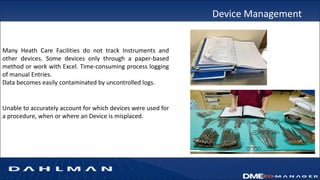
Many Heath Care Facilities do not track Instruments and
other devices. Some devices only through a paper-based
method or work with Excel. Time-consuming process logging
of manual Entries.
Data becomes easily contaminated by uncontrolled logs.
Unable to accurately account for which devices were used for
a procedure, when or where an Device is misplaced.
Key Findings In Hospitals - Devices
• Poor conditions, past expiry date.
• Low quality parts that cause unexpected failures.
• Incidents go unseen without accountability.
• Devices used often uncalibrated.
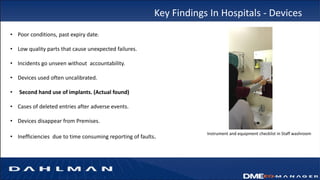
• Second hand use of implants. (Actual found)
• Cases of deleted entries after adverse events.
• Devices disappear from Premises.
• Inefficiencies due to time consuming reporting of faults. Instrument and equipment checklist in Staff washroom
Key Findings
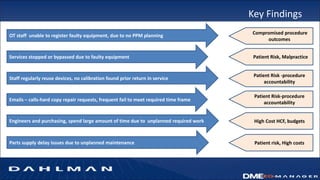
OT staff unable to register faulty equipment, due to no PPM planning
Services stopped or bypassed due to faulty equipment
Staff regularly reuse devices, no calibration found prior return in service
Emails – calls-hard copy repair requests, frequent fail to meet required time frame
Engineers and purchasing, spend large amount of time due to unplanned required work
Parts supply delay issues due to unplanned maintenance
Compromised procedure
outcomes
Patient Risk, Malpractice
Patient Risk -procedure
accountability
Patient Risk-procedure
accountability
High Cost HCF, budgets
Patient risk, High costs
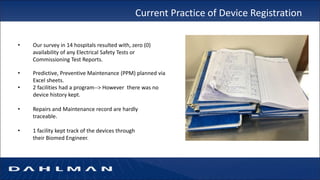
Current Practice of Device Registration
• Our survey in 14 hospitals resulted with, zero (0)
availability of any Electrical Safety Tests or
Commissioning Test Reports.
• Predictive, Preventive Maintenance (PPM) planned via
Excel sheets.
• 2 facilities had a program--> However there was no
device history kept.
• Repairs and Maintenance record are hardly
traceable.
• 1 facility kept track of the devices through
their Biomed Engineer.
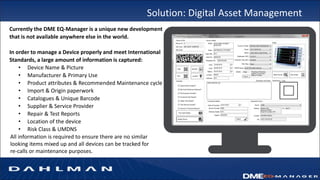
Currently the DME EQ-Manager is a unique new development
that is not available anywhere else in the world.
In order to manage a Device properly and meet International
Standards, a large amount of information is captured:
• Device Name & Picture
• Manufacturer & Primary Use
• Product attributes & Recommended Maintenance cycle
• Import & Origin paperwork
• Catalogues & Unique Barcode
• Supplier & Service Provider
• Repair & Test Reports
• Location of the device
• Risk Class & UMDNS
Solution: Digital Asset Management
All information is required to ensure there are no similar
looking items mixed up and all devices can be tracked for
re-calls or maintenance purposes.
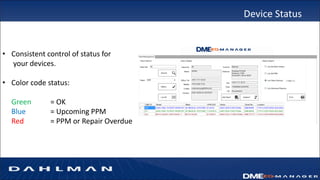
Device Status
• Consistent control of status for
your devices.
• Color code status:
Green = OK
Blue = Upcoming PPM
Red = PPM or Repair Overdue
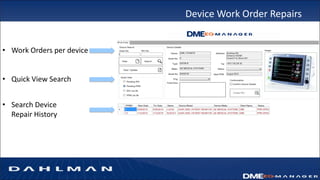
Device Work Order Repairs
• Work Orders per device
• Quick View Search
• Search Device
Repair History
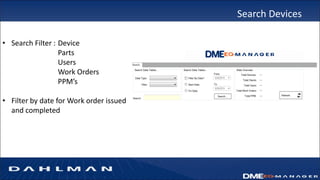
Search Devices
• Search Filter : Device
Parts
Users
Work Orders
PPM’s
• Filter by date for Work order issued
and completed
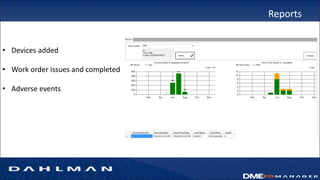
Reports
• Devices added
• Work order issues and completed
• Adverse events
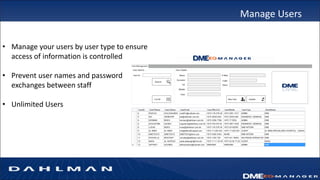
Manage Users
• Manage your users by user type to ensure
access of information is controlled
• Prevent user names and password
exchanges between staff
• Unlimited Users
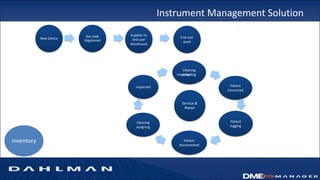
Instrument Management Solution
Service &
Repair
New Device
Cleaning
assigning
Patient
connected
Patient
logging
Cleaning
assigning
Patient
disconnected
Inspected
Inventory
Inspected
Bar code
Registered
Supplier to
End user
Warehouse
End user
asset
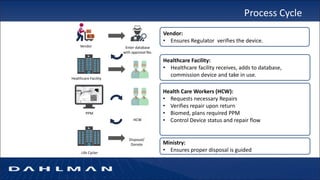
Process Cycle
Vendor:
• Ensures Regulator verifies the device.
Enter database
with approval No.
Vendor
Healthcare Facility:
• Healthcare facility receives, adds to database,
commission device and take in use.
Healthcare Facility
Health Care Workers (HCW):
• Requests necessary Repairs
• Verifies repair upon return
• Biomed, plans required PPM
• Control Device status and repair flowHCW
Disposal/
Donate Ministry:
• Ensures proper disposal is guidedLife Cycler
PPM
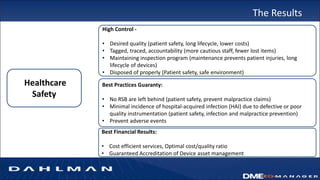
The Results
High Control -
• Desired quality (patient safety, long lifecycle, lower costs)
• Tagged, traced, accountability (more cautious staff, fewer lost items)
• Maintaining inspection program (maintenance prevents patient injuries, long
lifecycle of devices)
• Disposed of properly (Patient safety, safe environment)
Healthcare
Safety
Best Practices Guaranty:
• No RSB are left behind (patient safety, prevent malpractice claims)
• Minimal incidence of hospital-acquired infection (HAI) due to defective or poor
quality instrumentation (patient safety, infection and malpractice prevention)
• Prevent adverse events
Best Financial Results:
• Cost efficient services, Optimal cost/quality ratio
• Guaranteed Accreditation of Device asset management
Thank you for your
kind attention.

DME EQ Manager - Medical device management

  • 2.
    Device Management Many HeathCare Facilities do not track Instruments and other devices. Some devices only through a paper-based method or work with Excel. Time-consuming process logging of manual Entries. Data becomes easily contaminated by uncontrolled logs. Unable to accurately account for which devices were used for a procedure, when or where an Device is misplaced.
  • 3.
    Key Findings InHospitals - Devices • Poor conditions, past expiry date. • Low quality parts that cause unexpected failures. • Incidents go unseen without accountability. • Devices used often uncalibrated. • Second hand use of implants. (Actual found) • Cases of deleted entries after adverse events. • Devices disappear from Premises. • Inefficiencies due to time consuming reporting of faults. Instrument and equipment checklist in Staff washroom
  • 4.
    Key Findings OT staffunable to register faulty equipment, due to no PPM planning Services stopped or bypassed due to faulty equipment Staff regularly reuse devices, no calibration found prior return in service Emails – calls-hard copy repair requests, frequent fail to meet required time frame Engineers and purchasing, spend large amount of time due to unplanned required work Parts supply delay issues due to unplanned maintenance Compromised procedure outcomes Patient Risk, Malpractice Patient Risk -procedure accountability Patient Risk-procedure accountability High Cost HCF, budgets Patient risk, High costs
  • 5.
    Current Practice ofDevice Registration • Our survey in 14 hospitals resulted with, zero (0) availability of any Electrical Safety Tests or Commissioning Test Reports. • Predictive, Preventive Maintenance (PPM) planned via Excel sheets. • 2 facilities had a program--> However there was no device history kept. • Repairs and Maintenance record are hardly traceable. • 1 facility kept track of the devices through their Biomed Engineer.
  • 6.
    Currently the DMEEQ-Manager is a unique new development that is not available anywhere else in the world. In order to manage a Device properly and meet International Standards, a large amount of information is captured: • Device Name & Picture • Manufacturer & Primary Use • Product attributes & Recommended Maintenance cycle • Import & Origin paperwork • Catalogues & Unique Barcode • Supplier & Service Provider • Repair & Test Reports • Location of the device • Risk Class & UMDNS Solution: Digital Asset Management All information is required to ensure there are no similar looking items mixed up and all devices can be tracked for re-calls or maintenance purposes.
  • 7.
    Device Status • Consistentcontrol of status for your devices. • Color code status: Green = OK Blue = Upcoming PPM Red = PPM or Repair Overdue
  • 8.
    Device Work OrderRepairs • Work Orders per device • Quick View Search • Search Device Repair History
  • 9.
    Search Devices • SearchFilter : Device Parts Users Work Orders PPM’s • Filter by date for Work order issued and completed
  • 10.
    Reports • Devices added •Work order issues and completed • Adverse events
  • 11.
    Manage Users • Manageyour users by user type to ensure access of information is controlled • Prevent user names and password exchanges between staff • Unlimited Users
  • 12.
    Instrument Management Solution Service& Repair New Device Cleaning assigning Patient connected Patient logging Cleaning assigning Patient disconnected Inspected Inventory Inspected Bar code Registered Supplier to End user Warehouse End user asset
  • 13.
    Process Cycle Vendor: • EnsuresRegulator verifies the device. Enter database with approval No. Vendor Healthcare Facility: • Healthcare facility receives, adds to database, commission device and take in use. Healthcare Facility Health Care Workers (HCW): • Requests necessary Repairs • Verifies repair upon return • Biomed, plans required PPM • Control Device status and repair flowHCW Disposal/ Donate Ministry: • Ensures proper disposal is guidedLife Cycler PPM
  • 14.
    The Results High Control- • Desired quality (patient safety, long lifecycle, lower costs) • Tagged, traced, accountability (more cautious staff, fewer lost items) • Maintaining inspection program (maintenance prevents patient injuries, long lifecycle of devices) • Disposed of properly (Patient safety, safe environment) Healthcare Safety Best Practices Guaranty: • No RSB are left behind (patient safety, prevent malpractice claims) • Minimal incidence of hospital-acquired infection (HAI) due to defective or poor quality instrumentation (patient safety, infection and malpractice prevention) • Prevent adverse events Best Financial Results: • Cost efficient services, Optimal cost/quality ratio • Guaranteed Accreditation of Device asset management
  • 15.
    Thank you foryour kind attention.