Health
Educatio
n
Health education is defined
as the principle by which
individuals and groups of people
learn to behave in a manner
conducive to the promotion,
maintenance, or restoration of
Aspects of Health
Physical health. Physical fitness is good
body health, and is the result of regular
exercise, proper diet and nutrition, and
proper rest physical recovery.
Mental health. Mental health refers to an
individual's emotional and psychological well-
well-being. "A state of emotional and
psychological well-being in which an
individual is able to use his or her cognitive
and emotional capabilities, function in society,
society, and meet the ordinary demands of
everyday life."
Determinants of health The LaLonde
report suggested that there are four general
determinants of health including:
a. human biology,
b. environment,
c. lifestyle, and
d. healthcare services.
Health maintenance
Achieving health and remaining
healthy is an active process. Effective
strategies for staying healthy and
improving one's health include the
following elements:
1. Nutrition (also called nourishment or aliment) is the
provision, to cells and organisms, of the materials
necessary (in the form of food) to support life. Many
common health problems can be prevented or alleviated
with good nutrition. The diet of an organism refers to
what it eats. Poor diet can have an injurious impact on
health, causing deficiency diseases such as scurvy,
beriberi, and kwashiorkor; health-threatening conditions
conditions like obesity and metabolic syndrome, and such
such common chronic systemic diseases as cardiovascular
cardiovascular disease, diabetes, and osteoporosis.
There are seven major classes of nutrients: major
classes of nutrients: carbohydrates, fats, fiber,
minerals, protein, vitamins, and water. These
nutrient classes can be categorized as either
macronutrients (needed in relatively large
amounts) or micronutrients (needed in Smaller
quantities). The macronutrients are
carbohydrates, fats, fiber, proteins, and water. The
micronutrients are minerals and vitamins.
Nutrients
The macronutrients (excluding
fiber and water) provide energy, which is
measured in Joules or kilocalories. Vitamins,
minerals, friber, and water do not provide
energy, but are necessary for the regulation
of important body processes.
Minerals
Dietary minerals are the
chemical elements required by living
organisms, other than the four
elements carbon, hydrogen, nitrogen
and oxygen that are present in
common organic molecules.
Macrominerals. Many elements are
essential in quantity; also called "bulk
minerals". Some are structural, but many
many play a role as electrolytes. Elements
Elements with recommended dietary
allowance (RDA) greater than 200 mg/day
mg/day are the following, in alphabetical
order (with informal or folk-medicine
perspectives in parentheses.
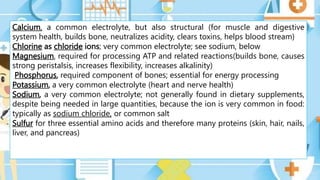
Calcium, a common electrolyte, but also structural (for muscle and digestive
system health, builds bone, neutralizes acidity, clears toxins, helps blood stream)
Chlorine as chloride ions; very common electrolyte; see sodium, below
Magnesium, required for processing ATP and related reactions(builds bone, causes
strong peristalsis, increases flexibility, increases alkalinity)
Phosphorus, required component of bones; essential for energy processing
Potassium, a very common electrolyte (heart and nerve health)
Sodium, a very common electrolyte; not generally found in dietary supplements,
despite being needed in large quantities, because the ion is very common in food:
typically as sodium chloride, or common salt
Sulfur for three essential amino acids and therefore many proteins (skin, hair, nails,
liver, and pancreas)
Trace minerals. Many elements
are required in trace amounts,
usually because they play a
catalytic role in enzymes.
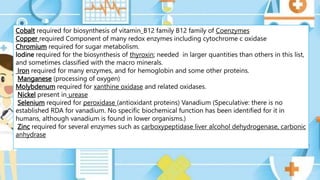
Cobalt required for biosynthesis of vitamin_B12 family B12 family of Coenzymes
Copper required Component of many redox enzymes including cytochrome c oxidase
Chromium required for sugar metabolism.
lodine required for the biosynthesis of thyroxin; needed in larger quantities than others in this list,
and sometimes classified with the macro minerals.
Iron required for many enzymes, and for hemoglobin and some other proteins.
Manganese (processing of oxygen)
Molybdenum required for xanthine oxidase and related oxidases.
Nickel present in urease
Selenium required for peroxidase (antioxidant proteins) Vanadium (Speculative: there is no
established RDA for vanadium. No specific biochemical function has been identified for it in
humans, although vanadium is found in lower organisms.)
Zinc required for several enzymes such as carboxypeptidase liver alcohol dehydrogenase, carbonic
anhydrase
Vitamins. As with the minerals
discussed above, twelve vitamins are
recognized as essential nutrients,
necessary in the diet for good health.
2.EXERCISE .Exercise is the performance of
movements in order to develop or maintain
physical fitness and overall health. It is often
directed toward also honing athletic ability or skill.
Frequent and regular physical exercise is an
important component to prevention of some
diseases of affluence such as cancer, heart disease
cardiovascular disease, Type 2 diabetes, obesity and
back pain.
Physical exercise is considered important for maintaining
physical fitness including:
1. Healthy weight;
2. Building and maintaining healthy bones, muscles, and
joints:
3. Promoting physiological well-being;
4. Reducing surgical risks; and
5. Strengthening the immune system.
3. HYGIENE. Hygiene is the practice of keeping the
body clean to prevent infection and illness, and the
avoidance of contact with infectious agents. Hygiene
practices include:
1. Bathing,
2. Brushing and flossing teeth
3. washing hands specially before eating
4. washing food before it is eaten,
5. cleaning food preparation utensils and surfaces before
and after preparing meals, and many others.
D. Stress Management
Prolonged psychological stress may negatively impact health, such as by
weakening the immune system. Stress management is the application of methods
to either reduces stress or increase tolerance to stress which include the ff:
1. Relaxation techniques are physical methods used to relieve stress.
2. Psychological methods include cognitive therapy, meditation, and positive
thinking which work by reducing response to stress.
3. Improving relevant skills and abilities builds confidence, which also reduces
the stress reaction to situations where those skills are applicable.
4. Reducing uncertainty, by increasing knowledge and experience related to
stress-causing situations, has the same effect.
E. Health
Health care is the prevention, treatment, and
management of illness and the preservation of
mental and physical well-being through the services
offered by the medical, nursing, and allied health
professions.
Role of science in Health
Health science is the branch of science
focused on health, and it includes many sub-
disciplines. There are two approaches to health
science: the study and research of the human body
and health- related issues to understand how humans
humans (and animals) function, and the application
of that knowledge to improve health and to prevent
and cure diseases.
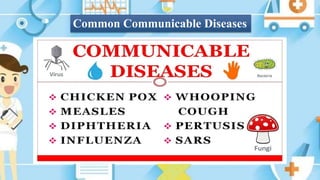
Common Communicable Diseases
Some of the most common communicable diseases affecting
many people are the following:
A. Cholera is a bacterial disease that affects the intestinal
tract. It is caused by a germ called Vibrio cholerae. Although
only a few cases are recognized in the United States each
year, epidemic levels of cholera have recently been reported
in parts of Central and South America.
B. DENGUE FEVER (breakbone fever, dengue
hemorrhagic fever)
Dengue Fever is a mosquito-borne disease caused by
a virus. The disease is mainly tropical in origin but
occasionally residents or visitors from other countries
may arrive in this country with dengue. Although
cases originating unknown, epidemic levels have
recently been reported in parts of in the United States
are virtually the Caribbean and Central America.
C. INFLUENZA (Flu)
The flu is a contagious respiratory illness by influenza viruses. It
can cause mild to severe illness, and at times can lead to death.
Some people, such as older people, young children, and people
with certain health conditions, are at high risk for serious flu
complications.
Every year in the United States, on average:
 5% to 20% of the population gets the flu
 More than 200,000 people are hospitalized from flu
complications, and ;
D. MALARIA. Malaria is a mosquito-borne
disease caused by any one of four different
different blood parasites, called Plasmodia.
Plasmodia. The disease is transmitted to
people by the Anopheles mosquito. This
disease is a leading cause of debilitating
illness, with over 200 million cases each
year from around the world.
E. PERTUSSIS (whooping cough)
Pertussis, or whooping cough, is a highly
contagious bacterial infection that causes an
an uncontrollable, violent cough lasting
several weeks or even months. It is caused by
by a bacterium that is found “the mouth,
nose and throat of an infected person.
What is parapertussis?
Parapertussis is a bacterial illness that is similar t to
pertussis (whooping cough) but is not as common and
generally causes less severe symptoms. Up to 40
percent of all cases of parapertussis will present with
no symptoms. Very young infants (less than six
months of age) may have a more severe course of
parapertussis than older persons. Parapertussis is
spread through the air in drop produced during
coughing and sneezing.
F. Pneumococcal Disease (includes pneumococcal
pneumonia, pneumococcal meningitisand
pneumococcal bacteremia)
Pneumococcal disease is a bacterial infection
caused by the bacteria Streptococcus pneumoniae,
also called pneumococcus. It may cause middle ear
infection, pneumonia, meningitis (inflammation of
the coverings of the brain and spinal column) or
bacteremia (a bloodstream infection).
G. Tuberculosis (TB)
Tuberculosis is a bacterial disease usually
affecting the lungs (pulmonary TB). Other parts
parts of the body can also be affected, for
example lymph nodes, kidneys, bones, joints,
etc. (extrapulmonary TB). Approximately 1,300
1,300 cases are reported each year in New York
York State.
J. Hepatitis B (serum hepatitis)
Hepatitis B is a liver disease caused by the
hepatitis B virus (HB). The virus can cause
lifelong infection, cirrhosis (scarring) of the
liver, liver cancer, liver failure and death.
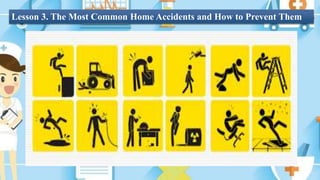
Lesson 3. The Most Common Home Accidents and How to Prevent Them
Common Home Accidents
Below are some of the common accidents at home and simple measures to
observe to prevent the effects of these common home accidents.
1. Drowning. One of the most common causes of injury and death around the
home is drowning. A small child can drown in only a few inches of water.
2. Burns. Another common injury around the home is burns. Scalds from hot
water top the list in burning injuries so be sure your water heaters are
managed properly at home,
3. Electrocution. Electrocution is a common household tragedy.
4. Falls. Protecting your family from falls can prevent bruises, broken bones, or
even death.
5. Poisoning. Poisoning is a dangerous household accident that is totally
preventable.
6. Choking. Choking is a hazard that mostly affects children.
7. Cuts and instrument Punctures. Cuts are open wounds made by any sharp
sharp instrument like a knife, a razor, broken made glass.

Health-Education PowerPoint presentation

  • 1.
  • 2.
    Health education isdefined as the principle by which individuals and groups of people learn to behave in a manner conducive to the promotion, maintenance, or restoration of
  • 3.
    Aspects of Health Physicalhealth. Physical fitness is good body health, and is the result of regular exercise, proper diet and nutrition, and proper rest physical recovery.
  • 4.
    Mental health. Mentalhealth refers to an individual's emotional and psychological well- well-being. "A state of emotional and psychological well-being in which an individual is able to use his or her cognitive and emotional capabilities, function in society, society, and meet the ordinary demands of everyday life."
  • 5.
    Determinants of healthThe LaLonde report suggested that there are four general determinants of health including: a. human biology, b. environment, c. lifestyle, and d. healthcare services.
  • 6.
    Health maintenance Achieving healthand remaining healthy is an active process. Effective strategies for staying healthy and improving one's health include the following elements:
  • 7.
    1. Nutrition (alsocalled nourishment or aliment) is the provision, to cells and organisms, of the materials necessary (in the form of food) to support life. Many common health problems can be prevented or alleviated with good nutrition. The diet of an organism refers to what it eats. Poor diet can have an injurious impact on health, causing deficiency diseases such as scurvy, beriberi, and kwashiorkor; health-threatening conditions conditions like obesity and metabolic syndrome, and such such common chronic systemic diseases as cardiovascular cardiovascular disease, diabetes, and osteoporosis.
  • 8.
    There are sevenmajor classes of nutrients: major classes of nutrients: carbohydrates, fats, fiber, minerals, protein, vitamins, and water. These nutrient classes can be categorized as either macronutrients (needed in relatively large amounts) or micronutrients (needed in Smaller quantities). The macronutrients are carbohydrates, fats, fiber, proteins, and water. The micronutrients are minerals and vitamins. Nutrients
  • 9.
    The macronutrients (excluding fiberand water) provide energy, which is measured in Joules or kilocalories. Vitamins, minerals, friber, and water do not provide energy, but are necessary for the regulation of important body processes.
  • 10.
    Minerals Dietary minerals arethe chemical elements required by living organisms, other than the four elements carbon, hydrogen, nitrogen and oxygen that are present in common organic molecules.
  • 11.
    Macrominerals. Many elementsare essential in quantity; also called "bulk minerals". Some are structural, but many many play a role as electrolytes. Elements Elements with recommended dietary allowance (RDA) greater than 200 mg/day mg/day are the following, in alphabetical order (with informal or folk-medicine perspectives in parentheses.
  • 12.
    Calcium, a commonelectrolyte, but also structural (for muscle and digestive system health, builds bone, neutralizes acidity, clears toxins, helps blood stream) Chlorine as chloride ions; very common electrolyte; see sodium, below Magnesium, required for processing ATP and related reactions(builds bone, causes strong peristalsis, increases flexibility, increases alkalinity) Phosphorus, required component of bones; essential for energy processing Potassium, a very common electrolyte (heart and nerve health) Sodium, a very common electrolyte; not generally found in dietary supplements, despite being needed in large quantities, because the ion is very common in food: typically as sodium chloride, or common salt Sulfur for three essential amino acids and therefore many proteins (skin, hair, nails, liver, and pancreas)
  • 13.
    Trace minerals. Manyelements are required in trace amounts, usually because they play a catalytic role in enzymes.
  • 14.
    Cobalt required forbiosynthesis of vitamin_B12 family B12 family of Coenzymes Copper required Component of many redox enzymes including cytochrome c oxidase Chromium required for sugar metabolism. lodine required for the biosynthesis of thyroxin; needed in larger quantities than others in this list, and sometimes classified with the macro minerals. Iron required for many enzymes, and for hemoglobin and some other proteins. Manganese (processing of oxygen) Molybdenum required for xanthine oxidase and related oxidases. Nickel present in urease Selenium required for peroxidase (antioxidant proteins) Vanadium (Speculative: there is no established RDA for vanadium. No specific biochemical function has been identified for it in humans, although vanadium is found in lower organisms.) Zinc required for several enzymes such as carboxypeptidase liver alcohol dehydrogenase, carbonic anhydrase
  • 15.
    Vitamins. As withthe minerals discussed above, twelve vitamins are recognized as essential nutrients, necessary in the diet for good health.
  • 16.
    2.EXERCISE .Exercise isthe performance of movements in order to develop or maintain physical fitness and overall health. It is often directed toward also honing athletic ability or skill. Frequent and regular physical exercise is an important component to prevention of some diseases of affluence such as cancer, heart disease cardiovascular disease, Type 2 diabetes, obesity and back pain.
  • 17.
    Physical exercise isconsidered important for maintaining physical fitness including: 1. Healthy weight; 2. Building and maintaining healthy bones, muscles, and joints: 3. Promoting physiological well-being; 4. Reducing surgical risks; and 5. Strengthening the immune system.
  • 18.
    3. HYGIENE. Hygieneis the practice of keeping the body clean to prevent infection and illness, and the avoidance of contact with infectious agents. Hygiene practices include: 1. Bathing, 2. Brushing and flossing teeth 3. washing hands specially before eating 4. washing food before it is eaten, 5. cleaning food preparation utensils and surfaces before and after preparing meals, and many others.
  • 19.
    D. Stress Management Prolongedpsychological stress may negatively impact health, such as by weakening the immune system. Stress management is the application of methods to either reduces stress or increase tolerance to stress which include the ff: 1. Relaxation techniques are physical methods used to relieve stress. 2. Psychological methods include cognitive therapy, meditation, and positive thinking which work by reducing response to stress. 3. Improving relevant skills and abilities builds confidence, which also reduces the stress reaction to situations where those skills are applicable. 4. Reducing uncertainty, by increasing knowledge and experience related to stress-causing situations, has the same effect.
  • 20.
    E. Health Health careis the prevention, treatment, and management of illness and the preservation of mental and physical well-being through the services offered by the medical, nursing, and allied health professions.
  • 21.
    Role of sciencein Health Health science is the branch of science focused on health, and it includes many sub- disciplines. There are two approaches to health science: the study and research of the human body and health- related issues to understand how humans humans (and animals) function, and the application of that knowledge to improve health and to prevent and cure diseases.
  • 22.
  • 23.
    Some of themost common communicable diseases affecting many people are the following: A. Cholera is a bacterial disease that affects the intestinal tract. It is caused by a germ called Vibrio cholerae. Although only a few cases are recognized in the United States each year, epidemic levels of cholera have recently been reported in parts of Central and South America.
  • 24.
    B. DENGUE FEVER(breakbone fever, dengue hemorrhagic fever) Dengue Fever is a mosquito-borne disease caused by a virus. The disease is mainly tropical in origin but occasionally residents or visitors from other countries may arrive in this country with dengue. Although cases originating unknown, epidemic levels have recently been reported in parts of in the United States are virtually the Caribbean and Central America.
  • 25.
    C. INFLUENZA (Flu) Theflu is a contagious respiratory illness by influenza viruses. It can cause mild to severe illness, and at times can lead to death. Some people, such as older people, young children, and people with certain health conditions, are at high risk for serious flu complications. Every year in the United States, on average:  5% to 20% of the population gets the flu  More than 200,000 people are hospitalized from flu complications, and ;
  • 26.
    D. MALARIA. Malariais a mosquito-borne disease caused by any one of four different different blood parasites, called Plasmodia. Plasmodia. The disease is transmitted to people by the Anopheles mosquito. This disease is a leading cause of debilitating illness, with over 200 million cases each year from around the world.
  • 27.
    E. PERTUSSIS (whoopingcough) Pertussis, or whooping cough, is a highly contagious bacterial infection that causes an an uncontrollable, violent cough lasting several weeks or even months. It is caused by by a bacterium that is found “the mouth, nose and throat of an infected person.
  • 28.
    What is parapertussis? Parapertussisis a bacterial illness that is similar t to pertussis (whooping cough) but is not as common and generally causes less severe symptoms. Up to 40 percent of all cases of parapertussis will present with no symptoms. Very young infants (less than six months of age) may have a more severe course of parapertussis than older persons. Parapertussis is spread through the air in drop produced during coughing and sneezing.
  • 29.
    F. Pneumococcal Disease(includes pneumococcal pneumonia, pneumococcal meningitisand pneumococcal bacteremia) Pneumococcal disease is a bacterial infection caused by the bacteria Streptococcus pneumoniae, also called pneumococcus. It may cause middle ear infection, pneumonia, meningitis (inflammation of the coverings of the brain and spinal column) or bacteremia (a bloodstream infection).
  • 30.
    G. Tuberculosis (TB) Tuberculosisis a bacterial disease usually affecting the lungs (pulmonary TB). Other parts parts of the body can also be affected, for example lymph nodes, kidneys, bones, joints, etc. (extrapulmonary TB). Approximately 1,300 1,300 cases are reported each year in New York York State.
  • 31.
    J. Hepatitis B(serum hepatitis) Hepatitis B is a liver disease caused by the hepatitis B virus (HB). The virus can cause lifelong infection, cirrhosis (scarring) of the liver, liver cancer, liver failure and death.
  • 32.
    Lesson 3. TheMost Common Home Accidents and How to Prevent Them
  • 33.
    Common Home Accidents Beloware some of the common accidents at home and simple measures to observe to prevent the effects of these common home accidents. 1. Drowning. One of the most common causes of injury and death around the home is drowning. A small child can drown in only a few inches of water. 2. Burns. Another common injury around the home is burns. Scalds from hot water top the list in burning injuries so be sure your water heaters are managed properly at home, 3. Electrocution. Electrocution is a common household tragedy. 4. Falls. Protecting your family from falls can prevent bruises, broken bones, or even death. 5. Poisoning. Poisoning is a dangerous household accident that is totally preventable. 6. Choking. Choking is a hazard that mostly affects children. 7. Cuts and instrument Punctures. Cuts are open wounds made by any sharp sharp instrument like a knife, a razor, broken made glass.