
Diversity mechanisms for
evolutionary populations in
Search-Based Software
Engineering
Prof. Andrea De Lucia, University of Salerno, Italy
Dr. Annibale Panichella, FBK, Italy
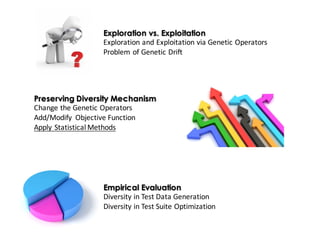
Exploration vs. Exploitation
Exploration	and	Exploitation	via	Genetic	Operators
Problem	of	Genetic	Drift
Preserving Diversity Mechanism
Change	the	Genetic	Operators
Add/Modify	 Objective	Function
Apply	Statistical	Methods
Empirical Evaluation
Diversity	in	Test	Data	Generation
Diversity	in	Test	Suite	Optimization
Optimization Problems
Local	Optimum
Global	Optimum
Minimize
x
f(x)
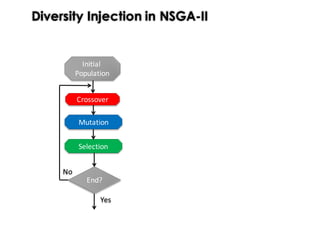
Single-Objective Problem Multi-Objective Problem
Minimize
Minimize
f2(x)
f1(x)
General Process
Genetic Algorithms
Single-Objective GAs Multi-Objective GAs
• Roulette	wheel
• Tournament
• Rank	Scaling
• …
• Single-point	
• Two-points
• Arithmetic
• …	
• Uniform
• Bit-flip
• Adaptive
• …
Initial	
Population
Crossover
Mutation
Selection
No
Yes
End?
• Non-dominated	Sorting
• Epsilon	Dominance
• Lorentz	Dominance
• Single-point	
• Two-points
• Arithmetic
• …	
• Uniform
• Bit-flip
• Adaptive
• …
Key factors for GAs
“Genetic Algorithms (GAs) must maintain a balance between the
exploitation […] and the exploration […] as to increase the probability of
finding the optimal solution.” Wong et al. [2003]
Exploitation: find nearby better solutions by promoting beneficial aspects
(genes) of existing solutions.
Exploration: find new solutions in different regions of the search space by
generating solutions with new aspects
Key factors for GAs
“Genetic Algorithms (GAs) must maintain a balance between the
exploitation […] and the exploration […] as to increase the probability of
finding the optimal solution.” Wong et al. [2003]
Exploitation: find nearby better solutions by promoting beneficial aspects
(genes) of existing solutions. It is guaranteed by:
• Selection: it selects the fittest individuals for reproduction
• Crossover: it generate new nearby solutions
Exploration: find new solutions in different regions of the search space by
generating solutions with new aspects. It is guaranteed by:
• Mutation:	it	randomly	modifies	 individuals	with	a	given	probability,	 and	
thus	increases	the	structural	diversity	of	a	population.
0.5
1.5
0.5
1.5
Exploitation
Selection	Pressure
To find nearby better
solutions using crossover
and selection.
( ) ]2;0[,1)1(sin)(min 8
∈+−= xxxf
x
f(x)
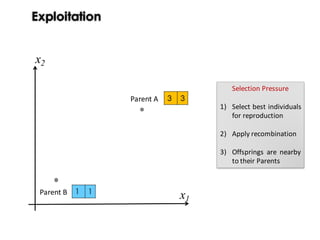
Exploitation
Selection	Pressure
1) Select best individuals
for reproduction
2) Apply recombination
3) Offsprings are nearby
to their Parents
Parent	A
Parent	B
x1
x2
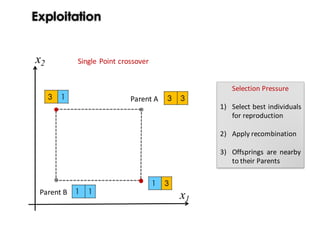
Exploitation
Parent	A
Parent	B
x1
x2
Selection	Pressure
1) Select best individuals
for reproduction
2) Apply recombination
3) Offsprings are nearby
to their Parents
Single	Point	crossover
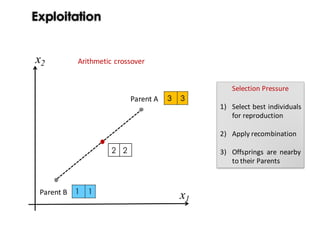
Exploitation
Parent	A
Parent	B
x1
x2
Selection	Pressure
1) Select best individuals
for reproduction
2) Apply recombination
3) Offsprings are nearby
to their Parents
Arithmetic	crossover
2 2
Exploration
GA got you
from here…
x
f(x)
( ) ]3.2;0[,1)1(sin)(min 8
∈+−= xxxf
Exploration
GA got you
from here…
( ) ]3.2;0[,1)1(sin)(min 8
∈+−= xxxf
Exploration
Looking	for		new	
unexplored	regions
x
f(x)
Exploration
GA got you
from here…
to here…
…but if you tried
something
radical…
( ) ]3.2;0[,1)1(sin)(min 8
∈+−= xxxf
x
f(x)
Exploration
GA got you
from here…
to here…
…but if you tried
something
radical…
…you could
get here!
( ) ]3.2;0[,1)1(sin)(min 8
∈+−= xxxf
x
f(x)
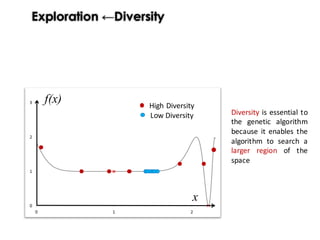
Exploration ←Diversity
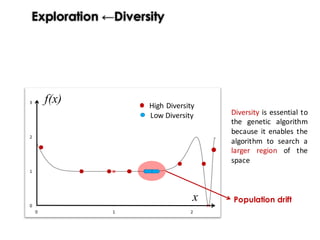
Diversity is essential to
the genetic algorithm
because it enables the
algorithm to search a
larger region of the
space.
Low	Diversity
High	Diversity
x
f(x)
Exploration ←Diversity
Population driftx
f(x)
Diversity is essential to
the genetic algorithm
because it enables the
algorithm to search a
larger region of the
space.
Low	Diversity
High	Diversity
Exploration ←Diversity
“Progress in evolution depends fundamentally on the existence of variation of
population.”
“Unfortunately, a key problem in many Evolutionary Computation (EC) systems is
the loss of diversity through premature convergence. ”
McPhee and Hopper [2]
“This lack of diversity often leads to stagnation, as the system finds itself trapped
in local optima, lacking the genetic diversity needed to escape. ”
Exploration ←Diversity
x1
x2
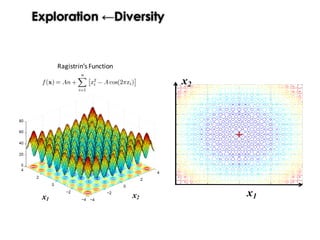
Ragistrin’s Function
x1
x2
Exploration ←Diversity
x1
x2
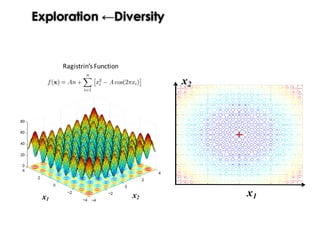
Ragistrin’s Function
x1
x2
Exploration ←Diversity
x1
x2
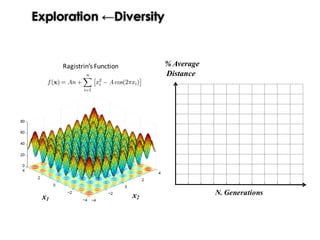
Ragistrin’s Function
N. Generations
% Average
Distance
Is Diversity a (meta) problem in SBSE?
Consider	two	typical	SEBSE	applications:
Search-Based Test Data Generation
Multi-Objective Test Suite Optimization
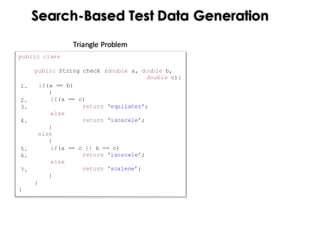
public class Triangle {
public String check (double a, double b,
double c){
if(a == b)
{
if(a == c)
return ‘equilater’;
else
return ‘isoscele’;
}
else
{
if(a == c || b == c)
return ‘isoscele’;
else
return ‘scalene’;
}
}
}
1.
2.
3.
4.
5.
6.
7.
Search-Based Test Data Generation
Triangle	Problem
public class Triangle {
public String check (double a, double b,
double c){
if(a == b)
{
if(a == c)
return ‘equilater’;
else
return ‘isoscele’;
}
else
{
if(a == c || b == c)
return ‘isoscele’;
else
return ‘scalene’;
}
}
}
1.
2.
3.
4.
5.
6.
7.
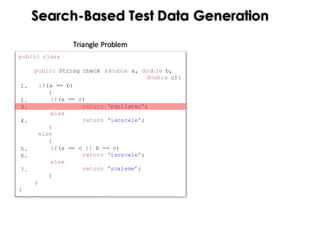
Triangle	Problem
Search-Based Test Data Generation
public class Triangle {
public String check (double a, double b,
double c){
if(a == b)
{
if(a == c)
return ‘equilater’;
else
return ‘isoscele’;
}
else
{
if(a == c || b == c)
return ‘isoscele’;
else
return ‘scalene’;
}
}
}
1.
2.
3.
4.
5.
6.
7.
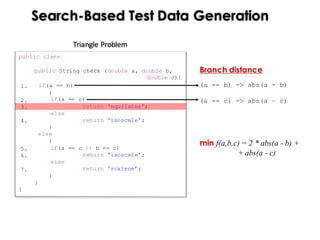
Triangle	Problem
Search-Based Test Data Generation
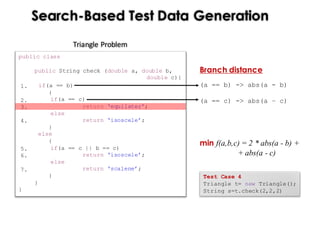
Branch distance
(a == b) -> abs(a - b)
(a == c) -> abs(a – c))
min f(a,b,c) = 2 * abs(a - b) +
+ abs(a - c)
public class Triangle {
public String check (double a, double b,
double c){
if(a == b)
{
if(a == c)
return ‘equilater’;
else
return ‘isoscele’;
}
else
{
if(a == c || b == c)
return ‘isoscele’;
else
return ‘scalene’;
}
}
}
1.
2.
3.
4.
5.
6.
7.
Triangle	Problem
Search-Based Test Data Generation
Test Case 4
Triangle t= new Triangle();
String s=t.check(2,2,2)
Branch distance
(a == b) -> abs(a - b)
(a == c) -> abs(a – c))
min f(a,b,c) = 2 * abs(a - b) +
+ abs(a - c)
c=2				a,	b	ϵ [-1;4]
a
b
Fitness
1) Flat	seach	space
2) Several	Local	optimal
3) Only	one	global	optimum
Triangle	Problem
Search-Based Test Data Generation
a,	b	ϵ [-30;30]
c=2
a
b
Fitness
GAs Simulation
Mutation	Rate	=	0.10
Population	=	50
Crossover	=		single-point	
Premature	convergence	
(genetic	drift)
Is Diversity a (meta) problem in SBSE?
Consider	two	typical	SEBSE	applications:
Search-Based Test Data Generation
Multi-Objective Test Suite Optimization
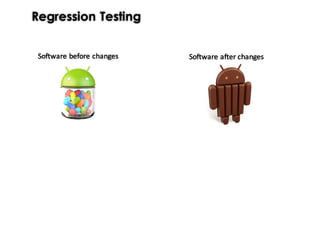
Regression Testing
Software	before	changes Software	after	changes
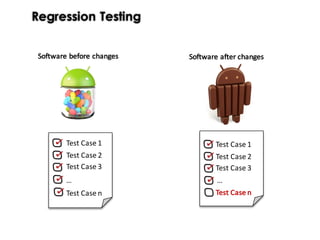
Regression Testing
Software	before	changes Software	after	changes
Test	Case	1
Test	Case	2
Test	Case	3
Test	Case	n
Test	Case	1
Test	Case	2
Test	Case	3
Test	Case	n
… …
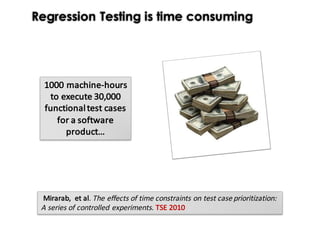
Regression Testing is time consuming
1000	machine-hours	
to	execute	30,000	
functional	test	cases	
for	a	software	
product…
Mirarab,	 et	al.	The	effects	of	time	constraints	on	test	case	prioritization:
A	series	of	controlled	experiments.	TSE	2010
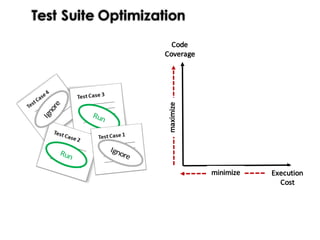
Test Suite Optimization
Code	
Coverage
Execution	
Cost
minimizemaximize
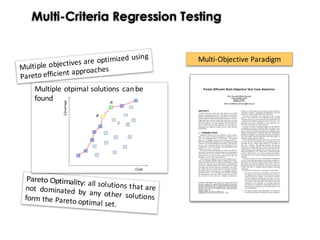
Multi-Criteria Regression Testing
Multi-Objective	Paradigm
Multiple	otpimal	solutions	 can	be	
found
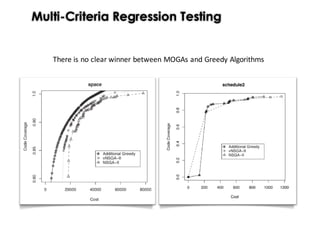
Multi-Criteria Regression Testing
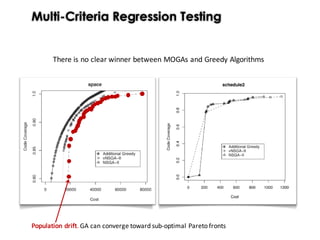
There	is	no	clear	winner	between	MOGAs	and	Greedy	Algorithms
Multi-Criteria Regression Testing
There	is	no	clear	winner	between	MOGAs	and	Greedy	Algorithms
Population	drift.	GA	can	converge	toward	sub-optimal	Pareto	fronts
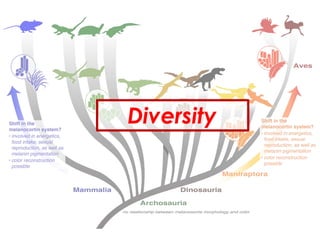
Diversity
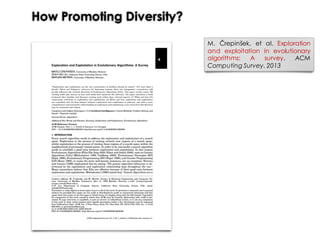
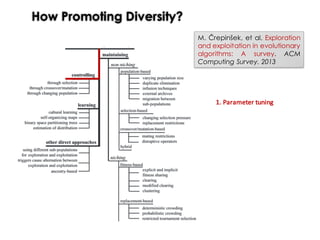
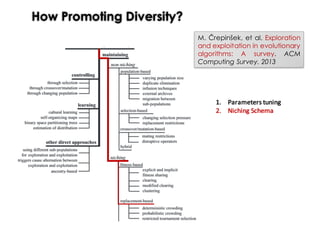
How Promoting Diversity?
M. Črepinšek, et al. Exploration
and exploitation in evolutionary
algorithms: A survey. ACM
Computing Survey. 2013
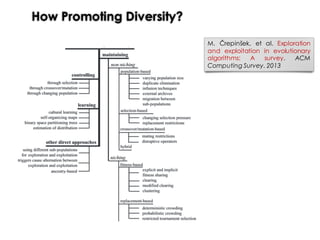
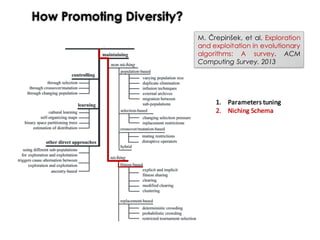
How Promoting Diversity?
M. Črepinšek, et al. Exploration
and exploitation in evolutionary
algorithms: A survey. ACM
Computing Survey. 2013
How Promoting Diversity?
1.	Parameter	tuning
M. Črepinšek, et al. Exploration
and exploitation in evolutionary
algorithms: A survey. ACM
Computing Survey. 2013
Mutation Rate
Peaks	Funtcion
x1
x2
f(x)
Mutation	Type	=	uniform
Mutation	Rate	=	0.01
Population	Size	=50
Crossover	=	Single-point
Crossover	prob.	=	0.6
Selection	=	roulette	wheel
[Whitley and Starkweather 1990]
Mutation Rate
Peaks Funtcion
x1
x2
f(x)
Exploitation
Exploration
Sub-optimal
solutions
can be reached
Mutation	Type	=	uniform
Mutation	Rate	=	0.01
Population	Size	=50
Crossover	=	Single-point
Crossover	prob.	=	0.6
Selection	=	roulette	wheel
[Whitley and Starkweather 1990]
Mutation Rate
Peaks Funtcion
x1
x2
f(x)
GAs might remain
at certain distance
to the optimum
Exploitation
Exploration
Mutation	Type	=	uniform
Mutation	Rate	=	0.90
Population	Size	=50
Crossover	=	Single-point
Crossover	prob.	=	0.6
Selection	=	roulette	wheel
[Whitley and Starkweather 1990]
Mutation Rate
Peaks Funtcion
x1
x2
f(x)
GAs might remain
at certain distance
to the optimum
Exploitation
Exploration
Mutation	Type	=	uniform
Mutation	Rate	=	0.90
Population	Size	=50
Crossover	=	Single-point
Crossover	prob.	=	0.6
Selection	=	roulette	wheel
[Whitley and Starkweather 1990]
How Promoting Diversity?
M. Črepinšek, et al. Exploration
and exploitation in evolutionary
algorithms: A survey. ACM
Computing Survey. 2013
1. Parameters	tuning
2. Niching	Schema
Fitness Sharing
x1
x2
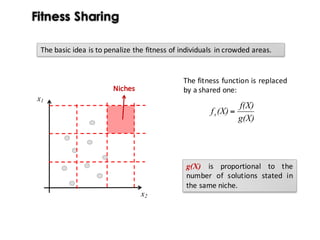
The basic idea is to penalize the fitness of individuals in crowded areas.
1) Divide the search space in partitions
or segments
2) Measure how scattered the
solutions are across the identified
partitions
3) Encourage individuals stated in
partitions sparely populated and
penalize individuals stated in
partitions densely populated
Niches
[Holland 1975]
[Goldberg and Richardson 198]
Fitness Sharing
g(X)
f(X)
(X)fs =
g(X) is proportional to the
number of solutions stated in
the same niche.
x1
x2
The basic idea is to penalize the fitness of individuals in crowded areas.
Niches
The fitness function is replaced
by a shared one:
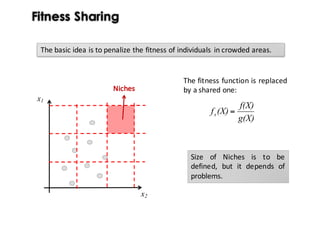
Fitness Sharing
Size of Niches is to be
defined, but it depends of
problems.
g(X)
f(X)
(X)fs =
x1
x2
The basic idea is to penalize the fitness of individuals in crowded areas.
Niches
The fitness function is replaced
by a shared one:
How Promoting Diversity?
M. Črepinšek, et al. Exploration
and exploitation in evolutionary
algorithms: A survey. ACM
Computing Survey. 2013
1. Parameters	tuning
2. Niching	Schema
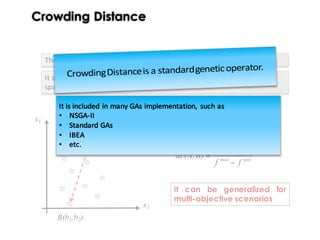
Crowding Distance
The most used diversity preserving techniques is the crowding distance.
x1
x2
A(a1,a2)
B(b1,b2)
[Mahfoud 1995]
Crowding Distance
x1
x2
It	selects	individuals	that	are	distant	from	each	other	in	the	objectives	
space.
( ) ( )
)B,A(
babaB)(A,d
babaB)(A,d
11
2
22
2
11
Hamming
222
1
−+−=
−+−=
Genotype
The independent variables
can have different ranges!
The most used diversity preserving techniques is the crowding distance.
x1
x2
A(a1,a2)
B(b1,b2)
[Mahfoud 1995]
Crowding Distance
minmax
ff
f(B)f(A)
B)dc(A,
−
−
=
Phenotype
x1
x2
It	selects	individuals	that	are	distant	from	each	other	in	the	objectives	
space.
The most used diversity preserving techniques is the crowding distance.
x1
x2
A(a1,a2)
B(b1,b2)
It can be generalized for
multi-objective scenarios
[Mahfoud 1995]
Crowding Distance
minmax
ff
f(B)f(A)
B)dc(A,
−
−
=
Phenotype
x1
x2
It	selects	individuals	that	are	distant	from	each	other	in	the	objectives	
space.
The most used diversity preserving techniques is the crowding distance.
x1
x2
A(a1,a2)
B(b1,b2)
It can be generalized for
multi-objective scenarios
It	is	included	in	many	GAs	implementation,	 such	as	
• NSGA-II
• Standard	GAs
• IBEA
• etc.
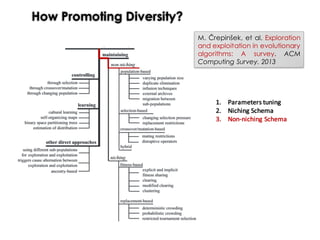
How Promoting Diversity?
M. Črepinšek, et al. Exploration
and exploitation in evolutionary
algorithms: A survey. ACM
Computing Survey. 2013
1. Parameters	tuning
2. Niching	Schema
3. Non-niching	Schema
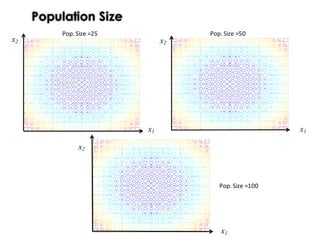
Population Size
The	idea	is	to	maintain	diversity	by	varying	the	population	size.
Steps:
1. Run GA with a given initial population size(PopSize=M)
2. Once GA converged storethe best solution
3. Increase PopSize=PopSize*2
4. Re-run with the new population size
5. Repeat steps 2-4 until the best solution is not improved for k re-runs
[McPhee and Hopper 1999]
Population Size
x1
x2
x1
x2
Pop.	Size	=25 Pop.	Size	=50
Pop.	Size	=100
x1
x2
Injection of new individuals
The idea is to maintain diversity by replacing identical individuals.
Variants:
1. Single generation: during each generation replace duplicated solutions
with new random ones (injection)
Issue: already explored individuals might be regenerated
2. Archive based: all individuals are stored in an archive of individuals
already explored; during each generation:
i. replace solutions already presents in the archive with new random
ones
ii. update archive
Issue: it requires to store all individuals (too memory)
[Chaiyaratana	et	al.	2007]
[Zhang and Sanderson 2009]
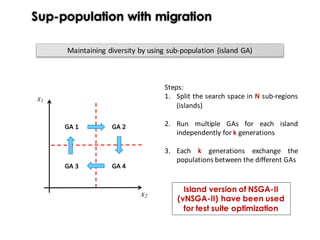
Sup-population with migration
Maintaining	diversity	by	using	sub-population	 (island	GA)
x1
x2
Steps:
1. Split the search space in N sub-regions
(islands)
2. Run multiple GAs for each island
independently for k generations
3. Each k generations exchange the
populations between the different GAs
GA	1 GA	2
GA	3 GA	4
Island version of NSGA-II
(vNSGA-II) have been used
for test suite optimization
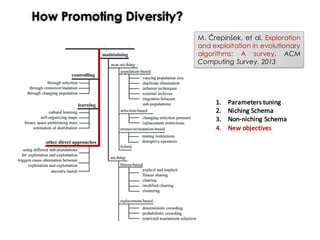
How Promoting Diversity?
M. Črepinšek, et al. Exploration
and exploitation in evolutionary
algorithms: A survey. ACM
Computing Survey. 2013
1. Parameters	tuning
2. Niching	Schema
3. Non-niching	Schema
4. New	objectives
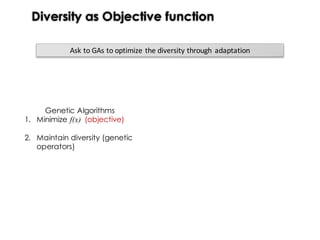
Diversity as Objective function
Ask	to	GAs	to	optimize	the	diversity	through	 adaptation
Genetic Algorithms
1. Minimize f(x) (objective)
2. Maintain diversity (genetic
operators)
Diversity as Objective function
Ask	to	GAs	to	optimize	the	diversity	through	 adaptation
Genetic Algorithms
1. Minimize f(x) (objective)
2. Maintain diversity (genetic
operators) (objective)
Multi-Objective Problem
min f(x)
min [f1(x),..., fn(x)]
min [f(x) d(x)]
min [f1(x) ... fn(x) d(x)]
Single-Objective Problem
d(x)= average similarity between
x and the other solutions
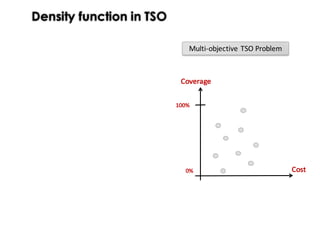
Density function in TSO
Multi-objective	TSO	Problem
Coverage
Cost0%
100%
Density function in TSO
Coverage
Cost0%
100%
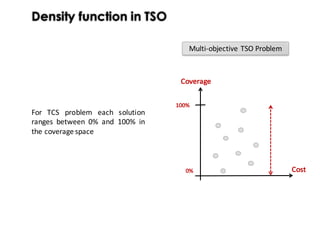
For TCS problem each solution
ranges between 0% and 100% in
the coverage space
Multi-objective TSO	Problem
Proposed Approach (2)
Coverage
Cost0%
100%
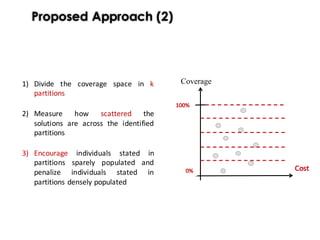
1) Divide the coverage space in k
partitions
2) Measure how scattered the
solutions are across the identified
partitions
3) Encourage individuals stated in
partitions sparely populated and
penalize individuals stated in
partitions densely populated
⎩
⎨
⎧
)Coverage(x
)Cost(x
i
i
Prosed Approach (2)
⎪⎩
⎪
⎨
⎧
)Density(x
)Coverage(x
)Cost(x
i
i
i
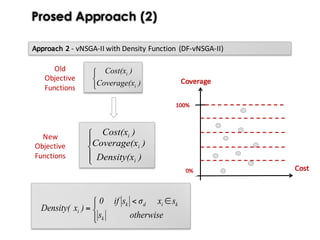
Old	
Objective	
Functions
New	
Objective	
Functions
⎩
⎨
⎧ ∈<
=
otherwises
sxσsif0
)xDensity(
k
kidk
i
Coverage
0%
100%
Approach	2	- vNSGA-II	with	Density	Function	 (DF-vNSGA-II)
Coverage
Cost0%
100%
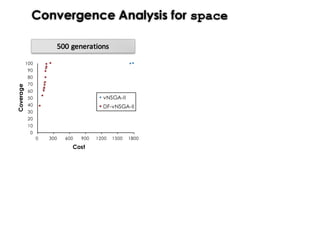
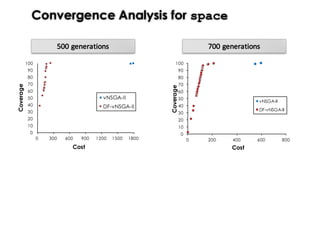
500	generations
0
10
20
30
40
50
60
70
80
90
100
0 300 600 900 1200 1500 1800
Coverage
Cost
vNSGA-II
DF-vNSGA-II
Convergence Analysis for space
0
10
20
30
40
50
60
70
80
90
100
0 200 400 600 800
Coverage
Cost
vNSGA-II
DF-vNSGA-II
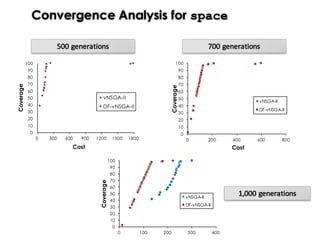
700	generations500	generations
0
10
20
30
40
50
60
70
80
90
100
0 300 600 900 1200 1500 1800
Coverage
Cost
vNSGA-II
DF-vNSGA-II
Convergence Analysis for space
0
10
20
30
40
50
60
70
80
90
100
0 100 200 300 400
Coverage
Cost
vNSGA-II
DF-vNSGA-II
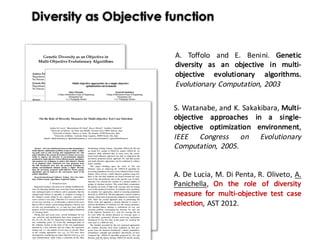
1,000	generations
0
10
20
30
40
50
60
70
80
90
100
0 200 400 600 800
Coverage
Cost
vNSGA-II
DF-vNSGA-II
700	generations500	generations
0
10
20
30
40
50
60
70
80
90
100
0 300 600 900 1200 1500 1800
Coverage
Cost
vNSGA-II
DF-vNSGA-II
Convergence Analysis for space
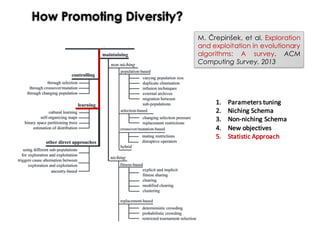
Diversity as Objective function
A. Toffolo and E. Benini. Genetic
diversity as an objective in multi-
objective evolutionary algorithms.
Evolutionary Computation, 2003
S. Watanabe, and K. Sakakibara, Multi-
objective approaches in a single-
objective optimization environment,
IEEE Congress on Evolutionary
Computation, 2005.
A. De Lucia, M. Di Penta, R. Oliveto, A.
Panichella, On the role of diversity
measure for multi-objective test case
selection, AST 2012.
How Promoting Diversity?
M. Črepinšek, et al. Exploration
and exploitation in evolutionary
algorithms: A survey. ACM
Computing Survey. 2013
1. Parameters	tuning
2. Niching	Schema
3. Non-niching	Schema
4. New	objectives
5. Statistic	Approach
Injecting Diversity
Estimating the
Evolution Direction
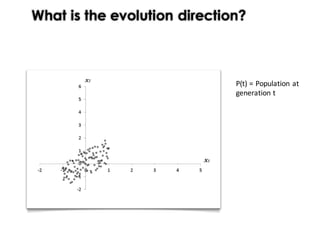
What is the evolution direction?
P(t)	=	Population	at	
generation	t
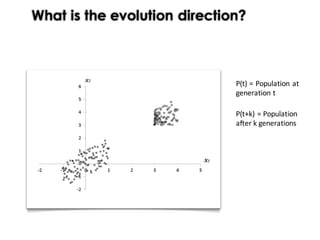
What is the evolution direction?
P(t)	=	Population	at	
generation	t	
P(t+k)	=	Population	
after	k	generations
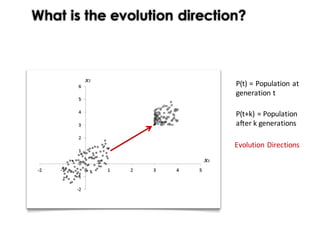
What is the evolution direction?
Evolution	Directions
P(t)	=	Population	at	
generation	t	
P(t+k)	=	Population	
after	k	generations
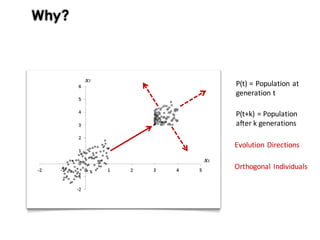
Why?
P(t)	=	Population	at	
generation	t	
P(t+k)	=	Population	
after	k	generations
Evolution	Directions
Orthogonal	Individuals
How?
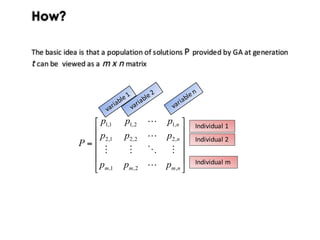
The basic idea is that a population of solutions P provided by GA at generation
t can be viewed as a m x n matrix
⎥
⎥
⎥
⎥
⎦
⎤
⎢
⎢
⎢
⎢
⎣
⎡
=
nmmm
n
n
ppp
ppp
ppp
P
,2,1,
,22,21,2
,12,11,1
!
"#""
!
! Individual	1
Individual	2
Individual	m
It measures the
relationship between
genes within the
individuals space
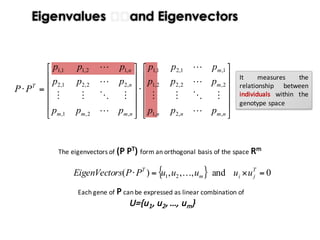
Eigenvalues and Eigenvectors
⎥
⎥
⎥
⎥
⎦
⎤
⎢
⎢
⎢
⎢
⎣
⎡
⋅
⎥
⎥
⎥
⎥
⎦
⎤
⎢
⎢
⎢
⎢
⎣
⎡
=⋅
nmmm
n
n
nmnn
m
m
T
aaa
aaa
aaa
aaa
aaa
aaa
AA
,2,1,
,22,21,2
,12,11,1
,,2,1
2,2,22,1
1,1,21,1
!
"#""
!
!
!
"#""
!
!
It measures the
relationship between
factors within the
observations space
The	eigenvectors	of	(P	PT)	form	an	orthogonal	basis	of	the	space	Rm
Each	gene	of	P can	be	expressed	as	linear	combination	of		
U={u1,	u2,	…,	um}
{ } 0and,,,)( 21 =×=⋅ T
jim
T
uuuuuPPrsEigenVecto !
It measures the
relationship between
individuals within the
genotype space⎥
⎥
⎥
⎥
⎦
⎤
⎢
⎢
⎢
⎢
⎣
⎡
⋅
⎥
⎥
⎥
⎥
⎦
⎤
⎢
⎢
⎢
⎢
⎣
⎡
=⋅
nmnn
m
m
nmmm
n
n
T
ppp
ppp
ppp
ppp
ppp
ppp
PP
,,2,1
2,2,22,1
1,1,21,1
,2,1,
,22,21,2
,12,11,1
!
"#""
!
!
!
"#""
!
!
It measures the
relationship between
individuals within the
genotype space
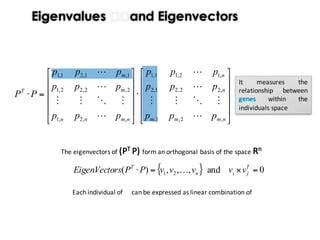
Eigenvalues and Eigenvectors
It measures the
relationship between
observations within the
factors space
⎥
⎥
⎥
⎥
⎦
⎤
⎢
⎢
⎢
⎢
⎣
⎡
⋅
⎥
⎥
⎥
⎥
⎦
⎤
⎢
⎢
⎢
⎢
⎣
⎡
=⋅
nmnn
m
m
nmmm
n
n
T
aaa
aaa
aaa
aaa
aaa
aaa
AA
,,2,1
2,2,22,1
1,1,21,1
,2,1,
,22,21,2
,12,11,1
!
"#""
!
!
!
"#""
!
!The	eigenvectors	of (PT	P)	form	an	orthogonal	basis	of	the	space	Rn
Each	individual	of	P can	be	expressed	as	linear	combination	of		
V={v1,	v2,	…,	vm}
{ } 0and,,,)( 21 =×=⋅ T
jin
T
vvvvvPPrsEigenVecto !
It measures the
relationship between
genes within the
individuals space⎥
⎥
⎥
⎥
⎦
⎤
⎢
⎢
⎢
⎢
⎣
⎡
⋅
⎥
⎥
⎥
⎥
⎦
⎤
⎢
⎢
⎢
⎢
⎣
⎡
=⋅
nmmm
n
n
nmnn
m
m
T
ppp
ppp
ppp
ppp
ppp
ppp
PP
,2,1,
,22,21,2
,12,11,1
,,2,1
2,2,22,1
1,1,21,1
!
"#""
!
!
!
"#""
!
!
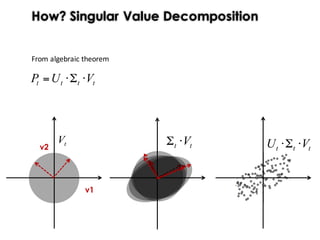
How? Singular Value Decomposition
THEOREM:	Let P	be	a	mxn	matrix	with	rank	k.	There	are	three	matrix	U	Σ V		such	that
VUP nkkkkmnm ××××
⋅⋅= Σ
Where:
• U contains the left singular vectors of P.They are eigenvectors of (PT P).
• V contains the right singular vectors of P. They are eigenvectors of (P PT ) .
• Σ is a diagonal matrix containing the non-zero singular values of P (found on the diagonal
entries of Σ) are the square roots of the non-zero eigenvalues of both (PT P) (P PT).
From	algebraic	theorem
tttt VUP ⋅Σ⋅=
tt V⋅ΣtV
v2
v1
How? Singular Value Decomposition
ttt VU ⋅Σ⋅
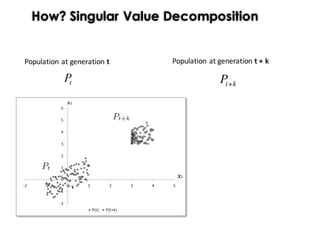
Population at generation t
tP ktP+
How? Singular Value Decomposition
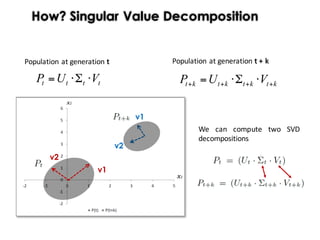
Population	at	generation	t Population	at	generation	t	+	k
Population	at	generation	t
We can compute two SVD
decompositions
tttt VUP ⋅Σ⋅=
Population	at	generation	t	+	k
ktktktkt VUP ++++ ⋅Σ⋅=
v2
v1
v1
v2
How? Singular Value Decomposition
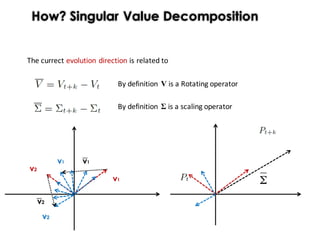
The currect evolution direction is related to
v2
v1
v1
v2
By	definition	 V is	a	Rotating	operator
By	definition	 Σ is	a	scaling	operator
Σ
How? Singular Value Decomposition
v1
v2
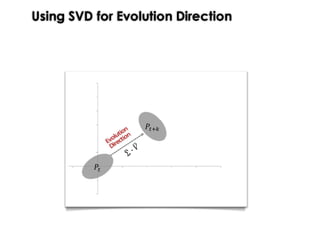
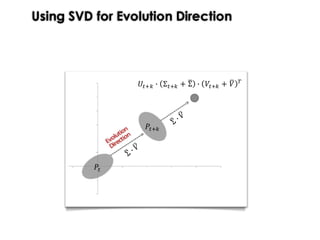
Using SVD for Evolution Direction
𝑈"#$ % Σ"#$ + Σ( % 𝑉"#$ + 𝑉( *
𝑃"#$
𝑃"
Using SVD for Evolution Direction
𝑈"#$ % Σ"#$ + Σ( % 𝑉"#$ + 𝑉( *
𝑃"#$
𝑃"
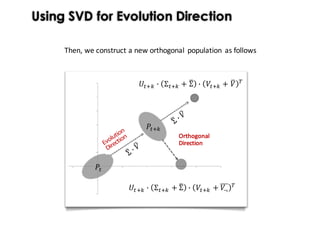
Using SVD for Evolution Direction
Then,	we	construct	a	new	orthogonal	 population	 as	follows
𝑈"#$ % Σ"#$ + Σ( % 𝑉"#$ + 𝑉( *
𝑃"#$
𝑃"
𝑈"#$ % Σ"#$ + Σ( % 𝑉"#$ + 𝑉¬
*
Orthogonal	
Direction
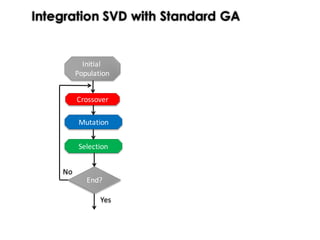
Integration SVD with Standard GA
• Rank	Scaling	Selection
• Single-point	 crossover
• Uniform	mutation
Initial	
Population
Crossover
Mutation
Selection
No
Yes
End?
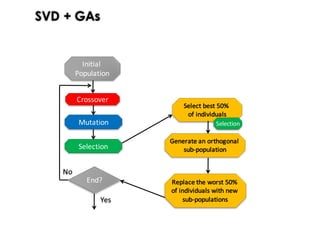
Select	best	50%	
of	individuals
Generate	an	orthogonal	
sub-population
Replace	the	worst	50%	
of	individuals	with	new	
sub-populations
SVD + GAs
Initial	
Population
Crossover
Mutation
Selection
No
Yes
End?
Selection
Diversity in SBSE
Consider	two	typical	SEBSE	applications:
Search-Based Test Data Generation
Multi-Objective Test Suite Optimization
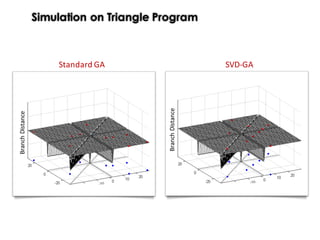
Simulation on Triangle Program
SVD-GAStandard	GA
Branch	Distance
Branch	Distance
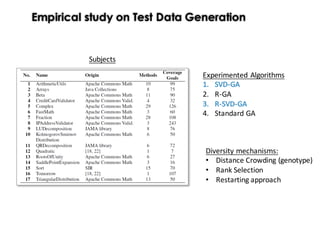
Empirical study on Test Data Generation
Subjects
Experimented	Algorithms:
1. SVD-GA
2. R-GA
3. R-SVD-GA
4. Standard	GA
Diversity	mechanisms:	
• Distance	Crowding	(genotype)
• Rank	Selection
• Restarting	approach
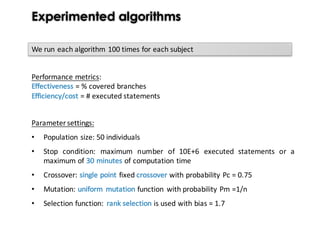
Experimented algorithms
Parameter settings:
• Population size: 50 individuals
• Stop condition: maximum number of 10E+6 executed statements or a
maximum of 30 minutes of computation time
• Crossover: single point fixed crossover with probability Pc = 0.75
• Mutation: uniform mutation function with probability Pm =1/n
• Selection function: rank selection is used with bias = 1.7
We run each algorithm 100 times for each subject
Performance	metrics:
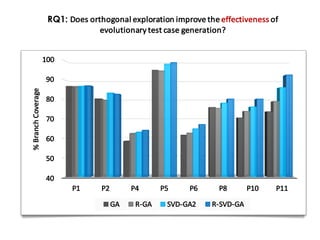
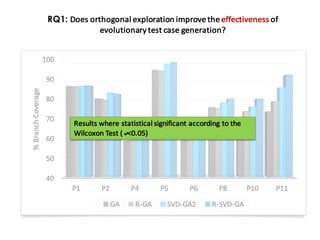
Effectiveness	=	%	covered	branches
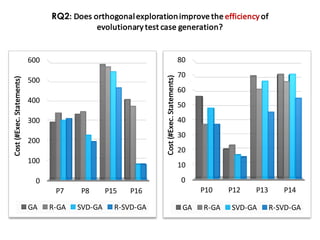
Efficiency/cost	=	#	executed	statements
Research Questions
RQ1: Does	orthogonal	exploration	improve	the	effectiveness of	
evolutionary	test	case	generation?
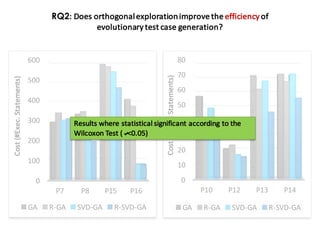
RQ2:	Does	orthogonal	exploration	improve	the	efficiency of	
evolutionary	test	case	generation?
40
50
60
70
80
90
100
P1 P2 P4 P5 P6 P8 P10 P11
%	Branch	Coverage
GA R-GA SVD-GA2 R-SVD-GA
RQ1: Does	orthogonal	exploration	improve	the	effectiveness of	
evolutionary	test	case	generation?
40
50
60
70
80
90
100
P1 P2 P4 P5 P6 P8 P10 P11
%	Branch	Coverage
GA R-GA SVD-GA2 R-SVD-GA
RQ1: Does	orthogonal	exploration	improve	the	effectiveness of	
evolutionary	test	case	generation?
Results	where	statistical	significant	according	to	the	
Wilcoxon	Test	(a<0.05)
0
10
20
30
40
50
60
70
80
P10 P12 P13 P14
Cost	(#Exec.	Statements)
GA R-GA SVD-GA R-SVD-GA
RQ2:	Does	orthogonal	exploration	improve	the	efficiency of	
evolutionary	test	case	generation?
0
100
200
300
400
500
600
P7 P8 P15 P16
Cost	(#Exec.	Statements)
GA R-GA SVD-GA R-SVD-GA
0
10
20
30
40
50
60
70
80
P10 P12 P13 P14
Cost	(#Exec.	Statements)
GA R-GA SVD-GA R-SVD-GA
RQ2:	Does	orthogonal	exploration	improve	the	efficiency of	
evolutionary	test	case	generation?
0
100
200
300
400
500
600
P7 P8 P15 P16
Cost	(#Exec.	Statements)
GA R-GA SVD-GA R-SVD-GA
Results	where	statistical	significant	according	to	the	
Wilcoxon	Test	(a<0.05)
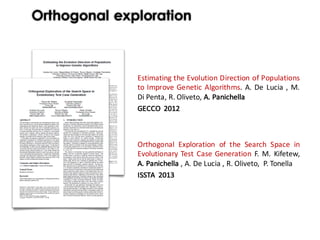
Estimating the Evolution Direction of Populations
to Improve Genetic Algorithms. A. De Lucia , M.
Di Penta, R. Oliveto, A. Panichella
GECCO		2012
Orthogonal exploration
Orthogonal Exploration of the Search Space in
Evolutionary Test Case Generation F. M. Kifetew,
A. Panichella , A. De Lucia , R. Oliveto, P. Tonella
ISSTA		2013
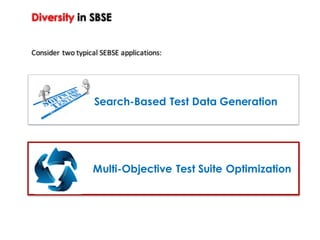
Diversity in SBSE
Consider	two	typical	SEBSE	applications:
Search-Based Test Data Generation
Multi-Objective Test Suite Optimization
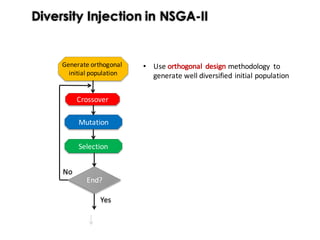
Diversity Injection in NSGA-II
• Non	Dominated	Sorting	 Algorithm
• Crowding	Distance
• Tournament	Selection
• Multi-points	crossover
• Bit-flip	mutation
Initial	
Population
Crossover
Mutation
Selection
No
Yes
End?
Diversity Injection in NSGA-II
Yes
Generate	orthogonal	
initial	population
• Use	orthogonal	 design	methodology	 to	
generate	well	diversified	initial	population	
population
Crossover
Mutation
Selection
No
Yes
End?
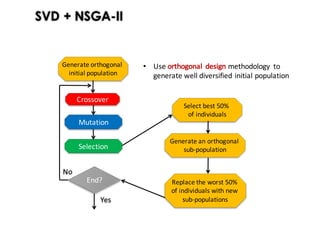
SVD + NSGA-II
Select	best	50%	
of	individuals
Generate	an	orthogonal	
sub-population
Replace	the	worst	50%	
of	individuals	with	new	
sub-populations
• Use	orthogonal	 design	methodology	 to	
generate	well	diversified	initial	population
Generate	orthogonal	
initial	population
Crossover
Mutation
Selection
No
Yes
End?
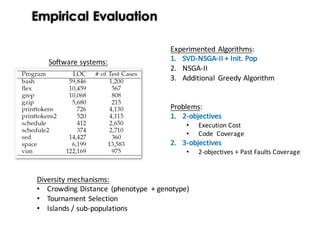
Empirical Evaluation
Experimented	Algorithms:
1. SVD-NSGA-II	+	Init. Pop
2. NSGA-II
3. Additional	 Greedy	Algorithm
Problems:
1. 2-objectives	
• Execution	Cost
• Code		Coverage
2. 3-objectives	
• 2-objectives	+	Past	Faults	Coverage
Software	systems:
Diversity	mechanisms:	
• Crowding	Distance	 (phenotype	 +	genotype)
• Tournament	Selection
• Islands	/	sub-populations
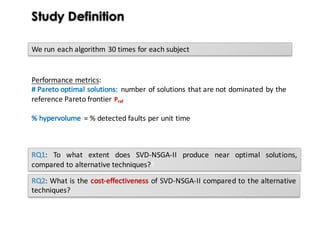
Study Definition
We run each algorithm 30 times for each subject
Performance	metrics:
#	Pareto	optimal	solutions:	 number	of	solutions	that	are	not	dominated	by	the	
reference	Pareto	frontier	Pref
%	hypervolume =	%	detected	faults	per	unit	time
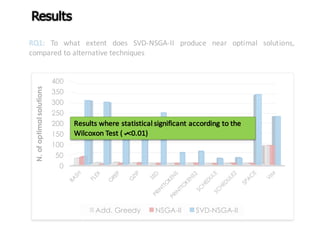
RQ1: To what extent does SVD-NSGA-II produce near optimal solutions,
compared to alternative techniques??
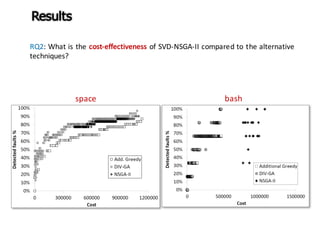
RQ2: What is the cost-effectiveness of SVD-NSGA-II compared to the alternative
techniques?
0%
10%
20%
30%
40%
50%
60%
70%
80%
90%
0 3000000 6000000 9000000
Coverage%
Cost
flex
NSGA-II
Additional Greedy
DIV-GASVD-NSGA-II
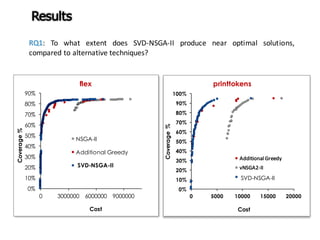
Results
RQ1: To what extent does SVD-NSGA-II produce near optimal solutions,
compared to alternative techniques??
0%
10%
20%
30%
40%
50%
60%
70%
80%
90%
100%
0 5000 10000 15000 20000
Coverage%
Cost
printtokens
Additional	Greedy
vNSGA2-II
DIV-GASVD-NSGA-II
0
50
100
150
200
250
300
350
400
N.ofoptimalsolutions
Add. Greedy NSGA-II SVD-NSGA-II
Results
RQ1: To what extent does SVD-NSGA-II produce near optimal solutions,
compared to alternative techniques?
Results	where	statistical	significant	according	to	the	
Wilcoxon	Test	(a<0.01)
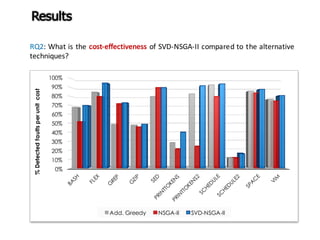
RQ2: What is the cost-effectiveness of SVD-NSGA-II compared to the alternative
techniques?
Results
space bash
RQ2: What is the cost-effectiveness of SVD-NSGA-II compared to the alternative
techniques?
0%
10%
20%
30%
40%
50%
60%
70%
80%
90%
100%
%Detectedfaultsperunitcost
Add. Greedy NSGA-II SVD-NSGA-II
Results
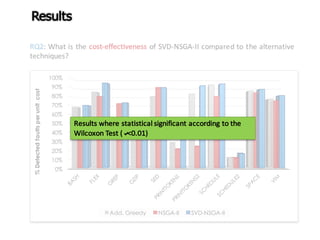
RQ2: What is the cost-effectiveness of SVD-NSGA-II compared to the alternative
techniques?
0%
10%
20%
30%
40%
50%
60%
70%
80%
90%
100%
%Detectedfaultsperunitcost
Add. Greedy NSGA-II SVD-NSGA-II
Results
Results	where	statistical	significant	according	to	the	
Wilcoxon	Test	(a<0.01)
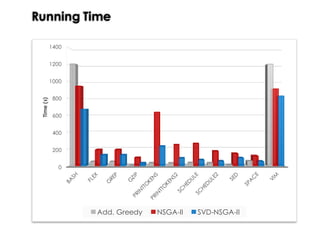
Running Time
0
200
400
600
800
1000
1200
1400Time(s)
Add. Greedy NSGA-II SVD-NSGA-II
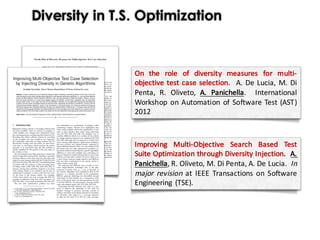
Diversity in T.S. Optimization
On the role of diversity measures for multi-
objective test case selection. A. De Lucia, M. Di
Penta, R. Oliveto, A. Panichella. International
Workshop on Automation of Software Test (AST)
2012
Improving Multi-Objective Search Based Test
Suite Optimization through Diversity Injection. A.
Panichella, R. Oliveto, M. Di Penta, A. De Lucia. In
major revision at IEEE Transactions on Software
Engineering (TSE).
In summary
Bibliography
• A. De Lucia , M. Di Penta, R. Oliveto, A. Panichella, Estimating the Evolution Direction of
Populations to Improve Genetic Algorithm. GECCO 2012
• F. M. Kifetew, A. Panichella , A. De Lucia , R. Oliveto, P. Tonella, Orthogonal Exploration of the
Search Space in Evolutionary Test Case Generation, ISSTA 2013
• A. De Lucia, M. Di Penta, R. Oliveto, A. Panichella. On the role of diversity measures for multi-
objective test case selection. International Workshop on Automation of Software Test (AST)
2012.
• A. Panichella, R. Oliveto, M. Di Penta, A. De Lucia, Improving Multi-Objective Search Based Test
Suite Optimization through Diversity Injection. In major revision at IEEE Transactions on
Software Engineering (TSE).
• Wong et. al. A novel approach in parameter adaptation and diversity maintenance for genetic
algorithms. Soft Computing, 2003.
• M. Črepinšek, S. Liu, and M. Mernik. 2013. Exploration and exploitation in evolutionary
algorithms: A survey. ACM Computer Survey. 2013
• S. Watanabe, and K. Sakakibara, Multi-objective approaches in a single-objective optimization
environment, IEEE Congress on Evolutionary Computation, 2005.
Bibliography
• A. Toffolo and E. Benini. Genetic diversity as an objective in multi-objective evolutionary
algorithms. Evolutionary Computation, 2003
• P. Bosman, D. Thierens, The balance between proximity and diversity in multi-objective
evolutionary algorithms, IEEE Transactions on Evolutionary Computation, 2003
• X. Cui, M. Li, T. Fang, Study of population diversity of multi-objective evolutionary algorithm
based on immune and entropy principles, Proceedings of the Congress on Evolutionary
Computation, 2001.
• Mark Wineberg and Franz Oppacher, The Underlying Similarity of Diversity Measures Used in
Evolutionary Computation, GECCO 2013.
• S. Yoo and M. Harman, “Regression testing minimization, selection and prioritization: a survey,”
Softw. Test. Verif. Reliab., vol. 22, no. 2, pp. 67–120, Mar. 2012.
• M. J. Harrold, R. Gupta, and M. L. Soffa, “A methodology for controlling the size of a test suite,”
ACM Transactions Software Engineering and Methodologies, vol. 2, pp. 270–285, 1993.
• S. Yoo, M. Harman, and S. Ur, “Highly scalable multi objective test suite minimisation using
graphics cards,” in Proceedings of the Third international conference on Search based software
engineering. Springer-Verlag, 2011, pp. 219–236.
Bibliography
• S. Yoo and M. Harman, “Pareto efficient multi-objective test case selection,” in Proceedings of
the ACM/SIGSOFT International Symposium on Software Testing and Analysis. London, UK:
ACM Press, 2007, pp. 140–150
• H. Li, Y.-C. Jiao, L. Zhang, and Z.-W. Gu, “Genetic algorithm based on the orthogonal design for
multidimensional knapsack problems,” Advances in Natural Computation, vol. 4221, pp. 696–
705, 2006.
• R. T. Marler and J. S. Arora, “Survey of multi-objective optimization methods for engineering,”
Structural and Multidisciplinary Optimization, vol. 26, pp. 369–395, 2004.
• H. E. Aguirre and K. Tanaka, “Selection, drift, recombination, and mutation in multiobjective
evolutionary algorithms on scalable mnk-landscapes,” in Evolutionary Multi-Criterion
Optimization, ser. Lecture Notes in Computer Science, vol. 3410. Springer Berlin Heidelberg,
2005.
• K. Deb, A. Pratap, S. Agarwal, and T. Meyarivan, “A fast elitist multi-objective genetic algorithm:
NSGA-II,” IEEE Transactions on Evolutionary Computation, vol. 6, pp. 182–197, 2000.
• A. E. Eiben and C. A. Schippers, “On evolutionary exploration and exploitation,” Fundam.
Inform., vol. 35, no. 1-4, pp. 35–50, 1998.
Bibliography
• H. Maaranen, K. Miettinen, and A. Penttinen, “On initial populations of a genetic algorithm for
continuous optimization problems,” Journal of Global Optimization, vol. 37, no. 3, pp. 405–436,
Mar. 2007.
• J. Zhu, G. Dai, and L. Mo, “A cluster-based orthogonal multi-objective genetic algorithm,”
Computational Intelligence and Intelligent Systems, vol. 51, pp. 45–55, 2009.
• S. W. Mahfoud, “Niching methods for genetic algorithms,” Illinois Genetic Algorithms
Laboratory, Tech. Rep., 1995.
• G. Harik, “Finding multimodal solutions using restricted tournament selection,” in Proceedings
of the Sixth International Conference on Genetic Algorithms. Pittsburgh, PA, USA: Morgan
Kaufmann, 1995, pp. 24–31.

Diversity mechanisms for evolutionary populations in Search-Based Software Engineering

  • 1.
    Diversity mechanisms for evolutionarypopulations in Search-Based Software Engineering Prof. Andrea De Lucia, University of Salerno, Italy Dr. Annibale Panichella, FBK, Italy
  • 2.
    Exploration vs. Exploitation Exploration and Exploitation via Genetic Operators Problem of Genetic Drift PreservingDiversity Mechanism Change the Genetic Operators Add/Modify Objective Function Apply Statistical Methods Empirical Evaluation Diversity in Test Data Generation Diversity in Test Suite Optimization
  • 3.
  • 4.
    General Process Genetic Algorithms Single-ObjectiveGAs Multi-Objective GAs • Roulette wheel • Tournament • Rank Scaling • … • Single-point • Two-points • Arithmetic • … • Uniform • Bit-flip • Adaptive • … Initial Population Crossover Mutation Selection No Yes End? • Non-dominated Sorting • Epsilon Dominance • Lorentz Dominance • Single-point • Two-points • Arithmetic • … • Uniform • Bit-flip • Adaptive • …
  • 5.
    Key factors forGAs “Genetic Algorithms (GAs) must maintain a balance between the exploitation […] and the exploration […] as to increase the probability of finding the optimal solution.” Wong et al. [2003] Exploitation: find nearby better solutions by promoting beneficial aspects (genes) of existing solutions. Exploration: find new solutions in different regions of the search space by generating solutions with new aspects
  • 6.
    Key factors forGAs “Genetic Algorithms (GAs) must maintain a balance between the exploitation […] and the exploration […] as to increase the probability of finding the optimal solution.” Wong et al. [2003] Exploitation: find nearby better solutions by promoting beneficial aspects (genes) of existing solutions. It is guaranteed by: • Selection: it selects the fittest individuals for reproduction • Crossover: it generate new nearby solutions Exploration: find new solutions in different regions of the search space by generating solutions with new aspects. It is guaranteed by: • Mutation: it randomly modifies individuals with a given probability, and thus increases the structural diversity of a population.
  • 7.
    0.5 1.5 0.5 1.5 Exploitation Selection Pressure To find nearbybetter solutions using crossover and selection. ( ) ]2;0[,1)1(sin)(min 8 ∈+−= xxxf x f(x)
  • 8.
    Exploitation Selection Pressure 1) Select bestindividuals for reproduction 2) Apply recombination 3) Offsprings are nearby to their Parents Parent A Parent B x1 x2
  • 9.
    Exploitation Parent A Parent B x1 x2 Selection Pressure 1) Select bestindividuals for reproduction 2) Apply recombination 3) Offsprings are nearby to their Parents Single Point crossover
  • 10.
    Exploitation Parent A Parent B x1 x2 Selection Pressure 1) Select bestindividuals for reproduction 2) Apply recombination 3) Offsprings are nearby to their Parents Arithmetic crossover 2 2
  • 11.
    Exploration GA got you fromhere… x f(x) ( ) ]3.2;0[,1)1(sin)(min 8 ∈+−= xxxf
  • 12.
    Exploration GA got you fromhere… ( ) ]3.2;0[,1)1(sin)(min 8 ∈+−= xxxf Exploration Looking for new unexplored regions x f(x)
  • 13.
    Exploration GA got you fromhere… to here… …but if you tried something radical… ( ) ]3.2;0[,1)1(sin)(min 8 ∈+−= xxxf x f(x)
  • 14.
    Exploration GA got you fromhere… to here… …but if you tried something radical… …you could get here! ( ) ]3.2;0[,1)1(sin)(min 8 ∈+−= xxxf x f(x)
  • 15.
    Exploration ←Diversity Diversity isessential to the genetic algorithm because it enables the algorithm to search a larger region of the space. Low Diversity High Diversity x f(x)
  • 16.
    Exploration ←Diversity Population driftx f(x) Diversityis essential to the genetic algorithm because it enables the algorithm to search a larger region of the space. Low Diversity High Diversity
  • 17.
    Exploration ←Diversity “Progress inevolution depends fundamentally on the existence of variation of population.” “Unfortunately, a key problem in many Evolutionary Computation (EC) systems is the loss of diversity through premature convergence. ” McPhee and Hopper [2] “This lack of diversity often leads to stagnation, as the system finds itself trapped in local optima, lacking the genetic diversity needed to escape. ”
  • 18.
  • 19.
  • 20.
  • 21.
    Is Diversity a(meta) problem in SBSE? Consider two typical SEBSE applications: Search-Based Test Data Generation Multi-Objective Test Suite Optimization
  • 22.
    public class Triangle{ public String check (double a, double b, double c){ if(a == b) { if(a == c) return ‘equilater’; else return ‘isoscele’; } else { if(a == c || b == c) return ‘isoscele’; else return ‘scalene’; } } } 1. 2. 3. 4. 5. 6. 7. Search-Based Test Data Generation Triangle Problem
  • 23.
    public class Triangle{ public String check (double a, double b, double c){ if(a == b) { if(a == c) return ‘equilater’; else return ‘isoscele’; } else { if(a == c || b == c) return ‘isoscele’; else return ‘scalene’; } } } 1. 2. 3. 4. 5. 6. 7. Triangle Problem Search-Based Test Data Generation
  • 24.
    public class Triangle{ public String check (double a, double b, double c){ if(a == b) { if(a == c) return ‘equilater’; else return ‘isoscele’; } else { if(a == c || b == c) return ‘isoscele’; else return ‘scalene’; } } } 1. 2. 3. 4. 5. 6. 7. Triangle Problem Search-Based Test Data Generation Branch distance (a == b) -> abs(a - b) (a == c) -> abs(a – c)) min f(a,b,c) = 2 * abs(a - b) + + abs(a - c)
  • 25.
    public class Triangle{ public String check (double a, double b, double c){ if(a == b) { if(a == c) return ‘equilater’; else return ‘isoscele’; } else { if(a == c || b == c) return ‘isoscele’; else return ‘scalene’; } } } 1. 2. 3. 4. 5. 6. 7. Triangle Problem Search-Based Test Data Generation Test Case 4 Triangle t= new Triangle(); String s=t.check(2,2,2) Branch distance (a == b) -> abs(a - b) (a == c) -> abs(a – c)) min f(a,b,c) = 2 * abs(a - b) + + abs(a - c)
  • 26.
    c=2 a, b ϵ [-1;4] a b Fitness 1) Flat seach space 2)Several Local optimal 3) Only one global optimum Triangle Problem Search-Based Test Data Generation
  • 27.
  • 28.
    Is Diversity a(meta) problem in SBSE? Consider two typical SEBSE applications: Search-Based Test Data Generation Multi-Objective Test Suite Optimization
  • 29.
  • 30.
  • 31.
    Regression Testing istime consuming 1000 machine-hours to execute 30,000 functional test cases for a software product… Mirarab, et al. The effects of time constraints on test case prioritization: A series of controlled experiments. TSE 2010
  • 32.
  • 33.
  • 34.
  • 35.
  • 36.
  • 37.
    How Promoting Diversity? M.Črepinšek, et al. Exploration and exploitation in evolutionary algorithms: A survey. ACM Computing Survey. 2013
  • 38.
    How Promoting Diversity? M.Črepinšek, et al. Exploration and exploitation in evolutionary algorithms: A survey. ACM Computing Survey. 2013
  • 39.
    How Promoting Diversity? 1. Parameter tuning M.Črepinšek, et al. Exploration and exploitation in evolutionary algorithms: A survey. ACM Computing Survey. 2013
  • 40.
  • 41.
    Mutation Rate Peaks Funtcion x1 x2 f(x) Exploitation Exploration Sub-optimal solutions canbe reached Mutation Type = uniform Mutation Rate = 0.01 Population Size =50 Crossover = Single-point Crossover prob. = 0.6 Selection = roulette wheel [Whitley and Starkweather 1990]
  • 42.
    Mutation Rate Peaks Funtcion x1 x2 f(x) GAsmight remain at certain distance to the optimum Exploitation Exploration Mutation Type = uniform Mutation Rate = 0.90 Population Size =50 Crossover = Single-point Crossover prob. = 0.6 Selection = roulette wheel [Whitley and Starkweather 1990]
  • 43.
    Mutation Rate Peaks Funtcion x1 x2 f(x) GAsmight remain at certain distance to the optimum Exploitation Exploration Mutation Type = uniform Mutation Rate = 0.90 Population Size =50 Crossover = Single-point Crossover prob. = 0.6 Selection = roulette wheel [Whitley and Starkweather 1990]
  • 44.
    How Promoting Diversity? M.Črepinšek, et al. Exploration and exploitation in evolutionary algorithms: A survey. ACM Computing Survey. 2013 1. Parameters tuning 2. Niching Schema
  • 45.
    Fitness Sharing x1 x2 The basicidea is to penalize the fitness of individuals in crowded areas. 1) Divide the search space in partitions or segments 2) Measure how scattered the solutions are across the identified partitions 3) Encourage individuals stated in partitions sparely populated and penalize individuals stated in partitions densely populated Niches [Holland 1975] [Goldberg and Richardson 198]
  • 46.
    Fitness Sharing g(X) f(X) (X)fs = g(X)is proportional to the number of solutions stated in the same niche. x1 x2 The basic idea is to penalize the fitness of individuals in crowded areas. Niches The fitness function is replaced by a shared one:
  • 47.
    Fitness Sharing Size ofNiches is to be defined, but it depends of problems. g(X) f(X) (X)fs = x1 x2 The basic idea is to penalize the fitness of individuals in crowded areas. Niches The fitness function is replaced by a shared one:
  • 48.
    How Promoting Diversity? M.Črepinšek, et al. Exploration and exploitation in evolutionary algorithms: A survey. ACM Computing Survey. 2013 1. Parameters tuning 2. Niching Schema
  • 49.
    Crowding Distance The mostused diversity preserving techniques is the crowding distance. x1 x2 A(a1,a2) B(b1,b2) [Mahfoud 1995]
  • 50.
    Crowding Distance x1 x2 It selects individuals that are distant from each other in the objectives space. ( )( ) )B,A( babaB)(A,d babaB)(A,d 11 2 22 2 11 Hamming 222 1 −+−= −+−= Genotype The independent variables can have different ranges! The most used diversity preserving techniques is the crowding distance. x1 x2 A(a1,a2) B(b1,b2) [Mahfoud 1995]
  • 51.
    Crowding Distance minmax ff f(B)f(A) B)dc(A, − − = Phenotype x1 x2 It selects individuals that are distant from each other in the objectives space. The mostused diversity preserving techniques is the crowding distance. x1 x2 A(a1,a2) B(b1,b2) It can be generalized for multi-objective scenarios [Mahfoud 1995]
  • 52.
    Crowding Distance minmax ff f(B)f(A) B)dc(A, − − = Phenotype x1 x2 It selects individuals that are distant from each other in the objectives space. The mostused diversity preserving techniques is the crowding distance. x1 x2 A(a1,a2) B(b1,b2) It can be generalized for multi-objective scenarios It is included in many GAs implementation, such as • NSGA-II • Standard GAs • IBEA • etc.
  • 53.
    How Promoting Diversity? M.Črepinšek, et al. Exploration and exploitation in evolutionary algorithms: A survey. ACM Computing Survey. 2013 1. Parameters tuning 2. Niching Schema 3. Non-niching Schema
  • 54.
    Population Size The idea is to maintain diversity by varying the population size. Steps: 1. RunGA with a given initial population size(PopSize=M) 2. Once GA converged storethe best solution 3. Increase PopSize=PopSize*2 4. Re-run with the new population size 5. Repeat steps 2-4 until the best solution is not improved for k re-runs [McPhee and Hopper 1999]
  • 55.
  • 56.
    Injection of newindividuals The idea is to maintain diversity by replacing identical individuals. Variants: 1. Single generation: during each generation replace duplicated solutions with new random ones (injection) Issue: already explored individuals might be regenerated 2. Archive based: all individuals are stored in an archive of individuals already explored; during each generation: i. replace solutions already presents in the archive with new random ones ii. update archive Issue: it requires to store all individuals (too memory) [Chaiyaratana et al. 2007] [Zhang and Sanderson 2009]
  • 57.
    Sup-population with migration Maintaining diversity by using sub-population (island GA) x1 x2 Steps: 1. Split the search space in N sub-regions (islands) 2. Run multiple GAs for each island independently for k generations 3. Each k generations exchange the populations between the different GAs GA 1 GA 2 GA 3 GA 4 Island version of NSGA-II (vNSGA-II) have been used for test suite optimization
  • 58.
    How Promoting Diversity? M.Črepinšek, et al. Exploration and exploitation in evolutionary algorithms: A survey. ACM Computing Survey. 2013 1. Parameters tuning 2. Niching Schema 3. Non-niching Schema 4. New objectives
  • 59.
    Diversity as Objectivefunction Ask to GAs to optimize the diversity through adaptation Genetic Algorithms 1. Minimize f(x) (objective) 2. Maintain diversity (genetic operators)
  • 60.
    Diversity as Objectivefunction Ask to GAs to optimize the diversity through adaptation Genetic Algorithms 1. Minimize f(x) (objective) 2. Maintain diversity (genetic operators) (objective) Multi-Objective Problem min f(x) min [f1(x),..., fn(x)] min [f(x) d(x)] min [f1(x) ... fn(x) d(x)] Single-Objective Problem d(x)= average similarity between x and the other solutions
  • 61.
    Density function inTSO Multi-objective TSO Problem Coverage Cost0% 100%
  • 62.
    Density function inTSO Coverage Cost0% 100% For TCS problem each solution ranges between 0% and 100% in the coverage space Multi-objective TSO Problem
  • 63.
    Proposed Approach (2) Coverage Cost0% 100% 1)Divide the coverage space in k partitions 2) Measure how scattered the solutions are across the identified partitions 3) Encourage individuals stated in partitions sparely populated and penalize individuals stated in partitions densely populated
  • 64.
    ⎩ ⎨ ⎧ )Coverage(x )Cost(x i i Prosed Approach (2) ⎪⎩ ⎪ ⎨ ⎧ )Density(x )Coverage(x )Cost(x i i i Old Objective Functions New Objective Functions ⎩ ⎨ ⎧∈< = otherwises sxσsif0 )xDensity( k kidk i Coverage 0% 100% Approach 2 - vNSGA-II with Density Function (DF-vNSGA-II) Coverage Cost0% 100%
  • 65.
    500 generations 0 10 20 30 40 50 60 70 80 90 100 0 300 600900 1200 1500 1800 Coverage Cost vNSGA-II DF-vNSGA-II Convergence Analysis for space
  • 66.
    0 10 20 30 40 50 60 70 80 90 100 0 200 400600 800 Coverage Cost vNSGA-II DF-vNSGA-II 700 generations500 generations 0 10 20 30 40 50 60 70 80 90 100 0 300 600 900 1200 1500 1800 Coverage Cost vNSGA-II DF-vNSGA-II Convergence Analysis for space
  • 67.
    0 10 20 30 40 50 60 70 80 90 100 0 100 200300 400 Coverage Cost vNSGA-II DF-vNSGA-II 1,000 generations 0 10 20 30 40 50 60 70 80 90 100 0 200 400 600 800 Coverage Cost vNSGA-II DF-vNSGA-II 700 generations500 generations 0 10 20 30 40 50 60 70 80 90 100 0 300 600 900 1200 1500 1800 Coverage Cost vNSGA-II DF-vNSGA-II Convergence Analysis for space
  • 68.
    Diversity as Objectivefunction A. Toffolo and E. Benini. Genetic diversity as an objective in multi- objective evolutionary algorithms. Evolutionary Computation, 2003 S. Watanabe, and K. Sakakibara, Multi- objective approaches in a single- objective optimization environment, IEEE Congress on Evolutionary Computation, 2005. A. De Lucia, M. Di Penta, R. Oliveto, A. Panichella, On the role of diversity measure for multi-objective test case selection, AST 2012.
  • 69.
    How Promoting Diversity? M.Črepinšek, et al. Exploration and exploitation in evolutionary algorithms: A survey. ACM Computing Survey. 2013 1. Parameters tuning 2. Niching Schema 3. Non-niching Schema 4. New objectives 5. Statistic Approach
  • 70.
  • 71.
    What is theevolution direction? P(t) = Population at generation t
  • 72.
    What is theevolution direction? P(t) = Population at generation t P(t+k) = Population after k generations
  • 73.
    What is theevolution direction? Evolution Directions P(t) = Population at generation t P(t+k) = Population after k generations
  • 74.
  • 75.
    How? The basic ideais that a population of solutions P provided by GA at generation t can be viewed as a m x n matrix ⎥ ⎥ ⎥ ⎥ ⎦ ⎤ ⎢ ⎢ ⎢ ⎢ ⎣ ⎡ = nmmm n n ppp ppp ppp P ,2,1, ,22,21,2 ,12,11,1 ! "#"" ! ! Individual 1 Individual 2 Individual m
  • 76.
    It measures the relationshipbetween genes within the individuals space Eigenvalues and Eigenvectors ⎥ ⎥ ⎥ ⎥ ⎦ ⎤ ⎢ ⎢ ⎢ ⎢ ⎣ ⎡ ⋅ ⎥ ⎥ ⎥ ⎥ ⎦ ⎤ ⎢ ⎢ ⎢ ⎢ ⎣ ⎡ =⋅ nmmm n n nmnn m m T aaa aaa aaa aaa aaa aaa AA ,2,1, ,22,21,2 ,12,11,1 ,,2,1 2,2,22,1 1,1,21,1 ! "#"" ! ! ! "#"" ! ! It measures the relationship between factors within the observations space The eigenvectors of (P PT) form an orthogonal basis of the space Rm Each gene of P can be expressed as linear combination of U={u1, u2, …, um} { } 0and,,,)( 21 =×=⋅ T jim T uuuuuPPrsEigenVecto ! It measures the relationship between individuals within the genotype space⎥ ⎥ ⎥ ⎥ ⎦ ⎤ ⎢ ⎢ ⎢ ⎢ ⎣ ⎡ ⋅ ⎥ ⎥ ⎥ ⎥ ⎦ ⎤ ⎢ ⎢ ⎢ ⎢ ⎣ ⎡ =⋅ nmnn m m nmmm n n T ppp ppp ppp ppp ppp ppp PP ,,2,1 2,2,22,1 1,1,21,1 ,2,1, ,22,21,2 ,12,11,1 ! "#"" ! ! ! "#"" ! !
  • 77.
    It measures the relationshipbetween individuals within the genotype space Eigenvalues and Eigenvectors It measures the relationship between observations within the factors space ⎥ ⎥ ⎥ ⎥ ⎦ ⎤ ⎢ ⎢ ⎢ ⎢ ⎣ ⎡ ⋅ ⎥ ⎥ ⎥ ⎥ ⎦ ⎤ ⎢ ⎢ ⎢ ⎢ ⎣ ⎡ =⋅ nmnn m m nmmm n n T aaa aaa aaa aaa aaa aaa AA ,,2,1 2,2,22,1 1,1,21,1 ,2,1, ,22,21,2 ,12,11,1 ! "#"" ! ! ! "#"" ! !The eigenvectors of (PT P) form an orthogonal basis of the space Rn Each individual of P can be expressed as linear combination of V={v1, v2, …, vm} { } 0and,,,)( 21 =×=⋅ T jin T vvvvvPPrsEigenVecto ! It measures the relationship between genes within the individuals space⎥ ⎥ ⎥ ⎥ ⎦ ⎤ ⎢ ⎢ ⎢ ⎢ ⎣ ⎡ ⋅ ⎥ ⎥ ⎥ ⎥ ⎦ ⎤ ⎢ ⎢ ⎢ ⎢ ⎣ ⎡ =⋅ nmmm n n nmnn m m T ppp ppp ppp ppp ppp ppp PP ,2,1, ,22,21,2 ,12,11,1 ,,2,1 2,2,22,1 1,1,21,1 ! "#"" ! ! ! "#"" ! !
  • 78.
    How? Singular ValueDecomposition THEOREM: Let P be a mxn matrix with rank k. There are three matrix U Σ V such that VUP nkkkkmnm ×××× ⋅⋅= Σ Where: • U contains the left singular vectors of P.They are eigenvectors of (PT P). • V contains the right singular vectors of P. They are eigenvectors of (P PT ) . • Σ is a diagonal matrix containing the non-zero singular values of P (found on the diagonal entries of Σ) are the square roots of the non-zero eigenvalues of both (PT P) (P PT).
  • 79.
    From algebraic theorem tttt VUP ⋅Σ⋅= ttV⋅ΣtV v2 v1 How? Singular Value Decomposition ttt VU ⋅Σ⋅
  • 80.
    Population at generationt tP ktP+ How? Singular Value Decomposition Population at generation t Population at generation t + k
  • 81.
    Population at generation t We can computetwo SVD decompositions tttt VUP ⋅Σ⋅= Population at generation t + k ktktktkt VUP ++++ ⋅Σ⋅= v2 v1 v1 v2 How? Singular Value Decomposition
  • 82.
    The currect evolutiondirection is related to v2 v1 v1 v2 By definition V is a Rotating operator By definition Σ is a scaling operator Σ How? Singular Value Decomposition v1 v2
  • 83.
    Using SVD forEvolution Direction 𝑈"#$ % Σ"#$ + Σ( % 𝑉"#$ + 𝑉( * 𝑃"#$ 𝑃"
  • 84.
    Using SVD forEvolution Direction 𝑈"#$ % Σ"#$ + Σ( % 𝑉"#$ + 𝑉( * 𝑃"#$ 𝑃"
  • 85.
    Using SVD forEvolution Direction Then, we construct a new orthogonal population as follows 𝑈"#$ % Σ"#$ + Σ( % 𝑉"#$ + 𝑉( * 𝑃"#$ 𝑃" 𝑈"#$ % Σ"#$ + Σ( % 𝑉"#$ + 𝑉¬ * Orthogonal Direction
  • 86.
    Integration SVD withStandard GA • Rank Scaling Selection • Single-point crossover • Uniform mutation Initial Population Crossover Mutation Selection No Yes End?
  • 87.
  • 88.
    Diversity in SBSE Consider two typical SEBSE applications: Search-BasedTest Data Generation Multi-Objective Test Suite Optimization
  • 89.
    Simulation on TriangleProgram SVD-GAStandard GA Branch Distance Branch Distance
  • 90.
    Empirical study onTest Data Generation Subjects Experimented Algorithms: 1. SVD-GA 2. R-GA 3. R-SVD-GA 4. Standard GA Diversity mechanisms: • Distance Crowding (genotype) • Rank Selection • Restarting approach
  • 91.
    Experimented algorithms Parameter settings: •Population size: 50 individuals • Stop condition: maximum number of 10E+6 executed statements or a maximum of 30 minutes of computation time • Crossover: single point fixed crossover with probability Pc = 0.75 • Mutation: uniform mutation function with probability Pm =1/n • Selection function: rank selection is used with bias = 1.7 We run each algorithm 100 times for each subject Performance metrics: Effectiveness = % covered branches Efficiency/cost = # executed statements
  • 92.
    Research Questions RQ1: Does orthogonal exploration improve the effectivenessof evolutionary test case generation? RQ2: Does orthogonal exploration improve the efficiency of evolutionary test case generation?
  • 93.
    40 50 60 70 80 90 100 P1 P2 P4P5 P6 P8 P10 P11 % Branch Coverage GA R-GA SVD-GA2 R-SVD-GA RQ1: Does orthogonal exploration improve the effectiveness of evolutionary test case generation?
  • 94.
    40 50 60 70 80 90 100 P1 P2 P4P5 P6 P8 P10 P11 % Branch Coverage GA R-GA SVD-GA2 R-SVD-GA RQ1: Does orthogonal exploration improve the effectiveness of evolutionary test case generation? Results where statistical significant according to the Wilcoxon Test (a<0.05)
  • 95.
    0 10 20 30 40 50 60 70 80 P10 P12 P13P14 Cost (#Exec. Statements) GA R-GA SVD-GA R-SVD-GA RQ2: Does orthogonal exploration improve the efficiency of evolutionary test case generation? 0 100 200 300 400 500 600 P7 P8 P15 P16 Cost (#Exec. Statements) GA R-GA SVD-GA R-SVD-GA
  • 96.
    0 10 20 30 40 50 60 70 80 P10 P12 P13P14 Cost (#Exec. Statements) GA R-GA SVD-GA R-SVD-GA RQ2: Does orthogonal exploration improve the efficiency of evolutionary test case generation? 0 100 200 300 400 500 600 P7 P8 P15 P16 Cost (#Exec. Statements) GA R-GA SVD-GA R-SVD-GA Results where statistical significant according to the Wilcoxon Test (a<0.05)
  • 97.
    Estimating the EvolutionDirection of Populations to Improve Genetic Algorithms. A. De Lucia , M. Di Penta, R. Oliveto, A. Panichella GECCO 2012 Orthogonal exploration Orthogonal Exploration of the Search Space in Evolutionary Test Case Generation F. M. Kifetew, A. Panichella , A. De Lucia , R. Oliveto, P. Tonella ISSTA 2013
  • 98.
    Diversity in SBSE Consider two typical SEBSE applications: Search-BasedTest Data Generation Multi-Objective Test Suite Optimization
  • 99.
    Diversity Injection inNSGA-II • Non Dominated Sorting Algorithm • Crowding Distance • Tournament Selection • Multi-points crossover • Bit-flip mutation Initial Population Crossover Mutation Selection No Yes End?
  • 100.
    Diversity Injection inNSGA-II Yes Generate orthogonal initial population • Use orthogonal design methodology to generate well diversified initial population population Crossover Mutation Selection No Yes End?
  • 101.
    SVD + NSGA-II Select best 50% of individuals Generate an orthogonal sub-population Replace the worst 50% of individuals with new sub-populations •Use orthogonal design methodology to generate well diversified initial population Generate orthogonal initial population Crossover Mutation Selection No Yes End?
  • 102.
    Empirical Evaluation Experimented Algorithms: 1. SVD-NSGA-II + Init.Pop 2. NSGA-II 3. Additional Greedy Algorithm Problems: 1. 2-objectives • Execution Cost • Code Coverage 2. 3-objectives • 2-objectives + Past Faults Coverage Software systems: Diversity mechanisms: • Crowding Distance (phenotype + genotype) • Tournament Selection • Islands / sub-populations
  • 103.
    Study Definition We runeach algorithm 30 times for each subject Performance metrics: # Pareto optimal solutions: number of solutions that are not dominated by the reference Pareto frontier Pref % hypervolume = % detected faults per unit time RQ1: To what extent does SVD-NSGA-II produce near optimal solutions, compared to alternative techniques?? RQ2: What is the cost-effectiveness of SVD-NSGA-II compared to the alternative techniques?
  • 104.
    0% 10% 20% 30% 40% 50% 60% 70% 80% 90% 0 3000000 60000009000000 Coverage% Cost flex NSGA-II Additional Greedy DIV-GASVD-NSGA-II Results RQ1: To what extent does SVD-NSGA-II produce near optimal solutions, compared to alternative techniques?? 0% 10% 20% 30% 40% 50% 60% 70% 80% 90% 100% 0 5000 10000 15000 20000 Coverage% Cost printtokens Additional Greedy vNSGA2-II DIV-GASVD-NSGA-II
  • 105.
    0 50 100 150 200 250 300 350 400 N.ofoptimalsolutions Add. Greedy NSGA-IISVD-NSGA-II Results RQ1: To what extent does SVD-NSGA-II produce near optimal solutions, compared to alternative techniques? Results where statistical significant according to the Wilcoxon Test (a<0.01)
  • 106.
    RQ2: What isthe cost-effectiveness of SVD-NSGA-II compared to the alternative techniques? Results space bash
  • 107.
    RQ2: What isthe cost-effectiveness of SVD-NSGA-II compared to the alternative techniques? 0% 10% 20% 30% 40% 50% 60% 70% 80% 90% 100% %Detectedfaultsperunitcost Add. Greedy NSGA-II SVD-NSGA-II Results
  • 108.
    RQ2: What isthe cost-effectiveness of SVD-NSGA-II compared to the alternative techniques? 0% 10% 20% 30% 40% 50% 60% 70% 80% 90% 100% %Detectedfaultsperunitcost Add. Greedy NSGA-II SVD-NSGA-II Results Results where statistical significant according to the Wilcoxon Test (a<0.01)
  • 109.
  • 110.
    Diversity in T.S.Optimization On the role of diversity measures for multi- objective test case selection. A. De Lucia, M. Di Penta, R. Oliveto, A. Panichella. International Workshop on Automation of Software Test (AST) 2012 Improving Multi-Objective Search Based Test Suite Optimization through Diversity Injection. A. Panichella, R. Oliveto, M. Di Penta, A. De Lucia. In major revision at IEEE Transactions on Software Engineering (TSE).
  • 111.
  • 112.
    Bibliography • A. DeLucia , M. Di Penta, R. Oliveto, A. Panichella, Estimating the Evolution Direction of Populations to Improve Genetic Algorithm. GECCO 2012 • F. M. Kifetew, A. Panichella , A. De Lucia , R. Oliveto, P. Tonella, Orthogonal Exploration of the Search Space in Evolutionary Test Case Generation, ISSTA 2013 • A. De Lucia, M. Di Penta, R. Oliveto, A. Panichella. On the role of diversity measures for multi- objective test case selection. International Workshop on Automation of Software Test (AST) 2012. • A. Panichella, R. Oliveto, M. Di Penta, A. De Lucia, Improving Multi-Objective Search Based Test Suite Optimization through Diversity Injection. In major revision at IEEE Transactions on Software Engineering (TSE). • Wong et. al. A novel approach in parameter adaptation and diversity maintenance for genetic algorithms. Soft Computing, 2003. • M. Črepinšek, S. Liu, and M. Mernik. 2013. Exploration and exploitation in evolutionary algorithms: A survey. ACM Computer Survey. 2013 • S. Watanabe, and K. Sakakibara, Multi-objective approaches in a single-objective optimization environment, IEEE Congress on Evolutionary Computation, 2005.
  • 113.
    Bibliography • A. Toffoloand E. Benini. Genetic diversity as an objective in multi-objective evolutionary algorithms. Evolutionary Computation, 2003 • P. Bosman, D. Thierens, The balance between proximity and diversity in multi-objective evolutionary algorithms, IEEE Transactions on Evolutionary Computation, 2003 • X. Cui, M. Li, T. Fang, Study of population diversity of multi-objective evolutionary algorithm based on immune and entropy principles, Proceedings of the Congress on Evolutionary Computation, 2001. • Mark Wineberg and Franz Oppacher, The Underlying Similarity of Diversity Measures Used in Evolutionary Computation, GECCO 2013. • S. Yoo and M. Harman, “Regression testing minimization, selection and prioritization: a survey,” Softw. Test. Verif. Reliab., vol. 22, no. 2, pp. 67–120, Mar. 2012. • M. J. Harrold, R. Gupta, and M. L. Soffa, “A methodology for controlling the size of a test suite,” ACM Transactions Software Engineering and Methodologies, vol. 2, pp. 270–285, 1993. • S. Yoo, M. Harman, and S. Ur, “Highly scalable multi objective test suite minimisation using graphics cards,” in Proceedings of the Third international conference on Search based software engineering. Springer-Verlag, 2011, pp. 219–236.
  • 114.
    Bibliography • S. Yooand M. Harman, “Pareto efficient multi-objective test case selection,” in Proceedings of the ACM/SIGSOFT International Symposium on Software Testing and Analysis. London, UK: ACM Press, 2007, pp. 140–150 • H. Li, Y.-C. Jiao, L. Zhang, and Z.-W. Gu, “Genetic algorithm based on the orthogonal design for multidimensional knapsack problems,” Advances in Natural Computation, vol. 4221, pp. 696– 705, 2006. • R. T. Marler and J. S. Arora, “Survey of multi-objective optimization methods for engineering,” Structural and Multidisciplinary Optimization, vol. 26, pp. 369–395, 2004. • H. E. Aguirre and K. Tanaka, “Selection, drift, recombination, and mutation in multiobjective evolutionary algorithms on scalable mnk-landscapes,” in Evolutionary Multi-Criterion Optimization, ser. Lecture Notes in Computer Science, vol. 3410. Springer Berlin Heidelberg, 2005. • K. Deb, A. Pratap, S. Agarwal, and T. Meyarivan, “A fast elitist multi-objective genetic algorithm: NSGA-II,” IEEE Transactions on Evolutionary Computation, vol. 6, pp. 182–197, 2000. • A. E. Eiben and C. A. Schippers, “On evolutionary exploration and exploitation,” Fundam. Inform., vol. 35, no. 1-4, pp. 35–50, 1998.
  • 115.
    Bibliography • H. Maaranen,K. Miettinen, and A. Penttinen, “On initial populations of a genetic algorithm for continuous optimization problems,” Journal of Global Optimization, vol. 37, no. 3, pp. 405–436, Mar. 2007. • J. Zhu, G. Dai, and L. Mo, “A cluster-based orthogonal multi-objective genetic algorithm,” Computational Intelligence and Intelligent Systems, vol. 51, pp. 45–55, 2009. • S. W. Mahfoud, “Niching methods for genetic algorithms,” Illinois Genetic Algorithms Laboratory, Tech. Rep., 1995. • G. Harik, “Finding multimodal solutions using restricted tournament selection,” in Proceedings of the Sixth International Conference on Genetic Algorithms. Pittsburgh, PA, USA: Morgan Kaufmann, 1995, pp. 24–31.