Distinguish Technical
Terms Used in Research
(Research Paper)
Why is research important?
-inform action,
-to prove a theory, and
-contribute to developing knowledge
in a field or study.
What is “Research?
-defined as “a systematic and
scientific procedure of data
collection, compilation,
analysis, interpretation, and
implication pertaining to any
problem.”
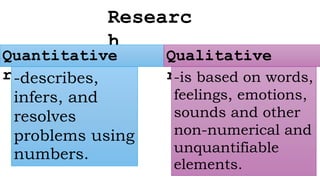
Researc
h
Quantitative
research
Qualitative
research
-describes,
infers, and
resolves
problems using
numbers.
-is based on words,
feelings, emotions,
sounds and other
non-numerical and
unquantifiable
elements.
Action research, thesis,
dissertation, and case
study are examples of
research.
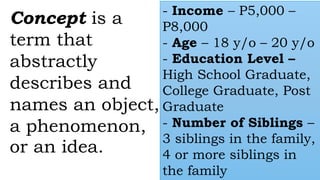
Concept is a
term that
abstractly
describes and
names an object,
a phenomenon,
or an idea.
- Income – P5,000 –
P8,000
- Age – 18 y/o – 20 y/o
- Education Level –
High School Graduate,
College Graduate, Post
Graduate
- Number of Siblings –
3 siblings in the family,
4 or more siblings in
the family
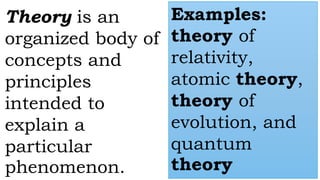
Theory is an
organized body of
concepts and
principles
intended to
explain a
particular
phenomenon.
Examples:
theory of
relativity,
atomic theory,
theory of
evolution, and
quantum
theory
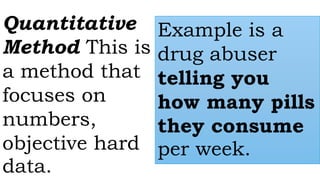
Quantitative
Method This is
a method that
focuses on
numbers,
objective hard
data.
Example is a
drug abuser
telling you
how many pills
they consume
per week.
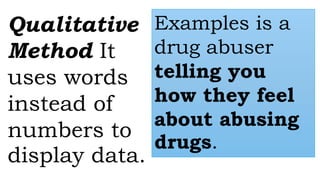
Qualitative
Method It
uses words
instead of
numbers to
display data.
Examples is a
drug abuser
telling you
how they feel
about abusing
drugs.
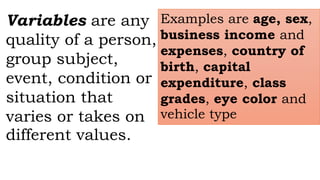
Variables are any
quality of a person,
group subject,
event, condition or
situation that
varies or takes on
different values.
Examples are age, sex,
business income and
expenses, country of
birth, capital
expenditure, class
grades, eye color and
vehicle type
Hypothesis is
a logical
supposition, a
reasonable
guess, and
educated
conjecture.
For example, a researcher
might be interested in the
relationship between
study habits and test
anxiety. The researcher
would propose a
hypothesis about how
these two variables are
related, such as "Test
anxiety decreases as a
result of effective study
habits."
Sampling it is the
process of selecting
participants who
are representatives
of a larger
population – gain
an understanding
of a larger
population.
For example, a random
sample may include
choosing the names of 25
employees out of a hat in a
company of 250
employees. The population
is all 250 employees, and
the sample is random
because each employee
has an equal chance of
being chosen.
SMART is a good way to
remember the fundamentals
of research paper writing, and
to help prepare an author in
writing a successful research
paper.
Specific
Measurable
Attainable
Realistic
Time
Here are some common
ways you can narrow
down a research topic:
By demographic
characteristics
Narrow it down
by age group,
occupation,
ethnic group,
gender, etc.
e.g. challenges
faced by
international
college
graduates
entering the
workforce
By relevant issues
Try to identify key
issues related to your
topic, especially ones
that you have an
opinion on. You can
turn your opinion into
your thesis statement
or research question.
e.g. challenges
faced by college
graduates who
are unable to
find meaningful
or relevant
work
By location
Focus on a
specific country,
province, city, or
type of
environment
(rural vs. urban).
e.g. challenges
faced by college
graduates
entering the
workforce in
rural Ontario
By timeframe
Decide whether you
want to study recent
events or a historical
time period. This will
also help you decide
how current the
information you use
must be.
e.g. challenges
faced by college
graduates
entering the
workforce during
the COVID-19
pandemic z
By causes
You can take
the perspective
of looking for
causes of an
issue you are
researching.
e.g. Why do
employers
hire fewer
college
graduates?

Distinguishing Different Technical Terms Used in Research

  • 1.
    Distinguish Technical Terms Usedin Research (Research Paper)
  • 2.
    Why is researchimportant? -inform action, -to prove a theory, and -contribute to developing knowledge in a field or study.
  • 3.
    What is “Research? -definedas “a systematic and scientific procedure of data collection, compilation, analysis, interpretation, and implication pertaining to any problem.”
  • 4.
    Researc h Quantitative research Qualitative research -describes, infers, and resolves problems using numbers. -isbased on words, feelings, emotions, sounds and other non-numerical and unquantifiable elements.
  • 5.
    Action research, thesis, dissertation,and case study are examples of research.
  • 6.
    Concept is a termthat abstractly describes and names an object, a phenomenon, or an idea. - Income – P5,000 – P8,000 - Age – 18 y/o – 20 y/o - Education Level – High School Graduate, College Graduate, Post Graduate - Number of Siblings – 3 siblings in the family, 4 or more siblings in the family
  • 7.
    Theory is an organizedbody of concepts and principles intended to explain a particular phenomenon. Examples: theory of relativity, atomic theory, theory of evolution, and quantum theory
  • 8.
    Quantitative Method This is amethod that focuses on numbers, objective hard data. Example is a drug abuser telling you how many pills they consume per week.
  • 9.
    Qualitative Method It uses words insteadof numbers to display data. Examples is a drug abuser telling you how they feel about abusing drugs.
  • 10.
    Variables are any qualityof a person, group subject, event, condition or situation that varies or takes on different values. Examples are age, sex, business income and expenses, country of birth, capital expenditure, class grades, eye color and vehicle type
  • 11.
    Hypothesis is a logical supposition,a reasonable guess, and educated conjecture. For example, a researcher might be interested in the relationship between study habits and test anxiety. The researcher would propose a hypothesis about how these two variables are related, such as "Test anxiety decreases as a result of effective study habits."
  • 12.
    Sampling it isthe process of selecting participants who are representatives of a larger population – gain an understanding of a larger population. For example, a random sample may include choosing the names of 25 employees out of a hat in a company of 250 employees. The population is all 250 employees, and the sample is random because each employee has an equal chance of being chosen.
  • 13.
    SMART is agood way to remember the fundamentals of research paper writing, and to help prepare an author in writing a successful research paper.
  • 14.
  • 15.
    Here are somecommon ways you can narrow down a research topic:
  • 16.
    By demographic characteristics Narrow itdown by age group, occupation, ethnic group, gender, etc. e.g. challenges faced by international college graduates entering the workforce
  • 17.
    By relevant issues Tryto identify key issues related to your topic, especially ones that you have an opinion on. You can turn your opinion into your thesis statement or research question. e.g. challenges faced by college graduates who are unable to find meaningful or relevant work
  • 18.
    By location Focus ona specific country, province, city, or type of environment (rural vs. urban). e.g. challenges faced by college graduates entering the workforce in rural Ontario
  • 19.
    By timeframe Decide whetheryou want to study recent events or a historical time period. This will also help you decide how current the information you use must be. e.g. challenges faced by college graduates entering the workforce during the COVID-19 pandemic z
  • 20.
    By causes You cantake the perspective of looking for causes of an issue you are researching. e.g. Why do employers hire fewer college graduates?