POWER8 critical capabilities for
navigating an
unpredictable world
By Debbie Craig
People Strategist and Catalyst
8
“What we intend to, and
pay attention to,
become our reality”
John Keehoe
Unpredictable World
Pre Covid
In Covid
Post Covid
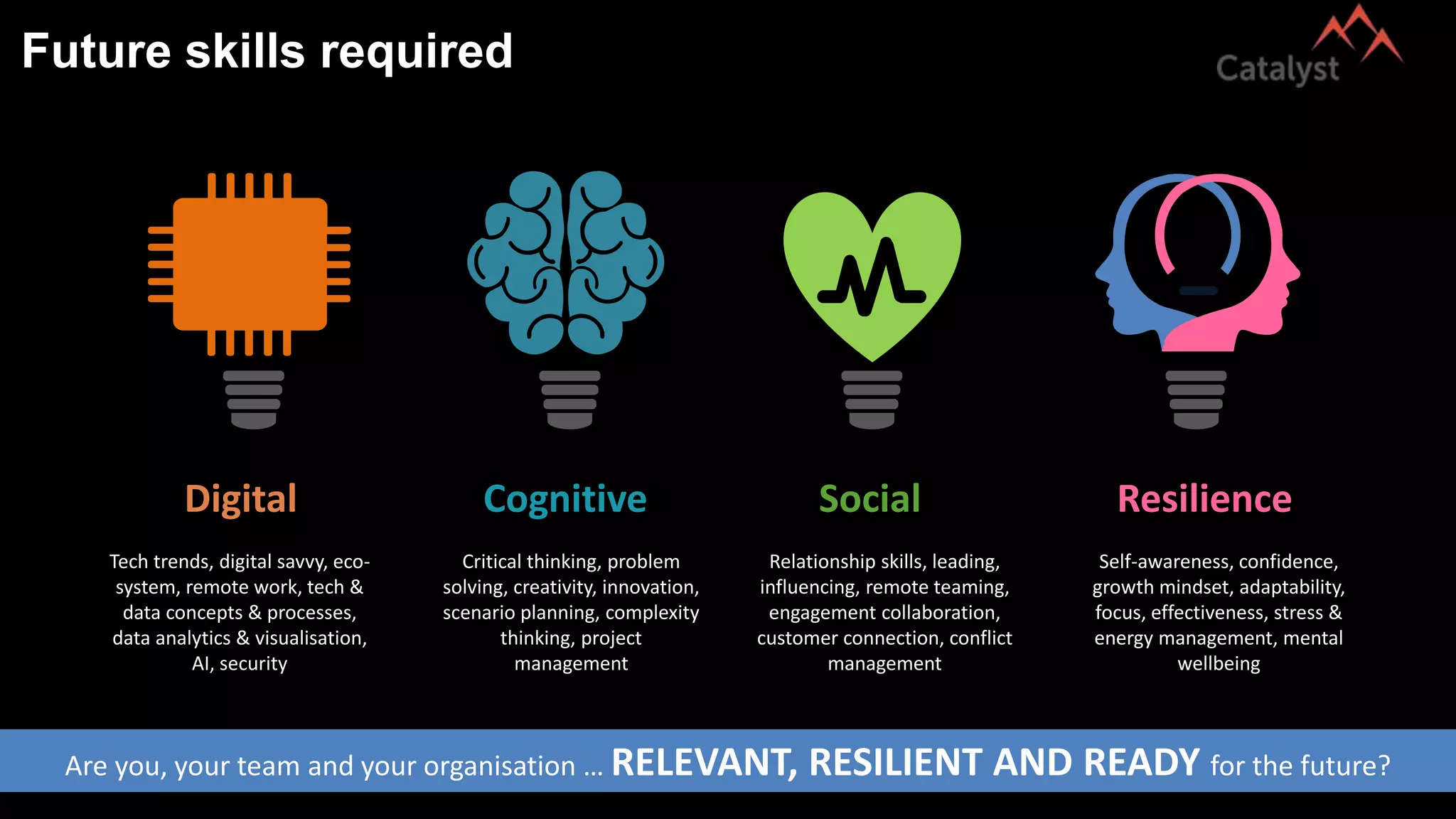
Future skills required
Digital
Tech trends, digital savvy, eco-
system, remote work, tech &
data concepts & processes,
data analytics & visualisation,
AI, security
Cognitive
Critical thinking, problem
solving, creativity, innovation,
scenario planning, complexity
thinking, project
management
Social
Relationship skills, leading,
influencing, remote teaming,
engagement collaboration,
customer connection, conflict
management
Resilience
Self-awareness, confidence,
growth mindset, adaptability,
focus, effectiveness, stress &
energy management, mental
wellbeing
Are you, your team and your organisation … RELEVANT, RESILIENT AND READY for the future?
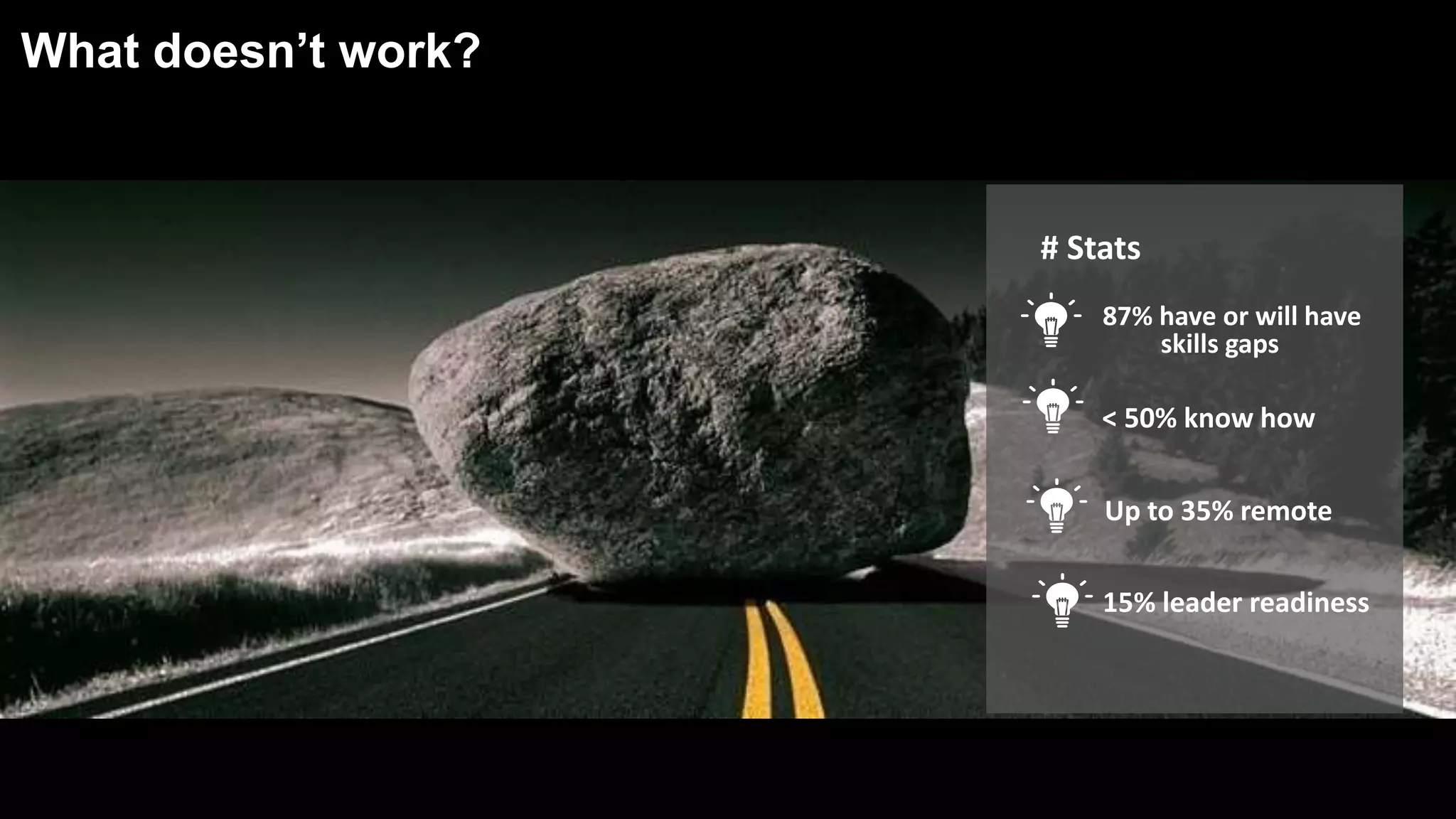
What doesn’t work?
# Stats
87% have or will have
skills gaps
Up to 35% remote
15% leader readiness
< 50% know how
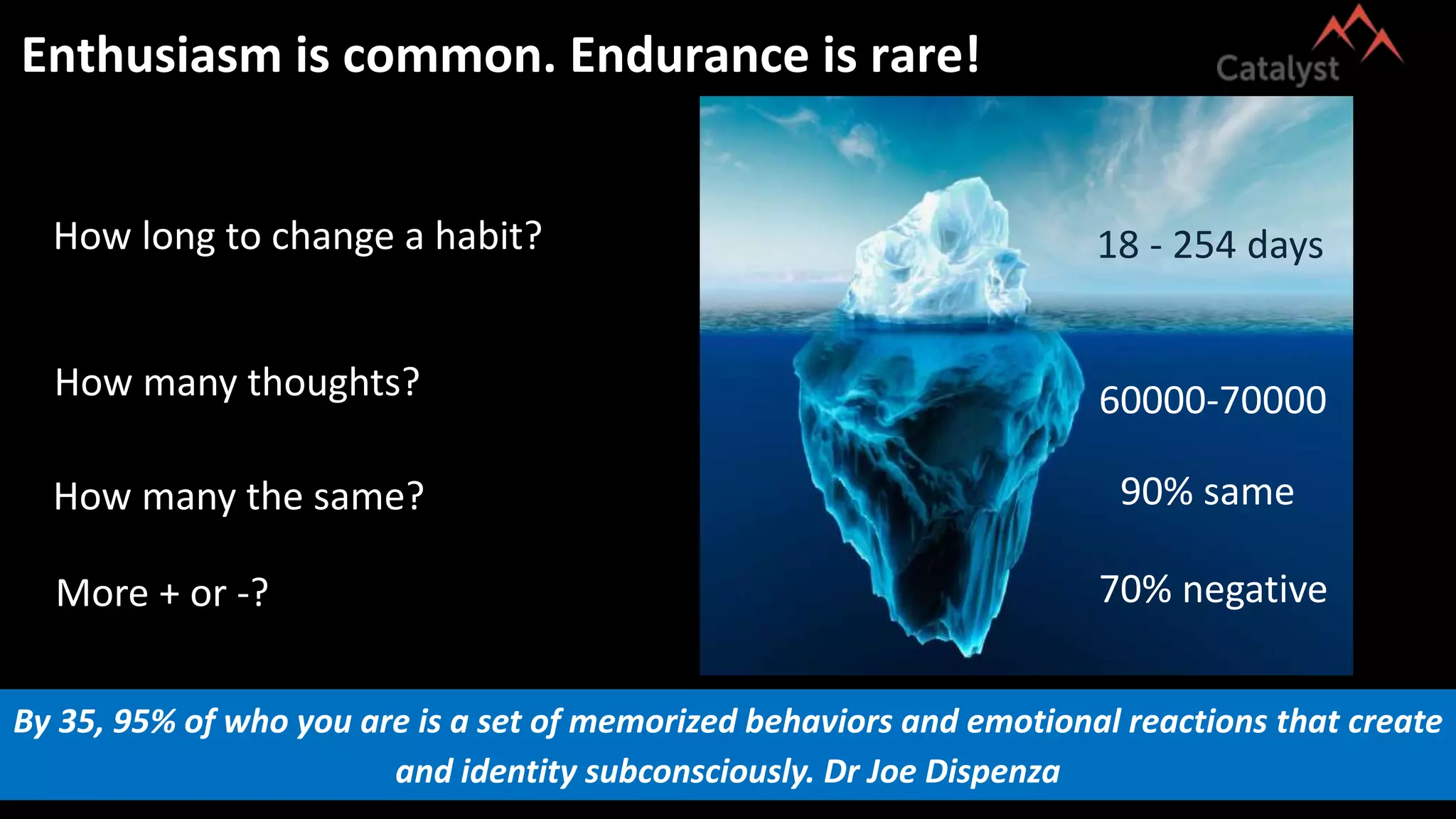
Enthusiasm is common. Endurance is rare!
By 35, 95% of who you are is a set of memorized behaviors and emotional reactions that create
and identity subconsciously. Dr Joe Dispenza
60000-70000
18 - 254 days
How many thoughts?
90% sameHow many the same?
How long to change a habit?
More + or -? 70% negative
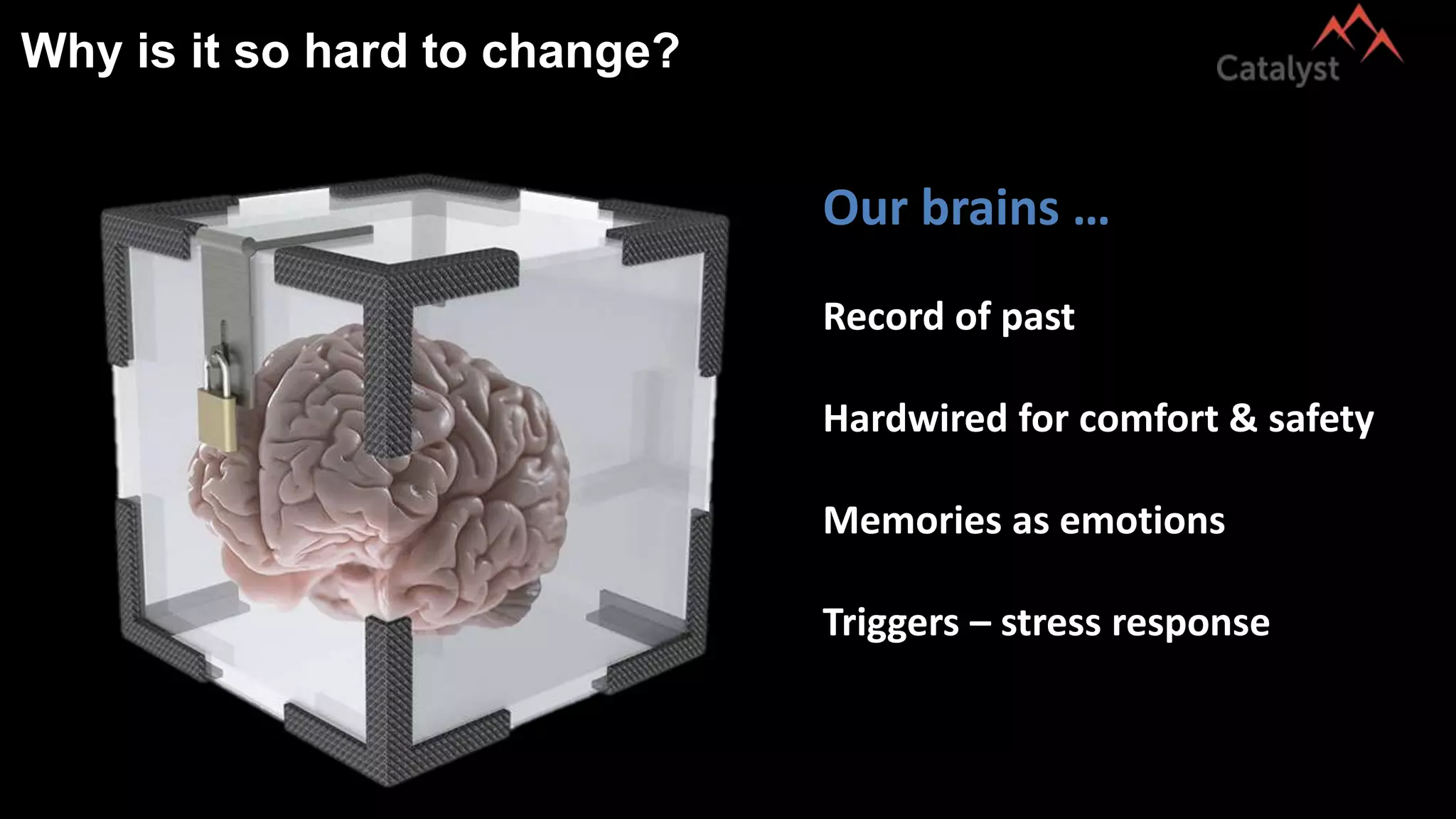
Why is it so hard to change?
Our brains …
Record of past
Hardwired for comfort & safety
Memories as emotions
Triggers – stress response
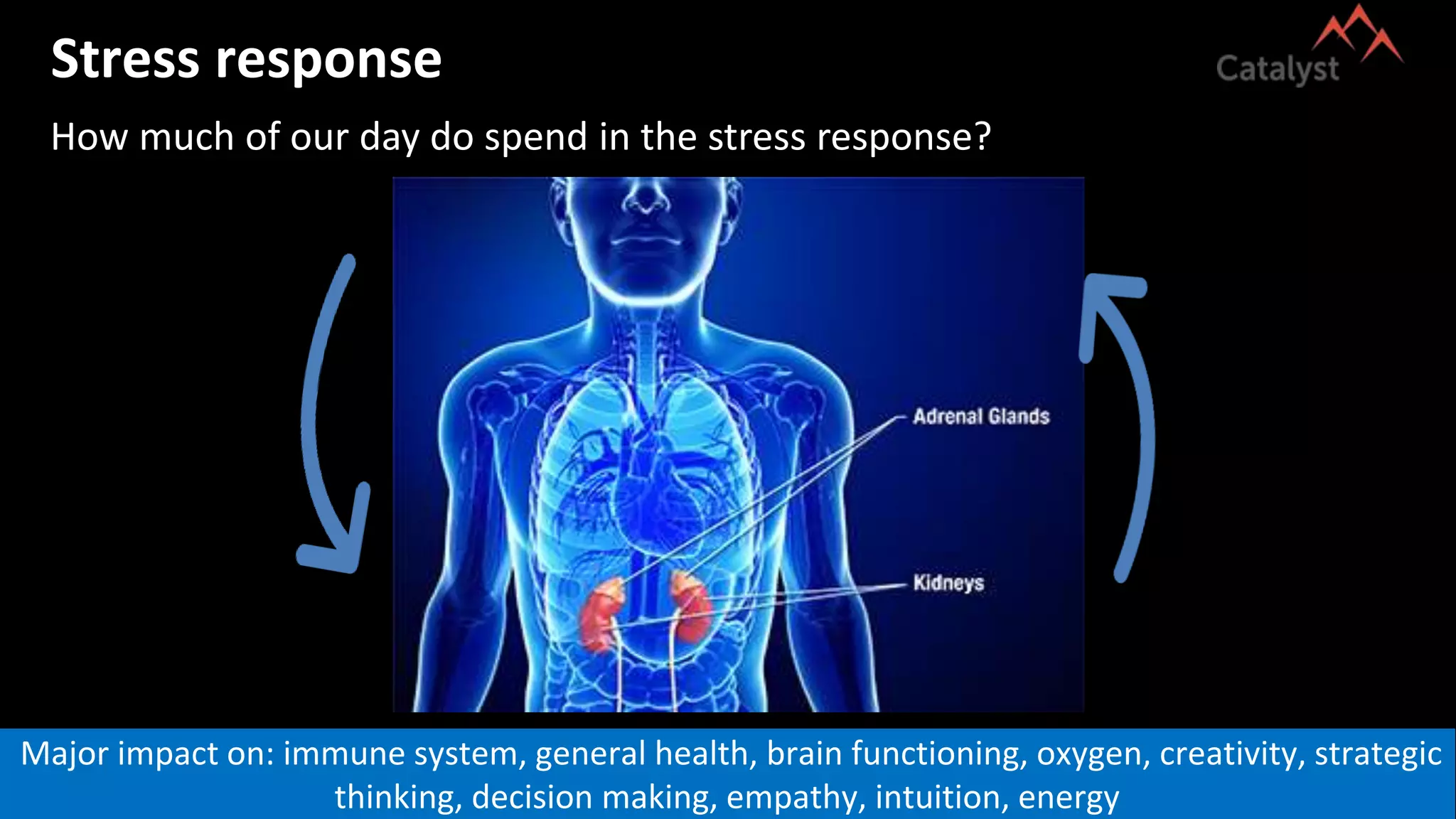
Stress response
Major impact on: immune system, general health, brain functioning, oxygen, creativity, strategic
thinking, decision making, empathy, intuition, energy
How much of our day do spend in the stress response?
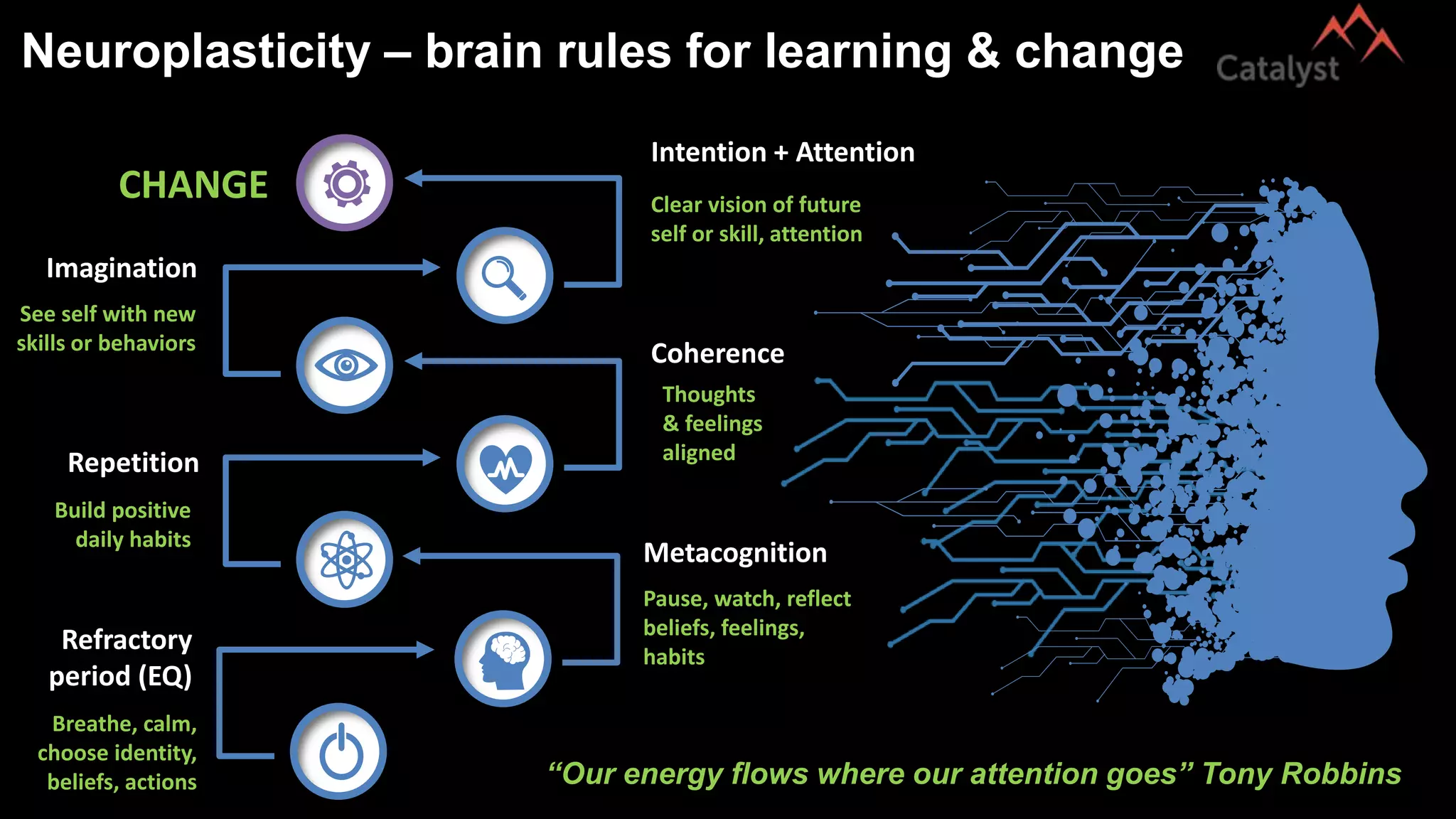
Neuroplasticity – brain rules for learning & change
Clear vision of future
self or skill, attention
Thoughts
& feelings
aligned
See self with new
skills or behaviors
Build positive
daily habits
Breathe, calm,
choose identity,
beliefs, actions
Pause, watch, reflect
beliefs, feelings,
habits
CHANGE
“Our energy flows where our attention goes” Tony Robbins
Intention + Attention
Coherence
Imagination
Repetition
Refractory
period (EQ)
Metacognition
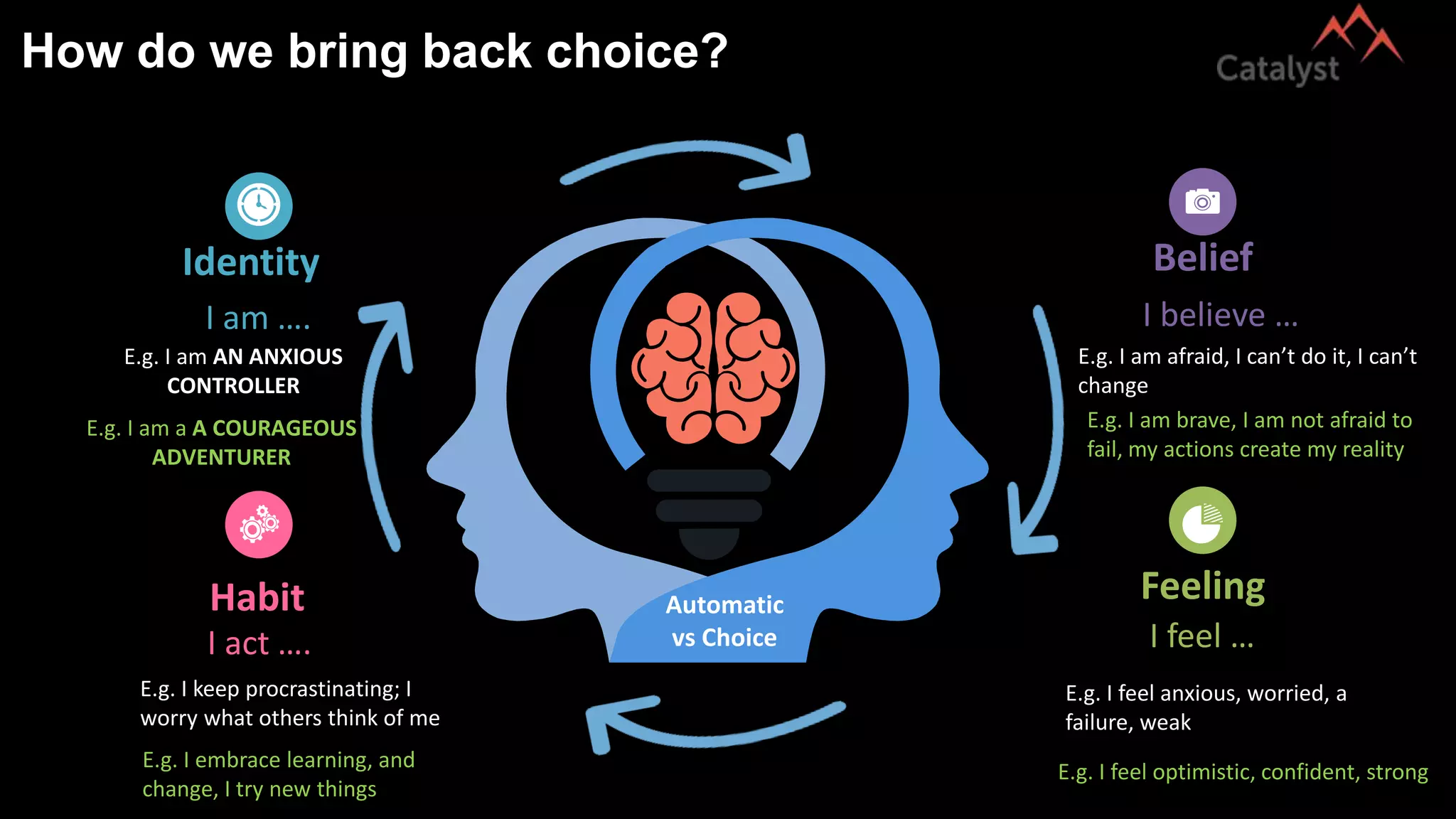
How do we bring back choice?
Belief
I believe …
Feeling
I feel …
Identity
I am ….
Habit
I act ….
E.g. I am afraid, I can’t do it, I can’t
change
E.g. I feel anxious, worried, a
failure, weak
E.g. I keep procrastinating; I
worry what others think of me
E.g. I am brave, I am not afraid to
fail, my actions create my reality
E.g. I feel optimistic, confident, strongE.g. I embrace learning, and
change, I try new things
E.g. I am AN ANXIOUS
CONTROLLER
E.g. I am a A COURAGEOUS
ADVENTURER
Automatic
vs Choice
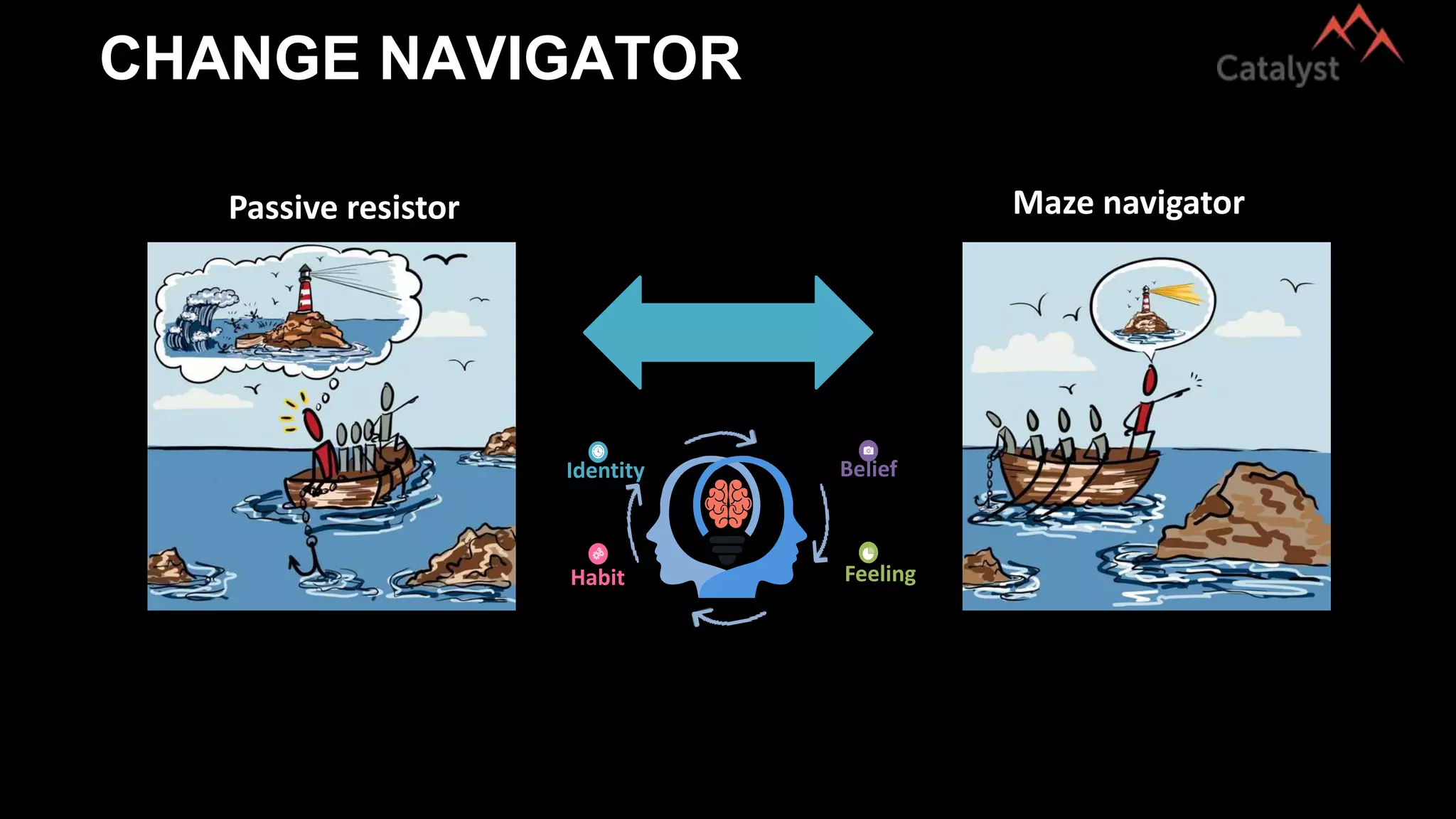
Passive resistor Maze navigator
CHANGE NAVIGATOR
Belief
Feeling
Identity
Habit
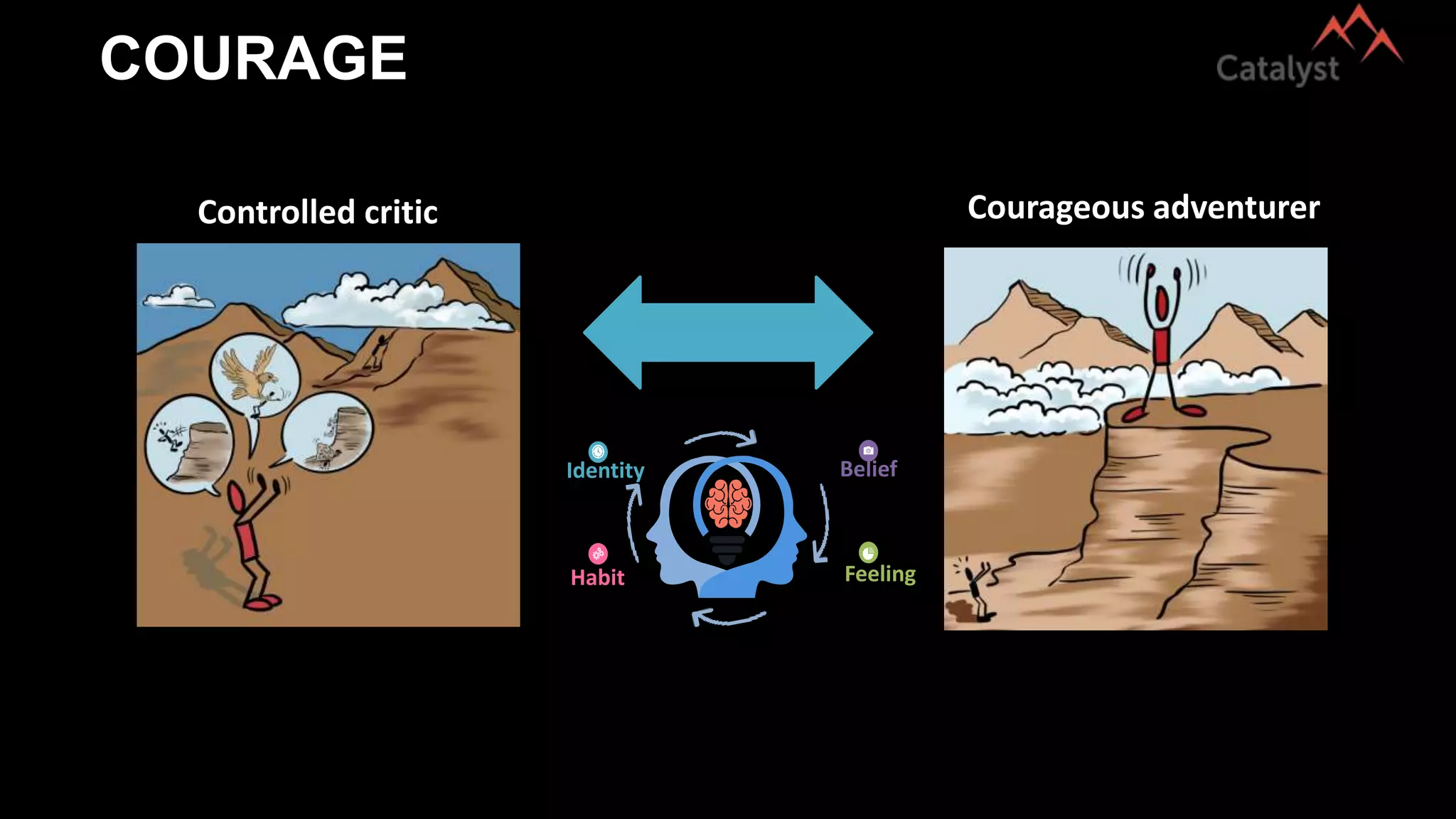
COURAGE
Controlled critic Courageous adventurer
Belief
Feeling
Identity
Habit
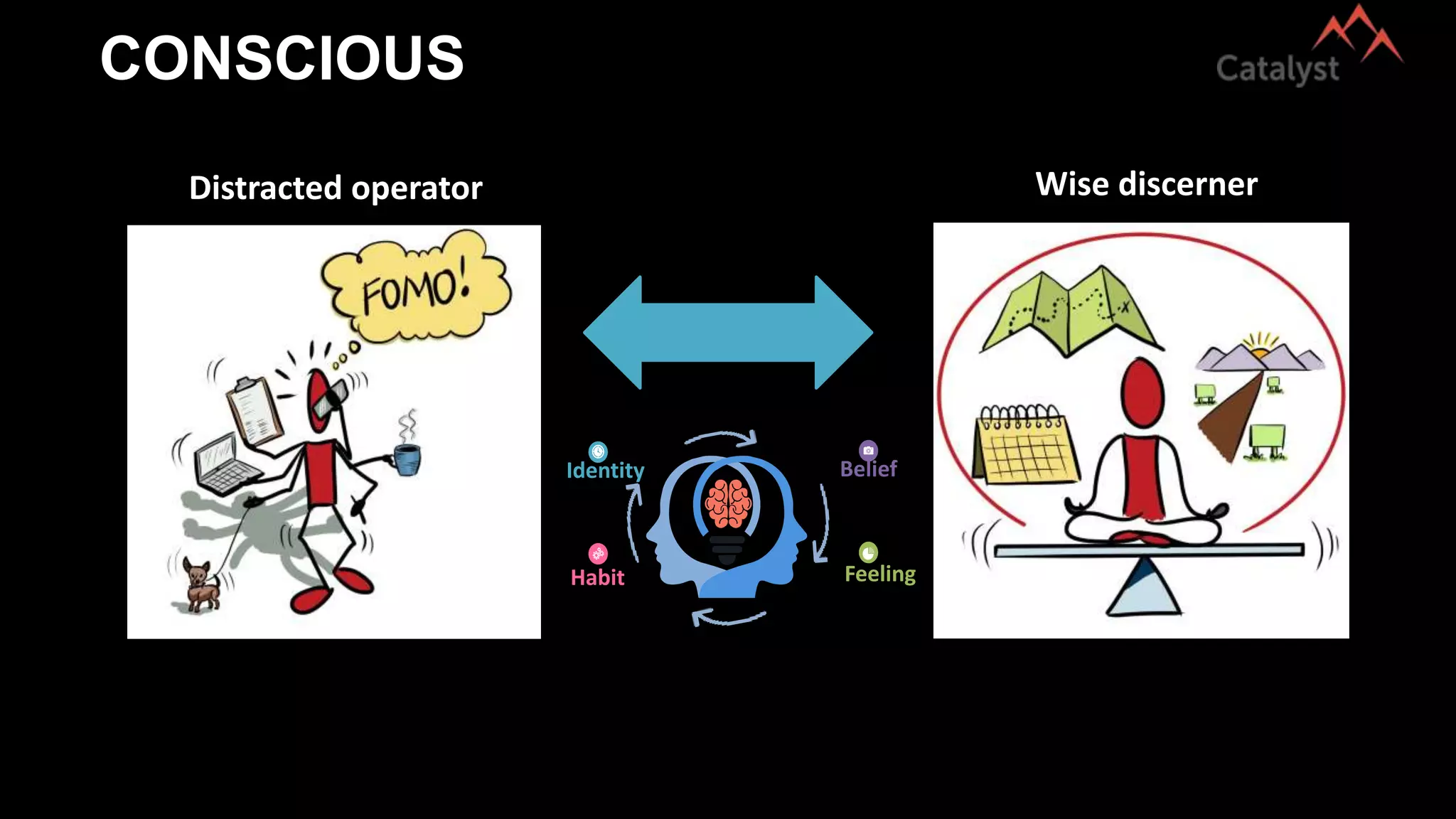
Distracted operator Wise discerner
CONSCIOUS
Belief
Feeling
Identity
Habit
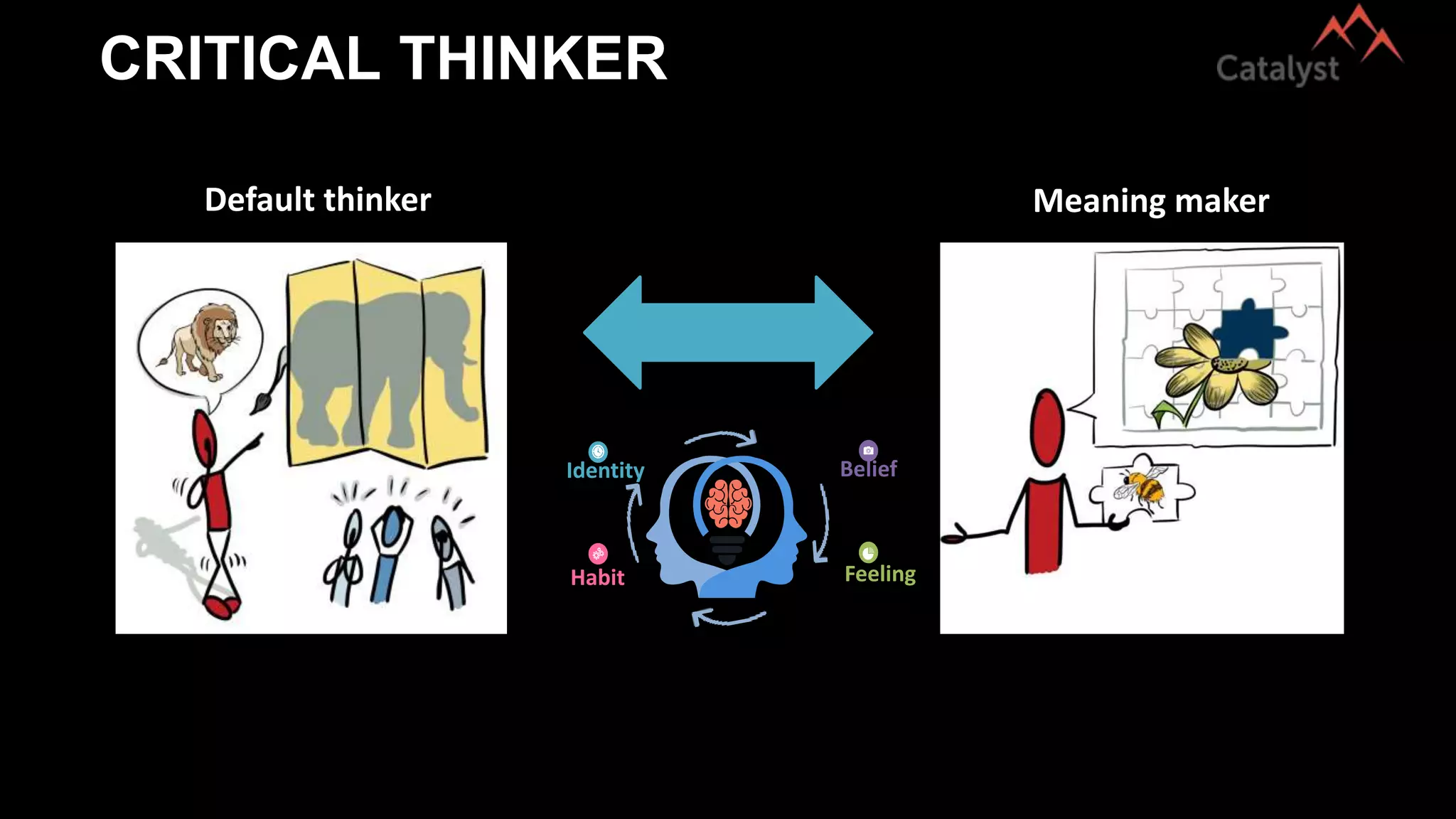
Default thinker Meaning maker
CRITICAL THINKER
Belief
Feeling
Identity
Habit
Identities
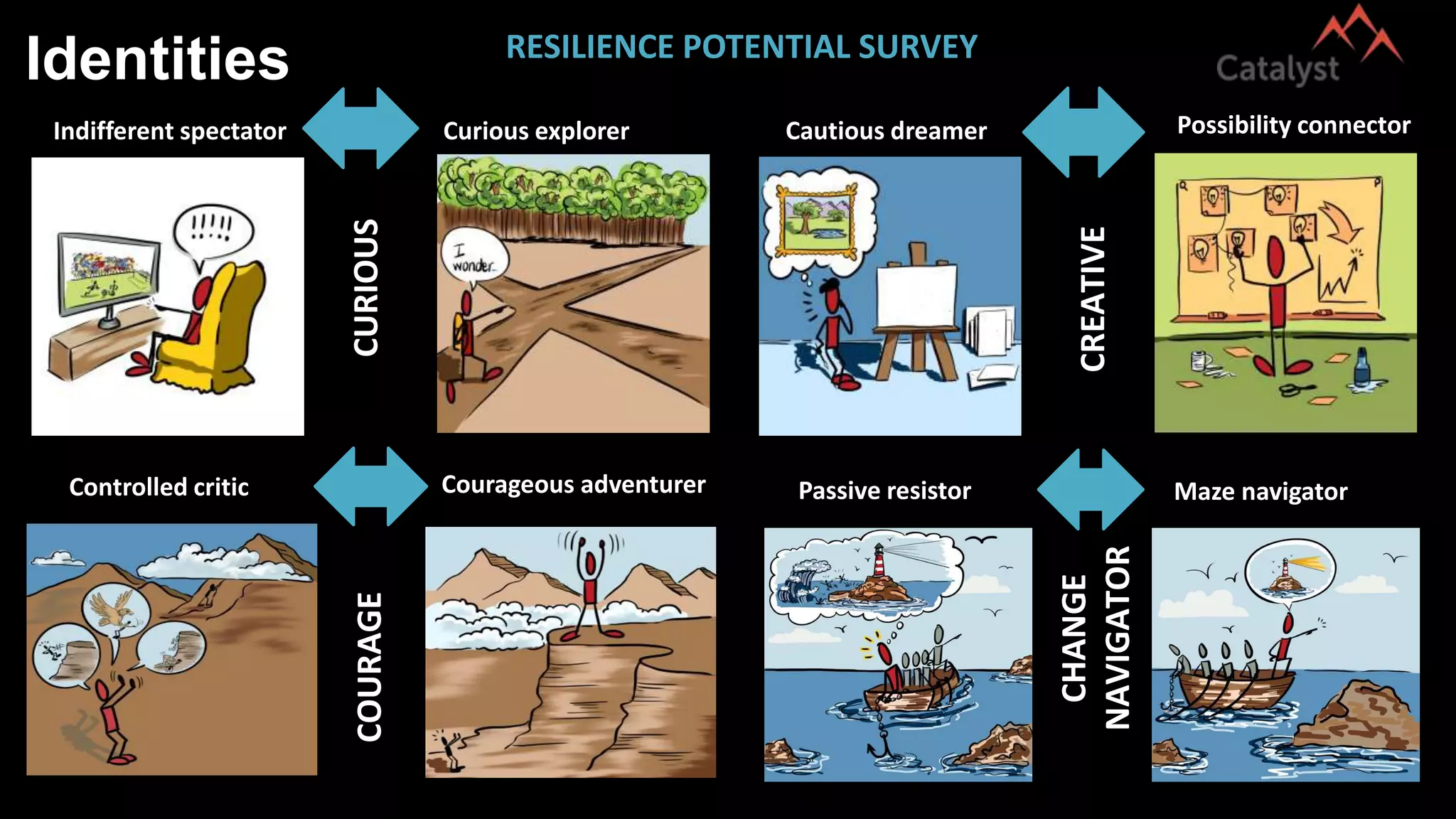
Controlled critic Courageous adventurer Passive resistor Maze navigator
Indifferent spectator Curious explorer
CURIOUS
Cautious dreamer Possibility connector
CREATIVE
COURAGE
CHANGE
NAVIGATOR
RESILIENCE POTENTIAL SURVEY
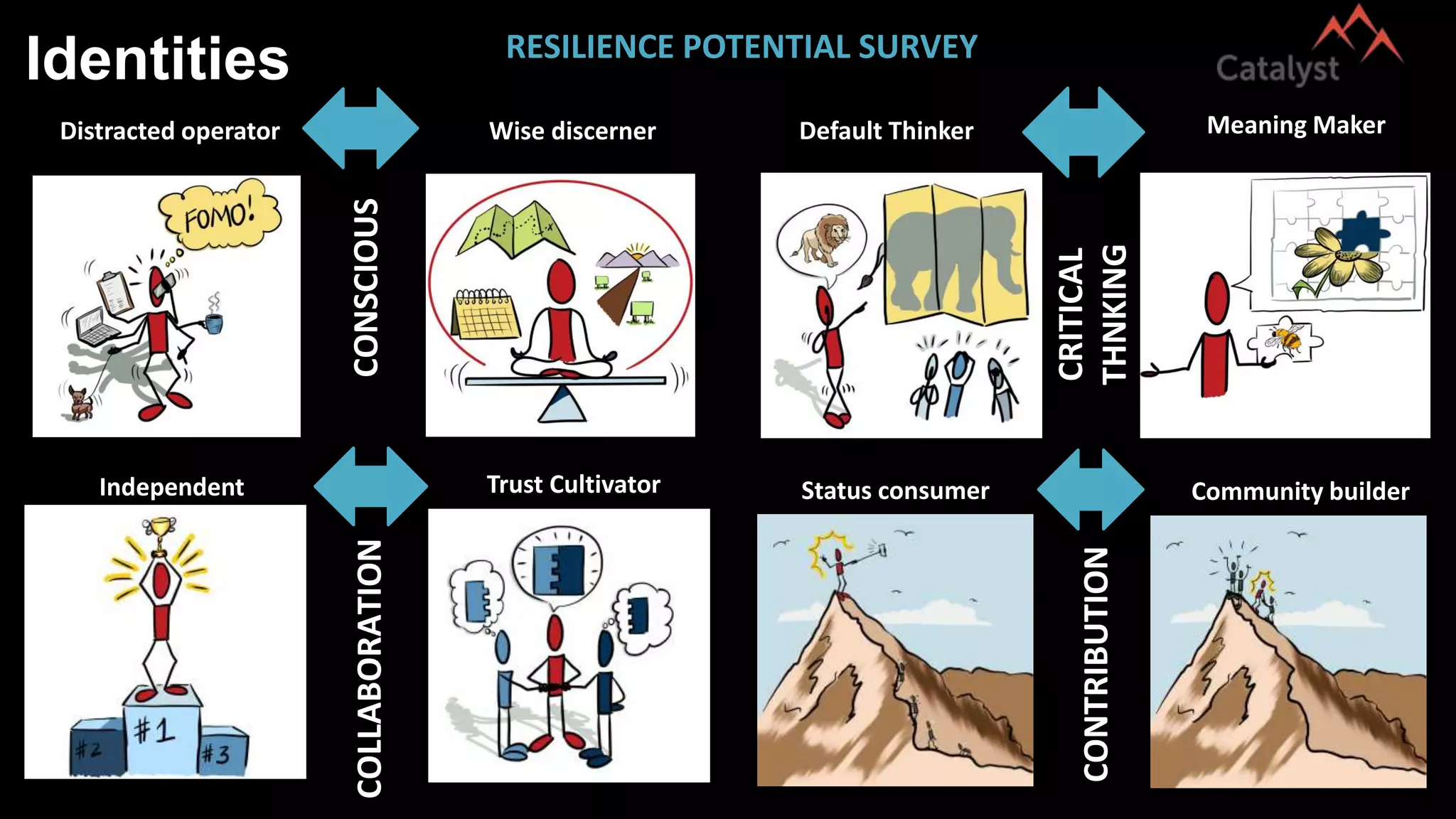
Identities
Independent
Competitor
Trust Cultivator Status consumer Community builder
Distracted operator Wise discerner
CONSCIOUS
Default Thinker Meaning Maker
CRITICAL
THNKING
COLLABORATION
CONTRIBUTION
RESILIENCE POTENTIAL SURVEY
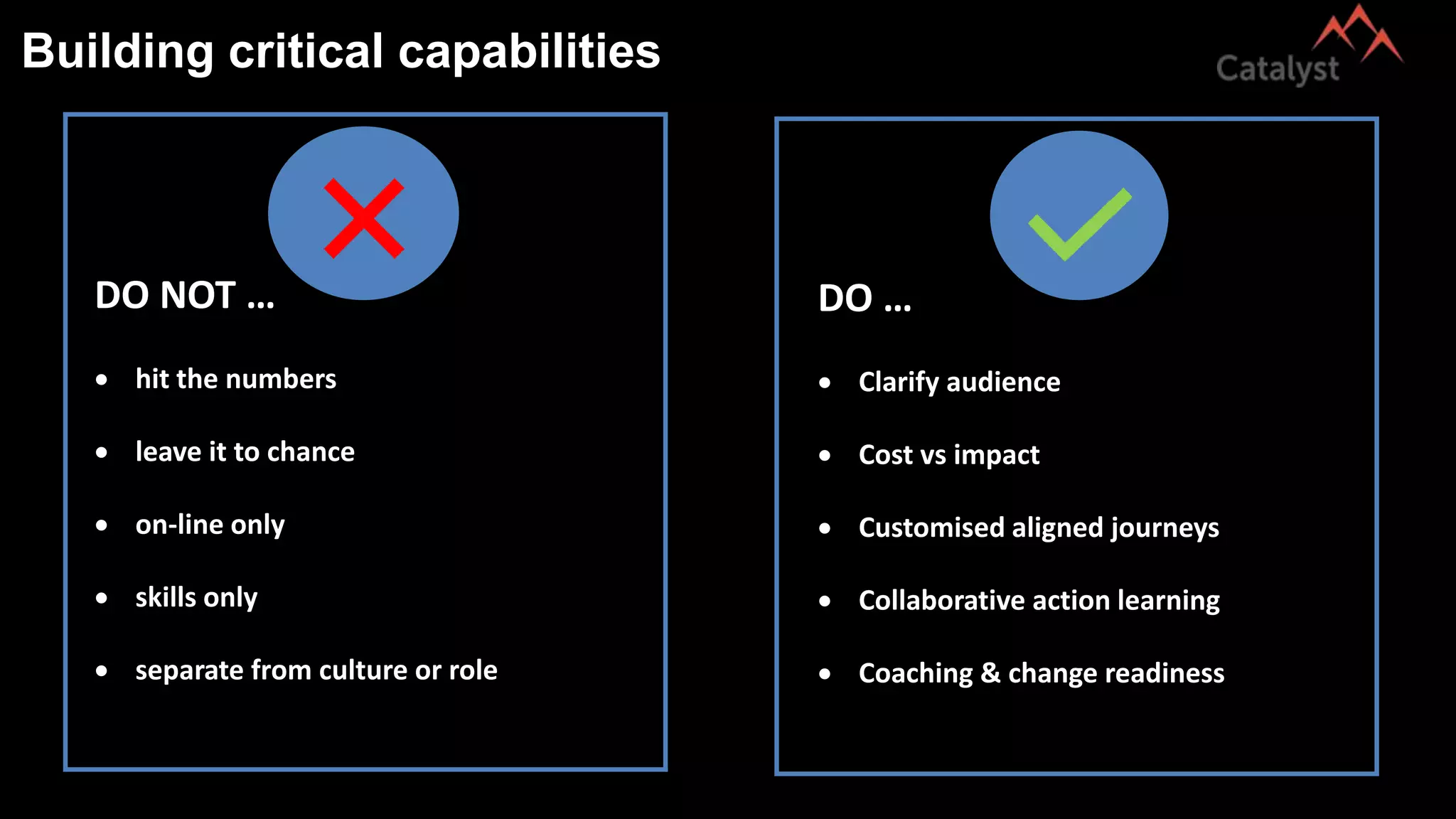
Building critical capabilities

DO NOT …
 hit the numbers
 leave it to chance
 on-line only
 skills only
 separate from culture or role
DO …
 Clarify audience
 Cost vs impact
 Customised aligned journeys
 Collaborative action learning
 Coaching & change readiness
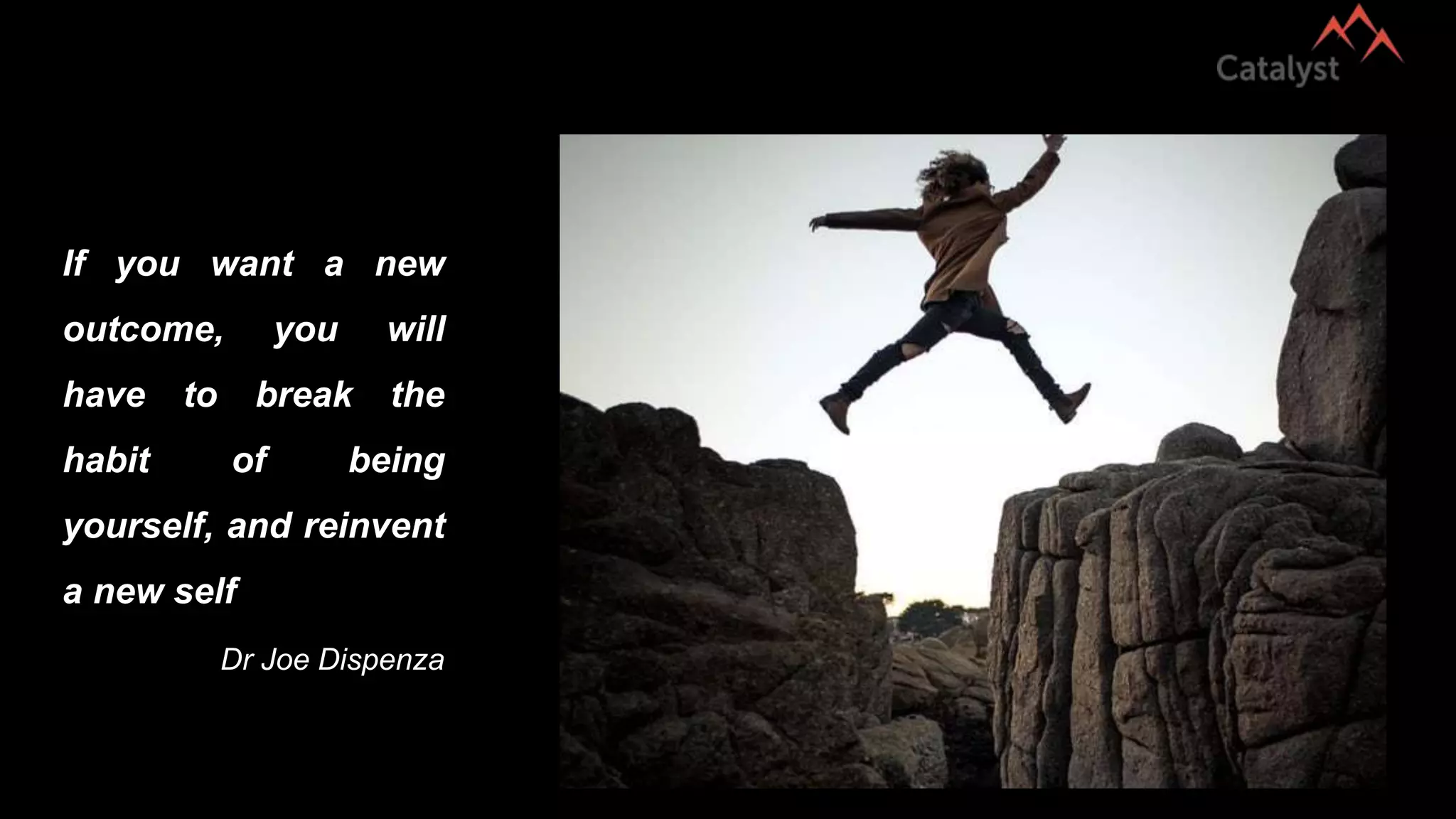
If you want a new
outcome, you will
have to break the
habit of being
yourself, and reinvent
a new self
Dr Joe Dispenza
THANK YOU
BOOK LAUNCH 29 SEPT
Debbie Craig
Catalyst Consulting (Pty) Ltd
Phone +27 82 872 5429
Email debbie@catalystconsulting.co.za
Web www.catalystconsulting.co.za
Follow us
Catalyst Consulting South Africa
Catalyst Consulting Pty Ltd
CatalystSA
Proudly a B-BBEE Level 2 Contributor

Disruptive Thinking - Skills & Mindests for the Future

  • 1.
    POWER8 critical capabilitiesfor navigating an unpredictable world By Debbie Craig People Strategist and Catalyst 8 “What we intend to, and pay attention to, become our reality” John Keehoe
  • 2.
  • 4.
    Future skills required Digital Techtrends, digital savvy, eco- system, remote work, tech & data concepts & processes, data analytics & visualisation, AI, security Cognitive Critical thinking, problem solving, creativity, innovation, scenario planning, complexity thinking, project management Social Relationship skills, leading, influencing, remote teaming, engagement collaboration, customer connection, conflict management Resilience Self-awareness, confidence, growth mindset, adaptability, focus, effectiveness, stress & energy management, mental wellbeing Are you, your team and your organisation … RELEVANT, RESILIENT AND READY for the future?
  • 5.
    What doesn’t work? #Stats 87% have or will have skills gaps Up to 35% remote 15% leader readiness < 50% know how
  • 6.
    Enthusiasm is common.Endurance is rare! By 35, 95% of who you are is a set of memorized behaviors and emotional reactions that create and identity subconsciously. Dr Joe Dispenza 60000-70000 18 - 254 days How many thoughts? 90% sameHow many the same? How long to change a habit? More + or -? 70% negative
  • 7.
    Why is itso hard to change? Our brains … Record of past Hardwired for comfort & safety Memories as emotions Triggers – stress response
  • 8.
    Stress response Major impacton: immune system, general health, brain functioning, oxygen, creativity, strategic thinking, decision making, empathy, intuition, energy How much of our day do spend in the stress response?
  • 9.
    Neuroplasticity – brainrules for learning & change Clear vision of future self or skill, attention Thoughts & feelings aligned See self with new skills or behaviors Build positive daily habits Breathe, calm, choose identity, beliefs, actions Pause, watch, reflect beliefs, feelings, habits CHANGE “Our energy flows where our attention goes” Tony Robbins Intention + Attention Coherence Imagination Repetition Refractory period (EQ) Metacognition
  • 10.
    How do webring back choice? Belief I believe … Feeling I feel … Identity I am …. Habit I act …. E.g. I am afraid, I can’t do it, I can’t change E.g. I feel anxious, worried, a failure, weak E.g. I keep procrastinating; I worry what others think of me E.g. I am brave, I am not afraid to fail, my actions create my reality E.g. I feel optimistic, confident, strongE.g. I embrace learning, and change, I try new things E.g. I am AN ANXIOUS CONTROLLER E.g. I am a A COURAGEOUS ADVENTURER Automatic vs Choice
  • 11.
    Passive resistor Mazenavigator CHANGE NAVIGATOR Belief Feeling Identity Habit
  • 12.
    COURAGE Controlled critic Courageousadventurer Belief Feeling Identity Habit
  • 13.
    Distracted operator Wisediscerner CONSCIOUS Belief Feeling Identity Habit
  • 14.
    Default thinker Meaningmaker CRITICAL THINKER Belief Feeling Identity Habit
  • 15.
    Identities Controlled critic Courageousadventurer Passive resistor Maze navigator Indifferent spectator Curious explorer CURIOUS Cautious dreamer Possibility connector CREATIVE COURAGE CHANGE NAVIGATOR RESILIENCE POTENTIAL SURVEY
  • 16.
    Identities Independent Competitor Trust Cultivator Statusconsumer Community builder Distracted operator Wise discerner CONSCIOUS Default Thinker Meaning Maker CRITICAL THNKING COLLABORATION CONTRIBUTION RESILIENCE POTENTIAL SURVEY
  • 17.
    Building critical capabilities DONOT …  hit the numbers  leave it to chance  on-line only  skills only  separate from culture or role DO …  Clarify audience  Cost vs impact  Customised aligned journeys  Collaborative action learning  Coaching & change readiness
  • 18.
    If you wanta new outcome, you will have to break the habit of being yourself, and reinvent a new self Dr Joe Dispenza
  • 19.
    THANK YOU BOOK LAUNCH29 SEPT Debbie Craig Catalyst Consulting (Pty) Ltd Phone +27 82 872 5429 Email debbie@catalystconsulting.co.za Web www.catalystconsulting.co.za Follow us Catalyst Consulting South Africa Catalyst Consulting Pty Ltd CatalystSA Proudly a B-BBEE Level 2 Contributor

Editor's Notes

  • #2 Hi I am Debbie Craig. Apart from being the founder and MD of Catalyst, I am passionate adventurer, mountain climber, dolphin lover, compulsive seeker & sharer, difference maker, author, yoga nut, wine snob, dog lover, guardian mom, step mom, wife and friend.
  • #3 The world of work is changing exponentially as rapid technological innovation and global forces are compelling businesses to disrupt traditional industry models and adopt new digital strategies and skills to compete. This requires new future-fit thinking, habits and capability to learn, adapt, experiment and fail fast. Whilst technology may be threatening to replace many repetitive or replicable human activities, there is still a critical need for thinking and skills that will enable innovation, customer engagement, responsiveness, adaptability, cross-boundary teamwork, virtual teams and personal health, success and fulfillment. Trends: Autonomous technology; Internet of Things; Big Data & Data Science; Distributed Legers / Blockchain; Artificial Intelligence; Next Gen Mobile Connectivity; Sensor Technology; Robotics; Extended Reality; Quantum Computing; Fintech / Digital Money Pre Covid – technology, economy, competition, ways of working, global teams, new skills, globalisation, cyber threat Economic decline; Leadership gap; Local conditions; Job & skills threat In Covid – remote working, digital learning, virtual teams, restructuring, re-skilling, cross-skilling, outsouring How many of you have had to adapt, learn, develop new skills and habits?? What new mindsets, behaviours, habits have you needed? Post Covid – new normal, many companies changing their structures, place of work and how and who they hire, resizing, new skills required, agile, smart teams, gig economy, merging of technology and humans, new ways of leading, managing and mentoring for an employee experience that keeps and grows the best talent, accelerated learning, learning culture We need to adapt, pivot, innovate, adjust, solve impossible dilemmas e.g. Pakistan going back to work, salary cuts (FIFO or best talent), Sending people out during Covid knowing the risk, upskilling people, critical health care, cyber attacks, negotiating with labour Deloitte – Covid times
  • #4 some days we just feel overwhelmed, exhausted, incompetency, drowning, sick, behind the curve, getting old, playing catch up, losing relevance outdated
  • #5 Studies: WEF, Google Project Oxygen, Harvard, Deloitte, EY, Korn Ferry, Institute of the Future
  • #7 Journal of Clinical Psychology We used to believe it takes 21 days to change a habit. Other research in the European Journal of Social Psychology3 shows that it takes from 18 to 254 days to automate a new chosen habit depending on how consistently the behaviour was repeated in a consistent context. When we are learning something completely new, in which we have no previous experience i.e. driving a car … it is actually easier than un-learning and re-learning a new behaviour or habit which is hard-wired e.g. wanting to change procrastination or give up sugar!!   As Angela Duckworth says in Grit: Enthusiasm is common. Endurance is rare!
  • #9 Narrow focus on body, environment, time Heart rhythm response - HeartMath
  • #10 Adaptability: our brains are adaptable, can learn and grow and are not fixed at any age. We can change how we think, feel and act and change how we show up and our attitudes (neuroplasticity) Attention: We can develop our brains through consistent, focused attention on the new thinking, feeling and doing habits we wish to create (where focus goes, energy flows) Repetition: We can build new habits through repetition or “stopping” old habits. A great analogy is noticing how a path in the bush becomes a road (or even a highway) with plenty of use or gets grown over when not used. (Hebbian Law = nerve cells that fire together, wire together) Imagination: We can change the structure of our brain by regularly imagining a future vision for ourselves AND feeling it as if it has already happened. Our brains can then more easily recognize opportunities to create that future. (Our brains do not know the difference between imagination and reality!) Stress: We have an inbuilt stress response (fight or flight) as a natural survival mechanism to protect us from potential threats. “We can trigger the stress response by thought alone” when we imagine worse case scenarios. We can also minimise the impact of stress through our awareness and choosing more appropriate thoughts. Brainwaves: Our brains operate at different frequencies depending on our mental activity levels e.g. worrying, problem solving, learning, relaxing or sleeping. We can utilize different brainwave states to optimise our ability to imagine, create, learn, de-stress and rewire our brains. Subconscious: The majority of our bodily functions, beliefs, memories and default thinking and behavioural patterns are stored or driven from our subconscious minds. We can access these patterns and programs through certain brain wave states and other techniques, to accelerate change. Chemistry: Triggers in our environment and our thoughts initiate a cascade of chemicals (feel good or stress hormones) which result in feelings. These in turn influence thoughts – causing a positive or negative thinking, feeling loop. We can manage our mental and emotional state by developing the ability to self-regulate and pause and reflect before responding. Coherence: Our heart is in regular communication with our brains and body. We can utilise the powerful nerve center in our heart to activate coherence or “harmony” in our brain, nervous system and electromagnetic field around us. Certain breathing techniques can counter the stress response and switch on our rest and renew response instead. Meta-cognition: We have the ability to observe ourselves (our thoughts, feelings, actions), pause and choose more empowering responses to life. We can learn to delay reacting emotionally to an external trigger (e.g. criticism) or internal trigger (e.g. craving), until we have more information, are calmer and can make better choices. This is emotional intelligence in action. Incoherence frustration, irritation, impatience, worry Inhibits brain function – impairs performa Coherence appreciation, calm, patience, confidence Facilitates brain function – promotes optimal performance
  • #12 Passive resistor Passive resistor: resist change, fault finder, corridor talk Passive resistor: resist change, discomfort, threats, danger, maintain ego identities, sabotage change, hyper critical, find fault, derail, white ant, smile and then sabotage Hitchhiker: passenger, oxygen thief, non-committal Hitchhikers: let others take all the risks, passenger, follower, avoiding personal risk or public failure, non-committal, vague, not pro-active Push over: overly sensitive, weak character, lack of perseverance Push-overs: when forced to choose, will go with the majority, not stand up for their views, insecure, overly sensitive to feedback or perceived criticism leading to drama and toxicity in the team Maze navigator Path finder: visionary, intentional, inspirational Path finder: sift through noise, create an intentional and inspirational vision, optimism, hope, belief in self and others to survive and thrive through the challenges and struggles 0 Maze navigator: committed, determined, agile Maze navigator: committed to their vision, determined to find a way, despite barriers, agile, quickly adapt their approach or route, resilient, quick to reflect, learn and explore possibilities, persevere, Change influencer: listener, engager, influencer Change influencer: tap into other’s, fears and motivators and engage, awareness, empathy and deep listening, articulate vision with passion and energy, outline journey of adventure and risk, benefits, meaning and hope, network, people willing to follow them into the exciting unknown.
  • #13 How many of you have faced moments of courage Controlled Critic Pretenders: big act, mask, pretend, self-critical, not good enough, judgmental, under the radar, Anxious: highly strung, risk averse, fearful, avoidant, organized, controlled, pessimistic, untrusting   Stuck: overthinker, dreamer, big-talker, procrastinator, avoid decisions   Courageous adventurer Authentic: whole hearted, honest, strength of character, self-confident, open, engaging, willing to be vulnerable, laugh at self, humble Resilient; grit, determination, tough minded, bounce back, perseverance, committed, self-belief   Adventurers: faces the unknown, takes action despite fear, steps up, takes calculated risks, brave, stretch, inner and outer adventures
  • #14 Tim Ferris; Thuli Madonsela Drifter: superficial, out of touch, ignorant Drifters: drift, superficial, out of touch, ignorant, no idea of impact, unreliable, chasing their tail, non-commital     Blamer: emotional, victim, excuses Blamers: victim, blame, make excuses, avoid responsibility, not owning their destinies, bouncing between dramas   Distracted: busy, stressed, disorganised (FOMO) Distracted: easily distracted, or influenced, (rubber arm), 0pulled in many directions, FOMO, busy, stressed, disorganized, can’t say NO   Discerning: self-aware, mindful, intuitive Discerners: tuned in to intuition, bodies needs, calm, rational in a crisis, responsive, balanced, not overwhelmed, assertive, healthy boundaries expectations to priorities, organised not a control-freak. Responder: calm, responsible, wise Responder: wise choices, thoughtful, appropriate decisions, ask questions or get more information, avoid assumptions and rash emotional decisions, quickly assess impact, aware of external world, notice cues of opportunities or risks, natural BS detector and avoid scammers or opportunists, sensory acuity, empathy, balance tuning into their inner and outer world, managing attention and energy, time, space, focus, effective, not busy, add value, healthy boundaries, work life balance, honest conversations, manage Focussed: energized, healthy, organised Focused: aware, witness, think about their thinking, discern what they are consuming, avoid “noise”, repetitive dramas. interrupt the pattern, differentiate, understanding self, triggers, hot-buttons, dysfunctional habits, baggage  
  • #15 Expedient: quick to judge, assumption maker, biased Expedient, lazy thinkers, quick to judge, skim over info, move on quickly, min effort, assumptions, biases, flawed thinking, incomplete data, broad categorisation, stereotyping, over-simplifying, giant leaps of assumption. Speed and ease is more important to them than accuracy or long-term sustainable solutions. Spontaneous, “in the moment”, not considering impact of their suggestions and decisions. gullible without validating facts or sources.   smart and know it all. time is valuable short-cuts. things are “obvious” minimum fuss. most people “don’t get it” Impatient, arrogant, clever     Linear thinker: silo thinker, one dimensional, narrow thinking unable to expand thinking beyond the box, perpetuate silo-thinking “us vs them” fall into the trap of cause and obvious effect without considering the ripple effect of changes. Options narrow and limited without considering “wisdom in the room”.   Complicator: overload, overwhelm, confuse jumping to conclusions and solutions too quickly without a deeper and wider investigation of the problem. exacerbates conflict damage relationships unnecessarily. Issues confounded root causes or interrelationships between issues are not fully understood overload overwhelm people due to an inability to integrate, simplify and make meaning of the “noise” in the system.   Anticipator: see bigger picture, systemic thinker, questioner think strategically long-term big picture. systemically cause and effect and different parts of a system interact with take time to reflect on scenarios, possibilities and unintended consequences. watch trends anticipate change and adapt asking questions both internally in their minds and externally to others to gain additional data or insight to improve their problem solving and decision making.   Complexity navigator: complexity analyser, dilemma solver, relevance validator navigate complexity take the time to gather relevant data from multiple, sources, avoid false or superficial information or opinions. organise and analyse the data understand, compare and find answers. creating mental models and variety of options to clarify ambiguous situations and challenge assumptions and paradigms. testing and piloting ideas to gain buy-in and confidence conscious of trade-offs minimum loss and maximum gain. not always a single, linear solution way forward may need to emerge over a period of time as more data becomes available.   Meaning maker: integrator, simplifier, insight generator connect dots, ideas, opportunities and people and are excellent at integrating these and making sense of it into a few pictures, themes or statements ideas are found in the space between traditional industries or obvious relationship matches, and they pull people together to innovate something original. simplify. simplest, easiest, quickest and least resource intensive method of doing work i.e. doing more with less. overwhelming amount of input or “noise” and make sense for others with simple reasons, roadmaps, steps and benefits enabling them to take action toward a vision.   What is the long-term impact of this decision? What other trends or scenarios or changes might impact our success in the future? What is the impact if we don’t invest in this? Who else could be impacted by this? What is the root cause of this issue? What could some unintended consequences? What might I be overlooking?
  • #16 Collaboration Examples Koen brothers, Lady Gaga & Beyonce, Agricultural drones, Disney & Pixar Independent Competitor Independent: prefers to work alone, be in control of own time and energy, self-involved, can be isolated Suspicious: naturally suspicious, sensitive to being hurt, trust needs to be earned, hedges bets, imagines the worst, keeps information to self   Protector: protects boundaries and own resources, power or inner circle or team, competitive win-lose mindset, tends to see what I’m giving up   Trust Cultivator Inclusive: embraces diversity, cultivates networks, identifies and builds strengths and synergies across boundaries, abundance mindset Trusting: open-hearted, naturally trusting, relationship builder, shows empathy and cultivates trust between people and groups Resolver: seeks common ground, negotiates, resolves conflict, explores win-win solutions, tend to see what everyone gains  
  • #17 Collaboration Examples Koen brothers, Lady Gaga & Beyonce, Agricultural drones, Disney & Pixar Independent Competitor Independent: prefers to work alone, be in control of own time and energy, self-involved, can be isolated Suspicious: naturally suspicious, sensitive to being hurt, trust needs to be earned, hedges bets, imagines the worst, keeps information to self   Protector: protects boundaries and own resources, power or inner circle or team, competitive win-lose mindset, tends to see what I’m giving up   Trust Cultivator Inclusive: embraces diversity, cultivates networks, identifies and builds strengths and synergies across boundaries, abundance mindset Trusting: open-hearted, naturally trusting, relationship builder, shows empathy and cultivates trust between people and groups Resolver: seeks common ground, negotiates, resolves conflict, explores win-win solutions, tend to see what everyone gains  
  • #18 Building foundational capabilities - What not to do Before we get into how best to build these, it is sometimes useful to know what not to do. From our many years of experience in the field, we see lots of what goes right and what goes wrong – often unintentionally. A lot of valuable time, energy and money can be wasted on learning that is not relevant, customized, practical or measured. So here is our not to do list: DO NOT … do nothing and leave learning to chance or book groups of people on training to hit the numbers - hoping they will learn something. Most people find only 10 - 15% of non-customised, large group training relevant, and forget most of it afterwards if not reinforced and integrated into day to day role DO NOT … leave learning up to the individual with access to on-line modules hoping they will be motivated and ready for self-driven learning. Without a learning culture, encouragement and recognition, adoption rates of on-line learning platforms are a tiny fraction of the employee population DO NOT … expect mindset shift and transformational experiences to happen with self-directed on-line learning only without some robust conversations and opportunities for insight. The ah-ha moment and learning impact is often attained through a combination of activities and input from others. DO NOT … prioritise leadership or technical skills above core or foundational skills. An integrated approach to build a solid foundation or platform upon which to build should be the focus. DO NOT … only focus on leaders to build foundational skills. Front line and support staff play a key role in day to day culture and decisions. Pick your change champions at all levels and have a cross cutting approach. DO NOT … see learning new skills in isolation of culture and employee experience. It is critical that the culture is ripe for learning and encourages space to experiment and fail fast. Building foundational capabilities - What to do We have had to rapidly develop capability and implement new systems, processes and cultures in many turnkey projects. Our recommended principles for ensuring future-fit learning are not surprisingly also categorised into 8Cs: Clarify audience: understand your target audience requiring foundational skills and identify the leadership, technical and foundational capabilities required Cost vs impact: assess the impact of budget invested in people that will have the biggest impact on the culture and learning of others at different levels (your change influencers). Critical mass: choose a sufficient percentage of your target audience to embark on learning journeys to build a common language, culture and tools around the foundational skills, which then can spread to others. A few people attending programs as individuals will struggle to make big organisation impact by themselves. Customised journeys: spread the learning over 6-12 months with a combination of self-driven digital learning, facilitated sessions, collaborative team based learning projects and coaching to ensure learning is embedded and impactful. Strategy alignment: closely align your learning journeys to strategy, culture and role. Master classes can be utilised to build onto existing learning journeys but must be integrated into the overall outcomes and expectations. Collaborative action learning: build social and team skills and feedback rich environments by designing relevant team-based action learning projects with tracking and accountability. Coaching: provide access to group coaching for common tricky aspects to create opportunities for individual and group insight and transformation and accelerated learning for key individuals where speed is necessary. Change management: ensure learner readiness for a new way of learning through effective communication, system on-boarding, expectation management, leader engagement, and group launch sessions to build important connections and energy for the journey. Calculate: Track and measure the impact of the learning – on individual performance, skills, engagement and self-confidence, as well as team and organisational impact.
  • #19 Courage is also…. Speaking up in a meeting or to your boss when you know it is the right thing to do Confronting a friend who has been taking advantage or abusing your good or patient nature Asking for feedback to reality test how you are showing up Saying no to friends or a lover when you are not in the mood for food, drugs, sex, alcohol or company Facing tough conversations with someone close to you, really listening, and not making it about you Dealing with your own frailty through illness or inability to do or achieve something Coping with let-downs, disappointments and failures, but still taking the next step Telling your spouse/loved one how you feel about something important, even when you know it might upset him/her and lead to an argument Reaching out and helping a friend or stranger in need and being willing to sacrifice something of yours (time, plans, money, convenience) Starting your own business when everyone else think’s you are crazy Supporting a friend or colleague who has messed up but needs support to get back to their authentic self (when everyone else is avoiding them like the plague)