








AQUA GROUP GOLD COIN
Disease Control with particular
reference to White Spot Disease
.
Poh Yong Thong
2 Feb 2016 Chilaw, Sri Lanka
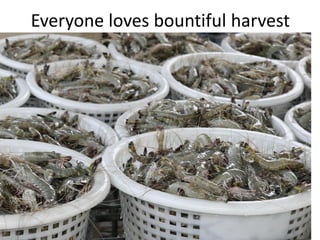
Everyone loves bountiful harvest
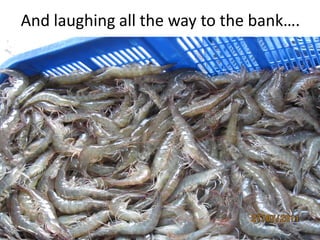
And laughing all the way to the bank….
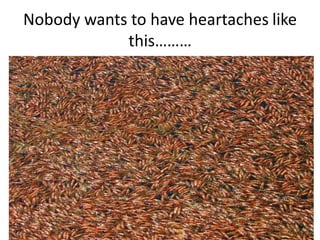
Nobody wants to have heartaches like
this………
What is WSSV?
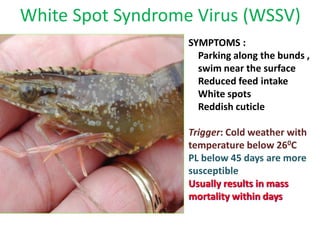
White Spot Syndrome Virus (WSSV)
SYMPTOMS :
Parking along the bunds ,
swim near the surface
Reduced feed intake
White spots
Reddish cuticle
Trigger: Cold weather with
temperature below 260C
PL below 45 days are more
susceptible
Usually results in mass
mortality within days
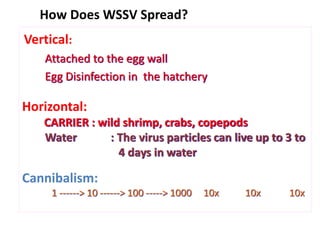
How Does WSSV Spread?
Vertical:
Attached to the egg wall
Egg Disinfection in the hatchery
Horizontal:
CARRIER : wild shrimp, crabs, copepods
Water : The virus particles can live up to 3 to
4 days in water
Cannibalism:
1 ------> 10 ------> 100 -----> 1000 10x 10x 10x
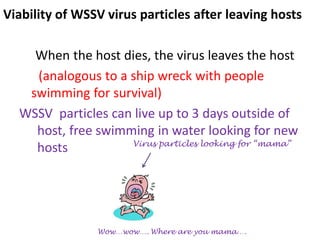
Viability of WSSV virus particles after leaving hosts
When the host dies, the virus leaves the host
(analogous to a ship wreck with people
swimming for survival)
WSSV particles can live up to 3 days outside of
host, free swimming in water looking for new
hosts
Wow…wow…. Where are you mama….
Virus particles looking for “mama”
Basics for Aquaculture Success
• Suitable water free of pollution
• Clean pond bottom
• Motivated people
• Quality PL
• Strict Biosecurity
• Quality feed and Superb Feed Management
• Suitable weather
• Understanding of Carrying Capacity
Basics for Aquaculture Success
• Suitable water free of pollution
• Clean pond bottom
• Motivated people
• Quality PL
• Understanding of Carrying Capacity
• Strict Biosecurity
• Quality feed and Superb Feed Management
• Suitable weather
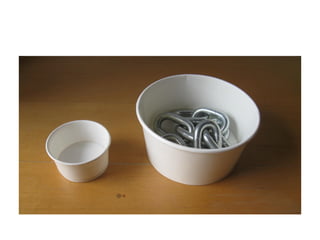
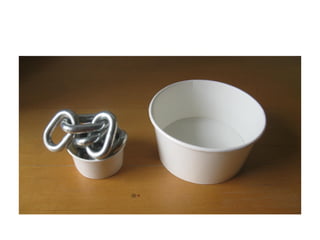
Understanding of Carrying Capacity
• Different ponds have different carrying capacity
• Concrete & HDPE lined > Earthen pond on hard
earth > earthen pond on mud
• New pond > old pond
• 20 aerators > 15 aerators > 10 aerators > 5 aerators
• New pond can harvest 1,000 kg/Hp
• Average 500 kg/Hp
• Old pond < 350 kg/Hp
• When the carrying capacity is reached, it is better
to partial or total harvest the pond
What is Biosecurity?
Biosecurity is the implementation of measures to:
a) Avoid the entrance of infection into the farm
b) Control the dissemination of an infection if one
does enter the farm
c) Avoid spreading an infection to other farms.
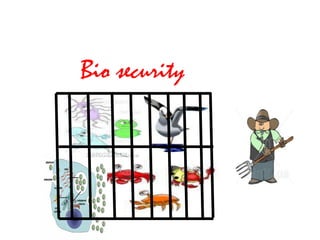
Bio security
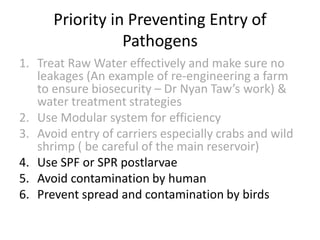
Priority in Preventing Entry of
Pathogens
1. Treat Raw Water effectively and make sure no
leakages (An example of re-engineering a farm
to ensure biosecurity – Dr Nyan Taw’s work) &
water treatment strategies
2. Avoid entry of carriers especially crabs & wild
shrimp ( be careful of the main reservoir)
3. Use SPF or SPR postlarvae
4. Avoid contamination by human
5. Prevent spread and contamination by birds
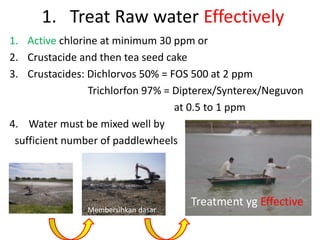
1. Active chlorine at minimum 30 ppm or
2. Crustacide and then tea seed cake
3. Crustacides: Dichlorvos 50% = FOS 500 at 2 ppm
Trichlorfon 97% = Dipterex/Synterex/Neguvon
at 0.5 to 1 ppm
4. Water must be mixed well by
sufficient number of paddlewheels
1. Treat Raw water Effectively
Treatment yg Effective
Membersihkan dasar
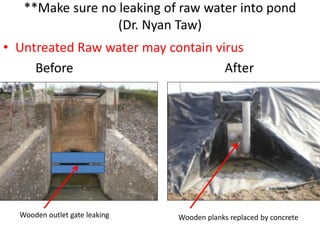
**Make sure no leaking of raw water into pond
(Dr. Nyan Taw)
• Untreated Raw water may contain virus
Before After
Wooden outlet gate leaking Wooden planks replaced by concrete
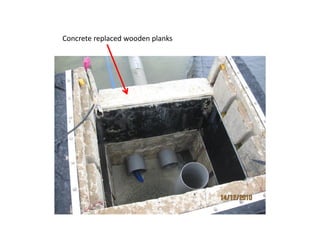
Concrete replaced wooden planks
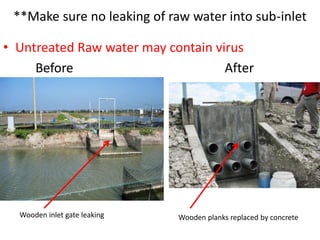
**Make sure no leaking of raw water into sub-inlet
• Untreated Raw water may contain virus
Before After
Wooden inlet gate leaking Wooden planks replaced by concrete
Water use strategies
1. Before stocking, water to be treated with active
chlorine at 30 ppm
2. DoC 1 to 45: only top up water in the ponds to
compensate for evaporation
3. DoC 46 to 90, minimal water exchange to the
ponds. Water has to be sterilised with active
chlorine at 30 ppm
4. Above DoC 90, use water that has passed
through filter of 250 microns (1mm = 1,000
microns)
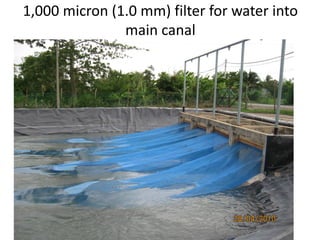
1,000 micron (1.0 mm) filter for water into
main canal
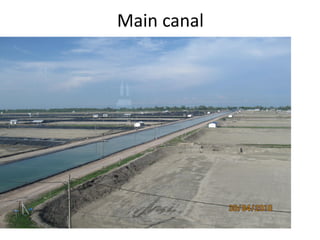
Main canal
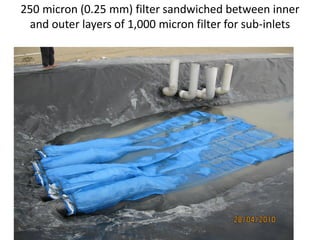
250 micron (0.25 mm) filter sandwiched between inner
and outer layers of 1,000 micron filter for sub-inlets
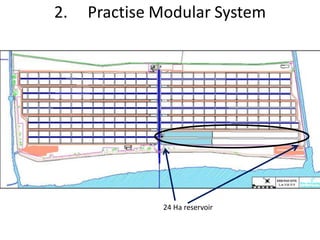
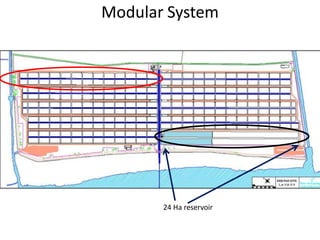
2. Practise Modular System
24 Ha reservoir
Modular System
24 Ha reservoir
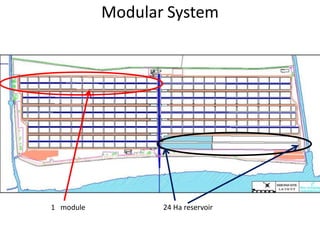
Modular System
24 Ha reservoir1 module
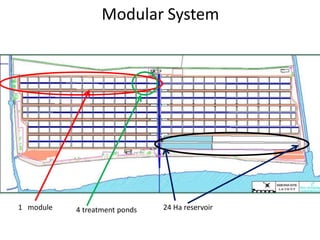
Modular System
24 Ha reservoir1 module 4 treatment ponds
Advantages of Modular System
1. All shrimp about the same age, easier to
manage feed and water exchange
2. Nearer transfer of equipment during harvest
3. Subinlet and suboutlet can be sterilised and
dried after harvest
Priority in Preventing Entry of
Pathogens
1. Treat Raw Water effectively and make sure no
leakages (An example of re-engineering a farm
to ensure biosecurity – Dr Nyan Taw’s work) &
water treatment strategies
2. Use Modular system for efficiency
3. Avoid entry of carriers especially crabs and wild
shrimp ( be careful of the main reservoir)
4. Use SPF or SPR postlarvae
5. Avoid contamination by human
6. Prevent spread and contamination by birds
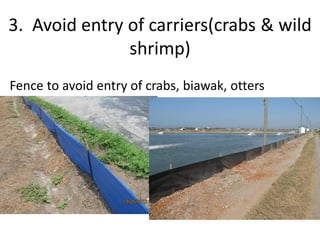
3. Avoid entry of carriers(crabs & wild
shrimp)
Fence to avoid entry of crabs, biawak, otters
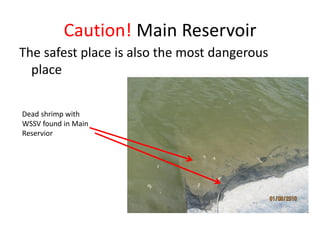
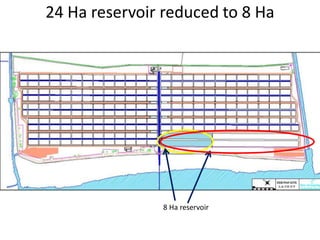
Caution! Main Reservoir
The safest place is also the most dangerous
place
Dead shrimp with
WSSV found in Main
Reservior
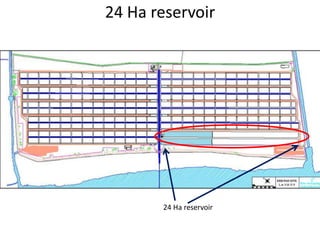
24 Ha reservoir
24 Ha reservoir
24 Ha reservoir reduced to 8 Ha
8 Ha reservoir
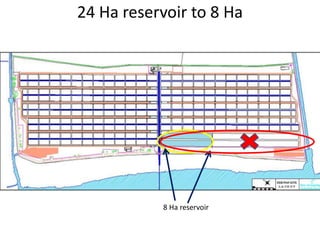
24 Ha reservoir to 8 Ha
8 Ha reservoir
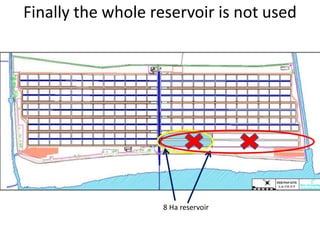
Finally the whole reservoir is not used
8 Ha reservoir
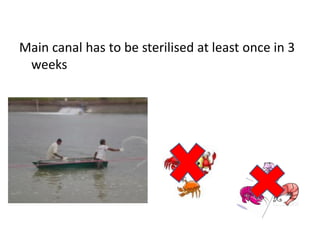
Main canal has to be sterilised at least once in 3
weeks
Priority in Preventing Entry of
Pathogens
1. Treat Raw Water effectively and make sure no
leakages (An example of re-engineering a farm
to ensure biosecurity – Dr Nyan Taw’s work) &
water treatment strategies
2. Use Modular system for efficiency
3. Avoid entry of carriers especially crabs and wild
shrimp ( be careful of the main reservoir)
4. Use SPF or SPR postlarvae
5. Avoid contamination by human
6. Prevent spread and contamination by birds
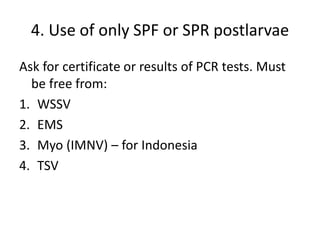
4. Use of only SPF or SPR postlarvae
Ask for certificate or results of PCR tests. Must
be free from:
1. WSSV
2. EMS
3. Myo (IMNV) – for Indonesia
4. TSV
Which one do you want?
This one?
Or This one?
Priority in Preventing Entry of
Pathogens
1. Treat Raw Water effectively and make sure no
leakages (An example of re-engineering a farm
to ensure biosecurity – Dr Nyan Taw’s work) &
water treatment strategies
2. Use Modular system for efficiency
3. Avoid entry of carriers especially crabs and wild
shrimp ( be careful of the main reservoir)
4. Use SPF or SPR postlarvae
5. Avoid contamination by human
6. Prevent spread and contamination by birds
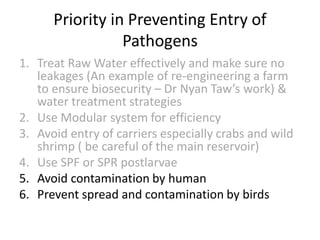
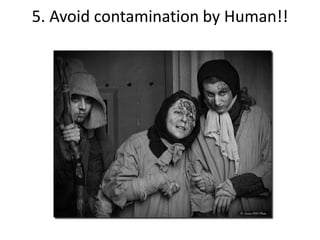
5. Avoid contamination by Human!!
Man is an important carrier!!
 Ban anyone to enter the farm if he has visited
another farm/hatchery/processing plant/fish
market in the last 3 days
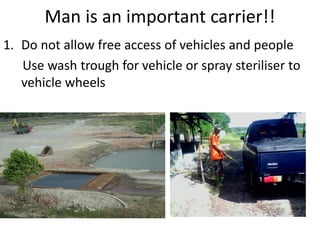
Man is an important carrier!!
1. Do not allow free access of vehicles and people
Use wash trough for vehicle or spray steriliser to
vehicle wheels
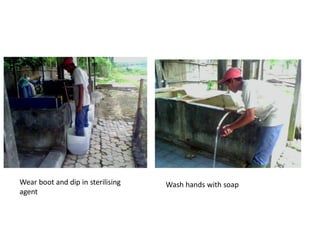
Wear boot and dip in sterilising
agent
Wash hands with soap
Priority in Preventing Entry of
Pathogens
1. Treat Raw Water effectively and make sure no
leakages (An example of re-engineering a farm
to ensure biosecurity – Dr Nyan Taw’s work) &
water treatment strategies
2. Use Modular system for efficiency
3. Avoid entry of carriers especially crabs and wild
shrimp ( be careful of the main reservoir)
4. Use SPF or SPR postlarvae
5. Avoid contamination by human
6. Prevent spread and contamination by birds
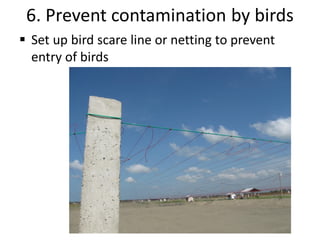
6. Prevent contamination by birds
 Set up bird scare line or netting to prevent
entry of birds
Control spread of
diseases to other ponds
Control Dissemination to other pond
1. Immediately seal off the infected pond
2. Quickly make decision to harvest or to
exterminate the pond (for WSSV)
If harvest, treat with Virkon at 1.5 ppm before
discharging the water OR
Cast net / drag net the pond without discharging
water and treat the remaining shrimp with 30
ppm active chlorine
3. Equipment used in must be sterilised
immediately
4. Workers must bathe with soap and clothings
rinsed in 30 ppm active chlorine immediately
after harvest near the infected pond
5. Any remaining dead shrimp must be
collected, dowsed with 100 ppm active
chlorine and buried
Bio security & Disiplin
Managing WSSV through Feeding Management
• In the zeal to speed up growth, there are
frequent overfeeding
• Overfeeding results in excessive organic matter
• Produces high ammonia, hydrogen sulphide and
carbon dioxide
• Encourages growth of pathogenic bacteria such
as vibrios
• Vibrios are known to be precursors of many
shrimp diseases such as WSSV, EMS, IMNV
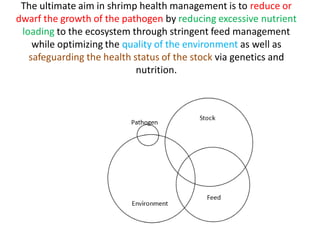
• Feed Management is the 4th dimension in
Disease Control in shrimp Farming
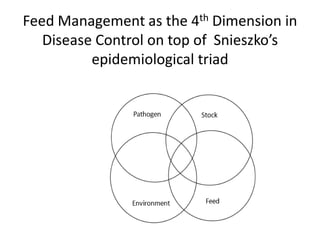
Feed Management as the 4th Dimension in
Disease Control on top of Snieszko’s
epidemiological triad
The ultimate aim in shrimp health management is to reduce or
dwarf the growth of the pathogen by reducing excessive nutrient
loading to the ecosystem through stringent feed management
while optimizing the quality of the environment as well as
safeguarding the health status of the stock via genetics and
nutrition.
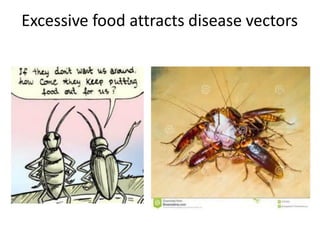
Excessive food attracts disease vectors
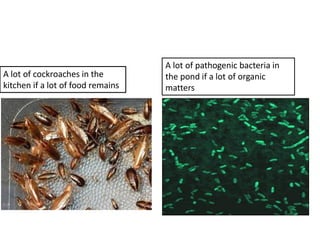
A lot of cockroaches in the
kitchen if a lot of food remains
A lot of pathogenic bacteria in
the pond if a lot of organic
matters
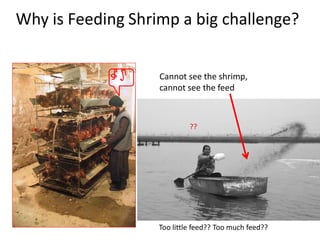
Why is Feeding Shrimp a big challenge?
Cannot see the shrimp,
cannot see the feed
Too little feed?? Too much feed??
??
Proper Feed Management is Important because:
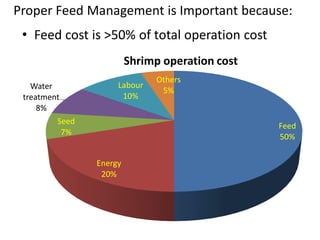
• Feed cost is >50% of total operation cost
Feed
50%
Energy
20%
Seed
7%
Water
treatment
8%
Labour
10%
Others
5%
Shrimp operation cost
If underfeeding……
Proper feed management is Important because:
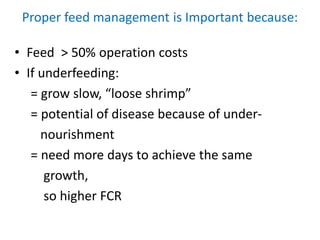
• Feed > 50% operation costs
• If underfeeding:
= grow slow, “loose shrimp”
= potential of disease because of under-
nourishment
= need more days to achieve the same
growth,
so higher FCR
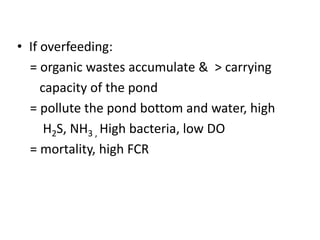
• If overfeeding:
= organic wastes accumulate & > carrying
capacity of the pond
= pollute the pond bottom and water, high
H2S, NH3 , High bacteria, low DO
= mortality, high FCR
Understanding Shrimp Feed
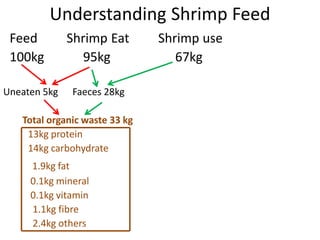
Feed Shrimp Eat Shrimp use
100kg 95kg 67kg
Uneaten 5kg Faeces 28kg
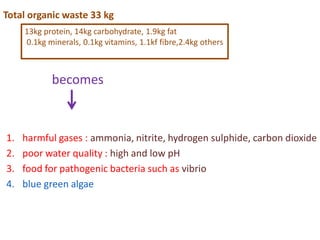
Total organic waste 33 kg
13kg protein
14kg carbohydrate
1.9kg fat
0.1kg mineral
0.1kg vitamin
1.1kg fibre
2.4kg others
Total organic waste 33 kg
becomes
1. harmful gases : ammonia, nitrite, hydrogen sulphide, carbon dioxide
2. poor water quality : high and low pH
3. food for pathogenic bacteria such as vibrio
4. blue green algae
13kg protein, 14kg carbohydrate, 1.9kg fat
0.1kg minerals, 0.1kg vitamins, 1.1kf fibre,2.4kg others
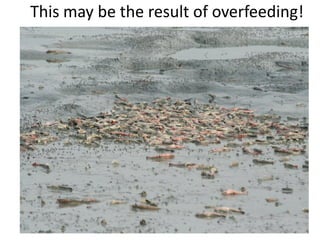
This may be the result of overfeeding!
Vannamei is a greedy eater
Vannamei eats more during hot weather
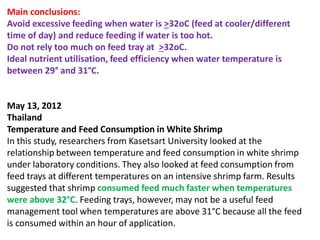
Main conclusions:
Avoid excessive feeding when water is >32oC (feed at cooler/different
time of day) and reduce feeding if water is too hot.
Do not rely too much on feed tray at >32oC.
Ideal nutrient utilisation, feed efficiency when water temperature is
between 29° and 31°C.
May 13, 2012
Thailand
Temperature and Feed Consumption in White Shrimp
In this study, researchers from Kasetsart University looked at the
relationship between temperature and feed consumption in white shrimp
under laboratory conditions. They also looked at feed consumption from
feed trays at different temperatures on an intensive shrimp farm. Results
suggested that shrimp consumed feed much faster when temperatures
were above 32°C. Feeding trays, however, may not be a useful feed
management tool when temperatures are above 31°C because all the feed
is consumed within an hour of application.
Temperature and Feed Management
• Use 300 C as standard for
checking tray if water
temperature is above 300 C
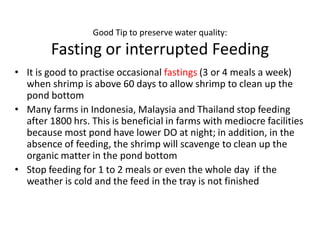
Good Tip to preserve water quality:
Fasting or interrupted Feeding
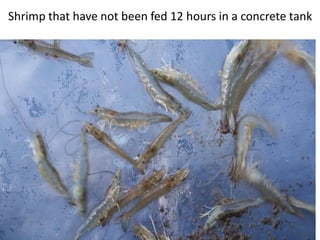
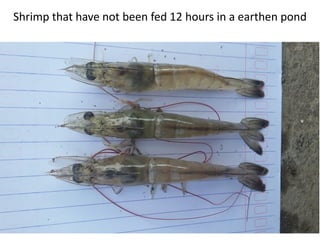
• It is good to practise occasional fastings (3 or 4 meals a week)
when shrimp is above 60 days to allow shrimp to clean up the
pond bottom
• Many farms in Indonesia, Malaysia and Thailand stop feeding
after 1800 hrs. This is beneficial in farms with mediocre facilities
because most pond have lower DO at night; in addition, in the
absence of feeding, the shrimp will scavenge to clean up the
organic matter in the pond bottom
• Stop feeding for 1 to 2 meals or even the whole day if the
weather is cold and the feed in the tray is not finished
Shrimp that have not been fed 12 hours in a concrete tank
Shrimp that have not been fed 12 hours in a earthen pond
Take Home Message:
• Overfeeding is the main cause for poor water
quality and diseases in shrimp farming
• Feed the shrimp 90% satiated for safe
farming
• Occasional fasting when shrimp appetite is
poor is BENEFICIAL
Thank You
a

Disease control with reference to white spot disease

  • 1.
    AQUA GROUP GOLDCOIN Disease Control with particular reference to White Spot Disease . Poh Yong Thong 2 Feb 2016 Chilaw, Sri Lanka
  • 2.
  • 3.
    And laughing allthe way to the bank….
  • 4.
    Nobody wants tohave heartaches like this………
  • 5.
  • 6.
    White Spot SyndromeVirus (WSSV) SYMPTOMS : Parking along the bunds , swim near the surface Reduced feed intake White spots Reddish cuticle Trigger: Cold weather with temperature below 260C PL below 45 days are more susceptible Usually results in mass mortality within days
  • 7.
    How Does WSSVSpread? Vertical: Attached to the egg wall Egg Disinfection in the hatchery Horizontal: CARRIER : wild shrimp, crabs, copepods Water : The virus particles can live up to 3 to 4 days in water Cannibalism: 1 ------> 10 ------> 100 -----> 1000 10x 10x 10x
  • 8.
    Viability of WSSVvirus particles after leaving hosts When the host dies, the virus leaves the host (analogous to a ship wreck with people swimming for survival) WSSV particles can live up to 3 days outside of host, free swimming in water looking for new hosts Wow…wow…. Where are you mama…. Virus particles looking for “mama”
  • 9.
    Basics for AquacultureSuccess • Suitable water free of pollution • Clean pond bottom • Motivated people • Quality PL • Strict Biosecurity • Quality feed and Superb Feed Management • Suitable weather • Understanding of Carrying Capacity
  • 10.
    Basics for AquacultureSuccess • Suitable water free of pollution • Clean pond bottom • Motivated people • Quality PL • Understanding of Carrying Capacity • Strict Biosecurity • Quality feed and Superb Feed Management • Suitable weather
  • 11.
    Understanding of CarryingCapacity • Different ponds have different carrying capacity • Concrete & HDPE lined > Earthen pond on hard earth > earthen pond on mud • New pond > old pond • 20 aerators > 15 aerators > 10 aerators > 5 aerators • New pond can harvest 1,000 kg/Hp • Average 500 kg/Hp • Old pond < 350 kg/Hp • When the carrying capacity is reached, it is better to partial or total harvest the pond
  • 14.
    What is Biosecurity? Biosecurityis the implementation of measures to: a) Avoid the entrance of infection into the farm b) Control the dissemination of an infection if one does enter the farm c) Avoid spreading an infection to other farms.
  • 15.
  • 16.
    Priority in PreventingEntry of Pathogens 1. Treat Raw Water effectively and make sure no leakages (An example of re-engineering a farm to ensure biosecurity – Dr Nyan Taw’s work) & water treatment strategies 2. Avoid entry of carriers especially crabs & wild shrimp ( be careful of the main reservoir) 3. Use SPF or SPR postlarvae 4. Avoid contamination by human 5. Prevent spread and contamination by birds
  • 17.
    1. Active chlorineat minimum 30 ppm or 2. Crustacide and then tea seed cake 3. Crustacides: Dichlorvos 50% = FOS 500 at 2 ppm Trichlorfon 97% = Dipterex/Synterex/Neguvon at 0.5 to 1 ppm 4. Water must be mixed well by sufficient number of paddlewheels 1. Treat Raw water Effectively Treatment yg Effective Membersihkan dasar
  • 18.
    **Make sure noleaking of raw water into pond (Dr. Nyan Taw) • Untreated Raw water may contain virus Before After Wooden outlet gate leaking Wooden planks replaced by concrete
  • 19.
  • 20.
    **Make sure noleaking of raw water into sub-inlet • Untreated Raw water may contain virus Before After Wooden inlet gate leaking Wooden planks replaced by concrete
  • 21.
    Water use strategies 1.Before stocking, water to be treated with active chlorine at 30 ppm 2. DoC 1 to 45: only top up water in the ponds to compensate for evaporation 3. DoC 46 to 90, minimal water exchange to the ponds. Water has to be sterilised with active chlorine at 30 ppm 4. Above DoC 90, use water that has passed through filter of 250 microns (1mm = 1,000 microns)
  • 22.
    1,000 micron (1.0mm) filter for water into main canal
  • 23.
  • 24.
    250 micron (0.25mm) filter sandwiched between inner and outer layers of 1,000 micron filter for sub-inlets
  • 25.
    2. Practise ModularSystem 24 Ha reservoir
  • 26.
  • 27.
    Modular System 24 Hareservoir1 module
  • 28.
    Modular System 24 Hareservoir1 module 4 treatment ponds
  • 29.
    Advantages of ModularSystem 1. All shrimp about the same age, easier to manage feed and water exchange 2. Nearer transfer of equipment during harvest 3. Subinlet and suboutlet can be sterilised and dried after harvest
  • 30.
    Priority in PreventingEntry of Pathogens 1. Treat Raw Water effectively and make sure no leakages (An example of re-engineering a farm to ensure biosecurity – Dr Nyan Taw’s work) & water treatment strategies 2. Use Modular system for efficiency 3. Avoid entry of carriers especially crabs and wild shrimp ( be careful of the main reservoir) 4. Use SPF or SPR postlarvae 5. Avoid contamination by human 6. Prevent spread and contamination by birds
  • 31.
    3. Avoid entryof carriers(crabs & wild shrimp) Fence to avoid entry of crabs, biawak, otters
  • 32.
    Caution! Main Reservoir Thesafest place is also the most dangerous place Dead shrimp with WSSV found in Main Reservior
  • 34.
    24 Ha reservoir 24Ha reservoir
  • 35.
    24 Ha reservoirreduced to 8 Ha 8 Ha reservoir
  • 36.
    24 Ha reservoirto 8 Ha 8 Ha reservoir
  • 37.
    Finally the wholereservoir is not used 8 Ha reservoir
  • 38.
    Main canal hasto be sterilised at least once in 3 weeks
  • 40.
    Priority in PreventingEntry of Pathogens 1. Treat Raw Water effectively and make sure no leakages (An example of re-engineering a farm to ensure biosecurity – Dr Nyan Taw’s work) & water treatment strategies 2. Use Modular system for efficiency 3. Avoid entry of carriers especially crabs and wild shrimp ( be careful of the main reservoir) 4. Use SPF or SPR postlarvae 5. Avoid contamination by human 6. Prevent spread and contamination by birds
  • 41.
    4. Use ofonly SPF or SPR postlarvae Ask for certificate or results of PCR tests. Must be free from: 1. WSSV 2. EMS 3. Myo (IMNV) – for Indonesia 4. TSV
  • 42.
    Which one doyou want?
  • 43.
  • 44.
  • 45.
    Priority in PreventingEntry of Pathogens 1. Treat Raw Water effectively and make sure no leakages (An example of re-engineering a farm to ensure biosecurity – Dr Nyan Taw’s work) & water treatment strategies 2. Use Modular system for efficiency 3. Avoid entry of carriers especially crabs and wild shrimp ( be careful of the main reservoir) 4. Use SPF or SPR postlarvae 5. Avoid contamination by human 6. Prevent spread and contamination by birds
  • 46.
  • 47.
    Man is animportant carrier!!
  • 48.
    Man is animportant carrier!!  Ban anyone to enter the farm if he has visited another farm/hatchery/processing plant/fish market in the last 3 days
  • 49.
    Man is animportant carrier!! 1. Do not allow free access of vehicles and people Use wash trough for vehicle or spray steriliser to vehicle wheels
  • 50.
    Wear boot anddip in sterilising agent Wash hands with soap
  • 51.
    Priority in PreventingEntry of Pathogens 1. Treat Raw Water effectively and make sure no leakages (An example of re-engineering a farm to ensure biosecurity – Dr Nyan Taw’s work) & water treatment strategies 2. Use Modular system for efficiency 3. Avoid entry of carriers especially crabs and wild shrimp ( be careful of the main reservoir) 4. Use SPF or SPR postlarvae 5. Avoid contamination by human 6. Prevent spread and contamination by birds
  • 52.
    6. Prevent contaminationby birds  Set up bird scare line or netting to prevent entry of birds
  • 53.
  • 54.
    Control Dissemination toother pond 1. Immediately seal off the infected pond 2. Quickly make decision to harvest or to exterminate the pond (for WSSV) If harvest, treat with Virkon at 1.5 ppm before discharging the water OR Cast net / drag net the pond without discharging water and treat the remaining shrimp with 30 ppm active chlorine 3. Equipment used in must be sterilised immediately
  • 55.
    4. Workers mustbathe with soap and clothings rinsed in 30 ppm active chlorine immediately after harvest near the infected pond 5. Any remaining dead shrimp must be collected, dowsed with 100 ppm active chlorine and buried
  • 56.
  • 57.
    Managing WSSV throughFeeding Management • In the zeal to speed up growth, there are frequent overfeeding • Overfeeding results in excessive organic matter • Produces high ammonia, hydrogen sulphide and carbon dioxide • Encourages growth of pathogenic bacteria such as vibrios • Vibrios are known to be precursors of many shrimp diseases such as WSSV, EMS, IMNV • Feed Management is the 4th dimension in Disease Control in shrimp Farming
  • 58.
    Feed Management asthe 4th Dimension in Disease Control on top of Snieszko’s epidemiological triad
  • 59.
    The ultimate aimin shrimp health management is to reduce or dwarf the growth of the pathogen by reducing excessive nutrient loading to the ecosystem through stringent feed management while optimizing the quality of the environment as well as safeguarding the health status of the stock via genetics and nutrition.
  • 60.
    Excessive food attractsdisease vectors
  • 61.
    A lot ofcockroaches in the kitchen if a lot of food remains A lot of pathogenic bacteria in the pond if a lot of organic matters
  • 62.
    Why is FeedingShrimp a big challenge? Cannot see the shrimp, cannot see the feed Too little feed?? Too much feed?? ??
  • 63.
    Proper Feed Managementis Important because: • Feed cost is >50% of total operation cost Feed 50% Energy 20% Seed 7% Water treatment 8% Labour 10% Others 5% Shrimp operation cost
  • 64.
  • 65.
    Proper feed managementis Important because: • Feed > 50% operation costs • If underfeeding: = grow slow, “loose shrimp” = potential of disease because of under- nourishment = need more days to achieve the same growth, so higher FCR
  • 66.
    • If overfeeding: =organic wastes accumulate & > carrying capacity of the pond = pollute the pond bottom and water, high H2S, NH3 , High bacteria, low DO = mortality, high FCR
  • 67.
    Understanding Shrimp Feed FeedShrimp Eat Shrimp use 100kg 95kg 67kg Uneaten 5kg Faeces 28kg Total organic waste 33 kg 13kg protein 14kg carbohydrate 1.9kg fat 0.1kg mineral 0.1kg vitamin 1.1kg fibre 2.4kg others
  • 68.
    Total organic waste33 kg becomes 1. harmful gases : ammonia, nitrite, hydrogen sulphide, carbon dioxide 2. poor water quality : high and low pH 3. food for pathogenic bacteria such as vibrio 4. blue green algae 13kg protein, 14kg carbohydrate, 1.9kg fat 0.1kg minerals, 0.1kg vitamins, 1.1kf fibre,2.4kg others
  • 69.
    This may bethe result of overfeeding!
  • 70.
    Vannamei is agreedy eater Vannamei eats more during hot weather
  • 71.
    Main conclusions: Avoid excessivefeeding when water is >32oC (feed at cooler/different time of day) and reduce feeding if water is too hot. Do not rely too much on feed tray at >32oC. Ideal nutrient utilisation, feed efficiency when water temperature is between 29° and 31°C. May 13, 2012 Thailand Temperature and Feed Consumption in White Shrimp In this study, researchers from Kasetsart University looked at the relationship between temperature and feed consumption in white shrimp under laboratory conditions. They also looked at feed consumption from feed trays at different temperatures on an intensive shrimp farm. Results suggested that shrimp consumed feed much faster when temperatures were above 32°C. Feeding trays, however, may not be a useful feed management tool when temperatures are above 31°C because all the feed is consumed within an hour of application.
  • 72.
    Temperature and FeedManagement • Use 300 C as standard for checking tray if water temperature is above 300 C
  • 73.
    Good Tip topreserve water quality: Fasting or interrupted Feeding • It is good to practise occasional fastings (3 or 4 meals a week) when shrimp is above 60 days to allow shrimp to clean up the pond bottom • Many farms in Indonesia, Malaysia and Thailand stop feeding after 1800 hrs. This is beneficial in farms with mediocre facilities because most pond have lower DO at night; in addition, in the absence of feeding, the shrimp will scavenge to clean up the organic matter in the pond bottom • Stop feeding for 1 to 2 meals or even the whole day if the weather is cold and the feed in the tray is not finished
  • 74.
    Shrimp that havenot been fed 12 hours in a concrete tank
  • 75.
    Shrimp that havenot been fed 12 hours in a earthen pond
  • 76.
    Take Home Message: •Overfeeding is the main cause for poor water quality and diseases in shrimp farming • Feed the shrimp 90% satiated for safe farming • Occasional fasting when shrimp appetite is poor is BENEFICIAL
  • 77.