LEADING PRODUCTIVITY
& INNOVATION
OBJECTIVES
1. Define productivity;
2. Determine the sources of productivity
slowdown; and
3. Identify some tips on how to achieve
success and development.
The COVID-19 pandemic has plunged the global
economy into its deepest recession since the Second World War.
Per capita incomes are expected to decline in about 90 percent of
countries in 2020, the largest fraction in recorded economic
history, and many millions will be tipped into poverty (World Bank
2020a).
The pandemic is also likely to leave lasting scars through
multiple channels, including lower investment, erosion of human
capital because of unemployment and loss of schooling, and a
possible retreat from global trade and supply linkages. These
effects may lower productivity and limit the ability of economies to
generate growth of real incomes in the long-term.
WHAT IS MEANT BY
PRODUCTIVITY?
The ratio between Output volume and Input
volume; GDP per hour worked.
Multifactor Productivity (MFP) – The relative
measure of the efficiency of a person, machine,
factory, system, etc. in converting inputs into useful
outputs. Computed by dividing the average output per
period by the total costs incurred or resources (capital,
energy, material, personnel) consumed in that period.
SOURCES OF THE
PRODUCTIVITY SLOWDOWN
 Weakening fundamental drivers of productivity growth
Working-age population growth has decelerated,
educational attainment has stabilized, and the pace of expansion
into more diverse and complex forms of production has lost
momentum as the growth of global value chains stalled. A new
finding is the increasing importance over time of economic
complexity, urbanization, and innovation, as well as demographic
factors, and that many drivers of productivity have been stabilizing
or declining over time.
 Slowing reallocation within and between sectors
At the sectoral level, labor reallocation toward
higher-productivity sectors has historically accounted
for about two-fifths of overall productivity growth in
EMDEs. This mechanism of structural change has also
weakened since the global financial crisis. Fading
productivity gains from labor reallocation have
accounted for about one-third of the post-crisis
productivity slowdown in EMDEs.
SOURCES OF THE
PRODUCTIVITY SLOWDOWN
 Adverse shocks to productivity growth
Natural disasters, wars, and major economic
disruptions such as financial crises and deep
recessions tend to be accompanied by a large and
protracted decline in labor productivity. Natural
disasters—70 percent of which are climate-related—
account for the vast majority of these adverse events.
SOURCES OF THE
PRODUCTIVITY SLOWDOWN
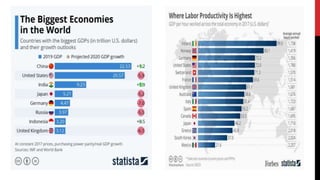
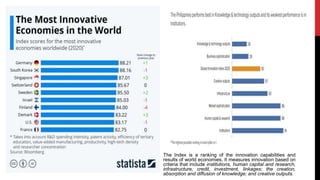
The Index is a ranking of the innovation capabilities and
results of world economies. It measures innovation based on
criteria that include institutions, human capital and research,
infrastructure, credit, investment, linkages; the creation,
absorption and diffusion of knowledge; and creative outputs.
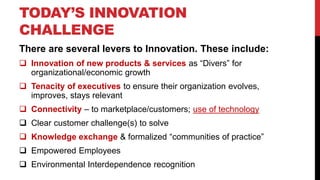
TODAY’S INNOVATION
CHALLENGE
There are several levers to Innovation. These include:
 Innovation of new products & services as “Divers” for
organizational/economic growth
 Tenacity of executives to ensure their organization evolves,
improves, stays relevant
 Connectivity – to marketplace/customers; use of technology
 Clear customer challenge(s) to solve
 Knowledge exchange & formalized “communities of practice”
 Empowered Employees
 Environmental Interdependence recognition
Innovation takes creative ideas and mobilizes them into
tangible products or services that have concrete economic benefit
and enhanced value. Having attended and been a part of various
panels on innovation over many years, one true-ism gets
constantly repeated.
Improving productivity and innovation is the result of
several efforts that executives must orchestrate together. And, it is
crucial to understand that many of the mechanisms for improving
productivity must be applied within an overall context for where the
organization is headed, how it will measure success, and the main
priorities within always a resource-constrained environment.
RECIPES FOR SUCCESS!
 Start with Clear and Compelling Vision
Coming out of the recession, many employees are weary, nervous
and anxious. They are overwhelmed by personal realities and besieged by
media messages of problems and concerns. Individually perhaps, you will
likely need to check-in with each person that report to you and understand
their challenges. Collectively you will need to find a way to inspire them and
energize them for when they come to work! Reinforce the value of what they
do and real impact of what the organization aspires to achieve.
People thirst for Vision and to be energized. Executives must pump
it up in post
RECIPES FOR SUCCESS!
 Enunciate and hold people Accountable towards
Outcomes Measures of Success
How do you achieve something significant and
yet a bit of a stretch? You break it down. You focus on
the priorities. And, you must push out the distractions
that can cause you to get way-laid. Some clear goals,
accompanied by a few key measures of success are
really important.
RECIPES FOR SUCCESS!
 Foster Individual Motivation and Commitment to
Personal Productivity
This is where it all starts! Our people just have to understand:
what does a productive 8hr day look like in action? As basic as it may
seem, this is a topic worthy of team discussion and perhaps even some
individual coaching. Downsizing of an organization creates both loss of
friends, and then seemingly overloads the remaining employees with all
the responsibilities left over. Executives have to be present and have to
facilitate an exploration of how you are going to do the same with less, or
do more with the same, or even do more with less.
RECIPES FOR SUCCESS!
Enhance the Flow of Information and
Proactive Communication/Collaboration
to Enhance Creativity
Clarity of “customer challenge” context, priorities and
reinforcement of success is all enhanced by ensuring information
is spread throughout the organization in a variety of forms that
address different learning/communication styles. This includes:
email, video, coffee chats, staff meetings, discussions, customer
presentations. But what is your culture of sharing information
within the organization and proactive thinking about and initiating
collaboration and communication?
RECIPES FOR SUCCESS!
 Enhance the Flow of Information and Proactive
Communication/Collaboration to Enhance
Creativity
If you want your employees to be “partners” in the organization’s
success, then you need to teach them the business of the organization. Share
monthly or quarterly financial and operational reports – then discuss what this
means. Engage ideas and suggestions from amongst employees of all levels.
Bring the front-line impact of our business into a ‘real’ perspective. Bring
customers and their challenges/feedback to the employees – either by in-person
sessions or by video, or take some out into the customer sites. Show employees
what their total all-in cost to the organization is, and how this is funded through
sales, grants, etc. Draw the connections. Then get explicit about the expectations
for communication and collaboration. Set examples, reward those who take such
initiative and build new heroes around this behavior.
RECIPES FOR SUCCESS!
 Develop the Appropriate Organizational Design
One of the most ‘sluggish’ aspects in organizations undergoing
change, is their ability to redesign workflow, to re-think and re-model
which key resources will be responsible for what. Particularly in
circumstances where there have been layoffs or where there are
severe resources constraints but expectations for enhanced
output/impact, then organizational design and development (OD) is a
critical executive skill to apply.
In fast changing and fast growth organizations, often the org.
chart and job descriptions need adjustment annually – not because
management doesn’t know what they are doing – but in order to be
sensitive and adaptive to the changing circumstances and/or
expectations of clients
RECIPES FOR SUCCESS!
 Drive-up Innovation – Appropriately
So what do we mean by innovation as it relates to
improved productivity?
Productivity and Innovation are invariably seen as two
sides of the same coin, and yet there are so many different kinds
of innovation and interpretations of the connection. Remembering
the different types of Innovation from above, think about what type
of Innovation is most appropriate for your organization. Be sure
you explain this to your team members so their approach to
innovation can be appropriately focused.
RECIPES FOR SUCCESS!
 Ensure Technology Integration & Business Processes
Improvement support Goals
The executives spend a great deal of time and effort developing
Vision, Values, Goals & Measures, then off-load the technology and business
process re-alignment to lower level managers or external resources. It seems
as though there is little appreciation for just how critical these aspects are to
the actual implementation of new practices and achievements of the goals.
So, what is your technology strategy in support of the achievement
of your organizational goals? Or, is everyone chasing adaptations to deal
with systems that cause you to do things in a manner inconsistent with your
goals and priorities? Seriously, things have to just work! And, the systems
must support collaboration, knowledge exchange, networks of formal and
non-formal work associates, partners and clients.
RECIPES FOR SUCCESS!
 Train employees, managers, leaders in application of
new technology & processes
With so much of our work tied into technology – be it laptops or
more powerful specialty applications – the training of our staff on the use
and application of technology is a clear necessity. As a reminder, there is a
BIG difference between training on ‘how to make the software work”, versus
“how to advance the business through effective use of the software &
technology”. Employees need both types of training.
In addition, employees often need some training on how to
effectively collaborate, the change process, high performance teams,
leadership and more. Also, they need time and space to share their
insights, ‘tricks and tips’, and explore together new approaches with the
technology.
REFERENCES
https://scholar.harvard.edu/files/jorgenson/files/34_innovation_and_p
roduction_growth.pdf
https://www.nber.org/system/files/working_papers/w28076/w28076.p
df
https://www.nber.org/system/files/working_papers/w24420/w24420.p
df
https://www.cmc-global.org/content/leading-productivity-innovation-
%E2%80%93-2-sides-same-coin
https://www.worldbank.org/en/topic/competitiveness/brief/the-world-
bank-productivity-project
PhDDS 317: Development and Management
of Innovative Programs
2nd Semester, AY 2020-2021
Rosanna D. Gonzales, PhD
Professor
Raymart R. Cabilangan
PhD Student in Development Studies

Discussion report on productivity

  • 1.
  • 2.
    OBJECTIVES 1. Define productivity; 2.Determine the sources of productivity slowdown; and 3. Identify some tips on how to achieve success and development.
  • 3.
    The COVID-19 pandemichas plunged the global economy into its deepest recession since the Second World War. Per capita incomes are expected to decline in about 90 percent of countries in 2020, the largest fraction in recorded economic history, and many millions will be tipped into poverty (World Bank 2020a). The pandemic is also likely to leave lasting scars through multiple channels, including lower investment, erosion of human capital because of unemployment and loss of schooling, and a possible retreat from global trade and supply linkages. These effects may lower productivity and limit the ability of economies to generate growth of real incomes in the long-term.
  • 4.
    WHAT IS MEANTBY PRODUCTIVITY? The ratio between Output volume and Input volume; GDP per hour worked. Multifactor Productivity (MFP) – The relative measure of the efficiency of a person, machine, factory, system, etc. in converting inputs into useful outputs. Computed by dividing the average output per period by the total costs incurred or resources (capital, energy, material, personnel) consumed in that period.
  • 6.
    SOURCES OF THE PRODUCTIVITYSLOWDOWN  Weakening fundamental drivers of productivity growth Working-age population growth has decelerated, educational attainment has stabilized, and the pace of expansion into more diverse and complex forms of production has lost momentum as the growth of global value chains stalled. A new finding is the increasing importance over time of economic complexity, urbanization, and innovation, as well as demographic factors, and that many drivers of productivity have been stabilizing or declining over time.
  • 7.
     Slowing reallocationwithin and between sectors At the sectoral level, labor reallocation toward higher-productivity sectors has historically accounted for about two-fifths of overall productivity growth in EMDEs. This mechanism of structural change has also weakened since the global financial crisis. Fading productivity gains from labor reallocation have accounted for about one-third of the post-crisis productivity slowdown in EMDEs. SOURCES OF THE PRODUCTIVITY SLOWDOWN
  • 8.
     Adverse shocksto productivity growth Natural disasters, wars, and major economic disruptions such as financial crises and deep recessions tend to be accompanied by a large and protracted decline in labor productivity. Natural disasters—70 percent of which are climate-related— account for the vast majority of these adverse events. SOURCES OF THE PRODUCTIVITY SLOWDOWN
  • 9.
    The Index isa ranking of the innovation capabilities and results of world economies. It measures innovation based on criteria that include institutions, human capital and research, infrastructure, credit, investment, linkages; the creation, absorption and diffusion of knowledge; and creative outputs.
  • 10.
    TODAY’S INNOVATION CHALLENGE There areseveral levers to Innovation. These include:  Innovation of new products & services as “Divers” for organizational/economic growth  Tenacity of executives to ensure their organization evolves, improves, stays relevant  Connectivity – to marketplace/customers; use of technology  Clear customer challenge(s) to solve  Knowledge exchange & formalized “communities of practice”  Empowered Employees  Environmental Interdependence recognition
  • 11.
    Innovation takes creativeideas and mobilizes them into tangible products or services that have concrete economic benefit and enhanced value. Having attended and been a part of various panels on innovation over many years, one true-ism gets constantly repeated. Improving productivity and innovation is the result of several efforts that executives must orchestrate together. And, it is crucial to understand that many of the mechanisms for improving productivity must be applied within an overall context for where the organization is headed, how it will measure success, and the main priorities within always a resource-constrained environment.
  • 12.
    RECIPES FOR SUCCESS! Start with Clear and Compelling Vision Coming out of the recession, many employees are weary, nervous and anxious. They are overwhelmed by personal realities and besieged by media messages of problems and concerns. Individually perhaps, you will likely need to check-in with each person that report to you and understand their challenges. Collectively you will need to find a way to inspire them and energize them for when they come to work! Reinforce the value of what they do and real impact of what the organization aspires to achieve. People thirst for Vision and to be energized. Executives must pump it up in post
  • 13.
    RECIPES FOR SUCCESS! Enunciate and hold people Accountable towards Outcomes Measures of Success How do you achieve something significant and yet a bit of a stretch? You break it down. You focus on the priorities. And, you must push out the distractions that can cause you to get way-laid. Some clear goals, accompanied by a few key measures of success are really important.
  • 14.
    RECIPES FOR SUCCESS! Foster Individual Motivation and Commitment to Personal Productivity This is where it all starts! Our people just have to understand: what does a productive 8hr day look like in action? As basic as it may seem, this is a topic worthy of team discussion and perhaps even some individual coaching. Downsizing of an organization creates both loss of friends, and then seemingly overloads the remaining employees with all the responsibilities left over. Executives have to be present and have to facilitate an exploration of how you are going to do the same with less, or do more with the same, or even do more with less.
  • 15.
    RECIPES FOR SUCCESS! Enhancethe Flow of Information and Proactive Communication/Collaboration to Enhance Creativity Clarity of “customer challenge” context, priorities and reinforcement of success is all enhanced by ensuring information is spread throughout the organization in a variety of forms that address different learning/communication styles. This includes: email, video, coffee chats, staff meetings, discussions, customer presentations. But what is your culture of sharing information within the organization and proactive thinking about and initiating collaboration and communication?
  • 16.
    RECIPES FOR SUCCESS! Enhance the Flow of Information and Proactive Communication/Collaboration to Enhance Creativity If you want your employees to be “partners” in the organization’s success, then you need to teach them the business of the organization. Share monthly or quarterly financial and operational reports – then discuss what this means. Engage ideas and suggestions from amongst employees of all levels. Bring the front-line impact of our business into a ‘real’ perspective. Bring customers and their challenges/feedback to the employees – either by in-person sessions or by video, or take some out into the customer sites. Show employees what their total all-in cost to the organization is, and how this is funded through sales, grants, etc. Draw the connections. Then get explicit about the expectations for communication and collaboration. Set examples, reward those who take such initiative and build new heroes around this behavior.
  • 17.
    RECIPES FOR SUCCESS! Develop the Appropriate Organizational Design One of the most ‘sluggish’ aspects in organizations undergoing change, is their ability to redesign workflow, to re-think and re-model which key resources will be responsible for what. Particularly in circumstances where there have been layoffs or where there are severe resources constraints but expectations for enhanced output/impact, then organizational design and development (OD) is a critical executive skill to apply. In fast changing and fast growth organizations, often the org. chart and job descriptions need adjustment annually – not because management doesn’t know what they are doing – but in order to be sensitive and adaptive to the changing circumstances and/or expectations of clients
  • 18.
    RECIPES FOR SUCCESS! Drive-up Innovation – Appropriately So what do we mean by innovation as it relates to improved productivity? Productivity and Innovation are invariably seen as two sides of the same coin, and yet there are so many different kinds of innovation and interpretations of the connection. Remembering the different types of Innovation from above, think about what type of Innovation is most appropriate for your organization. Be sure you explain this to your team members so their approach to innovation can be appropriately focused.
  • 19.
    RECIPES FOR SUCCESS! Ensure Technology Integration & Business Processes Improvement support Goals The executives spend a great deal of time and effort developing Vision, Values, Goals & Measures, then off-load the technology and business process re-alignment to lower level managers or external resources. It seems as though there is little appreciation for just how critical these aspects are to the actual implementation of new practices and achievements of the goals. So, what is your technology strategy in support of the achievement of your organizational goals? Or, is everyone chasing adaptations to deal with systems that cause you to do things in a manner inconsistent with your goals and priorities? Seriously, things have to just work! And, the systems must support collaboration, knowledge exchange, networks of formal and non-formal work associates, partners and clients.
  • 20.
    RECIPES FOR SUCCESS! Train employees, managers, leaders in application of new technology & processes With so much of our work tied into technology – be it laptops or more powerful specialty applications – the training of our staff on the use and application of technology is a clear necessity. As a reminder, there is a BIG difference between training on ‘how to make the software work”, versus “how to advance the business through effective use of the software & technology”. Employees need both types of training. In addition, employees often need some training on how to effectively collaborate, the change process, high performance teams, leadership and more. Also, they need time and space to share their insights, ‘tricks and tips’, and explore together new approaches with the technology.
  • 21.
  • 22.
    PhDDS 317: Developmentand Management of Innovative Programs 2nd Semester, AY 2020-2021 Rosanna D. Gonzales, PhD Professor Raymart R. Cabilangan PhD Student in Development Studies