Avoiding claims of discriminationby Fluid June 2010
Page 2Contents3-4 		Introduction to Fluid5-6		Legal considerations7-8		Discrimination Law Review-green paper9-10		Acknowledgement of bias11-12	Exercise A13-14	Ageism15-25	Disability26-27	Dyslexia28-29	Gender30-31	Race32-33	Religion34-35	Sexual orientation36-37	Smoking38-39	National Dismissal Register40-41	As a victim of discrimination42-43	Yes or no quiz44-48	Equality Act49-50	Case studies51-52	Exercise B53-54	Conclusion and questions
Page 3Introduction
Page 4Introduction to FluidFluid Consulting Limited (Fluid) is a specialist human resources consultancy headed by Tim Holden MCIPD 10 years in banking10 years in Human Resources consultancyFluid trading since 2006The core services provided by Fluid are:Retention
Selection-  Attraction-  Remuneration & Reward -  Outplacement-  Training & HR consultancy
Page 5Legal considerations
Page 6Legal considerationsLegislation
Types of discrimination
Direct discrimination
Harassment and segregation
Indirect discrimination
Victimisation
Genuine Occupational Requirement
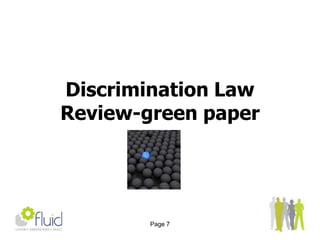
Cost of discriminationPage 7Discrimination Law Review-green paper
Page 8Discrimination Law Review-green paperIntroduce an equal pay moratorium where employers carry out pay audits and have a set period free from legal challenge within which to identify any inequalities identified
Develop an ‘equality check tool’ for employers to use, as recommended by the Women and Work Commission
Consider introducing a voluntary equality standard scheme, which could be an independently assessed, accredited standard
Important role for the Commission for Equality and Human Rights to develop positive action guidance
Extending positive duties in the public sector to cover all grounds of discriminationPage 9Acknowledgement of bias
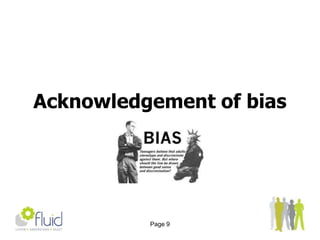
Page 10Need to accept we are biased; without this recognition there can be no progress
Need to understand what biases we really have.
Need to be able to discuss these biases with each other-need to ensure we challenge each other and remain vigilant and alert, not only to our biases but to those of others around usAcknowledgement of bias
Page 11Exercise A
Page 12Exercise A
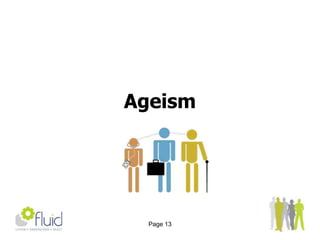
Page 13Ageism
Page 14AgeismTreating people differently on the grounds of age will be direct discrimination unless it can be justified objectively
To prove ‘objective justification’ employers have to show their discriminatory actions were a ‘proportionate means of achieving a legitimate aim’
Employers concerned about discrimination should identify what they want to achieve, come up with proposals, consult with stakeholders, consider alternatives and take reasonable action
Employers can safely retire employees at 65, if they follow the retirement proceduresPage 15Disability
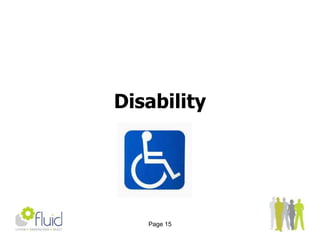
Page 16Disability 1 of 10Employers need to be aware of the need to make reasonable adjustments in cases where a provision, criterion or practice places a disabled person at a substantial disadvantage
An employer has to take reasonable steps to prevent that disadvantage, and there is no defence of justification for failure to comply
The DDA provides non-exhaustive lists of steps to be considered but there are still many grey areas for employersPage 17Disability 2 of 10Employees injured at work may sue for damages in a personal injury claim. If they are disabled, there may also be a discrimination claim under the DDA, if they can prove that the employer has failed to comply with the act’s premises regulations
Employers’ insurance policies generally only cover bodily injuries to employees rather than ancillary discrimination claims that may also arise
Case law suggests that secondary injury to feelings claims are likely to cost more than £1000Page 18HOW FAR SHOULD THE DDA GO?
Certain conditions are deemed ‘disabilities’ for the DDA, including blindness, severe disfigurements, cancer and HIV
In other cases, an individual’s condition must meet the statutory definition of disability to be protected under the DDA-but this can often lead to uncertainty particularly in the case of mental impairment
Certain conditions are excluded from the DDA such as substance addiction-however providing an impairment falls within the definition of disability its cause is irrelevant
Employers should audit all policies and procedures for disability bias and regularly review the effectiveness of procedures for identifying potential disabilities and reasonable adjustmentsDisability 3 of 10
Page 19Disability 4 of 10Disability-related discrimination occurs when someone is treated less favourably “ for a reason that related to that person’s disability” than others “to whom that reason does not or would not apply”
Establishing disability-related discrimination means asking:                                                                                                                                                                                      Has the disabled person received less favourable treatment for a reason relating to the disability?            If so, can the less favourable treatment be justified as   being “material to the circumstances of the particular case and substantial”?Page 20Disability 5 of 10CHANGES MADE BY EMPLOYERS TO RECRUITMENT PRACTICES
Offered a guaranteed interview to any person with a disability who meets essential criteria for the job
Included text in recruitment materials to show employer welcomes applicants with disabilities
Changed wording and/or images in job ads to give positive impression about commitment to employing people with disabilities
Modified the content of person specifications and/or job descriptionsPage 21Disability 6 of 10CHANGES MADE BY EMPLOYERS TO RECRUITMENT PRACTICES
Modified the organisation’s website to ensure it is accessible to people with disabilities
Made alterations to improve interview access for applicants with disabilities
Offered to provide an application form in alternative formats
Changed application form to make it easier for people with disabilities to complete
Advertised vacancies in the disability press to attract applicants
Sent organisation’s diversity/disability policy to applicantsPage 22Disability 7 of 10MAKING ADJUSTMENTS
Accommodating the needs of disabled workers extends way beyond installing a ramp or adapting toilet facilities. Forward-thinking employers go out of their way to make the jobs of disabled employers easier and fit in more flexibly to the business, with changes that include:
Employing signers to enable deaf people to attend important meetings
Identifying products by colour codes rather than numbers
Flashing lights for deaf employees and vibrating alerts for blind workersPage 23Disability 8 of 10Alterations to heavy doors for multiple sclerosis sufferers

Discrimination June 2010

  • 1.
    Avoiding claims ofdiscriminationby Fluid June 2010
  • 2.
    Page 2Contents3-4 Introductionto Fluid5-6 Legal considerations7-8 Discrimination Law Review-green paper9-10 Acknowledgement of bias11-12 Exercise A13-14 Ageism15-25 Disability26-27 Dyslexia28-29 Gender30-31 Race32-33 Religion34-35 Sexual orientation36-37 Smoking38-39 National Dismissal Register40-41 As a victim of discrimination42-43 Yes or no quiz44-48 Equality Act49-50 Case studies51-52 Exercise B53-54 Conclusion and questions
  • 3.
  • 4.
    Page 4Introduction toFluidFluid Consulting Limited (Fluid) is a specialist human resources consultancy headed by Tim Holden MCIPD 10 years in banking10 years in Human Resources consultancyFluid trading since 2006The core services provided by Fluid are:Retention
  • 5.
    Selection- Attraction- Remuneration & Reward - Outplacement- Training & HR consultancy
  • 6.
  • 7.
  • 8.
  • 9.
  • 10.
  • 11.
  • 12.
  • 13.
  • 14.
    Cost of discriminationPage7Discrimination Law Review-green paper
  • 15.
    Page 8Discrimination LawReview-green paperIntroduce an equal pay moratorium where employers carry out pay audits and have a set period free from legal challenge within which to identify any inequalities identified
  • 16.
    Develop an ‘equalitycheck tool’ for employers to use, as recommended by the Women and Work Commission
  • 17.
    Consider introducing avoluntary equality standard scheme, which could be an independently assessed, accredited standard
  • 18.
    Important role forthe Commission for Equality and Human Rights to develop positive action guidance
  • 19.
    Extending positive dutiesin the public sector to cover all grounds of discriminationPage 9Acknowledgement of bias
  • 20.
    Page 10Need toaccept we are biased; without this recognition there can be no progress
  • 21.
    Need to understandwhat biases we really have.
  • 22.
    Need to beable to discuss these biases with each other-need to ensure we challenge each other and remain vigilant and alert, not only to our biases but to those of others around usAcknowledgement of bias
  • 23.
  • 24.
  • 25.
  • 26.
    Page 14AgeismTreating peopledifferently on the grounds of age will be direct discrimination unless it can be justified objectively
  • 27.
    To prove ‘objectivejustification’ employers have to show their discriminatory actions were a ‘proportionate means of achieving a legitimate aim’
  • 28.
    Employers concerned aboutdiscrimination should identify what they want to achieve, come up with proposals, consult with stakeholders, consider alternatives and take reasonable action
  • 29.
    Employers can safelyretire employees at 65, if they follow the retirement proceduresPage 15Disability
  • 30.
    Page 16Disability 1of 10Employers need to be aware of the need to make reasonable adjustments in cases where a provision, criterion or practice places a disabled person at a substantial disadvantage
  • 31.
    An employer hasto take reasonable steps to prevent that disadvantage, and there is no defence of justification for failure to comply
  • 32.
    The DDA providesnon-exhaustive lists of steps to be considered but there are still many grey areas for employersPage 17Disability 2 of 10Employees injured at work may sue for damages in a personal injury claim. If they are disabled, there may also be a discrimination claim under the DDA, if they can prove that the employer has failed to comply with the act’s premises regulations
  • 33.
    Employers’ insurance policiesgenerally only cover bodily injuries to employees rather than ancillary discrimination claims that may also arise
  • 34.
    Case law suggeststhat secondary injury to feelings claims are likely to cost more than £1000Page 18HOW FAR SHOULD THE DDA GO?
  • 35.
    Certain conditions aredeemed ‘disabilities’ for the DDA, including blindness, severe disfigurements, cancer and HIV
  • 36.
    In other cases,an individual’s condition must meet the statutory definition of disability to be protected under the DDA-but this can often lead to uncertainty particularly in the case of mental impairment
  • 37.
    Certain conditions areexcluded from the DDA such as substance addiction-however providing an impairment falls within the definition of disability its cause is irrelevant
  • 38.
    Employers should auditall policies and procedures for disability bias and regularly review the effectiveness of procedures for identifying potential disabilities and reasonable adjustmentsDisability 3 of 10
  • 39.
    Page 19Disability 4of 10Disability-related discrimination occurs when someone is treated less favourably “ for a reason that related to that person’s disability” than others “to whom that reason does not or would not apply”
  • 40.
    Establishing disability-related discriminationmeans asking: Has the disabled person received less favourable treatment for a reason relating to the disability? If so, can the less favourable treatment be justified as being “material to the circumstances of the particular case and substantial”?Page 20Disability 5 of 10CHANGES MADE BY EMPLOYERS TO RECRUITMENT PRACTICES
  • 41.
    Offered a guaranteedinterview to any person with a disability who meets essential criteria for the job
  • 42.
    Included text inrecruitment materials to show employer welcomes applicants with disabilities
  • 43.
    Changed wording and/orimages in job ads to give positive impression about commitment to employing people with disabilities
  • 44.
    Modified the contentof person specifications and/or job descriptionsPage 21Disability 6 of 10CHANGES MADE BY EMPLOYERS TO RECRUITMENT PRACTICES
  • 45.
    Modified the organisation’swebsite to ensure it is accessible to people with disabilities
  • 46.
    Made alterations toimprove interview access for applicants with disabilities
  • 47.
    Offered to providean application form in alternative formats
  • 48.
    Changed application formto make it easier for people with disabilities to complete
  • 49.
    Advertised vacancies inthe disability press to attract applicants
  • 50.
    Sent organisation’s diversity/disabilitypolicy to applicantsPage 22Disability 7 of 10MAKING ADJUSTMENTS
  • 51.
    Accommodating the needsof disabled workers extends way beyond installing a ramp or adapting toilet facilities. Forward-thinking employers go out of their way to make the jobs of disabled employers easier and fit in more flexibly to the business, with changes that include:
  • 52.
    Employing signers toenable deaf people to attend important meetings
  • 53.
    Identifying products bycolour codes rather than numbers
  • 54.
    Flashing lights fordeaf employees and vibrating alerts for blind workersPage 23Disability 8 of 10Alterations to heavy doors for multiple sclerosis sufferers