PRESENTATION
ON
DISCRETE
MATHEMATICS
OUR TOPIC:
Different
types
of
Trees
GROUP:2
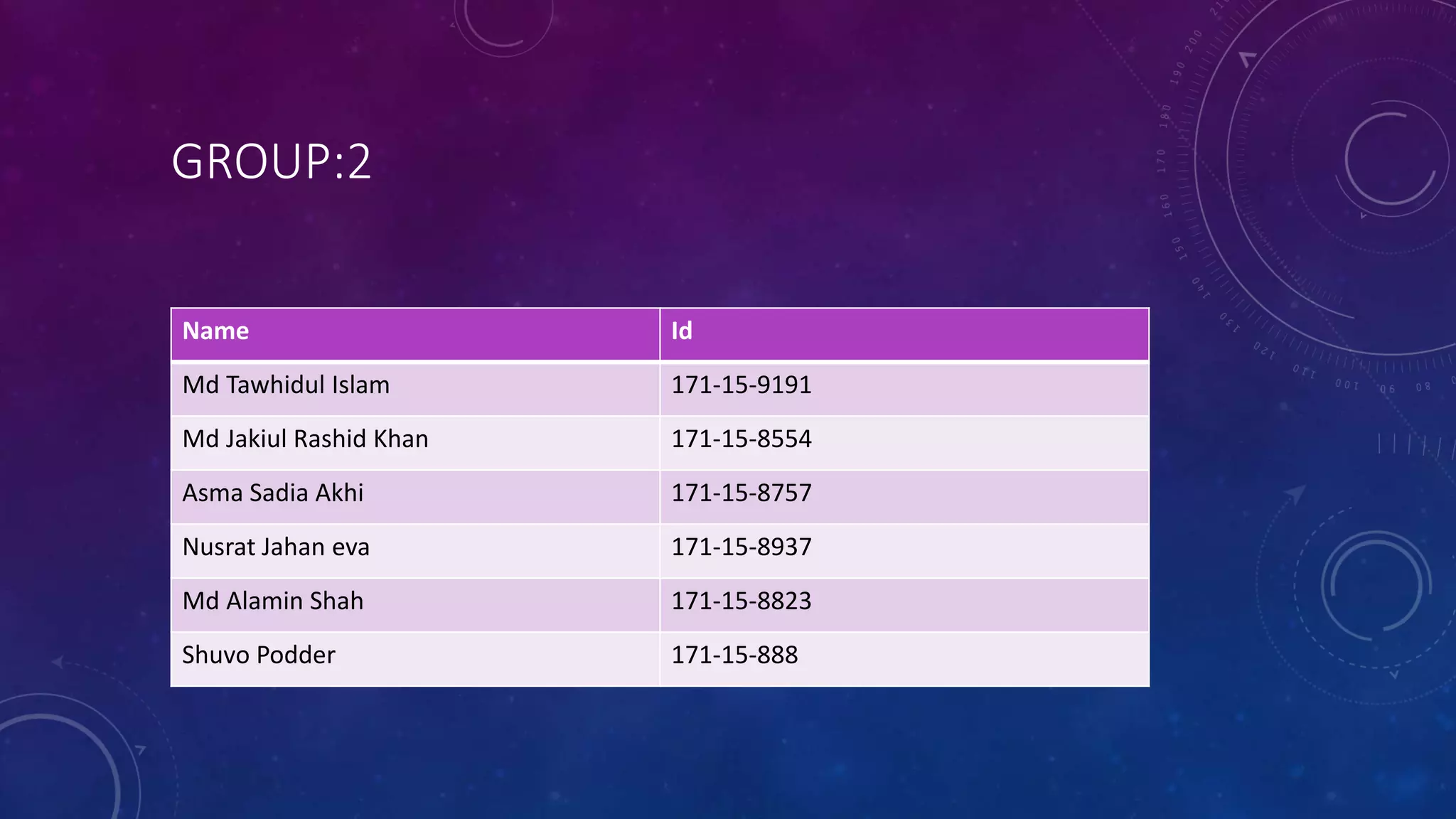
Name Id
Md Tawhidul Islam 171-15-9191
Md Jakiul Rashid Khan 171-15-8554
Asma Sadia Akhi 171-15-8757
Nusrat Jahan eva 171-15-8937
Md Alamin Shah 171-15-8823
Shuvo Podder 171-15-888
TREES
Defination:
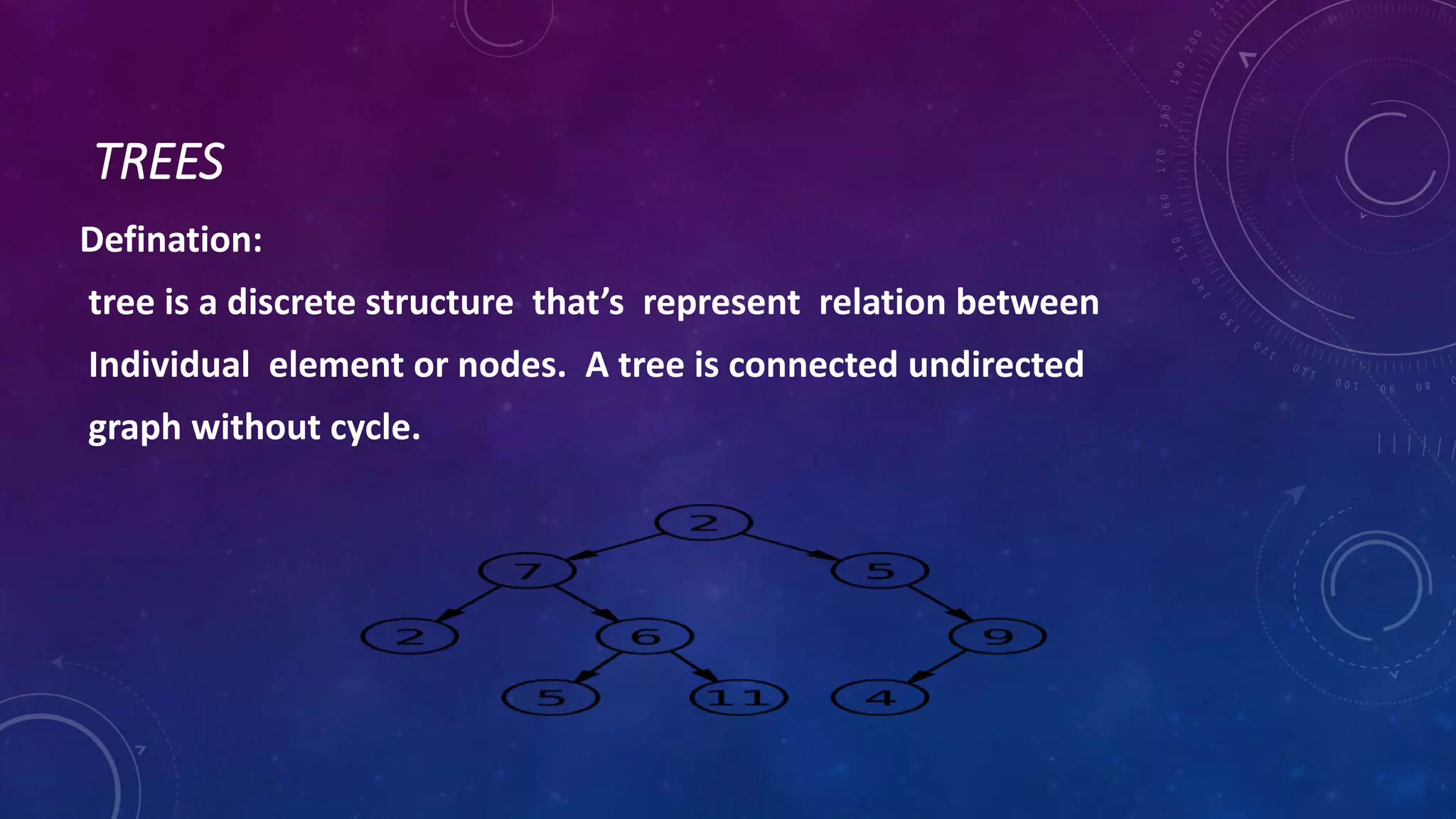
tree is a discrete structure that’s represent relation between
Individual element or nodes. A tree is connected undirected
graph without cycle.
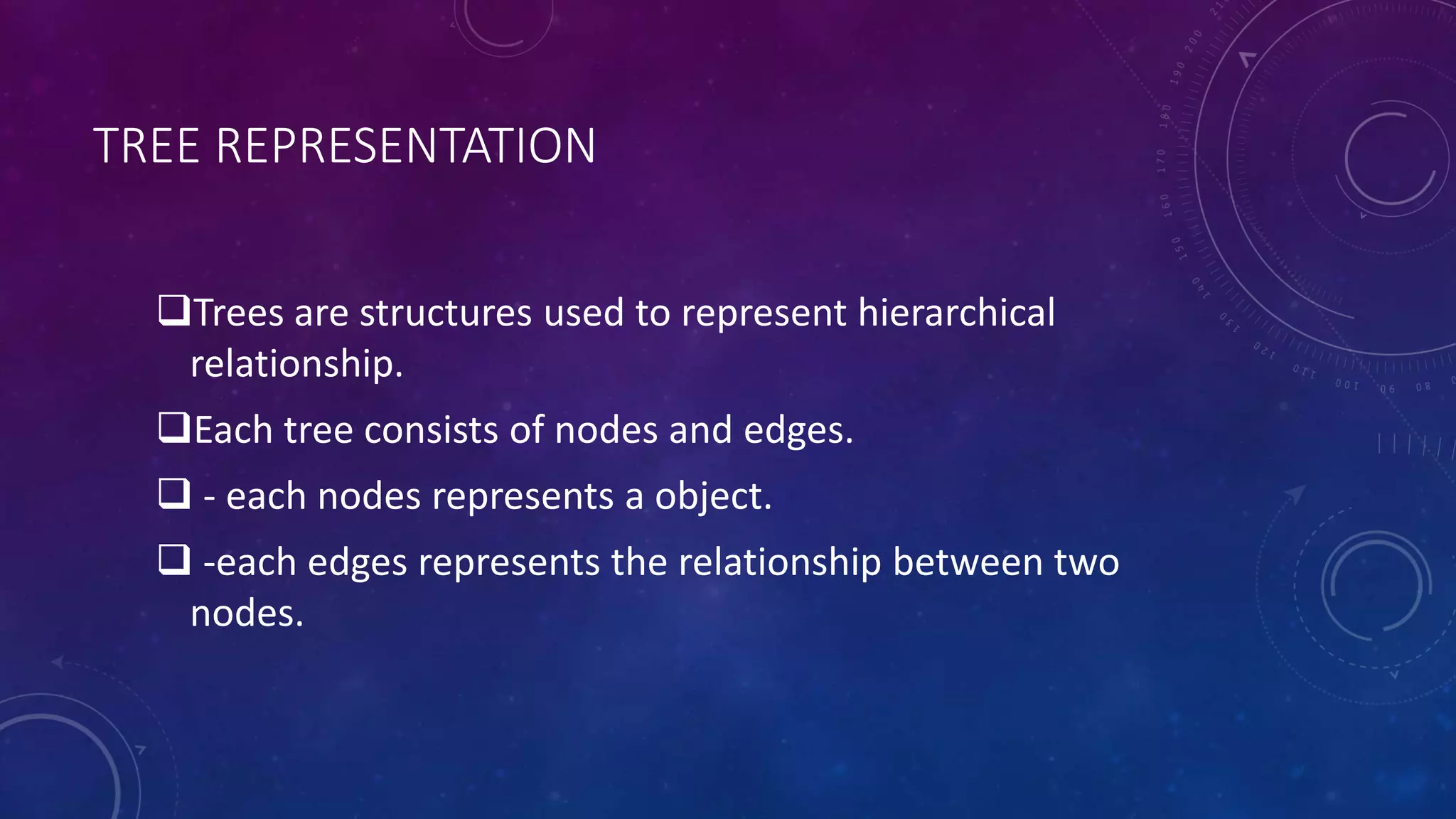
TREE REPRESENTATION
Trees are structures used to represent hierarchical
relationship.
Each tree consists of nodes and edges.
 - each nodes represents a object.
 -each edges represents the relationship between two
nodes.
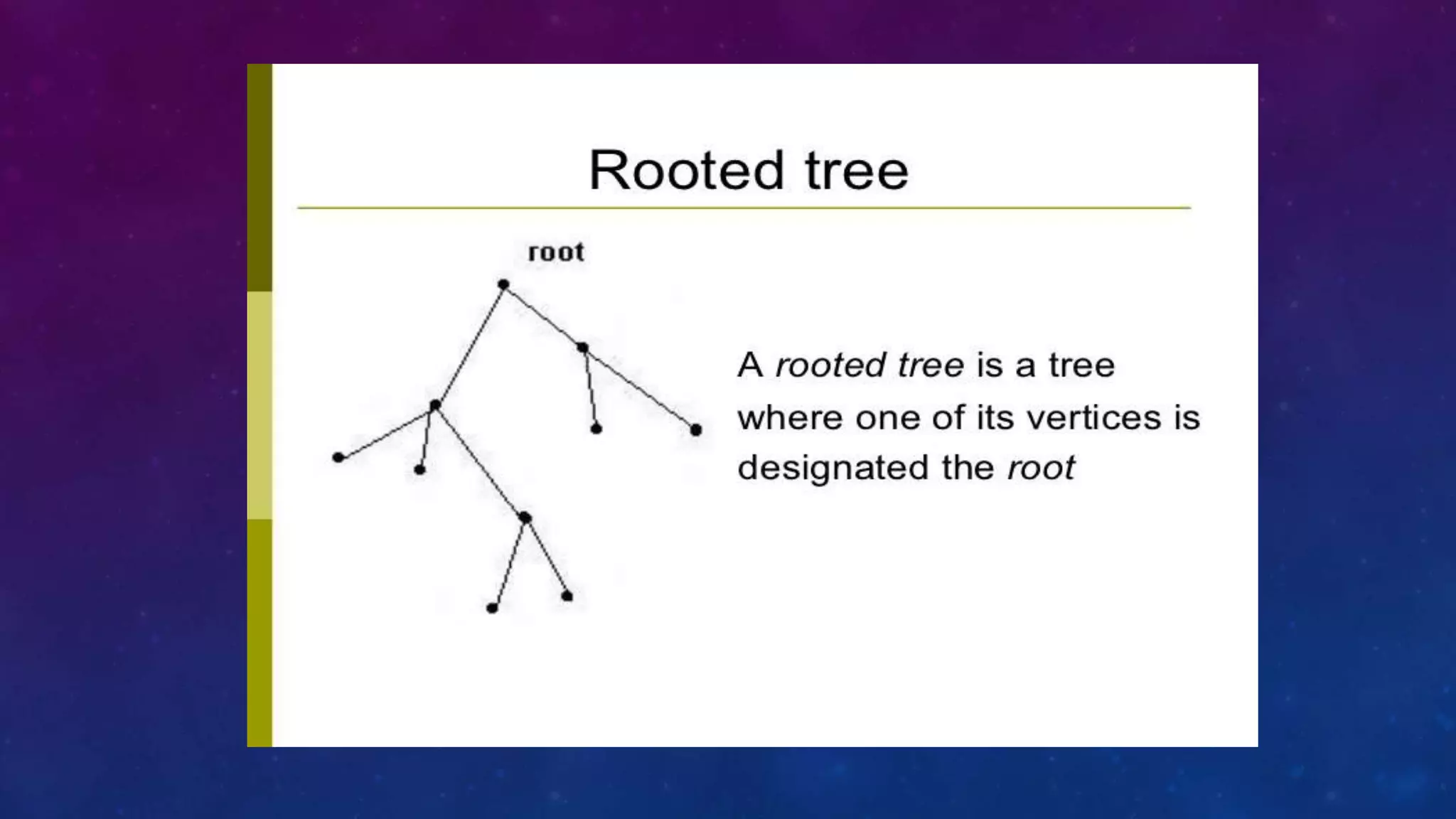
EXAMPLE
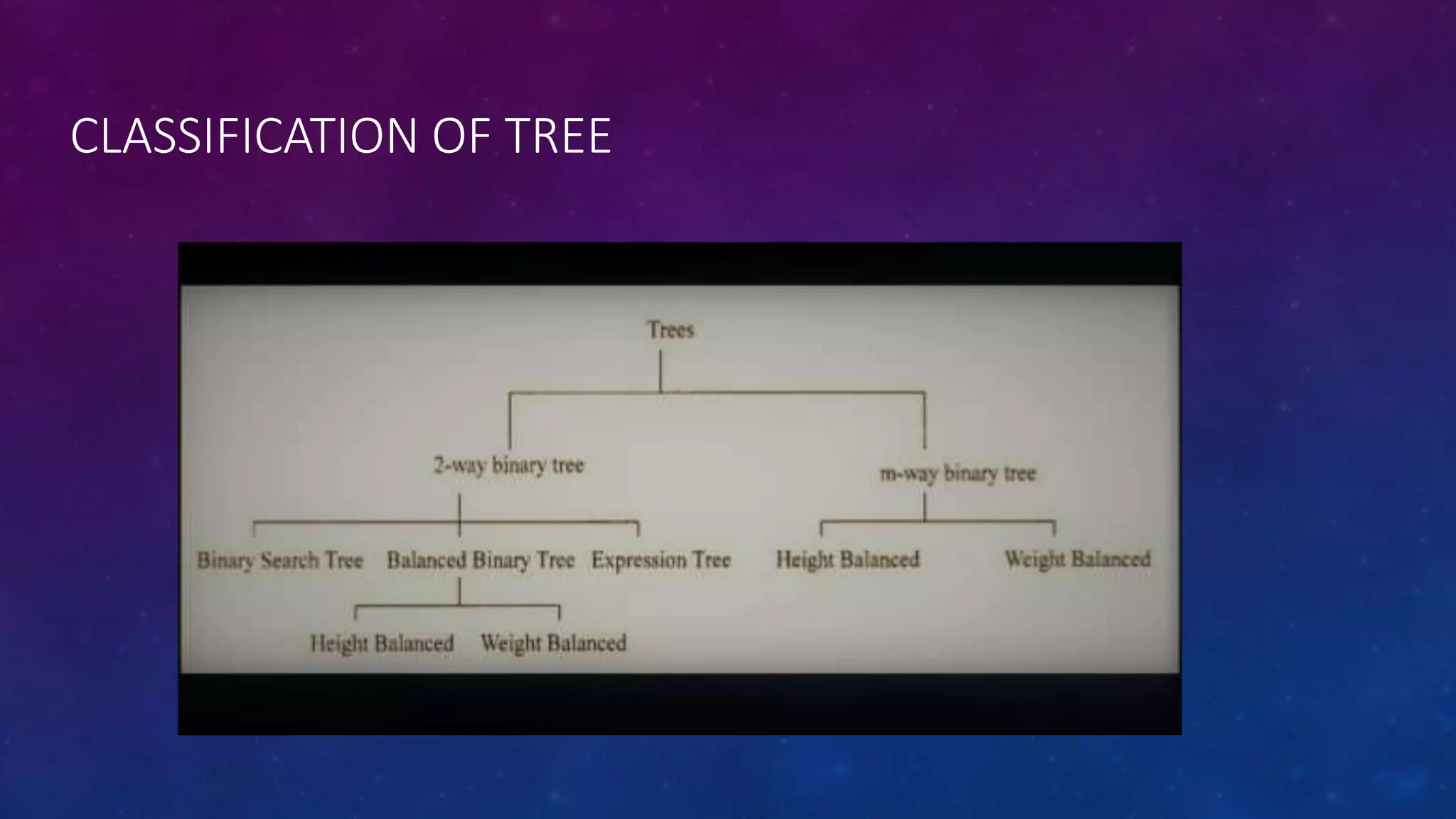
CLASSIFICATION OF TREE
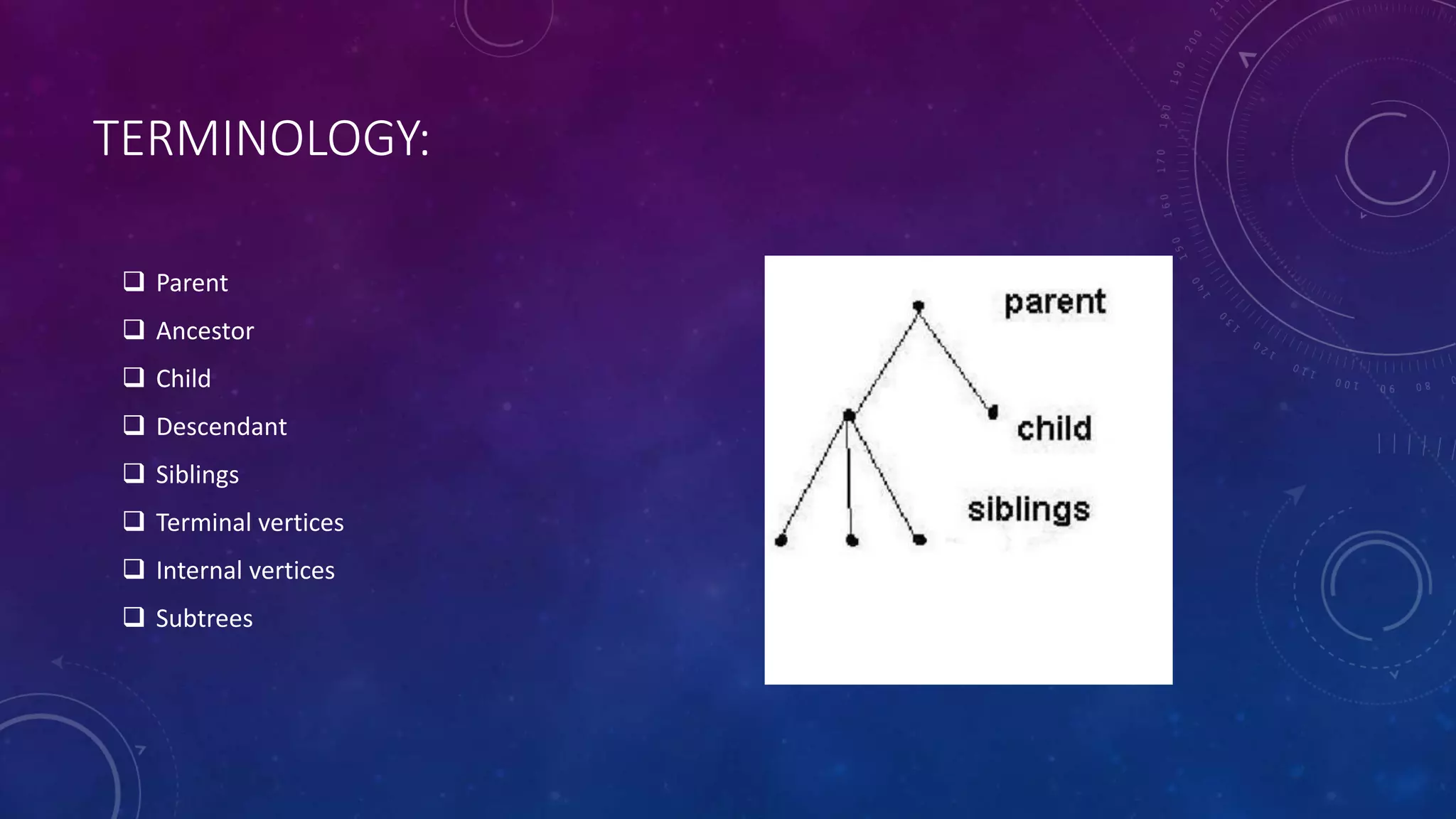
TERMINOLOGY:
 Parent
 Ancestor
 Child
 Descendant
 Siblings
 Terminal vertices
 Internal vertices
 Subtrees
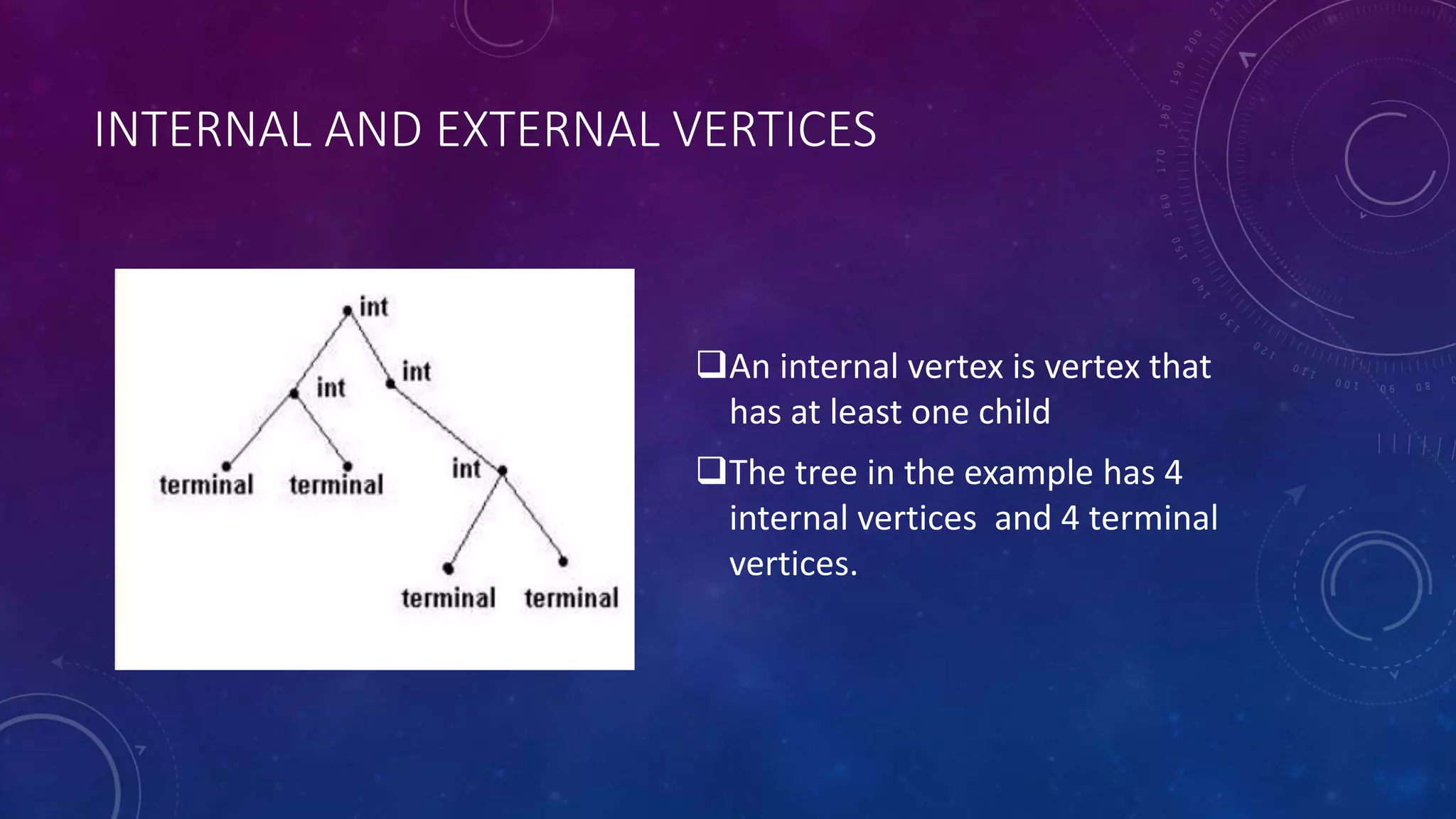
INTERNAL AND EXTERNAL VERTICES
An internal vertex is vertex that
has at least one child
The tree in the example has 4
internal vertices and 4 terminal
vertices.
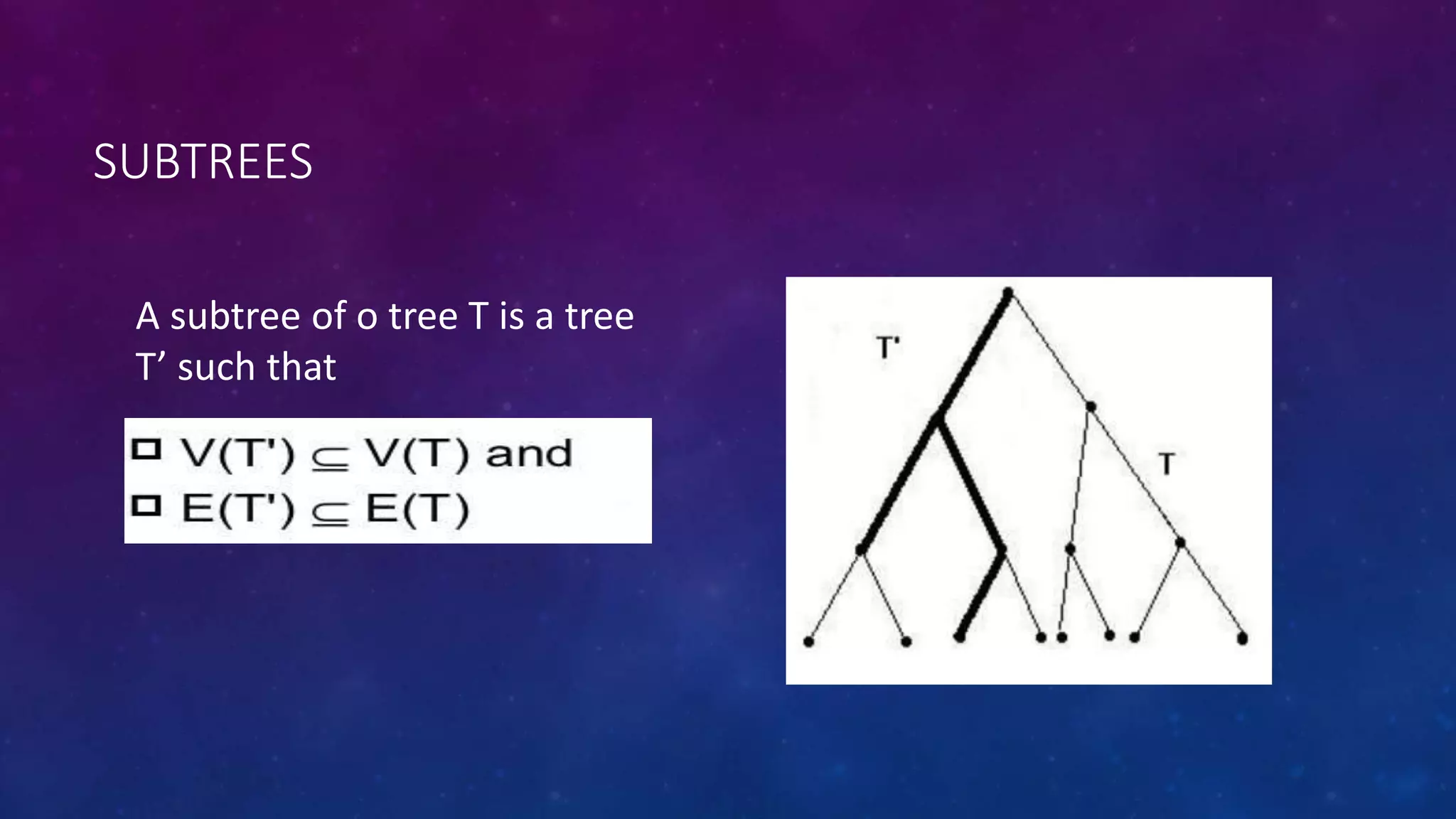
SUBTREES
A subtree of o tree T is a tree
T’ such that
SPANNING TREES
Given a graph G, a tree T is a s a
spanning tree of G if :
T is a subgraph of G and
T contains all the vertices of G
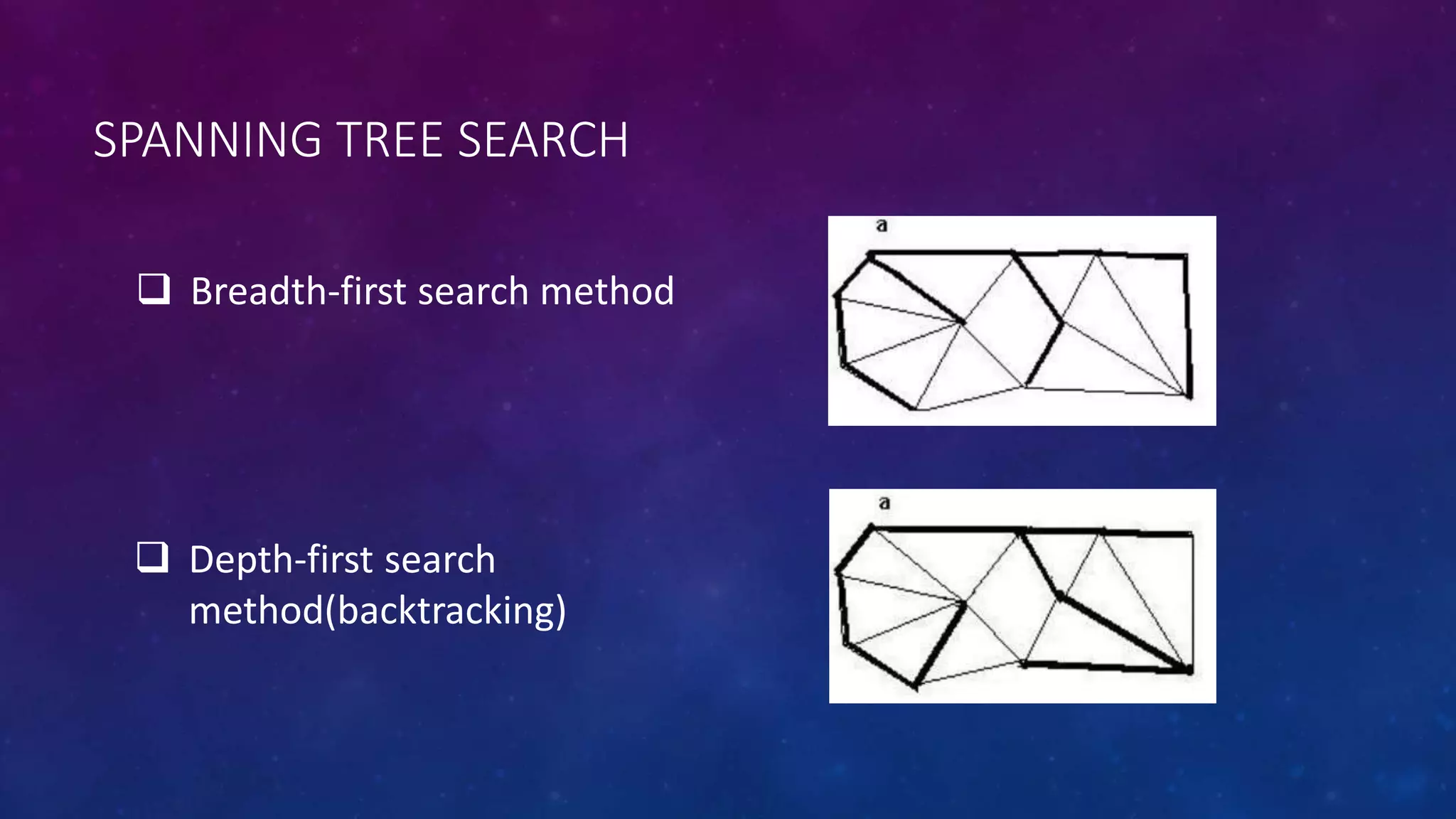
SPANNING TREE SEARCH
 Breadth-first search method
 Depth-first search
method(backtracking)
MINIMAL SPANNING TREES
Given a weighted graph G, a
minimum spanning tree is
A spanning tree of G
That has minimum “weight”
HEIGHT AND TERMINAL VERTICES
*Theorem7.5.6: If a binary tree
of height ‘h’ has ‘t’ terminal
vertices,thenene lg t<=h,
where lg is logarithm base 2.
Equivalently: t<=2^h.
#Example :h=4 and t=7.
Then t=7<16=2^4=2^h
A CASE OF EQUALITY
• #if all ‘t’ teminal vertices of a full binary tree T
have the same lavel
• h=heright of T,then “ t =2^h”.
• Example :
• The height is h=3.
• And the number of terminal vertices is “ t=8.
• } t=8=2^3=2^h..
ALPHABETICAL ORDER
Alphabetical or lexicographic order is the order of the
dictionary
a) Start with an ordered set of symbols x={a,b,c,………}…x
can be infinite or finite .
b) Let a=x1,x2,………xm and B=y1,y2……ym
Be strings over X. Then difne a<B if x1<y1.
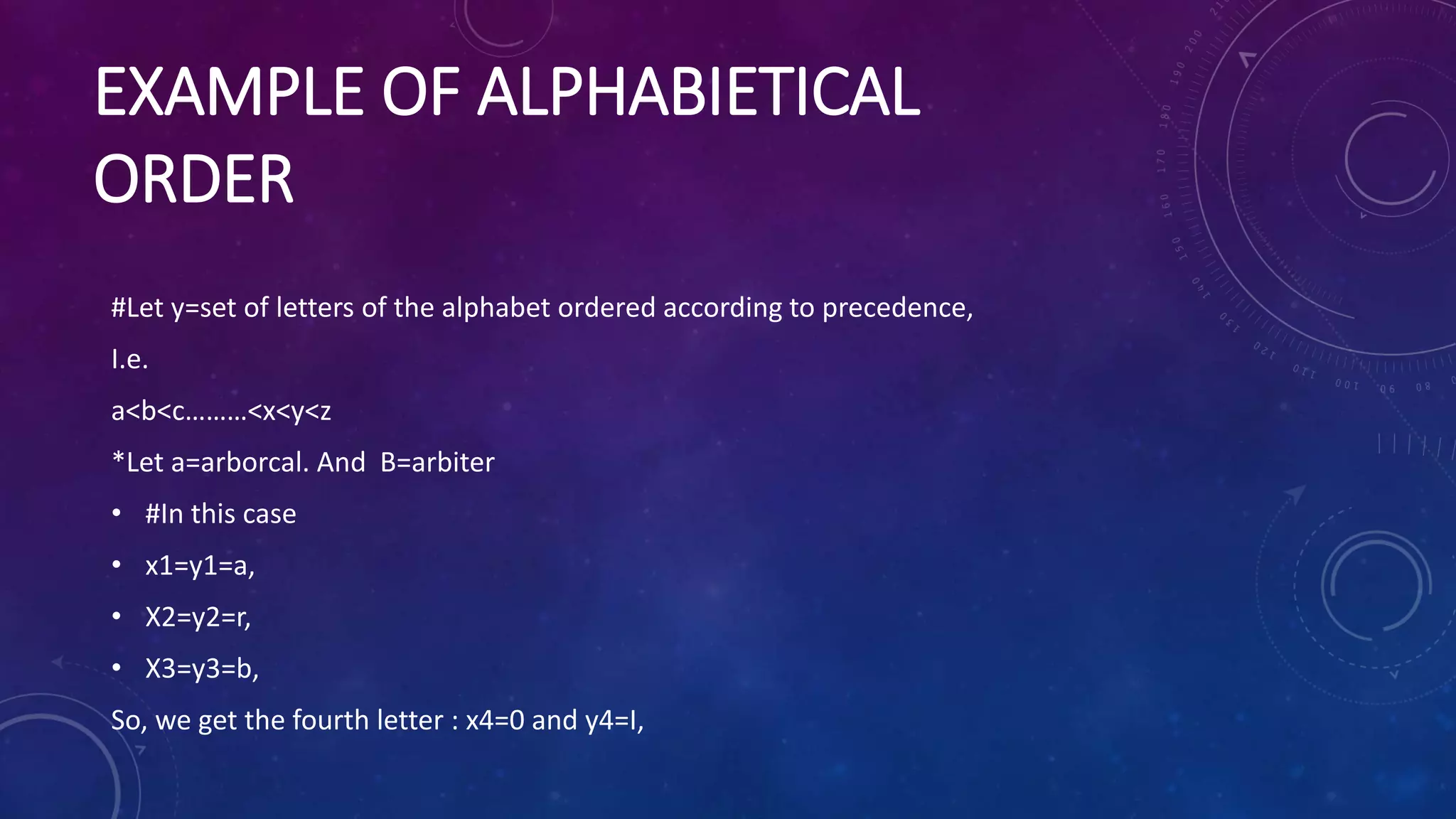
EXAMPLE OF ALPHABIETICAL
ORDER
#Let y=set of letters of the alphabet ordered according to precedence,
I.e.
a<b<c………<x<y<z
*Let a=arborcal. And B=arbiter
• #In this case
• x1=y1=a,
• X2=y2=r,
• X3=y3=b,
So, we get the fourth letter : x4=0 and y4=I,
BINARY TREE ISOMORPHISM
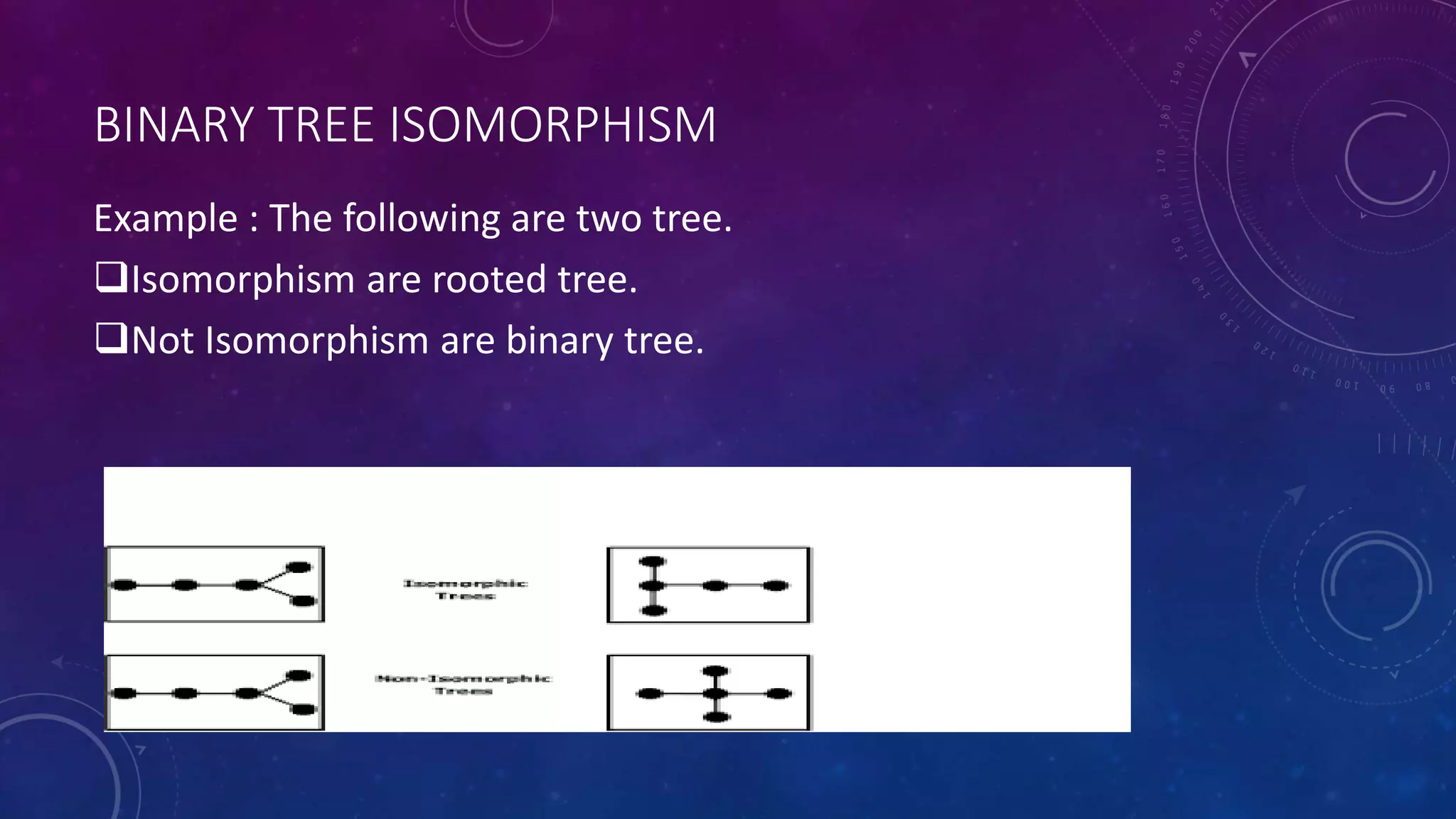
Example : The following are two tree.
• Isomorphism are rooted tree.
• Not Isomorphism are binary tree.
BINARY TREE ISOMORPHISM
Example : The following are two tree.
Isomorphism are rooted tree.
Not Isomorphism are binary tree.
SUMMARY OF TREE ISOMORPHISM
Isomorphism of tree.
Isomorphism of rooted trees.
Isomorphism of binary trees.
(left children goes to left
children,right child goes to
right children)
NON ISOMORPHISM OF TREES
Many time it may be easier to determine when two
tree are not isomorphism rather then to show their
isomorphism.
A tree isomorphism must respect certain properties ,
such as
-the number of vertices.
-the number of edges.
-roots must go to roots.
-position of children ,etc.
NON ISOMORPHISM OF ROOTED TREES
There are four non isomorphism rooted trees with
four vertices.
The root is the top vertex in each tree.
The degrees of the vertices apper in parenthesis.
NON ISOMORPHISM BINARY TREE
There are C(2n,n)/(n+1) non isomorphism binary
trees with n vertices .
C(2n,n)/(n+1) are the Catalan numbers Cn.
ISOMORPHISM OF BINARY TREES
There is an algorithm to test whether two binary trees are
isomorphism or not.
If the number of vertices in the two trees is n,
If the number of comparitions needed is an,it can be shown
that an<=3n+2.

Discrete mathematics

  • 1.
  • 2.
  • 3.
    GROUP:2 Name Id Md TawhidulIslam 171-15-9191 Md Jakiul Rashid Khan 171-15-8554 Asma Sadia Akhi 171-15-8757 Nusrat Jahan eva 171-15-8937 Md Alamin Shah 171-15-8823 Shuvo Podder 171-15-888
  • 4.
    TREES Defination: tree is adiscrete structure that’s represent relation between Individual element or nodes. A tree is connected undirected graph without cycle.
  • 5.
    TREE REPRESENTATION Trees arestructures used to represent hierarchical relationship. Each tree consists of nodes and edges.  - each nodes represents a object.  -each edges represents the relationship between two nodes.
  • 6.
  • 7.
  • 9.
    TERMINOLOGY:  Parent  Ancestor Child  Descendant  Siblings  Terminal vertices  Internal vertices  Subtrees
  • 10.
    INTERNAL AND EXTERNALVERTICES An internal vertex is vertex that has at least one child The tree in the example has 4 internal vertices and 4 terminal vertices.
  • 11.
    SUBTREES A subtree ofo tree T is a tree T’ such that
  • 12.
    SPANNING TREES Given agraph G, a tree T is a s a spanning tree of G if : T is a subgraph of G and T contains all the vertices of G
  • 13.
    SPANNING TREE SEARCH Breadth-first search method  Depth-first search method(backtracking)
  • 14.
    MINIMAL SPANNING TREES Givena weighted graph G, a minimum spanning tree is A spanning tree of G That has minimum “weight”
  • 15.
    HEIGHT AND TERMINALVERTICES *Theorem7.5.6: If a binary tree of height ‘h’ has ‘t’ terminal vertices,thenene lg t<=h, where lg is logarithm base 2. Equivalently: t<=2^h. #Example :h=4 and t=7. Then t=7<16=2^4=2^h
  • 16.
    A CASE OFEQUALITY • #if all ‘t’ teminal vertices of a full binary tree T have the same lavel • h=heright of T,then “ t =2^h”. • Example : • The height is h=3. • And the number of terminal vertices is “ t=8. • } t=8=2^3=2^h..
  • 17.
    ALPHABETICAL ORDER Alphabetical orlexicographic order is the order of the dictionary a) Start with an ordered set of symbols x={a,b,c,………}…x can be infinite or finite . b) Let a=x1,x2,………xm and B=y1,y2……ym Be strings over X. Then difne a<B if x1<y1.
  • 18.
    EXAMPLE OF ALPHABIETICAL ORDER #Lety=set of letters of the alphabet ordered according to precedence, I.e. a<b<c………<x<y<z *Let a=arborcal. And B=arbiter • #In this case • x1=y1=a, • X2=y2=r, • X3=y3=b, So, we get the fourth letter : x4=0 and y4=I,
  • 19.
    BINARY TREE ISOMORPHISM Example: The following are two tree. • Isomorphism are rooted tree. • Not Isomorphism are binary tree.
  • 20.
    BINARY TREE ISOMORPHISM Example: The following are two tree. Isomorphism are rooted tree. Not Isomorphism are binary tree.
  • 21.
    SUMMARY OF TREEISOMORPHISM Isomorphism of tree. Isomorphism of rooted trees. Isomorphism of binary trees. (left children goes to left children,right child goes to right children)
  • 22.
    NON ISOMORPHISM OFTREES Many time it may be easier to determine when two tree are not isomorphism rather then to show their isomorphism. A tree isomorphism must respect certain properties , such as -the number of vertices. -the number of edges. -roots must go to roots. -position of children ,etc.
  • 23.
    NON ISOMORPHISM OFROOTED TREES There are four non isomorphism rooted trees with four vertices. The root is the top vertex in each tree. The degrees of the vertices apper in parenthesis.
  • 24.
    NON ISOMORPHISM BINARYTREE There are C(2n,n)/(n+1) non isomorphism binary trees with n vertices . C(2n,n)/(n+1) are the Catalan numbers Cn.
  • 25.
    ISOMORPHISM OF BINARYTREES There is an algorithm to test whether two binary trees are isomorphism or not. If the number of vertices in the two trees is n, If the number of comparitions needed is an,it can be shown that an<=3n+2.