Consumer Behavior 2015 -Prof. Rajesh Satpathy
Definition and Meaning of Consumer Perception:
The term “perception” can be defined as the ability to derive
meaning. Derived from the word “perceive”, it refers to the ability
of giving meaning to whatever is sensed by our sense organs.
It is the process through which an individual interprets ones’
sensory impressions to give meaning to them. Schiffman defines it
as “the process by which an individual selects, organizes, and
interprets stimuli into a meaningful and coherent picture of the
world.”
Perception
Difference between Perception and Sensation.
Sensation is the ability of our five sense organs to sense a stimulus.
It is an auto reflex mechanism (direct and immediate) of our sense
organs, i.e. eyes, ears, nose, tongue, and skin towards a stimulus in
the environment.
This stimulus could be anything, a person, object, situation or
thing. In terms of marketing, it could be a product, a brand name,
an advertisement or even a store. Thus sensation is the reaction or
response of a sense organ or a sensory receptor towards a stimuli.
Perception
Perception is much broader in scope. It is complex process by
which a person organizes facts around the stimuli and gives
meaning to it. The perceptual process depicts a complex and
dynamic interplay of three processes, viz., selection, organization
and interpretation.
The person selects the stimuli and organizes and interprets the
input received from the sense organs, so as to give a meaning to
the stimuli. Thus, for example, as a person is caught by a new
packaging of a familiar brand, he picks up other stimuli on the
package through his senses, as well as organizes other facts from
internal (memory) and external sources (dealer, packaging) etc.
Perception
Individual Sensory Receptor-
Taste- MTR Masala, Everest & MDH Masala
Individual Sensory Receptor-
Touch- Vicks Vaporub
Nature of Perception:
Perception can be better explained by understanding the nature
and characteristics of perception:
1. Perception is a complex process. After a stimulus is detected by
the sense organs, the perception process comes into play and
involves the interplay of three processes, viz., selection,
organization and interpretation. It is a dynamic process.
2. It is also an intellectual process; it involves a lot of cognitive
effort. Once sensation takes place, the perception process involves
the selection, organization and interpretation of data.
Perception
3. Perception is broad in nature; it includes a physiological
component (through sensation), as well as sociological and
psychological components.
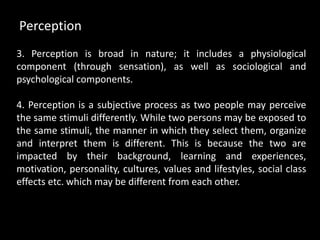
4. Perception is a subjective process as two people may perceive
the same stimuli differently. While two persons may be exposed to
the same stimuli, the manner in which they select them, organize
and interpret them is different. This is because the two are
impacted by their background, learning and experiences,
motivation, personality, cultures, values and lifestyles, social class
effects etc. which may be different from each other.
Perception
People perceive things differently because of their characteristics
and backgrounds, and because of the different perceptual
mechanisms that take place. Although we may differ in such
processes, universally speaking, the perceptual process comprises
four components, viz., input, perceptual mechanism, output and
behavior.
Perception
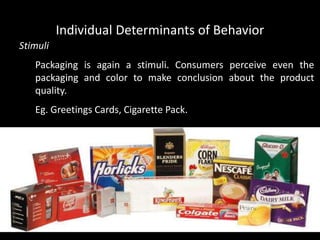
Stimuli
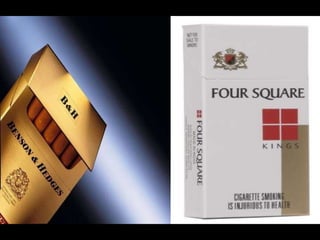
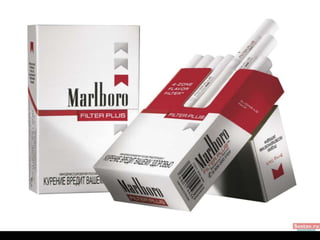
Packaging is again a stimuli. Consumers perceive even the
packaging and color to make conclusion about the product
quality.
Eg. Greetings Cards, Cigarette Pack.
Individual Determinants of Behavior
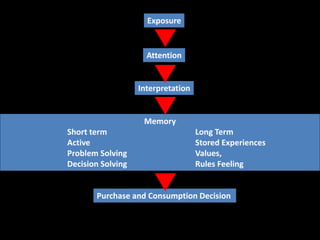
Exposure
Attention
Interpretation
Memory
Short term Long Term
Active Stored Experiences
Problem Solving Values,
Decision Solving Rules Feeling
Purchase and Consumption Decision
Perception
Much of the information may not be available to the memory
when an individual decides to purchase something.
So when communicating to the consumer , the marketer has a
uphill task, coz an individual is exposed to a lot of information
but retains very little in the memory.
Individual Determinants of Behavior
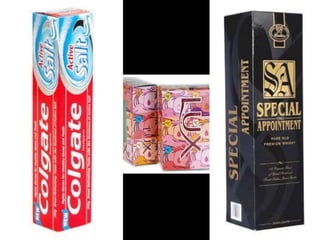
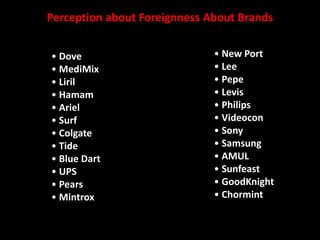
Perception about Foreignness About Brands
• Dove
• MediMix
• Liril
• Hamam
• Ariel
• Surf
• Colgate
• Tide
• Blue Dart
• UPS
• Pears
• Mintrox
• New Port
• Lee
• Pepe
• Levis
• Philips
• Videocon
• Sony
• Samsung
• AMUL
• Sunfeast
• GoodKnight
• Chormint
Thank You!

18 cb perception 2015

  • 1.
    Consumer Behavior 2015-Prof. Rajesh Satpathy
  • 2.
    Definition and Meaningof Consumer Perception: The term “perception” can be defined as the ability to derive meaning. Derived from the word “perceive”, it refers to the ability of giving meaning to whatever is sensed by our sense organs. It is the process through which an individual interprets ones’ sensory impressions to give meaning to them. Schiffman defines it as “the process by which an individual selects, organizes, and interprets stimuli into a meaningful and coherent picture of the world.” Perception
  • 3.
    Difference between Perceptionand Sensation. Sensation is the ability of our five sense organs to sense a stimulus. It is an auto reflex mechanism (direct and immediate) of our sense organs, i.e. eyes, ears, nose, tongue, and skin towards a stimulus in the environment. This stimulus could be anything, a person, object, situation or thing. In terms of marketing, it could be a product, a brand name, an advertisement or even a store. Thus sensation is the reaction or response of a sense organ or a sensory receptor towards a stimuli. Perception
  • 4.
    Perception is muchbroader in scope. It is complex process by which a person organizes facts around the stimuli and gives meaning to it. The perceptual process depicts a complex and dynamic interplay of three processes, viz., selection, organization and interpretation. The person selects the stimuli and organizes and interprets the input received from the sense organs, so as to give a meaning to the stimuli. Thus, for example, as a person is caught by a new packaging of a familiar brand, he picks up other stimuli on the package through his senses, as well as organizes other facts from internal (memory) and external sources (dealer, packaging) etc. Perception
  • 5.
    Individual Sensory Receptor- Taste-MTR Masala, Everest & MDH Masala
  • 6.
  • 7.
    Nature of Perception: Perceptioncan be better explained by understanding the nature and characteristics of perception: 1. Perception is a complex process. After a stimulus is detected by the sense organs, the perception process comes into play and involves the interplay of three processes, viz., selection, organization and interpretation. It is a dynamic process. 2. It is also an intellectual process; it involves a lot of cognitive effort. Once sensation takes place, the perception process involves the selection, organization and interpretation of data. Perception
  • 8.
    3. Perception isbroad in nature; it includes a physiological component (through sensation), as well as sociological and psychological components. 4. Perception is a subjective process as two people may perceive the same stimuli differently. While two persons may be exposed to the same stimuli, the manner in which they select them, organize and interpret them is different. This is because the two are impacted by their background, learning and experiences, motivation, personality, cultures, values and lifestyles, social class effects etc. which may be different from each other. Perception
  • 9.
    People perceive thingsdifferently because of their characteristics and backgrounds, and because of the different perceptual mechanisms that take place. Although we may differ in such processes, universally speaking, the perceptual process comprises four components, viz., input, perceptual mechanism, output and behavior. Perception
  • 10.
    Stimuli Packaging is againa stimuli. Consumers perceive even the packaging and color to make conclusion about the product quality. Eg. Greetings Cards, Cigarette Pack. Individual Determinants of Behavior
  • 15.
    Exposure Attention Interpretation Memory Short term LongTerm Active Stored Experiences Problem Solving Values, Decision Solving Rules Feeling Purchase and Consumption Decision
  • 16.
    Perception Much of theinformation may not be available to the memory when an individual decides to purchase something. So when communicating to the consumer , the marketer has a uphill task, coz an individual is exposed to a lot of information but retains very little in the memory. Individual Determinants of Behavior
  • 17.
    Perception about ForeignnessAbout Brands • Dove • MediMix • Liril • Hamam • Ariel • Surf • Colgate • Tide • Blue Dart • UPS • Pears • Mintrox • New Port • Lee • Pepe • Levis • Philips • Videocon • Sony • Samsung • AMUL • Sunfeast • GoodKnight • Chormint
  • 18.