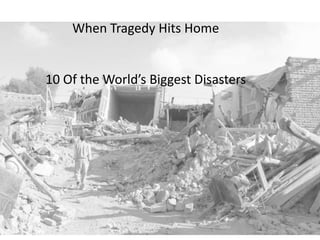
When Tragedy Hits Home
10 Of the World’s Biggest Disasters
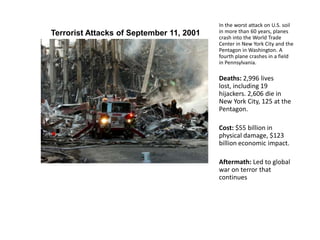
Terrorist Attacks of September 11, 2001
In the worst attack on U.S. soil
in more than 60 years, planes
crash into the World Trade
Center in New York City and the
Pentagon in Washington. A
fourth plane crashes in a field
in Pennsylvania.
Deaths: 2,996 lives
lost, including 19
hijackers. 2,606 die in
New York City, 125 at the
Pentagon.
Cost: $55 billion in
physical damage, $123
billion economic impact.
Aftermath: Led to global
war on terror that
continues
SARS Outbreak in Southern China
Nov. 2002 – July 2003
An outbreak of severe acute
respiratory syndrome hits
China and spreads to 16
other countries.
The deadly viral disease has a
fatality rate of nearly 10%.
Deaths: 775
deaths, including 349 in
China and 299 in Hong
Kong.
Cost: Estimated $40
billion impact on the
world economy [National
Institutes of Health]
Aftermath: China was
forced to become more
open in its reporting of
major medical cases.
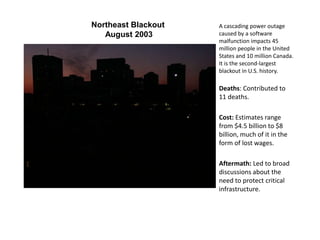
Northeast Blackout
August 2003
A cascading power outage
caused by a software
malfunction impacts 45
million people in the United
States and 10 million Canada.
It is the second-largest
blackout in U.S. history.
Deaths: Contributed to
11 deaths.
Cost: Estimates range
from $4.5 billion to $8
billion, much of it in the
form of lost wages.
Aftermath: Led to broad
discussions about the
need to protect critical
infrastructure.
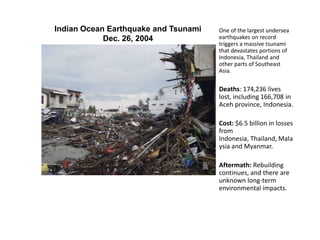
Indian Ocean Earthquake and Tsunami
Dec. 26, 2004
One of the largest undersea
earthquakes on record
triggers a massive tsunami
that devastates portions of
Indonesia, Thailand and
other parts of Southeast
Asia.
Deaths: 174,236 lives
lost, including 166,708 in
Aceh province, Indonesia.
Cost: $6.5 billion in losses
from
Indonesia, Thailand, Mala
ysia and Myanmar.
Aftermath: Rebuilding
continues, and there are
unknown long-term
environmental impacts.
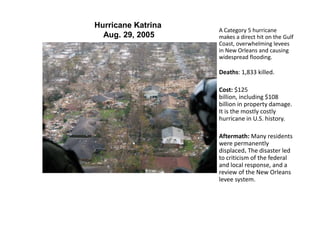
Hurricane Katrina
Aug. 29, 2005
A Category 5 hurricane
makes a direct hit on the Gulf
Coast, overwhelming levees
in New Orleans and causing
widespread flooding.
Deaths: 1,833 killed.
Cost: $125
billion, including $108
billion in property damage.
It is the mostly costly
hurricane in U.S. history.
Aftermath: Many residents
were permanently
displaced. The disaster led
to criticism of the federal
and local response, and a
review of the New Orleans
levee system.
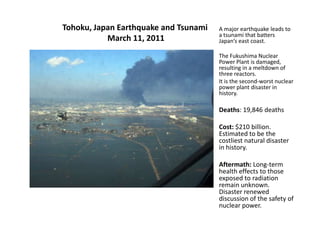
Tohoku, Japan Earthquake and Tsunami
March 11, 2011
A major earthquake leads to
a tsunami that batters
Japan’s east coast.
The Fukushima Nuclear
Power Plant is damaged,
resulting in a meltdown of
three reactors.
It is the second-worst nuclear
power plant disaster in
history.
Deaths: 19,846 deaths
Cost: $210 billion.
Estimated to be the
costliest natural disaster
in history.
Aftermath: Long-term
health effects to those
exposed to radiation
remain unknown.
Disaster renewed
discussion of the safety of
nuclear power.
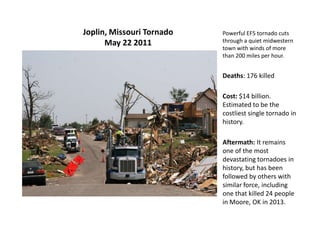
Joplin, Missouri Tornado
May 22 2011
Powerful EF5 tornado cuts
through a quiet midwestern
town with winds of more
than 200 miles per hour.
Deaths: 176 killed
Cost: $14 billion.
Estimated to be the
costliest single tornado in
history.
Aftermath: It remains
one of the most
devastating tornadoes in
history, but has been
followed by others with
similar force, including
one that killed 24 people
in Moore, OK in 2013.
Deepwater Horizon Explosion and Oil Spill
On April 20, 2010, the BP-
operated oil rig Deepwater
Horizon sank in the Gulf of
Mexico following a large
explosion.
Eleven workers died and the
accident led to the largest
marine oil spill in history. About
210 million gallons of oil
reportedly leaked into the Gulf.
Deaths: 11 deaths
Cost: $2.5 billion impact to
the fishing industry, $23
billion impact on tourism.
[NOAA]
BP has lost tens of billions of
dollars, including more than
$40 billion in settlements
and payments to those
affected.
Aftermath: The
environmental impact of the
disaster is still being
examined. The accident
renewed a debate about
offshore drilling.
‘Superstorm’ Sandy
Oct. 22-31, 2012
Sandy hits the northeast
United States as a Category 1
hurricane and slams the New
Jersey coast and impacting
more than two dozen states.
The Jersey shore and Staten
Island are particularly hard
hit with severe property
damage and extended power
outages.
Deaths: 148 direct deaths
Cost: $65 billion [NOAA]
Aftermath: Thousands of
people left displaced by
the storm in New Jersey
and New York remain in
need of help.
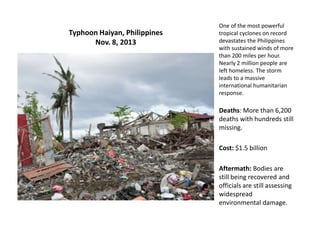
Typhoon Haiyan, Philippines
Nov. 8, 2013
One of the most powerful
tropical cyclones on record
devastates the Philippines
with sustained winds of more
than 200 miles per hour.
Nearly 2 million people are
left homeless. The storm
leads to a massive
international humanitarian
response.
Deaths: More than 6,200
deaths with hundreds still
missing.
Cost: $1.5 billion
Aftermath: Bodies are
still being recovered and
officials are still assessing
widespread
environmental damage.

Disasters

  • 1.
    When Tragedy HitsHome 10 Of the World’s Biggest Disasters
  • 2.
    Terrorist Attacks ofSeptember 11, 2001 In the worst attack on U.S. soil in more than 60 years, planes crash into the World Trade Center in New York City and the Pentagon in Washington. A fourth plane crashes in a field in Pennsylvania. Deaths: 2,996 lives lost, including 19 hijackers. 2,606 die in New York City, 125 at the Pentagon. Cost: $55 billion in physical damage, $123 billion economic impact. Aftermath: Led to global war on terror that continues
  • 3.
    SARS Outbreak inSouthern China Nov. 2002 – July 2003 An outbreak of severe acute respiratory syndrome hits China and spreads to 16 other countries. The deadly viral disease has a fatality rate of nearly 10%. Deaths: 775 deaths, including 349 in China and 299 in Hong Kong. Cost: Estimated $40 billion impact on the world economy [National Institutes of Health] Aftermath: China was forced to become more open in its reporting of major medical cases.
  • 4.
    Northeast Blackout August 2003 Acascading power outage caused by a software malfunction impacts 45 million people in the United States and 10 million Canada. It is the second-largest blackout in U.S. history. Deaths: Contributed to 11 deaths. Cost: Estimates range from $4.5 billion to $8 billion, much of it in the form of lost wages. Aftermath: Led to broad discussions about the need to protect critical infrastructure.
  • 5.
    Indian Ocean Earthquakeand Tsunami Dec. 26, 2004 One of the largest undersea earthquakes on record triggers a massive tsunami that devastates portions of Indonesia, Thailand and other parts of Southeast Asia. Deaths: 174,236 lives lost, including 166,708 in Aceh province, Indonesia. Cost: $6.5 billion in losses from Indonesia, Thailand, Mala ysia and Myanmar. Aftermath: Rebuilding continues, and there are unknown long-term environmental impacts.
  • 6.
    Hurricane Katrina Aug. 29,2005 A Category 5 hurricane makes a direct hit on the Gulf Coast, overwhelming levees in New Orleans and causing widespread flooding. Deaths: 1,833 killed. Cost: $125 billion, including $108 billion in property damage. It is the mostly costly hurricane in U.S. history. Aftermath: Many residents were permanently displaced. The disaster led to criticism of the federal and local response, and a review of the New Orleans levee system.
  • 7.
    Tohoku, Japan Earthquakeand Tsunami March 11, 2011 A major earthquake leads to a tsunami that batters Japan’s east coast. The Fukushima Nuclear Power Plant is damaged, resulting in a meltdown of three reactors. It is the second-worst nuclear power plant disaster in history. Deaths: 19,846 deaths Cost: $210 billion. Estimated to be the costliest natural disaster in history. Aftermath: Long-term health effects to those exposed to radiation remain unknown. Disaster renewed discussion of the safety of nuclear power.
  • 8.
    Joplin, Missouri Tornado May22 2011 Powerful EF5 tornado cuts through a quiet midwestern town with winds of more than 200 miles per hour. Deaths: 176 killed Cost: $14 billion. Estimated to be the costliest single tornado in history. Aftermath: It remains one of the most devastating tornadoes in history, but has been followed by others with similar force, including one that killed 24 people in Moore, OK in 2013.
  • 9.
    Deepwater Horizon Explosionand Oil Spill On April 20, 2010, the BP- operated oil rig Deepwater Horizon sank in the Gulf of Mexico following a large explosion. Eleven workers died and the accident led to the largest marine oil spill in history. About 210 million gallons of oil reportedly leaked into the Gulf. Deaths: 11 deaths Cost: $2.5 billion impact to the fishing industry, $23 billion impact on tourism. [NOAA] BP has lost tens of billions of dollars, including more than $40 billion in settlements and payments to those affected. Aftermath: The environmental impact of the disaster is still being examined. The accident renewed a debate about offshore drilling.
  • 10.
    ‘Superstorm’ Sandy Oct. 22-31,2012 Sandy hits the northeast United States as a Category 1 hurricane and slams the New Jersey coast and impacting more than two dozen states. The Jersey shore and Staten Island are particularly hard hit with severe property damage and extended power outages. Deaths: 148 direct deaths Cost: $65 billion [NOAA] Aftermath: Thousands of people left displaced by the storm in New Jersey and New York remain in need of help.
  • 11.
    Typhoon Haiyan, Philippines Nov.8, 2013 One of the most powerful tropical cyclones on record devastates the Philippines with sustained winds of more than 200 miles per hour. Nearly 2 million people are left homeless. The storm leads to a massive international humanitarian response. Deaths: More than 6,200 deaths with hundreds still missing. Cost: $1.5 billion Aftermath: Bodies are still being recovered and officials are still assessing widespread environmental damage.