SESSION 2
GROUNDING
IN OUR SOCIAL CONDITION
(The Socio-Analytical Mediation)
OBJECTIVES
• To understand the need and the way of
doing social analysis
• To identify the crucial issues in our socio-
economic, political, cultural, and ecological
dimensions of our life in society
• To critical appreciate why such problems
exists especially through social analysis
SOCIAL ANALYSIS
• “It is up to Christian communities to
analyze with objectivity the situation which
is proper to their own country, to shed on it
the light of the Gospel’s unalterable words,
and to draw principles or reflections,
norms of judgment, and directives of
action from the social teaching of the
Church” Octogesima adveniens # 4
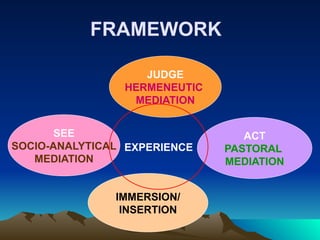
FRAMEWORK
SEE
SOCIO-ANALYTICAL
MEDIATION
JUDGE
HERMENEUTIC
MEDIATION
ACT
PASTORAL
MEDIATION
IMMERSION/
INSERTION
EXPERIENCE
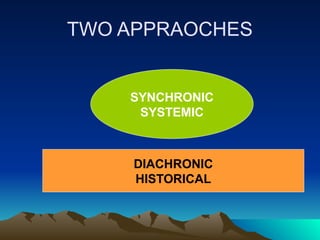
TWO APPRAOCHES
SYNCHRONIC
SYSTEMIC
DIACHRONIC
HISTORICAL
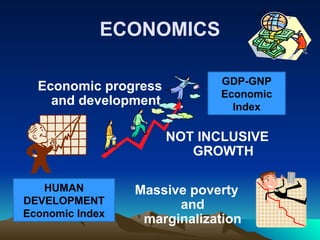
ECONOMICS
Massive poverty
and
marginalization
Economic progress
and development
NOT INCLUSIVE
GROWTH
GDP-GNP
Economic
Index
HUMAN
DEVELOPMENT
Economic Index
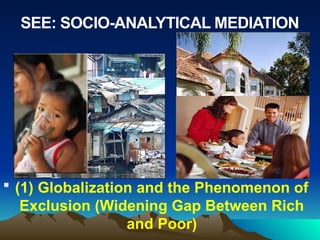
 (1) Globalization and the Phenomenon of
Exclusion (Widening Gap Between Rich
and Poor)
SEE: SOCIO-ANALYTICAL MEDIATION
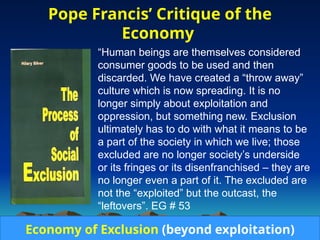
Pope Francis’ Critique of the
Economy
• “Human beings are themselves considered
consumer goods to be used and then
discarded. We have created a “throw away”
culture which is now spreading. It is no
longer simply about exploitation and
oppression, but something new. Exclusion
ultimately has to do with what it means to be
a part of the society in which we live; those
excluded are no longer society’s underside
or its fringes or its disenfranchised – they are
no longer even a part of it. The excluded are
not the “exploited” but the outcast, the
“leftovers”. EG # 53
Economy of Exclusion (beyond exploitation)
Critique of ‘Trickle-Down’ Economies
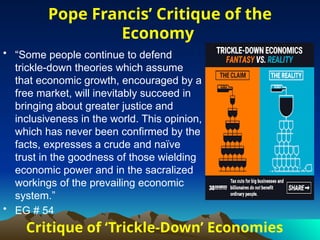
• “Some people continue to defend
trickle-down theories which assume
that economic growth, encouraged by a
free market, will inevitably succeed in
bringing about greater justice and
inclusiveness in the world. This opinion,
which has never been confirmed by the
facts, expresses a crude and naïve
trust in the goodness of those wielding
economic power and in the sacralized
workings of the prevailing economic
system.”
• EG # 54
Pope Francis’ Critique of the
Economy
Idolatry of Money (Fetishism of the Market)
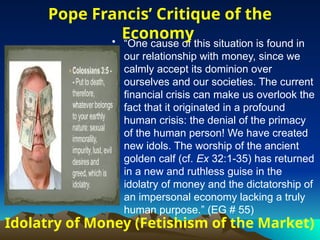
• “One cause of this situation is found in
our relationship with money, since we
calmly accept its dominion over
ourselves and our societies. The current
financial crisis can make us overlook the
fact that it originated in a profound
human crisis: the denial of the primacy
of the human person! We have created
new idols. The worship of the ancient

golden calf (cf. Ex 32:1-35) has returned
in a new and ruthless guise in the
idolatry of money and the dictatorship of
an impersonal economy lacking a truly
human purpose.” (EG # 55)
Pope Francis’ Critique of the
Economy
Financial System which Rules rather than Serves
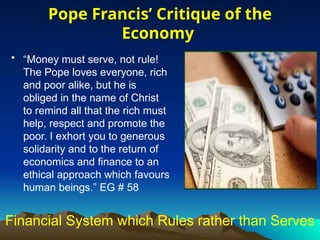
• “Money must serve, not rule!
The Pope loves everyone, rich
and poor alike, but he is
obliged in the name of Christ
to remind all that the rich must
help, respect and promote the
poor. I exhort you to generous
solidarity and to the return of
economics and finance to an
ethical approach which favours
human beings.” EG # 58
Pope Francis’ Critique of the
Economy
Exclusion and Violence
• “Today’s economic mechanisms promote
inordinate consumption, yet it is evident
that unbridled consumerism combined with
inequality proves doubly damaging to the
social fabric. Inequality eventually
engenders a violence which recourse to
arms cannot and never will be able to
resolve.”
Pope Francis’ Critique of the
Economy
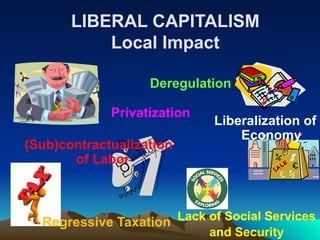
LIBERAL CAPITALISM
Local Impact
Deregulation
(Sub)contractualization
of Labor
Liberalization of
Economy
Privatization
Lack of Social Services
and Security
Regressive Taxation
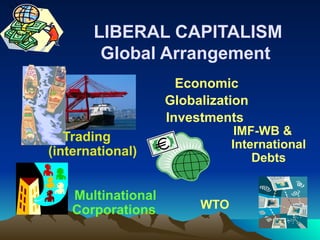
LIBERAL CAPITALISM
Global Arrangement
Economic
Globalization
Investments
Multinational
Corporations
Trading
(international)
IMF-WB &
International
Debts
WTO
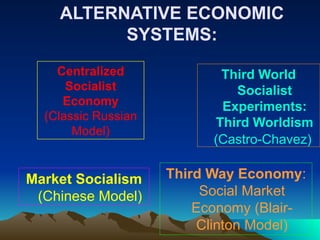
ALTERNATIVE ECONOMIC
SYSTEMS:
Market Socialism
(Chinese Model)
Third Way Economy:
Social Market
Economy (Blair-
Clinton Model)
Third World
Socialist
Experiments:
Third Worldism
(Castro-Chavez)
Centralized
Socialist
Economy
(Classic Russian
Model)
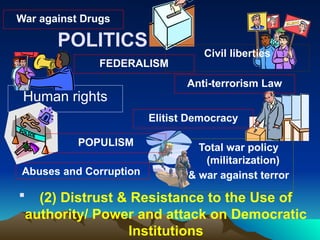
POLITICS
Human rights
Civil liberties
Total war policy
(militarization)
& war against terror
Abuses and Corruption
Elitist Democracy
 (2) Distrust & Resistance to the Use of
authority/ Power and attack on Democratic
Institutions
FEDERALISM
Anti-terrorism Law
POPULISM
War against Drugs
• “Just as goodness tends to spread,
the toleration of evil, which is injustice,
tends to expand its baneful influence
and quietly to undermine any political
and social system, no matter how
solid it may appear. If every action has
its consequences, an evil embedded
in the structures of a society has a
constant potential for disintegration
and death. We are far from the so-
called “end of history”, since the
conditions for a sustainable and
peaceful development have not yet
been adequately articulated and
realized.” EG # 59
Pope Francis’ Critique of the
Politics
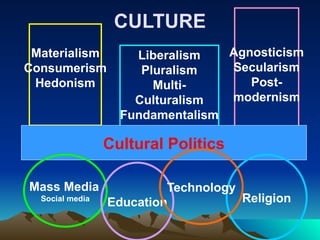
Agnosticism
Secularism
Post-
modernism
Materialism
Consumerism
Hedonism
Cultural Politics
Mass Media
Social media
Education Religion
Technology
CULTURE
Liberalism
Pluralism
Multi-
Culturalism
Fundamentalism
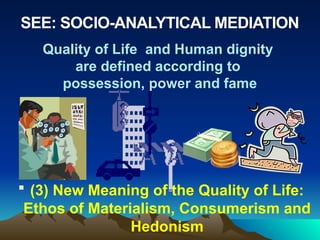
SEE: SOCIO-ANALYTICAL MEDIATION
 (3) New Meaning of the Quality of Life:
Ethos of Materialism, Consumerism and
Hedonism
Quality of Life and Human dignity
are defined according to
possession, power and fame
• “The individualism of our
postmodern and globalized era
favours a lifestyle which weakens
the development and stability of
personal relationships and distorts
family bonds. Pastoral activity
needs to bring out more clearly the
fact that our relationship with the
Father demands and encourages a
communion which heals, promotes
and reinforces interpersonal
bonds.” EG # 67
Pope Francis’ Critique of Culture
Individualism
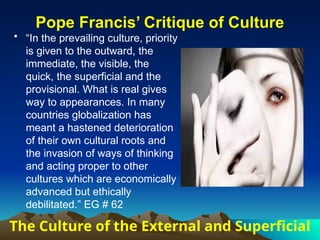
• “In the prevailing culture, priority
is given to the outward, the
immediate, the visible, the
quick, the superficial and the
provisional. What is real gives
way to appearances. In many
countries globalization has
meant a hastened deterioration
of their own cultural roots and
the invasion of ways of thinking
and acting proper to other
cultures which are economically
advanced but ethically
debilitated.” EG # 62
Pope Francis’ Critique of Culture
The Culture of the External and Superficial
• “The proliferation of new religious movements, some of which
tend to fundamentalism while others seem to propose a
spirituality without God. This is, on the one hand, a human
reaction to a materialistic, consumerist and individualistic
society, but it is also a means of exploiting the weaknesses of
people living in poverty and on the fringes of society, people
who make ends meet amid great human suffering and are
looking for immediate solutions to their needs. These religious
movements, not without a certain shrewdness, come to fill,
within a predominantly individualistic culture, a vacuum left by
secularist rationalism.” EG # 64
Pope Francis’ Critique of Culture
Ambivalence on Religious Movements
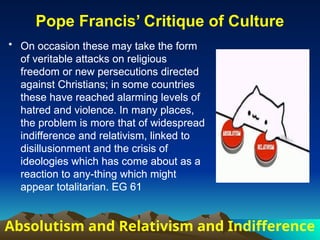
• On occasion these may take the form
of veritable attacks on religious
freedom or new persecutions directed
against Christians; in some countries
these have reached alarming levels of
hatred and violence. In many places,
the problem is more that of widespread
indifference and relativism, linked to
disillusionment and the crisis of
ideologies which has come about as a
reaction to any-thing which might
appear totalitarian. EG 61
Pope Francis’ Critique of Culture
Absolutism and Relativism and Indifference
• On occasion these may take the form
of veritable attacks on religious
freedom or new persecutions directed
against Christians; in some countries
these have reached alarming levels of
hatred and violence. In many places,
the problem is more that of widespread
indifference and relativism, linked to
disillusionment and the crisis of
ideologies which has come about as a
reaction to any-thing which might
appear totalitarian. EG 61
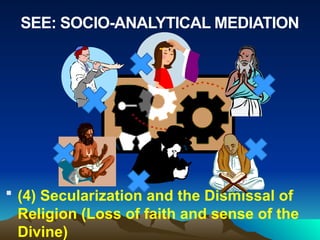
SEE: SOCIO-ANALYTICAL MEDIATION
 (4) Secularization and the Dismissal of
Religion (Loss of faith and sense of the
Divine)
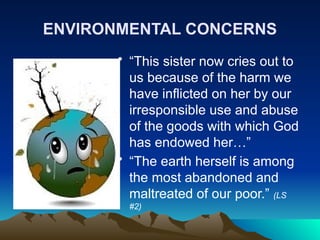
ENVIRONMENTAL CONCERNS
• “This sister now cries out to
us because of the harm we
have inflicted on her by our
irresponsible use and abuse
of the goods with which God
has endowed her…”
• “The earth herself is among
the most abandoned and
maltreated of our poor.” (LS
#2)
Perspectives from Religions
• “These statements of the Popes echo the
reflections of numerous scientists,
philosophers, theologians and civic groups, all
of which have enriched the Church’s thinking
on these questions. Outside the Catholic
Church, other Churches and Christian
communities – and other religions as well –
have expressed deep concern and offered
valuable reflections on issues which all of us
find disturbing.” LS # 7
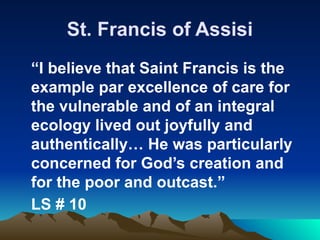
St. Francis of Assisi
“I believe that Saint Francis is the
example par excellence of care for
the vulnerable and of an integral
ecology lived out joyfully and
authentically… He was particularly
concerned for God’s creation and
for the poor and outcast.”
LS # 10
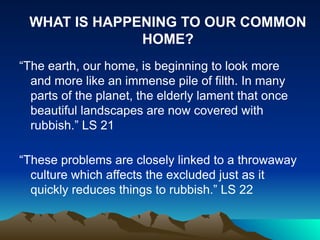
“The earth, our home, is beginning to look more
and more like an immense pile of filth. In many
parts of the planet, the elderly lament that once
beautiful landscapes are now covered with
rubbish.” LS 21
“These problems are closely linked to a throwaway
culture which affects the excluded just as it
quickly reduces things to rubbish.” LS 22
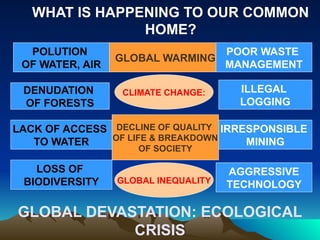
WHAT IS HAPPENING TO OUR COMMON
HOME?
GLOBAL DEVASTATION: ECOLOGICAL
CRISIS
GLOBAL WARMING
POLUTION
OF WATER, AIR
DENUDATION
OF FORESTS
LACK OF ACCESS
TO WATER
POOR WASTE
MANAGEMENT
LOSS OF
BIODIVERSITY
IRRESPONSIBLE
MINING
ILLEGAL
LOGGING
AGGRESSIVE
TECHNOLOGY
CLIMATE CHANGE:
WHAT IS HAPPENING TO OUR COMMON
HOME?
DECLINE OF QUALITY
OF LIFE & BREAKDOWN
OF SOCIETY
GLOBAL INEQUALITY
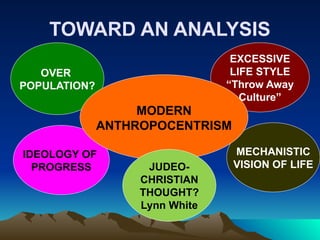
TOWARD AN ANALYSIS
OVER
POPULATION?
EXCESSIVE
LIFE STYLE
“Throw Away
Culture”
MECHANISTIC
VISION OF LIFE
IDEOLOGY OF
PROGRESS
MODERN
ANTHROPOCENTRISM
JUDEO-
CHRISTIAN
THOUGHT?
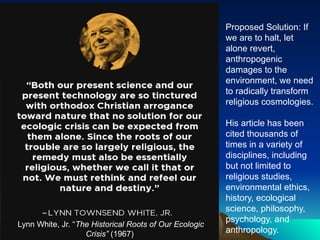
Lynn White
Lynn White, Jr. “The Historical Roots of Our Ecologic
Crisis” (1967)
Proposed Solution: If
we are to halt, let
alone revert,
anthropogenic
damages to the
environment, we need
to radically transform
religious cosmologies.
His article has been
cited thousands of
times in a variety of
disciplines, including
but not limited to
religious studies,
environmental ethics,
history, ecological
science, philosophy,
psychology, and
anthropology.
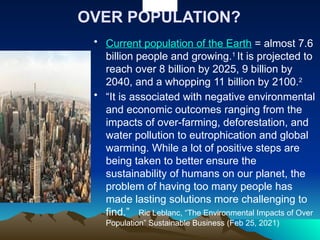
OVER POPULATION?
• Current population of the Earth = almost 7.6
billion people and growing.1
It is projected to
reach over 8 billion by 2025, 9 billion by
2040, and a whopping 11 billion by 2100.2
• “It is associated with negative environmental
and economic outcomes ranging from the
impacts of over-farming, deforestation, and
water pollution to eutrophication and global
warming. While a lot of positive steps are
being taken to better ensure the
sustainability of humans on our planet, the
problem of having too many people has
made lasting solutions more challenging to
find.” Ric Leblanc, “The Environmental Impacts of Over
Population” Sustainable Business (Feb 25, 2021)
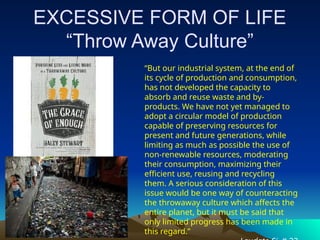
EXCESSIVE FORM OF LIFE
“Throw Away Culture”
“But our industrial system, at the end of
its cycle of production and consumption,
has not developed the capacity to
absorb and reuse waste and by-
products. We have not yet managed to
adopt a circular model of production
capable of preserving resources for
present and future generations, while
limiting as much as possible the use of
non-renewable resources, moderating
their consumption, maximizing their
efficient use, reusing and recycling
them. A serious consideration of this
issue would be one way of counteracting
the throwaway culture which affects the
entire planet, but it must be said that
only limited progress has been made in
this regard.”
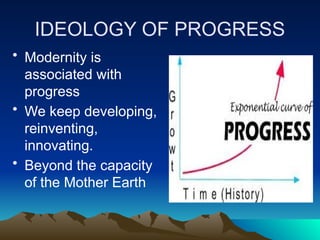
IDEOLOGY OF PROGRESS
• Modernity is
associated with
progress
• We keep developing,
reinventing,
innovating.
• Beyond the capacity
of the Mother Earth
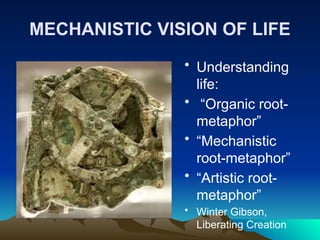
MECHANISTIC VISION OF LIFE
• Understanding
life:
• “Organic root-
metaphor”
• “Mechanistic
root-metaphor”
• “Artistic root-
metaphor”
• Winter Gibson,
Liberating Creation
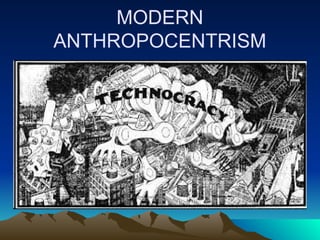
MODERN
ANTHROPOCENTRISM
• “It would be hardly helpful to describe
symptoms without acknowledging the human
origins of the ecological crisis. A certain way of
understanding human life and activity has gone
awry, to the serious detriment of the world
around us. Should we not pause and consider
this? At this stage, I propose that we focus on
the dominant technocratic paradigm and the
place of human beings and of human action in
the world.” LS 101
TECHNOCRATIC MENTALITY
THANK YOU!

apple--sadasdcjawdadsdasdasdasdasdascscesce

  • 1.
    SESSION 2 GROUNDING IN OURSOCIAL CONDITION (The Socio-Analytical Mediation)
  • 2.
    OBJECTIVES • To understandthe need and the way of doing social analysis • To identify the crucial issues in our socio- economic, political, cultural, and ecological dimensions of our life in society • To critical appreciate why such problems exists especially through social analysis
  • 3.
    SOCIAL ANALYSIS • “Itis up to Christian communities to analyze with objectivity the situation which is proper to their own country, to shed on it the light of the Gospel’s unalterable words, and to draw principles or reflections, norms of judgment, and directives of action from the social teaching of the Church” Octogesima adveniens # 4
  • 4.
  • 5.
  • 6.
    ECONOMICS Massive poverty and marginalization Economic progress anddevelopment NOT INCLUSIVE GROWTH GDP-GNP Economic Index HUMAN DEVELOPMENT Economic Index
  • 7.
     (1) Globalizationand the Phenomenon of Exclusion (Widening Gap Between Rich and Poor) SEE: SOCIO-ANALYTICAL MEDIATION
  • 8.
    Pope Francis’ Critiqueof the Economy • “Human beings are themselves considered consumer goods to be used and then discarded. We have created a “throw away” culture which is now spreading. It is no longer simply about exploitation and oppression, but something new. Exclusion ultimately has to do with what it means to be a part of the society in which we live; those excluded are no longer society’s underside or its fringes or its disenfranchised – they are no longer even a part of it. The excluded are not the “exploited” but the outcast, the “leftovers”. EG # 53 Economy of Exclusion (beyond exploitation)
  • 9.
    Critique of ‘Trickle-Down’Economies • “Some people continue to defend trickle-down theories which assume that economic growth, encouraged by a free market, will inevitably succeed in bringing about greater justice and inclusiveness in the world. This opinion, which has never been confirmed by the facts, expresses a crude and naïve trust in the goodness of those wielding economic power and in the sacralized workings of the prevailing economic system.” • EG # 54 Pope Francis’ Critique of the Economy
  • 10.
    Idolatry of Money(Fetishism of the Market) • “One cause of this situation is found in our relationship with money, since we calmly accept its dominion over ourselves and our societies. The current financial crisis can make us overlook the fact that it originated in a profound human crisis: the denial of the primacy of the human person! We have created new idols. The worship of the ancient golden calf (cf. Ex 32:1-35) has returned in a new and ruthless guise in the idolatry of money and the dictatorship of an impersonal economy lacking a truly human purpose.” (EG # 55) Pope Francis’ Critique of the Economy
  • 11.
    Financial System whichRules rather than Serves • “Money must serve, not rule! The Pope loves everyone, rich and poor alike, but he is obliged in the name of Christ to remind all that the rich must help, respect and promote the poor. I exhort you to generous solidarity and to the return of economics and finance to an ethical approach which favours human beings.” EG # 58 Pope Francis’ Critique of the Economy
  • 12.
    Exclusion and Violence •“Today’s economic mechanisms promote inordinate consumption, yet it is evident that unbridled consumerism combined with inequality proves doubly damaging to the social fabric. Inequality eventually engenders a violence which recourse to arms cannot and never will be able to resolve.” Pope Francis’ Critique of the Economy
  • 13.
    LIBERAL CAPITALISM Local Impact Deregulation (Sub)contractualization ofLabor Liberalization of Economy Privatization Lack of Social Services and Security Regressive Taxation
  • 14.
  • 15.
    ALTERNATIVE ECONOMIC SYSTEMS: Market Socialism (ChineseModel) Third Way Economy: Social Market Economy (Blair- Clinton Model) Third World Socialist Experiments: Third Worldism (Castro-Chavez) Centralized Socialist Economy (Classic Russian Model)
  • 16.
    POLITICS Human rights Civil liberties Totalwar policy (militarization) & war against terror Abuses and Corruption Elitist Democracy  (2) Distrust & Resistance to the Use of authority/ Power and attack on Democratic Institutions FEDERALISM Anti-terrorism Law POPULISM War against Drugs
  • 17.
    • “Just asgoodness tends to spread, the toleration of evil, which is injustice, tends to expand its baneful influence and quietly to undermine any political and social system, no matter how solid it may appear. If every action has its consequences, an evil embedded in the structures of a society has a constant potential for disintegration and death. We are far from the so- called “end of history”, since the conditions for a sustainable and peaceful development have not yet been adequately articulated and realized.” EG # 59 Pope Francis’ Critique of the Politics
  • 18.
    Agnosticism Secularism Post- modernism Materialism Consumerism Hedonism Cultural Politics Mass Media Socialmedia Education Religion Technology CULTURE Liberalism Pluralism Multi- Culturalism Fundamentalism
  • 19.
    SEE: SOCIO-ANALYTICAL MEDIATION (3) New Meaning of the Quality of Life: Ethos of Materialism, Consumerism and Hedonism Quality of Life and Human dignity are defined according to possession, power and fame
  • 20.
    • “The individualismof our postmodern and globalized era favours a lifestyle which weakens the development and stability of personal relationships and distorts family bonds. Pastoral activity needs to bring out more clearly the fact that our relationship with the Father demands and encourages a communion which heals, promotes and reinforces interpersonal bonds.” EG # 67 Pope Francis’ Critique of Culture Individualism
  • 21.
    • “In theprevailing culture, priority is given to the outward, the immediate, the visible, the quick, the superficial and the provisional. What is real gives way to appearances. In many countries globalization has meant a hastened deterioration of their own cultural roots and the invasion of ways of thinking and acting proper to other cultures which are economically advanced but ethically debilitated.” EG # 62 Pope Francis’ Critique of Culture The Culture of the External and Superficial
  • 22.
    • “The proliferationof new religious movements, some of which tend to fundamentalism while others seem to propose a spirituality without God. This is, on the one hand, a human reaction to a materialistic, consumerist and individualistic society, but it is also a means of exploiting the weaknesses of people living in poverty and on the fringes of society, people who make ends meet amid great human suffering and are looking for immediate solutions to their needs. These religious movements, not without a certain shrewdness, come to fill, within a predominantly individualistic culture, a vacuum left by secularist rationalism.” EG # 64 Pope Francis’ Critique of Culture Ambivalence on Religious Movements
  • 23.
    • On occasionthese may take the form of veritable attacks on religious freedom or new persecutions directed against Christians; in some countries these have reached alarming levels of hatred and violence. In many places, the problem is more that of widespread indifference and relativism, linked to disillusionment and the crisis of ideologies which has come about as a reaction to any-thing which might appear totalitarian. EG 61 Pope Francis’ Critique of Culture Absolutism and Relativism and Indifference • On occasion these may take the form of veritable attacks on religious freedom or new persecutions directed against Christians; in some countries these have reached alarming levels of hatred and violence. In many places, the problem is more that of widespread indifference and relativism, linked to disillusionment and the crisis of ideologies which has come about as a reaction to any-thing which might appear totalitarian. EG 61
  • 24.
    SEE: SOCIO-ANALYTICAL MEDIATION (4) Secularization and the Dismissal of Religion (Loss of faith and sense of the Divine)
  • 25.
    ENVIRONMENTAL CONCERNS • “Thissister now cries out to us because of the harm we have inflicted on her by our irresponsible use and abuse of the goods with which God has endowed her…” • “The earth herself is among the most abandoned and maltreated of our poor.” (LS #2)
  • 26.
    Perspectives from Religions •“These statements of the Popes echo the reflections of numerous scientists, philosophers, theologians and civic groups, all of which have enriched the Church’s thinking on these questions. Outside the Catholic Church, other Churches and Christian communities – and other religions as well – have expressed deep concern and offered valuable reflections on issues which all of us find disturbing.” LS # 7
  • 27.
    St. Francis ofAssisi “I believe that Saint Francis is the example par excellence of care for the vulnerable and of an integral ecology lived out joyfully and authentically… He was particularly concerned for God’s creation and for the poor and outcast.” LS # 10
  • 28.
    “The earth, ourhome, is beginning to look more and more like an immense pile of filth. In many parts of the planet, the elderly lament that once beautiful landscapes are now covered with rubbish.” LS 21 “These problems are closely linked to a throwaway culture which affects the excluded just as it quickly reduces things to rubbish.” LS 22 WHAT IS HAPPENING TO OUR COMMON HOME?
  • 29.
    GLOBAL DEVASTATION: ECOLOGICAL CRISIS GLOBALWARMING POLUTION OF WATER, AIR DENUDATION OF FORESTS LACK OF ACCESS TO WATER POOR WASTE MANAGEMENT LOSS OF BIODIVERSITY IRRESPONSIBLE MINING ILLEGAL LOGGING AGGRESSIVE TECHNOLOGY CLIMATE CHANGE: WHAT IS HAPPENING TO OUR COMMON HOME? DECLINE OF QUALITY OF LIFE & BREAKDOWN OF SOCIETY GLOBAL INEQUALITY
  • 30.
    TOWARD AN ANALYSIS OVER POPULATION? EXCESSIVE LIFESTYLE “Throw Away Culture” MECHANISTIC VISION OF LIFE IDEOLOGY OF PROGRESS MODERN ANTHROPOCENTRISM JUDEO- CHRISTIAN THOUGHT? Lynn White
  • 31.
    Lynn White, Jr.“The Historical Roots of Our Ecologic Crisis” (1967) Proposed Solution: If we are to halt, let alone revert, anthropogenic damages to the environment, we need to radically transform religious cosmologies. His article has been cited thousands of times in a variety of disciplines, including but not limited to religious studies, environmental ethics, history, ecological science, philosophy, psychology, and anthropology.
  • 32.
    OVER POPULATION? • Currentpopulation of the Earth = almost 7.6 billion people and growing.1 It is projected to reach over 8 billion by 2025, 9 billion by 2040, and a whopping 11 billion by 2100.2 • “It is associated with negative environmental and economic outcomes ranging from the impacts of over-farming, deforestation, and water pollution to eutrophication and global warming. While a lot of positive steps are being taken to better ensure the sustainability of humans on our planet, the problem of having too many people has made lasting solutions more challenging to find.” Ric Leblanc, “The Environmental Impacts of Over Population” Sustainable Business (Feb 25, 2021)
  • 33.
    EXCESSIVE FORM OFLIFE “Throw Away Culture” “But our industrial system, at the end of its cycle of production and consumption, has not developed the capacity to absorb and reuse waste and by- products. We have not yet managed to adopt a circular model of production capable of preserving resources for present and future generations, while limiting as much as possible the use of non-renewable resources, moderating their consumption, maximizing their efficient use, reusing and recycling them. A serious consideration of this issue would be one way of counteracting the throwaway culture which affects the entire planet, but it must be said that only limited progress has been made in this regard.”
  • 34.
    IDEOLOGY OF PROGRESS •Modernity is associated with progress • We keep developing, reinventing, innovating. • Beyond the capacity of the Mother Earth
  • 35.
    MECHANISTIC VISION OFLIFE • Understanding life: • “Organic root- metaphor” • “Mechanistic root-metaphor” • “Artistic root- metaphor” • Winter Gibson, Liberating Creation
  • 36.
  • 37.
    • “It wouldbe hardly helpful to describe symptoms without acknowledging the human origins of the ecological crisis. A certain way of understanding human life and activity has gone awry, to the serious detriment of the world around us. Should we not pause and consider this? At this stage, I propose that we focus on the dominant technocratic paradigm and the place of human beings and of human action in the world.” LS 101 TECHNOCRATIC MENTALITY
  • 38.