DIRECTING
by JINCE THOMAS
Prof ,SJB COLLEGE OF
NURSING ,Bangalore
DIRECTING is said to be a process in which the
managers instruct, guide and oversee the
performance of the workers to achieve predetermined
goals. Directing is said to be the heart of
management process. Planning, organizing, staffing
have got no importance if direction function does not
take place.
Directing is influencing people's behavior through
motivation, communication, group dynamics,
leadership and discipline. Managers give this
function a variety of names. Higgins calls it leading.
Other labels are: influencing, coaching, motivating,
interpersonal relations, and human relations.
DEFINITION
D I R E C T I N G R E F E R S T O A
P R O C E S S O R T E C H N I Q U E O F
I N S T R U C T I N G , G U I D I N G ,
I N S P I R I N G , C O U N S E L L I N G ,
O V E R S E E I N G A N D L E A D I N G
P E O P L E T O WA R D S T H E
A C C O M P L I S H M E N T O F
O R G A N I Z AT I O N A L G O A L S . I T I S
A C O N T I N U O U S M A N A G E R I A L
P R O C E S S T H AT G O E S O N
T H R O U G H O U T T H E L I F E O F
T H E O R G A N I Z AT I O N
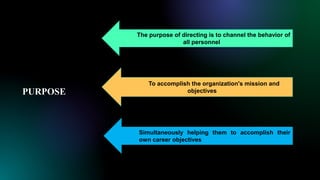
PURPOSE
The purpose of directing is to channel the behavior of
all personnel
To accomplish the organization's mission and
objectives
Simultaneously helping them to accomplish their
own career objectives
Direction consists of the process and techniques utilizing in issuing
instruction and making certain that operations are carried out as originally
planned.
Direction is a complex function that includes all those activities which are
designed to which encourage subordinates to work effectively and efficiently
in both short and long run
Direction is telling people what to do and seeing that they do it to the best of
their ability.
Directing deals with the steps a manager takes to get subordinates and others
to carry out plans.
Direction provides link between different functions in an organization.
Basic
Concepts
about
Directing
1. Pervasive Function - Directing is required at all levels of organization. Every manager provides guidance and
inspiration to his subordinates.
2. Continuous Activity - Direction is a continuous activity as it continuous throughout the life of organization.
3. Human Factor - Directing function is related to subordinates and therefore it is related to human factor. Since
human factor is complex and behaviour is unpredictable, direction function becomes important.
4. Creative Activity - Direction function helps in converting plans into performance. Without this function,
people become inactive and physical resources are meaningless.
5. Executive Function - Direction function is carried out by all managers and executives at all levels throughout
the working of an enterprise, a subordinate receives instructions from his superior only.
6. Delegate Function - Direction is supposed to be a function dealing with human beings. Human behaviour is
unpredictable by nature and conditioning the people’
s behaviour towards the goals of the enterprise is what the
executive does in this function. Therefore, it is termed as having delicacy in it to tackle human behaviour.
Characteristics Of Direction
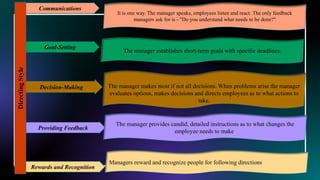
Directing
Style
Communications
Goal-Setting
Decision-Making
Providing Feedback
Rewards and Recognition
The manager makes most if not all decisions. When problems arise the manager
evaluates options, makes decisions and directs employees as to what actions to
take.
It is one way. The manager speaks, employees listen and react. The only feedback
managers ask for is - "Do you understand what needs to be done?"
Managers reward and recognize people for following directions.
The manager establishes short-term goals with specific deadlines.
The manager provides candid, detailed instructions as to what changes the
employee needs to make.
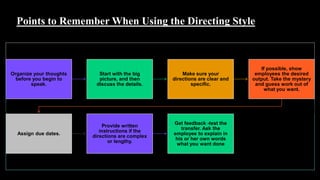
Points to Remember When Using the Directing Style
Organize your thoughts
before you begin to
speak.
Start with the big
picture, and then
discuss the details.
Make sure your
directions are clear and
specific.
If possible, show
employees the desired
output. Take the mystery
and guess work out of
what you want.
Assign due dates.
Provide written
instructions if the
directions are complex
or lengthy.
Get feedback -test the
transfer. Ask the
employee to explain in
his or her own words
what you want done
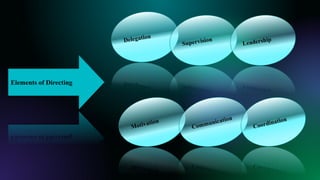
Elements of Directing
THANK YOU

Directing

  • 1.
    DIRECTING by JINCE THOMAS Prof,SJB COLLEGE OF NURSING ,Bangalore
  • 2.
    DIRECTING is saidto be a process in which the managers instruct, guide and oversee the performance of the workers to achieve predetermined goals. Directing is said to be the heart of management process. Planning, organizing, staffing have got no importance if direction function does not take place. Directing is influencing people's behavior through motivation, communication, group dynamics, leadership and discipline. Managers give this function a variety of names. Higgins calls it leading. Other labels are: influencing, coaching, motivating, interpersonal relations, and human relations.
  • 3.
    DEFINITION D I RE C T I N G R E F E R S T O A P R O C E S S O R T E C H N I Q U E O F I N S T R U C T I N G , G U I D I N G , I N S P I R I N G , C O U N S E L L I N G , O V E R S E E I N G A N D L E A D I N G P E O P L E T O WA R D S T H E A C C O M P L I S H M E N T O F O R G A N I Z AT I O N A L G O A L S . I T I S A C O N T I N U O U S M A N A G E R I A L P R O C E S S T H AT G O E S O N T H R O U G H O U T T H E L I F E O F T H E O R G A N I Z AT I O N
  • 4.
    PURPOSE The purpose ofdirecting is to channel the behavior of all personnel To accomplish the organization's mission and objectives Simultaneously helping them to accomplish their own career objectives
  • 5.
    Direction consists ofthe process and techniques utilizing in issuing instruction and making certain that operations are carried out as originally planned. Direction is a complex function that includes all those activities which are designed to which encourage subordinates to work effectively and efficiently in both short and long run Direction is telling people what to do and seeing that they do it to the best of their ability. Directing deals with the steps a manager takes to get subordinates and others to carry out plans. Direction provides link between different functions in an organization. Basic Concepts about Directing
  • 6.
    1. Pervasive Function- Directing is required at all levels of organization. Every manager provides guidance and inspiration to his subordinates. 2. Continuous Activity - Direction is a continuous activity as it continuous throughout the life of organization. 3. Human Factor - Directing function is related to subordinates and therefore it is related to human factor. Since human factor is complex and behaviour is unpredictable, direction function becomes important. 4. Creative Activity - Direction function helps in converting plans into performance. Without this function, people become inactive and physical resources are meaningless. 5. Executive Function - Direction function is carried out by all managers and executives at all levels throughout the working of an enterprise, a subordinate receives instructions from his superior only. 6. Delegate Function - Direction is supposed to be a function dealing with human beings. Human behaviour is unpredictable by nature and conditioning the people’ s behaviour towards the goals of the enterprise is what the executive does in this function. Therefore, it is termed as having delicacy in it to tackle human behaviour. Characteristics Of Direction
  • 7.
    Directing Style Communications Goal-Setting Decision-Making Providing Feedback Rewards andRecognition The manager makes most if not all decisions. When problems arise the manager evaluates options, makes decisions and directs employees as to what actions to take. It is one way. The manager speaks, employees listen and react. The only feedback managers ask for is - "Do you understand what needs to be done?" Managers reward and recognize people for following directions. The manager establishes short-term goals with specific deadlines. The manager provides candid, detailed instructions as to what changes the employee needs to make.
  • 8.
    Points to RememberWhen Using the Directing Style Organize your thoughts before you begin to speak. Start with the big picture, and then discuss the details. Make sure your directions are clear and specific. If possible, show employees the desired output. Take the mystery and guess work out of what you want. Assign due dates. Provide written instructions if the directions are complex or lengthy. Get feedback -test the transfer. Ask the employee to explain in his or her own words what you want done
  • 9.
  • 10.