Food and Beverage Service
Meeting
Guest
Expectations
Moments of Truth
 The great majority of
moments of truth
that occur in food
and beverage
settings are service
related.
Food and Beverage Service
 Outline
 Styles of Table Service
 Dining Room Organization and Personnel
 The Front Door
 Getting Ready for Service
 Serving Guests
 Beverage Service
 Wine Service
Styles of Table Service
 Seated Styles
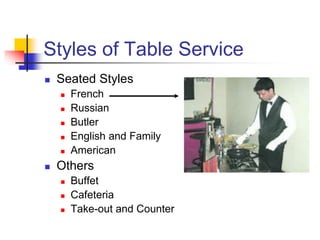
 French
 Russian
 Butler
 English and Family
 American
 Others
 Buffet
 Cafeteria
 Take-out and Counter
Styles of Table Service
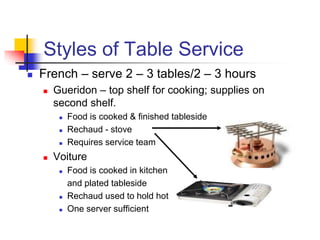
 French – serve 2 – 3 tables/2 – 3 hours
 Gueridon – top shelf for cooking; supplies on
second shelf.
 Food is cooked & finished tableside
 Rechaud - stove
 Requires service team
 Voiture
 Food is cooked in kitchen
and plated tableside
 Rechaud used to hold hot
 One server sufficient
On the gueridon, you work from and plate from left to right.
Everything is served from the right – liquids & solids.
SERVICE CART
FRENCH SERVICE POSITIONS
“BRIGADE STYLE”
 Chef de Rang –
station captain.
Takes orders,
finishes prep, plates
food.
 Commis de Rang –
Chef de Rang’s
assistant. Serves
the food after Chef
plates.
 Commis de Suite –
Food runner/timer;
sets up the gueridon
and brings out all
the food.
 Commis de
Barrasseur – bus
person; serves
bread, water, details
the table.
FRENCH SERVICE:
 Cons
1. Highly trained staff
required – high labor
cost
2. Expensive equipment
required
3. Fewer turnovers
4. Seating capacity
reduced by space
required for tableside
equipment
 Pros
1. Elegant, leisurely
and personalized
service
2. Entertaining –
flambe
3. Showcases food
and preparation
4. High average check
SHOWCASES SKILLS
Styles of Table Service
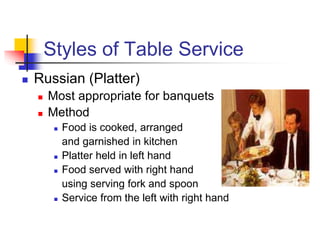
 Russian (Platter)
 Most appropriate for banquets
 Method
 Food is cooked, arranged
and garnished in kitchen
 Platter held in left hand
 Food served with right hand
using serving fork and spoon
 Service from the left with right hand
BUTLER SERVICE
 Butler
 Same as Russian Service except server
holds platter with both hands and guests
serve themselves from tray with utensils
provided
 This type of service was used on Sunday
evenings when the wait staff had the
evening off and the butler helped out at
dinner
BUTLERS……….
BUTLER SERVICE, CONT’D
 Cons of Russian
& Butler Service:
1. Space between
chairs for platter
required
2. Poor portion
control – could run
out
3. Time-consuming
 Pros of Russian and
Butler Service
1. Personalized Service
2. Guests may choose
quantity size
3. Guests may choose
quantity of sauces
Styles of Table Service
 English (Family)
 Most appropriate for private rooms or special
group dinners
 Method -- English
 Plates are preset
 Food is prepared in kitchen
 Host or maitre d’ plates main dish, guests help
themselves to sides
 Method – Family
 Same as English except guests help themselves to all
food
Styles of Table Service
 Cons
1. Not elegant
2. No portion control
3. No plate
presentation
 Pros of English
(Family)
1. Casual, communal
atmosphere
2. Guests can help
themselves to
seconds
3. Less-skilled
servers required
FAMILY STYLE……..
AMERICAN SERVICE
By far the most common style of service
 Appropriate for almost all meals
 All food is prepared and plated in kitchen.
 Serve solid food from the left with the left
hand whenever possible.
 Serve beverages and liquids from the right
with the right hand whenever possible.
 Clear from the right with the right hand
whenever possible.
AMERICAN SERVICE
 CONS
1. Less personalized
2. Guests cannot
choose portion size
 PROS
1. Informal
2. Portion control –
leads to better
portion control,
better cost control
3. Servers may have
limited skill
4. Less space
required
BUFFETS……
 Serve many guests in a short time
 The guest goes to the food
 Arrangement – Logical and convenient
 Cold foods – fruits, salads
 Vegetable
 Starch
 Main Course
 Carved meats
 A server may be present behind line
BUFFETS, CONT’D
 CONS
1. Long lines
2. Portion control –
food cost can be
high
3. Additional
equipment required
4. Not as elegant as
being served
 PROS
1. Guests have more
choices
2. Impressive display
of food – make it
pretty
3. Flexible set-up
4. Less service staff
required
5. Less-skilled
servers required
Buffet Equipment
soup
Chafing dishes
Heat lamp for carving
Dining Room Organization
and Personnel
 Owner, General Manager, Assistant General
Manager
 Maitre D’Hotel (Dining Room Manager)
 Responsible for overall management of services in
the dining room
 Includes service staff, bar staff, customer relations
and physical plant
 Captain/Supervisor
 Responsible for service in a section of tables
 Takes order
 Assists in serving food
Dining Room Organization
and Personnel
 Waiter (Front Waiter)
 Relays order to kitchen
 Serves food
 Food Runner (Back Waiter)
 Delivers food and drink
 Clears
 Bus person
 Clears, Bread, water, restock
Dining Room Organization
and Personnel
 Sommelier (Wine Steward)
 Creates wine list
 Purchases and stores wine
 Recommends wine to guests
 Serves wine
 Bartender
 Responsible for beverage service
 Bar back
 Responsible for supporting bartenders, re-stock,
clean
The Front Door
 First Impressions
 Greeting
 Seating
THE FRONT DOOR GREETING
 Make a good first and last impression
 Greet guests within thirty seconds
 Use names – especially regulars
 Pay attention to guests and the room –
not the reservation book
 Review the reservation book to
maximize seating
SEATING:
 Lead the guests to table
 Seat women by pulling out chairs
 Ladies seated against wall, men facing
ladies
 Offer menus
 Offer cocktails
 Offer bread and water
Getting Ready for Service
 Arrange tables & chairs according to
reservations.
 Make sure chairs are clean.
 Linen – Cloths and napkins; silencer
 Condiments – fill and wipe
 Stock side stations
 Appropriate table settings
ARE YOU READY?
READY?
Getting Ready for Service
Table setting
Serving Guests
Standards of Service
 Greet guests within thirty seconds.
 Serve women first, adults, kids.
 Know the proper sequence of courses.
 Serve SOLID food from the left with the left
hand. HINT: Check flatware placement if
you are not sure.
 Serve LIQUIDS from the right with the right
hand. Check flatware placement.
 Clear from the right with the right hand.
 Don’t reach across in front of a guest.
BEVERAGE SERVICE STANDARDS
 Serve beverages from the right with the
right hand
 Cocktail napkins should only be used on
a hard surface. Unnecessary on linen.
 Cocktails placed to the right above the
knife
 When wine service begins, cocktail
service ends; remove glasses
Wine Service
Service Standards
 Show the bottle label
 Cut the capsule
 Remove the cork – place
it in front of the host
 Pour about one ounce for the host
 Pour glasses for the women first
 A 750ml holds about 26 oz. – Portion
accordingly
 Whites should be stored in an ice bath
Wine Service
Service Standards
 Whites are served chilled – 44 to 54 F
 Reds are served slightly chilled – 50 to
65 F
 Sparkling wine served chilled -- 41 to
47 F
 Appropriate Glass
ware
Red White Sparkly

Dining room service

  • 1.
    Food and BeverageService Meeting Guest Expectations
  • 2.
    Moments of Truth The great majority of moments of truth that occur in food and beverage settings are service related.
  • 3.
    Food and BeverageService  Outline  Styles of Table Service  Dining Room Organization and Personnel  The Front Door  Getting Ready for Service  Serving Guests  Beverage Service  Wine Service
  • 4.
    Styles of TableService  Seated Styles  French  Russian  Butler  English and Family  American  Others  Buffet  Cafeteria  Take-out and Counter
  • 5.
    Styles of TableService  French – serve 2 – 3 tables/2 – 3 hours  Gueridon – top shelf for cooking; supplies on second shelf.  Food is cooked & finished tableside  Rechaud - stove  Requires service team  Voiture  Food is cooked in kitchen and plated tableside  Rechaud used to hold hot  One server sufficient
  • 6.
    On the gueridon,you work from and plate from left to right. Everything is served from the right – liquids & solids. SERVICE CART
  • 7.
    FRENCH SERVICE POSITIONS “BRIGADESTYLE”  Chef de Rang – station captain. Takes orders, finishes prep, plates food.  Commis de Rang – Chef de Rang’s assistant. Serves the food after Chef plates.  Commis de Suite – Food runner/timer; sets up the gueridon and brings out all the food.  Commis de Barrasseur – bus person; serves bread, water, details the table.
  • 8.
    FRENCH SERVICE:  Cons 1.Highly trained staff required – high labor cost 2. Expensive equipment required 3. Fewer turnovers 4. Seating capacity reduced by space required for tableside equipment  Pros 1. Elegant, leisurely and personalized service 2. Entertaining – flambe 3. Showcases food and preparation 4. High average check
  • 9.
  • 12.
    Styles of TableService  Russian (Platter)  Most appropriate for banquets  Method  Food is cooked, arranged and garnished in kitchen  Platter held in left hand  Food served with right hand using serving fork and spoon  Service from the left with right hand
  • 13.
    BUTLER SERVICE  Butler Same as Russian Service except server holds platter with both hands and guests serve themselves from tray with utensils provided  This type of service was used on Sunday evenings when the wait staff had the evening off and the butler helped out at dinner
  • 14.
  • 15.
    BUTLER SERVICE, CONT’D Cons of Russian & Butler Service: 1. Space between chairs for platter required 2. Poor portion control – could run out 3. Time-consuming  Pros of Russian and Butler Service 1. Personalized Service 2. Guests may choose quantity size 3. Guests may choose quantity of sauces
  • 16.
    Styles of TableService  English (Family)  Most appropriate for private rooms or special group dinners  Method -- English  Plates are preset  Food is prepared in kitchen  Host or maitre d’ plates main dish, guests help themselves to sides  Method – Family  Same as English except guests help themselves to all food
  • 17.
    Styles of TableService  Cons 1. Not elegant 2. No portion control 3. No plate presentation  Pros of English (Family) 1. Casual, communal atmosphere 2. Guests can help themselves to seconds 3. Less-skilled servers required
  • 18.
  • 19.
    AMERICAN SERVICE By farthe most common style of service  Appropriate for almost all meals  All food is prepared and plated in kitchen.  Serve solid food from the left with the left hand whenever possible.  Serve beverages and liquids from the right with the right hand whenever possible.  Clear from the right with the right hand whenever possible.
  • 20.
    AMERICAN SERVICE  CONS 1.Less personalized 2. Guests cannot choose portion size  PROS 1. Informal 2. Portion control – leads to better portion control, better cost control 3. Servers may have limited skill 4. Less space required
  • 22.
    BUFFETS……  Serve manyguests in a short time  The guest goes to the food  Arrangement – Logical and convenient  Cold foods – fruits, salads  Vegetable  Starch  Main Course  Carved meats  A server may be present behind line
  • 23.
    BUFFETS, CONT’D  CONS 1.Long lines 2. Portion control – food cost can be high 3. Additional equipment required 4. Not as elegant as being served  PROS 1. Guests have more choices 2. Impressive display of food – make it pretty 3. Flexible set-up 4. Less service staff required 5. Less-skilled servers required
  • 26.
  • 27.
    Dining Room Organization andPersonnel  Owner, General Manager, Assistant General Manager  Maitre D’Hotel (Dining Room Manager)  Responsible for overall management of services in the dining room  Includes service staff, bar staff, customer relations and physical plant  Captain/Supervisor  Responsible for service in a section of tables  Takes order  Assists in serving food
  • 28.
    Dining Room Organization andPersonnel  Waiter (Front Waiter)  Relays order to kitchen  Serves food  Food Runner (Back Waiter)  Delivers food and drink  Clears  Bus person  Clears, Bread, water, restock
  • 29.
    Dining Room Organization andPersonnel  Sommelier (Wine Steward)  Creates wine list  Purchases and stores wine  Recommends wine to guests  Serves wine  Bartender  Responsible for beverage service  Bar back  Responsible for supporting bartenders, re-stock, clean
  • 30.
    The Front Door First Impressions  Greeting  Seating
  • 31.
    THE FRONT DOORGREETING  Make a good first and last impression  Greet guests within thirty seconds  Use names – especially regulars  Pay attention to guests and the room – not the reservation book  Review the reservation book to maximize seating
  • 32.
    SEATING:  Lead theguests to table  Seat women by pulling out chairs  Ladies seated against wall, men facing ladies  Offer menus  Offer cocktails  Offer bread and water
  • 33.
    Getting Ready forService  Arrange tables & chairs according to reservations.  Make sure chairs are clean.  Linen – Cloths and napkins; silencer  Condiments – fill and wipe  Stock side stations  Appropriate table settings
  • 34.
  • 35.
  • 36.
    Getting Ready forService Table setting
  • 37.
    Serving Guests Standards ofService  Greet guests within thirty seconds.  Serve women first, adults, kids.  Know the proper sequence of courses.  Serve SOLID food from the left with the left hand. HINT: Check flatware placement if you are not sure.  Serve LIQUIDS from the right with the right hand. Check flatware placement.  Clear from the right with the right hand.  Don’t reach across in front of a guest.
  • 38.
    BEVERAGE SERVICE STANDARDS Serve beverages from the right with the right hand  Cocktail napkins should only be used on a hard surface. Unnecessary on linen.  Cocktails placed to the right above the knife  When wine service begins, cocktail service ends; remove glasses
  • 39.
    Wine Service Service Standards Show the bottle label  Cut the capsule  Remove the cork – place it in front of the host  Pour about one ounce for the host  Pour glasses for the women first  A 750ml holds about 26 oz. – Portion accordingly  Whites should be stored in an ice bath
  • 42.
    Wine Service Service Standards Whites are served chilled – 44 to 54 F  Reds are served slightly chilled – 50 to 65 F  Sparkling wine served chilled -- 41 to 47 F  Appropriate Glass ware Red White Sparkly