Styles of
Service
• French Ser vice
English Service
Family Service
American or count
Style Service
• Formal or Russian
Ser vice
Styles of
Service
• Apar tment or Blue
Plate
Tray Service
Smorgasbord
• Buffet Ser vice
Cafeteria
Gueridon Service
FRENCH SERVICE
• It is very personalized and private service. In this food serving style,
large joints, roast poultry, whole fish, and so on, that have elaborate
garnish, are neatly arranged on a platter, presented to the host, taken
back to the sideboard, carved, portioned, and served to the guests
with service spoon and fork.
Advantages
1 Elevated Dining Experience
As a type of table service, French service
offers a truly unique and luxurious dining
experience, with an emphasis on
presentation, attention to detail, and
personalized service. Customers can
expect a high level of professionalism from
their waiters, who are trained to anticipate
their needs and preferences, ensuring a
seamless dining experience.
Advantages
1 Tableside Preparation
One of the most distinctive aspects of
French service is the tableside
preparation of food. By preparing
dishes directly in front of guests, French
service adds an element of theater and
excitement to the dining experience.
This also allows guests to witness the
skill and craftsmanship that goes into
their meal, fostering a deeper
appreciation for the art of fine dining.
Advantages Customization
French service allows for a high degree
of customization, as guests can often
select their preferred dishes, sauces, and
accompaniments directly from the
service table. This not only enhances
the personalization of the dining
experience but also ensures that each
guest’s meal is tailored to their
individual tastes and preferences.
Disadvantages Cost
Due to the high level of attention to
detail and the need for skilled waitstaff,
French service can be more expensive
than other types of dining experiences.
The use of high-quality ingredients,
specialized tools, and elaborate
presentation can also contribute to the
increased cost, making French service a
luxury that not everyone can afford.
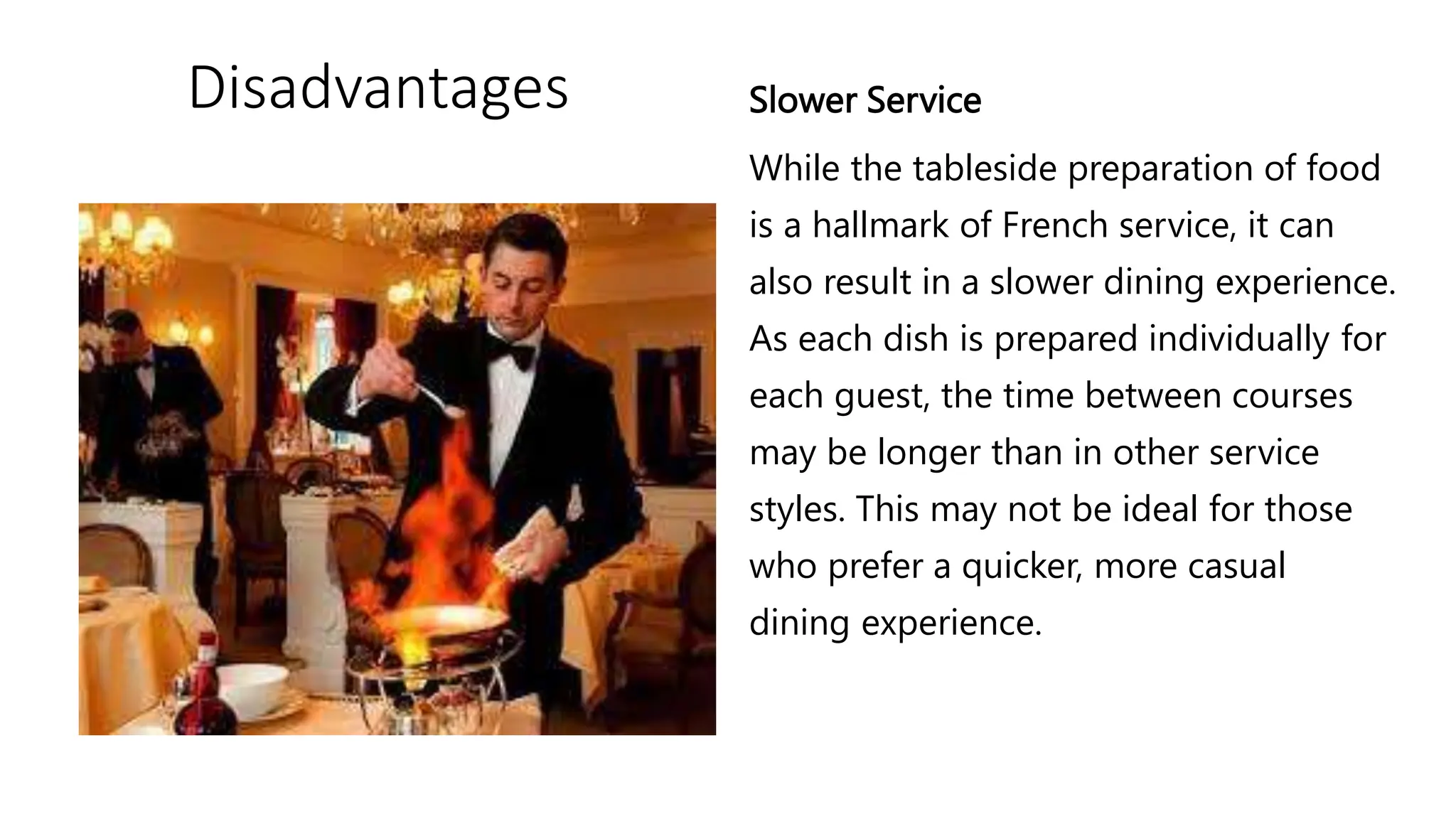
Disadvantages Slower Service
While the tableside preparation of food
is a hallmark of French service, it can
also result in a slower dining experience.
As each dish is prepared individually for
each guest, the time between courses
may be longer than in other service
styles. This may not be ideal for those
who prefer a quicker, more casual
dining experience.
Disadvantages Complexity
French service can be more complex
and labor-intensive than other styles of
dining, both for the staff and the guests.
Waitstaff must be well-trained in the
intricacies of French service, while
guests may need to understand the
various customs and etiquette
associated with this style of dining to
fully appreciate and enjoy the
experience.
•Responsible Personnel for French Service
• 1. Chef De Rang
• The Chef De Rang plays a crucial role in French service, overseeing the service
for a specific section of the dining room. They are responsible for ensuring that
each guest receives personalized and preparation of dishes.
• 2. Commis De Rang
• The Commis De Rang supports the Chef De Rang by assisting with tasks such as
setting and clearing tables, serving dishes, and attending to guests’ needs. Their
role is essential in maintaining a smooth flow of service throughout the dining
experience.
• 3. Dining Room Captain
• The Dining Room Captain oversees the entire dining room operation,
ensuring that service standards are met and coordinating the efforts
of the waitstaff. They are responsible for maintaining the overall
atmosphere and managing any issues that may arise.
• 4. Cocktail Server
• The Cocktail Server is responsible for preparing and serving cocktails
and other beverages to guests. They must be knowledgeable about
the ingredients and preparation techniques for each drink and
provide prompt, courteous service.
• 5. Wine Steward
The Wine Steward, or sommelier, is an expert in wine selection and
pairing. They assist guests in choosing the perfect wine to complement
their meal, ensuring that each bottle is properly stored, served, and
decanted as necessary. Their expertise is invaluable in enhancing the
overall dining experience.
• Each member of the French service team plays a vital role in creating
an unforgettable dining experience, working together to ensure that
each guest’s needs are met with grace, skill, and professionalism.
How to Serve
Approachin
g the table
Serving
Order
Tableside
Service
Servers should approach
from the left-hand side,
with the exception of
serving beverages, which
should be served from the
right.
French service, women are
served first, followed by
men, and finally, the host.
When clearing the table, servers should wait until all
guests have finished their course before removing
any plates or utensils. They should begin with the
guest who finished first and work their way around
the table in a clockwise direction. As a general rule,
plates should be cleared from the right-hand side,
How to Serve
Clearing
the table
When clearing the table,
servers should wait until all
guests have finished their
course before removing
any plates or utensils. They
should begin with the
guest who finished first
and work their way around
the table in a clockwise
direction.
AMERICAN SERVICE
• American service is a simple and informal form of service. It is
also known as a Plated service. In this American service style,
dishes are neatly plated in the kitchen by the kitchen staff and
placed on the guest’s cover from the right-hand side.
Advantages of American Service
1
• Service skill is not
required.
• Low labor cost.
• Quick service.
• High seat turnover as
service is fast.
• The kitchen staff has the
scope to demonstrate
their plating skills.
Disadvantages of American Service
D
• No personalized service.
• Skilled writers do not have
the scope to show their
service skills.
• Food may become cold.
• More kitchen time and
labor.
How to Serve
Approachin
g the table
Food and beverage are served from the
right side of the guests. sauces and
other garnishes are served from the left
side of the guests
The waiter should be able to carry at least
three dishes out of full plates to speed up the
service. For a group of more than three guests,
the waiter and the assistant waiter work as a
team to place the plates. Using trays for
transporting plates is not recommended.
Trays are used to carry dished-out cups and bowls.
Cups are placed on the saucers and bowls on
quarter plates with the appropriate spoons.
How to Serve
Serving
Order
Clearing
The server moves clockwise while
placing plated food.
Clearance is done from the right-hand
side.
RUSSIAN SERVICE
• In this type of service, food is fully prepared and pre-
cut in the kitchen and neatly arranged in silver
platters by the chef. The platters are brought in the
dining room by the waiter who serves the guests by
the way of dishing out food from the platter to the
individual plates.
Advantages of Russian Service
1
• Less staff is needed.
• Quick service.
• Elegant and entertaining.
• No extra space needed
for equipments
• Less expensive than most
of the service.
• Less waste because
unused foos goes back to
the kitchen to be reused
Disadvantages of American Service
D
• It requires high initial
investments on platters
and Silverware.
• If many are to be served
from one silver platter, the
last one to be served may
see rather unappetizing
serving platter
• If every guests in a party
orders different dishes.
How to Serve
Approachin
g the table
Food is served directly from the silver
platter from the left side of the guets
using the servers right hand with a
serving gear.
Serving
Order
Counter clockwise
Clearing Clearance is done from the right-hand side.
How to Serve
Clearing
Clearance is done from the right-hand
side.
ENGLISH SERVICE
• This service is often referred to as ‘Host Service’ where the host plays a
dominant role in the service. The food on platters and heated plates are
brought from the kitchen and place before the host at the head table.
• The host portions the meat, if nessesary up to the entree and vegetable
on individual plates. The host hands the plates to the waiter standing
on his left, who served the hostess, guests of honor and all other
guests.
ENGLISH SERVICE
• This is also referred to as family style service. It
originated in the home and used mainly by family
restaurants or coffee shop.
Advantages of English Service
• This type of service also
requires little dining area
or space.
• There is a higher or rapid
table turnover rate with
this type of service.
Disadvantages of English Service
• One of the major disadvantages
of the platter style service is the
difficulty to control the portion
sizes. This is because the last
guest who gets served may not
get enough item if other guest
had taken more.
How to Serve
Approachin
g the table
English service requires the food to be placed on large
platters or in large bowls placed before the host. The
guests then pass the food around the table and serve
themselves. The host may also ask the waiter to serve
the food. Food is served on the guests left hand side
while beverages on the right.
Serving
Order Counter clockwise. For replenishment of
guest food the waiter may then take the
dishes around for guests to help
themselves or be served by the waiter
Clearing Clearance is done from the right-hand
side.
Apartment or Blue Plate Service
• In this service, plates are served up in the kitchen and placed on the table
just before the dinner sit down.
Characterized by the ‘‘blue-plate’’, the plate that is divided into sections
mainly by meat and veggies.
Apartment or Blue Plate Service
Advantages of Blue Plate or Apartment Service
• The Blue plate emerged to
cater the needs of those
strapped in time. Since the
food served is pre-made
and packaged in a single
plate.
• Meals are less expensive
Disadvantages of Blu Plate Service
• The diner is forced to choose
between combos.
• NO substitution rule is
sometimes enforced.
• Designed relatively small
number of people.
How to Serve
Approach
ing the
table
Plates are served up in the kitchen and placed on the table just
before the dinner sit down. Sometimes served after seated.
Serving
Order
Eating begins when the hosts signals.
Second portions can be served from
the kitchen or offered from serving
dishes that are passed from hand to
hand.
Clearin
g
After the diners are finished, each diner may
bring his/her own plate, flatware to the kitchen.
In other cases, waiters do the clearing.
Significance of the Blue Plate Style.
Blue Plate is considered the precurser of the modren
fast- food meals . With the Blue Plate almost ready-to
eat and conveniently presented, fast food chains have
borrowed taken many of the factors that made Blue
Plate Popular.
FAMILY STYLE SERVICE
• It originated in the home and used mainly by family restaurants or
coffee shop.
• Food are dished out in a large bowls and platters by placing them in
the center of the table. The food are passed around the table to help
themselves to the portion desired.
Advantages of Family Style
• It is fast.
• Self Service.
• A waiter or waitress will be
able to service more people.
Disadvantages of a Family Style Service
• The guests receives less
personal attention and must
served himself from a food
platter which becomes less
attractive as other guests
service themselves..
COUNTRY STYLE SERVICE
• Is an old type of service involving serving oneself from a common
pot. It is fairly commonly used for serving family or public meals.
Almost similar to family service.
COUNTRY STYLE SERVICE
1. Individual plates at the table are completetly laid,
including dinner plate.
2. Serving dishes of food are placed on the dining table.
3. Each Serving dish is passed from hand to hand in one
dirention until all in the table have served themselves.
4. Each person serves himself.
5. Someone at the table removes the main course and
served the dessert.
6. Dessert may be brought in from the kitchen in hte
individual portions, it may be served at a table, or it may be
passed around the table.
TRAY SERVICE
• method of service in which the whole or part of a meal is
served on a tray to customer such as hospitals, aircraft or
railway catering.
• Place a mat of some kind on the tray to keep dishes from sliding.
• Lay only the flatware required for the main course.
• Tuck the napking partially under the flatwares.
• Use short tumblers. Cups without saucers may be used for beverages.
• bread and butter plates or small bowls for salad may be used.
• Serve the main course in a smallest plate that may accommodate it.
• Dessert may be included in a tray.
Gueridon Service
Gueridon service is a style of dining where food is partially
prepared in the kitchen, then completed in the guests’
presence, typically using a gueridon, a mobile cooking cart.
This technique not only provides a meal but also a form of
entertainment, showcasing the culinary skills and flair of
the chef or server.
Different Types of Gueridon Trolleys used in
Gueridon Service
Flambe Trolley
These have a gas burner or flare
lamp which is fixed on the trolley
to the level of the top surface. The
carving trolley has a carving board
that is placed over a chafing dish
during carving to retain the heat
of the meat.
Different Types of Gueridon Trolleys used in
Gueridon Service
Carving Trolley
The carving trolley has a
carving board that is placed
over a chafing dish during
carving to retain the heat of
the meat.
Different Types of Gueridon Trolleys used in
Gueridon Service
Cheese Trolley
It has a variety of cheeses, a
cheese board, and cheese knife
for cutting the cheese, and
appropriate accompaniments for
cheese. The surface of the trolley
is normally marble and has a
translucent dome to cover the
top.
Different Types of Gueridon Trolleys used in
Gueridon Service
Liquor Trolley
It has assorted glasses,
measurements, ice buckets, spirit
and liqueur bottles, carafes, etc. It
may also have cigars, a cigar
cutter, and a lighter. A restaurant
normally has two to three types of
trolleys in gueridon service,
mainly preparation, flambeing,
and liqueur trolleys.
Different Types of Gueridon Trolleys used in
Gueridon Service
Flambe Trolley
These have a gas burner or flare
lamp which is fixed on the trolley
to the level of the top surface. The
carving trolley has a carving board
that is placed over a chafing dish
during carving to retain the heat
of the meat.
Different Types of Gueridon Trolleys used in
Gueridon Service
Salad Trolley
It has plates and bowls, underplates, containers with
prepared ingredients, salad dressings, and seasonings that
are required to prepare the salads.
BUFFET SERVICE
•Buffet service is a self-service dining setup
where guests serve themselves from a
variety of dishes displayed on a long table.
This service is popular in various settings,
from casual gatherings to upscale events.
Advantages of Buffet Style Service
• Diversity of Cuisine
• Visual Appeal and
Presentation.
• Guests have the freedom
to choose what they want
to eat, how much they
want, and in what order.
• This self-service format
empowers guests to create
their own dining
experience
Advantages of Buffet Style Service
• Interaction and Engagement
• Ideal for serving a large number of guests simultaneously
without the wait associated with traditional sit-down services.
• It reduces the need for a large service staff, as guests serve
themselves.
• Cost-Effectiveness
• Simplified Service Model
• Flexibility in Event Planning
Disadvantages of a Buffet Style Service
• Food Safety and Hygiene
• Wastage
• Dining Experience
• Cost and Setup
• Initial setup can be costly due
to the need for multiple sets of
serving equipment and
dishware.
• Requires more space to
accommodate large tables and
guest movement.
• Guest Flow
I have a house , towards
the sea, with spring flowers
blossoming.
I have a house , towards
the sea, with spring flowers
blossoming.
I have a house , towards
the sea, with spring flowers
blossoming.
I have a house , towards
the sea, with spring flowers
blossoming.
I have a house , towards
the sea, with spring flowers
blossoming.
YOUR TEXT YOUR TEXT YOUR TEXT
YOUR TEXT
YOUR TEXT
5 YOUR TITLE
Organizing a Buffet Service
• Setting Up the Buffet Table
• Arrange dishes in logical order, starting with appetizers and ending
with desserts.
• Place plates at the beginning and flatware at the end for ease of
handling.
Presentation
•Use varying heights and attractive dishware to
create a visually appealing spread.
•Label each dish, especially those that cater to
dietary restrictions.
Executing a Smooth Buffet Service
•Managing Flow
•Designate clear starting and ending points
to prevent congestion.
•Consider multiple buffet tables for larger
events to ensure smooth flow.
Maintaining the Buffet
•Regularly replenish dishes to keep the buffet
looking abundant.
•Keep the area clean and tidy to maintain an
inviting atmosphere.
CAFETERIA SERVICE
• This service normally exists in industrial canteens, colleges,
hospitals or hotel staff cafeterias. To facilitate quick service, the
menu is fixed and display on large menu boards with each item
priced separately. Food is attractively arranged in proper
sequence o counter. The guests start at one end of the counter
holding plates on their hands. They move along the counter
picking their choice of dishes. The cashier makes a bill for the
items that are collected by the guests.
CAFETERIA SERVICE
• Features-
• Guests stand in a line.
• They pick up the tray.
•They move along the counter picking their choice of
dishes.
• The guests pay the bill.
Advantages of Cafeteria Style Service
• Less skilled staff is
required.
• Labor cost is low.
• Seat turnover is very
high.
Disadvantages of Cafeteria Style Service
• If counters are not
properly organized, it
may lead to congestion.
• Dishes may lose eye
appeal after repeated
serving.
• Food may be cold after
some times.
Smorgasbord
A smorgasbord is a Swedish term that refers to a type of buffet that
features traditional Scandinavian dishes. The term has evolved to
describe any type of buffet that offers a wide variety of dishes. Unlike a
traditional buffet, a smorgasbord typically includes cold dishes, such as
pickled herring, smoked salmon, and cold cuts, as well as hot dishes like
meatballs, sausages, and casseroles. Smorgasbords are often served at
special events and celebrations, such as weddings and holidays.
Smorgasbord
The word smörgåsbord is Swedish and its
etymology comes from the words smörgås,
meaning “open sandwich” or “buttered bread” and
bord meaning “table”. So, the definition of
smörgåsbord is literally a table full of open
sandwiches.
Smorgasbord
T h a n k s f o r W a t c h i n g
D a t e
S u m m e r h o l i d a y

Service Styles Presentation. Food Service

  • 2.
    Styles of Service • FrenchSer vice English Service Family Service American or count Style Service • Formal or Russian Ser vice
  • 31.
    Styles of Service • Apartment or Blue Plate Tray Service Smorgasbord • Buffet Ser vice Cafeteria Gueridon Service
  • 32.
    FRENCH SERVICE • Itis very personalized and private service. In this food serving style, large joints, roast poultry, whole fish, and so on, that have elaborate garnish, are neatly arranged on a platter, presented to the host, taken back to the sideboard, carved, portioned, and served to the guests with service spoon and fork.
  • 34.
    Advantages 1 Elevated DiningExperience As a type of table service, French service offers a truly unique and luxurious dining experience, with an emphasis on presentation, attention to detail, and personalized service. Customers can expect a high level of professionalism from their waiters, who are trained to anticipate their needs and preferences, ensuring a seamless dining experience.
  • 35.
    Advantages 1 Tableside Preparation Oneof the most distinctive aspects of French service is the tableside preparation of food. By preparing dishes directly in front of guests, French service adds an element of theater and excitement to the dining experience. This also allows guests to witness the skill and craftsmanship that goes into their meal, fostering a deeper appreciation for the art of fine dining.
  • 36.
    Advantages Customization French serviceallows for a high degree of customization, as guests can often select their preferred dishes, sauces, and accompaniments directly from the service table. This not only enhances the personalization of the dining experience but also ensures that each guest’s meal is tailored to their individual tastes and preferences.
  • 37.
    Disadvantages Cost Due tothe high level of attention to detail and the need for skilled waitstaff, French service can be more expensive than other types of dining experiences. The use of high-quality ingredients, specialized tools, and elaborate presentation can also contribute to the increased cost, making French service a luxury that not everyone can afford.
  • 38.
    Disadvantages Slower Service Whilethe tableside preparation of food is a hallmark of French service, it can also result in a slower dining experience. As each dish is prepared individually for each guest, the time between courses may be longer than in other service styles. This may not be ideal for those who prefer a quicker, more casual dining experience.
  • 39.
    Disadvantages Complexity French servicecan be more complex and labor-intensive than other styles of dining, both for the staff and the guests. Waitstaff must be well-trained in the intricacies of French service, while guests may need to understand the various customs and etiquette associated with this style of dining to fully appreciate and enjoy the experience.
  • 40.
    •Responsible Personnel forFrench Service • 1. Chef De Rang • The Chef De Rang plays a crucial role in French service, overseeing the service for a specific section of the dining room. They are responsible for ensuring that each guest receives personalized and preparation of dishes. • 2. Commis De Rang • The Commis De Rang supports the Chef De Rang by assisting with tasks such as setting and clearing tables, serving dishes, and attending to guests’ needs. Their role is essential in maintaining a smooth flow of service throughout the dining experience.
  • 41.
    • 3. DiningRoom Captain • The Dining Room Captain oversees the entire dining room operation, ensuring that service standards are met and coordinating the efforts of the waitstaff. They are responsible for maintaining the overall atmosphere and managing any issues that may arise. • 4. Cocktail Server • The Cocktail Server is responsible for preparing and serving cocktails and other beverages to guests. They must be knowledgeable about the ingredients and preparation techniques for each drink and provide prompt, courteous service.
  • 42.
    • 5. WineSteward The Wine Steward, or sommelier, is an expert in wine selection and pairing. They assist guests in choosing the perfect wine to complement their meal, ensuring that each bottle is properly stored, served, and decanted as necessary. Their expertise is invaluable in enhancing the overall dining experience. • Each member of the French service team plays a vital role in creating an unforgettable dining experience, working together to ensure that each guest’s needs are met with grace, skill, and professionalism.
  • 43.
    How to Serve Approachin gthe table Serving Order Tableside Service Servers should approach from the left-hand side, with the exception of serving beverages, which should be served from the right. French service, women are served first, followed by men, and finally, the host. When clearing the table, servers should wait until all guests have finished their course before removing any plates or utensils. They should begin with the guest who finished first and work their way around the table in a clockwise direction. As a general rule, plates should be cleared from the right-hand side,
  • 44.
    How to Serve Clearing thetable When clearing the table, servers should wait until all guests have finished their course before removing any plates or utensils. They should begin with the guest who finished first and work their way around the table in a clockwise direction.
  • 45.
    AMERICAN SERVICE • Americanservice is a simple and informal form of service. It is also known as a Plated service. In this American service style, dishes are neatly plated in the kitchen by the kitchen staff and placed on the guest’s cover from the right-hand side.
  • 46.
    Advantages of AmericanService 1 • Service skill is not required. • Low labor cost. • Quick service. • High seat turnover as service is fast. • The kitchen staff has the scope to demonstrate their plating skills.
  • 47.
    Disadvantages of AmericanService D • No personalized service. • Skilled writers do not have the scope to show their service skills. • Food may become cold. • More kitchen time and labor.
  • 48.
    How to Serve Approachin gthe table Food and beverage are served from the right side of the guests. sauces and other garnishes are served from the left side of the guests The waiter should be able to carry at least three dishes out of full plates to speed up the service. For a group of more than three guests, the waiter and the assistant waiter work as a team to place the plates. Using trays for transporting plates is not recommended. Trays are used to carry dished-out cups and bowls. Cups are placed on the saucers and bowls on quarter plates with the appropriate spoons.
  • 49.
    How to Serve Serving Order Clearing Theserver moves clockwise while placing plated food. Clearance is done from the right-hand side.
  • 50.
    RUSSIAN SERVICE • Inthis type of service, food is fully prepared and pre- cut in the kitchen and neatly arranged in silver platters by the chef. The platters are brought in the dining room by the waiter who serves the guests by the way of dishing out food from the platter to the individual plates.
  • 51.
    Advantages of RussianService 1 • Less staff is needed. • Quick service. • Elegant and entertaining. • No extra space needed for equipments • Less expensive than most of the service. • Less waste because unused foos goes back to the kitchen to be reused
  • 52.
    Disadvantages of AmericanService D • It requires high initial investments on platters and Silverware. • If many are to be served from one silver platter, the last one to be served may see rather unappetizing serving platter • If every guests in a party orders different dishes.
  • 53.
    How to Serve Approachin gthe table Food is served directly from the silver platter from the left side of the guets using the servers right hand with a serving gear. Serving Order Counter clockwise Clearing Clearance is done from the right-hand side.
  • 54.
    How to Serve Clearing Clearanceis done from the right-hand side.
  • 55.
    ENGLISH SERVICE • Thisservice is often referred to as ‘Host Service’ where the host plays a dominant role in the service. The food on platters and heated plates are brought from the kitchen and place before the host at the head table. • The host portions the meat, if nessesary up to the entree and vegetable on individual plates. The host hands the plates to the waiter standing on his left, who served the hostess, guests of honor and all other guests.
  • 56.
    ENGLISH SERVICE • Thisis also referred to as family style service. It originated in the home and used mainly by family restaurants or coffee shop.
  • 57.
    Advantages of EnglishService • This type of service also requires little dining area or space. • There is a higher or rapid table turnover rate with this type of service.
  • 58.
    Disadvantages of EnglishService • One of the major disadvantages of the platter style service is the difficulty to control the portion sizes. This is because the last guest who gets served may not get enough item if other guest had taken more.
  • 59.
    How to Serve Approachin gthe table English service requires the food to be placed on large platters or in large bowls placed before the host. The guests then pass the food around the table and serve themselves. The host may also ask the waiter to serve the food. Food is served on the guests left hand side while beverages on the right. Serving Order Counter clockwise. For replenishment of guest food the waiter may then take the dishes around for guests to help themselves or be served by the waiter Clearing Clearance is done from the right-hand side.
  • 60.
    Apartment or BluePlate Service • In this service, plates are served up in the kitchen and placed on the table just before the dinner sit down. Characterized by the ‘‘blue-plate’’, the plate that is divided into sections mainly by meat and veggies.
  • 61.
    Apartment or BluePlate Service
  • 62.
    Apartment or BluePlate Service
  • 63.
    Advantages of BluePlate or Apartment Service • The Blue plate emerged to cater the needs of those strapped in time. Since the food served is pre-made and packaged in a single plate. • Meals are less expensive
  • 64.
    Disadvantages of BluPlate Service • The diner is forced to choose between combos. • NO substitution rule is sometimes enforced. • Designed relatively small number of people.
  • 65.
    How to Serve Approach ingthe table Plates are served up in the kitchen and placed on the table just before the dinner sit down. Sometimes served after seated. Serving Order Eating begins when the hosts signals. Second portions can be served from the kitchen or offered from serving dishes that are passed from hand to hand. Clearin g After the diners are finished, each diner may bring his/her own plate, flatware to the kitchen. In other cases, waiters do the clearing.
  • 66.
    Significance of theBlue Plate Style. Blue Plate is considered the precurser of the modren fast- food meals . With the Blue Plate almost ready-to eat and conveniently presented, fast food chains have borrowed taken many of the factors that made Blue Plate Popular.
  • 67.
    FAMILY STYLE SERVICE •It originated in the home and used mainly by family restaurants or coffee shop. • Food are dished out in a large bowls and platters by placing them in the center of the table. The food are passed around the table to help themselves to the portion desired.
  • 68.
    Advantages of FamilyStyle • It is fast. • Self Service. • A waiter or waitress will be able to service more people.
  • 69.
    Disadvantages of aFamily Style Service • The guests receives less personal attention and must served himself from a food platter which becomes less attractive as other guests service themselves..
  • 70.
    COUNTRY STYLE SERVICE •Is an old type of service involving serving oneself from a common pot. It is fairly commonly used for serving family or public meals. Almost similar to family service.
  • 71.
  • 72.
    1. Individual platesat the table are completetly laid, including dinner plate. 2. Serving dishes of food are placed on the dining table. 3. Each Serving dish is passed from hand to hand in one dirention until all in the table have served themselves. 4. Each person serves himself. 5. Someone at the table removes the main course and served the dessert. 6. Dessert may be brought in from the kitchen in hte individual portions, it may be served at a table, or it may be passed around the table.
  • 73.
    TRAY SERVICE • methodof service in which the whole or part of a meal is served on a tray to customer such as hospitals, aircraft or railway catering.
  • 74.
    • Place amat of some kind on the tray to keep dishes from sliding. • Lay only the flatware required for the main course. • Tuck the napking partially under the flatwares. • Use short tumblers. Cups without saucers may be used for beverages. • bread and butter plates or small bowls for salad may be used. • Serve the main course in a smallest plate that may accommodate it. • Dessert may be included in a tray.
  • 77.
    Gueridon Service Gueridon serviceis a style of dining where food is partially prepared in the kitchen, then completed in the guests’ presence, typically using a gueridon, a mobile cooking cart. This technique not only provides a meal but also a form of entertainment, showcasing the culinary skills and flair of the chef or server.
  • 78.
    Different Types ofGueridon Trolleys used in Gueridon Service Flambe Trolley These have a gas burner or flare lamp which is fixed on the trolley to the level of the top surface. The carving trolley has a carving board that is placed over a chafing dish during carving to retain the heat of the meat.
  • 79.
    Different Types ofGueridon Trolleys used in Gueridon Service Carving Trolley The carving trolley has a carving board that is placed over a chafing dish during carving to retain the heat of the meat.
  • 80.
    Different Types ofGueridon Trolleys used in Gueridon Service Cheese Trolley It has a variety of cheeses, a cheese board, and cheese knife for cutting the cheese, and appropriate accompaniments for cheese. The surface of the trolley is normally marble and has a translucent dome to cover the top.
  • 81.
    Different Types ofGueridon Trolleys used in Gueridon Service Liquor Trolley It has assorted glasses, measurements, ice buckets, spirit and liqueur bottles, carafes, etc. It may also have cigars, a cigar cutter, and a lighter. A restaurant normally has two to three types of trolleys in gueridon service, mainly preparation, flambeing, and liqueur trolleys.
  • 82.
    Different Types ofGueridon Trolleys used in Gueridon Service Flambe Trolley These have a gas burner or flare lamp which is fixed on the trolley to the level of the top surface. The carving trolley has a carving board that is placed over a chafing dish during carving to retain the heat of the meat.
  • 83.
    Different Types ofGueridon Trolleys used in Gueridon Service Salad Trolley It has plates and bowls, underplates, containers with prepared ingredients, salad dressings, and seasonings that are required to prepare the salads.
  • 84.
    BUFFET SERVICE •Buffet serviceis a self-service dining setup where guests serve themselves from a variety of dishes displayed on a long table. This service is popular in various settings, from casual gatherings to upscale events.
  • 85.
    Advantages of BuffetStyle Service • Diversity of Cuisine • Visual Appeal and Presentation. • Guests have the freedom to choose what they want to eat, how much they want, and in what order. • This self-service format empowers guests to create their own dining experience
  • 86.
    Advantages of BuffetStyle Service • Interaction and Engagement • Ideal for serving a large number of guests simultaneously without the wait associated with traditional sit-down services. • It reduces the need for a large service staff, as guests serve themselves. • Cost-Effectiveness • Simplified Service Model • Flexibility in Event Planning
  • 87.
    Disadvantages of aBuffet Style Service • Food Safety and Hygiene • Wastage • Dining Experience • Cost and Setup • Initial setup can be costly due to the need for multiple sets of serving equipment and dishware. • Requires more space to accommodate large tables and guest movement. • Guest Flow
  • 88.
    I have ahouse , towards the sea, with spring flowers blossoming. I have a house , towards the sea, with spring flowers blossoming. I have a house , towards the sea, with spring flowers blossoming. I have a house , towards the sea, with spring flowers blossoming. I have a house , towards the sea, with spring flowers blossoming. YOUR TEXT YOUR TEXT YOUR TEXT YOUR TEXT YOUR TEXT 5 YOUR TITLE
  • 89.
    Organizing a BuffetService • Setting Up the Buffet Table • Arrange dishes in logical order, starting with appetizers and ending with desserts. • Place plates at the beginning and flatware at the end for ease of handling.
  • 90.
    Presentation •Use varying heightsand attractive dishware to create a visually appealing spread. •Label each dish, especially those that cater to dietary restrictions.
  • 91.
    Executing a SmoothBuffet Service •Managing Flow •Designate clear starting and ending points to prevent congestion. •Consider multiple buffet tables for larger events to ensure smooth flow.
  • 92.
    Maintaining the Buffet •Regularlyreplenish dishes to keep the buffet looking abundant. •Keep the area clean and tidy to maintain an inviting atmosphere.
  • 93.
    CAFETERIA SERVICE • Thisservice normally exists in industrial canteens, colleges, hospitals or hotel staff cafeterias. To facilitate quick service, the menu is fixed and display on large menu boards with each item priced separately. Food is attractively arranged in proper sequence o counter. The guests start at one end of the counter holding plates on their hands. They move along the counter picking their choice of dishes. The cashier makes a bill for the items that are collected by the guests.
  • 94.
    CAFETERIA SERVICE • Features- •Guests stand in a line. • They pick up the tray. •They move along the counter picking their choice of dishes. • The guests pay the bill.
  • 95.
    Advantages of CafeteriaStyle Service • Less skilled staff is required. • Labor cost is low. • Seat turnover is very high.
  • 96.
    Disadvantages of CafeteriaStyle Service • If counters are not properly organized, it may lead to congestion. • Dishes may lose eye appeal after repeated serving. • Food may be cold after some times.
  • 97.
    Smorgasbord A smorgasbord isa Swedish term that refers to a type of buffet that features traditional Scandinavian dishes. The term has evolved to describe any type of buffet that offers a wide variety of dishes. Unlike a traditional buffet, a smorgasbord typically includes cold dishes, such as pickled herring, smoked salmon, and cold cuts, as well as hot dishes like meatballs, sausages, and casseroles. Smorgasbords are often served at special events and celebrations, such as weddings and holidays.
  • 98.
    Smorgasbord The word smörgåsbordis Swedish and its etymology comes from the words smörgås, meaning “open sandwich” or “buttered bread” and bord meaning “table”. So, the definition of smörgåsbord is literally a table full of open sandwiches.
  • 99.
  • 100.
    T h an k s f o r W a t c h i n g D a t e S u m m e r h o l i d a y