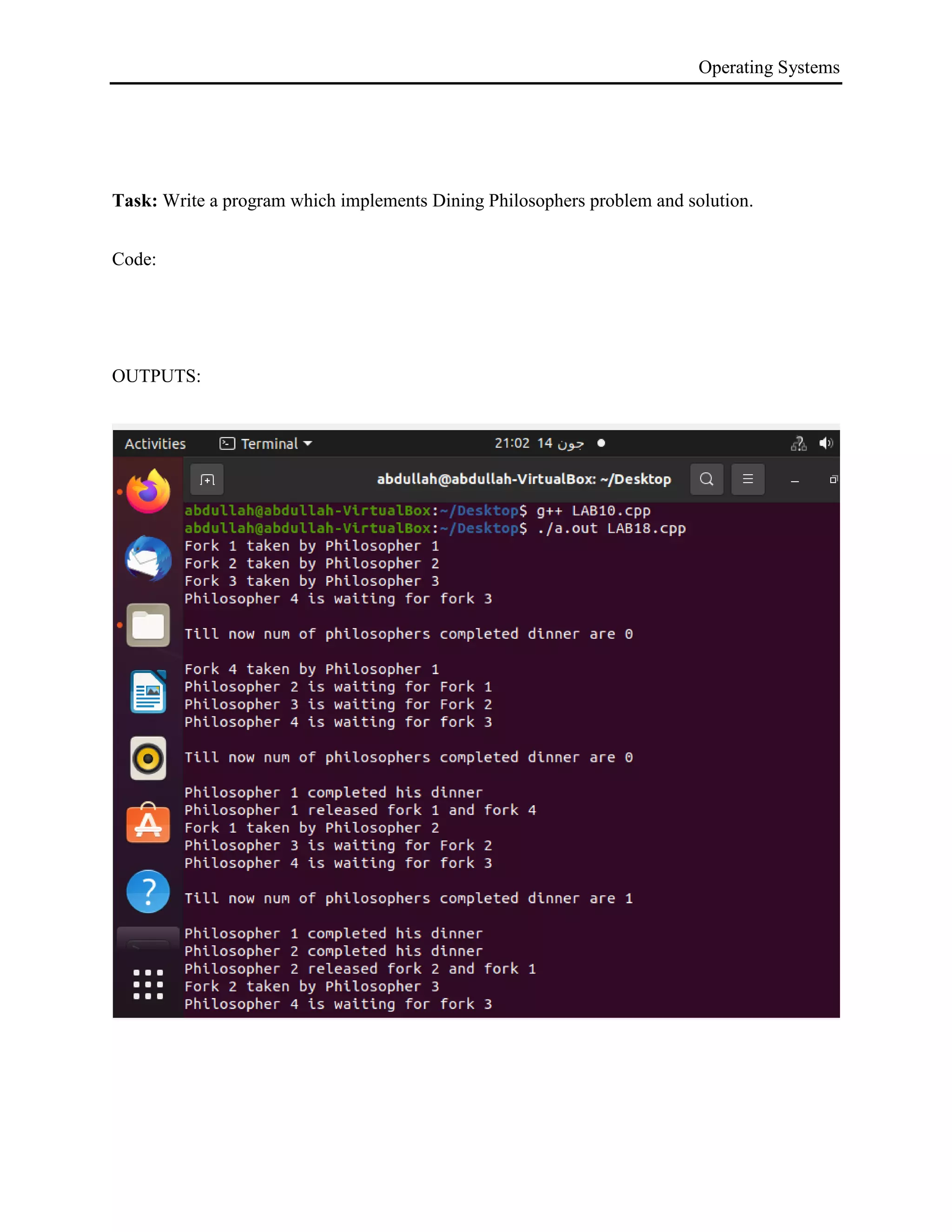
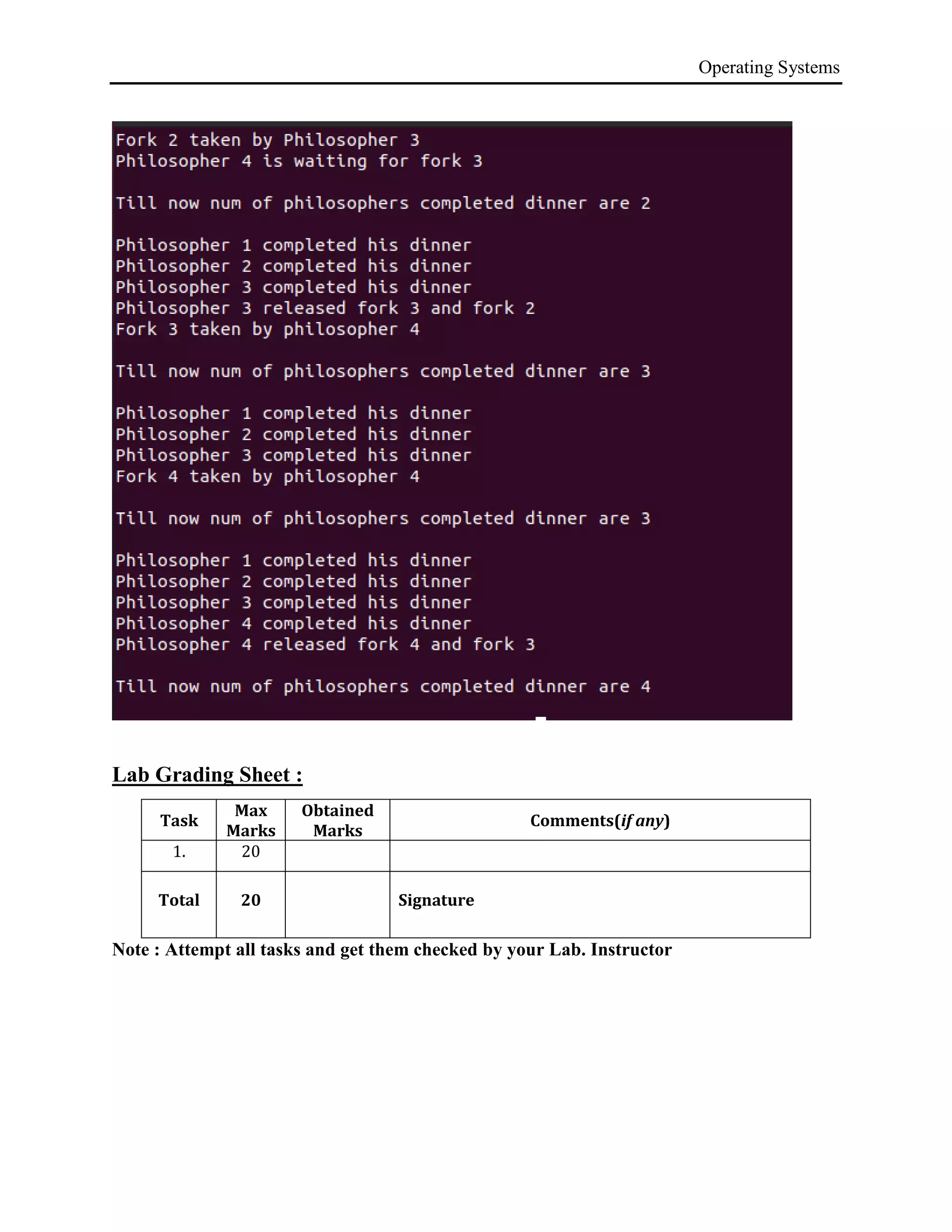
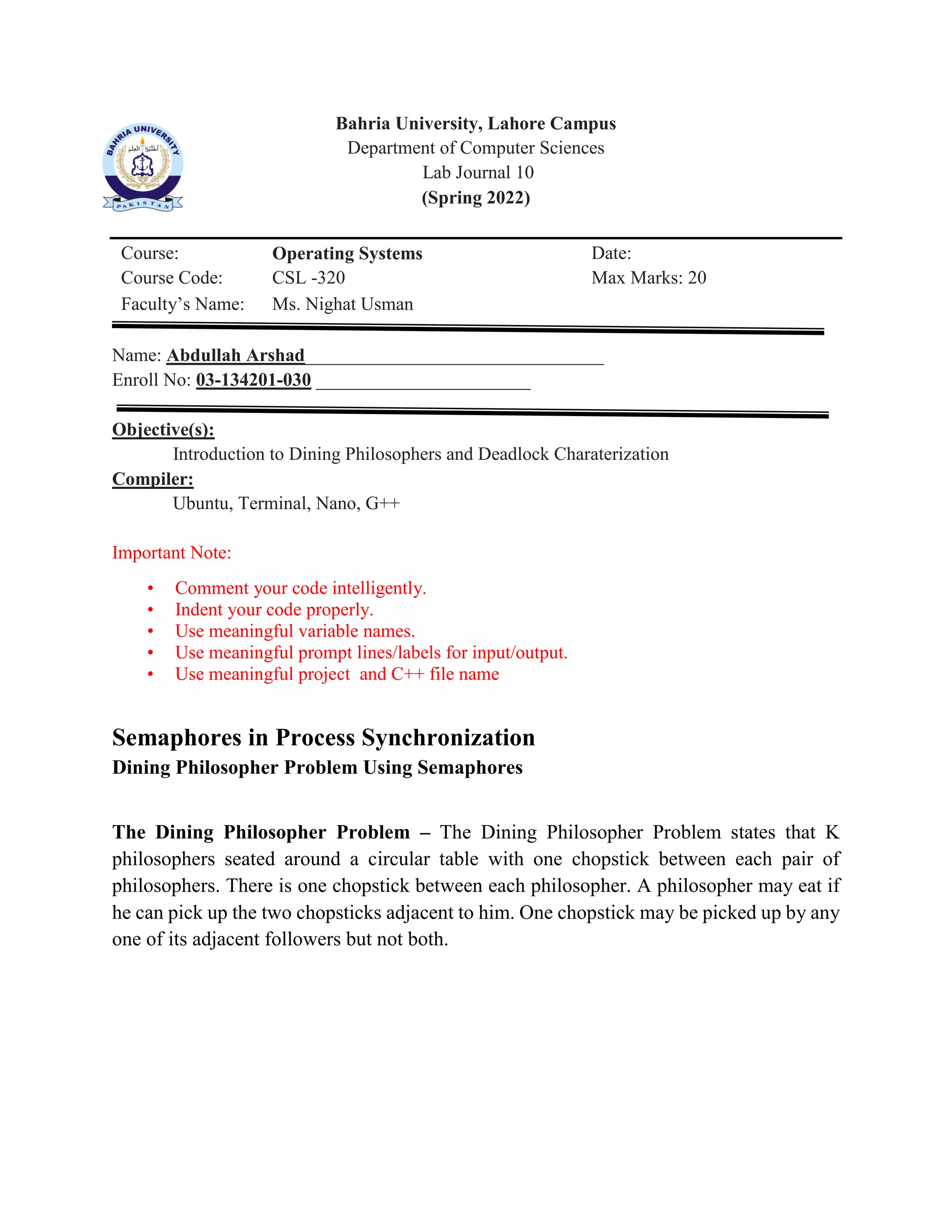
The document discusses the dining philosophers problem and provides a C++ program to model its solution using semaphores. The dining philosophers problem involves K philosophers sharing K/2 chopsticks where each philosopher needs two chopsticks to eat. The program represents each philosopher and chopstick with structures and uses semaphores to synchronize access in order to avoid deadlock. It allows the philosophers to think, pick up chopsticks, eat, and put chopsticks down in a loop until all have completed their meal.
![Operating Systems
Semaphore Solution to Dining Philosopher –
Each philosopher is represented by the following pseudocode:
process P[i]
while true do
{ THINK;
PICKUP(CHOPSTICK[i], CHOPSTICK[i+1 mod 5]);
EAT;
PUTDOWN(CHOPSTICK[i], CHOPSTICK[i+1 mod 5])
}
There are three states of the philosopher: THINKING, HUNGRY, and EATING. Here
there are two semaphores: Mutex and a semaphore array for the philosophers. Mutex is
used such that no two philosophers may access the pickup or putdown at the same time.
The array is used to control the behavior of each philosopher. But, semaphores can result
in deadlock due to programming errors.
Solution of Dining Philosophers Problem
A solution of the Dining Philosophers Problem is to use a semaphore to represent a
chopstick. A chopstick can be picked up by executing a wait operation on the semaphore
and released by executing a signal semaphore.](https://image.slidesharecdn.com/os-labjournal10-220622192422-524fb3ab/75/OS-Lab-journal-10-pdf-2-2048.jpg)
![Operating Systems
The structure of the chopstick is shown below −
semaphore chopstick [5];
Initially the elements of the chopstick are initialized to 1 as the chopsticks are on the table
and not picked up by a philosopher.
The structure of a random philosopher i is given as follows −
do {
wait( chopstick[i] );
wait( chopstick[ (i+1) % 5] );
. .
. EATING THE RICE
.
signal( chopstick[i] );
signal( chopstick[ (i+1) % 5] );
.
. THINKING
.
} while(1);
In the above structure, first wait operation is performed on chopstick[i] and chopstick[ (i+1) % 5].
This means that the philosopher i has picked up the chopsticks on his sides. Then the eating
function is performed.
After that, signal operation is performed on chopstick[i] and chopstick[ (i+1) % 5]. This means
that the philosopher i has eaten and put down the chopsticks on his sides. Then the philosopher
goes back to thinking.
Difficulty with the solution
The above solution makes sure that no two neighboring philosophers can eat at the same time.
But this solution can lead to a deadlock. This may happen if all the philosophers pick their left
chopstick simultaneously. Then none of them can eat and deadlock occurs.
Some of the ways to avoid deadlock are as follows −
There should be at most four philosophers on the table.
An even philosopher should pick the right chopstick and then the left chopstick while an
odd philosopher should pick the left chopstick and then the right chopstick.](https://image.slidesharecdn.com/os-labjournal10-220622192422-524fb3ab/75/OS-Lab-journal-10-pdf-3-2048.jpg)
![Operating Systems
A philosopher should only be allowed to pick their chopstick if both are available at the
same time.
Program for Dining Philosophers Problem in C++
#include<iostream>
#define n 4
using namespace std;
int compltedPhilo = 0,i;
struct fork{
int taken;
}ForkAvil[n];
struct philosp{
int left;
int right;
}Philostatus[n];
void goForDinner(int philID){ //same like threads concept here cases implemented
if(Philostatus[philID].left==10 && Philostatus[philID].right==10)
cout<<"Philosopher "<<philID+1<<" completed his dinnern";
//if already completed dinner
else if(Philostatus[philID].left==1 && Philostatus[philID].right==1){
//if just taken two forks
cout<<"Philosopher "<<philID+1<<" completed his dinnern";](https://image.slidesharecdn.com/os-labjournal10-220622192422-524fb3ab/75/OS-Lab-journal-10-pdf-4-2048.jpg)
![Operating Systems
Philostatus[philID].left = Philostatus[philID].right = 10; //remembering that he
completed dinner by assigning value 10
int otherFork = philID-1;
if(otherFork== -1)
otherFork=(n-1);
ForkAvil[philID].taken = ForkAvil[otherFork].taken = 0; //releasing forks
cout<<"Philosopher "<<philID+1<<" released fork "<<philID+1<<" and fork
"<<otherFork+1<<"n";
compltedPhilo++;
}
else if(Philostatus[philID].left==1 && Philostatus[philID].right==0){ //left already
taken, trying for right fork
if(philID==(n-1)){
if(ForkAvil[philID].taken==0){ //KEY POINT OF THIS PROBLEM, THAT
LAST PHILOSOPHER TRYING IN reverse DIRECTION
ForkAvil[philID].taken = Philostatus[philID].right = 1;
cout<<"Fork "<<philID+1<<" taken by philosopher "<<philID+1<<"n";
}else{
cout<<"Philosopher "<<philID+1<<" is waiting for fork
"<<philID+1<<"n";
}
}else{ //except last philosopher case
int dupphilID = philID;
philID-=1;](https://image.slidesharecdn.com/os-labjournal10-220622192422-524fb3ab/75/OS-Lab-journal-10-pdf-5-2048.jpg)
![Operating Systems
if(philID== -1)
philID=(n-1);
if(ForkAvil[philID].taken == 0){
ForkAvil[philID].taken = Philostatus[dupphilID].right = 1;
cout<<"Fork "<<philID+1<<" taken by Philosopher
"<<dupphilID+1<<"n";
}else{
cout<<"Philosopher "<<dupphilID+1<<" is waiting for Fork
"<<philID+1<<"n";
}
}
}
else if(Philostatus[philID].left==0){ //nothing taken yet
if(philID==(n-1)){
if(ForkAvil[philID-1].taken==0){ //KEY POINT OF THIS PROBLEM,
THAT LAST PHILOSOPHER TRYING IN reverse DIRECTION
ForkAvil[philID-1].taken = Philostatus[philID].left = 1;
cout<<"Fork "<<philID<<" taken by philosopher "<<philID+1<<"n";
}else{
cout<<"Philosopher "<<philID+1<<" is waiting for fork
"<<philID<<"n";
}
}else{ //except last philosopher case
if(ForkAvil[philID].taken == 0){
ForkAvil[philID].taken = Philostatus[philID].left = 1;](https://image.slidesharecdn.com/os-labjournal10-220622192422-524fb3ab/75/OS-Lab-journal-10-pdf-6-2048.jpg)
![Operating Systems
cout<<"Fork "<<philID+1<<" taken by Philosopher "<<philID+1<<"n";
}else{
cout<<"Philosopher "<<philID+1<<" is waiting for Fork
"<<philID+1<<"n";
}
}
}else{}
}
int main(){
for(i=0;i<n;i++)
ForkAvil[i].taken=Philostatus[i].left=Philostatus[i].right=0;
while(compltedPhilo<n){
/* Observe here carefully, while loop will run until all philosophers complete
dinner
Actually problem of deadlock occur only thy try to take at same time
This for loop will say that they are trying at same time. And remaining status
will print by go for dinner function
*/
for(i=0;i<n;i++)
goForDinner(i);
cout<<"nTill now num of philosophers completed dinner are
"<<compltedPhilo<<"nn";
}
return 0;](https://image.slidesharecdn.com/os-labjournal10-220622192422-524fb3ab/75/OS-Lab-journal-10-pdf-7-2048.jpg)
![Operating Systems
#include<iostream>
#define n 4
using namespace std;
int compltedPhilo = 0,i;
struct fork{
int taken;
}ForkAvil[n];
struct philosp{
int left;
int right;
}Philostatus[n];
void goForDinner(int philID){ //same like threads concept here cases implemented
if(Philostatus[philID].left==10 && Philostatus[philID].right==10)
cout<<"Philosopher "<<philID+1<<" completed his dinnern";
//if already completed dinner
else if(Philostatus[philID].left==1 && Philostatus[philID].right==1){
//if just taken two forks
cout<<"Philosopher "<<philID+1<<" completed his dinnern";](https://image.slidesharecdn.com/os-labjournal10-220622192422-524fb3ab/75/OS-Lab-journal-10-pdf-8-2048.jpg)
![Operating Systems
Philostatus[philID].left = Philostatus[philID].right = 10; //remembering that he
completed dinner by assigning value 10
int otherFork = philID-1;
if(otherFork== -1)
otherFork=(n-1);
ForkAvil[philID].taken = ForkAvil[otherFork].taken = 0; //releasing forks
cout<<"Philosopher "<<philID+1<<" released fork "<<philID+1<<" and fork
"<<otherFork+1<<"n";
compltedPhilo++;
}
else if(Philostatus[philID].left==1 && Philostatus[philID].right==0){ //left already
taken, trying for right fork
if(philID==(n-1)){
if(ForkAvil[philID].taken==0){ //KEY POINT OF THIS PROBLEM, THAT
LAST PHILOSOPHER TRYING IN reverse DIRECTION
ForkAvil[philID].taken = Philostatus[philID].right = 1;
cout<<"Fork "<<philID+1<<" taken by philosopher "<<philID+1<<"n";
}else{
cout<<"Philosopher "<<philID+1<<" is waiting for fork
"<<philID+1<<"n";
}
}else{ //except last philosopher case
int dupphilID = philID;
philID-=1;](https://image.slidesharecdn.com/os-labjournal10-220622192422-524fb3ab/75/OS-Lab-journal-10-pdf-9-2048.jpg)
![Operating Systems
if(philID== -1)
philID=(n-1);
if(ForkAvil[philID].taken == 0){
ForkAvil[philID].taken = Philostatus[dupphilID].right = 1;
cout<<"Fork "<<philID+1<<" taken by Philosopher
"<<dupphilID+1<<"n";
}else{
cout<<"Philosopher "<<dupphilID+1<<" is waiting for Fork
"<<philID+1<<"n";
}
}
}
else if(Philostatus[philID].left==0){ //nothing taken yet
if(philID==(n-1)){
if(ForkAvil[philID-1].taken==0){ //KEY POINT OF THIS PROBLEM,
THAT LAST PHILOSOPHER TRYING IN reverse DIRECTION
ForkAvil[philID-1].taken = Philostatus[philID].left = 1;
cout<<"Fork "<<philID<<" taken by philosopher "<<philID+1<<"n";
}else{
cout<<"Philosopher "<<philID+1<<" is waiting for fork
"<<philID<<"n";
}
}else{ //except last philosopher case
if(ForkAvil[philID].taken == 0){
ForkAvil[philID].taken = Philostatus[philID].left = 1;
cout<<"Fork "<<philID+1<<" taken by Philosopher "<<philID+1<<"n";](https://image.slidesharecdn.com/os-labjournal10-220622192422-524fb3ab/75/OS-Lab-journal-10-pdf-10-2048.jpg)
![Operating Systems
}else{
cout<<"Philosopher "<<philID+1<<" is waiting for Fork
"<<philID+1<<"n";
}
}
}else{}
}
int main(){
for(i=0;i<n;i++)
ForkAvil[i].taken=Philostatus[i].left=Philostatus[i].right=0;
while(compltedPhilo<n){
/* Observe here carefully, while loop will run until all philosophers complete dinner
Actually problem of deadlock occur only thy try to take at same time
This for loop will say that they are trying at same time. And remaining status will print by
go for dinner function
*/
for(i=0;i<n;i++)
goForDinner(i);
cout<<"nTill now num of philosophers completed dinner are "<<compltedPhilo<<"nn";
}
return 0;
}](https://image.slidesharecdn.com/os-labjournal10-220622192422-524fb3ab/75/OS-Lab-journal-10-pdf-11-2048.jpg)