Download to read offline
![#include <unistd.h>
#define NUM_PHIL 5
#define MEALS 100
static omp_lock_t chopsticks[NUM_PHIL];
void philosopher()
{
#pragma omp barrier
int id = omp_get_thread_num();
int right_chopstick;
int left_chopstick;
if(id < NUM_PHIL -1)
{
right_chopstick = id;
left_chopstick = id+1;
}
else
{
right_chopstick = 0;
left_chopstick = id;
}
int i;
for(i = 0; i < MEALS; i++)
{
omp_set_lock(&chopsticks[left_chopstick]);](https://image.slidesharecdn.com/dinningphilosopher-161108210848/85/Dinning-philosopher-2-320.jpg)
![omp_set_lock(&chopsticks[right_chopstick]);
printf("philosopher %d is eatingn", id);
usleep(100);
omp_unset_lock(&chopsticks[left_chopstick]);
omp_unset_lock(&chopsticks[right_chopstick]);
}
}
int main(int argc, char ** argv)
{
int i;
for(i = 0; i < NUM_PHIL; i++)
omp_init_lock(&chopsticks[i]);
#pragma omp parallel num_threads(NUM_PHIL)
{
philosopher();
}
for(i = 0; i < NUM_PHIL; i++)
omp_destroy_lock(&chopsticks[i]);
return 0;
}](https://image.slidesharecdn.com/dinningphilosopher-161108210848/85/Dinning-philosopher-3-320.jpg)
![Explanation of code: -
1. Locks to represent chopsticks
static omp_lock_t chopsticks[NUM_PHIL]
2. Wait for all threads to start
#pragma omp barrier
3. Acquire chopsticks (semaphores), eat, wait for 100 microseconds, then
release chopsticks (semaphores).
ACQUIRING CHOPSTICKS:
omp_set_lock(&chopsticks[left_chopstick]);
omp_set_lock(&chopsticks[right_chopstick]);
RELEASING CHOPSTICKS:
omp_unset_lock(&chopsticks[left_chopstick]);
omp_unset_lock(&chopsticks[right_chopstick]);
4. Initialize locks:
for(i = 0; i < NUM_PHIL; i++)
omp_init_lock(&chopsticks[i]);
5. Create and start philosopher threads.:
#pragma omp parallel num_threads(NUM_PHIL)](https://image.slidesharecdn.com/dinningphilosopher-161108210848/85/Dinning-philosopher-4-320.jpg)
![{
philosopher();
}
6. Wait for philosophers to finish then destroy locks.
for(i = 0; i < NUM_PHIL; i++)
omp_destroy_lock(&chopsticks[i])
OUTPUT:
The following screenshotdescribes the working of the program when: -
a) When each philosopher is eating twice.
b) When each philosopher is eating once.
(Hence this program can be executed even for when each philosopher eats
‘n’ times.)](https://image.slidesharecdn.com/dinningphilosopher-161108210848/85/Dinning-philosopher-5-320.jpg)


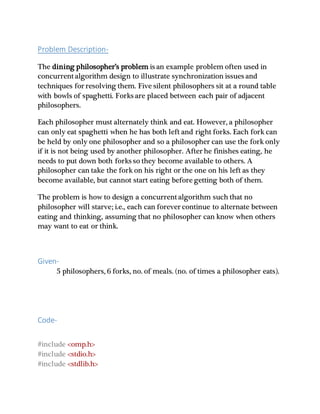
The dining philosophers problem involves 5 philosophers sharing 6 forks placed between them to eat spaghetti. Each philosopher must alternate between thinking and eating, but can only eat when holding both forks to their left and right. The problem is how to design an algorithm such that no philosopher starves while eating and thinking in parallel. The code implements a solution using locks to synchronize access to forks, with each philosopher acquiring left and right forks using locks before eating and releasing after. The output shows the philosophers eating 1 or 2 times each to demonstrate the algorithm working.


![Attack surfaces and attack tress[inform]](https://cdn.slidesharecdn.com/ss_thumbnails/lecture03-260108015941-a4dee53b-thumbnail.jpg?width=640&height=640&fit=bounds)


