10
Devon’s own cob castle.
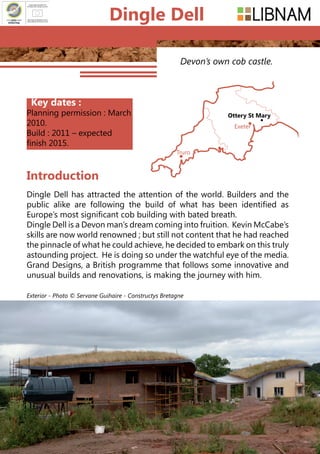
Dingle Dell has attracted the attention of the world. Builders and the
public alike are following the build of what has been identified as
Europe’s most significant cob building with bated breath.
Dingle Dell is a Devon man’s dream coming into fruition. Kevin McCabe’s
skills are now world renowned ; but still not content that he had reached
the pinnacle of what he could achieve, he decided to embark on this truly
astounding project. He is doing so under the watchful eye of the media.
Grand Designs, a British programme that follows some innovative and
unusual builds and renovations, is making the journey with him.
Introduction
Truro
Exeter
Ottery St Mary
Dingle Dell
Key dates :
Planning permission : March
2010.
Build : 2011 – expected
finish 2015.
Exterior - Photo © Servane Guihaire - Constructys Bretagne
www.libnam.eu 2
Kevin’s aim is to build a family house,
whilst testing the limitations of low
impact materials and endeavouring
to use some of the Passive House
standards to try to achieve CODE
Level 6 accreditation. He is using
over 30 years of experience to help
him achieve this ambitious project.
He would like the building to be a
showcase for British architecture and
so he applied for planning permission
under previous legislation, Planning
Policy Statement 7, which allows
exceptions to normal planning policy
for sustainable development in
rural areas. To gain this, the design
had to be outstanding, innovative
and ground-breaking in its use of
Context
materials or methods of construction.
To help him work towards this aim
Kevin worked with several different
architects and professionals across
the construction spectrum including
structural engineers, renewable
technologies experts, drainage
experts, an ecologist, and local
planners. Ultimately, Dingle Dell’s
palatial size and sweeping curves of
cob and glass combine the traditional
with the modern aesthetic, and is a
worthy of the special permission
granted.
Kevin’s dedication to the project is
demonstrated by the fact that he has
worked 70 hours a week over the past
Plan © Kevin McCabe
French-British collective Libnam3
three summers to try and achieve
his goal, making the most of what
good weather he could, although an
extraordinary amount of rain in 2013
- 2014 hampered his efforts.
Dingle Dell is to be 10,000 sqft,
double the size of Kevin’s current
home. The building will comprise of
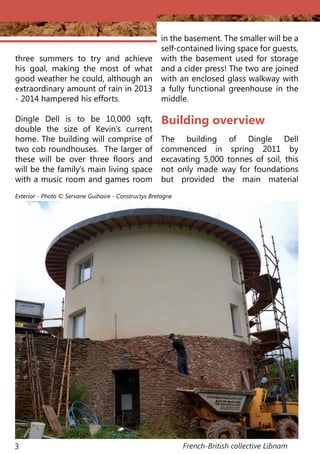
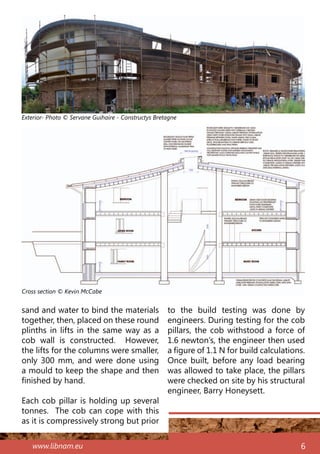
two cob roundhouses. The larger of
these will be over three floors and
will be the family’s main living space
with a music room and games room
in the basement. The smaller will be a
self-contained living space for guests,
with the basement used for storage
and a cider press! The two are joined
with an enclosed glass walkway with
a fully functional greenhouse in the
middle.
The building of Dingle Dell
commenced in spring 2011 by
excavating 5,000 tonnes of soil, this
not only made way for foundations
but provided the main material
Building overview
Exterior - Photo © Servane Guihaire - Constructys Bretagne
www.libnam.eu 4
needed to make the cob. The trench
system foundations for walls stretch
for ¼ of a mile and are filled with
eco concrete, with a reduced cement
content by using by-product from
coal fired power stations, and topped
with a mixture of lightweight concrete
blocks. The cob was laid on the block
base in lifts to create the enormous
walls. The centres of the roundhouses
have circular enclosures housing
helical staircases, and the outer cob
walls are also wrapped in polystyrene
for added insulation and covered
with lime render.
The structural strength for the roofing
is provided by using Glulam beams.
12 x 9 m lengths were used for the
main roof and were cut in a mixture
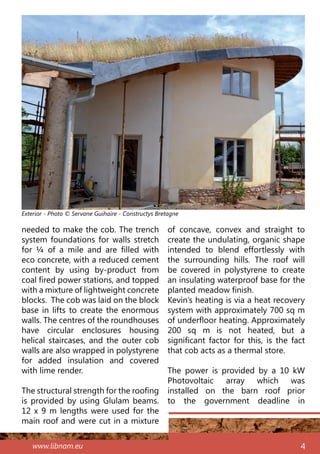
of concave, convex and straight to
create the undulating, organic shape
intended to blend effortlessly with
the surrounding hills. The roof will
be covered in polystyrene to create
an insulating waterproof base for the
planted meadow finish.
Kevin’s heating is via a heat recovery
system with approximately 700 sq m
of underfloor heating. Approximately
200 sq m is not heated, but a
significant factor for this, is the fact
that cob acts as a thermal store.
The power is provided by a 10  kW
Photovoltaic array which was
installed on the barn roof prior
to the government deadline in
Exterior - Photo © Servane Guihaire - Constructys Bretagne
French-British collective Libnam5
December 2011, so that Kevin could
take advantage of the feed in tariff
available at the time.
What is evident about this build is that
Kevin has pushed the limits of both
design and the use of materials to the
extreme, working in an experimental
but intelligent fashion. His love of
building with cob and its sculptural
Technical focus:
Using Cob Pillars
nature and strength has encouraged
him to push the boundaries. Not
many would think to make pillars from
cob. Kevin used pillars in building the
barn and also for the walkway of the
main house.
The supporting pillars for the main
house’s walkway are 550 mm in
diameter and the tallest is 5 m high.
The construction of the pillars was
done in the same way as the walls.
The foundations were put down to
stable ground, and then filled with a
concrete base, upon which the plinths
were built from natural stonework.
The cob is made from clay, straw,
Interior - Photo © Servane Guihaire - Constructys Bretagne
www.libnam.eu 6
sand and water to bind the materials
together, then, placed on these round
plinths in lifts in the same way as a
cob wall is constructed. However,
the lifts for the columns were smaller,
only 300 mm, and were done using
a mould to keep the shape and then
finished by hand.
Each cob pillar is holding up several
tonnes. The cob can cope with this
as it is compressively strong but prior
to the build testing was done by
engineers. During testing for the cob
pillars, the cob withstood a force of
1.6 newton’s, the engineer then used
a figure of 1.1 N for build calculations.
Once built, before any load bearing
was allowed to take place, the pillars
were checked on site by his structural
engineer, Barry Honeysett.
Exterior- Photo © Servane Guihaire - Constructys Bretagne
Cross section © Kevin McCabe
The building process for Dingle Dell
has not been as straight forward as
Kevin would have liked. He has been
hampered by the weather. In 2012,
Devon had the wettest summer for
Barriers and solutions
Stakeholders
Client : Rose and Kevin McCabe
Builder : Kevin McCabe www.
buildsomethingbeautiful.com
Architects : Bedford & Jobson www.
architecturedevon.co.uk
Costs
Kevin says that the cost of the build will
eventually be around £500,000, although this
does not take into account his own labour
and using cob from the site which would
more than double this figure, bringing it
closer to a million. Before building, Kevin
had already paid £30,000 to architects,
£30,000 for engineers, and £50,000 on
modelling before planning permission was
given. Building your own cob castle is not
cheap. They say an Englishman’s home is his
castle, and in Kevin’s case, he really will have
one.
7
100 years, and this severely restricted
the ability to build with cob. The
prolonged period of the build meant
that money became an issue, so
Kevin had to go back to work on
paid projects to fund the further
development.
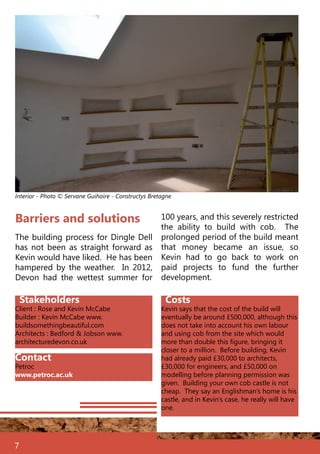
Interior - Photo © Servane Guihaire - Constructys Bretagne
Contact
Petroc
www.petroc.ac.uk

Dingle dell-en

  • 1.
    10 Devon’s own cobcastle. Dingle Dell has attracted the attention of the world. Builders and the public alike are following the build of what has been identified as Europe’s most significant cob building with bated breath. Dingle Dell is a Devon man’s dream coming into fruition. Kevin McCabe’s skills are now world renowned ; but still not content that he had reached the pinnacle of what he could achieve, he decided to embark on this truly astounding project. He is doing so under the watchful eye of the media. Grand Designs, a British programme that follows some innovative and unusual builds and renovations, is making the journey with him. Introduction Truro Exeter Ottery St Mary Dingle Dell Key dates : Planning permission : March 2010. Build : 2011 – expected finish 2015. Exterior - Photo © Servane Guihaire - Constructys Bretagne
  • 2.
    www.libnam.eu 2 Kevin’s aimis to build a family house, whilst testing the limitations of low impact materials and endeavouring to use some of the Passive House standards to try to achieve CODE Level 6 accreditation. He is using over 30 years of experience to help him achieve this ambitious project. He would like the building to be a showcase for British architecture and so he applied for planning permission under previous legislation, Planning Policy Statement 7, which allows exceptions to normal planning policy for sustainable development in rural areas. To gain this, the design had to be outstanding, innovative and ground-breaking in its use of Context materials or methods of construction. To help him work towards this aim Kevin worked with several different architects and professionals across the construction spectrum including structural engineers, renewable technologies experts, drainage experts, an ecologist, and local planners. Ultimately, Dingle Dell’s palatial size and sweeping curves of cob and glass combine the traditional with the modern aesthetic, and is a worthy of the special permission granted. Kevin’s dedication to the project is demonstrated by the fact that he has worked 70 hours a week over the past Plan © Kevin McCabe
  • 3.
    French-British collective Libnam3 threesummers to try and achieve his goal, making the most of what good weather he could, although an extraordinary amount of rain in 2013 - 2014 hampered his efforts. Dingle Dell is to be 10,000 sqft, double the size of Kevin’s current home. The building will comprise of two cob roundhouses. The larger of these will be over three floors and will be the family’s main living space with a music room and games room in the basement. The smaller will be a self-contained living space for guests, with the basement used for storage and a cider press! The two are joined with an enclosed glass walkway with a fully functional greenhouse in the middle. The building of Dingle Dell commenced in spring 2011 by excavating 5,000 tonnes of soil, this not only made way for foundations but provided the main material Building overview Exterior - Photo © Servane Guihaire - Constructys Bretagne
  • 4.
    www.libnam.eu 4 needed tomake the cob. The trench system foundations for walls stretch for ¼ of a mile and are filled with eco concrete, with a reduced cement content by using by-product from coal fired power stations, and topped with a mixture of lightweight concrete blocks. The cob was laid on the block base in lifts to create the enormous walls. The centres of the roundhouses have circular enclosures housing helical staircases, and the outer cob walls are also wrapped in polystyrene for added insulation and covered with lime render. The structural strength for the roofing is provided by using Glulam beams. 12 x 9 m lengths were used for the main roof and were cut in a mixture of concave, convex and straight to create the undulating, organic shape intended to blend effortlessly with the surrounding hills. The roof will be covered in polystyrene to create an insulating waterproof base for the planted meadow finish. Kevin’s heating is via a heat recovery system with approximately 700 sq m of underfloor heating. Approximately 200 sq m is not heated, but a significant factor for this, is the fact that cob acts as a thermal store. The power is provided by a 10  kW Photovoltaic array which was installed on the barn roof prior to the government deadline in Exterior - Photo © Servane Guihaire - Constructys Bretagne
  • 5.
    French-British collective Libnam5 December2011, so that Kevin could take advantage of the feed in tariff available at the time. What is evident about this build is that Kevin has pushed the limits of both design and the use of materials to the extreme, working in an experimental but intelligent fashion. His love of building with cob and its sculptural Technical focus: Using Cob Pillars nature and strength has encouraged him to push the boundaries. Not many would think to make pillars from cob. Kevin used pillars in building the barn and also for the walkway of the main house. The supporting pillars for the main house’s walkway are 550 mm in diameter and the tallest is 5 m high. The construction of the pillars was done in the same way as the walls. The foundations were put down to stable ground, and then filled with a concrete base, upon which the plinths were built from natural stonework. The cob is made from clay, straw, Interior - Photo © Servane Guihaire - Constructys Bretagne
  • 6.
    www.libnam.eu 6 sand andwater to bind the materials together, then, placed on these round plinths in lifts in the same way as a cob wall is constructed. However, the lifts for the columns were smaller, only 300 mm, and were done using a mould to keep the shape and then finished by hand. Each cob pillar is holding up several tonnes. The cob can cope with this as it is compressively strong but prior to the build testing was done by engineers. During testing for the cob pillars, the cob withstood a force of 1.6 newton’s, the engineer then used a figure of 1.1 N for build calculations. Once built, before any load bearing was allowed to take place, the pillars were checked on site by his structural engineer, Barry Honeysett. Exterior- Photo © Servane Guihaire - Constructys Bretagne Cross section © Kevin McCabe
  • 7.
    The building processfor Dingle Dell has not been as straight forward as Kevin would have liked. He has been hampered by the weather. In 2012, Devon had the wettest summer for Barriers and solutions Stakeholders Client : Rose and Kevin McCabe Builder : Kevin McCabe www. buildsomethingbeautiful.com Architects : Bedford & Jobson www. architecturedevon.co.uk Costs Kevin says that the cost of the build will eventually be around £500,000, although this does not take into account his own labour and using cob from the site which would more than double this figure, bringing it closer to a million. Before building, Kevin had already paid £30,000 to architects, £30,000 for engineers, and £50,000 on modelling before planning permission was given. Building your own cob castle is not cheap. They say an Englishman’s home is his castle, and in Kevin’s case, he really will have one. 7 100 years, and this severely restricted the ability to build with cob. The prolonged period of the build meant that money became an issue, so Kevin had to go back to work on paid projects to fund the further development. Interior - Photo © Servane Guihaire - Constructys Bretagne Contact Petroc www.petroc.ac.uk