DIGITAL TRENDS, INC . An Audio Visual and IT Company
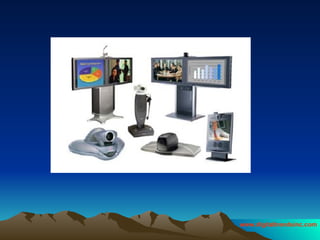
TYPES OF VIDEO  CONFERENCING  SYSTEM
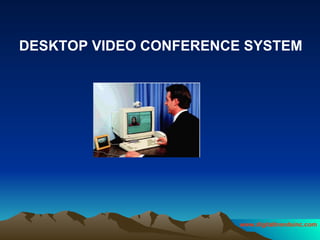
DESKTOP VIDEO CONFERENCE SYSTEM
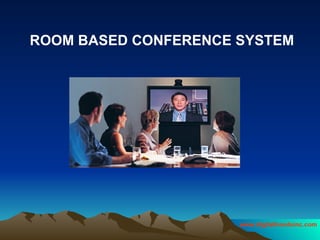
ROOM BASED CONFERENCE SYSTEM
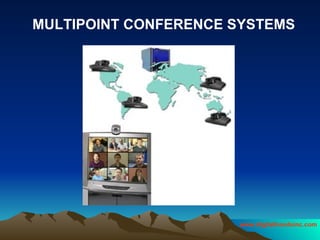
MULTIPOINT CONFERENCE SYSTEMS
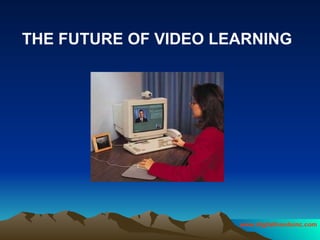
THE FUTURE OF VIDEO LEARNING
The Future of Video Conferencing Several commercial companies are developing new ways of using video conferencing in education. One of the most recent developments is to incorporate video conferencing into web based systems.  A web based system using  streaming video multi-casting  is now reaching the education sector. Teachers and presenters can sit in their own office or in a nearby studio and present a 'live' lecture in front of a camera attached to a web server. Using a simple switching device and several cameras, the presenter can provide remote participants with graphics, whiteboard, flipchart and other visual aids as well as alternative views of the local classroom, lecture room, etc.  These images and sound are subsequently 'webcast' - sent via the Internet to anyone who wishes to take part. Alongside the video images and sound is a MS Powerpoint presentation or other graphical sequence transmitted in a .gif file format. Synchronising software enables the graphic images and presentation materials to reach the viewers at the same time the presenter verbally cues them.
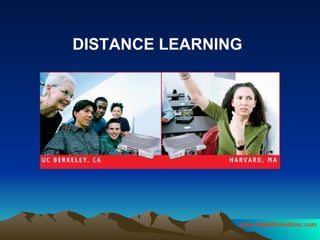
DISTANCE LEARNING
 
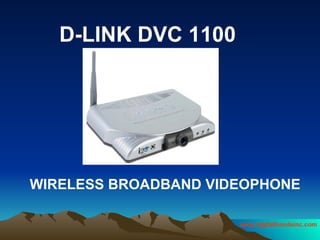
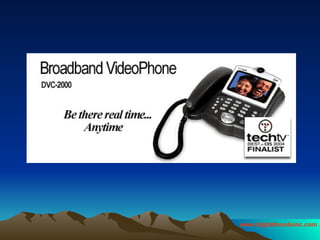
D-LINK DVC 1100 WIRELESS BROADBAND VIDEOPHONE
 
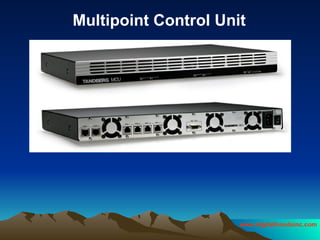
Multipoint Control Unit
FEATURES:   Fully integrated, easily configurable unit  Compact size: 1 U tall and 19" rack mountable  24 LEDs show operational status  Custom audio welcome and on-screen messaging  Join up to 16 video and 16 audio sites in one or more conferences  Supports network and video communications equipment from multiple vendors  Supports H.264 with IP and ISDN, and with Continuous Presence  Support for XGA, VGA and SVGA PC presentations  Automatic layout and resolution switching with Best Impression  Duo Video support for interactive presentations  Ad hoc multipoint calls with dial in/dial out capability  Easy to use Plug-and-Play technology  Supports mixed ISDN and IP video calls  Bandwidth: from 56 kbps - 2 Mbps  Highest level of standards-based embedded encryption  Downspeeding provides protection from network interruptions and maintains the call in progress
Thank You !!!

DIGITAL_TRENDS__INC_..

  • 1.
    DIGITAL TRENDS, INC. An Audio Visual and IT Company
  • 2.
    TYPES OF VIDEO CONFERENCING SYSTEM
  • 3.
  • 4.
  • 5.
  • 6.
    THE FUTURE OFVIDEO LEARNING
  • 7.
    The Future ofVideo Conferencing Several commercial companies are developing new ways of using video conferencing in education. One of the most recent developments is to incorporate video conferencing into web based systems. A web based system using streaming video multi-casting is now reaching the education sector. Teachers and presenters can sit in their own office or in a nearby studio and present a 'live' lecture in front of a camera attached to a web server. Using a simple switching device and several cameras, the presenter can provide remote participants with graphics, whiteboard, flipchart and other visual aids as well as alternative views of the local classroom, lecture room, etc. These images and sound are subsequently 'webcast' - sent via the Internet to anyone who wishes to take part. Alongside the video images and sound is a MS Powerpoint presentation or other graphical sequence transmitted in a .gif file format. Synchronising software enables the graphic images and presentation materials to reach the viewers at the same time the presenter verbally cues them.
  • 8.
  • 9.
  • 10.
    D-LINK DVC 1100WIRELESS BROADBAND VIDEOPHONE
  • 11.
  • 12.
  • 13.
    FEATURES: Fully integrated, easily configurable unit Compact size: 1 U tall and 19" rack mountable 24 LEDs show operational status Custom audio welcome and on-screen messaging Join up to 16 video and 16 audio sites in one or more conferences Supports network and video communications equipment from multiple vendors Supports H.264 with IP and ISDN, and with Continuous Presence Support for XGA, VGA and SVGA PC presentations Automatic layout and resolution switching with Best Impression Duo Video support for interactive presentations Ad hoc multipoint calls with dial in/dial out capability Easy to use Plug-and-Play technology Supports mixed ISDN and IP video calls Bandwidth: from 56 kbps - 2 Mbps Highest level of standards-based embedded encryption Downspeeding provides protection from network interruptions and maintains the call in progress
  • 14.