DIGITAL TECHNOLOGIES
             TIMELINE
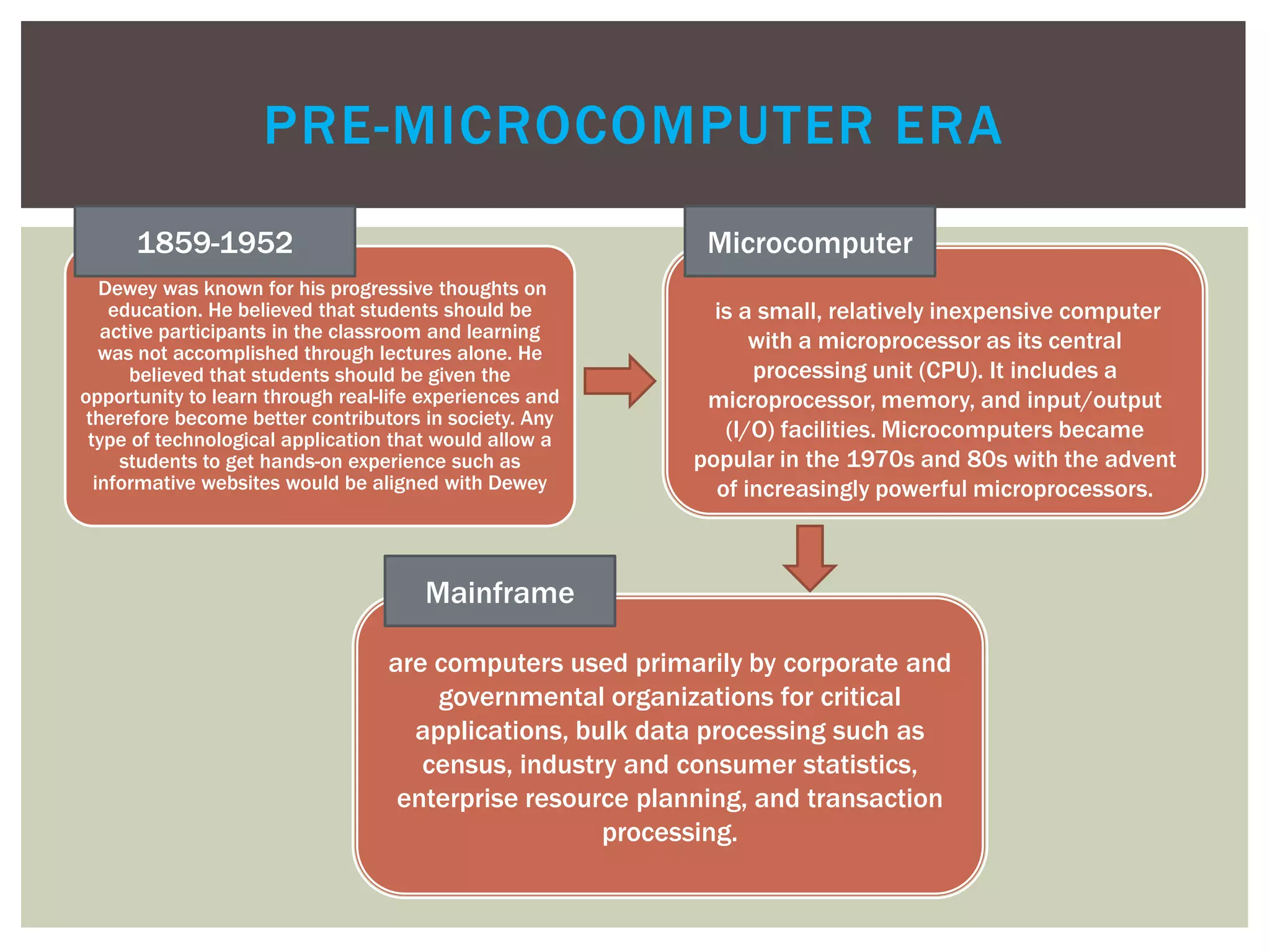
PRE-MICROCOMPUTER ERA
      1859-1952                                             Microcomputer
   Dewey was known for his progressive thoughts on
    education. He believed that students should be          is a small, relatively inexpensive computer
   active participants in the classroom and learning            with a microprocessor as its central
   was not accomplished through lectures alone. He
      believed that students should be given the                processing unit (CPU). It includes a
opportunity to learn through real-life experiences and     microprocessor, memory, and input/output
 therefore become better contributors in society. Any
 type of technological application that would allow a        (I/O) facilities. Microcomputers became
     students to get hands-on experience such as          popular in the 1970s and 80s with the advent
  informative websites would be aligned with Dewey          of increasingly powerful microprocessors.


                                      Mainframe

                                  are computers used primarily by corporate and
                                      governmental organizations for critical
                                    applications, bulk data processing such as
                                     census, industry and consumer statistics,
                                   enterprise resource planning, and transaction
                                                    processing.
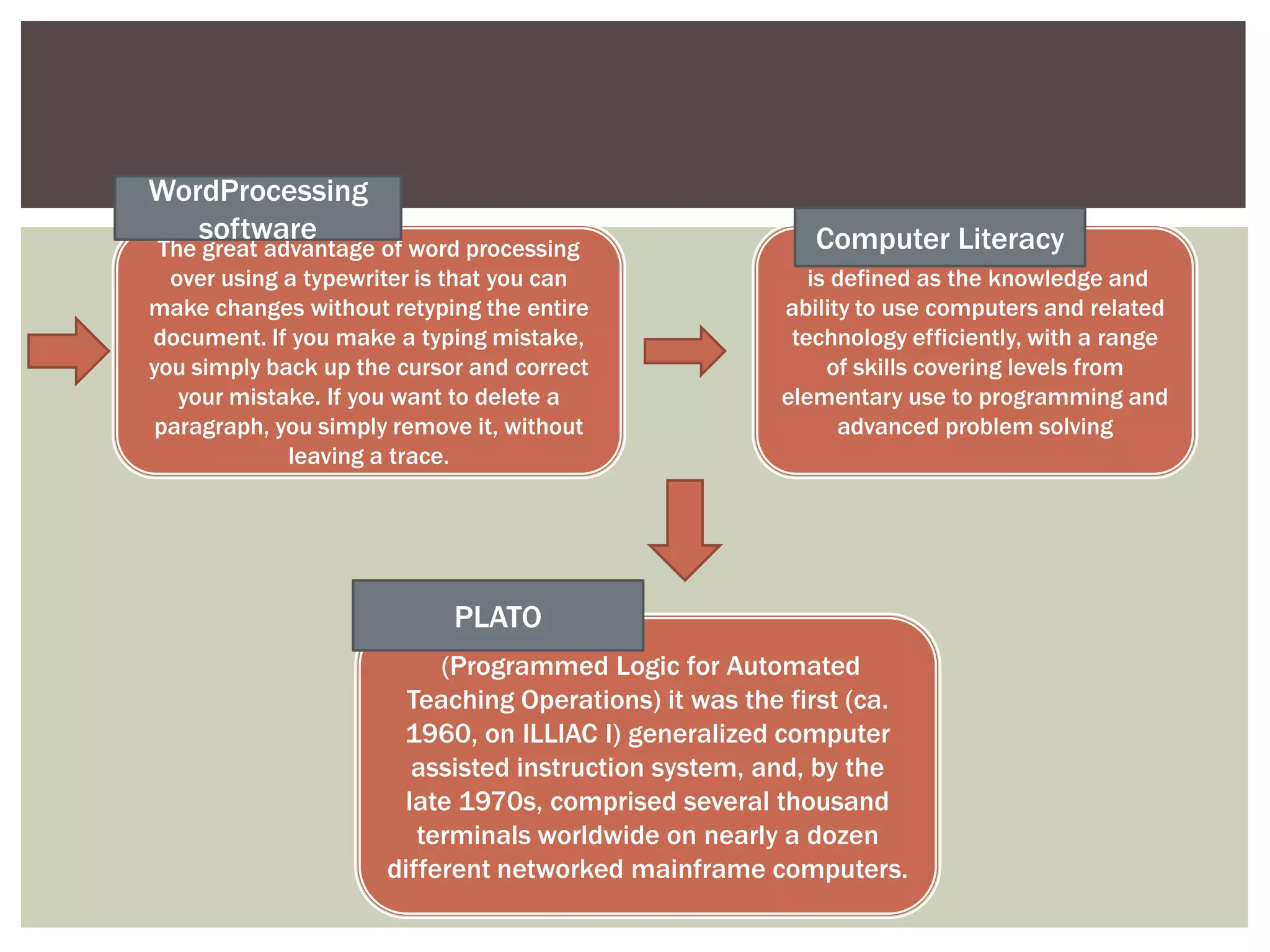
WordProcessing
   software                                               Computer Literacy
 The great advantage of word processing
  over using a typewriter is that you can                 is defined as the knowledge and
make changes without retyping the entire               ability to use computers and related
document. If you make a typing mistake,                 technology efficiently, with a range
you simply back up the cursor and correct                   of skills covering levels from
   your mistake. If you want to delete a               elementary use to programming and
 paragraph, you simply remove it, without                    advanced problem solving
             leaving a trace.


                            PLATO
                           (Programmed Logic for Automated
                        Teaching Operations) it was the first (ca.
                       1960, on ILLIAC I) generalized computer
                         assisted instruction system, and, by the
                        late 1970s, comprised several thousand
                         terminals worldwide on nearly a dozen
                      different networked mainframe computers.
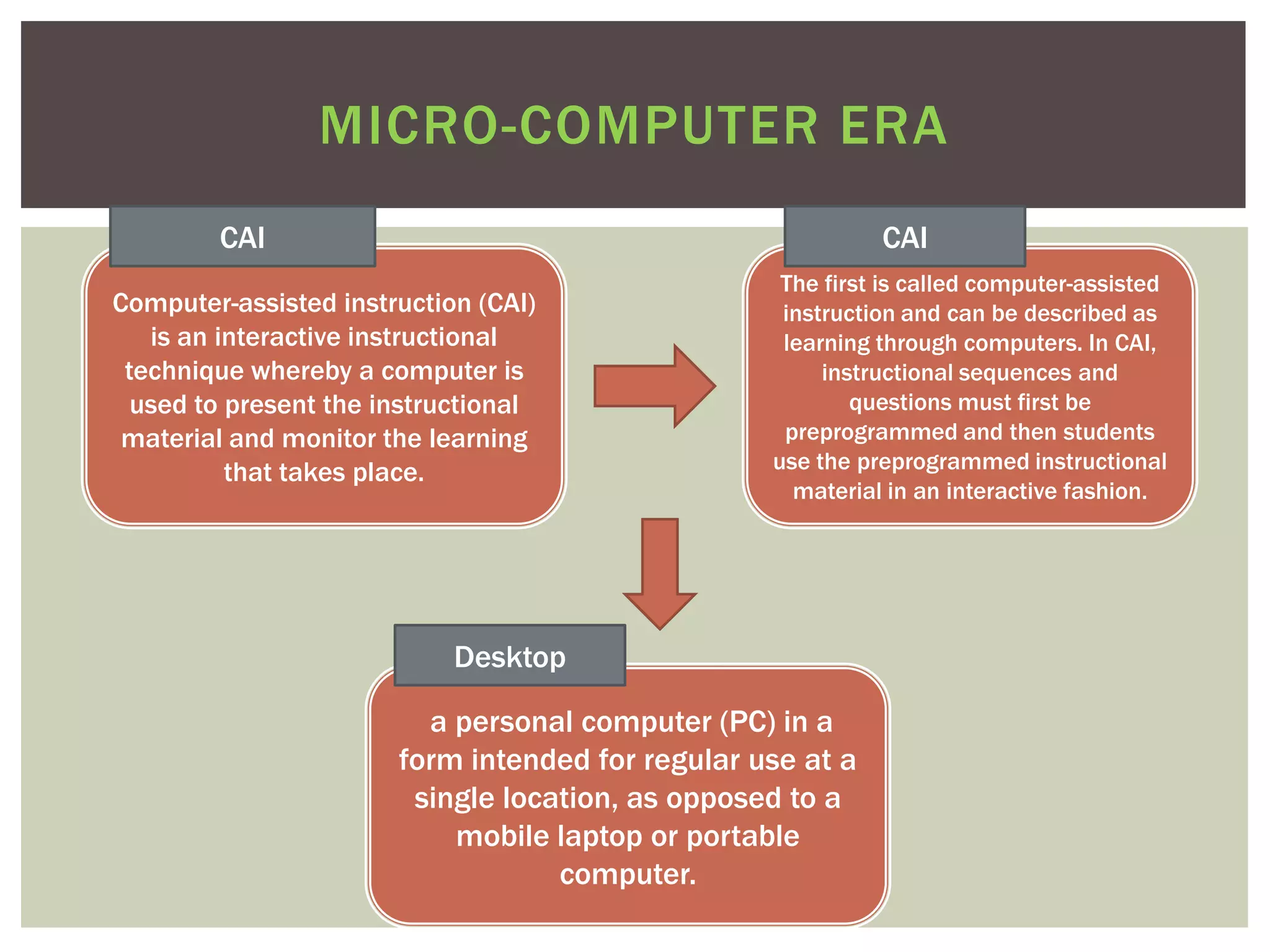
MICRO-COMPUTER ERA
        CAI                                                 CAI
                                                   The first is called computer-assisted
Computer-assisted instruction (CAI)                instruction and can be described as
   is an interactive instructional                 learning through computers. In CAI,
 technique whereby a computer is                       instructional sequences and
  used to present the instructional                       questions must first be
 material and monitor the learning                 preprogrammed and then students
          that takes place.                       use the preprogrammed instructional
                                                    material in an interactive fashion.


                            Desktop

                         a personal computer (PC) in a
                       form intended for regular use at a
                        single location, as opposed to a
                           mobile laptop or portable
                                   computer.
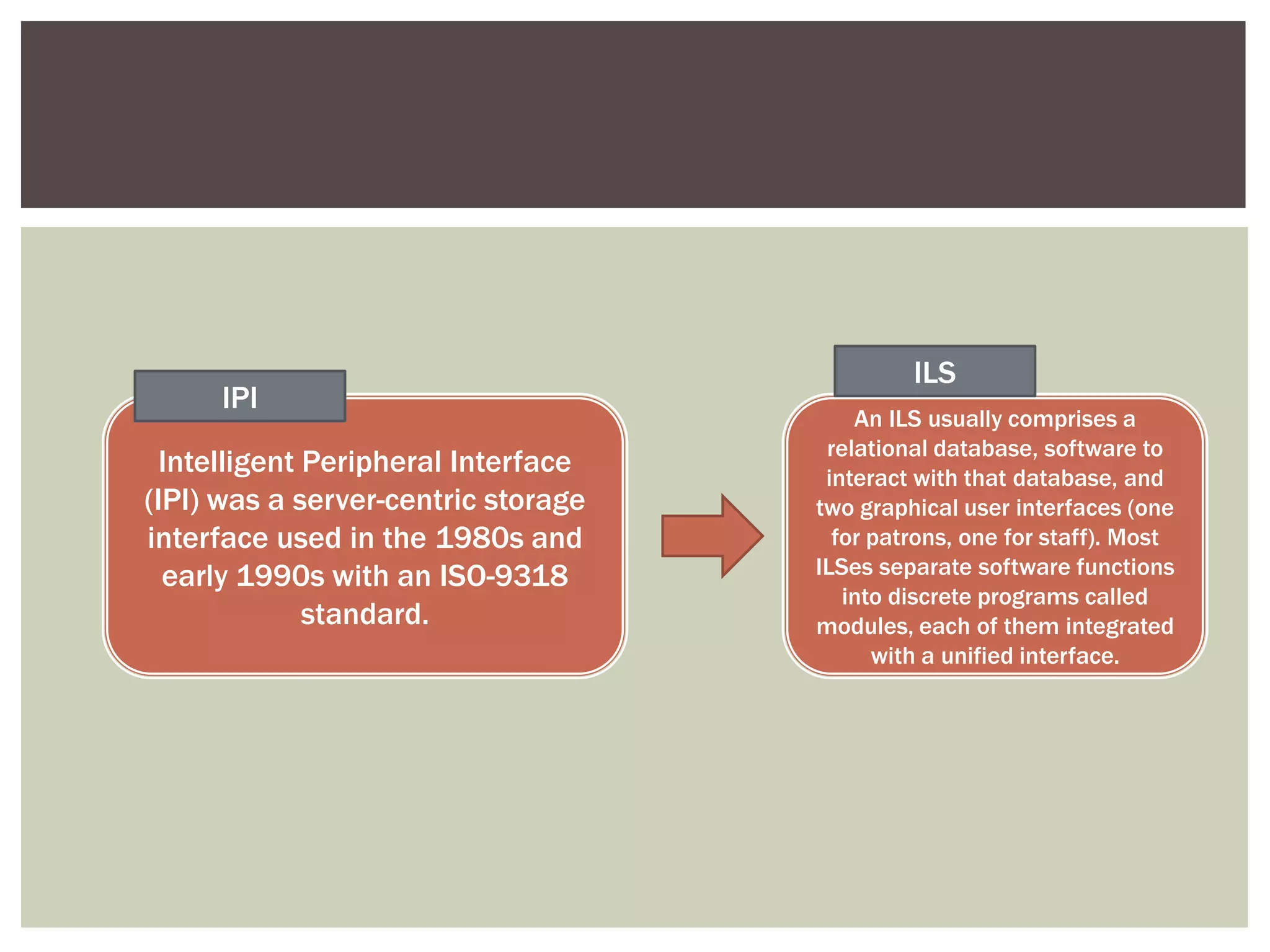
ILS
     IPI
                                         An ILS usually comprises a
                                      relational database, software to
  Intelligent Peripheral Interface    interact with that database, and
(IPI) was a server-centric storage   two graphical user interfaces (one
interface used in the 1980s and        for patrons, one for staff). Most
  early 1990s with an ISO-9318       ILSes separate software functions
                                        into discrete programs called
              standard.              modules, each of them integrated
                                           with a unified interface.
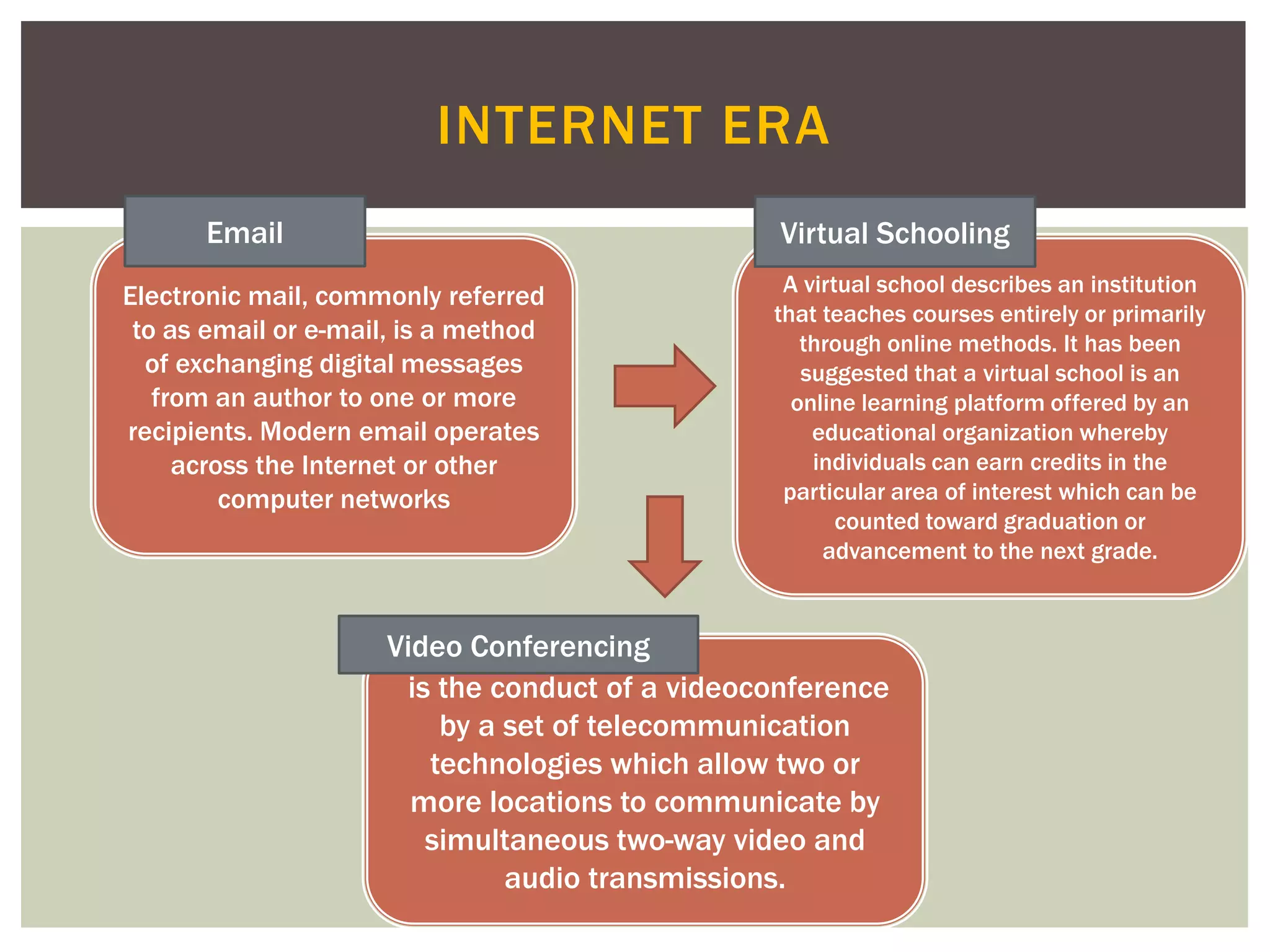
INTERNET ERA
      Email                                      Virtual Schooling
                                                 A virtual school describes an institution
Electronic mail, commonly referred
                                                that teaches courses entirely or primarily
 to as email or e-mail, is a method                through online methods. It has been
  of exchanging digital messages                   suggested that a virtual school is an
   from an author to one or more                  online learning platform offered by an
recipients. Modern email operates                   educational organization whereby
     across the Internet or other                   individuals can earn credits in the
         computer networks                       particular area of interest which can be
                                                       counted toward graduation or
                                                     advancement to the next grade.


                     Video Conferencing
                      is the conduct of a videoconference
                         by a set of telecommunication
                        technologies which allow two or
                       more locations to communicate by
                        simultaneous two-way video and
                              audio transmissions.
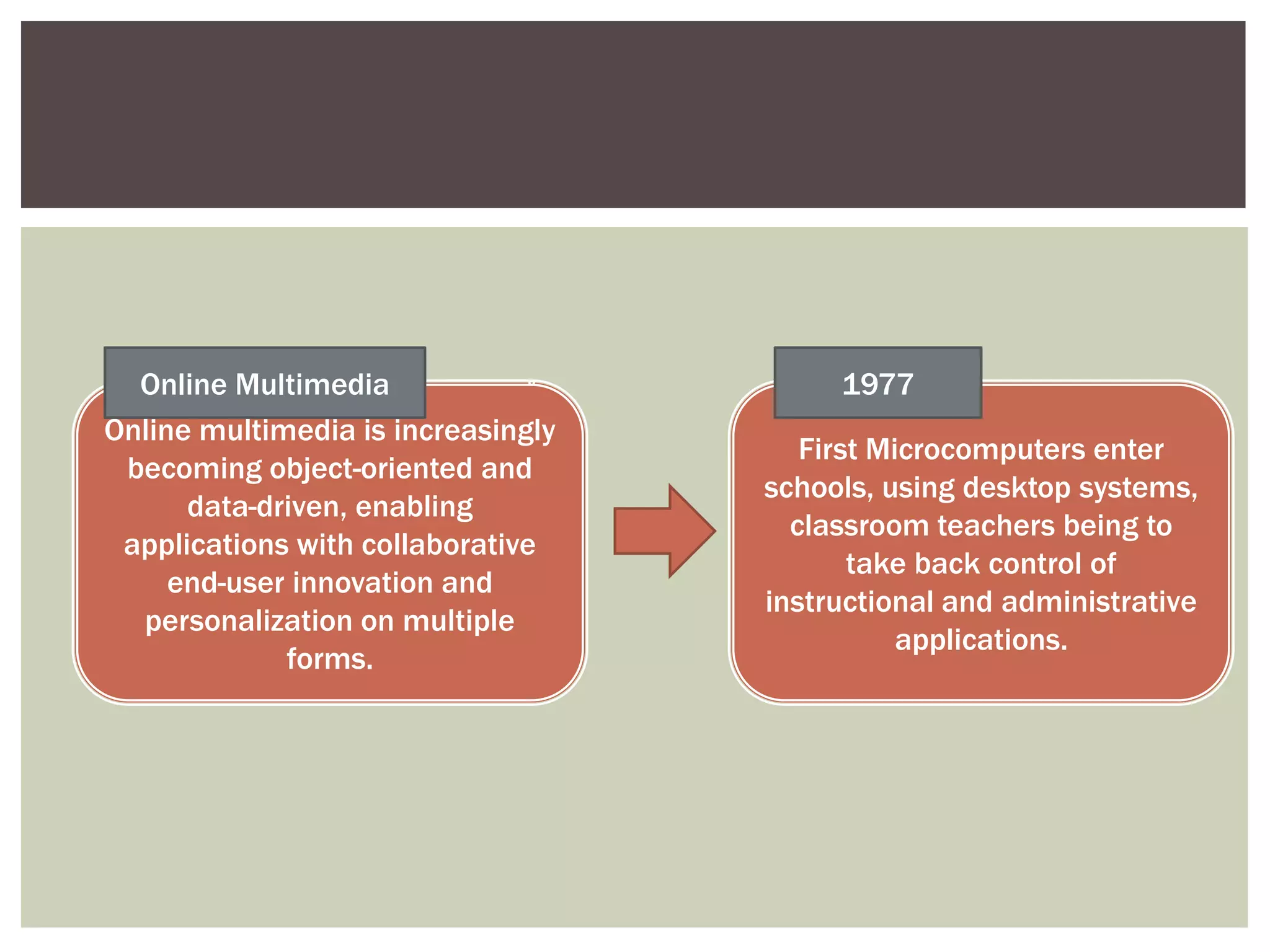
Online Multimedia                      1977
Online multimedia is increasingly
                                       First Microcomputers enter
 becoming object-oriented and
                                    schools, using desktop systems,
      data-driven, enabling
                                      classroom teachers being to
 applications with collaborative
                                           take back control of
     end-user innovation and
                                    instructional and administrative
  personalization on multiple
                                               applications.
             forms.
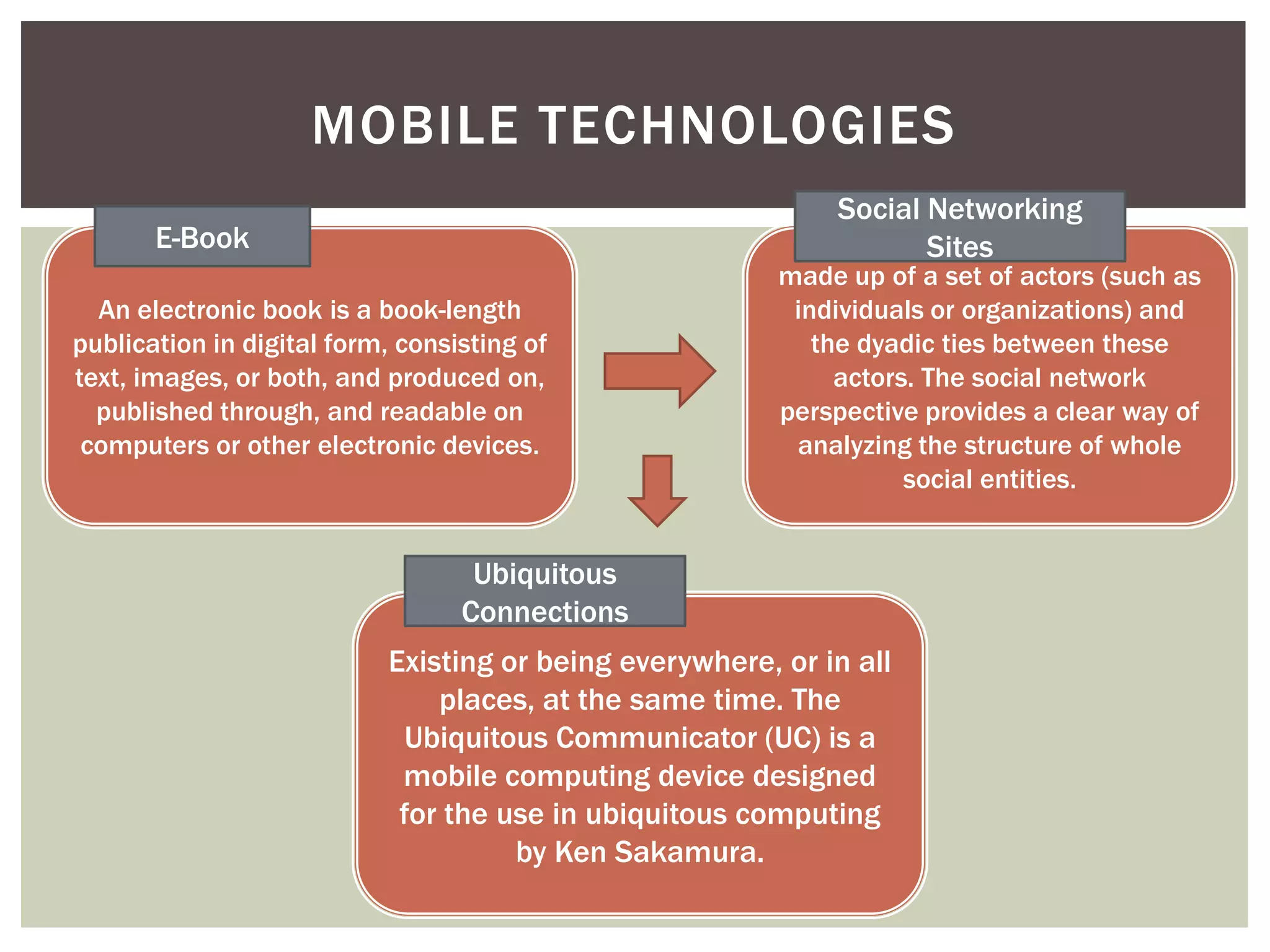
MOBILE TECHNOLOGIES
                                                             Social Networking
       E-Book                                                       Sites
                                                         made up of a set of actors (such as
  An electronic book is a book-length                     individuals or organizations) and
publication in digital form, consisting of                  the dyadic ties between these
text, images, or both, and produced on,                       actors. The social network
  published through, and readable on                     perspective provides a clear way of
 computers or other electronic devices.                   analyzing the structure of whole
                                                                    social entities.


                                   Ubiquitous
                                  Connections
                           Existing or being everywhere, or in all
                               places, at the same time. The
                            Ubiquitous Communicator (UC) is a
                            mobile computing device designed
                            for the use in ubiquitous computing
                                     by Ken Sakamura.
PodCasting


A podcast is a type of digital media consisting of an
 episodic series of audio radio, video, PDF, or ePub
  files subscribed to and downloaded through web
  syndication or streamed online to a computer or
                    mobile device.
SOURCE/S

 h t t p : / / w w w. t i meto a s t .c o m / t im el i n e s / e d uc - 3 5 3 - p r e - m i cr o co m p ute r - e r a - to - i n te r n et -
  era
 h t t p : / / w w w. t h e c a n a d i a n e nc yc lo p e d i a .c o m / a r t i cl e s / c o mp ute r a s s i s te d - l e a r n i n g
 h t t p : / / e n . w ik i p e d ia . o r g / w i k i / I n teg r a te d _ li b r a r y_ s y s te m
 h t t p : / / e n . w ik i p e d ia . o r g / w i k i / Po d c a s t
 h t t p : / / e n . w ik i p e d ia . o r g / w i k i / U b iq ui to us _ c o m p ut in g
 h t t p : / / e n . w ik i p e d ia . o r g / w i k i / M i c ro c o m p ute r
 h t t p : / / e n . w ik i p e d ia . o r g / w i k i / M ai n f r a m e _ co m p ute r
 h t t p : / / w w w. e h ow.c o m / wo r d - p ro c e s s i n g - s o f t wa r e /
 h t t p : / / e n . w ik i p e d ia . o r g / w i k i / C o mp uter _ l i te r a c y
 h t t p : / / e n . w ik i pe dia . o r g /w i k i / P L ATO_ ( c o mp ute r _ s y s te m )
 h t t p : / / w i ki e d uc a to r. o r g / C o mp ute r _ A s s i s te d _ In s t r uc t io n _ ( C A I )
 h t t p : / / e n . w ik i p e d ia . o r g / w i k i / D e s kto p _ c o mp ute r
 h t t p : / / e n . w ik i p e d ia . o r g / w i k i / E m a i l
 h t t p : / / e n . w ik i p e d ia . o r g / w i k i / I n tel l ig e n t _ Pe r ip h e r a l _ I n te r f ac e
 h t t p : / / e n . w ik i p e d ia . o r g / w i k i / V i d e o c o n fe r e nc i n g
 h t t p : / / e n . w ik i p e d ia . o r g / w i k i / M ult i m ed i a
 h t t p : / / e n . w ik i pe dia . o r g /w i k i / I n teg r a te d _ li b r a r y_ s y s te m
 h t t p : / / e n . w ik i p e d ia . o r g / w i k i / E - b o o k
 h t t p : / / e n . w ik i p e d ia . o r g / w i k i / S o ci a l _n et wo rk
PREPARED BY:


               Jaimie
               Anne
               Lopez

               BEE21

Digital technologies

  • 1.
  • 2.
    PRE-MICROCOMPUTER ERA 1859-1952 Microcomputer Dewey was known for his progressive thoughts on education. He believed that students should be is a small, relatively inexpensive computer active participants in the classroom and learning with a microprocessor as its central was not accomplished through lectures alone. He believed that students should be given the processing unit (CPU). It includes a opportunity to learn through real-life experiences and microprocessor, memory, and input/output therefore become better contributors in society. Any type of technological application that would allow a (I/O) facilities. Microcomputers became students to get hands-on experience such as popular in the 1970s and 80s with the advent informative websites would be aligned with Dewey of increasingly powerful microprocessors. Mainframe are computers used primarily by corporate and governmental organizations for critical applications, bulk data processing such as census, industry and consumer statistics, enterprise resource planning, and transaction processing.
  • 3.
    WordProcessing software Computer Literacy The great advantage of word processing over using a typewriter is that you can is defined as the knowledge and make changes without retyping the entire ability to use computers and related document. If you make a typing mistake, technology efficiently, with a range you simply back up the cursor and correct of skills covering levels from your mistake. If you want to delete a elementary use to programming and paragraph, you simply remove it, without advanced problem solving leaving a trace. PLATO (Programmed Logic for Automated Teaching Operations) it was the first (ca. 1960, on ILLIAC I) generalized computer assisted instruction system, and, by the late 1970s, comprised several thousand terminals worldwide on nearly a dozen different networked mainframe computers.
  • 4.
    MICRO-COMPUTER ERA CAI CAI The first is called computer-assisted Computer-assisted instruction (CAI) instruction and can be described as is an interactive instructional learning through computers. In CAI, technique whereby a computer is instructional sequences and used to present the instructional questions must first be material and monitor the learning preprogrammed and then students that takes place. use the preprogrammed instructional material in an interactive fashion. Desktop a personal computer (PC) in a form intended for regular use at a single location, as opposed to a mobile laptop or portable computer.
  • 5.
    ILS IPI An ILS usually comprises a relational database, software to Intelligent Peripheral Interface interact with that database, and (IPI) was a server-centric storage two graphical user interfaces (one interface used in the 1980s and for patrons, one for staff). Most early 1990s with an ISO-9318 ILSes separate software functions into discrete programs called standard. modules, each of them integrated with a unified interface.
  • 6.
    INTERNET ERA Email Virtual Schooling A virtual school describes an institution Electronic mail, commonly referred that teaches courses entirely or primarily to as email or e-mail, is a method through online methods. It has been of exchanging digital messages suggested that a virtual school is an from an author to one or more online learning platform offered by an recipients. Modern email operates educational organization whereby across the Internet or other individuals can earn credits in the computer networks particular area of interest which can be counted toward graduation or advancement to the next grade. Video Conferencing is the conduct of a videoconference by a set of telecommunication technologies which allow two or more locations to communicate by simultaneous two-way video and audio transmissions.
  • 7.
    Online Multimedia 1977 Online multimedia is increasingly First Microcomputers enter becoming object-oriented and schools, using desktop systems, data-driven, enabling classroom teachers being to applications with collaborative take back control of end-user innovation and instructional and administrative personalization on multiple applications. forms.
  • 8.
    MOBILE TECHNOLOGIES Social Networking E-Book Sites made up of a set of actors (such as An electronic book is a book-length individuals or organizations) and publication in digital form, consisting of the dyadic ties between these text, images, or both, and produced on, actors. The social network published through, and readable on perspective provides a clear way of computers or other electronic devices. analyzing the structure of whole social entities. Ubiquitous Connections Existing or being everywhere, or in all places, at the same time. The Ubiquitous Communicator (UC) is a mobile computing device designed for the use in ubiquitous computing by Ken Sakamura.
  • 9.
    PodCasting A podcast isa type of digital media consisting of an episodic series of audio radio, video, PDF, or ePub files subscribed to and downloaded through web syndication or streamed online to a computer or mobile device.
  • 10.
    SOURCE/S  h tt p : / / w w w. t i meto a s t .c o m / t im el i n e s / e d uc - 3 5 3 - p r e - m i cr o co m p ute r - e r a - to - i n te r n et - era  h t t p : / / w w w. t h e c a n a d i a n e nc yc lo p e d i a .c o m / a r t i cl e s / c o mp ute r a s s i s te d - l e a r n i n g  h t t p : / / e n . w ik i p e d ia . o r g / w i k i / I n teg r a te d _ li b r a r y_ s y s te m  h t t p : / / e n . w ik i p e d ia . o r g / w i k i / Po d c a s t  h t t p : / / e n . w ik i p e d ia . o r g / w i k i / U b iq ui to us _ c o m p ut in g  h t t p : / / e n . w ik i p e d ia . o r g / w i k i / M i c ro c o m p ute r  h t t p : / / e n . w ik i p e d ia . o r g / w i k i / M ai n f r a m e _ co m p ute r  h t t p : / / w w w. e h ow.c o m / wo r d - p ro c e s s i n g - s o f t wa r e /  h t t p : / / e n . w ik i p e d ia . o r g / w i k i / C o mp uter _ l i te r a c y  h t t p : / / e n . w ik i pe dia . o r g /w i k i / P L ATO_ ( c o mp ute r _ s y s te m )  h t t p : / / w i ki e d uc a to r. o r g / C o mp ute r _ A s s i s te d _ In s t r uc t io n _ ( C A I )  h t t p : / / e n . w ik i p e d ia . o r g / w i k i / D e s kto p _ c o mp ute r  h t t p : / / e n . w ik i p e d ia . o r g / w i k i / E m a i l  h t t p : / / e n . w ik i p e d ia . o r g / w i k i / I n tel l ig e n t _ Pe r ip h e r a l _ I n te r f ac e  h t t p : / / e n . w ik i p e d ia . o r g / w i k i / V i d e o c o n fe r e nc i n g  h t t p : / / e n . w ik i p e d ia . o r g / w i k i / M ult i m ed i a  h t t p : / / e n . w ik i pe dia . o r g /w i k i / I n teg r a te d _ li b r a r y_ s y s te m  h t t p : / / e n . w ik i p e d ia . o r g / w i k i / E - b o o k  h t t p : / / e n . w ik i p e d ia . o r g / w i k i / S o ci a l _n et wo rk
  • 11.
    PREPARED BY: Jaimie Anne Lopez BEE21