DIGITAL STORYTELLING 
OPPORTUNITIES FOR COU-PDR 
By Amos Ochieng’ 
Twitter: @ochiengamos
PREPARATIONS 
Just as in all work, it is important to create a 
structure for social media work and digital 
documentation.
Did you prepare? 
1. Begin with a meeting 
2. Decide what the editorial needs are 
3. Select what services and tools to use 
4. Choose when you are going to be most 
active 
5. Set up accounts 
6. Procure tools 
7. Start building your network 
8. Put someone in charge
Lets work 
with a few
Strategies 
1. Post short 
headlines of 
what you 
are up to. 
Attach a 
picture
Strategies 
1. Post short 
headlines of 
what you 
are up to. 
Attach a 
picture
Strategies 
2. Give links 
to read 
more… 
from your 
blog/website
Strategies 
3. Ask for feedback 
4. Create events; mobilize participants 
5. Other strategies??
Strategy … 
Use this channel to give updates of activities, ongoing work, 
remind of events, as a feedback mechanism e.t.c
Get started at 
www.blogger.com 
Its FREE and always will be
TOOLS
TOOLS
TOOLS
DOCUMENTATION 
Digital documentation is telling your 
organization’s “story” (the work you 
do, people you help, funds 
distribution) in a way that people find 
compelling, concise and original. 
Usually using photographs, videos or a 
combination of both.
DOCUMENTATION 
First consider: 
1. Who are you trying to reach? 
2. How will they access the 
photograph(s)? 
3. What message do you want to convey? 
4. What action are you trying to prompt?
SHOW your results. 
Don’t TELL :-)
If you are going to give 
statistics, SHOW and TELL 
Cases of child 
defilements have 
reduced by 20% from 
2013
How will people 
access your photos? 
1. Exhibitions 
2. Online slideshows 
3. E-mail 
4. Press 
5. Demotix 
6. Social media
How to take good 
photographs 
Four elements are vital: 
subject, composition, light, 
and exposure
The Subject/Focal point 
Every photograph must have a subject and if 
you cant determine the subject just put down 
the camera
Putting your Subject in focus 
Every photograph has a point of interest—and that point should 
be clear to the viewer. The viewer’s eyes should not roam 
aimlessly around the frame. They should be guided to the point 
of interest
Composing… 
Composition is the placement of the 
subject in the frame
An off-balance composition can be very 
entertaining to the eye (Rule of thirds)
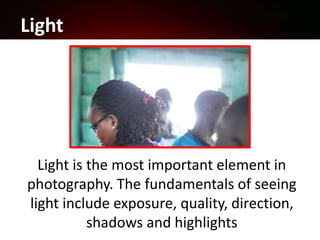
Light 
Light is the most important element in 
photography. The fundamentals of seeing 
light include exposure, quality, direction, 
shadows and highlights
Exposure 
Properly exposed Over exposed 
The amount of light captured in a 
photograph, and how to control it
Exposure 
Properly exposed Over exposed 
The amount of light captured in a 
photograph, and how to control it
Quality of light 
Warm Cool 
How “soft” or “hard” the light is, and the 
difference between “warm” and “cool” light.
Quality of light 
Warm Cool 
How “soft” or “hard” the light is, and the 
difference between “warm” and “cool” light.
Direction 
The position of the light source relative to the 
scene. Never point a camera to the window
Shadows and highlights 
The darkest and brightest regions in a photo, 
where details become hidden. Use flash to fill in
An off-balance composition can be very 
entertaining to the eye (Rule of thirds)
Final tips 
Closer, Closer 
“Get closer”. Make the object of your shot 
stand out. If you can’t move closer 
physically, use a longer lens. 
Think before you press 
Always think about what you are trying to 
say with an image.
Final tips 
Sense of Scale 
A cow standing in a field helps us 
comprehend the extent of the pasture. A 
sense of scale can be achieved by including 
something of known size, such as a person, 
a car, a tree, or an animal, in the picture 
beside it. 
Shoot from different angles
Almost everyone today owns a 
mobile phone with android and 
camera. 
Photo: amos 
You have no excuse for not 
documenting and sharing online
Otherwise don’t be always too serious 
online Share some FUN PHOTOS
That all folks. 
Thank you for 
listening. 
WhatsApp: 0729355550 
Twitter: ochiengamos 
FB: Amos Ochieng 
Work: amos@pixelskenya.com

Digital storytelling opportunities, Documentation tips

  • 1.
    DIGITAL STORYTELLING OPPORTUNITIESFOR COU-PDR By Amos Ochieng’ Twitter: @ochiengamos
  • 2.
    PREPARATIONS Just asin all work, it is important to create a structure for social media work and digital documentation.
  • 3.
    Did you prepare? 1. Begin with a meeting 2. Decide what the editorial needs are 3. Select what services and tools to use 4. Choose when you are going to be most active 5. Set up accounts 6. Procure tools 7. Start building your network 8. Put someone in charge
  • 5.
  • 7.
    Strategies 1. Postshort headlines of what you are up to. Attach a picture
  • 8.
    Strategies 1. Postshort headlines of what you are up to. Attach a picture
  • 9.
    Strategies 2. Givelinks to read more… from your blog/website
  • 10.
    Strategies 3. Askfor feedback 4. Create events; mobilize participants 5. Other strategies??
  • 12.
    Strategy … Usethis channel to give updates of activities, ongoing work, remind of events, as a feedback mechanism e.t.c
  • 18.
    Get started at www.blogger.com Its FREE and always will be
  • 19.
  • 20.
  • 24.
  • 25.
    DOCUMENTATION Digital documentationis telling your organization’s “story” (the work you do, people you help, funds distribution) in a way that people find compelling, concise and original. Usually using photographs, videos or a combination of both.
  • 26.
    DOCUMENTATION First consider: 1. Who are you trying to reach? 2. How will they access the photograph(s)? 3. What message do you want to convey? 4. What action are you trying to prompt?
  • 27.
    SHOW your results. Don’t TELL :-)
  • 28.
    If you aregoing to give statistics, SHOW and TELL Cases of child defilements have reduced by 20% from 2013
  • 29.
    How will people access your photos? 1. Exhibitions 2. Online slideshows 3. E-mail 4. Press 5. Demotix 6. Social media
  • 30.
    How to takegood photographs Four elements are vital: subject, composition, light, and exposure
  • 32.
    The Subject/Focal point Every photograph must have a subject and if you cant determine the subject just put down the camera
  • 33.
    Putting your Subjectin focus Every photograph has a point of interest—and that point should be clear to the viewer. The viewer’s eyes should not roam aimlessly around the frame. They should be guided to the point of interest
  • 34.
    Composing… Composition isthe placement of the subject in the frame
  • 35.
    An off-balance compositioncan be very entertaining to the eye (Rule of thirds)
  • 36.
    Light Light isthe most important element in photography. The fundamentals of seeing light include exposure, quality, direction, shadows and highlights
  • 37.
    Exposure Properly exposedOver exposed The amount of light captured in a photograph, and how to control it
  • 38.
    Exposure Properly exposedOver exposed The amount of light captured in a photograph, and how to control it
  • 39.
    Quality of light Warm Cool How “soft” or “hard” the light is, and the difference between “warm” and “cool” light.
  • 40.
    Quality of light Warm Cool How “soft” or “hard” the light is, and the difference between “warm” and “cool” light.
  • 41.
    Direction The positionof the light source relative to the scene. Never point a camera to the window
  • 42.
    Shadows and highlights The darkest and brightest regions in a photo, where details become hidden. Use flash to fill in
  • 43.
    An off-balance compositioncan be very entertaining to the eye (Rule of thirds)
  • 44.
    Final tips Closer,Closer “Get closer”. Make the object of your shot stand out. If you can’t move closer physically, use a longer lens. Think before you press Always think about what you are trying to say with an image.
  • 45.
    Final tips Senseof Scale A cow standing in a field helps us comprehend the extent of the pasture. A sense of scale can be achieved by including something of known size, such as a person, a car, a tree, or an animal, in the picture beside it. Shoot from different angles
  • 46.
    Almost everyone todayowns a mobile phone with android and camera. Photo: amos You have no excuse for not documenting and sharing online
  • 47.
    Otherwise don’t bealways too serious online Share some FUN PHOTOS
  • 48.
    That all folks. Thank you for listening. WhatsApp: 0729355550 Twitter: ochiengamos FB: Amos Ochieng Work: amos@pixelskenya.com

Editor's Notes

  • #2 Where is COU-PDR with social media, digital documentation Do you have a facebook page, website, twitter handle, blog, camera, audio recorder Who is in charge? Admin? Content contributors
  • #3 Explain what is facebook
  • #4 BEGIN WTH A MEETING It is important for the whole staff to be involved in social media work. Don’t leave it to the communications person only. DECIDE WHAT THE EDITORIAL NEEDS ARE Do you want stir up debate, use online petitions as an advocacy tactic, share stories of change? Do you want to receive feedback about your work? Discuss what expectations you have on your work with your beneficiaries, audience e.t.c or you just maybe you just want to brag your results to your donor. SELECT WHAT SERVICES AND TOOLS TO USE For a programme that needs to do quick updates, Twitter might be best, while Facebook might be better for building relations and for in-depth information. Starting up a blog if you cant afford a website might be a better option. Most often you will be using a combination of these. New services are forever replacing old ones, so knowledge about them is a perishable good. Procure the necessary tools: Camera, Sound recorder, mobile internet via smartphone or portable router, laptop if you don’t have one already. CHOOSE WHEN YOU ARE GOING TO BE MOST ACTIVE Reflect on when your audience is active on social media. Some common peaks are around 8 and 9 in the morning, when people are commuting to work, around lunchtime and after 8 pm when parents have put small children to bed. By keeping an eye on when your posts are re-tweeted (RT), i.e. when they’re reposted on Twitter, or when people comment on Facebook, you can determine when your visitors are active. Try to adapt to that SET UP ACCOUNTS First have your own personal account Create account (s) for organization and let everyone know; share it with partners, announce on mailing list, ask colleagues to make noise about it, its your official contact put it on your Letterheads, email signatures and all communications internal and external PROCURE TOOLS Source quotations, do a requisition and buy the necessary equipment that will get the work done Take time and learn how to handle and use the tools. Everyone should know how to use the tools without supervision. START BUILDING YOUR NETWORK Use hashtags very very much Ask colleagues, friends, partners..anyone who might be interested in your cause to Like your page, follow you on twitter, read more about the program on your blog, comment on facebook etc etc PUT SOMEONE IN CHARGE Appoint a person to have the main responsibility of managing your social media (social media editors) but that doesn’t mean they are the only ones who should work in social media
  • #7 Explain what is facebook
  • #18 Who uses WhatsApp? How do you usually use it
  • #19 If you don’t have the budget of setting up a website, here is an option. Its absolutely free
  • #20 If you don’t have the budget of setting up a website, here is an option. Its absolutely free
  • #21 If you don’t have the budget of setting up a website, here is an option. Its absolutely free
  • #22 If you don’t have the budget of setting up a website, here is an option. Its absolutely free
  • #23 If you don’t have the budget of setting up a website, here is an option. Its absolutely free
  • #24 If you don’t have the budget of setting up a website, here is an option. Its absolutely free
  • #25 If you don’t have the budget of setting up a website, here is an option. Its absolutely free
  • #26 If you don’t have the budget of setting up a website, here is an option. Its absolutely free
  • #27 Who are you trying to reach? If its Caro, you are trying to reach; Caro wants results. SHOW her RESULTS. SHOW her that due to demand from community, we constructed a police post
  • #28 Lets say due to demand from the community, you constructed a police post, take a picture of the police post and share, place it in your report
  • #29 If you are going to give statistics, SHOW and TELL
  • #30 Other ways your audiences can access/consume the photographs; Exhibitions For a start consider your office as the venue for your exhibition (like in Diakonia’s office). It’s a good a way of constantly remind the staff about what the organization mission/areas of focus. Launch of the exhibition is an event that can be presented as news. Online slideshows If you have been to most LVRP workshops you may be familiar with this. Slideshows allow your audience to browse through a selection of images with accompanying captions and credits, but from the comfort of their home or desk. They retain control over the speed they go through the work, and can return as often as they like to go through the photos and information over multiple visits. Additional information can be signposted with links or downloadable resources. E-mail Disseminating photos by email can be an effective way to get them in front of your target audience but the message has to centre around a single high-impact photo, capturing attention and drawing it to information or a call to action. Press Getting images of change makers and beneficiaries into the press can be a fantastic result, since it introduces the issue being dealt with from the perspective of the affected community/people involved. Demotix (www.demotix.com) is a ‘citizen journalism’ websites that give a platform to showcase work while at the same time putting the work forward to the international media. Social media Whether as a way to reach new people with outputs, or as a way of linking and mobilising action. Whichever social media tools you are using, you must consider how images could feed in to enhance visibility and impact. Consider image hosting platform Flickr Other creative uses; T-shirt exhibitions Beneficiaries wearing T-shirts with captioned photographs on one side and the advocacy message on the other or issues of concern can be visualized in a word cloud and printed on T-shirts and caps. The more people you gather, the more intriguing it will be, and the more likely it will be seen as a stunt worthy of media coverage. Remember that those involved must completely understand what they are contributing to and what the messages on their T-shirts mean, otherwise this is manipulation and reflects badly on the programme and Diakonia as an organization.
  • #31 Which of these elements have you ever considered while taking a photograph
  • #34 HANDS ON How to focus on your subject/focal point and make it clear to the viewer Aperture is the size of the hole of the lens through which light travels, and is measured in f-stops. When the aperture opens up (lower f-stops: f1.4, f2, f2.8, f4), more light enters the camera, resulting in more light being captured. When it’s reduced (higher f-stops: f16, f22, f32), less light enters. More importantly, aperture also affects how blurred or sharp certain areas of the photo are, also known as the depth of field. For a uniformly sharp image — especially in shots of landscapes or architecture — a higher f-stop is used. This keeps both the foreground and background of the image in focus. However, because the aperture is reduced, you’ll require a much longer shutter speed to capture the same amount of light, so that your photo does not get too dark.
  • #35 HANDS ON; Introduce Tripod, monopod
  • #36 HANDS ON; Introduce Framing line of sight, aerial, oblique, cropping
  • #37 HANDS ON; Shoot to the window
  • #38 HANDS ON How to adjust exposure Exposure is essentially the amount of light that falls on film or the sensor of your camera, resulting in the overall lightness or darkness of a photo. Measured in stops, or exposure values (EV). On modern cameras, you’ll see a scale that reflects these values, typically over 6 to 9 stops, with 0 EV being the balanced value as judged by the camera.
  • #39 Exposure is essentially the amount of light that falls on film or the sensor of your camera, resulting in the overall lightness or darkness of a photo. Measured in stops, or exposure values (EV). On modern cameras, you’ll see a scale that reflects these values, typically over 6 to 9 stops, with 0 EV being the balanced value as judged by the camera.
  • #41 Depends on natural light, can be changed during post production, mobile phone tools
  • #43 HANDS ON How to use flash Increasing strength of flash ISO With all other factors constant, a low sensitivity (ISO 100 to 800) results in darker images, while higher sensitivities (ISO 3200 onwards) result in brighter images. High ISO pictures are often “noisy,” in that they become grainy or contain discoloration. As a rule of thumb, ISO is set to the lowest possible value that can achieve the desired shutter speed and aperture.
  • #45 Which of these elements have you ever considered while taking a photograph
  • #46 Which of these elements have you ever considered while taking a photograph