SearchLight and the NIST Cyber
Security Framework
IDENTIFY
PROTECT
DETECT
RESPOND
RECOVER
ID.AM-4
Function Sub-Category Digital Shadows
ID.RA-1
ID.RA-2
ID.RA-3
ID.RA-4
ID.RA-5
ID.SC-2
ID.SC-4
PR.DS-5
PR.IP-12
DE.CM-1
DE.AE-2
DE.AE-3
DE.CM-3
DE.CM-5
DE.CM-6
DE.CM-8
RS.RP-1
External information systems are
catalogued
Asset vulnerabilities are
identified and documented
Cyber threat intelligence is received
from information sharing forums and
sources
Threats, both internal and external,
are identified and documented
Potential business impacts and
likelihoods are identified
Threats, vulnerabilities, likelihoods,
and impacts are used to determine
risk
Suppliers and third party
partners of information systems,
components, and services are identified,
prioritized, and assessed using a cyber
supply chain risk assessment process
Suppliers and third-party partners are
routinely assessed using audits, test
results, or other forms of evaluations to
confirm they are meeting their
contractual obligations.
Protections against data leaks are
implemented
Event data are collected and
correlated from multiple sources and
sensors
Digital Shadows is a source for external event data.
A vulnerability management plan is
developed and implemented
The network is monitored to detect
potential cybersecurity events
Detected events are analyzed to
understand attack targets and
methods
Digital Shadows can be used to proactively detect
events (SearchLight), but can also be used for
incident response activities to provide context and
enrichment for investigations (Shadow Search).
Read more.
Personnel activity is monitored to
detect potential cybersecurity events
Unauthorized mobile code is detected
External service provider activity is
monitored to detect potential
cybersecurity events
Vulnerability scans are performed
Response plan is executed
during or after an incident
Digital Shadows continuously monitors your
external digital footprint, identifying new as-
sets and new services. Read more.
Digital Shadows helps organizations identify
external and internal vulnerabilities. External
assets are continuously monitored and
assessed for vulnerabilities. Internal assets that
have been exposed through misconfiguration
(e.g.: GitHub or Amazon S3) are also identified.
Read more.
Digital Shadows is a cyber threat intelligence
provider. Read more.
Digital Shadows can help to identify external and
internal threats. External threats could range from
hacktivists targeting an organization to cyber
criminals selling access or data associated with an
organization. Digital Shadows can assist with
potential insider threats by monitoring for malicious
activity (e.g. employees selling access or data on
criminal forum).Read more.
Digital Shadows can provide context around the
likelihood of external threat activity. For example,
intelligence around the likelihood of a threat actor
targeting a specific organization or vertical. This
context can be considered in overall business
impact analysis.
Digital Shadows knowledge around external threats,
vulnerabilities and likelihood, can be included in
risk assessments to determine overall risk.
Digital Shadows Shadow Search can be used to
monitor suppliers and third party partners.
Digital Shadows Shadow Search can be used to
monitor suppliers and third party partners.
Digital Shadows data leakage detection capabilities
can be used to identify and remediate data leakage.
Read more.
Digital Shadows’ digital footprint monitoring is a
component of a vulnerability management program.
Read more.
Digital Shadows monitors the external network
and alerts on potential cyber security events.
Digital Shadows monitors the external digital
footprint of key staff and VIPs to detect
cybersecurity events.
Digital Shadows mobile application monitoring
detects unauthorized mobile code. Read more.
Digital Shadows Shadow Search can be used
to monitor external service providers for
potential cybersecurity events.
Digital Shadows provides passive vulnerability
scanning via Shodan. Digital Shadows then provides
additional context on identified vulnerabilities.
Digital Shadows can be used for the external
investigation component of Incident Response
plans. Read more.

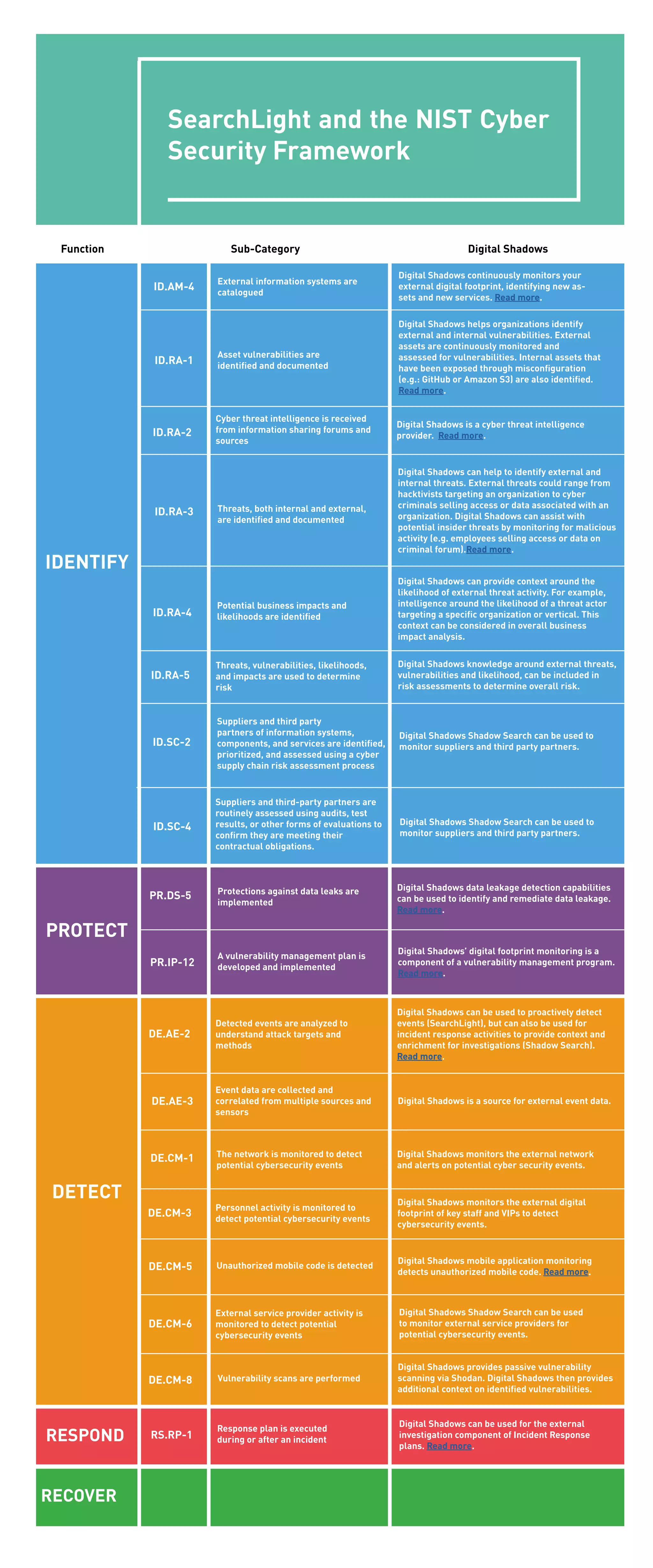
Digital Shadows and the NIST Cyber Security Framework

  • 1.
    SearchLight and theNIST Cyber Security Framework IDENTIFY PROTECT DETECT RESPOND RECOVER ID.AM-4 Function Sub-Category Digital Shadows ID.RA-1 ID.RA-2 ID.RA-3 ID.RA-4 ID.RA-5 ID.SC-2 ID.SC-4 PR.DS-5 PR.IP-12 DE.CM-1 DE.AE-2 DE.AE-3 DE.CM-3 DE.CM-5 DE.CM-6 DE.CM-8 RS.RP-1 External information systems are catalogued Asset vulnerabilities are identified and documented Cyber threat intelligence is received from information sharing forums and sources Threats, both internal and external, are identified and documented Potential business impacts and likelihoods are identified Threats, vulnerabilities, likelihoods, and impacts are used to determine risk Suppliers and third party partners of information systems, components, and services are identified, prioritized, and assessed using a cyber supply chain risk assessment process Suppliers and third-party partners are routinely assessed using audits, test results, or other forms of evaluations to confirm they are meeting their contractual obligations. Protections against data leaks are implemented Event data are collected and correlated from multiple sources and sensors Digital Shadows is a source for external event data. A vulnerability management plan is developed and implemented The network is monitored to detect potential cybersecurity events Detected events are analyzed to understand attack targets and methods Digital Shadows can be used to proactively detect events (SearchLight), but can also be used for incident response activities to provide context and enrichment for investigations (Shadow Search). Read more. Personnel activity is monitored to detect potential cybersecurity events Unauthorized mobile code is detected External service provider activity is monitored to detect potential cybersecurity events Vulnerability scans are performed Response plan is executed during or after an incident Digital Shadows continuously monitors your external digital footprint, identifying new as- sets and new services. Read more. Digital Shadows helps organizations identify external and internal vulnerabilities. External assets are continuously monitored and assessed for vulnerabilities. Internal assets that have been exposed through misconfiguration (e.g.: GitHub or Amazon S3) are also identified. Read more. Digital Shadows is a cyber threat intelligence provider. Read more. Digital Shadows can help to identify external and internal threats. External threats could range from hacktivists targeting an organization to cyber criminals selling access or data associated with an organization. Digital Shadows can assist with potential insider threats by monitoring for malicious activity (e.g. employees selling access or data on criminal forum).Read more. Digital Shadows can provide context around the likelihood of external threat activity. For example, intelligence around the likelihood of a threat actor targeting a specific organization or vertical. This context can be considered in overall business impact analysis. Digital Shadows knowledge around external threats, vulnerabilities and likelihood, can be included in risk assessments to determine overall risk. Digital Shadows Shadow Search can be used to monitor suppliers and third party partners. Digital Shadows Shadow Search can be used to monitor suppliers and third party partners. Digital Shadows data leakage detection capabilities can be used to identify and remediate data leakage. Read more. Digital Shadows’ digital footprint monitoring is a component of a vulnerability management program. Read more. Digital Shadows monitors the external network and alerts on potential cyber security events. Digital Shadows monitors the external digital footprint of key staff and VIPs to detect cybersecurity events. Digital Shadows mobile application monitoring detects unauthorized mobile code. Read more. Digital Shadows Shadow Search can be used to monitor external service providers for potential cybersecurity events. Digital Shadows provides passive vulnerability scanning via Shodan. Digital Shadows then provides additional context on identified vulnerabilities. Digital Shadows can be used for the external investigation component of Incident Response plans. Read more.