Social Media
and the New
Public Sphere
Re-thinking the roles of political communication and public
opinion in the age of participatory media
Copyright
Heather L. LaMarre, PhD, MPA
A little About My Research
Political Communication and Public Opinion Scholar
The role of entertainment and social media in the
public sphere
The uses and effects of these media on attitudes,
opinions, and behaviors, which have social,
economic, and political consequences for individuals,
groups, and organizations in civil society
Copyright 2/12/2012Heather L LaMarre
Simply put, how do these media
affect our democracy?
Copyright 2/12/2012Heather L LaMarre
Tonight’s Focus:
Social Media and Politics
The rise of social media in political communication
Intersections between socially mediated politics
and public opinion
Changing dynamics and roles for political elites,
journalists, and publics
Discussion
Copyright 2/12/2012Heather L LaMarre
Social Media Snapshot….
Data source: Knight Foundation, 2012
 Over 50,000 people list themselves as a “social media
consultant” on Linkedin
 200 million Tweets are sent per day with over 10 million
users
 Over 50 million users on Facebook
 YouTube is the second largest search engine and largest
video-sharing site on the Internet
 Tumblr is a blogging platform that has over 1.5 billion views
per month and is one of the top 50 sites on the Internet
 Flickr is the top online photo sharing site with the most stock
images available under common creative licensing (you can
use them without paying a fee)
Copyright 2/12/2012Heather L LaMarre
The Rise of Political Social Media in
the United States
Pew Research Center Internet and American Life Project
1994: Senator Diane Feinstein, Democrat of California, put up the first campaign web
site.
1998: The Minnesota campaign of independent Jesse Ventura featured email.
2000: GOP presidential candidate John McCain began raising money online and used
the Internet to disseminate political news and information.
2004: Howard Dean's presidential campaign used blogs to generate voter interest,
recruit, motivate volunteers and change the interplay between citizens and
campaigns.
2008: Social media tools were used including candidate Facebook pages, Twitter
feeds, texting services and others. The New York Times said Barack Obama was the
first presidential candidature to truly understand social media.
2010: Most Congressional campaigns and over 53% of voters used social media to
connect to election information and news.
2012: Mobile apps are expected to rise significantly during election cycle.
Copyright 2/12/2012Heather L LaMarre
Social Media and Politics
The rise of social media in political communication
Intersections between socially mediated politics
and public opinion
What we know about the uses and effects of social
media in US and international politics
Changing dynamics and roles for political elites,
journalists, and publics
Discussion
Copyright 2/12/2012Heather L LaMarre
The New Public Sphere…..in the
United Stated
July 23, 2007 – The first
YouTube Debate
April 20, 2011 – The
first White House
Facebook Town Hall
July 6, 2011 – The first
White House Twitter
Town Hall
Copyright 2/12/2012Heather L LaMarre
The New Public Sphere…..in the
Middle East
“The structural changes changing our world today are in
fact empowering individuals as never before.” (Prepared by: ISN Staff;
http://www.isn.ethz.ch/isn/Current-Affairs/)
Copyright 2/12/2012Heather L LaMarre
Social media global attitudes
project
“In 15 of 21 countries, at least
25% of those polled use social
networking sites. Israel (53%)
and the U.S. (50%) top the list
with the highest percentage of
adults who say they use online
social networking sites such as
Facebook.”
(PEW global attitudes survey,
2011).
Copyright 2/12/2012Heather L LaMarre
Social Media and Politics
The rise of social media in political communication
Intersections between socially mediated politics
and public opinion
Changing dynamics and roles for political elites,
journalists, and publics
Discussion
Copyright 2/12/2012Heather L LaMarre
Scholars are growing interested in understanding the social media
eco-system…..it is proving to be a complex, dynamic system that is
rapidly changing and difficult to empirically examine
Copyright 2/12/2012Heather L LaMarre
Social Media Matters in US Politics
“During the 2010 elections, more Republicans used
Twitter than did Democrats running for the House of
Representatives……and empirical evidence suggests a
that there was a significant relationship between
Twitter Use and increased odds of winning the
election.” (LaMarre, 2012)
Copyright 2/12/2012Heather L LaMarre
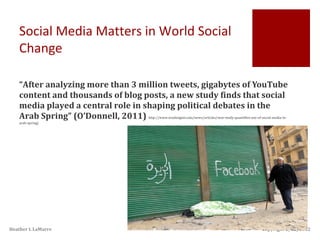
“After analyzing more than 3 million tweets, gigabytes of YouTube
content and thousands of blog posts, a new study finds that social
media played a central role in shaping political debates in the
Arab Spring” (O’Donnell, 2011) http://www.washington.edu/news/articles/new-study-quantifies-use-of-social-media-in-
arab-spring)
Social Media Matters in World Social
Change
Copyright 2/12/2012Heather L LaMarre
“There has been much coverage of the role of social media in
spreading democracy. But what dangers can social media pose when
in the wrong hands? Can it be more effective against freedom than
working for it?” (NATO, http://www.nato.int/docu/review/2011/Social_Medias/Dark-Side-Social-Media/EN)
Examples: Facebook and Twitter are illegal in China
Authoritarian regimes such as Iran are using using social media to
identify and track protestors
Wikileaks puts classified information at risk
But Can Social Media Hurt
Democracy?
Information and Democracy
“If you took all of the information produced in the entire
history of US journalism and turned it into digital data……it
would equal about the amount of information produced in a
single day on the Internet” (MIT media lab, Knight foundation media learning seminar, 2012)
Copyright 2/12/2012Heather L LaMarre
Thank You!
Presented by, Heather LaMarre
hlamarre@umn.edu
Copyright 2/12/2012Heather L LaMarre

kayapalı ismet

  • 1.
    Social Media and theNew Public Sphere Re-thinking the roles of political communication and public opinion in the age of participatory media Copyright Heather L. LaMarre, PhD, MPA
  • 2.
    A little AboutMy Research Political Communication and Public Opinion Scholar The role of entertainment and social media in the public sphere The uses and effects of these media on attitudes, opinions, and behaviors, which have social, economic, and political consequences for individuals, groups, and organizations in civil society Copyright 2/12/2012Heather L LaMarre
  • 3.
    Simply put, howdo these media affect our democracy? Copyright 2/12/2012Heather L LaMarre
  • 4.
    Tonight’s Focus: Social Mediaand Politics The rise of social media in political communication Intersections between socially mediated politics and public opinion Changing dynamics and roles for political elites, journalists, and publics Discussion Copyright 2/12/2012Heather L LaMarre
  • 5.
    Social Media Snapshot…. Datasource: Knight Foundation, 2012  Over 50,000 people list themselves as a “social media consultant” on Linkedin  200 million Tweets are sent per day with over 10 million users  Over 50 million users on Facebook  YouTube is the second largest search engine and largest video-sharing site on the Internet  Tumblr is a blogging platform that has over 1.5 billion views per month and is one of the top 50 sites on the Internet  Flickr is the top online photo sharing site with the most stock images available under common creative licensing (you can use them without paying a fee) Copyright 2/12/2012Heather L LaMarre
  • 6.
    The Rise ofPolitical Social Media in the United States Pew Research Center Internet and American Life Project 1994: Senator Diane Feinstein, Democrat of California, put up the first campaign web site. 1998: The Minnesota campaign of independent Jesse Ventura featured email. 2000: GOP presidential candidate John McCain began raising money online and used the Internet to disseminate political news and information. 2004: Howard Dean's presidential campaign used blogs to generate voter interest, recruit, motivate volunteers and change the interplay between citizens and campaigns. 2008: Social media tools were used including candidate Facebook pages, Twitter feeds, texting services and others. The New York Times said Barack Obama was the first presidential candidature to truly understand social media. 2010: Most Congressional campaigns and over 53% of voters used social media to connect to election information and news. 2012: Mobile apps are expected to rise significantly during election cycle. Copyright 2/12/2012Heather L LaMarre
  • 7.
    Social Media andPolitics The rise of social media in political communication Intersections between socially mediated politics and public opinion What we know about the uses and effects of social media in US and international politics Changing dynamics and roles for political elites, journalists, and publics Discussion Copyright 2/12/2012Heather L LaMarre
  • 8.
    The New PublicSphere…..in the United Stated July 23, 2007 – The first YouTube Debate April 20, 2011 – The first White House Facebook Town Hall July 6, 2011 – The first White House Twitter Town Hall Copyright 2/12/2012Heather L LaMarre
  • 9.
    The New PublicSphere…..in the Middle East “The structural changes changing our world today are in fact empowering individuals as never before.” (Prepared by: ISN Staff; http://www.isn.ethz.ch/isn/Current-Affairs/) Copyright 2/12/2012Heather L LaMarre
  • 10.
    Social media globalattitudes project “In 15 of 21 countries, at least 25% of those polled use social networking sites. Israel (53%) and the U.S. (50%) top the list with the highest percentage of adults who say they use online social networking sites such as Facebook.” (PEW global attitudes survey, 2011). Copyright 2/12/2012Heather L LaMarre
  • 11.
    Social Media andPolitics The rise of social media in political communication Intersections between socially mediated politics and public opinion Changing dynamics and roles for political elites, journalists, and publics Discussion Copyright 2/12/2012Heather L LaMarre
  • 12.
    Scholars are growinginterested in understanding the social media eco-system…..it is proving to be a complex, dynamic system that is rapidly changing and difficult to empirically examine Copyright 2/12/2012Heather L LaMarre
  • 13.
    Social Media Mattersin US Politics “During the 2010 elections, more Republicans used Twitter than did Democrats running for the House of Representatives……and empirical evidence suggests a that there was a significant relationship between Twitter Use and increased odds of winning the election.” (LaMarre, 2012) Copyright 2/12/2012Heather L LaMarre
  • 14.
    Copyright 2/12/2012Heather LLaMarre “After analyzing more than 3 million tweets, gigabytes of YouTube content and thousands of blog posts, a new study finds that social media played a central role in shaping political debates in the Arab Spring” (O’Donnell, 2011) http://www.washington.edu/news/articles/new-study-quantifies-use-of-social-media-in- arab-spring) Social Media Matters in World Social Change
  • 15.
    Copyright 2/12/2012Heather LLaMarre “There has been much coverage of the role of social media in spreading democracy. But what dangers can social media pose when in the wrong hands? Can it be more effective against freedom than working for it?” (NATO, http://www.nato.int/docu/review/2011/Social_Medias/Dark-Side-Social-Media/EN) Examples: Facebook and Twitter are illegal in China Authoritarian regimes such as Iran are using using social media to identify and track protestors Wikileaks puts classified information at risk But Can Social Media Hurt Democracy?
  • 16.
    Information and Democracy “Ifyou took all of the information produced in the entire history of US journalism and turned it into digital data……it would equal about the amount of information produced in a single day on the Internet” (MIT media lab, Knight foundation media learning seminar, 2012) Copyright 2/12/2012Heather L LaMarre
  • 17.
    Thank You! Presented by,Heather LaMarre hlamarre@umn.edu Copyright 2/12/2012Heather L LaMarre