







MEDIA AND ADVERTISING
Introduction
What I have done:
• Account Manager & then Digital Media Expert @
an agency
• Consult for a number Tech, Event and
Merchandising Start Ups
What I am doing:
• Account Lead at a boutique digital agency
Contact Me:
• Gaurav.gargya@gmail.com
Universe
The total group of persons in a
specific geographic area, that share
a common characteristic.
Impression
One opportunity for one individual
to see an advertisement.
Click- Throughs
The action of clicking an ad and
being taken to another web page
via a hyperlink.
Click- Through Rate
Click-through rate (CTR) is the ratio of
users who click on a specific link to the
number of total users who view a page,
email, or advertisement.
Click-through rate = Click-throughs (#) / Impressions (#)
View- Throughs
The action of viewing a video ad
for a particular duration.
View- Through Rate
A view-through rate (VTR) is the ratio of the
number viewthroughs from to the number of
total users who view video or video ad.
View-through rate = View-throughs (#) / Impressions (#)
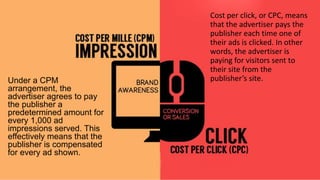
Under a CPM
arrangement, the
advertiser agrees to pay
the publisher a
predetermined amount for
every 1,000 ad
impressions served. This
effectively means that the
publisher is compensated
for every ad shown.
Cost per click, or CPC, means
that the advertiser pays the
publisher each time one of
their ads is clicked. In other
words, the advertiser is
paying for visitors sent to
their site from the
publisher’s site.
COS
T
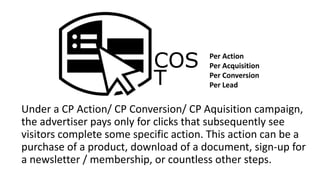
Under a CP Action/ CP Conversion/ CP Aquisition campaign,
the advertiser pays only for clicks that subsequently see
visitors complete some specific action. This action can be a
purchase of a product, download of a document, sign-up for
a newsletter / membership, or countless other steps.
Per Action
Per Acquisition
Per Conversion
Per Lead
Retargeting vs Remarketing
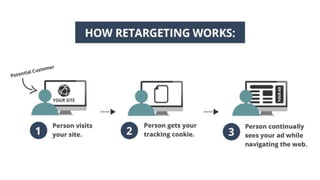
Retargeting is usually a term used
to describe display banner ads
that are served to users who have
visited your website.
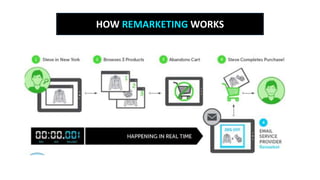
Remarketing is basically the same
thing but usually there is email
involved – for example the
personalised emails Amazon sends
you after visiting their website if you
already have an Amazon account.
HOW REMARKETING WORKS
Know your client!
• What is the business need? – Drive leads, increase sales,
educate, increase awareness, etc.
• What is their level of understanding? – Spend time nurturing
and educating your clients – There are many misconceptions
about display advertising
• What are their expectations? – Determine if they are realistic. If
not, educate then reset expectations.
• What have they done? What worked? What didn’t? Why? – Ask
for examples of creative, reports, etc. Don’t rely on “I sort of
remember…”
Define your campaign objectives!
• Identify your key metrics (KPI’s) – Visitors, page views, # of leads,
revenue, CPA …
• Establish your baseline metrics.
• Precisely define the expected campaign results.
• Increase total number of website visitors and generate leads.
• Drive 10K additional website visitors during the first 30- days, generating 250
qualified leads.
Define your TG
• Who do you want to reach? – Moms w/ children under 10 vs.
CIO/Director of Technology.
• Why should they care about your product/service? – Clearly define
the benefits in terms of your target consumer.
• What do you know about them? – Demographics, psychographics,
behaviouristics. – Consider creating a persona for each.
• What motivates or influences them? – Money, convenience, safety
Define your TG
• Where are they in the product/service lifecycle? – Do they have a
need yet? – Do they know about your brand? – Have they used? Know
your prospects/target consumers.
• How do they search for information? – Search engines, discussion
groups, expert resources
• What related websites do they visit?
• What ultimate action do you want them to take?
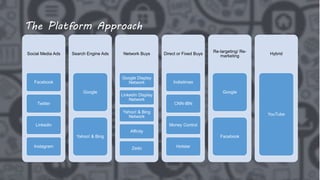
The Platform Approach
Social Media Ads
Facebook
Twitter
Linkedin
Instagram
Search Engine Ads
Google
Yahoo! & Bing
Network Buys
Google Display
Network
Linkedin Display
Network
Yahoo! & Bing
Network
Affinity
Zedo
Direct or Fixed Buys
Indiatimes
CNN-IBN
Money Control
Hotstar
Re-targeting/ Re-
marketing
Google
Facebook
Hybrid
YouTube
The Platform Approach
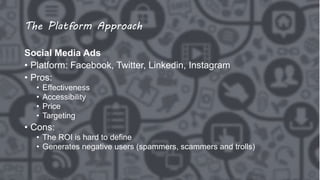
Social Media Ads
• Platform: Facebook, Twitter, Linkedin, Instagram
• Pros:
• Effectiveness
• Accessibility
• Price
• Targeting
• Cons:
• The ROI is hard to define
• Generates negative users (spammers, scammers and trolls)
The Platform Approach
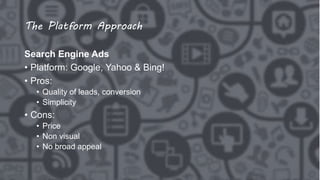
Search Engine Ads
• Platform: Google, Yahoo & Bing!
• Pros:
• Quality of leads, conversion
• Simplicity
• Cons:
• Price
• Non visual
• No broad appeal
The Platform Approach
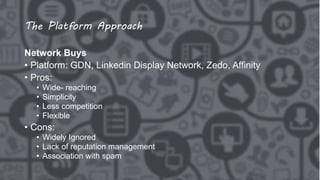
Network Buys
• Platform: GDN, Linkedin Display Network, Zedo, Affinity
• Pros:
• Wide- reaching
• Simplicity
• Less competition
• Flexible
• Cons:
• Widely Ignored
• Lack of reputation management
• Association with spam
The Platform Approach
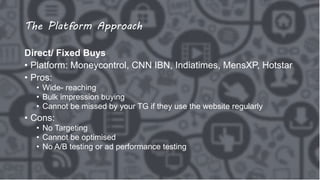
Direct/ Fixed Buys
• Platform: Moneycontrol, CNN IBN, Indiatimes, MensXP, Hotstar
• Pros:
• Wide- reaching
• Bulk impression buying
• Cannot be missed by your TG if they use the website regularly
• Cons:
• No Targeting
• Cannot be optimised
• No A/B testing or ad performance testing
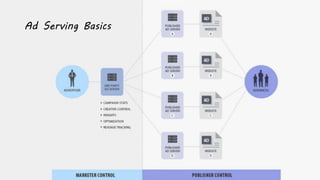
Ad Serving Basics
Pros:
• Your own numbers! (i.e., your own reporting and statistics with which to compare with the
publisher's ad server)
• Full control over your creatives (rotation, split-testing, etc.)
• Performance insights that might not be visible otherwise
• Simplified management (all campaigns in one place vs. managing multiple publisher ad servers)
• Ownership and control over all your campaign data
• Real-time reporting vs. delayed stats (sometimes up to 24 hours)
• Revenue tracking (in most cases, you don't want publishers knowing your ROI on their traffic)
• Potentially faster ad serving
Cons:
• Additional cost (in the range of $0.02 to $0.08 CPM)
• CDN costs (most ad servers should have CDN integration with separate billing)
• Certification (many publishers require ad servers be "approved" or certified by them)
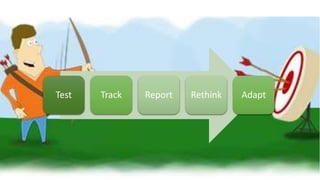
Test Track Report Rethink Adapt
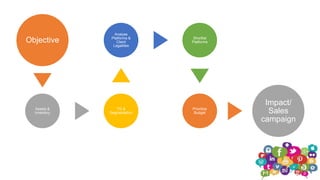
Make A
Media
Plan
Objective
Assets &
Inventory
TG &
Segmentation
Analyse
Platforms &
Client
Legalities
Shortlist
Platforms
Prioritize
Budget
Impact/
Sales
campaign
Get Your
Campaign
LIVE
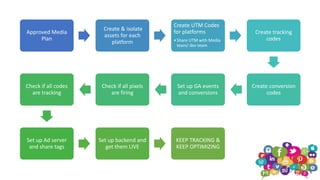
Approved Media
Plan
Create & isolate
assets for each
platform
Create UTM Codes
for platforms
•Share UTM with Media
team/ dev team
Create tracking
codes
Create conversion
codes
Set up GA events
and conversions
Check if all pixels
are firing
Check if all codes
are tracking
Set up Ad server
and share tags
Set up backend and
get them LIVE
KEEP TRACKING &
KEEP OPTIMIZING
Any Questions?
Digital Media & Advertising : Basics

Digital Media & Advertising : Basics

  • 1.
  • 2.
    Introduction What I havedone: • Account Manager & then Digital Media Expert @ an agency • Consult for a number Tech, Event and Merchandising Start Ups What I am doing: • Account Lead at a boutique digital agency Contact Me: • Gaurav.gargya@gmail.com
  • 4.
    Universe The total groupof persons in a specific geographic area, that share a common characteristic.
  • 5.
    Impression One opportunity forone individual to see an advertisement.
  • 6.
    Click- Throughs The actionof clicking an ad and being taken to another web page via a hyperlink.
  • 7.
    Click- Through Rate Click-throughrate (CTR) is the ratio of users who click on a specific link to the number of total users who view a page, email, or advertisement. Click-through rate = Click-throughs (#) / Impressions (#)
  • 8.
    View- Throughs The actionof viewing a video ad for a particular duration.
  • 9.
    View- Through Rate Aview-through rate (VTR) is the ratio of the number viewthroughs from to the number of total users who view video or video ad. View-through rate = View-throughs (#) / Impressions (#)
  • 10.
    Under a CPM arrangement,the advertiser agrees to pay the publisher a predetermined amount for every 1,000 ad impressions served. This effectively means that the publisher is compensated for every ad shown. Cost per click, or CPC, means that the advertiser pays the publisher each time one of their ads is clicked. In other words, the advertiser is paying for visitors sent to their site from the publisher’s site.
  • 11.
    COS T Under a CPAction/ CP Conversion/ CP Aquisition campaign, the advertiser pays only for clicks that subsequently see visitors complete some specific action. This action can be a purchase of a product, download of a document, sign-up for a newsletter / membership, or countless other steps. Per Action Per Acquisition Per Conversion Per Lead
  • 12.
    Retargeting vs Remarketing Retargetingis usually a term used to describe display banner ads that are served to users who have visited your website. Remarketing is basically the same thing but usually there is email involved – for example the personalised emails Amazon sends you after visiting their website if you already have an Amazon account.
  • 14.
  • 15.
    Know your client! •What is the business need? – Drive leads, increase sales, educate, increase awareness, etc. • What is their level of understanding? – Spend time nurturing and educating your clients – There are many misconceptions about display advertising • What are their expectations? – Determine if they are realistic. If not, educate then reset expectations. • What have they done? What worked? What didn’t? Why? – Ask for examples of creative, reports, etc. Don’t rely on “I sort of remember…”
  • 16.
    Define your campaignobjectives! • Identify your key metrics (KPI’s) – Visitors, page views, # of leads, revenue, CPA … • Establish your baseline metrics. • Precisely define the expected campaign results. • Increase total number of website visitors and generate leads. • Drive 10K additional website visitors during the first 30- days, generating 250 qualified leads.
  • 17.
    Define your TG •Who do you want to reach? – Moms w/ children under 10 vs. CIO/Director of Technology. • Why should they care about your product/service? – Clearly define the benefits in terms of your target consumer. • What do you know about them? – Demographics, psychographics, behaviouristics. – Consider creating a persona for each. • What motivates or influences them? – Money, convenience, safety
  • 18.
    Define your TG •Where are they in the product/service lifecycle? – Do they have a need yet? – Do they know about your brand? – Have they used? Know your prospects/target consumers. • How do they search for information? – Search engines, discussion groups, expert resources • What related websites do they visit? • What ultimate action do you want them to take?
  • 19.
    The Platform Approach SocialMedia Ads Facebook Twitter Linkedin Instagram Search Engine Ads Google Yahoo! & Bing Network Buys Google Display Network Linkedin Display Network Yahoo! & Bing Network Affinity Zedo Direct or Fixed Buys Indiatimes CNN-IBN Money Control Hotstar Re-targeting/ Re- marketing Google Facebook Hybrid YouTube
  • 20.
    The Platform Approach SocialMedia Ads • Platform: Facebook, Twitter, Linkedin, Instagram • Pros: • Effectiveness • Accessibility • Price • Targeting • Cons: • The ROI is hard to define • Generates negative users (spammers, scammers and trolls)
  • 21.
    The Platform Approach SearchEngine Ads • Platform: Google, Yahoo & Bing! • Pros: • Quality of leads, conversion • Simplicity • Cons: • Price • Non visual • No broad appeal
  • 22.
    The Platform Approach NetworkBuys • Platform: GDN, Linkedin Display Network, Zedo, Affinity • Pros: • Wide- reaching • Simplicity • Less competition • Flexible • Cons: • Widely Ignored • Lack of reputation management • Association with spam
  • 23.
    The Platform Approach Direct/Fixed Buys • Platform: Moneycontrol, CNN IBN, Indiatimes, MensXP, Hotstar • Pros: • Wide- reaching • Bulk impression buying • Cannot be missed by your TG if they use the website regularly • Cons: • No Targeting • Cannot be optimised • No A/B testing or ad performance testing
  • 24.
  • 25.
    Pros: • Your ownnumbers! (i.e., your own reporting and statistics with which to compare with the publisher's ad server) • Full control over your creatives (rotation, split-testing, etc.) • Performance insights that might not be visible otherwise • Simplified management (all campaigns in one place vs. managing multiple publisher ad servers) • Ownership and control over all your campaign data • Real-time reporting vs. delayed stats (sometimes up to 24 hours) • Revenue tracking (in most cases, you don't want publishers knowing your ROI on their traffic) • Potentially faster ad serving Cons: • Additional cost (in the range of $0.02 to $0.08 CPM) • CDN costs (most ad servers should have CDN integration with separate billing) • Certification (many publishers require ad servers be "approved" or certified by them)
  • 26.
    Test Track ReportRethink Adapt
  • 27.
  • 28.
    Objective Assets & Inventory TG & Segmentation Analyse Platforms& Client Legalities Shortlist Platforms Prioritize Budget Impact/ Sales campaign
  • 29.
  • 30.
    Approved Media Plan Create &isolate assets for each platform Create UTM Codes for platforms •Share UTM with Media team/ dev team Create tracking codes Create conversion codes Set up GA events and conversions Check if all pixels are firing Check if all codes are tracking Set up Ad server and share tags Set up backend and get them LIVE KEEP TRACKING & KEEP OPTIMIZING
  • 31.

Editor's Notes

  • #5 Geographic limit Can be Households or Persons - “Population” alternative term - Basis for calculations - Examples – Women 18-49 in India, Men 18+ in Mumbai - Usually listed at the top of a report or table
  • #6 Applies to TV, Radio, Magazines, Outdoor – basically any media “Opportunity” is the key term - There is no guarantee a viewer, reader or listener will actually be exposed to the ad. - Measures the medium or media vehicle, not the ad• Exposure – This is sometimes used in place of Impression. It denotes “exposure to the medium”• Gross Impressions: Total number of opportunities to see an advertisement, as provided by a campaign or plan. • Sum of all opportunities, includes multiple impressions by persons in the target audience.
  • #7 Very important in terms of the campaign KPI, used to calculate the CTR
  • #8 the digital advertising business has relied on the easy to measure click-through rate (CTR) typically provided by the ad server. Most ad server platforms also measure unique or reach impressions based on deduplication of browser cookies.
  • #9 Very important in terms of the campaign KPI, used to calculate the CTR
  • #10 In measuring view-based conversions, there is room for manipulation. Because viewthrough conversions are tied to the setting the ad network's cookie and later matching it up via the same ad network's page tag loaded on a conversion page, less scrupulous ad networks have taken advantage of this by purchasing cheap below-the-fold ad inventory more for the purposes of dropping as many cookies as possible across as many users as possible than for showing the target audience advertiser's ads. Such a strategy is called cookie-bombing and permits ad networks to potentially take credit for more conversion events than they should. When possible it is always recommended to use a standalone analytics package though many ad networks offer this functionality and to also leverage experimental design to measure true incrementality.
  • #27 Test, track, report, rethink, adapt. | Test your creative (A/B, Multivariate). | Track your results. | Reporting is a tool, not an outcome. | Rethink your creative and placements regularly. | Adapt by shift dollars away from ineffective media buys to more effective opportunities. Do you need a third party ad server?This is a great option if you are running multiple campaigns across a large number ofwebsites/networks, spending significant dollars and want highly accurate, real-timetracking.
  • #31 Tracking codes- GA, Conversion codes/ pixels, remarketing codes/ pixels,