

ABC’s of Brand
Advertising
October 20, 2009
Shari Gunn, Kaboodle
Online Advertising and Social Media Summit
What do you want to
get out of today?
Today’s Agenda
 Online Advertising Industry Snapshot
 Basics of Brand Advertising Online
 Lifecycle of a Brand Campaign
 Ad Networks and the Path to Monetization
 Final Thoughts & Wrap-Up
Let’s Get Personal
 Write down the 3 – 5 content sites that
you visit on a regular basis
 Name an advertiser or advertising
campaign that you remember seeing on
one of those sites
Online Advertising Industry
Snapshot
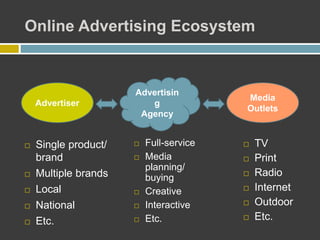
Online Advertising Ecosystem
 Full-service
 Media
planning/
buying
 Creative
 Interactive
 Etc.
Advertiser
Media
Outlets
Advertisin
g
Agency
 TV
 Print
 Radio
 Internet
 Outdoor
 Etc.
 Single product/
brand
 Multiple brands
 Local
 National
 Etc.
The Changing Media World
 Changing media landscape
 An industry in constant transition
 Evolving relationship with the consumer
 Consumers are in control of their media
consumption
 Growth in social media
 Economic pressures on both consumers and
advertisers
 Still a big discrepancy between consumers’
media consumption and where ad budgets are
spent
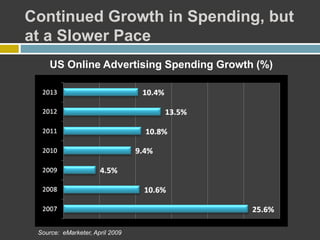
Continued Growth in Spending, but
at a Slower Pace
US Online Advertising Spending Growth (%)
Source: eMarketer, April 2009
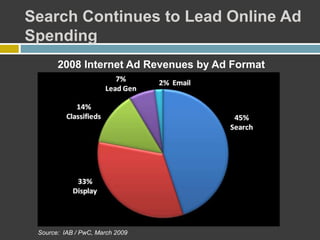
Search Continues to Lead Online Ad
Spending
2008 Internet Ad Revenues by Ad Format
Source: IAB / PwC, March 2009
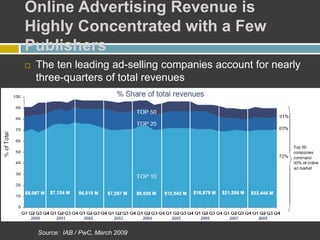
Online Advertising Revenue is
Highly Concentrated with a Few
Publishers
Source: IAB / PwC, March 2009
 The ten leading ad-selling companies account for nearly
three-quarters of total revenues
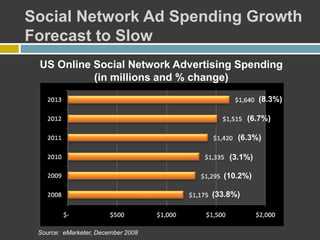
Social Network Ad Spending Growth
Forecast to Slow
US Online Social Network Advertising Spending
(in millions and % change)
Source: eMarketer, December 2008
(33.8%)
(10.2%)
(3.1%)
(6.3%)
(6.7%)
(8.3%)
Advertising on Social Networking
Sites:
Trends and Implications
 Socnet sites generally have not done well
with ads
 BUT 62% of Generation Y’ers have visited
a fan page on a socnet and nearly half
actually joined *
 Advertisers want proof that increasing
investment in will yield measurable
benefits
 Implications for publishers?* Source: Pace University Study, 2008
Back to the Basics
Meet the Interactive Advertising
Bureau
 More than 375 leading media and tech companies
who are responsible for selling 86% of online
advertising in the US
 The IAB is dedicated to:
 The growth of the interactive advertising marketplace
 Evaluating and recommending standards and
practices
 Fielding critical research on interactive advertising
 Creating a world-class medium that provides and
delivers the highest level of transparency and
accountability
 Educating marketers, agencies, media companies
and the broader business community about the value
of interactive advertising
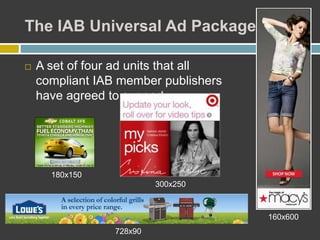
The IAB Universal Ad Package
 A set of four ad units that all
compliant IAB member publishers
have agreed to support
180x150
300x250
728x90
160x600
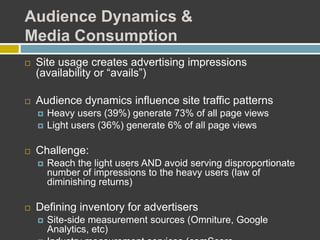
Audience Dynamics &
Media Consumption
 Site usage creates advertising impressions
(availability or “avails”)
 Audience dynamics influence site traffic patterns
 Heavy users (39%) generate 73% of all page views
 Light users (36%) generate 6% of all page views
 Challenge:
 Reach the light users AND avoid serving disproportionate
number of impressions to the heavy users (law of
diminishing returns)
 Defining inventory for advertisers
 Site-side measurement sources (Omniture, Google
Analytics, etc)
The Mechanics:
Reach, Frequency and Pricing
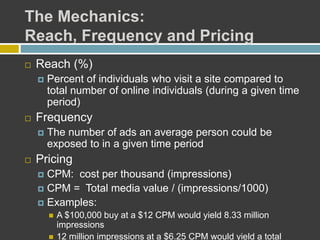
 Reach (%)
 Percent of individuals who visit a site compared to
total number of online individuals (during a given time
period)
 Frequency
 The number of ads an average person could be
exposed to in a given time period
 Pricing
 CPM: cost per thousand (impressions)
 CPM = Total media value / (impressions/1000)
 Examples:
 A $100,000 buy at a $12 CPM would yield 8.33 million
impressions
 12 million impressions at a $6.25 CPM would yield a total
More Mechanics:
Sell-Through and Effectiveness
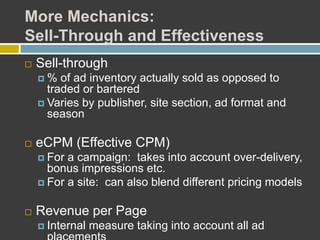
 Sell-through
 % of ad inventory actually sold as opposed to
traded or bartered
 Varies by publisher, site section, ad format and
season
 eCPM (Effective CPM)
 For a campaign: takes into account over-delivery,
bonus impressions etc.
 For a site: can also blend different pricing models
 Revenue per Page
 Internal measure taking into account all ad
Example:
Using Media Assets to Lower eCPM
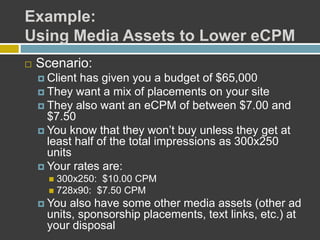
 Scenario:
 Client has given you a budget of $65,000
 They want a mix of placements on your site
 They also want an eCPM of between $7.00 and
$7.50
 You know that they won’t buy unless they get at
least half of the total impressions as 300x250
units
 Your rates are:
 300x250: $10.00 CPM
 728x90: $7.50 CPM
 You also have some other media assets (other ad
units, sponsorship placements, text links, etc.) at
your disposal
Example:
Using Media Assets to Lower eCPM
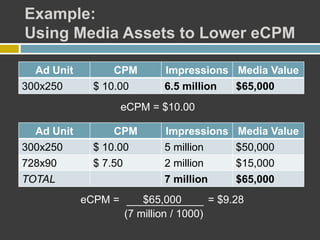
Ad Unit CPM Impressions Media Value
300x250 $ 10.00 6.5 million $65,000
eCPM = $10.00
Ad Unit CPM Impressions Media Value
300x250 $ 10.00 5 million $50,000
728x90 $ 7.50 2 million $15,000
TOTAL 7 million $65,000
eCPM = $65,000 = $9.28
(7 million / 1000)
Example:
Using Media Assets to Lower eCPM
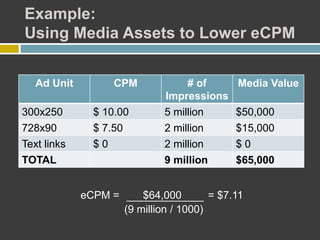
Ad Unit CPM # of
Impressions
Media Value
300x250 $ 10.00 5 million $50,000
728x90 $ 7.50 2 million $15,000
Text links $ 0 2 million $ 0
TOTAL 9 million $65,000
eCPM = $64,000 = $7.11
(9 million / 1000)
Example:
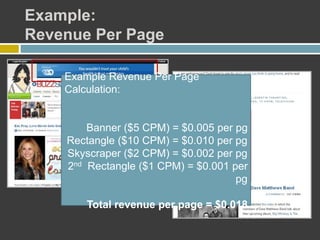
Revenue Per Page
Example Revenue Per Page
Calculation:
Banner ($5 CPM) = $0.005 per pg
Rectangle ($10 CPM) = $0.010 per pg
Skyscraper ($2 CPM) = $0.002 per pg
2nd Rectangle ($1 CPM) = $0.001 per
pg
Total revenue per page = $0.018
The Most Accountable of All Media:
Measuring Success
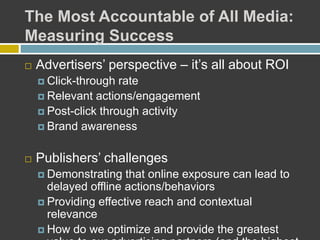
 Advertisers’ perspective – it’s all about ROI
 Click-through rate
 Relevant actions/engagement
 Post-click through activity
 Brand awareness
 Publishers’ challenges
 Demonstrating that online exposure can lead to
delayed offline actions/behaviors
 Providing effective reach and contextual
relevance
 How do we optimize and provide the greatest
Targeting
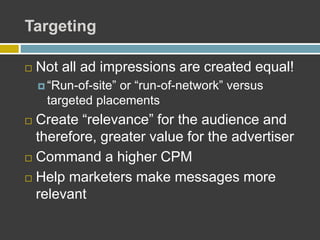
 Not all ad impressions are created equal!
 “Run-of-site” or “run-of-network” versus
targeted placements
 Create “relevance” for the audience and
therefore, greater value for the advertiser
 Command a higher CPM
 Help marketers make messages more
relevant
Types of Targeting
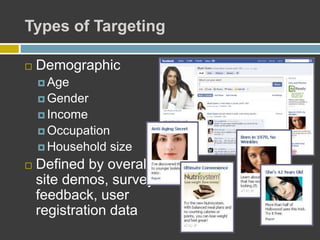
 Demographic
 Age
 Gender
 Income
 Occupation
 Household size
 Defined by overall
site demos, survey
feedback, user
registration data
Types of Targeting
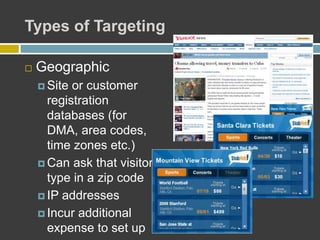
 Geographic
 Site or customer
registration
databases (for
DMA, area codes,
time zones etc.)
 Can ask that visitors
type in a zip code
 IP addresses
 Incur additional
expense to set up
Types of Targeting
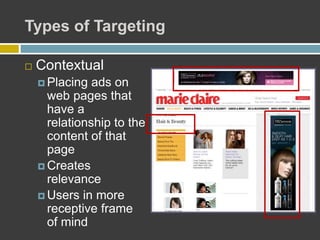
 Contextual
 Placing ads on
web pages that
have a
relationship to the
content of that
page
 Creates
relevance
 Users in more
receptive frame
of mind
Types of Targeting
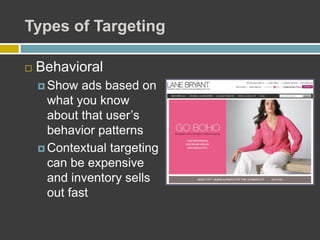
 Behavioral
 Show ads based on
what you know
about that user’s
behavior patterns
 Contextual targeting
can be expensive
and inventory sells
out fast
Types of Targeting
 Daypart
 Consumers choose
and use media
throughout the day
 Workday routines
shape online
consumption (peaks
in mornings, dinner
and prime time
hours)
Advanced Ad Formats:
Rich Media
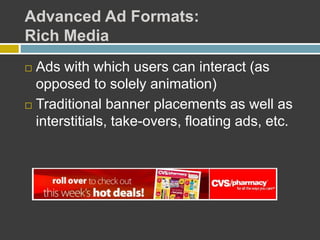
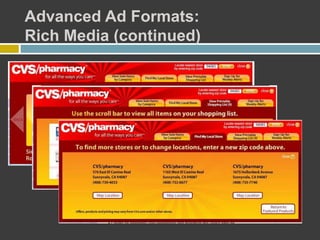
 Ads with which users can interact (as
opposed to solely animation)
 Traditional banner placements as well as
interstitials, take-overs, floating ads, etc.
Advanced Ad Formats:
Rich Media (continued)
Advanced Ad Formats:
Video
 Video
 Traditional ad placements: Pre-roll, Mid-roll,
Post-roll
 High demand for premium video inventory
trading at 2-3x display CPMs (emphasis on
“premium”)
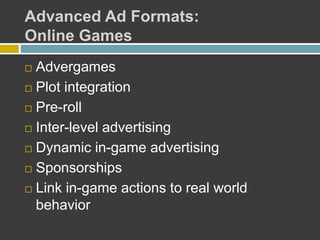
Advanced Ad Formats:
Online Games
 Advergames
 Plot integration
 Pre-roll
 Inter-level advertising
 Dynamic in-game advertising
 Sponsorships
 Link in-game actions to real world
behavior
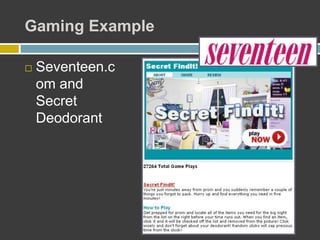
Gaming Example
 Seventeen.c
om and
Secret
Deodorant
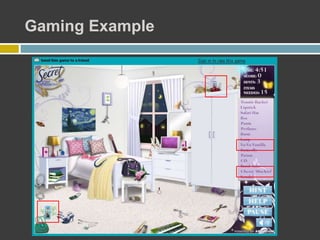
Gaming Example
Lifecycle of a Brand Campaign
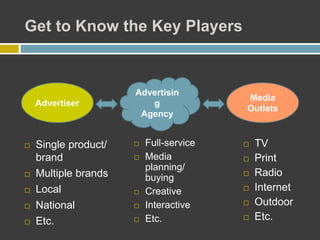
Get to Know the Key Players
 Full-service
 Media
planning/
buying
 Creative
 Interactive
 Etc.
Advertiser
Media
Outlets
Advertisin
g
Agency
 TV
 Print
 Radio
 Internet
 Outdoor
 Etc.
 Single product/
brand
 Multiple brands
 Local
 National
 Etc.
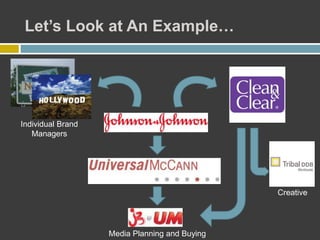
Let’s Look at An Example…
Individual Brand
Managers
Media Planning and Buying
Creative
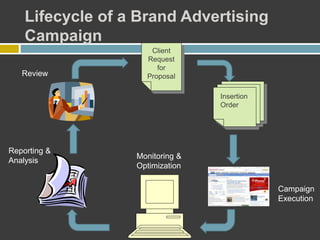
Lifecycle of a Brand Advertising
Campaign
Insertion
Order
Client
Request
for
Proposal
Monitoring &
Optimization
Campaign
Execution
Reporting &
Analysis
Review
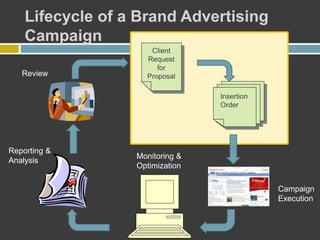
Lifecycle of a Brand Advertising
Campaign
Insertion
Order
Client
Request
for
Proposal
Monitoring &
Optimization
Campaign
Execution
Reporting &
Analysis
Review
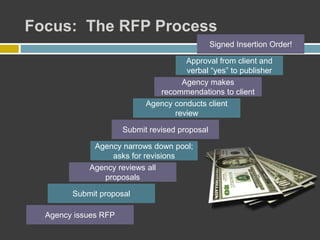
Focus: The RFP Process
Agency issues RFP
Submit proposal
Agency reviews all
proposals
Agency narrows down pool;
asks for revisions
Submit revised proposal
Agency conducts client
review
Agency makes
recommendations to client
Approval from client and
verbal “yes” to publisher
Signed Insertion Order!
The Role of Ad Networks
Ad Networks:
The Long Tail of Online Advertising
 The emergence of ad networks
 Top 100 publishers sell only 40% of their inventory through direct
means
 Provide small and mid-sized publishers with more advertising
revenues than would otherwise be possible
 Aggregate traffic that was previously too difficult to buy or which
was otherwise undesirable
 Small publishers can’t afford their own sales force (and support)
 Advertisers (or their agencies) can’t manage individual
relationships with hundreds (or even dozens) of sites
 Brand advertisers need mass reach; someone needs to
aggregate
 Growth and fragmentation
 300 – 400 ad networks today (up from only 15 seven years ago)
 Use of ad networks has increased from 5% of sold inventory in
2006 to 30% in 2007 (Source: Bain & Company)
Types of Ad Networks
 General (ex. Advertising.com)
 Geographic
 Contextual (ex. Google)
 Behavioral (ex. Tacoda, Revenue
Science)
 Vertical (ex. Glam, Jumpstart Automotive)
 Pricing (CPM, CPC, CPA, CPE)
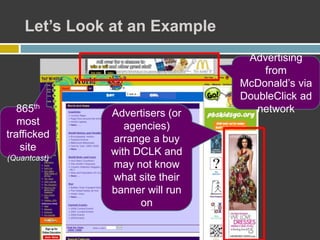
Let’s Look at an Example
865th
most
trafficked
site
(Quantcast)
Advertising
from
McDonald’s via
DoubleClick ad
networkAdvertisers (or
agencies)
arrange a buy
with DCLK and
may not know
what site their
banner will run
on
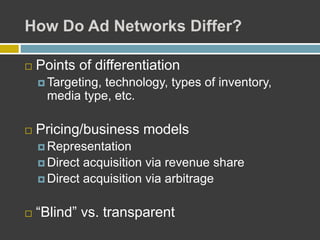
How Do Ad Networks Differ?
 Points of differentiation
 Targeting, technology, types of inventory,
media type, etc.
 Pricing/business models
 Representation
 Direct acquisition via revenue share
 Direct acquisition via arbitrage
 “Blind” vs. transparent
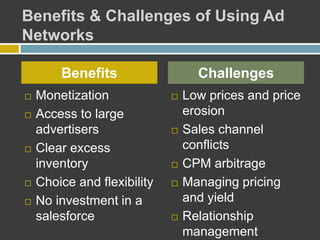
Benefits & Challenges of Using Ad
Networks
 Monetization
 Access to large
advertisers
 Clear excess
inventory
 Choice and flexibility
 No investment in a
salesforce
 Low prices and price
erosion
 Sales channel
conflicts
 CPM arbitrage
 Managing pricing
and yield
 Relationship
management
Benefits Challenges
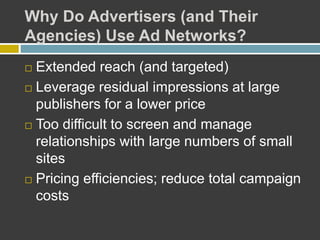
Why Do Advertisers (and Their
Agencies) Use Ad Networks?
 Extended reach (and targeted)
 Leverage residual impressions at large
publishers for a lower price
 Too difficult to screen and manage
relationships with large numbers of small
sites
 Pricing efficiencies; reduce total campaign
costs
Implications for Publishers
 Challenge of potential price erosion
 Need to better support the value of premium
inventory – through more innovative offerings
and/or reducing units available
 Can work with multiple networks for
optimization, but requires resources
 Need to actively manage secondary
channels, both to maximize yield and to
safeguard strategic position
Final Thoughts:
What’s the Right Path to
Monetization?
 Depends on your business, traffic, goals, audience,
reach, etc.
 Experiment with Google AdSense
 No long-term commitment
 No transparency on revenue share
 Most flexibility and minimal resources required
 Get some baseline metrics
 Ties into Google Ad Manager (ad serving)
 Look to ad networks for deeper support
 Test a few and optimize
 Exclusive vs. non-exclusive relationships; beware of
contract terms
Final Thoughts:
When Do You Build a Direct Sales
Force?
 Maybe never!
 Do the math
 5 million ad impressions per month at a 40% sell-
through at $8 CPM = $16,000
 Resources
 Sales manager, marketing/sales solutions,
assistant sales manager/planner, ad
trafficking/operations, reporting & analytics, billing
 Payment cycles and the impact on your working
capital
Final Thoughts:
How to Get RFP’s from Agencies
 Agencies want and need options
 Reach out to MD’s, AMD’s and Media
Planners
 Make a connection between your
audience/content and the agency’s client
 Research and industry trends
 Leverage your “launch” period
 Be prepared to talk about aggressive
pricing, low minimums, custom
opportunities and ad units
Your Homework Assignment
 Who’s your customer?
 Who is your site, product, service meant
to serve?
 What is your unique value proposition?
 How do you engage your customers and
how is that unique?
 What is the monetization strategy now?
 What do you think it could be?
Useful Resources
 Interactive Advertising Bureau (www.iab.net)
 Advertising Research Foundation
(www.thearf.org)
 comScore (www.comscore.com)
 Nielsen//NetRatings (www.nielsen-online.com)
 Forrester Research (www.forrester.com)
 eMarketer (www.emarketer.com)
 ClickZ (www.clickz.com)
 MediaPost (www.mediapost.com)
 Word of Mouth Marketing Assoc.
(www.womma.org)
Contact Information
 Shari Gunn
VP Advertising & Business Development
Kaboodle, Inc.
e: shari@kaboodle.com
p: 408.328.7019

Shari Gunn

  • 1.
    ABC’s of Brand Advertising October20, 2009 Shari Gunn, Kaboodle Online Advertising and Social Media Summit
  • 2.
    What do youwant to get out of today?
  • 3.
    Today’s Agenda  OnlineAdvertising Industry Snapshot  Basics of Brand Advertising Online  Lifecycle of a Brand Campaign  Ad Networks and the Path to Monetization  Final Thoughts & Wrap-Up
  • 4.
    Let’s Get Personal Write down the 3 – 5 content sites that you visit on a regular basis  Name an advertiser or advertising campaign that you remember seeing on one of those sites
  • 5.
  • 6.
    Online Advertising Ecosystem Full-service  Media planning/ buying  Creative  Interactive  Etc. Advertiser Media Outlets Advertisin g Agency  TV  Print  Radio  Internet  Outdoor  Etc.  Single product/ brand  Multiple brands  Local  National  Etc.
  • 7.
    The Changing MediaWorld  Changing media landscape  An industry in constant transition  Evolving relationship with the consumer  Consumers are in control of their media consumption  Growth in social media  Economic pressures on both consumers and advertisers  Still a big discrepancy between consumers’ media consumption and where ad budgets are spent
  • 8.
    Continued Growth inSpending, but at a Slower Pace US Online Advertising Spending Growth (%) Source: eMarketer, April 2009
  • 9.
    Search Continues toLead Online Ad Spending 2008 Internet Ad Revenues by Ad Format Source: IAB / PwC, March 2009
  • 10.
    Online Advertising Revenueis Highly Concentrated with a Few Publishers Source: IAB / PwC, March 2009  The ten leading ad-selling companies account for nearly three-quarters of total revenues
  • 11.
    Social Network AdSpending Growth Forecast to Slow US Online Social Network Advertising Spending (in millions and % change) Source: eMarketer, December 2008 (33.8%) (10.2%) (3.1%) (6.3%) (6.7%) (8.3%)
  • 12.
    Advertising on SocialNetworking Sites: Trends and Implications  Socnet sites generally have not done well with ads  BUT 62% of Generation Y’ers have visited a fan page on a socnet and nearly half actually joined *  Advertisers want proof that increasing investment in will yield measurable benefits  Implications for publishers?* Source: Pace University Study, 2008
  • 13.
  • 14.
    Meet the InteractiveAdvertising Bureau  More than 375 leading media and tech companies who are responsible for selling 86% of online advertising in the US  The IAB is dedicated to:  The growth of the interactive advertising marketplace  Evaluating and recommending standards and practices  Fielding critical research on interactive advertising  Creating a world-class medium that provides and delivers the highest level of transparency and accountability  Educating marketers, agencies, media companies and the broader business community about the value of interactive advertising
  • 15.
    The IAB UniversalAd Package  A set of four ad units that all compliant IAB member publishers have agreed to support 180x150 300x250 728x90 160x600
  • 16.
    Audience Dynamics & MediaConsumption  Site usage creates advertising impressions (availability or “avails”)  Audience dynamics influence site traffic patterns  Heavy users (39%) generate 73% of all page views  Light users (36%) generate 6% of all page views  Challenge:  Reach the light users AND avoid serving disproportionate number of impressions to the heavy users (law of diminishing returns)  Defining inventory for advertisers  Site-side measurement sources (Omniture, Google Analytics, etc)
  • 17.
    The Mechanics: Reach, Frequencyand Pricing  Reach (%)  Percent of individuals who visit a site compared to total number of online individuals (during a given time period)  Frequency  The number of ads an average person could be exposed to in a given time period  Pricing  CPM: cost per thousand (impressions)  CPM = Total media value / (impressions/1000)  Examples:  A $100,000 buy at a $12 CPM would yield 8.33 million impressions  12 million impressions at a $6.25 CPM would yield a total
  • 18.
    More Mechanics: Sell-Through andEffectiveness  Sell-through  % of ad inventory actually sold as opposed to traded or bartered  Varies by publisher, site section, ad format and season  eCPM (Effective CPM)  For a campaign: takes into account over-delivery, bonus impressions etc.  For a site: can also blend different pricing models  Revenue per Page  Internal measure taking into account all ad
  • 19.
    Example: Using Media Assetsto Lower eCPM  Scenario:  Client has given you a budget of $65,000  They want a mix of placements on your site  They also want an eCPM of between $7.00 and $7.50  You know that they won’t buy unless they get at least half of the total impressions as 300x250 units  Your rates are:  300x250: $10.00 CPM  728x90: $7.50 CPM  You also have some other media assets (other ad units, sponsorship placements, text links, etc.) at your disposal
  • 20.
    Example: Using Media Assetsto Lower eCPM Ad Unit CPM Impressions Media Value 300x250 $ 10.00 6.5 million $65,000 eCPM = $10.00 Ad Unit CPM Impressions Media Value 300x250 $ 10.00 5 million $50,000 728x90 $ 7.50 2 million $15,000 TOTAL 7 million $65,000 eCPM = $65,000 = $9.28 (7 million / 1000)
  • 21.
    Example: Using Media Assetsto Lower eCPM Ad Unit CPM # of Impressions Media Value 300x250 $ 10.00 5 million $50,000 728x90 $ 7.50 2 million $15,000 Text links $ 0 2 million $ 0 TOTAL 9 million $65,000 eCPM = $64,000 = $7.11 (9 million / 1000)
  • 22.
    Example: Revenue Per Page ExampleRevenue Per Page Calculation: Banner ($5 CPM) = $0.005 per pg Rectangle ($10 CPM) = $0.010 per pg Skyscraper ($2 CPM) = $0.002 per pg 2nd Rectangle ($1 CPM) = $0.001 per pg Total revenue per page = $0.018
  • 23.
    The Most Accountableof All Media: Measuring Success  Advertisers’ perspective – it’s all about ROI  Click-through rate  Relevant actions/engagement  Post-click through activity  Brand awareness  Publishers’ challenges  Demonstrating that online exposure can lead to delayed offline actions/behaviors  Providing effective reach and contextual relevance  How do we optimize and provide the greatest
  • 24.
    Targeting  Not allad impressions are created equal!  “Run-of-site” or “run-of-network” versus targeted placements  Create “relevance” for the audience and therefore, greater value for the advertiser  Command a higher CPM  Help marketers make messages more relevant
  • 25.
    Types of Targeting Demographic  Age  Gender  Income  Occupation  Household size  Defined by overall site demos, survey feedback, user registration data
  • 26.
    Types of Targeting Geographic  Site or customer registration databases (for DMA, area codes, time zones etc.)  Can ask that visitors type in a zip code  IP addresses  Incur additional expense to set up
  • 27.
    Types of Targeting Contextual  Placing ads on web pages that have a relationship to the content of that page  Creates relevance  Users in more receptive frame of mind
  • 28.
    Types of Targeting Behavioral  Show ads based on what you know about that user’s behavior patterns  Contextual targeting can be expensive and inventory sells out fast
  • 29.
    Types of Targeting Daypart  Consumers choose and use media throughout the day  Workday routines shape online consumption (peaks in mornings, dinner and prime time hours)
  • 30.
    Advanced Ad Formats: RichMedia  Ads with which users can interact (as opposed to solely animation)  Traditional banner placements as well as interstitials, take-overs, floating ads, etc.
  • 31.
    Advanced Ad Formats: RichMedia (continued)
  • 32.
    Advanced Ad Formats: Video Video  Traditional ad placements: Pre-roll, Mid-roll, Post-roll  High demand for premium video inventory trading at 2-3x display CPMs (emphasis on “premium”)
  • 33.
    Advanced Ad Formats: OnlineGames  Advergames  Plot integration  Pre-roll  Inter-level advertising  Dynamic in-game advertising  Sponsorships  Link in-game actions to real world behavior
  • 34.
  • 35.
  • 36.
    Lifecycle of aBrand Campaign
  • 37.
    Get to Knowthe Key Players  Full-service  Media planning/ buying  Creative  Interactive  Etc. Advertiser Media Outlets Advertisin g Agency  TV  Print  Radio  Internet  Outdoor  Etc.  Single product/ brand  Multiple brands  Local  National  Etc.
  • 38.
    Let’s Look atAn Example… Individual Brand Managers Media Planning and Buying Creative
  • 39.
    Lifecycle of aBrand Advertising Campaign Insertion Order Client Request for Proposal Monitoring & Optimization Campaign Execution Reporting & Analysis Review
  • 40.
    Lifecycle of aBrand Advertising Campaign Insertion Order Client Request for Proposal Monitoring & Optimization Campaign Execution Reporting & Analysis Review
  • 41.
    Focus: The RFPProcess Agency issues RFP Submit proposal Agency reviews all proposals Agency narrows down pool; asks for revisions Submit revised proposal Agency conducts client review Agency makes recommendations to client Approval from client and verbal “yes” to publisher Signed Insertion Order!
  • 42.
    The Role ofAd Networks
  • 43.
    Ad Networks: The LongTail of Online Advertising  The emergence of ad networks  Top 100 publishers sell only 40% of their inventory through direct means  Provide small and mid-sized publishers with more advertising revenues than would otherwise be possible  Aggregate traffic that was previously too difficult to buy or which was otherwise undesirable  Small publishers can’t afford their own sales force (and support)  Advertisers (or their agencies) can’t manage individual relationships with hundreds (or even dozens) of sites  Brand advertisers need mass reach; someone needs to aggregate  Growth and fragmentation  300 – 400 ad networks today (up from only 15 seven years ago)  Use of ad networks has increased from 5% of sold inventory in 2006 to 30% in 2007 (Source: Bain & Company)
  • 44.
    Types of AdNetworks  General (ex. Advertising.com)  Geographic  Contextual (ex. Google)  Behavioral (ex. Tacoda, Revenue Science)  Vertical (ex. Glam, Jumpstart Automotive)  Pricing (CPM, CPC, CPA, CPE)
  • 45.
    Let’s Look atan Example 865th most trafficked site (Quantcast) Advertising from McDonald’s via DoubleClick ad networkAdvertisers (or agencies) arrange a buy with DCLK and may not know what site their banner will run on
  • 46.
    How Do AdNetworks Differ?  Points of differentiation  Targeting, technology, types of inventory, media type, etc.  Pricing/business models  Representation  Direct acquisition via revenue share  Direct acquisition via arbitrage  “Blind” vs. transparent
  • 47.
    Benefits & Challengesof Using Ad Networks  Monetization  Access to large advertisers  Clear excess inventory  Choice and flexibility  No investment in a salesforce  Low prices and price erosion  Sales channel conflicts  CPM arbitrage  Managing pricing and yield  Relationship management Benefits Challenges
  • 48.
    Why Do Advertisers(and Their Agencies) Use Ad Networks?  Extended reach (and targeted)  Leverage residual impressions at large publishers for a lower price  Too difficult to screen and manage relationships with large numbers of small sites  Pricing efficiencies; reduce total campaign costs
  • 49.
    Implications for Publishers Challenge of potential price erosion  Need to better support the value of premium inventory – through more innovative offerings and/or reducing units available  Can work with multiple networks for optimization, but requires resources  Need to actively manage secondary channels, both to maximize yield and to safeguard strategic position
  • 50.
    Final Thoughts: What’s theRight Path to Monetization?  Depends on your business, traffic, goals, audience, reach, etc.  Experiment with Google AdSense  No long-term commitment  No transparency on revenue share  Most flexibility and minimal resources required  Get some baseline metrics  Ties into Google Ad Manager (ad serving)  Look to ad networks for deeper support  Test a few and optimize  Exclusive vs. non-exclusive relationships; beware of contract terms
  • 51.
    Final Thoughts: When DoYou Build a Direct Sales Force?  Maybe never!  Do the math  5 million ad impressions per month at a 40% sell- through at $8 CPM = $16,000  Resources  Sales manager, marketing/sales solutions, assistant sales manager/planner, ad trafficking/operations, reporting & analytics, billing  Payment cycles and the impact on your working capital
  • 52.
    Final Thoughts: How toGet RFP’s from Agencies  Agencies want and need options  Reach out to MD’s, AMD’s and Media Planners  Make a connection between your audience/content and the agency’s client  Research and industry trends  Leverage your “launch” period  Be prepared to talk about aggressive pricing, low minimums, custom opportunities and ad units
  • 53.
    Your Homework Assignment Who’s your customer?  Who is your site, product, service meant to serve?  What is your unique value proposition?  How do you engage your customers and how is that unique?  What is the monetization strategy now?  What do you think it could be?
  • 54.
    Useful Resources  InteractiveAdvertising Bureau (www.iab.net)  Advertising Research Foundation (www.thearf.org)  comScore (www.comscore.com)  Nielsen//NetRatings (www.nielsen-online.com)  Forrester Research (www.forrester.com)  eMarketer (www.emarketer.com)  ClickZ (www.clickz.com)  MediaPost (www.mediapost.com)  Word of Mouth Marketing Assoc. (www.womma.org)
  • 55.
    Contact Information  ShariGunn VP Advertising & Business Development Kaboodle, Inc. e: shari@kaboodle.com p: 408.328.7019