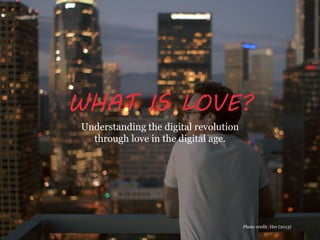
WHAT IS LOVE?
Understanding the digital revolution
through love in the digital age.
Photo credit: Her (2013)
We wanted the offline person to
translate into the mobile person.
- Lako Cho, Co-Founder, Between
2
3
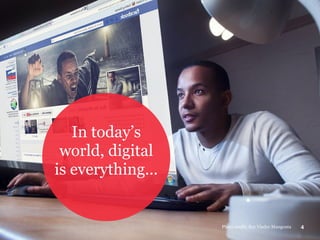
In today’s
world, digital
is everything...
4Photo credit: Rey Vladyc Mangouta
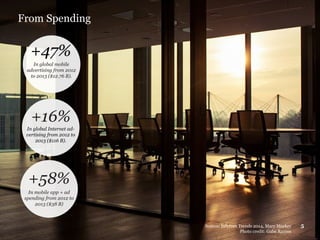
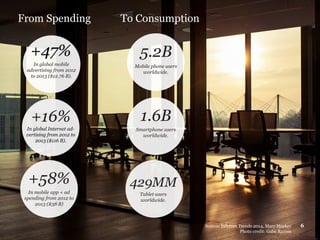
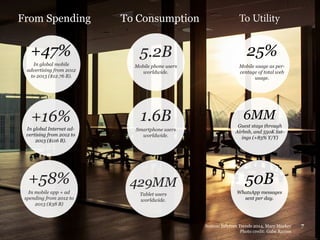
+47%
In global mobile
advertising from 2012
to 2013 ($12.76 B).
+16%
In global Internet ad-
vertising from 2012 to
2013 ($116 B).
5Source: Internet Trends 2014, Mary Meeker
Photo credit: Gabe Ramos
+58%
In mobile app + ad
spending from 2012 to
2013 ($38 B)
From Spending
5.2B
Mobile phone users
worldwide.
1.6B
Smartphone users
worldwide.
429MM
Tablet users
worldwide.
+47%
In global mobile
advertising from 2012
to 2013 ($12.76 B).
+16%
In global Internet ad-
vertising from 2012 to
2013 ($116 B).
6Source: Internet Trends 2014, Mary Meeker
Photo credit: Gabe Ramos
+58%
In mobile app + ad
spending from 2012 to
2013 ($38 B)
To ConsumptionFrom Spending
25%
Mobile usage as per-
centage of total web
usage.
50B
WhatsApp messages
sent per day.
5.2B
Mobile phone users
worldwide.
1.6B
Smartphone users
worldwide.
6MM
Guest stays through
Airbnb, and 550K list-
ings (+83% Y/Y)
429MM
Tablet users
worldwide.
+47%
In global mobile
advertising from 2012
to 2013 ($12.76 B).
+16%
In global Internet ad-
vertising from 2012 to
2013 ($116 B).
7Source: Internet Trends 2014, Mary Meeker
Photo credit: Gabe Ramos
+58%
In mobile app + ad
spending from 2012 to
2013 ($38 B)
To Consumption To UtilityFrom Spending
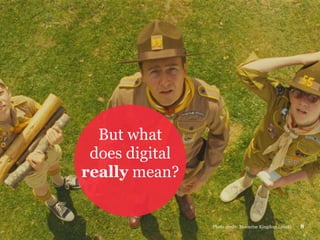
But what
does digital
really mean?
8Photo credit: Moonrise Kingdom (2012)
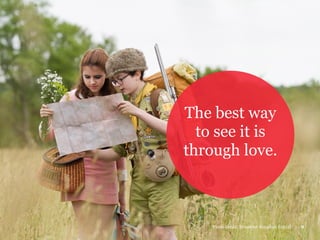
The best way
to see it is
through love.
9Photo credit: Moonrise Kingdom (2012)
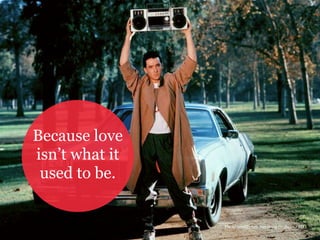
Because love
isn’t what it
used to be.
10Photo credit: Say Anything (1989)
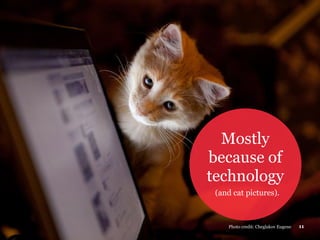
Mostly
because of
technology
(and cat pictures).
Photo credit: Cheglakov Eugene 11
So here are
three cultural
trends that help
explain digital
(not cats, though).
Photo credit: Fernando Kohan 12
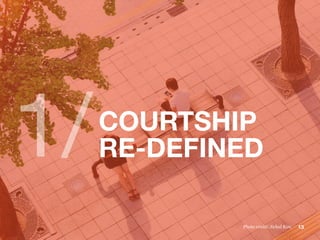
COURTSHIP
RE-DEFINED1/
Photo credit: Jichul Kim 13
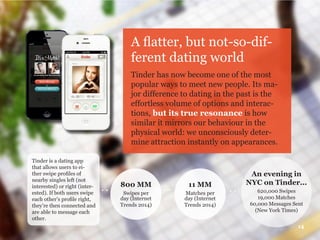
A flatter, but not-so-dif-
ferent dating world
Tinder has now become one of the most
popular ways to meet new people. Its ma-
jor difference to dating in the past is the
effortless volume of options and interac-
tions, but its true resonance is how
similar it mirrors our behaviour in the
physical world: we unconsciously deter-
mine attraction instantly on appearances.
14
Tinder is a dating app
that allows users to ei-
ther swipe profiles of
nearby singles left (not
interested) or right (inter-
ested). If both users swipe
each other’s profile right,
they’re then connected and
are able to message each
other.
800 MM
Swipes per
day (Internet
Trends 2014)
An evening in
NYC on Tinder...
620,000 Swipes
19,000 Matches
60,000 Messages Sent
(New York Times)
11 MM
Matches per
day (Internet
Trends 2014)
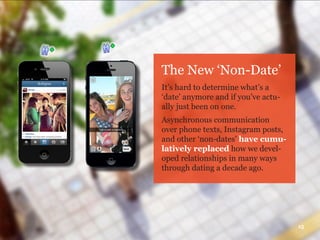
The New ‘Non-Date’
It’s hard to determine what’s a
‘date’ anymore and if you’ve actu-
ally just been on one.
Asynchronous communication
over phone texts, Instagram posts,
and other ‘non-dates’ have cumu-
latively replaced how we devel-
oped relationships in many ways
through dating a decade ago.
15
Dating culture has
evolved to a cycle of text
messages, each one re-
quiring the code-break-
ing skills of a cold war
spy to interpret. “The End of
Courtship?”
The New York
Times, January
11, 2013
16
Embrace all of the men in
your orbit, whether they
text or G-chat, whether
they’re hunky or grun-
gy... and in the midst of
this confusing, messy
muddle, the young wom-
en argued, romance can
(sometimes) bloom.
“Seeking Love?
Find Strength in
Numbers”
The New York
Times, October
24, 2012
“Tinder’s Sean
Rad Hints At A
Future Beyond
Dating,”
TechCrunch, Oc-
tober 29, 2013
..the basic mechanism,
where two people are only
connected when they both
express interest in each
other, is “a universal thing
across friendships, across
business, across any-
thing.”
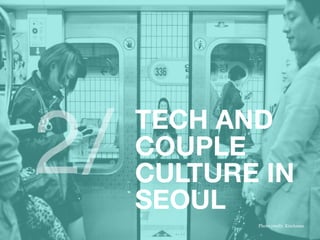
TECH AND
COUPLE
CULTURE IN
SEOUL
2/
Photo credit: Kimhwan
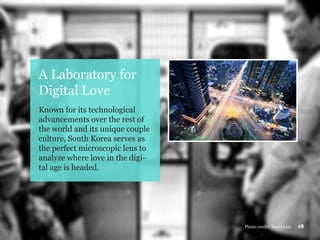
A Laboratory for
Digital Love
Known for its technological
advancements over the rest of
the world and its unique couple
culture, South Korea serves as
the perfect microscopic lens to
analyze where love in the digi-
tal age is headed.
18Photo credit: Jared Lim
19
Photo credit: CNN
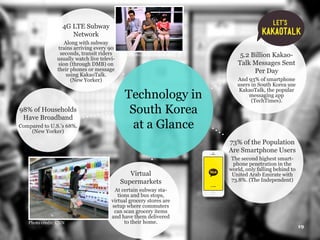
Technology in
South Korea
at a Glance
4G LTE Subway
Network
Along with subway
trains arriving every 90
seconds, transit riders
usually watch live televi-
sion (through DMB) on
their phones or message
using KakaoTalk.
(New Yorker)
Virtual
Supermarkets
At certain subway sta-
tions and bus stops,
virtual grocery stores are
setup where commuters
can scan grocery items
and have them delivered
to their home.
5.2 Billion Kakao-
Talk Messages Sent
Per Day
And 93% of smartphone
users in South Korea use
KakaoTalk, the popular
messaging app
(TechTimes).
73% of the Population
Are Smartphone Users
The second highest smart-
phone penetration in the
world, only falling behind to
United Arab Emirate with
73.8%. (The Independent)
98% of Households
Have Broadband
Compared to U.S.’s 68%.
(New Yorker)
Photo credit: kimhwan
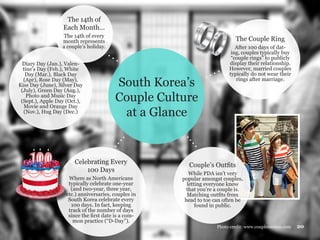
South Korea’s
Couple Culture
at a Glance
20Photo credit: www.couplemotion.com
Diary Day (Jan.), Valen-
tine’s Day (Feb.), White
Day (Mar.), Black Day
(Apr), Rose Day (May),
Kiss Day (June), Silver Day
(July), Green Day (Aug.),
Photo and Music Day
(Sept.), Apple Day (Oct.),
Movie and Orange Day
(Nov.), Hug Day (Dec.)
The 14th of
Each Month...
The 14th of every
month represents
a couple’s holiday.
The Couple Ring
After 100 days of dat-
ing, couples typically buy
“couple rings” to publicly
display their relationship.
However, married couples
typically do not wear their
rings after marriage.
Couple’s Outfits
While PDA isn’t very
popular amongst couples,
letting everyone know
that you’re a couple is.
Matching outfits from
head to toe can often be
found in public.
Celebrating Every
100 Days
Where as North Americans
typically celebrate one-year
(and two-year, three year,
etc.) anniversaries, couples in
South Korea celebrate every
100 days. In fact, keeping
track of the number of days
since the first date is a com-
mon practice (“D-Day”).
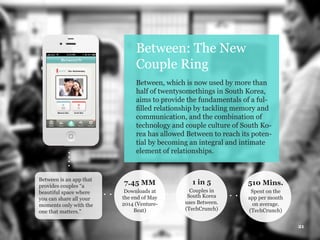
Between: The New
Couple Ring
Between, which is now used by more than
half of twentysomethings in South Korea,
aims to provide the fundamentals of a ful-
filled relationship by tackling memory and
communication, and the combination of
technology and couple culture of South Ko-
rea has allowed Between to reach its poten-
tial by becoming an integral and intimate
element of relationships.
21
Between is an app that
provides couples “a
beautiful space where
you can share all your
moments only with the
one that matters.”
7.45 MM
Downloads at
the end of May
2014 (Venture-
Beat)
510 Mins.
Spent on the
app per month
on average.
(TechCrunch)
1 in 5
Couples in
South Korea
uses Between.
(TechCrunch)
22
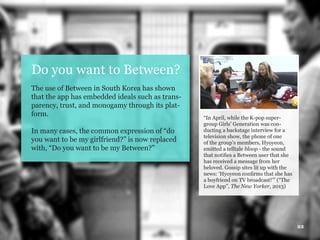
Do you want to Between?
The use of Between in South Korea has shown
that the app has embedded ideals such as trans-
parency, trust, and monogamy through its plat-
form.
In many cases, the common expression of “do
you want to be my girlfriend?” is now replaced
with, “Do you want to be my Between?”
“In April, while the K-pop super-
group Girls’ Generation was con-
ducting a backstage interview for a
television show, the phone of one
of the group’s members, Hyoyeon,
emitted a telltale bloop - the sound
that notifies a Between user that she
has received a message from her
beloved. Gossip sites lit up with the
news: ‘Hyoyeon confirms that she has
a boyfriend on TV broadcast!’” (“The
Love App”, The New Yorker, 2013)
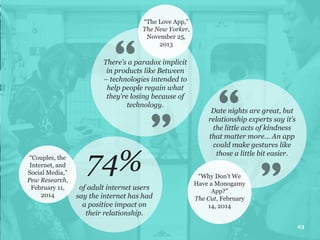
There’s a paradox implicit
in products like Between
– technologies intended to
help people regain what
they’re losing because of
technology.
“The Love App,”
The New Yorker,
November 25,
2013
74%“Couples, the
Internet, and
Social Media,”
Pew Research,
February 11,
2014
of adult internet users
say the internet has had
a positive impact on
their relationship.
23
Date nights are great, but
relationship experts say it’s
the little acts of kindness
that matter more... An app
could make gestures like
those a little bit easier.
“Why Don’t We
Have a Monogamy
App?”
The Cut, February
14, 2014
LESSONS
FROM ‘HER’3/
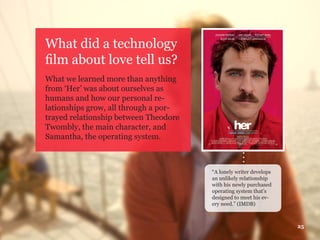
What did a technology
film about love tell us?
What we learned more than anything
from ‘Her’ was about ourselves as
humans and how our personal re-
lationships grow, all through a por-
trayed relationship between Theodore
Twombly, the main character, and
Samantha, the operating system.
25
“A lonely writer develops
an unlikely relationship
with his newly purchased
operating system that’s
designed to meet his ev-
ery need.” (IMDB)
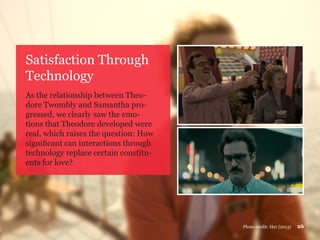
Satisfaction Through
Technology
As the relationship between Theo-
dore Twombly and Samantha pro-
gressed, we clearly saw the emo-
tions that Theodore developed were
real, which raises the question: How
significant can interactions through
technology replace certain constitu-
ents for love?
26Photo credit: Her (2013)
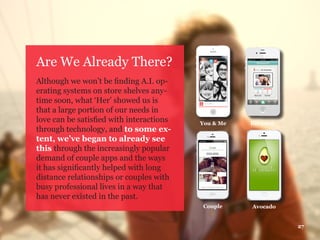
Are We Already There?
Although we won’t be finding A.I. op-
erating systems on store shelves any-
time soon, what ‘Her’ showed us is
that a large portion of our needs in
love can be satisfied with interactions
through technology, and to some ex-
tent, we’ve began to already see
this through the increasingly popular
demand of couple apps and the ways
it has significantly helped with long
distance relationships or couples with
busy professional lives in a way that
has never existed in the past.
27
You & Me
AvocadoCouple
Between
[Technology] may mod-
ify the way we go about
meeting our basic hu-
man needs, but they don’t
change our fundamental
human needs.
“Love in the
Modern Age,”
The Creator’s
Project, January
17, 2014
28
I think that [Aaron Schildkrout,
co-founder of ‘You & Me’] is
right. I’ve had some of my most
emotionally intimate and hon-
est conversations with friends
and romantic partners on mo-
bile devices. And while virtual
chats and hugs will never be the
same as their real-world coun-
terparts, they can come awfully
close in a pinch.
“I Had a Nice Time
With You Tonight.
On the App,”
The New York
Times, April 5, 2014
Any sort of love
is what connects
people to feel like
they exist.
Charlyne Yi,
Musician/Writ-
er/Comedian
29
3030
Now with cultural observations
from Tinder, Between, and
‘Her’ in mind, what’s the one
takeaway about digital?
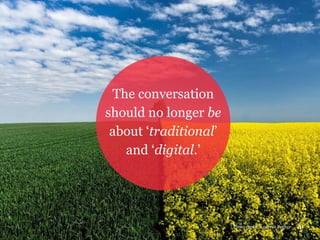
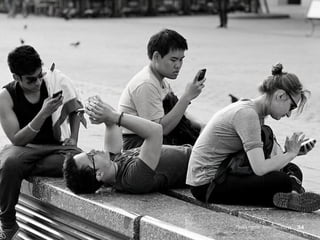
The conversation
should no longer be
about ‘traditional’
and ‘digital.’
31Photo credit: Andreas Paehge
Because
digital has
woven into
our everyday
lives.
32Photo credit: Martin Pokorny
3333
Instead, we should think about
how we can create for people
who live in a world where both
physical and digital exist on
the same plane to satisfy our
human needs.
34Photo credit: Jaroslaw Frycz
35
By Trung Ho
@trungho on Twitter
or trungho32@gmail.com
Inspired by
Spike Jonze’s ‘Her’ and
Lauren Collins’s ‘The Love App’
Resources
The Creator’s Project
The Cut
eatyourkimchi.com
‘Her’ (2013)
Internet Trends 2014 (Mary Meeker)
TechCrunch
The New Yorker
The New York Times

Understanding the Digital Revolution Through Love in the Digital Age

  • 1.
    WHAT IS LOVE? Understandingthe digital revolution through love in the digital age. Photo credit: Her (2013)
  • 2.
    We wanted theoffline person to translate into the mobile person. - Lako Cho, Co-Founder, Between 2
  • 3.
  • 4.
    In today’s world, digital iseverything... 4Photo credit: Rey Vladyc Mangouta
  • 5.
    +47% In global mobile advertisingfrom 2012 to 2013 ($12.76 B). +16% In global Internet ad- vertising from 2012 to 2013 ($116 B). 5Source: Internet Trends 2014, Mary Meeker Photo credit: Gabe Ramos +58% In mobile app + ad spending from 2012 to 2013 ($38 B) From Spending
  • 6.
    5.2B Mobile phone users worldwide. 1.6B Smartphoneusers worldwide. 429MM Tablet users worldwide. +47% In global mobile advertising from 2012 to 2013 ($12.76 B). +16% In global Internet ad- vertising from 2012 to 2013 ($116 B). 6Source: Internet Trends 2014, Mary Meeker Photo credit: Gabe Ramos +58% In mobile app + ad spending from 2012 to 2013 ($38 B) To ConsumptionFrom Spending
  • 7.
    25% Mobile usage asper- centage of total web usage. 50B WhatsApp messages sent per day. 5.2B Mobile phone users worldwide. 1.6B Smartphone users worldwide. 6MM Guest stays through Airbnb, and 550K list- ings (+83% Y/Y) 429MM Tablet users worldwide. +47% In global mobile advertising from 2012 to 2013 ($12.76 B). +16% In global Internet ad- vertising from 2012 to 2013 ($116 B). 7Source: Internet Trends 2014, Mary Meeker Photo credit: Gabe Ramos +58% In mobile app + ad spending from 2012 to 2013 ($38 B) To Consumption To UtilityFrom Spending
  • 8.
    But what does digital reallymean? 8Photo credit: Moonrise Kingdom (2012)
  • 9.
    The best way tosee it is through love. 9Photo credit: Moonrise Kingdom (2012)
  • 10.
    Because love isn’t whatit used to be. 10Photo credit: Say Anything (1989)
  • 11.
    Mostly because of technology (and catpictures). Photo credit: Cheglakov Eugene 11
  • 12.
    So here are threecultural trends that help explain digital (not cats, though). Photo credit: Fernando Kohan 12
  • 13.
  • 14.
    A flatter, butnot-so-dif- ferent dating world Tinder has now become one of the most popular ways to meet new people. Its ma- jor difference to dating in the past is the effortless volume of options and interac- tions, but its true resonance is how similar it mirrors our behaviour in the physical world: we unconsciously deter- mine attraction instantly on appearances. 14 Tinder is a dating app that allows users to ei- ther swipe profiles of nearby singles left (not interested) or right (inter- ested). If both users swipe each other’s profile right, they’re then connected and are able to message each other. 800 MM Swipes per day (Internet Trends 2014) An evening in NYC on Tinder... 620,000 Swipes 19,000 Matches 60,000 Messages Sent (New York Times) 11 MM Matches per day (Internet Trends 2014)
  • 15.
    The New ‘Non-Date’ It’shard to determine what’s a ‘date’ anymore and if you’ve actu- ally just been on one. Asynchronous communication over phone texts, Instagram posts, and other ‘non-dates’ have cumu- latively replaced how we devel- oped relationships in many ways through dating a decade ago. 15
  • 16.
    Dating culture has evolvedto a cycle of text messages, each one re- quiring the code-break- ing skills of a cold war spy to interpret. “The End of Courtship?” The New York Times, January 11, 2013 16 Embrace all of the men in your orbit, whether they text or G-chat, whether they’re hunky or grun- gy... and in the midst of this confusing, messy muddle, the young wom- en argued, romance can (sometimes) bloom. “Seeking Love? Find Strength in Numbers” The New York Times, October 24, 2012 “Tinder’s Sean Rad Hints At A Future Beyond Dating,” TechCrunch, Oc- tober 29, 2013 ..the basic mechanism, where two people are only connected when they both express interest in each other, is “a universal thing across friendships, across business, across any- thing.”
  • 17.
  • 18.
    A Laboratory for DigitalLove Known for its technological advancements over the rest of the world and its unique couple culture, South Korea serves as the perfect microscopic lens to analyze where love in the digi- tal age is headed. 18Photo credit: Jared Lim
  • 19.
    19 Photo credit: CNN Technologyin South Korea at a Glance 4G LTE Subway Network Along with subway trains arriving every 90 seconds, transit riders usually watch live televi- sion (through DMB) on their phones or message using KakaoTalk. (New Yorker) Virtual Supermarkets At certain subway sta- tions and bus stops, virtual grocery stores are setup where commuters can scan grocery items and have them delivered to their home. 5.2 Billion Kakao- Talk Messages Sent Per Day And 93% of smartphone users in South Korea use KakaoTalk, the popular messaging app (TechTimes). 73% of the Population Are Smartphone Users The second highest smart- phone penetration in the world, only falling behind to United Arab Emirate with 73.8%. (The Independent) 98% of Households Have Broadband Compared to U.S.’s 68%. (New Yorker) Photo credit: kimhwan
  • 20.
    South Korea’s Couple Culture ata Glance 20Photo credit: www.couplemotion.com Diary Day (Jan.), Valen- tine’s Day (Feb.), White Day (Mar.), Black Day (Apr), Rose Day (May), Kiss Day (June), Silver Day (July), Green Day (Aug.), Photo and Music Day (Sept.), Apple Day (Oct.), Movie and Orange Day (Nov.), Hug Day (Dec.) The 14th of Each Month... The 14th of every month represents a couple’s holiday. The Couple Ring After 100 days of dat- ing, couples typically buy “couple rings” to publicly display their relationship. However, married couples typically do not wear their rings after marriage. Couple’s Outfits While PDA isn’t very popular amongst couples, letting everyone know that you’re a couple is. Matching outfits from head to toe can often be found in public. Celebrating Every 100 Days Where as North Americans typically celebrate one-year (and two-year, three year, etc.) anniversaries, couples in South Korea celebrate every 100 days. In fact, keeping track of the number of days since the first date is a com- mon practice (“D-Day”).
  • 21.
    Between: The New CoupleRing Between, which is now used by more than half of twentysomethings in South Korea, aims to provide the fundamentals of a ful- filled relationship by tackling memory and communication, and the combination of technology and couple culture of South Ko- rea has allowed Between to reach its poten- tial by becoming an integral and intimate element of relationships. 21 Between is an app that provides couples “a beautiful space where you can share all your moments only with the one that matters.” 7.45 MM Downloads at the end of May 2014 (Venture- Beat) 510 Mins. Spent on the app per month on average. (TechCrunch) 1 in 5 Couples in South Korea uses Between. (TechCrunch)
  • 22.
    22 Do you wantto Between? The use of Between in South Korea has shown that the app has embedded ideals such as trans- parency, trust, and monogamy through its plat- form. In many cases, the common expression of “do you want to be my girlfriend?” is now replaced with, “Do you want to be my Between?” “In April, while the K-pop super- group Girls’ Generation was con- ducting a backstage interview for a television show, the phone of one of the group’s members, Hyoyeon, emitted a telltale bloop - the sound that notifies a Between user that she has received a message from her beloved. Gossip sites lit up with the news: ‘Hyoyeon confirms that she has a boyfriend on TV broadcast!’” (“The Love App”, The New Yorker, 2013)
  • 23.
    There’s a paradoximplicit in products like Between – technologies intended to help people regain what they’re losing because of technology. “The Love App,” The New Yorker, November 25, 2013 74%“Couples, the Internet, and Social Media,” Pew Research, February 11, 2014 of adult internet users say the internet has had a positive impact on their relationship. 23 Date nights are great, but relationship experts say it’s the little acts of kindness that matter more... An app could make gestures like those a little bit easier. “Why Don’t We Have a Monogamy App?” The Cut, February 14, 2014
  • 24.
  • 25.
    What did atechnology film about love tell us? What we learned more than anything from ‘Her’ was about ourselves as humans and how our personal re- lationships grow, all through a por- trayed relationship between Theodore Twombly, the main character, and Samantha, the operating system. 25 “A lonely writer develops an unlikely relationship with his newly purchased operating system that’s designed to meet his ev- ery need.” (IMDB)
  • 26.
    Satisfaction Through Technology As therelationship between Theo- dore Twombly and Samantha pro- gressed, we clearly saw the emo- tions that Theodore developed were real, which raises the question: How significant can interactions through technology replace certain constitu- ents for love? 26Photo credit: Her (2013)
  • 27.
    Are We AlreadyThere? Although we won’t be finding A.I. op- erating systems on store shelves any- time soon, what ‘Her’ showed us is that a large portion of our needs in love can be satisfied with interactions through technology, and to some ex- tent, we’ve began to already see this through the increasingly popular demand of couple apps and the ways it has significantly helped with long distance relationships or couples with busy professional lives in a way that has never existed in the past. 27 You & Me AvocadoCouple Between
  • 28.
    [Technology] may mod- ifythe way we go about meeting our basic hu- man needs, but they don’t change our fundamental human needs. “Love in the Modern Age,” The Creator’s Project, January 17, 2014 28 I think that [Aaron Schildkrout, co-founder of ‘You & Me’] is right. I’ve had some of my most emotionally intimate and hon- est conversations with friends and romantic partners on mo- bile devices. And while virtual chats and hugs will never be the same as their real-world coun- terparts, they can come awfully close in a pinch. “I Had a Nice Time With You Tonight. On the App,” The New York Times, April 5, 2014 Any sort of love is what connects people to feel like they exist. Charlyne Yi, Musician/Writ- er/Comedian
  • 29.
  • 30.
    3030 Now with culturalobservations from Tinder, Between, and ‘Her’ in mind, what’s the one takeaway about digital?
  • 31.
    The conversation should nolonger be about ‘traditional’ and ‘digital.’ 31Photo credit: Andreas Paehge
  • 32.
    Because digital has woven into oureveryday lives. 32Photo credit: Martin Pokorny
  • 33.
    3333 Instead, we shouldthink about how we can create for people who live in a world where both physical and digital exist on the same plane to satisfy our human needs.
  • 34.
  • 35.
    35 By Trung Ho @trunghoon Twitter or trungho32@gmail.com Inspired by Spike Jonze’s ‘Her’ and Lauren Collins’s ‘The Love App’ Resources The Creator’s Project The Cut eatyourkimchi.com ‘Her’ (2013) Internet Trends 2014 (Mary Meeker) TechCrunch The New Yorker The New York Times