Created by
M. Sultan Qureshi
Khubaib Khawaja
Tanveer Rafiq
Khalil Hur
Digital Library 
1
 What is “Digital Library”
– Why Digital Libraries?
– Online Publication & Digital Libraries,
–ISP digital Library,
–HEC digital library,….
Title and Content Layout with List
2
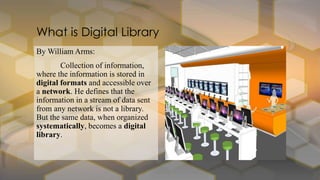
By William Arms:
Collection of information,
where the information is stored in
digital formats and accessible over
a network. He defines that the
information in a stream of data sent
from any network is not a library.
But the same data, when organized
systematically, becomes a digital
library.
What is Digital Library
• Digital Library are also known as Electronic library. focused on
collection of digital objects that can include text, visual material,
audio material, video material, stored as electronic media formats.
• The electronic content may be stored locally, or accessed remotely
via computer networks. An electronic library is a type
of information retrieval system
We can find all the digital library in
Link: http://www.dlib.org/dlib/July95/07arms.html
What is Digital Library
3
• 1st Digital library was introduced in 1971
Link: https://www.gutenberg.org/
• Project Gutenberg (PG) is a volunteer effort to digitize and
archive cultural works, to "encourage the creation and distribution
of eBooks". It was founded in 1971 by Michael S. Hart and is the
oldest digital library. Most of the items in its collection are the full
texts of public domain books.
• The project tries to make these as free as possible, in long-
lasting, open formats that can be used on almost any computer. As
of January 2015, Project Gutenberg has over 48,000 items in its
collection.
1st Digital Library project. Project Gutenberg
5
• Disadvantages of the Digital
Library.
• A digital library is speeded all over the world and is difficult to
maintain copyrights. Many people also find reading printed
material to be easier.
I. Copyright
II. Speed of access
III. Initial cost is high:
IV. Band width:
V. Efficiency:
VI. Environment:
• Advantages of the Digital
Library.
• A digital library is speeded all over the world. The user can get his/ her
information on his own computer screen by using the Internet. Actually it
is a network of multimedia system, which provides fingertip access.
I. No physical boundary.
II. Round the clock availability.
III. Multiple accesses.
IV. Structured approach: Catalog to the particular book then
to a particular chapter/in a sec so it is time saving.
V. Preservation and conservation.
VI. Networking a particular digital library can provide the link
to any other resources of other.
VII. Cost Saving.
Advantages disadvantages
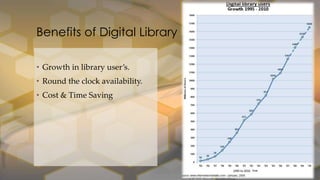
• Growth in library user’s.
• Round the clock availability.
• Cost & Time Saving
Benefits of Digital Library
• The preparation and issuing of a book, journal, piece of music,
or other work for public sale on Internet is called ONLINE
PUBLICATION
• The action of making something generally known.
For Example:
• A book, journal, etc. Issued for public sale on Internet.
Online Publication
• An online magazine is a magazine published on the
Internet, through the forms of public computer networks.
• Some online magazines distributed through the World
Wide Web call themselves Webzines.
Online Publication (Magazines)
Features of E-Publishing process :
• 1. Printing is not a part of E-Publishing process.
• 2. It avoids the distribution of a physical product. Because the
content is electronic, it may be distributed over the Internet and
through electronic bookstores. The consumer may read the
published content on a website, in an application on a tablet device,
or in a PDF on a computer.
• 3. In some cases customer may get it printed , as the Hard Copy is
required.
Electronic Publishing
• 4. Distributing content electronically as apps has become popular
due to the rapid consumer adoption of smartphones and tablets.
• 5. Using HTML5 to create web apps that can run on any browser
makes it universally compatible.
• Academic publishing is the subfield of publishing which
distributes academic research and scholarship. Most academic work
is published in academic journal article, book or thesis form.
• Academic publishing is undergoing major changes, as it makes the
transition from the print to the electronic format. Business models
are different in the electronic environment.
• Since the early 1990s, licensing of electronic resources, particularly
journals, has been very common.
• The Internet has facilitated open access self-archiving, in which
authors themselves make a copy of their published articles available
free for all on the web.
Academic Publishing
THANKzZz GUY’S

Digital Library 

  • 2.
    Created by M. SultanQureshi Khubaib Khawaja Tanveer Rafiq Khalil Hur Digital Library  1
  • 3.
     What is“Digital Library” – Why Digital Libraries? – Online Publication & Digital Libraries, –ISP digital Library, –HEC digital library,…. Title and Content Layout with List 2
  • 4.
    By William Arms: Collectionof information, where the information is stored in digital formats and accessible over a network. He defines that the information in a stream of data sent from any network is not a library. But the same data, when organized systematically, becomes a digital library. What is Digital Library
  • 5.
    • Digital Libraryare also known as Electronic library. focused on collection of digital objects that can include text, visual material, audio material, video material, stored as electronic media formats. • The electronic content may be stored locally, or accessed remotely via computer networks. An electronic library is a type of information retrieval system We can find all the digital library in Link: http://www.dlib.org/dlib/July95/07arms.html What is Digital Library 3
  • 6.
    • 1st Digitallibrary was introduced in 1971 Link: https://www.gutenberg.org/ • Project Gutenberg (PG) is a volunteer effort to digitize and archive cultural works, to "encourage the creation and distribution of eBooks". It was founded in 1971 by Michael S. Hart and is the oldest digital library. Most of the items in its collection are the full texts of public domain books. • The project tries to make these as free as possible, in long- lasting, open formats that can be used on almost any computer. As of January 2015, Project Gutenberg has over 48,000 items in its collection. 1st Digital Library project. Project Gutenberg 5
  • 7.
    • Disadvantages ofthe Digital Library. • A digital library is speeded all over the world and is difficult to maintain copyrights. Many people also find reading printed material to be easier. I. Copyright II. Speed of access III. Initial cost is high: IV. Band width: V. Efficiency: VI. Environment: • Advantages of the Digital Library. • A digital library is speeded all over the world. The user can get his/ her information on his own computer screen by using the Internet. Actually it is a network of multimedia system, which provides fingertip access. I. No physical boundary. II. Round the clock availability. III. Multiple accesses. IV. Structured approach: Catalog to the particular book then to a particular chapter/in a sec so it is time saving. V. Preservation and conservation. VI. Networking a particular digital library can provide the link to any other resources of other. VII. Cost Saving. Advantages disadvantages
  • 8.
    • Growth inlibrary user’s. • Round the clock availability. • Cost & Time Saving Benefits of Digital Library
  • 9.
    • The preparationand issuing of a book, journal, piece of music, or other work for public sale on Internet is called ONLINE PUBLICATION • The action of making something generally known. For Example: • A book, journal, etc. Issued for public sale on Internet. Online Publication
  • 10.
    • An onlinemagazine is a magazine published on the Internet, through the forms of public computer networks. • Some online magazines distributed through the World Wide Web call themselves Webzines. Online Publication (Magazines)
  • 11.
    Features of E-Publishingprocess : • 1. Printing is not a part of E-Publishing process. • 2. It avoids the distribution of a physical product. Because the content is electronic, it may be distributed over the Internet and through electronic bookstores. The consumer may read the published content on a website, in an application on a tablet device, or in a PDF on a computer. • 3. In some cases customer may get it printed , as the Hard Copy is required. Electronic Publishing
  • 12.
    • 4. Distributingcontent electronically as apps has become popular due to the rapid consumer adoption of smartphones and tablets. • 5. Using HTML5 to create web apps that can run on any browser makes it universally compatible.
  • 13.
    • Academic publishingis the subfield of publishing which distributes academic research and scholarship. Most academic work is published in academic journal article, book or thesis form. • Academic publishing is undergoing major changes, as it makes the transition from the print to the electronic format. Business models are different in the electronic environment. • Since the early 1990s, licensing of electronic resources, particularly journals, has been very common. • The Internet has facilitated open access self-archiving, in which authors themselves make a copy of their published articles available free for all on the web. Academic Publishing
  • 15.