Digital economy
Changing audience and monetisation trends
Patrick Smith - 4 July 2013
About TheMediaBriefing.com
● Media analysis and news
● Founded 2010 as a digital startup
● Editorial team of two
● 10,000 newsletters sent each week
● Site relaunch in 2013
● Three media conferences:
○ Mobile Media Strategies, 26/27 Sept 2013
○ Media Marketing Strategies, 19 Nov 2013
○ Digital Media Strategies, 4/5 March 2014
The market right now
UK consumers spend 34 hours online every month...
...But they spend 43 minutes on newspaper websites
One third of EU consumers own a smartphone...
... But 56 percent of them have never paid for content
UK tablet ownership doubled in 2012 to c16%
... But 80% of tablet owners still watch TV and 40% radio
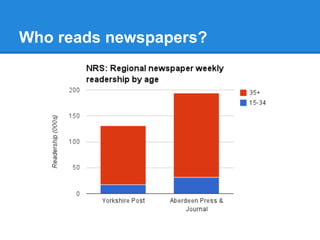
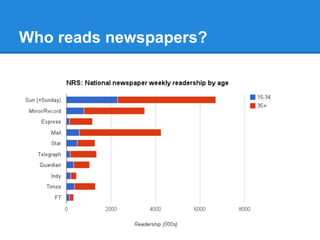
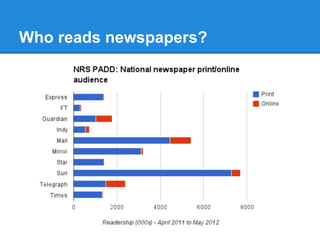
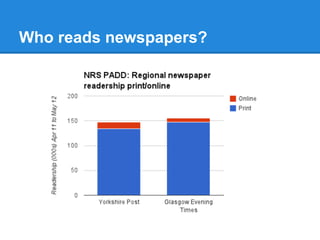
Who reads newspapers?
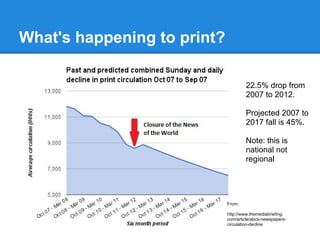
What's happening to print?
From:
http://www.themediabriefing.
com/article/abcs-newspapers-
circulation-decline
22.5% drop from
2007 to 2012.
Projected 2007 to
2017 fall is 45%.
Note: this is
national not
regional
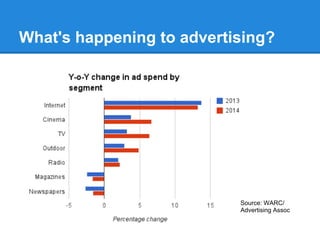
What's happening to advertising?
Source: WARC/
Advertising Assoc
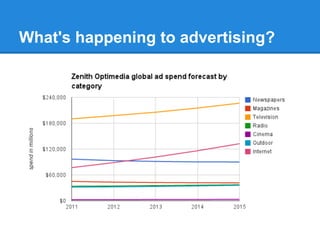
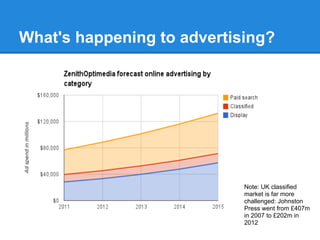
What's happening to advertising?
Note: UK classified
market is far more
challenged: Johnston
Press went from £407m
in 2007 to £202m in
2012
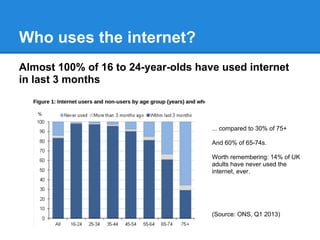
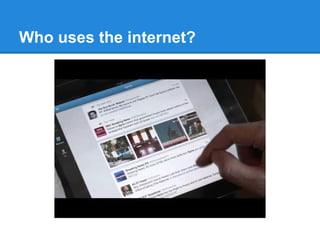
Who uses the internet?
Almost 100% of 16 to 24-year-olds have used internet
in last 3 months
... compared to 30% of 75+
And 60% of 65-74s.
Worth remembering: 14% of UK
adults have never used the
internet, ever.
(Source: ONS, Q1 2013)
Who uses the internet?
How important is mobile?
"Mobile has been overhyped in the short term
and underhyped in the medium-to-long term"
Sir Martin Sorrell, CEO, WPP - 2009
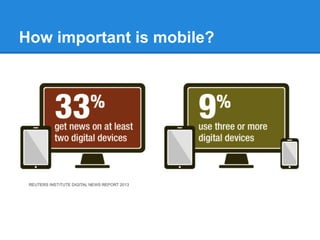
How important is mobile?
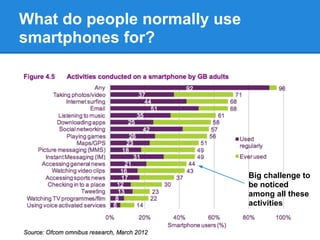
What do people normally use
smartphones for?
Big challenge to
be noticed
among all these
activities
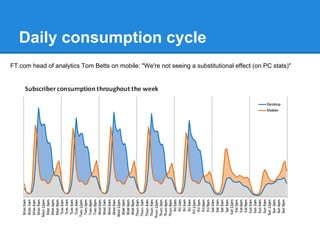
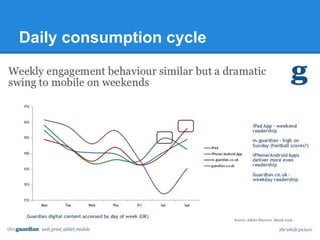
Daily consumption cycle
FT.com head of analytics Tom Betts on mobile: "We're not seeing a substitutional effect (on PC stats)"
Daily consumption cycle
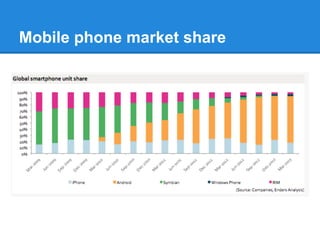
Mobile phone market share
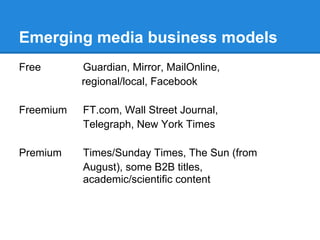
Emerging media business models
Free Guardian, Mirror, MailOnline,
regional/local, Facebook
Freemium FT.com, Wall Street Journal,
Telegraph, New York Times
Premium Times/Sunday Times, The Sun (from
August), some B2B titles,
academic/scientific content
Emerging media business models
The Times / Sunday Times
-- Launched bold paywall project July 2010
-- 99% content restricted to subscribers, all platforms
-- July 2013: 140,000 paying subscribers
-- c.500,000 daily "sales" including print + online
-- ARPU estimated at £12 means c.£1.6m gross
-- (not including churn, marketing costs etc etc)
-- Company claims 40m average reading time on iPad
-- Overall lost £28.7m in 2011/2012
Emerging media business models
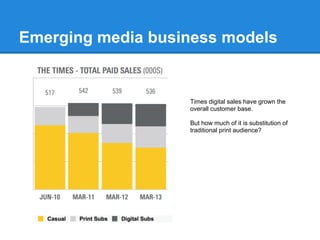
Times digital sales have grown the
overall customer base.
But how much of it is substitution of
traditional print audience?
Emerging media business models
Guardian News & Media
-- 83m unique monthly browsers (ABC, May)
-- 4.6m daily browsers
-- 2012 digital revenue £45.7m (about 1/3 of total)
-- From an audience of c60m a month, Guardian made
£14.6m in 2012 from online ads
-- Big push into America - huge international audience
-- Free on web, paid on smartphone + tablet
-- Overall lost £44.2m (partly due to capital investments)
Emerging media business models
Daily Mail / MailOnline
-- Huge online growth due to split print +online operations
-- Different content, focus, audience to the newspaper
-- MailOnline gets 8m browsers per day / 130m per month
-- Rise of the "dark social network"
-- Customer data = crucial and growing
-- Digital revenue £134m (+34%)
-- Print revenue £655m (-1%)
-- MailOnline contributes £45m in sales (+ small profit)
Importance of user data
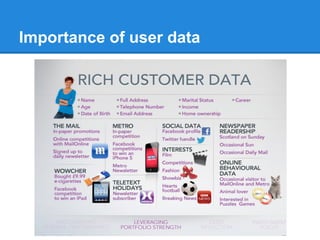
● From anonymous to known
● Usage patterns and consumption trends
● More valuable to advertisers
● Better, more targeted content
● What works? What doesn't?
Importance of user data
Digital publishing best practice
● Know the medium: print vs web vs online
○ "See picture left" on a web page
● Quality does matter - the audience knows the difference
● But no need for "TV on the internet"
● Sharing matters - is it as easy as possible?
● No shortcuts to traffic/sharing
● Track the metrics that matter (not just PV/UUs)
○ Don't always compare audience to print circulation
Digital publishing best practice
Editors + journalists = crucial
Technology changes but the craft doesn't
Thanks for listening
patrick.smith@briefingmedia.com
@psmith
www.themediabriefing.com

Mobile, desktop and journalism: The digital economy in 2013

  • 1.
    Digital economy Changing audienceand monetisation trends Patrick Smith - 4 July 2013
  • 2.
    About TheMediaBriefing.com ● Mediaanalysis and news ● Founded 2010 as a digital startup ● Editorial team of two ● 10,000 newsletters sent each week ● Site relaunch in 2013 ● Three media conferences: ○ Mobile Media Strategies, 26/27 Sept 2013 ○ Media Marketing Strategies, 19 Nov 2013 ○ Digital Media Strategies, 4/5 March 2014
  • 3.
    The market rightnow UK consumers spend 34 hours online every month... ...But they spend 43 minutes on newspaper websites One third of EU consumers own a smartphone... ... But 56 percent of them have never paid for content UK tablet ownership doubled in 2012 to c16% ... But 80% of tablet owners still watch TV and 40% radio
  • 4.
  • 5.
  • 6.
  • 7.
  • 8.
    What's happening toprint? From: http://www.themediabriefing. com/article/abcs-newspapers- circulation-decline 22.5% drop from 2007 to 2012. Projected 2007 to 2017 fall is 45%. Note: this is national not regional
  • 9.
    What's happening toadvertising? Source: WARC/ Advertising Assoc
  • 10.
    What's happening toadvertising?
  • 11.
    What's happening toadvertising? Note: UK classified market is far more challenged: Johnston Press went from £407m in 2007 to £202m in 2012
  • 12.
    Who uses theinternet? Almost 100% of 16 to 24-year-olds have used internet in last 3 months ... compared to 30% of 75+ And 60% of 65-74s. Worth remembering: 14% of UK adults have never used the internet, ever. (Source: ONS, Q1 2013)
  • 13.
    Who uses theinternet?
  • 14.
    How important ismobile? "Mobile has been overhyped in the short term and underhyped in the medium-to-long term" Sir Martin Sorrell, CEO, WPP - 2009
  • 15.
  • 16.
    What do peoplenormally use smartphones for? Big challenge to be noticed among all these activities
  • 17.
    Daily consumption cycle FT.comhead of analytics Tom Betts on mobile: "We're not seeing a substitutional effect (on PC stats)"
  • 18.
  • 19.
  • 20.
    Emerging media businessmodels Free Guardian, Mirror, MailOnline, regional/local, Facebook Freemium FT.com, Wall Street Journal, Telegraph, New York Times Premium Times/Sunday Times, The Sun (from August), some B2B titles, academic/scientific content
  • 21.
    Emerging media businessmodels The Times / Sunday Times -- Launched bold paywall project July 2010 -- 99% content restricted to subscribers, all platforms -- July 2013: 140,000 paying subscribers -- c.500,000 daily "sales" including print + online -- ARPU estimated at £12 means c.£1.6m gross -- (not including churn, marketing costs etc etc) -- Company claims 40m average reading time on iPad -- Overall lost £28.7m in 2011/2012
  • 22.
    Emerging media businessmodels Times digital sales have grown the overall customer base. But how much of it is substitution of traditional print audience?
  • 23.
    Emerging media businessmodels Guardian News & Media -- 83m unique monthly browsers (ABC, May) -- 4.6m daily browsers -- 2012 digital revenue £45.7m (about 1/3 of total) -- From an audience of c60m a month, Guardian made £14.6m in 2012 from online ads -- Big push into America - huge international audience -- Free on web, paid on smartphone + tablet -- Overall lost £44.2m (partly due to capital investments)
  • 24.
    Emerging media businessmodels Daily Mail / MailOnline -- Huge online growth due to split print +online operations -- Different content, focus, audience to the newspaper -- MailOnline gets 8m browsers per day / 130m per month -- Rise of the "dark social network" -- Customer data = crucial and growing -- Digital revenue £134m (+34%) -- Print revenue £655m (-1%) -- MailOnline contributes £45m in sales (+ small profit)
  • 25.
    Importance of userdata ● From anonymous to known ● Usage patterns and consumption trends ● More valuable to advertisers ● Better, more targeted content ● What works? What doesn't?
  • 26.
  • 27.
    Digital publishing bestpractice ● Know the medium: print vs web vs online ○ "See picture left" on a web page ● Quality does matter - the audience knows the difference ● But no need for "TV on the internet" ● Sharing matters - is it as easy as possible? ● No shortcuts to traffic/sharing ● Track the metrics that matter (not just PV/UUs) ○ Don't always compare audience to print circulation
  • 28.
    Digital publishing bestpractice Editors + journalists = crucial Technology changes but the craft doesn't
  • 29.