Iris Concise
Digital Disruption
& the Travel Industry
Presented by Ben Gill, February 2014
Contents
1. Digital Disruption
2. Travel trends
3. Trends that could affect hotels
4. What’s next?

2
1. Digital Disruption
“Changes enabled by digital technologies that occur
at a pace and magnitude that disrupt established
ways of value creation, social interactions, doing
business and more generally our thinking”
(Riemer, 2013)
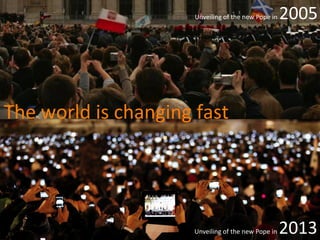
Unveiling of the new Pope in

2005

The world is changing fast

.

Unveiling of the new Pope in

2013
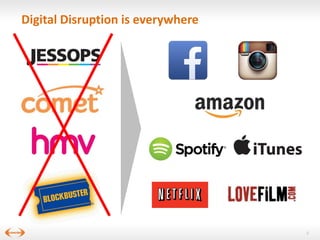
Digital Disruption is everywhere

5
The greats are falling
Blockbuster’s timeline
1985: First Blockbuster store opened in the US
1998: Netflix was founded
1999: Blockbuster IPO, valued at $4.8 billion
2003: Netflix posted its first profit, earning $6.5 million on
revenues of $272 million
2006: Blockbuster was valued at $500 million
2008: “I’ve been frankly confused by this fascination that
everybody has with Netflix… Netflix doesn’t really have or do
anything that we can’t or don’t already do ourselves.” Blockbuster CEO
September 2010: Blockbuster filed for bankruptcy in the US
January 2013: Blockbuster went into administration in the UK

(Fast Company, 2010)

6
Mobile is exploding
In 2014, there will be more than 2 billion smartphones globally
(Forrester, 2014)

Traditional PC shipments to decline 11% in 2013,
while tablet shipments increase 68%
(Gartner, 2013)
7
We’re now in the “Age of the Customer”

2013/14:
Amazon
ASOS
TripAdvisor
Netflix

(Forrester, 2011)
2. Travel trends
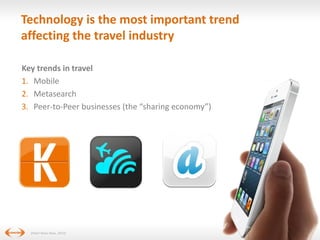
Technology is the most important trend
affecting the travel industry
Key trends in travel
1. Mobile
2. Metasearch
3. Peer-to-Peer businesses (the “sharing economy”)

(Hotel News Now, 2014)

24

10
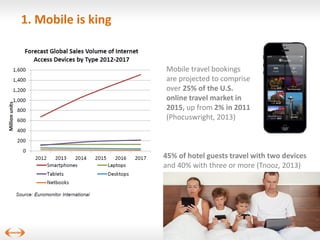
1. Mobile is king

Mobile travel bookings
are projected to comprise
over 25% of the U.S.
online travel market in
2015, up from 2% in 2011
(Phocuswright, 2013)

45% of hotel guests travel with two devices
and 40% with three or more (Tnooz, 2013)

24

11
2. Metasearch is disrupting the OTAs
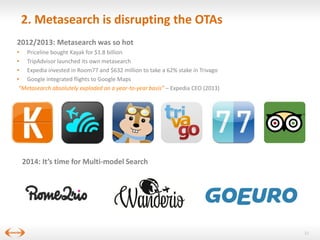
2012/2013: Metasearch was so hot
• Priceline bought Kayak for $1.8 billion
• TripAdvisor launched its own metasearch
• Expedia invested in Room77 and $632 million to take a 62% stake in Trivago
• Google integrated flights to Google Maps
“Metasearch absolutely exploded on a year-to-year basis” – Expedia CEO (2013)

2014: It’s time for Multi-model Search

12
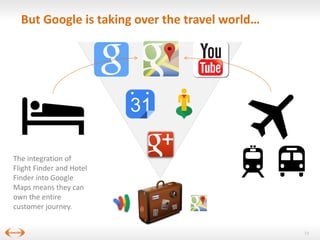
But Google is taking over the travel world…

The integration of
Flight Finder and Hotel
Finder into Google
Maps means they can
own the entire
customer journey.

13
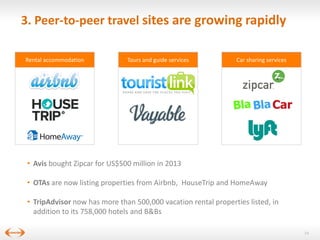
3. Peer-to-peer travel sites are growing rapidly
Rental accommodation

Tours and guide services

Car sharing services

• Avis bought Zipcar for US$500 million in 2013
• OTAs are now listing properties from Airbnb, HouseTrip and HomeAway
• TripAdvisor now has more than 500,000 vacation rental properties listed, in
addition to its 758,000 hotels and B&Bs
14
3. Trends that could affect
hotels
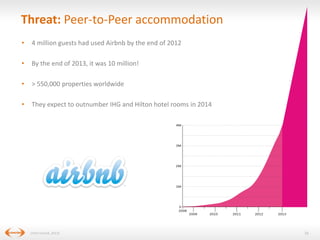
Threat: Peer-to-Peer accommodation
•

4 million guests had used Airbnb by the end of 2012

•

By the end of 2013, it was 10 million!

•

> 550,000 properties worldwide

•

They expect to outnumber IHG and Hilton hotel rooms in 2014

(Tech Crunch, 2013)

16
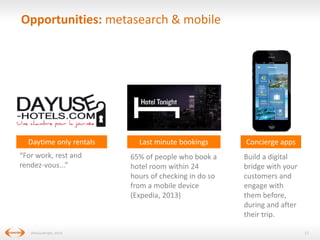
Opportunities: metasearch & mobile

Daytime only rentals
“For work, rest and
rendez-vous...”

(PhoCusWright, 2013)

Last minute bookings

Concierge apps

65% of people who book a
hotel room within 24
hours of checking in do so
from a mobile device
(Expedia, 2013)

Build a digital
bridge with your
customers and
engage with
them before,
during and after
their trip.
17
4. What’s Next?
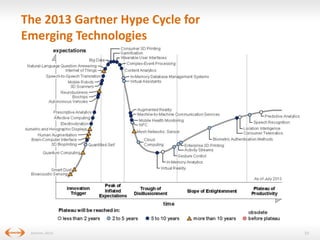
The 2013 Gartner Hype Cycle for
Emerging Technologies

(Gartner, 2013)

19
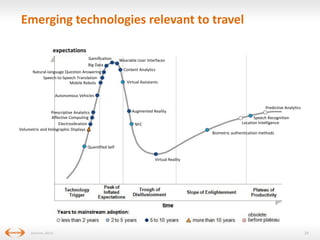
Emerging technologies relevant to travel
expectations
Gamification
Big Data
Natural-language Question Answering
Speech-to-Speech Translation
Mobile Robots

Wearable User Interfaces
Content Analytics
Virtual Assistants

Autonomous Vehicles

Prescriptive Analytics
Affective Computing
Electrovibration
Volumetric and Holographic Displays

Augmented Reality

Predictive Analytics
Speech Recognition
Location Intelligence

NFC

Biometric authentication methods

Quantified Self
Virtual Reality

(Gartner, 2013)

20
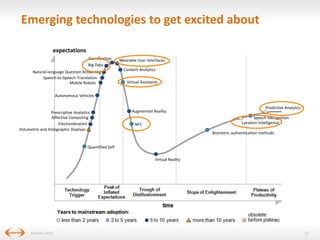
Emerging technologies to get excited about
expectations
Gamification
Big Data
Natural-language Question Answering
Speech-to-Speech Translation
Mobile Robots

Wearable User Interfaces
Content Analytics
Virtual Assistants

Autonomous Vehicles

Prescriptive Analytics
Affective Computing
Electrovibration
Volumetric and Holographic Displays

Augmented Reality

Predictive Analytics
Speech Recognition
Location Intelligence

NFC

Biometric authentication methods

Quantified Self
Virtual Reality

(Gartner, 2013)

21
Summary
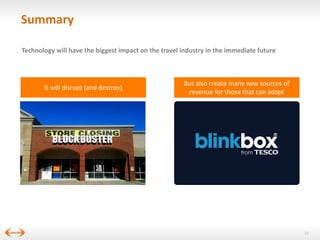
Technology will have the biggest impact on the travel industry in the immediate future

It will disrupt (and destroy)

But also create many new sources of
revenue for those that can adapt

22
Any questions?
Get in touch: ben.gill@iris-worldwide.com

23
References
Euromonitor (2013): World Travel Market Global Trends Report 2013
Forrester (2014): Predictions 2014: Mobile Trends In eBusiness
Gartner (2013): Gartner's 2013 Hype Cycle for Emerging Technologies Maps Out Evolving Relationship Between
Humans and Machines
Hotel News Now (2014): Venture capitalists spot 3 tech travel trends
Phocuswright (2013): European Online Travel Overview
Riemer (2013): What is Digital Disruption? (Part 1)

24
Appendix
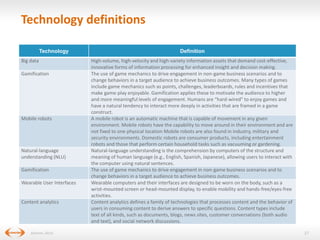
Technology definitions
Technology

Definition

Affective computing

Affective computing technologies sense the emotional state of a user (via sensors,
microphone, cameras and/or software logic) and respond by performing specific, predefined
product/service features, such as changing a quiz or recommending a set of videos to fit the
mood of the learner.

Electrovibration

Electrovibration is based on an effect in which touch receptors in the skin can be duped into
perceiving texture. Electrical charges simulate the feeling of localized vibration and friction,
mimicking shapes, textures and contours (such as the feel of a keyboard key or a button) on
touchscreens on tablets and other mobile devices or product surfaces

Volumetric displays

Volumetric displays create visual representations of objects in three dimensions, with an
almost 360-degree spherical viewing angle in which the image changes as the viewer moves
around.

Quantified Self

The Quantified Self is a movement to incorporate technology into data acquisition on
aspects of a person's daily life in terms of inputs, states, and performance. Such selfmonitoring and self-sensing, which combines wearable sensors and wearable computing

Prescriptive analytics

Prescriptive analytics is the area of business analytics (BA) dedicated to finding the best
course of action for a given situation. Prescriptive analytics seeks to determine the best
solution or outcome among various choices, given the known parameters.
Automatic translation

Speech-to-speech translation
Predictive analytics

(Gartner, 2013)

Predictive analytics describes any approach to data mining with four attributes: an emphasis
on prediction (rather than description, classification or clustering), rapid analysis measured in
hours or days (rather than the stereotypical months of traditional data mining), an emphasis
on the business relevance of the resulting insights (no ivory tower analyses) and (increasingly)
an emphasis on ease of use, thus making the tools accessible to business users.
26
Technology definitions
Technology
Big data
Gamification

Mobile robots

Natural-language
understanding (NLU)
Gamification
Wearable User Interfaces

Content analytics

(Gartner, 2013)

Definition
High-volume, high-velocity and high-variety information assets that demand cost-effective,
innovative forms of information processing for enhanced insight and decision making.
The use of game mechanics to drive engagement in non-game business scenarios and to
change behaviors in a target audience to achieve business outcomes. Many types of games
include game mechanics such as points, challenges, leaderboards, rules and incentives that
make game-play enjoyable. Gamification applies these to motivate the audience to higher
and more meaningful levels of engagement. Humans are “hard-wired” to enjoy games and
have a natural tendency to interact more deeply in activities that are framed in a game
construct.
A mobile robot is an automatic machine that is capable of movement in any given
environment. Mobile robots have the capability to move around in their environment and are
not fixed to one physical location Mobile robots are also found in industry, military and
security environments. Domestic robots are consumer products, including entertainment
robots and those that perform certain household tasks such as vacuuming or gardening.
Natural-language understanding is the comprehension by computers of the structure and
meaning of human language (e.g., English, Spanish, Japanese), allowing users to interact with
the computer using natural sentences.
The use of game mechanics to drive engagement in non-game business scenarios and to
change behaviors in a target audience to achieve business outcomes.
Wearable computers and their interfaces are designed to be worn on the body, such as a
wrist-mounted screen or head-mounted display, to enable mobility and hands-free/eyes-free
activities.
Content analytics defines a family of technologies that processes content and the behavior of
users in consuming content to derive answers to specific questions. Content types include
text of all kinds, such as documents, blogs, news sites, customer conversations (both audio
and text), and social network discussions.
27
Technology definitions
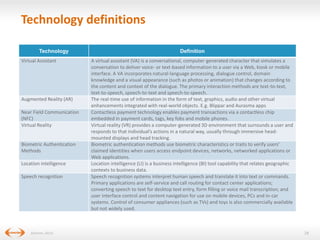
Technology
Virtual Assistant

Augmented Reality (AR)
Near Field Communication
(NFC)
Virtual Reality

Biometric Authentication
Methods
Location intelligence
Speech recognition

(Gartner, 2013)

Definition
A virtual assistant (VA) is a conversational, computer-generated character that simulates a
conversation to deliver voice- or text-based information to a user via a Web, kiosk or mobile
interface. A VA incorporates natural-language processing, dialogue control, domain
knowledge and a visual appearance (such as photos or animation) that changes according to
the content and context of the dialogue. The primary interaction methods are text-to-text,
text-to-speech, speech-to-text and speech-to-speech.
The real-time use of information in the form of text, graphics, audio and other virtual
enhancements integrated with real-world objects. E.g. Blippar and Aurasma apps
Contactless payment technology enables payment transactions via a contactless chip
embedded in payment cards, tags, key fobs and mobile phones.
Virtual reality (VR) provides a computer-generated 3D environment that surrounds a user and
responds to that individual’s actions in a natural way, usually through immersive headmounted displays and head tracking.
Biometric authentication methods use biometric characteristics or traits to verify users’
claimed identities when users access endpoint devices, networks, networked applications or
Web applications.
Location intelligence (LI) is a business intelligence (BI) tool capability that relates geographic
contexts to business data.
Speech recognition systems interpret human speech and translate it into text or commands.
Primary applications are self-service and call routing for contact center applications;
converting speech to text for desktop text entry, form filling or voice mail transcription; and
user interface control and content navigation for use on mobile devices, PCs and in-car
systems. Control of consumer appliances (such as TVs) and toys is also commercially available
but not widely used.

28

Digital disruption & the travel industry

  • 1.
    Iris Concise Digital Disruption &the Travel Industry Presented by Ben Gill, February 2014
  • 2.
    Contents 1. Digital Disruption 2.Travel trends 3. Trends that could affect hotels 4. What’s next? 2
  • 3.
    1. Digital Disruption “Changesenabled by digital technologies that occur at a pace and magnitude that disrupt established ways of value creation, social interactions, doing business and more generally our thinking” (Riemer, 2013)
  • 4.
    Unveiling of thenew Pope in 2005 The world is changing fast . Unveiling of the new Pope in 2013
  • 5.
  • 6.
    The greats arefalling Blockbuster’s timeline 1985: First Blockbuster store opened in the US 1998: Netflix was founded 1999: Blockbuster IPO, valued at $4.8 billion 2003: Netflix posted its first profit, earning $6.5 million on revenues of $272 million 2006: Blockbuster was valued at $500 million 2008: “I’ve been frankly confused by this fascination that everybody has with Netflix… Netflix doesn’t really have or do anything that we can’t or don’t already do ourselves.” Blockbuster CEO September 2010: Blockbuster filed for bankruptcy in the US January 2013: Blockbuster went into administration in the UK (Fast Company, 2010) 6
  • 7.
    Mobile is exploding In2014, there will be more than 2 billion smartphones globally (Forrester, 2014) Traditional PC shipments to decline 11% in 2013, while tablet shipments increase 68% (Gartner, 2013) 7
  • 8.
    We’re now inthe “Age of the Customer” 2013/14: Amazon ASOS TripAdvisor Netflix (Forrester, 2011)
  • 9.
  • 10.
    Technology is themost important trend affecting the travel industry Key trends in travel 1. Mobile 2. Metasearch 3. Peer-to-Peer businesses (the “sharing economy”) (Hotel News Now, 2014) 24 10
  • 11.
    1. Mobile isking Mobile travel bookings are projected to comprise over 25% of the U.S. online travel market in 2015, up from 2% in 2011 (Phocuswright, 2013) 45% of hotel guests travel with two devices and 40% with three or more (Tnooz, 2013) 24 11
  • 12.
    2. Metasearch isdisrupting the OTAs 2012/2013: Metasearch was so hot • Priceline bought Kayak for $1.8 billion • TripAdvisor launched its own metasearch • Expedia invested in Room77 and $632 million to take a 62% stake in Trivago • Google integrated flights to Google Maps “Metasearch absolutely exploded on a year-to-year basis” – Expedia CEO (2013) 2014: It’s time for Multi-model Search 12
  • 13.
    But Google istaking over the travel world… The integration of Flight Finder and Hotel Finder into Google Maps means they can own the entire customer journey. 13
  • 14.
    3. Peer-to-peer travelsites are growing rapidly Rental accommodation Tours and guide services Car sharing services • Avis bought Zipcar for US$500 million in 2013 • OTAs are now listing properties from Airbnb, HouseTrip and HomeAway • TripAdvisor now has more than 500,000 vacation rental properties listed, in addition to its 758,000 hotels and B&Bs 14
  • 15.
    3. Trends thatcould affect hotels
  • 16.
    Threat: Peer-to-Peer accommodation • 4million guests had used Airbnb by the end of 2012 • By the end of 2013, it was 10 million! • > 550,000 properties worldwide • They expect to outnumber IHG and Hilton hotel rooms in 2014 (Tech Crunch, 2013) 16
  • 17.
    Opportunities: metasearch &mobile Daytime only rentals “For work, rest and rendez-vous...” (PhoCusWright, 2013) Last minute bookings Concierge apps 65% of people who book a hotel room within 24 hours of checking in do so from a mobile device (Expedia, 2013) Build a digital bridge with your customers and engage with them before, during and after their trip. 17
  • 18.
  • 19.
    The 2013 GartnerHype Cycle for Emerging Technologies (Gartner, 2013) 19
  • 20.
    Emerging technologies relevantto travel expectations Gamification Big Data Natural-language Question Answering Speech-to-Speech Translation Mobile Robots Wearable User Interfaces Content Analytics Virtual Assistants Autonomous Vehicles Prescriptive Analytics Affective Computing Electrovibration Volumetric and Holographic Displays Augmented Reality Predictive Analytics Speech Recognition Location Intelligence NFC Biometric authentication methods Quantified Self Virtual Reality (Gartner, 2013) 20
  • 21.
    Emerging technologies toget excited about expectations Gamification Big Data Natural-language Question Answering Speech-to-Speech Translation Mobile Robots Wearable User Interfaces Content Analytics Virtual Assistants Autonomous Vehicles Prescriptive Analytics Affective Computing Electrovibration Volumetric and Holographic Displays Augmented Reality Predictive Analytics Speech Recognition Location Intelligence NFC Biometric authentication methods Quantified Self Virtual Reality (Gartner, 2013) 21
  • 22.
    Summary Technology will havethe biggest impact on the travel industry in the immediate future It will disrupt (and destroy) But also create many new sources of revenue for those that can adapt 22
  • 23.
    Any questions? Get intouch: ben.gill@iris-worldwide.com 23
  • 24.
    References Euromonitor (2013): WorldTravel Market Global Trends Report 2013 Forrester (2014): Predictions 2014: Mobile Trends In eBusiness Gartner (2013): Gartner's 2013 Hype Cycle for Emerging Technologies Maps Out Evolving Relationship Between Humans and Machines Hotel News Now (2014): Venture capitalists spot 3 tech travel trends Phocuswright (2013): European Online Travel Overview Riemer (2013): What is Digital Disruption? (Part 1) 24
  • 25.
  • 26.
    Technology definitions Technology Definition Affective computing Affectivecomputing technologies sense the emotional state of a user (via sensors, microphone, cameras and/or software logic) and respond by performing specific, predefined product/service features, such as changing a quiz or recommending a set of videos to fit the mood of the learner. Electrovibration Electrovibration is based on an effect in which touch receptors in the skin can be duped into perceiving texture. Electrical charges simulate the feeling of localized vibration and friction, mimicking shapes, textures and contours (such as the feel of a keyboard key or a button) on touchscreens on tablets and other mobile devices or product surfaces Volumetric displays Volumetric displays create visual representations of objects in three dimensions, with an almost 360-degree spherical viewing angle in which the image changes as the viewer moves around. Quantified Self The Quantified Self is a movement to incorporate technology into data acquisition on aspects of a person's daily life in terms of inputs, states, and performance. Such selfmonitoring and self-sensing, which combines wearable sensors and wearable computing Prescriptive analytics Prescriptive analytics is the area of business analytics (BA) dedicated to finding the best course of action for a given situation. Prescriptive analytics seeks to determine the best solution or outcome among various choices, given the known parameters. Automatic translation Speech-to-speech translation Predictive analytics (Gartner, 2013) Predictive analytics describes any approach to data mining with four attributes: an emphasis on prediction (rather than description, classification or clustering), rapid analysis measured in hours or days (rather than the stereotypical months of traditional data mining), an emphasis on the business relevance of the resulting insights (no ivory tower analyses) and (increasingly) an emphasis on ease of use, thus making the tools accessible to business users. 26
  • 27.
    Technology definitions Technology Big data Gamification Mobilerobots Natural-language understanding (NLU) Gamification Wearable User Interfaces Content analytics (Gartner, 2013) Definition High-volume, high-velocity and high-variety information assets that demand cost-effective, innovative forms of information processing for enhanced insight and decision making. The use of game mechanics to drive engagement in non-game business scenarios and to change behaviors in a target audience to achieve business outcomes. Many types of games include game mechanics such as points, challenges, leaderboards, rules and incentives that make game-play enjoyable. Gamification applies these to motivate the audience to higher and more meaningful levels of engagement. Humans are “hard-wired” to enjoy games and have a natural tendency to interact more deeply in activities that are framed in a game construct. A mobile robot is an automatic machine that is capable of movement in any given environment. Mobile robots have the capability to move around in their environment and are not fixed to one physical location Mobile robots are also found in industry, military and security environments. Domestic robots are consumer products, including entertainment robots and those that perform certain household tasks such as vacuuming or gardening. Natural-language understanding is the comprehension by computers of the structure and meaning of human language (e.g., English, Spanish, Japanese), allowing users to interact with the computer using natural sentences. The use of game mechanics to drive engagement in non-game business scenarios and to change behaviors in a target audience to achieve business outcomes. Wearable computers and their interfaces are designed to be worn on the body, such as a wrist-mounted screen or head-mounted display, to enable mobility and hands-free/eyes-free activities. Content analytics defines a family of technologies that processes content and the behavior of users in consuming content to derive answers to specific questions. Content types include text of all kinds, such as documents, blogs, news sites, customer conversations (both audio and text), and social network discussions. 27
  • 28.
    Technology definitions Technology Virtual Assistant AugmentedReality (AR) Near Field Communication (NFC) Virtual Reality Biometric Authentication Methods Location intelligence Speech recognition (Gartner, 2013) Definition A virtual assistant (VA) is a conversational, computer-generated character that simulates a conversation to deliver voice- or text-based information to a user via a Web, kiosk or mobile interface. A VA incorporates natural-language processing, dialogue control, domain knowledge and a visual appearance (such as photos or animation) that changes according to the content and context of the dialogue. The primary interaction methods are text-to-text, text-to-speech, speech-to-text and speech-to-speech. The real-time use of information in the form of text, graphics, audio and other virtual enhancements integrated with real-world objects. E.g. Blippar and Aurasma apps Contactless payment technology enables payment transactions via a contactless chip embedded in payment cards, tags, key fobs and mobile phones. Virtual reality (VR) provides a computer-generated 3D environment that surrounds a user and responds to that individual’s actions in a natural way, usually through immersive headmounted displays and head tracking. Biometric authentication methods use biometric characteristics or traits to verify users’ claimed identities when users access endpoint devices, networks, networked applications or Web applications. Location intelligence (LI) is a business intelligence (BI) tool capability that relates geographic contexts to business data. Speech recognition systems interpret human speech and translate it into text or commands. Primary applications are self-service and call routing for contact center applications; converting speech to text for desktop text entry, form filling or voice mail transcription; and user interface control and content navigation for use on mobile devices, PCs and in-car systems. Control of consumer appliances (such as TVs) and toys is also commercially available but not widely used. 28