



ROLE OF FARMERS FIELD SCHOOLS
IN
AGRICULTURE AND RURALDEVELOPMENT IN
PAKISTAN
By
Allah Dad Khan
allahdad52@gmail.com
03329221298
Bifurcation of Presentation
1. Introduction of Farmer Field School
2. Farmer Field School Approach
3. Basic Aims of FFS
4. Objectives of Farmer Field Schools
5. Characteristics of Farmer Field Schools
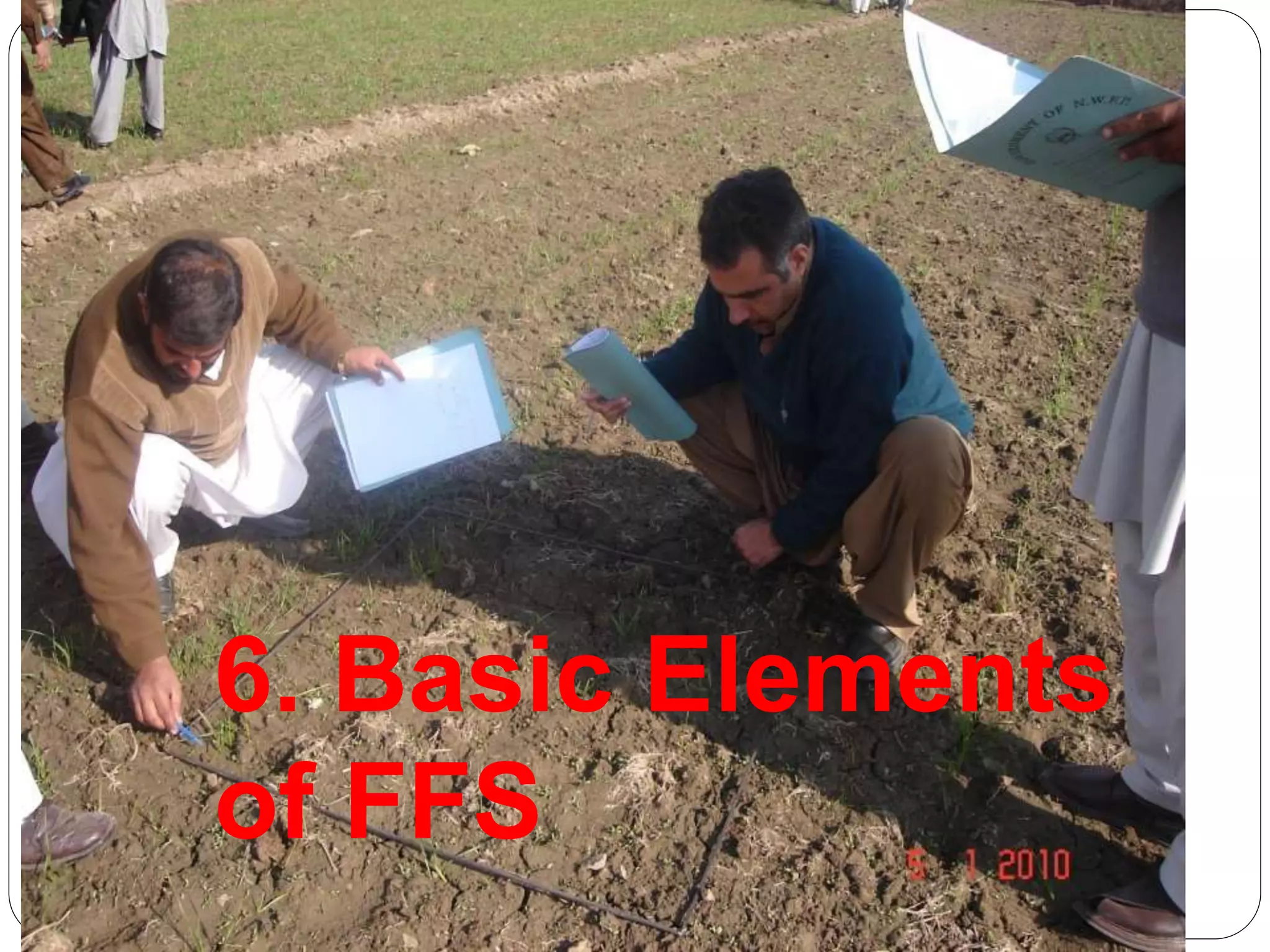
6. . Basic Elements of FFS
7. Method of education in FFS
8.Concepts of Farmer field Schools
9.Training Material for FFS
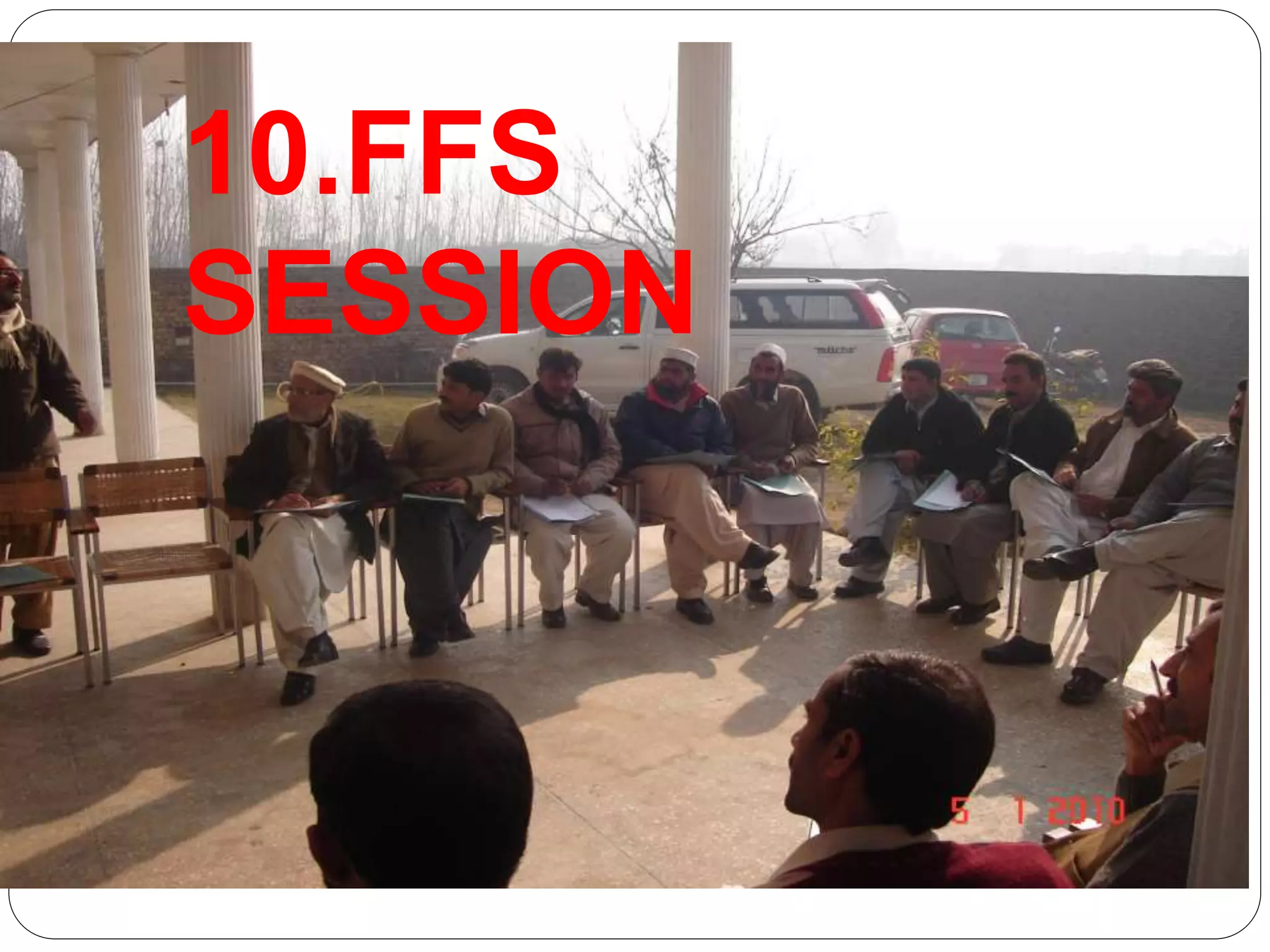
10.FFS session
1. Introduction to FFS
What is FFS
The Farmer Field School is a form of adult
education, which
evolved from the concept that farmers learn
optimally from
field observation and experimentation. It was
developed to help
farmers tailor their Integrated Pest Management
(IPM)
practices to diverse and dynamic ecological
conditions.
FFS A Paradigm Shift in Agricultural
Extension
There is an inclination towards FFS because the
extension
service is perceived having a much broader
coverage
That goes beyond the educational processes and
action learning
agenda of the FFS .
 Prophylactic, calendar-
based spraying
 Heavy subsidy on
pesticides (80%)
History of Farmer Field School
Outbreak of BPH during 1970-1980s
FFS ORIGIN
The term “Farmer Fields Schools” came from the
Indonesian
expression Sekolah Lapangan meaning just field
school.
The first Field Schools were established in 1989 in
Central Java
during a pilot season by 50 plant protection officers to
test and
develop field training methods as part of their IPM
training of
trainers course phase of the FAO-assisted National IPM
Programme.
This Programme was prompted by the devastating
insecticide-
induced outbreaks of brown plant hoppers (Nilaparvata
lugens) that
History of FFS in Pakistan
The Farmer Field School (FFS) approach evolved from the
concept
that optimal learning derives from experience - in the case of
farmers, from observation in the field. The FFS integrates the
domains of ecology and non-formal education to give
farmers the
opportunity to learn about their crop and to learn from each
other.
Learning objectives of FFS are;
i) grow healthy crop,
ii) conduct regular field observations,
iii) conserve natural enemies of pests,
iv) farmers understand ecology and become experts in their
own field.
The FFS based IPM approach was institutionalized in
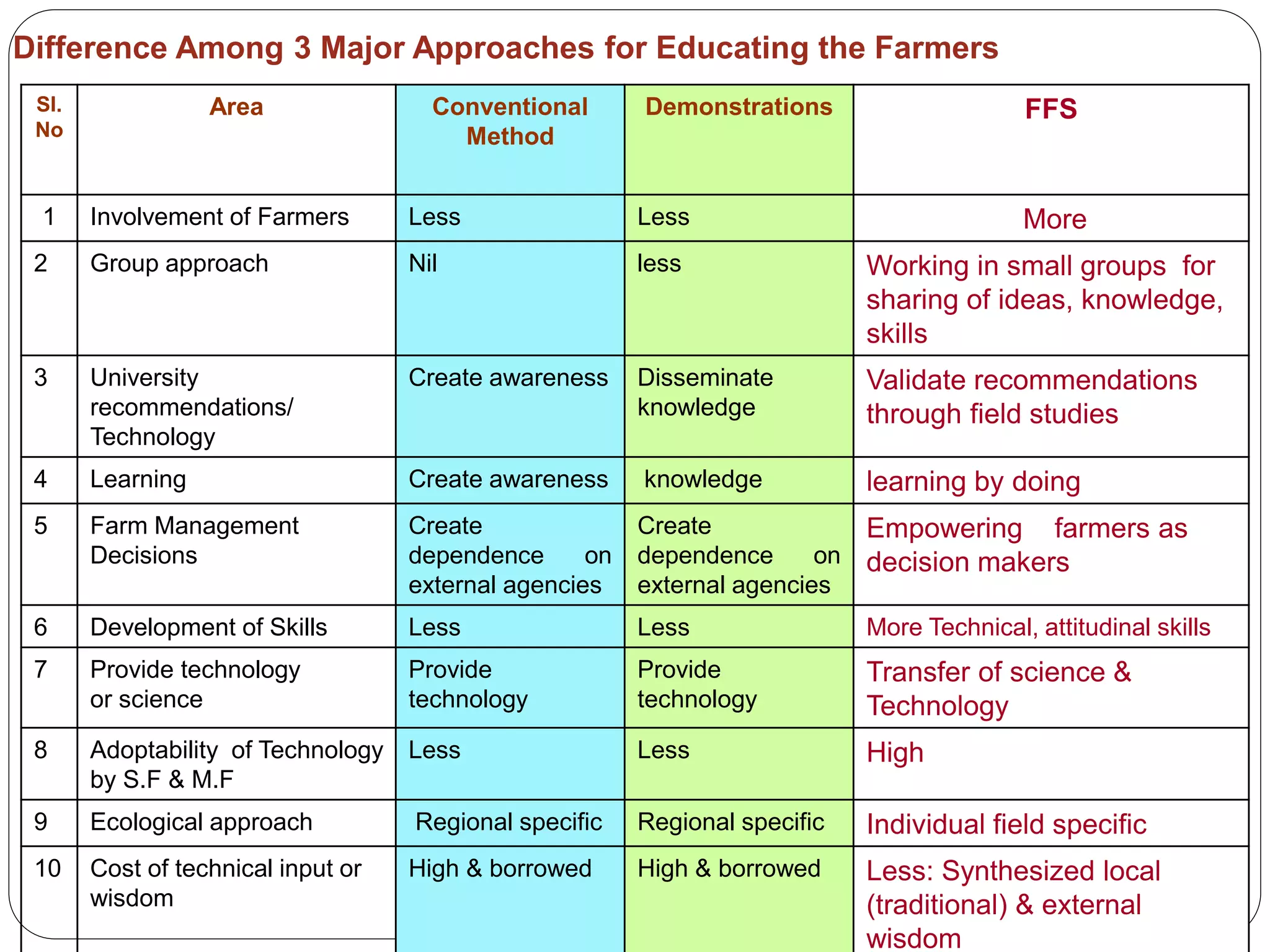
2. Farmer Field School
Approach
Sl.
No
Area Conventional
Method
Demonstrations FFS
1 Involvement of Farmers Less Less More
2 Group approach Nil less Working in small groups for
sharing of ideas, knowledge,
skills
3 University
recommendations/
Technology
Create awareness Disseminate
knowledge
Validate recommendations
through field studies
4 Learning Create awareness knowledge learning by doing
5 Farm Management
Decisions
Create
dependence on
external agencies
Create
dependence on
external agencies
Empowering farmers as
decision makers
6 Development of Skills Less Less More Technical, attitudinal skills
7 Provide technology
or science
Provide
technology
Provide
technology
Transfer of science &
Technology
8 Adoptability of Technology
by S.F & M.F
Less Less High
9 Ecological approach Regional specific Regional specific Individual field specific
10 Cost of technical input or
wisdom
High & borrowed High & borrowed Less: Synthesized local
(traditional) & external
wisdom
Difference Among 3 Major Approaches for Educating the Farmers
Farmer Field School Approach
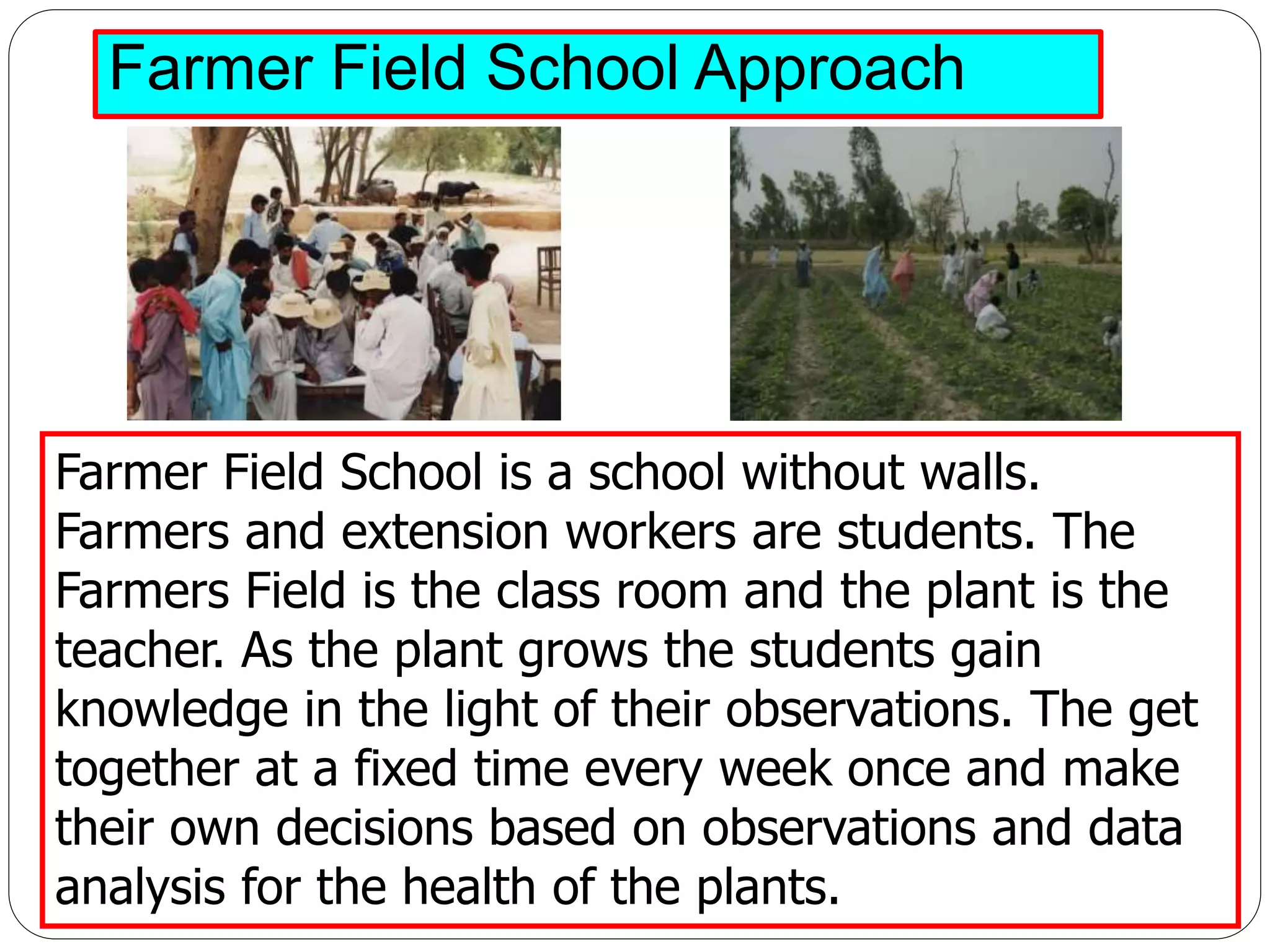
Farmer Field School is a school without walls.
Farmers and extension workers are students. The
Farmers Field is the class room and the plant is the
teacher. As the plant grows the students gain
knowledge in the light of their observations. The get
together at a fixed time every week once and make
their own decisions based on observations and data
analysis for the health of the plants.
Why the Farmer Field School
approach?
Extension work has traditionally been seen by research and extension institutions as
a mechanism to
transfer technologies to farmers. This approach, however, has proved inadequate
in complex situations
where farmers must frequently adjust their activities to changing conditions (crop
protection, soil
nutrient management, animal health and production).
Technology packages, delivered in a ‘top-down’ approach, were often too complex,
expensive or
poorly adapted to farmers’ needs. Extension workers realised that farmers were not
sufficiently
involved in identifying problems, selecting and testing options, and evaluating
possible solutions. With
declining government support for traditional extension work, it became clear that
alternative methods
were needed to identify the problems faced by farmers and to disseminate
appropriate technologies.
The FFS approach, in contrast, strengthens the capacity of farmers and the local
communities to
analyze their production systems, identify their main constraints and test possible
solutions. By adding
Why FFS for Farmers
 Only farmer can make the “right” Farm Management decision
based on his own perceptions of economics and technologies.
So farmer should be trained in decision-making
 There are too many farms (5.00 mill) and too few extension
workers to be able to service them all.
A self multiplying training programme for farmers need to
be established.
 Each farmer field is different in pest, beneficial fauna, soil and
other eco-system elements and cannot be treated on a generalized
technology package message.
 Technologies requiring decision-making and management need
skill transfer training.
IPM cannot be implemented simply by demonstration, field days,
TV Ads, radio, publications etc.
Technology Transfer
Products vs Knowledge based
Technologies
Knowledge vs Skill Development
Learning by doing vs. by seeing
Discovery based learning
Decision making vs following advice
Situation based vs Technology based
development
Participatory vs Empty barrel approach
3. Basic Aims of
FFS
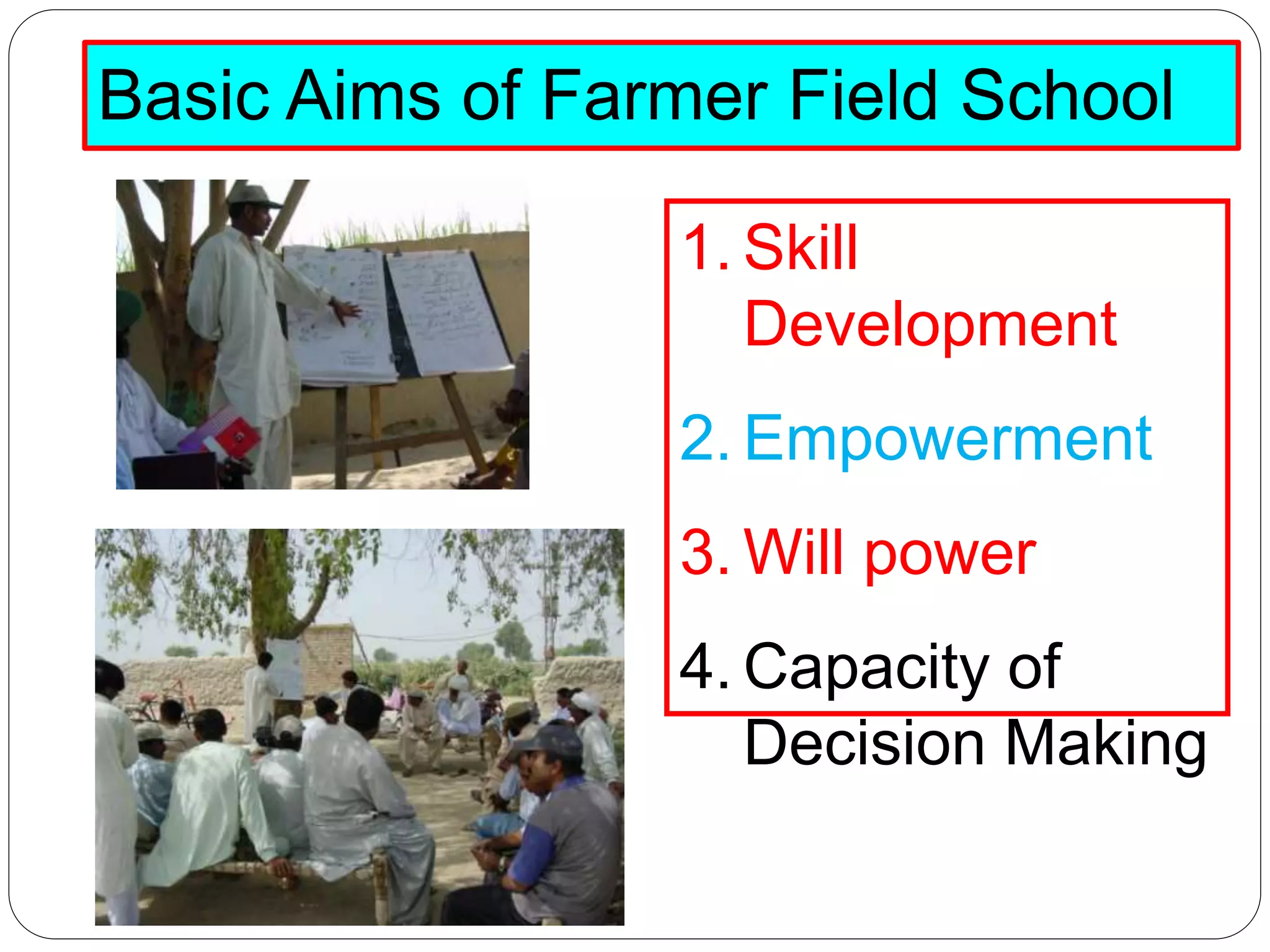
Basic Aims of Farmer Field School
1. Skill
Development
2. Empowerment
3. Will power
4. Capacity of
Decision Making
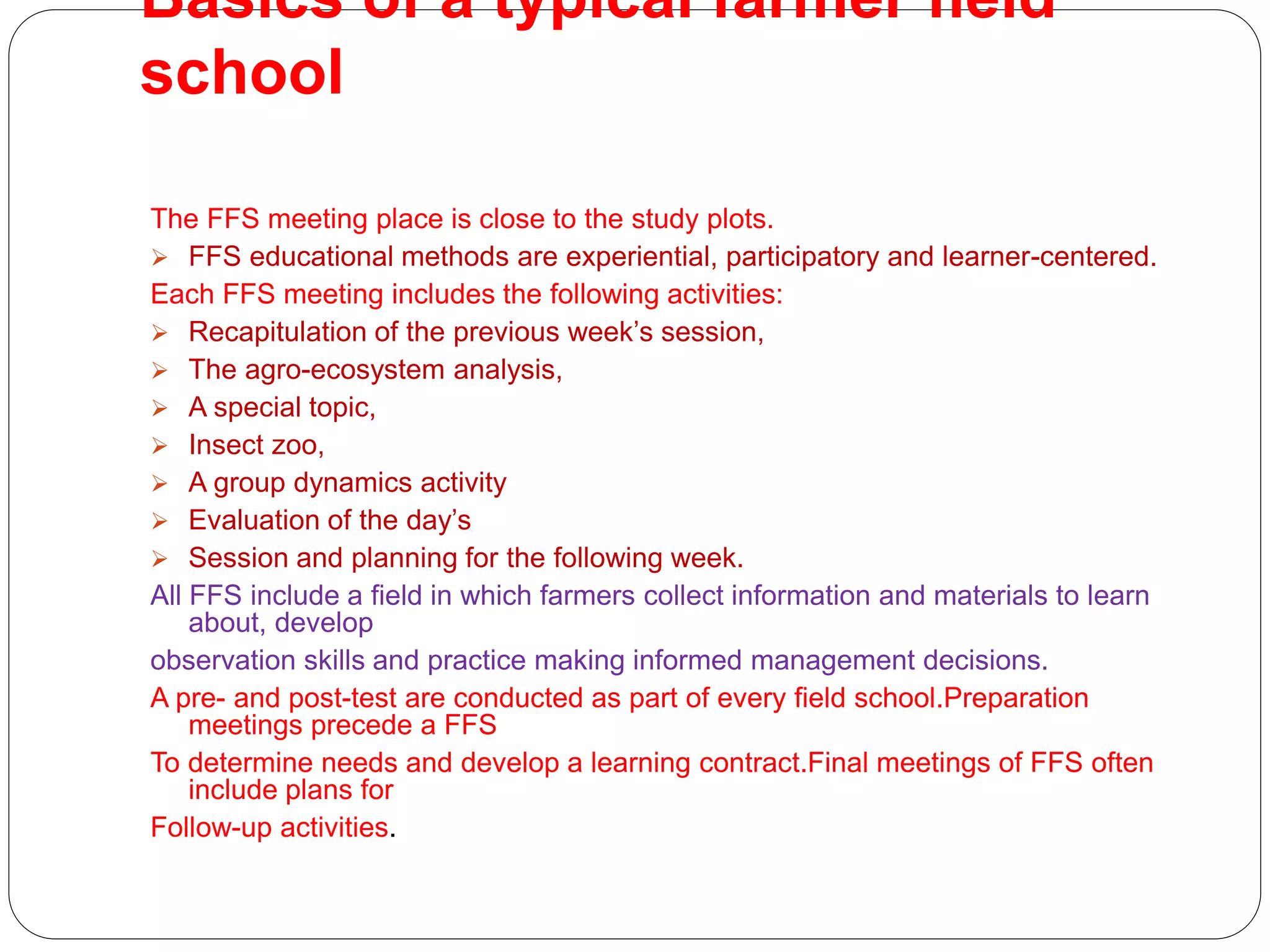
Basics of a typical farmer field
school
The FFS meeting place is close to the study plots.
 FFS educational methods are experiential, participatory and learner-centered.
Each FFS meeting includes the following activities:
 Recapitulation of the previous week’s session,
 The agro-ecosystem analysis,
 A special topic,
 Insect zoo,
 A group dynamics activity
 Evaluation of the day’s
 Session and planning for the following week.
All FFS include a field in which farmers collect information and materials to learn
about, develop
observation skills and practice making informed management decisions.
A pre- and post-test are conducted as part of every field school.Preparation
meetings precede a FFS
To determine needs and develop a learning contract.Final meetings of FFS often
include plans for
Follow-up activities.
Management and organization
Activities such as recapitulation and briefing provide
opportunities
for farmers to increase their management skills and to
experience
how to organize activities to prepare them for farmer-led
programmes. Leadership of small groups is rotated among
members
weekly and each FFS participant becomes the session Day’s
Team
Leader. Through this process, participants take over the
management
of the FFS.
A Field Day at the end of the season showcases the
management
and organization skills that participants gain in the FFS. The
Field
Day is attended by non-IPM farmers, local leaders, and other
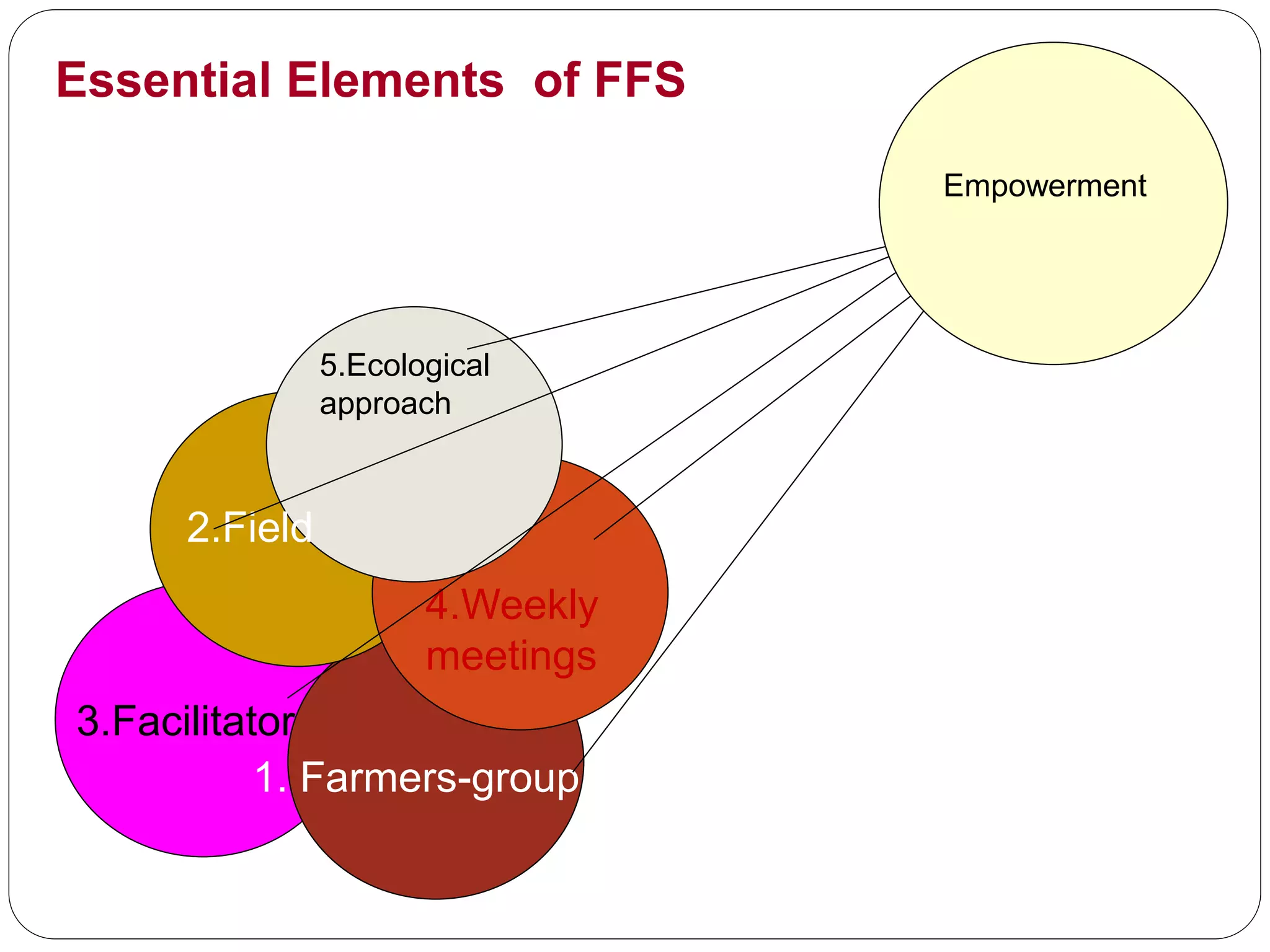
Essential Elements of FFS
4.Weekly
meetings
2.Field
3.Facilitator
1. Farmers-group
Empowerment
5.Ecological
approach
Conditions for successful FFS
Based on our experience, the following conditions are
necessary to
ensure the success of FFS:
 Well trained, technically competent facilitators
 Well defined priority problem(s)
 Adequate resources and logistical support
 Clear understanding of the FFS concept and
procedures by all stakeholders
 Support and good will by authorities at various levels
 Availability of appropriate technical knowledge and
interventions
 Availability of an FFS curriculum
Need of FFS
1. Declining soil productivity and inappropriate imbalanced
nutrient use.
2. Indiscriminate use of pesticides leading to increased cost
of cultivation
3. Poor water management resulting in low Water Use
Efficiency (WUE), soil
4. salinity and alkalinity problems
5. Inadequate research and extension support to Small &
Marginal farmers
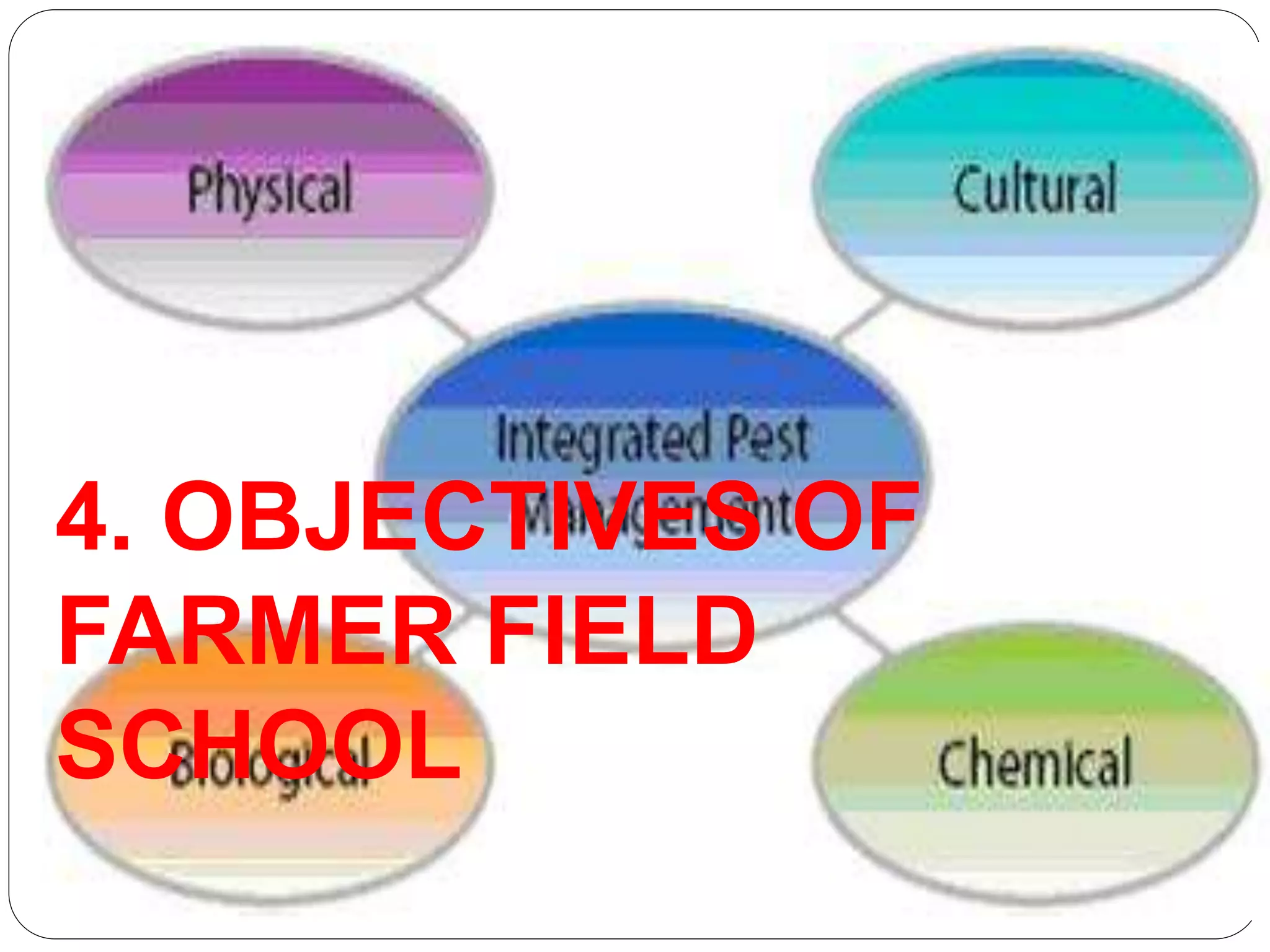
4. OBJECTIVES OF
FARMER FIELD
SCHOOL
Objectives of Farmer Field Schools
Broad Objectives
To bring farmers together to carry out collective and collaborative
inquiry with
the purpose of initiating community action in solving community
problems
Objectives of Farmer Field Schools
Specific Objectives
To empower farmers with knowledge and skills to
Make them
experts in there own fields.
To sharpen the farmers ability to make critical and
informed
decisions that render their farming profitable and
sustainable.
To sensitize farmers in new ways of thinking and
problem
solving
Help farmers learn how to organize themselves and
Objectives of Farmer Field Schools
FFS also contribute to the following objective;
Shorten the time it takes to get research results from the stations to adoption in farmers’
field by
involving farmers experimentation early in the technology development process.
Enhance the capacity of extension staff, working in collaboration with researchers, to
serve as
facilitators of farmers’ experiential learning. Rather than prescribing blanket
recommendation that
cover a wide geographic area but may not be relevant to all farms within it, the methods
train
extensionist and researchers to work with farmers in testing, assessing and adapting a
variety of options
within their specific local conditions.
Increase the expertise of farmers to make informed decisions on what works best for
them, based on
their own observations of experimental plots in their Field schools and to explain their
reasoning. No
Matter how good the researchers and extensions, recommendations must be tailored
and adapted to local
conditions, for which local expertise and involvement is required that only farmers
themselves can supply.
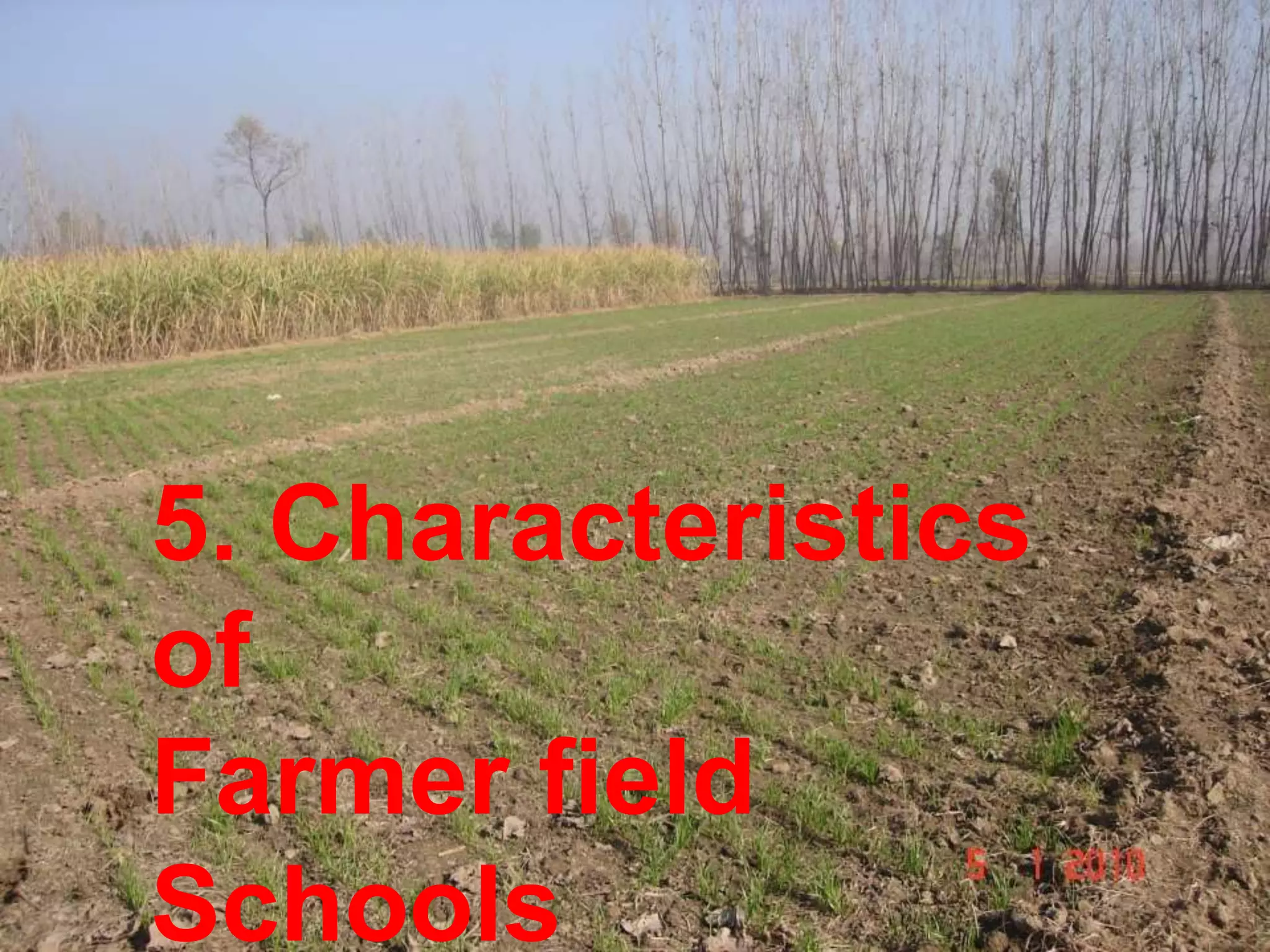
5. Characteristics
of
Farmer field
Schools
Essential of Farmer Field School
1.Group:-Comprises of 20-25 Farmers, having interest
.FFs tends to
strengthened existing group or may lead to formation of
new group.
2. Field : -Field is the teacher provide training material
such as
plants, pests and other facilities
3. Facilitator :-Technical person who leads group
members through
hands on exercises . The facilitator can be an extension
agent or a
farmer field school graduate .
4. Curriculum :-The curriculum follows the natural cycle
of crops ,
Characteristics of FFS Approach
 1. Farmers:- Farmers are experts conducting their own field
studies.
 2. Farmer Field :-The field is a learning place where farmers
working in small groups , collect data , analyze and arrived at
decision.
 3.Extensin Workers :-They are facilitators not teacher .
 4. Curriculum:-This is integrated to include crop husbandry in
relation to ecology, economics, sociology and education
 5.Training :- Related to seasonal cycle of practice being
investigated such as land preparation , cropping harvesting .
 6.Meeting:- These are held at regular interval depending on what
activities need to be done.
 7.Learning Material :- Theses are generated by farmers and are
consistent with local conditions.
 8. Group Dynamics:-Training include communication skill
building problem solving , leadership and discussion methods .
Farmer implements their own decision in the own fields.
6. Basic Elements
of FFS
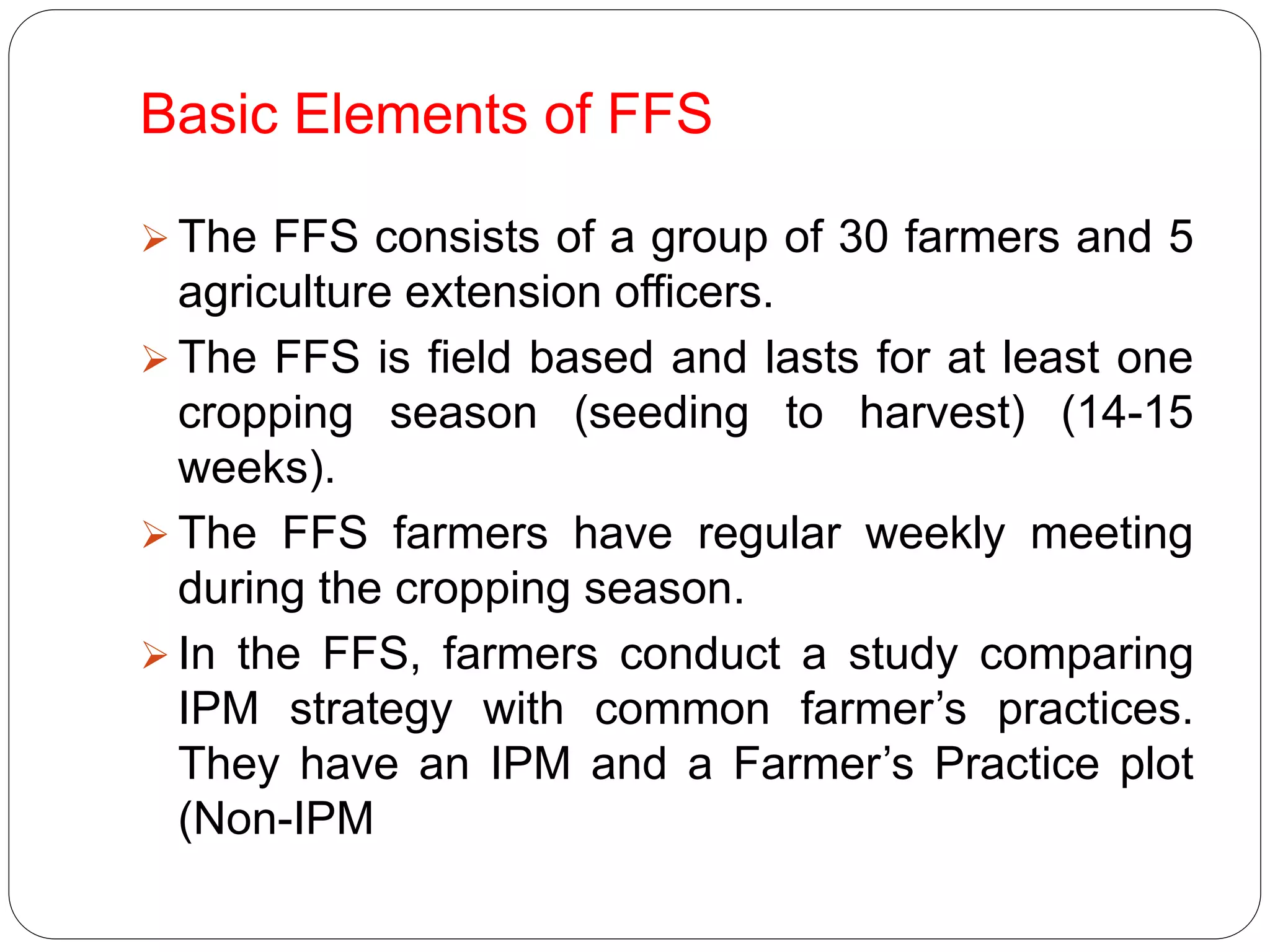
Basic Elements of FFS
 The FFS consists of a group of 30 farmers and 5
agriculture extension officers.
 The FFS is field based and lasts for at least one
cropping season (seeding to harvest) (14-15
weeks).
 The FFS farmers have regular weekly meeting
during the cropping season.
 In the FFS, farmers conduct a study comparing
IPM strategy with common farmer’s practices.
They have an IPM and a Farmer’s Practice plot
(Non-IPM
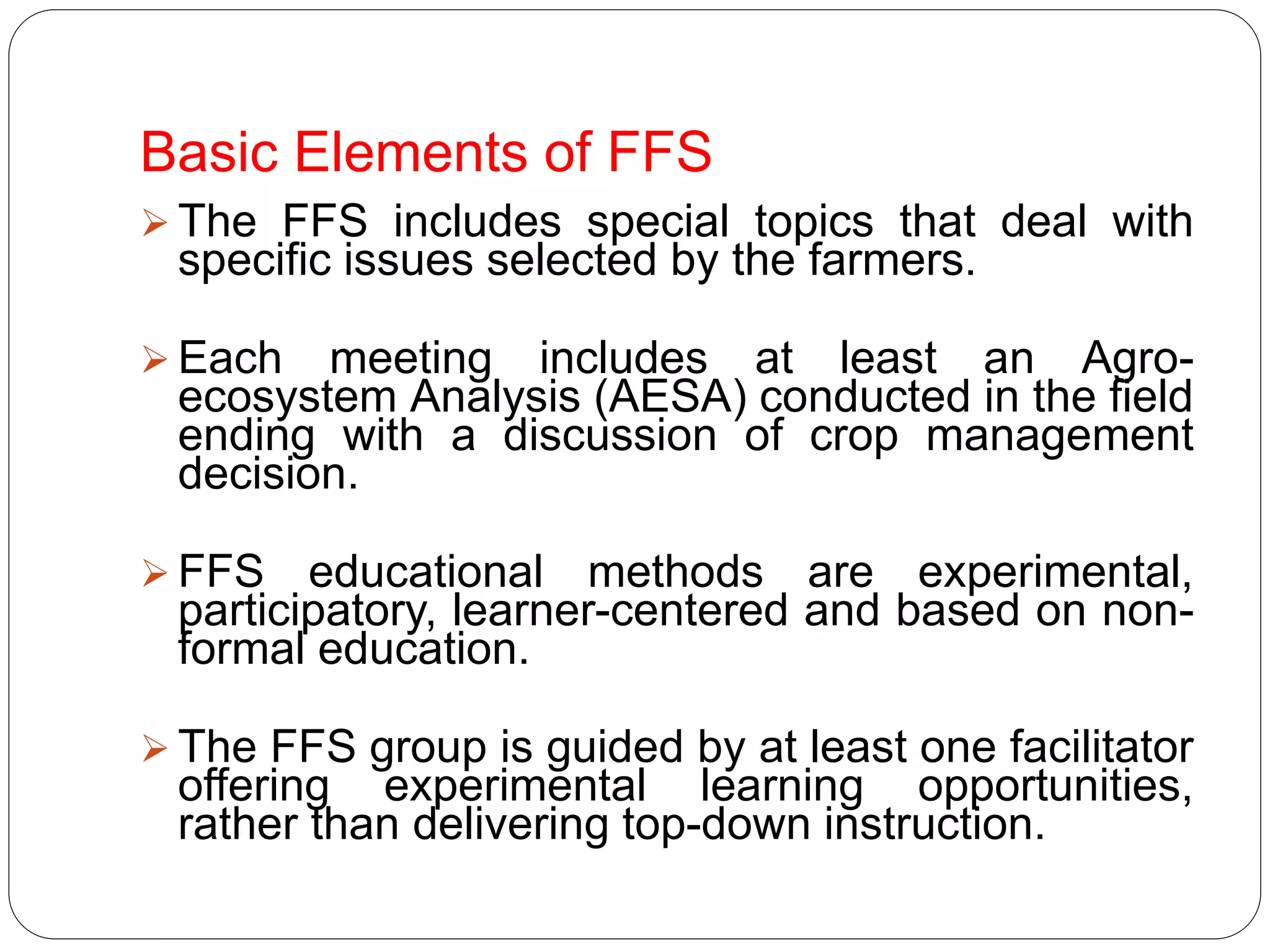
Basic Elements of FFS
 The FFS includes special topics that deal with
specific issues selected by the farmers.
 Each meeting includes at least an Agro-
ecosystem Analysis (AESA) conducted in the field
ending with a discussion of crop management
decision.
 FFS educational methods are experimental,
participatory, learner-centered and based on non-
formal education.
 The FFS group is guided by at least one facilitator
offering experimental learning opportunities,
rather than delivering top-down instruction.
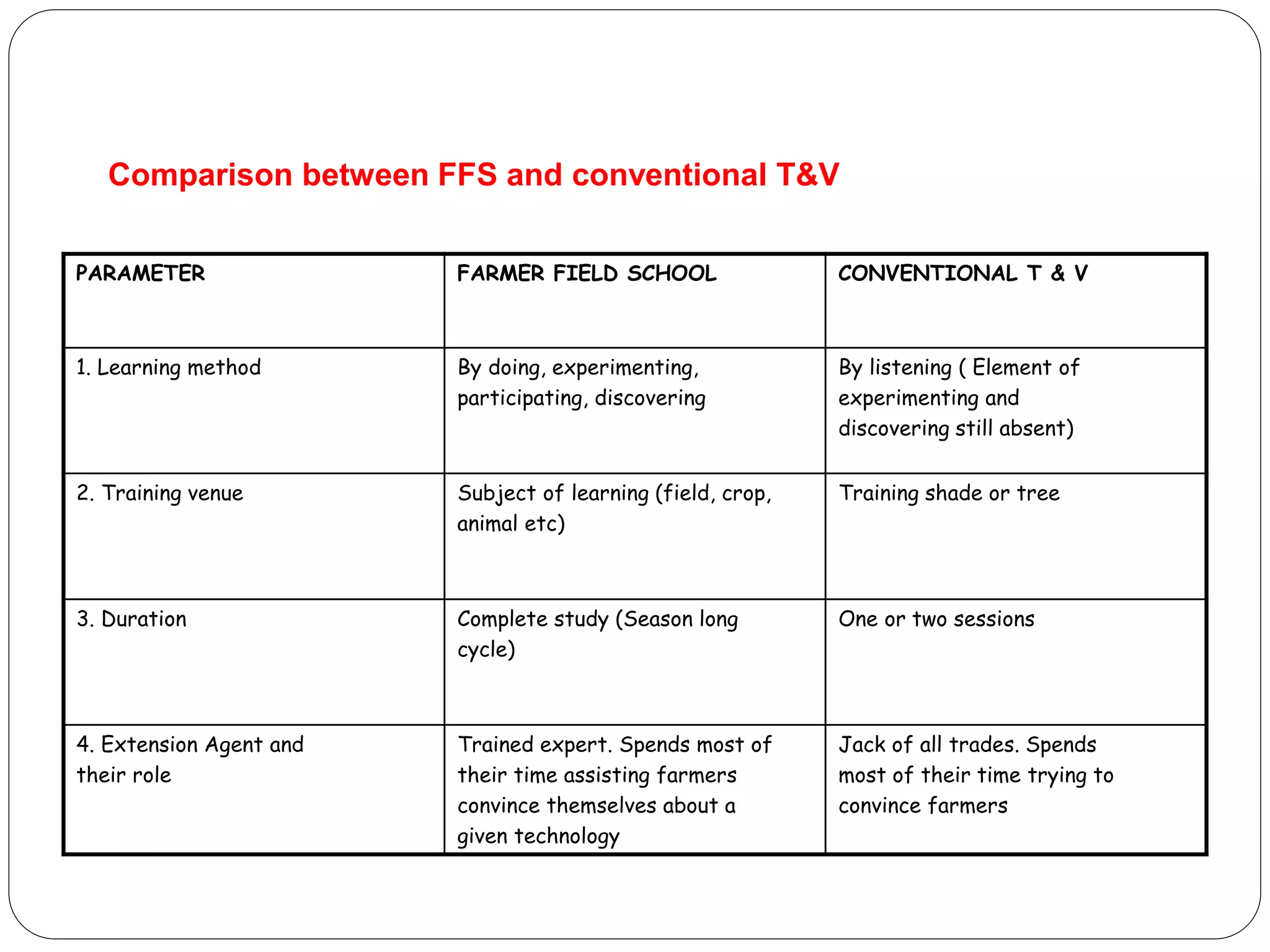
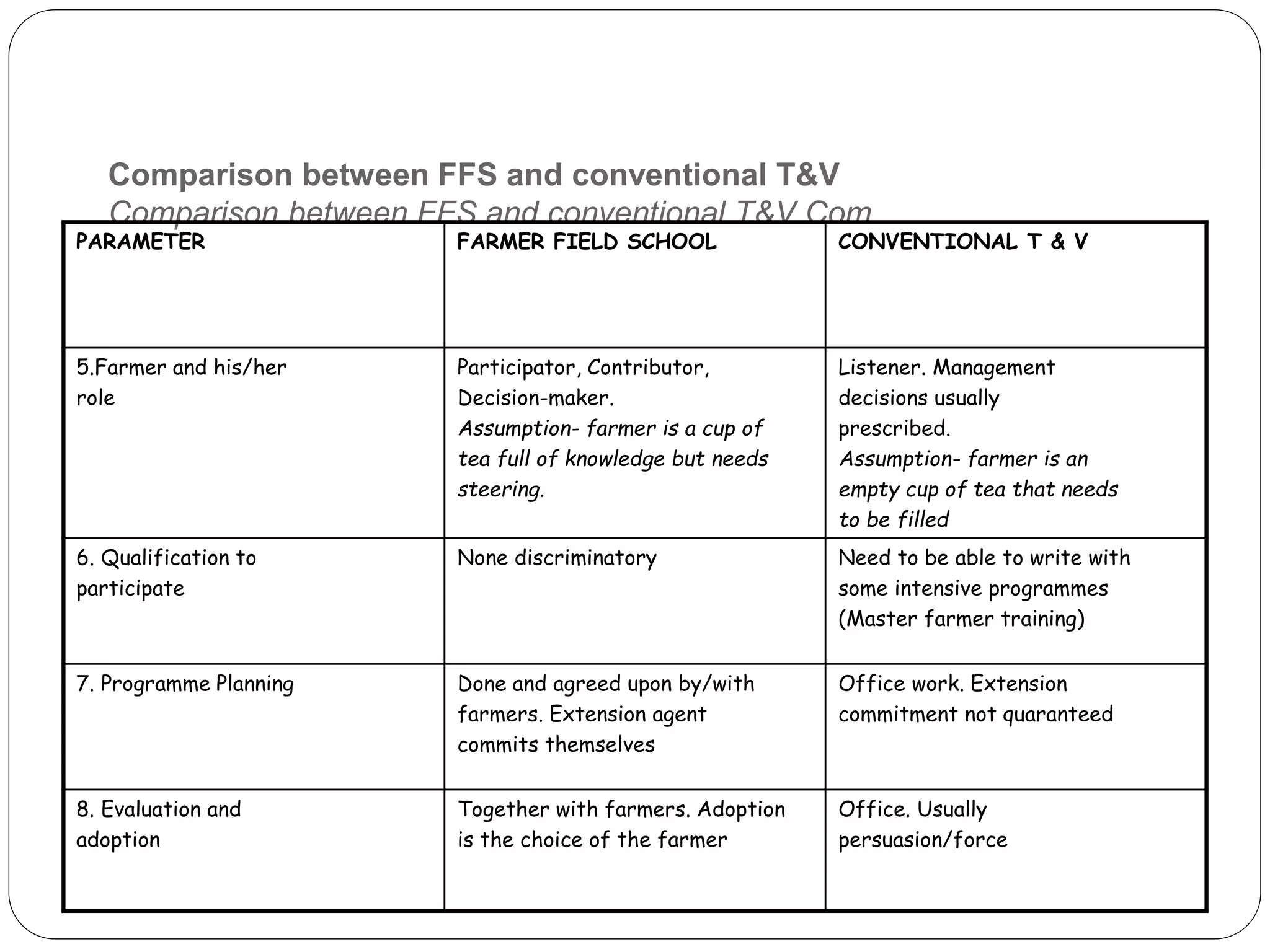
Comparison between FFS and conventional T&V
PARAMETER FARMER FIELD SCHOOL CONVENTIONAL T & V
1. Learning method By doing, experimenting,
participating, discovering
By listening ( Element of
experimenting and
discovering still absent)
2. Training venue Subject of learning (field, crop,
animal etc)
Training shade or tree
3. Duration Complete study (Season long
cycle)
One or two sessions
4. Extension Agent and
their role
Trained expert. Spends most of
their time assisting farmers
convince themselves about a
given technology
Jack of all trades. Spends
most of their time trying to
convince farmers
Comparison between FFS and conventional T&V
Comparison between FFS and conventional T&V Com
PARAMETER FARMER FIELD SCHOOL CONVENTIONAL T & V
5.Farmer and his/her
role
Participator, Contributor,
Decision-maker.
Assumption- farmer is a cup of
tea full of knowledge but needs
steering.
Listener. Management
decisions usually
prescribed.
Assumption- farmer is an
empty cup of tea that needs
to be filled
6. Qualification to
participate
None discriminatory Need to be able to write with
some intensive programmes
(Master farmer training)
7. Programme Planning Done and agreed upon by/with
farmers. Extension agent
commits themselves
Office work. Extension
commitment not quaranteed
8. Evaluation and
adoption
Together with farmers. Adoption
is the choice of the farmer
Office. Usually
persuasion/force
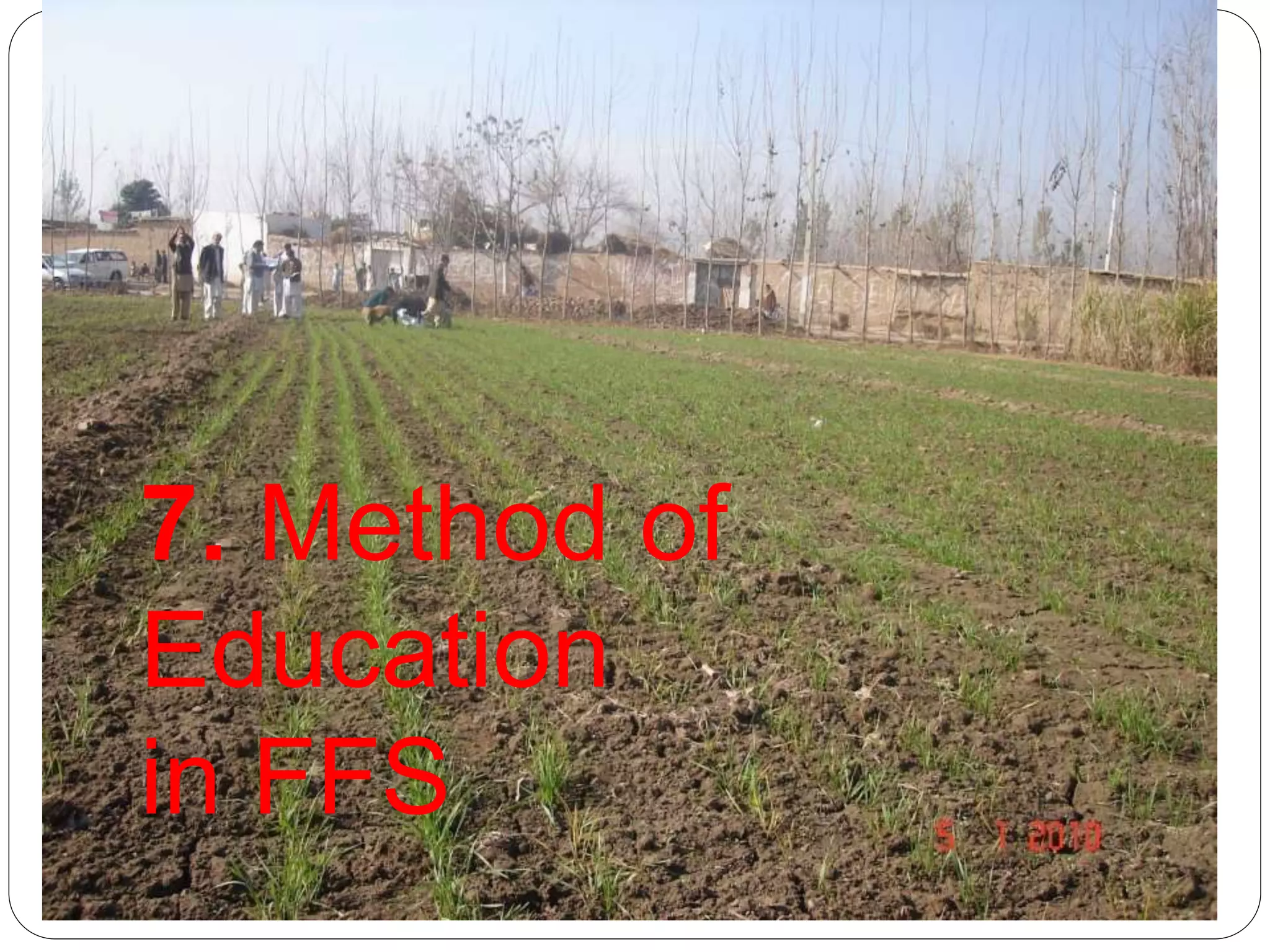
7. Method of
Education
in FFS
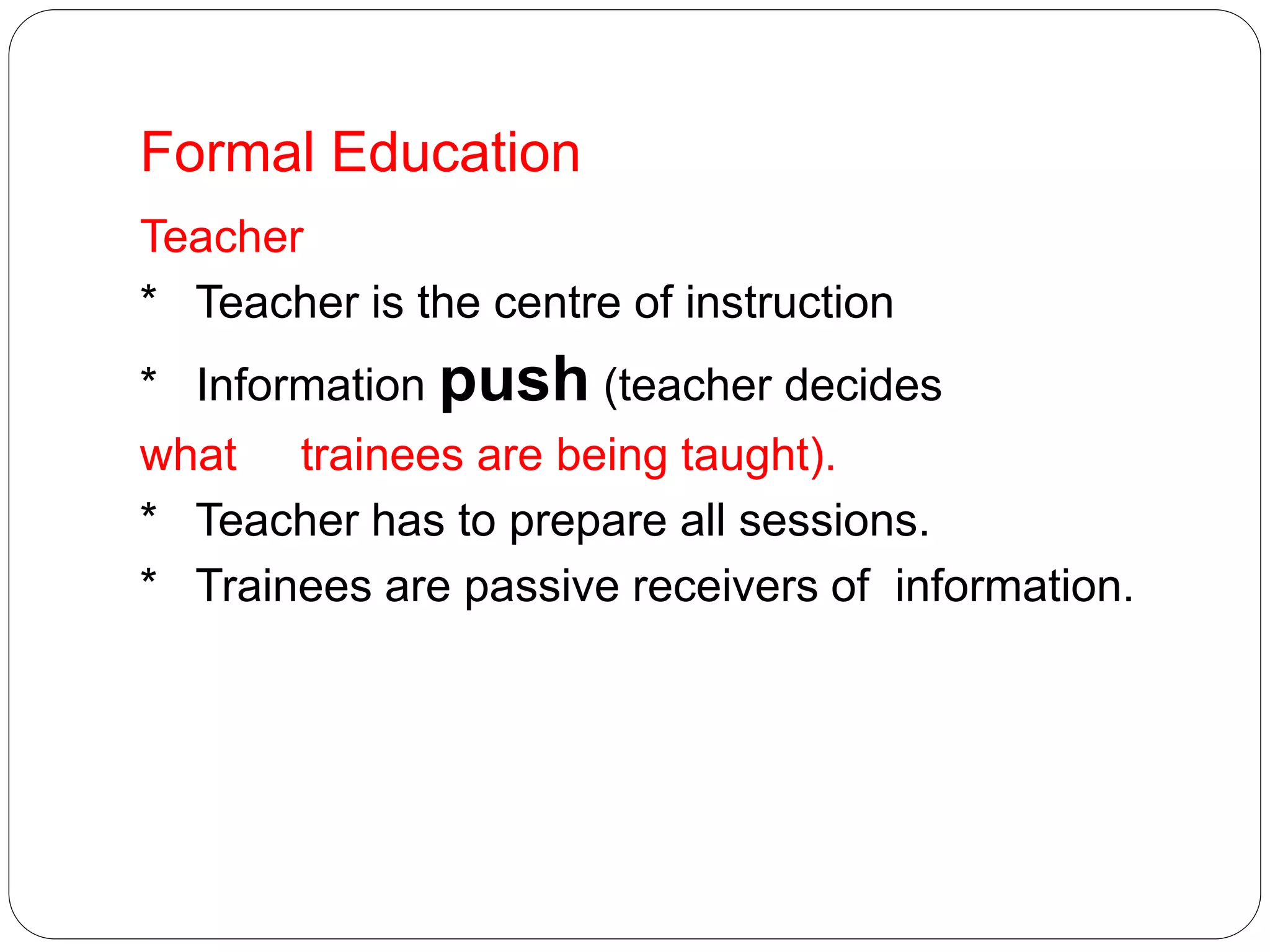
Formal Education
Teacher
* Teacher is the centre of instruction
* Information push (teacher decides
what trainees are being taught).
* Teacher has to prepare all sessions.
* Trainees are passive receivers of information.
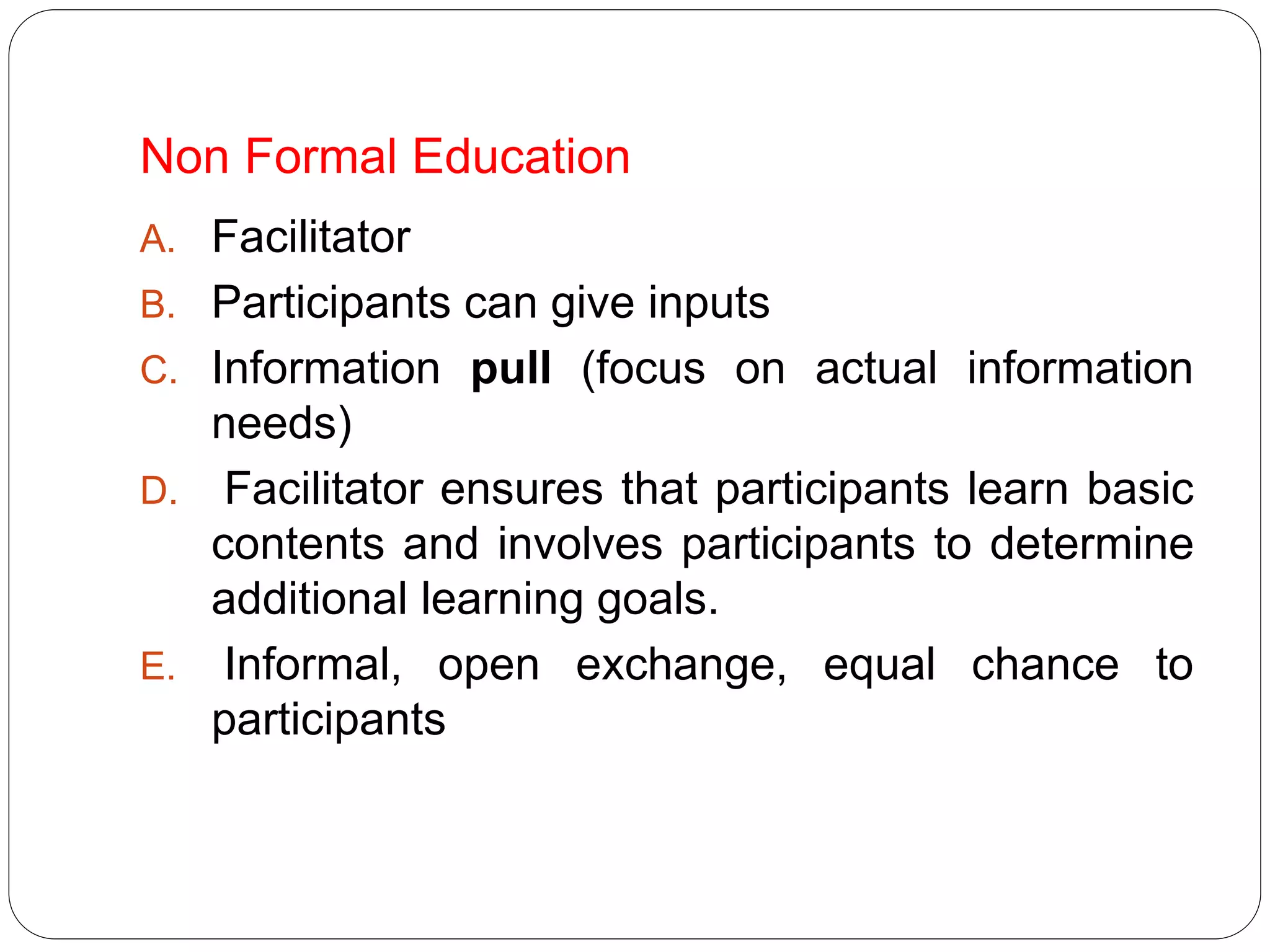
Non Formal Education
A. Facilitator
B. Participants can give inputs
C. Information pull (focus on actual information
needs)
D. Facilitator ensures that participants learn basic
contents and involves participants to determine
additional learning goals.
E. Informal, open exchange, equal chance to
participants
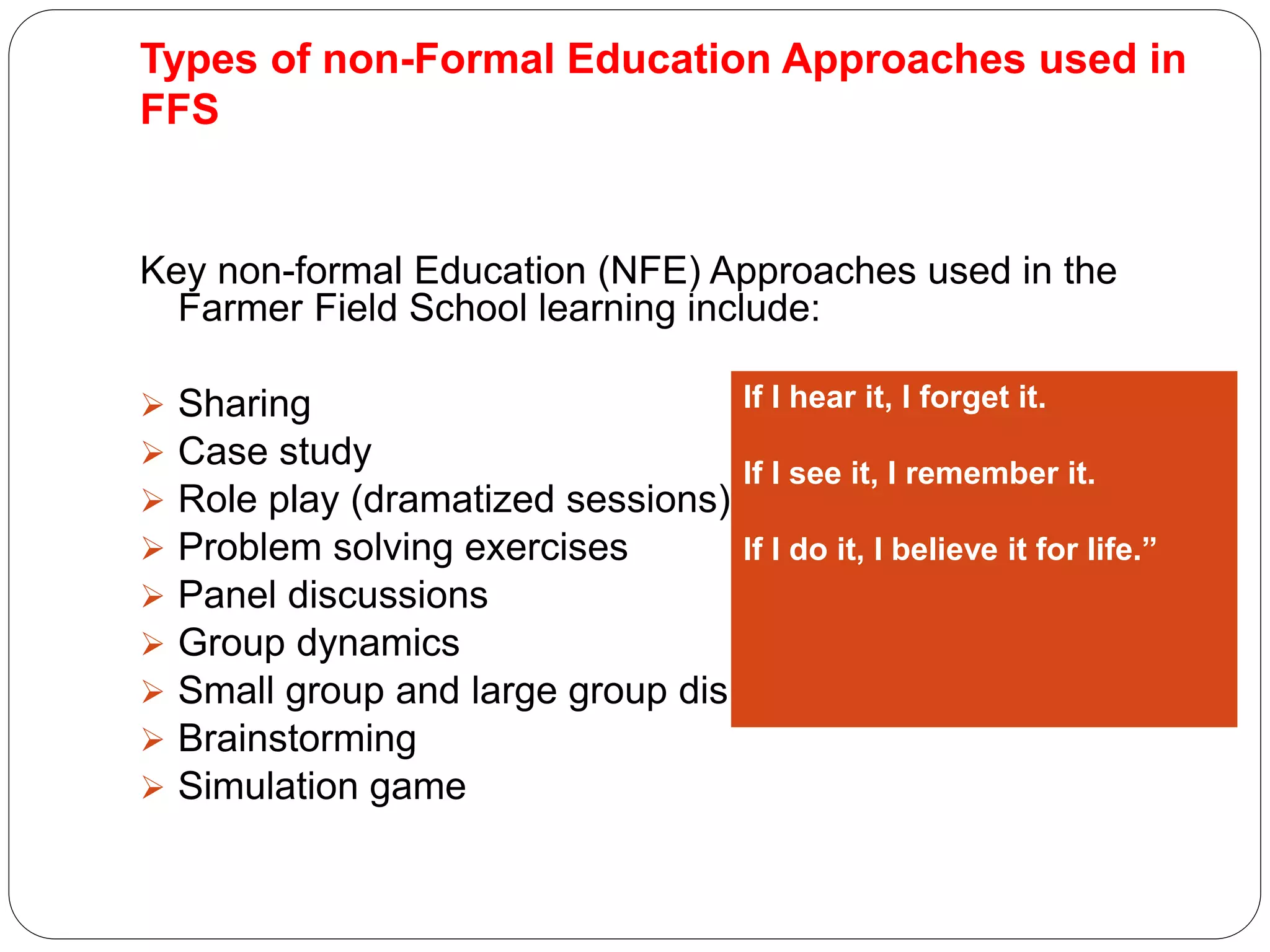
Types of non-Formal Education Approaches used in
FFS
Key non-formal Education (NFE) Approaches used in the
Farmer Field School learning include:
 Sharing
 Case study
 Role play (dramatized sessions)
 Problem solving exercises
 Panel discussions
 Group dynamics
 Small group and large group discussion
 Brainstorming
 Simulation game
If I hear it, I forget it.
If I see it, I remember it.
If I do it, I believe it for life.”
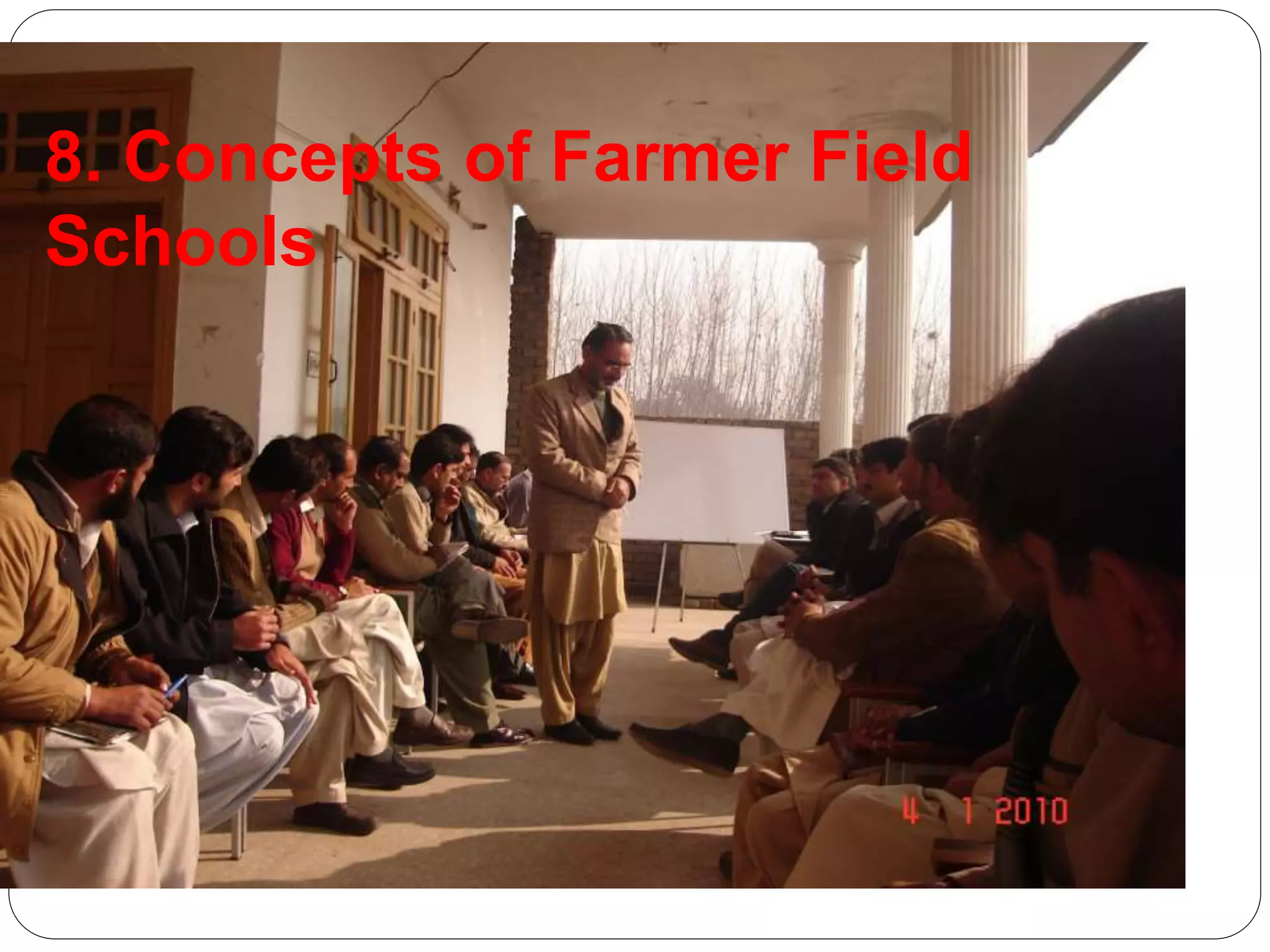
8. Concepts of Farmer Field
Schools
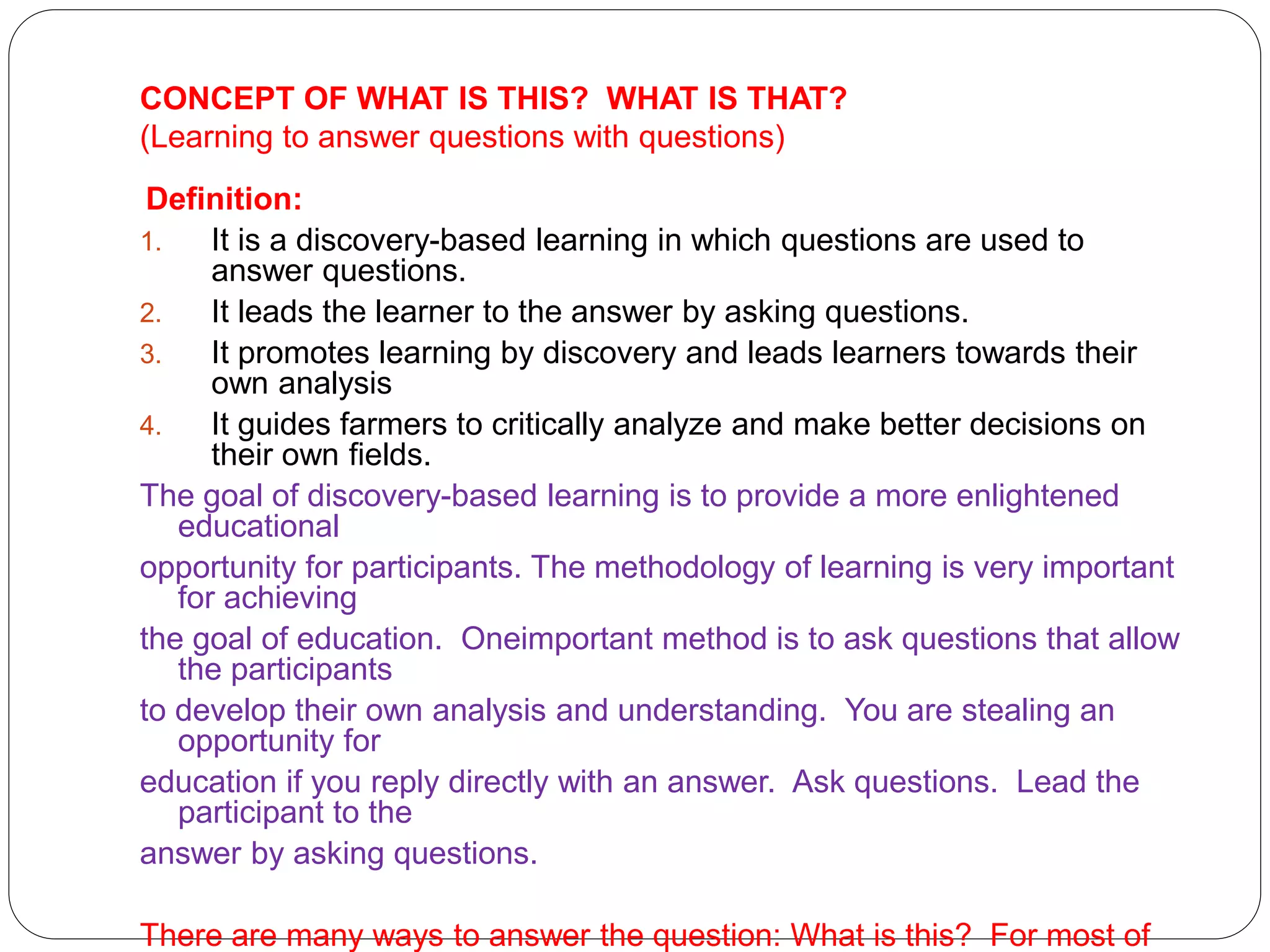
CONCEPT OF WHAT IS THIS? WHAT IS THAT?
(Learning to answer questions with questions)
Definition:
1. It is a discovery-based learning in which questions are used to
answer questions.
2. It leads the learner to the answer by asking questions.
3. It promotes learning by discovery and leads learners towards their
own analysis
4. It guides farmers to critically analyze and make better decisions on
their own fields.
The goal of discovery-based learning is to provide a more enlightened
educational
opportunity for participants. The methodology of learning is very important
for achieving
the goal of education. Oneimportant method is to ask questions that allow
the participants
to develop their own analysis and understanding. You are stealing an
opportunity for
education if you reply directly with an answer. Ask questions. Lead the
participant to the
answer by asking questions.
There are many ways to answer the question: What is this? For most of
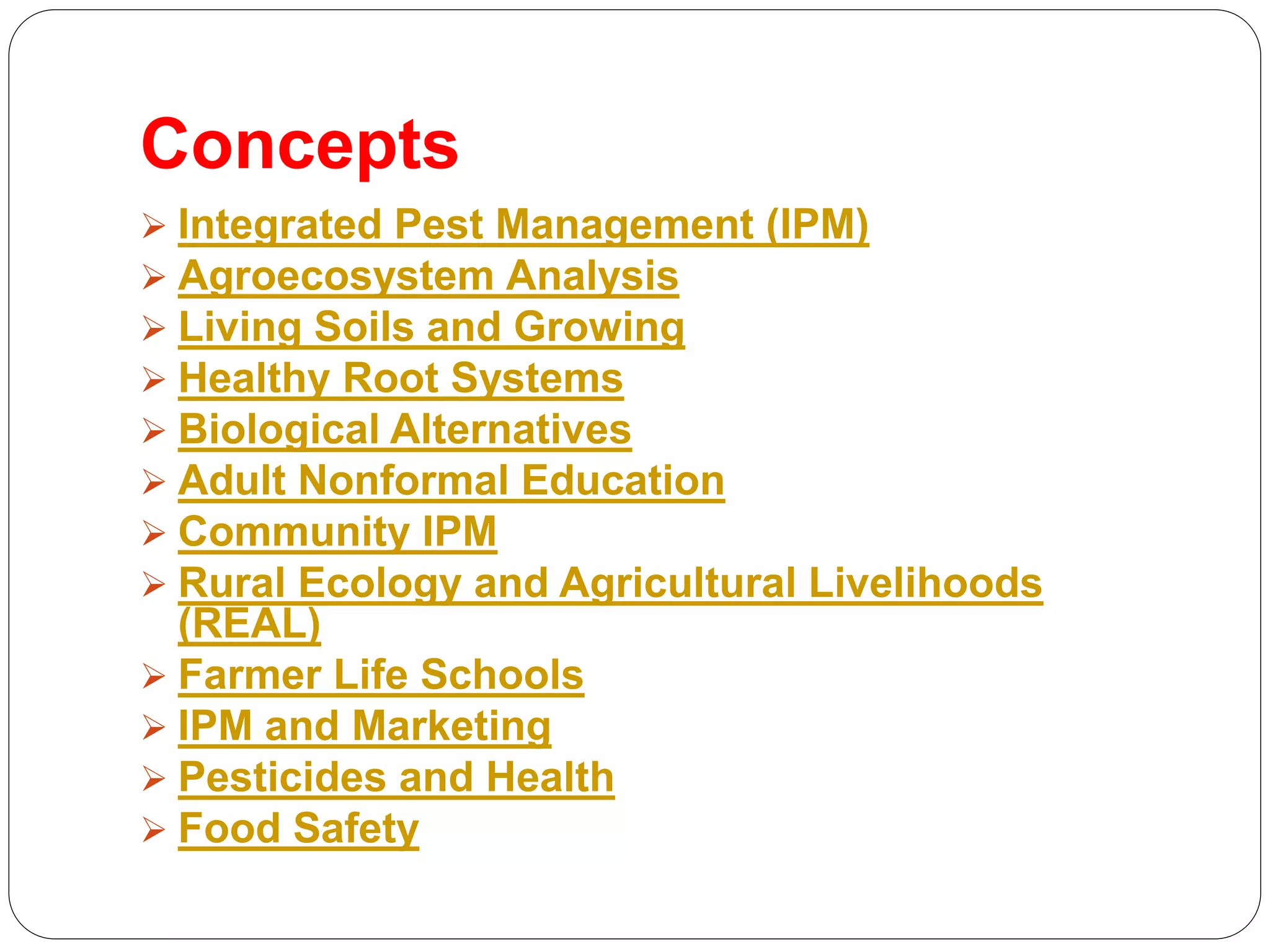
Concepts
 Integrated Pest Management (IPM)
 Agroecosystem Analysis
 Living Soils and Growing
 Healthy Root Systems
 Biological Alternatives
 Adult Nonformal Education
 Community IPM
 Rural Ecology and Agricultural Livelihoods
(REAL)
 Farmer Life Schools
 IPM and Marketing
 Pesticides and Health
 Food Safety
Key Training Activities
 Training of Trainers
 Farmer Field Schools
 Farmer Trainers & Farmer-to-Farmer FFS
 Farmer Field Studies
 Farmer's Congress
9.Training
Material
for FFS
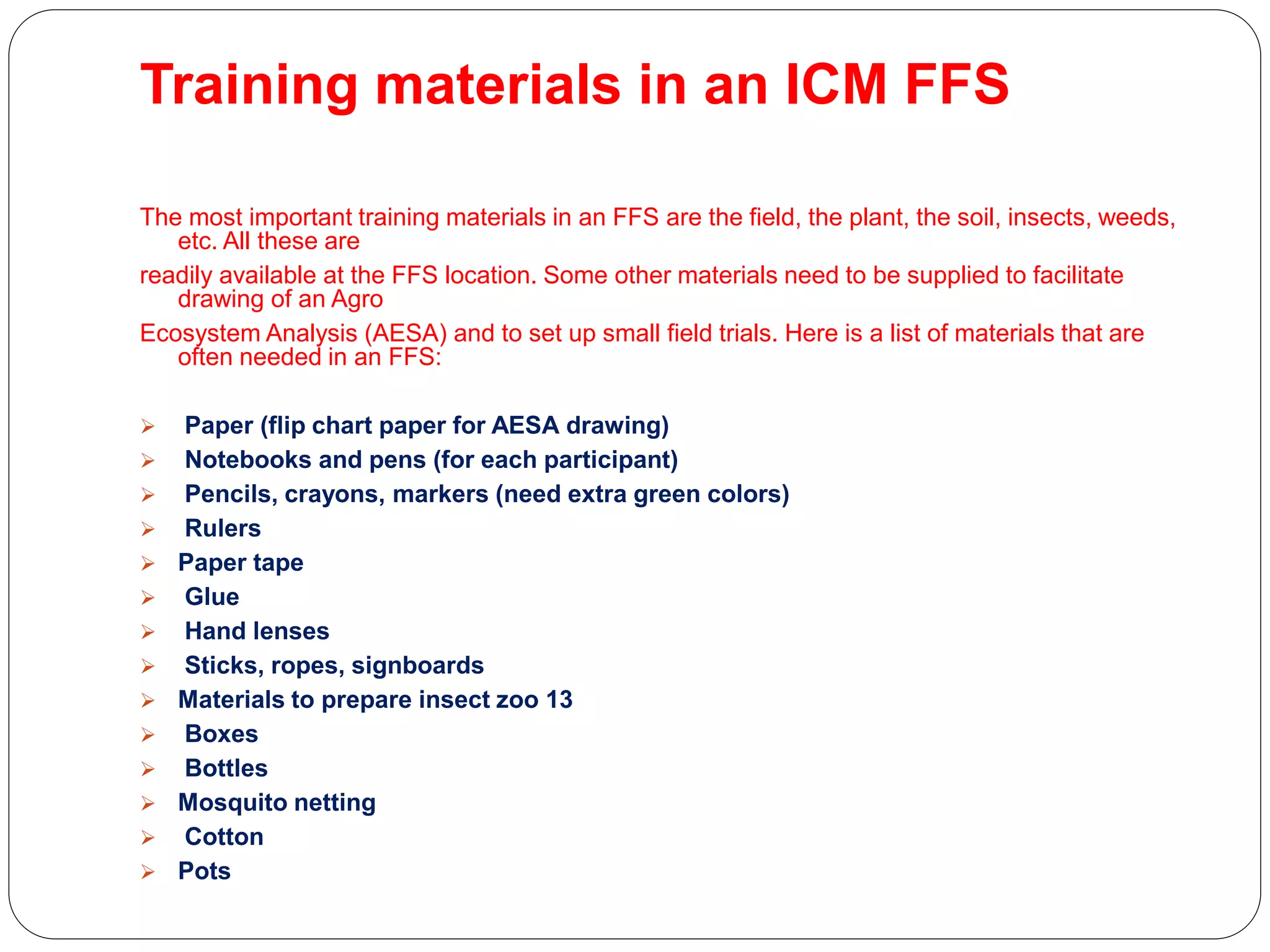
Training materials in an ICM FFS
The most important training materials in an FFS are the field, the plant, the soil, insects, weeds,
etc. All these are
readily available at the FFS location. Some other materials need to be supplied to facilitate
drawing of an Agro
Ecosystem Analysis (AESA) and to set up small field trials. Here is a list of materials that are
often needed in an FFS:
 Paper (flip chart paper for AESA drawing)
 Notebooks and pens (for each participant)
 Pencils, crayons, markers (need extra green colors)
 Rulers
 Paper tape
 Glue
 Hand lenses
 Sticks, ropes, signboards
 Materials to prepare insect zoo 13
 Boxes
 Bottles
 Mosquito netting
 Cotton
 Pots
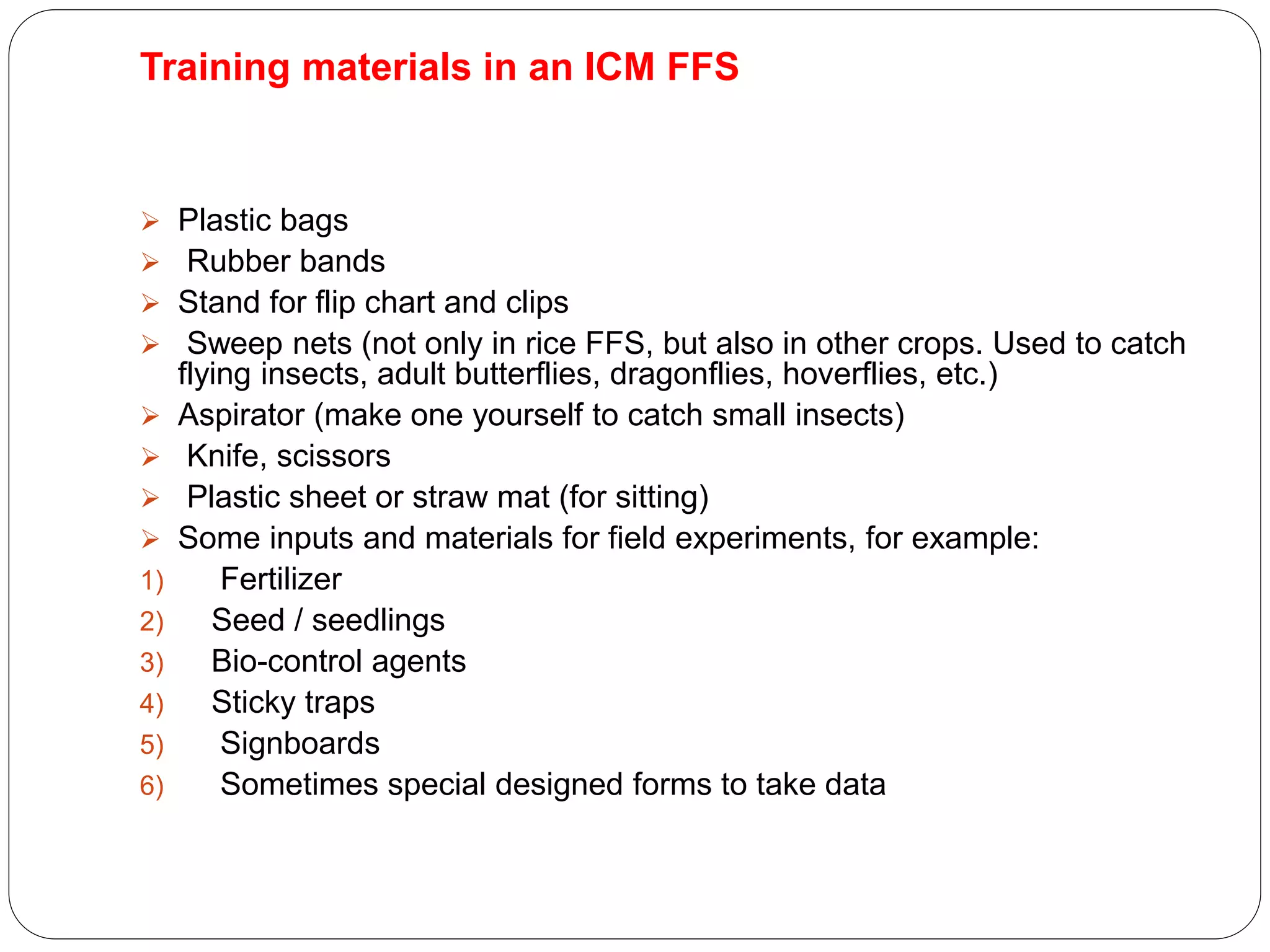
Training materials in an ICM FFS
 Plastic bags
 Rubber bands
 Stand for flip chart and clips
 Sweep nets (not only in rice FFS, but also in other crops. Used to catch
flying insects, adult butterflies, dragonflies, hoverflies, etc.)
 Aspirator (make one yourself to catch small insects)
 Knife, scissors
 Plastic sheet or straw mat (for sitting)
 Some inputs and materials for field experiments, for example:
1) Fertilizer
2) Seed / seedlings
3) Bio-control agents
4) Sticky traps
5) Signboards
6) Sometimes special designed forms to take data
10.FFS
SESSION
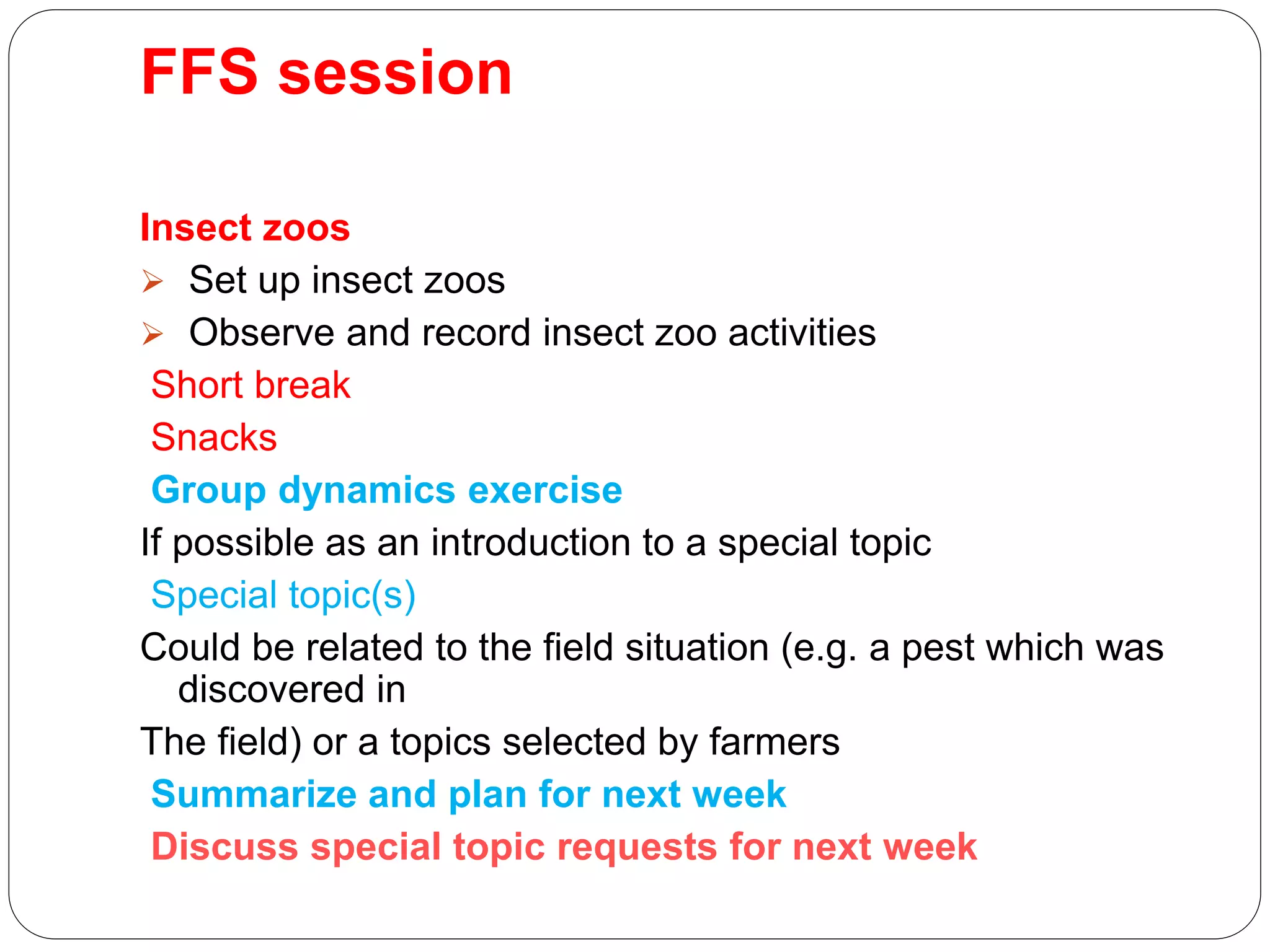
FFS session
In an ICM FFS a typical weekly session
will take
about 3 to 4 hours and will generally have
the
following schedule:
Introduction
Summarize what was done last week
(recapitulation)
Present today’s program
FFS session
Field visit / Field observations
 IPM/ICM plot
Farmer Plot
Field experiments
Collect data
Collect samples
Start analyzing the field situation. The
facilitators observe
 the field together with the farmers and ask
questions to
start discussions.
FFS session
AESA drawing / discussions within small
group
 Detailed analysis of the field situation.
The facilitator asks questions to stimulate
critical thinking.
AESA presentation
Decision making for the management of the
ICM plot
Agree on work to be done
Who is responsible?
When will it be done
FFS session
Insect zoos
 Set up insect zoos
 Observe and record insect zoo activities
Short break
Snacks
Group dynamics exercise
If possible as an introduction to a special topic
Special topic(s)
Could be related to the field situation (e.g. a pest which was
discovered in
The field) or a topics selected by farmers
Summarize and plan for next week
Discuss special topic requests for next week
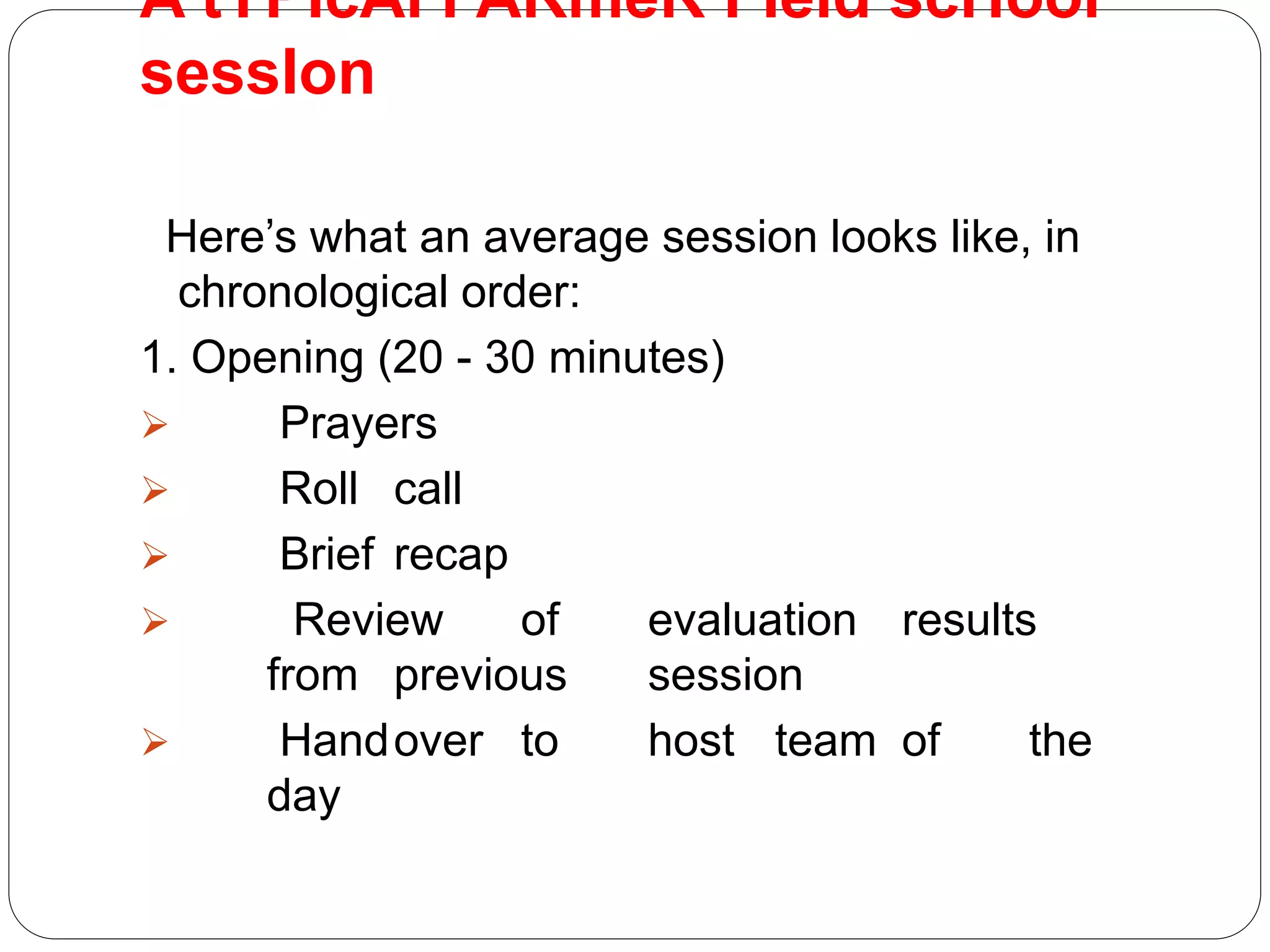
A tYPIcAl FARmeR FIeld scHool
sessIon
Here’s what an average session looks like, in
chronological order:
1. Opening (20 - 30 minutes)
 Prayers
 Roll call
 Brief recap
 Review of evaluation results
from previous session
 Handover to host team of the
day
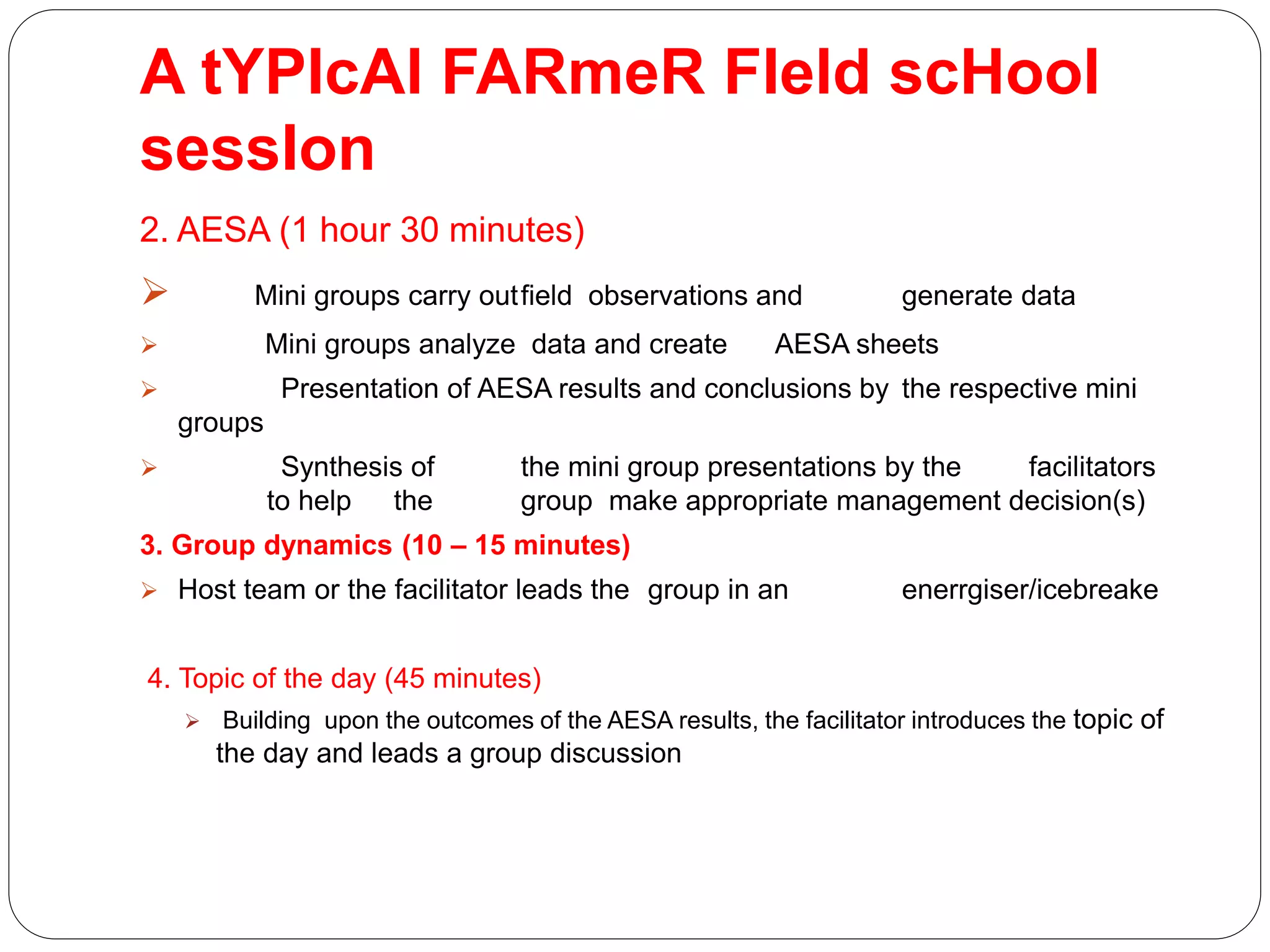
A tYPIcAl FARmeR FIeld scHool
sessIon
2. AESA (1 hour 30 minutes)
 Mini groups carry outfield observations and generate data
 Mini groups analyze data and create AESA sheets
 Presentation of AESA results and conclusions by the respective mini
groups
 Synthesis of the mini group presentations by the facilitators
to help the group make appropriate management decision(s)
3. Group dynamics (10 – 15 minutes)
 Host team or the facilitator leads the group in an enerrgiser/icebreake
4. Topic of the day (45 minutes)
 Building upon the outcomes of the AESA results, the facilitator introduces the topic of
the day and leads a group discussion
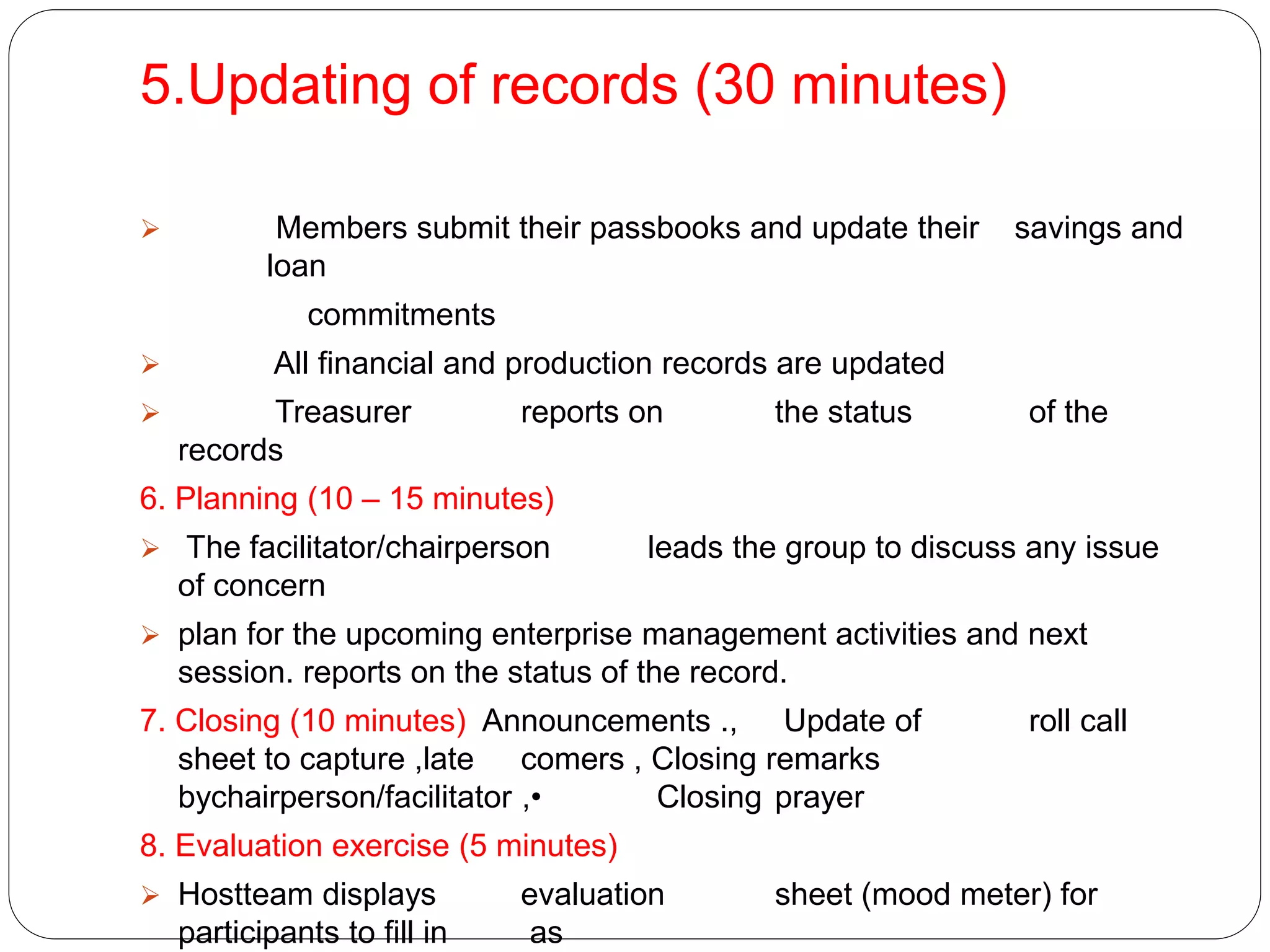
5.Updating of records (30 minutes)
 Members submit their passbooks and update their savings and
loan
commitments
 All financial and production records are updated
 Treasurer reports on the status of the
records
6. Planning (10 – 15 minutes)
 The facilitator/chairperson leads the group to discuss any issue
of concern
 plan for the upcoming enterprise management activities and next
session. reports on the status of the record.
7. Closing (10 minutes) Announcements ., Update of roll call
sheet to capture ,late comers , Closing remarks
bychairperson/facilitator ,• Closing prayer
8. Evaluation exercise (5 minutes)
 Hostteam displays evaluation sheet (mood meter) for
participants to fill in as
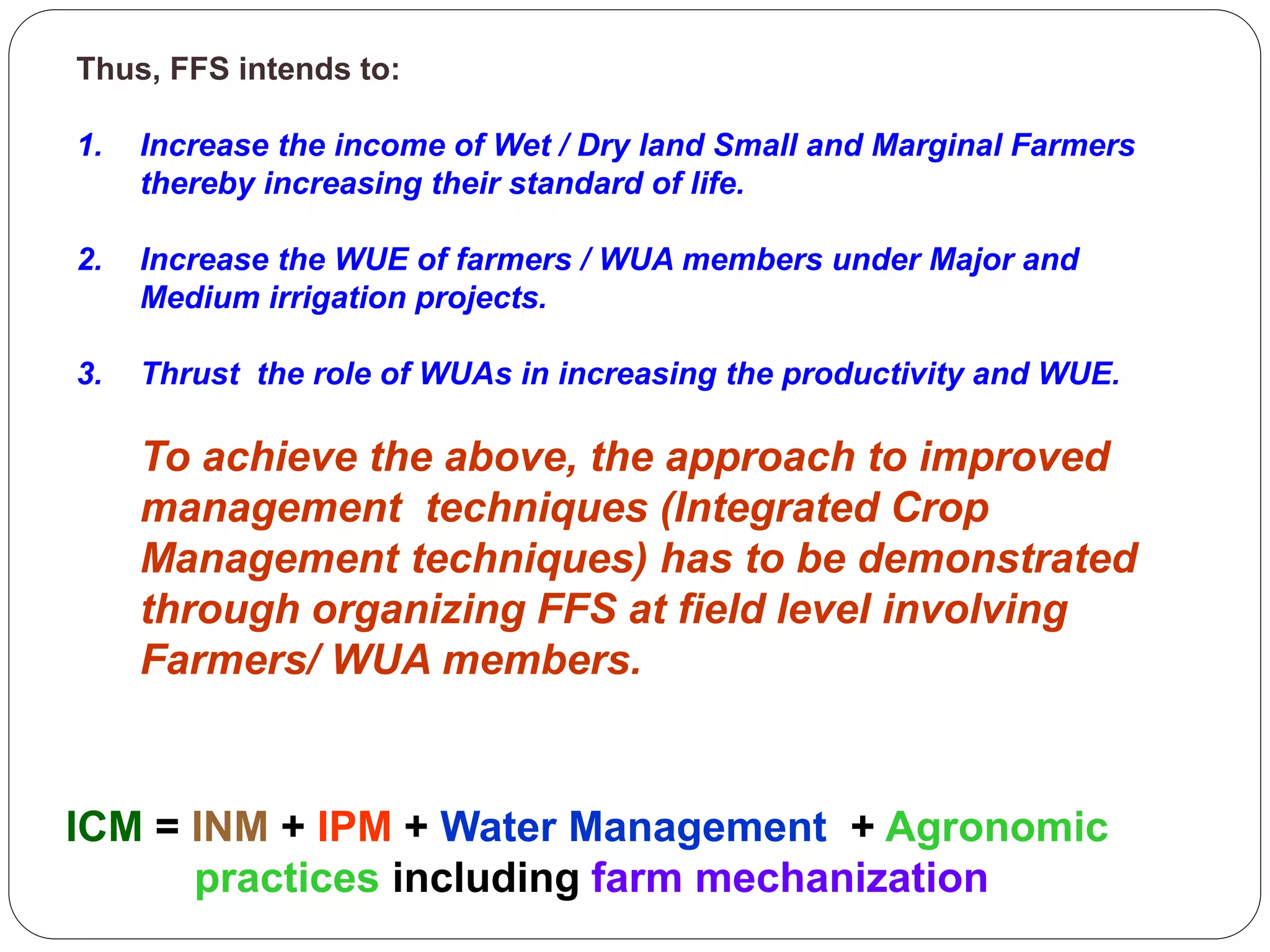
Thus, FFS intends to:
1. Increase the income of Wet / Dry land Small and Marginal Farmers
thereby increasing their standard of life.
2. Increase the WUE of farmers / WUA members under Major and
Medium irrigation projects.
3. Thrust the role of WUAs in increasing the productivity and WUE.
To achieve the above, the approach to improved
management techniques (Integrated Crop
Management techniques) has to be demonstrated
through organizing FFS at field level involving
Farmers/ WUA members.
ICM = INM + IPM + Water Management + Agronomic
practices including farm mechanization
FarmerField
Schools Give a man a fish
…...and feed him for a
day
Teach him how to fish
…..and feed him for
life
Steps in ffs A Lecture By Mr.Allah Dad Khan Visiting Professor the university of Agriculture Peshawar

Steps in ffs A Lecture By Mr.Allah Dad Khan Visiting Professor the university of Agriculture Peshawar

  • 2.
    ROLE OF FARMERSFIELD SCHOOLS IN AGRICULTURE AND RURALDEVELOPMENT IN PAKISTAN By Allah Dad Khan allahdad52@gmail.com 03329221298
  • 3.
    Bifurcation of Presentation 1.Introduction of Farmer Field School 2. Farmer Field School Approach 3. Basic Aims of FFS 4. Objectives of Farmer Field Schools 5. Characteristics of Farmer Field Schools 6. . Basic Elements of FFS 7. Method of education in FFS 8.Concepts of Farmer field Schools 9.Training Material for FFS 10.FFS session
  • 4.
  • 5.
    What is FFS TheFarmer Field School is a form of adult education, which evolved from the concept that farmers learn optimally from field observation and experimentation. It was developed to help farmers tailor their Integrated Pest Management (IPM) practices to diverse and dynamic ecological conditions.
  • 6.
    FFS A ParadigmShift in Agricultural Extension There is an inclination towards FFS because the extension service is perceived having a much broader coverage That goes beyond the educational processes and action learning agenda of the FFS .
  • 7.
     Prophylactic, calendar- basedspraying  Heavy subsidy on pesticides (80%) History of Farmer Field School Outbreak of BPH during 1970-1980s
  • 8.
    FFS ORIGIN The term“Farmer Fields Schools” came from the Indonesian expression Sekolah Lapangan meaning just field school. The first Field Schools were established in 1989 in Central Java during a pilot season by 50 plant protection officers to test and develop field training methods as part of their IPM training of trainers course phase of the FAO-assisted National IPM Programme. This Programme was prompted by the devastating insecticide- induced outbreaks of brown plant hoppers (Nilaparvata lugens) that
  • 9.
    History of FFSin Pakistan The Farmer Field School (FFS) approach evolved from the concept that optimal learning derives from experience - in the case of farmers, from observation in the field. The FFS integrates the domains of ecology and non-formal education to give farmers the opportunity to learn about their crop and to learn from each other. Learning objectives of FFS are; i) grow healthy crop, ii) conduct regular field observations, iii) conserve natural enemies of pests, iv) farmers understand ecology and become experts in their own field. The FFS based IPM approach was institutionalized in
  • 10.
    2. Farmer FieldSchool Approach
  • 11.
    Sl. No Area Conventional Method Demonstrations FFS 1Involvement of Farmers Less Less More 2 Group approach Nil less Working in small groups for sharing of ideas, knowledge, skills 3 University recommendations/ Technology Create awareness Disseminate knowledge Validate recommendations through field studies 4 Learning Create awareness knowledge learning by doing 5 Farm Management Decisions Create dependence on external agencies Create dependence on external agencies Empowering farmers as decision makers 6 Development of Skills Less Less More Technical, attitudinal skills 7 Provide technology or science Provide technology Provide technology Transfer of science & Technology 8 Adoptability of Technology by S.F & M.F Less Less High 9 Ecological approach Regional specific Regional specific Individual field specific 10 Cost of technical input or wisdom High & borrowed High & borrowed Less: Synthesized local (traditional) & external wisdom Difference Among 3 Major Approaches for Educating the Farmers
  • 12.
    Farmer Field SchoolApproach Farmer Field School is a school without walls. Farmers and extension workers are students. The Farmers Field is the class room and the plant is the teacher. As the plant grows the students gain knowledge in the light of their observations. The get together at a fixed time every week once and make their own decisions based on observations and data analysis for the health of the plants.
  • 13.
    Why the FarmerField School approach? Extension work has traditionally been seen by research and extension institutions as a mechanism to transfer technologies to farmers. This approach, however, has proved inadequate in complex situations where farmers must frequently adjust their activities to changing conditions (crop protection, soil nutrient management, animal health and production). Technology packages, delivered in a ‘top-down’ approach, were often too complex, expensive or poorly adapted to farmers’ needs. Extension workers realised that farmers were not sufficiently involved in identifying problems, selecting and testing options, and evaluating possible solutions. With declining government support for traditional extension work, it became clear that alternative methods were needed to identify the problems faced by farmers and to disseminate appropriate technologies. The FFS approach, in contrast, strengthens the capacity of farmers and the local communities to analyze their production systems, identify their main constraints and test possible solutions. By adding
  • 14.
    Why FFS forFarmers  Only farmer can make the “right” Farm Management decision based on his own perceptions of economics and technologies. So farmer should be trained in decision-making  There are too many farms (5.00 mill) and too few extension workers to be able to service them all. A self multiplying training programme for farmers need to be established.  Each farmer field is different in pest, beneficial fauna, soil and other eco-system elements and cannot be treated on a generalized technology package message.  Technologies requiring decision-making and management need skill transfer training. IPM cannot be implemented simply by demonstration, field days, TV Ads, radio, publications etc.
  • 15.
    Technology Transfer Products vsKnowledge based Technologies Knowledge vs Skill Development Learning by doing vs. by seeing Discovery based learning Decision making vs following advice Situation based vs Technology based development Participatory vs Empty barrel approach
  • 16.
  • 17.
    Basic Aims ofFarmer Field School 1. Skill Development 2. Empowerment 3. Will power 4. Capacity of Decision Making
  • 18.
    Basics of atypical farmer field school The FFS meeting place is close to the study plots.  FFS educational methods are experiential, participatory and learner-centered. Each FFS meeting includes the following activities:  Recapitulation of the previous week’s session,  The agro-ecosystem analysis,  A special topic,  Insect zoo,  A group dynamics activity  Evaluation of the day’s  Session and planning for the following week. All FFS include a field in which farmers collect information and materials to learn about, develop observation skills and practice making informed management decisions. A pre- and post-test are conducted as part of every field school.Preparation meetings precede a FFS To determine needs and develop a learning contract.Final meetings of FFS often include plans for Follow-up activities.
  • 19.
    Management and organization Activitiessuch as recapitulation and briefing provide opportunities for farmers to increase their management skills and to experience how to organize activities to prepare them for farmer-led programmes. Leadership of small groups is rotated among members weekly and each FFS participant becomes the session Day’s Team Leader. Through this process, participants take over the management of the FFS. A Field Day at the end of the season showcases the management and organization skills that participants gain in the FFS. The Field Day is attended by non-IPM farmers, local leaders, and other
  • 20.
    Essential Elements ofFFS 4.Weekly meetings 2.Field 3.Facilitator 1. Farmers-group Empowerment 5.Ecological approach
  • 21.
    Conditions for successfulFFS Based on our experience, the following conditions are necessary to ensure the success of FFS:  Well trained, technically competent facilitators  Well defined priority problem(s)  Adequate resources and logistical support  Clear understanding of the FFS concept and procedures by all stakeholders  Support and good will by authorities at various levels  Availability of appropriate technical knowledge and interventions  Availability of an FFS curriculum
  • 22.
    Need of FFS 1.Declining soil productivity and inappropriate imbalanced nutrient use. 2. Indiscriminate use of pesticides leading to increased cost of cultivation 3. Poor water management resulting in low Water Use Efficiency (WUE), soil 4. salinity and alkalinity problems 5. Inadequate research and extension support to Small & Marginal farmers
  • 23.
  • 24.
    Objectives of FarmerField Schools Broad Objectives To bring farmers together to carry out collective and collaborative inquiry with the purpose of initiating community action in solving community problems
  • 25.
    Objectives of FarmerField Schools Specific Objectives To empower farmers with knowledge and skills to Make them experts in there own fields. To sharpen the farmers ability to make critical and informed decisions that render their farming profitable and sustainable. To sensitize farmers in new ways of thinking and problem solving Help farmers learn how to organize themselves and
  • 26.
    Objectives of FarmerField Schools FFS also contribute to the following objective; Shorten the time it takes to get research results from the stations to adoption in farmers’ field by involving farmers experimentation early in the technology development process. Enhance the capacity of extension staff, working in collaboration with researchers, to serve as facilitators of farmers’ experiential learning. Rather than prescribing blanket recommendation that cover a wide geographic area but may not be relevant to all farms within it, the methods train extensionist and researchers to work with farmers in testing, assessing and adapting a variety of options within their specific local conditions. Increase the expertise of farmers to make informed decisions on what works best for them, based on their own observations of experimental plots in their Field schools and to explain their reasoning. No Matter how good the researchers and extensions, recommendations must be tailored and adapted to local conditions, for which local expertise and involvement is required that only farmers themselves can supply.
  • 27.
  • 28.
    Essential of FarmerField School 1.Group:-Comprises of 20-25 Farmers, having interest .FFs tends to strengthened existing group or may lead to formation of new group. 2. Field : -Field is the teacher provide training material such as plants, pests and other facilities 3. Facilitator :-Technical person who leads group members through hands on exercises . The facilitator can be an extension agent or a farmer field school graduate . 4. Curriculum :-The curriculum follows the natural cycle of crops ,
  • 29.
    Characteristics of FFSApproach  1. Farmers:- Farmers are experts conducting their own field studies.  2. Farmer Field :-The field is a learning place where farmers working in small groups , collect data , analyze and arrived at decision.  3.Extensin Workers :-They are facilitators not teacher .  4. Curriculum:-This is integrated to include crop husbandry in relation to ecology, economics, sociology and education  5.Training :- Related to seasonal cycle of practice being investigated such as land preparation , cropping harvesting .  6.Meeting:- These are held at regular interval depending on what activities need to be done.  7.Learning Material :- Theses are generated by farmers and are consistent with local conditions.  8. Group Dynamics:-Training include communication skill building problem solving , leadership and discussion methods . Farmer implements their own decision in the own fields.
  • 30.
  • 31.
    Basic Elements ofFFS  The FFS consists of a group of 30 farmers and 5 agriculture extension officers.  The FFS is field based and lasts for at least one cropping season (seeding to harvest) (14-15 weeks).  The FFS farmers have regular weekly meeting during the cropping season.  In the FFS, farmers conduct a study comparing IPM strategy with common farmer’s practices. They have an IPM and a Farmer’s Practice plot (Non-IPM
  • 32.
    Basic Elements ofFFS  The FFS includes special topics that deal with specific issues selected by the farmers.  Each meeting includes at least an Agro- ecosystem Analysis (AESA) conducted in the field ending with a discussion of crop management decision.  FFS educational methods are experimental, participatory, learner-centered and based on non- formal education.  The FFS group is guided by at least one facilitator offering experimental learning opportunities, rather than delivering top-down instruction.
  • 33.
    Comparison between FFSand conventional T&V PARAMETER FARMER FIELD SCHOOL CONVENTIONAL T & V 1. Learning method By doing, experimenting, participating, discovering By listening ( Element of experimenting and discovering still absent) 2. Training venue Subject of learning (field, crop, animal etc) Training shade or tree 3. Duration Complete study (Season long cycle) One or two sessions 4. Extension Agent and their role Trained expert. Spends most of their time assisting farmers convince themselves about a given technology Jack of all trades. Spends most of their time trying to convince farmers
  • 34.
    Comparison between FFSand conventional T&V Comparison between FFS and conventional T&V Com PARAMETER FARMER FIELD SCHOOL CONVENTIONAL T & V 5.Farmer and his/her role Participator, Contributor, Decision-maker. Assumption- farmer is a cup of tea full of knowledge but needs steering. Listener. Management decisions usually prescribed. Assumption- farmer is an empty cup of tea that needs to be filled 6. Qualification to participate None discriminatory Need to be able to write with some intensive programmes (Master farmer training) 7. Programme Planning Done and agreed upon by/with farmers. Extension agent commits themselves Office work. Extension commitment not quaranteed 8. Evaluation and adoption Together with farmers. Adoption is the choice of the farmer Office. Usually persuasion/force
  • 35.
  • 36.
    Formal Education Teacher * Teacheris the centre of instruction * Information push (teacher decides what trainees are being taught). * Teacher has to prepare all sessions. * Trainees are passive receivers of information.
  • 37.
    Non Formal Education A.Facilitator B. Participants can give inputs C. Information pull (focus on actual information needs) D. Facilitator ensures that participants learn basic contents and involves participants to determine additional learning goals. E. Informal, open exchange, equal chance to participants
  • 38.
    Types of non-FormalEducation Approaches used in FFS Key non-formal Education (NFE) Approaches used in the Farmer Field School learning include:  Sharing  Case study  Role play (dramatized sessions)  Problem solving exercises  Panel discussions  Group dynamics  Small group and large group discussion  Brainstorming  Simulation game If I hear it, I forget it. If I see it, I remember it. If I do it, I believe it for life.”
  • 39.
    8. Concepts ofFarmer Field Schools
  • 40.
    CONCEPT OF WHATIS THIS? WHAT IS THAT? (Learning to answer questions with questions) Definition: 1. It is a discovery-based learning in which questions are used to answer questions. 2. It leads the learner to the answer by asking questions. 3. It promotes learning by discovery and leads learners towards their own analysis 4. It guides farmers to critically analyze and make better decisions on their own fields. The goal of discovery-based learning is to provide a more enlightened educational opportunity for participants. The methodology of learning is very important for achieving the goal of education. Oneimportant method is to ask questions that allow the participants to develop their own analysis and understanding. You are stealing an opportunity for education if you reply directly with an answer. Ask questions. Lead the participant to the answer by asking questions. There are many ways to answer the question: What is this? For most of
  • 41.
    Concepts  Integrated PestManagement (IPM)  Agroecosystem Analysis  Living Soils and Growing  Healthy Root Systems  Biological Alternatives  Adult Nonformal Education  Community IPM  Rural Ecology and Agricultural Livelihoods (REAL)  Farmer Life Schools  IPM and Marketing  Pesticides and Health  Food Safety
  • 42.
    Key Training Activities Training of Trainers  Farmer Field Schools  Farmer Trainers & Farmer-to-Farmer FFS  Farmer Field Studies  Farmer's Congress
  • 43.
  • 44.
    Training materials inan ICM FFS The most important training materials in an FFS are the field, the plant, the soil, insects, weeds, etc. All these are readily available at the FFS location. Some other materials need to be supplied to facilitate drawing of an Agro Ecosystem Analysis (AESA) and to set up small field trials. Here is a list of materials that are often needed in an FFS:  Paper (flip chart paper for AESA drawing)  Notebooks and pens (for each participant)  Pencils, crayons, markers (need extra green colors)  Rulers  Paper tape  Glue  Hand lenses  Sticks, ropes, signboards  Materials to prepare insect zoo 13  Boxes  Bottles  Mosquito netting  Cotton  Pots
  • 45.
    Training materials inan ICM FFS  Plastic bags  Rubber bands  Stand for flip chart and clips  Sweep nets (not only in rice FFS, but also in other crops. Used to catch flying insects, adult butterflies, dragonflies, hoverflies, etc.)  Aspirator (make one yourself to catch small insects)  Knife, scissors  Plastic sheet or straw mat (for sitting)  Some inputs and materials for field experiments, for example: 1) Fertilizer 2) Seed / seedlings 3) Bio-control agents 4) Sticky traps 5) Signboards 6) Sometimes special designed forms to take data
  • 46.
  • 47.
    FFS session In anICM FFS a typical weekly session will take about 3 to 4 hours and will generally have the following schedule: Introduction Summarize what was done last week (recapitulation) Present today’s program
  • 48.
    FFS session Field visit/ Field observations  IPM/ICM plot Farmer Plot Field experiments Collect data Collect samples Start analyzing the field situation. The facilitators observe  the field together with the farmers and ask questions to start discussions.
  • 49.
    FFS session AESA drawing/ discussions within small group  Detailed analysis of the field situation. The facilitator asks questions to stimulate critical thinking. AESA presentation Decision making for the management of the ICM plot Agree on work to be done Who is responsible? When will it be done
  • 50.
    FFS session Insect zoos Set up insect zoos  Observe and record insect zoo activities Short break Snacks Group dynamics exercise If possible as an introduction to a special topic Special topic(s) Could be related to the field situation (e.g. a pest which was discovered in The field) or a topics selected by farmers Summarize and plan for next week Discuss special topic requests for next week
  • 51.
    A tYPIcAl FARmeRFIeld scHool sessIon Here’s what an average session looks like, in chronological order: 1. Opening (20 - 30 minutes)  Prayers  Roll call  Brief recap  Review of evaluation results from previous session  Handover to host team of the day
  • 52.
    A tYPIcAl FARmeRFIeld scHool sessIon 2. AESA (1 hour 30 minutes)  Mini groups carry outfield observations and generate data  Mini groups analyze data and create AESA sheets  Presentation of AESA results and conclusions by the respective mini groups  Synthesis of the mini group presentations by the facilitators to help the group make appropriate management decision(s) 3. Group dynamics (10 – 15 minutes)  Host team or the facilitator leads the group in an enerrgiser/icebreake 4. Topic of the day (45 minutes)  Building upon the outcomes of the AESA results, the facilitator introduces the topic of the day and leads a group discussion
  • 53.
    5.Updating of records(30 minutes)  Members submit their passbooks and update their savings and loan commitments  All financial and production records are updated  Treasurer reports on the status of the records 6. Planning (10 – 15 minutes)  The facilitator/chairperson leads the group to discuss any issue of concern  plan for the upcoming enterprise management activities and next session. reports on the status of the record. 7. Closing (10 minutes) Announcements ., Update of roll call sheet to capture ,late comers , Closing remarks bychairperson/facilitator ,• Closing prayer 8. Evaluation exercise (5 minutes)  Hostteam displays evaluation sheet (mood meter) for participants to fill in as
  • 54.
    Thus, FFS intendsto: 1. Increase the income of Wet / Dry land Small and Marginal Farmers thereby increasing their standard of life. 2. Increase the WUE of farmers / WUA members under Major and Medium irrigation projects. 3. Thrust the role of WUAs in increasing the productivity and WUE. To achieve the above, the approach to improved management techniques (Integrated Crop Management techniques) has to be demonstrated through organizing FFS at field level involving Farmers/ WUA members. ICM = INM + IPM + Water Management + Agronomic practices including farm mechanization
  • 57.
    FarmerField Schools Give aman a fish …...and feed him for a day Teach him how to fish …..and feed him for life