Digestive
System
Jens
Martensson
The part of your body that deals with the food is called the digestive
system. Its main job is to break down what you eat so the nutrients in the
food can be released to make the energy that your body needs.
Digestive System
Swallowing is the start of a long journey for your food that takes 24
hours or more. This process involves travelling up to 30 feet through a dark
tube full of powerful chemicals.
Let’s Learn
Jens
Martensson
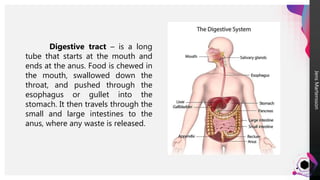
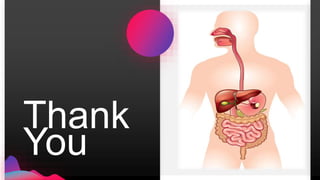
Digestive tract – is a long
tube that starts at the mouth and
ends at the anus. Food is chewed in
the mouth, swallowed down the
throat, and pushed through the
esophagus or gullet into the
stomach. It then travels through the
small and large intestines to the
anus, where any waste is released.
Jens
Martensson
1. Mouth
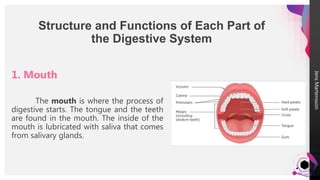
The mouth is where the process of
digestive starts. The tongue and the teeth
are found in the mouth. The inside of the
mouth is lubricated with saliva that comes
from salivary glands.
Structure and Functions of Each Part of
the Digestive System
Jens
Martensson
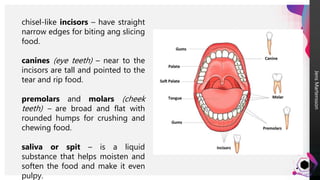
chisel-like incisors – have straight
narrow edges for biting ang slicing
food.
canines (eye teeth) – near to the
incisors are tall and pointed to the
tear and rip food.
premolars and molars (cheek
teeth) – are broad and flat with
rounded humps for crushing and
chewing food.
saliva or spit – is a liquid
substance that helps moisten and
soften the food and make it even
pulpy.
Jens
Martensson
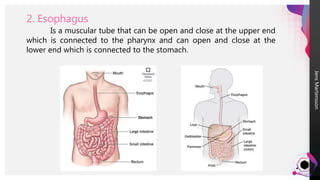
2. Esophagus
Is a muscular tube that can be open and close at the upper end
which is connected to the pharynx and can open and close at the
lower end which is connected to the stomach.
Jens
Martensson
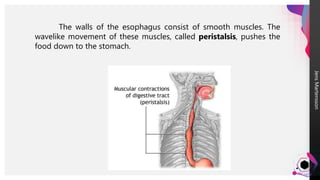
The walls of the esophagus consist of smooth muscles. The
wavelike movement of these muscles, called peristalsis, pushes the
food down to the stomach.
Jens
Martensson
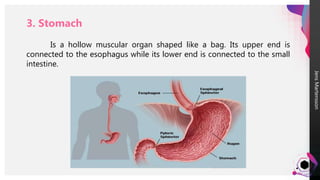
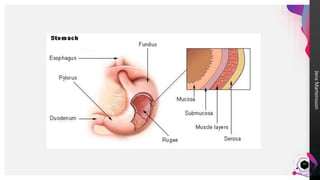
3. Stomach
Is a hollow muscular organ shaped like a bag. Its upper end is
connected to the esophagus while its lower end is connected to the small
intestine.
Jens
Martensson
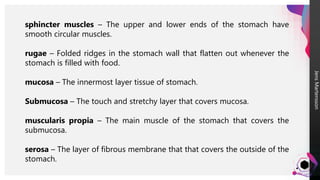
sphincter muscles – The upper and lower ends of the stomach have
smooth circular muscles.
rugae – Folded ridges in the stomach wall that flatten out whenever the
stomach is filled with food.
mucosa – The innermost layer tissue of stomach.
Submucosa – The touch and stretchy layer that covers mucosa.
muscularis propia – The main muscle of the stomach that covers the
submucosa.
serosa – The layer of fibrous membrane that that covers the outside of the
stomach.
Jens
Martensson
10
Jens
Martensson
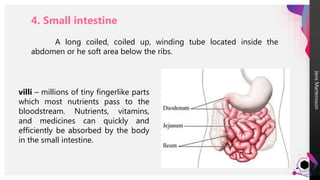
4. Small intestine
A long coiled, coiled up, winding tube located inside the
abdomen or he soft area below the ribs.
villi – millions of tiny fingerlike parts
which most nutrients pass to the
bloodstream. Nutrients, vitamins,
and medicines can quickly and
efficiently be absorbed by the body
in the small intestine.
Jens
Martensson
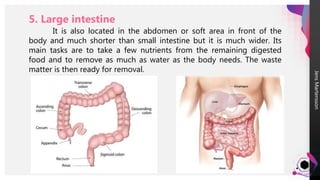
5. Large intestine
It is also located in the abdomen or soft area in front of the
body and much shorter than small intestine but it is much wider. Its
main tasks are to take a few nutrients from the remaining digested
food and to remove as much as water as the body needs. The waste
matter is then ready for removal.
Jens
Martensson
13
One end of the large intestine is connected to the small intestine
while the other end is connected to the anus.
cecum – First section of the large intestine, located in the lower abdominal
cavity and the receiving section of the undigested food material from the
small intestine.
colon – Longest section next to the cecum, it is where food is changed into
waste matter.
rectum – Large section and the terminal segment of the digestive system
where the accumulation of feces occurs just before discharge.
Thank
You

Digestive system

  • 1.
  • 2.
    Jens Martensson The part ofyour body that deals with the food is called the digestive system. Its main job is to break down what you eat so the nutrients in the food can be released to make the energy that your body needs. Digestive System Swallowing is the start of a long journey for your food that takes 24 hours or more. This process involves travelling up to 30 feet through a dark tube full of powerful chemicals. Let’s Learn
  • 3.
    Jens Martensson Digestive tract –is a long tube that starts at the mouth and ends at the anus. Food is chewed in the mouth, swallowed down the throat, and pushed through the esophagus or gullet into the stomach. It then travels through the small and large intestines to the anus, where any waste is released.
  • 4.
    Jens Martensson 1. Mouth The mouthis where the process of digestive starts. The tongue and the teeth are found in the mouth. The inside of the mouth is lubricated with saliva that comes from salivary glands. Structure and Functions of Each Part of the Digestive System
  • 5.
    Jens Martensson chisel-like incisors –have straight narrow edges for biting ang slicing food. canines (eye teeth) – near to the incisors are tall and pointed to the tear and rip food. premolars and molars (cheek teeth) – are broad and flat with rounded humps for crushing and chewing food. saliva or spit – is a liquid substance that helps moisten and soften the food and make it even pulpy.
  • 6.
    Jens Martensson 2. Esophagus Is amuscular tube that can be open and close at the upper end which is connected to the pharynx and can open and close at the lower end which is connected to the stomach.
  • 7.
    Jens Martensson The walls ofthe esophagus consist of smooth muscles. The wavelike movement of these muscles, called peristalsis, pushes the food down to the stomach.
  • 8.
    Jens Martensson 3. Stomach Is ahollow muscular organ shaped like a bag. Its upper end is connected to the esophagus while its lower end is connected to the small intestine.
  • 9.
    Jens Martensson sphincter muscles –The upper and lower ends of the stomach have smooth circular muscles. rugae – Folded ridges in the stomach wall that flatten out whenever the stomach is filled with food. mucosa – The innermost layer tissue of stomach. Submucosa – The touch and stretchy layer that covers mucosa. muscularis propia – The main muscle of the stomach that covers the submucosa. serosa – The layer of fibrous membrane that that covers the outside of the stomach.
  • 10.
  • 11.
    Jens Martensson 4. Small intestine Along coiled, coiled up, winding tube located inside the abdomen or he soft area below the ribs. villi – millions of tiny fingerlike parts which most nutrients pass to the bloodstream. Nutrients, vitamins, and medicines can quickly and efficiently be absorbed by the body in the small intestine.
  • 12.
    Jens Martensson 5. Large intestine Itis also located in the abdomen or soft area in front of the body and much shorter than small intestine but it is much wider. Its main tasks are to take a few nutrients from the remaining digested food and to remove as much as water as the body needs. The waste matter is then ready for removal.
  • 13.
    Jens Martensson 13 One end ofthe large intestine is connected to the small intestine while the other end is connected to the anus. cecum – First section of the large intestine, located in the lower abdominal cavity and the receiving section of the undigested food material from the small intestine. colon – Longest section next to the cecum, it is where food is changed into waste matter. rectum – Large section and the terminal segment of the digestive system where the accumulation of feces occurs just before discharge.
  • 14.