UAL Online
Yasi Tehrani, Pete Sparkes, Rob Clarke
Overview
Interactive workshop where the UAL Online Learning Designers will share common
learning design challenges and participants will be invited to discuss solutions.
1. Presentation: Research activities, learning design process and challenges
2. Group discussions: How would you respond to this learning design challenge?
3. Feedback: Each group shares their ideas
Presentation Title [To change text: Insert > Header and Footer] 2
The Project and process
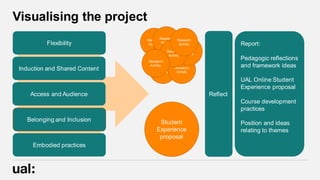
Visualising the project
Research
Activity
Flexibility
Induction and Shared Content
Access and Audience
Belonging and Inclusion
Embodied practices
Research
Activity
Research
Activity
Research
Activity
Research
Activity
Research
Activity
Research
Activity
Research
Activity
Research
Activity
Student
Experience
proposal
Report:
Pedagogic reflections
and framework ideas
UAL Online Student
Experience proposal
Course development
practices
Position and ideas
relating to themes
Research
Activity
Reflect
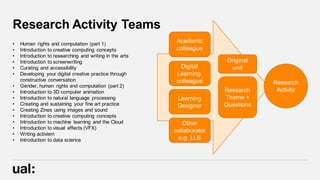
Research Activity Teams
Research
Activity
Academic
colleague
Research
Theme +
Questions
Digital
Learning
colleague
Learning
Designer
Other
collaborator
e.g. LLS
Original
unit
• Human rights and computation (part 1)
• Introduction to creative computing concepts
• Introduction to researching and writing in the arts
• Introduction to screenwriting
• Curating and accessibility
• Developing your digital creative practice through
constructive conversation
• Gender, human rights and computation (part 2)
• Introduction to 3D computer animation
• Introduction to natural language processing
• Creating and sustaining your fine art practice
• Creating Zines using images and sound
• Introduction to creative computing concepts
• Introduction to machine learning and the Cloud
• Introduction to visual effects (VFX)
• Writing activism
• Introduction to data science
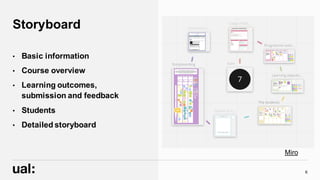
Storyboard
• Basic information
• Course overview
• Learning outcomes,
submission and feedback
• Students
• Detailed storyboard
6
Miro
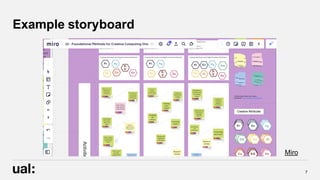
Example storyboard
7
Miro
The Scenarios
Scenarios
Consider your scenario and answer the following questions in your group:
 Are you familiar with this scenario in your own work (at UAL or elsewhere)?
 How would you respond in this scenario?
 What existing resources would you point them towards, or might it be useful
to create?
Each group will have 15 minutes to discuss their scenario, followed by up to 3 minutes to
feedback.
Padlet: https://bit.ly/UAL2022
Scenarios
 Scenario 1 – Your tutor hates Moodle!
Your tutor hates Moodle. They do not want to use it for their
online course, however its use is mandated by the
University. The tutor clearly is not familiar with the
functionality and different activity types that Moodle offers
and is not keen to learn (they have already made their
mind up).
Scenarios
 Scenario 2 – Your tutor wants to use lots of external
resources
Rather than creating their own original teaching content,
your tutor is relying heavily on external content that is
hosted on YouTube, Box of Broadcasts, articles that are
behind paywalls, and other web content that is out of the
control of UAL.
Scenarios
 Scenario 3 – Your tutor wants to rely heavily on
synchronous content to deliver the course
Your tutor wants to deliver the course through very regular,
synchronous sessions, leaving little time between live
sessions for students to undertake asynchronous learning
materials. In the synchronous sessions they are planning to
show videos or give lectures themselves for students to
watch ‘together'.
Scenarios
 Scenario 4 – Your tutor has never worked with learning
outcomes and is not familiar with concepts such as
constructive alignment
Your tutor is new to learning design and is very focused on
the content they want to teach rather than participating in
the learning design process that ensures that activities and
assessments are aligned to their learning outcomes. They
just want to record and produce lectures!
Scenarios
 Scenario 5 – Your tutor always delivers content at the
last minute!
Your tutor is used to preparing their lectures the day before
and they’re taking a similar approach to developing
asynchronous learning resources. As a result, weekly
content on Moodle is often sparse when it is initially
released and content is added on an irregular ad-hoc
basis. It cannot always be quality checked and students
are often unaware of what they are expected to do each
week.
Feedback
15
Scenarios
 Scenario 1 – Your tutor hates Moodle!
Your tutor hates Moodle. They do not want to use it for their
online course, however its use is mandated by the
University. The tutor clearly is not familiar with the
functionality and different activity types that Moodle offers
and is not keen to learn (they have already made their
mind up).
Scenarios
 Scenario 2 – Your tutor wants to use lots of external
resources
Rather than creating their own original teaching content,
your tutor is relying heavily on external content that is
hosted on YouTube, Box of Broadcasts, articles that are
behind paywalls, and other web content that is out of the
control of UAL.
Scenarios
 Scenario 3 – Your tutor wants to rely heavily on
synchronous content to deliver the course
Your tutor wants to deliver the course through very regular,
synchronous sessions, leaving little time between live
sessions for students to undertake asynchronous learning
materials. In the synchronous sessions they are planning to
show videos or give lectures themselves for students to
watch ‘together'.
Scenarios
 Scenario 4 – Your tutor has never worked with learning
outcomes and is not familiar with concepts such as
constructive alignment
Your tutor is new to learning design and is very focused on
the content they want to teach rather than participating in
the learning design process that ensures that activities and
assessments are aligned to their learning outcomes. They
just want to record and produce lectures!
Scenarios
 Scenario 5 – Your tutor always delivers content at the
last minute!
Your tutor is used to preparing their lectures the day before
and they’re taking a similar approach to developing
asynchronous learning resources. As a result, weekly
content on Moodle is often sparse when it is initially
released and content is added on an irregular ad-hoc
basis. It cannot always be quality checked and students
are often unaware of what they are expected to do each
week.
arts.ac.uk
Thank you

Dig Ed Day (1).pdf

  • 1.
    UAL Online Yasi Tehrani,Pete Sparkes, Rob Clarke
  • 2.
    Overview Interactive workshop wherethe UAL Online Learning Designers will share common learning design challenges and participants will be invited to discuss solutions. 1. Presentation: Research activities, learning design process and challenges 2. Group discussions: How would you respond to this learning design challenge? 3. Feedback: Each group shares their ideas Presentation Title [To change text: Insert > Header and Footer] 2
  • 3.
  • 4.
    Visualising the project Research Activity Flexibility Inductionand Shared Content Access and Audience Belonging and Inclusion Embodied practices Research Activity Research Activity Research Activity Research Activity Research Activity Research Activity Research Activity Research Activity Student Experience proposal Report: Pedagogic reflections and framework ideas UAL Online Student Experience proposal Course development practices Position and ideas relating to themes Research Activity Reflect
  • 5.
    Research Activity Teams Research Activity Academic colleague Research Theme+ Questions Digital Learning colleague Learning Designer Other collaborator e.g. LLS Original unit • Human rights and computation (part 1) • Introduction to creative computing concepts • Introduction to researching and writing in the arts • Introduction to screenwriting • Curating and accessibility • Developing your digital creative practice through constructive conversation • Gender, human rights and computation (part 2) • Introduction to 3D computer animation • Introduction to natural language processing • Creating and sustaining your fine art practice • Creating Zines using images and sound • Introduction to creative computing concepts • Introduction to machine learning and the Cloud • Introduction to visual effects (VFX) • Writing activism • Introduction to data science
  • 6.
    Storyboard • Basic information •Course overview • Learning outcomes, submission and feedback • Students • Detailed storyboard 6 Miro
  • 7.
  • 8.
  • 9.
    Scenarios Consider your scenarioand answer the following questions in your group:  Are you familiar with this scenario in your own work (at UAL or elsewhere)?  How would you respond in this scenario?  What existing resources would you point them towards, or might it be useful to create? Each group will have 15 minutes to discuss their scenario, followed by up to 3 minutes to feedback. Padlet: https://bit.ly/UAL2022
  • 10.
    Scenarios  Scenario 1– Your tutor hates Moodle! Your tutor hates Moodle. They do not want to use it for their online course, however its use is mandated by the University. The tutor clearly is not familiar with the functionality and different activity types that Moodle offers and is not keen to learn (they have already made their mind up).
  • 11.
    Scenarios  Scenario 2– Your tutor wants to use lots of external resources Rather than creating their own original teaching content, your tutor is relying heavily on external content that is hosted on YouTube, Box of Broadcasts, articles that are behind paywalls, and other web content that is out of the control of UAL.
  • 12.
    Scenarios  Scenario 3– Your tutor wants to rely heavily on synchronous content to deliver the course Your tutor wants to deliver the course through very regular, synchronous sessions, leaving little time between live sessions for students to undertake asynchronous learning materials. In the synchronous sessions they are planning to show videos or give lectures themselves for students to watch ‘together'.
  • 13.
    Scenarios  Scenario 4– Your tutor has never worked with learning outcomes and is not familiar with concepts such as constructive alignment Your tutor is new to learning design and is very focused on the content they want to teach rather than participating in the learning design process that ensures that activities and assessments are aligned to their learning outcomes. They just want to record and produce lectures!
  • 14.
    Scenarios  Scenario 5– Your tutor always delivers content at the last minute! Your tutor is used to preparing their lectures the day before and they’re taking a similar approach to developing asynchronous learning resources. As a result, weekly content on Moodle is often sparse when it is initially released and content is added on an irregular ad-hoc basis. It cannot always be quality checked and students are often unaware of what they are expected to do each week.
  • 15.
  • 16.
    Scenarios  Scenario 1– Your tutor hates Moodle! Your tutor hates Moodle. They do not want to use it for their online course, however its use is mandated by the University. The tutor clearly is not familiar with the functionality and different activity types that Moodle offers and is not keen to learn (they have already made their mind up).
  • 17.
    Scenarios  Scenario 2– Your tutor wants to use lots of external resources Rather than creating their own original teaching content, your tutor is relying heavily on external content that is hosted on YouTube, Box of Broadcasts, articles that are behind paywalls, and other web content that is out of the control of UAL.
  • 18.
    Scenarios  Scenario 3– Your tutor wants to rely heavily on synchronous content to deliver the course Your tutor wants to deliver the course through very regular, synchronous sessions, leaving little time between live sessions for students to undertake asynchronous learning materials. In the synchronous sessions they are planning to show videos or give lectures themselves for students to watch ‘together'.
  • 19.
    Scenarios  Scenario 4– Your tutor has never worked with learning outcomes and is not familiar with concepts such as constructive alignment Your tutor is new to learning design and is very focused on the content they want to teach rather than participating in the learning design process that ensures that activities and assessments are aligned to their learning outcomes. They just want to record and produce lectures!
  • 20.
    Scenarios  Scenario 5– Your tutor always delivers content at the last minute! Your tutor is used to preparing their lectures the day before and they’re taking a similar approach to developing asynchronous learning resources. As a result, weekly content on Moodle is often sparse when it is initially released and content is added on an irregular ad-hoc basis. It cannot always be quality checked and students are often unaware of what they are expected to do each week.
  • 21.