Here is whereyour presentation begins
DISASTER IN
DIFFERENT
PERSPECTIVE
2.
Learning Objectives:
By theend of the lesson, the student should be able to:
1. Define disasters in different perspectives.
2. Compare how disasters are perceived from various perspectives (e.g.,
physical, economic, social-cultural, and psychological).
3. Analyze the impact of disasters on different communities and
stakeholders.
4. Evaluate different approaches to disaster preparedness and response.
5. Reflect on their role in disaster risk reduction and resilience-building.
3.
ACTIVITY!
Direction: Think aboutthe scenario below. Write YES if it is a disaster; NO if not a
disaster. Write your answer on a separate sheet.
___ 1. A landslide in a mountain resort.
___ 2. A typhoon traversing a remote and uninhabited island.
___ 3. A volcano erupting 15 km away from a city.
___ 4. A mudslide towards a hill foot community.
___ 5. A strong earthquake in the city proper of Calamba.
1. Physical perspective
Naturaldisasters generally affect the physical infrastructural facilities,
agricultural productivity and even lead to loss of life and cause damage to
property. Various factors influence the effects of a disaster on a country among
them are the magnitude of the disaster, the geography of the area affected, and
the recovery efforts directed towards reducing the immediate effects of a disaster.
“Effects of a natural Disasters on a Country Essay”, Ivy Panda Free Study Hub,
January 20, 2020, https://ivypanda.com/essays/effects-of-a-natural-disasteron-
a-country/
6.
Effects of PhysicalDisasters
- Injuries
- Physical Disabilities or Illness
- Sanitation
- Damage in Infrastructure
7.
2. Psychological Perspective
Disastersare mostly unpredictable, which leave the victims in a state of
shock. They tend to deny the loss and try to escape from reality. Being in a denial
7state makes the victims more vulnerable to stress, anxiety, and other different
maladaptive reactions. Death of a closed one also leaves the victim in a state of
insecurity because the sense of love, attachment and belongingness are deprived.
Makwana, Nikunj Disaster and its impact on mental health: A narrative review,
October 31, 2019 https://www.ncbi.nlm.nih.gov/pmc/articles/PMC6857396/
3. Socio-cultural Perspective
Filipinosare generally known as “matiisin”, resourceful, helpful,
optimistic, and prayerful. These characteristics are manifested in the country’s
recent fight against COVID19.Due to the National Health Emergency, Enhanced
Community Quarantine (ECQ) prevailed in the whole country. A lot of people
temporarily lost their jobs, some people stranded in different regions, repatriated
OFWs were held in different quarantine facilities in Metro Manila, and all people
were restricted to go out of their homes for months. As a result, most Filipino
families would rely on government’s help for them to get by. However, limited
resources and aids from the government make people find possible ways to
survive amid the pandemic.
10.
Socio-Cultural Effect ofDisasters
- Change in individual roles
- Disruption of social relationships and personal
connection
11.
4. Economic Perspective
Disastersaffect the economic condition of a community because they
reduce local and international trade. It can also partially or totally paralyze a
country’s transportation system, just like what happened in the COVID19
pandemic. Implementation of a partial and total shut down of local business
operations result to a lot of people losing means of living.
12.
Economic Effects ofDisasters
- Loss of life
- Unemployment
- Loss of property
- Loss of household articles
- Loss of crops
- Loss of public infrastructure
13.
5. Political Perspective
Naturaldisasters are commonly thought to be less politically
argumentative than armed conflicts, yet a closer look shows that both the
effects of a natural disaster and the resulting distribution of humanitarian aid
are profoundly linked to politics. Just as vulnerability to disasters is mediated
by the political system of a country, disasters can have major consequences for
political stability and political legitimacy (Hörhager, July 2017. Since agencies
of government have a significant role to play in directing disaster preparedness,
prevention and recovery. Social systems establish vulnerability to natural
disasters and governments are often considered to be responsible for the
disaster effects.
14.
Political Effects ofa Disaster
- People who have trust in political institution will assess the
government’s risk assessments as credible and accept their hazard
policies (Johnson, 1999)
- Low level of trust in public institutions therefore means that citizens
may ignore the recommendations and disregard the information
provided by these institutions (McCaffey, 2004).
- If individuals are confident that they will receive sufficient aid from the
government when a disaster occurs, they might not be motivated to
take measures on their own (King and Kang, 2000)
15.
6. Biological Perspective
Thedisturbing effects caused by a prevalent kind of disease or virus
in an epidemic or pandemic level is known as biological disaster.
(a) Epidemic Level: Biological disaster affects large numbers of people within a
given community or area. Ex: Dengue.
(b) Pandemic Level: Biological disaster affects a much large region, sometime
spanning entire continents or the globe. Ex: Swine Flu.
16.
Biological disasters canwipe out an entire population at a short
span of time. Example of it is the COVID19 pandemic which infected millions
in less than a month and left thousands of deaths in the same duration. Viral
respiratory infections can lead to anything from a mild cough that lasts a few
weeks or months to full-blown persistent wheezing or asthma (Martin, 2020).
Examples are: Observing physical distancing, appropriate washing of the
hands, wearing of mask at all times once outside of one’s home, and boosting
one’s immune system.
17.
COVID19 patients whohave strong immune system can likely soon
recover from the disease. Also, those who follow the health precaution strictly
have less chance of being infected. As such, the effects of a biological disaster
can be reduced.
- Loss of lives
- Public demobilization
- Negative economic effect
- Unemployment
- Hunger
Effects of Biological Disasters
Watch or Reador Both?
Direction: Watch a video from the Youtube, entitled Philippines’
President Threatens to shoot dead corona virus lockdown or read the
article and answer the following questions.
21.
1. Based onthe video/article, what perspective/s of disaster does it imply?
2. What do you think are the significant needs of the people in the
video/article
3. Do you agree with the perspective of the President in mitigating the effect/s
of the disaster?
4. Suppose you have the authority to give suggestion/s to the President in
reducing the impacts of the disaster in the video, what advice will you give
him? Justify your answer.
5. What do you think is the role of the government in qualifying the effects of
a disaster?
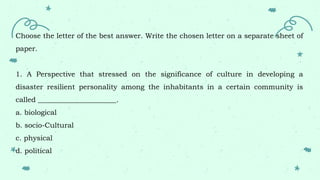
Choose the letterof the best answer. Write the chosen letter on a separate sheet of
paper.
1. A Perspective that stressed on the significance of culture in developing a
disaster resilient personality among the inhabitants in a certain community is
called ______________________.
a. biological
b. socio-Cultural
c. physical
d. political
24.
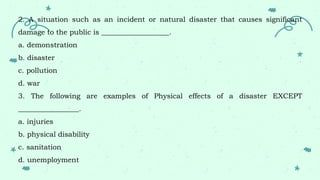
2. A situationsuch as an incident or natural disaster that causes significant
damage to the public is ___________________.
a. demonstration
b. disaster
c. pollution
d. war
3. The following are examples of Physical effects of a disaster EXCEPT
_________________.
a. injuries
b. physical disability
c. sanitation
d. unemployment
25.
4. A perspectiveof a disaster that shows how the government assess, manage,
and mitigate the effects of a disaster is _________________.
a. biological
b. economic
c. socio-cultural
d. Political
5. The following are examples of psychological effect of a disaster EXCEPT
_____________________.
a. anxiety
b. bereavement
c. depression
d. hunger
26.
6. The spreadof disease throughout a country or the whole world is called
__________________.
a. academic
b. epidemic
c. pandemic
d. prolific
7. The best disaster preparation is _________________.
a. Knowing what to do and who to trust.
b. Being vigilant and have disaster plan.
c. Preparing for the worst-case scenario.
d. Believing government disaster measures.
27.
8. A setof prevailing community traits help people in fighting the effects of a
disaster because ___________________.
a. It gives them a sense of hope.
b. It gives them a sense of pride.
c. It gives them a sense of identity.
d. It gives them a sense of cooperation.
9. The best description of a disaster is ___________________.
a. It is illogical.
b. It is irretrievable.
c. It is unchangeable.
d. It is unpredictable .
28.
10. The followingare examples of disasters, EXCEPT ___________.
a. COVID19 pandemic
b. Taal Volcano eruption
c. typhoon crossing the Pacific Ocean
d. flashflood in Tacloban and its neighboring towns
11. An incidence of a communicable disease in a community at a particular time
is known as _________________.
a. academic
b. epidemic
c. pandemic
d. prolific
29.
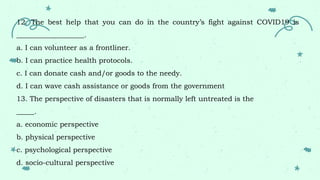
12. The besthelp that you can do in the country’s fight against COVID19 is
___________________.
a. I can volunteer as a frontliner.
b. I can practice health protocols.
c. I can donate cash and/or goods to the needy.
d. I can wave cash assistance or goods from the government
13. The perspective of disasters that is normally left untreated is the
_____.
a. economic perspective
b. physical perspective
c. psychological perspective
d. socio-cultural perspective
30.
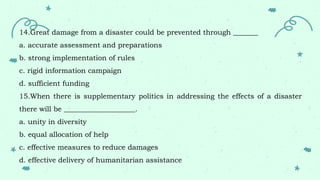
14.Great damage froma disaster could be prevented through _______
a. accurate assessment and preparations
b. strong implementation of rules
c. rigid information campaign
d. sufficient funding
15.When there is supplementary politics in addressing the effects of a disaster
there will be ____________________.
a. unity in diversity
b. equal allocation of help
c. effective measures to reduce damages
d. effective delivery of humanitarian assistance