DIFFERENT
CLASSIFICATIONS OF
ASSESSMENT
Assessment is the systematic basis for making
inferences about the learning and development of
students. It is the process of defining, selecting,
designing, collecting, analyzing, interpreting, and
using information to increase students' learning and
development.
Group 3
1
PREPARE
In order to plan, create, and select the appropriate
kind of assessment, you need to know the
characteristics of the different types of assessment
according to purpose, function, and the kind of
information needed about learners.
Group
3 2
DIFFERENT CLASSIFICATION OF ASSESSMENT
Group 3
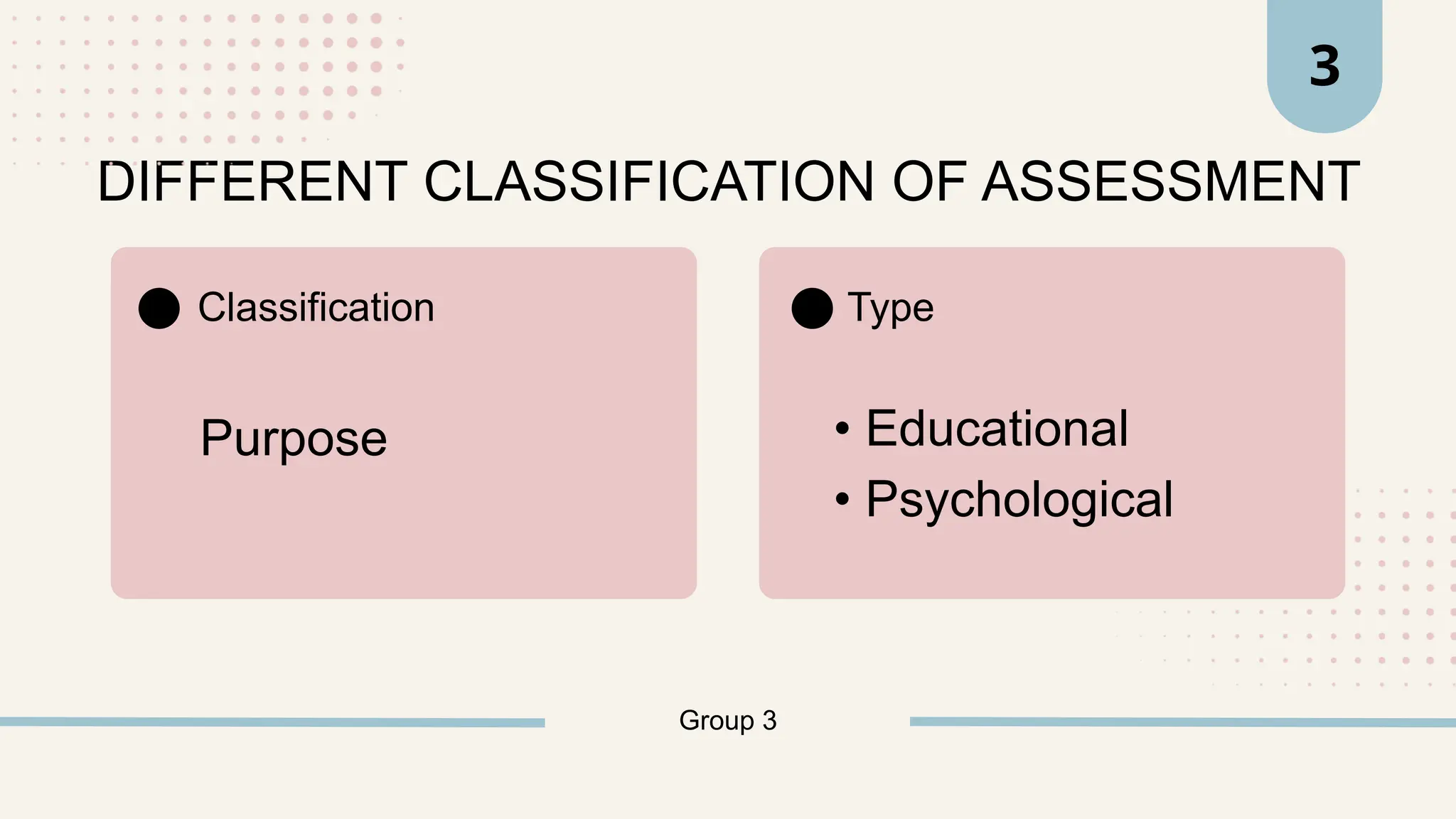
Purpose
Classification
• Educational
• Psychological
Type
3
DIFFERENT CLASSIFICATION OF ASSESSMENT
Group 3
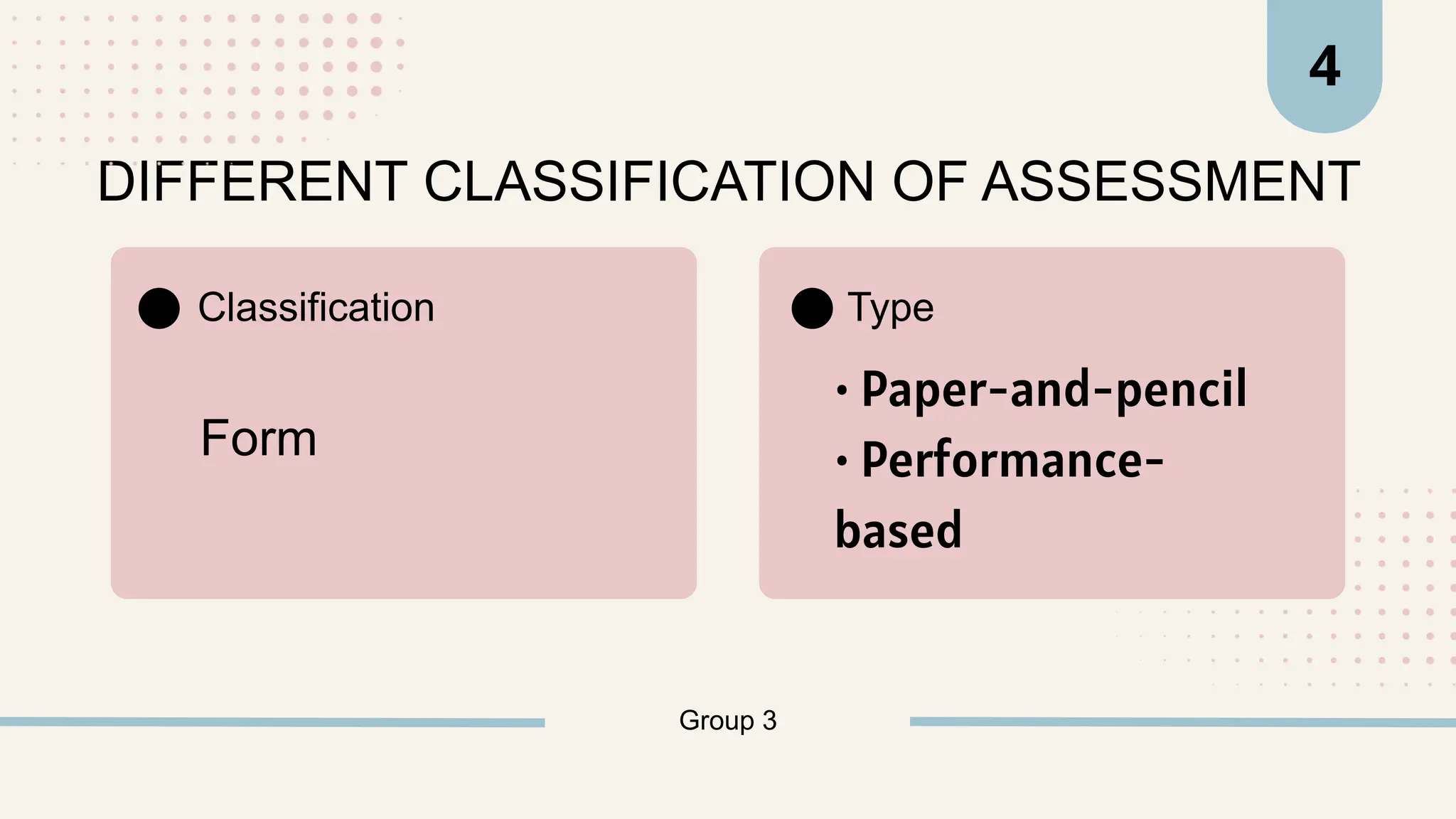
Form
Classification
• Paper-and-pencil
• Performance-
based
Type
4
DIFFERENT CLASSIFICATION OF ASSESSMENT
Group 3
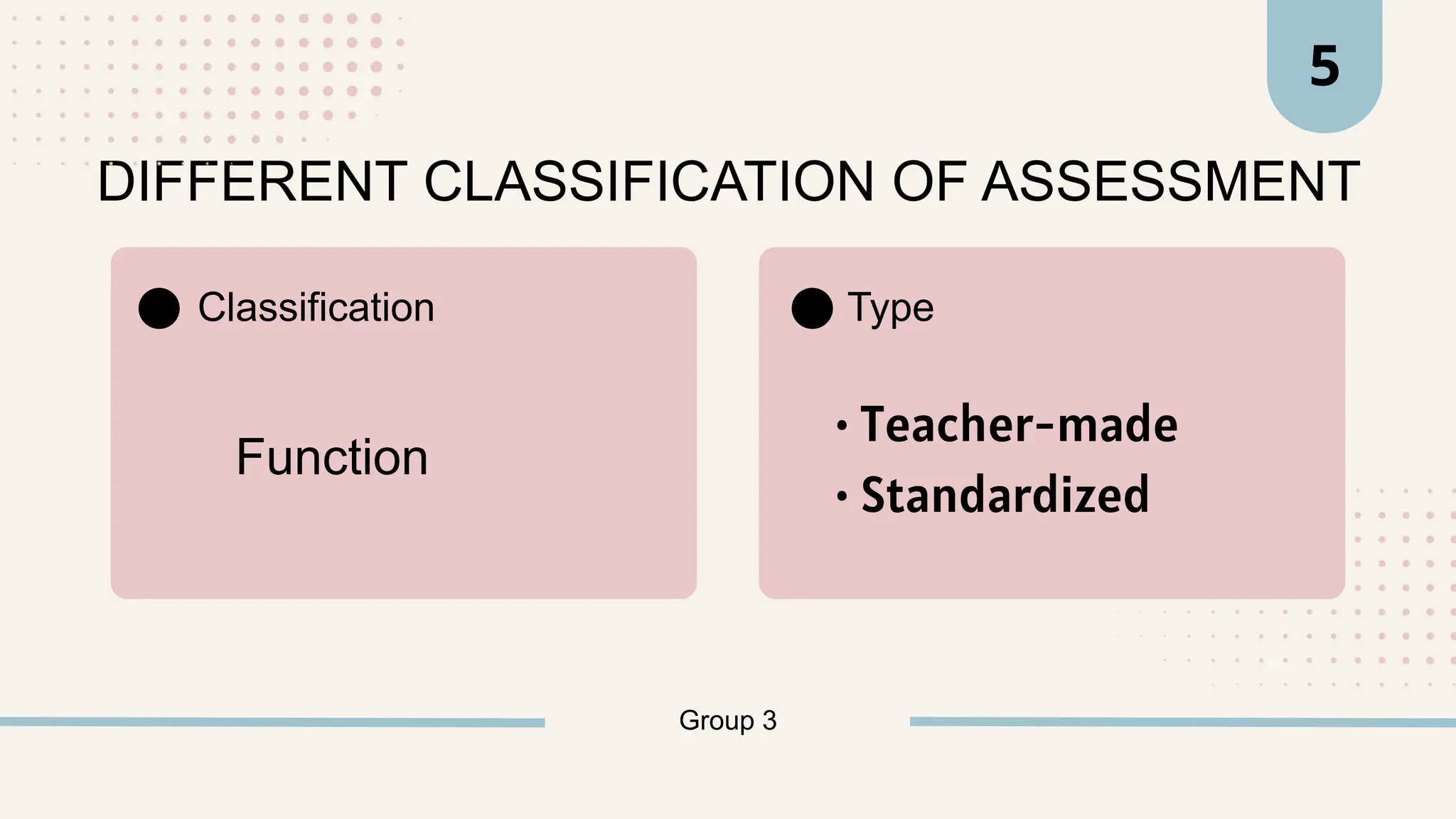
Function
Classification
• Teacher-made
• Standardized
Type
5
DIFFERENT CLASSIFICATION OF ASSESSMENT
Group 3
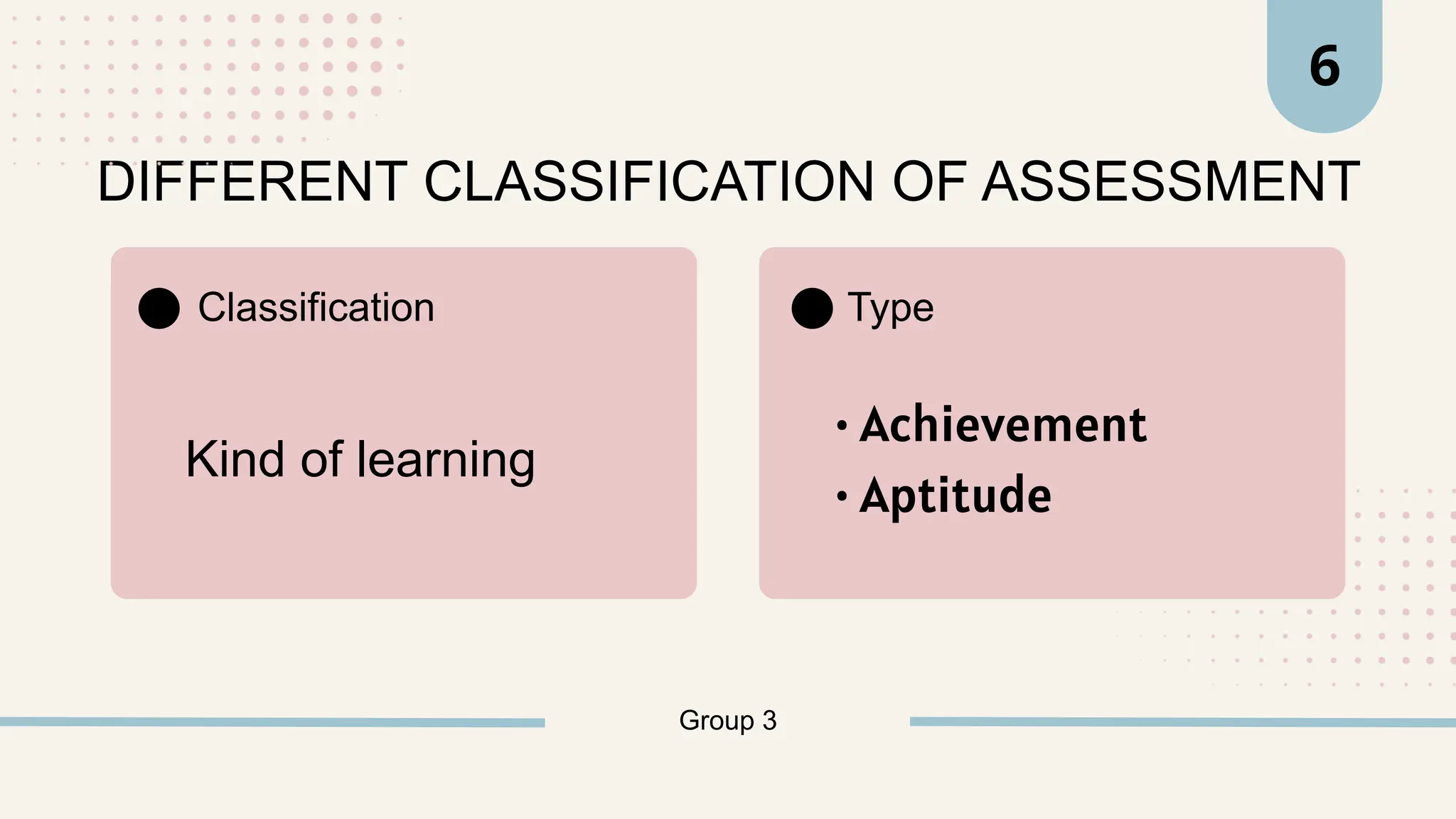
Kind of learning
Classification
• Achievement
• Aptitude
Type
6
DIFFERENT CLASSIFICATION OF ASSESSMENT
Group 3
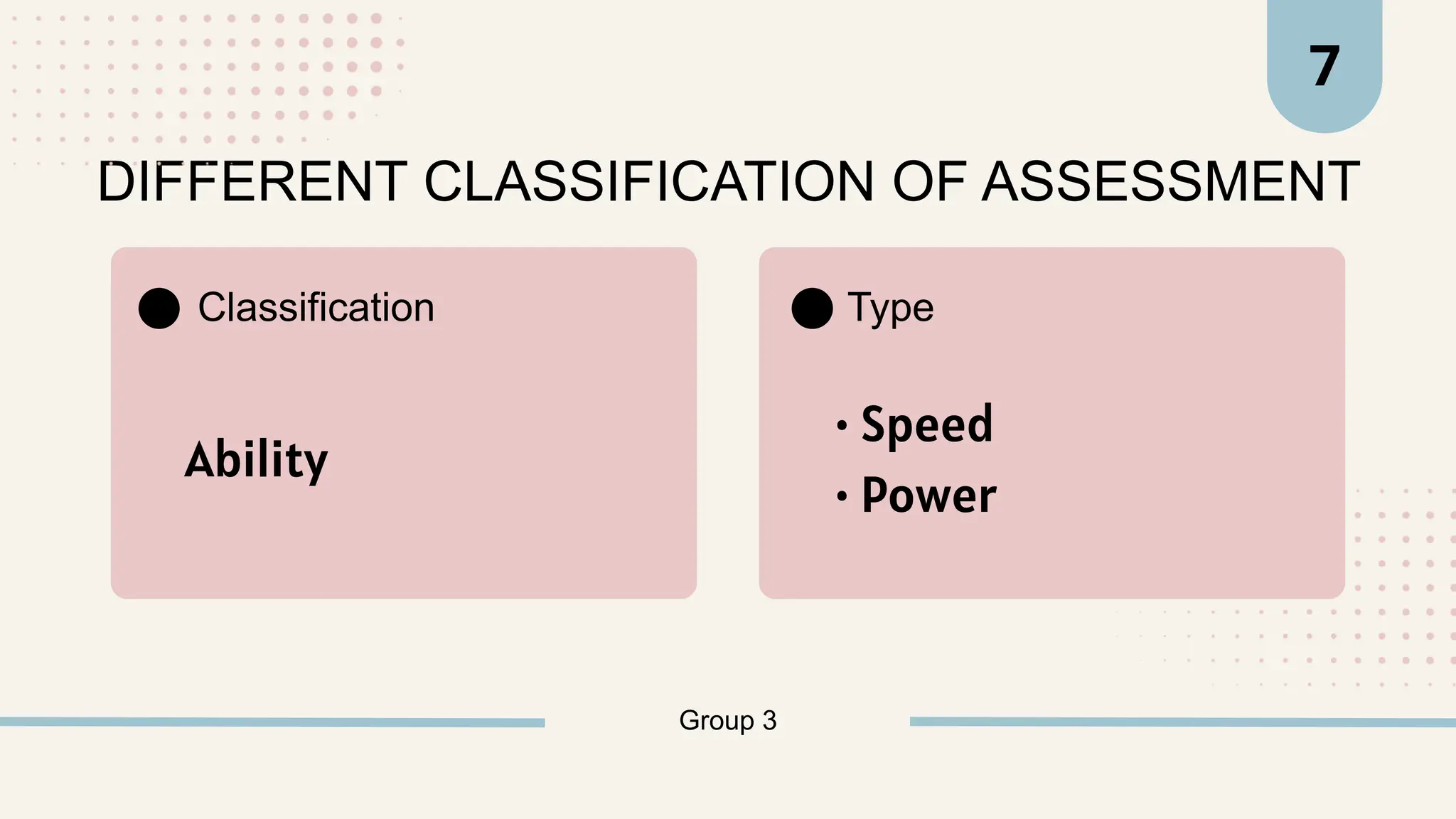
Ability
Classification
• Speed
• Power
Type
7
DIFFERENT CLASSIFICATION OF ASSESSMENT
Group 3
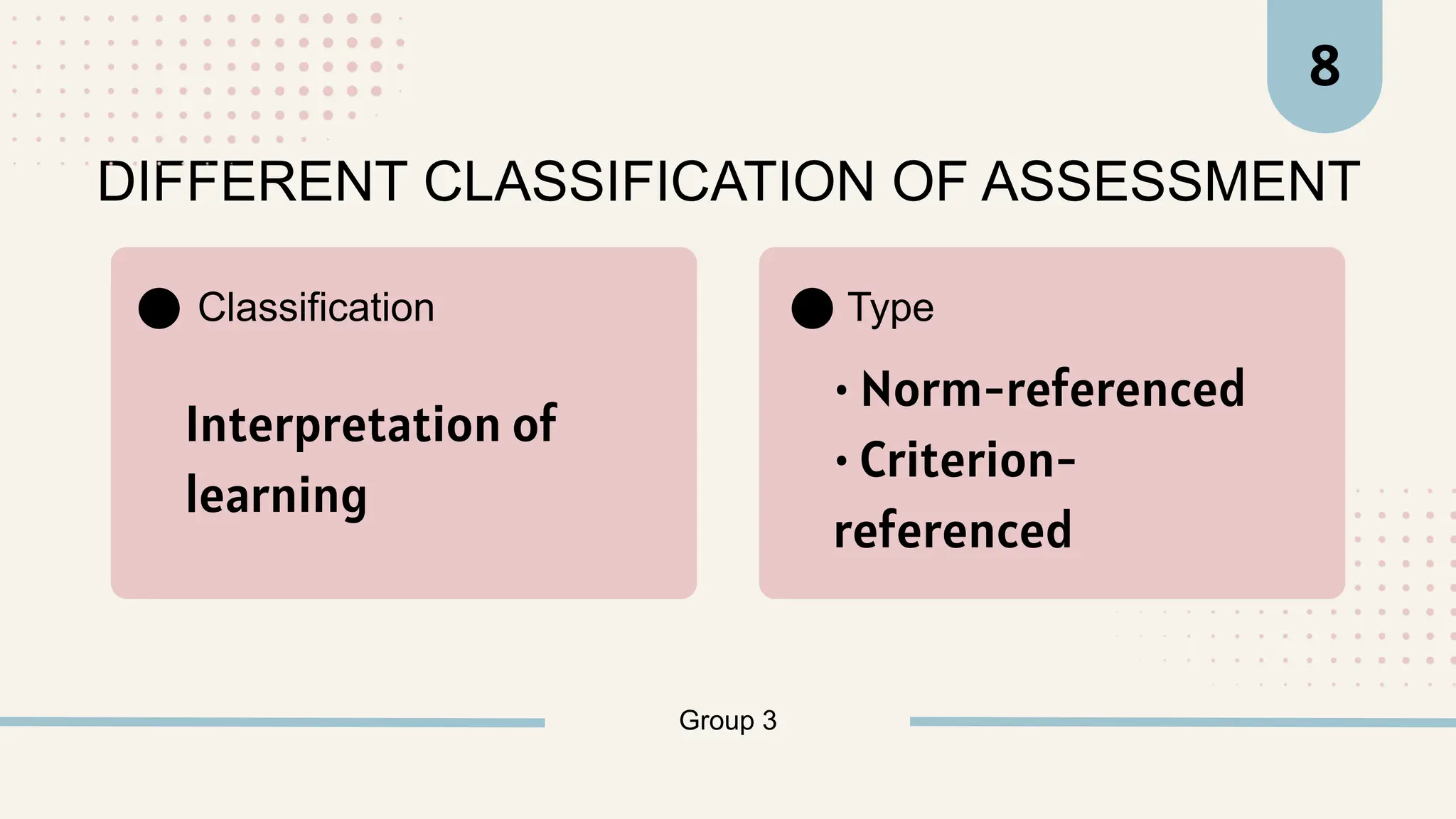
Interpretation of
learning
Classification
• Norm-referenced
• Criterion-
referenced
Type
8
WHEN DO WE USE
EDUCATIONAL AND
PSYCHOLOGICAL
ASSESSMENTS?
Group 3
9
Group 3
10
Educational assessments are used in the school
setting for the purpose of tracking the growth of
learners and grading their performance.
Group 3
11
This assessment in the educational setting comes in
the form of formative and summative assessment.
These work hand-in-hand to provide information about
student learning.
Group 3
12
Psychological assessments, such as tests and
scales, are . measures that determine the learner's
cognitive and non-cognitive characteristics.
WHEN DO WE USE PAPER-
AND-PENCIL AND
PERFORMANCE-BASED
TYPE OF ASSESSMENTS?
Group 3
13
Group 3
14
Paper-and-pencil type of assessments are
cognitive tasks that require a single correct answer.
They usually come in the form of test types such as
binary (true or false), showt answer (identification),
matching type and multiple choice.
Group 3
15
Performance-based type of assessments requires
learners to perform tasks, such as demonstrations,
arrive at a product, show strategies, and present
information.
Group 3
16
Learning targets that require a paper-and-pencil type of
assessments:
• Identify the parts of the plants
• Label the parts of the microscope
• Compute the compound interest
• Classify the phase of a given number
• Provide the appropriate verb in the sentence
• Identify the type of sentence
Group 3
17
Learning targets that require a performance-based
assessment:
• Varnish a wooden cabinet
• Draw a landscape using paintbrush in the computer
• Write a word problem involving multiplication of polynomials
• Deliver a speech convincing your classmates that you
are a good candidate for the student council
HOW DO WE DISTINGUISH
TEACHER-MADE FROM
STANDARDIZED TEST?
Group 3
18
Group 3
19
Standardized test have fixed directions for
administering and scoring. They can be purchased
with test manuals, booklets, and answer sheets.
WHAT INFORMATION IS SOUGHT
FROM ACHIEVEMENT AND
APTITUDE TEST?
Group 3
20
Group 3
21
Achievement tests measure what learners have
learned after instruction or after going through a
specific curricular program. Achievement test provide
information on what learners can do and have
acquired after training and instruction.
Group 3
22
According to Lohgman (2005), aptitudes are the
characteristics that influence a person's behavior that
aid goal attainment in a particular situation.
HOW DO WE
DIFFERENTIATE SPEED AND
POWER TEST?
Group 3
23
Group 3
24
Speed tests consist of easy items that need to be
completed within a time limit. Power tests consist of
items with increasing level of difficulty, but time is
sufficient to complete the whole test.
HOW DO WE DIFFERENTIATE
NORM-REFERENCED FROM
CRITERION-REFERENCED TEST?
Group 3
25
Group 3
26
Criterion-referenced test has a given set of
standards, and the scores are compared to the given
criterion.
Group 3
27
The norm-referenced test interprets results using
the distribution of scores of a sample group. The mean
and standard deviations are computed for the group.
The standing of every individual in a norm-referenced
test is based on how far they are from the mean and
standard deviation of the sample.
THANK YOU
Presented By : Group 3

Different Classification of Assessment.pptx

  • 1.
  • 2.
    Assessment is thesystematic basis for making inferences about the learning and development of students. It is the process of defining, selecting, designing, collecting, analyzing, interpreting, and using information to increase students' learning and development. Group 3 1
  • 3.
    PREPARE In order toplan, create, and select the appropriate kind of assessment, you need to know the characteristics of the different types of assessment according to purpose, function, and the kind of information needed about learners. Group 3 2
  • 4.
    DIFFERENT CLASSIFICATION OFASSESSMENT Group 3 Purpose Classification • Educational • Psychological Type 3
  • 5.
    DIFFERENT CLASSIFICATION OFASSESSMENT Group 3 Form Classification • Paper-and-pencil • Performance- based Type 4
  • 6.
    DIFFERENT CLASSIFICATION OFASSESSMENT Group 3 Function Classification • Teacher-made • Standardized Type 5
  • 7.
    DIFFERENT CLASSIFICATION OFASSESSMENT Group 3 Kind of learning Classification • Achievement • Aptitude Type 6
  • 8.
    DIFFERENT CLASSIFICATION OFASSESSMENT Group 3 Ability Classification • Speed • Power Type 7
  • 9.
    DIFFERENT CLASSIFICATION OFASSESSMENT Group 3 Interpretation of learning Classification • Norm-referenced • Criterion- referenced Type 8
  • 10.
    WHEN DO WEUSE EDUCATIONAL AND PSYCHOLOGICAL ASSESSMENTS? Group 3 9
  • 11.
    Group 3 10 Educational assessmentsare used in the school setting for the purpose of tracking the growth of learners and grading their performance.
  • 12.
    Group 3 11 This assessmentin the educational setting comes in the form of formative and summative assessment. These work hand-in-hand to provide information about student learning.
  • 13.
    Group 3 12 Psychological assessments,such as tests and scales, are . measures that determine the learner's cognitive and non-cognitive characteristics.
  • 14.
    WHEN DO WEUSE PAPER- AND-PENCIL AND PERFORMANCE-BASED TYPE OF ASSESSMENTS? Group 3 13
  • 15.
    Group 3 14 Paper-and-pencil typeof assessments are cognitive tasks that require a single correct answer. They usually come in the form of test types such as binary (true or false), showt answer (identification), matching type and multiple choice.
  • 16.
    Group 3 15 Performance-based typeof assessments requires learners to perform tasks, such as demonstrations, arrive at a product, show strategies, and present information.
  • 17.
    Group 3 16 Learning targetsthat require a paper-and-pencil type of assessments: • Identify the parts of the plants • Label the parts of the microscope • Compute the compound interest • Classify the phase of a given number • Provide the appropriate verb in the sentence • Identify the type of sentence
  • 18.
    Group 3 17 Learning targetsthat require a performance-based assessment: • Varnish a wooden cabinet • Draw a landscape using paintbrush in the computer • Write a word problem involving multiplication of polynomials • Deliver a speech convincing your classmates that you are a good candidate for the student council
  • 19.
    HOW DO WEDISTINGUISH TEACHER-MADE FROM STANDARDIZED TEST? Group 3 18
  • 20.
    Group 3 19 Standardized testhave fixed directions for administering and scoring. They can be purchased with test manuals, booklets, and answer sheets.
  • 21.
    WHAT INFORMATION ISSOUGHT FROM ACHIEVEMENT AND APTITUDE TEST? Group 3 20
  • 22.
    Group 3 21 Achievement testsmeasure what learners have learned after instruction or after going through a specific curricular program. Achievement test provide information on what learners can do and have acquired after training and instruction.
  • 23.
    Group 3 22 According toLohgman (2005), aptitudes are the characteristics that influence a person's behavior that aid goal attainment in a particular situation.
  • 24.
    HOW DO WE DIFFERENTIATESPEED AND POWER TEST? Group 3 23
  • 25.
    Group 3 24 Speed testsconsist of easy items that need to be completed within a time limit. Power tests consist of items with increasing level of difficulty, but time is sufficient to complete the whole test.
  • 26.
    HOW DO WEDIFFERENTIATE NORM-REFERENCED FROM CRITERION-REFERENCED TEST? Group 3 25
  • 27.
    Group 3 26 Criterion-referenced testhas a given set of standards, and the scores are compared to the given criterion.
  • 28.
    Group 3 27 The norm-referencedtest interprets results using the distribution of scores of a sample group. The mean and standard deviations are computed for the group. The standing of every individual in a norm-referenced test is based on how far they are from the mean and standard deviation of the sample.
  • 29.