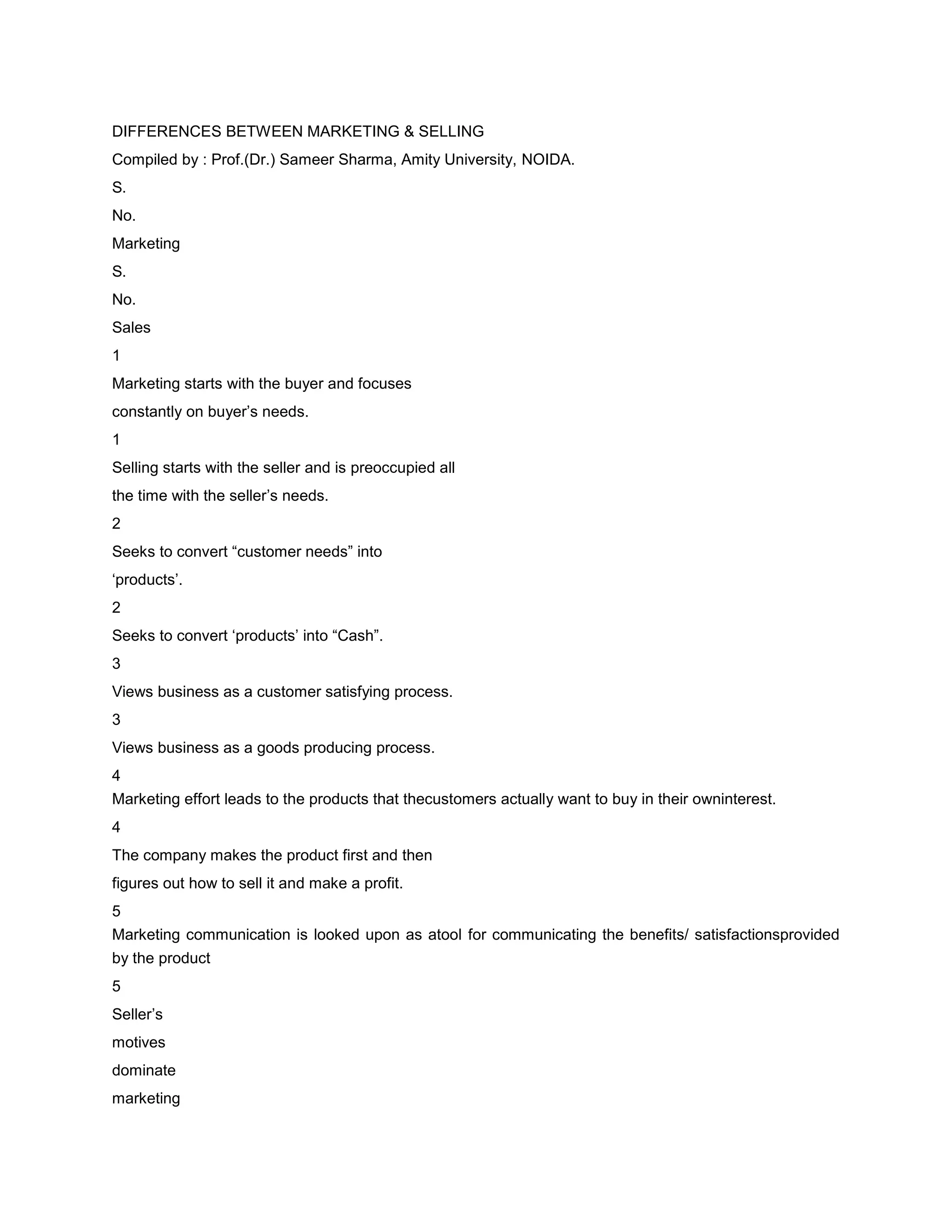
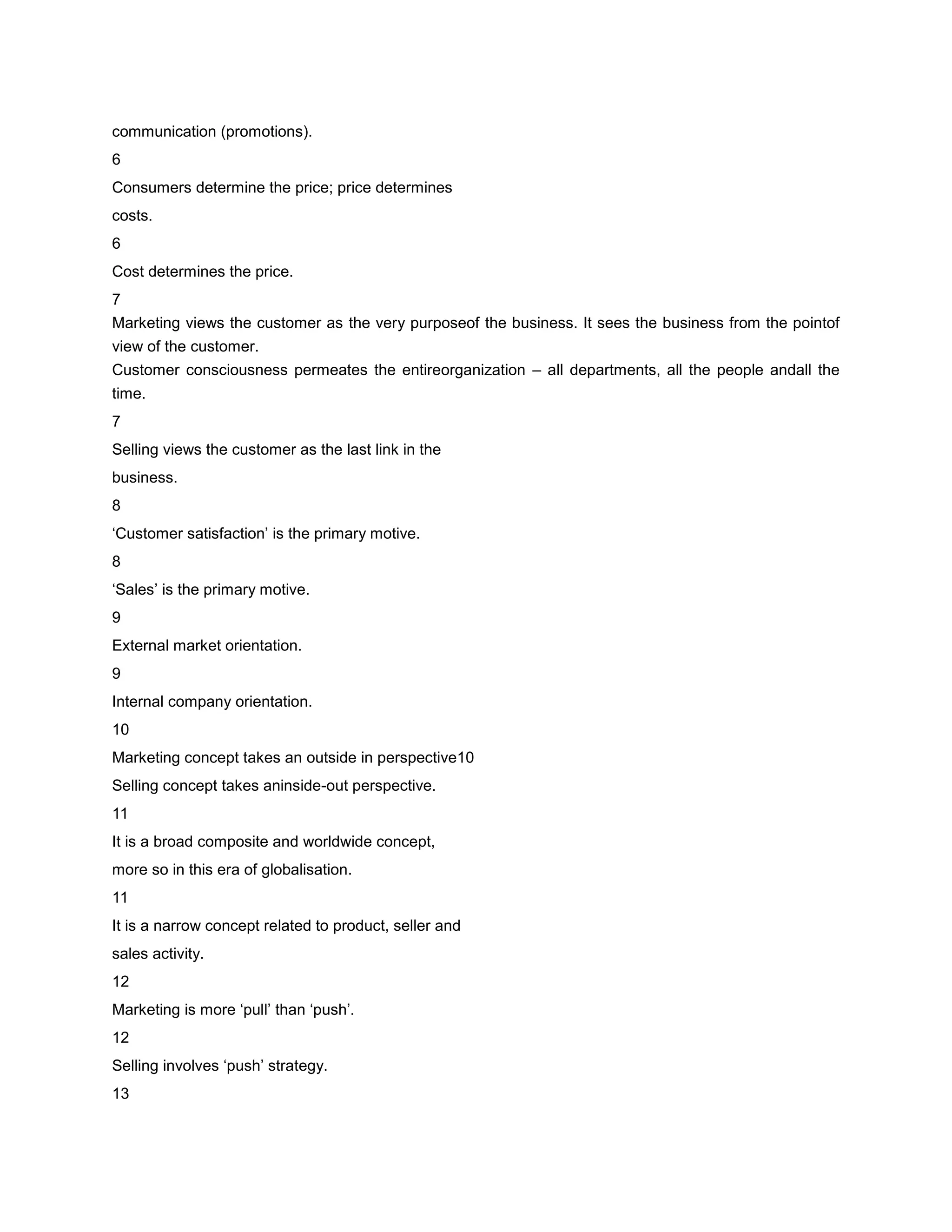
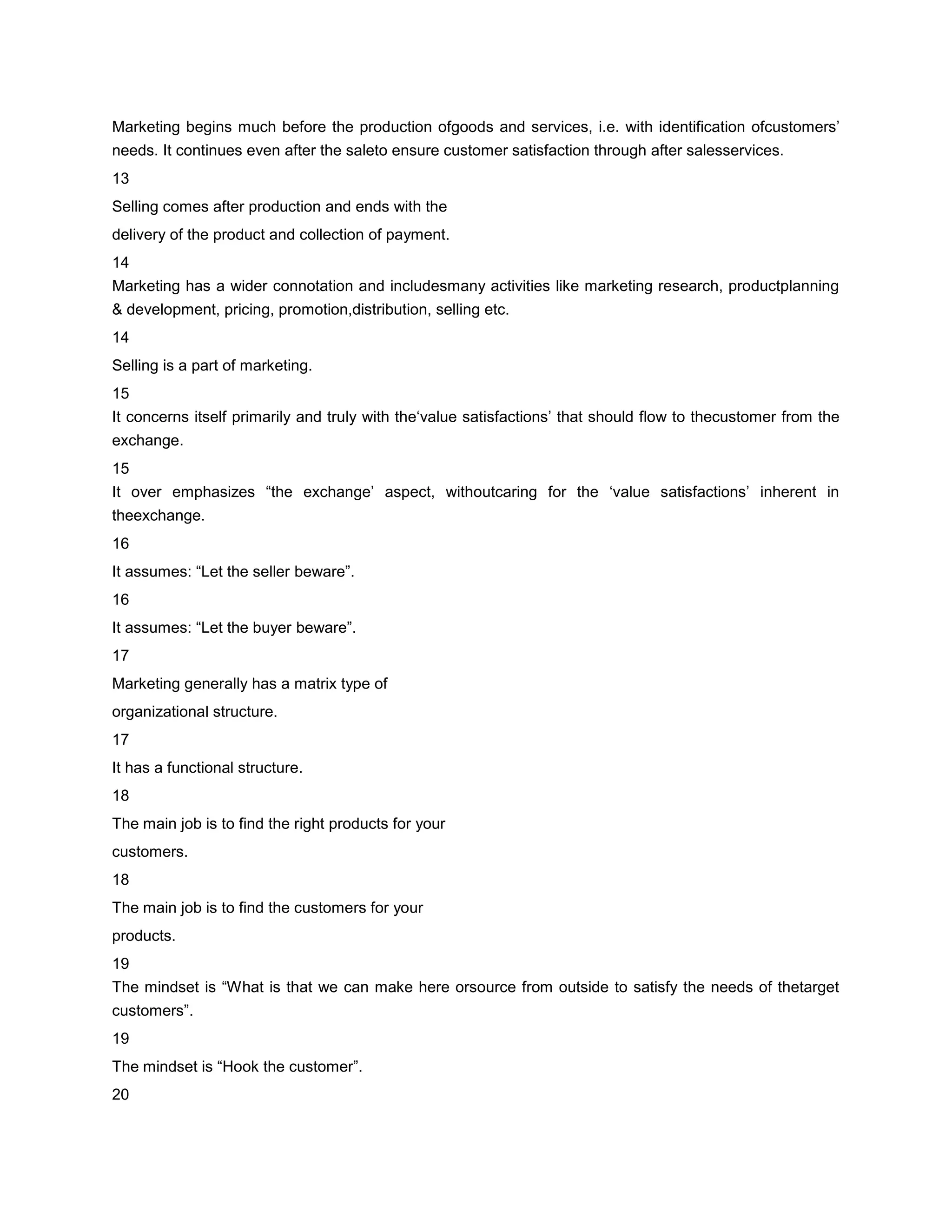
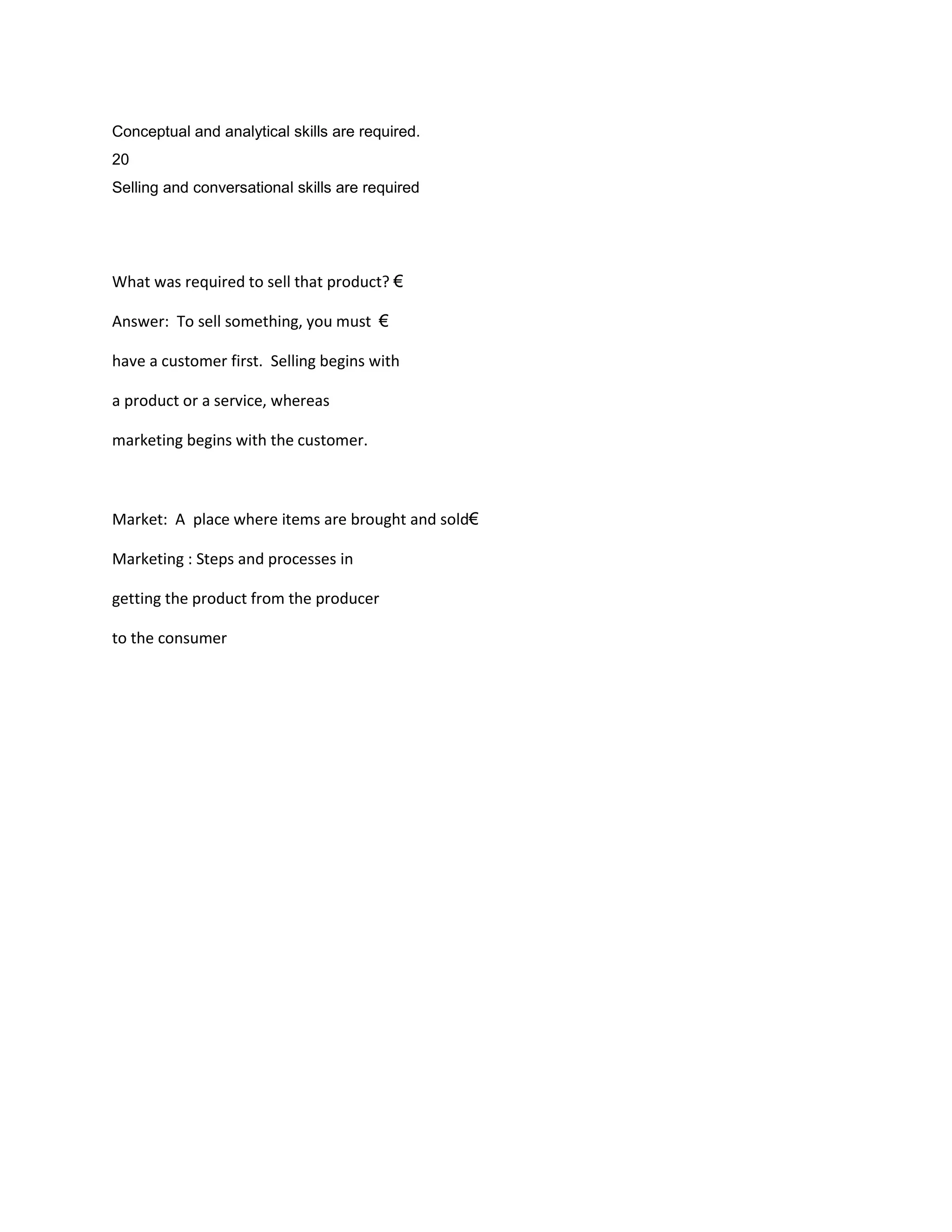
DIFFERENCES BETWEEN MARKETING & SELLING<br />Compiled by : Prof.(Dr.) Sameer Sharma, Amity University, NOIDA.<br />S.<br />No.<br />Marketing<br />S.<br />No.<br />Sales<br />1<br />Marketing starts with the buyer and focuses<br />constantly on buyer’s needs.<br />1<br />Selling starts with the seller and is preoccupied all<br />the time with the seller’s needs.<br />2<br />Seeks to convert “customer needs” into<br />‘products’.<br />2<br />Seeks to convert ‘products’ into “Cash”.<br />3<br />Views business as a customer satisfying process.<br />3<br />Views business as a goods producing process.<br />4<br />Marketing effort leads to the products that thecustomers actually want to buy in their owninterest.<br />4<br />The company makes the product first and then<br />figures out how to sell it and make a profit.<br />5<br />Marketing communication is looked upon as atool for communicating the benefits/ satisfactionsprovided by the product<br />5<br />Seller’s<br />motives<br />dominate<br />marketing<br />communication (promotions).<br />6<br />Consumers determine the price; price determines<br />costs.<br />6<br />Cost determines the price.<br />7<br />Marketing views the customer as the very purposeof the business. It sees the business from the pointof view of the customer.<br />Customer consciousness permeates the entireorganization – all departments, all the people andall the time.<br />7<br />Selling views the customer as the last link in the<br />business.<br />8<br />‘Customer satisfaction’ is the primary motive.<br />8<br />‘Sales’ is the primary motive.<br />9<br />External market orientation.<br />9<br />Internal company orientation.<br />10<br />Marketing concept takes an outside in perspective10<br />Selling concept takes aninside-out perspective.<br />11<br />It is a broad composite and worldwide concept,<br />more so in this era of globalisation.<br />11<br />It is a narrow concept related to product, seller and<br />sales activity.<br />12<br />Marketing is more ‘pull’ than ‘push’.<br />12<br />Selling involves ‘push’ strategy.<br />13<br />Marketing begins much before the production ofgoods and services, i.e. with identification ofcustomers’ needs. It continues even after the saleto ensure customer satisfaction through after salesservices.<br />13<br />Selling comes after production and ends with the<br />delivery of the product and collection of payment.<br />14<br />Marketing has a wider connotation and includesmany activities like marketing research, productplanning & development, pricing, promotion,distribution, selling etc.<br />14<br />Selling is a part of marketing.<br />15<br />It concerns itself primarily and truly with the‘value satisfactions’ that should flow to thecustomer from the exchange.<br />15<br />It over emphasizes “the exchange’ aspect, withoutcaring for the ‘value satisfactions’ inherent in theexchange.<br />16<br />It assumes: “Let the seller beware”.<br />16<br />It assumes: “Let the buyer beware”.<br />17<br />Marketing generally has a matrix type of<br />organizational structure.<br />17<br />It has a functional structure.<br />18<br />The main job is to find the right products for your<br />customers.<br />18<br />The main job is to find the customers for your<br />products.<br />19<br />The mindset is “What is that we can make here orsource from outside to satisfy the needs of thetarget customers”.<br />19<br />The mindset is “Hook the customer”.<br />20<br />Conceptual and analytical skills are required.<br />20<br />Selling and conversational skills are required<br />What was required to sell that product? €<br />Answer:  To sell something, you must  €<br />have a customer first.  Selling begins with <br />a product or a service, whereas <br />marketing begins with the customer.<br />Market:  A  place where items are brought and sold€<br />Marketing : Steps and processes in  <br />getting the product from the producer <br />to the consumer<br />
Differences between marketing

Differences between marketing

  • 1.
    DIFFERENCES BETWEEN MARKETING& SELLING<br />Compiled by : Prof.(Dr.) Sameer Sharma, Amity University, NOIDA.<br />S.<br />No.<br />Marketing<br />S.<br />No.<br />Sales<br />1<br />Marketing starts with the buyer and focuses<br />constantly on buyer’s needs.<br />1<br />Selling starts with the seller and is preoccupied all<br />the time with the seller’s needs.<br />2<br />Seeks to convert “customer needs” into<br />‘products’.<br />2<br />Seeks to convert ‘products’ into “Cash”.<br />3<br />Views business as a customer satisfying process.<br />3<br />Views business as a goods producing process.<br />4<br />Marketing effort leads to the products that thecustomers actually want to buy in their owninterest.<br />4<br />The company makes the product first and then<br />figures out how to sell it and make a profit.<br />5<br />Marketing communication is looked upon as atool for communicating the benefits/ satisfactionsprovided by the product<br />5<br />Seller’s<br />motives<br />dominate<br />marketing<br />communication (promotions).<br />6<br />Consumers determine the price; price determines<br />costs.<br />6<br />Cost determines the price.<br />7<br />Marketing views the customer as the very purposeof the business. It sees the business from the pointof view of the customer.<br />Customer consciousness permeates the entireorganization – all departments, all the people andall the time.<br />7<br />Selling views the customer as the last link in the<br />business.<br />8<br />‘Customer satisfaction’ is the primary motive.<br />8<br />‘Sales’ is the primary motive.<br />9<br />External market orientation.<br />9<br />Internal company orientation.<br />10<br />Marketing concept takes an outside in perspective10<br />Selling concept takes aninside-out perspective.<br />11<br />It is a broad composite and worldwide concept,<br />more so in this era of globalisation.<br />11<br />It is a narrow concept related to product, seller and<br />sales activity.<br />12<br />Marketing is more ‘pull’ than ‘push’.<br />12<br />Selling involves ‘push’ strategy.<br />13<br />Marketing begins much before the production ofgoods and services, i.e. with identification ofcustomers’ needs. It continues even after the saleto ensure customer satisfaction through after salesservices.<br />13<br />Selling comes after production and ends with the<br />delivery of the product and collection of payment.<br />14<br />Marketing has a wider connotation and includesmany activities like marketing research, productplanning & development, pricing, promotion,distribution, selling etc.<br />14<br />Selling is a part of marketing.<br />15<br />It concerns itself primarily and truly with the‘value satisfactions’ that should flow to thecustomer from the exchange.<br />15<br />It over emphasizes “the exchange’ aspect, withoutcaring for the ‘value satisfactions’ inherent in theexchange.<br />16<br />It assumes: “Let the seller beware”.<br />16<br />It assumes: “Let the buyer beware”.<br />17<br />Marketing generally has a matrix type of<br />organizational structure.<br />17<br />It has a functional structure.<br />18<br />The main job is to find the right products for your<br />customers.<br />18<br />The main job is to find the customers for your<br />products.<br />19<br />The mindset is “What is that we can make here orsource from outside to satisfy the needs of thetarget customers”.<br />19<br />The mindset is “Hook the customer”.<br />20<br />Conceptual and analytical skills are required.<br />20<br />Selling and conversational skills are required<br />What was required to sell that product? €<br />Answer: To sell something, you must €<br />have a customer first. Selling begins with <br />a product or a service, whereas <br />marketing begins with the customer.<br />Market: A place where items are brought and sold€<br />Marketing : Steps and processes in <br />getting the product from the producer <br />to the consumer<br />