1
A BASIC GUIDE
OF
SALES & MARKETING
BY
MOHAMMED RIYAZ
GET (R&D)
2
WHAT IS MARKETING?
Any interpersonal and inter organizational relationship
involving an exchange is marketing.
WILLIAM J.STANTON
 The management process through which goods and services move from
concept to the customer. It includes the coordination of four elements called
the 4 P's of Marketing:
(1) Identification, selection and development of a Product,
(2) Determination of its Price,
(3) Selection of a distribution channel to reach the customer's Place, and
(4) Development and implementation of a Promotional strategy
3
 Marketing is a social process by which individuals and groups obtain what
they need and want through creating and exchanging products and value
with others.
 This definition includes following core concepts :
Needs ,Wants and Demands
Products
Value & Satisfaction
Exchange & Transaction
Markets & Marketers
NEEDS, WANTS AND DEMANDS:
 Need : A state of felt deprivation of some basic satisfaction
(Food, Clothing, Shelter, Belonging etc. )
 Wants : Wants are desires for specific satisfiers of the deeper needs.
Needs are few and wants are many.
 Demands : are wants backed by -Ability to buy and Willingness to buy.
PRODUCTS:
 Anything that can be offered to someone to satisfy a need or want is a
product.
 Product refers to physical object.
 Services refer to intangible object.
4
VALUE AND SATISFACTION:
 Value is the customers’ estimate of the Product’s capacity to satisfy a
set of goals
 Value is the ratio between what the customer gets and what
he gives (V=B/C)
 Customer gets benefits & assume costs
WHEN:
Customer Expectance=Performance (satisfied)
Customer Expectance>Performance (dis-satisfied)
Customer Expectance<Performance (Highly satisfied)
EXCHANGE AND TRANSACTION:
 Exchange is the act of obtaining a desired product by offering
something in return.
Exchange takes place when 5 conditions are satisfied:
 Two parties should be there
 Each party must have something of value to the other
 Each party is capable of communication & delivery
 Each party is free to accept or reject the offer
 Each party believes that it is appropriate to deal with the other
party
5
Exchange is a process rather than event.
It is a value creating process because it normally leaves both parties
better off.
A Transaction is a trade of values between two or more parties ( a barter
transaction or a monetary transaction ). 
MARKET :
A market consists of all the potential customers sharing a particular need or
want who might be willing and able to engage in exchange to satisfy that need or
want.
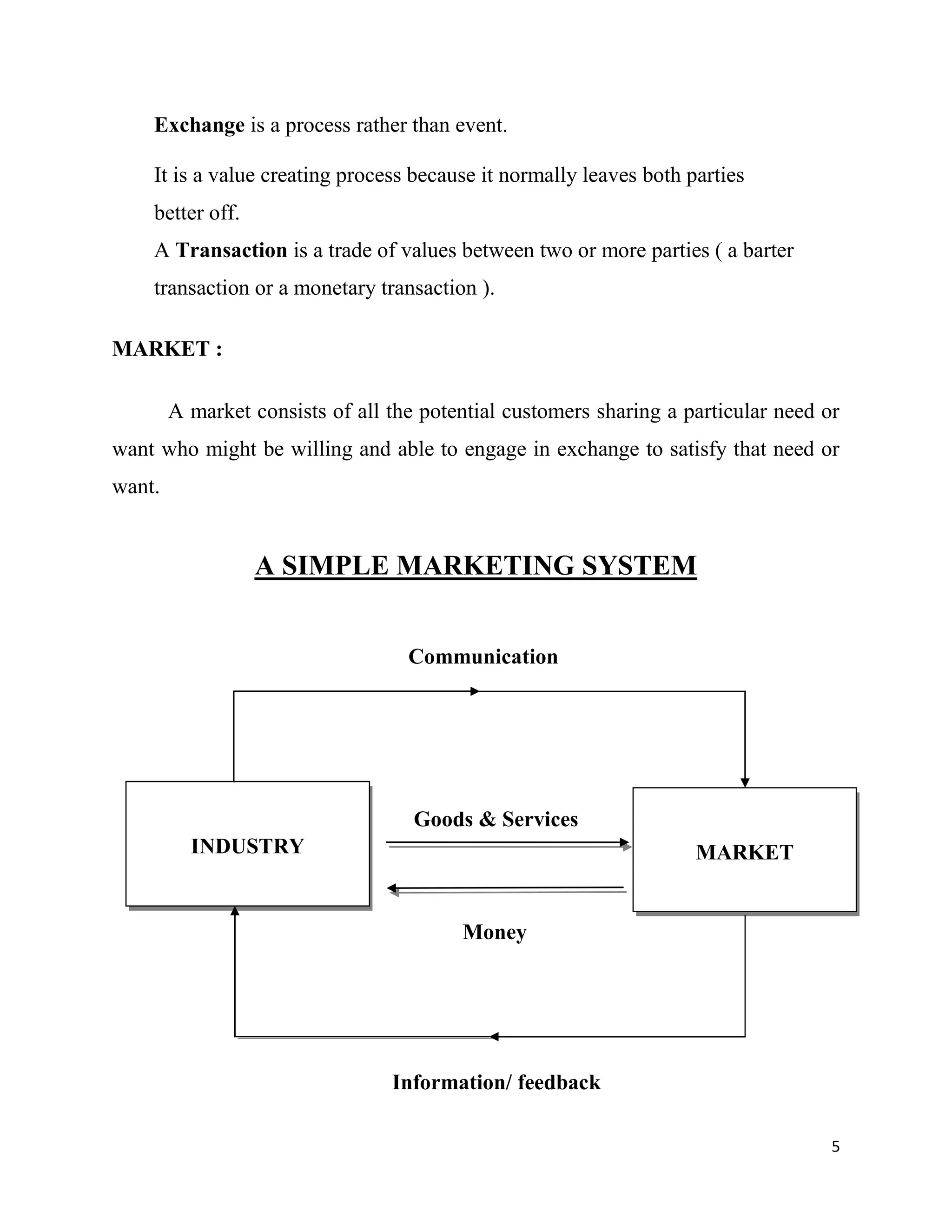
A SIMPLE MARKETING SYSTEM
Communication
Goods & Services
Money
Information/ feedback
INDUSTRY MARKET
6
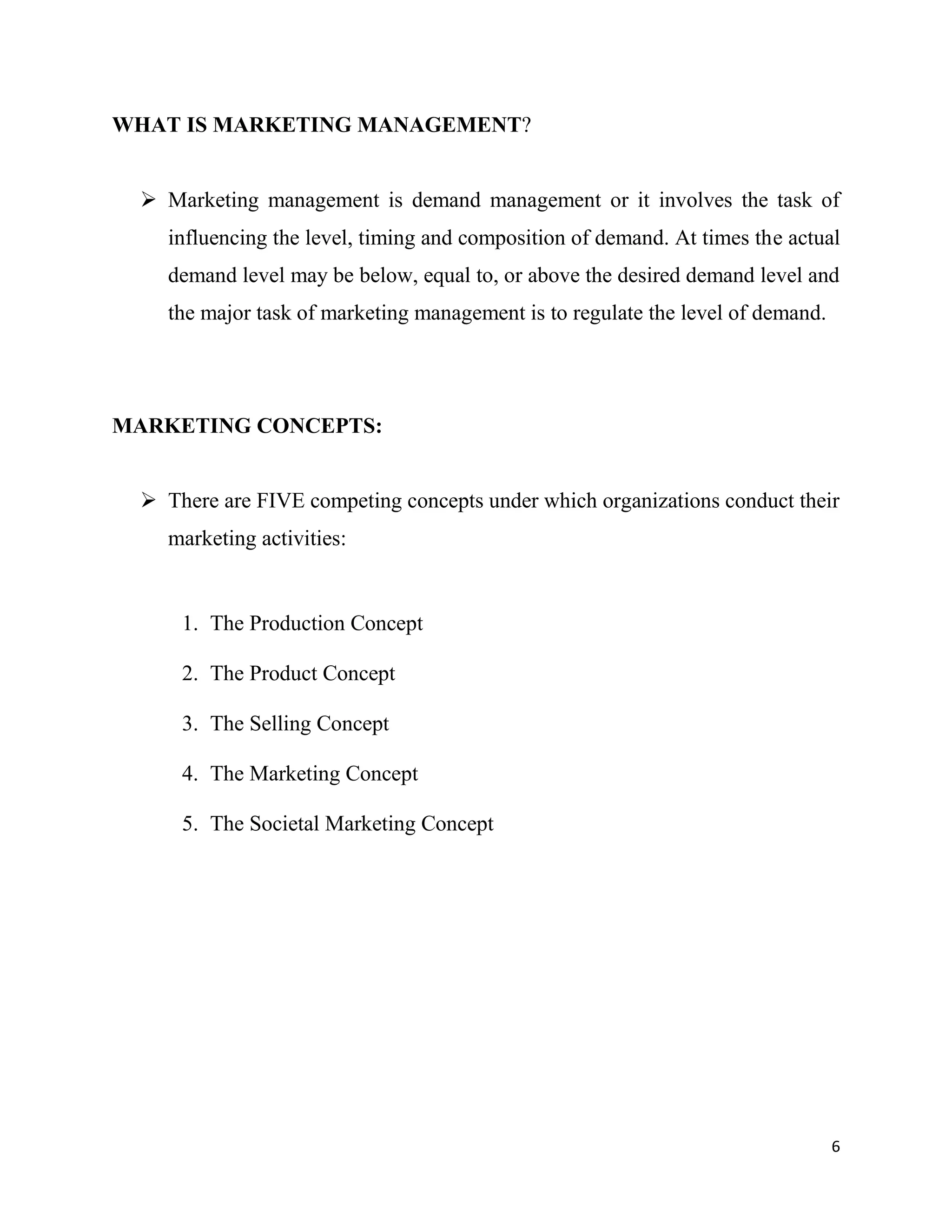
WHAT IS MARKETING MANAGEMENT?
 Marketing management is demand management or it involves the task of
influencing the level, timing and composition of demand. At times the actual
demand level may be below, equal to, or above the desired demand level and
the major task of marketing management is to regulate the level of demand.
MARKETING CONCEPTS:
 There are FIVE competing concepts under which organizations conduct their
marketing activities:
1. The Production Concept
2. The Product Concept
3. The Selling Concept
4. The Marketing Concept
5. The Societal Marketing Concept
7
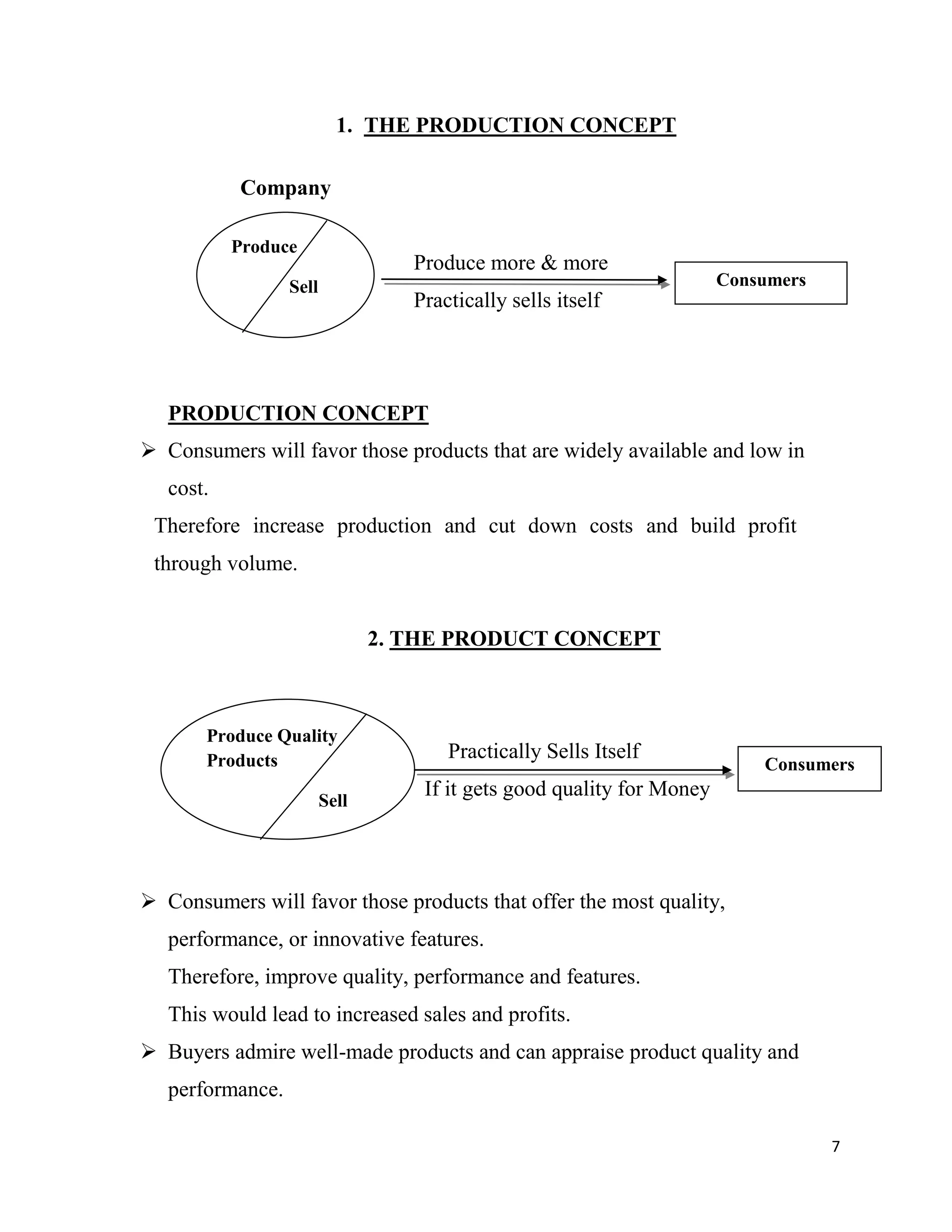
1. THE PRODUCTION CONCEPT
Company
Produce more & more
Practically sells itself
PRODUCTION CONCEPT
 Consumers will favor those products that are widely available and low in
cost.
Therefore increase production and cut down costs and build profit
through volume.
2. THE PRODUCT CONCEPT
Practically Sells Itself
If it gets good quality for Money
 Consumers will favor those products that offer the most quality,
performance, or innovative features.
Therefore, improve quality, performance and features.
This would lead to increased sales and profits.
 Buyers admire well-made products and can appraise product quality and
performance.
Produce
Sell Consumers
Produce Quality
Products
Sell
Consumers
8
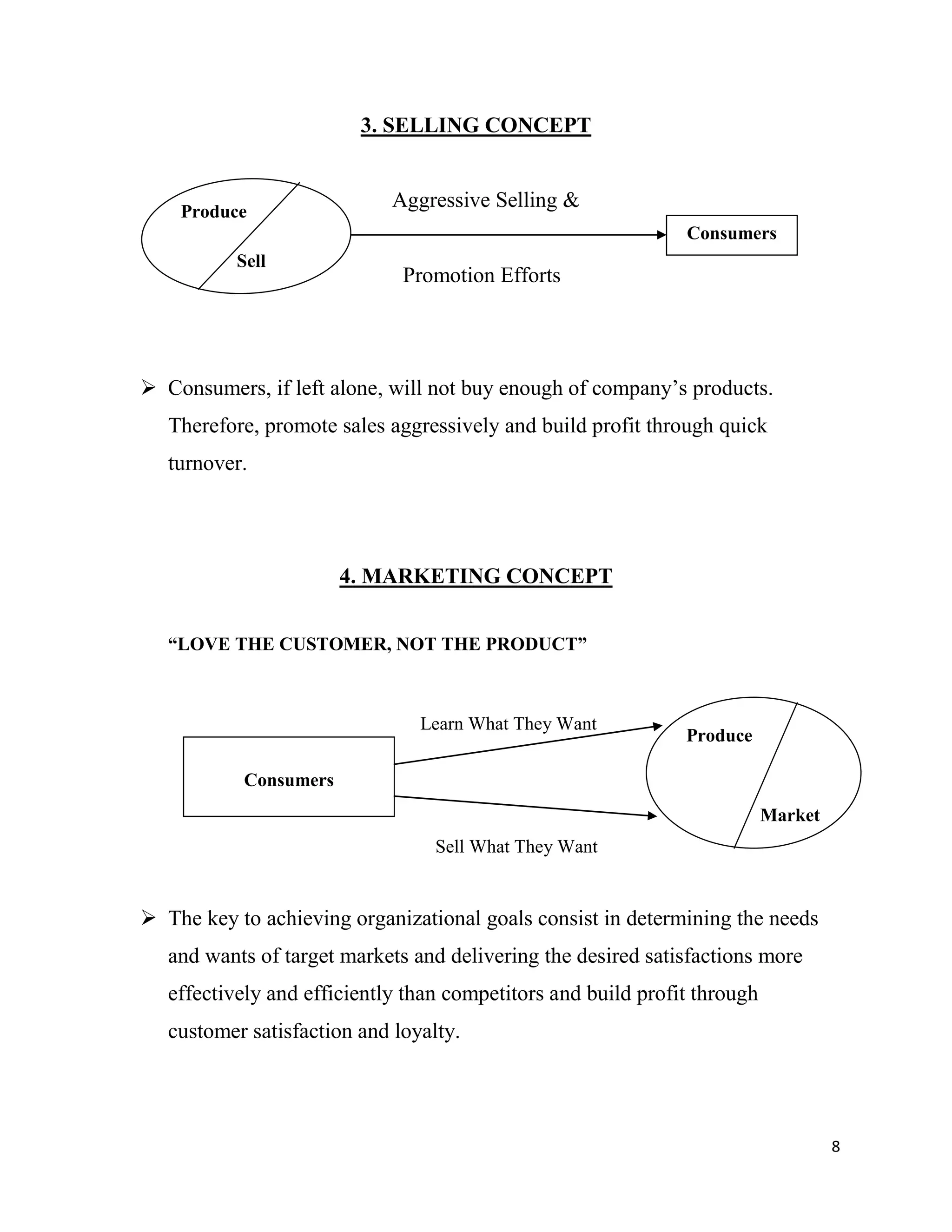
3. SELLING CONCEPT
Aggressive Selling &
Promotion Efforts
 Consumers, if left alone, will not buy enough of company’s products.
Therefore, promote sales aggressively and build profit through quick
turnover.
4. MARKETING CONCEPT
“LOVE THE CUSTOMER, NOT THE PRODUCT”
Learn What They Want
Sell What They Want
 The key to achieving organizational goals consist in determining the needs
and wants of target markets and delivering the desired satisfactions more
effectively and efficiently than competitors and build profit through
customer satisfaction and loyalty.
Produce
Sell
Consumers
Consumers
Produce
Market
9
5. THE SOCIETAL MARKETING CONCEPT
 It is Marketing Concept (+) Society’s well being.
 Balancing of following 3 considerations while setting marketing policies:
 Customer’s want satisfaction
 Society’s well being
 Company’s profits
 The societal marketing concept holds that the organization’s task is to
determine the needs, wants, and interests of target markets and to deliver the
desired satisfactions more effectively and efficiently than competitors in a
way that preserves or enhances the consumer’s and the society’s well being.
 It addresses conflicts between consumer’s and firm’s short run wants and
long term welfare.
GOALS OF THE MARKETING SYSTEM:
 Maximize Consumption
 Maximize Consumer Satisfaction
 Maximize Choice
 Maximize Life Quality
10
THREE BASIC PRINCIPLES OF MARKETING
 The essence of marketing can be summarized in three great principles. The
first identifies the purpose and task of marketing, the second the competitive
reality of marketing and third the principal means for achieving the first two.
(1).The Customer Value and Value
Equation: V=B/P
Where; V=Value
B= Perceived Benefits
P= Price
(Value is increased by increasing the numerator and/or reducing
the denominator)
(2).Competitive or Differential Advantage :
The total offer must be more attractive than that of the competition
in order to create a competitive advantage.
(3).Focus or the Concentration of Attention :
The task of creating Customer Value at a Competitive advantage.
11
SALES
 A sale is the exchange of a commodity for money or service in return for
money or the action of selling something.
 The seller or the provider of the goods or services completes a sale in
response to an acquisition, an appropriation or a request. There is a passing
of title (property or ownership) of the item, and the settlement of a price.
12
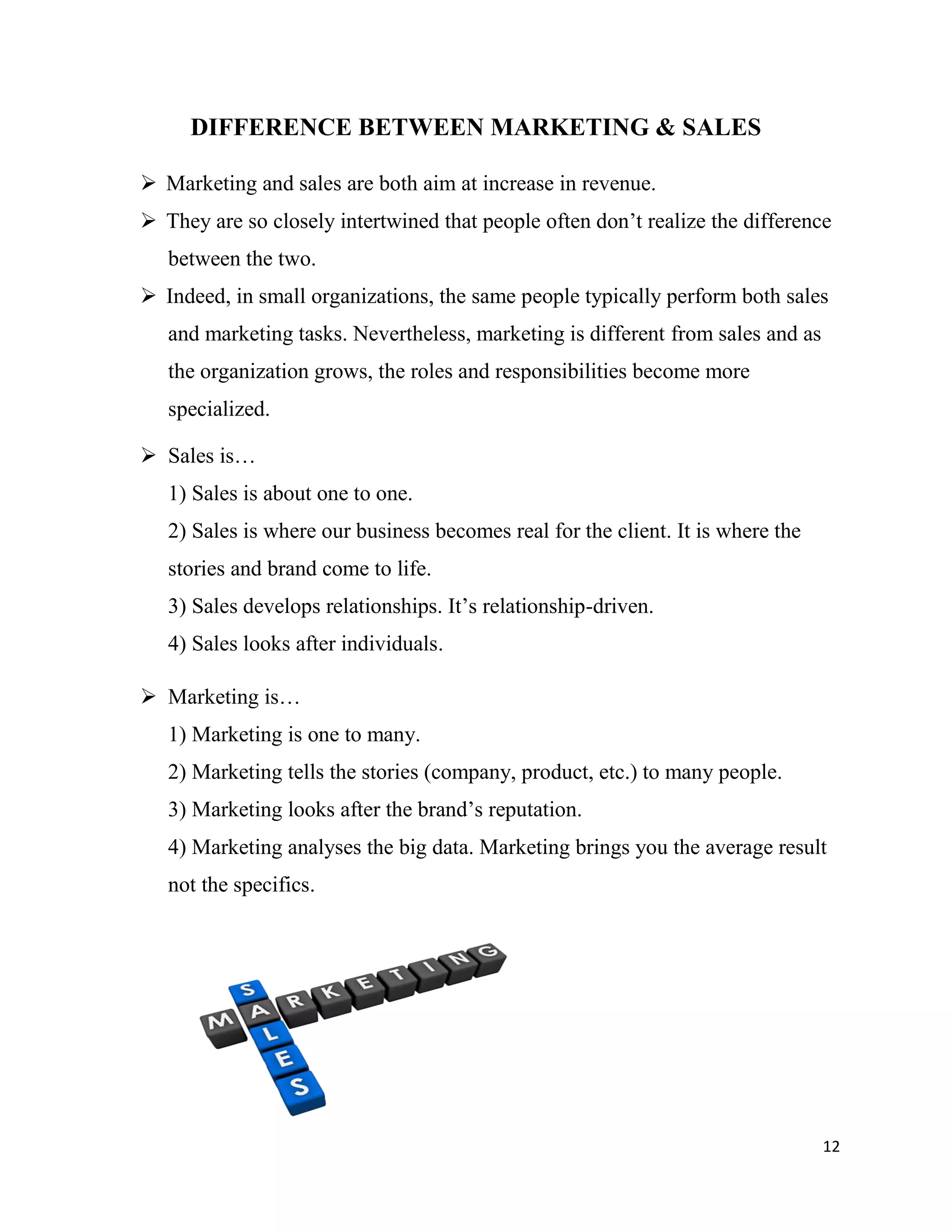
DIFFERENCE BETWEEN MARKETING & SALES
 Marketing and sales are both aim at increase in revenue.
 They are so closely intertwined that people often don’t realize the difference
between the two.
 Indeed, in small organizations, the same people typically perform both sales
and marketing tasks. Nevertheless, marketing is different from sales and as
the organization grows, the roles and responsibilities become more
specialized.
 Sales is…
1) Sales is about one to one.
2) Sales is where our business becomes real for the client. It is where the
stories and brand come to life.
3) Sales develops relationships. It’s relationship-driven.
4) Sales looks after individuals.
 Marketing is…
1) Marketing is one to many.
2) Marketing tells the stories (company, product, etc.) to many people.
3) Marketing looks after the brand’s reputation.
4) Marketing analyses the big data. Marketing brings you the average result
not the specifics.
13
CONCLUSION
 Sales target on individuals or small groups. Marketing on the other hand
targets a larger group o the general public.
 Marketing means generating leads or prospects. sales means converting the
leads or prospects into purchases and orders.
 Marketing involves a longer process of building a name for a brand and
pursuing the customer to buy it even if they do not need it. Where as sales
only involve a short term of finding the target consumer.

Sales and marketing_documentation

  • 1.
    1 A BASIC GUIDE OF SALES& MARKETING BY MOHAMMED RIYAZ GET (R&D)
  • 2.
    2 WHAT IS MARKETING? Anyinterpersonal and inter organizational relationship involving an exchange is marketing. WILLIAM J.STANTON  The management process through which goods and services move from concept to the customer. It includes the coordination of four elements called the 4 P's of Marketing: (1) Identification, selection and development of a Product, (2) Determination of its Price, (3) Selection of a distribution channel to reach the customer's Place, and (4) Development and implementation of a Promotional strategy
  • 3.
    3  Marketing isa social process by which individuals and groups obtain what they need and want through creating and exchanging products and value with others.  This definition includes following core concepts : Needs ,Wants and Demands Products Value & Satisfaction Exchange & Transaction Markets & Marketers NEEDS, WANTS AND DEMANDS:  Need : A state of felt deprivation of some basic satisfaction (Food, Clothing, Shelter, Belonging etc. )  Wants : Wants are desires for specific satisfiers of the deeper needs. Needs are few and wants are many.  Demands : are wants backed by -Ability to buy and Willingness to buy. PRODUCTS:  Anything that can be offered to someone to satisfy a need or want is a product.  Product refers to physical object.  Services refer to intangible object.
  • 4.
    4 VALUE AND SATISFACTION: Value is the customers’ estimate of the Product’s capacity to satisfy a set of goals  Value is the ratio between what the customer gets and what he gives (V=B/C)  Customer gets benefits & assume costs WHEN: Customer Expectance=Performance (satisfied) Customer Expectance>Performance (dis-satisfied) Customer Expectance<Performance (Highly satisfied) EXCHANGE AND TRANSACTION:  Exchange is the act of obtaining a desired product by offering something in return. Exchange takes place when 5 conditions are satisfied:  Two parties should be there  Each party must have something of value to the other  Each party is capable of communication & delivery  Each party is free to accept or reject the offer  Each party believes that it is appropriate to deal with the other party
  • 5.
    5 Exchange is aprocess rather than event. It is a value creating process because it normally leaves both parties better off. A Transaction is a trade of values between two or more parties ( a barter transaction or a monetary transaction ).  MARKET : A market consists of all the potential customers sharing a particular need or want who might be willing and able to engage in exchange to satisfy that need or want. A SIMPLE MARKETING SYSTEM Communication Goods & Services Money Information/ feedback INDUSTRY MARKET
  • 6.
    6 WHAT IS MARKETINGMANAGEMENT?  Marketing management is demand management or it involves the task of influencing the level, timing and composition of demand. At times the actual demand level may be below, equal to, or above the desired demand level and the major task of marketing management is to regulate the level of demand. MARKETING CONCEPTS:  There are FIVE competing concepts under which organizations conduct their marketing activities: 1. The Production Concept 2. The Product Concept 3. The Selling Concept 4. The Marketing Concept 5. The Societal Marketing Concept
  • 7.
    7 1. THE PRODUCTIONCONCEPT Company Produce more & more Practically sells itself PRODUCTION CONCEPT  Consumers will favor those products that are widely available and low in cost. Therefore increase production and cut down costs and build profit through volume. 2. THE PRODUCT CONCEPT Practically Sells Itself If it gets good quality for Money  Consumers will favor those products that offer the most quality, performance, or innovative features. Therefore, improve quality, performance and features. This would lead to increased sales and profits.  Buyers admire well-made products and can appraise product quality and performance. Produce Sell Consumers Produce Quality Products Sell Consumers
  • 8.
    8 3. SELLING CONCEPT AggressiveSelling & Promotion Efforts  Consumers, if left alone, will not buy enough of company’s products. Therefore, promote sales aggressively and build profit through quick turnover. 4. MARKETING CONCEPT “LOVE THE CUSTOMER, NOT THE PRODUCT” Learn What They Want Sell What They Want  The key to achieving organizational goals consist in determining the needs and wants of target markets and delivering the desired satisfactions more effectively and efficiently than competitors and build profit through customer satisfaction and loyalty. Produce Sell Consumers Consumers Produce Market
  • 9.
    9 5. THE SOCIETALMARKETING CONCEPT  It is Marketing Concept (+) Society’s well being.  Balancing of following 3 considerations while setting marketing policies:  Customer’s want satisfaction  Society’s well being  Company’s profits  The societal marketing concept holds that the organization’s task is to determine the needs, wants, and interests of target markets and to deliver the desired satisfactions more effectively and efficiently than competitors in a way that preserves or enhances the consumer’s and the society’s well being.  It addresses conflicts between consumer’s and firm’s short run wants and long term welfare. GOALS OF THE MARKETING SYSTEM:  Maximize Consumption  Maximize Consumer Satisfaction  Maximize Choice  Maximize Life Quality
  • 10.
    10 THREE BASIC PRINCIPLESOF MARKETING  The essence of marketing can be summarized in three great principles. The first identifies the purpose and task of marketing, the second the competitive reality of marketing and third the principal means for achieving the first two. (1).The Customer Value and Value Equation: V=B/P Where; V=Value B= Perceived Benefits P= Price (Value is increased by increasing the numerator and/or reducing the denominator) (2).Competitive or Differential Advantage : The total offer must be more attractive than that of the competition in order to create a competitive advantage. (3).Focus or the Concentration of Attention : The task of creating Customer Value at a Competitive advantage.
  • 11.
    11 SALES  A saleis the exchange of a commodity for money or service in return for money or the action of selling something.  The seller or the provider of the goods or services completes a sale in response to an acquisition, an appropriation or a request. There is a passing of title (property or ownership) of the item, and the settlement of a price.
  • 12.
    12 DIFFERENCE BETWEEN MARKETING& SALES  Marketing and sales are both aim at increase in revenue.  They are so closely intertwined that people often don’t realize the difference between the two.  Indeed, in small organizations, the same people typically perform both sales and marketing tasks. Nevertheless, marketing is different from sales and as the organization grows, the roles and responsibilities become more specialized.  Sales is… 1) Sales is about one to one. 2) Sales is where our business becomes real for the client. It is where the stories and brand come to life. 3) Sales develops relationships. It’s relationship-driven. 4) Sales looks after individuals.  Marketing is… 1) Marketing is one to many. 2) Marketing tells the stories (company, product, etc.) to many people. 3) Marketing looks after the brand’s reputation. 4) Marketing analyses the big data. Marketing brings you the average result not the specifics.
  • 13.
    13 CONCLUSION  Sales targeton individuals or small groups. Marketing on the other hand targets a larger group o the general public.  Marketing means generating leads or prospects. sales means converting the leads or prospects into purchases and orders.  Marketing involves a longer process of building a name for a brand and pursuing the customer to buy it even if they do not need it. Where as sales only involve a short term of finding the target consumer.