Machine learning
Continue…
Machine learning is a growing technology which enables computers to
learn automatically from past data. Machine learning uses various
algorithms for building mathematical models and making predictions
using historical data or information.
Types of Machine Learning
Continue…
⮚ Supervised Machine Learning
⮚ Unsupervised Machine Learning
What is Supervised Learning?
Continue…
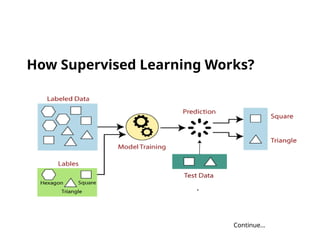
Supervised learning is the types of machine learning in which
machines are trained using well "labelled" training data, and on
basis of that data, machines predict the output.
In supervised learning, the training data provided to the
machines work as the supervisor that teaches the machines to
predict the output correctly. It applies the same concept as a
student learns in the supervision of the teacher.
How Supervised Learning Works?
Continue…
What is Unsupervised Learning?
Continue…
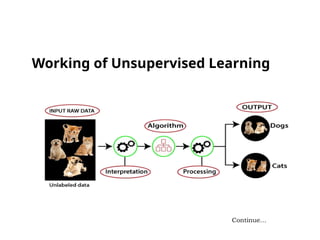
Unsupervised learning is a type of machine learning in which
models are trained using unlabeled dataset and are allowed to
act on that data without any supervision.
The goal of unsupervised learning is to find the underlying
structure of dataset, group that data according to similarities,
and represent that dataset in a compressed format.
Working of Unsupervised Learning
Continue…
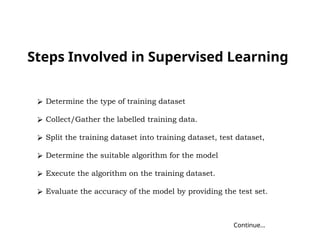
Steps Involved in Supervised Learning
Continue…
⮚ Determine the type of training dataset
⮚ Collect/Gather the labelled training data.
⮚ Split the training dataset into training dataset, test dataset,
⮚ Determine the suitable algorithm for the model
⮚ Execute the algorithm on the training dataset.
⮚ Evaluate the accuracy of the model by providing the test set.
Types of Supervised Learning Algorithms
Continue…
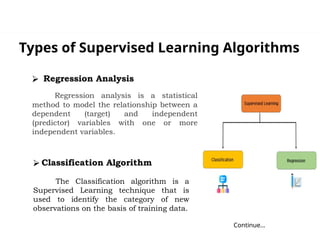
⮚ Regression Analysis
Regression analysis is a statistical
method to model the relationship between a
dependent (target) and independent
(predictor) variables with one or more
independent variables.
⮚ Classification Algorithm
The Classification algorithm is a
Supervised Learning technique that is
used to identify the category of new
observations on the basis of training data.
Types Regression Analysis
Continue…
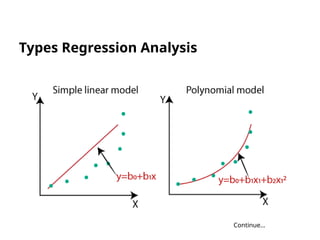
⮚ Linear Regression
Linear relationship between dependent and independent
variables
⮚ Polynomial Regression
Non linear relationship between dependent and independent
variables
Types Regression Analysis
Continue…
Linear Regression
Continue…
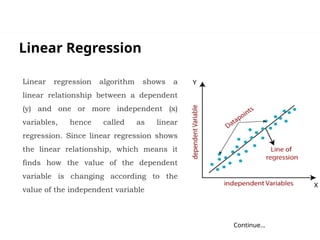
Linear regression algorithm shows a
linear relationship between a dependent
(y) and one or more independent (x)
variables, hence called as linear
regression. Since linear regression shows
the linear relationship, which means it
finds how the value of the dependent
variable is changing according to the
value of the independent variable
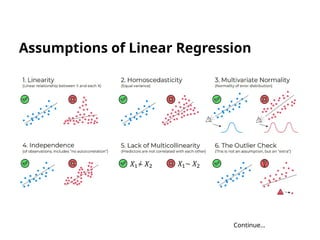
Assumptions of Linear Regression
Continue…
Types of Linear Regression Analysis
Continue…
▪ Simple Linear Regression
▪ Multiple Linear Regression
Simple Linear Regression
Continue…
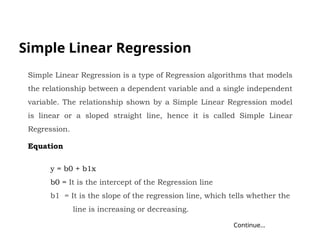
Simple Linear Regression is a type of Regression algorithms that models
the relationship between a dependent variable and a single independent
variable. The relationship shown by a Simple Linear Regression model
is linear or a sloped straight line, hence it is called Simple Linear
Regression.
Equation
y = b0 + b1x
b0 = It is the intercept of the Regression line
b1 = It is the slope of the regression line, which tells whether the
line is increasing or decreasing.
Multiple Linear Regression
Continue…
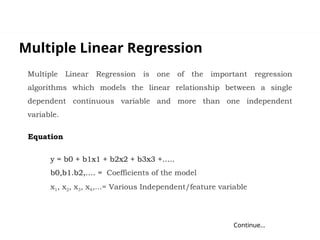
Multiple Linear Regression is one of the important regression
algorithms which models the linear relationship between a single
dependent continuous variable and more than one independent
variable.
Equation
y = b0 + b1x1 + b2x2 + b3x3 +…..
b0,b1.b2,…. = Coefficients of the model
x1, x2, x3, x4,...= Various Independent/feature variable
16
Clustering
• Clustering is a technique for finding similarity groups in data,
called clusters.
• it groups data instances that are similar to (near) each other
in one cluster and data instances that are very different (far
away) from each other into different clusters.
17
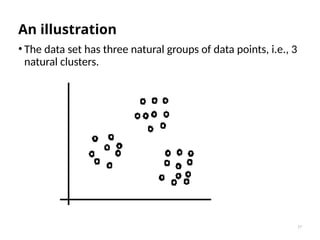
An illustration
• The data set has three natural groups of data points, i.e., 3
natural clusters.
What is clustering for?
• Let us see some real-life examples:
• Example 1: groups people of similar sizes together to make “small”,
“medium” and “large” T-Shirts.
• Tailor-made for each person: too expensive
• One-size-fits-all: does not fit all.
• Example 2: In marketing, segment customers according to their
similarities
• To do targeted marketing.
What is clustering for?
• Example 3: Given a collection of text documents, we want to organize
them according to their content similarities.
• In fact, clustering is one of the most utilized data mining techniques.
• It has a long history, and used in almost every field, e.g., medicine,
psychology, botany, sociology, biology, archeology, marketing,
insurance, libraries, etc.
• In recent years, due to the rapid increase of online documents, text
clustering becomes important.

Difference between Supervised and Unsupervised Machine Learning.pptx

  • 1.
    Machine learning Continue… Machine learningis a growing technology which enables computers to learn automatically from past data. Machine learning uses various algorithms for building mathematical models and making predictions using historical data or information.
  • 2.
    Types of MachineLearning Continue… ⮚ Supervised Machine Learning ⮚ Unsupervised Machine Learning
  • 3.
    What is SupervisedLearning? Continue… Supervised learning is the types of machine learning in which machines are trained using well "labelled" training data, and on basis of that data, machines predict the output. In supervised learning, the training data provided to the machines work as the supervisor that teaches the machines to predict the output correctly. It applies the same concept as a student learns in the supervision of the teacher.
  • 4.
    How Supervised LearningWorks? Continue…
  • 5.
    What is UnsupervisedLearning? Continue… Unsupervised learning is a type of machine learning in which models are trained using unlabeled dataset and are allowed to act on that data without any supervision. The goal of unsupervised learning is to find the underlying structure of dataset, group that data according to similarities, and represent that dataset in a compressed format.
  • 6.
    Working of UnsupervisedLearning Continue…
  • 7.
    Steps Involved inSupervised Learning Continue… ⮚ Determine the type of training dataset ⮚ Collect/Gather the labelled training data. ⮚ Split the training dataset into training dataset, test dataset, ⮚ Determine the suitable algorithm for the model ⮚ Execute the algorithm on the training dataset. ⮚ Evaluate the accuracy of the model by providing the test set.
  • 8.
    Types of SupervisedLearning Algorithms Continue… ⮚ Regression Analysis Regression analysis is a statistical method to model the relationship between a dependent (target) and independent (predictor) variables with one or more independent variables. ⮚ Classification Algorithm The Classification algorithm is a Supervised Learning technique that is used to identify the category of new observations on the basis of training data.
  • 9.
    Types Regression Analysis Continue… ⮚Linear Regression Linear relationship between dependent and independent variables ⮚ Polynomial Regression Non linear relationship between dependent and independent variables
  • 10.
  • 11.
    Linear Regression Continue… Linear regressionalgorithm shows a linear relationship between a dependent (y) and one or more independent (x) variables, hence called as linear regression. Since linear regression shows the linear relationship, which means it finds how the value of the dependent variable is changing according to the value of the independent variable
  • 12.
    Assumptions of LinearRegression Continue…
  • 13.
    Types of LinearRegression Analysis Continue… ▪ Simple Linear Regression ▪ Multiple Linear Regression
  • 14.
    Simple Linear Regression Continue… SimpleLinear Regression is a type of Regression algorithms that models the relationship between a dependent variable and a single independent variable. The relationship shown by a Simple Linear Regression model is linear or a sloped straight line, hence it is called Simple Linear Regression. Equation y = b0 + b1x b0 = It is the intercept of the Regression line b1 = It is the slope of the regression line, which tells whether the line is increasing or decreasing.
  • 15.
    Multiple Linear Regression Continue… MultipleLinear Regression is one of the important regression algorithms which models the linear relationship between a single dependent continuous variable and more than one independent variable. Equation y = b0 + b1x1 + b2x2 + b3x3 +….. b0,b1.b2,…. = Coefficients of the model x1, x2, x3, x4,...= Various Independent/feature variable
  • 16.
    16 Clustering • Clustering isa technique for finding similarity groups in data, called clusters. • it groups data instances that are similar to (near) each other in one cluster and data instances that are very different (far away) from each other into different clusters.
  • 17.
    17 An illustration • Thedata set has three natural groups of data points, i.e., 3 natural clusters.
  • 18.
    What is clusteringfor? • Let us see some real-life examples: • Example 1: groups people of similar sizes together to make “small”, “medium” and “large” T-Shirts. • Tailor-made for each person: too expensive • One-size-fits-all: does not fit all. • Example 2: In marketing, segment customers according to their similarities • To do targeted marketing.
  • 19.
    What is clusteringfor? • Example 3: Given a collection of text documents, we want to organize them according to their content similarities. • In fact, clustering is one of the most utilized data mining techniques. • It has a long history, and used in almost every field, e.g., medicine, psychology, botany, sociology, biology, archeology, marketing, insurance, libraries, etc. • In recent years, due to the rapid increase of online documents, text clustering becomes important.