Difference between RDBMS and DBMS
Database Management System (DBMS) is a software that is used to
define, create and maintain a database and provides controlled access to the
data.
Relational Database Management System (RDBMS) is an advanced
version of a DBMS.
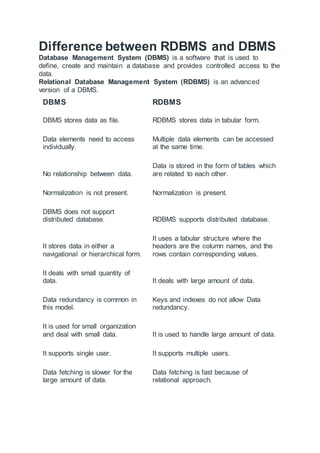
DBMS RDBMS
DBMS stores data as file. RDBMS stores data in tabular form.
Data elements need to access
individually.
Multiple data elements can be accessed
at the same time.
No relationship between data.
Data is stored in the form of tables which
are related to each other.
Normalization is not present. Normalization is present.
DBMS does not support
distributed database. RDBMS supports distributed database.
It stores data in either a
navigational or hierarchical form.
It uses a tabular structure where the
headers are the column names, and the
rows contain corresponding values.
It deals with small quantity of
data. It deals with large amount of data.
Data redundancy is common in
this model.
Keys and indexes do not allow Data
redundancy.
It is used for small organization
and deal with small data. It is used to handle large amount of data.
It supports single user. It supports multiple users.
Data fetching is slower for the
large amount of data.
Data fetching is fast because of
relational approach.
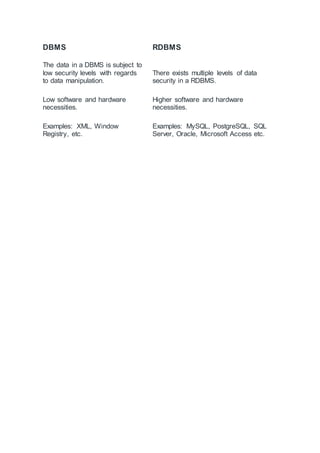
DBMS RDBMS
The data in a DBMS is subject to
low security levels with regards
to data manipulation.
There exists multiple levels of data
security in a RDBMS.
Low software and hardware
necessities.
Higher software and hardware
necessities.
Examples: XML, Window
Registry, etc.
Examples: MySQL, PostgreSQL, SQL
Server, Oracle, Microsoft Access etc.

Difference between RDBMS and DBMS.docx

  • 1.
    Difference between RDBMSand DBMS Database Management System (DBMS) is a software that is used to define, create and maintain a database and provides controlled access to the data. Relational Database Management System (RDBMS) is an advanced version of a DBMS. DBMS RDBMS DBMS stores data as file. RDBMS stores data in tabular form. Data elements need to access individually. Multiple data elements can be accessed at the same time. No relationship between data. Data is stored in the form of tables which are related to each other. Normalization is not present. Normalization is present. DBMS does not support distributed database. RDBMS supports distributed database. It stores data in either a navigational or hierarchical form. It uses a tabular structure where the headers are the column names, and the rows contain corresponding values. It deals with small quantity of data. It deals with large amount of data. Data redundancy is common in this model. Keys and indexes do not allow Data redundancy. It is used for small organization and deal with small data. It is used to handle large amount of data. It supports single user. It supports multiple users. Data fetching is slower for the large amount of data. Data fetching is fast because of relational approach.
  • 2.
    DBMS RDBMS The datain a DBMS is subject to low security levels with regards to data manipulation. There exists multiple levels of data security in a RDBMS. Low software and hardware necessities. Higher software and hardware necessities. Examples: XML, Window Registry, etc. Examples: MySQL, PostgreSQL, SQL Server, Oracle, Microsoft Access etc.